
AO
Republic of Angola
Angola
Summary
- Official Name
- Republic of Angola
- Population
- 33,937,000
- General Remarks
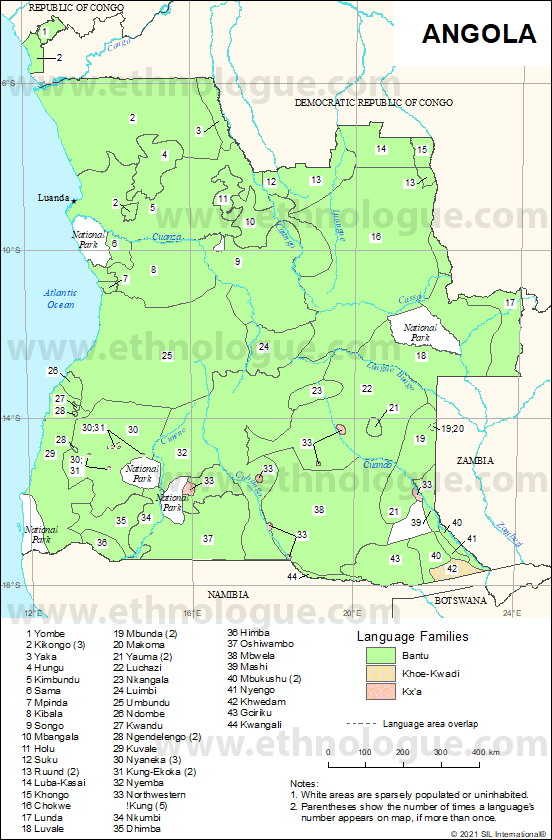
- Cabinda province is an enclave separated from Angola by the Kongo-Central province of the Democratic Republic of Congo, and the Congo Republic department of Pointe-Noire
- Principal Languages
- Portuguese
- Literacy Rate
- 71% (2015 World Factbook)
- International Conventions
- ACHPR (1987), CPPDCE (2006), ICCPR (1966), UNCRPD (2006), UNDRIP (2007)
- General References
- Bendor-Samuel and Hartell 1989, Fernandes and Ntondo 2002, Redinha 1970, Welmers 1971a
- Language Counts
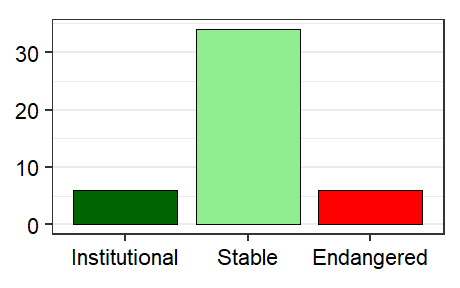
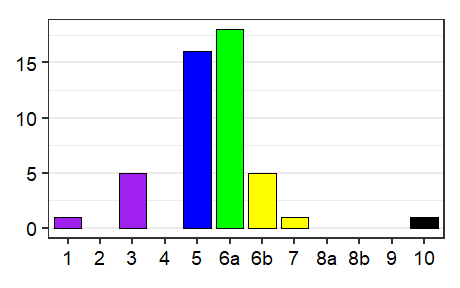
- The number of established languages listed for Angola is 46. Of these, 45 are living and 1 is extinct. Of the living languages, 40 are indigenous and 5 are non-indigenous. Furthermore, 6 are institutional, 16 are developing, 17 are vigorous, and 6 are in trouble. Also listed is 1 unestablished language.
Languages
- Chokwe cjk
- Widespread. East Bié, Cunene, central Kuando Kubango, Lunda Norte, Lunda Sul, Malanje, and west Moxico provinces. Users: 2,020,000 in Angola (2020). Total users in all countries: 2,541,700. Status: 3 (Wider communication). De facto language of national identity. In 20th century, began to spread in many different ethnic groups in southern Congo and northeastern Angola. Used in trade, fishing, craftsmanship, hunting, farming, and cattle raising. Alternate Names: Ciokwe, Djok, Kioko, Quioco, Shioko, Tchokwé, Tschiokloe, Tshokwe, Ucokwe Autonym: Cokwe Classification: Niger-Congo, Atlantic-Congo, Volta-Congo, Benue-Congo, Bantoid, Southern, Narrow Bantu, Central, K, Ciokwe-Luchazi (K.11)
- Dhimba dhm
- Coastal Benguela and Namibe provinces: as far as Equimina; Cunene and Huíla provinces: near Namibia border. Users: 18,000 in Angola (2011). Total users in all countries: 25,000. Status: 5 (Developing). Alternate Names: Chimba, Dimba, Oluthimba, Oluzimba, Otjidhimba, Ovazimba, Simba, Tjimba, Zemba Autonym: Oludhimba Classification: Niger-Congo, Atlantic-Congo, Volta-Congo, Benue-Congo, Bantoid, Southern, Narrow Bantu, Central, R, Herero (R.311)
- Gciriku diu
- Kuando Kubango province: Diriku municipality; southeast border with Namibia. Users: 24,000 in Angola. Status: 5* (Dispersed). Alternate Names: Dciriku, Dirico, Diriko, Diriku, Manyo, Mbogedo, Rugciriku, Rumanyo, Shimbogedu Classification: Niger-Congo, Atlantic-Congo, Volta-Congo, Benue-Congo, Bantoid, Southern, Narrow Bantu, Central, K, Luyana (K.332)
- Himba her
- Cunene province: Cahama and Curoca municipalities; Namibe province: Tombua municipality. Users: 20,000 in Angola (2018 L. Jordan). Status: 6a (Vigorous). Alternate Names: Herero, Otjihimba Classification: Niger-Congo, Atlantic-Congo, Volta-Congo, Benue-Congo, Bantoid, Southern, Narrow Bantu, Central, R, Herero (R.30)
- Holu hol
- Northwest Lunda Norte and northeast Malanje provinces: Kwango river area. Users: 23,100 in Angola (2000). Total users in all countries: 28,200. Status: 6a* (Vigorous). Alternate Names: Holo, Hongu, Kiholo, Kiholu Classification: Niger-Congo, Atlantic-Congo, Volta-Congo, Benue-Congo, Bantoid, Southern, Narrow Bantu, Central, L, Pende (L.12)
- Hungu hng
- Bengo province, east; Kuanza Sul province, north; Uíge province, south. Users: 500,000 (2018 L. Jordan). Ethnic population: 800,000 (2018 L. Jordan). Status: 6b (Threatened). Alternate Names: Bahungu, Dihungu, Kihungu Classification: Niger-Congo, Atlantic-Congo, Volta-Congo, Benue-Congo, Bantoid, Southern, Narrow Bantu, Central, H, Yaka (H.32)
- Kabuverdianu kea
- Users: 65,000 in Angola (2015 Instituto de Apoio ao Emigrante). Status: Unestablished. Classification: Creole, Portuguese based
- Khongo lwa
- Lunda Norte province: Cambulo municipality. Users: 20,000 in Angola (2018 L. Jordan). Status: 6a (Vigorous). Alternate Names: Lwalu Classification: Niger-Congo, Atlantic-Congo, Volta-Congo, Benue-Congo, Bantoid, Southern, Narrow Bantu, Central, L, Songe (L.221)
- Khwedam xuu
- Kuando Kubango province: Huthembo, northeast of Likuwa; Lukanga, west of Rivungu. Users: 200 in Angola (Brenzinger 2013b). Status: 7 (Shifting). Alternate Names: !Hukwe, Black Bushman, Cazama, Glanda-Khwe, Hukwe, Khwe, Kxoe, Kxoedam, Schekere, Vazama, Water Bushmen, Xu, Xuhwe, Xun, Zama, “Mbarakwena” (pej.), “Mbarakwengo” (pej.) Classification: Khoe-Kwadi, Khoe, Kalahari Khoe, Northwest
- Kibala blv
- Kuanza Sul province: Libolo municipality southeast of Luanda. Users: 950,000 (2016 L. Jordan). Ethnic population: 1,030,000 (2016 L. Jordan). Status: 6a (Vigorous). Alternate Names: Ipala, Kibala-Ngoya, Kimbundu de Kwanza Sul, Ngoya, Pala, Quibala Classification: Niger-Congo, Atlantic-Congo, Volta-Congo, Benue-Congo, Bantoid, Southern, Narrow Bantu, Central, H, Kimbundu (H.23)
- Kikongo kng
- Scattered. north Bengo and Malanje provinces; south Cabinda province; Kuanza Norte province: small border areas; Uíge and Zaire provinces: north, along Congo river. Cabinda (Kiyombe dialect); Angola proper (Kisikongo and San Salvador dialects). Users: 3,300,000 in Angola (2020). 2,550,000 Kikongo, 747,000 Fiote. Status: 3 (Wider communication). De facto language of national identity. Alternate Names: Congo, Kikoongo, Kongo, Koongo Classification: Niger-Congo, Atlantic-Congo, Volta-Congo, Benue-Congo, Bantoid, Southern, Narrow Bantu, Central, H, Kikongo (H.16)
- Kilari ldi
- Zaire province: northwest corner; possibly scattered communities. Status: 6a* (Vigorous). Alternate Names: Laadi, Laari, Ladi, Lari Classification: Niger-Congo, Atlantic-Congo, Volta-Congo, Benue-Congo, Bantoid, Southern, Narrow Bantu, Central, H, Kikongo (H.16)
- Kimbundu kmb
- Widespread northwest, mainly Bengo, Kuanza Norte, and Malanje provinces; adjacent areas in Kuanza Sul, Luanda, and Uíge provinces. Users: 1,700,000 in Angola (2015 L. Jordan). Ethnic population: 6,000,000 (2015 L. Jordan). Total users in all countries: 1,700,160. Status: 3 (Wider communication). Established 15th century. Spread in northwestern Angola under Portuguese colonialism (16th century) and Methodist missionary influence (1880s). Alternate Names: Kimbundo, Loanda Mbundu, Loande, Luanda, Lunda, Mbundu, N’bundo, Nbundu, North Mbundu Autonym: Kimbundu Classification: Niger-Congo, Atlantic-Congo, Volta-Congo, Benue-Congo, Bantoid, Southern, Narrow Bantu, Central, H, Kimbundu (H.21)
- Kung-Ekoka knw
- Cunene, Huíla, and Kuando Kubango provinces. Users: 5,500 in Angola (2016 L. Jordan). Status: 6b* (Threatened). Alternate Names: !Hu, !Khung, !Ku, !Kung, !Xu, !Xun, !Xung, Ekoko-!Xû, Qxû Classification: Kx’a, !Kung
- Kuvale olu
- Benguela and Namibe provinces: Atlantic coast to Huila province border east, from Dombe Grande north to Tombua south. Users: 70,000 (2015 L. Jordan). Status: 6a (Vigorous). Alternate Names: Mucubal Autonym: Kuvale, Olukuvale Classification: Niger-Congo, Atlantic-Congo, Volta-Congo, Benue-Congo, Bantoid, Southern, Narrow Bantu, Central, R, Umbundu (R.101)
- Kwadi kwz
- Namibe province: southwest corner, Coroca river area south of Namibe town. Users: No known L1 speakers. Last known speakers survived into the late 1970s (Winter 1981). Status: 10 (Extinct). Alternate Names: Bakoroka, Cuanhoca, Cuepe, Curoca, Koroka, Makoroko, Mucoroca Classification: Khoe-Kwadi, Kwadi
- Kwandu xdo
- Namibe province: Kumucuio municipality, on the Serra das Neves plateau, near Mamué. Users: 6,000 (2016 L. Jordan). Ethnic population: 6,000 (2016 L. Jordan). Status: 5 (Developing). Alternate Names: Kwando, Ovakwandu Autonym: Kwandu, Olukwandu Classification: Niger-Congo, Atlantic-Congo, Volta-Congo, Benue-Congo, Bantoid, Southern, Narrow Bantu, Central, R, Umbundu (R.13)
- Kwangali kwn
- Kuando Kubango province: Diriku and Kalai municipalities. Users: 22,000 in Angola (2017 K. Legère). Status: 5* (Dispersed). Alternate Names: Cuangar, Kwangare, Kwangari, Rukwangari, Rukwángali, Sikwangali, Vakwángali Classification: Niger-Congo, Atlantic-Congo, Volta-Congo, Benue-Congo, Bantoid, Southern, Narrow Bantu, Central, K, Luyana (K.33)
- Luba-Kasai lua
- Lunda Norte province: Cambulo, Chitato, Cuilo, and Lucapa municipalities. Users: 60,000 in Angola (2018 L. Jordan). Status: 6a (Vigorous). Classification: Niger-Congo, Atlantic-Congo, Volta-Congo, Benue-Congo, Bantoid, Southern, Narrow Bantu, Central, L, Luba (L.31)
- Luchazi lch
- Kuando Kubango province: Kuito Kuanavale to Mavinga; southwest Moxico province: Lucazi municipality; adjacent areas. Users: 400,000 in Angola (2011 S. Floor). Total users in all countries: 431,000. Status: 5 (Developing). Alternate Names: Lucazi, Lujash, Lujazi, Lutchaz, Lutshase, Luxage, Ponda, chi-Luchazi Autonym: Chiluchazi Classification: Niger-Congo, Atlantic-Congo, Volta-Congo, Benue-Congo, Bantoid, Southern, Narrow Bantu, Central, K, Ciokwe-Luchazi (K.13)
- Luimbi lum
- North Bié and south Malanje provinces: Kuanza river watershed area. Users: 43,900 (2000). Status: 6a* (Vigorous). Alternate Names: Chiluimbi, Luimbe, Lwimbe, Lwimbi Classification: Niger-Congo, Atlantic-Congo, Volta-Congo, Benue-Congo, Bantoid, Southern, Narrow Bantu, Central, K, Ciokwe-Luchazi (K.12)
- Lunda lun
- Lunda Norte province: Caungula municipality; Lunda Sul and Moxico provinces: contiguous border area with Democratic Republic of Congo (DRC) and Zambia. Users: 178,000 in Angola (Johnstone and Mandryk 2001). Status: 5* (Dispersed). Alternate Names: Ruund, chiLunda Classification: Niger-Congo, Atlantic-Congo, Volta-Congo, Benue-Congo, Bantoid, Southern, Narrow Bantu, Central, L, Lunda (L.52)
- Luvale lue
- Moxico and southeast provinces. Users: 311,000 in Angola (2020). Status: 5* (Dispersed). Alternate Names: Balovale, Chiluvale, Lovale, Lubale, Luena, Lwena Classification: Niger-Congo, Atlantic-Congo, Volta-Congo, Benue-Congo, Bantoid, Southern, Narrow Bantu, Central, K, Ciokwe-Luchazi (K.14)
- Makoma sie
- Moxico province: Bundas municipality; vicinity around Mussuma town east of Lumbala near the border of Zambia. Users: 3,000 in Angola (2018 L. Jordan). Status: 6a (Vigorous). Alternate Names: Simaa Classification: Niger-Congo, Atlantic-Congo, Volta-Congo, Benue-Congo, Bantoid, Southern, Narrow Bantu, Central, K, Luyana (K.35)
- Mashi mho
- Kuando Kubango and Moxico provinces: Kuando river west bank. Users: 2,630 in Angola (2000). Status: 5 (Developing). Alternate Names: Kamaxi, Masi Classification: Niger-Congo, Atlantic-Congo, Volta-Congo, Benue-Congo, Bantoid, Southern, Narrow Bantu, Central, K, Luyana (K.34)
- Mbangala mxg
- West Lunda Norte province; northeast Malanje province; Malanje province: Canhica area; northwest Lunda Sul and Uíge provinces: small areas east; Kahombo, Kela e Kambundi Katembu; community in Luanda. Users: 400,000 (2012). Status: 5* (Developing). Alternate Names: Bangala, Cimbangala, Umbangala Classification: Niger-Congo, Atlantic-Congo, Volta-Congo, Benue-Congo, Bantoid, Southern, Narrow Bantu, Central, H, Yaka (H.34)
- Mbukushu mhw
- Kuando Kubango province: Okavango river north bank. Users: 4,810 in Angola (2014 L. Jordan). Ethnic population: 7,210 (2014 L. Jordan). Status: 6b* (Threatened). Alternate Names: Cusso, Gova, Kuso, Mambukush, Mampukush, Mbukuhu, Mbukushi, Thimbukushu Classification: Niger-Congo, Atlantic-Congo, Volta-Congo, Benue-Congo, Bantoid, Southern, Narrow Bantu, Central, K, Luyana (K.333)
- Mbunda mck
- Moxico province. Users: 135,000 in Angola (Johnstone and Mandryk 2001). Total users in all countries: 218,000. Status: 5* (Developing). Alternate Names: Chimbunda, Ki-mbunda, Mbúùnda Autonym: Chimbúùnda Classification: Niger-Congo, Atlantic-Congo, Volta-Congo, Benue-Congo, Bantoid, Southern, Narrow Bantu, Central, K, Ciokwe-Luchazi (K.15)
- Mbwela mfu
- Kuando Kubango province: large central, southern area; Bié, Cunene, Huíla, and Moxico provinces. Users: 222,000 (Johnstone and Mandryk 2001). Status: 6a* (Vigorous). Alternate Names: Ambuela, Ambuella, Mbuela, Mbwera, Shimbwera Classification: Niger-Congo, Atlantic-Congo, Volta-Congo, Benue-Congo, Bantoid, Southern, Narrow Bantu, Central, K, Ciokwe-Luchazi (K.17)
- Mpinda pnd
- Kuanza Sul province: south of Porto Amboim town. Users: 18,000 (2018 L. Jordan). Ethnic population: 30,000 (2018 L. Jordan). Status: 6b (Threatened). Classification: Niger-Congo, Atlantic-Congo, Volta-Congo, Benue-Congo, Bantoid, Southern, Narrow Bantu, Central, H, Kimbundu (H.21)
- Ndombe ndq
- Benguela province: Ndombe area south and southeast of Benguela. Users: 22,300 (2000). Status: 6a* (Vigorous). Alternate Names: Dombe Classification: Niger-Congo, Atlantic-Congo, Volta-Congo, Benue-Congo, Bantoid, Southern, Narrow Bantu, Central, R, Umbundu (R.12)
- Ngendelengo nql
- Namibe Province: north of Kamucuio town, just south of Mamué; also south of Kamucuio municipality. Users: 900 (2016 L. Jordan). Ethnic population: 1,000 (2016 L. Jordan). Status: 6a (Vigorous). Alternate Names: Cuendelengo, Kwendelengo, N’Guendelengo, Olungendelengo, Ovangendelengo Classification: Niger-Congo, Atlantic-Congo, Volta-Congo, Benue-Congo, Bantoid, Southern, Narrow Bantu, Central, R, Umbundu (R.101)
- Nkangala nkn
- Kuando Kubango and Moxico provinces. Users: 22,300 (2000). Status: 6a* (Vigorous). Alternate Names: Cangala, Ngangala Classification: Niger-Congo, Atlantic-Congo, Volta-Congo, Benue-Congo, Bantoid, Southern, Narrow Bantu, Central, K, Ciokwe-Luchazi (K.18)
- Nkumbi khu
- Cunene and Huíla provinces: Cunene river west bank. Users: 654,000 (2020). Status: 5 (Developing). Alternate Names: Khumbi, Muhumbi, Ngumbi, Nkhumbi, Olungkhumbi, Otjingumbi Autonym: Ocinkumbi Classification: Niger-Congo, Atlantic-Congo, Volta-Congo, Benue-Congo, Bantoid, Southern, Narrow Bantu, Central, R, Umbundu (R.14)
- Northwestern !Kung vaj
- Cunene province: border area, surrounded by Oshiwambo [kua] language area, at least 8 communities; Huambo province; Kuando Kubango province: 3 enclaves, one between Mbwela [mfu] and Kwangali [kwn] language areas, another northeast on Kuando river. Users: 9,200 in Angola (2015 L. Jordan). Ethnic population: 10,000 (2015 L. Jordan). Total users in all countries: 15,070. Status: 6b (Threatened). Alternate Names: !’O!Xun, !O!kung, !O!ung, !Xun, Maligo, Northwestern !Xun, Sekela, Vasekela Bushman, Vasekele Classification: Kx’a, !Kung
- Nyaneka nyk
- Mainly Huíla and Namibe provinces; also Benguela and Cunene provinces. Users: 1,060,000 (2020). Status: 5 (Developing). Alternate Names: Lunyaneka, Nhaneca, Nhaneka Autonym: Olunyaneka Classification: Niger-Congo, Atlantic-Congo, Volta-Congo, Benue-Congo, Bantoid, Southern, Narrow Bantu, Central, R, Umbundu (R.13)
- Nyemba nba
- North Cunene, east Huíla, northwest Kuando Kubango provinces; some in Bié and Huambo provinces. Users: 965,000 in Angola (2020). Total users in all countries: 974,540. Status: 5* (Developing). Alternate Names: Gangela, Ganguela, Ganguella, Ngangela, Nhemba Classification: Niger-Congo, Atlantic-Congo, Volta-Congo, Benue-Congo, Bantoid, Southern, Narrow Bantu, Central, K, Ciokwe-Luchazi (K.12)
- Nyengo nye
- Kuando Kubango province. Users: 9,380 (2000). Status: 6a* (Vigorous). Alternate Names: Nhengo Classification: Niger-Congo, Atlantic-Congo, Volta-Congo, Benue-Congo, Bantoid, Southern, Narrow Bantu, Central, K, Ciokwe-Luchazi (K.16)
- Oshiwambo kua
- South central, Namibian border: Cunene and Kuando Kubango provinces. Users: 756,000 in Angola, all users. L1 users: 716,000 in Angola (2020). L2 users: 40,000 (2013 SIL). Total users in all countries: 1,364,000 (as L1: 1,324,000; as L2: 40,000). Status: 3 (Wider communication). De facto language of national identity. Original language of powerful Kwanyama kingdom of southern Angola and northern Namibia. Spread as language of conquest throughout colonial period until 1917. Currently used in eastern half of Kunene Province in church, market, business, and media domains. Alternate Names: Cuanhama, Humba, Kuanjama, Kuanyama, Kwancama, Kwanjama, Kwanyama, Ochikwanyama, Oshikuanjama, Osikuanjama, Ovambo, Oxikuanyama, Wambo Autonym: Oshikwanyama, Oshiwambo Classification: Niger-Congo, Atlantic-Congo, Volta-Congo, Benue-Congo, Bantoid, Southern, Narrow Bantu, Central, R, Wambo (R.21)
- Portuguese por
- Users: 18,700,000 in Angola, all users. L1 users: 12,500,000 in Angola (2020). Includes 60,000 foreign L1 users. In cities, Portuguese increasingly L1 of younger generation. 60% of Angolans use Portuguese, 40% as L1. High level of urbanization due to civil war led to increased use. L2 users: 6,200,000 (2020). Status: 1 (National). Statutory national language (2010, Constitution, Article 19(1)). Alternate Names: Português Classification: Indo-European, Italic, Romance, Italo-Western, Western, Gallo-Iberian, Ibero-Romance, West Iberian, Portuguese-Galician
- Ruund rnd
- Northeast, north central Lunda Norte province: Luchibe river area. Users: 98,500 in Angola (2000). Status: 5* (Developing). Alternate Names: Chilu Wunda, Luunda, Muatiamvua, Northern Lunda, Ruwund, Uruund Classification: Niger-Congo, Atlantic-Congo, Volta-Congo, Benue-Congo, Bantoid, Southern, Narrow Bantu, Central, L, Lunda (L.53)
- Songo nsx
- North central, southeast of Luanda, Malanje, Kuanza Sul, Bié, and Lunda Norte provinces. Users: 50,000 (1978 UBS). Status: 5* (Developing). Alternate Names: Nsongo, Sungu Classification: Niger-Congo, Atlantic-Congo, Volta-Congo, Benue-Congo, Bantoid, Southern, Narrow Bantu, Central, H, Kimbundu (H.24)
- Suku sub
- Lunda Norte province: Caungula and Cuango municipalities. Users: 30,000 in Angola (2018 L. Jordan). Status: 6a (Vigorous). Classification: Niger-Congo, Atlantic-Congo, Volta-Congo, Benue-Congo, Bantoid, Southern, Narrow Bantu, Central, H, Yaka (H.32)
- Umbundu umb
- Scattered in the west central area, mostly Huambo, Kuanza Sul, and Benguela provinces; also Bié, Huíla, Namibe, and Bengo provinces. Users: 7,160,000 (2020). Status: 3 (Wider communication). Trade language, particularly for slave and ivory trade, between Ovimbundu people and Portuguese settlers in 1700s. Beginning in 1874 used as church language with arrival of Catholic missionaries. Alternate Names: Kimbari, M’bundo, Mbali, Mbari, Mbundu, Mbundu Benguella, Nano, Olumbali, Ovimbundu, South Mbundu, Umbundo Autonym: Umbundu Classification: Niger-Congo, Atlantic-Congo, Volta-Congo, Benue-Congo, Bantoid, Southern, Narrow Bantu, Central, R, Umbundu (R.11)
- Yaka yaf
- North central corner, east of the Kwango river; Uíge province: Kimbele municipality; Malanje province northeast corner. Users: 200,000 in Angola (2000 SIL). Status: 6a* (Vigorous). Alternate Names: Iaca, Iaka, Iyaka, Kiyaka Classification: Niger-Congo, Atlantic-Congo, Volta-Congo, Benue-Congo, Bantoid, Southern, Narrow Bantu, Central, H, Yaka (H.31)
- Yauma yax
- Southeast, isolated enclave in Luchazi [lch] language area, Moxico province; Kuando Kubango Province, Kuando river area. Users: 17,100 in Angola (2000). Total users in all countries: 29,100. Status: 6a* (Vigorous). Classification: Niger-Congo, Atlantic-Congo, Volta-Congo, Benue-Congo, Bantoid, Southern, Narrow Bantu, Central, K, Ciokwe-Luchazi (K.16)
- Yombe yom
- Cabinda. Users: 39,400 in Angola (2000). Status: 5* (Developing). Alternate Names: Bayombe, Ibinda, Iombe, Kiombi, Kiyombe, Kiyoombi Classification: Niger-Congo, Atlantic-Congo, Volta-Congo, Benue-Congo, Bantoid, Southern, Narrow Bantu, Central, H, Kikongo (H.16)
Languages by Status
Portuguese
[por] 1 (National). Statutory national language (2010, Constitution, Article 19(1)). 18,700,000 in Angola, all users. L1 users: 12,500,000 in Angola (2020). Includes 60,000 foreign L1 users. In cities, Portuguese increasingly L1 of younger generation. 60% of Angolans use Portuguese, 40% as L1. High level of urbanization due to civil war led to increased use. L2 users: 6,200,000 (2020).
Chokwe
[cjk] 3 (Wider communication). De facto language of national identity. In 20th century, began to spread in many different ethnic groups in southern Congo and northeastern Angola. Used in trade, fishing, craftsmanship, hunting, farming, and cattle raising. 2,020,000 in Angola (2020). Total users in all countries: 2,541,700.
Kikongo
[kng] 3 (Wider communication). De facto language of national identity. 3,300,000 in Angola (2020). 2,550,000 Kikongo, 747,000 Fiote.
Kimbundu
[kmb] 3 (Wider communication). Established 15th century. Spread in northwestern Angola under Portuguese colonialism (16th century) and Methodist missionary influence (1880s). 1,700,000 in Angola (2015 L. Jordan). Ethnic population: 6,000,000 (2015 L. Jordan). Total users in all countries: 1,700,160.
Oshiwambo
[kua] 3 (Wider communication). De facto language of national identity. Original language of powerful Kwanyama kingdom of southern Angola and northern Namibia. Spread as language of conquest throughout colonial period until 1917. Currently used in eastern half of Kunene Province in church, market, business, and media domains. 756,000 in Angola, all users. L1 users: 716,000 in Angola (2020). L2 users: 40,000 (2013 SIL). Total users in all countries: 1,364,000 (as L1: 1,324,000; as L2: 40,000).
Umbundu
[umb] 3 (Wider communication). Trade language, particularly for slave and ivory trade, between Ovimbundu people and Portuguese settlers in 1700s. Beginning in 1874 used as church language with arrival of Catholic missionaries. 7,160,000 (2020).
Gciriku
[diu] 5* (Dispersed). 24,000 in Angola.
Kwangali
[kwn] 5* (Dispersed). 22,000 in Angola (2017 K. Legère).
Lunda
[lun] 5* (Dispersed). 178,000 in Angola (Johnstone and Mandryk 2001).
Luvale
[lue] 5* (Dispersed). 311,000 in Angola (2020).
Dhimba
[dhm] 5 (Developing). 18,000 in Angola (2011). Total users in all countries: 25,000.
Kwandu
[xdo] 5 (Developing). 6,000 (2016 L. Jordan). Ethnic population: 6,000 (2016 L. Jordan).
Luchazi
[lch] 5 (Developing). 400,000 in Angola (2011 S. Floor). Total users in all countries: 431,000.
Mashi
[mho] 5 (Developing). 2,630 in Angola (2000).
Mbangala
[mxg] 5* (Developing). 400,000 (2012).
Mbunda
[mck] 5* (Developing). 135,000 in Angola (Johnstone and Mandryk 2001). Total users in all countries: 218,000.
Nkumbi
[khu] 5 (Developing). 654,000 (2020).
Nyaneka
[nyk] 5 (Developing). 1,060,000 (2020).
Nyemba
[nba] 5* (Developing). 965,000 in Angola (2020). Total users in all countries: 974,540.
Ruund
[rnd] 5* (Developing). 98,500 in Angola (2000).
Songo
[nsx] 5* (Developing). 50,000 (1978 UBS).
Yombe
[yom] 5* (Developing). 39,400 in Angola (2000).
Himba
[her] 6a (Vigorous). 20,000 in Angola (2018 L. Jordan).
Holu
[hol] 6a* (Vigorous). 23,100 in Angola (2000). Total users in all countries: 28,200.
Khongo
[lwa] 6a (Vigorous). 20,000 in Angola (2018 L. Jordan).
Kibala
[blv] 6a (Vigorous). 950,000 (2016 L. Jordan). Ethnic population: 1,030,000 (2016 L. Jordan).
Kilari
[ldi] 6a* (Vigorous).
Kuvale
[olu] 6a (Vigorous). 70,000 (2015 L. Jordan).
Luba-Kasai
[lua] 6a (Vigorous). 60,000 in Angola (2018 L. Jordan).
Luimbi
[lum] 6a* (Vigorous). 43,900 (2000).
Makoma
[sie] 6a (Vigorous). 3,000 in Angola (2018 L. Jordan).
Mbwela
[mfu] 6a* (Vigorous). 222,000 (Johnstone and Mandryk 2001).
Ndombe
[ndq] 6a* (Vigorous). 22,300 (2000).
Ngendelengo
[nql] 6a (Vigorous). 900 (2016 L. Jordan). Ethnic population: 1,000 (2016 L. Jordan).
Nkangala
[nkn] 6a* (Vigorous). 22,300 (2000).
Nyengo
[nye] 6a* (Vigorous). 9,380 (2000).
Suku
[sub] 6a (Vigorous). 30,000 in Angola (2018 L. Jordan).
Yaka
[yaf] 6a* (Vigorous). 200,000 in Angola (2000 SIL).
Yauma
[yax] 6a* (Vigorous). 17,100 in Angola (2000). Total users in all countries: 29,100.
Hungu
[hng] 6b (Threatened). 500,000 (2018 L. Jordan). Ethnic population: 800,000 (2018 L. Jordan).
Kung-Ekoka
[knw] 6b* (Threatened). 5,500 in Angola (2016 L. Jordan).
Mbukushu
[mhw] 6b* (Threatened). 4,810 in Angola (2014 L. Jordan). Ethnic population: 7,210 (2014 L. Jordan).
Mpinda
[pnd] 6b (Threatened). 18,000 (2018 L. Jordan). Ethnic population: 30,000 (2018 L. Jordan).
Northwestern !Kung
[vaj] 6b (Threatened). 9,200 in Angola (2015 L. Jordan). Ethnic population: 10,000 (2015 L. Jordan). Total users in all countries: 15,070.
Khwedam
[xuu] 7 (Shifting). 200 in Angola (Brenzinger 2013b).
Kwadi
[kwz] 10 (Extinct). No known L1 speakers. Last known speakers survived into the late 1970s (Winter 1981).
Kabuverdianu
[kea] Unestablished. 65,000 in Angola (2015 Instituto de Apoio ao Emigrante).
Maps
Angola
Graphs
Language Vitality Profile
Full explanation
Language Status Profile
Full explanation
Resources
View Terms
Each Ethnologue country digest is a licensed product with restricted terms of use. Before downloading the product, you must agree to the following terms:
- This is a license for individual use. Just as with a conventionally published book, it is a violation of copyright to make a copy and give it to others.
- You may not redistribute this work in any form, including ingesting the contents into a database that is shared with others or posting it on a web site (whether public or private).
To inquire about permission for reuse or redistribution, please use the Contact Us form in the footer.
Digest of the languages of Angola ($199.95, 42 page PDF)