
BD
People’s Republic of Bangladesh
Bangladesh
Summary
- Official Name
- People’s Republic of Bangladesh
- Population
- 166,303,000
- Principal Languages
- Bengali
- Literacy Rate
- 74% (2018 World Factbook)
- International Conventions
- CPPDCE (2006), CSICH (2012), ICCPR (1966), UNCRPD (2006)
- General References
- Campbell and King 2011, Comrie 1987, Hale 1982, Matisoff et al 1996, Voegelin and Voegelin 1977
- Deaf Population
- 7,596,500
- Language Counts
- The number of established languages listed for Bangladesh is 42. All are living languages. Of these, 36 are indigenous and 6 are non-indigenous. Furthermore, 6 are institutional, 11 are developing, 13 are vigorous, and 12 are in trouble. Also listed are 2 unestablished languages.
Languages
- Atong aot
- Dhaka division: north Netrokona district. Users: 5,400 in Bangladesh. Status: 6b (Threatened). Alternate Names: A’tong, Attong Classification: Sino-Tibetan, Tibeto-Burman, Sal, Boro-Garo, Koch
- Bangla Sign Language ins
- Scattered. Users: 815,000 in Bangladesh (2021 DBS/DOOR/SIL). Estimated 500,000–1,000,000, assuming 0.3%–0.6% of the total population. Another estimate: 2,600,000 (2014 Disabled Peoples’ International Pacific-Asia Region). Status: 6a* (Vigorous). Alternate Names: Bangla Ishara Vasha, Bangladesh Sign Language, Bangladeshi Sign Language, Bengali Sign Language, Indian Sign Language Classification: Sign language, Deaf community sign language
- Bengali ben
- Widespread. Users: 159,000,000 in Bangladesh, all users. L1 users: 130,000,000 in Bangladesh (2017). L2 users: 29,000,000 (2017). Total users in all countries: 272,677,150 (as L1: 233,674,270; as L2: 39,002,880). Status: 1 (National). Statutory national language (1972, Constitution, Article 3), has been reinforced by the Bengali Language Introduction Act of 1987 to fully enact Article 3 of the Constitution, making the use of Bengali compulsory at all levels of state activities except in foreign affairs. Alternate Names: Bangala, Bangla-Bhasa Autonym: বাংলা (Bangla) Classification: Indo-European, Indo-Iranian, Indo-Aryan, Outer Languages, Eastern, Bengali-Assamese
- Bihari urd
- Chittagong, Dhaka, Khulna, and Rangpur divisions; mainly refugee camps in 13 districts. Users: 250,000 in Bangladesh (2009 UNHR). Status: 5 (Dispersed). Alternate Names: Urdu Classification: Indo-European, Indo-Iranian, Indo-Aryan, Western Hindi, Hindustani
- Bishnupuriya bpy
- Sylhet division: south Habiganj district, Sylhet city, 1 village; Moulvibazar district; Sunamganj district, 2 villages. Users: 40,000 in Bangladesh (2003). 400 monolinguals. Status: 6a (Vigorous). Alternate Names: Bishnupria, Bishnupriya, Bishnupriya Manipuri, Bisna Puriya Classification: Indo-European, Indo-Iranian, Indo-Aryan, Outer Languages, Eastern, Bengali-Assamese
- Chak ckh
- Chittagong division: Baishari, Bandarban, Bishar Chokpra; south Naikhongchari area in Arakan Blue mountains. 14 villages. Users: 3,000 in Bangladesh (Bradley 2007b). Total users in all countries: 4,000. Status: 6a (Vigorous). Alternate Names: Sak, Tsak, atsaʔ Classification: Sino-Tibetan, Tibeto-Burman, Sal, Jingppaw-Asakia, Asakian
- Chakma ccp
- Chittagong division: Chittagong city, Chittagong Hills area; Khagrachari and Rangamati districts. Users: 150,000 in Bangladesh (2007 SIL). Total users in all countries: 378,000. Status: 4 (Educational). Alternate Names: Changma Kodha, Sakma, Sangma, Takam Autonym: Changma Vaj Classification: Indo-European, Indo-Iranian, Indo-Aryan, Outer Languages, Eastern, Bengali-Assamese
- Chin, Asho csh
- Chittagong division: Bandarban, Chittagong, and Rangamati districts. plains area (Laitu); hill area (Kongtu). Users: 4,000 in Bangladesh (2011). Status: 6a (Vigorous). Alternate Names: Khyang, Khyeng, Qin, Sho, Shoa Classification: Sino-Tibetan, Tibeto-Burman, Kuki-Chin, Peripheral, Southern, Cho-Asho, Asho
- Chin, Bawm bgr
- Chittagong division: Bandarbar and south Rangamati districts, near Myanmar border. Users: 10,000 in Bangladesh (2011). Status: 5 (Developing). Alternate Names: Bawm, Bawm hawlh, Bawn, Bawng, Bom Classification: Sino-Tibetan, Tibeto-Burman, Kuki-Chin, Central, Lai
- Chin, Khumi cnk
- Chittagong division: Bandarban district, Rowanchari, Ruma, and Thanchi subdistricts. Users: 4,000 in Bangladesh (2018). Status: 6a (Vigorous). Alternate Names: Khami, Khumi, Khumi Chin, Khuni, “Khweymi” (pej.) Classification: Sino-Tibetan, Tibeto-Burman, Kuki-Chin, Peripheral, Southern
- Chittagonian ctg
- Chittagong division: widespread. Users: 13,000,000 (2006 SIL). Status: 3 (Wider communication). Used as a trade language under the Portuguese colonial administration in 1528. Widespread during the British period (1700–1947) with other speech communities migrating to Chittagong district and surrounding areas. Main domain is everyday communication. Alternate Names: Chatgaiyan Buli, Chatgaya, Chittagonian Bengali Autonym: চাঁটগাঁইয়া বুলি (Caṭgãia Buli) Classification: Indo-European, Indo-Iranian, Indo-Aryan, Outer Languages, Eastern, Bengali-Assamese
- English eng
- Users: 29,300,000 in Bangladesh (2020 Euromonitor International), L2 users. Status: 5* (Dispersed). Classification: Indo-European, Germanic, West, English
- Garo grt
- Dhaka division: Dhaka, Jamalpur, Madhupur, Netrokona, Sherpur districts; enclaves north, southwest and northwest of Mymensingh city; Sylhet division: Sylhet and Sunamganj districts. Users: 120,000 in Bangladesh (2005). Status: 5 (Dispersed). Used as LWC among all Mandi. Alternate Names: Garrow, Mande, Mandi Classification: Sino-Tibetan, Tibeto-Burman, Sal, Boro-Garo
- Hajong haj
- Mymensingh division: Rangpur district east to Sunamganj district; Sylhet division. Users: 8,000 in Bangladesh. Status: 5 (Developing). Alternate Names: Hajang Classification: Indo-European, Indo-Iranian, Indo-Aryan, Outer Languages, Eastern, Bengali-Assamese
- Khasi kha
- Sylhet division: Brahman Bazar enclave south of Sylhet town, Jaintiapur north border enclave; Barlekha area southwest to Kamalpur. Users: Very few speakers. Status: 6b* (Threatened). Alternate Names: Cossyah, Kahasi, Khasie, Khasiyas, Khassee, Khuchia, Kyi Classification: Austro-Asiatic, Mon-Khmer, Northern Mon-Khmer, Khasian
- Koch kdq
- Dhaka division: north Sherpur district. Users: 6,000 in Bangladesh (2006 SIL). Status: 6a (Vigorous). Alternate Names: Koc, Kocch, Koce, Kochboli, Konch Classification: Sino-Tibetan, Tibeto-Burman, Sal, Boro-Garo, Koch
- Koda cdz
- Rajshahi division: Puthia, Mohonpur and Mundumala districts. Users: 1,300 in Bangladesh (2005). Status: 6a (Vigorous). Classification: Austro-Asiatic, Munda, North Munda, Kherwari, Mundari
- Kok Borok trp
- Chittagong division: Chandpur and Comilla areas east of Ganges delta; Sylhet divsion: 2 border areas southeast of Habiganj. Users: 5,000 in Bangladesh. Status: 6a (Vigorous). Alternate Names: Debbarma, Tipura, Tripura, Tripuri Classification: Sino-Tibetan, Tibeto-Burman, Sal, Boro-Garo, Dimasa-Kokborok, Kok Borok
- Kol ekl
- Rajshahi district: Godagari subdistrict. Users: 1,660 (2012 SIL). Status: 6a (Vigorous). Alternate Names: Hor Classification: Austro-Asiatic, Munda, North Munda, Kherwari, Mundari
- Kurux kru
- Rangpur division: Dinajpur, Panchagarn, Rangpur, Saidpur and Thakurgaon districts’ areas. Users: 50,000 in Bangladesh (2011), decreasing. Ethnic population: 50,000 (2011). Status: 6b (Threatened). Alternate Names: Kurukh, Oraoan, Uraon Classification: Dravidian, Northern
- Lyngngam lyg
- Dhaka division: Netrokona district. Users: 1,000 in Bangladesh. Status: 7 (Shifting). Alternate Names: Megam Classification: Austro-Asiatic, Mon-Khmer, Northern Mon-Khmer, Khasian
- Mahali mjx
- Rajshahi division: Abirpara, Matindor, and Mundumala-Pachondor villages; scattered. Users: 3,000 in Bangladesh (2010 SIL). Ethnic population: 3,000 (2004 SIL). Status: 6a (Vigorous). Alternate Names: Mahle Classification: Austro-Asiatic, Munda, North Munda, Kherwari, Santali
- Marma rmz
- Chittagong division: Bandarban, Khagrachari, and Rangamati districts. Users: 150,000 in Bangladesh (2007). Total users in all countries: 186,700. Status: 3 (Wider communication). Originating in Pegu of Burma (Myanmar), the Marma people migrated to Chittagong Hill Tracts in Bangladesh from the 14th–17th centuries. Marma became widespread during the European colonization (1757–1857). Used in ethno-medicinal practices, daily communication, trade, and religious ceremonies. Alternate Names: Arkanese-Marma, Mraima, “Mogh” (pej.) Autonym: မရမာ (Mraima) Classification: Sino-Tibetan, Tibeto-Burman, Ngwi-Burmese, Burmish, Southern
- Megam mef
- Dhaka division: Netrokona district, Kalmakanda subdistrict. Users: 6,870 (2000). Status: 6a (Vigorous). Alternate Names: Migam, Negam Classification: Sino-Tibetan, Tibeto-Burman, Sal, Boro-Garo
- Meitei mni
- Sylhet division: Moulvi Bazar district, Kamalganj subdistrict; Sylhet city. Users: 15,000 in Bangladesh (2003). 300 monolinguals. Status: 5 (Dispersed). Alternate Names: Manipuri, Meetei, Meitei Manipuri, Meithei Classification: Sino-Tibetan, Tibeto-Burman, Sal, Kuki-Chin-Naga
- Mizo lus
- Chittagong division: Rangamati, Sajek. Users: 250 in Bangladesh (2007 census). Status: 6b (Threatened). Alternate Names: Hualngo, Lei, Lusai, Lushai, Lushei, Sailau, Whelngo Classification: Sino-Tibetan, Tibeto-Burman, Kuki-Chin, Central, Mizo
- Mru mro
- Chittagong division: Bandarban district. Users: 30,000 in Bangladesh (2007). Total users in all countries: 50,200. Status: 5 (Developing). Alternate Names: Maru, Mro, Mrung, Murung Autonym: Mru Classification: Sino-Tibetan, Tibeto-Burman, Ngwi-Burmese, Mru
- Mundari unr
- Rajshahi division: Naogaon district; Rangpur division: Dinajpur district; Sylhet division: possibly some tea estates. Users: 2,500 in Bangladesh (2005 Caritas Bangladesh). Ethnic population: 5,000. Status: 6b (Threatened). Alternate Names: Colh, Horo, Mandari, Mondari, Munari, Munda Classification: Austro-Asiatic, Munda, North Munda, Kherwari, Mundari
- Odia ory
- Users: 32,500 in Bangladesh (2000). Status: Unestablished. Classification: Indo-European, Indo-Iranian, Indo-Aryan, Outer Languages, Eastern, Oriya
- Pangkhua pkh
- Chittagong division: Rangamati district. Users: 2,400 in Bangladesh (2015 Z. Akter). Ethnic population: 4,000 (2021 Joshua Project). Status: 6b (Threatened). Alternate Names: Pangkhu, Pankho, Pankhu, Panko Classification: Sino-Tibetan, Tibeto-Burman, Kuki-Chin, Central
- Pnar pbv
- Sylhet division: Sylhet district, Jaflong area, Jaintiapur, north of Raipur, and Tamabil; Moulvi Bazar district, Alinagar, Barlekha, Fenchuganj area, Fultala, Goalbari, Islampur, Kamalganj, Khajori, Madhabkunda, Rashidpur, and Satgoan. Users: 4,000 in Bangladesh (2002). Status: 6b* (Threatened). Classification: Austro-Asiatic, Mon-Khmer, Northern Mon-Khmer, Khasian
- Punjabi, Eastern pan
- Users: 23,700 in Bangladesh (2000). Status: Unestablished. Classification: Indo-European, Indo-Iranian, Indo-Aryan, Intermediate Divisions, Western, Panjabi
- Rakhine rki
- Barisal division: Patuakhali district; Chittagong division: Cox’s Bazar, Maheshkhali island and south. Users: 200,000 in Bangladesh (2011 SIL). Status: 5 (Dispersed). Alternate Names: Rakhain, Rakkhaine, “Mogh” (pej.) Classification: Sino-Tibetan, Tibeto-Burman, Ngwi-Burmese, Burmish, Southern
- Rangpuri rkt
- Rajshahi division: Joypurhat area; Rangpur division: Dinajpur, Gaibanda, Lalmonihat, Nilphamari, Panchagar, Rangpur, and Thakurgaon districts. Users: 10,325,000 in Bangladesh, all users. L1 users: 10,000,000 in Bangladesh (2007 SIL). L2 users: 325,000 (2015 SIL). Total users in all countries: 10,801,000 (as L1: 10,476,000; as L2: 325,000). Status: 5 (Developing). Used in the market and for commerce, media, and travel by nearly all minority language speakers in the greater Rangpur-Dinajpur area. Rangpuri has reportedly been spoken in the area for centuries. Alternate Names: Anchalit Bangla, Bahe, Bahe Bangla, Deshi Bhasa, Dhekia, Dhekri, Polia Autonym: রংপুরী (Rangpuri) Classification: Indo-European, Indo-Iranian, Indo-Aryan, Outer Languages, Eastern, Bengali-Assamese
- Riang ria
- Chittagong division: Rangamati district. Users: 500 in Bangladesh (2007). Status: 7 (Shifting). Alternate Names: Kau Bru, Reang Classification: Sino-Tibetan, Tibeto-Burman, Sal, Boro-Garo, Dimasa-Kokborok, Kok Borok
- Rohingya rhg
- Chittagong division: Cox’s Bazaar district. Users: 947,000 in Bangladesh (2017 The Arakan Project). Status: 6b* (Threatened). Alternate Names: Rohinga, Ruwainggya Classification: Indo-European, Indo-Iranian, Indo-Aryan, Outer Languages, Eastern, Bengali-Assamese
- Sadri, Oraon sdr
- Khulna division: Jhenaidah, Kushtia, and Magura districts; Rajshahi division: widespread; Rangpur division: Hilli area; Sylhet division: possibly Habiganj and Moulvibazar districts. Users: 166,000 (2000). Status: 6b (Threatened). Alternate Names: Pahan Classification: Indo-European, Indo-Iranian, Indo-Aryan, Outer Languages, Eastern, Bihari
- Santhali sat
- Rajshahi and Rangpur divisions: widespread. Users: 225,000 in Bangladesh (2011). Status: 5 (Dispersed). Alternate Names: Har, Har Rar, Hor, Sandal, Sangtal, Santal, Santali, Satar, Sonthal Classification: Austro-Asiatic, Munda, North Munda, Kherwari, Santali
- Sauria Paharia mjt
- Rajshahi division: northwest of city, also near Singra; Rangpur division: south of Rangpur city. Users: 7,000 in Bangladesh (2007). Status: 7 (Shifting). Alternate Names: Malto, Paharia Classification: Dravidian, Northern
- Sylheti syl
- Sylhet division: Habiganj, Moulvibazar, Sunamganj, and Sylhet districts. Users: 8,020,000 in Bangladesh, all users. L1 users: 6,520,000 in Bangladesh (2017). L2 users: 1,500,000. Total users in all countries: 11,520,000 (as L1: 10,020,000; as L2: 1,500,000). Status: 3 (Wider communication). Became widespread in the 16th century alongside Standard Bengali [ben]. Used in literature, religious poetry, home life, and online written communication. Alternate Names: Siloti, Srihattia, Sylhetti, Sylhetti Bangla, Syloti, Syloty Autonym: Sileti, ছিলটী (Silôṭi) Classification: Indo-European, Indo-Iranian, Indo-Aryan, Outer Languages, Eastern, Bengali-Assamese
- Tangchangya tnv
- Chittagong hills. Users: 21,600 (1991 census). Status: 6a (Vigorous). Alternate Names: Tanchangya Classification: Indo-European, Indo-Iranian, Indo-Aryan, Outer Languages, Eastern, Bengali-Assamese
- Tippera tpe
- Chittagong division: Chittagong district, Fatikchari subdistrict; Khagrachari district. Users: 85,000. Status: 4 (Educational). Alternate Names: Kok Borok, Tipperah, Tippurah, Tipra, Tipura, Triperah, Tripura Classification: Sino-Tibetan, Tibeto-Burman, Sal, Boro-Garo
- Usoi usi
- Chittagong division: Bandarban district. Users: 22,400. Status: 5 (Developing). Alternate Names: Kau Brung, Unshoi, Unsuiy, Ushoi, Usui Autonym: Kaobrung Classification: Sino-Tibetan, Tibeto-Burman, Sal, Boro-Garo, Dimasa-Kokborok, Kok Borok
- War-Jaintia aml
- Sylhet division: Moulvi Bazar district, Alinagar, Barlekha, Fenchuganj area, Fultala, Goalbari, Islampur, Kamalganj, Khajori, Madhabkunda, Rashidpur, and Satgoan; Sylhet district, Jaflong area, Jaintiapur, north of Raipur, and Tamabil. Users: 16,000 in Bangladesh (2003 SIL). 4,000 monolinguals. Total users in all countries: 67,600. Status: 6a (Vigorous). Alternate Names: War-Khasi Classification: Austro-Asiatic, Mon-Khmer, Northern Mon-Khmer, Khasian
Languages by Status
Bengali
[ben] 1 (National). Statutory national language (1972, Constitution, Article 3), has been reinforced by the Bengali Language Introduction Act of 1987 to fully enact Article 3 of the Constitution, making the use of Bengali compulsory at all levels of state activities except in foreign affairs. 159,000,000 in Bangladesh, all users. L1 users: 130,000,000 in Bangladesh (2017). L2 users: 29,000,000 (2017). Total users in all countries: 272,677,150 (as L1: 233,674,270; as L2: 39,002,880).
Chittagonian
[ctg] 3 (Wider communication). Used as a trade language under the Portuguese colonial administration in 1528. Widespread during the British period (1700–1947) with other speech communities migrating to Chittagong district and surrounding areas. Main domain is everyday communication. 13,000,000 (2006 SIL).
Marma
[rmz] 3 (Wider communication). Originating in Pegu of Burma (Myanmar), the Marma people migrated to Chittagong Hill Tracts in Bangladesh from the 14th–17th centuries. Marma became widespread during the European colonization (1757–1857). Used in ethno-medicinal practices, daily communication, trade, and religious ceremonies. 150,000 in Bangladesh (2007). Total users in all countries: 186,700.
Sylheti
[syl] 3 (Wider communication). Became widespread in the 16th century alongside Standard Bengali [ben]. Used in literature, religious poetry, home life, and online written communication. 8,020,000 in Bangladesh, all users. L1 users: 6,520,000 in Bangladesh (2017). L2 users: 1,500,000. Total users in all countries: 11,520,000 (as L1: 10,020,000; as L2: 1,500,000).
Chakma
[ccp] 4 (Educational). 150,000 in Bangladesh (2007 SIL). Total users in all countries: 378,000.
Tippera
[tpe] 4 (Educational). 85,000.
Bihari
[urd] 5 (Dispersed). 250,000 in Bangladesh (2009 UNHR).
English
[eng] 5* (Dispersed). 29,300,000 in Bangladesh (2020 Euromonitor International), L2 users.
Garo
[grt] 5 (Dispersed). Used as LWC among all Mandi. 120,000 in Bangladesh (2005).
Meitei
[mni] 5 (Dispersed). 15,000 in Bangladesh (2003). 300 monolinguals.
Rakhine
[rki] 5 (Dispersed). 200,000 in Bangladesh (2011 SIL).
Santhali
[sat] 5 (Dispersed). 225,000 in Bangladesh (2011).
Chin, Bawm
[bgr] 5 (Developing). 10,000 in Bangladesh (2011).
Hajong
[haj] 5 (Developing). 8,000 in Bangladesh.
Mru
[mro] 5 (Developing). 30,000 in Bangladesh (2007). Total users in all countries: 50,200.
Rangpuri
[rkt] 5 (Developing). Used in the market and for commerce, media, and travel by nearly all minority language speakers in the greater Rangpur-Dinajpur area. Rangpuri has reportedly been spoken in the area for centuries. 10,325,000 in Bangladesh, all users. L1 users: 10,000,000 in Bangladesh (2007 SIL). L2 users: 325,000 (2015 SIL). Total users in all countries: 10,801,000 (as L1: 10,476,000; as L2: 325,000).
Usoi
[usi] 5 (Developing). 22,400.
Bangla Sign Language
[ins] 6a* (Vigorous). 815,000 in Bangladesh (2021 DBS/DOOR/SIL). Estimated 500,000–1,000,000, assuming 0.3%–0.6% of the total population. Another estimate: 2,600,000 (2014 Disabled Peoples’ International Pacific-Asia Region).
Bishnupuriya
[bpy] 6a (Vigorous). 40,000 in Bangladesh (2003). 400 monolinguals.
Chak
[ckh] 6a (Vigorous). 3,000 in Bangladesh (Bradley 2007b). Total users in all countries: 4,000.
Chin, Asho
[csh] 6a (Vigorous). 4,000 in Bangladesh (2011).
Chin, Khumi
[cnk] 6a (Vigorous). 4,000 in Bangladesh (2018).
Koch
[kdq] 6a (Vigorous). 6,000 in Bangladesh (2006 SIL).
Koda
[cdz] 6a (Vigorous). 1,300 in Bangladesh (2005).
Kok Borok
[trp] 6a (Vigorous). 5,000 in Bangladesh.
Kol
[ekl] 6a (Vigorous). 1,660 (2012 SIL).
Mahali
[mjx] 6a (Vigorous). 3,000 in Bangladesh (2010 SIL). Ethnic population: 3,000 (2004 SIL).
Megam
[mef] 6a (Vigorous). 6,870 (2000).
Tangchangya
[tnv] 6a (Vigorous). 21,600 (1991 census).
War-Jaintia
[aml] 6a (Vigorous). 16,000 in Bangladesh (2003 SIL). 4,000 monolinguals. Total users in all countries: 67,600.
Atong
[aot] 6b (Threatened). 5,400 in Bangladesh.
Khasi
[kha] 6b* (Threatened). Very few speakers.
Kurux
[kru] 6b (Threatened). 50,000 in Bangladesh (2011), decreasing. Ethnic population: 50,000 (2011).
Mizo
[lus] 6b (Threatened). 250 in Bangladesh (2007 census).
Mundari
[unr] 6b (Threatened). 2,500 in Bangladesh (2005 Caritas Bangladesh). Ethnic population: 5,000.
Pangkhua
[pkh] 6b (Threatened). 2,400 in Bangladesh (2015 Z. Akter). Ethnic population: 4,000 (2021 Joshua Project).
Pnar
[pbv] 6b* (Threatened). 4,000 in Bangladesh (2002).
Rohingya
[rhg] 6b* (Threatened). 947,000 in Bangladesh (2017 The Arakan Project).
Sadri, Oraon
[sdr] 6b (Threatened). 166,000 (2000).
Maps
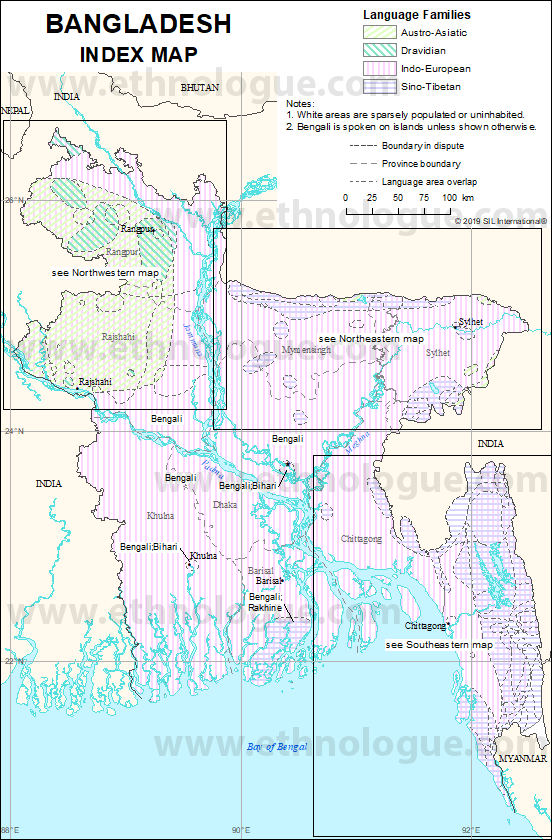
Bangladesh: Index map
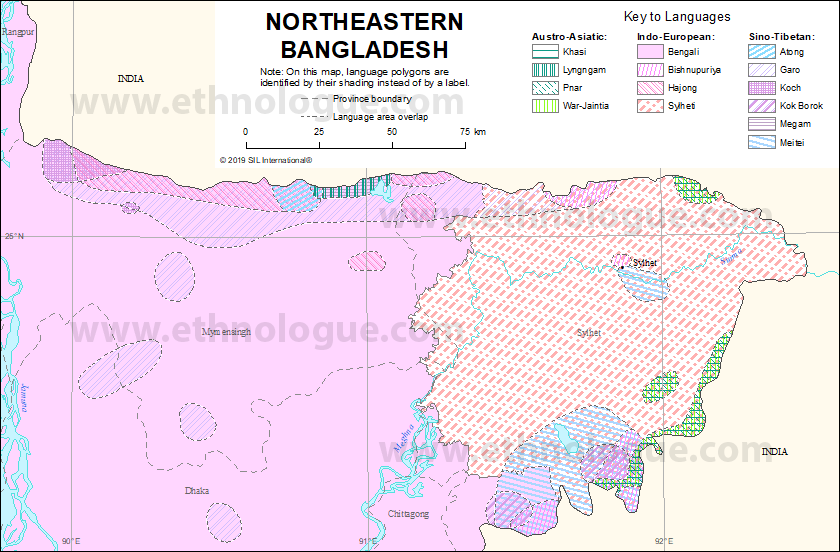
Northeastern Bangladesh
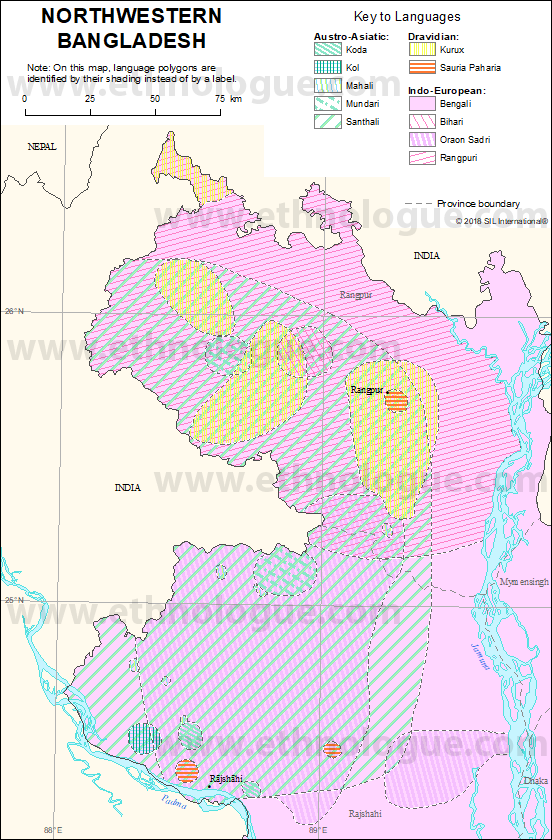
Northwestern Bangladesh
Southeastern Bangladesh
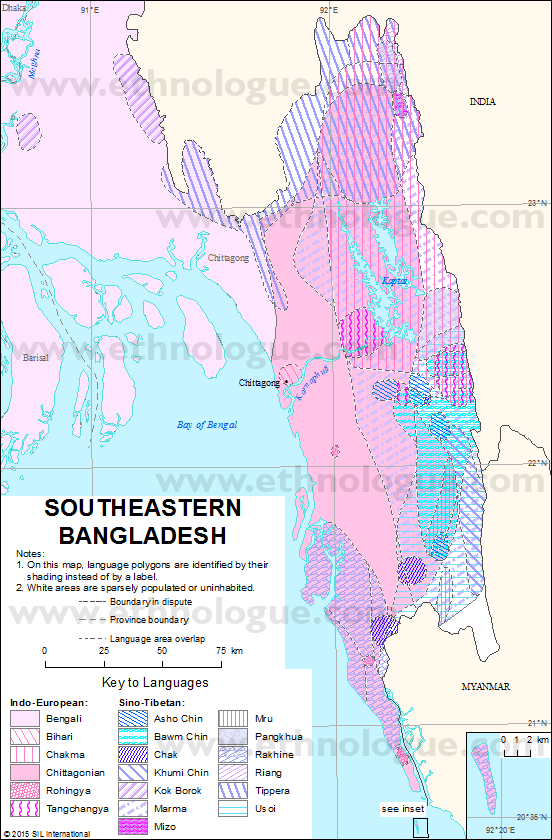
Graphs
Language Vitality Profile
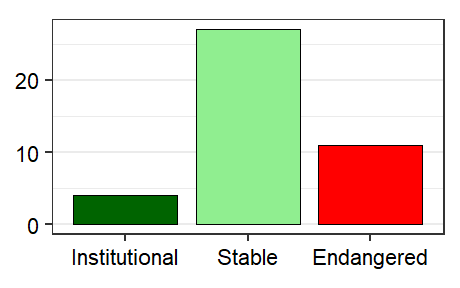
Full explanation
Language Status Profile
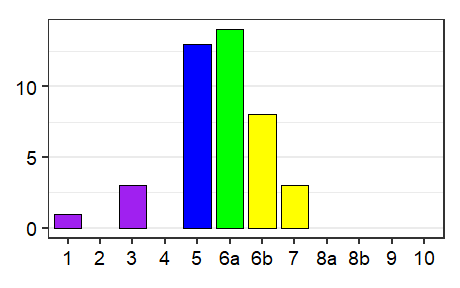
Full explanation
Resources
View Terms
Each Ethnologue country digest is a licensed product with restricted terms of use. Before downloading the product, you must agree to the following terms:
- This is a license for individual use. Just as with a conventionally published book, it is a violation of copyright to make a copy and give it to others.
- You may not redistribute this work in any form, including ingesting the contents into a database that is shared with others or posting it on a web site (whether public or private).
To inquire about permission for reuse or redistribution, please use the Contact Us form in the footer.