
BO
Plurinational State of Bolivia
Bolivia
Summary
- Official Name
- Plurinational State of Bolivia
- Population
- 11,797,000
- General Remarks
- Under the 2009 constitution, governmental bodies must select as co-official, alongside Spanish, at least one of 36 listed indigenous languages, the choice dependent on a number of stated factors, including use, circumstances, local preferences, etc. Predominant choices would be Quechua and Aymara. The border between Cochabamba and El Beni is still not defined
- Principal Languages
- Spanish
- Literacy Rate
- 93% (2015 UNESCO)
- International Conventions
- CDE (1960), CPPDCE (2006), CSICH (2012), ICCPR (1966), (), UNCRPD (2006), UNDRIP (2007)
- General References
- Campbell 1997, Campbell and King 2011, Crevels 2007
- Deaf Population
- 22,600
- Language Counts
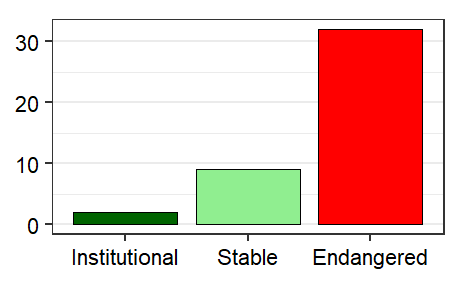
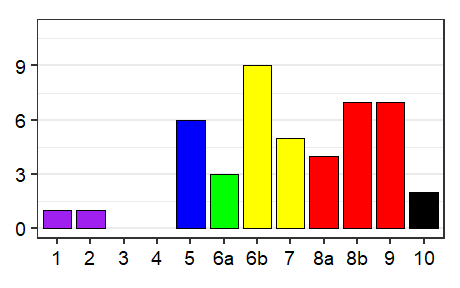
- The number of established languages listed for Bolivia is 47. Of these, 43 are living and 4 are extinct. Of the living languages, 39 are indigenous and 4 are non-indigenous. Furthermore, 2 are institutional, 7 are developing, 2 are vigorous, 13 are in trouble, and 19 are dying. Also listed is 1 unestablished language and 1 macrolanguage.
Languages
- Araona aro
- La Paz department: Manupari river headwaters; Puerto Araona. Users: 110 (2006 PIB). Ethnic population: 160 (Crevels 2012). Status: 6b (Threatened). Alternate Names: Cavina Classification: Tacanan, Tacana
- Aymara aym
- Users: Population total all languages (L1 only): 1,677,100. Status:
- Aymara, Central ayr
- La Paz, Oruro, and Potosí departments: west of eastern Andes. Users: 998,000 in Bolivia (2014 UNSD). Total users in all countries: 1,464,100. Status: 6b (Threatened). Alternate Names: Aimara Autonym: Aymar, Aymar aru Classification: Aymaran, Aymara
- Ayoreo ayo
- Santa Cruz department: Ángel Sandoval, Chiquitos, Germán Busch, and Ñuflo de Chávez provinces; Santa Cruz de la Sierra city, Zapocó, Poza Verde, Puesto Paz, Guidai Ichai, Santa Teresita, Tobité, Urucú, Motacú, Rincón del Tigre, Belen. Users: 2,190 in Bolivia (2012 census). Status: 6a (Vigorous). Alternate Names: Ayoeo, Ayoré, Ayoweo, Moro, Morotoco, Pyeta, Yovai Classification: Zamucoan
- Baure brg
- El Beni department: Iténez and Mamoré provinces, Baures, Huacaraje, Magdalena municipalities, Baures and El Carmen, San Miguel, Tujure, Cairo, Alta Gracia, Jasiaquini, Bereuro, San Francisco, San Pedro, Buena Hora, Las Peñas, and Pueblo Baure villages; between Iténez and Río Blanco rivers. Users: 67 (Crevels 2012), decreasing. Ethnic population: 980 (2006 PIB). Status: 8a (Moribund). Alternate Names: Chiquimiti, Maure Classification: Maipurean, Southern, Southern Outlier, Mojo
- Bolivian Sign Language bvl
- Scattered, especially Cochabamba, La Paz, and Santa Cruz departments; El Beni Department, Riberalta municipality. Users: 22,600 (2008 WFD). Approximately 0.24% of the total population in 2008. Status: 5 (Developing). Classification: Sign language, Deaf community sign language
- Borôro bor
- Santa Cruz department: Ángel Sandoval province. Users: 2 in Bolivia (2004 S. Anonby), decreasing. Status: 8b (Nearly extinct). Alternate Names: Boe, Boe Wadáru Classification: Bororoan
- Callawalla caw
- La Paz department: Charazani; highlands north of Lake Titicaca. Users: No known L1 speakers. Last known speakers survived into the first decade of the 2000s. Status: 9 (Dormant). Alternate Names: Callahuaya, Callawaya, Kallawaya, Pohena Classification: Language isolate
- Canichana caz
- El Beni department: Puerto del Carmen area. Users: No known L1 speakers. Last known speakers survived into the late 1990s. Ethnic population: 1,550 (2001 DNPI). Status: 9 (Dormant). Alternate Names: Kanichana Classification: Language isolate
- Cavineña cav
- El Beni department: Baqueti, Bolívar, California, Candelaria, El Choro, Francia, Galilea, Misión Cavinas, Natividad, Pando, Paraíso, Peña Guarayo, San José, San Juan, San Miguel, Santa Catalina; southeast of Riberalta along Beni river. Users: 600 (Crevels 2012). Ethnic population: 1,680 (Crevels 2012). Status: 6b (Threatened). Alternate Names: Kavinenya Classification: Tacanan
- Cayubaba cyb
- El Beni department: Yakuma province; west of Mamore river, north of Santa Ana. Users: No known L1 speakers. Cayubaba ceased to be spoken several generations ago (Crevels and Muysken 2012). Ethnic population: 650 (2006 PIB). Status: 9 (Dormant). Alternate Names: Cayuvava, Cayuwaba, Kayuvava Classification: Language isolate
- Chácobo cao
- El Beni department: Alto Ivon, California, Cayuses, Motacusal, Núcleo, Nuevo Mojos, Siete Almendros; south of Riberalta on Alto Ivon river. Users: 1,400 (Tallman 2018). Ethnic population: 1,800 (Tallman 2018). Status: 6b (Threatened). Alternate Names: Chákobo Classification: Panoan, Bolivian Panoan, Chákobo
- Chané caj
- Santa Cruz department: Cordillera province. Users: No known L1 speakers in Bolivia. Last speaker likely died in the 18th century. Total users in all countries: none known. Status: 10 (Extinct). Classification: Maipurean, Southern, Southern Outlier, Terena
- Chipaya cap
- Oruro department: Atahuallpa province. Users: 1,800 (Crevels 2012), increasing. 90 monolinguals. Ethnic population: 2,130 (Crevels 2012). Status: 5* (Developing). Alternate Names: Puquina Autonym: Chipaya Classification: Chipaya-Uru
- Chiquitano cax
- Santa Cruz department: Ángel Sandoval and Germán Busch, Chiquitos, Concepción, Florida, Lomerío, Ñuflo de Chávez, Roboré, San Ignacio, San Javier, San José, San Miguel, San Rafael, San Ramón, Santa Rosa de la Roca, and Velasco provinces. Users: 4,620 in Bolivia (Crevels 2012). Ethnic population: 47,100 (Adelaar 2004). Total users in all countries: 4,670. Status: 8a (Moribund). Alternate Names: Besïro, Chikitano, Chiquito, Tarapecosi Classification: Language isolate
- Ese Ejja ese
- El Beni, La Paz, and Pando departments; Portachuelo Alto, Portachuelo Bajo, Portachuelo Medio; into foothills on Beni and Madre de Dios rivers. Users: 520 in Bolivia (Crevels 2012). Ethnic population: 730 (Crevels 2012). Total users in all countries: 1,110. Status: 5 (Developing). Alternate Names: Ese Eja, Ese Exa, Ese’eha, Eseejja, Essejja, Huarayo, Tiatinagua, “Chama” (pej.) Autonym: Ese’ejja Classification: Tacanan, Chama
- Guaraní, Eastern Bolivian gui
- Chuquisaca, Santa Cruz, and Tarija departments; south central Parapeti river area. Users: 52,000 in Bolivia (2014 UNSD). Ethnic population: 125,000 (Crevels 2012). Total users in all countries: 69,530. Status: 5 (Developing). Alternate Names: Western Argentine Guaraní, “Chawuncu” (pej.), “Chiriguano” (pej.) Autonym: Guaraní Classification: Tupian, Tupí-Guaraní, Guaraní, Guaraní, Bolivian Guaraní
- Guaraní, Western Bolivian gnw
- Chuquisaca department: south to Pilcomayo river, east to Cuevo, north to Monte Agudo; Santa Cruz and Tarija departments. Users: 7,000 (2002 J. Russell). Status: 6a* (Vigorous). Alternate Names: Simba, Simba Guaraní Autonym: Guaraní Classification: Tupian, Tupí-Guaraní, Guaraní, Guaraní, Bolivian Guaraní
- Guarayu gyr
- Santa Cruz department: Ascensión de Guarayos, Urubichá, Salvatierra, San Pablo, Yaguarú y Yotaú, El Puente, Nueva Jerusalén, El Verano, Santa María, Cururú, Momené, Surucusi, San José Obrero, Cerro Chico, Cerro Grande, Cachuela, Puerto Ñuflo de Chávez. Users: 8,430 (Crevels 2012). Ethnic population: 12,000 (Crevels 2012). Status: 5 (Developing). Alternate Names: Chapacura, Guapore, Huachi, Iten, Maré, Tapacura, Ñañañe, “Guarayo” (pej.) Autonym: Gwarayu Classification: Tupian, Tupí-Guaraní, Guarayú
- Ignaciano ign
- El Beni department. Users: 1,080 (Crevels 2012). Ethnic population: 2,000 (Crevels 2012). Status: 7 (Shifting). Alternate Names: Ignaciano Mojo, Moja, Mojeño, Mojo, Moxo Autonym: Inaciànurupi Classification: Maipurean, Southern, Southern Outlier, Mojo, Mojo
- Itene ite
- El Beni department: junction of Mamoré and Iténez rivers. Users: 44 in Bolivia (Crevels 2012). Ethnic population: 64 (Crevels 2012). Total users in all countries: 45. Status: 8a (Moribund). Alternate Names: Guarayo, Iten, Iteneo, Iténez, Maré, Moré Classification: Chapacuran, Itene
- Itonama ito
- El Beni department: Chumano, Huaracajes, La Selva, Magdalena, Nueva Calama, San Borja, San Ramón, Versalles. Itonamas river area. Users: 1 (Crevels 2012). Ethnic population: 2,940 (2006 PIB). Status: 8b (Nearly extinct). Alternate Names: Itonama-Saramo, Itoname, Machoto, Saramo, Sihnipadara Classification: Language isolate
- Jorá jor
- Santa Cruz department. Users: No known L1 speakers. 5 speakers in 1976 (Danielsen and Gasparini 2015). Status: 10 (Extinct). Alternate Names: Hora Classification: Tupian, Tupí-Guaraní, Guarayú, Sirionó
- Leco lec
- La Paz department: Apolo area, Karura, Candelaria, Tutilimundi, and Uyapi, Coroico river in Trapichiponte in KeleKelera, Pucasucho, Inca, Trinidad, Mulihuara, Chirimayo, Muiri, Ilipana Yuyo, Munaypata, Irimo, Correo, Santo Domingo. Lake Titicaca east; scattered on Mapiri-Kaka river. Users: 20 (2001 S. van de Kerke). Ethnic population: 4,190 (Crevels 2012). Status: 8b (Nearly extinct). Alternate Names: Leko, Rik’a Classification: Language isolate
- Machinere mpd
- Pando department: Nicolás Suárez province, Bolpebra municipality, San Miguel; on Acre river. Users: 13 in Bolivia (Crevels 2012). Ethnic population: 30 (Crevels 2012). Status: 8b (Nearly extinct). Alternate Names: Machineri, Manchinere, Manchineri, Manitenerí, Manitenére, Maxinéri Classification: Maipurean, Southern, Southern Outlier, Piro, Piro
- Movima mzp
- El Beni department: 18 de Noviembre, 20 de Enero, Bella Flor, Buen Día, Carmen de Iruyañez, Carnavales, Ipimo, Miraflores, Navidad, San Lorenzo, Santa Ana del Yacuma. Users: 1,170 (Crevels 2012). Ethnic population: 12,200 (Crevels 2012). Status: 8a (Moribund). Autonym: Chosineɬ di’ mowi:maj Classification: Language isolate
- Pacahuara pcp
- El Beni department: Vaca Díez province, Puerto Tujuré; Pando department: Federico Román province, between Río Negro and Río Pacahuaras. Users: 3 (Tallman 2018). Ethnic population: 18 (Adelaar 2004). Possibly as many as 50 in 8 scattered families (Crevels 2007). Status: 8b (Nearly extinct). Alternate Names: Pacawara Classification: Panoan, Bolivian Panoan
- Paunaka pnk
- Santa Cruz department: San José de Chiquitos province. Users: 5 (Crevels 2012). Status: 8b (Nearly extinct). Alternate Names: Pauna, Paunaca Classification: Maipurean, Southern, Southern Outlier, Mojo
- Pauserna psm
- El Beni department: Guaporé river. Users: No known L1 speakers. Last speakers survived into the late 20th century. 1 semi-speaker reported in Bolivia. Ethnic population: 46 (Adelaar 2004). Status: 9 (Dormant). Alternate Names: Guarasugwé, Guarasú’we, Guarayu-Ta, Paucerne, Pauserna-Guarasugwé, Warázu Classification: Tupian, Tupí-Guaraní, Guarayú
- Plautdietsch pdt
- Santa Cruz department. Users: 60,000 in Bolivia (Salminen 2007). Status: 6b* (Threatened). Alternate Names: German, Mennonite German Classification: Indo-European, Germanic, West, Low Saxon-Low Franconian, Low Saxon
- Puquina puq
- La Paz department: Lake Titicaca area. Users: No known L1 speakers in Bolivia. Last speaker likely died in the 1700s. Total users in all countries: none known. Status: 10 (Extinct). Alternate Names: Pukina Classification: Language isolate
- Quechua, North Bolivian qul
- La Paz department: Franz Tamayo province, Apolo region. Users: 116,000 in Bolivia (1978 census), increasing. 18,500 monolinguals. Status: 2 (Provincial). Recognized language (2009, Constitution, Article 5(1)). Alternate Names: North La Paz Quechua Autonym: Quechua Classification: Quechuan, Peripheral Quechua, Chinchay, Southern Chinchay
- Quechua, South Bolivian quh
- Cochabamba, Chuquisaca, Oruro departments; La Paz department: except Franz Tamayo, Apolo area; mainly Potosí department; Tarija department. Users: 1,610,000 in Bolivia (2014 UNSD). Total users in all countries: 1,616,120. Status: 5* (Developing). Recognized language (2009, Constitution, Article 5(1)). Alternate Names: Central Bolivian Quechua, Cochabamba Quechua, Qhishwa, Quechua, Quechua Boliviano, Uralan Buliwya runasimi Autonym: Qhichwa Classification: Quechuan, Peripheral Quechua, Chinchay, Southern Chinchay
- Reyesano rey
- El Beni department: José Ballivián province, San Borja area. Users: 12 (Crevels 2012). Ethnic population: 4,920 (Crevels 2012). Status: 8b (Nearly extinct). Alternate Names: Maropa, San Borjano Classification: Tacanan, Tacana
- Saraveca sar
- Santa Cruz department: Velasco province. Users: No known L1 speakers (Crevels 2007). Probably extinct by the 1970s. Status: 10 (Extinct). Classification: Maipurean, Southern, Central, Paresí
- Sirionó srq
- El Beni and Santa Cruz departments: Ibiato (Eviato); Salvatierra on Río Blanco river. Users: 190 (Crevels 2012), decreasing. 30 monolinguals. Ethnic population: 980 (2016 L. Evans). More than half the ethnic group is under 15 years old (Crevels 2007). Status: 6b (Threatened). Alternate Names: Mbia Chee, Mbya Classification: Tupian, Tupí-Guaraní, Guarayú, Sirionó
- Spanish spa
- Users: 11,470,000 in Bolivia, all users. L1 users: 9,520,000 in Bolivia (Instituto Cervantes 2019). L2 users: 1,950,000 (Instituto Cervantes 2019). Status: 1 (National). Statutory national language (2009, Constitution, Article 5(1)). Classification: Indo-European, Italic, Romance, Italo-Western, Western, Gallo-Iberian, Ibero-Romance, West Iberian, Castilian
- Tacana tna
- La Paz department: Iturralde province, Tumupasa and Ixiamas cantons; Capaina, Napashe, San Buenaventura, Tahua; along Orton, Beni, and Madre de Dios rivers. Users: 1,150 (Crevels 2012). Ethnic population: 7,350 (Crevels 2012). Status: 7 (Shifting). Alternate Names: Takana, Tupamasa Classification: Tacanan, Tacana
- Tapieté tpj
- Tarija department: Gran Chaco province, Villa Montes municipality, Samayhuate and Cutaiqui; left bank Pilcomayo river. Users: 29 in Bolivia (Crevels 2012). Most elders and women are monolingual in Tapiete (Crevels 2007). Ethnic population: 41 (Crevels 2012). Status: 8a (Moribund). Alternate Names: Guasurango, Tirumbae, Yanaigua, Ñanagua Classification: Tupian, Tupí-Guaraní, Guaraní, Guaraní
- Toba tob
- Tarija department: Pilmacayo river, between Villa Montes and Paraguay border. Users: No known L1 speakers in Bolivia. The Toba speakers were pushed out of Bolivia to neighboring countries by 1936 (Crevels 2007). Status: 9 (Dormant). Alternate Names: Namqom, Qom, Qom l’aqtac, Qoml’ek Classification: Guaykuruan, Southern
- Toromono tno
- La Paz department: Abel Iturralde province; between Madidi and Heath river. Users: No known L1 speakers. Probably became extinct early in the 20th century. Ethnic population: 200 (Adelaar 2004). Status: 9 (Dormant). Alternate Names: Toromona Classification: Tacanan, Chama
- Trinitario trn
- El Beni department. Users: 3,140 (Crevels 2012). Ethnic population: 30,000 (Crevels 2012). Status: 7 (Shifting). Alternate Names: Mojeño, Mojeño Trinitario, Mojo, Mojos, Moxeño, Moxo, Moxos Classification: Maipurean, Southern, Southern Outlier, Mojo, Mojo
- Tsimané cas
- El Beni department: San Miguel de Huachi and Santa Ana de Alto Beni; along Maniqui river; La Paz department: north of La Paz city. Users: 7,300 (Crevels 2012). 950 Mosetén, 6,350 Tsimané (Crevels 2012). Ethnic population: 10,200 (Crevels 2012). 1,590 Mosetén, 8,610 Tsimané (Crevels 2012). Status: 6b (Threatened). Alternate Names: Chimané, Moseteno, Mosetén Classification: Mosetenan
- Uru ure
- La Paz department: Lake Titicaca, Desaguadero river area; Oruro department: Atahuallpa province. Users: No known L1 speakers (Crevels 2012). Last speaker died in 2004 (Crevels 2012). Ethnic population: 230 (Crevels 2012). Status: 9 (Dormant). Alternate Names: Iru-Itu, Morato, Muratu, Uchumataqu Classification: Chipaya-Uru
- Weenhayek mtp
- Tarija department: Cordillera de Pirapo; southwest of Pilcomayo river. Users: 1,930 (Crevels 2012). Ethnic population: 2,020 (1994). Status: 5* (Developing). Alternate Names: Bolivian, Noctenes, Noctén, Oktenai, Wichí Lhamtés Nocten, “Mataco” (pej.), “Mataco Nocten” (pej.) Autonym: ’weenhayeklhayhi’, ’weenhayeklhàmet Classification: Matacoan, Mataco
- Yaminahua yaa
- Pando department: Nicolás Suárez province, Puerto Yaminawa; headwaters of Alto Yuruá and Purús rivers. Users: 51 in Bolivia (Crevels 2012). Ethnic population: 93 (Crevels 2012). Status: 6b (Threatened). Alternate Names: Yamanawa, Yaminawá Classification: Panoan, Mainline, Tri-State
- Yuqui yuq
- Foothills north of Cochabamba; Chimoré river. Users: 140 (Crevels 2012). Ethnic population: 210 (Crevels 2012). Status: 7 (Shifting). Alternate Names: Bia, Mbia, Yuki Autonym: Biá yë Classification: Tupian, Tupí-Guaraní, Guarayú, Sirionó
- Yuracare yuz
- El Beni and Cochabamba departments, primarily along Chapare river. Users: 1,810 (Crevels 2012). Ethnic population: 2,830 (Crevels 2012). Status: 7 (Shifting). Alternate Names: Yura, Yuracar, Yurakar, Yurakaré, Yurucare, Yurujare, Yurujuré Classification: Language isolate
Languages by Status
Spanish
[spa] 1 (National). Statutory national language (2009, Constitution, Article 5(1)). 11,470,000 in Bolivia, all users. L1 users: 9,520,000 in Bolivia (Instituto Cervantes 2019). L2 users: 1,950,000 (Instituto Cervantes 2019).
Quechua, North Bolivian
[qul] 2 (Provincial). Recognized language (2009, Constitution, Article 5(1)). 116,000 in Bolivia (1978 census), increasing. 18,500 monolinguals.
Bolivian Sign Language
[bvl] 5 (Developing). 22,600 (2008 WFD). Approximately 0.24% of the total population in 2008.
Chipaya
[cap] 5* (Developing). 1,800 (Crevels 2012), increasing. 90 monolinguals. Ethnic population: 2,130 (Crevels 2012).
Ese Ejja
[ese] 5 (Developing). 520 in Bolivia (Crevels 2012). Ethnic population: 730 (Crevels 2012). Total users in all countries: 1,110.
Guaraní, Eastern Bolivian
[gui] 5 (Developing). 52,000 in Bolivia (2014 UNSD). Ethnic population: 125,000 (Crevels 2012). Total users in all countries: 69,530.
Guarayu
[gyr] 5 (Developing). 8,430 (Crevels 2012). Ethnic population: 12,000 (Crevels 2012).
Quechua, South Bolivian
[quh] 5* (Developing). Recognized language (2009, Constitution, Article 5(1)). 1,610,000 in Bolivia (2014 UNSD). Total users in all countries: 1,616,120.
Weenhayek
[mtp] 5* (Developing). 1,930 (Crevels 2012). Ethnic population: 2,020 (1994).
Ayoreo
[ayo] 6a (Vigorous). 2,190 in Bolivia (2012 census).
Guaraní, Western Bolivian
[gnw] 6a* (Vigorous). 7,000 (2002 J. Russell).
Araona
[aro] 6b (Threatened). 110 (2006 PIB). Ethnic population: 160 (Crevels 2012).
Aymara, Central
[ayr] 6b (Threatened). 998,000 in Bolivia (2014 UNSD). Total users in all countries: 1,464,100.
Cavineña
[cav] 6b (Threatened). 600 (Crevels 2012). Ethnic population: 1,680 (Crevels 2012).
Chácobo
[cao] 6b (Threatened). 1,400 (Tallman 2018). Ethnic population: 1,800 (Tallman 2018).
Plautdietsch
[pdt] 6b* (Threatened). 60,000 in Bolivia (Salminen 2007).
Sirionó
[srq] 6b (Threatened). 190 (Crevels 2012), decreasing. 30 monolinguals. Ethnic population: 980 (2016 L. Evans). More than half the ethnic group is under 15 years old (Crevels 2007).
Tsimané
[cas] 6b (Threatened). 7,300 (Crevels 2012). 950 Mosetén, 6,350 Tsimané (Crevels 2012). Ethnic population: 10,200 (Crevels 2012). 1,590 Mosetén, 8,610 Tsimané (Crevels 2012).
Yaminahua
[yaa] 6b (Threatened). 51 in Bolivia (Crevels 2012). Ethnic population: 93 (Crevels 2012).
Ignaciano
[ign] 7 (Shifting). 1,080 (Crevels 2012). Ethnic population: 2,000 (Crevels 2012).
Tacana
[tna] 7 (Shifting). 1,150 (Crevels 2012). Ethnic population: 7,350 (Crevels 2012).
Trinitario
[trn] 7 (Shifting). 3,140 (Crevels 2012). Ethnic population: 30,000 (Crevels 2012).
Yuqui
[yuq] 7 (Shifting). 140 (Crevels 2012). Ethnic population: 210 (Crevels 2012).
Yuracare
[yuz] 7 (Shifting). 1,810 (Crevels 2012). Ethnic population: 2,830 (Crevels 2012).
Baure
[brg] 8a (Moribund). 67 (Crevels 2012), decreasing. Ethnic population: 980 (2006 PIB).
Chiquitano
[cax] 8a (Moribund). 4,620 in Bolivia (Crevels 2012). Ethnic population: 47,100 (Adelaar 2004). Total users in all countries: 4,670.
Itene
[ite] 8a (Moribund). 44 in Bolivia (Crevels 2012). Ethnic population: 64 (Crevels 2012). Total users in all countries: 45.
Movima
[mzp] 8a (Moribund). 1,170 (Crevels 2012). Ethnic population: 12,200 (Crevels 2012).
Tapieté
[tpj] 8a (Moribund). 29 in Bolivia (Crevels 2012). Most elders and women are monolingual in Tapiete (Crevels 2007). Ethnic population: 41 (Crevels 2012).
Borôro
[bor] 8b (Nearly extinct). 2 in Bolivia (2004 S. Anonby), decreasing.
Itonama
[ito] 8b (Nearly extinct). 1 (Crevels 2012). Ethnic population: 2,940 (2006 PIB).
Leco
[lec] 8b (Nearly extinct). 20 (2001 S. van de Kerke). Ethnic population: 4,190 (Crevels 2012).
Machinere
[mpd] 8b (Nearly extinct). 13 in Bolivia (Crevels 2012). Ethnic population: 30 (Crevels 2012).
Pacahuara
[pcp] 8b (Nearly extinct). 3 (Tallman 2018). Ethnic population: 18 (Adelaar 2004). Possibly as many as 50 in 8 scattered families (Crevels 2007).
Paunaka
[pnk] 8b (Nearly extinct). 5 (Crevels 2012).
Reyesano
[rey] 8b (Nearly extinct). 12 (Crevels 2012). Ethnic population: 4,920 (Crevels 2012).
Callawalla
[caw] 9 (Dormant). No known L1 speakers. Last known speakers survived into the first decade of the 2000s.
Canichana
[caz] 9 (Dormant). No known L1 speakers. Last known speakers survived into the late 1990s. Ethnic population: 1,550 (2001 DNPI).
Cayubaba
[cyb] 9 (Dormant). No known L1 speakers. Cayubaba ceased to be spoken several generations ago (Crevels and Muysken 2012). Ethnic population: 650 (2006 PIB).
Pauserna
[psm] 9 (Dormant). No known L1 speakers. Last speakers survived into the late 20th century. 1 semi-speaker reported in Bolivia. Ethnic population: 46 (Adelaar 2004).
Toba
[tob] 9 (Dormant). No known L1 speakers in Bolivia. The Toba speakers were pushed out of Bolivia to neighboring countries by 1936 (Crevels 2007).
Toromono
[tno] 9 (Dormant). No known L1 speakers. Probably became extinct early in the 20th century. Ethnic population: 200 (Adelaar 2004).
Uru
[ure] 9 (Dormant). No known L1 speakers (Crevels 2012). Last speaker died in 2004 (Crevels 2012). Ethnic population: 230 (Crevels 2012).
Chané
[caj] 10 (Extinct). No known L1 speakers in Bolivia. Last speaker likely died in the 18th century. Total users in all countries: none known.
Jorá
[jor] 10 (Extinct). No known L1 speakers. 5 speakers in 1976 (Danielsen and Gasparini 2015).
Puquina
[puq] 10 (Extinct). No known L1 speakers in Bolivia. Last speaker likely died in the 1700s. Total users in all countries: none known.
Saraveca
[sar] 10 (Extinct). No known L1 speakers (Crevels 2007). Probably extinct by the 1970s.
Maps
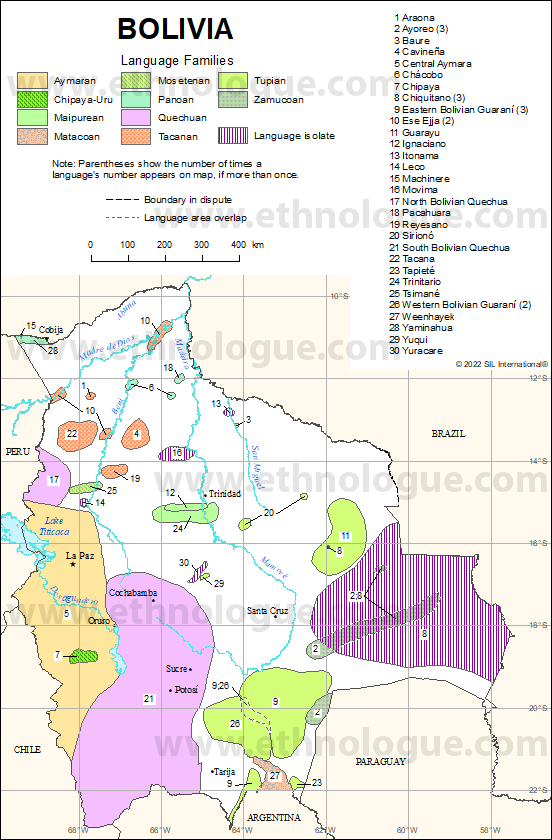
Bolivia
Graphs
Language Vitality Profile
Full explanation
Language Status Profile
Full explanation
Resources
View Terms
Each Ethnologue country digest is a licensed product with restricted terms of use. Before downloading the product, you must agree to the following terms:
- This is a license for individual use. Just as with a conventionally published book, it is a violation of copyright to make a copy and give it to others.
- You may not redistribute this work in any form, including ingesting the contents into a database that is shared with others or posting it on a web site (whether public or private).
To inquire about permission for reuse or redistribution, please use the Contact Us form in the footer.
Digest of the languages of Bolivia ($199.95, 39 page PDF)