
BR
Brazil
Summary
- Official Name
- Population
- 213,993,000
- Principal Languages
- Portuguese
- Literacy Rate
- 99% (2019 World Factbook)
- International Conventions
- CDE (1960), CPPDCE (2006), CSICH (2012), ICCPR (1966), (), UNCRPD (2006), UNDRIP (2007)
- General References
- Campbell 1997, Crevels 2007, Derbyshire and Pullum 1991, Derbyshire and Pullum 1998, Dixon and Aikhenvald 1999, Hopper 1967, Moore 2006, Ribeiro 1957, Rodrigues 1986, Rodrigues 1999
- Deaf Population
- 9,717,318
- Language Counts
- The number of established languages listed for Brazil is 243. Of these, 218 are living and 25 are extinct. Of the living languages, 201 are indigenous and 17 are non-indigenous. Furthermore, 6 are institutional, 40 are developing, 33 are vigorous, 43 are in trouble, and 96 are dying. Also listed are 21 unestablished languages.
Languages
- Acroá acs
- Bahia state. Users: No known L1 speakers. Probably extinct by the 20th century. Status: 10 (Extinct). Alternate Names: Coroá Classification: Jean, Central
- Agavotaguerra avo
- Mato Grosso state. Users: No known L1 speakers. Last known speaker survived into the first decades of the 2000s (2016 SIL). Status: 10 (Extinct). Alternate Names: Agavotocueng, Agavotokueng, Agavotoqueng Classification: Unclassified
- Aikanã tba
- Rondônia, west of Vilhena, near Cuiabá-Porto Velho highway. Users: 150 (Crevels 2012). Ethnic population: 200 (Crevels 2012). Status: 6b (Threatened). Alternate Names: Aikaná, Corumbiara, Huari, Kasupá, Kolumbiara, Mondé, Tubarão, Uari, Wari Classification: Language isolate
- Akuntsu aqz
- Rondônia state: Rio Omerê Indigenous Territory. Users: 3 (2022 C. Aragon). Ethnic population: 5 (Crevels 2012). Status: 8b (Nearly extinct). Alternate Names: Akunsu, Akunt’su, Akuntsun, Akuntsú Classification: Tupian, Tuparí
- Alapmunte apv
- Mato Grosso state: Terra Indígena Vale do Guaporé indigenous reserve. Users: No known L1 speakers. The last speaker likely died in the early 1900s. Status: 10 (Extinct). Alternate Names: Alapmonde, Yala’mun’du, Yalapmunde, Yalapmunte Classification: Nambikwara, Nambikwara Complex, Northern
- Amahuaca amc
- Acre state: Peru border area. Users: 220 in Brazil (1995). Status: 8b (Nearly extinct). Alternate Names: Amawaca, Amawáka, Amenguaca, Sayacu, Yora Classification: Panoan, Mainline, Tri-State, Amawaka
- Amanayé ama
- Pará state: Domingos do Capim municipality; Capim river. Users: No known L1 speakers. Last known speakers survived into the first decade of the 2000s (2007 SIL). Ethnic population: 190 (2001 ISA). Status: 9 (Dormant). Alternate Names: Amanage, Amanaié, Amanajé, Amanajó, Amanyé, Ararandeuara, Manajó, Mananyé, Manaxó, Manayé, Manaze, Manazewá, Manazo, Turiwa Classification: Tupian, Tupí-Guaraní, Wayampí, Amanayé
- Amundava adw
- Rondônia, Acre, near Jiparaná river. Users: 83 (2003 ISA). Crevels 2007 groups the Amundava together with the Uru-Eu-Wau-Wau [urz] for a total population of 170 (2003). Status: 6b* (Threatened). Alternate Names: Amondawa, Amundawa Classification: Tupian, Tupí-Guaraní, Kawahib, Parintintin
- Anambé aan
- Pará state; Cairari river (Moju river tributary). Users: 6 (Moore 2006). Ethnic population: 130 (2000 ISA). Status: 8b (Nearly extinct). Classification: Tupian, Tupí-Guaraní, Wayampí, Amanayé
- Apalaí apy
- Pará state: Paru Leste river; some on Jarí and Citare rivers, 20 villages; a few in Amapá state. Users: 950, all users. L1 users: 650 (2022 SIL). L2 users: 300 (2022 SIL). Status: 5 (Developing). Alternate Names: Apalay, Aparaí, Arakwayu Classification: Cariban, Central
- Apiaká api
- Mato Grosso state: upper Rio Tapajos, Slo Manoel confluence; a few in Pará state. Users: No known L1 speakers. The last fluent speaker, Pedrinho Kamassuri, died in 2011. Ethnic population: 1,000 (Tempesta 2009). Status: 9 (Dormant). Alternate Names: Apiacá, Apiake Classification: Tupian, Tupí-Guaraní, Kawahib
- Apinagé apn
- Tocantins and Maranhão states, near Tocantinopolis; 6 villages. Users: 1,500 (Crevels 2012). Ethnic population: 1,530 (2006 FUNASA). Status: 5* (Developing). Alternate Names: Afotigé, Aogé, Apinaié, Apinajé, Apinayé, Otogé, Oupinagee, Pinagé, Pinaré, Timbira Ocidentais, Uhitische, Utinsche, Western Timbira Autonym: Panhĩ kapẽr Classification: Jean, Northern
- Apurinã apu
- Amazonas state: Purus river, from Rio Branco to Manaus. Users: 2,000 (Crevels 2012). Ethnic population: 6,990 (2010 FUNASA). Status: 6b (Threatened). Alternate Names: Ipurinã, Ipurinãn, Kangite, Popengare Classification: Maipurean, Southern, Southern Outlier, Piro
- Arabic, North Levantine Spoken apc
- São Paulo. Users: 700,000 in Brazil (Guedri 2008). Ethnic population: 7,000,000 (2015). Status: Unestablished. Classification: Afro-Asiatic, Semitic, Central, South, Arabic
- Arapaso arj
- Amazonas state: São Gabriel, Iauarete. Users: No known L1 speakers. The last speaker died by the 1960s; ethnic Arapaso had shifted to Tucano (Loukotka 1968). Ethnic population: 570 (Crevels 2012). Status: 9 (Dormant). Alternate Names: Arapaço, Araspaso, Koneá Classification: Tucanoan, Eastern Tucanoan
- Arára, Mato Grosso axg
- Mato Grosso State. Users: No known L1 speakers. 7 speakers remained in 1986 (Rodrigues 1986). Ethnic population: 210 (Crevels 2012). Status: 9 (Dormant). Alternate Names: Arara, Arara do Aripuanã, Arara do Beiradão, Arara do Rio Branco, Koaia, Koaiá, Koayá Classification: Unclassified
- Arára, Pará aap
- Pará: Laranjal and Cachoeira Seca. Users: 340 (2010 I. Souza). Status: 7 (Shifting). Alternate Names: Arára Bravos Autonym: Ukarãngmã Classification: Cariban, South Amazonian, Arara
- Ararandewára xaj
- Pará state. Users: No known L1 speakers. Probably became extinct in the latter half of the 20th century. Status: 10 (Extinct). Alternate Names: Ararandeuras, Ararandeuára, Manajé Classification: Tupian, Tupí-Guaraní, Wayampí, Amanayé
- Araweté awt
- Pará state: near Altamira; near Xingu river. Users: 340 (Crevels 2012). Nearly all are monolingual (1986). Ethnic population: 340 (Crevels 2012). Status: 6a (Vigorous). Alternate Names: Araueté, Arawine, Bïde Classification: Tupian, Tupí-Guaraní
- Arikapú ark
- Rondônia state; Rio Branco headwaters, Guaporé tributary. Users: No known L1 speakers. Last known speaker likely survived into the 2010s. Ethnic population: 30 (Crevels 2012). Status: 9 (Dormant). Alternate Names: Aricapú, Mashubi, Maxubí Classification: Jabutian
- Arikem ait
- Rondônia state. Users: No known L1 speakers. Survived into the 1930s. Status: 10 (Extinct). Alternate Names: Ahopovo, Ahôpovo, Ariken, Arikém, Ariqueme, Ariquemes, Ariquême, Uitáte Classification: Tupian, Arikem
- Armenian, Western hyw
- Users: 47,000 in Brazil (2021 Joshua Project), based on ethnicity. Status: Unestablished. Classification: Indo-European, Armenian
- Aruá aru
- Amazonas state. Users: No known L1 speakers. Last speaker died in 1877. Status: 10 (Extinct). Alternate Names: Arawá Classification: Arauan
- Aruá arx
- Rondônia state: Rio Branco post; Branco and Guaporé rivers. Users: 12 (Crevels 2012). Ethnic population: 36 (Crevels 2012). Status: 8a (Moribund). Alternate Names: Arouá, Arouén Classification: Tupian, Mondé, Aruá
- Arutani atx
- Roraima state: Saúba village. Users: 1 in Brazil (Labrada et al 2020). Status: 8b (Nearly extinct). Alternate Names: Anake, Aoaqui, Auakê, Auaqué, Awaikê, Awaké, Oewaku, Orotani, Uruak, Urutaní Classification: Language isolate
- Ashéninka, Ucayali-Yurúa cpb
- Acre state: border area with Peru, Juruá river between Amônia, Arara, and Breu tributaries; Tarauacá river, Envira tributary. Users: 810 in Brazil (Crevels 2012). Ethnic population: 870 (2004 CPIAC). Status: 6a* (Vigorous). Alternate Names: Campa, Kampa Classification: Maipurean, Southern, Campa, Ashéninga
- Asurini of Xingú asn
- Pará state: Xingu River, Kwatinemu village. Users: 120 (Pereira 2009), decreasing. Any monolingual speakers are above 40 years of age (Pereira 2009). Ethnic population: 120 (Pereira 2009). Status: 6b (Threatened). Alternate Names: Assurinikin, Assuriní, Asurini do Xingú, Asuriní de Koatinema, Awaeté, Awaté, Kuben-Kamrektí Classification: Tupian, Tupí-Guaraní, Kayabí
- Asurini, Tocantins asu
- Pará state: Trocará near Tucurui; Tocantins river. Users: 380 (Crevels 2012). Ethnic population: 380 (Crevels 2012). Status: 7 (Shifting). Alternate Names: Akwawa, Akwawa-Asuriní, Akwaya, Assuriní, Asuriní do Tocantins, Asuriní do Trocará, “Akuáwa” (pej.) Autonym: Asuriní Classification: Tupian, Tupí-Guaraní, Tenetehara, Akwawa
- Atorada aox
- Roraima. Users: Few in Brazil (2000). Status: 8a (Moribund). Alternate Names: Ator’ti, Atorad, Atorai, Dauri Classification: Maipurean, Northern, Maritime, Wapixana
- Aurá aux
- Pará state. Users: No known L1 speakers. Last known speaker survived into the first decade of the 2000s (2004 SIL). Status: 10 (Extinct). Alternate Names: Auré Classification: Tupian, Tupí-Guaraní, Wayampí
- Avá-Canoeiro avv
- Goiás state: Terra Indigena Ava-Canoeiro; Tocantins state: Bananal island, upper Tocantins river valley. Status: 6b (Threatened). Alternate Names: Abá, Avá, Awana, Canoa, Canoe, Canoeiro, Canoeiros, Cara Preta, Carijó, Indios Negros Classification: Tupian, Tupí-Guaraní, Tenetehara
- Awetí awe
- Mato Grosso state: Xingú park, Rio Culiseu, Aweti, and Sauva villages; upper Xingú river. Users: 170 (2011 S. Drude). Status: 6b (Threatened). Alternate Names: Arauine, Arauite, Auetí, Auetó, Auití, Autl, Awetö Classification: Tupian
- Bakairí bkq
- Mato Grosso state: about 9 villages. Users: 950 (Crevels 2012). Ethnic population: 950 (1999 ISA). Status: 5* (Developing). Alternate Names: Bacairí Autonym: Kurâ Classification: Cariban, South Amazonian, Bakairí
- Baniwa bwi
- Amazonas state: Middle Içana river. Users: 5,810 in Brazil (Crevels 2012). Status: 6b* (Threatened). Alternate Names: Baniba, Baniua do Içana, Baniva, Dakenei, Issana, Kohoroxitari, Maniba, Wakuenai, Walimanai Classification: Maipurean, Northern, Upper Amazon, Eastern Nawiki, Karu
- Baré bae
- Amazonas state: Xié river area. Users: No known L1 speakers in Brazil. The Baré people now speak Nhengatu [yrl] (Meira 2021). Ethnic population: 2,790 (Moore 2006). Status: 8b (Nearly extinct). Alternate Names: Balé Classification: Maipurean, Northern, Upper Amazon, Central Upper Amazon, Baré
- Borôro bor
- Mato Grosso state: Meruri, Sangradouro, Perigera. Users: 1,390 in Brazil (Crevels 2012). Ethnic population: 1,390 (Crevels 2012). Total users in all countries: 1,392. Status: 6b (Threatened). Alternate Names: Boe, Eastern Bororo Autonym: Boe Wadáru Classification: Bororoan
- Brazilian Sign Language bzs
- Scattered. Users: 630,000 (2021 DBS/DOOR/SIL). Estimated 420,000–840,000 deaf sign language users, based on 0.2%–0.4% of the general population. Another estimate: 2,000,000 (2019 R. Quadros). Ethnic population: 9,700,000 (2010). Ethnic population represents people with significant hearing loss (2010 census). Status: 5 (Developing). Recognized language (2002, Law 10.436/2002, Parliamentary decree 5626/2005). Alternate Names: LIBRAS, LSB, Libras, Língua Brasileira de Sinais, Língua de Sinais Brasileira, Língua de Sinais dos Centros Urbanos Brasileiros, SPSL, São Paulo Sign Language Classification: Sign language, Deaf community sign language
- Cafundo Creole ccd
- Rio de Janeiro state: Cafundo, 240 km from São Paulo. Users: 40 (1978 M. Gnerre). Status: 8b (Nearly extinct). Classification: Creole, Portuguese based
- Caló rmq
- Widespread, primarily northeast and north central Brazil. Users: 400,000 in Brazil (2014 S. Anonby). Ethnic population: 800,000 (2011 R7 Noticias). Status: 6b* (Threatened). Alternate Names: Chibi, Gitano, Iberian Romani Classification: Mixed language, Iberian-Romani
- Canela ram
- Maranhão state. Users: 2,500 (Crevels 2012). Ethnic population: 2,500 (2006 FUNASA). Status: 5* (Developing). Alternate Names: Kanela Autonym: Canela Classification: Jean, Northern, Timbira
- Chinese, Mandarin cmn
- Users: 62,900 in Brazil (2020 Registro Nacional Migratório no Brasil), based on nationality. Status: Unestablished. Classification: Sino-Tibetan, Chinese
- Chiquitano cax
- Mato Grosso, border area with Bolivia, municipalities of Vila Bela, Cáceres and Porto Espiridião. Users: 50 in Brazil (Crevels 2012). Ethnic population: 740 (Crevels 2012). Status: 8a (Moribund). Alternate Names: Anenho, Linguará Classification: Language isolate
- Chiripá nhd
- Mato Grosso do Sul, Paraná, Rio Grande do Sul, Santa Catarina, and São Paulo states; scattered. Users: 4,900 in Brazil (1995 AMTB). Ethnic population: 8,000 (2003 ISA). Status: 8a (Moribund). Alternate Names: Apytare, Ava Guaraní, Guaraní, Nandeva, Nhandeva, Tsiripá, Txiripá, Ñandeva Classification: Tupian, Tupí-Guaraní, Guaraní, Guaraní
- Cinta Larga cin
- Mato Grosso state: Terra Indigena Aripuanã; Rondônia state: Terra Indigena Roosevelt, Parque Indigena Aripuanã. Users: 650 (Crevels 2012). Nearly all are monolingual. Ethnic population: 650 (Crevels 2012). Status: 6a* (Vigorous). Classification: Tupian, Mondé, Aruá
- Cocama-Cocamilla cod
- Amazonas state: Rio Solimões region, Terra Indígena Acapuri de Cima, Terra Indígena Espírito Santo, Terra Indígena Evaré I, Terra Indígena Kokama. Users: Ethnic population: 620 (Moore 2006). Status: 8b (Nearly extinct). Alternate Names: Cocama, Kocama, Kokama Classification: Tupian, Tupí-Guaraní, Tupí, Cocama
- Cubeo cub
- Amazonas state: near São Gabriel. Users: 150 in Brazil (Crevels 2012). Ethnic population: 380 (Crevels 2012). Status: 8a (Moribund). Alternate Names: Cobewa, Cubeu, Cuveo, Hehenawa, Kobeua, Kobewa, Kobéwa, Kubeo, Kubewa, Kubwa, Pamiwa, Pamié Classification: Tucanoan, Central Tucanoan
- Dâw kwa
- Amazonas state: across the river from São Gabriel de Cochoeira, below confluence of Vaupés and Negro rivers. Users: 120 (Crevels 2012). Ethnic population: 120 (Crevels 2012). Status: 6a (Vigorous). Alternate Names: Dow, “Kamu Maku” (pej.), “Kamán” (pej.), “Kamã” (pej.), “Kamã Makú” (pej.) Classification: Puinavean
- Dení dny
- Amazonas state: Terra Indigena Camadeni and Terra Indigena Deni, between Purus and Juruá rivers, Upper Cunhua and Xiruã rivers. Users: 740 (Moore 2006). Ethnic population: 880 (2006 FUNASA). Status: 5* (Developing). Alternate Names: Dani Autonym: Madiha Classification: Arauan
- Desano des
- Amazonas state: Terra Indígena Alto Rio Negro, sixty communities on Tiquié river and tributaries; border with Colombia. Users: 700 in Brazil (Crevels 2012). Ethnic population: 2,200 (Crevels 2012). Total users in all countries: 3,160. Status: 6b* (Threatened). Alternate Names: Boleka, Desana-Siriana, Dessano, Desâna, Kusibi, Oregu, Uina, Umúkomasá, Wina, Wirã Autonym: Wirã ya Classification: Tucanoan, Eastern Tucanoan, Desano-Siriano
- Dutch nld
- Paraná. Users: 11,000 in Brazil (2020 Registro Nacional Migratório no Brasil), based on nationality. Status: Unestablished. Classification: Indo-European, Germanic, West, Low Saxon-Low Franconian, Low Franconian
- Enawené-Nawé unk
- Mato Grosso state. Users: 450 (Crevels 2012). Most are still monolingual (Crevels 2007). Ethnic population: 450 (2006 FUNASA). Status: 6a* (Vigorous). Alternate Names: Eneuene-Mare, Salumã Classification: Maipurean, Unclassified
- English eng
- Scattered. Users: 10,921,000 in Brazil, all users. L1 users: 121,000 in Brazil (2020 Registro Nacional Migratório no Brasil), based on nationality. L2 users: 10,800,000 (2020 British Council). Status: 4 (Educational). Alternate Names: Inglês Classification: Indo-European, Germanic, West, English
- French fra
- Users: 42,700 in Brazil (2020 Registro Nacional Migratório no Brasil), based on nationality. Status: Unestablished. Classification: Indo-European, Italic, Romance, Italo-Western, Western, Gallo-Iberian, Gallo-Romance, Gallo-Rhaetian, Oïl, French
- Galibi car
- Amapá state: Terra Indigena Galibi, São José dos Galibi village on Oiapoque river right bank, south of Saint Georges, between Morcego and Taparabu streams. Users: 28 in Brazil (Moore 2006). Ethnic population: 66 (Crevels 2012). Status: 8a (Moribund). Alternate Names: Carib, Caribe, Cariña, Kalihna, Kalinya, Kari’na auran, Kari’ña, Maraworno, Marworno Classification: Cariban
- Gavião do Jiparaná gvo
- Rondônia state, Terra Indigena Igarape Lourdes (Gavião dialect). Mato Grosso state, municipality of Rondolándia (Zoró dialect). Users: 1,120 (Crevels 2012). 520 Gavião and 600 Zoró speakers (Crevels 2012). Ethnic population: 1,120 (Crevels 2012). Status: 5 (Developing). Alternate Names: Digüt, Gavião - RO, Gavião do Rondônia, Ikolen, Ikólóéhj, Ikõleey, Ikõlej, Ikõro Classification: Tupian, Mondé, Aruá
- Gavião, Pará gvp
- Pará state: Kaikoture near Maraba; possibly in original locations in Maranhão state. Users: 970 (Crevels 2012). 480 Gavião Perkatêjê and 490 Pukobjê (Crevels 2012). Ethnic population: 970 (2006 ISA). 480 Parakatêjê and 470 Pukobjê (Crevels 2012). Status: 7 (Shifting). Alternate Names: Gavião Perkatêjê, Gavião do Mãe Maria, Gavião do Pará, Parakatêjê, Parkatêjê, Perkatêjê, Pukobjê Classification: Jean, Northern, Timbira
- German, Standard deu
- Users: 40,000 in Brazil (2020 Registro Nacional Migratório no Brasil), based on nationality. Status: Unestablished. Classification: Indo-European, Germanic, West, High German, German, Middle German, East Middle German
- Greek ell
- Users: 11,000 in Brazil (2021 Joshua Project), based on ethnicity. Status: Unestablished. Classification: Indo-European, Greek, Attic
- Guajá gvj
- Maranhão state: Terra Indígena Alto Turiaçu and Terra Indígena Caru, four settlements; Pará state. Users: 280 (Moore 2006). Ethnic population: 280 (Crevels 2012). Status: 6a* (Vigorous). Alternate Names: Avá, Awá, Awá Guajá, Ayaya, Guaxare, Wazaizara Classification: Tupian, Tupí-Guaraní, Wayampí, Amanayé
- Guajajára gub
- Maranhão state: Pindaré, Grajaú, Mearim, and Zutiua rivers. 81 villages. Users: 14,000 (Crevels 2012). Ethnic population: 19,500 (2006 FUNASA). Status: 5* (Developing). Alternate Names: Guazazzara, Tenetehar, Tenetehára Autonym: Zeʼegete Classification: Tupian, Tupí-Guaraní, Tenetehara, Tenetehara
- Guana gqn
- Mato Grosso do Sul state: near the Terêna. Users: No known L1 speakers. Last speakers survived into the 2000s. Ethnic population: 250 (2005 ISA). Status: 9 (Dormant). Alternate Names: Chana, Chuala, East Paraná, Equinao, Equiniquinao, Guaná, Kinihinao, Kinikinao, Kinikinau Classification: Maipurean, Southern, Southern Outlier, Terena
- Guaraní, Mbyá gun
- Paraná, São Paulo, Espírito Santo, Pará, Rio Grande do Sul, and Santa Catarina states; possibly also Minas Gerais state. 35 villages. Users: 6,000 in Brazil (2008 CTI). Most children, women and elders are monolingual (Crevels 2007). Ethnic population: 6,000 (Crevels 2012). Total users in all countries: 19,960. Status: 5* (Developing). Alternate Names: Bugre, Mbiá, Mbua, Mbya, Mbyá Autonym: Nhandeayvu Classification: Tupian, Tupí-Guaraní, Guaraní, Guaraní
- Guató gta
- Mato Grosso do Sul state: Paraguai river banks and up São Lourenço river, along Bolivian border. Users: 5 (Crevels 2012). Ethnic population: 370 (2006 FUNASA). Status: 8b (Nearly extinct). Classification: Language isolate
- Haitian Creole hat
- Users: 136,000 in Brazil (2020 Registro Nacional Migratório no Brasil), based on nationality. Status: Unestablished. Classification: Creole, French based
- Himarimã hir
- Amazonas state: Tapauá valley, near the Jamamadi and Jarawara. Users: 40. Status: 6a (Vigorous). Alternate Names: Hi-Merima Classification: Unclassified
- Hixkaryána hix
- Pará and Amazonas states: upper Nhamunda river to Mapuera and Jatapu rivers. Users: 1,200 (2020 M. da Silva). Ethnic population: 1,200 (2012 SESAI). Status: 5 (Developing). Alternate Names: Chawiyana, Faruaru, Hichkaryana, Hishkariana, Hishkaryana, Hixkariana, Hyxkaryana, Kumiyana, Parucutu, Parukoto-Charuma, Sherewyana, Sokaka, Wabui, Xereu, Xerewyana Autonym: Hixkaryána Classification: Cariban, Waiwai
- Hungarian hun
- Users: 22,000 in Brazil (2021 Joshua Project), based on ethnicity. Status: Unestablished. Classification: Uralic
- Hunsrik hrx
- Widespread. Many in Paraná, Rio Grande do Sul, and Santa Catarina states. Users: 3,000,000 in Brazil. Ethnic population: 5,000,000 (2021 Joshua Project). Status: 7 (Shifting). Alternate Names: Hunsrick, Hunsrickisch, Hunsriker, Hunsriqueano, Hunsriqueano Riograndense, Hunsrück, Katharinensisch, Rio Grand Hunsriker Autonym: Hunsrik, Riograndenser Hunsrickisch Classification: Indo-European, Germanic, West, High German, German
- Hupdë jup
- Amazonas state: Rio Auari. Users: 1,500 in Brazil (Crevels 2012). Ethnic population: 1,500 (Crevels 2012). Total users in all countries: 1,740. Status: 5* (Developing). Alternate Names: Hupda, Hupdah, Hupdé, Jupde, Ubdé, “Hupdá Makú” (pej.), “Jupdá Macú” (pej.), “Macú de Tucano” (pej.), “Makú-Hupdá” (pej.) Autonym: Hup Classification: Puinavean, Hupda
- Iatê fun
- Alagoas state; Pernambuco State: Sertão, Águas Belas municipality, 2 villages. Users: 1,000 (Crevels 2012). Ethnic population: 2,930 (Crevels 2012). Status: 7 (Shifting). Alternate Names: Carnijó, Fornió, Fulniô, Furniô, Yaathe, Yahthe, Yatê, Yatê-Fulniô Autonym: Iatê Classification: Language isolate
- Ikpeng txi
- Mato Grosso state: Xingú park. Users: 340 (Crevels 2012). Ethnic population: 340 (2006 FUNASA). Status: 6a* (Vigorous). Alternate Names: Chicao, Tonore, Tunuli, Txicão, Txikân, Txikão Classification: Cariban, South Amazonian, Arara
- Ingarikó ake
- Roraima state: Terra Indígena Raposa or Serra do Sol, near Cotingo river. Users: 1,700 in Brazil (Instituto Socioambiental 2020). Ethnic population: 1,700 (Instituto Socioambiental 2020). Status: 5 (Developing). Alternate Names: Acahuayo, Acewaio, Akawai, Akawaio, Akawayo, Akwaio, Kapon, Kapóng, Patamona Classification: Cariban, North Amazonian, Pemón, Pemón proper, Kapong
- Irántxe irn
- Mato Grosso state: Rio Cravari headwaters, Rio Sangue tributary, a tributary of Rio Juruena. Users: 90 (Crevels 2012). 10 Irántxe and 80 Münkü (Crevels 2012). Ethnic population: 360 (2006 ISA). 280 Irántxe and 80 Münkü (Crevels 2012). Status: 8a (Moribund). Alternate Names: Iranche, Iranshe, Iranxe, Manoki, Münkü Classification: Language isolate
- Italian ita
- Scattered, in Minas Gerais, Rio Grande do Sul, São Paulo. Users: 39,300 in Brazil (2020 Registro Nacional Migratório no Brasil), based on nationality. Ethnic population: 22,000,000 (2020 S. Schwartzman). Status: 7 (Shifting). Alternate Names: Italiano Classification: Indo-European, Italic, Romance, Italo-Western, Italo-Dalmatian
- Itene ite
- Rondônia state: Guajará-Mirim, Porto Velho. Users: 1 in Brazil (Instituto Socioambiental 2020). Ethnic population: 30 (2002). Status: 8b (Nearly extinct). Alternate Names: Moré Classification: Chapacuran, Itene
- Jabutí jbt
- Rondônia state: Rio Branco Post. Users: 40 (Crevels 2007). Ethnic population: 170 (Crevels 2012). Status: 6b (Threatened). Alternate Names: Djeoromitxí, Jabotí, Jeoromitxí, Quipiu, Yabutí Classification: Jabutian
- Jamamadí jaa
- Amazonas state: Jaruara; Lábrea municipality, 7 villages; Banawá river area; others scattered. Users: 780 (2019). 100 Banawá, 450 Jamamadí, 230 Jarawara. Banawa Yafi (Kitiya) mostly monolingual; 160 ethnic Jarawara, also mostly monolingual (Crevels 2007). Ethnic population: 790 (2012). 100 Banawá Yafí, 450 Jamamadí, 240 Jarawara. Status: 4 (Educational). Alternate Names: Canamanti, Kanamanti, Kapaná, Madi, Yamadi, Yamamadí, Yamamandi Autonym: Jamamadí Classification: Arauan, Jamamadi
- Jaminawa yaa
- Acre: Alto Acre, Alto Yaco and Caiete rivers; Amazonas: Purus river. Users: 1,300 in Brazil (2020). Ethnic population: 1,400 (2020). Status: 6b (Threatened). Alternate Names: Iauminawa, Yamanawa, Yaminahua, Yaminawá Classification: Panoan, Mainline, Tri-State
- Japanese jpn
- Users: 380,000 in Brazil (2021 Joshua Project). Ethnic population: 2,750,000 (2020 S. Schwartzman). Status: Unestablished. Classification: Japonic
- Júma jua
- Amazonas state: Upper Jamary village; Mucuim river, Rio Açuã tributary. Users: No known L1 speakers (2021). The last fluent speaker, named Aruka Juma, died on February 17, 2021 (2021 M. Astor). Status: 10 (Extinct). Alternate Names: Arara, Içuã Tupi, Kagwahibm, Kagwahiph, Kagwahiv, Kavahiva, Kawahip, Kawaib, Yumá Autonym: Kagwahiva Classification: Tupian, Tupí-Guaraní, Kawahib, Parintintin
- Jurúna jur
- Mato Grosso state: Xingu park, 2 villages; Maritsauu-Mitau river mouth; possibly also Pará state. Users: 280 (Moore 2006). 1 speaker left in the Terra Indígena Paquiçamba in 1989 (Crevels 2007). Ethnic population: 360 (2006 FUNASA). 35 ethnic group members in the Tierra Indígena Paquiçamba (Crevels 2007). Status: 6a* (Vigorous). Alternate Names: Iuruna, Jaruna, Jurûna, Yudjá, Yudya, Yurúna Classification: Tupian, Juruna
- Kaapor urb
- Maranhão and Pará states: 8–10 villages scattered over 7,250 square km; Gurupi river. Users: 800 (Moore 2006). Ethnic population: 990 (2006 FUNASA). Status: 5* (Developing). Alternate Names: Caapor, Ka’apor, Kaaporté, Urubú-Kaapor, “Urubú” (pej.) Autonym: Kaapor, awa je’ẽha Classification: Tupian, Tupí-Guaraní, Wayampí, Amanayé
- Kaapor Sign Language uks
- Maranhão and Pará states: several villages, near the Gurupi river. Users: No known L1 users. Ferreira Brito 1984 reported 5 deaf and less than 500 hearing, but unconfirmed reports in 1987 say no users remain. Deaf users were monolingual. Status: 10 (Extinct). Alternate Names: Ka’apor Sign Language, LSKB, Língua de Sinais Kaapor Brasileira, “UKSL” (pej.), “Urubu-Kaapor Sign Language” (pej.), “Urubú Sign Language” (pej.) Classification: Sign language, Shared sign language
- Kabuverdianu kea
- Users: 4,000 in Brazil (2015 Instituto de Apoio ao Emigrante). Status: Unestablished. Classification: Creole, Portuguese based
- Kadiwéu kbc
- Mato Grosso do Sul state: Serra da Bodoquena area; 3 villages. Users: 1,590 (Moore 2006). Ethnic population: 1,630 (2006 FUNASA). Status: 5 (Developing). Alternate Names: Cadiuéu, Caduvéo, Ediu-Adig, Ejiwajigi, Eyiguayegi, Kadiweo, Mbaya-Guaikuru Autonym: Goniwoladi ejiwajegi Classification: Guaykuruan, Guaykurú
- Kaimbé xai
- Bahia state. Users: No known L1 speakers. Became extinct early in the 20th century. Ethnic population: 1,100 (1986 SIL). Status: 9 (Dormant). Alternate Names: Caimbé, Cambe, Kariri de Massacará Classification: Unclassified
- Kaingang kgp
- Paraná State: 9 reservations between Paranapena and Iguaçu rivers; Rio Grande do Sul state: 5 reservations of southeast dialect south of Uruguay river east of Passo Fundo river; southwest dialect on 7 reservations; east of Passo Fundo river; outskirts of cities in Rio Grande do Sul; Santa Catarina state: 8 reservations between Iguaçu and Uruguay rivers; São Paulo state: 3 reservations north of Paranapena river; Scattered. Users: 18,500 (Crevels 2012). Ethnic population: 28,000 (Crevels 2012). Status: 6b (Threatened). Alternate Names: Bugre, Caingang, Caingangue, Coroado, Coroados, Kanhgág Classification: Jean, Southern, Kaingang
- Kaingáng, São Paulo zkp
- São Paulo. Users: No known L1 speakers. Last known speakers survived into the 1990s (1989 SIL). Status: 10 (Extinct). Classification: Jean, Southern, Kaingang
- Kaiwá kgk
- Mato Grosso do Sul state: Apa, Dourados, and Ivinhema rivers north to Mbarakaju mountains and Jejui river tributaries south. Users: 18,000 (2003 ISA). Ethnic population: 20,000 (Crevels 2012). Status: 6b* (Threatened). Alternate Names: Caingua, Caiua, Caiwa, Cayua, Kaingwá, Kaiova, Kaiowá, Kayova, Paï-Tavyterã Classification: Tupian, Tupí-Guaraní, Guaraní, Guaraní
- Kamakan vkm
- Bahia state. Users: No known L1 speakers. The last speaker died by the 1960s (Loukotka 1968). Status: 10 (Extinct). Alternate Names: Ezeshio, Kamakán Classification: Kamakanan, Kamakán
- Kamayurá kay
- Mato Grosso state: Xingú park. Users: 530 (Vitti 2015). Ethnic population: 600 (2014 ISA). Status: 5 (Developing). Alternate Names: Camaiura, Kamaiurá, Kamayirá Classification: Tupian
- Kambiwá xbw
- Pernambuco state. Users: No known L1 speakers. Became extinct early in the 20th century. Ethnic population: 2,820 (Crevels 2012). Status: 9 (Dormant). Alternate Names: Cambioá, Cambiuá Classification: Unclassified
- Kanamarí knm
- Amazonas state: Itaquai, Jurua, Jutai rivers’ upper regions. Users: 1,330 (Moore 2006). Ethnic population: 1,650 (Crevels 2012). 100 Tshom-Djapa in 1985 (Crevels 2012). Status: 6a* (Vigorous). Alternate Names: Canamarí, Djapá, Kanamaré, Tâkâna, Tüküná Classification: Katukinan
- Kanoé kxo
- Rondônia state: Guaporé river. Users: 3 (Crevels 2012). Ethnic population: 95 (Crevels 2007). Status: 8b (Nearly extinct). Alternate Names: Amniapé, Canoé, Canoê, Guarategaja, Guaratira, Guaratégaya, Kanoê, Kapishanã, Kapixana, Kapixaná, Koaratira Classification: Language isolate
- Kapinawá xpn
- Pernambuco state. Users: No known L1 speakers. The last speaker died in the 20th century. Ethnic population: 420 (Crevels 2007). Status: 9 (Dormant). Alternate Names: Capinauá Classification: Unclassified
- Karajá kpj
- Mato Grosso, Pará, and Tocantins states: Bananal island, Araguaia river; possibly also Goias state. Users: 3,060 (Crevels 2012). Javaé 800, Karajá 2,250, Xambioá 10 (Crevels 2012). Ethnic population: 4,010 (Crevels 2012). Javaé 1,210, Karajá 2,530, Xambioá 270 (Crevels 2012). Status: 6b* (Threatened). Alternate Names: Caraiauna, Carajá, Chambioa, Iny, Ynã Classification: Karajá
- Karapanã cbc
- Amazonas state: Pari-Cachoeira and São Gabriel. Users: 63 in Brazil (Crevels 2012). Ethnic population: 63 (Crevels 2012). Status: 6b* (Threatened). Alternate Names: Carapana, Carapanã, Mextã, Muteamasa, Ukopinõpõna Classification: Tucanoan, Eastern Tucanoan, Carapano
- Karipuna kuq
- Rondônia state: Jaru, Jamery, Urupa, Cabecciras, Candeias, and Jaciparana rivers’ banks. Users: 10 (Crevels 2012). Ethnic population: 14 (Crevels 2012). Status: 8a (Moribund). Alternate Names: Ah’e, Caripuna, Jau-Navo, Juanauo, Kagwahiva, Karipuna de Rondônia, Karipuna do Guaporé Classification: Tupian, Tupí-Guaraní, Kawahib, Parintintin
- Karipúna kgm
- Amapá state: on French Guiana border. Users: No known L1 speakers. Status: 10 (Extinct). Alternate Names: Karipuna do Amapá, Karipuna do Uaçá Classification: Tupian, Tupí-Guaraní, Kawahib
- Karipuna French Creole kmv
- Amapá state: on French Guiana border. Users: 2,400 (2008 SIL). Status: 6b* (Threatened). Alternate Names: Amapá French Creole, Crioulo, Crioulo karipúna, Uaçá Creole French Autonym: Lanc-Patuá Classification: Creole, French based
- Karirí-Xocó kzw
- Alagoas state. Users: No known L1 speakers. Spoken into last half of 20th century. Ethnic population: 1,470 (Crevels 2012). Status: 9 (Dormant). Alternate Names: Cariri, Dzubukuá, Kariri Xucó, Kariri-Xoc, Karirí, Kiriri, Quirirí, Tumbulalá, Xocó, Xokó, Xokó-Karirí, Xukuru Kariri, Xukurú Classification: Language isolate
- Karitiâna ktn
- Rondônia state: Candeias river, a tributary of upper Madeira river. Users: 210 (Moore 2006). Ethnic population: 320 (2005 ISA). Status: 5* (Developing). Alternate Names: Caritiana, Yjxa Classification: Tupian, Arikem
- Karo arr
- Mato Grosso and Rondônia states: south Terra Indígena Igarapé de Lourdes; Iterap and Paygap villages. Users: 200 (Crevels 2012). Spoken by almost everyone in the two villages (Crevels 2007). Ethnic population: 210 (2006 Associação de Defensa Etnoambiental). Status: 6a (Vigorous). Alternate Names: Arara Tupi, Arara-Karo, Arára, Arára de Rondonia, Arára do Jiparaná, Itogapuc, Itogapúk, Ntogapid, Ntogapig, Ramarama, Uruku, Urukú, Urumi, Ytangá Classification: Tupian, Ramarama
- Katawixi xat
- Amazonas state: Canutama municipality; Jacareúba river. Users: 10 (Moore 2006). Ethnic population: 250 (Moore 2006). Status: 8b (Nearly extinct). Alternate Names: Catauichi, Catauixi, Catawishi, Catawixi, Jacareúba Classification: Katukinan
- Katukína kav
- Acre. Users: No known L1 speakers. Last known speaker survived into the late 1970s (1976 SIL). Ethnic population: 450 (Crevels 2012). Status: 9 (Dormant). Alternate Names: Catuquina, Katukina do Jutaí, Katukina do Rio Biá, Pedá Djapá, Pidá-Djapá, Tüküná Classification: Katukinan
- Katukína, Panoan knt
- Amazonas state: Acre. Users: 700 (2010 S. Kennell). Ethnic population: 700 (S. Kennell). Status: 6a (Vigorous). Alternate Names: Catuquina, Kamanawa, Kamannaua, Kanamarí, Katukina Pano, Katukina do Acre, Katukina do Juruá, Katukina-Kanamari, Waninnawa Classification: Panoan, Mainline, Shipibo
- Kaxararí ktx
- Acre, Amazonas, and Rondônia states: Alto Rio Marmelo, tributary of Rio Abuna. Users: 300 (Crevels 2012). Ethnic population: 320 (2009 FUNASA). Status: 6b (Threatened). Alternate Names: Caxarari, Kaxariri Classification: Panoan
- Kaxinawá cbs
- Acre and Amazonas states. Along the Purus, Jordão, Envira, and Juruá rivers, in the towns of Santa Rosa do Purus, Manuel Urbano, Rio Branco, and Jordão. Users: 5,000 in Brazil (2020 H. Freitas). Ethnic population: 10,800 (2014 SESAI). Status: 6b (Threatened). Alternate Names: Cashinahua, Caxinauá, Caxinawá, Huni Kui, Huni Kuin, Hãtxa Kuī, Juni Kuin, Kaxinauá, Kaxynawa Classification: Panoan, Mainline, Tri-State
- Kaxuiâna kbb
- Pará state: Cachorro river, Chapéu, Maharuwanï, and Santidade villages; Paru D’Oeste river, 4 villages north of Missão Tiriyó; Trombetes river near junction with Mapuwera, Aldeia Kasipakuru and Araçá villages. Most among the Trió [tri]; a few among Hixkaryána [hix] villages of Areia and Cafezal along the Nhamundá river. Users: 150 (Crevels 2012). Ethnic population: 230 (Crevels 2012). Status: 8a (Moribund). Alternate Names: Caxuiana, Kachuana, Kashujana, Kashuyana, Katxuyana, Katxuyana-Xikuyana, Kaxuyana-Xikuyana, Kaxúyana, Warikiana, Warikyana Classification: Cariban, Central, Wayana
- Kayabí kyz
- Mato Grosso state: Xingú Park, south Pará; Teles Pires river and Tatui. Users: 1,000 (Moore 2006). Ethnic population: 1,620 (2006 FUNASA). Status: 6b (Threatened). Alternate Names: Caiabí, Kaiabí, Kajabí, Maquiri, Parua Classification: Tupian, Tupí-Guaraní, Kayabí
- Kayapó txu
- Mato Grosso and Pará states: Xingú Park, both sides of Xingú river, west up to the Iriri and tributaries; west bank to Fresco and Zinho rivers; 14 villages. Users: 7,270 (Crevels 2012). 19 communities in regular contact with outsiders; also 3–4 isolated Kayapó groups of 30–100 people (Crevels 2007). 3,950 monolinguals. Ethnic population: 7,270 (Crevels 2012). Status: 5 (Developing). Alternate Names: Cayapo, Kokraimoro, Mebêngokrê, Put Karot Autonym: Mẽbêngôkre kabẽn Classification: Jean, Northern
- Kepkiriwát kpn
- Rondônia state. Users: No known L1 speakers. Probably survived into 1950s. Status: 10 (Extinct). Alternate Names: Kepkiriwat, Kepkiriwate, Quepi-quiri-uate, Quepiquiriquat, Quepiquiriuate Classification: Tupian, Tuparí
- Korean kor
- Users: 48,300 in Brazil (2019 Korean Ministry of Foreign Affairs), based on nationality. Status: Unestablished. Classification: Koreanic
- Koripako kpc
- Amazonas state: Içana. Users: 1,330 in Brazil (Crevels 2012). Status: 7 (Shifting). Alternate Names: Coripaco, Cumata, Curipaco, Curripaco, Korispaso, Kuripako, Pacu, Palioariene, Payualiene, Payuliene, “Paku-Tapuya” (pej.), “Pato Tapuia” (pej.), “Pato-Tapuya” (pej.) Classification: Maipurean, Northern, Upper Amazon, Eastern Nawiki, Karu
- Koropó xxr
- Espírito Santo and Minas Gerais states. Users: No known L1 speakers. Survived into the late 19th century. Status: 10 (Extinct). Alternate Names: Coropó Classification: Purian
- Korubo xor
- Amazonas state: Terra Indígena Vale do Javari; Ituí river, Talawaka and Tapalaya villages. Users: 140 (2010 census). Ethnic population: 140 (2010 census). Status: 6a (Vigorous). Alternate Names: Caceteiro, Caceteiros, Corubo, Kaniwa, Maya Classification: Panoan, Mayoruna-Matsés
- Krahô xra
- Maranhão and Tocantins states; 5 villages. Users: 2,180 (Crevels 2012). Ethnic population: 2,180 (2006 FUNASA). Status: 6a* (Vigorous). Alternate Names: Craho, Craô, Kraô, Mehim Classification: Jean, Northern, Timbira
- Krenak kqq
- Minas Gerais state: between Conselheiro Pena and Resplendor towns; São Paulo state: small enclave; Doce river east bank. Users: 10 (Moore 2006). Ethnic population: 200 (Crevels 2012). Status: 8a (Moribund). Alternate Names: Aimorés, Borun, Botocudo, Botocudos, Crenac, Crenaque, Krenac, Krenak-Nakrehé, Nakrehé Classification: Botocudoan
- Kreye xre
- Maranhão and Pará states. Users: No known L1 speakers. Last speakers survived into the first decade of the 2000s. Ethnic population: 30 (Crevels 2012). Status: 9 (Dormant). Alternate Names: Crange, Crenge, Crenye, Creye, Krem-Ye, Kren-Yê, Tage, Taze Classification: Jean, Northern, Timbira
- Krikati-Timbira xri
- Maranhão state: Amarante municipality, Governador village. Users: 680 (2005 FUNASA). Ethnic population: 680 (2005 FUNASA). Status: 5* (Developing). Alternate Names: Krikati-Gaviao, Krinkati-Gaviao, Krinkati-Timbira Classification: Jean, Northern, Timbira
- Kuikúro-Kalapálo kui
- Mato Grosso state: Xingú Park; 7 villages along Culuene river. Users: 1,110 (Crevels 2012). 600 Kuikúro and 500 Kalapálo. Status: 6a (Vigorous). Alternate Names: Apalakiri, Apalaquiri, Calapalu, Cuicuro, Cuicutl, Guicurú, Kalapalo, Kuikuru, Kurkuro Classification: Cariban, South Amazonian, Bakairí, Amonap
- Kulina cul
- Acre and Amazonas states: Juruá and Purus rivers. Users: 3,000 in Brazil (Crevels 2012). Ethnic population: 3,500 (Crevels 2012). Total users in all countries: 3,420. Status: 6a (Vigorous). Alternate Names: Corina, Culina, Kulina Madihá, Kulyna, Kulína, Madiha Autonym: Madija Classification: Arauan
- Kulina Pano xpk
- Amazonas state: Vale do Javari Indigenous Territory; Aldeia Pedro Lopes village, Curuca river. Migrating to Tabatinga town near the confluence of the Amazon and Javari Amazon rivers. Users: 32 (2007 SIL). Ethnic population: 130 (Crevels 2012). Status: 8a (Moribund). Alternate Names: Culina Pano, Kulina do Acre Classification: Panoan
- Kuruáya kyr
- Pará state: Altamira municipality; Terra Indígena Curuá, Cajueiro village, Curuá river right bank; Terra Indígena Xipaia, Altamira town. Users: No known L1 speakers. The last fluent speakers died in 2010 (Picanço 2010). Ethnic population: 130 (2006 FUNASA). 115 (2002) in Cajueiro village (Crevels 2007). Status: 9 (Dormant). Alternate Names: Caravare, Curuaia, Kuruaia Classification: Tupian, Mundurukú
- Kwaza xwa
- Rondônia state: west of Vilhena, near Cuiabá-Porto Velho highway. Same reserve as Aikanãs [tba] and Latundês [ltn]. Users: 25 (Crevels 2012). Ethnic population: 40 (Crevels 2012). Status: 8b (Nearly extinct). Alternate Names: Coaiá, Koaiá, Koaya, Quaiá Classification: Language isolate
- Lakondê lkd
- Rondônia state: Vilhena village. Users: 1 (Crevels 2012). Ethnic population: 7 (Crevels 2012). Status: 8b (Nearly extinct). Classification: Nambikwara, Nambikwara Complex, Northern, Roosevelt Cluster
- Latundê ltn
- Rondônia state: Aikaná-Latundê Indigenous Reserve. Users: 10 (2010 S. Anonby). Ethnic population: 20 (2010 S. Anonby). Status: 8a (Moribund). Alternate Names: Leitodu Classification: Nambikwara, Nambikwara Complex, Northern, Roosevelt Cluster
- Machinere mpd
- Acre state: Assis and Sena Madureira municipalities, Terra Indígena Mamoadate. Users: 940 in Brazil (2004 CPIAC). Total users in all countries: 953. Status: 7 (Shifting). Alternate Names: Machineri, Manchinere, Manchineri, Manitenerí, Manitenére, Manxinéri, Maxinéri Classification: Maipurean, Southern, Southern Outlier, Piro, Piro
- Macuna myy
- Amazonas state: Rio Chié. Users: 32 in Brazil (Crevels 2012). Ethnic population: 32 (Crevels 2012). Status: 8b (Nearly extinct). Alternate Names: Baigana, Buhagana, Jepa-Matsi, Makuna, Masa ye, Paneroa, Wuhána, Yeba-Masã, Yebamasã, Yehpá Majsá, Yepá Maxsã, Yepá-Mahsá Classification: Tucanoan, Eastern Tucanoan
- Macushi mbc
- Roraima state; Contingo, Mau, Pium, Quino rivers. Users: 15,000 in Brazil (Crevels 2012). Ethnic population: 23,400 (2006 FUNASA). Total users in all countries: 15,930. Status: 6b* (Threatened). Alternate Names: Macushi Maimu, Macusi, Macuxi, Makuchi, Makushi, Makuxi, Teueia, Teweya Autonym: Makusi Classification: Cariban, North Amazonian, Pemón, Pemón proper
- Máku xak
- Roraima territory, Uraricuera river. Users: No known L1 speakers in Brazil. The last speaker died in 2001. Status: 10 (Extinct). Alternate Names: Maco, Macu, Maku, Makó, Makú, Máko Classification: Language isolate
- Makuráp mpu
- Rondônia state: Branco, Guaporé, Mequéns and Pororoca post rivers. Users: 50 (Crevels 2012). Ethnic population: 380 (Crevels 2012). Status: 8a (Moribund). Alternate Names: Kurateg, Macurapi, Macuráp, Makurápi, Massaka Classification: Tupian, Tuparí
- Mamaindê wmd
- Mato Grosso state: between Cabixi and Pardo rivers. Users: 300 (2017 D. Eberhard). Losing speakers among the youth in one of the 4 villages. Ethnic population: 330 (Crevels 2012). 250 Mamaindê, 80 Negarotê. Status: 6b (Threatened). Alternate Names: Mamaindé Autonym: Mamainsahai’gidu Classification: Nambikwara, Nambikwara Complex, Northern
- Mapidian mpw
- Roraima state: with the Waiwai [waw]. Users: 10 in Brazil (Moore 2006). Status: 8b (Nearly extinct). Alternate Names: Mahuayana, Maiopitian, Maopityan, Mawayana Classification: Maipurean, Northern, Maritime, Wapixana
- Maquiritari mch
- Roraima state: near Venezuela border, Terra Indígena Yanomami. Users: 430 in Brazil (Crevels 2012). Ethnic population: 430 (Crevels 2012). Status: 6a (Vigorous). Alternate Names: Maiongong, Makiritare, Maquiritai, Maquiritare, Mayongong, Pawana, So’to, Ye’kuana, Yecuana, Yekuána, Yekwana Classification: Cariban, Central, Makiritare
- Maritsauá msp
- Mato Grosso state. Users: No known L1 speakers. The last speaker died in the first half of the twentieth century (Rodrigues 1986). Status: 10 (Extinct). Alternate Names: Manitsauá, Manitsawa, Manitsawá, Mantizula Classification: Tupian, Juruna
- Marubo mzr
- Amazonas state: headwaters of Ituí and Curuçá, near the Peru border; large groups in Atalaia do Norte city; smaller groups in towns of Cruzeiro do Sul and Guajará. Users: 1,980 (2019). Ethnic population: 2,000 (2014 SESAI). Status: 5 (Developing). Alternate Names: Kaniuá, Marova, Maruba Autonym: Yora Classification: Panoan, Mainline, Shipibo
- Matipuhy mzo
- Mato Grosso state: Xingú Park south, 2 villages. Users: 130 (Crevels 2012). 10 Matipuhy and 120 Nahukuá (Crevels 2012). Ethnic population: 230 (Crevels 2012). 100 Matipuhy and 130 Nahukuá (Crevels 2012). Status: 8a (Moribund). Alternate Names: Mariape-Nahuqua, Matipu Classification: Cariban, South Amazonian, Bakairí, Amonap
- Matís mpq
- Amazonas state: Atalaia do Norte municipality; on Peru border; Javari valley. Users: 320 (2008 ISA). Status: 6a (Vigorous). Classification: Panoan, Mayoruna-Matsés
- Matsés mcf
- Amazonas state: Terra Indígena Lameiãro, Terra Indígena Vale do Javari, Javari river basin; Terra Indígena Mayoruna, Solimões river area. Users: 1,500 in Brazil (Crevels 2012). Ethnic population: 1,590 (2006 FUNASA). Status: 5 (Developing). Alternate Names: Matse, Mayoruna Classification: Panoan, Mayoruna-Matsés
- Maxakalí mbl
- Minas Gerais and Bahia states: 160 km inland from coast. 14 villages. Users: 1,270 (Crevels 2012). Ethnic population: 1,270 (Crevels 2012). Status: 5 (Developing). Alternate Names: Caposho, Cumanasho, Kumanuxú, Macuni, Mashakalí, Maxacalí, Monacó, Monaxo, Monocho, Tikmuún Autonym: Tikmũ’ũn Yĩy’ax Classification: Maxakalian
- Mehináku mmh
- Mato Grosso state: Xingú Park. Users: 200 (Crevels 2012). All Mehinaku still speak their mother tongue (Crevels 2007). Combined Waura [wau] and Mehinaku speakers: 600 (2012). Ethnic population: 230 (2006 ISA). Status: 6a (Vigorous). Alternate Names: Mahinaku, Mehinaco, Mehinako, Meinaku, Minaco Classification: Maipurean, Southern, Central, Waurá
- Miranha boa
- Amazonas state: Solimões, between Tefé and Caiçara river areas; along Brazilian Rio Iça. Users: No known L1 speakers in Brazil. Ethnic population: 840 (Crevels 2012). Status: 9 (Dormant). Alternate Names: Bora, Boro, Meamuyna, Miamunaa, Miraña, Mirãnha, Mirãnia Classification: Witotoan, Proto-Bora-Muinane
- Miriti mmv
- Amazonas state: Pari-Cachoeira, Taracua. Users: No known L1 speakers. Survived into the 1980s. Ethnic population: 75 (Crevels 2012). Status: 9 (Dormant). Alternate Names: Baniva de rio Içana, Baníwa do Içana, Buia-Tapuya, Búia-tapúya, Dyuremáwa, Dzúreme, Dzúremene, Miriti Tapuyo, Miriti-Tapuia, Mirity-Tapuya, Neenoá, Neenöa, Yiboia-tapuya, Yibóya-tapúya Classification: Tucanoan
- Mondé mnd
- Rondônia state: Apidia river, tributary of Igarape Tanaru, near Pimenta Bueno. Users: No known L1 speakers (Golla 2007). Survived into late 20th century. 2 semi-speakers left (Golla 2007). Status: 9 (Dormant). Alternate Names: Salamaikã, Salamãi, Sanamaica, Sanamaiká, Sanamaykã Classification: Tupian, Mondé
- Morerebi xmo
- Amazonas state: Marmelos and Rio Preto; Mato Grosso state. Users: 100 (2000). Status: 6b* (Threatened). Classification: Tupian, Tupí-Guaraní, Kawahib, Parintintin
- Mundurukú myu
- Amazonas, Mato Grosso, and Pará states; middle Madeira, and middle and upper Tapajós rivers; 22 villages. Users: 8,000 (Crevels 2012). Ethnic population: 10,100 (2002 FUNASA). Status: 6b (Threatened). Alternate Names: Caras-Pretas, Monjoroku, Mundurucu, Paiquize, Pari, Weidyenye Autonym: Mõnjoroko Classification: Tupian, Mundurukú
- Nadëb mbj
- Amazonas state: 3 locations on Uneiuxi river: a tributary of Negro river, Japurá and Negro rivers. Users: 370 (Crevels 2012). 350 Nadëb, 20 Kuyabi (Crevels 2012). Ethnic population: 850 (2010 S. Anonby). Status: 5* (Developing). Alternate Names: Anodöb, Guariba, Guariba-Tapuyo, Kabari, Kabori, Makunadöbö, Makú Nadëb, Nadeb Macu, Nadöb, Nadöbö, Xiriwai, Xuriwai Autonym: Nadëb Classification: Puinavean, Kaburi
- Nambikuára, Southern nab
- Mato Grosso state: along Porto Velho-Cuiabá highway. 10 villages. Users: 720 (Moore 2006). Ethnic population: 720 (Moore 2006). Status: 5 (Developing). Alternate Names: Nambicuara, Nambikuára, Nambikwara, Nambikwara do Sul, Nambiquara, Southern Nambikwara Classification: Nambikwara, Nambikwara Complex
- Nhengatu yrl
- Amazonas state: Içana, Lower Vaupés, Xié and Negro river areas. Users: 6,000 in Brazil (2020). Total users in all countries: 14,000. Status: 6b (Threatened). Alternate Names: Coastal Tupian, Geral, Língua Geral, Língua Geral Amazônica, Modern Tupí, Nheengatú, Nyengato, Nyengatú, Waengatu, Yeral, Ñeegatú Autonym: Ñe’engatú Classification: Tupian, Tupí-Guaraní, Tupí, Tupí
- Ninam shb
- Roraima state: Mucajaí, Paragua, Roraima, and upper Uraricaá rivers. Users: 470 in Brazil (Crevels 2012). About evenly divided between northern and southern dialects. 15,700 for all Yanomam groups in Brazil (2006 FUNASA). Most are monolingual. Ethnic population: 470 (Crevels 2012). Total users in all countries: 1,030. Status: 6a (Vigorous). Alternate Names: Shiriana, Xirianá, Xirixana, Yanam Classification: Yanomaman
- Norwegian nor
- Users: 11,000 in Brazil (2020 Registro Nacional Migratório no Brasil), based on nationality. Status: Unestablished. Classification: Indo-European, Germanic, North, East Scandinavian, Danish-Swedish, Danish-Bokmal
- Nukuini nuc
- Acre state: Juruá, from upper Mõa to Rio Sungarú. Users: No known L1 speakers. Spoken into last half of 20th century. Although not used anymore, a few people were reported to still remember the Nukuini language in 2013. Ethnic population: 600 (Crevels 2012). Status: 9 (Dormant). Alternate Names: Inukuini, Nucuini, Nukini, Nuquini, Remo, Rheno Classification: Panoan, Mainline, Unclassified
- Ofayé opy
- Mato Grosso do Sul state: Ivinhema, Vacaris, and Verde rivers; Brasilándia area. Users: 12 (Crevels 2012). Ethnic population: 61 (Crevels 2012). Status: 8a (Moribund). Alternate Names: Ofaié, Ofaié-Xavante, Ofayé-Xavante, Opaié-Shavante, Opayé Classification: Language isolate
- Omagua omg
- Amazonas state: Alvaráes municipality, Terra Indígena Igarapé Grande; Maraã municipality, Terra Indígena Jaquiri; Tefé municipality, Santa Cruz on right bank of Solimões river, and Terra Indígena Kokama. Users: No known L1 speakers in Brazil. Ethnic population: 350 (Crevels 2012). Status: 9 (Dormant). Alternate Names: Agua, Anapia, Ariana, Cambeba, Cambela, Campeba, Campeua, Canga-Peba, Carari, Compeva, Janbeba, Kambeba, Kambewa, Kambéba, Macanipa, Omagua-Yete, Pariana, Umaua, Yhuata Classification: Tupian, Tupí-Guaraní, Tupí, Cocama
- Oro Win orw
- Rondônia state: Pacaás-Novos river headwaters, a tributary of Mamoré river. Users: 5 (Crevels 2012). Ethnic population: 56 (Crevels 2012). Status: 8b (Nearly extinct). Alternate Names: Oto Towati Classification: Chapacuran, Wari
- Oti oti
- São Paulo. Users: No known L1 speakers. Became extinct early in the 20th century. Status: 10 (Extinct). Alternate Names: Chavante, Eochavante, Euchavante, Otí Classification: Language isolate
- Otuke otu
- Mato Grosso state. Users: No known L1 speakers. Survived into the 1920s. Status: 10 (Extinct). Alternate Names: Loushiru, Louxiru, Louxiur, Otuké, Otuque, Otuqui, Otuqué Classification: Bororoan
- Pakaásnovos pav
- Rondônia state: 7 villages. Users: 2,720 (Crevels 2012). Ethnic population: 2,720 (2006 FUNASA). Status: 6a* (Vigorous). Alternate Names: Jaru, Oro Wari, Orowari, Pacahanovo, Pacaás Novos, Pakaa Nova, Pakaanova, Pakaanovas, Uomo, Wari’ Classification: Chapacuran, Wari
- Palikúr plu
- Amapá state: Oiapoque municipality, Terra Indígena Uaçá I and II, in 10 villages; Urucauá river banks, right-bank tributary of the Uaçá between Uaçá and Curipi rivers. Users: 1,290 in Brazil (2010 IEPE). Ethnic population: 1,330 (Crevels 2012). Total users in all countries: 1,540. Status: 5* (Developing). Alternate Names: Aukuyene, Aukwayene, Paikwene, Palicur, Palijur, Palikour, Paliku’ene, Palincur, Paricores, Paricuria, Parikurene, Parinkur-lene Autonym: Pa’ikwaki Classification: Maipurean, Northern, Eastern, Palikur
- Panará kre
- Mato Grosso state: Parque Indígena do Xingú; Pará state: Terra Indígena Panará, on Iriri river. Users: 380 (2008 SIL). Ethnic population: 540 (2014 ISA). Status: 5* (Developing). Alternate Names: Indios Gigantes, Kreen Akarore, Kren Akarore, Krenakarore, Krenakore, Krenhakarore Autonym: Panãra pẽẽ Classification: Jean, Northern
- Pankararé pax
- Bahia state. Users: No known L1 speakers. The last speaker probably died by the 1960s. Ethnic population: 1,500. Status: 9 (Dormant). Alternate Names: Pankaré Classification: Unclassified
- Pankararú paz
- Pernambuco and Alagoas states. Users: No known L1 speakers. The last speaker probably died in the 1960s. Ethnic population: 6,520 (Crevels 2012). Status: 9 (Dormant). Alternate Names: Pancaru, Pancaré, Pankarará, Pankaravu, Pankaroru, Pankarú Classification: Language isolate
- Parakanã pak
- Pará state: lower Xingú river, near São Felix and Altamira towns. Users: 900 (Crevels 2012). Ethnic population: 900 (2004 ISA). Status: 5* (Developing). Alternate Names: Apiterewa, Awaeté, Paracana, Parakanân, Parocana Classification: Tupian, Tupí-Guaraní, Tenetehara, Akwawa
- Paranawát paf
- Rondônia state: Jiparaná (Machado) and Sono rivers’ tributaries. Users: No known L1 speakers. Probably extinct by the 1970s. Ethnic population: 50 (1986 SIL). Status: 9 (Dormant). Alternate Names: Cabahyba, Cauaiua, Cauhib, Cawahib, Jauareta-Tapiia, Kawahib, Kawaib, Majubim, Paranauat, Pawate, Pawaté, Pawaté-Wirafed, Tupi do Machado, Tupí-Kawahíb, Wiraféd Classification: Tupian, Tupí-Guaraní, Kawahib, Parintintin
- Parecís pab
- Mato Grosso state: Jubá, Guaporé, Verde, Papagaio, Burití, and Juruena rivers. 15–20 villages. Users: 1,800 (Brandão 2014). Ethnic population: 2,000 (Brandão 2014). Status: 5* (Developing). Alternate Names: Arití, Paressí, Paresí, Pareás, Porçoes Autonym: Haliti Classification: Maipurean, Southern, Central, Paresí
- Patamona pbc
- Roraima state: Terra Indígena Raposa or Serra do Sol. Users: Ethnic population: 200 (Instituto Socioambiental 2020). Status: 6a* (Vigorous). Classification: Cariban, North Amazonian, Pemón, Pemón proper, Kapong
- Pataxó Hã-Ha-Hãe pth
- Minas Gerais and Bahia states; Pôsto Paraguassu in Itabuna municipality. Users: No known L1 speakers. The last speaker died by the late 1930s (Loukotka 1968). Ethnic population: 2,220 (Crevels 2012). Status: 9 (Dormant). Alternate Names: Hã Hã Hãe, Patashó, Pataxi, Pataxó, Pataxó-Hãhaãi, Patoxó Classification: Maxakalian
- Paumarí pad
- Amazonas state: Purus river. 3 villages. Users: 290 (Crevels 2007). Ethnic population: 890 (Crevels 2012). Status: 8a (Moribund). Alternate Names: Palmari, Purupurú Autonym: Pamoari Classification: Arauan
- Pemon aoc
- Roraima state: Rio Branco, near Guyana border. Users: 500 in Brazil (Crevels 2012). Ethnic population: 580 (Crevels 2012). Status: 6b* (Threatened). Alternate Names: Kamarakotos, Pemong, Taulipáng, Taurepáng Classification: Cariban, North Amazonian, Pemón, Pemón proper
- Pirahã myp
- Amazonas state: Maici and Autaces rivers. Users: 390 (Crevels 2012). Most are monolingual. Ethnic population: 9,690 (Crevels 2012). 9,300 Múra, 390 Pirahã (Crevels 2012). Status: 6b (Threatened). Alternate Names: Mura, Múra-Pirahã, Pirahán Autonym: Xapaitíiso Classification: Muran
- Piratapuyo pir
- Amazonas state: Terra Indígena Médio Rio Negro I, Terra Indígena Médio Rio Negro II, Terra Indígena Rio Negro, Terra Indígena Rio Téa. Users: 700 in Brazil (Crevels 2012). Ethnic population: 1,430 (2005 FOIRN). Total users in all countries: 1,330. Status: 6b* (Threatened). Alternate Names: Pira-Tapuia, Pira-Tapuya, Piratapuia, Piratapuya, Uaiana, Uaicana, Uaikena, Uainana, Waikhara, Waikino, Waina, Wanana-Pirá, Waíkana Classification: Tucanoan, Eastern Tucanoan
- Plautdietsch pdt
- Paraná state: Curitiaba, other scattered communities. Users: 8,000 in Brazil (Salminen 2007). Status: 6b* (Threatened). Alternate Names: Low German, Mennonite German Classification: Indo-European, Germanic, West, Low Saxon-Low Franconian, Low Saxon
- Pokangá pok
- Amazonas state: Upper Tiquie, tributary of Vaupés. Users: 34 (Crevels 2012). Ethnic population: 34 (Crevels 2012). Status: 8a (Moribund). Alternate Names: Bara Sona, Barasana, Barasano, Bará, Bará-Tukano, Hanera, Pakang, Panenoá, Pokangá-Tapuya, Pãnerã Classification: Tucanoan, Eastern Tucanoan, Bará-Tuyuka
- Polish pol
- Users: 7,670 in Brazil (2020 Registro Nacional Migratório no Brasil), based on nationality. Status: Unestablished. Classification: Indo-European, Balto-Slavic, Slavic, West, Lechitic
- Pomeranian nds
- Espírito Santo: Domingos Martins, Laranja da Terra, Pancas, Santa Maria de Jetibá, and Vila Pavão; Rio Grande do Sul: Serra dos Tapes, Canguçu. Users: 300,000 in Brazil (2016 M. Braga). Status: 4 (Educational). Statutory language of provincial identity in State of Espirito Santo (2011, State Amendment), co-official in a number of municipalities within the state. Alternate Names: Pomerano, Pommersch Classification: Indo-European, Germanic, West, Low Saxon-Low Franconian, Low Saxon
- Portuguese por
- Widespread. Users: 211,200,000 in Brazil, all users. L1 users: 201,000,000 in Brazil (2020). L2 users: 10,200,000 (2020). Status: 1 (National). Statutory national language (1988, Constitution, Article 13). Alternate Names: Português Classification: Indo-European, Italic, Romance, Italo-Western, Western, Gallo-Iberian, Ibero-Romance, West Iberian, Portuguese-Galician
- Potiguára pog
- Paraíba state: Mamanguape municipality, Pôsto Nísia Brasileira on Baía da Traição. Users: No known L1 speakers. The last speaker either died or had shifted entirely to Portuguese [por] by the early 1970s. Ethnic population: 11,400 (Crevels 2012). Status: 9 (Dormant). Alternate Names: Petigaré, Pitonara, Potiguara, Potyguara Classification: Tupian, Tupí-Guaraní, Tupí, Tupí
- Poyanáwa pyn
- Acre state: upper Rio Môa, Jumá tributary. Users: No known L1 speakers. Last known speakers likely survived into the first decade of the 2000s. Ethnic population: 400 (1999 ISA). Status: 9 (Dormant). Alternate Names: Poianáua, Puinahua Classification: Panoan, Mainline
- Puri prr
- Espírito Santo, Minas Gerais, Rio de Janeiro, and São Paulo states. Users: No known L1 speakers, but emerging L2 speakers. Became extinct late in the 19th century. Status: 9 (Reawakening). Alternate Names: Colorado, Coroado, Paquí, Telikóng Classification: Purian
- Puruborá pur
- Rondônia state: headwaters of the Rio São Miguel, tributary of Guaporé right bank. Users: 2 (Crevels 2012). Ethnic population: 50 (Moore 2006). Status: 8b (Nearly extinct). Alternate Names: Aurã, Burubora, Cujubi, Kuyubi, Miguelenho, Migueleno, Pumbora, Puroborá, Puruba Classification: Tupian
- Rikbaktsa rkb
- Mato Grosso and Amazonas states: confluence of Sangue and Juruena rivers, Japuira on the east bank of the Juruena between Arinos and Sangue rivers; Posto Escondido on Juruena west bank 700 km north. 9 villages, 14 settlements. Users: 40 (2010 SIL). Ethnic population: 1,120 (Crevels 2012). Status: 8a (Moribund). Alternate Names: Aripaktsá, Canoeiro, Erigbaagtsá, Erigpactsá, Erigpaktsá, Erikbaktsá, Erikbatsá, Erikpatsá, Orelhas de Pau, Rikpakcá, Rikpaktsá Autonym: Rikbaktsa Classification: Language isolate
- Romani, Vlax rmy
- Pernambuco state. Users: 20,000 in Brazil (2021 Joshua Project), based on ethnicity. Status: Unestablished. Classification: Indo-European, Indo-Iranian, Indo-Aryan, Intermediate Divisions, Western, Romani, Vlax
- Romanian ron
- Users: 21,000 in Brazil (2021 Joshua Project), based on ethnicity. Status: Unestablished. Classification: Indo-European, Italic, Romance, Eastern
- Russian rus
- Users: 143,000 in Brazil (2021 Joshua Project), based on ethnicity. Status: Unestablished. Classification: Indo-European, Balto-Slavic, Slavic, East
- Sabanê sae
- Mato Grosso state. Users: 3 (Crevels 2012). Ethnic population: 140 (Crevels 2012). Status: 8b (Nearly extinct). Alternate Names: Sabanês, Sabones, Sowainte Classification: Nambikwara
- Sakirabiá skf
- Rondônia state: Cerejeira and Colorado do Oeste municipalities, Mequens river. Users: 22 (Crevels 2012). Ethnic population: 84 (Crevels 2012). Status: 8a (Moribund). Alternate Names: Mekens, Mekém, Sakirabiák, Sakirabiáp, Sakirabiát, Sakirap, Sakiriabar, Sakurabiat Classification: Tupian, Tuparí
- Salumá slj
- Pará state: upper Anamu, Trombetas river source, along Suriname border. Users: 240 (2000). Status: 8a (Moribund). Classification: Cariban, Tiriyó
- Sanumá xsu
- Roraima state: Auaris river. Users: 460 in Brazil (Moore 2006). All Yanomam groups in Brazil: 11,700 (2000 ISA). Ethnic population: 460 (Crevels 2012). Status: 7 (Shifting). Alternate Names: Sanema, Sanïma, Sanöma, Sánïma, Tsanuma Classification: Yanomaman
- Sateré-Mawé mav
- Pará and Amazonas states: Andirá, and Maués rivers, between lower Tapajós and lower Madeira rivers. More than 14 villages. Users: 6,220 (Crevels 2012). Ethnic population: 9,160 (2008 FUNASA). Status: 5 (Developing). Alternate Names: Andira, Arapium, Mabue, Maragua, Maué, Mawé, Sataré, Sataré-Maué, Sateré Autonym: Satere Mawe Classification: Tupian
- Serbian srp
- Users: 21,000 in Brazil (2021 Joshua Project), based on ethnicity. Status: Unestablished. Classification: Indo-European, Balto-Slavic, Slavic, South, Western
- Shanenawa swo
- Amazonas state: near Feijó city. Users: 9 (Moore 2006). Ethnic population: 360 (2002 FUNAI). Status: 8b (Nearly extinct). Alternate Names: Katukina Shanenawá Classification: Unclassified
- Sharanahua mcd
- Acre state: Cruzeiro do Sul municipality, on Rio Humaitá off Juará river; Marináwa, along the upper Envira, tributary of the Tarauacá. Users: 9 in Brazil (Crevels 2012). Ethnic population: 330 (Crevels 2012). Status: 8b (Nearly extinct). Alternate Names: Acre Arara, Arara Pano, Arara Shawãdawa, Arara do Acre, Sharanahuan tsain, Shawadawa, Shawanauá, Shawã Classification: Panoan, Mainline, Tri-State
- Sikiana sik
- Pará state: between Rio Cafuini and headwaters of the Turuna and Itapi, near the Suriname border. Users: 33 in Brazil (1986 SIL). Total users in all countries: 45. Status: 8a (Moribund). Alternate Names: Chikena, Chiquena, Chiquiana, Shikiana, Sikiâna, Sikïiyana, Xikiyana, Xikujana Classification: Cariban, Kashuyana
- Siriano sri
- Amazonas state: São Gabriel. Users: 17 in Brazil (Moore 2006). Ethnic population: 52 (2009 FUNASA). Status: 8a (Moribund). Alternate Names: Sarirá, Siria-Masã, Siriana, Siriane, Surianá, Surirá, Suryana, Sʉraya Classification: Tucanoan, Eastern Tucanoan, Desano-Siriano
- Slovak slk
- Users: 3,900 in Brazil (2021 Joshua Project), based on ethnicity. Status: Unestablished. Classification: Indo-European, Balto-Slavic, Slavic, West, Czech-Slovak
- Spanish spa
- Users: 6,342,000 in Brazil, all users. L1 users: 742,000 in Brazil (2020 Registro Nacional Migratório no Brasil), based on nationality. L2 users: 5,600,000 (Instituto Cervantes 2019). Status: 4 (Educational). Classification: Indo-European, Italic, Romance, Italo-Western, Western, Gallo-Iberian, Ibero-Romance, West Iberian, Castilian
- Suruahá swx
- Amazonas state: Juruá, Jutaí and Purus rivers area. Users: 140 (Moore 2006). 140 monolinguals. All are monolingual. Ethnic population: 140 (Crevels 2007). Status: 6a (Vigorous). Alternate Names: Indios do Coxodoá, Sorowaha, Suruwahá, Zuruahã Classification: Arauan
- Suruí sru
- Rondônia and Mato Grosso states: border area, 10 villages and scattered. Users: 1,010 (Crevels 2012). Ethnic population: 1,010 (Crevels 2012). Status: 5 (Developing). Alternate Names: Suruí de Rondônia, Suruí do Jiparaná, Suruí-Paiter Autonym: Paiter Classification: Tupian, Mondé
- Suruí do Pará mdz
- Pará state: São João municipality, Araguaia. Users: 260 (Crevels 2012). Ethnic population: 260 (2006 FUNASA). Status: 6a* (Vigorous). Alternate Names: Aikewara, Akewara, Akewere, Sororos, Suruí, Suruí do Tocantins, “Mudjetíre” (pej.), “Mudjetíre-Suruí” (pej.), “Mudjétira” (pej.) Classification: Tupian, Tupí-Guaraní, Tenetehara, Akwawa
- Suyá suy
- Mato Grosso state: Xingú Park, headwaters of Rio Culuene; Pará state: Terra Indígena Capoto or Jarina reservation, Kayapó villages (2002 ISA). Users: 410 (Crevels 2012). 350 Suya (main dialect); 58 Tapayúna (Crevels 2012). Ethnic population: 410 (Crevels 2012). 350 Suya (main dialect); 58 Tapayúna (Crevels 2012). All Tapayuna speak their native language (Crevels 2007). Status: 6a* (Vigorous). Alternate Names: Kisêdjê, Mẽkisêdjê, Suiá Classification: Jean, Northern
- Tagalog tgl
- Users: 29,600 in Brazil (2020 Registro Nacional Migratório no Brasil), based on nationality. Status: Unestablished. Classification: Austronesian, Malayo-Polynesian, Greater Central Philippine, Central Philippine, Tagalog
- Talian vec
- Northern Rio Grande do Sul: Caxias do Sul area. Users: No known L1 speakers in Brazil. Ethnic population: 1,000,000 (2021). Status: 9 (Dormant). Alternate Names: Taliano, Venetian, Veneto, Vêneto Brasileiro Classification: Indo-European, Italic, Romance, Italo-Western, Western, Gallo-Iberian, Gallo-Romance, Gallo-Italian
- Tapirapé taf
- Mato Grosso state: Terra Indigena Tapirape/Karaja, 1 village; Terra Indigena Urubu Branco (Tapi’itawa), 7 villages. Users: 950 (2020 F. Gerardi). Status: 4 (Educational). Alternate Names: Tapi’irape Autonym: Apyãwa Classification: Tupian, Tupí-Guaraní, Tenetehara
- Tariana tae
- Amazonas state: Santa Rosa (Juquira), Iauarete, Periquitos, and Ji-Ponta on Middle Vaupés river. Users: 100 in Brazil (Crevels 2012). Ethnic population: 1,910 (2002 ISA). Status: 8a (Moribund). Alternate Names: Taliáseri, Tariano, Tariáno, Tarîna Classification: Maipurean, Northern, Upper Amazon, Eastern Nawiki
- Tawandê xtw
- Rondônia state: Pyrineus de Souza village, near Vilhena town. Users: 1 (Crevels 2012). Status: 8b (Nearly extinct). Alternate Names: Da’wan’du, Tawaindê Classification: Nambikwara, Nambikwara Complex, Northern, Roosevelt Cluster
- Tembé tqb
- Pará state: Terra Indígena Alto Turiaçu, banks of Gurupi river. Users: Ethnic population: 1,430 (Crevels 2012). Status: 7 (Shifting). Alternate Names: Tenetehara, Timbé, Turiwara Classification: Tupian, Tupí-Guaraní, Tenetehara, Tenetehara
- Tenharim pah
- Amazonas and Mato Grosso states. 2 villages. Users: 360 (Crevels 2012). 1 Diahói, 10 Parintintin, and 350 Tenharim (Crevels 2012). Ethnic population: 1,070 (Crevels 2012). 90 Diahói, 280 Parintintin, and 700 Tenharim (Crevels 2012). Status: 6b (Threatened). Alternate Names: Kagwahiv, Kagwahiwa, Kawaib, Tenharem, Tenharin Autonym: Kagwahiva Classification: Tupian, Tupí-Guaraní, Kawahib, Parintintin
- Terêna ter
- Mato Grosso do Sul state: east of Paraguay river in Miranda and Aguidauana rivers area, 20 villages and 2 cities; some in São Paulo state. Users: 15,800 (Moore 2006). Ethnic population: 20,000 (Crevels 2012). Status: 7 (Shifting). Alternate Names: Etelena, Tereno Autonym: Emo’u xâne Classification: Maipurean, Southern, Southern Outlier, Terena
- Ticuna tca
- Amazonas state: upper Solimões river area, more than 20 indigenous islands, more than 90 villages. Users: 35,000 in Brazil (Crevels 2012). Ethnic population: 35,000 (Crevels 2012). Total users in all countries: 48,580. Status: 5 (Developing). Alternate Names: Du-ûgü, Duüxügu, Magüa, Tikuna, Tucuna, Tukuna Autonym: Ticunaga Classification: Language isolate
- Tingui-Boto tgv
- Alagoas state. Users: No known L1 speakers. Extinct by the 1970s. Ethnic population: 300 (Crevels 2012). Status: 9 (Dormant). Alternate Names: Carapató, Carapoto, Dzboku’a, Dzubukuá, Karapató, Shocó, Tingui, Tingui Botó, Xocó Classification: Unclassified
- Torá trz
- Amazonas state: lower Rio Marmelos tributary of Rio Madeira. Users: No known L1 speakers. Extinct by 2000s. Ethnic population: 310 (Crevels 2012). Status: 9 (Dormant). Alternate Names: Tora, Toraz, Torerizes, Toré, Tura, Turá Classification: Chapacuran, Itene
- Tremembé tme
- Ceará state. Users: No known L1 speakers. Last speaker died sometime in the 18th or 19th century. Ethnic population: 2,050 (Crevels 2012). Status: 9 (Dormant). Alternate Names: Taramembé, Teremembé Classification: Unclassified
- Trió tri
- Pará state: mostly on west Paru river; also Terra Indígena Parque Tumucumaque, on Marapi and East Paru rivers. Users: 1,160 in Brazil (Crevels 2012). Most are monolingual. Ethnic population: 1,160 (Crevels 2012). Status: 5* (Developing). Alternate Names: Tarona, Tarëno, Tiriyó, Tirió, Yawi Classification: Cariban, Tiriyó, Tiriyó
- Truká tka
- Bahia and Pernambuco states. Users: No known L1 speakers. Extinct in latter half of 20th century. Ethnic population: 4,170 (Crevels 2012). Status: 9 (Dormant). Classification: Unclassified
- Trumai tpy
- Mato Grosso state: Xingú Park, source of Xingú river, villages along banks. Users: 51 (Moore 2006). Ethnic population: 250 (2014 SESAI). Status: 8a (Moribund). Classification: Language isolate
- Tucano tuo
- Amazonas state. Wasona users primarily in Yacayacá village. Users: 4,600 in Brazil (Moore 2006). Ethnic population: 6,240 (Crevels 2012). Total users in all countries: 11,620. Status: 5* (Developing). Alternate Names: Dahseyé, Dasea, Daxsea, Takuna, Tukano, Tukána, Ye’pãmasa Autonym: Dasea ye Classification: Tucanoan, Eastern Tucanoan, Tucano
- Tukumanféd tkf
- Rondônia state. Users: No known L1 speakers. Became extinct in late 20th century. Status: 10 (Extinct). Alternate Names: Tekumanfed, Tukumaféd Classification: Tupian, Tupí-Guaraní, Kawahib, Parintintin
- Tuparí tpr
- Rondônia state: Pororoca Post, Branco river, tributary of the Guaporé. Users: 150 (Crevels 2007). Ethnic population: 430 (Crevels 2012). Status: 8a (Moribund). Classification: Tupian, Tuparí
- Tupí tpw
- Espírito Santo, Paraná, Rio de Janeiro, Rio Grande do Sul, Santa Catarina, and São Paulo: coastal areas. Users: No known L1 speakers. Last speaker likely died in the 1800s. Status: 10 (Extinct). Alternate Names: Classical Tupí, Língua Brasílica, Língua Geral, Língua Geral Amazônica, Old Tupí, Tupi Antigo, Tupinambá Autonym: Abáñeenga, ñeendyba Classification: Tupian, Tupí-Guaraní, Tupí, Tupí
- Tupinambá tpn
- Status: 10 (Extinct). Classification: Tupian, Tupí-Guaraní, Tupí, Tupí
- Tupinikin tpk
- Espírito Santo state. Users: No known L1 speakers. Extinct by 1960s. Ethnic population: 1,390. Status: 9 (Dormant). Alternate Names: Margaya, Tupinaki, Tupinikim, Tupiniquim, Tupiniquin, Tupiniquín Classification: Tupian, Tupí-Guaraní, Tupí, Tupí
- Turiwára twt
- Pará state: with the Tembé [tqb] language group on Acará-miri river. Users: No known L1 speakers. The last speaker either died or was assimilated by the late 1980s. Ethnic population: 30 (1995 SIL). Status: 9 (Dormant). Alternate Names: Turiguara, Turiuara, Turiwara Classification: Tupian, Tupí-Guaraní, Wayampí, Amanayé
- Turkish tur
- Users: 6,200 in Brazil (2021 Joshua Project), based on ethnicity. Status: Unestablished. Classification: Turkic, Southern, Turkish
- Tuxá tud
- Bahia and Pernambuco states. Users: No known L1 speakers. The last speaker died in the 1960s (Crevels 2012). Ethnic population: 3,930 (Crevels 2012). Status: 9 (Dormant). Alternate Names: Payacú, Rodela, Todela, Tusha, Tushá Classification: Language isolate
- Tuxináwa tux
- Acre state. Users: No known L1 speakers. Extinct by 1970s. Status: 10 (Extinct). Alternate Names: Tuchinaua, Tushinawa, Tutxinawa, Tuxinaua, Tuxinawa Classification: Panoan, Mainline
- Tuyuca tue
- Amazonas state: Vaupés region, Terra Indígena Alto Rio Negro and Terra Indígena Apaporis. Users: 800 in Brazil (Crevels 2012). Ethnic population: 830 (Crevels 2012). Status: 8a (Moribund). Alternate Names: Borá-Tuyuka, Dochkafuara, Doka-Poara, Dokapuara, Doxká-Poárá, Tuiuca, Tuyuka, Utapinõmakãphõná Classification: Tucanoan, Eastern Tucanoan, Bará-Tuyuka
- Uamué uam
- Pernambuco state: Floresta area. Users: No known L1 speakers. The last speaker died in the 1960s (Crevels 2012). Ethnic population: 2,740 (Crevels 2007). Status: 9 (Dormant). Alternate Names: Aticum, Atikum, Huamuê, Wamoé Classification: Language isolate
- Ukrainian ukr
- Paraná state. Users: 34,000 in Brazil (2021 Joshua Project). Ethnic population: 500,000 (2015). Status: 4 (Educational). Classification: Indo-European, Balto-Slavic, Slavic, East
- Umotína umo
- Mato Grosso state: along the Paraguay River. Users: No known L1 speakers (Crevels 2012). The last speaker, Julá Paré, died in 2004 (2011 E. Vital). Ethnic population: 450 (Crevels 2012). Status: 9 (Dormant). Alternate Names: Barbados, Omotina, Umutina Classification: Bororoan
- Uru-Eu-Wau-Wau urz
- Rondônia state: upper Cautário, Jaciparaná, and Jamari rivers. Users: 87 (Moore 2006). Crevels (2007) groups the Uru-Eu-Wau-Wau together with Amundava [adw] for a total population of 170 (2003). Ethnic population: 87 (Moore 2006). Status: 6a (Vigorous). Alternate Names: Eru-Eu-Wau-Wau, Jupaú, Kagwahiva, Kawahíb, Uru-Eu-Uau-Uau, Uruewawau Classification: Tupian, Tupí-Guaraní, Kawahib
- Uru-Pa-In urp
- Rondônia state: Ariquemes municipality. Users: 200 (1995 SIL). Status: 6a* (Vigorous). Classification: Tupian, Tupí-Guaraní, Kawahib
- Urumi uru
- Rondônia state. Users: No known L1 speakers. Became extinct in latter half of 20th century. Status: 10 (Extinct). Alternate Names: Itanga, Ramarama, Ramarama-Urumí, Urumí Classification: Tupian, Ramarama
- Waimaha bao
- Amazonas state: Terra Indigena Pari Cachoeira, Bittencourt and Iauareté municipalities; Terra Indigena Pari Cachoeira II, Iauareté municipality; Terra Indigena Pari Cachoeira III, Bittencourt municipality, all on upper Tiquié river. Users: 21 in Brazil (Crevels 2012). Ethnic population: 21 (Crevels 2012). Status: 8b (Nearly extinct). Alternate Names: Barazana, Northern Barasano, Waimajã, Waípinõmakã, “Bará” (pej.) Classification: Tucanoan, Eastern Tucanoan, Bará-Tuyuka
- Waimiri-Atroarí atr
- Amazonas state: border area with Roraima state on Alalau and Camanau, Jatapu, and Jauaperi rivers. 24 villages. Users: 2,010 (2018 ISA). Status: 6a (Vigorous). Alternate Names: Atroahy, Atroahí, Atroarí, Atroaí, Atrowari, Atruahí, Ki’nya, Kinja, Kinja Iara, Kinã Classification: Cariban, North Amazonian, Yawaperí
- Waiwai waw
- Pará and Roraima states. Users: 2,020 in Brazil (Moore 2006). Ethnic population: 2,900 (2005 ISA). Total users in all countries: 2,230. Status: 5* (Developing). Alternate Names: Ouayeone, Tunayana-Waiwai, Uaieue, Wai Wai Autonym: UaiUai Classification: Cariban, Waiwai
- Wajiara yui
- Amazonas state: Iauarete. Users: No known L1 speakers in Brazil. Last known speakers likely survived into the 2000s (Crevels 2012). Status: 9 (Dormant). Alternate Names: Jurití, Juruti, Juruti-Tapuia, Luruty-Tapuya, Wajiaraye, Yuriti-Tapuia, Yurutí Classification: Tucanoan, Eastern Tucanoan, Tucano
- Wakoná waf
- Alagoas state: Lagoa Comprida, Penedo, and Porto Real do Colegio. Users: No known L1 speakers. Last speaker died in the 1960s (Loukotka 1968). Ethnic population: 500 (1995 SIL). Status: 9 (Dormant). Alternate Names: Aconan Classification: Unclassified
- Wanano gvc
- Amazonas state: Terra Indígena Alto Rio Negro; on Colombia border. Users: 1,000 in Brazil (2020 L. Drake). Ethnic population: 1,200 (2020 L. Drake). Total users in all countries: 1,300. Status: 6b (Threatened). Alternate Names: Anana, Guanano, Kootiria, Kótedia, Kótirya, Uanana, Uanano, Wanana-Pirá, Wanâna Autonym: Kotiria Classification: Tucanoan, Eastern Tucanoan
- Wapishana wap
- Roraima state: 23 indigenous lands. Users: 6,500 in Brazil (2000 ISA). Ethnic population: 7,000 (Crevels 2012). Status: 7 (Shifting). Alternate Names: Aruma, Uapixana, Vapidiana, Wapichan, Wapichan paradan, Wapishiana, Wapisiana, Wapixiana, Wapixiána, Wapixána Classification: Maipurean, Northern, Maritime, Wapixana
- Warekena gae
- Amazonas state: Rio Chié (Xié) and Içana; near Venezuelan border. Users: No known L1 speakers in Brazil (Meira 2021). Ethnic population: 810 (Crevels 2012). Status: 9 (Dormant). Alternate Names: Arequena, Guarequena, Uarequena, Uerequema, Urequema, Werekena, Werikena Classification: Maipurean, Northern, Upper Amazon, Western Nawiki, Warekena
- Wasu wsu
- Alagoas state. Users: No known L1 speakers. Ethnic population: 1,560 (Crevels 2012). Status: 9 (Dormant). Alternate Names: Wassu, Wassú, Waçu Classification: Unclassified
- Waurá wau
- Mato Grosso state: Xingú Park. Users: 320 (Moore 2006). Ethnic population: 320 (Moore 2006). Status: 5* (Developing). Alternate Names: Aura, Uará, Uaura, Waujá, Waurá-Meinaku Classification: Maipurean, Southern, Central, Waurá, Waurá-Meinaku
- Wayampi oym
- Amapá and Pará states: tributaries of upper Amapari river. 8 villages. Users: 910 in Brazil (Crevels 2012). Ethnic population: 910 (Crevels 2012). Total users in all countries: 1,660. Status: 5* (Developing). Alternate Names: Guaiapi, Guayapi, Oiampí, Oyampí, Oyampík, Oyanpík, Waiampi, Waiãpi, Wajapae, Wajapuku, Wayapae, Wayapi, Wayãpi, Wayãpy, “Oiampipucu” (pej.), “Oyampipuku” (pej.) Autonym: Wajãpi Classification: Tupian, Tupí-Guaraní, Wayampí, Wayampí
- Wayana way
- Pará state: Parque Indígena do Tumucumaque, and Terra Indígena Rio Paru D’Este, mainly on Paru de Leste river. Users: 290 in Brazil (Crevels 2012). Ethnic population: 450 (Moore 2006). Wayana and Aparai are registered as a single group of 420 members (1998). Status: 8a (Moribund). Alternate Names: Alukuyana, Aparaí, Oayana, Oiana, Oyana, Uaiana, Upurui, Waiana, Wayâna Classification: Cariban, Central, Wayana
- Wayoró wyr
- Rondônia state: Pororoca post, Guapore river. Users: 8 (Moore 2006). Ethnic population: 94 (Crevels 2012). Status: 8b (Nearly extinct). Alternate Names: Ajurú, Ayurú, Uaiora, Wajaru, Wayurú Classification: Tupian, Tuparí
- Wiraféd wir
- Rondônia state. Users: No known L1 speakers. Extinct by 1980s. Status: 10 (Extinct). Alternate Names: Bocas Pretas, Cabahyba, Cauaiua, Cauhib, Cawahib, Jauareta-Tapiia, Kawahib, Kawaib, Paranawat, Pawaté-Wirafed, Tupi do rio Machado, Uirafed, Wirafed, Wiroféd Classification: Tupian, Tupí-Guaraní, Kawahib, Parintintin
- Xakriabá xkr
- Minas Gerais state. Users: No known L1 speakers. Became extinct in latter 19th century. Ethnic population: 7,670 (Crevels 2012). Status: 9 (Dormant). Alternate Names: Chakriaba, Chicriaba, Chicriabá, Chikriaba, Shacriaba, Shakriabá, Shicriaba, Shicriabá, Xacriabá, Xikriabá Classification: Jean, Central
- Xavánte xav
- Mato Grosso state: 6 noncontiguous reservations. 80 villages. Users: 19,000 (2010 census). 7,000 monolinguals. Status: 5 (Developing). Alternate Names: A’uwe Uptabi, A’we, Akuên, Akwen, Awen, Chavante, Crisca, Pusciti, Shavante, Tapacua Autonym: A’uwẽ Classification: Jean, Central
- Xerénte xer
- Tocantins state: between Rio do Sono and Rio Tocantins. Users: 2,570 (Crevels 2012). Ethnic population: 2,570 (Crevels 2012). Status: 5 (Developing). Alternate Names: Acuen, Akwen, Akwẽ-Xerente, Sherenté Autonym: Akwẽ Classification: Jean, Central
- Xetá xet
- Paraná state: among Kaingang [kgp]. Users: No known L1 speakers. Last known speakers survived into the 1990s (1986 SIL). Ethnic population: 86 (Crevels 2012). Status: 9 (Dormant). Alternate Names: Aré, Cheta, Curutón, Hetá, Seta, Sheta Classification: Tupian, Tupí-Guaraní, Guaraní
- Xipaya xiy
- Pará state: lower Xingú river. Users: 1 (2011 SIL). Ethnic population: 600 (2002 ISA). The ethnic population probably includes Kuruaya [kyr] as they are sometimes considered a single ethnic group. There were 8 elders of Kuruaya and Xipaya descendance in Altamira reported to speak the native language in 2007 (Crevels 2007). Status: 8b (Nearly extinct). Alternate Names: Shipaja, Shipaya, Xipaia Classification: Tupian, Juruna
- Xiriâna xir
- Amazonas state: Demeni and Rio Negro tributaries, near Venezuela border. Users: No known L1 speakers. There were 200 monolingual speakers in 1960 (Migliazza and Grimes 1961), but the language became dormant by the 2000s. Ethnic population: 900 (2000). Status: 9 (Dormant). Alternate Names: Bahuana, Bahwana, Barauána, Chiriana, Chiriána, Shiriana, Shriana, Xiriana Classification: Maipurean, Northern, Upper Amazon, Unclassified
- Xokleng xok
- Santa Catarina state: Itajaí river tributary. Users: 100 (Crevels 2012). Ethnic population: 890 (Crevels 2012). Status: 8a (Moribund). Alternate Names: Aweikoma, Aweikoma-Kaingang, Botocudos, Kaingang de Santa Catarina, Laklanô, Shokléng, Xakléng, Xogléng, Xokré, Xokrén, Xokréng, “Bugres” (pej.), “Bugré” (pej.) Classification: Jean, Southern
- Xukurú xoo
- Bahía state; Pernambuco state: Serra de Urubá (Arobá) near Cimbres city. Users: No known L1 speakers. The last speaker probably died in the 1960s (Meader 1978). Ethnic population: 2,650 (Crevels 2012). Status: 9 (Dormant). Alternate Names: Ichikile, Kirirí, Kirirí-Xokó, Shukuru, Shukurú, Xucuru, Xukuru-Kariri Classification: Language isolate
- Yabaâna ybn
- Amazonas state: Marauia and Cauaboris rivers’ headwaters, tributaries of the left bank of Rio Negro. Users: No known L1 speakers. The last speaker either died or shifted entirely to Portuguese by 1986 (Rodrigues 1986). Ethnic population: 90 (1986 SIL). Status: 9 (Dormant). Alternate Names: Hobacana, Jabaana, Jabâ-ana, Yabarana, Yabaána Classification: Maipurean, Northern, Upper Amazon, Unclassified
- Yalakalore xyl
- Rondônia state: north of Vilhena. Users: No known L1 speakers. Last speaker died sometime before 1907. Status: 10 (Extinct). Alternate Names: Yalakalodu Classification: Nambikwara, Nambikwara Complex, Northern
- Yanomámi wca
- Amazonas state: Toototobi post; Roraima state: Waicá post, Catrimani and Uraricuera rivers. Users: 6,000 (Moore 2006). 11,700 for all Yanomam groups in Brazil (2000 ISA). Most are monolingual. Ethnic population: 6,000 (Crevels 2012). Status: 6a (Vigorous). Alternate Names: Central Waica, Parahuri, Surara, Waicá, Waiká, Xurima, Yanoam, Yanoama, Yanomam, Yanomama, Yanomamé, Yanomamï, Yanomamõ Classification: Yanomaman
- Yanomamö guu
- Amazonas and Roraima states: upper tributaries of Rio Negro, along Venezuela border. Users: 4,000 in Brazil (Moore 2006). 11,700 for all Yanomam groups in Brazil (2000 ISA). Most are monolingual. Ethnic population: 4,000 (Crevels 2012). Status: 5* (Developing). Alternate Names: Guaharibo, Guaica, Shaathari, Shamatri, Yanomae, Yanomam, Yanomami Classification: Yanomaman
- Yaroamë yro
- Roraima. Users: 430 (Ferreira 2011). Status: 6a* (Vigorous). Alternate Names: Jawari, Yawari Classification: Yanomaman
- Yawalapití yaw
- Mato Grosso state: Xingú Park. Users: 5 (Instituto Socioambiental 2020). Ethnic population: 260 (Instituto Socioambiental 2020). Status: 8b (Nearly extinct). Alternate Names: Iaualapití, Jaulapiti, Yaulapiti Classification: Maipurean, Southern, Central, Waurá, Waurá-Meinaku
- Yawanawa ywn
- Acre state: Gregório river. Users: 520 (Crevels 2012). Ethnic population: 520 (2006 FUNASA). Status: 6a* (Vigorous). Alternate Names: Iauanauá, Jawanaua, Yahuanahua, Yauanauá Classification: Panoan, Mainline, Tri-State
- Yuhup yab
- Amazonas state: on the Apapóris, Castanha, Cunuri, Igarapé Samaúma, Ira, and Tiquié rivers. 11 villages. Users: 620 in Brazil (Crevels 2012). Ethnic population: 620 (Crevels 2012). Total users in all countries: 720. Status: 5 (Developing). Alternate Names: Makú-Yahup, Yahup, Yahup Makú, Yuhupdeh, Yëhup, “Maku” (pej.) Autonym: Yuhup Classification: Puinavean, Hupda
- Zo’é pto
- Pará state: Obidos municipality on Cuminapanema river. Users: 180 (Crevels 2012). Ethnic population: 180 (Crevels 2012). Status: 6a (Vigorous). Alternate Names: Buré, Jo’é, Poturu, Poturujara, Puturú, Tupí of Cuminapanema Classification: Tupian
Languages by Status
Portuguese
[por] 1 (National). Statutory national language (1988, Constitution, Article 13). 211,200,000 in Brazil, all users. L1 users: 201,000,000 in Brazil (2020). L2 users: 10,200,000 (2020).
English
[eng] 4 (Educational). 10,921,000 in Brazil, all users. L1 users: 121,000 in Brazil (2020 Registro Nacional Migratório no Brasil), based on nationality. L2 users: 10,800,000 (2020 British Council).
Jamamadí
[jaa] 4 (Educational). 780 (2019). 100 Banawá, 450 Jamamadí, 230 Jarawara. Banawa Yafi (Kitiya) mostly monolingual; 160 ethnic Jarawara, also mostly monolingual (Crevels 2007). Ethnic population: 790 (2012). 100 Banawá Yafí, 450 Jamamadí, 240 Jarawara.
Pomeranian
[nds] 4 (Educational). Statutory language of provincial identity in State of Espirito Santo (2011, State Amendment), co-official in a number of municipalities within the state. 300,000 in Brazil (2016 M. Braga).
Spanish
[spa] 4 (Educational). 6,342,000 in Brazil, all users. L1 users: 742,000 in Brazil (2020 Registro Nacional Migratório no Brasil), based on nationality. L2 users: 5,600,000 (Instituto Cervantes 2019).
Tapirapé
[taf] 4 (Educational). 950 (2020 F. Gerardi).
Ukrainian
[ukr] 4 (Educational). 34,000 in Brazil (2021 Joshua Project). Ethnic population: 500,000 (2015).
Apalaí
[apy] 5 (Developing). 950, all users. L1 users: 650 (2022 SIL). L2 users: 300 (2022 SIL).
Apinagé
[apn] 5* (Developing). 1,500 (Crevels 2012). Ethnic population: 1,530 (2006 FUNASA).
Bakairí
[bkq] 5* (Developing). 950 (Crevels 2012). Ethnic population: 950 (1999 ISA).
Brazilian Sign Language
[bzs] 5 (Developing). Recognized language (2002, Law 10.436/2002, Parliamentary decree 5626/2005). 630,000 (2021 DBS/DOOR/SIL). Estimated 420,000–840,000 deaf sign language users, based on 0.2%–0.4% of the general population. Another estimate: 2,000,000 (2019 R. Quadros). Ethnic population: 9,700,000 (2010). Ethnic population represents people with significant hearing loss (2010 census).
Canela
[ram] 5* (Developing). 2,500 (Crevels 2012). Ethnic population: 2,500 (2006 FUNASA).
Dení
[dny] 5* (Developing). 740 (Moore 2006). Ethnic population: 880 (2006 FUNASA).
Gavião do Jiparaná
[gvo] 5 (Developing). 1,120 (Crevels 2012). 520 Gavião and 600 Zoró speakers (Crevels 2012). Ethnic population: 1,120 (Crevels 2012).
Guajajára
[gub] 5* (Developing). 14,000 (Crevels 2012). Ethnic population: 19,500 (2006 FUNASA).
Guaraní, Mbyá
[gun] 5* (Developing). 6,000 in Brazil (2008 CTI). Most children, women and elders are monolingual (Crevels 2007). Ethnic population: 6,000 (Crevels 2012). Total users in all countries: 19,960.
Hixkaryána
[hix] 5 (Developing). 1,200 (2020 M. da Silva). Ethnic population: 1,200 (2012 SESAI).
Hupdë
[jup] 5* (Developing). 1,500 in Brazil (Crevels 2012). Ethnic population: 1,500 (Crevels 2012). Total users in all countries: 1,740.
Ingarikó
[ake] 5 (Developing). 1,700 in Brazil (Instituto Socioambiental 2020). Ethnic population: 1,700 (Instituto Socioambiental 2020).
Kaapor
[urb] 5* (Developing). 800 (Moore 2006). Ethnic population: 990 (2006 FUNASA).
Kadiwéu
[kbc] 5 (Developing). 1,590 (Moore 2006). Ethnic population: 1,630 (2006 FUNASA).
Kamayurá
[kay] 5 (Developing). 530 (Vitti 2015). Ethnic population: 600 (2014 ISA).
Karitiâna
[ktn] 5* (Developing). 210 (Moore 2006). Ethnic population: 320 (2005 ISA).
Kayapó
[txu] 5 (Developing). 7,270 (Crevels 2012). 19 communities in regular contact with outsiders; also 3–4 isolated Kayapó groups of 30–100 people (Crevels 2007). 3,950 monolinguals. Ethnic population: 7,270 (Crevels 2012).
Krikati-Timbira
[xri] 5* (Developing). 680 (2005 FUNASA). Ethnic population: 680 (2005 FUNASA).
Marubo
[mzr] 5 (Developing). 1,980 (2019). Ethnic population: 2,000 (2014 SESAI).
Matsés
[mcf] 5 (Developing). 1,500 in Brazil (Crevels 2012). Ethnic population: 1,590 (2006 FUNASA).
Maxakalí
[mbl] 5 (Developing). 1,270 (Crevels 2012). Ethnic population: 1,270 (Crevels 2012).
Nadëb
[mbj] 5* (Developing). 370 (Crevels 2012). 350 Nadëb, 20 Kuyabi (Crevels 2012). Ethnic population: 850 (2010 S. Anonby).
Nambikuára, Southern
[nab] 5 (Developing). 720 (Moore 2006). Ethnic population: 720 (Moore 2006).
Palikúr
[plu] 5* (Developing). 1,290 in Brazil (2010 IEPE). Ethnic population: 1,330 (Crevels 2012). Total users in all countries: 1,540.
Panará
[kre] 5* (Developing). 380 (2008 SIL). Ethnic population: 540 (2014 ISA).
Parakanã
[pak] 5* (Developing). 900 (Crevels 2012). Ethnic population: 900 (2004 ISA).
Parecís
[pab] 5* (Developing). 1,800 (Brandão 2014). Ethnic population: 2,000 (Brandão 2014).
Sateré-Mawé
[mav] 5 (Developing). 6,220 (Crevels 2012). Ethnic population: 9,160 (2008 FUNASA).
Suruí
[sru] 5 (Developing). 1,010 (Crevels 2012). Ethnic population: 1,010 (Crevels 2012).
Ticuna
[tca] 5 (Developing). 35,000 in Brazil (Crevels 2012). Ethnic population: 35,000 (Crevels 2012). Total users in all countries: 48,580.
Trió
[tri] 5* (Developing). 1,160 in Brazil (Crevels 2012). Most are monolingual. Ethnic population: 1,160 (Crevels 2012).
Tucano
[tuo] 5* (Developing). 4,600 in Brazil (Moore 2006). Ethnic population: 6,240 (Crevels 2012). Total users in all countries: 11,620.
Waiwai
[waw] 5* (Developing). 2,020 in Brazil (Moore 2006). Ethnic population: 2,900 (2005 ISA). Total users in all countries: 2,230.
Waurá
[wau] 5* (Developing). 320 (Moore 2006). Ethnic population: 320 (Moore 2006).
Wayampi
[oym] 5* (Developing). 910 in Brazil (Crevels 2012). Ethnic population: 910 (Crevels 2012). Total users in all countries: 1,660.
Xavánte
[xav] 5 (Developing). 19,000 (2010 census). 7,000 monolinguals.
Xerénte
[xer] 5 (Developing). 2,570 (Crevels 2012). Ethnic population: 2,570 (Crevels 2012).
Yanomamö
[guu] 5* (Developing). 4,000 in Brazil (Moore 2006). 11,700 for all Yanomam groups in Brazil (2000 ISA). Most are monolingual. Ethnic population: 4,000 (Crevels 2012).
Yuhup
[yab] 5 (Developing). 620 in Brazil (Crevels 2012). Ethnic population: 620 (Crevels 2012). Total users in all countries: 720.
Araweté
[awt] 6a (Vigorous). 340 (Crevels 2012). Nearly all are monolingual (1986). Ethnic population: 340 (Crevels 2012).
Ashéninka, Ucayali-Yurúa
[cpb] 6a* (Vigorous). 810 in Brazil (Crevels 2012). Ethnic population: 870 (2004 CPIAC).
Cinta Larga
[cin] 6a* (Vigorous). 650 (Crevels 2012). Nearly all are monolingual. Ethnic population: 650 (Crevels 2012).
Dâw
[kwa] 6a (Vigorous). 120 (Crevels 2012). Ethnic population: 120 (Crevels 2012).
Enawené-Nawé
[unk] 6a* (Vigorous). 450 (Crevels 2012). Most are still monolingual (Crevels 2007). Ethnic population: 450 (2006 FUNASA).
Guajá
[gvj] 6a* (Vigorous). 280 (Moore 2006). Ethnic population: 280 (Crevels 2012).
Himarimã
[hir] 6a (Vigorous). 40.
Ikpeng
[txi] 6a* (Vigorous). 340 (Crevels 2012). Ethnic population: 340 (2006 FUNASA).
Jurúna
[jur] 6a* (Vigorous). 280 (Moore 2006). 1 speaker left in the Terra Indígena Paquiçamba in 1989 (Crevels 2007). Ethnic population: 360 (2006 FUNASA). 35 ethnic group members in the Tierra Indígena Paquiçamba (Crevels 2007).
Kanamarí
[knm] 6a* (Vigorous). 1,330 (Moore 2006). Ethnic population: 1,650 (Crevels 2012). 100 Tshom-Djapa in 1985 (Crevels 2012).
Karo
[arr] 6a (Vigorous). 200 (Crevels 2012). Spoken by almost everyone in the two villages (Crevels 2007). Ethnic population: 210 (2006 Associação de Defensa Etnoambiental).
Katukína, Panoan
[knt] 6a (Vigorous). 700 (2010 S. Kennell). Ethnic population: 700 (S. Kennell).
Korubo
[xor] 6a (Vigorous). 140 (2010 census). Ethnic population: 140 (2010 census).
Krahô
[xra] 6a* (Vigorous). 2,180 (Crevels 2012). Ethnic population: 2,180 (2006 FUNASA).
Kuikúro-Kalapálo
[kui] 6a (Vigorous). 1,110 (Crevels 2012). 600 Kuikúro and 500 Kalapálo.
Kulina
[cul] 6a (Vigorous). 3,000 in Brazil (Crevels 2012). Ethnic population: 3,500 (Crevels 2012). Total users in all countries: 3,420.
Maquiritari
[mch] 6a (Vigorous). 430 in Brazil (Crevels 2012). Ethnic population: 430 (Crevels 2012).
Matís
[mpq] 6a (Vigorous). 320 (2008 ISA).
Mehináku
[mmh] 6a (Vigorous). 200 (Crevels 2012). All Mehinaku still speak their mother tongue (Crevels 2007). Combined Waura [wau] and Mehinaku speakers: 600 (2012). Ethnic population: 230 (2006 ISA).
Ninam
[shb] 6a (Vigorous). 470 in Brazil (Crevels 2012). About evenly divided between northern and southern dialects. 15,700 for all Yanomam groups in Brazil (2006 FUNASA). Most are monolingual. Ethnic population: 470 (Crevels 2012). Total users in all countries: 1,030.
Pakaásnovos
[pav] 6a* (Vigorous). 2,720 (Crevels 2012). Ethnic population: 2,720 (2006 FUNASA).
Patamona
[pbc] 6a* (Vigorous). Ethnic population: 200 (Instituto Socioambiental 2020).
Suruahá
[swx] 6a (Vigorous). 140 (Moore 2006). 140 monolinguals. All are monolingual. Ethnic population: 140 (Crevels 2007).
Suruí do Pará
[mdz] 6a* (Vigorous). 260 (Crevels 2012). Ethnic population: 260 (2006 FUNASA).
Suyá
[suy] 6a* (Vigorous). 410 (Crevels 2012). 350 Suya (main dialect); 58 Tapayúna (Crevels 2012). Ethnic population: 410 (Crevels 2012). 350 Suya (main dialect); 58 Tapayúna (Crevels 2012). All Tapayuna speak their native language (Crevels 2007).
Uru-Eu-Wau-Wau
[urz] 6a (Vigorous). 87 (Moore 2006). Crevels (2007) groups the Uru-Eu-Wau-Wau together with Amundava [adw] for a total population of 170 (2003). Ethnic population: 87 (Moore 2006).
Uru-Pa-In
[urp] 6a* (Vigorous). 200 (1995 SIL).
Waimiri-Atroarí
[atr] 6a (Vigorous). 2,010 (2018 ISA).
Yanomámi
[wca] 6a (Vigorous). 6,000 (Moore 2006). 11,700 for all Yanomam groups in Brazil (2000 ISA). Most are monolingual. Ethnic population: 6,000 (Crevels 2012).
Yaroamë
[yro] 6a* (Vigorous). 430 (Ferreira 2011).
Yawanawa
[ywn] 6a* (Vigorous). 520 (Crevels 2012). Ethnic population: 520 (2006 FUNASA).
Zo’é
[pto] 6a (Vigorous). 180 (Crevels 2012). Ethnic population: 180 (Crevels 2012).
Aikanã
[tba] 6b (Threatened). 150 (Crevels 2012). Ethnic population: 200 (Crevels 2012).
Amundava
[adw] 6b* (Threatened). 83 (2003 ISA). Crevels 2007 groups the Amundava together with the Uru-Eu-Wau-Wau [urz] for a total population of 170 (2003).
Apurinã
[apu] 6b (Threatened). 2,000 (Crevels 2012). Ethnic population: 6,990 (2010 FUNASA).
Asurini of Xingú
[asn] 6b (Threatened). 120 (Pereira 2009), decreasing. Any monolingual speakers are above 40 years of age (Pereira 2009). Ethnic population: 120 (Pereira 2009).
Avá-Canoeiro
[avv] 6b (Threatened).
Awetí
[awe] 6b (Threatened). 170 (2011 S. Drude).
Baniwa
[bwi] 6b* (Threatened). 5,810 in Brazil (Crevels 2012).
Borôro
[bor] 6b (Threatened). 1,390 in Brazil (Crevels 2012). Ethnic population: 1,390 (Crevels 2012). Total users in all countries: 1,392.
Caló
[rmq] 6b* (Threatened). 400,000 in Brazil (2014 S. Anonby). Ethnic population: 800,000 (2011 R7 Noticias).
Desano
[des] 6b* (Threatened). 700 in Brazil (Crevels 2012). Ethnic population: 2,200 (Crevels 2012). Total users in all countries: 3,160.
Jabutí
[jbt] 6b (Threatened). 40 (Crevels 2007). Ethnic population: 170 (Crevels 2012).
Jaminawa
[yaa] 6b (Threatened). 1,300 in Brazil (2020). Ethnic population: 1,400 (2020).
Kaingang
[kgp] 6b (Threatened). 18,500 (Crevels 2012). Ethnic population: 28,000 (Crevels 2012).
Kaiwá
[kgk] 6b* (Threatened). 18,000 (2003 ISA). Ethnic population: 20,000 (Crevels 2012).
Karajá
[kpj] 6b* (Threatened). 3,060 (Crevels 2012). Javaé 800, Karajá 2,250, Xambioá 10 (Crevels 2012). Ethnic population: 4,010 (Crevels 2012). Javaé 1,210, Karajá 2,530, Xambioá 270 (Crevels 2012).
Karapanã
[cbc] 6b* (Threatened). 63 in Brazil (Crevels 2012). Ethnic population: 63 (Crevels 2012).
Karipuna French Creole
[kmv] 6b* (Threatened). 2,400 (2008 SIL).
Kaxararí
[ktx] 6b (Threatened). 300 (Crevels 2012). Ethnic population: 320 (2009 FUNASA).
Kaxinawá
[cbs] 6b (Threatened). 5,000 in Brazil (2020 H. Freitas). Ethnic population: 10,800 (2014 SESAI).
Kayabí
[kyz] 6b (Threatened). 1,000 (Moore 2006). Ethnic population: 1,620 (2006 FUNASA).
Macushi
[mbc] 6b* (Threatened). 15,000 in Brazil (Crevels 2012). Ethnic population: 23,400 (2006 FUNASA). Total users in all countries: 15,930.
Mamaindê
[wmd] 6b (Threatened). 300 (2017 D. Eberhard). Losing speakers among the youth in one of the 4 villages. Ethnic population: 330 (Crevels 2012). 250 Mamaindê, 80 Negarotê.
Morerebi
[xmo] 6b* (Threatened). 100 (2000).
Mundurukú
[myu] 6b (Threatened). 8,000 (Crevels 2012). Ethnic population: 10,100 (2002 FUNASA).
Nhengatu
[yrl] 6b (Threatened). 6,000 in Brazil (2020). Total users in all countries: 14,000.
Pemon
[aoc] 6b* (Threatened). 500 in Brazil (Crevels 2012). Ethnic population: 580 (Crevels 2012).
Pirahã
[myp] 6b (Threatened). 390 (Crevels 2012). Most are monolingual. Ethnic population: 9,690 (Crevels 2012). 9,300 Múra, 390 Pirahã (Crevels 2012).
Piratapuyo
[pir] 6b* (Threatened). 700 in Brazil (Crevels 2012). Ethnic population: 1,430 (2005 FOIRN). Total users in all countries: 1,330.
Plautdietsch
[pdt] 6b* (Threatened). 8,000 in Brazil (Salminen 2007).
Tenharim
[pah] 6b (Threatened). 360 (Crevels 2012). 1 Diahói, 10 Parintintin, and 350 Tenharim (Crevels 2012). Ethnic population: 1,070 (Crevels 2012). 90 Diahói, 280 Parintintin, and 700 Tenharim (Crevels 2012).
Wanano
[gvc] 6b (Threatened). 1,000 in Brazil (2020 L. Drake). Ethnic population: 1,200 (2020 L. Drake). Total users in all countries: 1,300.
Arára, Pará
[aap] 7 (Shifting). 340 (2010 I. Souza).
Asurini, Tocantins
[asu] 7 (Shifting). 380 (Crevels 2012). Ethnic population: 380 (Crevels 2012).
Gavião, Pará
[gvp] 7 (Shifting). 970 (Crevels 2012). 480 Gavião Perkatêjê and 490 Pukobjê (Crevels 2012). Ethnic population: 970 (2006 ISA). 480 Parakatêjê and 470 Pukobjê (Crevels 2012).
Hunsrik
[hrx] 7 (Shifting). 3,000,000 in Brazil. Ethnic population: 5,000,000 (2021 Joshua Project).
Iatê
[fun] 7 (Shifting). 1,000 (Crevels 2012). Ethnic population: 2,930 (Crevels 2012).
Italian
[ita] 7 (Shifting). 39,300 in Brazil (2020 Registro Nacional Migratório no Brasil), based on nationality. Ethnic population: 22,000,000 (2020 S. Schwartzman).
Koripako
[kpc] 7 (Shifting). 1,330 in Brazil (Crevels 2012).
Machinere
[mpd] 7 (Shifting). 940 in Brazil (2004 CPIAC). Total users in all countries: 953.
Sanumá
[xsu] 7 (Shifting). 460 in Brazil (Moore 2006). All Yanomam groups in Brazil: 11,700 (2000 ISA). Ethnic population: 460 (Crevels 2012).
Tembé
[tqb] 7 (Shifting). Ethnic population: 1,430 (Crevels 2012).
Terêna
[ter] 7 (Shifting). 15,800 (Moore 2006). Ethnic population: 20,000 (Crevels 2012).
Wapishana
[wap] 7 (Shifting). 6,500 in Brazil (2000 ISA). Ethnic population: 7,000 (Crevels 2012).
Aruá
[arx] 8a (Moribund). 12 (Crevels 2012). Ethnic population: 36 (Crevels 2012).
Atorada
[aox] 8a (Moribund). Few in Brazil (2000).
Chiquitano
[cax] 8a (Moribund). 50 in Brazil (Crevels 2012). Ethnic population: 740 (Crevels 2012).
Chiripá
[nhd] 8a (Moribund). 4,900 in Brazil (1995 AMTB). Ethnic population: 8,000 (2003 ISA).
Cubeo
[cub] 8a (Moribund). 150 in Brazil (Crevels 2012). Ethnic population: 380 (Crevels 2012).
Galibi
[car] 8a (Moribund). 28 in Brazil (Moore 2006). Ethnic population: 66 (Crevels 2012).
Irántxe
[irn] 8a (Moribund). 90 (Crevels 2012). 10 Irántxe and 80 Münkü (Crevels 2012). Ethnic population: 360 (2006 ISA). 280 Irántxe and 80 Münkü (Crevels 2012).
Karipuna
[kuq] 8a (Moribund). 10 (Crevels 2012). Ethnic population: 14 (Crevels 2012).
Kaxuiâna
[kbb] 8a (Moribund). 150 (Crevels 2012). Ethnic population: 230 (Crevels 2012).
Krenak
[kqq] 8a (Moribund). 10 (Moore 2006). Ethnic population: 200 (Crevels 2012).
Kulina Pano
[xpk] 8a (Moribund). 32 (2007 SIL). Ethnic population: 130 (Crevels 2012).
Latundê
[ltn] 8a (Moribund). 10 (2010 S. Anonby). Ethnic population: 20 (2010 S. Anonby).
Makuráp
[mpu] 8a (Moribund). 50 (Crevels 2012). Ethnic population: 380 (Crevels 2012).
Matipuhy
[mzo] 8a (Moribund). 130 (Crevels 2012). 10 Matipuhy and 120 Nahukuá (Crevels 2012). Ethnic population: 230 (Crevels 2012). 100 Matipuhy and 130 Nahukuá (Crevels 2012).
Ofayé
[opy] 8a (Moribund). 12 (Crevels 2012). Ethnic population: 61 (Crevels 2012).
Paumarí
[pad] 8a (Moribund). 290 (Crevels 2007). Ethnic population: 890 (Crevels 2012).
Pokangá
[pok] 8a (Moribund). 34 (Crevels 2012). Ethnic population: 34 (Crevels 2012).
Rikbaktsa
[rkb] 8a (Moribund). 40 (2010 SIL). Ethnic population: 1,120 (Crevels 2012).
Sakirabiá
[skf] 8a (Moribund). 22 (Crevels 2012). Ethnic population: 84 (Crevels 2012).
Salumá
[slj] 8a (Moribund). 240 (2000).
Sikiana
[sik] 8a (Moribund). 33 in Brazil (1986 SIL). Total users in all countries: 45.
Siriano
[sri] 8a (Moribund). 17 in Brazil (Moore 2006). Ethnic population: 52 (2009 FUNASA).
Tariana
[tae] 8a (Moribund). 100 in Brazil (Crevels 2012). Ethnic population: 1,910 (2002 ISA).
Trumai
[tpy] 8a (Moribund). 51 (Moore 2006). Ethnic population: 250 (2014 SESAI).
Tuparí
[tpr] 8a (Moribund). 150 (Crevels 2007). Ethnic population: 430 (Crevels 2012).
Tuyuca
[tue] 8a (Moribund). 800 in Brazil (Crevels 2012). Ethnic population: 830 (Crevels 2012).
Wayana
[way] 8a (Moribund). 290 in Brazil (Crevels 2012). Ethnic population: 450 (Moore 2006). Wayana and Aparai are registered as a single group of 420 members (1998).
Xokleng
[xok] 8a (Moribund). 100 (Crevels 2012). Ethnic population: 890 (Crevels 2012).
Akuntsu
[aqz] 8b (Nearly extinct). 3 (2022 C. Aragon). Ethnic population: 5 (Crevels 2012).
Amahuaca
[amc] 8b (Nearly extinct). 220 in Brazil (1995).
Anambé
[aan] 8b (Nearly extinct). 6 (Moore 2006). Ethnic population: 130 (2000 ISA).
Arutani
[atx] 8b (Nearly extinct). 1 in Brazil (Labrada et al 2020).
Baré
[bae] 8b (Nearly extinct). No known L1 speakers in Brazil. The Baré people now speak Nhengatu [yrl] (Meira 2021). Ethnic population: 2,790 (Moore 2006).
Cafundo Creole
[ccd] 8b (Nearly extinct). 40 (1978 M. Gnerre).
Cocama-Cocamilla
[cod] 8b (Nearly extinct). Ethnic population: 620 (Moore 2006).
Guató
[gta] 8b (Nearly extinct). 5 (Crevels 2012). Ethnic population: 370 (2006 FUNASA).
Itene
[ite] 8b (Nearly extinct). 1 in Brazil (Instituto Socioambiental 2020). Ethnic population: 30 (2002).
Kanoé
[kxo] 8b (Nearly extinct). 3 (Crevels 2012). Ethnic population: 95 (Crevels 2007).
Katawixi
[xat] 8b (Nearly extinct). 10 (Moore 2006). Ethnic population: 250 (Moore 2006).
Kwaza
[xwa] 8b (Nearly extinct). 25 (Crevels 2012). Ethnic population: 40 (Crevels 2012).
Lakondê
[lkd] 8b (Nearly extinct). 1 (Crevels 2012). Ethnic population: 7 (Crevels 2012).
Macuna
[myy] 8b (Nearly extinct). 32 in Brazil (Crevels 2012). Ethnic population: 32 (Crevels 2012).
Mapidian
[mpw] 8b (Nearly extinct). 10 in Brazil (Moore 2006).
Oro Win
[orw] 8b (Nearly extinct). 5 (Crevels 2012). Ethnic population: 56 (Crevels 2012).
Puruborá
[pur] 8b (Nearly extinct). 2 (Crevels 2012). Ethnic population: 50 (Moore 2006).
Sabanê
[sae] 8b (Nearly extinct). 3 (Crevels 2012). Ethnic population: 140 (Crevels 2012).
Shanenawa
[swo] 8b (Nearly extinct). 9 (Moore 2006). Ethnic population: 360 (2002 FUNAI).
Sharanahua
[mcd] 8b (Nearly extinct). 9 in Brazil (Crevels 2012). Ethnic population: 330 (Crevels 2012).
Tawandê
[xtw] 8b (Nearly extinct). 1 (Crevels 2012).
Waimaha
[bao] 8b (Nearly extinct). 21 in Brazil (Crevels 2012). Ethnic population: 21 (Crevels 2012).
Wayoró
[wyr] 8b (Nearly extinct). 8 (Moore 2006). Ethnic population: 94 (Crevels 2012).
Xipaya
[xiy] 8b (Nearly extinct). 1 (2011 SIL). Ethnic population: 600 (2002 ISA). The ethnic population probably includes Kuruaya [kyr] as they are sometimes considered a single ethnic group. There were 8 elders of Kuruaya and Xipaya descendance in Altamira reported to speak the native language in 2007 (Crevels 2007).
Yawalapití
[yaw] 8b (Nearly extinct). 5 (Instituto Socioambiental 2020). Ethnic population: 260 (Instituto Socioambiental 2020).
Amanayé
[ama] 9 (Dormant). No known L1 speakers. Last known speakers survived into the first decade of the 2000s (2007 SIL). Ethnic population: 190 (2001 ISA).
Apiaká
[api] 9 (Dormant). No known L1 speakers. The last fluent speaker, Pedrinho Kamassuri, died in 2011. Ethnic population: 1,000 (Tempesta 2009).
Arapaso
[arj] 9 (Dormant). No known L1 speakers. The last speaker died by the 1960s; ethnic Arapaso had shifted to Tucano (Loukotka 1968). Ethnic population: 570 (Crevels 2012).
Arára, Mato Grosso
[axg] 9 (Dormant). No known L1 speakers. 7 speakers remained in 1986 (Rodrigues 1986). Ethnic population: 210 (Crevels 2012).
Arikapú
[ark] 9 (Dormant). No known L1 speakers. Last known speaker likely survived into the 2010s. Ethnic population: 30 (Crevels 2012).
Guana
[gqn] 9 (Dormant). No known L1 speakers. Last speakers survived into the 2000s. Ethnic population: 250 (2005 ISA).
Kaimbé
[xai] 9 (Dormant). No known L1 speakers. Became extinct early in the 20th century. Ethnic population: 1,100 (1986 SIL).
Kambiwá
[xbw] 9 (Dormant). No known L1 speakers. Became extinct early in the 20th century. Ethnic population: 2,820 (Crevels 2012).
Kapinawá
[xpn] 9 (Dormant). No known L1 speakers. The last speaker died in the 20th century. Ethnic population: 420 (Crevels 2007).
Karirí-Xocó
[kzw] 9 (Dormant). No known L1 speakers. Spoken into last half of 20th century. Ethnic population: 1,470 (Crevels 2012).
Katukína
[kav] 9 (Dormant). No known L1 speakers. Last known speaker survived into the late 1970s (1976 SIL). Ethnic population: 450 (Crevels 2012).
Kreye
[xre] 9 (Dormant). No known L1 speakers. Last speakers survived into the first decade of the 2000s. Ethnic population: 30 (Crevels 2012).
Kuruáya
[kyr] 9 (Dormant). No known L1 speakers. The last fluent speakers died in 2010 (Picanço 2010). Ethnic population: 130 (2006 FUNASA). 115 (2002) in Cajueiro village (Crevels 2007).
Miranha
[boa] 9 (Dormant). No known L1 speakers in Brazil. Ethnic population: 840 (Crevels 2012).
Miriti
[mmv] 9 (Dormant). No known L1 speakers. Survived into the 1980s. Ethnic population: 75 (Crevels 2012).
Mondé
[mnd] 9 (Dormant). No known L1 speakers (Golla 2007). Survived into late 20th century. 2 semi-speakers left (Golla 2007).
Nukuini
[nuc] 9 (Dormant). No known L1 speakers. Spoken into last half of 20th century. Although not used anymore, a few people were reported to still remember the Nukuini language in 2013. Ethnic population: 600 (Crevels 2012).
Omagua
[omg] 9 (Dormant). No known L1 speakers in Brazil. Ethnic population: 350 (Crevels 2012).
Pankararé
[pax] 9 (Dormant). No known L1 speakers. The last speaker probably died by the 1960s. Ethnic population: 1,500.
Pankararú
[paz] 9 (Dormant). No known L1 speakers. The last speaker probably died in the 1960s. Ethnic population: 6,520 (Crevels 2012).
Paranawát
[paf] 9 (Dormant). No known L1 speakers. Probably extinct by the 1970s. Ethnic population: 50 (1986 SIL).
Pataxó Hã-Ha-Hãe
[pth] 9 (Dormant). No known L1 speakers. The last speaker died by the late 1930s (Loukotka 1968). Ethnic population: 2,220 (Crevels 2012).
Potiguára
[pog] 9 (Dormant). No known L1 speakers. The last speaker either died or had shifted entirely to Portuguese [por] by the early 1970s. Ethnic population: 11,400 (Crevels 2012).
Poyanáwa
[pyn] 9 (Dormant). No known L1 speakers. Last known speakers likely survived into the first decade of the 2000s. Ethnic population: 400 (1999 ISA).
Talian
[vec] 9 (Dormant). No known L1 speakers in Brazil. Ethnic population: 1,000,000 (2021).
Tingui-Boto
[tgv] 9 (Dormant). No known L1 speakers. Extinct by the 1970s. Ethnic population: 300 (Crevels 2012).
Torá
[trz] 9 (Dormant). No known L1 speakers. Extinct by 2000s. Ethnic population: 310 (Crevels 2012).
Tremembé
[tme] 9 (Dormant). No known L1 speakers. Last speaker died sometime in the 18th or 19th century. Ethnic population: 2,050 (Crevels 2012).
Truká
[tka] 9 (Dormant). No known L1 speakers. Extinct in latter half of 20th century. Ethnic population: 4,170 (Crevels 2012).
Tupinikin
[tpk] 9 (Dormant). No known L1 speakers. Extinct by 1960s. Ethnic population: 1,390.
Turiwára
[twt] 9 (Dormant). No known L1 speakers. The last speaker either died or was assimilated by the late 1980s. Ethnic population: 30 (1995 SIL).
Tuxá
[tud] 9 (Dormant). No known L1 speakers. The last speaker died in the 1960s (Crevels 2012). Ethnic population: 3,930 (Crevels 2012).
Uamué
[uam] 9 (Dormant). No known L1 speakers. The last speaker died in the 1960s (Crevels 2012). Ethnic population: 2,740 (Crevels 2007).
Umotína
[umo] 9 (Dormant). No known L1 speakers (Crevels 2012). The last speaker, Julá Paré, died in 2004 (2011 E. Vital). Ethnic population: 450 (Crevels 2012).
Wajiara
[yui] 9 (Dormant). No known L1 speakers in Brazil. Last known speakers likely survived into the 2000s (Crevels 2012).
Wakoná
[waf] 9 (Dormant). No known L1 speakers. Last speaker died in the 1960s (Loukotka 1968). Ethnic population: 500 (1995 SIL).
Warekena
[gae] 9 (Dormant). No known L1 speakers in Brazil (Meira 2021). Ethnic population: 810 (Crevels 2012).
Wasu
[wsu] 9 (Dormant). No known L1 speakers. Ethnic population: 1,560 (Crevels 2012).
Xakriabá
[xkr] 9 (Dormant). No known L1 speakers. Became extinct in latter 19th century. Ethnic population: 7,670 (Crevels 2012).
Xetá
[xet] 9 (Dormant). No known L1 speakers. Last known speakers survived into the 1990s (1986 SIL). Ethnic population: 86 (Crevels 2012).
Xiriâna
[xir] 9 (Dormant). No known L1 speakers. There were 200 monolingual speakers in 1960 (Migliazza and Grimes 1961), but the language became dormant by the 2000s. Ethnic population: 900 (2000).
Xukurú
[xoo] 9 (Dormant). No known L1 speakers. The last speaker probably died in the 1960s (Meader 1978). Ethnic population: 2,650 (Crevels 2012).
Yabaâna
[ybn] 9 (Dormant). No known L1 speakers. The last speaker either died or shifted entirely to Portuguese by 1986 (Rodrigues 1986). Ethnic population: 90 (1986 SIL).
Acroá
[acs] 10 (Extinct). No known L1 speakers. Probably extinct by the 20th century.
Agavotaguerra
[avo] 10 (Extinct). No known L1 speakers. Last known speaker survived into the first decades of the 2000s (2016 SIL).
Alapmunte
[apv] 10 (Extinct). No known L1 speakers. The last speaker likely died in the early 1900s.
Ararandewára
[xaj] 10 (Extinct). No known L1 speakers. Probably became extinct in the latter half of the 20th century.
Arikem
[ait] 10 (Extinct). No known L1 speakers. Survived into the 1930s.
Aruá
[aru] 10 (Extinct). No known L1 speakers. Last speaker died in 1877.
Aurá
[aux] 10 (Extinct). No known L1 speakers. Last known speaker survived into the first decade of the 2000s (2004 SIL).
Júma
[jua] 10 (Extinct). No known L1 speakers (2021). The last fluent speaker, named Aruka Juma, died on February 17, 2021 (2021 M. Astor).
Kaapor Sign Language
[uks] 10 (Extinct). No known L1 users. Ferreira Brito 1984 reported 5 deaf and less than 500 hearing, but unconfirmed reports in 1987 say no users remain. Deaf users were monolingual.
Kaingáng, São Paulo
[zkp] 10 (Extinct). No known L1 speakers. Last known speakers survived into the 1990s (1989 SIL).
Kamakan
[vkm] 10 (Extinct). No known L1 speakers. The last speaker died by the 1960s (Loukotka 1968).
Karipúna
[kgm] 10 (Extinct). No known L1 speakers.
Kepkiriwát
[kpn] 10 (Extinct). No known L1 speakers. Probably survived into 1950s.
Koropó
[xxr] 10 (Extinct). No known L1 speakers. Survived into the late 19th century.
Máku
[xak] 10 (Extinct). No known L1 speakers in Brazil. The last speaker died in 2001.
Maritsauá
[msp] 10 (Extinct). No known L1 speakers. The last speaker died in the first half of the twentieth century (Rodrigues 1986).
Oti
[oti] 10 (Extinct). No known L1 speakers. Became extinct early in the 20th century.
Otuke
[otu] 10 (Extinct). No known L1 speakers. Survived into the 1920s.
Tukumanféd
[tkf] 10 (Extinct). No known L1 speakers. Became extinct in late 20th century.
Tupí
[tpw] 10 (Extinct). No known L1 speakers. Last speaker likely died in the 1800s.
Tupinambá
[tpn] 10 (Extinct).
Tuxináwa
[tux] 10 (Extinct). No known L1 speakers. Extinct by 1970s.
Urumi
[uru] 10 (Extinct). No known L1 speakers. Became extinct in latter half of 20th century.
Wiraféd
[wir] 10 (Extinct). No known L1 speakers. Extinct by 1980s.
Yalakalore
[xyl] 10 (Extinct). No known L1 speakers. Last speaker died sometime before 1907.
Arabic, North Levantine Spoken
[apc] Unestablished. 700,000 in Brazil (Guedri 2008). Ethnic population: 7,000,000 (2015).
Armenian, Western
[hyw] Unestablished. 47,000 in Brazil (2021 Joshua Project), based on ethnicity.
Chinese, Mandarin
[cmn] Unestablished. 62,900 in Brazil (2020 Registro Nacional Migratório no Brasil), based on nationality.
Dutch
[nld] Unestablished. 11,000 in Brazil (2020 Registro Nacional Migratório no Brasil), based on nationality.
French
[fra] Unestablished. 42,700 in Brazil (2020 Registro Nacional Migratório no Brasil), based on nationality.
German, Standard
[deu] Unestablished. 40,000 in Brazil (2020 Registro Nacional Migratório no Brasil), based on nationality.
Greek
[ell] Unestablished. 11,000 in Brazil (2021 Joshua Project), based on ethnicity.
Haitian Creole
[hat] Unestablished. 136,000 in Brazil (2020 Registro Nacional Migratório no Brasil), based on nationality.
Hungarian
[hun] Unestablished. 22,000 in Brazil (2021 Joshua Project), based on ethnicity.
Japanese
[jpn] Unestablished. 380,000 in Brazil (2021 Joshua Project). Ethnic population: 2,750,000 (2020 S. Schwartzman).
Kabuverdianu
[kea] Unestablished. 4,000 in Brazil (2015 Instituto de Apoio ao Emigrante).
Korean
[kor] Unestablished. 48,300 in Brazil (2019 Korean Ministry of Foreign Affairs), based on nationality.
Norwegian
[nor] Unestablished. 11,000 in Brazil (2020 Registro Nacional Migratório no Brasil), based on nationality.
Polish
[pol] Unestablished. 7,670 in Brazil (2020 Registro Nacional Migratório no Brasil), based on nationality.
Romani, Vlax
[rmy] Unestablished. 20,000 in Brazil (2021 Joshua Project), based on ethnicity.
Romanian
[ron] Unestablished. 21,000 in Brazil (2021 Joshua Project), based on ethnicity.
Russian
[rus] Unestablished. 143,000 in Brazil (2021 Joshua Project), based on ethnicity.
Serbian
[srp] Unestablished. 21,000 in Brazil (2021 Joshua Project), based on ethnicity.
Slovak
[slk] Unestablished. 3,900 in Brazil (2021 Joshua Project), based on ethnicity.
Tagalog
[tgl] Unestablished. 29,600 in Brazil (2020 Registro Nacional Migratório no Brasil), based on nationality.
Turkish
[tur] Unestablished. 6,200 in Brazil (2021 Joshua Project), based on ethnicity.
Maps
Brazil: Index map
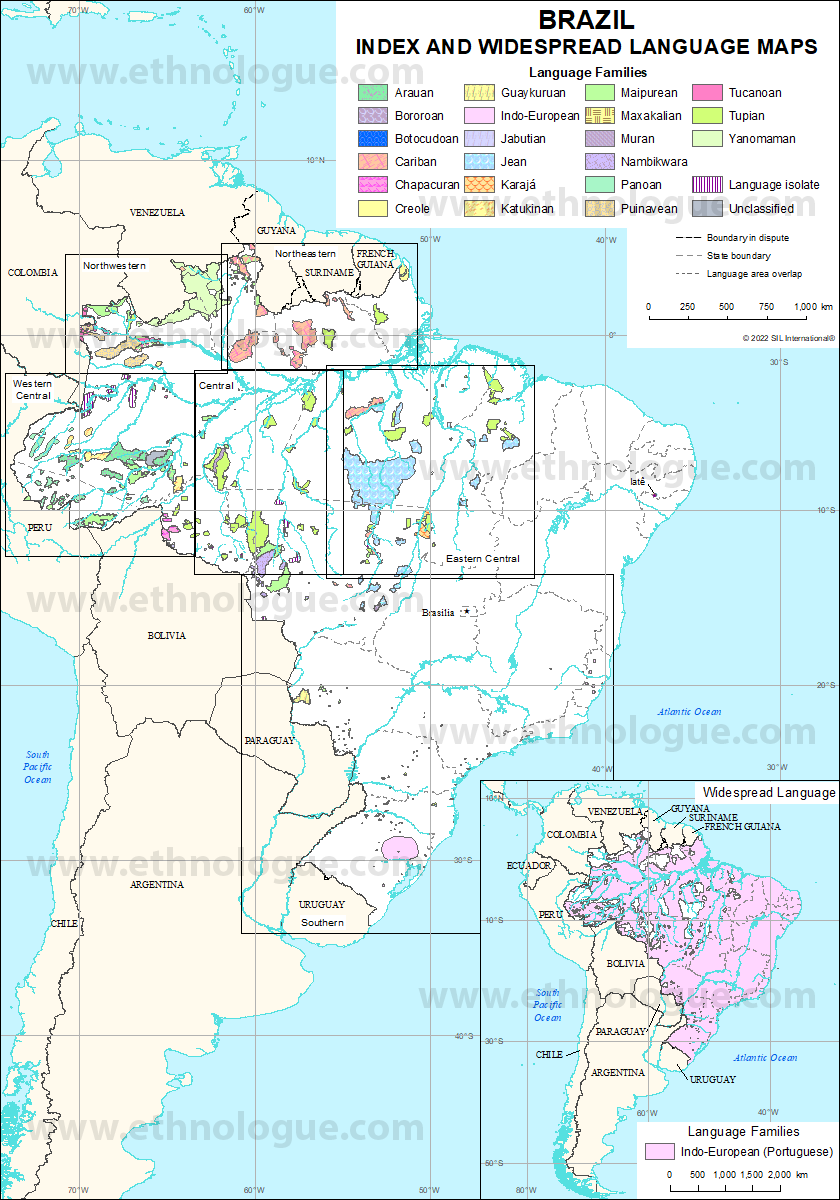
Central Brazil
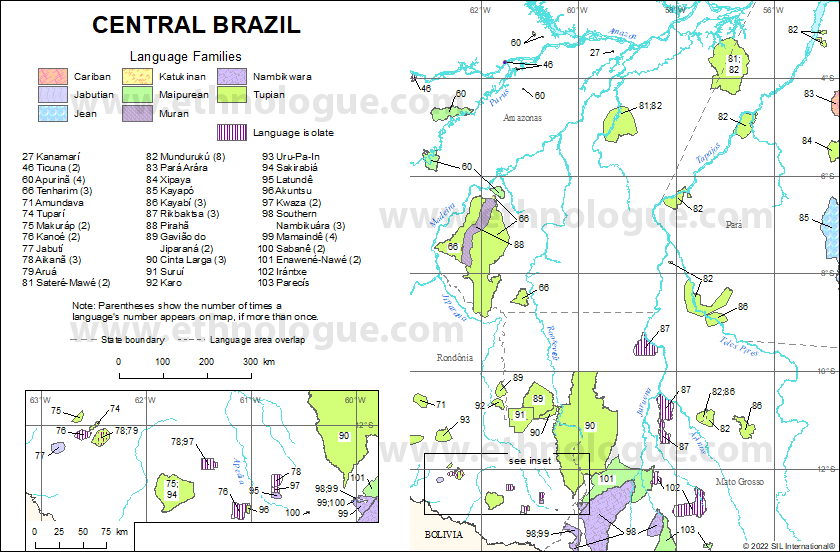
Eastern Central Brazil
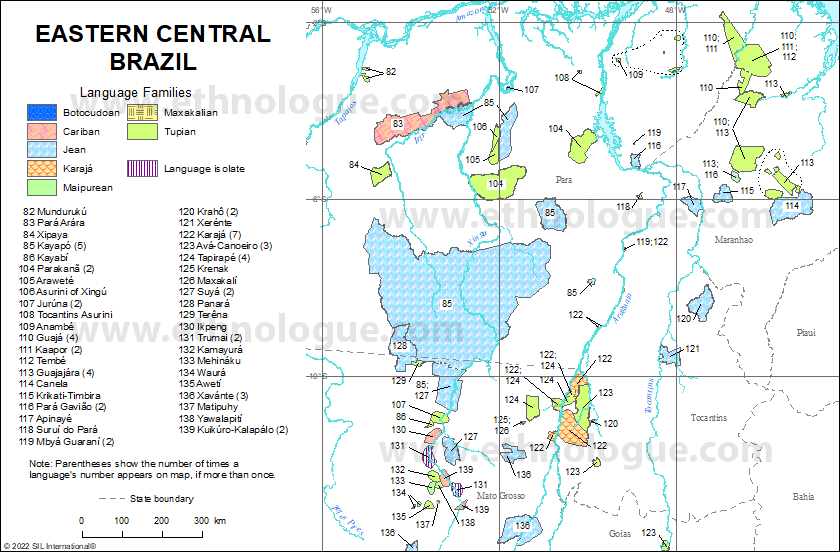
Northeastern Brazil
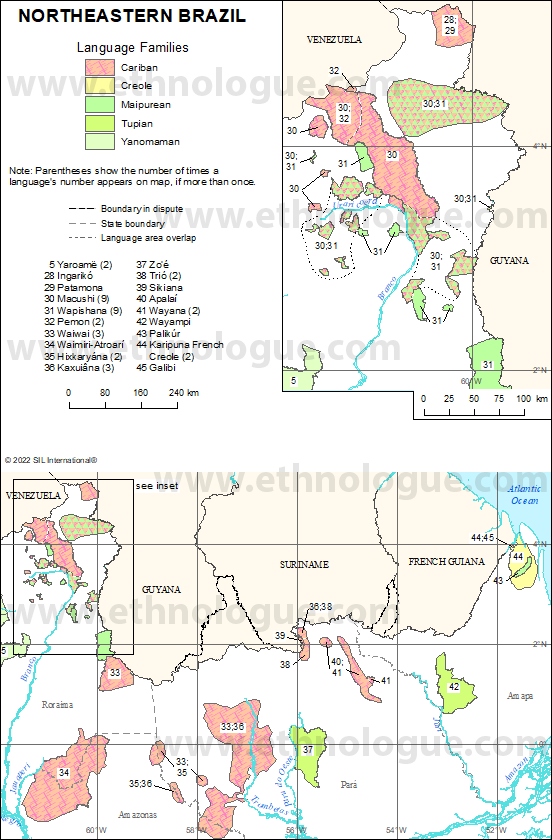
Northwestern Brazil
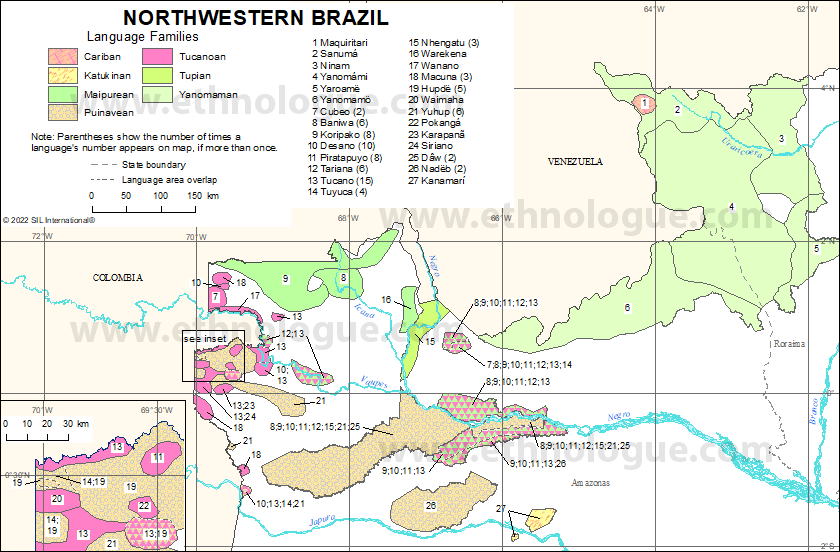
Southern Brazil
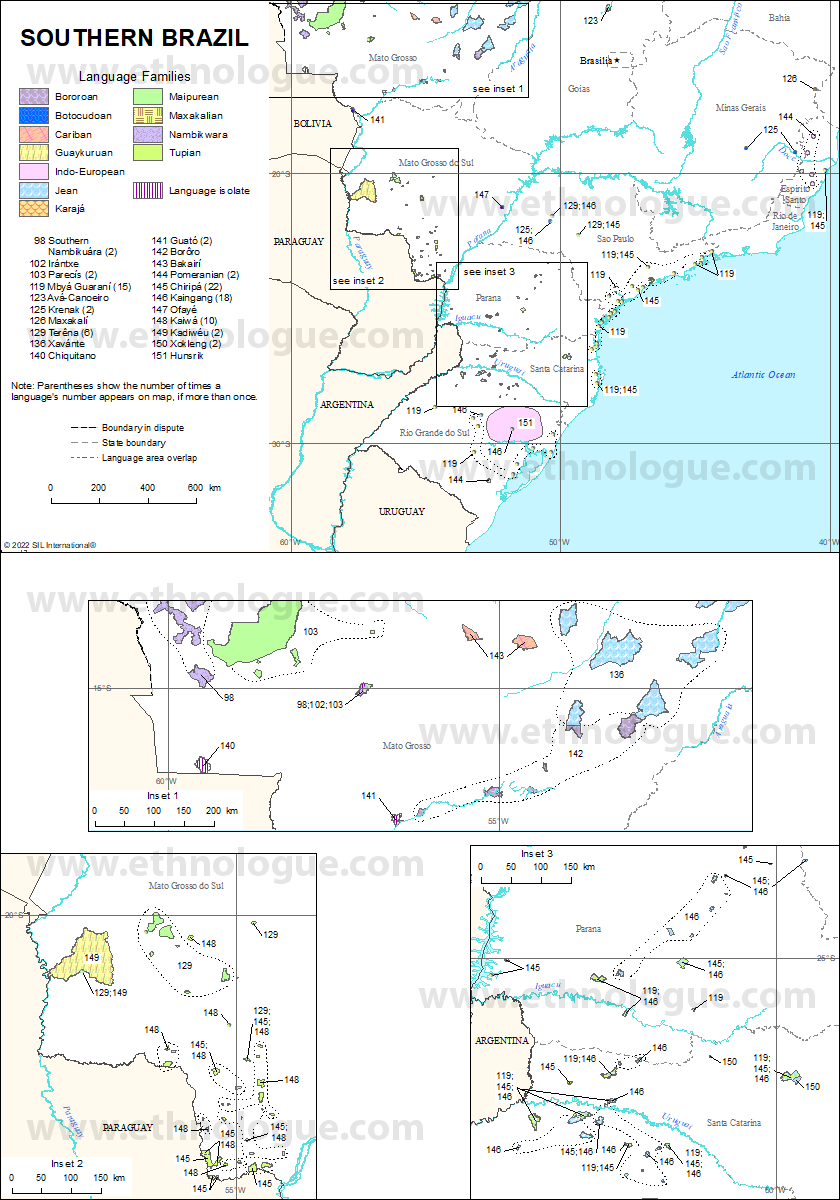
Western Central Brazil
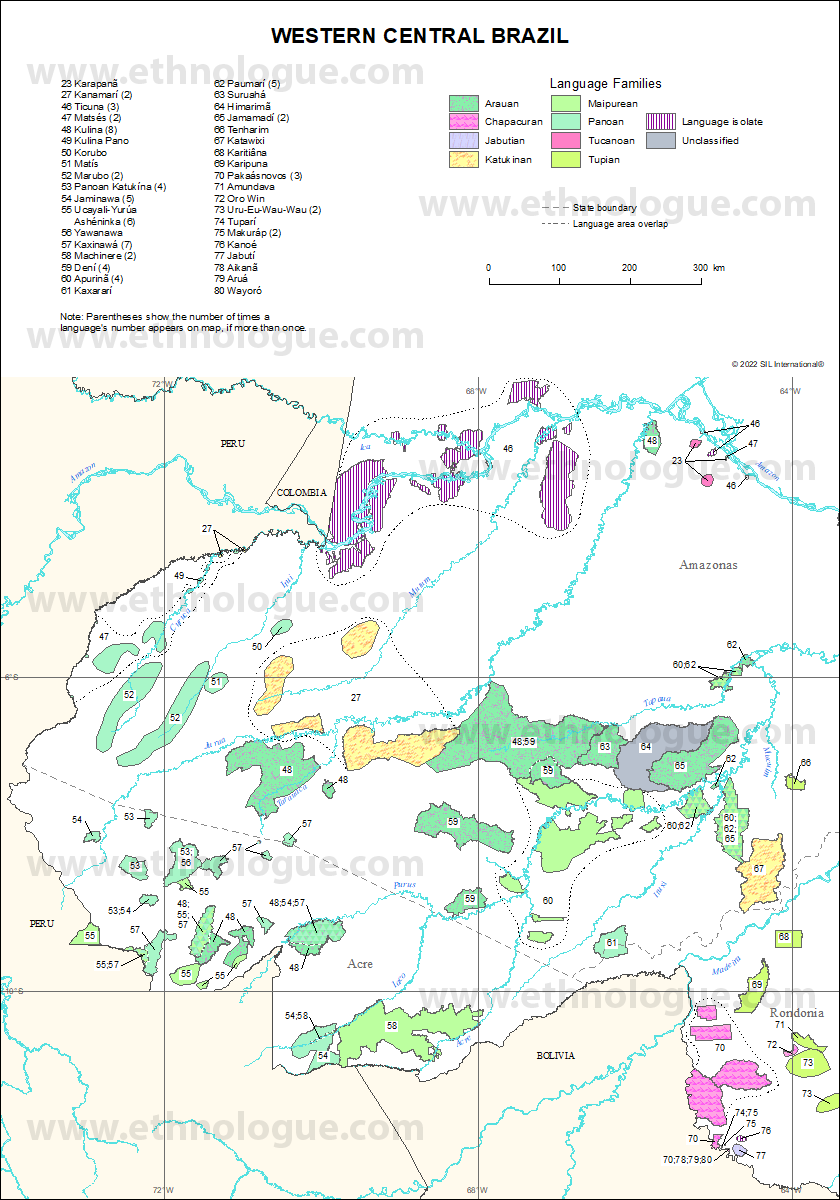
Graphs
Language Vitality Profile
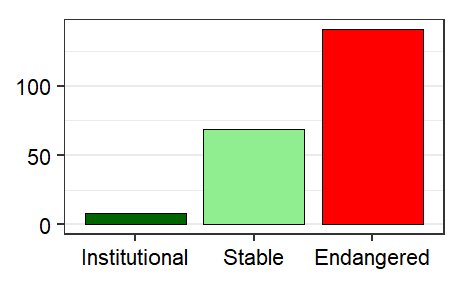
Full explanation
Language Status Profile
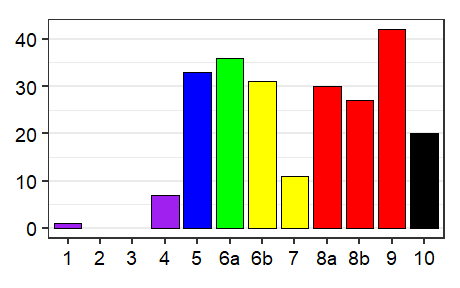
Full explanation
Resources
View Terms
Each Ethnologue country digest is a licensed product with restricted terms of use. Before downloading the product, you must agree to the following terms:
- This is a license for individual use. Just as with a conventionally published book, it is a violation of copyright to make a copy and give it to others.
- You may not redistribute this work in any form, including ingesting the contents into a database that is shared with others or posting it on a web site (whether public or private).
To inquire about permission for reuse or redistribution, please use the Contact Us form in the footer.
Digest of the languages of Brazil ($399.95, 128 page PDF)