
BZ
Belize
Summary
- Official Name
- Population
- 404,900
- Principal Languages
- English
- Literacy Rate
- 83% (Roser and Ortiz-Ospina 2018)
- International Conventions
- CDE (1960), CPPDCE (2006), CSICH (2012), ICCPR (1966), UNCRPD (2006), UNDRIP (2007)
- Deaf Population
- 3,000
- Language Counts
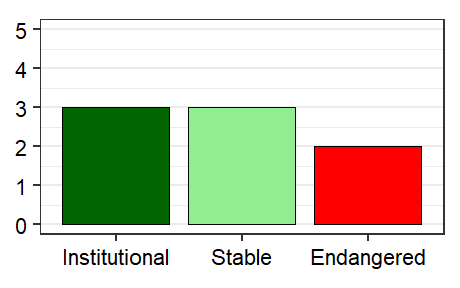
- The number of established languages listed for Belize is 8. All are living languages. Of these, 5 are indigenous and 3 are non-indigenous. Furthermore, 3 are institutional, 1 is developing, 2 are vigorous, and 2 are in trouble. Also listed are 3 unestablished languages.
Languages
- American Sign Language ase
- Users: 3,000 in Belize (2011 L. Parks). Estimated population 3,000 (2011 L. Parks), approximately 0.7% of the total population. Another estimate, assuming 0.2%–0.4%: 800–1,600 (2021 DBS/DOOR/SIL). Status: Unestablished. Alternate Names: ASL, Belize Sign Language, Belizean Sign Language Classification: Sign language, Deaf community sign language
- Belize English Creole bzj
- Widespread, including communities on Ambergris and Caulker cayes. Users: 130,000 in Belize (2014 UNSD). Total users in all countries: 170,000. Status: 3 (Wider communication). Developed and grew between 1650 and 1930 as a result of the slave trade. Lingua franca of Belize. L1 of some Garifunas, Mestizos, Maya and other ethnic groups. Alternate Names: Belize Kriol English, Miskito Coast English Creole, Western Caribbean Creole Autonym: Kriol Classification: Creole, English based, Atlantic, Western
- Chinese zho
- Users: 2,600 in Belize (2013 census). Status: Unestablished.
- English eng
- Widespread. Users: 240,000 in Belize, all users. L1 users: 184,000 in Belize (2014 UNSD). L2 users: 56,000 (Crystal 2003a). Status: 1 (National). De facto national language. Classification: Indo-European, Germanic, West, English
- Garifuna cab
- Belize, Stann Creek, and Toledo districts: 6 villages. Users: 8,440 in Belize (2014 UNSD). Ethnic population: 15,100 (2013 census). Status: 6b (Threatened). Alternate Names: Caribe, Central American Carib, Garínagu, “Black Carib” (pej.), “Moreno” (pej.) Classification: Maipurean, Northern, Maritime, Ta-Maipurean, Iñeri
- Kekchí kek
- Southwest corner, inland following east slopes, Maya Mountains, Toledo and Stann Creek districts; also in Cayo District, Belmopan area. Users: 17,600 in Belize (2014 UNSD). Status: 6a* (Vigorous). Alternate Names: Cacché, Ketchi, Kʼeqchi’, Q’eqchi’, Quecchí Classification: Mayan, Yucatecan-Core Mayan, K’ichean-Mamean, K’ichean
- Maya, Mopán mop
- Cayo, Stann Creek, and Toledo districts: highlands. Users: 10,600 in Belize (2014 UNSD). Total users in all countries: 12,610. Status: 5* (Developing). Alternate Names: Mopan, Mopane Autonym: Maya Mopán Classification: Mayan, Yucatecan-Core Mayan, Yucatecan, Mopan-Itzá
- Maya, Yucatec yua
- Cayo district: San Antonio and Succoths; possibly also Corozal and Orange Walk districts near the Mexico border. Users: 2,520 in Belize (2014 UNSD). Status: 6b (Threatened). Alternate Names: Maaya, Maaya t’aan, Maayáa, Maya, Yucantán Maya, Yucateco Classification: Mayan, Yucatecan-Core Mayan, Yucatecan, Yucatec-Lacandon
- Plautdietsch pdt
- Cayo and Orange Walk districts: inland. Users: 9,360 in Belize (2014 UNSD). Status: 6a* (Vigorous). Alternate Names: German, Mennonite German Classification: Indo-European, Germanic, West, Low Saxon-Low Franconian, Low Saxon
- Sindhi snd
- Users: 1,200 in Belize (2011). Status: Unestablished. Classification: Indo-European, Indo-Iranian, Indo-Aryan, Outer Languages, Northwestern, Sindhi
- Spanish spa
- Corozal, Orange Walk, and Cayo districts. Users: 201,000 in Belize, all users. L1 users: 165,000 in Belize (2014 UNSD). L2 users: 36,000 (Instituto Cervantes 2019). Status: 3 (Wider communication). Alternate Names: Castellano, Español Classification: Indo-European, Italic, Romance, Italo-Western, Western, Gallo-Iberian, Ibero-Romance, West Iberian, Castilian
Languages by Status
English
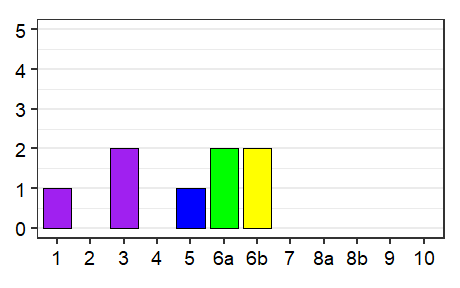
[eng] 1 (National). De facto national language. 240,000 in Belize, all users. L1 users: 184,000 in Belize (2014 UNSD). L2 users: 56,000 (Crystal 2003a).
Belize English Creole
[bzj] 3 (Wider communication). Developed and grew between 1650 and 1930 as a result of the slave trade. Lingua franca of Belize. L1 of some Garifunas, Mestizos, Maya and other ethnic groups. 130,000 in Belize (2014 UNSD). Total users in all countries: 170,000.
Spanish
[spa] 3 (Wider communication). 201,000 in Belize, all users. L1 users: 165,000 in Belize (2014 UNSD). L2 users: 36,000 (Instituto Cervantes 2019).
Maya, Mopán
[mop] 5* (Developing). 10,600 in Belize (2014 UNSD). Total users in all countries: 12,610.
Kekchí
[kek] 6a* (Vigorous). 17,600 in Belize (2014 UNSD).
Plautdietsch
[pdt] 6a* (Vigorous). 9,360 in Belize (2014 UNSD).
Garifuna
[cab] 6b (Threatened). 8,440 in Belize (2014 UNSD). Ethnic population: 15,100 (2013 census).
Maya, Yucatec
[yua] 6b (Threatened). 2,520 in Belize (2014 UNSD).
American Sign Language
[ase] Unestablished. 3,000 in Belize (2011 L. Parks). Estimated population 3,000 (2011 L. Parks), approximately 0.7% of the total population. Another estimate, assuming 0.2%–0.4%: 800–1,600 (2021 DBS/DOOR/SIL).
Chinese
[zho] Unestablished. 2,600 in Belize (2013 census).
Sindhi
[snd] Unestablished. 1,200 in Belize (2011).
Maps
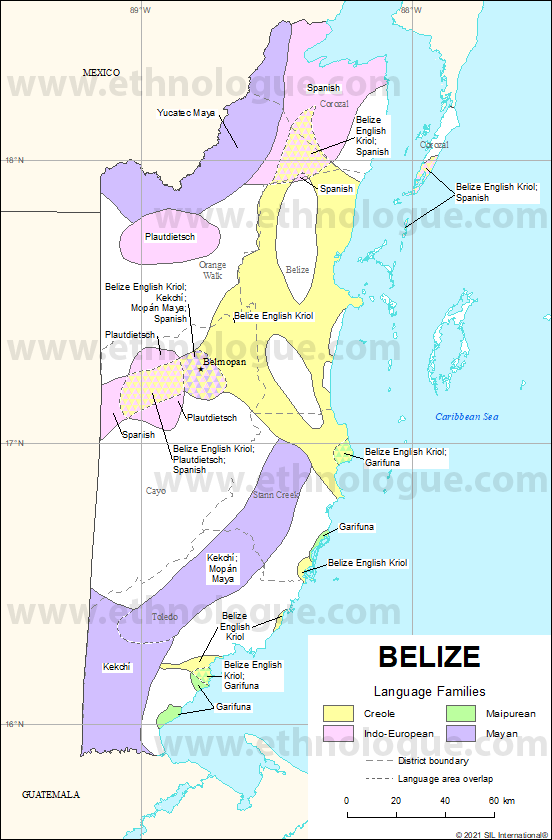
Belize
Graphs
Language Vitality Profile
Full explanation
Language Status Profile
Full explanation
Resources
View Terms
Each Ethnologue country digest is a licensed product with restricted terms of use. Before downloading the product, you must agree to the following terms:
- This is a license for individual use. Just as with a conventionally published book, it is a violation of copyright to make a copy and give it to others.
- You may not redistribute this work in any form, including ingesting the contents into a database that is shared with others or posting it on a web site (whether public or private).
To inquire about permission for reuse or redistribution, please use the Contact Us form in the footer.
Digest of the languages of Belize ($149.95, 21 page PDF)