
CA
Canada
Summary
- Official Name
- Population
- 38,666,000
- Principal Languages
- English, French
- Literacy Rate
- 99% (Roser and Ortiz-Ospina 2018)
- International Conventions
- CPPDCE (2006), ICCPR (1966), UNCRPD (2006), UNDRIP (2007)
- General References
- Campbell 1997, Campbell and King 2011, Chafe 1962, Chafe 1965, Golla 2007, Harrison and Marmen 1996
- Deaf Population
- 1,704,500
- Recognized Nationalities
- The constitution of Canada recognizes three categories of indigenous peoples: Indians (now referred to as First Nations), Inuit and Métis. The government department of Indigenous and Northern Affairs Canada (INAC) maintains a listing of over 600 officially recognized First Nation communities who are eligible for government services.
- Language Counts
- The number of established languages listed for Canada is 103. Of these, 99 are living and 4 are extinct. Of the living languages, 82 are indigenous and 17 are non-indigenous. Furthermore, 4 are institutional, 11 are developing, 1 is vigorous, 34 are in trouble, and 49 are dying. Also listed are 96 unestablished languages and 5 macrolanguages.
Languages
- Abenaki, Western abe
- Quebec province: Odanak Reserve on Saint Francois river. Users: 10 in Canada (Golla 2007). Total users in all countries: 14. Status: 8b (Nearly extinct). Language of recognized indigenous peoples: Odanak, Première Nation des Abénakis de Wôlinak. Alternate Names: Abenaki, Abenaqui, Alnombak, Saint Francis, Western Abnaki Autonym: Alnôbak Classification: Algic, Algonquian, Eastern Algonquian, Abenaki
- Afrikaans afr
- Users: 10,300 in Canada (2016 census). Status: Unestablished. Classification: Indo-European, Germanic, West, Low Saxon-Low Franconian, Low Franconian
- Akan aka
- Users: 13,500 in Canada (2016 census). Status: Unestablished. Classification: Niger-Congo, Atlantic-Congo, Volta-Congo, Kwa, Nyo, Potou-Tano, Tano, Central, Akan
- Algonquin alq
- Quebec province: northwest of Ottawa, and Maniwaki; Ontario province: Golden Lake. Users: 1,760 (2011 census), decreasing. 180 monolinguals. Ethnic population: 5,000 (1987 SIL). Status: 6b (Threatened). Language of recognized indigenous peoples: Algonquins of Barriere Lake, Algonquins of Pikwakanagan, Anishnaabeg of Naongashiing, Atikameksheng Anishnawbek, Communauté anicinape de Kitcisakik, Conseil de la Première Nation Abitibiwinni, Dokis, Kebaowek, Kitigan Zibi Anishinabeg, Long Point, Nation Anishnabe du Lac Simon, Nipissing, Timiskaming, Wahgoshig, Wolf Lake. Alternate Names: Algonkin Autonym: Anicinàbemowin Classification: Algic, Algonquian, Ojibwa-Potawatomi
- American Sign Language ase
- Scattered. English-speaking areas of Canada. Users: 38,000 in Canada (2021 DBS/DOOR/SIL). Estimated based on 0.1% of the total population. Other estimates vary widely: 3,660 (2011 census), 357,000 (2015 Canadian Association of the Deaf). Status: 5 (Developing). Alternate Names: ASL, Ameslan Classification: Sign language, Deaf community sign language
- Amharic amh
- Users: 22,500 in Canada (2016 census). Status: Unestablished. Classification: Afro-Asiatic, Semitic, South, Ethiopian, South, Transversal, Amharic-Argobba
- Arabic, Algerian Spoken arq
- Users: 40,200 in Canada (2016). Total Arabic speakers in Canada: 420,000 (2016 census). Status: Unestablished. Classification: Afro-Asiatic, Semitic, Central, South, Arabic
- Arabic, Egyptian Spoken arz
- Users: 21,900 in Canada (2016). Total Arabic speakers in Canada: 420,000 (2016 census). Status: Unestablished. Classification: Afro-Asiatic, Semitic, Central, South, Arabic
- Arabic, Gulf Spoken afb
- Users: 46,100 in Canada (2016). Total Arabic speakers in Canada: 420,000 (2016 census). Status: Unestablished. Classification: Afro-Asiatic, Semitic, Central, South, Arabic
- Arabic, Judeo-Moroccan aju
- Users: 2,960 in Canada (2016). Total Arabic speakers in Canada: 420,000 (2016 census). Status: Unestablished. Classification: Afro-Asiatic, Semitic, Central, South, Arabic
- Arabic, Libyan Spoken ayl
- Users: 3,310 in Canada (2016). Total Arabic speakers in Canada: 420,000 (2016 census). Status: Unestablished. Classification: Afro-Asiatic, Semitic, Central, South, Arabic
- Arabic, Mesopotamian Spoken acm
- Users: 42,600 in Canada (2016). Total Arabic speakers in Canada: 420,000 (2016 census). Status: Unestablished. Classification: Afro-Asiatic, Semitic, Central, South, Arabic
- Arabic, Moroccan Spoken ary
- Users: 62,100 in Canada (2016). Total Arabic speakers in Canada: 420,000 (2016 census). Status: Unestablished. Classification: Afro-Asiatic, Semitic, Central, South, Arabic
- Arabic, Najdi Spoken ars
- Users: 3,310 in Canada (2016). Total Arabic speakers in Canada: 420,000 (2016 census). Status: Unestablished. Classification: Afro-Asiatic, Semitic, Central, South, Arabic
- Arabic, North Levantine Spoken apc
- Users: 135,000 in Canada (2016). Total Arabic speakers in Canada: 420,000 (2016 census). Status: Unestablished. Classification: Afro-Asiatic, Semitic, Central, South, Arabic
- Arabic, Sanaani Spoken ayn
- Users: 3,960 in Canada (2016). Total Arabic speakers in Canada: 420,000 (2016 census). Status: Unestablished. Classification: Afro-Asiatic, Semitic, Central, South, Arabic
- Arabic, South Levantine Spoken ajp
- Users: 34,900 in Canada (2016). Total Arabic speakers in Canada: 420,000 (2016 census). Status: Unestablished. Classification: Afro-Asiatic, Semitic, Central, South, Arabic
- Arabic, Sudanese Spoken apd
- Users: 7,690 in Canada (2016). Total Arabic speakers in Canada: 420,000 (2016 census). Status: Unestablished. Classification: Afro-Asiatic, Semitic, Central, South, Arabic
- Arabic, Tunisian Spoken aeb
- Users: 15,400 in Canada (2016). Total Arabic speakers in Canada: 420,000 (2016 census). Status: Unestablished. Classification: Afro-Asiatic, Semitic, Central, South, Arabic
- Armenian, Western hyw
- Ontario: Ottawa and Toronto; Quebec: Montreal; British Columbia: Vancouver. Users: 33,500 in Canada (2016 census). Status: 5* (Developing). Classification: Indo-European, Armenian
- Assiniboine asb
- Saskatchewan province: part of Carry-the-Kettle, Mosquito-Grizzly Bear’s Head, and Whitebear. Users: 150 in Canada (Golla 2007). This is the total of L1 speakers for Canada and the United States. Ethnic population: 3,500 in Canada and the United States (Golla 2007). Status: 8a (Moribund). Language of recognized indigenous peoples: Carry The Kettle, Mosquito-Grizzly Bear’s Head-Lean Man, Ocean Man, Pheasant Rump Nakota. Alternate Names: Assiniboin, Nakhoda, Nakhona, Nakhota, Nakhóda, Nakhóna, Nakhóta, Nakoda, Nakon, Nakona, Nakota Classification: Siouan-Catawban, Siouan, Mississippi Valley-Ohio Valley Siouan, Mississippi Valley Siouan, Dakota
- Assyrian Neo-Aramaic aii
- Users: 16,100 in Canada (2016 census). Ethnic population: 38,000. Status: Unestablished. Classification: Afro-Asiatic, Semitic, Central, Aramaic, Eastern, Central, Northeastern
- Atikamekw atj
- Quebec province: between La Tuque and Senneterre, 200–400 km north of Montreal, along the upper reaches of Saint Maurice river, 3 isolated communities on Manuane, Obedjiwan, and Weymontachie reservations. Users: 6,160 (2016 census). Status: 5 (Developing). Language of recognized indigenous peoples: Atikamekw d’Opitciwan, Conseil des Atikamekw de Wemotaci, Les Atikamekw de Manawan. Alternate Names: Atihkamekw, Atikamek, Attikamek, Attimewk, Tête de Boule Autonym: Atikamekw Classification: Algic, Algonquian, Cree-Montagnais
- Azerbaijani, South azb
- Users: 3,260 in Canada (2016 census). Census does not distinguish between South Azerbaijani [azb] and North Azerbaijani [azj]. Status: Unestablished. Classification: Turkic, Southern, Azerbaijani
- Babine bcr
- British Columbia province: scattered. Bulkley river and Burns lake areas(Wetsuset’en dialect); Lake Babine and Takla Lake communities (Babine Proper dialect). Users: 430 (FPCC 2014). 295 semi-speakers (FPCC 2014). 100 fluent speakers and 100 passive speakers of Wetsuwet’en. 200 speakers of all degrees of fluency of Babine Proper (Golla 2007). Ethnic population: 3,410 (FPCC 2014). Status: 7 (Shifting). Language of recognized indigenous peoples: Burns Lake, Hagwilget Village, Lake Babine, Nee-Tahi-Buhn, Skin Tyee, Takla Lake, Wet’suwet’en, Witset, Yekooche. Alternate Names: Babine Carrier, Lake Babine, Nadot’en, Nat’oot’en, Northern Carrier Autonym: Nedut’en Classification: Eyak-Athabaskan, Athabaskan, Northern Athabaskan
- Beaver bea
- British Columbia and Alberta provinces: Chateh (Assumption) on Hay river, and Prophet river south of Fort Nelson. Users: 160 (FPCC 2014). 450 semi-speakers (FPCC 2014). Ethnic population: 1,560 (FPCC 2014). Status: 8a (Moribund). Language of recognized indigenous peoples: Beaver, Blueberry River, Doig River, Halfway River, Horse Lake, Prophet River, Saulteau, West Moberly. Alternate Names: Castor, Dane-zaa, Dane-zaa Záágé, Danezaa, Dunne-za, Dunneza Autonym: Danezaa ZaageɁ (Danezaa Zaage) Classification: Eyak-Athabaskan, Athabaskan, Northern Athabaskan
- Bella Coola blc
- British Columbia province: Burke channel head, North Bentinck arm, Bella Coola river mouth. Users: 17 (FPCC 2014). 510 semi-speakers (FPCC 2014). Ethnic population: 1,660 (FPCC 2014). Status: 8b (Nearly extinct). Language of recognized indigenous peoples: Nuxalk. Alternate Names: Nuxalk Classification: Salish
- Bengali ben
- Users: 73,100 in Canada (2016 census). Status: Unestablished. Classification: Indo-European, Indo-Iranian, Indo-Aryan, Outer Languages, Eastern, Bengali-Assamese
- Beothuk bue
- Newfoundland and Labrador: Newfoundland island. Users: No known L1 speakers. Shanawdithit, the last speaker, died in 1829. Status: 10 (Extinct). Alternate Names: Beothukan Classification: Unclassified
- Blackfoot bla
- Alberta province: Blackfoot, Blood, and Piegan reserves. Users: 2,820 in Canada (2016 census), decreasing. Few monolinguals. Ethnic population: 15,000. Total users in all countries: 2,920. Status: 7 (Shifting). Language of recognized indigenous peoples: Blood, Piikani, Siksika. Alternate Names: Blackfeet, Niitsipowahsin, Pied Noir Autonym: Siksiká Classification: Algic, Algonquian
- Bosnian bos
- Users: 12,200 in Canada (2016 census). Status: Unestablished. Classification: Indo-European, Balto-Slavic, Slavic, South, Western
- Bulgarian bul
- Users: 20,000 in Canada (2016 census). Status: Unestablished. Classification: Indo-European, Balto-Slavic, Slavic, South, Eastern
- Burmese mya
- Users: 3,590 in Canada (2016 census). Status: Unestablished. Classification: Sino-Tibetan, Tibeto-Burman, Ngwi-Burmese, Burmish, Southern
- Carrier crx
- British Columbia province: Stuart and Trembleur lake area. Users: 680 (FPCC 2014). 1,380 semi-speakers (FPCC 2014). Ethnic population: 9,350 (FPCC 2014). Status: 7 (Shifting). Language of recognized indigenous peoples: Burns Lake, Cheslatta Carrier, Lheidli T’enneh, Lhoosk’uz Dene, Lhtako Dene, Nadleh Whuten, Nak’azdli Whut’en, Nazko, Saik’uz, Stellat’en, Takla Lake, Tl’azt’en, Toosey, Ulkatcho, Yekooche. Alternate Names: Central Carrier, Porteur, Takelne, Takulie Autonym: Dakelh, Dakelhne Classification: Eyak-Athabaskan, Athabaskan, Northern Athabaskan, Carrier
- Carrier, Southern caf
- British Columbia province: west of Quesnel and south of Cheslatta lake, Anahim Lake-Ulkatcho, toward the Fraser river and tributaries. Users: 500 (1987 SIL). 2,060 identified in 2001. Census does not separate Babine [bcr], Central Carrier [crx], and Southern Carrier. All Athapaskan L1 speakers in Canada 17,400 (2016 census). Status: 8a (Moribund). Autonym: Dakelh Classification: Eyak-Athabaskan, Athabaskan, Northern Athabaskan, Carrier
- Cayuga cay
- Ontario province: Grand River, Six Nations Reserve. Users: 40 in Canada (2016 census). Ethnic population: 3,000 (Yamamoto 2007). Total users in all countries: 46. Status: 8a (Moribund). Language of recognized indigenous peoples: Lower Cayuga, Six Nations of the Grand River, Upper Cayuga. Autonym: Gayogo̱hó:nǫ’ Classification: Iroquoian, Northern Iroquoian, Five Nations-Huronian-Susquehannock, Five Nations-Susquehannock
- Cebuano ceb
- Users: 19,900 in Canada (2016 census). Status: Unestablished. Classification: Austronesian, Malayo-Polynesian, Greater Central Philippine, Central Philippine, Bisayan, Cebuan
- Chaldean Neo-Aramaic cld
- Users: 5,550 in Canada (2016 census). Status: Unestablished. Classification: Afro-Asiatic, Semitic, Central, Aramaic, Eastern, Central, Northeastern
- Chilcotin clc
- British Columbia province: west of Williams Lake. 7 reserve communities: Alexandria, Anahim, Nemiah, Redstone, Stone, Toosey, Ulkatcho. Users: 860 (FPCC 2014). 760 semi-speakers (FPCC 2014). 100 monolinguals. Ethnic population: 4,350 (FPCC 2014). Status: 7 (Shifting). Language of recognized indigenous peoples: Alexis Creek, Tl’etinqox Government, Toosey, Xeni Gwet’in First Nations Government, Yunesit’in Government. Alternate Names: Nenqayni Ch’ih, Tsilhqút’ín, Tzilkotin Autonym: Tŝinlhqot’in Classification: Eyak-Athabaskan, Athabaskan, Northern Athabaskan
- Chinese, Hakka hak
- Users: 10,900 in Canada (2016 census). Status: Unestablished. Classification: Sino-Tibetan, Chinese
- Chinese, Mandarin cmn
- British Columbia: Vancouver area; Ontario: Toronto area. Users: 592,000 in Canada (2016 census). Status: 5* (Dispersed). Classification: Sino-Tibetan, Chinese
- Chinese, Min Nan nan
- Users: 31,800 in Canada (2016 census). Status: Unestablished. Classification: Sino-Tibetan, Chinese
- Chinese, Wu wuu
- Users: 12,900 in Canada (2016 census). Status: Unestablished. Classification: Sino-Tibetan, Chinese
- Chinese, Yue yue
- British Columbia: Vancouver area; Ontario: Toronto area. Users: 565,000 in Canada (2016 census). Status: 4 (Educational). Alternate Names: Guangfu Classification: Sino-Tibetan, Chinese
- Chinook Wawa chn
- British Columbia. Users: No known L1 speakers in Canada (Wurm et al 1996). A total of 1,000 L2 speakers in both Canada and the United States (Grant 2013). The last speaker died in the mid-1970s. Status: 9 (Dormant). Alternate Names: Chinook Jargon, Chinook Pidgin, Chinuk Wawa, Jargon Classification: Pidgin, Amerindian
- Clallam clm
- British Columbia province: southern Vancouver island, Becher Bay Reserve. Users: No known L1 speakers in Canada. Status: 9 (Dormant). Alternate Names: Klallam, Na’klallam, S’klallam Classification: Salish, Central Salish
- Comox coo
- British Columbia, Vancouver Island, and coast north of Powell river. Users: 36 (FPCC 2014). 710 semi-speakers (FPCC 2014). Ethnic population: 1,900 (FPCC 2014). Status: 8a (Moribund). Language of recognized indigenous peoples: Homalco, K’ómoks, Klahoose, Tla’amin. Alternate Names: Comox-Sliammon Classification: Salish, Central Salish
- Cree cre
- Users: Population total all languages (L1 only): 10,875. Status:
- Cree, Moose crm
- Southern tip of James Bay, Moosonee, Ontario. Moose Cree, East Cree [crl] and [crj], and Swampy Cree [csw] reside in this community and surrounding area (Moose Factory, Ontario). Users: 3,000 (Golla 2007). Ethnic population: 5,000 (1982 SIL). Status: 6b* (Threatened). Language of recognized indigenous peoples: Brunswick House, Chapleau Cree, Flying Post, Matachewan, Missanabie Cree, Moose Cree, Taykwa Tagamou, Wahgoshig. Alternate Names: Cri de Moose, West Main Cree, West Shore Cree, York Cree Autonym: ᐃᓕᓖᒧᐧᐃᓐ (ililîmowin) Classification: Algic, Algonquian, Cree-Montagnais
- Cree, Northern East crl
- West central Quebec, east coast of lower Hudson Bay and James Bay; some speakers likely on Nunavut islands in James Bay; Whapmagoostui, Chisasibi, Wemindji, and most in Eastmain communities. Users: 320 (2016 census). Status: 5* (Developing). Language of recognized indigenous peoples: Cree Nation of Chisasibi, Cree Nation of Wemindji, Première nation de Whapmagoostui. Alternate Names: Cri du Nord-Est, East Cree, East Main Cree, Eastern James Bay Cree Northern Dialect, James Bay Cree, James Bay Cree Northern Autonym: Iyiyiw-Ayimiwin, ᐄᔨᔫ ᐊᔨᒨᓐ (Īyiyū Ayimūn) Classification: Algic, Algonquian, Cree-Montagnais
- Cree, Plains crk
- North central Manitoba, scattered west across Saskatchewan and central Alberta to the foot of the Rocky Mountains; isolated enclave in British Columbia. Users: 3,070 in Canada (2016 census). Total users in all countries: 3,170. Status: 5 (Developing). Statutory language of provincial identity in NWT (1988, NWT Official Languages Act, Chapter 56 (Supplemented), Section 4), restricted official use. Language of recognized indigenous peoples: Ahtahkakoop, Alexander, Beardy’s and Okemasis, Big Island Lake Cree, Big River, Bigstone Cree, Blueberry River, Canoe Lake Cree, Chiniki, Driftpile Cree, Enoch Cree, Ermineskin Tribe, Flying Dust, Fort Nelson, Frog Lake, George Gordon, James Smith, Kahkewistahaw, Kawacatoose, Kehewin Cree, Little Pine, Little Red River Cree, Loon River Cree, Louis Bull, Lubicon Lake, Lucky Man, Makwa Sahgaiehcan, Mikisew Cree, Ministikwan Lake Cree, Mistawasis Nêhiyawak, Montana, Moosomin, Muskeg Lake Cree, Muskoday, Ochapowace, Okanese, One Arrow, Onion Lake Cree, Pasqua, Paul, Peepeekisis Cree, Pelican Lake, Pheasant Rump Nakota, Piapot, Poundmaker, Red Pheasant, Saddle Lake Cree, Samson, Sapotaweyak Cree, Saulteau, Sawridge, Stoney, Star Blanket Cree, Sturgeon Lake, Sunchild, Sweetgrass, Tallcree Tribal Government, Thunderchild, Waterhen Lake, Wesley, White Bear, Whitefish Lake, Witchekan Lake. Alternate Names: Cri des plaines, Nehiyaw, Western Cree Autonym: Nēhiyawēwin, ᓀᐦᐃᔭᐍᐏᐣ (nēhiyawēwin) Classification: Algic, Algonquian, Cree-Montagnais
- Cree, Southern East crj
- Quebec, southeastward from James Bay, inland to the watershed east of Lake Mistissini. Coastal communities of Waskaganish, some in Eastmain. Inland, in Mistissini, Waswanipi, Nemaska, Ouje-Bougoumo. Users: 45 (2016 census). Status: 8a (Moribund). Language of recognized indigenous peoples: Cree Nation of Mistissini, Cree Nation of Nemaska, Eastmain, Oujé-Bougoumou Cree, The Crees of the Waskaganish. Alternate Names: Cri du Sud-Est, Eastern James Bay Cree Southern Dialect, James Bay Cree Southern Dialect Autonym: Īnū Ayimūn, ᐄᓅ ᐊᔨᒨᓐ (Īnū Ayimūn) Classification: Algic, Algonquian, Cree-Montagnais
- Cree, Swampy csw
- Scattered communities, Ontario, Hudson Bay coast, James Bay northwest coast; inland into Manitoba, then Saskatchewan. Users: 2,500 (Golla 2007). Ethnic population: 2,800 (Golla 2007). Status: 6b* (Threatened). Language of recognized indigenous peoples: Albany, Attawapiskat, Chemawawin Cree, Cumberland House Cree, Fisher River, Fort Severn, Fox Lake, Gambler, God’s Lake, Manto Sipi Cree, Marcel Colomb, Mathias Colomb, Misipawistik Cree, Mosakahiken Cree, Norway House Cree, Okanese, Opaskwayak Cree, Peguis, Poplar River, Red Earth, Sapotaweyak Cree, Sawridge, Shamattawa, Shoal Lake Cree, Tataskweyak Cree, War Lake, Weenusk, Wuskwi Sipihk, York Factory. Alternate Names: Cri des marais, Inilîmowin, Maskekon, Moskégon, Omaškêkowak, Omushkego, West Main Cree, West Shore Cree, York Cree Autonym: ᓀᐦᐃᓇᐍᐏᐣ (nêhinawêwin) Classification: Algic, Algonquian, Cree-Montagnais
- Cree, Woods cwd
- Far north Manitoba into Saskatchewan, inland southwest from Churchill. Users: 1,840 (2016 census). Ethnic population: 53,000 (1982 SIL). Status: 6b* (Threatened). Language of recognized indigenous peoples: Barren Lands, Beaver Lake Cree, Bunibonibee Cree, Chemawawin Cree, Cross Lake Band of Indians, Duncan’s, Fort McKay, Fort McMurray, Lac La Ronge, Montreal Lake, Nisichawayasihk Cree, O-Pipon-Na-Piwin Cree, Peerless Trout, Peter Ballantyne Cree, Red Earth, Shoal Lake Cree, Sturgeon Lake Cree, Sucker Creek, Swan River, Woodland Cree. Alternate Names: Cri des bois Autonym: Nīhithawīwin, ᓀᐦᐃᖬᐍᐏᐣ (nīhithawīwin) Classification: Algic, Algonquian, Cree-Montagnais
- Croatian hrv
- Users: 48,200 in Canada (2016 census). Status: Unestablished. Classification: Indo-European, Balto-Slavic, Slavic, South, Western
- Czech ces
- Users: 22,300 in Canada (2016 census). Status: Unestablished. Classification: Indo-European, Balto-Slavic, Slavic, West, Czech-Slovak
- Dakota dak
- Manitoba: south; Saskatchewan: Oak River and Oak Lake, Long Plain west of Winnipeg, Standing Buffalo, Birdtail, Stony Wahpeton, and Moose Woods. May be at Wood Mountain Reserve. Users: 190 in Canada (2016 W. Meya), decreasing. 2,300 L1 speakers of all Sioux dialects in a total population of 175,000, of which 5,000 reside in Canada (2016 Lakota Language Consortium). Ethnic population: 5,000 (2016 Lakota Language Consortium). Includes all ethnic Sioux. Status: 8b (Nearly extinct). Language of recognized indigenous peoples: Birdtail Sioux, Canupawakpa Dakota, Dakota Plains, Dakota Tipi, Sioux Valley Dakota, Standing Buffalo, Wahpeton Dakota, White Bear, Whitecap Dakota. Alternate Names: Sioux Classification: Siouan-Catawban, Siouan, Mississippi Valley-Ohio Valley Siouan, Mississippi Valley Siouan, Dakota
- Danish dan
- Users: 12,600 in Canada (2016 census). Status: Unestablished. Classification: Indo-European, Germanic, North, East Scandinavian, Danish-Swedish, Danish-Riksmal, Danish
- Dene chp
- Northern Alberta, Saskatchewan, Manitoba, southeastern Northwest Territories (Snowdrift and Fort Resolution), Fort Smith, Fort Chipewyan, Wolliston Post, Buffalo Narrows, Brochet, and some communities in Reindeer Lake. Users: 10,700 (2016 census). Status: 6b* (Threatened). Recognized language (1988, NWT Official Languages Act, Chapter 56 (Supplemented), Section 4), restricted official use. Language of recognized indigenous peoples: Athabasca Chipewyan, Barren Lands, Birch Narrows, Black Lake, Buffalo River Dene, Chipewyan Prairie, Clearwater River Dene, Cold Lake, Deninu K’ue, English River, Fond du Lac, Fort McKay, Fort McMurray, Hatchet Lake, K’atlodeeche, Lutsel K’e Dene, Northlands Denesuline, Salt River, Sayisi Dene, Smith’s Landing, Yellowknives Dene. Alternate Names: Dëne Súline, “Chipewyan” (pej.) Autonym: Dënesųłıné Classification: Eyak-Athabaskan, Athabaskan, Northern Athabaskan
- Dinka, Southeastern dks
- Users: 2,120 in Canada (2016 census). Identified as Dinka in the census. Status: Unestablished. Classification: Nilo-Saharan, Satellite-Core, Core, Eastern Sudanic, Southern (n languages), Nilotic, Western, Dinka-Nuer, Dinka
- Ditidaht dtd
- British Columbia, Malachan Reserve, Nitinaht lake. Also previously used in Pacheedaht Territory in the vicinity of Port Renfrew, British Columbia. Users: 7 (FPCC 2014). 6 semi-speakers (FPCC 2014). Ethnic population: 940 (FPCC 2014). Status: 8b (Nearly extinct). Language of recognized indigenous peoples: Ditidaht. Alternate Names: Diidiitidq, Diitiid’aatx, Nitinaht, Nitinat Classification: Wakashan, Southern Wakashan
- Dutch nld
- Users: 103,000 in Canada (2016 census). Status: Unestablished. Classification: Indo-European, Germanic, West, Low Saxon-Low Franconian, Low Franconian
- English eng
- Users: 30,000,000 in Canada, all users. L1 users: 19,500,000 in Canada (2016 census). L2 users: 10,500,000 (2016 census). Status: 1 (National). Statutory national language (1988, Official Languages Act, Ch. 38, Articles 1, 34). Alternate Names: Anglais Classification: Indo-European, Germanic, West, English
- Estonian, Standard ekk
- Users: 5,450 in Canada (2016 census). Status: Unestablished. Classification: Uralic, Finnic
- Finnish fin
- Users: 15,300 in Canada (2016 census). Status: Unestablished. Classification: Uralic, Finnic
- French fra
- Québécois in Quebec; Franco-Ontarien in Ontario; Acadian on the east coast of New Brunswick, pockets in Nova Scotia and Prince Edward Island; Franco-Terreneuvien in Newfoundland. Some Québécois in Manitoba. Users: 11,060,000 in Canada, all users. L1 users: 7,170,000 in Canada (2016 census). 300,000 speak Acadien, 500,000 speak Franco-Ontarien, over 51,000 speak Franco-Manitoban. L2 users: 3,890,000 (Marcoux et al 2022). Status: 1 (National). Statutory national language (1988, Official Languages Act, Ch. 38, Articles 1, 34). Alternate Names: Français Classification: Indo-European, Italic, Romance, Italo-Western, Western, Gallo-Iberian, Gallo-Romance, Gallo-Rhaetian, Oïl, French
- Frisian fry
- Users: 2,100 in Canada (2016 census). Status: Unestablished. Classification: Indo-European, Germanic, West, Frisian
- German, Pennsylvania pdc
- Kitchener-Waterloo area, Ontario. Users: 15,000 in Canada (1995). Status: 5* (Developing). Alternate Names: Deitsch, Pennsilfaanisch Deitsch, Pennsylvania Dutch, Pennsylvanisch Classification: Indo-European, Germanic, West, High German, German, Middle German, West Middle German
- German, Standard deu
- Scattered. Users: 384,000 in Canada (2016 census). Status: 5* (Dispersed). Alternate Names: Allemand, Deutsch Classification: Indo-European, Germanic, West, High German, German, Middle German, East Middle German
- Gitxsan git
- West central British Columbia, Gitxsan, middle Skeena river. Users: 350 (FPCC 2014). 490 semi-speakers (FPCC 2014). Ethnic population: 7,600 (FPCC 2014). Status: 6b (Threatened). Language of recognized indigenous peoples: Gitanmaax, Gitanyow, Gitsegukla, Gitwangak, Glen Vowell, Kispiox, Lax Kw’alaams, Takla Lake. Alternate Names: Giklsan, Gitksan, Gitxsen, Gityskyan, Hazelton, Nass-Gitksan Autonym: Gitsenimx Classification: Tsimshian, Nass-Gitksan
- Greek ell
- Users: 107,000 in Canada (2016 census). Status: Unestablished. Classification: Indo-European, Greek, Attic
- Gujarati guj
- Users: 109,000 in Canada (2016 census). Status: Unestablished. Classification: Indo-European, Indo-Iranian, Indo-Aryan, Intermediate Divisions, Western, Gujarati
- Gwich’in gwi
- Northwest Territories: Aklavik, Inuvik, Tsiigehtchic, Fort McPherson; Yukon Territory: Old Crow. Users: 260 in Canada (2016 census). Ethnic population: 1,900 (Krauss 2007). Total users in all countries: 560. Status: 7 (Shifting). Statutory language of provincial identity in NWT (1988, NWT Official Languages Act, Chapter 56 (Supplemented), Section 4). Language of recognized indigenous peoples: Gwichya Gwich’in, Inuvik Native, Tetlit Gwich’in, Vuntut Gwitchin. Alternate Names: Kutchin, Loucheux, Takudh, Tukkuthkutchin, Tukudh Autonym: Dinju Zhuh K’yuu Classification: Eyak-Athabaskan, Athabaskan, Northern Athabaskan
- Haida hai
- Users: Population total all languages (L1 only): 13. Status:
- Haida, Northern hdn
- British Columbia province: Haida Gwaii islands, Masset village. Users: 2 in Canada (FPCC 2014). 7 semi-speakers (FPCC 2014). Ethnic population: 4,550 (FPCC 2014). Total users in all countries: 6. Status: 8b (Nearly extinct). Language of recognized indigenous peoples: Old Massett Village Council. Alternate Names: Masset, X̱aad Kíl, Xaad Kil Autonym: X̱aat Kíl Classification: Haida
- Haida, Southern hax
- British Columbia province: Haida Gwaii islands, Skidegate. Users: 7 (FPCC 2014). 6 semi-speakers (FPCC 2014). L2 users: 0. Ethnic population: 500 (Golla 2007). Status: 8b (Nearly extinct). Language of recognized indigenous peoples: Skidegate. Alternate Names: Xaaydaa Kil Classification: Haida
- Haisla has
- British Columbia province: Douglas Channel head, near Kitimat. Users: 240 (FPCC 2014). 21 semi-speakers (FPCC 2014). Ethnic population: 1,680 (FPCC 2014). Status: 7 (Shifting). Language of recognized indigenous peoples: Haisla. Alternate Names: Haishilla, Kitlope, Northern Kwakiutl, Xenaksialakala Classification: Wakashan, Northern Wakashan
- Haitian Creole hat
- Users: 3,040 in Canada (2016 census). Status: Unestablished. Classification: Creole, French based
- Halkomelem hur
- British Columbia province: small communities along lower Fraser river, on the east coast of Vancouver Island. Users: 260 in Canada (FPCC 2014). 990 semi-speakers (FPCC 2014). Ethnic population: 19,000 (FPCC 2014). Total users in all countries: 285. Status: 8a (Moribund). Language of recognized indigenous peoples: Aitchelitz, Beecher Bay, Chawathil, Cheam, Cowichan, Halalt, Katzie, Kwantlen, Kwaw-kwaw-Apilt, Lake Cowichan, Leq’ a: mel, Lyackson, Malahat, Matsqui, Musqueam, Nanoose, New Westminster, Penelakut Tribe, Peters, Popkum, Qualicum, Seabird Island, Shxw’ow’hamel, Shxwhá:y Village, Skawahlook, Skowkale, Skwah, Snuneymuxw, Soowahlie, Sq’éwlets, Squiala, Sts’ailes, Stz’uminus, Sumas, Tsawwassen, Tsleil-Waututh, Tzeachten, Union Bar, Yakweakwioose, Yale. Alternate Names: Holkomelem Classification: Salish, Central Salish
- Han haa
- Yukon territory: Dawson City. Users: 7 in Canada (Krauss 1997). Ethnic population: 300. Status: 8b (Nearly extinct). Language of recognized indigenous peoples: Tr’ondëk Hwëch’in. Alternate Names: Dawson, Han-Kutchin, Hän, Moosehide, Tr’ondëk Hwëch’in Classification: Eyak-Athabaskan, Athabaskan, Northern Athabaskan
- Hebrew heb
- Users: 19,500 in Canada (2016 census). Status: Unestablished. Classification: Afro-Asiatic, Semitic, Central, South, Canaanite
- Heiltsuk hei
- British Columbia province: Bella Bella and Kitasoo villages, Rivers Inlet area. Users: 66 (FPCC 2014). 50 semi-speakers; 6 remaining speakers of Oowekyala (FPCC 2014). Ethnic population: 2,530 (FPCC 2014). Status: 7 (Shifting). Language of recognized indigenous peoples: Heiltsuk, Wuikinuxv. Alternate Names: Hailhzaqvla Classification: Wakashan, Northern Wakashan, Kwakiutlan
- Hiligaynon hil
- Users: 6,880 in Canada (2016 census). Status: Unestablished. Classification: Austronesian, Malayo-Polynesian, Greater Central Philippine, Central Philippine, Bisayan, Central, Peripheral
- Hindi hin
- Users: 111,000 in Canada (2016 census). Status: Unestablished. Classification: Indo-European, Indo-Iranian, Indo-Aryan, Western Hindi, Hindustani
- Hungarian hun
- Users: 61,200 in Canada (2016 census). Status: Unestablished. Classification: Uralic
- Hutterisch geh
- Alberta, Manitoba, and Saskatchewan provinces; isolated settlement in British Columbia. 370 colonies, about 95 people per colony. Users: 35,000 in Canada (2016 census). Total users in all countries: 45,800. Status: 6a (Vigorous). Alternate Names: Carinthian German, Hutterian German, Hutterite German Autonym: Hutterisch Classification: Indo-European, Germanic, West, High German, German, Upper German, Bavarian-Austrian
- Igbo ibo
- Users: 4,240 in Canada (2016 census). Status: Unestablished. Classification: Niger-Congo, Atlantic-Congo, Volta-Congo, Benue-Congo, Igboid, Igbo
- Ilocano ilo
- Users: 26,300 in Canada (2016 census). Status: Unestablished. Classification: Austronesian, Malayo-Polynesian, Northern Luzon, Ilocano
- Innu moe
- Newfoundland and Labrador, and Quebec provinces; Lake Saint John east along Saguenay Valley to north shore Saint Lawrence River, Gulf of Saint Lawrence east to St. Augustin, north to height of land at Schefferville and inland Labrador, Goose Bay and Lake Melville, 11 communities. Users: 10,200 (2016 census). Status: 6b (Threatened). Language of recognized indigenous peoples: Bande des Innus de Pessamit, Innu Takuaikan Uashat Mak Mani-Utenam, Innue Essipit, Innu Matimekush-Lac John, Les Innus de Ekuanitshit, Montagnais de Pakua Shipi, Montagnais de Unamen Shipu, Montagnais du Lac St-Jean, Mushuau Innu, Innus de Nutashkuan, Sheshatshiu Innu. Alternate Names: Innu Aionun, Montagnais, Montagnais Innu Autonym: Innu, Innu Aimun Classification: Algic, Algonquian, Cree-Montagnais
- Inuinnaqtun ikt
- Northwest Territories: Beaufort sea, Mackenzie river mouth east into Nunavut; Victoria Island area, Kugluktuk, Umingmatok, Bathurst Inlet, and Iquluktuuttraq communities, east to King William Island, and Boothian and Melville peninsula settlements; Hudson Bay northwest coast. Users: 1,020 (2016 census). Status: 2 (Provincial). Statutory provincial working language in NWT (1988, NWT Official Languages Act, Chapter 56 (Supplemented), Section 4), restricted official use. Language of recognized indigenous peoples: Inuvik Native. Alternate Names: Western Canada Inuktun, Western Canadian Inuit, Western Canadian Inuktitut Autonym: Inuinnaqtun, ᐃᓄᐃᓐᓇᖅᑐᓐ (Inuvialuktun) Classification: Eskimo-Aleut, Eskimo, Inuit-Inupiaq
- Inuit Sign Language iks
- Nunavut territory: Scattered, especially Baker Lake areas, Rankin Inlet, and Taloyoak. Users: 20 (Schuit 2012), decreasing. Possibly as many as 50 deaf in 2000 (MacDougall 2000). At least 20 deaf in 2012, with an unknown number of hearing with varying proficiency, but estimated to be at least twice the number of deaf (Schuit 2012). In some communities, as many as 75% of the hearing population may have known the sign language (MacDougall 2000). Ethnic population: 150 (MacDougall 2000). Status: 8a (Moribund). Alternate Names: ISL, IUR, Inuit Uukturausingit, Inuk Sign Language Classification: Sign language, Shared sign language
- Inuktitut iku
- Users: Population total all languages (L1 only): 36,220. Status: Autonym: Inuktitut
- Inuktitut, Eastern Canadian ike
- Newfoundland and Labrador, Nunavut, and Quebec provinces: Hudson Strait, east through Nunavut, southern Baffin Island; northern coastal settlements in Quebec, and along North Atlantic coast. Users: 35,200 (2016 census). Status: 2 (Provincial). Statutory provincial language in Nunavut Territory (1988, Inuit Language Protection Act, Chapter 17). Statutory provincial working language in NWT (1988, NWT Official Languages Act, Chapter 56 (Supplemented), Section 4), restricted official use. Alternate Names: Canadian Inuit, Inuit, Inuit of Quebec, “Eastern Arctic Eskimo” (pej.), “Eastern Canadian Eskimo” (pej.) Autonym: ᐃᓄᒃᑎᑐᑦ (Inuktitut) Classification: Eskimo-Aleut, Eskimo, Inuit-Inupiaq
- Inuktitut, North Alaskan esi
- Northwest Territories: Mackenzie delta region, Aklavik and Inuvik areas. Status: 7 (Shifting). Language of recognized indigenous peoples: Aklavik. Alternate Names: Inupiat, Iñupiaq, Iñupiatun, North Alaskan Inupiat, “Eskimo” (pej.) Classification: Eskimo-Aleut, Eskimo, Inuit-Inupiaq
- Irish gle
- Newfoundland and Labrador province. Users: No known L1 speakers in Canada. Last speakers likely died in the mid-2000s. Status: 9 (Dormant). Classification: Indo-European, Celtic, Insular, Goidelic
- Italian ita
- Users: 376,000 in Canada (2016 census). Status: Unestablished. Classification: Indo-European, Italic, Romance, Italo-Western, Italo-Dalmatian
- Japanese jpn
- Users: 43,600 in Canada (2016 census). Status: Unestablished. Classification: Japonic
- Kabuverdianu kea
- Users: 4,000 in Canada (2015 Instituto de Apoio ao Emigrante). Status: Unestablished. Classification: Creole, Portuguese based
- Kabyle kab
- Users: 13,200 in Canada (2016 census). Status: Unestablished. Classification: Afro-Asiatic, Berber, Northern, Kabyle
- Kannada kan
- Users: 3,970 in Canada (2016 census). Status: Unestablished. Classification: Dravidian, Southern, Tamil-Kannada, Kannada
- Kashubian csb
- Ontario province: Barry’s Bay area, west of Ottawa. Users: 10,000 in Canada, L2 users. Status: Unestablished. Classification: Indo-European, Balto-Slavic, Slavic, West, Lechitic
- Kaska kkz
- British Columbia province: Dease Lake, Fireside, Good Hope Lake, Lower Post, Muncho Lake; Yukon territory: Lower Post, Ross River, Watson Lake. Users: 16 (FPCC 2014). 62 semi-speakers (FPCC 2014). Ethnic population: 540 (FPCC 2014). Status: 7 (Shifting). Language of recognized indigenous peoples: Dease River, Kwadacha, Liard, Ross River. Alternate Names: Caska, Eastern Nahane, Kaska Dena, Nahane, Nahani Autonym: Danezāgé’ Classification: Eyak-Athabaskan, Athabaskan, Northern Athabaskan, Tahltan
- Khmer khm
- Montreal, Toronto, other cities. Users: 20,100 in Canada (2016 census). Status: Unestablished. Classification: Austro-Asiatic, Mon-Khmer, Eastern Mon-Khmer, Khmer
- Kinyarwanda kin
- Users: 5,250 in Canada (2016 census). Status: Unestablished. Classification: Niger-Congo, Atlantic-Congo, Volta-Congo, Benue-Congo, Bantoid, Southern, Narrow Bantu, Central, J, Ruanda-Rundi (D.61)
- Konkani knn
- Users: 3,330 in Canada (2016 census). Status: Unestablished. Classification: Indo-European, Indo-Iranian, Indo-Aryan, Outer Languages, Southern, Konkani
- Korean kor
- Users: 153,000 in Canada (2016 census). Ethnic population: 242,000 (2019 Korean Ministry of Foreign Affairs). Status: Unestablished. Classification: Koreanic
- Kurdish, Northern kmr
- Users: 11,700 in Canada (2016 census). Status: Unestablished. Classification: Indo-European, Indo-Iranian, Iranian, Western, Northwestern, Kurdish
- Kutenai kut
- British Columbia province: Columbia Lake, Saint Mary’s, Tobacco Plains (Upper Kutenai dialect); British Columbia province: Lower Kutenai at Creston (Lower Kutenai dialect). Users: 25 in Canada (FPCC 2014). 20 semi-speakers (FPCC 2014). Ethnic population: 1,150 (FPCC 2014). Total users in all countries: 245. Status: 8a (Moribund). Language of recognized indigenous peoples: Chiniki, Lower Kootenay, Stoney, Tobacco Plains, Wesley. Alternate Names: Kootenai, Kootenay Autonym: Ktunaxa Classification: Language isolate
- Kwakwala kwk
- British Columbia province: north Vancouver Island and adjacent mainland. Users: 170 in Canada (FPCC 2014). 500 semi-speakers (FPCC 2014). Ethnic population: 7,310 (FPCC 2014). Total users in all countries: 350. Status: 8a (Moribund). Language of recognized indigenous peoples: Campbell River, Cape Mudge, Da’naxda’xw, Dzawada’enuxw, Gwa’Sala-Nakwaxda’xw, Gwawaenuk Tribe, Klahoose, Kwakiutl, Kwiakah, Kwikwasut’inuxw Haxwa’mis, Kwikwetlem, Mamalilikulla, Namgis, Qualicum, Quatsino, Tlatlasikwala, Tlowitsis Tribe. Alternate Names: Kwagiutl, Kwakiutl, Kwakwaka’wakw Autonym: Kwakwala Classification: Wakashan, Northern Wakashan, Kwakiutlan
- Lakota lkt
- Saskatchewan province: Wood Mountain Reserve. Users: 100 in Canada (2016 Lakota Language Consortium). Ethnic population: 5,000 (2016 Lakota Language Consortium). Includes all ethnic Sioux. Status: 8a (Moribund). Language of recognized indigenous peoples: Wood Mountain. Alternate Names: Lakȟótiyapi, Lakhota, Teton Classification: Siouan-Catawban, Siouan, Mississippi Valley-Ohio Valley Siouan, Mississippi Valley Siouan, Dakota
- Lao lao
- Users: 12,700 in Canada (2016 census). Status: Unestablished. Classification: Kra-Dai, Kam-Tai, Tai, Southwestern
- Latvian, Standard lvs
- Users: 5,460 in Canada (2016 census). Status: Unestablished. Classification: Indo-European, Balto-Slavic, Baltic, Eastern
- Laurentian lre
- Ontario; eastern end of Lake Ontario; Quebec: Saint Lawrence river valley between present-day Montreal and Quebec City. Users: No known L1 speakers. Last speaker likely died in the late 16th century. Status: 10 (Extinct). Alternate Names: St. Lawrence Iroquoian Classification: Iroquoian, Northern Iroquoian, Five Nations-Huronian-Susquehannock, Huronian
- Lillooet lil
- British Columbia province: Lillooet and middle Fraser river area. Users: 140 (FPCC 2014). 690 semi-speakers (FPCC 2014). Ethnic population: 6,670 (FPCC 2014). Status: 8a (Moribund). Language of recognized indigenous peoples: Bridge River, Cayoose Creek, Douglas, Lil’wat, N’Quatqua, Samahquam, Skatin, T’it’q’et, Ts’kw’aylaxw, Tsal’alh, Xaxli’p. Alternate Names: Slatlemuk, St’at’imcets, Statimc, Stl’atl’imc, Stl’atl’imx, Stlatliumh Classification: Salish, Interior
- Lingala lin
- Users: 3,810 in Canada (2016 census). Status: Unestablished. Classification: Niger-Congo, Atlantic-Congo, Volta-Congo, Benue-Congo, Bantoid, Southern, Narrow Bantu, Northwest, C, Bangi-Ntomba (C.30)
- Lithuanian lit
- Users: 7,080 in Canada (2016 census). Status: Unestablished. Classification: Indo-European, Balto-Slavic, Baltic, Eastern
- Macedonian mkd
- Users: 16,800 in Canada (2016 census). Status: Unestablished. Classification: Indo-European, Balto-Slavic, Slavic, South, Eastern
- Malay zlm
- Users: 12,300 in Canada (2016 census). Status: Unestablished. Classification: Austronesian, Malayo-Polynesian, Malayo-Chamic, Malayic, Malay
- Malayalam mal
- Users: 28,600 in Canada (2016 census). Status: Unestablished. Classification: Dravidian, Southern, Tamil-Kannada, Tamil-Kodagu, Tamil-Malayalam, Malayalam
- Malecite-Passamaquoddy pqm
- New Brunswick province: Saint John river villages. Users: 310 in Canada (2016 census). Ethnic population: 3,000 (1998 SIL). Total users in all countries: 410. Status: 8a (Moribund). Language of recognized indigenous peoples: Kingsclear, Madawaska Maliseet, Oromocto, Malecite de Viger, Saint Mary’s, Tobique, Woodstock. Alternate Names: Maliseet-Passamaquoddy Autonym: Peskotomuhkati Wolastoqewi Latuwewakon Classification: Algic, Algonquian, Eastern Algonquian
- Maltese mlt
- Users: 5,570 in Canada (2016 census). Status: Unestablished. Classification: Afro-Asiatic, Semitic, Central, South, Arabic
- Marathi mar
- Users: 8,300 in Canada (2016 census). Status: Unestablished. Classification: Indo-European, Indo-Iranian, Indo-Aryan, Outer Languages, Southern
- Maritime Sign Language nsr
- Scattered in New Brunswick, Nova Scotia, and Prince Edward Island. Users: 90 (Yoel 2009). One hundred users or less. Status: 8b (Nearly extinct). Alternate Names: MSL, Nova Scotia Sign Language, Nova Scotian Sign Language, Old Signs Classification: Sign language, Deaf community sign language
- Mi’kmaq mic
- New Brunswick province: Big Cove, Burnt Church, Eel Ground, Eel River Bar, Fort Folly, Indian Island, Pabino Falls, and Red Bank; Newfoundland and Labrador province: Newfoundland Island, 1 settlement south of Millertown; Nova Scotia: Afton, Bear River, Shubenagadie, Pictou, Truro, and Yarmouth, on Cape Breton Island: Chapel Island, Eskasoni, Memberto, Waikoqomaq, and Wakmatkuq; Prince Edward Island province; Quebec province: Gesgapeqiaq, Gespe’q, and Listuguj on east Gaspé peninsula. Users: 6,690 in Canada (2016 census), decreasing. No monolinguals. Ethnic population: 14,200 (1998 SIL). 1,500 are in mainland Nova Scotia, 4,000 on Cape Breton Island, Nova Scotia, 800 on Prince Edward Island and Lennox Island, 4,550 on the east coast of New Brunswick, 3,150 on the Gaspe Peninsula, Quebec, 200 in Newfoundland. Total users in all countries: 6,900. Status: 6b (Threatened). Language of recognized indigenous peoples: Abegweit, Acadia, Annapolis Valley, Bear River, Buctouche MicMac, Eel Ground, Eel River Bar, Elsipogtog, Esgenoopetitj, Eskasoni, Fort Folly, Glooscap, Indian Island, Micmac de Gespeg, Lennox Island, Listuguj Mi’gmaq Government, Membertou, Metepenagiag Mi’kmaq, Miawpukek, Micmacs of Gesgapegiag, Millbrook, Pabineau, Paqtnkek Mi’kmaw, Pictou Landing, Potlotek, Qalipu Mi’kmaq, Sipekne’katik, Wagmatcook, We’koqma’q. Alternate Names: Mi’gmaq, Mi’gmaw, Mi’gmawi’simg, Mi’kmaw, Micmac, Miigmao, Mikmak, Mikmaw, Mìgmaq, Mìkmaq Autonym: L’nui’simk, Míkmawísimk Classification: Algic, Algonquian, Eastern Algonquian
- Michif crg
- Manitoba province: scattered, a short distance from the United States border. Users: 470 in Canada (2016 census). L2 users: 0. Status: 8b (Nearly extinct). Alternate Names: French Cree, Métis Classification: Mixed language, French-Cree
- Mohawk moh
- Ontario province: Six Nations Reserve, Tyendinaga Reserve on Bay of Quinte near Kingston, and a small settlement at Wahta Mohawk Territory east of Georgian Bay; Quebec province: Kahnawà:ke and Kanehsatà:ke (Oka) near Montreal. Users: 990 in Canada (2016 census). Ethnic population: 24,000 (1999 SIL). Total users in all countries: 3,040 (as L1: 2,940; as L2: 100). Status: 6b (Threatened). Language of recognized indigenous peoples: Bay of Quinte Mohawk, Lower Mohawk, Mohawks of Akwesasne, Mohawks of Kahnawá:ke, Mohawks of Kanesatake, Mohawks of the Bay of Quinte, Six Nations of the Grand River, Upper Mohawk, Wahta Mohawk, Walker Mohawk. Alternate Names: Kanien’kehaka Autonym: Kanien’kéha Classification: Iroquoian, Northern Iroquoian, Five Nations-Huronian-Susquehannock, Five Nations-Susquehannock, Mohawk-Oneida
- Munsee umu
- Ontario province: Moraviantown Reserve. Users: 4 in Canada (2009). Ethnic population: 400 (Kinkade 1991). Status: 8b (Nearly extinct). Language of recognized indigenous peoples: Delaware, Moravian of the Thames, Munsee-Delaware, Six Nations of the Grand River. Alternate Names: Delaware, Lunaapeew, Munsiiw, Ontario Delaware Autonym: Huluníixsuwaakan Classification: Algic, Algonquian, Eastern Algonquian, Delaware
- Naskapi nsk
- Newfoundland and Labrador provinces: Natuashish on the mainland, an isolated community in Labrador (Eastern Naskapi dialect); Quebec province: Kawawachikamach about 10 km northeast of Schefferville at watershed (Western Naskapi dialect). Users: 1,210 (2016 census). Ethnic population: 1,300 (2017 N. Jancewicz). 900 Western Naskapi, 400 Eastern Naskapi. Status: 4 (Educational). Language of recognized indigenous peoples: Naskapi Nation of Kawawachikamach. Alternate Names: Innu Aimun, Iyuw Imuun, Naaskaapii iyuw iyimuuun, Naskapi Innu Autonym: Naskapi, ᐃᔪᐤ ᐃᔨᒧᐅᓐ (Iyuw Iyimuuun), ᓇᔅᑲᐱ (Naskapi) Classification: Algic, Algonquian, Cree-Montagnais
- Nepali npi
- Users: 18,300 in Canada (2016 census). Status: Unestablished. Classification: Indo-European, Indo-Iranian, Indo-Aryan, Intermediate Divisions, Eastern, Eastern Pahari
- Nisga’a ncg
- British Columbia province: Aiyansh (Ay’ans), Canyon City (Gitwinksihlkw), Greenville (Laxtalts’ap or Gitxat’in), Kincolith (Gingolx) villages on lower Nass river valley. Users: 2,360, all users. L1 users: 860 (FPCC 2014). 1,380 semi-speakers (FPCC 2014). L2 users: 1,500. Ethnic population: 5,430 (FPCC 2014). Status: 7 (Shifting). Language of recognized indigenous peoples: Nisga’a Village of Gingolx, Nisga’a Village of Gitwinksihlkw, Nisga’a Village of Laxgalt’sap, Nisga’a Village of New Aiyansh. Alternate Names: Nass, Nisgha, Nishga, Nishka, Nisk’a, Nisqa’a Autonym: Nisga’a Classification: Tsimshian, Nass-Gitksan
- Northern Straits Salish str
- British Columbia province: southern Vancouver Island, many islands in the Salish Sea. Users: 100 in Canada, all users. L1 users: No known L1 speakers in Canada (2021). Last fluent speaker died in 2020. 5 semi-speakers in scattered locations (2021 T. Montler). L2 users: 100. Ethnic population: 3,060 (FPCC 2014). Total users in all countries: 100 (as L1: ; as L2: 100). Status: 9 (Dormant). Language of recognized indigenous peoples: Esquimalt, Pauquachin, Semiahmoo, Songhees, T’Sou-ke, Tsartlip, Tsawout, Tseycum. Alternate Names: North Straits Salish, SENĆOŦEN, Straits, Straits Salish Classification: Salish, Central Salish
- Norwegian nor
- Users: 4,620 in Canada (2016 census). Status: Unestablished. Classification: Indo-European, Germanic, North, East Scandinavian, Danish-Swedish, Danish-Bokmal
- Nuu-chah-nulth nuk
- British Columbia province: Vancouver Island, Pacific Ocean coast. Users: 130 (FPCC 2014). 200 semi-speakers (FPCC 2014). Ethnic population: 7,680 (FPCC 2014). Status: 8b (Nearly extinct). Language of recognized indigenous peoples: Ahousaht, Ehattesaht, Hesquiaht, Hupacasath, Huu-ay-aht, Ka:’yu:’k’t’h’/Che:k:tles7et’h’, Mowachaht/Muchalaht, Nuchatlaht, Pacheedaht, Tla-o-qui-aht, Toquaht, Tseshaht, Uchucklesaht, Ucluelet. Alternate Names: Aht, Nootka, Nootkans, Nutka, Nuučaan’ul, Quuquu’aca, T’aat’aaqsapa, West Coast Classification: Wakashan, Southern Wakashan
- Oji-Cree ojs
- Manitoba and Ontario provinces. Users: 13,600 (2017 census). Status: 6b (Threatened). Language of recognized indigenous peoples: Albany, Animakee Wa Zhing, Aroland, Bearskin Lake, Brunswick House, Cat Lake, Constance Lake, Day Star, Deer Lake, Eabametoong, Flying Post, Garden Hill, Kasabonika Lake, Kee-Way-Win, Kingfisher, Kitchenuhmaykoosib Inninuwug, Lac Seul, Little Black Bear, Mattagami, McDowell Lake, Mishkeegogamang, Muskrat Dam Lake, Neskantaga, Nibinamik, North Caribou Lake, North Spirit Lake, Ojibway Nation of Saugeen, Red Sucker Lake, Sachigo Lake, Sandy Lake, Slate Falls, St. Theresa Point, Wapekeka, Wasagamack, Wawakapewin, Webequie, Weenusk, Wunnumin. Alternate Names: Anishinaabemowin, Cree, Northern Ojibwa, Ojibway, Ojibwe, Ojicree, Severn Ojibwa Autonym: ᐊᓂᐦᔑᓂᓃᒧᐏᐣ (Anishininiimowin) Classification: Algic, Algonquian, Ojibwa-Potawatomi
- Ojibwa oji
- Users: Population total all languages (L1 only): 89,860. Status:
- Ojibwa, Central ojc
- Ontario province: Lake Nipigon west to Lake Nipissing east. Users: 8,000 (2007 SIL). All Ojibwa varieties in Canada: 17,900 (2016 census). Status: 6b* (Threatened). Language of recognized indigenous peoples: Animbiigoo Zaagi’igan Anishinaabek, Batchewana, Biigtigong Nishnaabeg, Biinjitiwaabik Zaaging Anishinaabek, Bingwi Neyaashi Anishinaabek, Brunswick House, Chapleau Ojibway, Flying Post, Garden River, Ginoogaming, Gull Bay, Long Lake, Magnetawan, Matachewan, Michipicoten, Nipissing, Pays Plat, Pic Mobert, Red Rock, Serpent River, Shawanaga, Temagami, Thessalon, Wahnapitae. Alternate Names: Central Ojibwe, Ojibway, Ojibwe Classification: Algic, Algonquian, Ojibwa-Potawatomi
- Ojibwa, Eastern ojg
- Ontario province: north of Lake Ontario and east of Georgian Bay. East of north-south line through Bruce Peninsula base (Rhodes 1976). Users: 25,900 (1998 census). Status: 6b* (Threatened). Language of recognized indigenous peoples: Alderville, Chippewas of Georgina Island, Chippewas of Rama, Curve Lake, Hiawatha, Magnetawan, Mississauga, Mississaugas of Scugog Island, Mississaugas of the Credit, Shawanaga, Wasauksing. Alternate Names: Ojibway, Ojibwe Autonym: Jibwemwin, Nishnaabemwin Classification: Algic, Algonquian, Ojibwa-Potawatomi
- Ojibwa, Northwestern ojb
- Manitoba and Ontario provinces. Users: 20,000 (2000 UBS). Status: 7 (Shifting). Language of recognized indigenous peoples: Anishinabe of Wauzhushk Onigum, Aundeck-Omni-Kaning, Berens River, Big Grassy, Fort William, God’s Lake, Iskatewizaagegan, Lac Des Mille Lacs, Lac La Croix, Lac Seul, Little Grand Rapids, Martin Falls, Mitaanjigamiing, Naicatchewenin, Naotkamegwanning, Nigigoonsiminikaaning, Northwest Angle, Obashkaandagaang, Ochiichagwe’babigo’ining, Ojibways of Onigaming, Pauingassi, Pikangikum, Pinaymootang, Poplar Hill, Poplar River, Rainy River, Seine River, Shoal Lake, Wabaseemoong, Wabauskang, Wabigoon Lake Ojibway, Weenusk, Whitesand. Alternate Names: Northern Ojibwa, Ojibway, Ojibwe Autonym: Nakawēmowin Classification: Algic, Algonquian, Ojibwa-Potawatomi
- Ojibwa, Western ojw
- Alberta, British Columbia, Manitoba, and Saskatchewan provinces; west from Lake Winnipeg. Users: 10,000 (2002 W. Poser). Ethnic population: 60,000 (1997 SIL). Status: 6b (Threatened). Language of recognized indigenous peoples: Aamjiwnaang, Black River, Bloodvein, Brokenhead Ojibway, Buffalo Point, Cote, Couchiching, Cowessess, Dauphin River, Day Star, Eagle Lake, Ebb and Flow, Fishing Lake, Fort Alexander, George Gordon, Heart Lake, Henvey Inlet, Hollow Water, Kapawe’no, Keeseekoose, Keeseekoowenin, Kinistin Saulteaux, Kinonjeoshtegon, Lake Manitoba, Lake St. Martin, Little Saskatchewan, Long Plain, Muscowpetung, Muskoday, Muskowekwan, Nekaneet, O’Chiese, O-Chi-Chak-Ko-Sipi, Okanese, Pasqua, Peguis, Pheasant Rump Nakota, Pine Creek, Poplar River, Rolling River, Roseau River Anishinabe, Sakimay, Sandy Bay, Sapotaweyak Cree, Saulteau, Saulteaux, Sawridge, Skownan, Sturgeon Lake, The Key, Tootinaowaziibeeng, War Lake, Waywayseecappo, White Bear, Yellow Quill. Alternate Names: Nahkawēwin, Ojibway, Ojibwe, Plains Ojibway, Plains Ojibwe, Saulteau, Saulteaux, Saulteaux Ojibwe, Western Ojibwe Autonym: Anishnaubemowin, Nakawēmowin Classification: Algic, Algonquian, Ojibwa-Potawatomi
- Okanagan oka
- British Columbia province: 7 reserves: Douglas Lake, Hedley, Keremeos, Oliver, Penticton, Vernon, Westbank; east of Fraser Valley and west of Kootenai. Users: 190 in Canada (FPCC 2014), increasing. Except for 12 fluent speakers on Westbank Reserve, the other reserves each have at least 50 speakers of varying fluency, Vernon Reserve perhaps 100 (Golla 2007). 170 semi-speakers (FPCC 2014). Ethnic population: 5,180 (FPCC 2014). Total users in all countries: 420. Status: 7 (Shifting). Language of recognized indigenous peoples: Lower Similkameen, Okanagan, Osoyoos, Penticton, Upper Nicola, Upper Similkameen, Westbank. Alternate Names: Colville-Okanagan, Nselxcin, Okanagan-Colville, Okanagon, Okanogan, Syilx Autonym: Nsyilxcən Classification: Salish, Interior, Southern
- Oneida one
- Ontario province: Six Nations Reserve. Users: 55 in Canada (2016 census). Ethnic population: 3,000 (Golla 2007). On Thames River near London, Ontario. Total users in all countries: 67. Status: 8a (Moribund). Language of recognized indigenous peoples: Oneida, Oneida Nation of the Thames, Six Nations of the Grand River. Autonym: Onʌyota’a:ka Classification: Iroquoian, Northern Iroquoian, Five Nations-Huronian-Susquehannock, Five Nations-Susquehannock, Mohawk-Oneida
- Onondaga ono
- Ontario province: Six Nations Reserve. Users: 40 in Canada (Golla 2007). Total users in all countries: 52. Status: 8b (Nearly extinct). Language of recognized indigenous peoples: Bearfoot Onondaga, Onondaga Clear Sky, Six Nations of the Grand River. Alternate Names: Onandaga, Ongwehonhwe Autonym: Onoñda’géga’ Classification: Iroquoian, Northern Iroquoian, Five Nations-Huronian-Susquehannock, Five Nations-Susquehannock
- Ottawa otw
- Ontario province: Lake Huron area islands, Manitoulin Island; Walople Island Reserve. West of a north south line through Bruce Peninsula (Rhodes 1976). Users: 150 in Canada (2016 census). Nishnaabemwin is an emergent language, fusion of Ottawa and Eastern Ojibwa [ojg], having a couple thousand speakers (Golla 2007). Ethnic population: 60,000. Total users in all countries: 7,360. Status: 7 (Shifting). Language of recognized indigenous peoples: Atikameksheng Anishnawbek, Aundeck-Omni-Kaning, Beausoleil, Caldwell, Chippewas of Kettle and Stony Point, Chippewas of Nawash, Chippewas of the Thames, M’Chigeeng, Mattagami, Nipissing, Sagamok Anishnawbek, Saugeen, Shawanaga, Sheguiandah, Sheshegwaning, Walpole Island, Wasauksing, Whitefish River, Wikwemikong, Zhiibaahaasing. Alternate Names: Odawa, Ojibway, Ojibwe Autonym: Daawaamwin, Nishnaabemwin Classification: Algic, Algonquian, Ojibwa-Potawatomi
- Pampangan pam
- Users: 4,050 in Canada (2016 census). Status: Unestablished. Classification: Austronesian, Malayo-Polynesian, Central Luzon, Pampangan
- Pashto, Northern pbu
- Users: 16,900 in Canada (2016 census). Status: Unestablished. Classification: Indo-European, Indo-Iranian, Iranian, Eastern, Southeastern, Pashto
- Pentlatch ptw
- British Columbia: Vancouver Island, between Comox and Nanaimo. Users: No known L1 speakers. Joe Nimnim, the last speaker, died in 1940. Status: 10 (Extinct). Alternate Names: Puntlatch, Puntledge Classification: Salish, Central Salish
- Persian, Iranian pes
- Users: 214,000 in Canada (2016 census). Status: Unestablished. Classification: Indo-European, Indo-Iranian, Iranian, Western, Southwestern, Persian
- Plains Indian Sign Language psd
- Scattered. Great Plains and neighboring regions, particularly on reserves of Assiniboine, Blackfeet, and Kutenai First Nations. Users: Small rapidly diminishing population. Status: 8b (Nearly extinct). Provincially recognized language in Ontario (2007, 38:2 Bill 213, Recognition of Sign Language as an Official Language Act). Alternate Names: First Nation Sign Language, NAISL, North American Indian Sign Language, PISL, Plains Sign Language, Plains Sign Talk Classification: Sign language, Shared sign language
- Plautdietsch pdt
- Alberta, British Columbia, Manitoba, Ontario, and Saskatchewan provinces. Users: 80,000 in Canada (Salminen 2007). Total users in all countries: 401,360. Status: 8a (Moribund). Alternate Names: Low German, Mennonite German, Mennoniten Platt Autonym: Plautdietsch Classification: Indo-European, Germanic, West, Low Saxon-Low Franconian, Low Saxon
- Polish pol
- Users: 182,000 in Canada (2016 census). Status: Unestablished. Classification: Indo-European, Balto-Slavic, Slavic, West, Lechitic
- Portuguese por
- Users: 222,000 in Canada (2016 census). Status: Unestablished. Classification: Indo-European, Italic, Romance, Italo-Western, Western, Gallo-Iberian, Ibero-Romance, West Iberian, Portuguese-Galician
- Potawatomi pot
- Ontario province: Walpole Island Reserve. Users: No known L1 speakers in Canada. Status: 9 (Dormant). Language of recognized indigenous peoples: Aundeck-Omni-Kaning, Beausoleil, Caldwell, M’Chigeeng, Moose Deer Point, Sagamok Anishnawbek, Saugeen, Shawanaga, Walpole Island, Wasauksing, Wikwemikong. Alternate Names: Neshnabémwen, Pottawottomi Classification: Algic, Algonquian, Ojibwa-Potawatomi
- Punjabi, Eastern pan
- Users: 502,000 in Canada (2016 census). Includes both Eastern and Western Punjabi [pnb]. Status: Unestablished. Classification: Indo-European, Indo-Iranian, Indo-Aryan, Intermediate Divisions, Western, Panjabi
- Quebec Sign Language fcs
- Scattered, especially in eastern provinces that are primarily Francophone: Quebec, eastern Ontario, New Brunswick, and Nova Scotia. Users: 8,000 (2021 DBS/DOOR/SIL). Estimated 8,000 deaf signers, assuming 0.1% of the total population of Quebec. Other estimates vary widely: 5,000–6,000 (Parisot et al 2015), 50,000 (2010 E. Parks). Status: 5 (Developing). Alternate Names: LSQ, Langue Signe Quebecars, Langue des signes, Langue des signes canadiens français, Langue des signes du Québec, Langue des signes québécoise, Québécoise Classification: Sign language, Deaf community sign language
- Romanian ron
- Users: 96,700 in Canada (2016 census). Status: Unestablished. Classification: Indo-European, Italic, Romance, Eastern
- Rundi run
- Users: 5,850 in Canada (2016 census). Status: Unestablished. Classification: Niger-Congo, Atlantic-Congo, Volta-Congo, Benue-Congo, Bantoid, Southern, Narrow Bantu, Central, J, Ruanda-Rundi (D.62)
- Russian rus
- British Columbia province: Kootenay district; western Canada. Users: 530,000 in Canada (Arefyev 2012), all users. L1 users: 188,000 (2011 census). Status: Unestablished. Classification: Indo-European, Balto-Slavic, Slavic, East
- Sarsi srs
- Alberta province: Calgary area. Users: 80 (2016 census). A small number of semi-speakers and passive speakers (Golla 2007). Ethnic population: 600 (1977 SIL). Status: 8a (Moribund). Language of recognized indigenous peoples: Tsuut’ina. Alternate Names: Sarcee, Tsuu T’ina, Tsúùtínà Classification: Eyak-Athabaskan, Athabaskan, Northern Athabaskan
- Scottish Gaelic gla
- Nova Scotia: Cape Breton; Prince Edward Island. Users: 1,090 in Canada (2016 census). Status: 7 (Shifting). Alternate Names: Gàidhlig, Gàidhlig na h-Alba Classification: Indo-European, Celtic, Insular, Goidelic
- Sechelt sec
- British Columbia province: coast north of Vancouver. Users: 4 (FPCC 2014). 34 semi-speakers (FPCC 2014). L2 users: 0. Ethnic population: 1,200 (FPCC 2014). Status: 8b (Nearly extinct). Language of recognized indigenous peoples: Sechelt. Alternate Names: She Shashishalhem Classification: Salish, Central Salish
- Sekani sek
- British Columbia province: Beaver community of Prophet River, Fort McLeod, Iskut Tahltan community, Ware. Users: 30 (FPCC 2014). 240 semi-speakers (FPCC 2014). L2 users: 0 (Golla 2007). Ethnic population: 1,410 (FPCC 2014). Status: 8a (Moribund). Language of recognized indigenous peoples: McLeod Lake, Tsay Keh Dene. Alternate Names: Tse’khene, Tsek’ehne, Tsek’hene Autonym: Tsek’ene Classification: Eyak-Athabaskan, Athabaskan, Northern Athabaskan
- Seneca see
- Ontario: Six Nations Reserve, near Brantford. Users: No known L1 speakers in Canada. Ethnic population: 900 (2013). Status: 9 (Dormant). Language of recognized indigenous peoples: Konadaha Seneca, Niharondasa Seneca, Six Nations of the Grand River. Alternate Names: Onödowá’ga: Classification: Iroquoian, Northern Iroquoian, Five Nations-Huronian-Susquehannock, Five Nations-Susquehannock
- Serbian srp
- Users: 57,400 in Canada (2016 census). Status: Unestablished. Classification: Indo-European, Balto-Slavic, Slavic, South, Western
- Shona sna
- Users: 3,190 in Canada (2016 census). Status: Unestablished. Classification: Niger-Congo, Atlantic-Congo, Volta-Congo, Benue-Congo, Bantoid, Southern, Narrow Bantu, Central, S, Shona (S.10)
- Shuswap shs
- British Columbia province. Users: 200 (FPCC 2014), increasing. 1,190 semi-speakers (FPCC 2014). L2 users: 0 (Golla 2007). Ethnic population: 9,860 (FPCC 2014). Status: 8a (Moribund). Language of recognized indigenous peoples: Adams Lake, Bonaparte, Canim Lake, Chiniki, Esk’etemc, High Bar, Little Shuswap Lake, Neskonlith, Shuswap, Simpcw, Skeetchestn, Soda Creek, Splatsin, Stoney, Stswecem’c Xgat’tem, Tk’emlúps te Secwépemc, Ts’kw’aylaxw, Whispering Pines/Clinton, Williams Lake. Alternate Names: Secwepemc, Secwepemctsín Classification: Salish, Interior
- Sindhi snd
- Users: 11,900 in Canada (2016 census). Status: Unestablished. Classification: Indo-European, Indo-Iranian, Indo-Aryan, Outer Languages, Northwestern, Sindhi
- Sinhala sin
- Users: 16,300 in Canada (2016 census). Status: Unestablished. Classification: Indo-European, Indo-Iranian, Indo-Aryan, Outer Languages, Southern, Sinhalese-Maldivian
- Slave den
- Users: Population total all languages (L1 only): 1,720. Status: Alternate Names: Dene K’e
- Slavey, North scs
- Northwest Territories: Mackenzie district, middle Mackenzie River from Fort Norman north, around Great Bear Lake; Colville Lake, Deline, Fort Good Hope, Norman Wells, and Tulita in Mackenzie Mountains; Yellowknife. Users: 770 (2016 census). Bearlake dialect: 580; Hare dialect: 145; Mountain dialect: 100 (Golla 2007). Ethnic population: 1,950 (Golla 2007). Bearlake dialect: 1,070. Hare dialect: 710. Mountain dialect: 170 (Golla 2007). Status: 6b (Threatened). Statutory language of provincial identity in NWT (1988, NWT Official Languages Act, Chapter 56 (Supplemented), Section 4). Language of recognized indigenous peoples: Behdzi Ahda’, Deline, Fort Good Hope, Nahanni Butte, Ross River, Tulita Dene, Yellowknives Dene. Alternate Names: Dene, Dené, Esclave du Nord, Mackenzian, “Slave” (pej.), “Slavi” (pej.) Autonym: Satúotine Yatí Classification: Eyak-Athabaskan, Athabaskan, Northern Athabaskan, Slavey-Hare
- Slavey, South xsl
- Alberta province: Hay River area and Steen River-May Creek watershed; British Columbia province: Fort Nelson-Snake river area; Northwest Territories: Mackenzie district, Great Slave Lake, upper Mackenzie River. Users: 950 (2016 census). Ethnic population: 3,600 (1995 M. Krauss). Status: 7 (Shifting). Statutory language of provincial identity in NWT (1988, NWT Official Languages Act, Chapter 56 (Supplemented), Section 4), restricted official use. Language of recognized indigenous peoples: Acho Dene Koe, Deh Gáh Got’ie Dene, Dene Tha’, Fort Nelson, Jean Marie River, K’atlodeeche, Ka’a’gee Tu, Liidlii Kue, Pehdzeh Ki, Ross River, Sambaa K’e, West Point, Yellowknives Dene. Alternate Names: Acha’otinne, Dene, Dene Tha’, Denetha, Dené, Esclave du Sud, Mackenzian, “Slave” (pej.), “Slavi” (pej.) Autonym: Deh Gáh Ghotie Zhatie Classification: Eyak-Athabaskan, Athabaskan, Northern Athabaskan, Slavey-Hare
- Slovak slk
- Users: 17,600 in Canada (2016 census). Status: Unestablished. Classification: Indo-European, Balto-Slavic, Slavic, West, Czech-Slovak
- Slovene slv
- Users: 9,790 in Canada (2016 census). Status: Unestablished. Classification: Indo-European, Balto-Slavic, Slavic, South, Western
- Somali som
- Users: 36,800 in Canada (2016 census). Status: Unestablished. Classification: Afro-Asiatic, Cushitic, East, Somali
- Spanish spa
- Users: 565,000 in Canada, all users. L1 users: 459,000 in Canada (2016 census). L2 users: 106,000 (2019). Status: Unestablished. Classification: Indo-European, Italic, Romance, Italo-Western, Western, Gallo-Iberian, Ibero-Romance, West Iberian, Castilian
- Squamish squ
- British Columbia province: north of Vancouver. Users: 7 (FPCC 2014). 34 semi-speakers (FPCC 2014). L2 users: 0 (2000). Ethnic population: 4,080 (FPCC 2014). Status: 8b (Nearly extinct). Language of recognized indigenous peoples: Squamish. Alternate Names: Skwxwu’mesh snichim Classification: Salish, Central Salish
- Stoney sto
- Alberta province: Alexis, Bighorn, Eden Valley, Morley, and Paul reserves west and northwest of Calgary and west of Edmonton. Users: 3,030 (2016 census). Ethnic population: 3,200 (Golla 2007). Status: 7 (Shifting). Language of recognized indigenous peoples: Alexis Nakota Sioux, Bearspaw, Chiniki, Paul, Stoney, Wesley, White Bear. Alternate Names: Dakota, Nakoda, Stony Autonym: Ĩyãħé Nakoda Classification: Siouan-Catawban, Siouan, Mississippi Valley-Ohio Valley Siouan, Mississippi Valley Siouan, Dakota
- Swahili swh
- Users: 13,400 in Canada (2016 census). Status: Unestablished. Classification: Niger-Congo, Atlantic-Congo, Volta-Congo, Benue-Congo, Bantoid, Southern, Narrow Bantu, Central, G, Swahili (G.42)
- Swedish swe
- Users: 6,840 in Canada (2016 census). Status: Unestablished. Classification: Indo-European, Germanic, North, East Scandinavian, Danish-Swedish, Swedish
- Tagalog tgl
- Scattered, in Alberta, British Columbia, Manitoba, Northwest Territories, Saskatchewan, and Yukon. Users: 431,000 in Canada (2016 census). Status: 5* (Dispersed). Classification: Austronesian, Malayo-Polynesian, Greater Central Philippine, Central Philippine, Tagalog
- Tagish tgx
- Yukon territory: some at Carcross. Users: No known L1 speakers. The last known fluent speaker, Lucy Wren, died in 2008. Ethnic population: 400 (Krauss 1997). Status: 9 (Dormant). Language of recognized indigenous peoples: Carcross/Tagish, Kwanlin Dun. Alternate Names: Dene K’e Classification: Eyak-Athabaskan, Athabaskan, Northern Athabaskan, Tahltan
- Tahltan tht
- British Columbia province: Telegraph Creek, Iskut. Users: 45 (FPCC 2014). 60 semi-speakers (FPCC 2014). Ethnic population: 2,460 (FPCC 2014). Status: 8a (Moribund). Language of recognized indigenous peoples: Iskut, Tahltan. Alternate Names: Nahanni, Tāltān Classification: Eyak-Athabaskan, Athabaskan, Northern Athabaskan, Tahltan
- Tamil tam
- Users: 141,000 in Canada (2016 census). Status: Unestablished. Classification: Dravidian, Southern, Tamil-Kannada, Tamil-Kodagu, Tamil-Malayalam, Tamil
- Tanana, Upper tau
- Yukon territory: Beaver Creek. Users: 10 in Canada (Krauss 1997). Ethnic population: 40 (Krauss 1997). Status: 7 (Shifting). Language of recognized indigenous peoples: White River. Alternate Names: Nee’aaneegn’ Classification: Eyak-Athabaskan, Athabaskan, Northern Athabaskan
- Telugu tel
- Users: 15,700 in Canada (2016 census). Status: Unestablished. Classification: Dravidian, South-Central, Telugu
- Thai tha
- Users: 9,260 in Canada (2016 census). Status: Unestablished. Classification: Kra-Dai, Kam-Tai, Tai, Southwestern
- Thompson thp
- British Columbia province: Fraser River north of Yale, lower Thompson River and tributaries. Users: 130 (FPCC 2014). 340 semi-speakers (FPCC 2014). Ethnic population: 6,140 (FPCC 2014). Status: 8a (Moribund). Language of recognized indigenous peoples: Ashcroft, Boothroyd, Boston Bar, Coldwater, Cook’s Ferry, Kanaka Bar, Lower Nicola, Lytton, Nicomen, Nooaitch, Oregon Jack Creek, Seabird Island, Shackan, Siska, Skuppah, Spuzzum, Yale. Alternate Names: Nklapmx, Nle’kepmxcín, Ntlakapamux, Ntlakapmuk, Thompson Salish Classification: Salish, Interior, Northern
- Tibetan, Central bod
- Users: 6,170 in Canada (2016 census). Status: Unestablished. Classification: Sino-Tibetan, Tibeto-Burman, Western Tibeto-Burman, Bodish, Central Bodish, Central
- Tigrigna tir
- Users: 16,600 in Canada (2016 census). Status: Unestablished. Classification: Afro-Asiatic, Semitic, South, Ethiopian, North
- Tlicho dgr
- Northwest Territories, between Great Slave lake and Great Bear lake. 6 communities: Bechoko, Whati (formerly Lac la Martre), Gameti, Wekweti, Detah, and Ndilo (a subcommunity of Yellowknife). Rae is center. Detah and Ndilo host the Weledeh dialect. Users: 1,650 (2016 census). 250 monolinguals. Ethnic population: 3,220 (2018). Status: 6b (Threatened). Statutory language of provincial identity in NWT (1988, NWT Official Languages Act, Chapter 56 (Supplemented), Section 4), restricted offical use. Language of recognized indigenous peoples: Dechi Laot’i, Dog Rib Rae, Gameti, Wha Ti, Yellowknives Dene. Alternate Names: Dogrib, Flanc-de-chien, Tłı̨chǫ, Thlingchadine Autonym: Tłı̨chǫ Yatıì Classification: Eyak-Athabaskan, Athabaskan, Northern Athabaskan
- Tlingit tli
- British Columbia province: Atlin; Yukon territory: Carcross, Teslin. Users: 2 in Canada (FPCC 2014). 7 semi-speakers (FPCC 2014). Ethnic population: 400 (FPCC 2014). Status: 8b (Nearly extinct). Language of recognized indigenous peoples: Carcross/Tagish, Kwanlin Dun, Taku River Tlingit, Teslin Tlingit. Alternate Names: Inland Tlingit, Kolosch, Kolosh, Thlinget, Tlinkit, Łingít Classification: Eyak-Athabaskan, Tlingit
- Tsetsaut txc
- British Columbia: northwest region, near Alaska (United States) border. Users: No known L1 speakers in Canada. Last fluent speaker died around 1927. Ethnic population: 30 (2020), the Skii km Lax Ha Nation. Total users in all countries: none known. Status: 9 (Dormant). Alternate Names: Jits’aawit, Wetaŀ, Wetalh Classification: Eyak-Athabaskan, Athabaskan, Northern Athabaskan
- Tsimshian tsi
- British Columbia province: north coast, on coast at Klemtu. Users: 160 in Canada, all users. L1 users: 110 in Canada (FPCC 2014). 1 speaker of Southern Tsimshian; the rest speak Coast Tsimshian (Golla 2007). L2 users: 50 (2000). Ethnic population: 6,880 (FPCC 2014). Total users in all countries: 200 (as L1: 150; as L2: 50). Status: 8a (Moribund). Language of recognized indigenous peoples: Gitga’at, Gitxaala, Kitasoo, Kitselas, Kitsumkalum, Lax Kw’alaams, Metlakatla. Alternate Names: Chimmezyan, Maritime Tsimshianic, Tsimpshean, Zimshian Autonym: Sm’algyax Classification: Tsimshian
- Turkish tur
- Users: 32,800 in Canada (2016 census). Status: Unestablished. Classification: Turkic, Southern, Turkish
- Tuscarora tus
- Ontario province: Six Nations Reserve. Users: No known L1 speakers in Canada. The last speaker in Canada, Helen Salter, died in December 1995 (Skutnabb-Kangas 2000). Status: 9 (Dormant). Language of recognized indigenous peoples: Six Nations of the Grand River, Tuscarora. Classification: Iroquoian, Northern Iroquoian, Tuscarora-Nottoway
- Tutchone, Northern ttm
- Yukon territory: Carmacks, Mayo-Stewart, Selkirk-Pelly, White River, and Whitehorse areas. Users: 220 (2016 census). Ethnic population: 1,100 (Golla 2007). Status: 8a (Moribund). Language of recognized indigenous peoples: Nacho Nyak Dun, Little Salmon/Carmacks, Selkirk, White River. Alternate Names: Selkirk, Tutchone du Nord Classification: Eyak-Athabaskan, Athabaskan, Northern Athabaskan, Tuchone
- Tutchone, Southern tce
- Yukon territory: Aishihik, Burwash Landing, Champagne, Haines Junction, Kloo Lake, Klukshu, Lake Laberge, and Whitehorse settlements. Users: 70 (2016 census). Ethnic population: 1,400 (Golla 2007). Status: 8a (Moribund). Language of recognized indigenous peoples: Aishihik, Champagne, Champagne and Aishihik, Kluane, Kwanlin Dun, Ta’an Kwach’an. Alternate Names: Tutchone du Sud Classification: Eyak-Athabaskan, Athabaskan, Northern Athabaskan, Tuchone
- Tutelo tta
- Ontario: Six Nations Reserve. Users: No known L1 speakers. Last native speaker, Albert Green, died in 1985. Status: 10 (Extinct). Alternate Names: Saponi, Tutelo-Saponi Classification: Siouan-Catawban, Siouan, Mississippi Valley-Ohio Valley Siouan
- Ukrainian ukr
- Users: 102,000 in Canada (2016 census). Status: Unestablished. Classification: Indo-European, Balto-Slavic, Slavic, East
- Urdu urd
- Users: 211,000 in Canada (2016 census). Status: Unestablished. Classification: Indo-European, Indo-Iranian, Indo-Aryan, Western Hindi, Hindustani
- Vietnamese vie
- Users: 156,000 in Canada (2016 census). Status: Unestablished. Classification: Austro-Asiatic, Mon-Khmer, Viet-Muong, Vietnamese
- Wendat wdt
- Quebec province: Wendake community. Users: No known L1 speakers. The last speakers survived into the 1960s. Ethnic population: 4,150 (2020 M. Lukaniec). Status: 9 (Dormant). Language of recognized indigenous peoples: Nation Huronne Wendat. Alternate Names: Huron, Huron-Wendat Classification: Iroquoian, Northern Iroquoian, Five Nations-Huronian-Susquehannock, Huronian, Huron-Petun
- Wolof wol
- Users: 3,990 in Canada (2016 census). Status: Unestablished. Classification: Niger-Congo, Atlantic-Congo, Atlantic, Northern, Senegambian, Fula-Wolof, Wolof
- Yiddish, Eastern ydd
- Scattered: Manitoba, Ontario, and Quebec. Users: 13,600 in Canada (2016 census). Status: 5* (Dispersed). Classification: Indo-European, Germanic, West, High German, Yiddish
- Yoruba yor
- Users: 9,090 in Canada (2016 census). Status: Unestablished. Classification: Niger-Congo, Atlantic-Congo, Volta-Congo, Benue-Congo, Defoid, Yoruboid, Edekiri
Languages by Status
English
[eng] 1 (National). Statutory national language (1988, Official Languages Act, Ch. 38, Articles 1, 34). 30,000,000 in Canada, all users. L1 users: 19,500,000 in Canada (2016 census). L2 users: 10,500,000 (2016 census).
French
[fra] 1 (National). Statutory national language (1988, Official Languages Act, Ch. 38, Articles 1, 34). 11,060,000 in Canada, all users. L1 users: 7,170,000 in Canada (2016 census). 300,000 speak Acadien, 500,000 speak Franco-Ontarien, over 51,000 speak Franco-Manitoban. L2 users: 3,890,000 (Marcoux et al 2022).
Inuinnaqtun
[ikt] 2 (Provincial). Statutory provincial working language in NWT (1988, NWT Official Languages Act, Chapter 56 (Supplemented), Section 4), restricted official use. Language of recognized indigenous peoples: Inuvik Native. 1,020 (2016 census).
Inuktitut, Eastern Canadian
[ike] 2 (Provincial). Statutory provincial language in Nunavut Territory (1988, Inuit Language Protection Act, Chapter 17). Statutory provincial working language in NWT (1988, NWT Official Languages Act, Chapter 56 (Supplemented), Section 4), restricted official use. 35,200 (2016 census).
Chinese, Yue
[yue] 4 (Educational). 565,000 in Canada (2016 census).
Naskapi
[nsk] 4 (Educational). Language of recognized indigenous peoples: Naskapi Nation of Kawawachikamach. 1,210 (2016 census). Ethnic population: 1,300 (2017 N. Jancewicz). 900 Western Naskapi, 400 Eastern Naskapi.
Chinese, Mandarin
[cmn] 5* (Dispersed). 592,000 in Canada (2016 census).
German, Standard
[deu] 5* (Dispersed). 384,000 in Canada (2016 census).
Tagalog
[tgl] 5* (Dispersed). 431,000 in Canada (2016 census).
Yiddish, Eastern
[ydd] 5* (Dispersed). 13,600 in Canada (2016 census).
American Sign Language
[ase] 5 (Developing). 38,000 in Canada (2021 DBS/DOOR/SIL). Estimated based on 0.1% of the total population. Other estimates vary widely: 3,660 (2011 census), 357,000 (2015 Canadian Association of the Deaf).
Armenian, Western
[hyw] 5* (Developing). 33,500 in Canada (2016 census).
Atikamekw
[atj] 5 (Developing). Language of recognized indigenous peoples: Atikamekw d’Opitciwan, Conseil des Atikamekw de Wemotaci, Les Atikamekw de Manawan. 6,160 (2016 census).
Cree, Northern East
[crl] 5* (Developing). Language of recognized indigenous peoples: Cree Nation of Chisasibi, Cree Nation of Wemindji, Première nation de Whapmagoostui. 320 (2016 census).
Cree, Plains
[crk] 5 (Developing). Statutory language of provincial identity in NWT (1988, NWT Official Languages Act, Chapter 56 (Supplemented), Section 4), restricted official use. Language of recognized indigenous peoples: Ahtahkakoop, Alexander, Beardy’s and Okemasis, Big Island Lake Cree, Big River, Bigstone Cree, Blueberry River, Canoe Lake Cree, Chiniki, Driftpile Cree, Enoch Cree, Ermineskin Tribe, Flying Dust, Fort Nelson, Frog Lake, George Gordon, James Smith, Kahkewistahaw, Kawacatoose, Kehewin Cree, Little Pine, Little Red River Cree, Loon River Cree, Louis Bull, Lubicon Lake, Lucky Man, Makwa Sahgaiehcan, Mikisew Cree, Ministikwan Lake Cree, Mistawasis Nêhiyawak, Montana, Moosomin, Muskeg Lake Cree, Muskoday, Ochapowace, Okanese, One Arrow, Onion Lake Cree, Pasqua, Paul, Peepeekisis Cree, Pelican Lake, Pheasant Rump Nakota, Piapot, Poundmaker, Red Pheasant, Saddle Lake Cree, Samson, Sapotaweyak Cree, Saulteau, Sawridge, Stoney, Star Blanket Cree, Sturgeon Lake, Sunchild, Sweetgrass, Tallcree Tribal Government, Thunderchild, Waterhen Lake, Wesley, White Bear, Whitefish Lake, Witchekan Lake. 3,070 in Canada (2016 census). Total users in all countries: 3,170.
German, Pennsylvania
[pdc] 5* (Developing). 15,000 in Canada (1995).
Quebec Sign Language
[fcs] 5 (Developing). 8,000 (2021 DBS/DOOR/SIL). Estimated 8,000 deaf signers, assuming 0.1% of the total population of Quebec. Other estimates vary widely: 5,000–6,000 (Parisot et al 2015), 50,000 (2010 E. Parks).
Hutterisch
[geh] 6a (Vigorous). 35,000 in Canada (2016 census). Total users in all countries: 45,800.
Algonquin
[alq] 6b (Threatened). Language of recognized indigenous peoples: Algonquins of Barriere Lake, Algonquins of Pikwakanagan, Anishnaabeg of Naongashiing, Atikameksheng Anishnawbek, Communauté anicinape de Kitcisakik, Conseil de la Première Nation Abitibiwinni, Dokis, Kebaowek, Kitigan Zibi Anishinabeg, Long Point, Nation Anishnabe du Lac Simon, Nipissing, Timiskaming, Wahgoshig, Wolf Lake. 1,760 (2011 census), decreasing. 180 monolinguals. Ethnic population: 5,000 (1987 SIL).
Cree, Moose
[crm] 6b* (Threatened). Language of recognized indigenous peoples: Brunswick House, Chapleau Cree, Flying Post, Matachewan, Missanabie Cree, Moose Cree, Taykwa Tagamou, Wahgoshig. 3,000 (Golla 2007). Ethnic population: 5,000 (1982 SIL).
Cree, Swampy
[csw] 6b* (Threatened). Language of recognized indigenous peoples: Albany, Attawapiskat, Chemawawin Cree, Cumberland House Cree, Fisher River, Fort Severn, Fox Lake, Gambler, God’s Lake, Manto Sipi Cree, Marcel Colomb, Mathias Colomb, Misipawistik Cree, Mosakahiken Cree, Norway House Cree, Okanese, Opaskwayak Cree, Peguis, Poplar River, Red Earth, Sapotaweyak Cree, Sawridge, Shamattawa, Shoal Lake Cree, Tataskweyak Cree, War Lake, Weenusk, Wuskwi Sipihk, York Factory. 2,500 (Golla 2007). Ethnic population: 2,800 (Golla 2007).
Cree, Woods
[cwd] 6b* (Threatened). Language of recognized indigenous peoples: Barren Lands, Beaver Lake Cree, Bunibonibee Cree, Chemawawin Cree, Cross Lake Band of Indians, Duncan’s, Fort McKay, Fort McMurray, Lac La Ronge, Montreal Lake, Nisichawayasihk Cree, O-Pipon-Na-Piwin Cree, Peerless Trout, Peter Ballantyne Cree, Red Earth, Shoal Lake Cree, Sturgeon Lake Cree, Sucker Creek, Swan River, Woodland Cree. 1,840 (2016 census). Ethnic population: 53,000 (1982 SIL).
Dene
[chp] 6b* (Threatened). Recognized language (1988, NWT Official Languages Act, Chapter 56 (Supplemented), Section 4), restricted official use. Language of recognized indigenous peoples: Athabasca Chipewyan, Barren Lands, Birch Narrows, Black Lake, Buffalo River Dene, Chipewyan Prairie, Clearwater River Dene, Cold Lake, Deninu K’ue, English River, Fond du Lac, Fort McKay, Fort McMurray, Hatchet Lake, K’atlodeeche, Lutsel K’e Dene, Northlands Denesuline, Salt River, Sayisi Dene, Smith’s Landing, Yellowknives Dene. 10,700 (2016 census).
Gitxsan
[git] 6b (Threatened). Language of recognized indigenous peoples: Gitanmaax, Gitanyow, Gitsegukla, Gitwangak, Glen Vowell, Kispiox, Lax Kw’alaams, Takla Lake. 350 (FPCC 2014). 490 semi-speakers (FPCC 2014). Ethnic population: 7,600 (FPCC 2014).
Innu
[moe] 6b (Threatened). Language of recognized indigenous peoples: Bande des Innus de Pessamit, Innu Takuaikan Uashat Mak Mani-Utenam, Innue Essipit, Innu Matimekush-Lac John, Les Innus de Ekuanitshit, Montagnais de Pakua Shipi, Montagnais de Unamen Shipu, Montagnais du Lac St-Jean, Mushuau Innu, Innus de Nutashkuan, Sheshatshiu Innu. 10,200 (2016 census).
Mi’kmaq
[mic] 6b (Threatened). Language of recognized indigenous peoples: Abegweit, Acadia, Annapolis Valley, Bear River, Buctouche MicMac, Eel Ground, Eel River Bar, Elsipogtog, Esgenoopetitj, Eskasoni, Fort Folly, Glooscap, Indian Island, Micmac de Gespeg, Lennox Island, Listuguj Mi’gmaq Government, Membertou, Metepenagiag Mi’kmaq, Miawpukek, Micmacs of Gesgapegiag, Millbrook, Pabineau, Paqtnkek Mi’kmaw, Pictou Landing, Potlotek, Qalipu Mi’kmaq, Sipekne’katik, Wagmatcook, We’koqma’q. 6,690 in Canada (2016 census), decreasing. No monolinguals. Ethnic population: 14,200 (1998 SIL). 1,500 are in mainland Nova Scotia, 4,000 on Cape Breton Island, Nova Scotia, 800 on Prince Edward Island and Lennox Island, 4,550 on the east coast of New Brunswick, 3,150 on the Gaspe Peninsula, Quebec, 200 in Newfoundland. Total users in all countries: 6,900.
Mohawk
[moh] 6b (Threatened). Language of recognized indigenous peoples: Bay of Quinte Mohawk, Lower Mohawk, Mohawks of Akwesasne, Mohawks of Kahnawá:ke, Mohawks of Kanesatake, Mohawks of the Bay of Quinte, Six Nations of the Grand River, Upper Mohawk, Wahta Mohawk, Walker Mohawk. 990 in Canada (2016 census). Ethnic population: 24,000 (1999 SIL). Total users in all countries: 3,040 (as L1: 2,940; as L2: 100).
Oji-Cree
[ojs] 6b (Threatened). Language of recognized indigenous peoples: Albany, Animakee Wa Zhing, Aroland, Bearskin Lake, Brunswick House, Cat Lake, Constance Lake, Day Star, Deer Lake, Eabametoong, Flying Post, Garden Hill, Kasabonika Lake, Kee-Way-Win, Kingfisher, Kitchenuhmaykoosib Inninuwug, Lac Seul, Little Black Bear, Mattagami, McDowell Lake, Mishkeegogamang, Muskrat Dam Lake, Neskantaga, Nibinamik, North Caribou Lake, North Spirit Lake, Ojibway Nation of Saugeen, Red Sucker Lake, Sachigo Lake, Sandy Lake, Slate Falls, St. Theresa Point, Wapekeka, Wasagamack, Wawakapewin, Webequie, Weenusk, Wunnumin. 13,600 (2017 census).
Ojibwa, Central
[ojc] 6b* (Threatened). Language of recognized indigenous peoples: Animbiigoo Zaagi’igan Anishinaabek, Batchewana, Biigtigong Nishnaabeg, Biinjitiwaabik Zaaging Anishinaabek, Bingwi Neyaashi Anishinaabek, Brunswick House, Chapleau Ojibway, Flying Post, Garden River, Ginoogaming, Gull Bay, Long Lake, Magnetawan, Matachewan, Michipicoten, Nipissing, Pays Plat, Pic Mobert, Red Rock, Serpent River, Shawanaga, Temagami, Thessalon, Wahnapitae. 8,000 (2007 SIL). All Ojibwa varieties in Canada: 17,900 (2016 census).
Ojibwa, Eastern
[ojg] 6b* (Threatened). Language of recognized indigenous peoples: Alderville, Chippewas of Georgina Island, Chippewas of Rama, Curve Lake, Hiawatha, Magnetawan, Mississauga, Mississaugas of Scugog Island, Mississaugas of the Credit, Shawanaga, Wasauksing. 25,900 (1998 census).
Ojibwa, Western
[ojw] 6b (Threatened). Language of recognized indigenous peoples: Aamjiwnaang, Black River, Bloodvein, Brokenhead Ojibway, Buffalo Point, Cote, Couchiching, Cowessess, Dauphin River, Day Star, Eagle Lake, Ebb and Flow, Fishing Lake, Fort Alexander, George Gordon, Heart Lake, Henvey Inlet, Hollow Water, Kapawe’no, Keeseekoose, Keeseekoowenin, Kinistin Saulteaux, Kinonjeoshtegon, Lake Manitoba, Lake St. Martin, Little Saskatchewan, Long Plain, Muscowpetung, Muskoday, Muskowekwan, Nekaneet, O’Chiese, O-Chi-Chak-Ko-Sipi, Okanese, Pasqua, Peguis, Pheasant Rump Nakota, Pine Creek, Poplar River, Rolling River, Roseau River Anishinabe, Sakimay, Sandy Bay, Sapotaweyak Cree, Saulteau, Saulteaux, Sawridge, Skownan, Sturgeon Lake, The Key, Tootinaowaziibeeng, War Lake, Waywayseecappo, White Bear, Yellow Quill. 10,000 (2002 W. Poser). Ethnic population: 60,000 (1997 SIL).
Slavey, North
[scs] 6b (Threatened). Statutory language of provincial identity in NWT (1988, NWT Official Languages Act, Chapter 56 (Supplemented), Section 4). Language of recognized indigenous peoples: Behdzi Ahda’, Deline, Fort Good Hope, Nahanni Butte, Ross River, Tulita Dene, Yellowknives Dene. 770 (2016 census). Bearlake dialect: 580; Hare dialect: 145; Mountain dialect: 100 (Golla 2007). Ethnic population: 1,950 (Golla 2007). Bearlake dialect: 1,070. Hare dialect: 710. Mountain dialect: 170 (Golla 2007).
Tlicho
[dgr] 6b (Threatened). Statutory language of provincial identity in NWT (1988, NWT Official Languages Act, Chapter 56 (Supplemented), Section 4), restricted offical use. Language of recognized indigenous peoples: Dechi Laot’i, Dog Rib Rae, Gameti, Wha Ti, Yellowknives Dene. 1,650 (2016 census). 250 monolinguals. Ethnic population: 3,220 (2018).
Babine
[bcr] 7 (Shifting). Language of recognized indigenous peoples: Burns Lake, Hagwilget Village, Lake Babine, Nee-Tahi-Buhn, Skin Tyee, Takla Lake, Wet’suwet’en, Witset, Yekooche. 430 (FPCC 2014). 295 semi-speakers (FPCC 2014). 100 fluent speakers and 100 passive speakers of Wetsuwet’en. 200 speakers of all degrees of fluency of Babine Proper (Golla 2007). Ethnic population: 3,410 (FPCC 2014).
Blackfoot
[bla] 7 (Shifting). Language of recognized indigenous peoples: Blood, Piikani, Siksika. 2,820 in Canada (2016 census), decreasing. Few monolinguals. Ethnic population: 15,000. Total users in all countries: 2,920.
Carrier
[crx] 7 (Shifting). Language of recognized indigenous peoples: Burns Lake, Cheslatta Carrier, Lheidli T’enneh, Lhoosk’uz Dene, Lhtako Dene, Nadleh Whuten, Nak’azdli Whut’en, Nazko, Saik’uz, Stellat’en, Takla Lake, Tl’azt’en, Toosey, Ulkatcho, Yekooche. 680 (FPCC 2014). 1,380 semi-speakers (FPCC 2014). Ethnic population: 9,350 (FPCC 2014).
Chilcotin
[clc] 7 (Shifting). Language of recognized indigenous peoples: Alexis Creek, Tl’etinqox Government, Toosey, Xeni Gwet’in First Nations Government, Yunesit’in Government. 860 (FPCC 2014). 760 semi-speakers (FPCC 2014). 100 monolinguals. Ethnic population: 4,350 (FPCC 2014).
Gwich’in
[gwi] 7 (Shifting). Statutory language of provincial identity in NWT (1988, NWT Official Languages Act, Chapter 56 (Supplemented), Section 4). Language of recognized indigenous peoples: Gwichya Gwich’in, Inuvik Native, Tetlit Gwich’in, Vuntut Gwitchin. 260 in Canada (2016 census). Ethnic population: 1,900 (Krauss 2007). Total users in all countries: 560.
Haisla
[has] 7 (Shifting). Language of recognized indigenous peoples: Haisla. 240 (FPCC 2014). 21 semi-speakers (FPCC 2014). Ethnic population: 1,680 (FPCC 2014).
Heiltsuk
[hei] 7 (Shifting). Language of recognized indigenous peoples: Heiltsuk, Wuikinuxv. 66 (FPCC 2014). 50 semi-speakers; 6 remaining speakers of Oowekyala (FPCC 2014). Ethnic population: 2,530 (FPCC 2014).
Inuktitut, North Alaskan
[esi] 7 (Shifting). Language of recognized indigenous peoples: Aklavik.
Kaska
[kkz] 7 (Shifting). Language of recognized indigenous peoples: Dease River, Kwadacha, Liard, Ross River. 16 (FPCC 2014). 62 semi-speakers (FPCC 2014). Ethnic population: 540 (FPCC 2014).
Nisga’a
[ncg] 7 (Shifting). Language of recognized indigenous peoples: Nisga’a Village of Gingolx, Nisga’a Village of Gitwinksihlkw, Nisga’a Village of Laxgalt’sap, Nisga’a Village of New Aiyansh. 2,360, all users. L1 users: 860 (FPCC 2014). 1,380 semi-speakers (FPCC 2014). L2 users: 1,500. Ethnic population: 5,430 (FPCC 2014).
Ojibwa, Northwestern
[ojb] 7 (Shifting). Language of recognized indigenous peoples: Anishinabe of Wauzhushk Onigum, Aundeck-Omni-Kaning, Berens River, Big Grassy, Fort William, God’s Lake, Iskatewizaagegan, Lac Des Mille Lacs, Lac La Croix, Lac Seul, Little Grand Rapids, Martin Falls, Mitaanjigamiing, Naicatchewenin, Naotkamegwanning, Nigigoonsiminikaaning, Northwest Angle, Obashkaandagaang, Ochiichagwe’babigo’ining, Ojibways of Onigaming, Pauingassi, Pikangikum, Pinaymootang, Poplar Hill, Poplar River, Rainy River, Seine River, Shoal Lake, Wabaseemoong, Wabauskang, Wabigoon Lake Ojibway, Weenusk, Whitesand. 20,000 (2000 UBS).
Okanagan
[oka] 7 (Shifting). Language of recognized indigenous peoples: Lower Similkameen, Okanagan, Osoyoos, Penticton, Upper Nicola, Upper Similkameen, Westbank. 190 in Canada (FPCC 2014), increasing. Except for 12 fluent speakers on Westbank Reserve, the other reserves each have at least 50 speakers of varying fluency, Vernon Reserve perhaps 100 (Golla 2007). 170 semi-speakers (FPCC 2014). Ethnic population: 5,180 (FPCC 2014). Total users in all countries: 420.
Ottawa
[otw] 7 (Shifting). Language of recognized indigenous peoples: Atikameksheng Anishnawbek, Aundeck-Omni-Kaning, Beausoleil, Caldwell, Chippewas of Kettle and Stony Point, Chippewas of Nawash, Chippewas of the Thames, M’Chigeeng, Mattagami, Nipissing, Sagamok Anishnawbek, Saugeen, Shawanaga, Sheguiandah, Sheshegwaning, Walpole Island, Wasauksing, Whitefish River, Wikwemikong, Zhiibaahaasing. 150 in Canada (2016 census). Nishnaabemwin is an emergent language, fusion of Ottawa and Eastern Ojibwa [ojg], having a couple thousand speakers (Golla 2007). Ethnic population: 60,000. Total users in all countries: 7,360.
Scottish Gaelic
[gla] 7 (Shifting). 1,090 in Canada (2016 census).
Slavey, South
[xsl] 7 (Shifting). Statutory language of provincial identity in NWT (1988, NWT Official Languages Act, Chapter 56 (Supplemented), Section 4), restricted official use. Language of recognized indigenous peoples: Acho Dene Koe, Deh Gáh Got’ie Dene, Dene Tha’, Fort Nelson, Jean Marie River, K’atlodeeche, Ka’a’gee Tu, Liidlii Kue, Pehdzeh Ki, Ross River, Sambaa K’e, West Point, Yellowknives Dene. 950 (2016 census). Ethnic population: 3,600 (1995 M. Krauss).
Stoney
[sto] 7 (Shifting). Language of recognized indigenous peoples: Alexis Nakota Sioux, Bearspaw, Chiniki, Paul, Stoney, Wesley, White Bear. 3,030 (2016 census). Ethnic population: 3,200 (Golla 2007).
Tanana, Upper
[tau] 7 (Shifting). Language of recognized indigenous peoples: White River. 10 in Canada (Krauss 1997). Ethnic population: 40 (Krauss 1997).
Assiniboine
[asb] 8a (Moribund). Language of recognized indigenous peoples: Carry The Kettle, Mosquito-Grizzly Bear’s Head-Lean Man, Ocean Man, Pheasant Rump Nakota. 150 in Canada (Golla 2007). This is the total of L1 speakers for Canada and the United States. Ethnic population: 3,500 in Canada and the United States (Golla 2007).
Beaver
[bea] 8a (Moribund). Language of recognized indigenous peoples: Beaver, Blueberry River, Doig River, Halfway River, Horse Lake, Prophet River, Saulteau, West Moberly. 160 (FPCC 2014). 450 semi-speakers (FPCC 2014). Ethnic population: 1,560 (FPCC 2014).
Carrier, Southern
[caf] 8a (Moribund). 500 (1987 SIL). 2,060 identified in 2001. Census does not separate Babine [bcr], Central Carrier [crx], and Southern Carrier. All Athapaskan L1 speakers in Canada 17,400 (2016 census).
Cayuga
[cay] 8a (Moribund). Language of recognized indigenous peoples: Lower Cayuga, Six Nations of the Grand River, Upper Cayuga. 40 in Canada (2016 census). Ethnic population: 3,000 (Yamamoto 2007). Total users in all countries: 46.
Comox
[coo] 8a (Moribund). Language of recognized indigenous peoples: Homalco, K’ómoks, Klahoose, Tla’amin. 36 (FPCC 2014). 710 semi-speakers (FPCC 2014). Ethnic population: 1,900 (FPCC 2014).
Cree, Southern East
[crj] 8a (Moribund). Language of recognized indigenous peoples: Cree Nation of Mistissini, Cree Nation of Nemaska, Eastmain, Oujé-Bougoumou Cree, The Crees of the Waskaganish. 45 (2016 census).
Halkomelem
[hur] 8a (Moribund). Language of recognized indigenous peoples: Aitchelitz, Beecher Bay, Chawathil, Cheam, Cowichan, Halalt, Katzie, Kwantlen, Kwaw-kwaw-Apilt, Lake Cowichan, Leq’ a: mel, Lyackson, Malahat, Matsqui, Musqueam, Nanoose, New Westminster, Penelakut Tribe, Peters, Popkum, Qualicum, Seabird Island, Shxw’ow’hamel, Shxwhá:y Village, Skawahlook, Skowkale, Skwah, Snuneymuxw, Soowahlie, Sq’éwlets, Squiala, Sts’ailes, Stz’uminus, Sumas, Tsawwassen, Tsleil-Waututh, Tzeachten, Union Bar, Yakweakwioose, Yale. 260 in Canada (FPCC 2014). 990 semi-speakers (FPCC 2014). Ethnic population: 19,000 (FPCC 2014). Total users in all countries: 285.
Inuit Sign Language
[iks] 8a (Moribund). 20 (Schuit 2012), decreasing. Possibly as many as 50 deaf in 2000 (MacDougall 2000). At least 20 deaf in 2012, with an unknown number of hearing with varying proficiency, but estimated to be at least twice the number of deaf (Schuit 2012). In some communities, as many as 75% of the hearing population may have known the sign language (MacDougall 2000). Ethnic population: 150 (MacDougall 2000).
Kutenai
[kut] 8a (Moribund). Language of recognized indigenous peoples: Chiniki, Lower Kootenay, Stoney, Tobacco Plains, Wesley. 25 in Canada (FPCC 2014). 20 semi-speakers (FPCC 2014). Ethnic population: 1,150 (FPCC 2014). Total users in all countries: 245.
Kwakwala
[kwk] 8a (Moribund). Language of recognized indigenous peoples: Campbell River, Cape Mudge, Da’naxda’xw, Dzawada’enuxw, Gwa’Sala-Nakwaxda’xw, Gwawaenuk Tribe, Klahoose, Kwakiutl, Kwiakah, Kwikwasut’inuxw Haxwa’mis, Kwikwetlem, Mamalilikulla, Namgis, Qualicum, Quatsino, Tlatlasikwala, Tlowitsis Tribe. 170 in Canada (FPCC 2014). 500 semi-speakers (FPCC 2014). Ethnic population: 7,310 (FPCC 2014). Total users in all countries: 350.
Lakota
[lkt] 8a (Moribund). Language of recognized indigenous peoples: Wood Mountain. 100 in Canada (2016 Lakota Language Consortium). Ethnic population: 5,000 (2016 Lakota Language Consortium). Includes all ethnic Sioux.
Lillooet
[lil] 8a (Moribund). Language of recognized indigenous peoples: Bridge River, Cayoose Creek, Douglas, Lil’wat, N’Quatqua, Samahquam, Skatin, T’it’q’et, Ts’kw’aylaxw, Tsal’alh, Xaxli’p. 140 (FPCC 2014). 690 semi-speakers (FPCC 2014). Ethnic population: 6,670 (FPCC 2014).
Malecite-Passamaquoddy
[pqm] 8a (Moribund). Language of recognized indigenous peoples: Kingsclear, Madawaska Maliseet, Oromocto, Malecite de Viger, Saint Mary’s, Tobique, Woodstock. 310 in Canada (2016 census). Ethnic population: 3,000 (1998 SIL). Total users in all countries: 410.
Oneida
[one] 8a (Moribund). Language of recognized indigenous peoples: Oneida, Oneida Nation of the Thames, Six Nations of the Grand River. 55 in Canada (2016 census). Ethnic population: 3,000 (Golla 2007). On Thames River near London, Ontario. Total users in all countries: 67.
Plautdietsch
[pdt] 8a (Moribund). 80,000 in Canada (Salminen 2007). Total users in all countries: 401,360.
Sarsi
[srs] 8a (Moribund). Language of recognized indigenous peoples: Tsuut’ina. 80 (2016 census). A small number of semi-speakers and passive speakers (Golla 2007). Ethnic population: 600 (1977 SIL).
Sekani
[sek] 8a (Moribund). Language of recognized indigenous peoples: McLeod Lake, Tsay Keh Dene. 30 (FPCC 2014). 240 semi-speakers (FPCC 2014). L2 users: 0 (Golla 2007). Ethnic population: 1,410 (FPCC 2014).
Shuswap
[shs] 8a (Moribund). Language of recognized indigenous peoples: Adams Lake, Bonaparte, Canim Lake, Chiniki, Esk’etemc, High Bar, Little Shuswap Lake, Neskonlith, Shuswap, Simpcw, Skeetchestn, Soda Creek, Splatsin, Stoney, Stswecem’c Xgat’tem, Tk’emlúps te Secwépemc, Ts’kw’aylaxw, Whispering Pines/Clinton, Williams Lake. 200 (FPCC 2014), increasing. 1,190 semi-speakers (FPCC 2014). L2 users: 0 (Golla 2007). Ethnic population: 9,860 (FPCC 2014).
Tahltan
[tht] 8a (Moribund). Language of recognized indigenous peoples: Iskut, Tahltan. 45 (FPCC 2014). 60 semi-speakers (FPCC 2014). Ethnic population: 2,460 (FPCC 2014).
Thompson
[thp] 8a (Moribund). Language of recognized indigenous peoples: Ashcroft, Boothroyd, Boston Bar, Coldwater, Cook’s Ferry, Kanaka Bar, Lower Nicola, Lytton, Nicomen, Nooaitch, Oregon Jack Creek, Seabird Island, Shackan, Siska, Skuppah, Spuzzum, Yale. 130 (FPCC 2014). 340 semi-speakers (FPCC 2014). Ethnic population: 6,140 (FPCC 2014).
Tsimshian
[tsi] 8a (Moribund). Language of recognized indigenous peoples: Gitga’at, Gitxaala, Kitasoo, Kitselas, Kitsumkalum, Lax Kw’alaams, Metlakatla. 160 in Canada, all users. L1 users: 110 in Canada (FPCC 2014). 1 speaker of Southern Tsimshian; the rest speak Coast Tsimshian (Golla 2007). L2 users: 50 (2000). Ethnic population: 6,880 (FPCC 2014). Total users in all countries: 200 (as L1: 150; as L2: 50).
Tutchone, Northern
[ttm] 8a (Moribund). Language of recognized indigenous peoples: Nacho Nyak Dun, Little Salmon/Carmacks, Selkirk, White River. 220 (2016 census). Ethnic population: 1,100 (Golla 2007).
Tutchone, Southern
[tce] 8a (Moribund). Language of recognized indigenous peoples: Aishihik, Champagne, Champagne and Aishihik, Kluane, Kwanlin Dun, Ta’an Kwach’an. 70 (2016 census). Ethnic population: 1,400 (Golla 2007).
Abenaki, Western
[abe] 8b (Nearly extinct). Language of recognized indigenous peoples: Odanak, Première Nation des Abénakis de Wôlinak. 10 in Canada (Golla 2007). Total users in all countries: 14.
Bella Coola
[blc] 8b (Nearly extinct). Language of recognized indigenous peoples: Nuxalk. 17 (FPCC 2014). 510 semi-speakers (FPCC 2014). Ethnic population: 1,660 (FPCC 2014).
Dakota
[dak] 8b (Nearly extinct). Language of recognized indigenous peoples: Birdtail Sioux, Canupawakpa Dakota, Dakota Plains, Dakota Tipi, Sioux Valley Dakota, Standing Buffalo, Wahpeton Dakota, White Bear, Whitecap Dakota. 190 in Canada (2016 W. Meya), decreasing. 2,300 L1 speakers of all Sioux dialects in a total population of 175,000, of which 5,000 reside in Canada (2016 Lakota Language Consortium). Ethnic population: 5,000 (2016 Lakota Language Consortium). Includes all ethnic Sioux.
Ditidaht
[dtd] 8b (Nearly extinct). Language of recognized indigenous peoples: Ditidaht. 7 (FPCC 2014). 6 semi-speakers (FPCC 2014). Ethnic population: 940 (FPCC 2014).
Haida, Northern
[hdn] 8b (Nearly extinct). Language of recognized indigenous peoples: Old Massett Village Council. 2 in Canada (FPCC 2014). 7 semi-speakers (FPCC 2014). Ethnic population: 4,550 (FPCC 2014). Total users in all countries: 6.
Haida, Southern
[hax] 8b (Nearly extinct). Language of recognized indigenous peoples: Skidegate. 7 (FPCC 2014). 6 semi-speakers (FPCC 2014). L2 users: 0. Ethnic population: 500 (Golla 2007).
Han
[haa] 8b (Nearly extinct). Language of recognized indigenous peoples: Tr’ondëk Hwëch’in. 7 in Canada (Krauss 1997). Ethnic population: 300.
Maritime Sign Language
[nsr] 8b (Nearly extinct). 90 (Yoel 2009). One hundred users or less.
Michif
[crg] 8b (Nearly extinct). 470 in Canada (2016 census). L2 users: 0.
Munsee
[umu] 8b (Nearly extinct). Language of recognized indigenous peoples: Delaware, Moravian of the Thames, Munsee-Delaware, Six Nations of the Grand River. 4 in Canada (2009). Ethnic population: 400 (Kinkade 1991).
Nuu-chah-nulth
[nuk] 8b (Nearly extinct). Language of recognized indigenous peoples: Ahousaht, Ehattesaht, Hesquiaht, Hupacasath, Huu-ay-aht, Ka:’yu:’k’t’h’/Che:k:tles7et’h’, Mowachaht/Muchalaht, Nuchatlaht, Pacheedaht, Tla-o-qui-aht, Toquaht, Tseshaht, Uchucklesaht, Ucluelet. 130 (FPCC 2014). 200 semi-speakers (FPCC 2014). Ethnic population: 7,680 (FPCC 2014).
Onondaga
[ono] 8b (Nearly extinct). Language of recognized indigenous peoples: Bearfoot Onondaga, Onondaga Clear Sky, Six Nations of the Grand River. 40 in Canada (Golla 2007). Total users in all countries: 52.
Plains Indian Sign Language
[psd] 8b (Nearly extinct). Provincially recognized language in Ontario (2007, 38:2 Bill 213, Recognition of Sign Language as an Official Language Act). Small rapidly diminishing population.
Sechelt
[sec] 8b (Nearly extinct). Language of recognized indigenous peoples: Sechelt. 4 (FPCC 2014). 34 semi-speakers (FPCC 2014). L2 users: 0. Ethnic population: 1,200 (FPCC 2014).
Squamish
[squ] 8b (Nearly extinct). Language of recognized indigenous peoples: Squamish. 7 (FPCC 2014). 34 semi-speakers (FPCC 2014). L2 users: 0 (2000). Ethnic population: 4,080 (FPCC 2014).
Tlingit
[tli] 8b (Nearly extinct). Language of recognized indigenous peoples: Carcross/Tagish, Kwanlin Dun, Taku River Tlingit, Teslin Tlingit. 2 in Canada (FPCC 2014). 7 semi-speakers (FPCC 2014). Ethnic population: 400 (FPCC 2014).
Chinook Wawa
[chn] 9 (Dormant). No known L1 speakers in Canada (Wurm et al 1996). A total of 1,000 L2 speakers in both Canada and the United States (Grant 2013). The last speaker died in the mid-1970s.
Clallam
[clm] 9 (Dormant). No known L1 speakers in Canada.
Irish
[gle] 9 (Dormant). No known L1 speakers in Canada. Last speakers likely died in the mid-2000s.
Northern Straits Salish
[str] 9 (Dormant). Language of recognized indigenous peoples: Esquimalt, Pauquachin, Semiahmoo, Songhees, T’Sou-ke, Tsartlip, Tsawout, Tseycum. 100 in Canada, all users. L1 users: No known L1 speakers in Canada (2021). Last fluent speaker died in 2020. 5 semi-speakers in scattered locations (2021 T. Montler). L2 users: 100. Ethnic population: 3,060 (FPCC 2014). Total users in all countries: 100 (as L1: ; as L2: 100).
Potawatomi
[pot] 9 (Dormant). Language of recognized indigenous peoples: Aundeck-Omni-Kaning, Beausoleil, Caldwell, M’Chigeeng, Moose Deer Point, Sagamok Anishnawbek, Saugeen, Shawanaga, Walpole Island, Wasauksing, Wikwemikong. No known L1 speakers in Canada.
Seneca
[see] 9 (Dormant). Language of recognized indigenous peoples: Konadaha Seneca, Niharondasa Seneca, Six Nations of the Grand River. No known L1 speakers in Canada. Ethnic population: 900 (2013).
Tagish
[tgx] 9 (Dormant). Language of recognized indigenous peoples: Carcross/Tagish, Kwanlin Dun. No known L1 speakers. The last known fluent speaker, Lucy Wren, died in 2008. Ethnic population: 400 (Krauss 1997).
Tsetsaut
[txc] 9 (Dormant). No known L1 speakers in Canada. Last fluent speaker died around 1927. Ethnic population: 30 (2020), the Skii km Lax Ha Nation. Total users in all countries: none known.
Tuscarora
[tus] 9 (Dormant). Language of recognized indigenous peoples: Six Nations of the Grand River, Tuscarora. No known L1 speakers in Canada. The last speaker in Canada, Helen Salter, died in December 1995 (Skutnabb-Kangas 2000).
Wendat
[wdt] 9 (Dormant). Language of recognized indigenous peoples: Nation Huronne Wendat. No known L1 speakers. The last speakers survived into the 1960s. Ethnic population: 4,150 (2020 M. Lukaniec).
Beothuk
[bue] 10 (Extinct). No known L1 speakers. Shanawdithit, the last speaker, died in 1829.
Laurentian
[lre] 10 (Extinct). No known L1 speakers. Last speaker likely died in the late 16th century.
Pentlatch
[ptw] 10 (Extinct). No known L1 speakers. Joe Nimnim, the last speaker, died in 1940.
Tutelo
[tta] 10 (Extinct). No known L1 speakers. Last native speaker, Albert Green, died in 1985.
Afrikaans
[afr] Unestablished. 10,300 in Canada (2016 census).
Akan
[aka] Unestablished. 13,500 in Canada (2016 census).
Amharic
[amh] Unestablished. 22,500 in Canada (2016 census).
Arabic, Algerian Spoken
[arq] Unestablished. 40,200 in Canada (2016). Total Arabic speakers in Canada: 420,000 (2016 census).
Arabic, Egyptian Spoken
[arz] Unestablished. 21,900 in Canada (2016). Total Arabic speakers in Canada: 420,000 (2016 census).
Arabic, Gulf Spoken
[afb] Unestablished. 46,100 in Canada (2016). Total Arabic speakers in Canada: 420,000 (2016 census).
Arabic, Judeo-Moroccan
[aju] Unestablished. 2,960 in Canada (2016). Total Arabic speakers in Canada: 420,000 (2016 census).
Arabic, Libyan Spoken
[ayl] Unestablished. 3,310 in Canada (2016). Total Arabic speakers in Canada: 420,000 (2016 census).
Arabic, Mesopotamian Spoken
[acm] Unestablished. 42,600 in Canada (2016). Total Arabic speakers in Canada: 420,000 (2016 census).
Arabic, Moroccan Spoken
[ary] Unestablished. 62,100 in Canada (2016). Total Arabic speakers in Canada: 420,000 (2016 census).
Arabic, Najdi Spoken
[ars] Unestablished. 3,310 in Canada (2016). Total Arabic speakers in Canada: 420,000 (2016 census).
Arabic, North Levantine Spoken
[apc] Unestablished. 135,000 in Canada (2016). Total Arabic speakers in Canada: 420,000 (2016 census).
Arabic, Sanaani Spoken
[ayn] Unestablished. 3,960 in Canada (2016). Total Arabic speakers in Canada: 420,000 (2016 census).
Arabic, South Levantine Spoken
[ajp] Unestablished. 34,900 in Canada (2016). Total Arabic speakers in Canada: 420,000 (2016 census).
Arabic, Sudanese Spoken
[apd] Unestablished. 7,690 in Canada (2016). Total Arabic speakers in Canada: 420,000 (2016 census).
Arabic, Tunisian Spoken
[aeb] Unestablished. 15,400 in Canada (2016). Total Arabic speakers in Canada: 420,000 (2016 census).
Assyrian Neo-Aramaic
[aii] Unestablished. 16,100 in Canada (2016 census). Ethnic population: 38,000.
Azerbaijani, South
[azb] Unestablished. 3,260 in Canada (2016 census). Census does not distinguish between South Azerbaijani [azb] and North Azerbaijani [azj].
Bengali
[ben] Unestablished. 73,100 in Canada (2016 census).
Bosnian
[bos] Unestablished. 12,200 in Canada (2016 census).
Bulgarian
[bul] Unestablished. 20,000 in Canada (2016 census).
Burmese
[mya] Unestablished. 3,590 in Canada (2016 census).
Cebuano
[ceb] Unestablished. 19,900 in Canada (2016 census).
Chaldean Neo-Aramaic
[cld] Unestablished. 5,550 in Canada (2016 census).
Chinese, Hakka
[hak] Unestablished. 10,900 in Canada (2016 census).
Chinese, Min Nan
[nan] Unestablished. 31,800 in Canada (2016 census).
Chinese, Wu
[wuu] Unestablished. 12,900 in Canada (2016 census).
Croatian
[hrv] Unestablished. 48,200 in Canada (2016 census).
Czech
[ces] Unestablished. 22,300 in Canada (2016 census).
Danish
[dan] Unestablished. 12,600 in Canada (2016 census).
Dinka, Southeastern
[dks] Unestablished. 2,120 in Canada (2016 census). Identified as Dinka in the census.
Dutch
[nld] Unestablished. 103,000 in Canada (2016 census).
Estonian, Standard
[ekk] Unestablished. 5,450 in Canada (2016 census).
Finnish
[fin] Unestablished. 15,300 in Canada (2016 census).
Frisian
[fry] Unestablished. 2,100 in Canada (2016 census).
Greek
[ell] Unestablished. 107,000 in Canada (2016 census).
Gujarati
[guj] Unestablished. 109,000 in Canada (2016 census).
Haitian Creole
[hat] Unestablished. 3,040 in Canada (2016 census).
Hebrew
[heb] Unestablished. 19,500 in Canada (2016 census).
Hiligaynon
[hil] Unestablished. 6,880 in Canada (2016 census).
Hindi
[hin] Unestablished. 111,000 in Canada (2016 census).
Hungarian
[hun] Unestablished. 61,200 in Canada (2016 census).
Igbo
[ibo] Unestablished. 4,240 in Canada (2016 census).
Ilocano
[ilo] Unestablished. 26,300 in Canada (2016 census).
Italian
[ita] Unestablished. 376,000 in Canada (2016 census).
Japanese
[jpn] Unestablished. 43,600 in Canada (2016 census).
Kabuverdianu
[kea] Unestablished. 4,000 in Canada (2015 Instituto de Apoio ao Emigrante).
Kabyle
[kab] Unestablished. 13,200 in Canada (2016 census).
Kannada
[kan] Unestablished. 3,970 in Canada (2016 census).
Kashubian
[csb] Unestablished. 10,000 in Canada, L2 users.
Khmer
[khm] Unestablished. 20,100 in Canada (2016 census).
Kinyarwanda
[kin] Unestablished. 5,250 in Canada (2016 census).
Konkani
[knn] Unestablished. 3,330 in Canada (2016 census).
Korean
[kor] Unestablished. 153,000 in Canada (2016 census). Ethnic population: 242,000 (2019 Korean Ministry of Foreign Affairs).
Kurdish, Northern
[kmr] Unestablished. 11,700 in Canada (2016 census).
Lao
[lao] Unestablished. 12,700 in Canada (2016 census).
Latvian, Standard
[lvs] Unestablished. 5,460 in Canada (2016 census).
Lingala
[lin] Unestablished. 3,810 in Canada (2016 census).
Lithuanian
[lit] Unestablished. 7,080 in Canada (2016 census).
Macedonian
[mkd] Unestablished. 16,800 in Canada (2016 census).
Malay
[zlm] Unestablished. 12,300 in Canada (2016 census).
Malayalam
[mal] Unestablished. 28,600 in Canada (2016 census).
Maltese
[mlt] Unestablished. 5,570 in Canada (2016 census).
Marathi
[mar] Unestablished. 8,300 in Canada (2016 census).
Nepali
[npi] Unestablished. 18,300 in Canada (2016 census).
Norwegian
[nor] Unestablished. 4,620 in Canada (2016 census).
Pampangan
[pam] Unestablished. 4,050 in Canada (2016 census).
Pashto, Northern
[pbu] Unestablished. 16,900 in Canada (2016 census).
Persian, Iranian
[pes] Unestablished. 214,000 in Canada (2016 census).
Polish
[pol] Unestablished. 182,000 in Canada (2016 census).
Portuguese
[por] Unestablished. 222,000 in Canada (2016 census).
Punjabi, Eastern
[pan] Unestablished. 502,000 in Canada (2016 census). Includes both Eastern and Western Punjabi [pnb].
Romanian
[ron] Unestablished. 96,700 in Canada (2016 census).
Rundi
[run] Unestablished. 5,850 in Canada (2016 census).
Russian
[rus] Unestablished. 530,000 in Canada (Arefyev 2012), all users. L1 users: 188,000 (2011 census).
Serbian
[srp] Unestablished. 57,400 in Canada (2016 census).
Shona
[sna] Unestablished. 3,190 in Canada (2016 census).
Sindhi
[snd] Unestablished. 11,900 in Canada (2016 census).
Sinhala
[sin] Unestablished. 16,300 in Canada (2016 census).
Slovak
[slk] Unestablished. 17,600 in Canada (2016 census).
Slovene
[slv] Unestablished. 9,790 in Canada (2016 census).
Somali
[som] Unestablished. 36,800 in Canada (2016 census).
Spanish
[spa] Unestablished. 565,000 in Canada, all users. L1 users: 459,000 in Canada (2016 census). L2 users: 106,000 (2019).
Swahili
[swh] Unestablished. 13,400 in Canada (2016 census).
Swedish
[swe] Unestablished. 6,840 in Canada (2016 census).
Tamil
[tam] Unestablished. 141,000 in Canada (2016 census).
Telugu
[tel] Unestablished. 15,700 in Canada (2016 census).
Thai
[tha] Unestablished. 9,260 in Canada (2016 census).
Tibetan, Central
[bod] Unestablished. 6,170 in Canada (2016 census).
Tigrigna
[tir] Unestablished. 16,600 in Canada (2016 census).
Turkish
[tur] Unestablished. 32,800 in Canada (2016 census).
Ukrainian
[ukr] Unestablished. 102,000 in Canada (2016 census).
Urdu
[urd] Unestablished. 211,000 in Canada (2016 census).
Vietnamese
[vie] Unestablished. 156,000 in Canada (2016 census).
Wolof
[wol] Unestablished. 3,990 in Canada (2016 census).
Yoruba
[yor] Unestablished. 9,090 in Canada (2016 census).
Maps
Canada
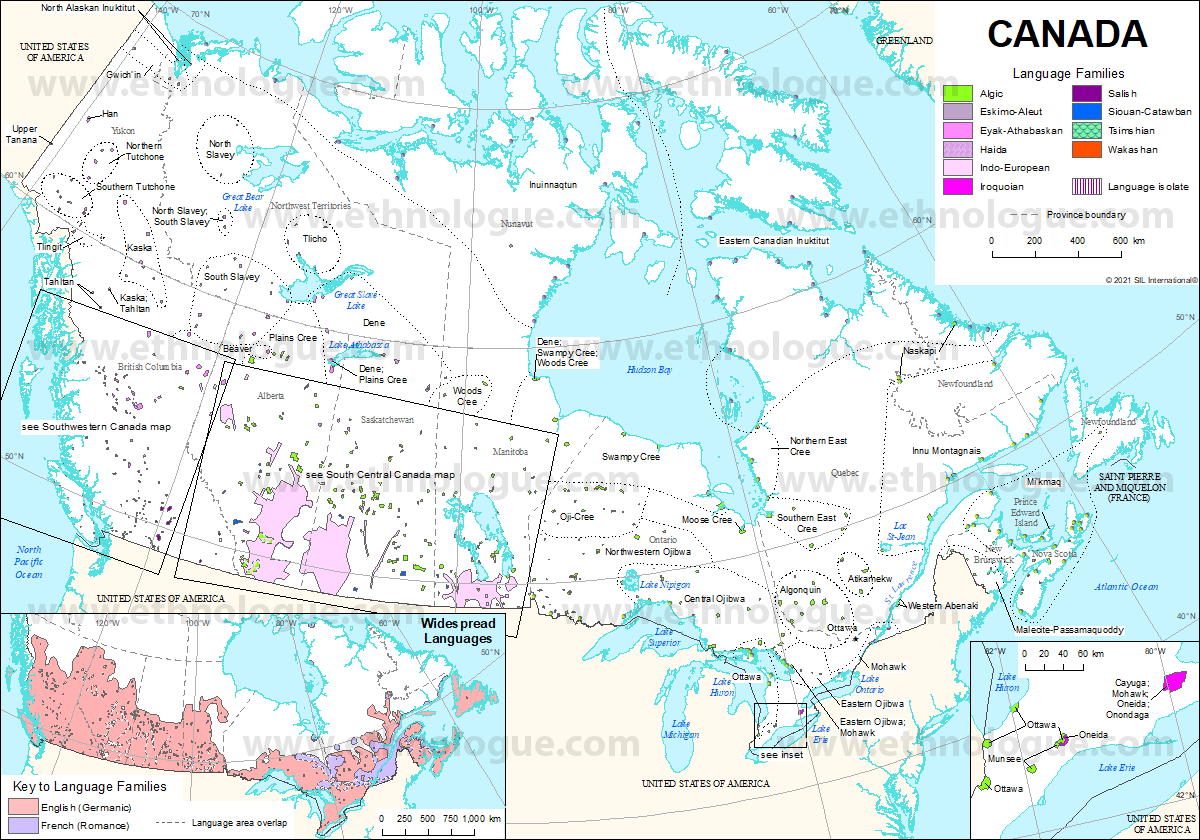
Southern Central Canada
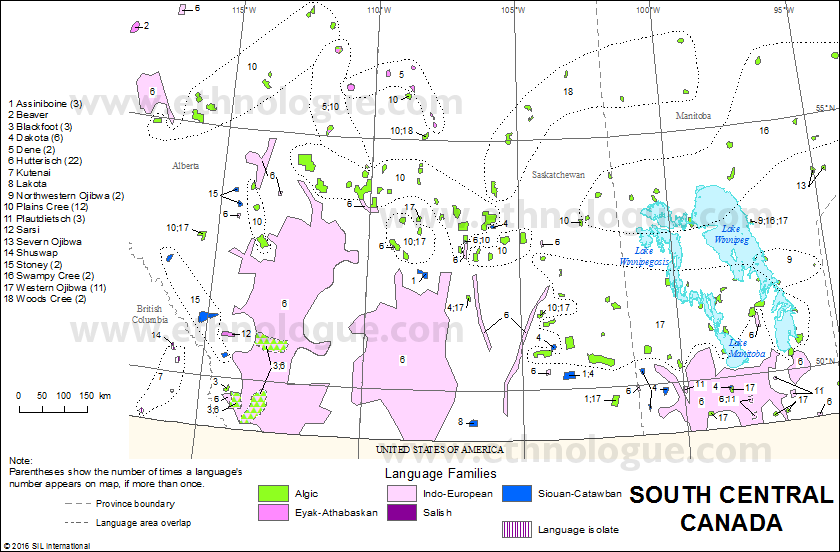
Southwestern Canada
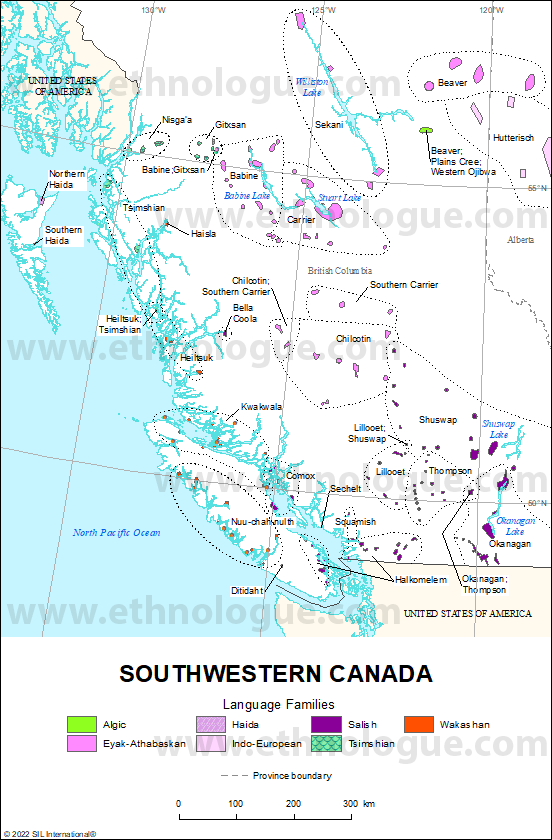
Graphs
Language Vitality Profile
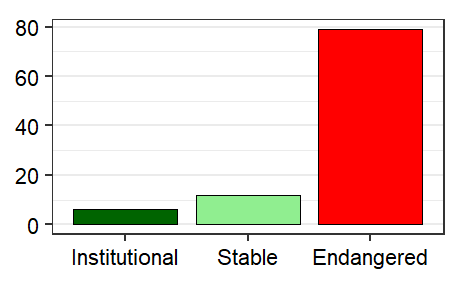
Full explanation
Language Status Profile
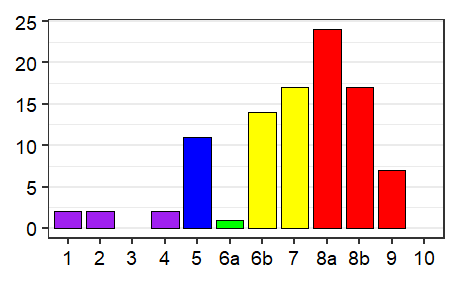
Full explanation
Resources
View Terms
Each Ethnologue country digest is a licensed product with restricted terms of use. Before downloading the product, you must agree to the following terms:
- This is a license for individual use. Just as with a conventionally published book, it is a violation of copyright to make a copy and give it to others.
- You may not redistribute this work in any form, including ingesting the contents into a database that is shared with others or posting it on a web site (whether public or private).
To inquire about permission for reuse or redistribution, please use the Contact Us form in the footer.
Digest of the languages of Canada ($399.95, 108 page PDF)