
CI
Republic of Cote d’Ivoire
Côte d’Ivoire
Summary
- Official Name
- Republic of Cote d’Ivoire
- Population
- 27,054,000
- Principal Languages
- French
- Literacy Rate
- 47% (2018 UNESCO)
- International Conventions
- ACHPR (1987), CDE (1960), CPPDCE (2006), CSICH (2012), ICCPR (1966), UNCRPD (2006)
- General References
- Institut de Linguistique Appliquée 1983, Bendor-Samuel and Hartell 1989, Delafosse 1904
- Language Counts
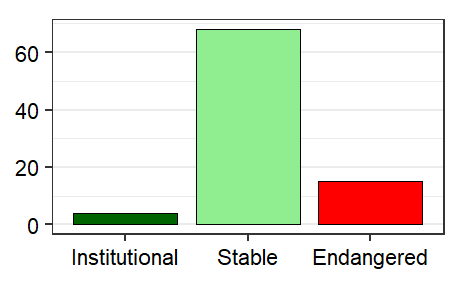
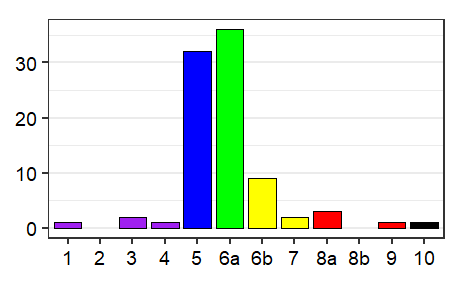
- The number of established languages listed for Côte d’Ivoire is 91. Of these, 88 are living and 3 are extinct. Of the living languages, 76 are indigenous and 12 are non-indigenous. Furthermore, 3 are institutional, 35 are developing, 35 are vigorous, 11 are in trouble, and 4 are dying. Also listed are 6 unestablished languages.
Languages
- Abé aba
- Lacs district: Bongouanou subprefecture; Lagunes district: Agboville subprefecture (except Krobou canton), Tiassale subprefecture, Abbe canton, 70 villages. Users: 268,000 (Leclerc 2017c). Status: 6a (Vigorous). Alternate Names: Abbey, Abbé, Abi Classification: Niger-Congo, Atlantic-Congo, Volta-Congo, Kwa, Nyo, Agneby
- Abidji abi
- Lagunes district: Dabou and Sikensi subprefectures, Agboville area. 12 villages. Users: 85,000 (Leclerc 2017c). Status: 6a (Vigorous). Alternate Names: Abiji Autonym: Enyembe lɛɛ Ogbru Classification: Niger-Congo, Atlantic-Congo, Volta-Congo, Kwa, Nyo, Agneby
- Abron abr
- Zanzan distict: Bondoukou and Tanda subprefectures. Users: 223,000 in Côte d’Ivoire (Leclerc 2017c). Status: 6a* (Vigorous). Alternate Names: Bron, Brong, Doma, Gyaman Classification: Niger-Congo, Atlantic-Congo, Volta-Congo, Kwa, Nyo, Potou-Tano, Tano, Central, Akan
- Abure abu
- Comoé district: Bonoua subprefecture; Lagunes district: Grand Bassam subprefecture; Abidjan. Users: 93,000 (Leclerc 2017c). Status: 6a* (Vigorous). Alternate Names: Abonwa, Abouré, Abule, Akaplass, Ehie, Eyive, Obule oyve, Ossouon Autonym: ɔbule ɔyʋɛ Classification: Niger-Congo, Atlantic-Congo, Volta-Congo, Kwa, Nyo, Potou-Tano, Tano, Western
- Adioukrou adj
- Lagunes district: Dabou subprefecture. 49 villages. Users: 140,000 (Leclerc 2017c). Status: 5* (Developing). Alternate Names: Adjukru, Adyoukrou, Adyukru, Ajukru, Mojukru Autonym: Mↄjukru Classification: Niger-Congo, Atlantic-Congo, Volta-Congo, Kwa, Nyo, Agneby
- Aizi, Aproumu ahp
- Lagunes district: Dabou subprefecture, Allaba village; Jacqueville subprefecture, Attoutou A, Attoutou B, Bapo (Allaba B, Taboth), Koko, and Tefredji villages on Ebrié lagoon banks. Users: 6,500 (1999 SIL). Status: 7 (Shifting). Alternate Names: Ahizi, Apro, Aproin, Aprou, Aproumu, Aprwe, Oprou Classification: Niger-Congo, Atlantic-Congo, Volta-Congo, Kru, Aizi
- Aizi, Mobumrin ahm
- Lagunes district: Jacqueville subprefecture, Ebrié lagoon north bank, Abraco and Abraniamiambo villages. Users: 2,000 (1999 SIL). Status: 7 (Shifting). Alternate Names: Ahizi, Ed-eyng, Ezibo, Frukpu, Mouin Classification: Niger-Congo, Atlantic-Congo, Volta-Congo, Kru, Aizi
- Aizi, Tiagbamrin ahi
- Lagunes district: Jacqueville subprefecture, Ebrié lagoon banks, Attoutou B, Nigui-Assoko, Nigui-Saff, Tiagba, and Tiémié villages. Users: 9,000 (1999 SIL). Status: 6a* (Vigorous). Alternate Names: Ahizi, Ed-eyng, Ezibo, Kropko, Lélémrin, Prokpo, Tiagba, Tiagbamrin Classification: Niger-Congo, Atlantic-Congo, Volta-Congo, Kru, Aizi
- Alladian ald
- Lagunes district: Jacqueville subprefecture, plain between the coast and Ebrie lagoon. 21 villages. Users: 23,000 (1993 SIL). Status: 5* (Developing). Alternate Names: Aladian, Alladyan, Allagia, Allagian Autonym: Alladian Classification: Niger-Congo, Atlantic-Congo, Volta-Congo, Kwa, Nyo, Avikam-Alladian
- American Sign Language ase
- Scattered. Users: 130,000 in Côte d’Ivoire (2021 DBS/DOOR/SIL). Estimated 77,000–155,000, based on 0.3%–0.6% of the total population. Status: 5 (Developing). Alternate Names: LSAF, LSAF Ivoirienne, LSCI, Langue des signes d’Afrique francophone, Langue des signes de Côte d’Ivoire, Langue des signes de l’Afrique francophone Classification: Sign language, Deaf community sign language
- Anyin any
- Comoé and Lagunes districts; Lacs district: Bongouanou, Daoukro, and M’bahiakro subprefectures; Zanzan district: Bondoukou and Tanda subprefectures. Users: 1,450,000 in Côte d’Ivoire, all users. L1 users: 1,440,000 in Côte d’Ivoire (Leclerc 2017c). L2 users: 10,000. Total users in all countries: 1,516,400 (as L1: 1,506,400; as L2: 10,000). Status: 5* (Developing). Alternate Names: Agni, Agni Sanvi, Agny, Anyi Autonym: Anyin Classification: Niger-Congo, Atlantic-Congo, Volta-Congo, Kwa, Nyo, Potou-Tano, Tano, Central, Bia, Northern
- Anyin Morofo mtb
- Lacs district: Moronou area; Lagunes district: central, southern, and eastern departments. Users: 300,000 (2002 SIL). Status: 6a* (Vigorous). Alternate Names: Morofo Classification: Niger-Congo, Atlantic-Congo, Volta-Congo, Kwa, Nyo, Potou-Tano, Tano, Central, Bia, Northern
- Arabic, North Levantine Spoken apc
- Users: 30,000 in Côte d’Ivoire (2019). Status: Unestablished. Classification: Afro-Asiatic, Semitic, Central, South, Arabic
- Attié ati
- Lacs district: southeast; Lagunes district: Adzopé, Affery, Agou, Akoupé, Alépé, Anyama, and Yakassé-Attobrou subprefectures. Users: 642,000 (Leclerc 2017c). Status: 5* (Developing). Alternate Names: -Atye” (pej.), Akie, Akye, Atche, Atie, Atshe Autonym: -Atshe Classification: Niger-Congo, Atlantic-Congo, Volta-Congo, Kwa, Nyo, Attie
- Avikam avi
- Gôh-Djiboua district: coast west of Tagbo Lagoon; Lagunes district: Grand Lahou coastal plain area, Avikam canton. Users: 21,000 (1993 SIL). Status: 5* (Developing). Alternate Names: Avekom, Brignan, Brinya, Gbanda, Kwakwa, Lahu Autonym: Avikam Classification: Niger-Congo, Atlantic-Congo, Volta-Congo, Kwa, Nyo, Avikam-Alladian
- Bakwé bjw
- Bas-Sassandra district: San Pedro, Sassandra, and Soubre prefectures. Users: 10,300 (1993 SIL). Status: 5 (Developing). Autonym: Bakʋɛwii Classification: Niger-Congo, Atlantic-Congo, Volta-Congo, Kru, Eastern, Bakwe
- Bambara bam
- Denguélé district: center and northeast; Savanes district: Tingréla department, Ségélon subprefecture; Malian diaspora in all major cities. Users: 5,500 in Côte d’Ivoire (1993 SIL). Status: 3 (Wider communication). Alternate Names: Bamako, Bamana, Bamanakan, Bamanankan Classification: Niger-Congo, Mande, Western, Central-Southwestern, Central, Manding-Jogo, Manding-Vai, Manding-Mokole, Manding, Manding-East, Northeastern Manding, Bamana
- Baoulé bci
- Lacs, Lagunes, Gôh-Djiboua, Sassandra-Marahoué, Vallée du Bandama, Woroba, and Yamoussoukro regions. Widespread in the south. Users: 4,650,000 in Côte d’Ivoire (Leclerc 2017c). Total users in all countries: 4,654,060. Status: 5* (Developing). Alternate Names: Baoule, Baule, Baule-Ando, Bawolɛ, Bawule Autonym: Wawle Classification: Niger-Congo, Atlantic-Congo, Volta-Congo, Kwa, Nyo, Potou-Tano, Tano, Central, Bia, Northern
- Beng nhb
- Lacs district: M’bahiakro subprefecture, northeast corner; Prikro subprefecture. 22 villages. Users: 17,000 (1993 SIL). Status: 6a* (Vigorous). Alternate Names: Ben, Gan, Ngain, Ngan, Ngen Classification: Niger-Congo, Mande, Eastern, Southeastern, Nwa-Ben, Ben-Gban
- Bété, Daloa bev
- Sassandra-Marahoué district: Daloa subprefecture. Users: 130,000 (1993 SIL). All Bété varieties: 730,000 (Leclerc 2017c). Status: 5* (Developing). Alternate Names: Bhete, Daloua Bété, Northern Bété Autonym: “Bhɛtɩ Gbʋ Classification: Niger-Congo, Atlantic-Congo, Volta-Congo, Kru, Eastern, Bete, Western
- Bété, Gagnoa btg
- Bas-Sassandra district: some in north; Gôh-Djiboua district: Gagnoa subprefecture; Sassandra-Marahoué district: Sinfra subprefecture. Users: 150,000 (1989 SIL). All Bété varieties: 730,000 (Leclerc 2017c). Status: 6a* (Vigorous). Alternate Names: Bhete, Bhete of Gagnoa, Eastern Bété, Gagnoua-Bété, Shyen Classification: Niger-Congo, Atlantic-Congo, Volta-Congo, Kru, Eastern, Bete, Eastern
- Bété, Guiberoua bet
- Bas-Sassandra district: Soubre, Buyo, Gregbeu, and Ouaragahio subprefectures; Sassandra-Marahoué district: Daloua, Guiberoua, and Issia subprefectures; Gôh-Djiboua district. Users: 130,000 (1993 SIL). All Bété varieties: 730,000 (Leclerc 2017c). Status: 5* (Developing). Alternate Names: Bhete, Central Bété, Western Bété, ʼbhɛtegbooʼmë Autonym: ʼbhɛtɩgbʋʋ ʼmö Classification: Niger-Congo, Atlantic-Congo, Volta-Congo, Kru, Eastern, Bete, Western
- Beti eot
- Comoé district: Grand Bassam subprefecture, Vitre I and Vitre II villages. Users: 200 (Blench 1999b). Ethnic population: 3,180 (1988 census). Status: 8a (Moribund). Alternate Names: Eotile Classification: Niger-Congo, Atlantic-Congo, Volta-Congo, Kwa, Nyo, Potou-Tano, Tano, Western
- Birifor, Southern biv
- Zanzan district: northeast corner. Users: 4,310 in Côte d’Ivoire (1993 SIL). Status: 5 (Developing). Alternate Names: Birifo Classification: Niger-Congo, Atlantic-Congo, Volta-Congo, North, Gur, Central, Northern, Oti-Volta, Western, Northwest, Dagaari-Birifor, Birifor
- Bisa bib
- Users: 127,000 in Côte d’Ivoire (Leclerc 2017c). Status: Unestablished. Classification: Niger-Congo, Mande, Eastern, Eastern, Bissa
- Cerma cme
- Savanes district: Ouangolodougou area, north of Ferkessedougou. 5 villages along main road to Banfora. Users: 1,700 in Côte d’Ivoire (1991). Status: 5 (Developing). Alternate Names: Gouin, Guin, Gwe, Gwen, Kirma Classification: Niger-Congo, Atlantic-Congo, Volta-Congo, North, Gur, Central, Southern, Kirma-Tyurama
- Daho-Doo das
- Montagnes district: Tai area and south; Bas-Sassandra district: northwest. Doo are in 5 villages south of Guiglo. Users: 4,000 (1996 SIL). Status: 6b* (Threatened). Classification: Niger-Congo, Atlantic-Congo, Volta-Congo, Kru, Western, Wee, Guere-Krahn
- Dan dnj
- Montagnes district: Biankouma, Danané, and Man prefectures, Liberian border area west of Touba. 19 villages. Users: 1,300,000 in Côte d’Ivoire (2012 V. Vydrin). 650,000 in Eastern Dan, 650,000 in western Dan. Total users in all countries: 1,568,800. Status: 5 (Developing). Alternate Names: Da, Dàn, Gio, Gio-Dan, Ya, Yacouba, Yakuba Autonym: Dã̀ã̀ Classification: Niger-Congo, Mande, Eastern, Southeastern, Guro-Tura, Tura-Dan-Mano, Tura-Dan
- Deg mzw
- Zanzan district. Users: 1,100 in Côte d’Ivoire (1991). Status: 5* (Developing). Alternate Names: Aculo, Buro, Dɛg, Degha, Janela, Mmfo, Mo Classification: Niger-Congo, Atlantic-Congo, Volta-Congo, North, Gur, Central, Southern, Grusi, Western
- Dida, Lakota dic
- Gôh-Djiboua district: Lakota town area and several small areas; Lagunes district: south of Lake Taabo. Users: 93,800 (1993 SIL). All Dida: 336,000 (Leclerc 2017c). Status: 6a* (Vigorous). Alternate Names: Brabori, Dieko, Gabo, Satro, Ziki Classification: Niger-Congo, Atlantic-Congo, Volta-Congo, Kru, Eastern, Dida
- Dida, Yocoboué gud
- Gôh-Djiboua district: Guitry subprefecture, Guitry town area; Lagunes district: Tagbo Lagoon. Users: 102,000 (1993 SIL). 7,100 Guitry, 94,500 Divo. All Dida: 336,000 (Leclerc 2017c). Status: 5* (Developing). Alternate Names: Dida de Yocoboué Autonym: Dída Classification: Niger-Congo, Atlantic-Congo, Volta-Congo, Kru, Eastern, Dida
- Ega ega
- Gôh-Djiboua district: Diés canton, Borondoukou village near Gly. Users: 2,500 (2001 B. Connell). Status: 6b (Threatened). Alternate Names: Diés, Egwa Classification: Niger-Congo, Atlantic-Congo, Volta-Congo, Kwa, Nyo, Potou-Tano, Ega
- Esuma esm
- Comoé district: Sud-Comoé region, Adiaké department, Assinie-Mafia. Users: No known L1 speakers. Last speakers shifted to Anyin [any] and Nzema [nzi] around 1800. Status: 10 (Extinct). Alternate Names: Essouma Classification: Niger-Congo, Atlantic-Congo, Volta-Congo, Kwa
- French fra
- Users: 9,321,700 in Côte d’Ivoire, all users. L1 users: 1,700 in Côte d’Ivoire (2022 Joshua Project), based on ethnicity. L2 users: 9,320,000 (Marcoux et al 2022). Status: 1 (National). Statutory national language (2000, Constitution, Article 29). Alternate Names: Français Classification: Indo-European, Italic, Romance, Italo-Western, Western, Gallo-Iberian, Gallo-Romance, Gallo-Rhaetian, Oïl, French
- Fulfulde, Maasina ffm
- Savanes district: scattered. Users: 479,000 in Côte d’Ivoire (Leclerc 2017c). Status: 5* (Dispersed). Alternate Names: Fulfulde, Maasinankoore Classification: Niger-Congo, Atlantic-Congo, Atlantic, Northern, Senegambian, Fula-Wolof, Fula, West Central
- Gban ggu
- Gôh-Djiboua district: Oume subprefecture, also area south of Laouda. Users: 60,000 (2012 V. Vydrin). Status: 6a* (Vigorous). Alternate Names: Gagou, Gagu, Kago, Sodua Classification: Niger-Congo, Mande, Eastern, Southeastern, Nwa-Ben, Ben-Gban
- Gbin xgb
- Zanzan district: Bondoukou city. Users: No known L1 speakers. The ethnic group was assimilating to Senoufo and Akan [aka] by the early 1920s. Status: 10 (Extinct). Alternate Names: Binfo, Bïn, Gbin-Gouro, Gurombo, Gurungo Classification: Niger-Congo, Mande, Eastern, Southeastern
- Glio-Oubi oub
- Bas-Sassandra district: east bank of Cavally north of Tabou. Users: 2,500 in Côte d’Ivoire (1991). Status: 6b* (Threatened). Alternate Names: Glio, Oubi, Ubi Classification: Niger-Congo, Atlantic-Congo, Volta-Congo, Kru, Western, Grebo, Glio-Oubi
- Godié god
- Bas-Sassandra district: Fresco and Sassandra subprefectures, Kotrohou canton; some in Gôh-Djiboua district. Users: 26,400 (1993 SIL). Status: 6a (Vigorous). Alternate Names: -gwödyéwale, Betɩgwʋʋ, Dadjriwalé, Godye Autonym: -gwëjewälɩɩ’ Classification: Niger-Congo, Atlantic-Congo, Volta-Congo, Kru, Eastern, Bete, Western
- Goo gov
- Montagnes district: Biankoma and Man departments, Deiné, Déoulé, Glagwin, Gouanlé, Mengouen, Mampleu, Sangoué, Zagoué, and Zeikpopleu villages. Users: 8,000 (2021 V. Vydrin). Status: 6a (Vigorous). Alternate Names: Goh, Gụ̏ụ̏, Guse, Guu Classification: Niger-Congo, Mande, Eastern, Southeastern, Guro-Tura, Tura-Dan-Mano, Tura-Dan
- Grebo, Southern grj
- Bas-Sassandra district: near Liberia border. Users: 71,000 in Côte d’Ivoire (Leclerc 2017c). Status: 6a* (Vigorous). Classification: Niger-Congo, Atlantic-Congo, Volta-Congo, Kru, Western, Grebo, Liberian
- Guébie gie
- Gôh-Djiboua district: Gnagbodougnoa subprefecture, Dodougnoa, Gnagbodougnoa, Gnamagnoa, and Gragbalilie villages. Users: 7,000 (2015 H. Sande). Status: 6b (Threatened). Classification: Niger-Congo, Atlantic-Congo, Volta-Congo, Kru, Eastern, Dida
- Guro goa
- Mainly Sassandra-Marahoué and Gôh-Djiboua districts: Bouaflé, Gouitafla, Oumé, Sinfra, Vavoua, and Zuénoula subprefectures; smaller areas in Lacs, Vallée du Bandama, and Woroba districts. Users: 500,000 (2012 V. Vydrin). Status: 5* (Developing). Alternate Names: Baba, Dalo, Dipa, Gouro, Ku, Kweni, Kwéndré, Lo Autonym: Golo Classification: Niger-Congo, Mande, Eastern, Southeastern, Guro-Tura, Guro-Yaoure
- Hausa hau
- Abidjan. Users: 395,000 in Côte d’Ivoire (Leclerc 2017c). Ethnic population: 1,000,000. Status: 5* (Dispersed). Classification: Afro-Asiatic, Chadic, West, A, A.1
- Jeri Kuo jek
- Savanes district: Korhogo area, 3 enclaves. Users: 1,500 (1990 R. Kastenholz). Ethnic population: 20,000 (1990 R. Kastenholz). Status: 8a (Moribund). Alternate Names: Celle, Jeli Kuo Classification: Niger-Congo, Mande, Western, Central-Southwestern, Central, Manding-Jogo, Jogo-Jeri
- Jula dyu
- Savanes and Zanzan districts; widespread in all major cities. Users: 8,500,000 in Côte d’Ivoire, all users. L1 users: 1,500,000 in Côte d’Ivoire (2012 V. Vydrin). L2 users: 7,000,000 (2012 V. Vydrin). Total users in all countries: 12,504,000 (as L1: 2,226,000; as L2: 10,278,000). Status: 3 (Wider communication). Lingua franca in Côte d’Ivoire in the 19th century during the French colonial period. Also spoken in Burkina Faso. Used in education, trade, hunting, and religion. Alternate Names: Dioula, Diula, Djula, Dyoula, Dyula, Jula Kong, Kong Jula, Tagboussikan Autonym: Julakan Classification: Niger-Congo, Mande, Western, Central-Southwestern, Central, Manding-Jogo, Manding-Vai, Manding-Mokole, Manding, Manding-East, Northeastern Manding, Bamana
- Karaboro, Eastern xrb
- Users: 5,610 in Côte d’Ivoire (2000). Status: Unestablished. Classification: Niger-Congo, Atlantic-Congo, Volta-Congo, North, Gur, Senufo, Karaboro
- Khisa kqm
- Zanzan district: north. Users: 5,000 in Côte d’Ivoire (Vanderaa 1991). Total users in all countries: 8,000. Status: 6b* (Threatened). Alternate Names: Khi Khipa, Komono, Kumwenu Classification: Niger-Congo, Atlantic-Congo, Volta-Congo, North, Gur, Central, Southern, Gan-Dogose
- Kla-Dan lda
- Montagnes district: Biankouma department, Zouzoupleu village; Woroba district: Touba department, 25 villages. Users: 25,000 in Côte d’Ivoire (2001 V. Vydrin). Status: 6a (Vigorous). Alternate Names: Kla Classification: Niger-Congo, Mande, Eastern, Southeastern, Guro-Tura, Tura-Dan-Mano, Tura-Dan
- Kodia kwp
- Bas-Sassandra district. Users: 840 (1993 SIL). Status: 6b (Threatened). Alternate Names: Kwadia, Kwadya Classification: Niger-Congo, Atlantic-Congo, Volta-Congo, Kru, Eastern, Kwadia
- Koro kfo
- Woroba district: Mankono department, Tiéningboué subprefecture. Users: 58,000 (Leclerc 2017c). Status: 6a* (Vigorous). Alternate Names: Koro Jula Classification: Niger-Congo, Mande, Western, Central-Southwestern, Central, Manding-Jogo, Manding-Vai, Manding-Mokole, Manding, Manding-East, Southeastern Manding, Maninka-Mori
- Kouya kyf
- Sassandra-Marahoué district: Vavoua subprefecture, Kouya canton; small area west of Bonefla. 12 villages. Users: 10,100 (1993 SIL). Status: 6a (Vigorous). Alternate Names: Kowya, Kuya, Sokuya, Sokya Autonym: Sɔkɔwɛlɩ Classification: Niger-Congo, Atlantic-Congo, Volta-Congo, Kru, Eastern, Bete, Eastern
- Koyaga kga
- Woroba district: Mankono department, 4 subprefectures west. Users: 84,000 (Leclerc 2017c). Status: 6a* (Vigorous). Alternate Names: Koya, Koyaa, Koyaga Jula, Koyagakan, Koyaka, Koyara Classification: Niger-Congo, Mande, Western, Central-Southwestern, Central, Manding-Jogo, Manding-Vai, Manding-Mokole, Manding, Manding-East, Southeastern Manding, Maninka-Mori
- Krahn, Eastern kqo
- Lacs, Sassandra-Marahoué, and Vallée du Bandama districts: Lake Kossou area; Montagnes district. Users: 10,600 in Côte d’Ivoire. Status: 6a* (Vigorous). Classification: Niger-Congo, Atlantic-Congo, Volta-Congo, Kru, Western, Wee, Konobo
- Krahn, Western krw
- Montagnes district: Toulépleu subprefecture. Users: 12,200 in Côte d’Ivoire (1993 SIL). Status: 5* (Developing). Alternate Names: Krahn, Northern Krahn Classification: Niger-Congo, Atlantic-Congo, Volta-Congo, Kru, Western, Wee, Guere-Krahn
- Krobu kxb
- Lagunes district: Agboville subprefecture. 4 villages. Users: 9,920 (1993 SIL). Status: 6a* (Vigorous). Alternate Names: Krobou Classification: Niger-Congo, Atlantic-Congo, Volta-Congo, Kwa, Nyo, Potou-Tano, Tano, Krobu
- Krumen, Plapo ktj
- Bas-Sassandra district: between Bapo and Honpo dialects of Tepo Krumen [ted]. Users: 200 (2022 Joshua Project), based on ethnicity. Status: 6b (Threatened). Alternate Names: Kroumen, Kroumen Plaapo, Kru Plapo, Krumen, Krumen Plapo, Plaapo Kroumen, Plapo Autonym: Plaawin Classification: Niger-Congo, Atlantic-Congo, Volta-Congo, Kru, Western, Grebo, Ivorian
- Krumen, Pye pye
- Bas-Sassandra district: Bereby, San Pedro, and Tai subprefectures. Users: 20,000 (1993 SIL). All Krumen: 48,300 (1993 SIL). Status: 5* (Developing). Alternate Names: Kroumen, Kroumen Piè, Krumen, Krumen Piè, Krumen Pye, Northeastern Krumen, Southeastern Krumen Autonym: Pɩɛwin Classification: Niger-Congo, Atlantic-Congo, Volta-Congo, Kru, Western, Grebo, Ivorian
- Krumen, Tepo ted
- Bas-Sassandra district: Grabo and Tabou subprefectures. Users: 28,300 in Côte d’Ivoire (1993 SIL). All Krumen: 48,300 (1993 SIL). Total users in all countries: 33,910. Status: 5* (Developing). Alternate Names: Krou tepo, Kroumen, Kroumen tépo, Kru, Kru tepo, Krumen, Krumen tepo, Southern Krumen, Southwestern Kroumen, Tepo Krou Autonym: Tepowin Classification: Niger-Congo, Atlantic-Congo, Volta-Congo, Kru, Western, Grebo, Ivorian
- Kulango, Bondoukou kzc
- Zanzan district: Bondoukou subprefecture. Users: 77,000 in Côte d’Ivoire (1993 SIL). All Kulango: 372,000 (Leclerc 2017c). Total users in all countries: 104,000. Status: 6a* (Vigorous). Alternate Names: Bondoukou, Bonduku, Koulango, Kulange, Kulango, Nkuraeng, Nkurange Autonym: Kolango Classification: Niger-Congo, Atlantic-Congo, Volta-Congo, North, Gur, Kulango
- Kulango, Bouna nku
- Zanzan district: Nassian subprefecture. Users: 14,400 in Côte d’Ivoire (1998). All Kulango: 372,000 (Leclerc 2017c). Total users in all countries: 29,900. Status: 6a* (Vigorous). Alternate Names: Koulango, Kulange, Nkuraeng, Nkurange Autonym: Bouna Kulango Classification: Niger-Congo, Atlantic-Congo, Volta-Congo, North, Gur, Kulango
- Ligbi lig
- Zanzan district: Bouna department, Bineto village; Woroba district: Slil town near Boundoukou. Users: 4,000 in Côte d’Ivoire (Vanderaa 1991). Status: 6a* (Vigorous). Classification: Niger-Congo, Mande, Western, Central-Southwestern, Central, Manding-Jogo, Jogo-Jeri, Jogo
- Lobi lob
- Zanzan district: north strip. Users: 270,000 in Côte d’Ivoire (Leclerc 2017c). Status: 5* (Developing). Alternate Names: ’Lobiire, Lobiri, Miwa Classification: Niger-Congo, Atlantic-Congo, Volta-Congo, North, Gur, Lobi
- Loma loi
- Zanzan district: Kulango and Téén areas. Users: 8,010 (2000). Status: 6a* (Vigorous). Alternate Names: Lomakka, Lomapo, Lomasse, Malinke Classification: Niger-Congo, Atlantic-Congo, Volta-Congo, North, Gur, Teen
- Mahou mxx
- Denguélé district: south of Bako; Montagnes district: northeast; Woroba district: Touba department. Users: 300,000 (2012 V. Vydrin). Status: 6a* (Vigorous). Alternate Names: Mahu, Maou, Mau, Mauka, Mauke, Mawu, Mawukakan Classification: Niger-Congo, Mande, Western, Central-Southwestern, Central, Manding-Jogo, Manding-Vai, Manding-Mokole, Manding, Manding-East, Southeastern Manding, Maninka-Mori
- Mbato gwa
- Comoé district: Comoé river east bank; Lagunes district: Petit Alépé subprefecture. Users: 25,000 (1993 SIL). Status: 6a* (Vigorous). Alternate Names: Goaa, Gwa, M’bato, Mbatto, Mgbato, N-Batto, Nglwa, Ogwia, Potu Classification: Niger-Congo, Atlantic-Congo, Volta-Congo, Kwa, Nyo, Potou-Tano, Potou
- Mbre mka
- Vallée du Bandama district: Marabadiassa area, Bondosso village. Users: 50 (Tiote 2017). Ethnic population: 700. Status: 8a (Moribund). Alternate Names: Bɛrɛ, Bere, Bre, Pɛrɛ, Pɛrɛpisjà, Pre, Pre Pisia Classification: Niger-Congo, Unclassified
- Mòoré mos
- Users: 1,360,000 in Côte d’Ivoire (Leclerc 2017c). Status: 6a* (Vigorous). Classification: Niger-Congo, Atlantic-Congo, Volta-Congo, North, Gur, Central, Northern, Oti-Volta, Western, Northwest
- Mwan moa
- Woroba district: Kongasso and south Mankono subprefectures. Users: 20,000 (2012 V. Vydrin). Status: 5* (Developing). Alternate Names: Mona, Mouna, Muan, Muana, Mwa Autonym: Mwan Classification: Niger-Congo, Mande, Eastern, Southeastern, Nwa-Ben, Wan-Mwan
- N’ko nqo
- Scattered. Users: No known L1 speakers in Côte d’Ivoire. Ethnic population: No ethnic community. Status: 9 (Second language only). Classification: Mixed language
- Nafaanra nfr
- Zanzan district: Transua department. Users: Few in Côte d’Ivoire. Status: 5* (Developing). Classification: Niger-Congo, Atlantic-Congo, Volta-Congo, North, Gur, Senufo, Nafaanra
- Neyo ney
- Bas-Sassandra district: Sassandra subprefecture, Kébé and Neyo cantons, from Niégba west to Dagbégo east and Niabayo north. Users: 9,200 (1993 SIL). Status: 6a* (Vigorous). Alternate Names: Gwibwen, Towi Classification: Niger-Congo, Atlantic-Congo, Volta-Congo, Kru, Eastern, Dida
- Ngen gnj
- Abidjan district; Lacs district: M’bahiakro subprefecture, Djonkrou and Mangofla villages. Users: 1,000 (2021 T. Korol). Status: 6b (Threatened). Alternate Names: Gan, Ngɛn, Ngain, Ngan, Ngin, Nguin Classification: Niger-Congo, Mande, Eastern, Southeastern, Nwa-Ben, Ben-Gban
- Nyabwa nwb
- Bas-Sassandra district: northwest; Sassandra-Marahoué district: Vavoua subprefecture, Kouya canton; Buyo, Daloua, Issia, Vavoua (Nyedebwa), and Zoukougbeu (Nyabwa) subprefectures, 12 southwest villages; all in Lake Buyo area. Users: 72,000 (Leclerc 2017c). Status: 5* (Developing). Alternate Names: Niaboua, Nyaboa, Nyabobɔgo, Nyabwa-Nyédébwa, “Bété” (pej.) Autonym: Nyabobɔgʋ Classification: Niger-Congo, Atlantic-Congo, Volta-Congo, Kru, Western, Wee, Nyabwa
- Nzema nzi
- Comoé district: Aboisso department, Tiapoum subprefecture, southeast coast; Abidjan. Users: 113,000 in Côte d’Ivoire (Leclerc 2017c). Status: 5* (Dispersed). Alternate Names: Appolo, Nzima Classification: Niger-Congo, Atlantic-Congo, Volta-Congo, Kwa, Nyo, Potou-Tano, Tano, Central, Bia, Southern
- Sénoufo, Cebaara sef
- Denguélé and Woroba districts; Savanes district: Korhogo city area and west; Vallée du Bandama district: west of Bandama Blanc river. Users: 862,000 (1993 SIL). Status: 5* (Developing). Alternate Names: Senadi, Senari, Syenere, Sénoufo-Sénanri, Tiebaara, Tyebala Classification: Niger-Congo, Atlantic-Congo, Volta-Congo, North, Gur, Senufo, Senari
- Sénoufo, Djimini dyi
- Lacs district: northwest of Kouandkro; Savanes district: Ferkessedougou department; Vallée du Bandama district: Dabakala department, northeast corner. Users: 95,500 (1993 SIL). Status: 5* (Developing). Alternate Names: Djimini, Dyimini, Jinmini Autonym: Jinmiire Classification: Niger-Congo, Atlantic-Congo, Volta-Congo, North, Gur, Senufo, Tagwana-Djimini
- Sénoufo, Nyarafolo sev
- Savanes district: northeast Ferkessédougou area; Vallée du Bandama district: some border areas north. Users: 60,000 (2009 L. Boese). Status: 6a* (Vigorous). Alternate Names: Niafolo, Niarafolo Autonym: Nyaʔafolido Classification: Niger-Congo, Atlantic-Congo, Volta-Congo, North, Gur, Senufo, Tagwana-Djimini
- Sénoufo, Palaka plr
- Savanes district: east of Bandama Blanc river; Vallée du Bandama district: Sikolo area. Users: 8,000 (1995 SIL). Status: 6a* (Vigorous). Alternate Names: Kpalaga, Kpalagha, Palaka, Palara, Pallakha, Pilara Classification: Niger-Congo, Atlantic-Congo, Volta-Congo, North, Gur, Senufo, Kpalaga
- Sénoufo, Shempire seb
- Savanes district: north of Tingréla. Users: 100,000 in Côte d’Ivoire (1996). Total users in all countries: 114,800. Status: 6a* (Vigorous). Alternate Names: Shenpire, Syempire Classification: Niger-Congo, Atlantic-Congo, Volta-Congo, North, Gur, Senufo, Suppire-Mamara
- Sénoufo, Tagwana tgw
- Savanes district: east of Korhogo city; Vallée du Bandama district: north central area; Woroba district: north of Lake Kossou. Users: 138,000 (1993 SIL). Status: 6a* (Vigorous). Alternate Names: Tagbana, Tagouna, Tagwana Classification: Niger-Congo, Atlantic-Congo, Volta-Congo, North, Gur, Senufo, Tagwana-Djimini
- Soninke snk
- Major cities. Users: 185,000 in Côte d’Ivoire (Leclerc 2017c). Status: Unestablished. Classification: Niger-Congo, Mande, Western, Northwestern, Soninke-Bobo, Soninke-Boso, Soninke
- Spanish spa
- Users: 302,000 in Côte d’Ivoire (2019), L2 users. Status: Unestablished. Classification: Indo-European, Italic, Romance, Italo-Western, Western, Gallo-Iberian, Ibero-Romance, West Iberian, Castilian
- Tchaman ebr
- Urban Abidjan and Lagunes districts: Bingerville and Dabou subprefectures. 57 villages, with 27 in Abidjan. Users: 152,000 (Leclerc 2017c). Status: 5* (Developing). Alternate Names: Cama, Caman, Kyama, Tsama, Tyama, “Ebrié” (pej.) Autonym: Tyaman Classification: Niger-Congo, Atlantic-Congo, Volta-Congo, Kwa, Nyo, Potou-Tano, Potou
- Téén lor
- Zanzan district. Users: 6,100 in Côte d’Ivoire (1991). Total users in all countries: 8,100. Status: 6a (Vigorous). Alternate Names: Loghon, Lorhon, Loron, Nabe, Tegesie, Touni, Tuni, Ténhé Autonym: Téén Classification: Niger-Congo, Atlantic-Congo, Volta-Congo, North, Gur, Teen
- Tonjon tjn
- Vallée du Bandama district. Users: No known L1 speakers. Status: 10 (Extinct). Classification: Niger-Congo, Mande, Western, Central-Southwestern, Central, Manding-Jogo, Jogo-Jeri, Jogo
- Toura neb
- Montagnes district: east Biankouma department, mountainous region east of Man to Touba main road, north of Man to Séguéla main road, north of Bafing river; Bafing and Sassandra rivers from north and east borders. Users: 67,000 (Leclerc 2017c). Status: 5* (Developing). Alternate Names: Tura, Ween Autonym: Wɛɛn Classification: Niger-Congo, Mande, Eastern, Southeastern, Guro-Tura, Tura-Dan-Mano, Tura-Dan
- Wan wan
- Sassandra-Marahoué and Vallée du Bandama districts: Lake Bossou north shore; Woroba district: west Beoumi and Kounahiri subprefectures. Users: 22,000 (1993 UBS). Status: 6a* (Vigorous). Alternate Names: Nwa Classification: Niger-Congo, Mande, Eastern, Southeastern, Nwa-Ben, Wan-Mwan
- Wané hwa
- Bas-Sassandra district: Kounoukou area on southwest coast. Users: 2,100 (1993 SIL). Status: 6b* (Threatened). Alternate Names: Hwane, Ngwané Classification: Niger-Congo, Atlantic-Congo, Volta-Congo, Kru, Eastern, Bakwe
- Wè Northern wob
- Montagnes district: Fakobly and Kouibly subprefectures. Users: 265,000 (Leclerc 2017c). Status: 5* (Developing). Alternate Names: Ouobe, Wobé, Wèè, Wê Autonym: Wɛɛ Classification: Niger-Congo, Atlantic-Congo, Volta-Congo, Kru, Western, Wee, Wobe
- Wè Southern gxx
- Bas-Sassandra district: Lake Buyo area; Montagnes district: Bangolo, Duékoué, Guiglo, and Tai subprefectures. Users: 422,000 (Leclerc 2017c). Status: 5* (Developing). Alternate Names: Central Guéré, Gere, Guéré, Wèè Classification: Niger-Congo, Atlantic-Congo, Volta-Congo, Kru, Western, Wee, Guere-Krahn
- Wè Western wec
- Montagnes district: Toulépleu subprefecture. Users: 25,200 (1998 SIL). 20,000 Kaoro (1995 SIL). Status: 5* (Developing). Alternate Names: Gere, Guéré, Neyo Autonym: Wèè Classification: Niger-Congo, Atlantic-Congo, Volta-Congo, Kru, Western, Wee, Guere-Krahn
- Wojenaka jod
- Denguélé district: Odienné department; Woroba district: Boundiali department. Users: 147,000 (Leclerc 2017c). Status: 6a* (Vigorous). Alternate Names: Malinké, Odiennekakan, Odienné Jula Classification: Niger-Congo, Mande, Western, Central-Southwestern, Central, Manding-Jogo, Manding-Vai, Manding-Mokole, Manding, Manding-East, Southeastern Manding, Maninka-Mori
- Worodougou jud
- Denguélé, Montagnes, and Sassandra-Marahoué districts; Woroba district: Mankono and Séguéla departments, Tiéningboué subprefecture. Users: 115,000 (Leclerc 2017c). Status: 6a* (Vigorous). Alternate Names: Bakokan, Ouorodougou, Worodougou Jula, Worodougoukakan, Worodugu Autonym: Wüödughukakan Classification: Niger-Congo, Mande, Western, Central-Southwestern, Central, Manding-Jogo, Manding-Vai, Manding-Mokole, Manding, Manding-East, Southeastern Manding, Maninka-Mori
- Yaouré yre
- Sassandra-Marahoué district: Bouaflé department, Bouaflé subprefecture, Yaouré canton, bounded south by Red Bandama, east by White Bandama river, north by Lake Kossou, west by Bouaflé. Users: 40,000 (2012 V. Vydrin). Status: 5* (Developing). Alternate Names: Yaure, Yohowré, Youré Autonym: Yɔwlɛ Classification: Niger-Congo, Mande, Eastern, Southeastern, Guro-Tura, Guro-Yaoure
- Yoruba yor
- Users: 115,000 in Côte d’Ivoire (Leclerc 2017c). Status: 5* (Dispersed). Classification: Niger-Congo, Atlantic-Congo, Volta-Congo, Benue-Congo, Defoid, Yoruboid, Edekiri
Languages by Status
French
[fra] 1 (National). Statutory national language (2000, Constitution, Article 29). 9,321,700 in Côte d’Ivoire, all users. L1 users: 1,700 in Côte d’Ivoire (2022 Joshua Project), based on ethnicity. L2 users: 9,320,000 (Marcoux et al 2022).
Bambara
[bam] 3 (Wider communication). 5,500 in Côte d’Ivoire (1993 SIL).
Jula
[dyu] 3 (Wider communication). Lingua franca in Côte d’Ivoire in the 19th century during the French colonial period. Also spoken in Burkina Faso. Used in education, trade, hunting, and religion. 8,500,000 in Côte d’Ivoire, all users. L1 users: 1,500,000 in Côte d’Ivoire (2012 V. Vydrin). L2 users: 7,000,000 (2012 V. Vydrin). Total users in all countries: 12,504,000 (as L1: 2,226,000; as L2: 10,278,000).
Fulfulde, Maasina
[ffm] 5* (Dispersed). 479,000 in Côte d’Ivoire (Leclerc 2017c).
Hausa
[hau] 5* (Dispersed). 395,000 in Côte d’Ivoire (Leclerc 2017c). Ethnic population: 1,000,000.
Nzema
[nzi] 5* (Dispersed). 113,000 in Côte d’Ivoire (Leclerc 2017c).
Yoruba
[yor] 5* (Dispersed). 115,000 in Côte d’Ivoire (Leclerc 2017c).
Adioukrou
[adj] 5* (Developing). 140,000 (Leclerc 2017c).
Alladian
[ald] 5* (Developing). 23,000 (1993 SIL).
American Sign Language
[ase] 5 (Developing). 130,000 in Côte d’Ivoire (2021 DBS/DOOR/SIL). Estimated 77,000–155,000, based on 0.3%–0.6% of the total population.
Anyin
[any] 5* (Developing). 1,450,000 in Côte d’Ivoire, all users. L1 users: 1,440,000 in Côte d’Ivoire (Leclerc 2017c). L2 users: 10,000. Total users in all countries: 1,516,400 (as L1: 1,506,400; as L2: 10,000).
Attié
[ati] 5* (Developing). 642,000 (Leclerc 2017c).
Avikam
[avi] 5* (Developing). 21,000 (1993 SIL).
Bakwé
[bjw] 5 (Developing). 10,300 (1993 SIL).
Baoulé
[bci] 5* (Developing). 4,650,000 in Côte d’Ivoire (Leclerc 2017c). Total users in all countries: 4,654,060.
Bété, Daloa
[bev] 5* (Developing). 130,000 (1993 SIL). All Bété varieties: 730,000 (Leclerc 2017c).
Bété, Guiberoua
[bet] 5* (Developing). 130,000 (1993 SIL). All Bété varieties: 730,000 (Leclerc 2017c).
Birifor, Southern
[biv] 5 (Developing). 4,310 in Côte d’Ivoire (1993 SIL).
Cerma
[cme] 5 (Developing). 1,700 in Côte d’Ivoire (1991).
Dan
[dnj] 5 (Developing). 1,300,000 in Côte d’Ivoire (2012 V. Vydrin). 650,000 in Eastern Dan, 650,000 in western Dan. Total users in all countries: 1,568,800.
Deg
[mzw] 5* (Developing). 1,100 in Côte d’Ivoire (1991).
Dida, Yocoboué
[gud] 5* (Developing). 102,000 (1993 SIL). 7,100 Guitry, 94,500 Divo. All Dida: 336,000 (Leclerc 2017c).
Guro
[goa] 5* (Developing). 500,000 (2012 V. Vydrin).
Krahn, Western
[krw] 5* (Developing). 12,200 in Côte d’Ivoire (1993 SIL).
Krumen, Pye
[pye] 5* (Developing). 20,000 (1993 SIL). All Krumen: 48,300 (1993 SIL).
Krumen, Tepo
[ted] 5* (Developing). 28,300 in Côte d’Ivoire (1993 SIL). All Krumen: 48,300 (1993 SIL). Total users in all countries: 33,910.
Lobi
[lob] 5* (Developing). 270,000 in Côte d’Ivoire (Leclerc 2017c).
Mwan
[moa] 5* (Developing). 20,000 (2012 V. Vydrin).
Nafaanra
[nfr] 5* (Developing). Few in Côte d’Ivoire.
Nyabwa
[nwb] 5* (Developing). 72,000 (Leclerc 2017c).
Sénoufo, Cebaara
[sef] 5* (Developing). 862,000 (1993 SIL).
Sénoufo, Djimini
[dyi] 5* (Developing). 95,500 (1993 SIL).
Tchaman
[ebr] 5* (Developing). 152,000 (Leclerc 2017c).
Toura
[neb] 5* (Developing). 67,000 (Leclerc 2017c).
Wè Northern
[wob] 5* (Developing). 265,000 (Leclerc 2017c).
Wè Southern
[gxx] 5* (Developing). 422,000 (Leclerc 2017c).
Wè Western
[wec] 5* (Developing). 25,200 (1998 SIL). 20,000 Kaoro (1995 SIL).
Yaouré
[yre] 5* (Developing). 40,000 (2012 V. Vydrin).
Abé
[aba] 6a (Vigorous). 268,000 (Leclerc 2017c).
Abidji
[abi] 6a (Vigorous). 85,000 (Leclerc 2017c).
Abron
[abr] 6a* (Vigorous). 223,000 in Côte d’Ivoire (Leclerc 2017c).
Abure
[abu] 6a* (Vigorous). 93,000 (Leclerc 2017c).
Aizi, Tiagbamrin
[ahi] 6a* (Vigorous). 9,000 (1999 SIL).
Anyin Morofo
[mtb] 6a* (Vigorous). 300,000 (2002 SIL).
Beng
[nhb] 6a* (Vigorous). 17,000 (1993 SIL).
Bété, Gagnoa
[btg] 6a* (Vigorous). 150,000 (1989 SIL). All Bété varieties: 730,000 (Leclerc 2017c).
Dida, Lakota
[dic] 6a* (Vigorous). 93,800 (1993 SIL). All Dida: 336,000 (Leclerc 2017c).
Gban
[ggu] 6a* (Vigorous). 60,000 (2012 V. Vydrin).
Godié
[god] 6a (Vigorous). 26,400 (1993 SIL).
Goo
[gov] 6a (Vigorous). 8,000 (2021 V. Vydrin).
Grebo, Southern
[grj] 6a* (Vigorous). 71,000 in Côte d’Ivoire (Leclerc 2017c).
Kla-Dan
[lda] 6a (Vigorous). 25,000 in Côte d’Ivoire (2001 V. Vydrin).
Koro
[kfo] 6a* (Vigorous). 58,000 (Leclerc 2017c).
Kouya
[kyf] 6a (Vigorous). 10,100 (1993 SIL).
Koyaga
[kga] 6a* (Vigorous). 84,000 (Leclerc 2017c).
Krahn, Eastern
[kqo] 6a* (Vigorous). 10,600 in Côte d’Ivoire.
Krobu
[kxb] 6a* (Vigorous). 9,920 (1993 SIL).
Kulango, Bondoukou
[kzc] 6a* (Vigorous). 77,000 in Côte d’Ivoire (1993 SIL). All Kulango: 372,000 (Leclerc 2017c). Total users in all countries: 104,000.
Kulango, Bouna
[nku] 6a* (Vigorous). 14,400 in Côte d’Ivoire (1998). All Kulango: 372,000 (Leclerc 2017c). Total users in all countries: 29,900.
Ligbi
[lig] 6a* (Vigorous). 4,000 in Côte d’Ivoire (Vanderaa 1991).
Loma
[loi] 6a* (Vigorous). 8,010 (2000).
Mahou
[mxx] 6a* (Vigorous). 300,000 (2012 V. Vydrin).
Mbato
[gwa] 6a* (Vigorous). 25,000 (1993 SIL).
Mòoré
[mos] 6a* (Vigorous). 1,360,000 in Côte d’Ivoire (Leclerc 2017c).
Neyo
[ney] 6a* (Vigorous). 9,200 (1993 SIL).
Sénoufo, Nyarafolo
[sev] 6a* (Vigorous). 60,000 (2009 L. Boese).
Sénoufo, Palaka
[plr] 6a* (Vigorous). 8,000 (1995 SIL).
Sénoufo, Shempire
[seb] 6a* (Vigorous). 100,000 in Côte d’Ivoire (1996). Total users in all countries: 114,800.
Sénoufo, Tagwana
[tgw] 6a* (Vigorous). 138,000 (1993 SIL).
Téén
[lor] 6a (Vigorous). 6,100 in Côte d’Ivoire (1991). Total users in all countries: 8,100.
Wan
[wan] 6a* (Vigorous). 22,000 (1993 UBS).
Wojenaka
[jod] 6a* (Vigorous). 147,000 (Leclerc 2017c).
Worodougou
[jud] 6a* (Vigorous). 115,000 (Leclerc 2017c).
Daho-Doo
[das] 6b* (Threatened). 4,000 (1996 SIL).
Ega
[ega] 6b (Threatened). 2,500 (2001 B. Connell).
Glio-Oubi
[oub] 6b* (Threatened). 2,500 in Côte d’Ivoire (1991).
Guébie
[gie] 6b (Threatened). 7,000 (2015 H. Sande).
Khisa
[kqm] 6b* (Threatened). 5,000 in Côte d’Ivoire (Vanderaa 1991). Total users in all countries: 8,000.
Kodia
[kwp] 6b (Threatened). 840 (1993 SIL).
Krumen, Plapo
[ktj] 6b (Threatened). 200 (2022 Joshua Project), based on ethnicity.
Ngen
[gnj] 6b (Threatened). 1,000 (2021 T. Korol).
Wané
[hwa] 6b* (Threatened). 2,100 (1993 SIL).
Aizi, Aproumu
[ahp] 7 (Shifting). 6,500 (1999 SIL).
Aizi, Mobumrin
[ahm] 7 (Shifting). 2,000 (1999 SIL).
Beti
[eot] 8a (Moribund). 200 (Blench 1999b). Ethnic population: 3,180 (1988 census).
Jeri Kuo
[jek] 8a (Moribund). 1,500 (1990 R. Kastenholz). Ethnic population: 20,000 (1990 R. Kastenholz).
Mbre
[mka] 8a (Moribund). 50 (Tiote 2017). Ethnic population: 700.
Esuma
[esm] 10 (Extinct). No known L1 speakers. Last speakers shifted to Anyin [any] and Nzema [nzi] around 1800.
Gbin
[xgb] 10 (Extinct). No known L1 speakers. The ethnic group was assimilating to Senoufo and Akan [aka] by the early 1920s.
Tonjon
[tjn] 10 (Extinct). No known L1 speakers.
Arabic, North Levantine Spoken
[apc] Unestablished. 30,000 in Côte d’Ivoire (2019).
Bisa
[bib] Unestablished. 127,000 in Côte d’Ivoire (Leclerc 2017c).
Karaboro, Eastern
[xrb] Unestablished. 5,610 in Côte d’Ivoire (2000).
Soninke
[snk] Unestablished. 185,000 in Côte d’Ivoire (Leclerc 2017c).
Spanish
[spa] Unestablished. 302,000 in Côte d’Ivoire (2019), L2 users.
Maps
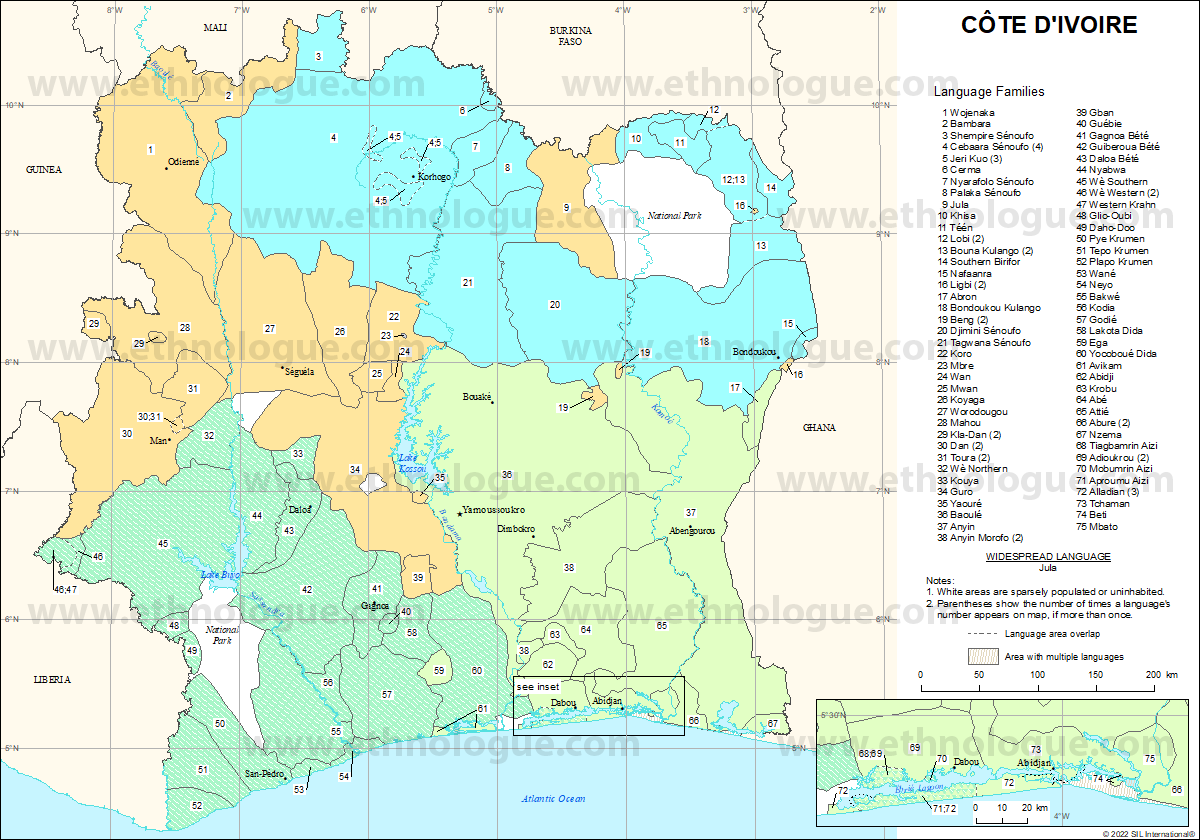
Côte d’Ivoire
Graphs
Language Vitality Profile
Full explanation
Language Status Profile
Full explanation
Resources
View Terms
Each Ethnologue country digest is a licensed product with restricted terms of use. Before downloading the product, you must agree to the following terms:
- This is a license for individual use. Just as with a conventionally published book, it is a violation of copyright to make a copy and give it to others.
- You may not redistribute this work in any form, including ingesting the contents into a database that is shared with others or posting it on a web site (whether public or private).
To inquire about permission for reuse or redistribution, please use the Contact Us form in the footer.
Digest of the languages of Côte d’Ivoire ($299.95, 57 page PDF)