
CM
Republic of Cameroon
Cameroon
Summary
- Official Name
- Republic of Cameroon
- Population
- 26,546,000
- Principal Languages
- English, French
- Literacy Rate
- 77% (2018 UNESCO)
- International Conventions
- ACHPR (1987), CPPDCE (2006), CSICH (2012), ICCPR (1966), UNDRIP (2007)
- General References
- Bendor-Samuel and Hartell 1989, Bikoi 2012, Campbell and King 2011, Dieu and Renaud 1983, Dimmendaal and Voeltz 2007
- Language Counts
- The number of established languages listed for Cameroon is 286. Of these, 277 are living and 9 are extinct. Of the living languages, 272 are indigenous and 5 are non-indigenous. Furthermore, 14 are institutional, 102 are developing, 66 are vigorous, 78 are in trouble, and 17 are dying.
Languages
- Afade aal
- Far North region: Logone-and-Chari division, south Makari subdivision, Afade area. Users: 5,000 in Cameroon (Tourneux 2004). 40,000 all Kotoko languages (Tourneux 2004). Status: 6b* (Threatened). Alternate Names: Afadeh, Affade, Mandagué Classification: Afro-Asiatic, Chadic, Biu-Mandara, B, B.1, Kotoko Proper, North
- Aghem agq
- North West region: Menchum division, Wum Central subdivision, Wum area. Users: 39,100 (2005 SIL), increasing. Status: 5 (Developing). Alternate Names: Wum, Yum Autonym: Aghɨ̂m Classification: Niger-Congo, Atlantic-Congo, Volta-Congo, Benue-Congo, Bantoid, Southern, Wide Grassfields, Narrow Grassfields, Ring, West
- Ajumbu muc
- North West region: Menchum division, Wum subdivision, Ajumbu village northeast of Wum. Users: 200 (Good et al 2011). Status: 6b (Threatened). Alternate Names: Ajuh Mbuh, Du Adzu, Mbu’ Classification: Niger-Congo, Atlantic-Congo, Volta-Congo, Benue-Congo, Bantoid, Southern, Yemne-Kimbi
- Akoose bss
- Littoral region: Moungo division, Manjo subdivision; South West region: Koupé-Muanenguba division, Bangem, Nguti, and Tombel subdivisions. Users: 100,000 (2001 SIL), increasing. Status: 5 (Developing). Alternate Names: Akose, Akosi, Bafaramani, Bakosi, Bakossi, Bekoose, Koose, Kosi, Kosse, Kossi, Manenguba, Ngoe, Nkoosi, Nkosi Autonym: Akoose Classification: Niger-Congo, Atlantic-Congo, Volta-Congo, Benue-Congo, Bantoid, Southern, Narrow Bantu, Northwest, A, Lundu-Balong (A.15C)
- Akum aku
- North West region: Menchum division, Furu-Awa subdivision, Nigeria border area, Akum village. Users: 1,400 in Cameroon (2002 SIL). Status: 6a (Vigorous). Alternate Names: Aakuem, Anyar, Oakuem, Okum Classification: Niger-Congo, Atlantic-Congo, Volta-Congo, Benue-Congo, Jukunoid, Yukuben-Kuteb
- Ambele ael
- North West region: Momo division, west Widikum-Menka subdivision, 11 villages. Users: 5,000 (2005 SIL). Ethnic population: 6,000 (2001 SIL). Status: 6a (Vigorous). Alternate Names: Ambala, Bata’o, Lembala Classification: Niger-Congo, Atlantic-Congo, Volta-Congo, Benue-Congo, Bantoid, Southern, Wide Grassfields, Western Momo
- Arabic, Shuwa shu
- Far North region: Diamaré, Logone-and-Chari, Mayo-Danay, and Mayo-Sava divisions; along Chari river between Lake Chad and Kousséri, pockets south of Kousséri. Users: 145,000 in Cameroon, all users. L1 users: 75,000 in Cameroon (2005 SIL). L2 users: 70,000 (2013 SIL). Status: 3 (Wider communication). Used as a LWC in the market and media, and in some churches. Originated from the migration of Arabic speakers from Chad to Cameroon from colonial period until present. Alternate Names: Arabe Choa, Chadian Spoken Arabic, Choa, Shoa, Shoa Arabic, Shua, Western Sudanic Arabic Classification: Afro-Asiatic, Semitic, Central, South, Arabic
- Atong ato
- North West region: Momo division, extreme northwest Widikum-Menka subdivision, 5 villages. Users: 4,200 (2000 SIL). Status: 6b* (Threatened). Alternate Names: Etoh Classification: Niger-Congo, Atlantic-Congo, Volta-Congo, Benue-Congo, Bantoid, Southern, Wide Grassfields, Western Momo
- Awing azo
- North West region: Mezam division, Awing-Bambaluwe village. Users: 19,000 (2001 SIL). Status: 5 (Developing). Alternate Names: Atembuluwe, Atembwә’wi, Awi, Bambuluwe, Mbwe’wi, Mbí̵ɨwiŋə Autonym: Mbɨ̂wiŋə Classification: Niger-Congo, Atlantic-Congo, Volta-Congo, Benue-Congo, Bantoid, Southern, Wide Grassfields, Narrow Grassfields, Mbam-Nkam, Ngemba
- Babanki bbk
- North West region: Mezam division, Tubah subdivision, Kejom-Keku and Kejom-Ketinguh villages. Users: 39,000 (2011 SIL), increasing. Status: 5 (Developing). Alternate Names: Finge, Ga’a Kedjom, Kedjom, Kejeng, Kejom, Kidzem, Kidzom, Nga-Kejom Autonym: Ga’a-Kejom Classification: Niger-Congo, Atlantic-Congo, Volta-Congo, Benue-Congo, Bantoid, Southern, Wide Grassfields, Narrow Grassfields, Ring, Center
- Bafanji bfj
- North West region: Ngo-Ketunjia division, Balikumbat subdivision, southwest of Ndop on Ndop plain. Users: 18,000 (2005 SIL). Status: 5 (Developing). Alternate Names: Bafangi, Bafanyi, Chuufi, Nchufie Autonym: Chufie’ Classification: Niger-Congo, Atlantic-Congo, Volta-Congo, Benue-Congo, Bantoid, Southern, Wide Grassfields, Narrow Grassfields, Mbam-Nkam, Nun
- Bafaw-Balong bwt
- Littoral region: Moungo division; South West region: Meme division, Kumba area and north along Kumba-Mamfe road and southeast of Ekondo-Titi. Users: 8,400 (1982 SIL). Status: 6a* (Vigorous). Alternate Names: Ngoe Classification: Niger-Congo, Atlantic-Congo, Volta-Congo, Benue-Congo, Bantoid, Southern, Narrow Bantu, Northwest, A, Lundu-Balong (A.13)
- Bafia ksf
- Centre region: Mbam-and-Inoubou division, Bafia, Kiiki, and Kon-Yambetta subdivisions, north of Sanaga river. Users: 60,000 (1991 UBS). Status: 6a (Vigorous). Alternate Names: Bekpak, Kpa, Rikpa’ Autonym: Rikpa Classification: Niger-Congo, Atlantic-Congo, Volta-Congo, Benue-Congo, Bantoid, Southern, Narrow Bantu, Northwest, A, Bafia (A.53)
- Bafut bfd
- North West region: Mezam division, Tuba subdivision, Bafut. Users: 100,000 (Tamanji 2009), increasing. Status: 5 (Developing). Alternate Names: Befe, Bufe, Fu, Fut Autonym: Bɨfɨɨ̀ Classification: Niger-Congo, Atlantic-Congo, Volta-Congo, Benue-Congo, Bantoid, Southern, Wide Grassfields, Narrow Grassfields, Mbam-Nkam, Ngemba
- Baka bkc
- East region: Boumba, Kadey, Ngoko, and Upper Nyong divisions; South region: Dja-and-Lobo division. Users: 40,000 in Cameroon (2007 Y. Léonard). 15,000 monolinguals. Mainly women. Ethnic population: 40,000. Total users in all countries: 43,200. Status: 5 (Developing). Alternate Names: Bebayaga, Bebayaka, Bibaya, Pygmees Baka, Pygmees de l’Est, “Babinga” (pej.) Autonym: baka Classification: Niger-Congo, Atlantic-Congo, Volta-Congo, North, Adamawa-Ubangi, Ubangi, Sere-Ngbaka-Mba, Ngbaka-Mba, Ngbaka, Western, Baka-Gundi
- Bakaka bqz
- Littoral region: Moungo division, west Loum, Manjo, south Nkongsamba, and Nlonako subdivisions. Users: 30,000 (1998 SIL). Status: 6b (Threatened). Alternate Names: Central Mbo, Ehob Mkaa, Mkaa’ Classification: Niger-Congo, Atlantic-Congo, Volta-Congo, Benue-Congo, Bantoid, Southern, Narrow Bantu, Northwest, A, Lundu-Balong (A.15C)
- Bakoko bkh
- Littoral region: scattered communities; Moungo division, south of Dibombari; Nkam division, Nkondjok area; Sanaga-Maritime division, southwest of Edéa; Wouri division, south of Douala; South region: northwest Océan division; West region: Haut-Nkam division. Users: 50,000 (1982 SIL), increasing. Status: 6a (Vigorous). Alternate Names: Basoo, Koko Autonym: Bakoko Classification: Niger-Congo, Atlantic-Congo, Volta-Congo, Benue-Congo, Bantoid, Southern, Narrow Bantu, Northwest, A, Basaa (A.43)
- Bakole kme
- South West region: Ndian division, Bamusso area south of Meme estuary. Users: 300 (1982 SIL). Status: 8b (Nearly extinct). Alternate Names: Bakolle, Bamusso, Kole Classification: Niger-Congo, Atlantic-Congo, Volta-Congo, Benue-Congo, Bantoid, Southern, Narrow Bantu, Northwest, A, Duala (A.231)
- Baldemu bdn
- Far North region: Diamaré division, Balda, Bogo, and Guingley east of Maroua; Lara, south of Maroua. Users: No known L1 speakers. Last known speakers probably survived into the early 2010s. Status: 10 (Extinct). Alternate Names: Baldamu, Baldare, Mbazla Classification: Afro-Asiatic, Chadic, Biu-Mandara, A, A.5
- Balo bqo
- South West region: Manyu division, Akwaya subdivision. Users: 2,230 (2000). Status: 6b (Threatened). Classification: Niger-Congo, Atlantic-Congo, Volta-Congo, Benue-Congo, Bantoid, Southern, Tivoid
- Bamali bbq
- North West region: Ngo-Ketunjia division, Ndop subdivision, southwest of Ndop town, on Ndop plain. Users: 10,800 (2008 SIL). Status: 5 (Developing). Alternate Names: Chopechop, Ngoobechop Autonym: Chɔpəchɔp Classification: Niger-Congo, Atlantic-Congo, Volta-Congo, Benue-Congo, Bantoid, Southern, Wide Grassfields, Narrow Grassfields, Mbam-Nkam, Nun
- Bambalang bmo
- North West region: Ngo-Ketunjia division, Ndop subdivision, southeast of Ndop town, on Ndop plain. Users: 29,000 (2008 SIL). Status: 5 (Developing). Alternate Names: Bambolang, Chirambo, Cirambo, Mbawyakum, Mboyakum, Tshirambo Autonym: Chrambo Classification: Niger-Congo, Atlantic-Congo, Volta-Congo, Benue-Congo, Bantoid, Southern, Wide Grassfields, Narrow Grassfields, Mbam-Nkam, Nun
- Bambili-Bambui baw
- North West region: Mezam division, Tuba subdivision, Bambili and Bambui villages along Ring road northeast of Bamenda. Users: 12,500 (2005 SIL), increasing. Status: 6a (Vigorous). Alternate Names: Bambili Classification: Niger-Congo, Atlantic-Congo, Volta-Congo, Benue-Congo, Bantoid, Southern, Wide Grassfields, Narrow Grassfields, Mbam-Nkam, Ngemba
- Bamenyam bce
- North West region: southeast Mezam division; West region: Bamboutos division, northwest Galim subdivision, Bamenyam area. Users: 5,300 (2005 SIL). Status: 6a (Vigorous). Alternate Names: Bamenyan, Mamenyan, Mengambo, Pamenyan Classification: Niger-Congo, Atlantic-Congo, Volta-Congo, Benue-Congo, Bantoid, Southern, Wide Grassfields, Narrow Grassfields, Mbam-Nkam, Nun
- Bamukumbit bqt
- North West region: Ngo-Ketunjia division, Balikumbat subdivision, southwest of Ndop on Ndop plain. Users: 12,000 (2008 SIL). Status: 5 (Developing). Alternate Names: Bamenkombit, Bamenkoumbit, Bamoukoumbit, Bamunkum, Bamunkumbit, Mangkong, Mankong Autonym: Achab a Maŋkɔ̧ Classification: Niger-Congo, Atlantic-Congo, Volta-Congo, Benue-Congo, Bantoid, Southern, Wide Grassfields, Narrow Grassfields, Mbam-Nkam, Ngemba
- Bamun bax
- Centre region: border areas; North West region: Ngo-Ketunjia division, north Lake Bamendjing on Ndop plain; West region: southeast Bamboutos division, north Mifi division, Noun division, Foumban area. Users: 420,000 (2005 SIL). Based on actual population of the subdivisions where the Bamun people are present, as of the official 2005 census (2014 C. Hamm). Status: 3 (Wider communication). Originated in the high western grasslands of Cameroon with capital at Foumban, a town in Northwest Cameroon. Alternate Names: Bamoum, Bamoun, Bamum, Shupamem Autonym: Shüpamom Classification: Niger-Congo, Atlantic-Congo, Volta-Congo, Benue-Congo, Bantoid, Southern, Wide Grassfields, Narrow Grassfields, Mbam-Nkam, Nun
- Bamunka bvm
- North West region: Ngo Ketunjia division, Ndop subdivision, Ndop town, and south and east of Ndop, on Ndop plain. Users: 31,000 (2008 SIL). Status: 5 (Developing). Alternate Names: Bamunkun, Mbika, Mekoh, Muka, Ndop-Bamunka, Ngiemekohke Autonym: Niemeng Classification: Niger-Congo, Atlantic-Congo, Volta-Congo, Benue-Congo, Bantoid, Southern, Wide Grassfields, Narrow Grassfields, Ring, South
- Bana bcw
- Far North region: Mayo-Tsanaga division, Bourrah subdivision on Nigeria border. Users: 23,000 (2007 SIL). 14,000 Gamboura and 9,000 Guili. Status: 5 (Developing). Alternate Names: Baza, Ka-Bana, Koma, Mizeran, Parole des Bana Autonym: kwəmà ká bàná Classification: Afro-Asiatic, Chadic, Biu-Mandara, A, A.3
- Bangandu bgf
- East region: Boumba-and-Ngoko division, Moloundou subdivision. Users: 2,700 (Voegelin and Voegelin 1977). Status: 6a (Vigorous). Alternate Names: Bagando, Bangando, Bangantu, Southern Bangantu Classification: Niger-Congo, Atlantic-Congo, Volta-Congo, North, Adamawa-Ubangi, Ubangi, Gbaya-Manza-Ngbaka, Southwest
- Bangolan bgj
- North West region: Ngo-Ketunjia division, Babessi subdivision, east of Ndop, south of Jakiri, on Ndop plain. Users: 14,000 (2008 census). Status: 5 (Developing). Alternate Names: Məndenkie, Mendenkye, Songnungbangle, shʉ panəm Autonym: Mədəŋkyɛ Classification: Niger-Congo, Atlantic-Congo, Volta-Congo, Benue-Congo, Bantoid, Southern, Wide Grassfields, Narrow Grassfields, Mbam-Nkam, Nun
- Bankon abb
- Littoral region: Moungo division, north of Douala and west of Wouri river, and Dibombari. Users: 12,000 (2001 SIL). Status: 6b (Threatened). Alternate Names: Abaw, Abo, Bo, Bon Classification: Niger-Congo, Atlantic-Congo, Volta-Congo, Benue-Congo, Bantoid, Southern, Narrow Bantu, Northwest, A, Basaa (A.42)
- Barombi bbi
- South West region: Meme division, Lake Barombi-Koto area north of Mount Cameroon, also west of Kumba town; Ndian division, northeast of Ekondo-Titi. Users: 3,000 (2001 SIL). Status: 6b (Threatened). Alternate Names: Balombi, Barumbi, Lambi, Lombe, Lombi, Rambi, Rombi Classification: Niger-Congo, Atlantic-Congo, Volta-Congo, Benue-Congo, Bantoid, Southern, Narrow Bantu, Northwest, A, Basaa (A.41)
- Basaa bas
- Centre region: widespread in Nyong-and-Kéllé division; Littoral region: Nkam and Sanaga-Maritime divisions; South region: Océan division; West region: Menoua division. Users: 300,000 (2005 SIL). Based on the actual population of the subdivisions where the Basaa people are present, as of the official 2005 census (2014 C. Hamm). Status: 5 (Developing). Alternate Names: Basa, Bassa, Bicek, Bikyek, Bisaa, Mbele, Mee, Mvele, Northern Mbene, Tupen Autonym: Basaa Classification: Niger-Congo, Atlantic-Congo, Volta-Congo, Benue-Congo, Bantoid, Southern, Narrow Bantu, Northwest, A, Basaa (A.43)
- Bassossi bsi
- South West region: Koupé-Muanenguba division, central Nguti subdivision, Nguti town, and east and south. Users: 5,000 (2004 SIL). Status: 6a* (Vigorous). Alternate Names: Asobse, Basosi, Basossi, Ngen, Nsose, Nswase, Nswose, Sosi, Swose Classification: Niger-Congo, Atlantic-Congo, Volta-Congo, Benue-Congo, Bantoid, Southern, Narrow Bantu, Northwest, A, Lundu-Balong (A.15B)
- Bata bta
- North region: Bénoué division along Nigeria border; along Bénoué river, west of Garoua; north Faro division, along Faro river. Users: 2,500 in Cameroon. Status: 6b* (Threatened). Alternate Names: Batta, Dii, Gbwata, Gwate, Magbwati, Magbwatiye, Magbwatá Classification: Afro-Asiatic, Chadic, Biu-Mandara, A, A.8
- Batanga bnm
- South region: Océan division, Kribi area, Bight of Biafra coast. Users: 5,750 in Cameroon (2015 SIL), decreasing. Very few monolinguals. Ethnic population: 11,500 (2015 SIL). Total users in all countries: 13,750. Status: 6b* (Threatened). Alternate Names: Batanga-Banda, Noho, Noku Autonym: Batanga Classification: Niger-Congo, Atlantic-Congo, Volta-Congo, Benue-Congo, Bantoid, Southern, Narrow Bantu, Northwest, A, Bubi-Benga (A.32)
- Bati btc
- Centre region: Mbam-and-Inoubou division; Littoral region: Sanaga-Maritime division, Ndom subdivision, Bati canton, 4 villages. Users: 800 (1975 census). Status: 6b (Threatened). Alternate Names: Bati Ba Ngong, Bati de Brousse Classification: Niger-Congo, Atlantic-Congo, Volta-Congo, Benue-Congo, Bantoid, Southern, Narrow Bantu, Northwest, A, Sanaga (A.65)
- Beba bfp
- North West region: Mezam division, Benakuma subdivision; South West region: Manyu division, Akwaya subdivision. Users: 3,000 (2002 SIL). Status: 6b (Threatened). Alternate Names: Baba’zhi, Babadji, Batadji, Bazhi, Beba’, Bebadji, Biba, Bombe, Bombe-Beba, Mubadji, Shishong Classification: Niger-Congo, Atlantic-Congo, Volta-Congo, Benue-Congo, Bantoid, Southern, Wide Grassfields, Narrow Grassfields, Mbam-Nkam, Ngemba
- Bebele beb
- Centre region: Upper Sanaga division, Minta subdivision; East region: Lom-and-Djerem division, Diang subdivision. Users: 24,000 (Welmers 1971a). Status: 6b (Threatened). Alternate Names: Bamvele Classification: Niger-Congo, Atlantic-Congo, Volta-Congo, Benue-Congo, Bantoid, Southern, Narrow Bantu, Northwest, A, Ewondo-Fang (A.73)
- Bebil bxp
- East region: Lom-and-Djerem division, Bélabo subdivision, Bélabo area. Users: 6,000 (1991 SIL). Status: 6a* (Vigorous). Alternate Names: Bobilis, Gbigbil Classification: Niger-Congo, Atlantic-Congo, Volta-Congo, Benue-Congo, Bantoid, Southern, Narrow Bantu, Northwest, A, Ewondo-Fang (A.73)
- Beezen bnz
- North West region: Menchum division, Furu-Awa subdivision, Kpep (Beezen) village. Users: 450 (2001 SIL). Status: 6b (Threatened). Alternate Names: Bezen Classification: Niger-Congo, Atlantic-Congo, Volta-Congo, Benue-Congo, Jukunoid, Yukuben-Kuteb
- Befang bby
- North West region: Menchum division, Wum dubdivision, Befang area; Mezam division, Tuba subdivision. Users: 9,000 (2005 SIL). Status: 6b* (Threatened). Alternate Names: Beba-Befang, Biba-Bifang, Bifang, Menchum Classification: Niger-Congo, Atlantic-Congo, Volta-Congo, Benue-Congo, Bantoid, Southern, Wide Grassfields, Menchum
- Bekwel bkw
- East region: Boumba-and-Ngoko division, Moloundou area along Ngoko river north side. Users: 1,700 in Cameroon (2021 Joshua Project), based on ethnicity. Status: 6a* (Vigorous). Alternate Names: Bɛkwyel, Bakwele, Bakwil, Bekwil, Okpele Classification: Niger-Congo, Atlantic-Congo, Volta-Congo, Benue-Congo, Bantoid, Southern, Narrow Bantu, Northwest, A, Makaa-Njem (A.85)
- Bikya byb
- North West region: Menchum division, Furu-Awa subdivision, Furubana village. Users: No known L1 speakers. Last known speakers survived into the late 1980s (1986 R. Breton). Status: 10 (Extinct). Alternate Names: Furu Classification: Niger-Congo, Atlantic-Congo, Volta-Congo, Benue-Congo, Bantoid, Southern, Unclassified
- Bishuo bwh
- North West region: Menchum division, Furu-Awa subdivision. Users: No known L1 speakers. Last known speakers survived into the late 1980s (1986 R. Breton). Status: 10 (Extinct). Alternate Names: Biyam, Furu Classification: Niger-Congo, Atlantic-Congo, Volta-Congo, Benue-Congo, Bantoid, Southern, Unclassified
- Bitare brt
- Adamawa region: Mayo-Banyo division, near Banyo. Users: 6,000 in Cameroon (2000). Status: 6a* (Vigorous). Alternate Names: Asha, Njwande, Yukutare Classification: Niger-Congo, Atlantic-Congo, Volta-Congo, Benue-Congo, Bantoid, Southern, Tivoid
- Bokyi bky
- South West region: Manyu division, Akwaya subdivision, along Nigeria border northwest of Mamfe. Users: 7,900 in Cameroon (2005 SIL). Status: 6b (Threatened). Alternate Names: Boki, Byoki, Nfua, Nki, Okii, Osikom, Osukam, Uki, Vaaneroki Classification: Niger-Congo, Atlantic-Congo, Volta-Congo, Benue-Congo, Cross River, Bendi
- Bomwali bmw
- East region: east of Moloundou, Malapa village. Users: 6,100 in Cameroon (2000). Status: 6a* (Vigorous). Alternate Names: Bomali, Boumoali, Bumali, Lino, Sangasanga, Sanghasangha Classification: Niger-Congo, Atlantic-Congo, Volta-Congo, Benue-Congo, Bantoid, Southern, Narrow Bantu, Northwest, A, Makaa-Njem (A.87)
- Bonkeng bvg
- Littoral region: Moungo division, Loum subdivision. Users: 3,000 (2000). Status: 6b* (Threatened). Alternate Names: Bongken, Bonkeng-Pendia, Bonkenge Classification: Niger-Congo, Atlantic-Congo, Volta-Congo, Benue-Congo, Bantoid, Southern, Narrow Bantu, Northwest, A, Lundu-Balong (A.14)
- Bubia bbx
- South West region: Fako division, Limbé subdivision, Wovea village. Users: 600 (Voegelin and Voegelin 1977). Status: 6b (Threatened). Alternate Names: Bobe, Bobea, Bota, Ewota, Wovea, Woweta, Wuvia Classification: Niger-Congo, Atlantic-Congo, Volta-Congo, Benue-Congo, Bantoid, Southern, Narrow Bantu, Northwest, A, Bubi-Benga (A.31)
- Buduma bdm
- Far North region: Logone-and-Chari division, islands of Lake Chad. Users: 200 in Cameroon. Status: 6b* (Threatened). Alternate Names: Boudouma, Yadena, Yedima, Yedina, Yedǝnami Classification: Afro-Asiatic, Chadic, Biu-Mandara, B, B.1, Buduma
- Bulu bum
- Centre region: southern Upper Sanaga division, northern Nyong-and-Mfoumou division; East region: western tip Upper Nyong division; South region: northern Mvila and Dja-and-Lobo divisions, into Océan division. Users: 1,658,000, all users. L1 users: 858,000 (2007). L2 users: 800,000 (1991 UBS). Status: 3 (Wider communication). Migrated in 1883 from Nubia, between southern Egypt and central Sudan, and settled in the Centre region of Cameroon. In 19th century, spread through the work of Protestant missionaries establishing Bulu schools. Used in church, commerce, and education. Alternate Names: Boulou Autonym: Bulu Classification: Niger-Congo, Atlantic-Congo, Volta-Congo, Benue-Congo, Bantoid, Southern, Narrow Bantu, Northwest, A, Ewondo-Fang (A.74)
- Bum bmv
- North West region: Boyo division, Bum subdivision, mainly Fonfuka village. Users: 21,400 (2001 SIL), increasing. Status: 5 (Developing). Alternate Names: Bom Autonym: Bum Classification: Niger-Congo, Atlantic-Congo, Volta-Congo, Benue-Congo, Bantoid, Southern, Wide Grassfields, Narrow Grassfields, Ring, Center
- Bung bqd
- Adamawa region: Mayo-Banyo division. Users: No known L1 speakers. 3 semi-speakers in 1997 (Connell 1997). Last speaker probably died in the 1970s. Status: 10 (Extinct). Classification: Unclassified
- Busam bxs
- North West region: Momo division, Batibo subdivision, Ambambo, Bifang, and Dinku villages. Users: 3,400 (2005 SIL). Status: 6b (Threatened). Classification: Niger-Congo, Atlantic-Congo, Volta-Congo, Benue-Congo, Bantoid, Southern, Wide Grassfields, Western Momo
- Busuu bju
- North West region: Menchum division, Furu-Awa subdivision. Users: No known L1 speakers. Last known speakers probably survived into the late 2000s. Status: 10 (Extinct). Alternate Names: Awa, Furu Classification: Niger-Congo, Atlantic-Congo, Volta-Congo, Benue-Congo, Bantoid, Southern, Unclassified
- Buwal bhs
- Far North region: Mayo-Tsanaga division, Mokolo subdivision, Gadala area, south of Mokolo. Users: 10,000 (2004 SIL), increasing. Status: 5 (Developing). Alternate Names: Bual, Gadala Autonym: Ma Buwal Classification: Afro-Asiatic, Chadic, Biu-Mandara, A, A.7
- Byep mkk
- East region: Lom-and-Djerem division, east Diang subdivision, west of Bertoua town. Users: 9,500 (1988 SIL). Status: 6a* (Vigorous). Alternate Names: Maka, Makya, Meka, Mekae, Mekay, Mekey, Mekye, Mika, Moka, North Makaa Classification: Niger-Congo, Atlantic-Congo, Volta-Congo, Benue-Congo, Bantoid, Southern, Narrow Bantu, Northwest, A, Makaa-Njem (A.831)
- Caka ckx
- South West region: northeast Manyu division, Akwaya subdivision, Asaka, Batanga, and Basaka villages. Users: 5,000 (Dieu and Renaud 1983). Status: 6b* (Threatened). Classification: Niger-Congo, Atlantic-Congo, Volta-Congo, Benue-Congo, Bantoid, Southern, Tivoid
- Chung cnq
- North West Region: Boyo division, Bum subdivision, Chung and Mbuk villages, west of Nkambe, northeast of Wum. Users: 1,400 (2001 SIL). Status: 5 (Developing). Alternate Names: Cung Autonym: Chuŋ Classification: Niger-Congo, Atlantic-Congo, Volta-Congo, Benue-Congo, Bantoid, Southern, Beboid
- Cuvok cuv
- Far North region: Mayo-Tsanaga division, Mokolo subdivision, Tchouvok area, Matakam South canton, near Zamay. Users: 13,500 (2021 SIL), increasing. Status: 5 (Developing). Alternate Names: Tchouvok Autonym: Cuvakw Classification: Afro-Asiatic, Chadic, Biu-Mandara, A, A.5
- Daba dbq
- Far North region: Mayo-Tsanaga division, Bourrah and Hina subdivisions; North region: Mayo-Louti division, Mayo-Oulo and Guider subdivisions northwest of Guider. Users: 24,000 in Cameroon (2007 SIL). Total users in all countries: 25,000. Status: 5 (Developing). Alternate Names: Dabba Autonym: Daba Classification: Afro-Asiatic, Chadic, Biu-Mandara, A, A.7
- Dama dmm
- North region: Bénoué division, Rey-Bouba subdivision, a small enclave. Users: 50 (Ayotte and Ayotte 2002). Ethnic population: 500 (Ayotte and Ayotte 2002). Status: 8a (Moribund). Alternate Names: Dama-Mono Classification: Niger-Congo, Atlantic-Congo, Volta-Congo, North, Adamawa-Ubangi, Adamawa, Mbum-Day, Mbum, Northern, Dama-Galke
- Dek dek
- North region. Users: 2,980 (2000). Status: 6b* (Threatened). Classification: Niger-Congo, Atlantic-Congo, Volta-Congo, North, Adamawa-Ubangi, Adamawa, Mbum-Day, Mbum, Unclassified
- Denya anv
- South West region: Manyu division, central and south Akwaya subdivisions; north Mamfe Central subdivision, Takamanda Forest Reserve. Users: 11,200 (1982 SIL), increasing. Status: 5 (Developing). Alternate Names: Agnang, Anyah, Anyan, Anyang, Eyan, Nyang, Obonya, Takamanda Autonym: Denya Classification: Niger-Congo, Atlantic-Congo, Volta-Congo, Benue-Congo, Bantoid, Southern, Mamfe
- Dii dur
- Adamawa region: Vina division, Ngaoundéré subdivision, north and east of Ngaoundéré; North region: Mayo-Rey division, Tcholliré subdivision. Users: 50,000 (2010 L. Bohnhoff). Status: 5 (Developing). Alternate Names: Dourou, Durru, Duru, Nyag Dii, Yag Dii, Zaa Autonym: Ya̧g dìì Classification: Niger-Congo, Atlantic-Congo, Volta-Congo, North, Adamawa-Ubangi, Adamawa, Leko-Nimbari, Duru, Dii
- Dimbong dii
- Centre region: Mbam-and-Inoubou division, northwest of Bafia. 2 villages. Users: 140 (1992 SIL). Ethnic population: 50,000. Status: 8a (Moribund). Alternate Names: Bape, Bumbong, Kaalong, Kalong, Lakaalong, Lambong, Mbong, Palong Classification: Niger-Congo, Atlantic-Congo, Volta-Congo, Benue-Congo, Bantoid, Southern, Narrow Bantu, Northwest, A, Bafia (A.52)
- Doyayo dow
- North region: Bénoué division, north Poli subdivision and Poli area. Users: 15,000 (Wiering and Wiering 1994). Status: 5 (Developing). Alternate Names: Doayo, Donyanyo, Donyayo, Doohyaayo, Doowaaya̰a̰yɔ, Doowaayo, Dooyaangyo, Dooyaayo, Dooyayo, Dowayayo, Dowayo, Doyaayo, Doyau, Nomai, Tunga, Tungbo, Tuuno, “Namchi” (pej.), “Namci” (pej.), “Namshi” (pej.) Autonym: Dooya̰a̰yɔ Classification: Niger-Congo, Atlantic-Congo, Volta-Congo, North, Adamawa-Ubangi, Adamawa, Leko-Nimbari, Duru, Voko-Dowayo, Vere-Dowayo, Dowayo
- Duala dua
- Littoral region: Moungo division, Dibombari area; Nkam division, toward Yabassi town along Wouri river; Wouri division, Cameroon estuary area; South West region: Fako division, both sides of Mungo river. Users: 87,700 (1982 SIL). Status: 3 (Wider communication). First spoken in Cameroon in 1650 by immigrants who arrived from Congo. In 1845 a mission was opened in Duala; by 1875 Duala had become the lingua franca for many ethnic groups in Cameroon. Used in all domains. Alternate Names: Diwala, Douala, Dualla, Dwala, Dwela, Sawa Autonym: Duálá Classification: Niger-Congo, Atlantic-Congo, Volta-Congo, Benue-Congo, Bantoid, Southern, Narrow Bantu, Northwest, A, Duala (A.24)
- Dugun ndu
- North region: Faro division, Poli subdivision, southeast of Poli. Users: 7,000 (1997 L. Lode). Status: 6a* (Vigorous). Alternate Names: Pa’non, Pani, Panon, Pape, Saa Classification: Niger-Congo, Atlantic-Congo, Volta-Congo, North, Adamawa-Ubangi, Adamawa, Leko-Nimbari, Duru, Dii
- Dugwor dme
- Far North region: Diamaré division, Meri subdivision, west of Tchere canton between Maroua and Meri, 6 villages. Users: 5,000 (2001 SIL). Status: 6a (Vigorous). Alternate Names: Dougour, Memekere, Mofu-Dugwor, Tchakidjebe Classification: Afro-Asiatic, Chadic, Biu-Mandara, A, A.5
- Duli-Gey duz
- North region: Bénoué division, near Pitoa town. Users: No known L1 speakers. Probably became extinct in the latter half of the 20th century. Ethnic population: 1,900 (1982 SIL). Status: 9 (Dormant). Alternate Names: Dui, Duli, Duli-Gewe, Gewe, Gey, Gueve Classification: Niger-Congo, Atlantic-Congo, Volta-Congo, North, Adamawa-Ubangi, Adamawa, Leko-Nimbari, Duru, Duli
- Duupa dae
- North region: Bénoué and Faro divisions, east of Poli. Users: 5,000 (1991 UBS). Status: 5* (Developing). Alternate Names: Doupa, Dupa, Nduupa, Saa Classification: Niger-Congo, Atlantic-Congo, Volta-Congo, North, Adamawa-Ubangi, Adamawa, Leko-Nimbari, Duru, Dii
- Ejagham etu
- South West region: south Mamfe subdivision west of Mamfe; Manyu division, Eyumodjok subdivision. Users: 49,400 in Cameroon (2000), increasing. Status: 5 (Developing). Alternate Names: Edjagam, Ejagam, Ejaham, Ejwe, Ejághá, Ekoi, Etung, Jagham, Keaka, Kwa, Obang, Éjághám Classification: Niger-Congo, Atlantic-Congo, Volta-Congo, Benue-Congo, Bantoid, Southern, Ekoid
- Elip ekm
- Centre region: Mbam-and-Inoubou division, southeast of Bokito town, Yambasa village in watershed of Mbam and Sanaga rivers. Users: 6,400 (1982 SIL). Status: 5* (Developing). Alternate Names: Belibi, Belip, Central Yambassa, Libie, Nuasúɛ, Nulibie Autonym: Nulíbíe Classification: Niger-Congo, Atlantic-Congo, Volta-Congo, Benue-Congo, Bantoid, Southern, Narrow Bantu, Northwest, A, Sanaga (A.62)
- Eman emn
- South West region: northeast Manyu division, Akwaya subdivision, Akalabo, Akalam Gomo, Amanavil, and Amayo towns. Users: 800 (1990 SIL). Status: 6b (Threatened). Alternate Names: Emane Classification: Niger-Congo, Atlantic-Congo, Volta-Congo, Benue-Congo, Bantoid, Southern, Tivoid
- English eng
- Mainly North West and South West regions. Users: 9,805,900 in Cameroon, all users. L1 users: 5,900 in Cameroon (2020 Joshua Project), based on ethnicity. L2 users: 9,800,000 (Pinyon and Haydon 2010). Status: 1 (National). Statutory national language (1996, Constitution, Article 1(3)). Alternate Names: Anglais Classification: Indo-European, Germanic, West, English
- Esimbi ags
- North West region: Menchum division, Menchum Valley subdivision, from Benakuma into Nigeria. Users: 34,800 in Cameroon (2005 SIL), increasing. Status: 6a (Vigorous). Alternate Names: Aage, Age, Bogen, Bogue, Essimbi, Isimbi, Mburugam, Simpi Autonym: Eshimbi Classification: Niger-Congo, Atlantic-Congo, Volta-Congo, Benue-Congo, Bantoid, Southern, Tivoid
- Eton eto
- Centre region: most of Lekié division. Users: 250,000 (2005 census). Based on census results for whole Lekie division. Delpech (1985: 161), cited in Van de Velde 2006, gives 250,000 in 1982 (2014 C. Hamm). Status: 6a (Vigorous). Alternate Names: Iton Classification: Niger-Congo, Atlantic-Congo, Volta-Congo, Benue-Congo, Bantoid, Southern, Narrow Bantu, Northwest, A, Ewondo-Fang (A.71)
- Evant bzz
- South West region: Manyu division, Akwaya subdivision, Atolo and Matene I villages. Users: 1,000 in Cameroon (1996 SIL). Status: 6b (Threatened). Alternate Names: Avand, Avande, Balegete, Belegete, Evand, Ovand, Ovande, Ovando Classification: Niger-Congo, Atlantic-Congo, Volta-Congo, Benue-Congo, Bantoid, Southern, Tivoid
- Ewondo ewo
- Centre region: all except east Méfou division; Mfoundi and Nyong-and-So’o divisions; southern Nyong-and-Mfoumou division; South region: north Océan division. Users: 578,000 (1982 SIL). Status: 3 (Wider communication). Originated in the forests south of the Sanaga river (East, Centre, and Littoral regions of Cameroon). Used for trade. Alternate Names: Ewundu, Jaunde, Yaounde, Yaunde Autonym: Ewondo Classification: Niger-Congo, Atlantic-Congo, Volta-Congo, Benue-Congo, Bantoid, Southern, Narrow Bantu, Northwest, A, Ewondo-Fang (A.72)
- Fali, North fll
- North region: Mayo-Louti division, Mayo-Oulo subdivision, Dourbeye and Mayo-Oulo area. Users: 16,000 (1982 SIL). Status: 6b* (Threatened). Classification: Niger-Congo, Atlantic-Congo, Volta-Congo, North, Adamawa-Ubangi, Adamawa, Fali
- Fali, South fal
- North region: Bénoué division, northeast of Garoua, Pitoa subdivision, south of Dembo, Hossere Bapara area, Hossere Toro, Ndoudja, and Tsolaram. Users: 20,000 (1982 SIL). Status: 5* (Developing). Alternate Names: Fali Classification: Niger-Congo, Atlantic-Congo, Volta-Congo, North, Adamawa-Ubangi, Adamawa, Fali
- Fang fak
- North West region: Menchum division, Wum subdivision, northeast of Wum, Fang village. Users: 4,000 (Good et al 2011). Status: 6b (Threatened). Autonym: Benjube Fenga Classification: Niger-Congo, Atlantic-Congo, Volta-Congo, Benue-Congo, Bantoid, Southern, Yemne-Kimbi
- Fang fan
- South region: southern part of Mvila (south of Ebolowa and Mvangan), Dja-and-Lobo division, south of Djoum; Vallée-du-Ntem division; Océan division, isolated locations between Lolodorf and Kribi towns, and east of Campo. Users: 111,000 in Cameroon (2000). Status: 5 (Dispersed). Alternate Names: Pahouin, Pamue Classification: Niger-Congo, Atlantic-Congo, Volta-Congo, Benue-Congo, Bantoid, Southern, Narrow Bantu, Northwest, A, Ewondo-Fang (A.75)
- Fe’fe’ fmp
- West region: Upper Nkam division, except Kekem area and small section in southeast corner; some in Mifi division, Bangam. Users: 140,000 (2005 SIL). Based on the population of the subdivision where the Fe’fe’ people are present; this is the best estimate available since the 1982 census (2014 C. Hamm). Status: 5* (Developing). Alternate Names: Bafang, Bamileke-Fe’fe’, Fe’efe’e, Feefee, Fefe, Fotouni, Fè-fèè, Nufi Autonym: fè’éfě’è, nùfī Classification: Niger-Congo, Atlantic-Congo, Volta-Congo, Benue-Congo, Bantoid, Southern, Wide Grassfields, Narrow Grassfields, Mbam-Nkam, Bamileke
- French fra
- Mainly Adamawa, Centre, East, Far North, Littoral, North, South, and West regions. Users: 11,500,000 in Cameroon (Marcoux et al 2022), L2 users. Status: 1 (National). Statutory national language (1996, Constitution, Article 1(3)). Alternate Names: français Classification: Indo-European, Italic, Romance, Italo-Western, Western, Gallo-Iberian, Gallo-Romance, Gallo-Rhaetian, Oïl, French
- Fulfulde, Adamawa fub
- Widespead in Adamawa, Far North, and North regions. Users: 5,180,000 in Cameroon, all users. L1 users: 2,500,000 in Cameroon (2019). L2 users: 2,680,000 (2019). Total users in all countries: 5,685,500 (as L1: 3,005,500; as L2: 2,680,000). Status: 3 (Wider communication). Brought to Cameroon in 1805 via a religious war (jihad) launched by Usman Dan Fodio in northern Nigeria. Originally used as a trade language. Since the arrival of missionaries in 1885, used as a church language. Now used as LWC in 3 regions of northern Cameroon. Alternate Names: Boulbe, Domona, Dzemay, Eastern Fulani, Foulfoulde, Ful, Fula, Fulata, Fulbe, Mbororo, Palata, Peul, Peulh Autonym: Fulfulde, ڢُلْڢُلْدٜ (Fulfulde) Classification: Niger-Congo, Atlantic-Congo, Atlantic, Northern, Senegambian, Fula-Wolof, Fula, Eastern
- Fulfulde, Mbororo fuv
- Widespread by clans in Adamawa, Far North, and North West regions; North West region (Fulfulde-Jaafun and Fulfulde-Aku dialects). Users: 85,000 in Cameroon (2011 SIL), increasing. Status: 5* (Dispersed). Alternate Names: Fulbe, Fulfulde, Peul Classification: Niger-Congo, Atlantic-Congo, Atlantic, Northern, Senegambian, Fula-Wolof, Fula, East Central
- Gavar gou
- Far North region: Mayo-Tsanaga division, Mokolo subdivision, Mogode canton, Gawar area, south of Mokolo. Some Gavar Hossere live among Gavar-Fulfulde, and some isolated in Kortchi village mountain area. Users: 15,000 (2010 SIL). Status: 6b (Threatened). Alternate Names: Gauar, Gawar, Gaware, Gouwar, Kortchi, Rtchi Autonym: Ma Gavar Classification: Afro-Asiatic, Chadic, Biu-Mandara, A, A.7
- Gbaya-Mbodomo gmm
- East region: Lom-and-Djerem division, Bétaré-Oya subdivision, Ngoura district. Users: 8,000 (1992). Status: 6a (Vigorous). Alternate Names: Mbodomo Classification: Niger-Congo, Atlantic-Congo, Volta-Congo, North, Adamawa-Ubangi, Ubangi, Gbaya-Manza-Ngbaka, Southwest
- Gbaya, Northwest gya
- Adamawa region: Djerem division, Ngaoundal and Tibati subdivisions; Faro and Deo divisions, Tignere subdivision; Mbere division, Meiganga subdivision; East region: Lom and Djerem divisions, Betare-Oya, Bertoua, and Garoua Boulay subdivisions; Kadey division, Kette subdivision; Boumba and Ngoko divisions, Gari-Gombo subdivision; North region: Mayo-Rey division, south of Touboro. Users: 65,000 in Cameroon (1980). Status: 5 (Developing). Alternate Names: Baya Classification: Niger-Congo, Atlantic-Congo, Volta-Congo, North, Adamawa-Ubangi, Ubangi, Gbaya-Manza-Ngbaka, Northwest
- German, Standard deu
- Users: 300,000 in Cameroon (2010 D. Bathe), L2 users. Status: 4 (Educational). Classification: Indo-European, Germanic, West, High German, German, Middle German, East Middle German
- Ghomálá’ bbj
- West region: some in south Bamboutos division, east Menoua division, Mifi division except south and pockets north and west, Bamendjou subdivision. Users: 350,000 (2005 SIL). Based on the actual population of the subdivisions where the Ghomala’ people are present, as of the official 2005 census (2014 C. Hamm). Status: 5* (Developing). Alternate Names: Baloum, Bamileke-Bandjoun, Bandjoun, Banjoun-Baham, Banjun, Batie, Mahum, Mandju, ghᴐmala’ Autonym: Ghomálá’ Classification: Niger-Congo, Atlantic-Congo, Volta-Congo, Benue-Congo, Bantoid, Southern, Wide Grassfields, Narrow Grassfields, Mbam-Nkam, Bamileke
- Gidar gid
- Far North region: a small section of Diamaré division; North region: Mayo- Louti division, Figuil and Guider subdivisions. Users: 54,000 in Cameroon (1982 SIL). Total users in all countries: 65,700. Status: 5* (Developing). Alternate Names: Baynawa, Gidder, Guidar, Guider, Kaɗa, Kada Autonym: ma Kaɗa Classification: Afro-Asiatic, Chadic, Biu-Mandara, C
- Gimme kmp
- North region: Faro division, on Saptou plain, west of Poli along Nigeria border in Atlantika Mountains. Users: 3,000 (1982 SIL). Status: 6b* (Threatened). Alternate Names: Koma Kompana, Kompana, Kompara, Panbe Autonym: Gimma Classification: Niger-Congo, Atlantic-Congo, Volta-Congo, North, Adamawa-Ubangi, Adamawa, Leko-Nimbari, Duru, Voko-Dowayo, Vere-Dowayo, Vere-Gimme, Gimme
- Gimnime gmn
- North region: Faro division, Wangay area in Atlantika Mountains, northwest of Poli along Nigeria border. Users: 3,000 (1982 SIL). Status: 6b* (Threatened). Alternate Names: Gimbe, Kadam, Koma Kadam, Komlama, Laame, Yotubo Classification: Niger-Congo, Atlantic-Congo, Volta-Congo, North, Adamawa-Ubangi, Adamawa, Leko-Nimbari, Duru, Voko-Dowayo, Vere-Dowayo, Vere-Gimme, Gimme
- Giziga giz
- Far North region: Diamaré and Kaélé divisions, Diamare plains, southwest of Maroua. Users: 60,000 (1991 UBS). Status: 5 (Developing). Alternate Names: Gisiga, Gisika, Guiziga, Marva, South Giziga Autonym: Giziga Classification: Afro-Asiatic, Chadic, Biu-Mandara, A, A.5
- Giziga, North gis
- Far North region: Diamaré division, Meri subdivision, Mogazang and Tchere massifs and Dogba plains, north and west of Maroua. Users: 20,000 (1982 SIL). Status: 6a* (Vigorous). Alternate Names: Dogba, Gisiga, Gisika, Giziga de, Guiziga, Maroua, Marva, Mi Marva, Tchere Classification: Afro-Asiatic, Chadic, Biu-Mandara, A, A.5
- Glavda glw
- Far North region: Mayo-Tsanaga division, Koza subdivision, on Nigeria border, Gelvaxdaxa village area south of Ashigashia. Users: 2,800 in Cameroon (1982 SIL). Status: 6b* (Threatened). Alternate Names: Galavda, Galvaxdaxa, Gelvaxdaxa, Guelebda, Vale Classification: Afro-Asiatic, Chadic, Biu-Mandara, A, A.4, Mandara Proper, Glavda
- Gude gde
- Far North region: Mayo-Tsanaga division, south Bourrah subdivision, north and northwest of Dourbeye; North region: Mayo-Louti division, extreme northwest Mayo-Oulo subdivision. Users: 20,000 in Cameroon (1992 SIL). Status: 5* (Developing). Alternate Names: Cheke, Goude, Mapodi, Mocigin, Motchekin, Mubi, Mudaye, Shede, Tchade, Tcheke, guɗe Classification: Afro-Asiatic, Chadic, Biu-Mandara, A, A.8
- Gvoko ngs
- Far North region: Mayo-Tsanaga division, Mokolo subdivision, north of Tourou, Ngoshi village (different from Nggoshe). Users: 1,000 in Cameroon (2000 SIL). Status: 6a (Vigorous). Alternate Names: Gavoko, Gevoko, Ghboko, Kuvoko, Ngoshe-Ndhang, Ngoshi, Ngossi Classification: Afro-Asiatic, Chadic, Biu-Mandara, A, A.4, Mandara Proper, Glavda
- Gyele gyi
- Centre region: Nyong-et-Kéllé division; South region: Océan division, Bipindi, Campo, Kribi, and Lolodorf subdivisions, forested areas between Nyong and Ntem rivers, many near Campo-Maan Reserve. Users: 4,250 in Cameroon (2012 SIL). Total users in all countries: 4,300. Status: 6b (Threatened). Alternate Names: Babinga, Bagiele, Bagyele, Bajele, Bajeli, Bakuele, Bekoe, Bogyel, Bogyeli, Bondjiel, Giele, Gieli, Gyeli Autonym: Gyele Classification: Niger-Congo, Atlantic-Congo, Volta-Congo, Benue-Congo, Bantoid, Southern, Narrow Bantu, Northwest, A, Makaa-Njem (A.801)
- Hausa hau
- Widespread. Users: 312,500 in Cameroon, all users. L1 users: 23,500 in Cameroon (1982 SIL). L2 users: 289,000 (2018 J. Leclerc). Status: 5* (Dispersed). Alternate Names: Haoussa, Hawsa Classification: Afro-Asiatic, Chadic, West, A, A.1
- Hdi xed
- Far North region: Mayo-Tsanaga division, Mokolo subdivision, Nigeria border northwest of Mokolo. 15 villages. Users: 25,000 in Cameroon (2001 SIL). Total users in all countries: 29,000. Status: 5 (Developing). Alternate Names: Hedi, Hide, Hǝdi, Tur, Turu-Hide, Xədi, Xadi, Xdi, Xedi Autonym: Hdi Classification: Afro-Asiatic, Chadic, Biu-Mandara, A, A.4, Lamang
- Hijuk hij
- Centre region: Mbam-and-Inoubou division, Bokito subdivision, southwest of Bokito, Batanga village, 2 quartiers. Users: 400 (1992 SIL). Status: 6b (Threatened). Classification: Niger-Congo, Atlantic-Congo, Volta-Congo, Benue-Congo, Bantoid, Southern, Narrow Bantu, Northwest, A, Bafia (A.501)
- Hya hya
- Far North region: Mayo-Tsanaga division, Mokolo subdivision, Amsa. Users: 940 in Cameroon (2002 SIL). Total users in all countries: 2,940. Status: 8a (Moribund). Alternate Names: Ghye, Za Classification: Afro-Asiatic, Chadic, Biu-Mandara, A, A.3
- Iceve-Maci bec
- South West region: Manyu division, north and south of Akwaya town. Users: 7,000 in Cameroon (1990). Total users in all countries: 12,000. Status: 6a (Vigorous). Alternate Names: Icheve, Utse, Utser, Utseu Autonym: Iceve Classification: Niger-Congo, Atlantic-Congo, Volta-Congo, Benue-Congo, Bantoid, Southern, Tivoid
- Ipulo ass
- North West region: Menchum division; South West region: Manyu division, Akwaya subdivision, south and southeast of Akwaya town. Users: 2,500 (1990 SIL). Status: 6a (Vigorous). Alternate Names: Assumbo, Asumbo, Badzumbo, Ipulo-Olulu Classification: Niger-Congo, Atlantic-Congo, Volta-Congo, Benue-Congo, Bantoid, Southern, Tivoid
- Isu isu
- North West region: Menchum division, Wum Central subdivision, widespread to Nigeria border. Users: 15,400 (1993 SIL), increasing. Status: 6a (Vigorous). Classification: Niger-Congo, Atlantic-Congo, Volta-Congo, Benue-Congo, Bantoid, Southern, Wide Grassfields, Narrow Grassfields, Ring, West
- Isu szv
- Littoral region: Wouri division; South West region: Fako division, Tiko subdivision, Bimbia estuary area east of Limbé and west of Douala, at the foot of Mount Cameroon, 3 villages. Users: 800 (1982 SIL). Few speakers (Dimmendaal and Voeltz 2007). Status: 6b (Threatened). Alternate Names: Bimbia, Isubu, Isuwu, Su, Subu Classification: Niger-Congo, Atlantic-Congo, Volta-Congo, Benue-Congo, Bantoid, Southern, Narrow Bantu, Northwest, A, Duala (A.23)
- Iyasa yko
- South region: Océan division, Campo and Kribi subdivisions, 15 villages on the coast near Equatorial Guinea. Users: 2,200 in Cameroon (2015 SIL). Ethnic population: 4,400 (2015 SIL). Total users in all countries: 3,200. Status: 5 (Developing). Alternate Names: Bongwe, Lyaasa, Maasa, Yasa, Yassa Autonym: Iyasa Classification: Niger-Congo, Atlantic-Congo, Volta-Congo, Benue-Congo, Bantoid, Southern, Narrow Bantu, Northwest, A, Bubi-Benga (A.33)
- Iyive uiv
- South West region: Manyu division, Yive village northeast of Akwaya town on Nigeria border. Users: 1,000 in Cameroon (1996 WT). Total users in all countries: 2,000. Status: 6a (Vigorous). Alternate Names: Asumbo, Uive, Yiive Classification: Niger-Congo, Atlantic-Congo, Volta-Congo, Benue-Congo, Bantoid, Southern, Tivoid
- Jimjimen jim
- Far North region: Mayo-Tsanaga division, Bourrha area, on Nigeria border. Users: 10,000 (2019 SIL). Status: 6a (Vigorous). Alternate Names: Jimi, “’Um Falin” (pej.) Autonym: Jimjimən Classification: Afro-Asiatic, Chadic, Biu-Mandara, A, A.8
- Jina jia
- Far North region: Logone-and-Chari division, south Logone-Birni subdivision, Zina area and east of Waza town. Users: 1,500 (Tourneux 2004). 40,000 all Kotoko languages (Tourneux 2004). Status: 6b (Threatened). Alternate Names: Zina Classification: Afro-Asiatic, Chadic, Biu-Mandara, B, B.1, Jina
- Jukun Takum jbu
- North West region: Menchum division, Furu-Awa subdivision, Furu-Sambari, Furu-Turuwa, and Ntjieka villages. Users: 2,440 in Cameroon (2000). Total users in all countries: 42,440 (as L1: 2,440; as L2: 40,000). Status: 5 (Developing). Alternate Names: Diyu, Jukun Autonym: Njikum Classification: Niger-Congo, Atlantic-Congo, Volta-Congo, Benue-Congo, Jukunoid, Central, Jukun-Mbembe-Wurbo, Jukun
- Kako kkj
- East region: Kadey division, Batouri and Ndelele subdivisions. Users: 100,000 in Cameroon (2003 SIL). Total users in all countries: 123,400. Status: 5 (Developing). Alternate Names: Kaka, Mkaka, Mkako Autonym: Kakɔ Classification: Niger-Congo, Atlantic-Congo, Volta-Congo, Benue-Congo, Bantoid, Southern, Narrow Bantu, Northwest, A, Kaka (A.93)
- Kamkam bgu
- Adamawa region: Mayo-Banyo division, Mambila plateau. Status: 6b (Threatened). Alternate Names: Bungnu, Bungun, Bunu, Gbunhu, Kakaba, Mbongno Classification: Niger-Congo, Atlantic-Congo, Volta-Congo, Benue-Congo, Bantoid, Northern, Mambiloid, Mambila-Konja, Magu-Kamkam-Kila
- Kanuri, Yerwa knc
- Far North region: Diamaré division, Bogo and Maroua subdivisions; Mayo Danay and Mayo Kani divisions, as far as Guirvidig and Mindif; Mayo-Sava division, mainly north of Mora between Limani and Boundéri, and Kolofata subdivisions. Users: 56,500 in Cameroon (1982 SIL). Status: 5* (Dispersed). Alternate Names: Bornouan, Bornouans, Bornu, Central Kanuri, Kanouri, Kanoury, Kanuri, Kole, Kolere, Sirata, “Baribari” (pej.), “Beriberi” (pej.) Classification: Nilo-Saharan, Saharan, Western, Kanuri
- Karang kzr
- North region: Mayo-Rey division, Madingring district (homeland), south border of Bouba Ndjida National Park, south from Madingring, southeast to Lawzigoy, 25 villages. Displaced: Garoua, Ngaoundéré, Ngong, Tcholliré, and Touboro (and surrounding villages). Users: 17,000 in Cameroon (Dimmendaal and Voeltz 2007). Very few monolinguals. Total users in all countries: 18,000. Status: 6b (Threatened). Alternate Names: Mbum, Mbum-East, Nzak karaŋ Autonym: Karaŋ Classification: Niger-Congo, Atlantic-Congo, Volta-Congo, North, Adamawa-Ubangi, Adamawa, Mbum-Day, Mbum, Eastern Mbum, Karang
- Kare kbn
- Adamawa region: Vina division, Belel area; North region: Mayo-Rey division. Users: 4,460 in Cameroon (2000). Status: 5* (Developing). Alternate Names: Kali, Kari, Karré, nzáà kã́rĩ́ Classification: Niger-Congo, Atlantic-Congo, Volta-Congo, North, Adamawa-Ubangi, Adamawa, Mbum-Day, Mbum, Eastern Mbum, Karang
- Kasabe luw
- Adamawa region: Mayo-Banyo division, Bankim subdivision. Users: No known L1 speakers. Last known speaker died in November 1995 (1997 B. Carroll). Status: 10 (Extinct). Alternate Names: Luo Classification: Unclassified
- Kemedzung dmo
- North West region: Donga-Mantung division, Misaje subdivision, northwest of Nkambe, Dumbu area, Kwei village. Users: 3,540 (2008 Misaje council). Status: 5 (Developing). Alternate Names: Diábékwálé, Dumbo, Dzumbo, Kemezung, Kumaju, Kémézuñ Autonym: Kɨmədzuŋ Classification: Niger-Congo, Atlantic-Congo, Volta-Congo, Benue-Congo, Bantoid, Southern, Beboid
- Kendem kvm
- South West region: Manyu division, Tinto and Upper Bayang subdivisions, east of Mamfe: Bokwa, Kekpoti, and Kendem villages. Users: 1,900 (2005 SIL). Status: 6a (Vigorous). Alternate Names: Bokwa-Kendem Classification: Niger-Congo, Atlantic-Congo, Volta-Congo, Benue-Congo, Bantoid, Southern, Mamfe
- Kenswei Nsei ndb
- North West region: Ngo Ketunjia division, Ndop subdivision, west of Ndop on Ndop plain, Bamessing village. Users: 25,000 (2008 SIL). Status: 5 (Developing). Alternate Names: Bamessing, Befi, Calebasses, Kensense, Kenswey Nsey, Melamba, Mesing, Ndop-Bamessing, Veteng, Vetweng Autonym: Nsei Classification: Niger-Congo, Atlantic-Congo, Volta-Congo, Benue-Congo, Bantoid, Southern, Wide Grassfields, Narrow Grassfields, Ring, South
- Kenyang ken
- South West region: Koupé-Muanengouba division, west corner of Nguti subdivision; Manyu division, Mamfe Central and Upper Banyang subdivisions, Mamfe area and southwest. Users: 65,000 (1992 SIL), increasing. Ethnic population: 65,000. Status: 5 (Developing). Alternate Names: Banjangi, Banyang, Banyangi, Bayangi, Manyang, “Nyang” (pej.) Autonym: Kɛnyaŋ Classification: Niger-Congo, Atlantic-Congo, Volta-Congo, Benue-Congo, Bantoid, Southern, Mamfe
- Kera ker
- Far North region: Mayo-Danay division, southeast of Doukoula. Users: 6,000 in Cameroon. Status: 5* (Developing). Classification: Afro-Asiatic, Chadic, East, A, A.3
- Kol biw
- East region: Upper Nyong division, Messamena subdivision, on both sides of Nyong river. Users: 12,000 (2007 B. Henson). 1,000 in Bikeng. Status: 6a* (Vigorous). Alternate Names: Bekol, Bikele, Bikele-Bikay, Bikele-Bikeng, Bokol Autonym: Bòkól Classification: Niger-Congo, Atlantic-Congo, Volta-Congo, Benue-Congo, Bantoid, Southern, Narrow Bantu, Northwest, A, Makaa-Njem (A.832)
- Kolbila klc
- North region: Faro division, Bantadje canton, southeast of Poli, and east between Ngaoundéré and Garoua. Users: 4,500 (2018 IMB). Status: 5* (Developing). Alternate Names: Kolbilari, Kolbili, Kolbilla, Kolena, Zoono Classification: Niger-Congo, Atlantic-Congo, Volta-Congo, North, Adamawa-Ubangi, Adamawa, Leko-Nimbari, Leko
- Kom bkm
- North West region: south Boyo division, southeast of Wum town, northeast of Bamenda city; also major urban centers. Users: 233,000 (2005 CABTAL), increasing. 69,900 monolinguals. Ethnic population: 233,000. Status: 3 (Wider communication). Originated in Cameroon. Today used as a church language and in other domains by nine language groups. Alternate Names: Bamekon, Bikom, Kong, Nkom Autonym: Itangikom Classification: Niger-Congo, Atlantic-Congo, Volta-Congo, Benue-Congo, Bantoid, Southern, Wide Grassfields, Narrow Grassfields, Ring, Center
- Koma kmy
- North region: Faro division, northwest of Tchamba in Alantika Mountains along Nigeria border. Users: 3,000 in Cameroon (1984 SIL). Status: 6b* (Threatened). Alternate Names: Kuma Classification: Niger-Congo, Atlantic-Congo, Volta-Congo, North, Adamawa-Ubangi, Adamawa, Leko-Nimbari, Duru, Voko-Dowayo, Vere-Dowayo, Vere-Gimme, Vere
- Koonzime ozm
- East region: Upper Nyong division, Alouma, Lomie, Messok, Mindourou, and Somalomo villages north and northwest Dja river; South region: Dja-and-Lobo division. Users: 40,000 (2011 SIL). 26,400 monolinguals. Ethnic population: 40,000. Status: 5 (Developing). Alternate Names: Djimu, Dzimou, Kɔɔzime, Konzime, Kooncimo, Koozhime, Koozime, Nzime Autonym: Kɔɔnzime Classification: Niger-Congo, Atlantic-Congo, Volta-Congo, Benue-Congo, Bantoid, Southern, Narrow Bantu, Northwest, A, Makaa-Njem (A.842)
- Korop krp
- South West region: Ndian division, along Nigeria border, northwest of Mundemba. Users: 7,440 in Cameroon (Dimmendaal and Voeltz 2007). Status: 6a (Vigorous). Alternate Names: Durop, Dyurop, Erorup, Ododop Classification: Niger-Congo, Atlantic-Congo, Volta-Congo, Benue-Congo, Cross River, Delta Cross, Upper Cross, Kiong-Korop
- Koshin kid
- North West region: Menchum division, Wum subdivision, Koshin village. Users: 3,000 (Good et al 2011). Status: 6b (Threatened). Alternate Names: Bejube Ko, Kaw, Kosin, Kusheen Benubcouh Classification: Niger-Congo, Atlantic-Congo, Volta-Congo, Benue-Congo, Bantoid, Southern, Yemne-Kimbi
- Kuk kfn
- North West region: Menchum division, Fungom subdivision, Achaf, Ebo, Echuapo, Kuk, Kumfutu, and Nzela villages, on Ring Road and on the road between Bafmeng and Weh. Users: 3,600 (2005 SIL). Status: 6b (Threatened). Classification: Niger-Congo, Atlantic-Congo, Volta-Congo, Benue-Congo, Bantoid, Southern, Wide Grassfields, Narrow Grassfields, Ring, Center
- Kung kfl
- North West region: Menchum division, Fungom subdivision, 1 village. Users: 600 (Good et al 2011). Status: 6b (Threatened). Alternate Names: Cungo Classification: Niger-Congo, Atlantic-Congo, Volta-Congo, Benue-Congo, Bantoid, Southern, Wide Grassfields, Narrow Grassfields, Ring, Center
- Kuo xuo
- North region: between Sorombeo and Chad border, and Garoua area. Users: 7,950 in Cameroon (2011 SIL). Status: 5* (Developing). Alternate Names: Ko, Koh Classification: Niger-Congo, Atlantic-Congo, Volta-Congo, North, Adamawa-Ubangi, Adamawa, Mbum-Day, Mbum, Eastern Mbum, Koh
- Kutep kub
- North West region: Menchum division, Furu-Awa subdivision, Baji and Lubu villages near Nigeria border. Users: 3,000 in Cameroon (2005 SIL). Status: 6b* (Threatened). Alternate Names: Ati, Kuteb, Kutev, Mbarike, “Jompre” (pej.), “Zumper” (pej.) Classification: Niger-Congo, Atlantic-Congo, Volta-Congo, Benue-Congo, Jukunoid, Yukuben-Kuteb
- Kwa’ bko
- Littoral region: Nkam division, east Nkondjok subdivision; West region: southwest corner of Ndé division. Users: 1,000 (2000 SIL). Status: 7 (Shifting). Alternate Names: Bakoa, Bakwa, Bamileke-Kwa Classification: Niger-Congo, Atlantic-Congo, Volta-Congo, Benue-Congo, Bantoid, Southern, Wide Grassfields, Narrow Grassfields, Mbam-Nkam, Bamileke
- Kwaja kdz
- North West region: Donga-Mantung division, Nkambe subdivision. Users: 5,500 (2005 SIL). Status: 6a (Vigorous). Classification: Niger-Congo, Atlantic-Congo, Volta-Congo, Benue-Congo, Bantoid, Southern, Wide Grassfields, Narrow Grassfields, Mbam-Nkam, Nkambe
- Kwakum kwu
- East region: Lom-and-Djerem division, north of Bertoua, Bélabo subdivision; Upper Nyong division, Dimako and Doumé subdivisions. Users: 10,000 (2002 SIL). Status: 5* (Developing). Alternate Names: Abakoum, Abakum, Akpwakum, Bakoum, Bakum, Kpakum, Pakum Autonym: Kwakum Classification: Niger-Congo, Atlantic-Congo, Volta-Congo, Benue-Congo, Bantoid, Southern, Narrow Bantu, Northwest, A, Kaka (A.91)
- Kwanja knp
- Adamawa region: most south of Banyo between Mayo Darle and Bankim, west to Mbojdanga, east to Mbam river. Users: 10,000 (2011 LBT). Status: 5* (Developing). Alternate Names: Kondja, Konja Autonym: Kwànjâ Classification: Niger-Congo, Atlantic-Congo, Volta-Congo, Benue-Congo, Bantoid, Northern, Mambiloid, Mambila-Konja, Konja
- Kwasio nmg
- South region: Océan division, Kribi and Lolodorf subdivisions, Kribi forests area; Kribi and Lolodorf areas. Users: 9,000 in Cameroon (1982 SIL), increasing. Total users in all countries: 22,000. Status: 5 (Developing). Alternate Names: Kwassio Autonym: Kwasio Classification: Niger-Congo, Atlantic-Congo, Volta-Congo, Benue-Congo, Bantoid, Southern, Narrow Bantu, Northwest, A, Makaa-Njem (A.81)
- La’bi lbi
- North region: Mayo-Rey division, Touboro subdivision. Users: 4,400, all users. L1 users: No known L1 speakers (Samarin 1971). L2 users: 4,400 (2006). Ethnic population: No ethnic community. Status: 9 (Second language only). Classification: Niger-Congo, Atlantic-Congo, Volta-Congo, North, Adamawa-Ubangi, Adamawa, La’bi
- Lagwan kot
- Far North region: Logone-and-Chari division, Logone-Birni subdivision north of Waza National Park, Logone river bank across to Nigeria border. Users: 15,000 in Cameroon (Shryock and Brahim 2014). 40,000 all Kotoko languages (Tourneux 2004). Status: 6b* (Threatened). Alternate Names: Kotoko-Logone, Lagouane, Lagwane, Logone Classification: Afro-Asiatic, Chadic, Biu-Mandara, B, B.1, Kotoko Proper, South
- Laimbue lmx
- North West region: Boyo division, Fundong subdivision; Menchum division, Wum Central subdivision. Users: 5,000 (1994 SIL). Status: 6a* (Vigorous). Classification: Niger-Congo, Atlantic-Congo, Volta-Congo, Benue-Congo, Bantoid, Southern, Wide Grassfields, Narrow Grassfields, Ring, West
- Lamnso’ lns
- North West region: Bui division, east Jakiri and Kumbo subdivisions, northeast of Bamenda, Kumbo area. Users: 240,000 (2005 SIL), increasing. 72,000 monolinguals. Ethnic population: 240,000. Status: 3 (Wider communication). Originated in the Bamenda Grassfields of northwest Cameroon. Used by speakers of many other languages. Alternate Names: Bansaw, Banso, Banso’, Lamnsok, Lamso, Nsaw, Nsho’, Nso, Nso’, Panso Autonym: Lamnso’ Classification: Niger-Congo, Atlantic-Congo, Volta-Congo, Benue-Congo, Bantoid, Southern, Wide Grassfields, Narrow Grassfields, Ring, East
- Lefa lfa
- Centre region: Mbam-and-Inoubou division, Deuk subdivision. Users: 15,000 (2010 SIL). Status: 5 (Developing). Alternate Names: Balom, Fa’, Fak, Lefa’ Autonym: Lɨfa’ Classification: Niger-Congo, Atlantic-Congo, Volta-Congo, Benue-Congo, Bantoid, Southern, Narrow Bantu, Northwest, A, Bafia (A.51)
- Leti leo
- Centre region: Lekié division, Sa’a subdivision, Nkolebassimbi and Nkolndzomo villages; Mbam-and-Inoubou division, north of Sanaga river. Users: Some L1 speakers (2014 SIL). Status: 7 (Shifting). Alternate Names: Mengisa-Leti, Mengissa, Tiki, Tungidjo, Tungijo Classification: Niger-Congo, Atlantic-Congo, Volta-Congo, Benue-Congo, Bantoid, Southern, Narrow Bantu, Northwest, A, Sanaga (A.601)
- Lidzonka add
- North West region: Donga-Mantung division, extreme north Nwa subdivision, Adere village. Users: 2,600 in Cameroon (2000), increasing. Status: 6a (Vigorous). Alternate Names: Adere, Adiri, Arderi, Dzodinka, Dzodzinka Autonym: Lidzonka Classification: Niger-Congo, Atlantic-Congo, Volta-Congo, Benue-Congo, Bantoid, Southern, Wide Grassfields, Narrow Grassfields, Mbam-Nkam, Nkambe
- Limbum lmp
- North West region: Donga-Mantung division, Nkambe subdivision, Ndu and Nkambe areas. Users: 130,000 in Cameroon (2005 SIL), increasing. Based on the actual population of the subdivisions where the Limbum people are present as of the 2005 census (2014 C. Hamm). Status: 5 (Developing). Alternate Names: Bojiin, Limbom, Llimbumi, Ndzungle, Ndzungli, Njungene, Nsungali, Nsungli, Nsungni, Wimbum Autonym: Limbum Classification: Niger-Congo, Atlantic-Congo, Volta-Congo, Benue-Congo, Bantoid, Southern, Wide Grassfields, Narrow Grassfields, Mbam-Nkam, Nkambe
- Longto wok
- North region: Faro division, Poli subdivision, Voko area southwest of Poli to Faro Reserve. Users: 2,400 (1982 SIL). Status: 6b* (Threatened). Alternate Names: Boko, Gobeyo, Longa, Longbo, Lonto, Voko, Woko Classification: Niger-Congo, Atlantic-Congo, Volta-Congo, North, Adamawa-Ubangi, Adamawa, Leko-Nimbari, Duru, Voko-Dowayo, Voko
- Mada mxu
- Far North region: Mayo-Sava division, Tokombéré subdivision, Mada massif at edge of Mandara mountains and neighboring plain. Users: 17,000 (1982 SIL). Status: 6a (Vigorous). Autonym: Maɗa Classification: Afro-Asiatic, Chadic, Biu-Mandara, A, A.5
- Mafa maf
- Far North region: Mayo-Tsanaga division, Mokolo town and north. Users: 500,000 in Cameroon (1997 SIL). Total users in all countries: 504,910. Status: 3 (Wider communication). Alternate Names: Mofa, Natakan, “Matakam” (pej.) Autonym: Mafa Classification: Afro-Asiatic, Chadic, Biu-Mandara, A, A.5
- Majera xmj
- Far North region: Logone-and-Chari division, extreme south Logone-Birni subdivision, Majera area. Users: 500 in Cameroon (Tourneux 2004). 40,000 all Kotoko languages (Tourneux 2004). Status: 6b (Threatened). Alternate Names: Mazera Classification: Afro-Asiatic, Chadic, Biu-Mandara, B, B.1, Jina
- Makaa mcp
- East region: north Upper Nyong division, Abong-Mbang, Doumé, and Nguelemendouka subdivisions. Users: 80,000 (1987 SIL). Status: 5* (Developing). Alternate Names: Maka, Mekaa, South Makaa, South Mekaa Autonym: Məkaá Classification: Niger-Congo, Atlantic-Congo, Volta-Congo, Benue-Congo, Bantoid, Southern, Narrow Bantu, Northwest, A, Makaa-Njem (A.83)
- Malgbe mxf
- Far North region: Logone-and-Chari division, Goulfey subdivision, Chari river area north of Kousseri. Users: 6,000 in Cameroon (Tourneux 2004). 40,000 all Kotoko languages (Tourneux 2004). Status: 6b* (Threatened). Alternate Names: Goulfei, Gulfe, Gulfei, Malbe, Malgwe, Ngwalkwe, Sanbalbe Classification: Afro-Asiatic, Chadic, Biu-Mandara, B, B.1, Kotoko Proper, North
- Malimba mzd
- Littoral region: Sanaga-Maritime division, small pocket north of Edéa, and Sanaga river mouth area. Users: 1,780 (2009 SIL). Status: 6b (Threatened). Alternate Names: Lemba, Limba, Mudima, Mulimba Classification: Niger-Congo, Atlantic-Congo, Volta-Congo, Benue-Congo, Bantoid, Southern, Narrow Bantu, Northwest, A, Duala (A.27)
- Mambai mcs
- North region: Bénoué division, Bibemi and Pitoa subdivisions; Mayo Louti division, Guider and Figuil subdivisions; all locations along Mayo-Kebi river near Chad border. Users: 15,000 in Cameroon (Anonby 2014). Total users in all countries: 17,000. Status: 6a (Vigorous). Alternate Names: Mambay, Mamgbay, Mamgbei, Manbai, Mangbai, Mangbei, Mongbay Autonym: dâg tì mà̧mbày Classification: Niger-Congo, Atlantic-Congo, Volta-Congo, North, Adamawa-Ubangi, Adamawa, Mbum-Day, Mbum, Northern, Tupuri-Mambai
- Mambila, Cameroon mcu
- Adamawa region: northwest Mayo-Banyo division, Banyo and Bankim subdivisions on Nigeria border; North West region: eastern Donga-Mantung division. Users: 30,000 (1993 UBS). Status: 5* (Developing). Alternate Names: Bang, Bea, Ble, Juli, Lagubi, Mambere, Mambilla, Nor, Tagbo, Tongbo Autonym: Jù Bà Classification: Niger-Congo, Atlantic-Congo, Volta-Congo, Benue-Congo, Bantoid, Northern, Mambiloid, Mambila-Konja, Mambila
- Manta myg
- South West region: Manyu division northeast of Mamfe, from Mom border, Akwaya subdivision, to Manta, Upper Banyang subdivision. Users: 6,500 (2005 SIL). Status: 6b* (Threatened). Alternate Names: Anta, Banta, Bantakpa, Kisam, Menta, Tinta Classification: Niger-Congo, Atlantic-Congo, Volta-Congo, Benue-Congo, Bantoid, Southern, Tivoid
- Masana mcn
- Far North region: southeast Mayo-Danay division, Yagoua town area. Users: 103,000 in Cameroon (1982 SIL). Status: 5* (Developing). Alternate Names: Masa, Massa, Massana, “Banana” (pej.) Classification: Afro-Asiatic, Chadic, Masa
- Maslam msv
- Far North region: Logone-and-Chari division, Makari subdivision, northwest of Kousséri, Maltam, and Saho. Users: 250 in Cameroon (Tourneux 2004). 40,000 all Kotoko languages (Tourneux 2004). Status: 8a (Moribund). Classification: Afro-Asiatic, Chadic, Biu-Mandara, B, B.1, Kotoko Proper, North
- Matal mfh
- Far North region: Mayo-Sava division, Mora subdivision, southwest of Mora, east edge of Mandara mountains. Users: 18,000 (1982 SIL). Status: 5 (Developing). Alternate Names: Balda, Mouktele, Muktele, Muktile Autonym: Matal Classification: Afro-Asiatic, Chadic, Biu-Mandara, A, A.5
- Mazagway-Hidi dkx
- Far North region: Diamaré division southwest corner, Ndoukoula district, Dagaï, Kpala; Mayo-Tsanaga division, Mokolo subdivision, Hina district, Mayo-Ladde, Zouvoul; North region: Bénoué division: Tam Djidde; Mayo-Louti division, Baila, Boula Ibbi, Mazagway. Users: 35,000 (2005 census). Status: 6a (Vigorous). Alternate Names: Mazagway Autonym: Mazagway-Hidi Classification: Afro-Asiatic, Chadic, Biu-Mandara, A, A.7
- Mbembe, Tigon nza
- North West region: Donga-Mantung division, Ako subdivision, north of Nkambe. Users: 40,000 in Cameroon (2005 SIL), increasing. Based on the actual population of the subdivision where the Tigon Mbembe people are present, as of the official 2005 census (2014 C. Hamm). Total users in all countries: 60,000. Status: 5 (Developing). Alternate Names: Akonto, Tigon, Tigong, Tigum, Tigun, Tikun, cha Mbémbe, chya Mbembe, cya Mbembe Autonym: Mbémbe Classification: Niger-Congo, Atlantic-Congo, Volta-Congo, Benue-Congo, Jukunoid, Central, Jukun-Mbembe-Wurbo, Mbembe
- Mbessa emz
- North West region: Boyo division, Belo subdivision, Mbessa. Users: 25,000 (2020 K. Toah Nsah). Status: 6a (Vigorous). Alternate Names: Itangimbesa, Iteanghe-a-Mbessa, Mbesa, Mbizenaku Classification: Niger-Congo, Atlantic-Congo, Volta-Congo, Benue-Congo, Bantoid, Southern, Wide Grassfields, Narrow Grassfields, Ring, Center
- Mbo mbo
- Littoral region: Moungo division, Melong and Nkongsamba subdivisions; South West region: Noun division, border area northwest of Nkongsamba, Mbo plain; West region: Menoua division, Santchou subdivision and Upper Nkam division, Kekem subdivision. Users: 45,000 (Ewané Etamé 1995). Status: 6b* (Threatened). Alternate Names: Mboo, Sambo Classification: Niger-Congo, Atlantic-Congo, Volta-Congo, Benue-Congo, Bantoid, Southern, Narrow Bantu, Northwest, A, Lundu-Balong (A.15)
- Mbo’ mtk
- North West region: Donga-Mantung division, regional boundary area north of Magba town; Noun division. Users: 1,490 (2000). Status: 6b (Threatened). Classification: Niger-Congo, Atlantic-Congo, Volta-Congo, Benue-Congo, Bantoid, Southern, Wide Grassfields, Narrow Grassfields, Mbam-Nkam, Nkambe
- Mbonga xmb
- East region: Lom-and-Djerem division, west of Bétaré-Oya town. Users: 1,490 (2000). Status: 6b (Threatened). Alternate Names: Mboa Classification: Niger-Congo, Atlantic-Congo, Volta-Congo, Benue-Congo, Bantoid, Southern, Jarawan, Cameroon
- Mbudum xmd
- Far North region: Mayo-Tsanaga division, Mokolo subdivision, northeast of Hina. Users: 6,000 (2001 SIL). Status: 6a (Vigorous). Alternate Names: Boudoum, Hedi Mbudum, Mbedam, Mboudoum Autonym: Ma Mbudum Classification: Afro-Asiatic, Chadic, Biu-Mandara, A, A.7
- Mbuk bpc
- North West Region: Boyo division, Bum subdivision, Mbuk village, west of Nkambe, northeast of Wum. Users: 600 (2020 N. Tschonghongei). Status: 6a* (Vigorous). Alternate Names: Bembogho, Mbogho, Mbyuk Classification: Niger-Congo, Atlantic-Congo, Volta-Congo, Benue-Congo, Bantoid, Southern, Beboid
- Mbuko mqb
- Far North region: Diamaré division, Meri subdivision, Mbuko massif and neighboring Mayo-Rey plain east of Meri. Users: 15,000 (2008 SIL), increasing. Status: 5 (Developing). Alternate Names: Mbokou, Mboku, Mbuku Autonym: Mbuko Classification: Afro-Asiatic, Chadic, Biu-Mandara, A, A.5
- Mbule mlb
- Littoral region: Sanaga-Maritime division, Mbola village. Users: 110 (2009 SIL). No monolinguals. Status: 6b (Threatened). Alternate Names: Dumbule, Mbola, Mbure Classification: Niger-Congo, Atlantic-Congo, Volta-Congo, Benue-Congo, Bantoid, Southern, Narrow Bantu, Northwest, A, Sanaga (A.623)
- Mbum mdd
- Adamawa region: Djérem and Vina divisions, south and southwest of Ngaoundéré; Centre region: Mbam-and-Kim division, border area; East region: Lom-and-Djerem division, Bélabo subdivision, Gbete; North region: Faro division, Ngaoundéré area to border of Faro Reserve. Users: 38,600 in Cameroon (1982 SIL). Total users in all countries: 51,100. Status: 5* (Developing). Alternate Names: Buna, Mboum, Mboumtiba, Wuna Classification: Niger-Congo, Atlantic-Congo, Volta-Congo, North, Adamawa-Ubangi, Adamawa, Mbum-Day, Mbum, Southern
- Medumba byv
- Centre region: Mbam-and-Inoubou division; Littoral region: Nkam division, border area; West region: Ndé division, Bangangté and Tonga subdivisions east of Bangangté. Users: 210,000 (1991 UBS). Status: 3 (Wider communication). Grassfields language, originated in the Nde division of the West Region of Cameroon. Used as a church language by Protestant missionaries in the early 1900s. Alternate Names: Bagangte, Bamileke-Medumba, Bangangte Autonym: Medumba Classification: Niger-Congo, Atlantic-Congo, Volta-Congo, Benue-Congo, Bantoid, Southern, Wide Grassfields, Narrow Grassfields, Mbam-Nkam, Nun
- Mefele mfj
- Far North region: Mayo-Tsanaga division, Mokolo subdivision, 6 villages south and east of Mokolo. Users: 11,000 (2002 SIL). Status: 6a (Vigorous). Alternate Names: Baitsawara, Boulahay, Bula, Bulahai Classification: Afro-Asiatic, Chadic, Biu-Mandara, A, A.5
- Mendankwe-Nkwen mfd
- North West region: Mezam division, Bamenda Central subdivision, north and east of Bamenda town, either side of Ring Road, and mountainous circle of Menda Nkwe. Users: 27,700 (2005 SIL). Status: 6b* (Threatened). Alternate Names: Abɔŋnamɛnda, Nkwen Classification: Niger-Congo, Atlantic-Congo, Volta-Congo, Benue-Congo, Bantoid, Southern, Wide Grassfields, Narrow Grassfields, Mbam-Nkam, Ngemba
- Mengaka xmg
- North West region: Mezam division; West region: Bamboutos division, South Galim subdivision, Bagam, Bamendjing, and Galim. Users: 38,500 (2005 SIL). Status: 5* (Developing). Alternate Names: Bamileke-Mengaka, Eghap, Məgaka, Megaka Classification: Niger-Congo, Atlantic-Congo, Volta-Congo, Benue-Congo, Bantoid, Southern, Wide Grassfields, Narrow Grassfields, Mbam-Nkam, Bamileke
- Mengisa mct
- Centre region: Lekié division, Sa’a subdivision, Sanaga river bend area between the river and Sa’a. Users: 20,000 (1979 SIL), decreasing. Status: 6b (Threatened). Alternate Names: Mangisa, Mengisa-Njowe, Mengisa-Njowi, Njowe, Njowi Classification: Niger-Congo, Atlantic-Congo, Volta-Congo, Benue-Congo, Bantoid, Southern, Narrow Bantu, Northwest, A, Ewondo-Fang (A.71)
- Menka mea
- North West region: Momo division, Widikum-Menka subdivision, 10 villages west of Mbengwi, northwest of Batibo. Users: 5,200 (2000 SIL). Status: 6a* (Vigorous). Alternate Names: Bando, Mamwoh, Wando Classification: Niger-Congo, Atlantic-Congo, Volta-Congo, Benue-Congo, Bantoid, Southern, Wide Grassfields, Narrow Grassfields, Momo
- Merey meq
- Far North region: Diamaré division, near Meri massif west of Meri town. Users: 10,000 (1982 SIL). Status: 5 (Developing). Alternate Names: Mere, Meri, Mofu de Méri, Méré Classification: Afro-Asiatic, Chadic, Biu-Mandara, A, A.5
- Mesaka iyo
- North West region: Menchum division, Mbengwi area; South West region: Manyu division, isolated on Nigeria border northeast of Akwaya. Users: 14,000 (1982 SIL). Status: 6a (Vigorous). Alternate Names: Banagere, Iyon, Messaga, Messaga-Ekol, Messaka, Ugal, Ugare Autonym: Ugarə Classification: Niger-Congo, Atlantic-Congo, Volta-Congo, Benue-Congo, Bantoid, Southern, Tivoid
- Meta’ mgo
- North West region: Bamenda subdivision, Bafuchu and Nja village areas; Momo division, east and southeast Mbengwi and east Batibo subdivisions. Users: 83,000 (2013 CABTAL), increasing. Status: 5 (Developing). Alternate Names: Bameta, Batibo, Besi, Chubo, Menemo-Mogamo, Metta, Mitaa, Moghamo-Menemo, Muta, Uta’, Widikum-Tadkon Autonym: Mɨta’ Classification: Niger-Congo, Atlantic-Congo, Volta-Congo, Benue-Congo, Bantoid, Southern, Wide Grassfields, Narrow Grassfields, Momo
- Mfumte nfu
- North West region: Donga-Mantung division, Nwa subdivision, Mfumte canton, 16 villages north of Nwa and east of Nkambe. Users: 24,700 (1982 SIL). Status: 6a (Vigorous). Alternate Names: Nfumte Autonym: Mfɨ́ti Classification: Niger-Congo, Atlantic-Congo, Volta-Congo, Benue-Congo, Bantoid, Southern, Wide Grassfields, Narrow Grassfields, Mbam-Nkam, Nkambe
- Mina hna
- Far North region: Mayo-Tsanaga division, Hina subdivision, 20 villages south of Mokolo. Users: 11,000 (2000). Status: 6a (Vigorous). Alternate Names: Hina Classification: Afro-Asiatic, Chadic, Biu-Mandara, A, A.7
- Mmaala mmu
- Centre region: Mbam-and-Inoubou division, Mmala canton, in and south of Bokito. Users: 8,000 (2014 G. Boyd). Status: 6b (Threatened). Alternate Names: Central Yambassa, Mmala, Numaala, Numala, Yambassa Autonym: Numála Classification: Niger-Congo, Atlantic-Congo, Volta-Congo, Benue-Congo, Bantoid, Southern, Narrow Bantu, Northwest, A, Sanaga (A.62)
- Mmen bfm
- North West region: Menchum division, Wum subdivision, along Fundong road northwest of Fundong. Users: 35,000 (2001 SIL), increasing. 1,000 Fungom (1993 SIL). Status: 6a (Vigorous). Alternate Names: Bafmen, Bafmeng, Bafoumeng, Bafumen, Mme Autonym: Ewâmnèə Mə̂yn Classification: Niger-Congo, Atlantic-Congo, Volta-Congo, Benue-Congo, Bantoid, Southern, Wide Grassfields, Narrow Grassfields, Ring, Center
- Mofu-Gudur mif
- Far North region: Mayo-Tsanaga division into Diamare division, Mokolo subdivision, massifs south of Tsanaga river to Mayo-Louti river. Users: 90,000 (2008 SIL), increasing. Status: 5 (Developing). Alternate Names: Mey ŋga aŋgwa, Mey Mafaw Gudur, Mofou, Mofou de Goudour, Mofu, Mofu South, Mofu-Sud Autonym: Mey Mafaw, Mey aŋgwa Classification: Afro-Asiatic, Chadic, Biu-Mandara, A, A.5
- Mofu, North mfk
- Far North region: Diamaré division, massifs south of Meri. Users: 27,500 (1982 SIL). Status: 5* (Developing). Alternate Names: Douvangar, Mofu-Douvangar, Mofu-Nord Classification: Afro-Asiatic, Chadic, Biu-Mandara, A, A.5
- Mokpwe bri
- South West region: Fako division, Buéa, Limbé, Muyuka, and Tiko, subdivisions. Users: 20,000 (2014 M. Engeler). Ethnic population: 150,000 (2014 M. Engeler). Status: 6b* (Threatened). Alternate Names: Bakpwe, Bakueri, Bakwedi, Bakwele, Bakweri, Bakwiri, Bekwiri, Kpe, Kwedi, Kweli, Kwili, Kwiri, Mokpe, Ujuwa, Vakweli, Vambeng Autonym: Mòkpè Classification: Niger-Congo, Atlantic-Congo, Volta-Congo, Benue-Congo, Bantoid, Southern, Narrow Bantu, Northwest, A, Duala (A.22)
- Moloko mlw
- Far North region: Mayo-Sava division, Tokombéré subdivision, Makalingay canton, Melokwo mountain area. Users: 10,000 (Starr 1997). Status: 5 (Developing). Alternate Names: Melokwo, Mokyo, Molko, Molkoa, Molkwo, Molokwo, Mǝlokwo Autonym: Ma Mǝloko Classification: Afro-Asiatic, Chadic, Biu-Mandara, A, A.5
- Mom Jango ver
- North region: Faro division, Beka subdivision, on Nigeria border north of Tchamba. Users: 6,520 in Cameroon (2000). Status: 6a* (Vigorous). Alternate Names: Kobo, Vere, Verre, Were Classification: Niger-Congo, Atlantic-Congo, Volta-Congo, North, Adamawa-Ubangi, Adamawa, Leko-Nimbari, Duru, Voko-Dowayo, Vere-Dowayo, Vere-Gimme, Vere
- Mono mru
- North region: Mayo-Rey division, Kongrong area along Mayo-Godi river north of Rey-Bouba. Users: 300 (2001 SIL). Status: 8a (Moribund). Alternate Names: Mon-Non Classification: Niger-Congo, Atlantic-Congo, Volta-Congo, North, Adamawa-Ubangi, Adamawa, Mbum-Day, Mbum, Northern, Dama-Galke
- Mpade mpi
- Far North region: Logone-and-Chari division, south of Lake Chad, Makari area. Users: 16,000 in Cameroon (Tourneux 2004). 40,000 all Kotoko languages (Tourneux 2004). Status: 6b* (Threatened). Alternate Names: Makari, Makary, Makary Kotoko Classification: Afro-Asiatic, Chadic, Biu-Mandara, B, B.1, Kotoko Proper, North
- Mpiemo mcx
- East region: Boumba-and-Ngoko division, Gari-Gombo subdivision, along Gribi to Yokadouma road. Users: 5,000 in Cameroon (1991 SIL). Status: 6a* (Vigorous). Alternate Names: Bimu, Mbimou, Mbimu, Mpo, Mpyemɔ, Mpyemo Classification: Niger-Congo, Atlantic-Congo, Volta-Congo, Benue-Congo, Bantoid, Southern, Narrow Bantu, Northwest, A, Makaa-Njem (A.86)
- Mpumpong mgg
- East region: Boumba-and-Ngoko division, south and west of Yokadouma; Kadey division, Mbang subdivision, south of Batouri (Bangantu and Menzime dialects). Users: 45,000 (1991 SIL). Status: 6a* (Vigorous). Alternate Names: Bombo, Mbombo, Mpompo, Mpompon, Mpongmpong, Mpopo, Mpumpoo, Pongpong Autonym: Mpumpoŋ Classification: Niger-Congo, Atlantic-Congo, Volta-Congo, Benue-Congo, Bantoid, Southern, Narrow Bantu, Northwest, A, Makaa-Njem (A.86)
- Mser kqx
- Far North region: Logone-and-Chari division, Kousséri subdivision. Users: 500 in Cameroon (Tourneux 2004). 40,000 all Kotoko languages (Tourneux 2004). Status: 8a (Moribund). Alternate Names: Kotoko-Kuseri, Kouseri, Kousseri, Kuseri, Msər Classification: Afro-Asiatic, Chadic, Biu-Mandara, B, B.1, Kotoko Proper, South
- Mubako muo
- North West region: Mezam division, Santa subdivision, Baligham village; Ngo-Ketunjia division, Balikumbat subdivision, Baligashu, Baligansin, and Balikumbat villages on Ndop plain. Users: 39,500 in Cameroon (2005 SIL). Status: 6a* (Vigorous). Alternate Names: Daganonga, Daganyonga, Mumbake, Ndagam, Nyong, Nyongnepa, Samba Bali Classification: Niger-Congo, Atlantic-Congo, Volta-Congo, North, Adamawa-Ubangi, Adamawa, Leko-Nimbari, Leko
- Mundabli boe
- North West region: Menchum division, Fungom subdivision, 3 villages northeast of Wum. Users: 530 (Good et al 2011). Status: 6b (Threatened). Alternate Names: Buu, Mufu, Njan Classification: Niger-Congo, Atlantic-Congo, Volta-Congo, Benue-Congo, Bantoid, Southern, Yemne-Kimbi
- Mundang mua
- Far North region: Kaélé division, Kaélé subdivision, near Chad border north and west of Kaélé; North region: Bénoué division, south of Mayo-Kebi near Chad border. Users: 44,700 in Cameroon (1982 SIL). Status: 5* (Developing). Alternate Names: Kaele, Marhay, Moundan, Moundang, Musemban, Nda, záá múndàŋ Classification: Niger-Congo, Atlantic-Congo, Volta-Congo, North, Adamawa-Ubangi, Adamawa, Mbum-Day, Mbum, Northern, Tupuri-Mambai
- Mundani mnf
- South West region: Manyu division, north Fontem and Mamfe subdivisions south of Batibo town. Users: 34,000 (1987 SIL). Status: 5 (Developing). Autonym: ndɨ̧ Mundàni Classification: Niger-Congo, Atlantic-Congo, Volta-Congo, Benue-Congo, Bantoid, Southern, Wide Grassfields, Narrow Grassfields, Momo
- Mungaka mhk
- North West region: Mezam division, Bali subdivision; West region: Bamboutos division, southeast Galim subdivision; Mifi division, north Bafoussam subdivision. Users: 152,000 (2021 Joshua Project). Status: 6a* (Vigorous). Alternate Names: Bali, Li, Munga’ka, Nga’ka, Ngaaka Autonym: Mʉ̀ngâkà Classification: Niger-Congo, Atlantic-Congo, Volta-Congo, Benue-Congo, Bantoid, Southern, Wide Grassfields, Narrow Grassfields, Mbam-Nkam, Nun
- Mungbam mij
- North West region: Menchum division, Wum subdivision, Abar, Biya, Missong, Munken, and Ngun villages. Users: 1,850 (Good et al 2011). Status: 6b (Threatened). Alternate Names: Abar Classification: Niger-Congo, Atlantic-Congo, Volta-Congo, Benue-Congo, Bantoid, Southern, Yemne-Kimbi
- Musey mse
- Far North region: Mayo-Danay division, east of Guere on Chad border. Users: 50,000 in Cameroon (2005 SIL). Based on the actual population of the subdivisions where the Musey people are present as of the 2005 census (2014 C. Hamm). Status: 5* (Developing). Alternate Names: Bananna, Bananna Ho, Ho, Mosi, Moussei, Moussey, Musaya, Musei, Museyna, Musiina, Musoi, Mussoi, Mussoy Classification: Afro-Asiatic, Chadic, Masa
- Musgu mug
- Far North region: Mayo-Danay division, Maga subdivision. Users: 140,000 in Cameroon (2005 SIL). Based on the actual population of the sub-divisions where the Musgu people are present, as of the 2005 census (2014 C. Hamm). Total users in all countries: 164,400. Status: 5* (Developing). Alternate Names: Mousgou, Mousgoum, Mousgoun, Munjuk, Musgum, Musuk, Muzuk Autonym: Mulwi Classification: Afro-Asiatic, Chadic, Biu-Mandara, B, B.2
- Muyang muy
- Far North region: Mayo-Sava division, Gouadagouada, Mougouba, Muyang, and Palbara massifs northeast of Tokombéré. Users: 30,000 (2007 SIL). Status: 5 (Developing). Alternate Names: Mouyenge, Mouyengue, Muyenge, Myau, Myenge Autonym: ma Muyaŋ Classification: Afro-Asiatic, Chadic, Biu-Mandara, A, A.5
- Naami bzv
- North West region: Donga-Mantung division, Misaje subdivision, Bebe-Jama and Bebe-Jatto villages west of Nkambe, north of Ring Road. Users: 3,550 (2008 SIL). Status: 5 (Developing). Alternate Names: Bebe, Yi Be Wu Autonym: Naami Classification: Niger-Congo, Atlantic-Congo, Volta-Congo, Benue-Congo, Bantoid, Southern, Beboid
- Nagumi ngv
- North region: Bénoué division. Users: No known L1 speakers. Last known speakers survived into the 1980s (1983 Atlas Linguistique du Cameroun). Status: 10 (Extinct). Alternate Names: Bama, Gong, Mbama, Ngong, Puuri Classification: Niger-Congo, Atlantic-Congo, Volta-Congo, Benue-Congo, Bantoid, Southern, Jarawan, Cameroon
- Naki mff
- North West region: Menchum division, Furu-Awa subdivision, Nse chiefdom, Bukpang II, Lebo, Mashi, Mekaf, and Small Mekaf villages. Users: 3,000 (Breton 1993). 300 in Nse chiefdom. Status: 6b (Threatened). Alternate Names: Bunaki, Diokpang, Munkaf, Njeyibah, Nkap Classification: Niger-Congo, Atlantic-Congo, Volta-Congo, Benue-Congo, Bantoid, Southern, Beboid
- Nchane ncr
- North West region: Donga-Mantung division, Misaje subdivision, Bem, Chunge, Kibbo, Nfume, and Nkanchi villages west of Nkambe; Menchum division, Bum subdivision, Mungong. Users: 13,200 (2008 Misaje Council). Status: 5 (Developing). Alternate Names: Cane, Ncane, Nchaney, Nchanti, Ntshanti Autonym: Nchane Classification: Niger-Congo, Atlantic-Congo, Volta-Congo, Benue-Congo, Bantoid, Southern, Beboid
- Nda’nda’ nnz
- Littoral region: Nkam division; West region: Mifi and Ndé divisions straddling Upper Nkam east of Bana. Users: 10,000 (1990 SIL). Status: 6a* (Vigorous). Alternate Names: Bamileke-Nda’nda’, Bangwa Classification: Niger-Congo, Atlantic-Congo, Volta-Congo, Benue-Congo, Bantoid, Southern, Wide Grassfields, Narrow Grassfields, Mbam-Nkam, Bamileke
- Ndai gke
- North region: Mayo-Rey division, Tcholliré. Users: 5 (Ayotte and Ayotte 2002). Ethnic population: 50 (Ayotte and Ayotte 2002). Status: 8b (Nearly extinct). Alternate Names: Galke, Pormi Classification: Niger-Congo, Atlantic-Congo, Volta-Congo, North, Adamawa-Ubangi, Adamawa, Mbum-Day, Mbum, Northern, Dama-Galke
- Ndemli nml
- Littoral region: Nkam division, east Yabassi subdivision, to Bandem river; Nkondjock subdivision, Mbang district; Yingui subdivision, north of Yingui. Users: 10,000 (Ngoran 1999). Status: 6a (Vigorous). Alternate Names: Bandem, Bayong, Ndemba Classification: Niger-Congo, Atlantic-Congo, Volta-Congo, Benue-Congo, Bantoid, Southern, Ndemli
- Ndoola ndr
- Adamawa region: Faro-and-Déo division, south Mayo-Baléo subdivision, Dodeo village near Nigeria border on upper Mayo-Déo river; North West region: Donga-Mantung division, north of Nkambe. Users: 2,120 in Cameroon (2000). 3 elderly speakers in Dodeo dialect (2014 SIL). Status: 8a (Moribund). Alternate Names: Ndoro, Njoyame, Nundoro Classification: Niger-Congo, Atlantic-Congo, Volta-Congo, Benue-Congo, Bantoid, Northern, Mambiloid, Ndoro
- Ngamambo nbv
- North West region: Mezam division, Santa subdivision, Bafuchu and Nja village areas; Momo division, east Batibo and east and southeast Mbengwi subdivisions. Users: 108,000 (2013 CABTAL). 8,000 Ngamambo and 100,000 Moghamo (2013 CABTAL). Status: 6b* (Threatened). Alternate Names: Bafuchu, Banja, Mbu, Mungyen, Nga, Ngembo Classification: Niger-Congo, Atlantic-Congo, Volta-Congo, Benue-Congo, Bantoid, Southern, Wide Grassfields, Narrow Grassfields, Momo
- Ngambay sba
- North region: Bénoué division, Garoua; Mayo-Rey division, Mandingring and Rey-Bouba subdivisions, Chad border area east of Tcholliré; all along route to Garoua. Users: 57,000 in Cameroon (2005 SIL). Based on the actual population of the subdivisions where the Ngambay people are present, as of the official 2005 census (2014 C. Hamm). Status: 5* (Dispersed). Alternate Names: Gamb-Lai, Gamba, Gambai, Gambaye, Ngambai, Sara, Sara Ngambai Classification: Nilo-Saharan, Satellite-Core, Satellites, Central Sudanic, West, Bongo-Bagirmi, Sara-Bagirmi, Sara, Sara Proper
- Ngemba nge
- North West region: Mezam division, Bamenda and Tuba subdivisions. Users: 18,800 (2002 SIL). Status: 6a (Vigorous). Alternate Names: Ba-Ndom, Megimba, Mogimba, Mundum, Ngomba, Nguemba Classification: Niger-Congo, Atlantic-Congo, Volta-Congo, Benue-Congo, Bantoid, Southern, Wide Grassfields, Narrow Grassfields, Mbam-Nkam, Ngemba
- Ngie ngj
- North West region: Momo division, west Mbengwi subdivision, Andek area. Users: 37,000 (2001 SIL), increasing. Status: 6a (Vigorous). Alternate Names: Angie, Baminge, Baninge, Mingi, Ngi, Ugie Autonym: Ungie Classification: Niger-Congo, Atlantic-Congo, Volta-Congo, Benue-Congo, Bantoid, Southern, Wide Grassfields, Narrow Grassfields, Momo
- Ngiemboon nnh
- West region: Bamboutos division, Batcham subdivision and west Mbouda subdivision in Balatchi; Menoua division, north of Penka-Michel. Users: 250,000 (2000 CABTAL), increasing. 80,000 monolinguals. Status: 5 (Developing). Alternate Names: Bamileke-Ngiemboon, Bamileke-Ngyemboon, Nguemba, Ngyemboon Autonym: Shwoge Classification: Niger-Congo, Atlantic-Congo, Volta-Congo, Benue-Congo, Bantoid, Southern, Wide Grassfields, Narrow Grassfields, Mbam-Nkam, Bamileke
- Ngomba jgo
- West region: Bamboutos division, south Mbouda subdivision, southeast of Mbouda, 5 villages, each a separate dialect. Users: 63,000 (1999 SIL), increasing. Status: 5 (Developing). Alternate Names: Bamileke-Ngomba, Nda’a, Ndaa, Sẅíŋɛ́-Mbɔ́ndaa, Ŋgɔmba Autonym: Cú-Mbɔ́ndaa, Cú-Ŋgɔmbaa Classification: Niger-Congo, Atlantic-Congo, Volta-Congo, Benue-Congo, Bantoid, Southern, Wide Grassfields, Narrow Grassfields, Mbam-Nkam, Bamileke
- Ngombale nla
- West region: Bamboutos division, north Mbouda subdivision, northwest of Mbouda. Users: 53,500 (2005 SIL), increasing. Status: 5 (Developing). Alternate Names: Bamileke-Ngombale Autonym: Ngombale Classification: Niger-Congo, Atlantic-Congo, Volta-Congo, Benue-Congo, Bantoid, Southern, Wide Grassfields, Narrow Grassfields, Mbam-Nkam, Bamileke
- Ngoshie nsh
- North West region: Momo division, east Njikwa subdivision. Users: 9,200 (2001 SIL). Status: 6b* (Threatened). Alternate Names: Mise, Ngishe, Oshie Classification: Niger-Congo, Atlantic-Congo, Volta-Congo, Benue-Congo, Bantoid, Southern, Wide Grassfields, Narrow Grassfields, Momo
- Ngwe nwe
- South West region: Lebialem division, west of Dschang town. Users: 73,200 (2001 SIL). Status: 6a (Vigorous). Alternate Names: Bamileke-Ngwe, Fomopea, Fontem, Nwe, Nweh Classification: Niger-Congo, Atlantic-Congo, Volta-Congo, Benue-Congo, Bantoid, Southern, Wide Grassfields, Narrow Grassfields, Mbam-Nkam, Bamileke
- Ngwo ngn
- North West region: Momo division, Njikwa subdivision. Users: 22,000 (2004 SIL). Status: 6a (Vigorous). Alternate Names: Engwo, Ngwaw Classification: Niger-Congo, Atlantic-Congo, Volta-Congo, Benue-Congo, Bantoid, Southern, Wide Grassfields, Narrow Grassfields, Momo
- Nimbari nmr
- North region: Bénoué and Mayo-Louti divisions, Badjire, Gorimbari, and Padjara-Djabi villages. Users: No known L1 speakers. The last speakers probably died by the 1930s (Sommer 1992). Ethnic population: 130. Status: 9 (Dormant). Alternate Names: Bari, Niam-Niam, Niamniam, Nimbari-Kebi, Nyam-Nyam du Mayo-Kebi, Nyamnyam Classification: Niger-Congo, Atlantic-Congo, Volta-Congo, North, Adamawa-Ubangi, Adamawa, Leko-Nimbari, Nimbari
- Nizaa sgi
- Adamawa region: Faro-and-Déo division, Galim area southwest of Tignère; Mayo-Banyo division, north Banyo subdivision, Sambolabbo area. Users: 10,000 (1985). Status: 6b (Threatened). Alternate Names: Baghap, Galim, Ssuga, Suga, “Jemjem” (pej.), “Njemnjem” (pej.), “Nyamnyam” (pej.), “Nyemnyem” (pej.) Classification: Niger-Congo, Atlantic-Congo, Volta-Congo, Benue-Congo, Bantoid, Northern, Mambiloid, Suga-Vute, Suga
- Njen njj
- North West region: Momo division, Njen village southeast of Batibo town. Users: 1,800 (2002 SIL). Status: 6a (Vigorous). Alternate Names: Nen, Nyen, Nzin Classification: Niger-Congo, Atlantic-Congo, Volta-Congo, Benue-Congo, Bantoid, Southern, Wide Grassfields, Narrow Grassfields, Momo
- Njyem njy
- East region: Upper Nyong division, Ngoila subdivision. Users: 4,400 in Cameroon (2005 SIL). Based on the actual population of the subdivision where the Njyem people are present, as of the official 2005 census (2014 C. Hamm). 3,750 monolinguals. Total users in all countries: 7,900. Status: 5* (Developing). Alternate Names: Djem, Dzem, Ndjem, Ndjeme, Ndzem, Ngyeme, Njeme, Njém, Nyem, Zimu Autonym: Njyem Classification: Niger-Congo, Atlantic-Congo, Volta-Congo, Benue-Congo, Bantoid, Southern, Narrow Bantu, Northwest, A, Makaa-Njem (A.84)
- Nkongho nkc
- Littoral region: Moungo division; South West region: Koupé-Manengouba division, Nguti subdivision. Users: 2,230 (2000). Status: 6b (Threatened). Alternate Names: Kinkwa, Lekongo, Upper Mbo Classification: Niger-Congo, Atlantic-Congo, Volta-Congo, Benue-Congo, Bantoid, Southern, Narrow Bantu, Northwest, A, Lundu-Balong (A.151)
- Nomaande lem
- Centre region: Mbam-and-Inoubou division, west and north Bokito subdivision; Littoral region: Sanaga-Maritime division, small area, eastern border. Users: 6,000 (1982 SIL), increasing. Status: 5 (Developing). Alternate Names: Lemande, Maande, Mande, Mandi, Nɔmaántɛ́, Noomaante, Numaand, Numand, Pimenc Autonym: Nɔmaándɛ́ Classification: Niger-Congo, Atlantic-Congo, Volta-Congo, Benue-Congo, Bantoid, Southern, Narrow Bantu, Northwest, A, Basaa (A.46)
- Noone nhu
- North West region: Bui division, northwest Kumbo subdivision. Users: 40,000 (2005 SIL). Based on actual population of the sub-divisions where the Noone people are present as of the 2005 census (2014 C. Hamm). Status: 5 (Developing). Alternate Names: Noni Autonym: Nooni Classification: Niger-Congo, Atlantic-Congo, Volta-Congo, Benue-Congo, Bantoid, Southern, Beboid
- Nubaca baf
- Centre region: Mbam-and-Inoubou division, Bokito subdivision, Yangben canton, Bongo village, 8 quartiers south of Yangben: Buaya, Bupili, Buyatolo, Gafogo, Galala, Ganok, Nikoss, and Puéméné. Users: 4,500 (2007 SIL). No monolinguals. Ethnic population: 5,000. Status: 6b (Threatened). Alternate Names: Baca, Bongo, Nu Baca, Southern Yambassa, Yambassa Classification: Niger-Congo, Atlantic-Congo, Volta-Congo, Benue-Congo, Bantoid, Southern, Narrow Bantu, Northwest, A, Sanaga (A.621)
- Nugunu yas
- Centre region: Mbam-and-Inoubou division, Bokito and Ombessa subdivisions, Ombessa area southwest. Users: 35,000 (1987 SIL). Status: 5 (Developing). Alternate Names: Behie, Beke, Gounou, Gunu, Nu Gunu, Ombessa, Yambasa, Yambassa Autonym: Nugunu Classification: Niger-Congo, Atlantic-Congo, Volta-Congo, Benue-Congo, Bantoid, Southern, Narrow Bantu, Northwest, A, Sanaga (A.622)
- Nyokon nvo
- Centre region: Mbam-and-Inoubou division, Makénéné subdivision, Nyokon. Users: 3,900 (Guthrie and Tucker 1956). Status: 6a (Vigorous). Alternate Names: Fung, Hung, Ni Nyo’o, Nyo’on Classification: Niger-Congo, Atlantic-Congo, Volta-Congo, Benue-Congo, Bantoid, Southern, Narrow Bantu, Northwest, A, Basaa (A.45)
- Nzakambay nzy
- North region: Mayo-Rey division, Touboro subdivision, Touboro area. Users: 13,000 in Cameroon (2000). Status: 5* (Developing). Alternate Names: Mbay, Nzak Mbai, Nzak Mbay, Nzakmbay Classification: Niger-Congo, Atlantic-Congo, Volta-Congo, North, Adamawa-Ubangi, Adamawa, Mbum-Day, Mbum, Eastern Mbum, Karang
- Nzanyi nja
- North region: Mayo-Louti division, Mayo-Oulo subdivision, Doumo area, west of Dourbeye near Nigeria border. Users: 9,000 in Cameroon. Status: 6a* (Vigorous). Alternate Names: Jeng, Kobochi, Kobotshi, Mzangyim, Njai, Njanyi, Njegn, Njei, Njeng, Njeny, Nzangi, Zani, Zany Classification: Afro-Asiatic, Chadic, Biu-Mandara, A, A.8
- Oblo obl
- North region: Bénoué division, Pitoa subdivision, Gobtikéré, Ouro Badjouma, Ouro Bé areas. Status: 8b (Nearly extinct). Classification: Niger-Congo, Atlantic-Congo, Volta-Congo, North, Adamawa-Ubangi, Adamawa, Unclassified
- Oku oku
- North West region: Bui division, west Jakiri subdivision, Lake Oku and Mount Oku areas. Users: 87,000 (2005 SIL). Based on the actual population of the subdivision where the Oku people are present, as of the official 2005 census (2014 C. Hamm). Status: 5 (Developing). Alternate Names: Bvukoo, Ebkuo, Ekpwo, Kuo, Ukfwo, Uku Autonym: Əblam Əbkuo Classification: Niger-Congo, Atlantic-Congo, Volta-Congo, Benue-Congo, Bantoid, Southern, Wide Grassfields, Narrow Grassfields, Ring, Center
- Oroko bdu
- South West region: Meme division, all but east edge of Konye subdivision, southwest corner of Kumba subdivision, north two-thirds of Mbonge subdivision; Ndian division, Dikome Balue subdivision, most of Ekondo-Titi subdivision, most of Mundemba subdivision, except eastern edge. Users: 106,000 (2000). Status: 5 (Developing). Alternate Names: Bakundu-Balue, Oroko-East, Oroko-West Autonym: Oroko Classification: Niger-Congo, Atlantic-Congo, Volta-Congo, Benue-Congo, Bantoid, Southern, Narrow Bantu, Northwest, A, Lundu-Balong (A.11)
- Osatu ost
- South West region: Manyu division, Akwaya subdivision, southeast of Asumbo. Users: 400 (2002 SIL). Status: 6b (Threatened). Alternate Names: Ihatum, Ossatu Classification: Niger-Congo, Atlantic-Congo, Volta-Congo, Benue-Congo, Bantoid, Southern, Tivoid
- Pam pmn
- North region: Mayo-Rey division, south of Tcholliré. Users: 30 (Ayotte and Ayotte 2002). Ethnic population: 65 (Ayotte and Ayotte 2002). Status: 8a (Moribund). Classification: Niger-Congo, Atlantic-Congo, Volta-Congo, North, Adamawa-Ubangi, Adamawa, Mbum-Day, Mbum, Unclassified
- Pana pnz
- North region: Mayo-Rey division, Touboro subdivision. Some urban areas. Users: 2,980 in Cameroon (2000), increasing. Status: 6a (Vigorous). Alternate Names: Pani Classification: Niger-Congo, Atlantic-Congo, Volta-Congo, North, Adamawa-Ubangi, Adamawa, Mbum-Day, Mbum, Eastern Mbum, Karang
- Parkwa pbi
- Far North region: Mayo-Sava division, Mora subdivision, west and southwest of Mora. Users: 30,000 (1993 SIL). Status: 5 (Developing). Alternate Names: Gwadi Parekwa, Kudala, Padogo, Padoko, Padokwa, Paduko, Parekwa, Pawdawkwa, Podogo, Podoko, Podokwa, Podokwo Autonym: Gwaɗi Parəkwa Classification: Afro-Asiatic, Chadic, Biu-Mandara, A, A.4, Mandara Proper, Podoko
- Pere pfe
- Adamawa region: northwest Tignère subdivision between Tignère and Nigeria border, Faro-and-Déo division; Mayo-Banyo division northeast of Banyo. Users: 50,000 in Cameroon (2017 UBS). Status: 5* (Developing). Alternate Names: Kotpojo, Patapori, Peer, Peere, Potopore, “Koutin” (pej.), “Koutine” (pej.), “Kutin” (pej.), “Kutine” (pej.) Autonym: Pɛrɛ Classification: Niger-Congo, Atlantic-Congo, Volta-Congo, North, Adamawa-Ubangi, Adamawa, Leko-Nimbari, Duru, Voko-Dowayo, Kutin
- Pévé lme
- North region: Mayo-Rey division, northeast of Tchollire, Bouba-Ndjida Park area. Users: 5,720 in Cameroon (2000). Status: 6a* (Vigorous). Alternate Names: Lamé, Peve, “Ka’do” (pej.) Classification: Afro-Asiatic, Chadic, Masa
- Pidgin, Cameroon wes
- Primarily South West and North West regions; Centre and Littoral regions; Douala, Yaoundé, and other urban centers. Users: 12,000,000 (Ayafor and Green 2017), all users. Status: 3 (Wider communication). Originated along the west coast of Africa from Sierra Leone through Nigeria to Cameroon around 1800 and used as a trade language. Now the most widespread lingua franca in Cameroon, used by about half the population. Alternate Names: CPE, Cameroon Creole, Cameroon Creole English, Cameroonian Creole, Kamtok, Wes Cos, “Bush English” (pej.) Autonym: Pidgin Classification: Creole, English based, Atlantic, Krio
- Pinyin pny
- North West region: Mezam division, southwest Bamenda subdivision, southwest of Bamenda. Users: 24,600 (2001 SIL), increasing. Status: 5 (Developing). Alternate Names: Bapinyi, Menka, Pelimpo Autonym: Àshwəŋnə̀ Pìnyinə Classification: Niger-Congo, Atlantic-Congo, Volta-Congo, Benue-Congo, Bantoid, Southern, Wide Grassfields, Narrow Grassfields, Mbam-Nkam, Ngemba
- Pol pmm
- East region: Lom-and-Djerem division, east of Bélabo; northeast of Banyo; Upper Nyong division, Dimako subdivision, east of Doumé. Users: 38,700 in Cameroon (2000). Total users in all countries: 44,130. Status: 6a* (Vigorous). Alternate Names: Congo Pol, Pomo, Pori, Pul, Pólrì Classification: Niger-Congo, Atlantic-Congo, Volta-Congo, Benue-Congo, Bantoid, Southern, Narrow Bantu, Northwest, A, Kaka (A.92)
- Psikye kvj
- Far North region: Mayo-Tsanaga division, southwest Mokolo subdivision. Users: 40,500 in Cameroon (1982 SIL). Total users in all countries: 52,500. Status: 5* (Developing). Alternate Names: Kamsiki, Kapsiki, Ptsake Classification: Afro-Asiatic, Chadic, Biu-Mandara, A, A.3
- Samba Leko ndi
- North region: Faro division, south Beka subdivision along Nigeria border, between Tchamba and Mayo-Louti river west of Poli. Status: 5* (Developing). Alternate Names: Chamba Leeko, Samba Classification: Niger-Congo, Atlantic-Congo, Volta-Congo, North, Adamawa-Ubangi, Adamawa, Leko-Nimbari, Leko
- Sari asj
- North West region: Donga-Mantung division, Misaje subdivision, Akweto, Kamine, and Mbissa villages on Ring Road between Misaje and Nkambe. Users: 7,600 (2008 SIL). Status: 5 (Developing). Alternate Names: Akweto, Nsari, Pesaa, Saari, Sali Autonym: Sari Classification: Niger-Congo, Atlantic-Congo, Volta-Congo, Benue-Congo, Bantoid, Southern, Beboid
- Sharwa swq
- Far North region: Mayo-Tsanaga division, south Bourrah subdivision; North region: Mayo-Louti division. Users: 5,100 (2000 SIL). Status: 6b (Threatened). Alternate Names: Sarwaye, Sherwin, Tchevi Classification: Afro-Asiatic, Chadic, Biu-Mandara, A, A.8
- Supapya bbw
- North West region: Ngo-Ketunjia division, Babessi subdivision on Ndop plain, Baba village. Users: 24,500 (2005 SIL). Status: 6a (Vigorous). Alternate Names: Baba, Baba I, Bapa, Bapakum, Papia, Papiak, Papiakum, Supapyak’ Autonym: Súpǎpyāˀ Classification: Niger-Congo, Atlantic-Congo, Volta-Congo, Benue-Congo, Bantoid, Southern, Wide Grassfields, Narrow Grassfields, Mbam-Nkam, Nun
- Swo sox
- Centre region: Nyong-and-Mfoumou division, Akonolinga subdivision, Emvane and Melan cantons; East region: Upper Nyong division. Users: 9,000 (1992 SIL). Status: 6b (Threatened). Alternate Names: Fo, Shwo, Sso, Sô Autonym: Sùə̀ Classification: Niger-Congo, Atlantic-Congo, Volta-Congo, Benue-Congo, Bantoid, Southern, Narrow Bantu, Northwest, A, Makaa-Njem (A.82)
- Tibea ngy
- Centre region: Mbam-and-Inoubou division, extreme north Ngoro subdivision, northeast of Bafia, 3 villages. Users: 1,400 (1992 SIL). Status: 6b (Threatened). Alternate Names: Djanti, Minjanti, Ngayaba, Njanti, Nyabea, Zangnte Classification: Niger-Congo, Atlantic-Congo, Volta-Congo, Benue-Congo, Bantoid, Southern, Narrow Bantu, Northwest, A, Bafia (A.54)
- Tikar tik
- Adamawa region: Mayo-Banyo division, Bankim subdivision; Centre region: Mbam-and-Kim division, Ngambe-Tikar subdivision, scattered over northwest Yoko and northeast of Foumban; North West region: Donga-Mantung division, small border area; West region: Noun division, Magba subdivision. Users: 110,000 (2005 SIL). Based on the actual population of the subdivisions where the Tikar people are present, as of the official 2005 census (2014 C. Hamm). Status: 5 (Developing). Alternate Names: Tikali, Tikar-East, Tikari, Tingkala Autonym: lɛ̀ʼ Tikarì Classification: Niger-Congo, Atlantic-Congo, Volta-Congo, Benue-Congo, Bantoid, Southern, Tikar
- Tiv tiv
- South West region: Manyu division, Njobo village on Nigeria border. Users: Few in Cameroon. Status: 5* (Dispersed). Classification: Niger-Congo, Atlantic-Congo, Volta-Congo, Benue-Congo, Bantoid, Southern, Tivoid
- To toz
- North region: Mayo-Rey division, Touboro subdivision. Users: No known L1 speakers in Cameroon. Ethnic population: No ethnic community. Total users in all countries: none known. Status: 9 (Second language only). Classification: Niger-Congo, Atlantic-Congo, Volta-Congo, North, Adamawa-Ubangi, Adamawa, Mbum-Day, Mbum, Unclassified
- Tsuvan tsh
- Far North region: Mayo-Tsanaga division, southeast Bourrha subdivision, Tchevi village, 5 quartiers found in an area 10 km in diameter northeast of Dourbeye; some in North region: Mayo-Louti division. Users: 2,300 (2000 SIL). Status: 6b (Threatened). Alternate Names: Matsuvan, Motsuvan, Tchede, Telaki, Teleki, Terki Classification: Afro-Asiatic, Chadic, Biu-Mandara, A, A.8
- Tuki bag
- Centre region: Mbam-and-Inoubou division, on Sanaga river north of Saa; north of Sanaga river between Ombessa and Ntui; a few villages in Mbam-and-Kim division. Users: 26,000 (1982 SIL), increasing. Status: 6a (Vigorous). Alternate Names: Bacenga, Baki, Batchenga, Betsinga, Betzinga, Ki, Oki, Osa Nanga, Sanaga Autonym: Tukí Classification: Niger-Congo, Atlantic-Congo, Volta-Congo, Benue-Congo, Bantoid, Southern, Narrow Bantu, Northwest, A, Sanaga (A.601)
- Tunen tvu
- Centre region: Mbam-and-Inoubou division, Makénéné and Ndikinimeki subdivisions; Littoral region: Nkam division, Yingui subdivision. Users: 40,000 (1997 J. Mbongue). Ethnic population: 100,000 (1997 J. Mbongue). Status: 5 (Developing). Alternate Names: Banen, Banend, Nen, Penin, Penyin Autonym: Tunen Classification: Niger-Congo, Atlantic-Congo, Volta-Congo, Benue-Congo, Bantoid, Southern, Narrow Bantu, Northwest, A, Basaa (A.44)
- Tuotomb ttf
- Centre region: Mbam-and-Inoubou division, Bafia subdivision, Ndikinemeki area, Bonek village. Users: 1,000 (Dieu and Renaud 1983). Status: 6b (Threatened). Alternate Names: Bonek, Otomb, Ponek, Tuotom, Tuotomp Classification: Niger-Congo, Atlantic-Congo, Volta-Congo, Benue-Congo, Bantoid, Southern, Narrow Bantu, Northwest, A, Basaa (A.461)
- Tupuri tui
- Far North region: Kaélé division, southeast Moulvouday plain east of Kaélé; Mayo-Danay division, Kar-Hay subdivision. Users: 130,000 in Cameroon (2005 SIL). Based on the actual population of the subdivision where the Tupuri people are present, as of the official 2005 census (2014 C. Hamm). Total users in all countries: 321,000. Status: 5 (Developing). Alternate Names: Dema, Honya, Mata, Ndoore, Ndore, Tongoyna, Toubouri, Toupouri, Tpuri, Tuburi, Wina, jäāk Tpür, jäāk Tüpür Autonym: jäāk Tüpürï Classification: Niger-Congo, Atlantic-Congo, Volta-Congo, North, Adamawa-Ubangi, Adamawa, Mbum-Day, Mbum, Northern, Tupuri-Mambai
- Twendi twn
- Adamawa region: Mayo-Banyo division, Sanga village north of Bankim. Users: 30 (2000 B. Connell). Ethnic population: 1,000 (1991 SIL). Status: 8a (Moribund). Alternate Names: Cambap Classification: Niger-Congo, Atlantic-Congo, Volta-Congo, Benue-Congo, Bantoid, Northern, Mambiloid, Mambila-Konja, Konja
- Usaghade usk
- South West region: Ndian division, Isanguele subdivision, near the coast. Users: 10,000 in Cameroon (1990 B. Connell). Status: 6b* (Threatened). Alternate Names: Isangele, Usakade, Usakedet Classification: Niger-Congo, Atlantic-Congo, Volta-Congo, Benue-Congo, Cross River, Delta Cross, Lower Cross, Obolo, Usaghade
- Vame mlr
- Far North region: Mayo-Sava division, Mora and Tokombéré subdivisions, southern Mora massif south of Mora. Users: 8,500 (1992 SIL). Few monolinguals. Status: 5 (Developing). Alternate Names: Maslava, Pelasla, Pǝlasla Autonym: Vamé Classification: Afro-Asiatic, Chadic, Biu-Mandara, A, A.5
- Vemgo-Mabas vem
- Far North region: Mayo-Tsanaga division, Mabas village on Nigeria border northwest of Mokolo. Users: 1,000 in Cameroon (Hamm 2004a). Status: 6a (Vigorous). Classification: Afro-Asiatic, Chadic, Biu-Mandara, A, A.4, Lamang
- Vengo bav
- North West region: Ngo Ketunjia division, Ndop subdivision, Babungo village north of Ndop on Ndop plain. Users: 27,000 (2008 SIL). Status: 5 (Developing). Alternate Names: Babungo, Nge, Ngo, Nguu, Ngwa, Pengo, Vengi, Vengoo Classification: Niger-Congo, Atlantic-Congo, Volta-Congo, Benue-Congo, Bantoid, Southern, Wide Grassfields, Narrow Grassfields, Ring, South
- Vute vut
- Adamawa region: Djerem and Mayo-Banyo divisions near Banyo and Tibati; Centre region: northeast Mbam division; Upper Sanaga division, near Nanga-Eboko and Mbandjok; East region: western Lom-and-Djerem division. Users: 20,000 in Cameroon (1997 L. Lode). 300 in Banyo (1995 B. Connell). Total users in all countries: 21,000. Status: 5 (Developing). Alternate Names: ’Abotee, ’Abwetee, Baboute, Bamboute, Boute, Bubure, Bule, Bute, Foute, Luvure, Nbule, Pute, Voute, Voutere, Woute, Wute, nyindi vɨtèé Classification: Niger-Congo, Atlantic-Congo, Volta-Congo, Benue-Congo, Bantoid, Northern, Mambiloid, Suga-Vute, Vute
- Wandala mfi
- Far North region: Mayo-Sava division, east of Mora, north and northwest in a semicircle, to Nigeria border. Users: 23,500 in Cameroon (1982 SIL). Total users in all countries: 43,500. Status: 5 (Developing). Alternate Names: Mandara, Mandara Montagnard, Ndara Autonym: Wandala Classification: Afro-Asiatic, Chadic, Biu-Mandara, A, A.4, Mandara Proper, Mandara
- Wawa www
- Adamawa region: Mayo-Banyo division, Bankim subdivision, 9 villages: Dembesse, Gandoua, Gaoula, Kassala, Mbassewa, Mbenguedje, Ndi, Oumyari, and Yabam west of Banyo. Users: 3,000 (1991 SIL). 700 in Gandoua dialect (2014 SIL). Status: 6b (Threatened). Classification: Niger-Congo, Atlantic-Congo, Volta-Congo, Benue-Congo, Bantoid, Northern, Mambiloid, Suga-Vute, Vute
- Weh weh
- North West region: Menchum division, Wum Central subdivision, Weh village. Users: 8,000 (1993 SIL), increasing. Status: 6a (Vigorous). Alternate Names: Kɨ́wí, Wi Autonym: Ghɔ̂mə̀ kə́wí, Kə́wí Classification: Niger-Congo, Atlantic-Congo, Volta-Congo, Benue-Congo, Bantoid, Southern, Wide Grassfields, Narrow Grassfields, Ring, West
- Wumboko bqm
- South West region: Fako division, Buéa subdivision; Meme division, Kumba subdivision. Users: 4,000 (2000). Status: 6b (Threatened). Alternate Names: Bamboko, Bambuku, Bomboko, Bumboko, Mboko, Womboko Classification: Niger-Congo, Atlantic-Congo, Volta-Congo, Benue-Congo, Bantoid, Southern, Narrow Bantu, Northwest, A, Duala (A.21)
- Wushi bse
- North West region: Ngo Ketunjia division, Babessi subdivision, Babessi village east of Ndop. Users: 25,000 (2008 SIL). Status: 6a (Vigorous). Alternate Names: Babessi, Cho’ Wushike, Pesii, Sii, Vesi Classification: Niger-Congo, Atlantic-Congo, Volta-Congo, Benue-Congo, Bantoid, Southern, Wide Grassfields, Narrow Grassfields, Ring, South
- Wuzlam udl
- Far North region: Mayo-Sava division, Tokombéré subdivision, Wuzlam massif south of Mora. Users: 10,500 (1982 SIL), increasing. Very few monolinguals. Status: 5 (Developing). Alternate Names: Mizlime, Ouldeme, Udlam, Uldeme, Uzam, Uzlam Autonym: Wuzlam Classification: Afro-Asiatic, Chadic, Biu-Mandara, A, A.5
- Yamba yam
- North West region: Donga-Mantung division, Central Nwa subdivision; plains east of Nwa, Nkongsamba, Bafia. Seasonal immigrants in Mambila plateau, Nigeria. Users: 80,000 in Cameroon (2000), increasing, including those living outside the area. Status: 5 (Developing). Alternate Names: Bebaroe, Boenga Ko, Kakayamba, Mbem, Mbubem, Muzok, Swe’nga, “Kaka” (pej.) Autonym: Yamba Classification: Niger-Congo, Atlantic-Congo, Volta-Congo, Benue-Congo, Bantoid, Southern, Wide Grassfields, Narrow Grassfields, Mbam-Nkam, Nkambe
- Yambeta yat
- Centre region: Mbam-and-Inoubou division, north Kon-Yambeta subdivision northwest of Bafia town. Users: 3,700 (1982 SIL). Status: 6b (Threatened). Alternate Names: Njambeta, Yaŋpɛdá, Yambetta Autonym: Yambɛʼtá Classification: Niger-Congo, Atlantic-Congo, Volta-Congo, Benue-Congo, Bantoid, Southern, Narrow Bantu, Northwest, A, Basaa (A.462)
- Yangben yav
- Centre region: Mbam-and-Inoubou division, Bokito subdivision, Yangben canton south of Bokito town. Users: 2,300 (1994 SIL). Status: 6b (Threatened). Alternate Names: Central Yambassa, Kalɔŋ, Nuasue, Yambasa, Yambassa Autonym: Nuasúɛ Classification: Niger-Congo, Atlantic-Congo, Volta-Congo, Benue-Congo, Bantoid, Southern, Narrow Bantu, Northwest, A, Sanaga (A.62)
- Yemba ybb
- South West region: Lebialem division; West region: Menoua division, Dschang area. Users: 300,000 (1992 SIL), increasing. Status: 5 (Developing). Alternate Names: Atsang-Bangwa, Bafou, Bamileke-Yemba, Dschang, Tchang Autonym: Yemba Classification: Niger-Congo, Atlantic-Congo, Volta-Congo, Benue-Congo, Bantoid, Southern, Wide Grassfields, Narrow Grassfields, Mbam-Nkam, Bamileke
- Yeni yei
- Adamawa region: Nyalang area north of Mayo Darle village. Users: No known L1 speakers. Probably became extinct in the early 20th century. Status: 10 (Extinct). Classification: Unclassified
- Yukuben ybl
- North West region: Menchum division, west of Furu-Awa, near Nigeria border. Users: 950 in Cameroon (1986 R. Breton). Status: 6b* (Threatened). Alternate Names: Ayikiben, Balaabe, Balaaben, Boritsu, Gohum, Nyikobe, Nyikuben, Uuhum, Uuhum-Gigi Classification: Niger-Congo, Atlantic-Congo, Volta-Congo, Benue-Congo, Jukunoid, Yukuben-Kuteb
- Zhoa zhw
- North West region: Menchum division, Fungom subdivision, 1 village. Users: 2,000 (Troyer et al 1995). Status: 6b (Threatened). Classification: Niger-Congo, Atlantic-Congo, Volta-Congo, Benue-Congo, Bantoid, Southern, Wide Grassfields, Narrow Grassfields, Ring, West
- Zizilivakan ziz
- Far North region: Mayo-Tsanaga division, Bourrah subdivision, near Nigeria border. Users: 200 in Cameroon (2010 Z. Yoder et al.). Status: 8b (Nearly extinct). Alternate Names: Fali of Jilbu, Ziliva, Ziziliveken, Àmzírív Classification: Afro-Asiatic, Chadic, Biu-Mandara, A, A.8
- Zulgo-Gemzek gnd
- Far North region: Mayo-Sava division, Tokombéré subdivision, 16 villages on east edge of Mandara mountains, north of Maroua; Some parts of Mayo-Tsanaga division. Users: 26,000 (2002 SIL). Status: 5 (Developing). Alternate Names: Gemjek, Guemjek, Guemshek, Guemzek, Zoulgo Autonym: Gemzek, Zulgo Classification: Afro-Asiatic, Chadic, Biu-Mandara, A, A.5
- Zumaya zuy
- Far North region: Diamaré division, Maroua subdivision, Ouro-Lamorde. Users: No known L1 speakers. The last speaker probably died or shifted to Fulfulde by the late 1980s. Status: 10 (Extinct). Classification: Afro-Asiatic, Chadic, Masa
Languages by Status
English
[eng] 1 (National). Statutory national language (1996, Constitution, Article 1(3)). 9,805,900 in Cameroon, all users. L1 users: 5,900 in Cameroon (2020 Joshua Project), based on ethnicity. L2 users: 9,800,000 (Pinyon and Haydon 2010).
French
[fra] 1 (National). Statutory national language (1996, Constitution, Article 1(3)). 11,500,000 in Cameroon (Marcoux et al 2022), L2 users.
Arabic, Shuwa
[shu] 3 (Wider communication). Used as a LWC in the market and media, and in some churches. Originated from the migration of Arabic speakers from Chad to Cameroon from colonial period until present. 145,000 in Cameroon, all users. L1 users: 75,000 in Cameroon (2005 SIL). L2 users: 70,000 (2013 SIL).
Bamun
[bax] 3 (Wider communication). Originated in the high western grasslands of Cameroon with capital at Foumban, a town in Northwest Cameroon. 420,000 (2005 SIL). Based on actual population of the subdivisions where the Bamun people are present, as of the official 2005 census (2014 C. Hamm).
Bulu
[bum] 3 (Wider communication). Migrated in 1883 from Nubia, between southern Egypt and central Sudan, and settled in the Centre region of Cameroon. In 19th century, spread through the work of Protestant missionaries establishing Bulu schools. Used in church, commerce, and education. 1,658,000, all users. L1 users: 858,000 (2007). L2 users: 800,000 (1991 UBS).
Duala
[dua] 3 (Wider communication). First spoken in Cameroon in 1650 by immigrants who arrived from Congo. In 1845 a mission was opened in Duala; by 1875 Duala had become the lingua franca for many ethnic groups in Cameroon. Used in all domains. 87,700 (1982 SIL).
Ewondo
[ewo] 3 (Wider communication). Originated in the forests south of the Sanaga river (East, Centre, and Littoral regions of Cameroon). Used for trade. 578,000 (1982 SIL).
Fulfulde, Adamawa
[fub] 3 (Wider communication). Brought to Cameroon in 1805 via a religious war (jihad) launched by Usman Dan Fodio in northern Nigeria. Originally used as a trade language. Since the arrival of missionaries in 1885, used as a church language. Now used as LWC in 3 regions of northern Cameroon. 5,180,000 in Cameroon, all users. L1 users: 2,500,000 in Cameroon (2019). L2 users: 2,680,000 (2019). Total users in all countries: 5,685,500 (as L1: 3,005,500; as L2: 2,680,000).
Kom
[bkm] 3 (Wider communication). Originated in Cameroon. Today used as a church language and in other domains by nine language groups. 233,000 (2005 CABTAL), increasing. 69,900 monolinguals. Ethnic population: 233,000.
Lamnso’
[lns] 3 (Wider communication). Originated in the Bamenda Grassfields of northwest Cameroon. Used by speakers of many other languages. 240,000 (2005 SIL), increasing. 72,000 monolinguals. Ethnic population: 240,000.
Mafa
[maf] 3 (Wider communication). 500,000 in Cameroon (1997 SIL). Total users in all countries: 504,910.
Medumba
[byv] 3 (Wider communication). Grassfields language, originated in the Nde division of the West Region of Cameroon. Used as a church language by Protestant missionaries in the early 1900s. 210,000 (1991 UBS).
Pidgin, Cameroon
[wes] 3 (Wider communication). Originated along the west coast of Africa from Sierra Leone through Nigeria to Cameroon around 1800 and used as a trade language. Now the most widespread lingua franca in Cameroon, used by about half the population. 12,000,000 (Ayafor and Green 2017), all users.
German, Standard
[deu] 4 (Educational). 300,000 in Cameroon (2010 D. Bathe), L2 users.
Fang
[fan] 5 (Dispersed). 111,000 in Cameroon (2000).
Fulfulde, Mbororo
[fuv] 5* (Dispersed). 85,000 in Cameroon (2011 SIL), increasing.
Hausa
[hau] 5* (Dispersed). 312,500 in Cameroon, all users. L1 users: 23,500 in Cameroon (1982 SIL). L2 users: 289,000 (2018 J. Leclerc).
Kanuri, Yerwa
[knc] 5* (Dispersed). 56,500 in Cameroon (1982 SIL).
Ngambay
[sba] 5* (Dispersed). 57,000 in Cameroon (2005 SIL). Based on the actual population of the subdivisions where the Ngambay people are present, as of the official 2005 census (2014 C. Hamm).
Tiv
[tiv] 5* (Dispersed). Few in Cameroon.
Aghem
[agq] 5 (Developing). 39,100 (2005 SIL), increasing.
Akoose
[bss] 5 (Developing). 100,000 (2001 SIL), increasing.
Awing
[azo] 5 (Developing). 19,000 (2001 SIL).
Babanki
[bbk] 5 (Developing). 39,000 (2011 SIL), increasing.
Bafanji
[bfj] 5 (Developing). 18,000 (2005 SIL).
Bafut
[bfd] 5 (Developing). 100,000 (Tamanji 2009), increasing.
Baka
[bkc] 5 (Developing). 40,000 in Cameroon (2007 Y. Léonard). 15,000 monolinguals. Mainly women. Ethnic population: 40,000. Total users in all countries: 43,200.
Bamali
[bbq] 5 (Developing). 10,800 (2008 SIL).
Bambalang
[bmo] 5 (Developing). 29,000 (2008 SIL).
Bamukumbit
[bqt] 5 (Developing). 12,000 (2008 SIL).
Bamunka
[bvm] 5 (Developing). 31,000 (2008 SIL).
Bana
[bcw] 5 (Developing). 23,000 (2007 SIL). 14,000 Gamboura and 9,000 Guili.
Bangolan
[bgj] 5 (Developing). 14,000 (2008 census).
Basaa
[bas] 5 (Developing). 300,000 (2005 SIL). Based on the actual population of the subdivisions where the Basaa people are present, as of the official 2005 census (2014 C. Hamm).
Bum
[bmv] 5 (Developing). 21,400 (2001 SIL), increasing.
Buwal
[bhs] 5 (Developing). 10,000 (2004 SIL), increasing.
Chung
[cnq] 5 (Developing). 1,400 (2001 SIL).
Cuvok
[cuv] 5 (Developing). 13,500 (2021 SIL), increasing.
Daba
[dbq] 5 (Developing). 24,000 in Cameroon (2007 SIL). Total users in all countries: 25,000.
Denya
[anv] 5 (Developing). 11,200 (1982 SIL), increasing.
Dii
[dur] 5 (Developing). 50,000 (2010 L. Bohnhoff).
Doyayo
[dow] 5 (Developing). 15,000 (Wiering and Wiering 1994).
Duupa
[dae] 5* (Developing). 5,000 (1991 UBS).
Ejagham
[etu] 5 (Developing). 49,400 in Cameroon (2000), increasing.
Elip
[ekm] 5* (Developing). 6,400 (1982 SIL).
Fali, South
[fal] 5* (Developing). 20,000 (1982 SIL).
Fe’fe’
[fmp] 5* (Developing). 140,000 (2005 SIL). Based on the population of the subdivision where the Fe’fe’ people are present; this is the best estimate available since the 1982 census (2014 C. Hamm).
Gbaya, Northwest
[gya] 5 (Developing). 65,000 in Cameroon (1980).
Ghomálá’
[bbj] 5* (Developing). 350,000 (2005 SIL). Based on the actual population of the subdivisions where the Ghomala’ people are present, as of the official 2005 census (2014 C. Hamm).
Gidar
[gid] 5* (Developing). 54,000 in Cameroon (1982 SIL). Total users in all countries: 65,700.
Giziga
[giz] 5 (Developing). 60,000 (1991 UBS).
Gude
[gde] 5* (Developing). 20,000 in Cameroon (1992 SIL).
Hdi
[xed] 5 (Developing). 25,000 in Cameroon (2001 SIL). Total users in all countries: 29,000.
Iyasa
[yko] 5 (Developing). 2,200 in Cameroon (2015 SIL). Ethnic population: 4,400 (2015 SIL). Total users in all countries: 3,200.
Jukun Takum
[jbu] 5 (Developing). 2,440 in Cameroon (2000). Total users in all countries: 42,440 (as L1: 2,440; as L2: 40,000).
Kako
[kkj] 5 (Developing). 100,000 in Cameroon (2003 SIL). Total users in all countries: 123,400.
Kare
[kbn] 5* (Developing). 4,460 in Cameroon (2000).
Kemedzung
[dmo] 5 (Developing). 3,540 (2008 Misaje council).
Kenswei Nsei
[ndb] 5 (Developing). 25,000 (2008 SIL).
Kenyang
[ken] 5 (Developing). 65,000 (1992 SIL), increasing. Ethnic population: 65,000.
Kera
[ker] 5* (Developing). 6,000 in Cameroon.
Kolbila
[klc] 5* (Developing). 4,500 (2018 IMB).
Koonzime
[ozm] 5 (Developing). 40,000 (2011 SIL). 26,400 monolinguals. Ethnic population: 40,000.
Kuo
[xuo] 5* (Developing). 7,950 in Cameroon (2011 SIL).
Kwakum
[kwu] 5* (Developing). 10,000 (2002 SIL).
Kwanja
[knp] 5* (Developing). 10,000 (2011 LBT).
Kwasio
[nmg] 5 (Developing). 9,000 in Cameroon (1982 SIL), increasing. Total users in all countries: 22,000.
Lefa
[lfa] 5 (Developing). 15,000 (2010 SIL).
Limbum
[lmp] 5 (Developing). 130,000 in Cameroon (2005 SIL), increasing. Based on the actual population of the subdivisions where the Limbum people are present as of the 2005 census (2014 C. Hamm).
Makaa
[mcp] 5* (Developing). 80,000 (1987 SIL).
Mambila, Cameroon
[mcu] 5* (Developing). 30,000 (1993 UBS).
Masana
[mcn] 5* (Developing). 103,000 in Cameroon (1982 SIL).
Matal
[mfh] 5 (Developing). 18,000 (1982 SIL).
Mbembe, Tigon
[nza] 5 (Developing). 40,000 in Cameroon (2005 SIL), increasing. Based on the actual population of the subdivision where the Tigon Mbembe people are present, as of the official 2005 census (2014 C. Hamm). Total users in all countries: 60,000.
Mbuko
[mqb] 5 (Developing). 15,000 (2008 SIL), increasing.
Mbum
[mdd] 5* (Developing). 38,600 in Cameroon (1982 SIL). Total users in all countries: 51,100.
Mengaka
[xmg] 5* (Developing). 38,500 (2005 SIL).
Merey
[meq] 5 (Developing). 10,000 (1982 SIL).
Meta’
[mgo] 5 (Developing). 83,000 (2013 CABTAL), increasing.
Mofu-Gudur
[mif] 5 (Developing). 90,000 (2008 SIL), increasing.
Mofu, North
[mfk] 5* (Developing). 27,500 (1982 SIL).
Moloko
[mlw] 5 (Developing). 10,000 (Starr 1997).
Mundang
[mua] 5* (Developing). 44,700 in Cameroon (1982 SIL).
Mundani
[mnf] 5 (Developing). 34,000 (1987 SIL).
Musey
[mse] 5* (Developing). 50,000 in Cameroon (2005 SIL). Based on the actual population of the subdivisions where the Musey people are present as of the 2005 census (2014 C. Hamm).
Musgu
[mug] 5* (Developing). 140,000 in Cameroon (2005 SIL). Based on the actual population of the sub-divisions where the Musgu people are present, as of the 2005 census (2014 C. Hamm). Total users in all countries: 164,400.
Muyang
[muy] 5 (Developing). 30,000 (2007 SIL).
Naami
[bzv] 5 (Developing). 3,550 (2008 SIL).
Nchane
[ncr] 5 (Developing). 13,200 (2008 Misaje Council).
Ngiemboon
[nnh] 5 (Developing). 250,000 (2000 CABTAL), increasing. 80,000 monolinguals.
Ngomba
[jgo] 5 (Developing). 63,000 (1999 SIL), increasing.
Ngombale
[nla] 5 (Developing). 53,500 (2005 SIL), increasing.
Njyem
[njy] 5* (Developing). 4,400 in Cameroon (2005 SIL). Based on the actual population of the subdivision where the Njyem people are present, as of the official 2005 census (2014 C. Hamm). 3,750 monolinguals. Total users in all countries: 7,900.
Nomaande
[lem] 5 (Developing). 6,000 (1982 SIL), increasing.
Noone
[nhu] 5 (Developing). 40,000 (2005 SIL). Based on actual population of the sub-divisions where the Noone people are present as of the 2005 census (2014 C. Hamm).
Nugunu
[yas] 5 (Developing). 35,000 (1987 SIL).
Nzakambay
[nzy] 5* (Developing). 13,000 in Cameroon (2000).
Oku
[oku] 5 (Developing). 87,000 (2005 SIL). Based on the actual population of the subdivision where the Oku people are present, as of the official 2005 census (2014 C. Hamm).
Oroko
[bdu] 5 (Developing). 106,000 (2000).
Parkwa
[pbi] 5 (Developing). 30,000 (1993 SIL).
Pere
[pfe] 5* (Developing). 50,000 in Cameroon (2017 UBS).
Pinyin
[pny] 5 (Developing). 24,600 (2001 SIL), increasing.
Psikye
[kvj] 5* (Developing). 40,500 in Cameroon (1982 SIL). Total users in all countries: 52,500.
Samba Leko
[ndi] 5* (Developing).
Sari
[asj] 5 (Developing). 7,600 (2008 SIL).
Tikar
[tik] 5 (Developing). 110,000 (2005 SIL). Based on the actual population of the subdivisions where the Tikar people are present, as of the official 2005 census (2014 C. Hamm).
Tunen
[tvu] 5 (Developing). 40,000 (1997 J. Mbongue). Ethnic population: 100,000 (1997 J. Mbongue).
Tupuri
[tui] 5 (Developing). 130,000 in Cameroon (2005 SIL). Based on the actual population of the subdivision where the Tupuri people are present, as of the official 2005 census (2014 C. Hamm). Total users in all countries: 321,000.
Vame
[mlr] 5 (Developing). 8,500 (1992 SIL). Few monolinguals.
Vengo
[bav] 5 (Developing). 27,000 (2008 SIL).
Vute
[vut] 5 (Developing). 20,000 in Cameroon (1997 L. Lode). 300 in Banyo (1995 B. Connell). Total users in all countries: 21,000.
Wandala
[mfi] 5 (Developing). 23,500 in Cameroon (1982 SIL). Total users in all countries: 43,500.
Wuzlam
[udl] 5 (Developing). 10,500 (1982 SIL), increasing. Very few monolinguals.
Yamba
[yam] 5 (Developing). 80,000 in Cameroon (2000), increasing, including those living outside the area.
Yemba
[ybb] 5 (Developing). 300,000 (1992 SIL), increasing.
Zulgo-Gemzek
[gnd] 5 (Developing). 26,000 (2002 SIL).
Akum
[aku] 6a (Vigorous). 1,400 in Cameroon (2002 SIL).
Ambele
[ael] 6a (Vigorous). 5,000 (2005 SIL). Ethnic population: 6,000 (2001 SIL).
Bafaw-Balong
[bwt] 6a* (Vigorous). 8,400 (1982 SIL).
Bafia
[ksf] 6a (Vigorous). 60,000 (1991 UBS).
Bakoko
[bkh] 6a (Vigorous). 50,000 (1982 SIL), increasing.
Bambili-Bambui
[baw] 6a (Vigorous). 12,500 (2005 SIL), increasing.
Bamenyam
[bce] 6a (Vigorous). 5,300 (2005 SIL).
Bangandu
[bgf] 6a (Vigorous). 2,700 (Voegelin and Voegelin 1977).
Bassossi
[bsi] 6a* (Vigorous). 5,000 (2004 SIL).
Bebil
[bxp] 6a* (Vigorous). 6,000 (1991 SIL).
Bekwel
[bkw] 6a* (Vigorous). 1,700 in Cameroon (2021 Joshua Project), based on ethnicity.
Bitare
[brt] 6a* (Vigorous). 6,000 in Cameroon (2000).
Bomwali
[bmw] 6a* (Vigorous). 6,100 in Cameroon (2000).
Byep
[mkk] 6a* (Vigorous). 9,500 (1988 SIL).
Dugun
[ndu] 6a* (Vigorous). 7,000 (1997 L. Lode).
Dugwor
[dme] 6a (Vigorous). 5,000 (2001 SIL).
Esimbi
[ags] 6a (Vigorous). 34,800 in Cameroon (2005 SIL), increasing.
Eton
[eto] 6a (Vigorous). 250,000 (2005 census). Based on census results for whole Lekie division. Delpech (1985: 161), cited in Van de Velde 2006, gives 250,000 in 1982 (2014 C. Hamm).
Gbaya-Mbodomo
[gmm] 6a (Vigorous). 8,000 (1992).
Giziga, North
[gis] 6a* (Vigorous). 20,000 (1982 SIL).
Gvoko
[ngs] 6a (Vigorous). 1,000 in Cameroon (2000 SIL).
Iceve-Maci
[bec] 6a (Vigorous). 7,000 in Cameroon (1990). Total users in all countries: 12,000.
Ipulo
[ass] 6a (Vigorous). 2,500 (1990 SIL).
Isu
[isu] 6a (Vigorous). 15,400 (1993 SIL), increasing.
Iyive
[uiv] 6a (Vigorous). 1,000 in Cameroon (1996 WT). Total users in all countries: 2,000.
Jimjimen
[jim] 6a (Vigorous). 10,000 (2019 SIL).
Kendem
[kvm] 6a (Vigorous). 1,900 (2005 SIL).
Kol
[biw] 6a* (Vigorous). 12,000 (2007 B. Henson). 1,000 in Bikeng.
Korop
[krp] 6a (Vigorous). 7,440 in Cameroon (Dimmendaal and Voeltz 2007).
Kwaja
[kdz] 6a (Vigorous). 5,500 (2005 SIL).
Laimbue
[lmx] 6a* (Vigorous). 5,000 (1994 SIL).
Lidzonka
[add] 6a (Vigorous). 2,600 in Cameroon (2000), increasing.
Mada
[mxu] 6a (Vigorous). 17,000 (1982 SIL).
Mambai
[mcs] 6a (Vigorous). 15,000 in Cameroon (Anonby 2014). Total users in all countries: 17,000.
Mazagway-Hidi
[dkx] 6a (Vigorous). 35,000 (2005 census).
Mbessa
[emz] 6a (Vigorous). 25,000 (2020 K. Toah Nsah).
Mbudum
[xmd] 6a (Vigorous). 6,000 (2001 SIL).
Mbuk
[bpc] 6a* (Vigorous). 600 (2020 N. Tschonghongei).
Mefele
[mfj] 6a (Vigorous). 11,000 (2002 SIL).
Menka
[mea] 6a* (Vigorous). 5,200 (2000 SIL).
Mesaka
[iyo] 6a (Vigorous). 14,000 (1982 SIL).
Mfumte
[nfu] 6a (Vigorous). 24,700 (1982 SIL).
Mina
[hna] 6a (Vigorous). 11,000 (2000).
Mmen
[bfm] 6a (Vigorous). 35,000 (2001 SIL), increasing. 1,000 Fungom (1993 SIL).
Mom Jango
[ver] 6a* (Vigorous). 6,520 in Cameroon (2000).
Mpiemo
[mcx] 6a* (Vigorous). 5,000 in Cameroon (1991 SIL).
Mpumpong
[mgg] 6a* (Vigorous). 45,000 (1991 SIL).
Mubako
[muo] 6a* (Vigorous). 39,500 in Cameroon (2005 SIL).
Mungaka
[mhk] 6a* (Vigorous). 152,000 (2021 Joshua Project).
Nda’nda’
[nnz] 6a* (Vigorous). 10,000 (1990 SIL).
Ndemli
[nml] 6a (Vigorous). 10,000 (Ngoran 1999).
Ngemba
[nge] 6a (Vigorous). 18,800 (2002 SIL).
Ngie
[ngj] 6a (Vigorous). 37,000 (2001 SIL), increasing.
Ngwe
[nwe] 6a (Vigorous). 73,200 (2001 SIL).
Ngwo
[ngn] 6a (Vigorous). 22,000 (2004 SIL).
Njen
[njj] 6a (Vigorous). 1,800 (2002 SIL).
Nyokon
[nvo] 6a (Vigorous). 3,900 (Guthrie and Tucker 1956).
Nzanyi
[nja] 6a* (Vigorous). 9,000 in Cameroon.
Pana
[pnz] 6a (Vigorous). 2,980 in Cameroon (2000), increasing.
Pévé
[lme] 6a* (Vigorous). 5,720 in Cameroon (2000).
Pol
[pmm] 6a* (Vigorous). 38,700 in Cameroon (2000). Total users in all countries: 44,130.
Supapya
[bbw] 6a (Vigorous). 24,500 (2005 SIL).
Tuki
[bag] 6a (Vigorous). 26,000 (1982 SIL), increasing.
Vemgo-Mabas
[vem] 6a (Vigorous). 1,000 in Cameroon (Hamm 2004a).
Weh
[weh] 6a (Vigorous). 8,000 (1993 SIL), increasing.
Wushi
[bse] 6a (Vigorous). 25,000 (2008 SIL).
Afade
[aal] 6b* (Threatened). 5,000 in Cameroon (Tourneux 2004). 40,000 all Kotoko languages (Tourneux 2004).
Ajumbu
[muc] 6b (Threatened). 200 (Good et al 2011).
Atong
[ato] 6b* (Threatened). 4,200 (2000 SIL).
Bakaka
[bqz] 6b (Threatened). 30,000 (1998 SIL).
Balo
[bqo] 6b (Threatened). 2,230 (2000).
Bankon
[abb] 6b (Threatened). 12,000 (2001 SIL).
Barombi
[bbi] 6b (Threatened). 3,000 (2001 SIL).
Bata
[bta] 6b* (Threatened). 2,500 in Cameroon.
Batanga
[bnm] 6b* (Threatened). 5,750 in Cameroon (2015 SIL), decreasing. Very few monolinguals. Ethnic population: 11,500 (2015 SIL). Total users in all countries: 13,750.
Bati
[btc] 6b (Threatened). 800 (1975 census).
Beba
[bfp] 6b (Threatened). 3,000 (2002 SIL).
Bebele
[beb] 6b (Threatened). 24,000 (Welmers 1971a).
Beezen
[bnz] 6b (Threatened). 450 (2001 SIL).
Befang
[bby] 6b* (Threatened). 9,000 (2005 SIL).
Bokyi
[bky] 6b (Threatened). 7,900 in Cameroon (2005 SIL).
Bonkeng
[bvg] 6b* (Threatened). 3,000 (2000).
Bubia
[bbx] 6b (Threatened). 600 (Voegelin and Voegelin 1977).
Buduma
[bdm] 6b* (Threatened). 200 in Cameroon.
Busam
[bxs] 6b (Threatened). 3,400 (2005 SIL).
Caka
[ckx] 6b* (Threatened). 5,000 (Dieu and Renaud 1983).
Dek
[dek] 6b* (Threatened). 2,980 (2000).
Eman
[emn] 6b (Threatened). 800 (1990 SIL).
Evant
[bzz] 6b (Threatened). 1,000 in Cameroon (1996 SIL).
Fali, North
[fll] 6b* (Threatened). 16,000 (1982 SIL).
Fang
[fak] 6b (Threatened). 4,000 (Good et al 2011).
Gavar
[gou] 6b (Threatened). 15,000 (2010 SIL).
Gimme
[kmp] 6b* (Threatened). 3,000 (1982 SIL).
Gimnime
[gmn] 6b* (Threatened). 3,000 (1982 SIL).
Glavda
[glw] 6b* (Threatened). 2,800 in Cameroon (1982 SIL).
Gyele
[gyi] 6b (Threatened). 4,250 in Cameroon (2012 SIL). Total users in all countries: 4,300.
Hijuk
[hij] 6b (Threatened). 400 (1992 SIL).
Isu
[szv] 6b (Threatened). 800 (1982 SIL). Few speakers (Dimmendaal and Voeltz 2007).
Jina
[jia] 6b (Threatened). 1,500 (Tourneux 2004). 40,000 all Kotoko languages (Tourneux 2004).
Kamkam
[bgu] 6b (Threatened).
Karang
[kzr] 6b (Threatened). 17,000 in Cameroon (Dimmendaal and Voeltz 2007). Very few monolinguals. Total users in all countries: 18,000.
Koma
[kmy] 6b* (Threatened). 3,000 in Cameroon (1984 SIL).
Koshin
[kid] 6b (Threatened). 3,000 (Good et al 2011).
Kuk
[kfn] 6b (Threatened). 3,600 (2005 SIL).
Kung
[kfl] 6b (Threatened). 600 (Good et al 2011).
Kutep
[kub] 6b* (Threatened). 3,000 in Cameroon (2005 SIL).
Lagwan
[kot] 6b* (Threatened). 15,000 in Cameroon (Shryock and Brahim 2014). 40,000 all Kotoko languages (Tourneux 2004).
Longto
[wok] 6b* (Threatened). 2,400 (1982 SIL).
Majera
[xmj] 6b (Threatened). 500 in Cameroon (Tourneux 2004). 40,000 all Kotoko languages (Tourneux 2004).
Malgbe
[mxf] 6b* (Threatened). 6,000 in Cameroon (Tourneux 2004). 40,000 all Kotoko languages (Tourneux 2004).
Malimba
[mzd] 6b (Threatened). 1,780 (2009 SIL).
Manta
[myg] 6b* (Threatened). 6,500 (2005 SIL).
Mbo
[mbo] 6b* (Threatened). 45,000 (Ewané Etamé 1995).
Mbo’
[mtk] 6b (Threatened). 1,490 (2000).
Mbonga
[xmb] 6b (Threatened). 1,490 (2000).
Mbule
[mlb] 6b (Threatened). 110 (2009 SIL). No monolinguals.
Mendankwe-Nkwen
[mfd] 6b* (Threatened). 27,700 (2005 SIL).
Mengisa
[mct] 6b (Threatened). 20,000 (1979 SIL), decreasing.
Mmaala
[mmu] 6b (Threatened). 8,000 (2014 G. Boyd).
Mokpwe
[bri] 6b* (Threatened). 20,000 (2014 M. Engeler). Ethnic population: 150,000 (2014 M. Engeler).
Mpade
[mpi] 6b* (Threatened). 16,000 in Cameroon (Tourneux 2004). 40,000 all Kotoko languages (Tourneux 2004).
Mundabli
[boe] 6b (Threatened). 530 (Good et al 2011).
Mungbam
[mij] 6b (Threatened). 1,850 (Good et al 2011).
Naki
[mff] 6b (Threatened). 3,000 (Breton 1993). 300 in Nse chiefdom.
Ngamambo
[nbv] 6b* (Threatened). 108,000 (2013 CABTAL). 8,000 Ngamambo and 100,000 Moghamo (2013 CABTAL).
Ngoshie
[nsh] 6b* (Threatened). 9,200 (2001 SIL).
Nizaa
[sgi] 6b (Threatened). 10,000 (1985).
Nkongho
[nkc] 6b (Threatened). 2,230 (2000).
Nubaca
[baf] 6b (Threatened). 4,500 (2007 SIL). No monolinguals. Ethnic population: 5,000.
Osatu
[ost] 6b (Threatened). 400 (2002 SIL).
Sharwa
[swq] 6b (Threatened). 5,100 (2000 SIL).
Swo
[sox] 6b (Threatened). 9,000 (1992 SIL).
Tibea
[ngy] 6b (Threatened). 1,400 (1992 SIL).
Tsuvan
[tsh] 6b (Threatened). 2,300 (2000 SIL).
Tuotomb
[ttf] 6b (Threatened). 1,000 (Dieu and Renaud 1983).
Usaghade
[usk] 6b* (Threatened). 10,000 in Cameroon (1990 B. Connell).
Wawa
[www] 6b (Threatened). 3,000 (1991 SIL). 700 in Gandoua dialect (2014 SIL).
Wumboko
[bqm] 6b (Threatened). 4,000 (2000).
Yambeta
[yat] 6b (Threatened). 3,700 (1982 SIL).
Yangben
[yav] 6b (Threatened). 2,300 (1994 SIL).
Yukuben
[ybl] 6b* (Threatened). 950 in Cameroon (1986 R. Breton).
Zhoa
[zhw] 6b (Threatened). 2,000 (Troyer et al 1995).
Dama
[dmm] 8a (Moribund). 50 (Ayotte and Ayotte 2002). Ethnic population: 500 (Ayotte and Ayotte 2002).
Dimbong
[dii] 8a (Moribund). 140 (1992 SIL). Ethnic population: 50,000.
Hya
[hya] 8a (Moribund). 940 in Cameroon (2002 SIL). Total users in all countries: 2,940.
Maslam
[msv] 8a (Moribund). 250 in Cameroon (Tourneux 2004). 40,000 all Kotoko languages (Tourneux 2004).
Mono
[mru] 8a (Moribund). 300 (2001 SIL).
Mser
[kqx] 8a (Moribund). 500 in Cameroon (Tourneux 2004). 40,000 all Kotoko languages (Tourneux 2004).
Ndoola
[ndr] 8a (Moribund). 2,120 in Cameroon (2000). 3 elderly speakers in Dodeo dialect (2014 SIL).
Pam
[pmn] 8a (Moribund). 30 (Ayotte and Ayotte 2002). Ethnic population: 65 (Ayotte and Ayotte 2002).
Twendi
[twn] 8a (Moribund). 30 (2000 B. Connell). Ethnic population: 1,000 (1991 SIL).
Bakole
[kme] 8b (Nearly extinct). 300 (1982 SIL).
Ndai
[gke] 8b (Nearly extinct). 5 (Ayotte and Ayotte 2002). Ethnic population: 50 (Ayotte and Ayotte 2002).
Oblo
[obl] 8b (Nearly extinct).
Zizilivakan
[ziz] 8b (Nearly extinct). 200 in Cameroon (2010 Z. Yoder et al.).
Duli-Gey
[duz] 9 (Dormant). No known L1 speakers. Probably became extinct in the latter half of the 20th century. Ethnic population: 1,900 (1982 SIL).
Nimbari
[nmr] 9 (Dormant). No known L1 speakers. The last speakers probably died by the 1930s (Sommer 1992). Ethnic population: 130.
Baldemu
[bdn] 10 (Extinct). No known L1 speakers. Last known speakers probably survived into the early 2010s.
Bikya
[byb] 10 (Extinct). No known L1 speakers. Last known speakers survived into the late 1980s (1986 R. Breton).
Bishuo
[bwh] 10 (Extinct). No known L1 speakers. Last known speakers survived into the late 1980s (1986 R. Breton).
Bung
[bqd] 10 (Extinct). No known L1 speakers. 3 semi-speakers in 1997 (Connell 1997). Last speaker probably died in the 1970s.
Busuu
[bju] 10 (Extinct). No known L1 speakers. Last known speakers probably survived into the late 2000s.
Kasabe
[luw] 10 (Extinct). No known L1 speakers. Last known speaker died in November 1995 (1997 B. Carroll).
Nagumi
[ngv] 10 (Extinct). No known L1 speakers. Last known speakers survived into the 1980s (1983 Atlas Linguistique du Cameroun).
Yeni
[yei] 10 (Extinct). No known L1 speakers. Probably became extinct in the early 20th century.
Zumaya
[zuy] 10 (Extinct). No known L1 speakers. The last speaker probably died or shifted to Fulfulde by the late 1980s.
Maps
Cameroon: Index map
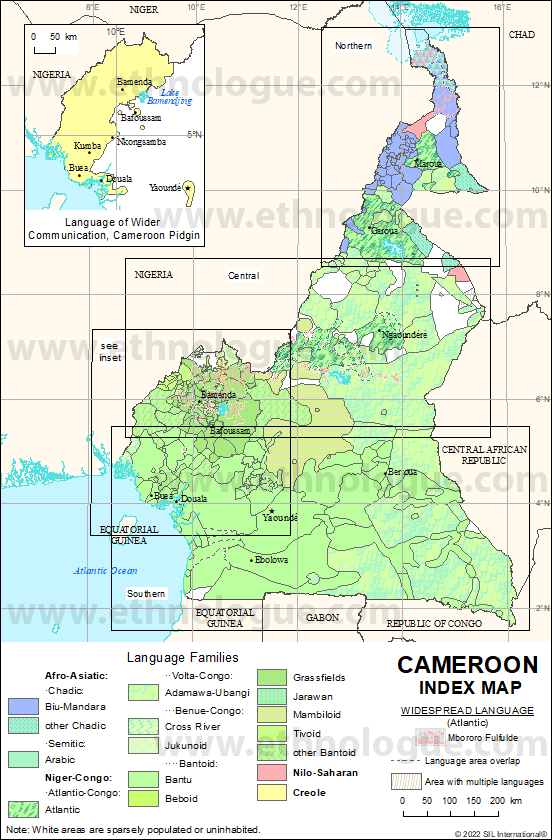
Central Cameroon
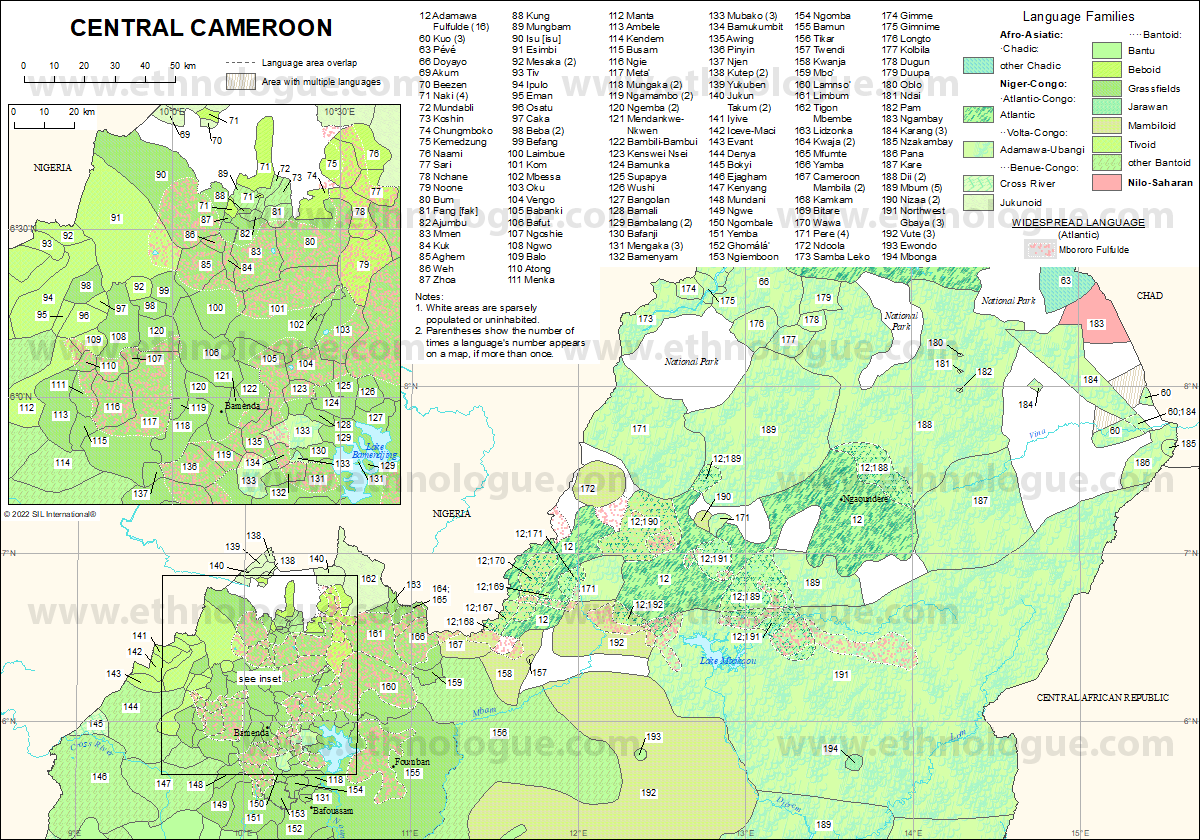
Northern Cameroon
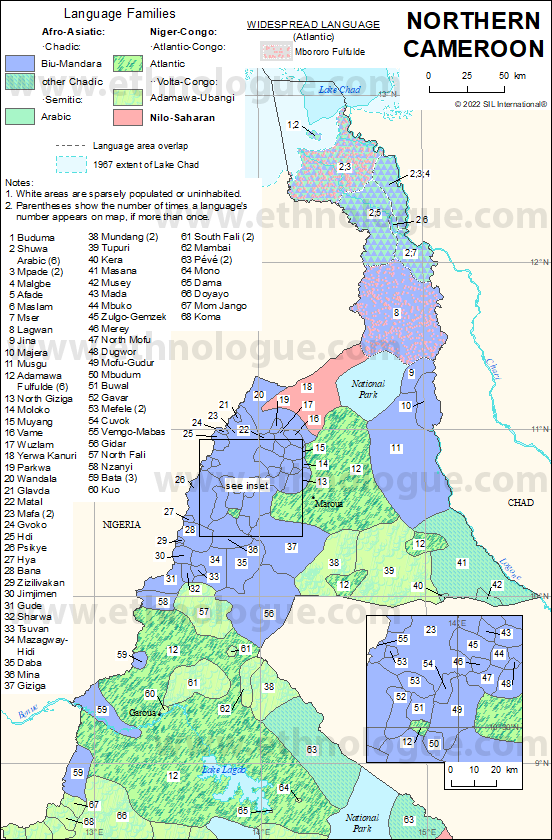
Southern Cameroon
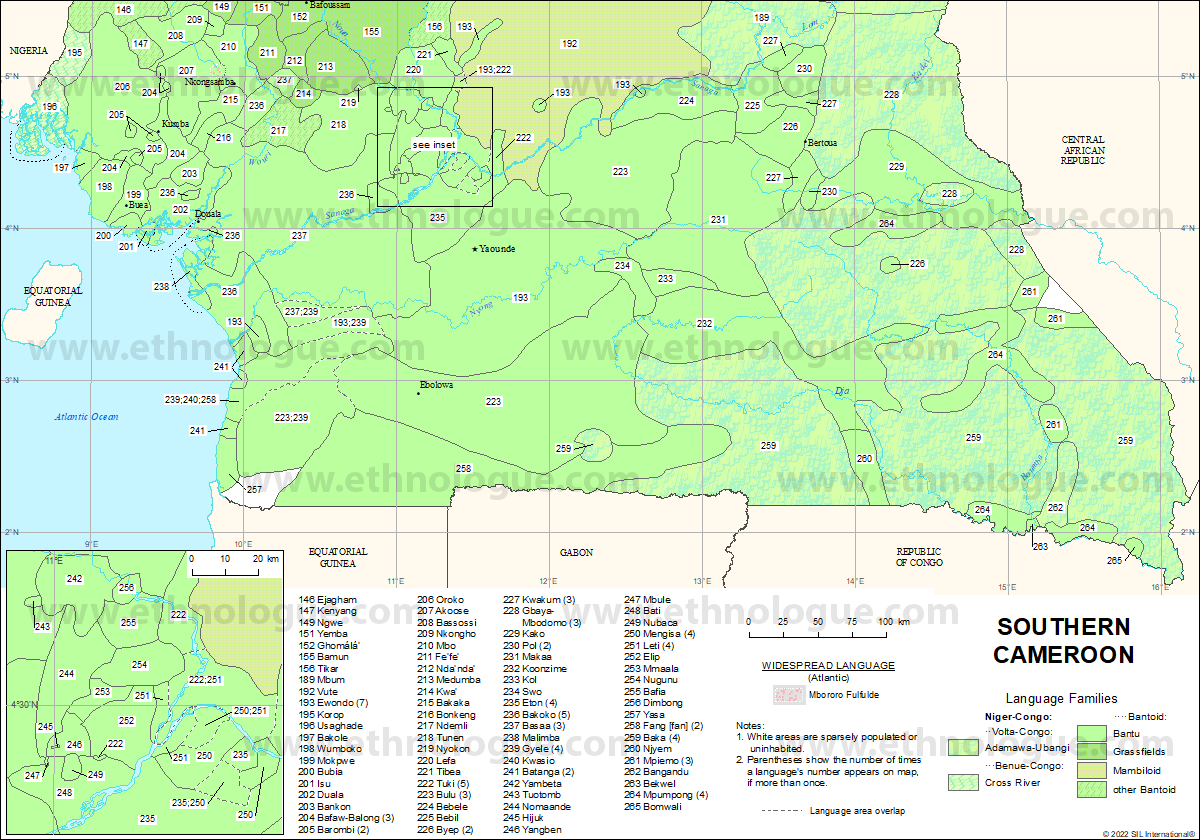
Graphs
Language Vitality Profile
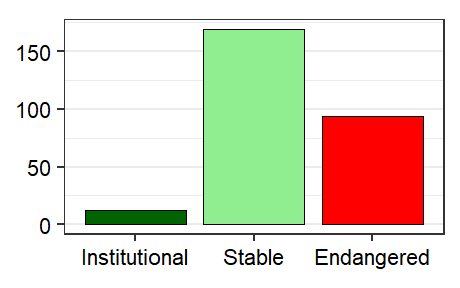
Full explanation
Language Status Profile
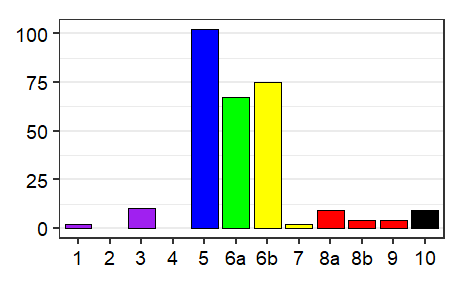
Full explanation
Resources
View Terms
Each Ethnologue country digest is a licensed product with restricted terms of use. Before downloading the product, you must agree to the following terms:
- This is a license for individual use. Just as with a conventionally published book, it is a violation of copyright to make a copy and give it to others.
- You may not redistribute this work in any form, including ingesting the contents into a database that is shared with others or posting it on a web site (whether public or private).
To inquire about permission for reuse or redistribution, please use the Contact Us form in the footer.
Digest of the languages of Cameroon ($399.95, 173 page PDF)