
CR
Costa Rica
Summary
- Official Name
- Population
- 5,094,000
- Principal Languages
- Spanish
- Literacy Rate
- 98% (2018 UNESCO)
- International Conventions
- CDE (1960), CPPDCE (2006), CSICH (2012), ICCPR (1966), (), UNCRPD (2006), UNDRIP (2007)
- General References
- Adelaar 2007, Campbell 1997
- Deaf Population
- 26,240
- Language Counts
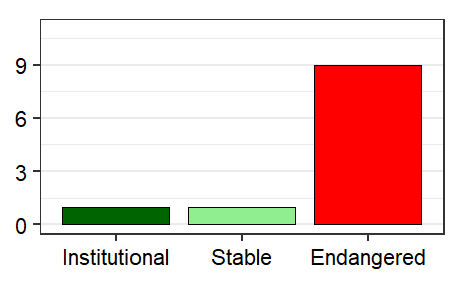
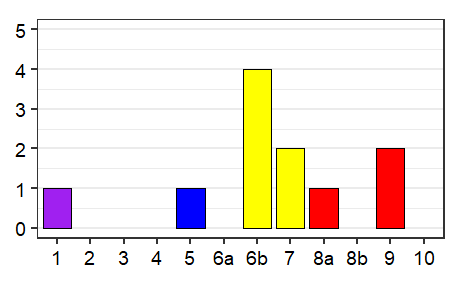
- The number of established languages listed for Costa Rica is 14. All are living languages. Of these, 8 are indigenous and 6 are non-indigenous. Furthermore, 1 is institutional, 2 are developing, 6 are in trouble, and 5 are dying. Also listed is 1 unestablished language.
Languages
- Boruca brn
- Puntarenas province: south coast between Golfito and Playa Bonita. Users: No known L1 speakers (2010 D. Castro-Garcia). 3 semi-speakers (Adelaar 2007). Ethnic population: 2,590 (2011 census). Status: 9 (Dormant). Alternate Names: Boruka, Borunca, Bronca, Brunca, Brunka, Burunca Classification: Chibchan, Chibchan A
- Bribri bzd
- Limón province: Talamanca cantón, along Lari, Telire, and Uren rivers; Puntarenas province: Buenos Aires cantón. Users: 7,000 (2011 census). Ethnic population: 12,800 (2011 census). Status: 6b* (Threatened). Alternate Names: Talamanca Autonym: Bribri Classification: Chibchan, Chibchan A, Viceitic
- Bribri Sign Language rib
- Limón province. Users: No known L1 users. The 3 deaf people who used it died in 1991, with only very elderly hearing people remembering any of it (2021 J. Woodward). Status: 9 (Dormant). Classification: Sign language, Shared sign language
- Brunca Sign Language rnb
- Puntarenas province: Buenos Aires cantón, Brunca village. Users: Unknown number of users but the language is still presumably in use (2021 J. Woodward). Status: 8a (Moribund). Classification: Sign language, Shared sign language
- Cabécar cjp
- Cartago, Limón, Puntarenas, San José provinces: Turrialba region. Users: 11,100 (2011 census). 2,000 monolinguals (2015 M. Porras). The only language in Costa Rica with monolingual speakers, mostly women (Adelaar 2007). Ethnic population: 12,700 (2011 census). Status: 6b* (Threatened). Alternate Names: Chirripó Autonym: Cabécar Classification: Chibchan, Chibchan A, Viceitic
- Chinese, Yue yue
- Guanacaste, Limón, Puntarenas, and San José provinces. Users: 4,500 in Costa Rica (2011 J. Leclerc). Status: Unestablished. Classification: Sino-Tibetan, Chinese
- Costa Rican Sign Language csr
- Scattered. Users: 15,000 in Costa Rica (2021 DBS/DOOR/SIL). Estimated 10,000–20,000 deaf signers, assuming 0.2%–0.4% of the general population; 70,700 people with hearing loss (2011 census). Status: 5 (Developing). Recognized language (2012, Ley 9049, Official Recognition of Costa Rican Sign Language). Recognized language (2020, Law 9822 Recognition and promotion of Lenguaje de Señas Costarricense (LESCO)). Alternate Names: LESCO, Lengua de Señas Costarricense, Lenguaje de Señas Costarricense Classification: Sign language, Deaf community sign language
- English eng
- Users: 399,500 in Costa Rica, all users. L1 users: 17,500 in Costa Rica (2021 Joshua Project), based on ethnicity. L2 users: 382,000 (2020 census). Status: 5* (Dispersed). Classification: Indo-European, Germanic, West, English
- Maléku Jaíka gut
- Alajuela province: Tonjibe and Margarita reservations; northern lowlands. Users: 300 (Yasugi 2007). Ethnic population: 1,070 (2000). Status: 7 (Shifting). Recognized language (2014, Reforma del Subsistema de Educación Indígena N° 37801-MEP). Alternate Names: Guatuso, Malécu lhaíca Classification: Chibchan, Chibchan B, Votic
- Ngäbere gym
- Puntarenas province. Users: 2,840 in Costa Rica (2011 census). Ethnic population: 3,650 (2011 census). Status: 6b (Threatened). Alternate Names: Guaymí, Nove Classification: Chibchan, Chibchan A, Guaymiíc
- Plautdietsch pdt
- Heredia province: Sarapiqui area. Users: 2,000 in Costa Rica (Salminen 2007). Status: 6b* (Threatened). Alternate Names: Low German, Mennonite German Classification: Indo-European, Germanic, West, Low Saxon-Low Franconian, Low Saxon
- Southwestern Caribbean English Creole jam
- Limón province: East of San José, principally railroad area between Limón and Siquirres, road south of Limón. Users: 55,100 in Costa Rica (Winkler 2013). Status: 8a (Moribund). Alternate Names: Jamiekan, Limonese Creole, Limón Creole English Classification: Creole, English based, Atlantic, Western
- Spanish spa
- Users: 5,055,400 in Costa Rica, all users. L1 users: 5,020,000 in Costa Rica (Instituto Cervantes 2019). L2 users: 35,400 (Instituto Cervantes 2019). Status: 1 (National). Statutory national language (1949, Constitution, Article 76). Alternate Names: Castellano, Español Classification: Indo-European, Italic, Romance, Italo-Western, Western, Gallo-Iberian, Ibero-Romance, West Iberian, Castilian
- Teribe tfr
- Puntarenas province: near Boruca Reservation. Users: No known L1 speakers in Costa Rica. Ethnic population: 1,270 (2011 census). Status: 9 (Dormant). Alternate Names: Naso, Terraba Classification: Chibchan, Chibchan A
- Yiddish, Eastern ydd
- San José. Status: 7 (Shifting). Classification: Indo-European, Germanic, West, High German, Yiddish
Languages by Status
Spanish
[spa] 1 (National). Statutory national language (1949, Constitution, Article 76). 5,055,400 in Costa Rica, all users. L1 users: 5,020,000 in Costa Rica (Instituto Cervantes 2019). L2 users: 35,400 (Instituto Cervantes 2019).
English
[eng] 5* (Dispersed). 399,500 in Costa Rica, all users. L1 users: 17,500 in Costa Rica (2021 Joshua Project), based on ethnicity. L2 users: 382,000 (2020 census).
Costa Rican Sign Language
[csr] 5 (Developing). Recognized language (2012, Ley 9049, Official Recognition of Costa Rican Sign Language). Recognized language (2020, Law 9822 Recognition and promotion of Lenguaje de Señas Costarricense (LESCO)). 15,000 in Costa Rica (2021 DBS/DOOR/SIL). Estimated 10,000–20,000 deaf signers, assuming 0.2%–0.4% of the general population; 70,700 people with hearing loss (2011 census).
Bribri
[bzd] 6b* (Threatened). 7,000 (2011 census). Ethnic population: 12,800 (2011 census).
Cabécar
[cjp] 6b* (Threatened). 11,100 (2011 census). 2,000 monolinguals (2015 M. Porras). The only language in Costa Rica with monolingual speakers, mostly women (Adelaar 2007). Ethnic population: 12,700 (2011 census).
Ngäbere
[gym] 6b (Threatened). 2,840 in Costa Rica (2011 census). Ethnic population: 3,650 (2011 census).
Plautdietsch
[pdt] 6b* (Threatened). 2,000 in Costa Rica (Salminen 2007).
Maléku Jaíka
[gut] 7 (Shifting). Recognized language (2014, Reforma del Subsistema de Educación Indígena N° 37801-MEP). 300 (Yasugi 2007). Ethnic population: 1,070 (2000).
Yiddish, Eastern
[ydd] 7 (Shifting).
Brunca Sign Language
[rnb] 8a (Moribund). Unknown number of users but the language is still presumably in use (2021 J. Woodward).
Southwestern Caribbean English Creole
[jam] 8a (Moribund). 55,100 in Costa Rica (Winkler 2013).
Boruca
[brn] 9 (Dormant). No known L1 speakers (2010 D. Castro-Garcia). 3 semi-speakers (Adelaar 2007). Ethnic population: 2,590 (2011 census).
Bribri Sign Language
[rib] 9 (Dormant). No known L1 users. The 3 deaf people who used it died in 1991, with only very elderly hearing people remembering any of it (2021 J. Woodward).
Teribe
[tfr] 9 (Dormant). No known L1 speakers in Costa Rica. Ethnic population: 1,270 (2011 census).
Chinese, Yue
[yue] Unestablished. 4,500 in Costa Rica (2011 J. Leclerc).
Maps
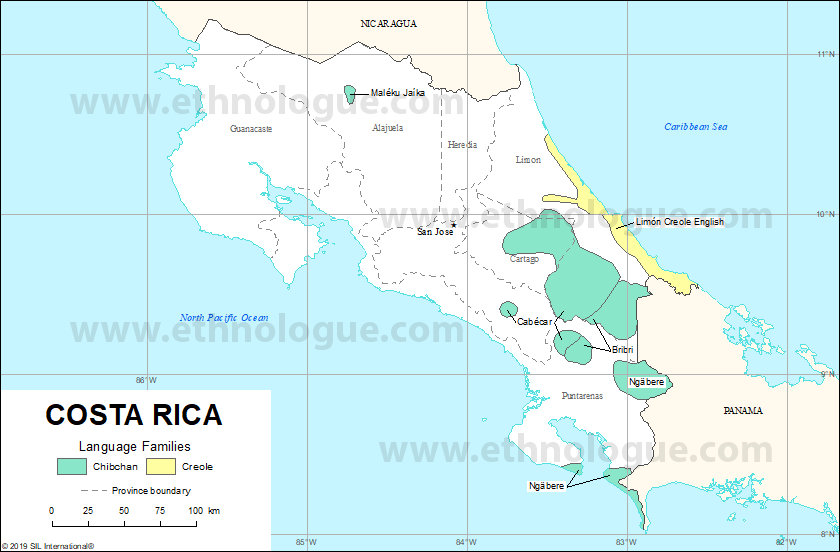
Costa Rica
Graphs
Language Vitality Profile
Full explanation
Language Status Profile
Full explanation
Resources
View Terms
Each Ethnologue country digest is a licensed product with restricted terms of use. Before downloading the product, you must agree to the following terms:
- This is a license for individual use. Just as with a conventionally published book, it is a violation of copyright to make a copy and give it to others.
- You may not redistribute this work in any form, including ingesting the contents into a database that is shared with others or posting it on a web site (whether public or private).
To inquire about permission for reuse or redistribution, please use the Contact Us form in the footer.
Digest of the languages of Costa Rica ($149.95, 24 page PDF)