
ET
Federal Democratic Republic of Ethiopia
Ethiopia
Summary
- Official Name
- Federal Democratic Republic of Ethiopia
- Population
- 117,876,000
- Principal Languages
- Amharic
- Literacy Rate
- 52% (2017 UNESCO)
- International Conventions
- ACHPR (1987), CPPDCE (2006), CSICH (2012), ICCPR (1966), UNCRPD (2006)
- General References
- Bender, M. 1971, Bender 1976, Bender 1983a, Bender 1989b, Campbell and King 2011, Dimmendaal and Voeltz 2007, Jordan et al 2015
- Deaf Population
- 1,000,000 (2005 Ethiopian National Association of the Deaf)
- Language Counts
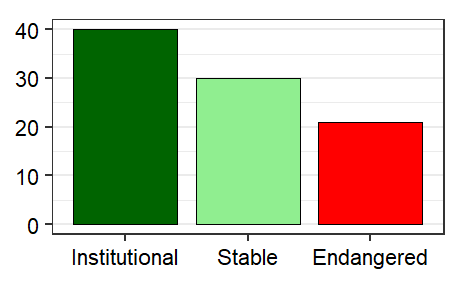
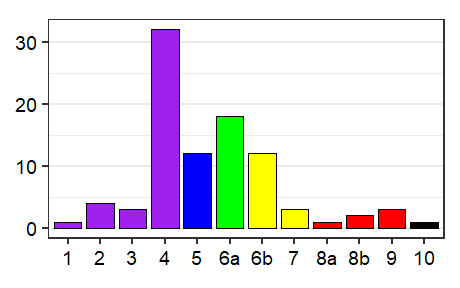
- The number of established languages listed for Ethiopia is 94. Of these, 92 are living and 2 are extinct. Of the living languages, 87 are indigenous and 5 are non-indigenous. Furthermore, 33 are institutional, 20 are developing, 18 are vigorous, 15 are in trouble, and 6 are dying. Also listed is 1 macrolanguage.
Languages
- Aari aiw
- Southern Nations, Nationalities, and Peoples’ region: central north Omo zone, south tip of Ethiopia plateau. Users: 298,300, all users. L1 users: 285,000 (2007 census). Includes Gayil [gyl] speakers. L2 users: 13,300. 129,000 monolinguals. Ethnic population: 290,000 (2007 census). Includes Gayil [gyl]. Status: 4 (Educational). Alternate Names: Aarai, Ara, Ari, Aro, “Shankilla” (pej.), “Shankilligna” (pej.), “Shankillinya” (pej.) Autonym: አፋን፡ኣሪ፡ (Áfan ārí) Classification: Afro-Asiatic, Omotic, South
- Afar aar
- Afar, Amhara, and Somali regions: eastern lowlands. Users: 1,862,800 in Ethiopia, all users. L1 users: 1,840,000 in Ethiopia (2018). L2 users: 22,800. 906,000 monolinguals (1994 census). Total users in all countries: 2,563,800 (as L1: 2,541,000; as L2: 22,800). Status: 2 (Provincial). De facto language of provincial identity in Afar Region. Alternate Names: Adal, Afaraf, Affar, Affarigna, Qafar, Qafaraf, ʿAfár af, “Danakil” (pej.), “Denkel” (pej.) Autonym: Qafar af Classification: Afro-Asiatic, Cushitic, East, Saho-Afar
- Alaba-K’abeena alw
- Oromia region: Rift Valley southwest of Lake Shala; Southern Nations, Nationalities, and Peoples’ region. Users: 307,700, all users. L1 users: 278,000 (2007 census). 227,000 Alaba, 51,300 K’abeena (2007 census). L2 users: 29,700. 111,000 monolinguals (1994 census). Ethnic population: 286,000 (2007 census). 233,000 Alaba, 52,700 K’abeena (2007 census). Status: 5* (Developing). Alternate Names: Alaaba, Allaaba, Halaba, K’abeena, K’abena, Qebena, Wanbasana Classification: Afro-Asiatic, Cushitic, East, Highland
- Ale gwd
- Southern Nations, Nationalities, and Peoples’ region: Segen zone, west of Lake Chamo. Users: 85,670, all users. L1 users: 84,300 (2017). L2 users: 1,370. 27,500 monolinguals. Ethnic population: 68,600 (2007 census). Status: 4 (Educational). Alternate Names: Dabosse, Debase, Dobase, Dullay, Gobeze, Pako Qalatte, Pako ʕalatte, Qawko, Werizoid, ʕale, “Gauwada” (pej.), “Gawata” (pej.), “Gawwada” (pej.), “Gewada” (pej.), “Kawwad’a” (pej.), “Kawwada” (pej.) Autonym: Qale Classification: Afro-Asiatic, Cushitic, East, Dullay
- Amharic amh
- Amhara region: north central; Addis Ababa. Users: 56,900,000 in Ethiopia, all users. L1 users: 31,800,000 in Ethiopia (2018). L2 users: 25,100,000 (2019). 14,800,000 monolinguals. Ethnic population: 29,300,000 (2018). Total users in all countries: 57,466,710 (as L1: 32,366,710; as L2: 25,100,000). Status: 1 (National). Statutory national language (1994, Constitution, Art 5(2)). Alternate Names: Abyssinian, Amarigna, Amarinya, Amhara, Ethiopian Autonym: ኣማርኛ (Amarəñña) Classification: Afro-Asiatic, Semitic, South, Ethiopian, South, Transversal, Amharic-Argobba
- Anfillo myo
- Oromia region: Anfillo forest, west of Dembi Dolo. Users: 500 (1990 SIL). Ethnic population: 1,000 (1990 SIL). Status: 8a (Moribund). Alternate Names: Southern Mao Classification: Afro-Asiatic, Omotic, North, Gonga-Gimojan, Gonga, Central
- Anuak anu
- Gambela region: Akobo river right bank, Alworo, Baro, and Gilo rivers; small areas in Southern Nations, Nationalities, and Peoples’ region and Oromia region. Users: 92,710 in Ethiopia, all users. L1 users: 90,600 in Ethiopia (2007 census). L2 users: 2,110. 34,300 monolinguals. Ethnic population: 89,100 (2007 census). Status: 5* (Developing). Alternate Names: Anyiwak, Anyuak, Anywa, Anywaa, Anywak, Bar, Burjin, Dha Anywaa, Jambo, Miroy, Moojanga, Nuro, Yambo, Yembo Classification: Nilo-Saharan, Satellite-Core, Core, Eastern Sudanic, Southern (n languages), Nilotic, Western, Luo, Northern, Anuak
- Arabic, Sudanese Spoken apd
- Benishangul-Gumuz region: Assosa. Status: 3 (Wider communication). Alternate Names: Dārijīya Classification: Afro-Asiatic, Semitic, Central, South, Arabic
- Arabic, Ta’izzi-Adeni Spoken acq
- Afar and Somali regions. Status: 3 (Wider communication). We are not reporting an L1 community in this country, but are reporting it being used as an L2 by a number of local languages. Therefore it is an LWC. Classification: Afro-Asiatic, Semitic, Central, South, Arabic
- Arbore arv
- Oromia region: Lake Chew Bahir area; Southern Nations, Nationalities, and Peoples’ region: South Omo zone. Users: 10,320, all users. L1 users: 7,210 (2007 census). L2 users: 3,110. 3,900 monolinguals (1994 census). Ethnic population: 7,280 (2007 census). Status: 6a (Vigorous). Alternate Names: Arbora, Arborie, Erbore, Irbore Classification: Afro-Asiatic, Cushitic, East, Western Omo-Tana
- Argobba agj
- Afar region: Argobba Special district, Abbule Arada; Amhara region: North Shewa zone, Ankober district, Afre and Aliyyu Amba; K’awat district: Goze and Shewa Robit; Minjarinna-Shenkora district: Arerti; Oromia zone, Dawa Ch’affa district, T’allaha village; Kemise district: Kemise. Users: 46,940, all users. L1 users: 43,700 (2007 census). L2 users: 3,240. Ethnic population: 141,000 (2007 census). Status: 6b (Threatened). Alternate Names: Argoba, Argobbigna, Argobgna Autonym: ዓርጎባ (Argoba) Classification: Afro-Asiatic, Semitic, South, Ethiopian, South, Transversal, Amharic-Argobba
- Awngi awn
- Amhara region: Awi and North Gonder zones, southwest of Lake Tana; Benishangul-Gumuz region: Metekel zone. Users: 553,400, all users. L1 users: 489,000 (2007 census), increasing. L2 users: 64,400 (1994 census). 323,000 monolinguals. Ethnic population: 636,000 (2007 census). Status: 5 (Developing). Alternate Names: Agau, Agaw, Agew, Agew-Awi, Agow, Awŋi, Awawar, Awi, Awija, Awiya, Damot, Kwollanyoch, “Kumfel” (pej.), “Kunfel” (pej.), “Kunfäl” (pej.) Autonym: አውጚ (Awŋi) Classification: Afro-Asiatic, Cushitic, Central, Southern
- Baiso bsw
- Southern Nations, Nationalities, and Peoples’ region: halfway between Soddo and Arba Minch, Merab Abaya area, Alge village (390); Gidicho Island, Baiso and Shigima villages (200); Welege island on Lake Abaya (420), and west shore. Users: 4,620 (2007 census). Ethnic population: 5,490 (2007 census). Status: 6a (Vigorous). Alternate Names: Alkali, Bayso, Gedicho, Giddicho, Gidicho Classification: Afro-Asiatic, Cushitic, East, Western Omo-Tana
- Basketo bst
- Southern Nations, Nationalities, and Peoples’ region: north Omo zone, plateau west of Bulki. Users: 101,560, all users. L1 users: 92,600 (2007 census). L2 users: 8,960. 42,800 monolinguals. Ethnic population: 78,300 (2007 census). Status: 4 (Educational). Alternate Names: Baskatta, Basketo-Dokka, Basketto, Mesketo, Misketto Autonym: ባስኬ፟ት (Basəke፟tə) Classification: Afro-Asiatic, Omotic, North, Gonga-Gimojan, Gimojan, Ometo-Gimira, Ometo, West
- Bench bcq
- Southern Nations, Nationalities, and Peoples’ region: Mizan Teferi area. Users: 370,600, all users. L1 users: 348,000 (2007 census). 14,300 Mer. L2 users: 22,600. 150,000 monolinguals. Ethnic population: 352,000 (2007 census). Status: 4 (Educational). Alternate Names: Benchnon, Bencnon, Dizu, “Ghimarra” (pej.), “Gimarra” (pej.), “Gimira” (pej.) Autonym: Benc’non Classification: Afro-Asiatic, Omotic, North, Gonga-Gimojan, Gimojan, Ometo-Gimira, Gimira
- Berta wti
- Benishangul-Gumuz region: Blue Nile river and Sudan border corner north of Asosa; Dalati, Sirba Abay area east of Dabus river; Matahara east. Users: 213,500 in Ethiopia, all users. L1 users: 197,000 in Ethiopia (2007 census), increasing. L2 users: 16,500. 99,700 monolinguals. Ethnic population: 199,000 (2007 census). Total users in all countries: 393,500 (as L1: 377,000; as L2: 16,500). Status: 4 (Educational). Alternate Names: Barta, Bela-Shangul, Bela-Shanguru, Beni Shangul, Bertha, Burta, Funj, Jebelawi, Rotana, Rut’ana, Wetawit Autonym: Ndú Benishangulú Classification: Nilo-Saharan, Satellite-Core, Satellites
- Borna bwo
- Benishangul-Gumuz region: Metekel zone, near Blue Nile river. Users: 38,180, all users. L1 users: 35,900 (2007 census). L2 users: 2,280. 18,600 monolinguals. 77 Gamila. Ethnic population: 60,600 (2007 census). Status: 6b (Threatened). Alternate Names: Bora, Borí noon, Bori Noona, Bornə, Borni noon, Boro, Bworo, Dangabo, Gonga, Scinacia, Shinasha, Shinassha, Shinicho, Šinaša Autonym: Borna Classification: Afro-Asiatic, Omotic, North, Gonga-Gimojan, Gonga, North
- Burji bji
- Southern Nations, Nationalities, and Peoples’ region: south of Lake Chamo; into Oromia region. Users: 49,450 in Ethiopia, all users. L1 users: 46,400 in Ethiopia (2007 census). L2 users: 3,050. 29,300 monolinguals. Ethnic population: 71,800 (2007 census). Total users in all countries: 86,350 (as L1: 83,300; as L2: 3,050). Status: 6b (Threatened). Alternate Names: Bambala, Bembala, Daashi, Dhaashatee Autonym: Dhaashate Classification: Afro-Asiatic, Cushitic, East, Highland
- Chara cra
- Southern Nations, Nationalities, and Peoples’ region: south Omo zone, Omo river. Users: 13,770, all users. L1 users: 13,100 (2007 census). L2 users: 670. 5,560 monolinguals. Ethnic population: 13,200 (2007 census). Status: 6a (Vigorous). Alternate Names: Ciara, Gimiri Nona Classification: Afro-Asiatic, Omotic, North, Gonga-Gimojan, Gimojan, Ometo-Gimira, Chara
- Daasanach dsh
- Southern Nations, Nationalities, and Peoples’ region: lower Omo river, along Lake Turkana. Users: 48,230 in Ethiopia, all users. L1 users: 48,000 in Ethiopia (2007 census). L2 users: 230. 31,400 monolinguals. Ethnic population: 48,100 (2007 census). Total users in all countries: 66,630 (as L1: 66,400; as L2: 230). Status: 5 (Developing). Alternate Names: Af ’Daasanach, Daasanech, Dama, Dasenech, Dathanaic, Dathanaik, Dathanik, Dhaasanac, Gallab, Galuba, Gelab, Geleb, Geleba, Gelebinya, Gelubba, Gheleba, Marille, Merile, Merille, Morille, Reshiat, Russia, af’Daasanach, “Shangilla” (pej.) Autonym: Af Daasanach Classification: Afro-Asiatic, Cushitic, East, Western Omo-Tana
- Daatsʼíin dtn
- Amhara region: Qwara district, small villages in Mahadid K’ebele; Benishangul-Gumuz region: Guba district, villages in Aynshemsh K’ebele. Users: 300 (2015 C. Ahland). Status: 6a (Vigorous). Alternate Names: Sa-Daatsʼíin Classification: Nilo-Saharan, Satellite-Core, Core, B’aga
- Dawro dwr
- Southern Nations, Nationalities, and Peoples’ region: Dawro zone; 2 small border areas in Oromia region. Users: 533,000, all users. L1 users: 513,000 (2007 census). 81,600 Konta (2007 census). L2 users: 20,000. 260,000 monolinguals. Ethnic population: 538,000 (2007 census). 83,600 Konta (2007 census). Status: 4 (Educational). Alternate Names: Dauro, Dawragna, Dawrogna, Dawuro, Ometay, “Cullo” (pej.), “Kullo” (pej.) Classification: Afro-Asiatic, Omotic, North, Gonga-Gimojan, Gimojan, Ometo-Gimira, Ometo, Central
- Dime dim
- Southern Nations, Nationalities, and Peoples’ region: north of Omo river, just before it turns south. Users: 1,100, all users. L1 users: 570 (2007 census), decreasing. L2 users: 530. Ethnic population: 870 (2007 census). Status: 6a (Vigorous). Alternate Names: Dim-af, Dim-ap, Dima Classification: Afro-Asiatic, Omotic, South
- Dirasha gdl
- Southern Nations, Nationalities, and Peoples’ region: Segen zone, Dirashe district, Gidole town area in hills west of Lake Chamo. Users: 80,500, all users. L1 users: 73,500 (2007 census). 15,300 Dirasha, 49,900 Gidole, 8,250 Kusumitta (2007 census). L2 users: 7,000. Ethnic population: 92,000 (2020 Local census). Status: 4 (Educational). Alternate Names: Derashe, Dhirasha, Dhiraytata, Dhirayyitta, Dhirayyittaat, Diraasha, Dirashitata, Dirayta, Diraytata, Diraytta, Gardulla, Gedoligna, Ghidole, Gidole Autonym: Dhirayta Classification: Afro-Asiatic, Cushitic, East, Konso-Gidole
- Dizin mdx
- Southern Nations, Nationalities, and Peoples’ region: Bench-Maji zone. Users: 35,950, all users. L1 users: 33,900 (2007 census), increasing. L2 users: 2,050. 17,600 monolinguals. Ethnic population: 34,700 (2007 census). Status: 4 (Educational). Alternate Names: Diizi-Noog, Dizi, Dizi-Maji, Dizinog, Dizinya, Maji, Majinya, Sizi, Twoyu Autonym: Diizi-nuog, Diizin Classification: Afro-Asiatic, Omotic, North, Dizoid
- Dorze doz
- Southern Nations, Nationalities, and Peoples’ region: north Omo zone, Chencha area. Users: 24,400, all users. L1 users: 20,800 (1994 census). L2 users: 3,600. 9,910 monolinguals. Ethnic population: 29,000 (1994 census). Status: 6b* (Threatened). Classification: Afro-Asiatic, Omotic, North, Gonga-Gimojan, Gimojan, Ometo-Gimira, Ometo, Central
- English eng
- Widespread. Users: 241,870 in Ethiopia, all users. L1 users: 1,870 in Ethiopia (2010 UNSD). L2 users: 240,000 (2018). Status: 4 (Educational). Classification: Indo-European, Germanic, West, English
- Ethiopian Sign Language eth
- Scattered. Users: 560,000 (2021 DBS/DOOR/SIL). Estimated 340,000–680,000 deaf signers, assuming 0.3%–0.6% of the total population. Other estimates: 250,000 as reported by the government (2008 WFD); 1,000,000 (2005 Ethiopian National Association of the Deaf); over 1 million (Tamene 2016:307). Status: 5 (Developing). Alternate Names: EthSL Classification: Sign language, Deaf community sign language
- Gafat gft
- Oromia state: East Welega zone and along the Blue Nile. Users: No known L1 speakers. In 1947 there were only 4 speakers left. Last speaker likely died by 1960. Status: 10 (Extinct). Classification: Afro-Asiatic, Semitic, South, Ethiopian, South, Outer, n-Group
- Gamo gmv
- Southern Nations, Nationalities, and Peoples’ region: Gamo-Gofa zone. Users: 1,654,400, all users. L1 users: 1,630,000 (2018), increasing. L2 users: 24,400. 600,000 monolinguals. Ethnic population: 1,630,000 (2018). Status: 4 (Educational). Alternate Names: Gammo, Gemu, Gereze Autonym: Gamotso Classification: Afro-Asiatic, Omotic, North, Gonga-Gimojan, Gimojan, Ometo-Gimira, Ometo, Central
- Ganza gza
- Benishangul-Gumuz region: Mao-Komo special district, Penshuba and Yabeldigis villages; Gambela region. Users: 400 in Ethiopia (2007). Status: 6a (Vigorous). Alternate Names: Ganzo, Gwami, Gwàmí Nánà, Koma Classification: Afro-Asiatic, Omotic, North, Mao
- Gayil gyl
- Southern Nations, Nationalities, and Peoples’ region: South Omo zone, Gelila district. Users: 55,700 (2007 L. Jordan). Status: 6a (Vigorous). Alternate Names: Galila, Gayi, Gayl, Gelila, Northern Aari Classification: Afro-Asiatic, Omotic, South
- Gedeo drs
- Southern Nations, Nationalities, and Peoples’ and Oromia regions: central highland area, southwest of Dilla and east of Lake Abaya. Users: 1,458,000, all users. L1 users: 1,410,000 (2018). L2 users: 48,000. 439,000 monolinguals. Ethnic population: 1,410,000 (2018). Status: 4 (Educational). Alternate Names: Geddeo, “Darasa” (pej.), “Darassa” (pej.), “Derasa” (pej.), “Derasanya” (pej.), “Deresa” (pej.) Autonym: ጌዴኡፈ (gedeʾufä) Classification: Afro-Asiatic, Cushitic, East, Highland
- Geez gez
- Scattered. Users: No known L1 speakers in Ethiopia. Ethnic population: No ethnic community. Total users in all countries: none known. Status: 9 (Second language only). Alternate Names: Ancient Ethiopic, Ethiopic, Ge’ez, Giiz Autonym: ግዕዝ (Gəʿəz) Classification: Afro-Asiatic, Semitic, South, Ethiopian, North
- Girirra gii
- Somali region: Afder zone, Elkere district. Users: 50,000 (2007). Status: 6b (Threatened). Alternate Names: Afgirirra, Girirro Classification: Afro-Asiatic, Cushitic, East, Somali
- Gofa gof
- Southern Nations, Nationalities, and Peoples’ region: Gamo-Gofa zone. Users: 392,400, all users. L1 users: 359,000 (2007 census), increasing. L2 users: 33,400. 190,000 monolinguals. Ethnic population: 362,000 (2007 census). Status: 4 (Educational). Alternate Names: Goffa, Goofa Autonym: Goofatho Classification: Afro-Asiatic, Omotic, North, Gonga-Gimojan, Gimojan, Ometo-Gimira, Ometo, Central
- Gumuz guk
- Amhara, Benishangul-Gumuz, and Oromia regions: Metemma area on Sudan border south through Gonder and Metekel zones; along Blue Nile south into Wellaga and Didessa valley up to Neqemt-Gimbi road; southwest of Addis Ababa, Welqite area villages. Used in minority communities in Amhara and Oromia regions. Users: 165,380 in Ethiopia, all users. L1 users: 161,000 in Ethiopia (2007 census). L2 users: 4,380. 88,200 monolinguals. Ethnic population: 164,000 (2007 census). Total users in all countries: 253,380 (as L1: 249,000; as L2: 4,380). Status: 4 (Educational). Alternate Names: B’ega, Baha, Bega-Tse, Debatsa, Debuga, Dehenda, Gemju, Gombo, Gumis, Gumuzu, Gumz, Kaza, Mendeya, Sa-B’aga, Sibaha, Sigumza, “Shankillinya” (pej.) Autonym: Sa-Gumuz Classification: Nilo-Saharan, Satellite-Core, Core, B’aga
- Gwama kmq
- Benishangul-Gumuz region: Mao Komo special woreda (Lowland dialect); Oromia region: West Wollega zone, Begi district; some villages near South Sudan border (Highland dialect). Users: 15,000 (Küspert 2015). Ethnic population: 20,000 (Küspert 2015). Status: 6b (Threatened). Alternate Names: Afaan Mao, Amam, Gogwama, Goma, Guama, Kewama, Kiring, Kuro, Kuwama, Kwama, Kwoma, Nokanoka, North Koma, Qewama, T’waKwama, Takwama Autonym: Gwama, Ttwa Gwama Classification: Nilo-Saharan, Satellite-Core, Core, Koman
- Hadiyya hdy
- Southern Nations, Nationalities, and Peoples’ region: Gurage, Hadiyya, and Kambaata zones, between Omo and Billate rivers, Hosaina town area; Oromia region: east Shewa zone. Users: 1,991,000, all users. L1 users: 1,840,000 (2018). L2 users: 151,000. 595,000 monolinguals. Ethnic population: 1,840,000 (2018). Status: 4 (Educational). Alternate Names: Adea, Adiya, Adiye, Hadia, Hadiya, Hadya Autonym: Hadiyyisa Classification: Afro-Asiatic, Cushitic, East, Highland
- Hamer-Banna amf
- Southern Nations, Nationalities, and Peoples’ region: South Omo zone, near Omo river; north of Lake Turkana, near Kenya and Sudan borders; Oromia region: Borena zone. Users: 81,520, all users. L1 users: 74,400 (2007 census). 47,500 Hamer, 26,900 Banna (2007 census). L2 users: 7,120. 38,400 monolinguals (1994 census). Ethnic population: 73,500 (2007 census). 46,500 Hamer, 27,000 Banna (2007 census). Status: 6a (Vigorous). Alternate Names: Amar, Amarcocche, Amer, Ammar, Bana, Banna, Banne 7apo, Bena, Beshada, Cocche, Hamar, Hamar-Benna, Hamar-Koke, Hamer, Hamer-Bana-Kara, Hammer, Hammercoche, Hámar aapó, Kara Kerre Classification: Afro-Asiatic, Omotic, South
- Harari har
- Harari region: walled city of Harar; Addis Ababa and Dire Dawa. Users: 33,570 in Ethiopia, all users. L1 users: 25,800 in Ethiopia (2007 census). 20,000 in Addis Ababa, outside Harar city (Hetzron 1997). L2 users: 7,770. 2,350 monolinguals. Ethnic population: 31,700 (2007 census). Total users in all countries: 34,890 (as L1: 27,120; as L2: 7,770). Status: 5* (Developing). Alternate Names: Adare, Adarinnya, Adere, Aderinya, Hararri, Hareri Autonym: ሃራሪ (Gey Sinan) Classification: Afro-Asiatic, Semitic, South, Ethiopian, South, Transversal, Harari-East Gurage
- Hozo hoz
- Benishangul-Gumuz region; Oromia region: West Wollega zone, Babo Gambel, Begi, K’ondala, and Manasibu districts. Users: 6,000 (Küspert 2015). Ethnic population: 24,300 (2007). This includes Hozo [hoz], Seze [sze] and Gwama [kmq] ethnic populations. Status: 7 (Shifting). Alternate Names: Agmo Wandi, Amo Wandi, Begi-Mao, Hoozo, Maramo, Mo Wandi, Nu Wandi, Shuluyo, Shulyo Classification: Afro-Asiatic, Omotic, North, Mao
- Inor ior
- Southern Nations, Nationalities, and Peoples’ region: west Gurage zone, Innemor and Endegeny districts. Users: 280,000. 50,000 Endegeny. Status: 6a (Vigorous). Alternate Names: Ennemor, Inoric Autonym: ኢኖር (Inori) Classification: Afro-Asiatic, Semitic, South, Ethiopian, South, Outer, tt-Group
- Kachama-Ganjule kcx
- Oromia and Southern Nations, Nationalities, and Peoples’ regions: Lake Abaya, Gidicho island, Kachama; Lake Chamo, Ganjule on west shore, Shela-Mela village. Users: 2,830 (2007 census). 1,000 Gats’ame and less than 50 Ganjule (Dimmendaal and Voeltz 2007). Ethnic population: 2,590 (2007 census). Status: 6a (Vigorous). Alternate Names: Qechem Classification: Afro-Asiatic, Omotic, North, Gonga-Gimojan, Gimojan, Ometo-Gimira, Ometo, East
- Kafa kbr
- Southern Nations, Nationalities, and Peoples’ region: Bonga town area; border areas in Oromia region. Users: 1,236,700, all users. L1 users: 1,190,000 (2018). L2 users: 46,700. 445,000 monolinguals (1994 census). Ethnic population: 1,300,000 (2018). Status: 4 (Educational). Alternate Names: Caafiti, Caffino, Kaffa, Kaffinya, Kaficho, Kefa, Keffa, Kefficho, Manjo Autonym: Kafi noono Classification: Afro-Asiatic, Omotic, North, Gonga-Gimojan, Gonga, South
- Kambaata ktb
- Southern Nations, Nationalities, and Peoples’ region: southwest Gurage, Kambaata, and Hadiyya zones; Durame is main town. Users: 822,300, all users. L1 users: 743,000 (2007 census). 30,100 Donga, 97,800 Timbaro (2007 census). L2 users: 79,300. 330,500 monolinguals. Includes 279,000 Kambaata, 51,600 Timbaro. Ethnic population: 761,000 (2007 census). Includes 35,200 Donga, 98,600 Timbaro (2007 census). Status: 4 (Educational). Alternate Names: Donga, Kambara, Kambata, Kambatta, Kemata, Kembata Autonym: Kambaatissata Classification: Afro-Asiatic, Cushitic, East, Highland
- Karo kxh
- Southern Nations, Nationalities, and Peoples’ region: south Omo zone. Users: 1,480 (2007 census). Ethnic population: 1,490 (2007 census). Status: 6b (Threatened). Alternate Names: Cherre, Kara, Kere, Kerre Classification: Afro-Asiatic, Omotic, South
- Kistane gru
- Oromia region; Southern Nations, Nationalities, and Peoples’ region: Gurage, Hadiyya, and Kambaata zones, southwest of Addis Ababa. Users: 315,500, all users. L1 users: 255,000 (1994 census). L2 users: 60,500. Ethnic population: 364,000 (1994 census). Includes 4,000 Gogot. Status: 6a (Vigorous). Alternate Names: Kəstane, North Gurage, Soddo, Soddo Gurage Classification: Afro-Asiatic, Semitic, South, Ethiopian, South, Outer, n-Group
- Komo xom
- Benishangul-Gumuz region: Mao-Komo special district south of Asosa; Gambela region: Itang special district, Pokung; Sombo Garre (Wallaga, southwest of Mugi); Southern Nations, Nationalities, and Peoples’ region: Bonga special district. Users: 1,000 in Ethiopia (Meckelberg 2016). Ethnic population: 1,500 (2018). Status: 6b (Threatened). Alternate Names: Central Koma, Gʊ̀ Kɔ̀mɔ̀, Koma, Madiin, South Koma, Tta Komo Classification: Nilo-Saharan, Satellite-Core, Core, Koman
- Konso kxc
- Southern Nations, Nationalities, and Peoples’ region: Konso zone south of Lake Chamo, near Segen River bend. Users: 247,660 in Ethiopia, all users. L1 users: 242,000 in Ethiopia (2007 census), increasing. L2 users: 5,660. 139,000 monolinguals. Ethnic population: 251,000 (2007 census). Total users in all countries: 248,960 (as L1: 243,300; as L2: 5,660). Status: 4 (Educational). Alternate Names: Conso, Gato, Khonso, Komso Autonym: Afaa Xonso, አፈ ኾንሶ (äfä honəso) Classification: Afro-Asiatic, Cushitic, East, Konso-Gidole
- Koorete kqy
- Oromia region: Lake Abbaya, Harro village; Southern Nations, Nationalities, and Peoples’ region: Amaro Woreda; mountains east of Lake Abaya and Lake Chamo. Users: 159,370, all users. L1 users: 157,000 (2007 census), increasing. L2 users: 2,370. 84,400 monolinguals (1994 census). Ethnic population: 157,000 (2007 census). Status: 5 (Developing). Alternate Names: Amaarro, Amarro, Badittu, Haro, Harro, Koore, Kore, Koyra, Kwera, Nuna Autonym: Koorete, Koori Nuuna Classification: Afro-Asiatic, Omotic, North, Gonga-Gimojan, Gimojan, Ometo-Gimira, Ometo, East
- Kunama kun
- Tigray region: west of Sheraro and Yirga. Users: 7,570 in Ethiopia, all users. L1 users: 7,430 in Ethiopia (2007 census). L2 users: 140 (1994 census). Ethnic population: 4,860 (2007 census). Status: 5* (Dispersed). Classification: Nilo-Saharan, Satellite-Core, Satellites, Kunama
- Kwegu xwg
- Southern Nations, Nationalities, and Peoples’ region: Omo river west bank, Kuchur village, and a small group north. Users: 5,110 (2007 census). 3,470 Bacha and 1,640 Koyego (2007 census). Ethnic population: 4,570 (2007 census). 2,630 Bacha and 1,940 Koyego. Status: 6b (Threatened). Alternate Names: Bacha, Koegu, Koyego, Kwegi, Menja, Nidi Classification: Nilo-Saharan, Satellite-Core, Core, Eastern Sudanic, Southern (n languages), Surmic, South, Southeast, Kwegu
- Libido liq
- Oromia region: west of Lake Ziway; Southern Nations, Nationalities, and Peoples’ region: Gurage, Hadiyya, and Kambaata zones, northeast of Hosaina. Users: 68,010, all users. L1 users: 58,800 (2007 census). L2 users: 9,210. 14,700 monolinguals. Ethnic population: 64,300 (2007 census). Status: 4 (Educational). Alternate Names: Mareko, Mareqo Autonym: Libido Classification: Afro-Asiatic, Cushitic, East, Highland
- Majang mpe
- Gambela and Oromia regions; Southern Nations, Nationalities, and Peoples’ region: a long, narrow belt east of Gambela, and south of Guraferda. Users: 30,000 (Joswig 2019). Status: 4 (Educational). Alternate Names: Ato, Ato Majang, Ato Majanger-Onk, Majanjiro, Masango, Masongo, Mejenger, Mesengo, Messengo, Mezhenger, Ojanjur, Tama Autonym: Ato Majangerongk Classification: Nilo-Saharan, Satellite-Core, Core, Eastern Sudanic, Southern (n languages), Surmic, North, Majang
- Male mdy
- Southern Nations, Nationalities, and Peoples’ region: north Omo zone, southeast of Jinka. Users: 101,430, all users. L1 users: 94,700 (2007 census). L2 users: 6,730. 40,500 monolinguals. Ethnic population: 97,900 (2007 census). Status: 5 (Developing). Alternate Names: Maale, Malie Classification: Afro-Asiatic, Omotic, North, Gonga-Gimojan, Gimojan, Ometo-Gimira, Ometo
- Màwés Aasʼè myf
- Benishangul-Gumuz region: Bambassi area toward the east to the Yabus River and also 300 km to the east in the Didessa river valley; Oromia region: western Wellaga zone. Users: 2,300 (2011 M. Ahland). Status: 5 (Developing). Alternate Names: Amam, Bambassi, Bambeshi, Didessa, Fadiro, Mawes Aasse, Northern Mao, Siggoyo Autonym: Màwés Aasʼè Classification: Afro-Asiatic, Omotic, North, Mao
- Me’en mym
- Southern Nations, Nationalities, and Peoples’ region: Bench-Maji zone; highlanders (Banio dialect) in Bachuma area; lowlanders (Koruwo dialect) south; Bodi near Omo river. Users: 157,300, all users. L1 users: 151,000 (2007 census), increasing. Includes 5,770 Bodi (2010 UNSD). L2 users: 6,300. 143,000 monolinguals. Ethnic population: 157,000 (2007 census). Includes 6,980 Bodi (2007 census). Status: 4 (Educational). Alternate Names: Me’enite, Mekan, Mela, Men, Meqan, Mie’en, Mieken, Suro, “Teshenna” (pej.), “Teshina” (pej.), “Tishana” (pej.), “Tishena” (pej.) Autonym: Mɛʼɛnɛn (Me’enen) Classification: Nilo-Saharan, Satellite-Core, Core, Eastern Sudanic, Southern (n languages), Surmic, South, Southeast, Pastoral, Me’en
- Melo mfx
- Southern Nations, Nationalities, and Peoples’ region: north Omo zone, Malo-Koza area. Users: 24,860, all users. L1 users: 20,200 (1994 census). L2 users: 4,660. 13,700 monolinguals. Ethnic population: 20,200 (1994 census). Status: 6a (Vigorous). Alternate Names: Malo Classification: Afro-Asiatic, Omotic, North, Gonga-Gimojan, Gimojan, Ometo-Gimira, Ometo, Central
- Mesmes mys
- Southern Nations, Nationalities, and Peoples’ region: Gurage, Hadiyya, and Kambaata zones. Users: No known L1 speakers. One L1 speaker was still living in 2001 (2018 M. Ahland). Status: 9 (Dormant). Classification: Afro-Asiatic, Semitic, South, Ethiopian, South, Outer, tt-Group
- Mesqan mvz
- Southern Nations, Nationalities, and Peoples’ region: west Gurage zone, Mesqan district, principal villages: Butajira, Hudat, Mesqan, and Mikayelo. Users: 195,000 (2007 SIL). Ethnic population: 205,000 (Woreda Farmers’ Cooperatives Office). Status: 6a (Vigorous). Alternate Names: Masqan, Meskan Classification: Afro-Asiatic, Semitic, South, Ethiopian, South, Outer, tt-Group
- Mositacha dox
- Southern Nations, Nationalities, and Peoples’ region: Segen zone, west of Lake Chamo. Users: 19,020, all users. L1 users: 18,100 (2007 census). L2 users: 920. 4,960 monolinguals. Ethnic population: 30,000 (2007 census). Status: 6b* (Threatened). Alternate Names: Bussa, Buusa, D’oopace, D’opaasunte, Gobeze, Goraze, Gowase, Lohu, Mashelle, Mashile, Masholle, Mosittacha, Mosittata, Mosiye, Mossiye, Musiye, Muusiye, Orase Classification: Afro-Asiatic, Cushitic, East, Konso-Gidole
- Mursi muz
- Southern Nations, Nationalities, and Peoples’ region: central Omo area, lowlands southwest of Jinka. Users: 8,390, all users. L1 users: 7,390 (2007 census). L2 users: 1,000 (Mütze 2014). 7,000 monolinguals (2017 M. Bryant). Ethnic population: 7,480 (2007 census). Status: 6a (Vigorous). Alternate Names: Dama, Merdu, Meritu, Mursinya, Murzi, Murzu, Nyikalabong Autonym: ሙነን (munɛn) Classification: Nilo-Saharan, Satellite-Core, Core, Eastern Sudanic, Southern (n languages), Surmic, South, Southeast, Pastoral, Suri
- Nayi noz
- Southern Nations, Nationalities, and Peoples’ region: scattered in Decha and Shoa Bench districts, Dulkuma village; Sheko district, Aybera, Jomdos, and Kosa villages. Users: 9,070, all users. L1 users: 7,190 (2007 census). L2 users: 1,880. 1,140 monolinguals. Ethnic population: 12,000 (Dimmendaal and Voeltz 2007). Status: 7 (Shifting). Alternate Names: Na’o, Nao Classification: Afro-Asiatic, Omotic, North, Dizoid
- Nuer nus
- Gambela region: along Baro river. Users: 154,120 in Ethiopia, all users. L1 users: 153,000 in Ethiopia (2007 census). L2 users: 1,120. 61,600 monolinguals. Ethnic population: 148,000 (2007 census). Status: 4 (Educational). Alternate Names: Naath, Nuwer, Thok Nath Classification: Nilo-Saharan, Satellite-Core, Core, Eastern Sudanic, Southern (n languages), Nilotic, Western, Dinka-Nuer, Nuer
- Nyangatom nnj
- Southern Nations, Nationalities, and Peoples’ region: south Omo zone, Omo and Kibish rivers area. Users: 24,300 (2007 census). Ethnic population: 25,200 (2007 census). Status: 6a (Vigorous). Alternate Names: Dongiro, Donyiro, Idongiro, Inyangatom Autonym: Nga-Nyangatom Classification: Nilo-Saharan, Satellite-Core, Core, Eastern Sudanic, Southern (n languages), Nilotic, Eastern, Lotuxo-Teso, Teso-Turkana, Turkana
- Ongota bxe
- Southern Nations, Nationalities, and Peoples’ region: south Omo zone, 1 village on Weyt’o river west bank. Users: 10 (2007). Status: 8b (Nearly extinct). Alternate Names: Ifa, “Birale” (pej.), “Birelle” (pej.), “Shanqilla” (pej.) Classification: Afro-Asiatic, Unclassified
- Opo lgn
- Gambela region: Sudan border area, 5 villages. Gambela region: Wanke and Langkwe villages; also in the Akula refugee camps (Bilugu dialect); Gambela region: Mera and Atuch (Atus) (Modin dialect). Users: 5,000 in Ethiopia (2014). Most are monolingual. Community self-reports population up to 20,000. Total users in all countries: 20,000. Status: 6a (Vigorous). Alternate Names: Ansita, Ciita, Cita, Kina, Kwina, Opo-Shita, Opuo, Opuuo, Po, Shiita, Shita, T’ap’o, Tʼashita, Upo, Zita, “Langa” (pej.) Autonym: T’apo, T’azita Classification: Nilo-Saharan, Satellite-Core, Core, Koman
- Oromo orm
- Users: Population total all languages (L1 only): 37,446,700. Status:
- Oromo, Borana-Arsi-Guji gax
- Afar, Amhara, and Somali regions; Oromia region: south; Southern Nations, Nationalities, and Peoples’ region. Users: 7,780,000 in Ethiopia (2018). 36,600,000 all Oromo speakers in Ethiopia (2018 World Factbook). Total users in all countries: 8,448,600. Status: 5 (Developing). Alternate Names: Afan Oromo, Booranaa, Borana, Oromiffa, Oromoo, Southern Oromo, “Galla” (pej.), “Galligna” (pej.), “Gallinya” (pej.) Autonym: Afaan Oromoo Classification: Afro-Asiatic, Cushitic, East, Oromo
- Oromo, Eastern hae
- Afar region: south; Dire Dawa and Harari regions; Oromia region: north Bale, east Hararghe, and west Hararghe zones; Somali region: Shinile zone. Users: 9,710,000 (2018). 36,600,000 all Oromo speakers in Ethiopia (2018 World Factbook). Status: 5 (Developing). Alternate Names: Afan Oromo, Harar, Harar Oromo, Harer, Oromiffa, Oromoo, “Kwottu” (pej.), “Qottu” (pej.), “Qotu Oromo” (pej.), “Quottu” (pej.), “Qwottu” (pej.) Autonym: Afaan Oromoo Classification: Afro-Asiatic, Cushitic, East, Oromo
- Oromo, West Central gaz
- Widespread. Users: 19,100,000 in Ethiopia (2018). 36,600,000 all Oromo speakers in Ethiopia (2018 World Factbook). Ethnic population: 30,000,000. Total users in all countries: 19,196,000. Status: 2 (Provincial). De facto language of provincial identity in Oromia Region. West Central Oromo [gaz] is lingua franca of the area. Alternate Names: Afan Oromo, Ittu, Ituu, Oromiffa, Oromoo, “Galla” (pej.) Autonym: Afaan Oromoo Classification: Afro-Asiatic, Cushitic, East, Oromo
- Oyda oyd
- Southern Nations, Nationalities, and Peoples’ region: northwest Omo area, southwest of Sawla. Users: 40,940, all users. L1 users: 36,900 (2007 census). L2 users: 4,040. 6,250 monolinguals. Ethnic population: 45,100 (2007 census). Status: 6a (Vigorous). Alternate Names: Oida Classification: Afro-Asiatic, Omotic, North, Gonga-Gimojan, Gimojan, Ometo-Gimira, Ometo, Central
- Qimant ahg
- Amhara region: north Gonder zone, north of Lake Tana. Users: 4,830, all users. L1 users: 1,650 (1994 census). L2 users: 3,180. Ethnic population: 172,000 (1994 census). Status: 8b (Nearly extinct). Alternate Names: Agaw, Kemant, Kemantney, Kimanteney, Qemant, Western Agaw Classification: Afro-Asiatic, Cushitic, Central, Western
- Rer Bare rer
- Somali region: Gode zone, Wabi Shebelle river near Somalia border; along Ganale and Dawa rivers. Users: No known L1 speakers. Extinct by 2000s. Status: 10 (Extinct). Alternate Names: Adona, Rerebere Classification: Unclassified
- Saho ssy
- Afar and Tigray regions. Users: 36,180 in Ethiopia, all users. L1 users: 32,800 in Ethiopia (2007 census). L2 users: 3,380. Ethnic population: 33,400 (2007 census). Status: 5* (Dispersed). Alternate Names: Sao, Shaho, Shiho, Shoho Classification: Afro-Asiatic, Cushitic, East, Saho-Afar
- Sebat Bet Gurage sgw
- Southern Nations, Nationalities, and Peoples’ region: west Gurage zone; Emdibir area (Chaha dialect); Agenna (Ezha dialect); Gura Megenase and Wirir areas (Gura dialect); K’abul and K’want’e (Gyeto dialect); Ch’eza area, mountains north of Chaha and Ezha (Muher dialect). Users: 2,170,000 (2018). Ethnic population: 2,710,000 (2018). Status: 5 (Developing). Alternate Names: Central West Gurage, Gouraghie, Gurage, Guragie, Gurague, West Gurage Autonym: ሰባት ቤት ጉራጌ (Səbat Bet Gurage) Classification: Afro-Asiatic, Semitic, South, Ethiopian, South, Outer, tt-Group
- Seze sze
- Oromia region: West Wollega zone, Begi and K’ondala districts. Users: 13,000 (Küspert 2015). Ethnic population: 24,300 (2007 census). This includes Hozo [hoz], Seze [sze] and Gwama [kmq] ethnic populations. Status: 7 (Shifting). Alternate Names: Begi Mao, Seez waani, Seezi, Seze Wani, Sezo Classification: Afro-Asiatic, Omotic, North, Mao
- Shabo sbf
- Southern Nations, Nationalities, and Peoples’ region: Sheka zone; Oromia region: Illubabor zone. Users: 400 (2000 M. Brenzinger), decreasing. Ethnic population: 600 (2000). Status: 6b (Threatened). Alternate Names: Chabu, Sabu, “Mekeyer” (pej.), “Mikair” (pej.), “Mikeyir” (pej.), “Shako” (pej.) Classification: Unclassified
- Shekkacho moy
- Oromia and Gambela regions; Southern Nations, Nationalities, and Peoples’ region: Maasha area. Users: 83,580, all users. L1 users: 80,100 (2007 census). L2 users: 3,480. 36,500 monolinguals. Ethnic population: 77,600 (2007 census). Status: 5* (Developing). Alternate Names: Mocha, Shakacho, Shekacho, Shekecho, Shekicho, Shekka, Šakačo, Šekki noono Autonym: Shekki-noone Classification: Afro-Asiatic, Omotic, North, Gonga-Gimojan, Gonga, South
- Sheko she
- Southeast Gambela region: southeast; Southern Nations, Nationalities, and Peoples’ region: Bench-Maji zone. Users: 43,820, all users. L1 users: 38,900 (2007 census). L2 users: 4,920. 13,600 monolinguals (1994 census). Ethnic population: 37,600 (2007 census). Status: 4 (Educational). Alternate Names: Shak, Shako, Shekka, Shekko, Tschako Autonym: S’oku noogu Classification: Afro-Asiatic, Omotic, North, Dizoid
- Sidamo sid
- Oromia region: southeast of Lake Awasa; Southern Nations, Nationalities, and Peoples’ region: northeast of Lake Abaya. Users: 4,441,000, all users. L1 users: 4,340,000 (2018). L2 users: 101,000. 2,530,000 monolinguals. Ethnic population: 4,340,000 (2018). Status: 4 (Educational). Alternate Names: Sidaama, Sidaamu afii, Sidama, Sidaminya, Sidámo ’Afó Autonym: Sidaamu Afoo Classification: Afro-Asiatic, Cushitic, East, Highland
- Silt’e stv
- Southern Nations, Nationalities, and Peoples’ region: Silte zone. Users: 881,000 (2007 census). Ethnic population: 1,410,000 (2018). Status: 4 (Educational). Alternate Names: East Gurage, Selti, Silte, Silti, Yesiltʼe Autonym: የስልጤ (Yesiltʼe) Classification: Afro-Asiatic, Semitic, South, Ethiopian, South, Transversal, Harari-East Gurage
- Somali som
- Mainly Oromia and Somali regions; areas in Afar and Dire Dawa regions. Users: 6,815,600 in Ethiopia, all users. L1 users: 6,720,000 in Ethiopia (2018). L2 users: 95,600. 2,880,000 monolinguals. Ethnic population: 6,720,000 (2018). Status: 2 (Provincial). De facto language of provincial identity in Somali Region. Alternate Names: Af-Soomaali, Common Somali, Somalie, Standard Somali Classification: Afro-Asiatic, Cushitic, East, Somali
- Suri, Kacipo-Bale koe
- Southern Nations, Nationalities, and Peoples’ region: south border with Sudan. Users: 2,360 in Ethiopia (2007 census). Ethnic population: 2,700 (2007 census). Status: 5 (Developing). Alternate Names: Baale, Kacipo-Balesi, Silmamo, Suri, Suri-Baale, Tsilmamo, Zelmam, Zelmamu, Zilmamo, Zilmamu, Zulmamu Classification: Nilo-Saharan, Satellite-Core, Core, Eastern Sudanic, Southern (n languages), Surmic, South, Southwest, Kacipo-Balesi
- Suri, Tirmaga-Chai suq
- Southern Nations, Nationalities, and Peoples’ region: Bench-Maji zone, toward Sudan border; west of Mizan Teferi. Users: 26,900 (2007 census), increasing. 24,200 monolinguals (2017). Status: 5 (Developing). Alternate Names: Churi, Dama, Dhuri, Eastern Suri, Shuri, Shuro, Suri, Surma, Tirma-Chai Autonym: Surichɛn Classification: Nilo-Saharan, Satellite-Core, Core, Eastern Sudanic, Southern (n languages), Surmic, South, Southeast, Pastoral, Suri
- Tigrigna tir
- Afar and Amhara regions; Tigray region border areas. Users: 6,537,000 in Ethiopia, all users. L1 users: 6,390,000 in Ethiopia (2018). L2 users: 147,000. 2,820,000 monolinguals. Ethnic population: 6,610,000 (2018). Status: 2 (Provincial). De facto language of provincial identity in Tigray Region. Alternate Names: Beta Israel, Tigray, Tigrie, Tigrinya Classification: Afro-Asiatic, Semitic, South, Ethiopian, North
- Tsamai tsb
- Southern Nations, Nationalities, and Peoples’ region: South Omo area, lowlands west of Lake Chamo. Users: 19,200, all users. L1 users: 18,000 (2007 census). L2 users: 1,200. 5,300 monolinguals. Ethnic population: 20,000 (2007 census). Status: 5 (Developing). Alternate Names: Bago S’aamakk-Ulo, Bago Tsamakkilo, S’amai, Tamaha, Ts’amay, Tsamakko, Tsamako, Tsemay, “Cule” (pej.), “Kuile” (pej.), “Kule” (pej.) Autonym: Bago Ts’amakkilo Classification: Afro-Asiatic, Cushitic, East, Dullay
- Weyto woy
- Amhara region: Lake Tana area. Users: No known L1 speakers. The last speaker had either died or shifted to Amharic by 1900 (Sommer 1992). Ethnic population: 1,630. 1,520 (93%) speak Amharic as L1. Status: 9 (Dormant). Alternate Names: Wayto, Weyt’o Classification: Unclassified
- Wolane wle
- Oromia region: southwest of Addis Ababa; Southern Nations, Nationalities, and Peoples’ region: Gurage zone. Users: 70,000 (Meyer 2006). Status: 6a (Vigorous). Alternate Names: Olane, Walane, Welene, Wäläne Classification: Afro-Asiatic, Semitic, South, Ethiopian, South, Transversal, Harari-East Gurage
- Wolaytta wal
- Southern Nations, Nationalities, and Peoples’ region: Wolaytta zone, Lake Abaya area. Users: 2,469,800, all users. L1 users: 2,380,000 (2018). L2 users: 89,800. 1,000,000 monolinguals. Ethnic population: 2,490,000 (2018). Status: 3 (Wider communication). Native to Ethiopia; has gained influence since Italy’s invasion in 1895. Used in different places in Ethiopia, though at present is not a lingua franca. Used in radio programs, written materials, trade, and agriculture activities. Alternate Names: Borodda, Ometo, Uba, Welaita, Wolaita, Wolaitta, Wolataita, Wolayta, “Ualamo” (pej.), “Uollamo” (pej.), “Walamo” (pej.), “Wallamo” (pej.), “Welamo” (pej.), “Wellamo” (pej.), “Wollamo” (pej.) Autonym: Wolaytta Classification: Afro-Asiatic, Omotic, North, Gonga-Gimojan, Gimojan, Ometo-Gimira, Ometo, Central
- Xamtanga xan
- Amhara region: Avergele district, Lasta and Waag zones; Tigray region: southeast in Jirurzba area. Users: 224,000, all users. L1 users: 213,000 (2010 UNSD). L2 users: 11,000. 93,900 monolinguals. Status: 5* (Developing). Alternate Names: Agaw, Agawinya, Khamtanga, Simt’anga, Xamir, Xamta Autonym: ኃምታጛ (X’imt’a-nga) Classification: Afro-Asiatic, Cushitic, Central, Eastern
- Yemsa jnj
- Oromia region: Fofa (main village); mixed in Oromo villages Deedoo, Jimma, Saja, and Sak’a; Southern Nations, Nationalities, and Peoples’ region: Yem zone. Users: 92,200 (2007 census). Ethnic population: 160,000 (2007 census). Status: 4 (Educational). Alternate Names: Yem, “Janjerinya” (pej.), “Janjero” (pej.), “Janjor” (pej.), “Yangaro” (pej.), “Zinjero” (pej.) Autonym: Yèmsa Classification: Afro-Asiatic, Omotic, North, Gonga-Gimojan, Gimojan, Janjero
- Zay zwa
- Oromia region: Lake Zway shores and east islands. Users: 14,000 (Meyer 2005), decreasing. Status: 6b (Threatened). Alternate Names: Gelilla, Lak’i, Laqi, Zway Classification: Afro-Asiatic, Semitic, South, Ethiopian, South, Transversal, Harari-East Gurage
- Zayse zay
- Southern Nations, Nationalities, and Peoples’ region: Gamo-Gofa Zone, west of Lake Chamo. Users: 18,500 (2007 census). 10,200 Zayse, 7,600 Zergulla. 3,000 monolinguals. Ethnic population: 17,900 (2007 census). Status: 5 (Developing). Alternate Names: Korisadam, Zagisite, Zaisse, Zayse-Zergulla, Zaysete, Zaysinya, Zaysse, Zeyese Autonym: Zaysite Classification: Afro-Asiatic, Omotic, North, Gonga-Gimojan, Gimojan, Ometo-Gimira, Ometo, East
Languages by Status
Amharic
[amh] 1 (National). Statutory national language (1994, Constitution, Art 5(2)). 56,900,000 in Ethiopia, all users. L1 users: 31,800,000 in Ethiopia (2018). L2 users: 25,100,000 (2019). 14,800,000 monolinguals. Ethnic population: 29,300,000 (2018). Total users in all countries: 57,466,710 (as L1: 32,366,710; as L2: 25,100,000).
Afar
[aar] 2 (Provincial). De facto language of provincial identity in Afar Region. 1,862,800 in Ethiopia, all users. L1 users: 1,840,000 in Ethiopia (2018). L2 users: 22,800. 906,000 monolinguals (1994 census). Total users in all countries: 2,563,800 (as L1: 2,541,000; as L2: 22,800).
Oromo, West Central
[gaz] 2 (Provincial). De facto language of provincial identity in Oromia Region. West Central Oromo [gaz] is lingua franca of the area. 19,100,000 in Ethiopia (2018). 36,600,000 all Oromo speakers in Ethiopia (2018 World Factbook). Ethnic population: 30,000,000. Total users in all countries: 19,196,000.
Somali
[som] 2 (Provincial). De facto language of provincial identity in Somali Region. 6,815,600 in Ethiopia, all users. L1 users: 6,720,000 in Ethiopia (2018). L2 users: 95,600. 2,880,000 monolinguals. Ethnic population: 6,720,000 (2018).
Tigrigna
[tir] 2 (Provincial). De facto language of provincial identity in Tigray Region. 6,537,000 in Ethiopia, all users. L1 users: 6,390,000 in Ethiopia (2018). L2 users: 147,000. 2,820,000 monolinguals. Ethnic population: 6,610,000 (2018).
Arabic, Sudanese Spoken
[apd] 3 (Wider communication).
Arabic, Ta’izzi-Adeni Spoken
[acq] 3 (Wider communication). We are not reporting an L1 community in this country, but are reporting it being used as an L2 by a number of local languages. Therefore it is an LWC.
Wolaytta
[wal] 3 (Wider communication). Native to Ethiopia; has gained influence since Italy’s invasion in 1895. Used in different places in Ethiopia, though at present is not a lingua franca. Used in radio programs, written materials, trade, and agriculture activities. 2,469,800, all users. L1 users: 2,380,000 (2018). L2 users: 89,800. 1,000,000 monolinguals. Ethnic population: 2,490,000 (2018).
Aari
[aiw] 4 (Educational). 298,300, all users. L1 users: 285,000 (2007 census). Includes Gayil [gyl] speakers. L2 users: 13,300. 129,000 monolinguals. Ethnic population: 290,000 (2007 census). Includes Gayil [gyl].
Ale
[gwd] 4 (Educational). 85,670, all users. L1 users: 84,300 (2017). L2 users: 1,370. 27,500 monolinguals. Ethnic population: 68,600 (2007 census).
Basketo
[bst] 4 (Educational). 101,560, all users. L1 users: 92,600 (2007 census). L2 users: 8,960. 42,800 monolinguals. Ethnic population: 78,300 (2007 census).
Bench
[bcq] 4 (Educational). 370,600, all users. L1 users: 348,000 (2007 census). 14,300 Mer. L2 users: 22,600. 150,000 monolinguals. Ethnic population: 352,000 (2007 census).
Berta
[wti] 4 (Educational). 213,500 in Ethiopia, all users. L1 users: 197,000 in Ethiopia (2007 census), increasing. L2 users: 16,500. 99,700 monolinguals. Ethnic population: 199,000 (2007 census). Total users in all countries: 393,500 (as L1: 377,000; as L2: 16,500).
Dawro
[dwr] 4 (Educational). 533,000, all users. L1 users: 513,000 (2007 census). 81,600 Konta (2007 census). L2 users: 20,000. 260,000 monolinguals. Ethnic population: 538,000 (2007 census). 83,600 Konta (2007 census).
Dirasha
[gdl] 4 (Educational). 80,500, all users. L1 users: 73,500 (2007 census). 15,300 Dirasha, 49,900 Gidole, 8,250 Kusumitta (2007 census). L2 users: 7,000. Ethnic population: 92,000 (2020 Local census).
Dizin
[mdx] 4 (Educational). 35,950, all users. L1 users: 33,900 (2007 census), increasing. L2 users: 2,050. 17,600 monolinguals. Ethnic population: 34,700 (2007 census).
English
[eng] 4 (Educational). 241,870 in Ethiopia, all users. L1 users: 1,870 in Ethiopia (2010 UNSD). L2 users: 240,000 (2018).
Gamo
[gmv] 4 (Educational). 1,654,400, all users. L1 users: 1,630,000 (2018), increasing. L2 users: 24,400. 600,000 monolinguals. Ethnic population: 1,630,000 (2018).
Gedeo
[drs] 4 (Educational). 1,458,000, all users. L1 users: 1,410,000 (2018). L2 users: 48,000. 439,000 monolinguals. Ethnic population: 1,410,000 (2018).
Gofa
[gof] 4 (Educational). 392,400, all users. L1 users: 359,000 (2007 census), increasing. L2 users: 33,400. 190,000 monolinguals. Ethnic population: 362,000 (2007 census).
Gumuz
[guk] 4 (Educational). 165,380 in Ethiopia, all users. L1 users: 161,000 in Ethiopia (2007 census). L2 users: 4,380. 88,200 monolinguals. Ethnic population: 164,000 (2007 census). Total users in all countries: 253,380 (as L1: 249,000; as L2: 4,380).
Hadiyya
[hdy] 4 (Educational). 1,991,000, all users. L1 users: 1,840,000 (2018). L2 users: 151,000. 595,000 monolinguals. Ethnic population: 1,840,000 (2018).
Kafa
[kbr] 4 (Educational). 1,236,700, all users. L1 users: 1,190,000 (2018). L2 users: 46,700. 445,000 monolinguals (1994 census). Ethnic population: 1,300,000 (2018).
Kambaata
[ktb] 4 (Educational). 822,300, all users. L1 users: 743,000 (2007 census). 30,100 Donga, 97,800 Timbaro (2007 census). L2 users: 79,300. 330,500 monolinguals. Includes 279,000 Kambaata, 51,600 Timbaro. Ethnic population: 761,000 (2007 census). Includes 35,200 Donga, 98,600 Timbaro (2007 census).
Konso
[kxc] 4 (Educational). 247,660 in Ethiopia, all users. L1 users: 242,000 in Ethiopia (2007 census), increasing. L2 users: 5,660. 139,000 monolinguals. Ethnic population: 251,000 (2007 census). Total users in all countries: 248,960 (as L1: 243,300; as L2: 5,660).
Libido
[liq] 4 (Educational). 68,010, all users. L1 users: 58,800 (2007 census). L2 users: 9,210. 14,700 monolinguals. Ethnic population: 64,300 (2007 census).
Majang
[mpe] 4 (Educational). 30,000 (Joswig 2019).
Me’en
[mym] 4 (Educational). 157,300, all users. L1 users: 151,000 (2007 census), increasing. Includes 5,770 Bodi (2010 UNSD). L2 users: 6,300. 143,000 monolinguals. Ethnic population: 157,000 (2007 census). Includes 6,980 Bodi (2007 census).
Nuer
[nus] 4 (Educational). 154,120 in Ethiopia, all users. L1 users: 153,000 in Ethiopia (2007 census). L2 users: 1,120. 61,600 monolinguals. Ethnic population: 148,000 (2007 census).
Sheko
[she] 4 (Educational). 43,820, all users. L1 users: 38,900 (2007 census). L2 users: 4,920. 13,600 monolinguals (1994 census). Ethnic population: 37,600 (2007 census).
Sidamo
[sid] 4 (Educational). 4,441,000, all users. L1 users: 4,340,000 (2018). L2 users: 101,000. 2,530,000 monolinguals. Ethnic population: 4,340,000 (2018).
Silt’e
[stv] 4 (Educational). 881,000 (2007 census). Ethnic population: 1,410,000 (2018).
Yemsa
[jnj] 4 (Educational). 92,200 (2007 census). Ethnic population: 160,000 (2007 census).
Kunama
[kun] 5* (Dispersed). 7,570 in Ethiopia, all users. L1 users: 7,430 in Ethiopia (2007 census). L2 users: 140 (1994 census). Ethnic population: 4,860 (2007 census).
Saho
[ssy] 5* (Dispersed). 36,180 in Ethiopia, all users. L1 users: 32,800 in Ethiopia (2007 census). L2 users: 3,380. Ethnic population: 33,400 (2007 census).
Alaba-K’abeena
[alw] 5* (Developing). 307,700, all users. L1 users: 278,000 (2007 census). 227,000 Alaba, 51,300 K’abeena (2007 census). L2 users: 29,700. 111,000 monolinguals (1994 census). Ethnic population: 286,000 (2007 census). 233,000 Alaba, 52,700 K’abeena (2007 census).
Anuak
[anu] 5* (Developing). 92,710 in Ethiopia, all users. L1 users: 90,600 in Ethiopia (2007 census). L2 users: 2,110. 34,300 monolinguals. Ethnic population: 89,100 (2007 census).
Awngi
[awn] 5 (Developing). 553,400, all users. L1 users: 489,000 (2007 census), increasing. L2 users: 64,400 (1994 census). 323,000 monolinguals. Ethnic population: 636,000 (2007 census).
Daasanach
[dsh] 5 (Developing). 48,230 in Ethiopia, all users. L1 users: 48,000 in Ethiopia (2007 census). L2 users: 230. 31,400 monolinguals. Ethnic population: 48,100 (2007 census). Total users in all countries: 66,630 (as L1: 66,400; as L2: 230).
Ethiopian Sign Language
[eth] 5 (Developing). 560,000 (2021 DBS/DOOR/SIL). Estimated 340,000–680,000 deaf signers, assuming 0.3%–0.6% of the total population. Other estimates: 250,000 as reported by the government (2008 WFD); 1,000,000 (2005 Ethiopian National Association of the Deaf); over 1 million (Tamene 2016:307).
Harari
[har] 5* (Developing). 33,570 in Ethiopia, all users. L1 users: 25,800 in Ethiopia (2007 census). 20,000 in Addis Ababa, outside Harar city (Hetzron 1997). L2 users: 7,770. 2,350 monolinguals. Ethnic population: 31,700 (2007 census). Total users in all countries: 34,890 (as L1: 27,120; as L2: 7,770).
Koorete
[kqy] 5 (Developing). 159,370, all users. L1 users: 157,000 (2007 census), increasing. L2 users: 2,370. 84,400 monolinguals (1994 census). Ethnic population: 157,000 (2007 census).
Male
[mdy] 5 (Developing). 101,430, all users. L1 users: 94,700 (2007 census). L2 users: 6,730. 40,500 monolinguals. Ethnic population: 97,900 (2007 census).
Màwés Aasʼè
[myf] 5 (Developing). 2,300 (2011 M. Ahland).
Oromo, Borana-Arsi-Guji
[gax] 5 (Developing). 7,780,000 in Ethiopia (2018). 36,600,000 all Oromo speakers in Ethiopia (2018 World Factbook). Total users in all countries: 8,448,600.
Oromo, Eastern
[hae] 5 (Developing). 9,710,000 (2018). 36,600,000 all Oromo speakers in Ethiopia (2018 World Factbook).
Sebat Bet Gurage
[sgw] 5 (Developing). 2,170,000 (2018). Ethnic population: 2,710,000 (2018).
Shekkacho
[moy] 5* (Developing). 83,580, all users. L1 users: 80,100 (2007 census). L2 users: 3,480. 36,500 monolinguals. Ethnic population: 77,600 (2007 census).
Suri, Kacipo-Bale
[koe] 5 (Developing). 2,360 in Ethiopia (2007 census). Ethnic population: 2,700 (2007 census).
Suri, Tirmaga-Chai
[suq] 5 (Developing). 26,900 (2007 census), increasing. 24,200 monolinguals (2017).
Tsamai
[tsb] 5 (Developing). 19,200, all users. L1 users: 18,000 (2007 census). L2 users: 1,200. 5,300 monolinguals. Ethnic population: 20,000 (2007 census).
Xamtanga
[xan] 5* (Developing). 224,000, all users. L1 users: 213,000 (2010 UNSD). L2 users: 11,000. 93,900 monolinguals.
Zayse
[zay] 5 (Developing). 18,500 (2007 census). 10,200 Zayse, 7,600 Zergulla. 3,000 monolinguals. Ethnic population: 17,900 (2007 census).
Arbore
[arv] 6a (Vigorous). 10,320, all users. L1 users: 7,210 (2007 census). L2 users: 3,110. 3,900 monolinguals (1994 census). Ethnic population: 7,280 (2007 census).
Baiso
[bsw] 6a (Vigorous). 4,620 (2007 census). Ethnic population: 5,490 (2007 census).
Chara
[cra] 6a (Vigorous). 13,770, all users. L1 users: 13,100 (2007 census). L2 users: 670. 5,560 monolinguals. Ethnic population: 13,200 (2007 census).
Daatsʼíin
[dtn] 6a (Vigorous). 300 (2015 C. Ahland).
Dime
[dim] 6a (Vigorous). 1,100, all users. L1 users: 570 (2007 census), decreasing. L2 users: 530. Ethnic population: 870 (2007 census).
Ganza
[gza] 6a (Vigorous). 400 in Ethiopia (2007).
Gayil
[gyl] 6a (Vigorous). 55,700 (2007 L. Jordan).
Hamer-Banna
[amf] 6a (Vigorous). 81,520, all users. L1 users: 74,400 (2007 census). 47,500 Hamer, 26,900 Banna (2007 census). L2 users: 7,120. 38,400 monolinguals (1994 census). Ethnic population: 73,500 (2007 census). 46,500 Hamer, 27,000 Banna (2007 census).
Inor
[ior] 6a (Vigorous). 280,000. 50,000 Endegeny.
Kachama-Ganjule
[kcx] 6a (Vigorous). 2,830 (2007 census). 1,000 Gats’ame and less than 50 Ganjule (Dimmendaal and Voeltz 2007). Ethnic population: 2,590 (2007 census).
Kistane
[gru] 6a (Vigorous). 315,500, all users. L1 users: 255,000 (1994 census). L2 users: 60,500. Ethnic population: 364,000 (1994 census). Includes 4,000 Gogot.
Melo
[mfx] 6a (Vigorous). 24,860, all users. L1 users: 20,200 (1994 census). L2 users: 4,660. 13,700 monolinguals. Ethnic population: 20,200 (1994 census).
Mesqan
[mvz] 6a (Vigorous). 195,000 (2007 SIL). Ethnic population: 205,000 (Woreda Farmers’ Cooperatives Office).
Mursi
[muz] 6a (Vigorous). 8,390, all users. L1 users: 7,390 (2007 census). L2 users: 1,000 (Mütze 2014). 7,000 monolinguals (2017 M. Bryant). Ethnic population: 7,480 (2007 census).
Nyangatom
[nnj] 6a (Vigorous). 24,300 (2007 census). Ethnic population: 25,200 (2007 census).
Opo
[lgn] 6a (Vigorous). 5,000 in Ethiopia (2014). Most are monolingual. Community self-reports population up to 20,000. Total users in all countries: 20,000.
Oyda
[oyd] 6a (Vigorous). 40,940, all users. L1 users: 36,900 (2007 census). L2 users: 4,040. 6,250 monolinguals. Ethnic population: 45,100 (2007 census).
Wolane
[wle] 6a (Vigorous). 70,000 (Meyer 2006).
Argobba
[agj] 6b (Threatened). 46,940, all users. L1 users: 43,700 (2007 census). L2 users: 3,240. Ethnic population: 141,000 (2007 census).
Borna
[bwo] 6b (Threatened). 38,180, all users. L1 users: 35,900 (2007 census). L2 users: 2,280. 18,600 monolinguals. 77 Gamila. Ethnic population: 60,600 (2007 census).
Burji
[bji] 6b (Threatened). 49,450 in Ethiopia, all users. L1 users: 46,400 in Ethiopia (2007 census). L2 users: 3,050. 29,300 monolinguals. Ethnic population: 71,800 (2007 census). Total users in all countries: 86,350 (as L1: 83,300; as L2: 3,050).
Dorze
[doz] 6b* (Threatened). 24,400, all users. L1 users: 20,800 (1994 census). L2 users: 3,600. 9,910 monolinguals. Ethnic population: 29,000 (1994 census).
Girirra
[gii] 6b (Threatened). 50,000 (2007).
Gwama
[kmq] 6b (Threatened). 15,000 (Küspert 2015). Ethnic population: 20,000 (Küspert 2015).
Karo
[kxh] 6b (Threatened). 1,480 (2007 census). Ethnic population: 1,490 (2007 census).
Komo
[xom] 6b (Threatened). 1,000 in Ethiopia (Meckelberg 2016). Ethnic population: 1,500 (2018).
Kwegu
[xwg] 6b (Threatened). 5,110 (2007 census). 3,470 Bacha and 1,640 Koyego (2007 census). Ethnic population: 4,570 (2007 census). 2,630 Bacha and 1,940 Koyego.
Mositacha
[dox] 6b* (Threatened). 19,020, all users. L1 users: 18,100 (2007 census). L2 users: 920. 4,960 monolinguals. Ethnic population: 30,000 (2007 census).
Shabo
[sbf] 6b (Threatened). 400 (2000 M. Brenzinger), decreasing. Ethnic population: 600 (2000).
Zay
[zwa] 6b (Threatened). 14,000 (Meyer 2005), decreasing.
Hozo
[hoz] 7 (Shifting). 6,000 (Küspert 2015). Ethnic population: 24,300 (2007). This includes Hozo [hoz], Seze [sze] and Gwama [kmq] ethnic populations.
Nayi
[noz] 7 (Shifting). 9,070, all users. L1 users: 7,190 (2007 census). L2 users: 1,880. 1,140 monolinguals. Ethnic population: 12,000 (Dimmendaal and Voeltz 2007).
Seze
[sze] 7 (Shifting). 13,000 (Küspert 2015). Ethnic population: 24,300 (2007 census). This includes Hozo [hoz], Seze [sze] and Gwama [kmq] ethnic populations.
Anfillo
[myo] 8a (Moribund). 500 (1990 SIL). Ethnic population: 1,000 (1990 SIL).
Ongota
[bxe] 8b (Nearly extinct). 10 (2007).
Qimant
[ahg] 8b (Nearly extinct). 4,830, all users. L1 users: 1,650 (1994 census). L2 users: 3,180. Ethnic population: 172,000 (1994 census).
Maps
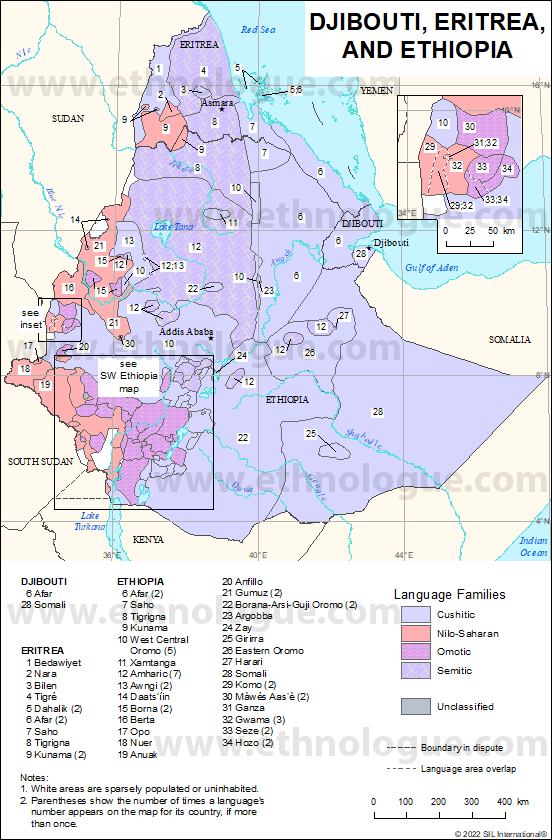
Djibouti, Eritrea and Ethiopia
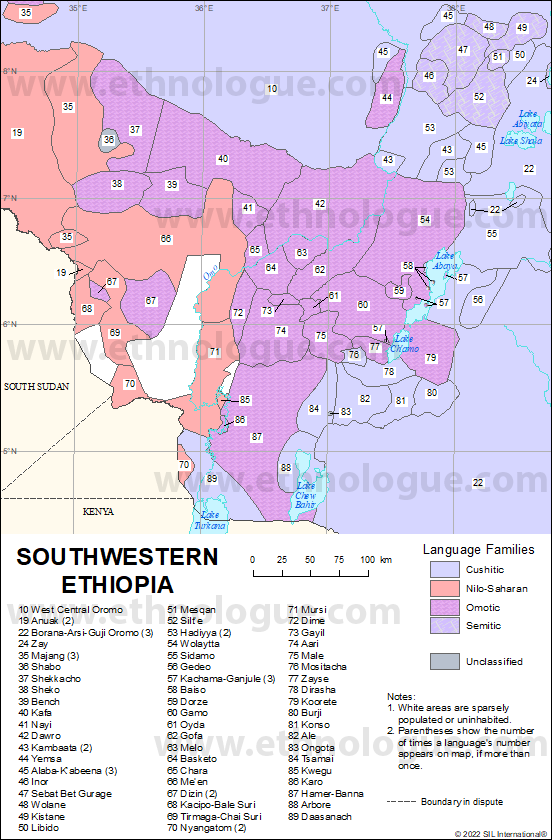
Southwestern Ethiopia
Graphs
Language Vitality Profile
Full explanation
Language Status Profile
Full explanation
Resources
View Terms
Each Ethnologue country digest is a licensed product with restricted terms of use. Before downloading the product, you must agree to the following terms:
- This is a license for individual use. Just as with a conventionally published book, it is a violation of copyright to make a copy and give it to others.
- You may not redistribute this work in any form, including ingesting the contents into a database that is shared with others or posting it on a web site (whether public or private).
To inquire about permission for reuse or redistribution, please use the Contact Us form in the footer.
Digest of the languages of Ethiopia ($299.95, 80 page PDF)