
GM
Republic of The Gambia
Gambia
Summary
- Official Name
- Republic of The Gambia
- Population
- 2,413,000
- Principal Languages
- English
- Literacy Rate
- 56% (2015 World Factbook)
- International Conventions
- ACHPR (1987), CPPDCE (2006), CSICH (2012), ICCPR (1966), UNCRPD (2006)
- General References
- Bendor-Samuel and Hartell 1989, Vanderaa 1991
- Language Counts
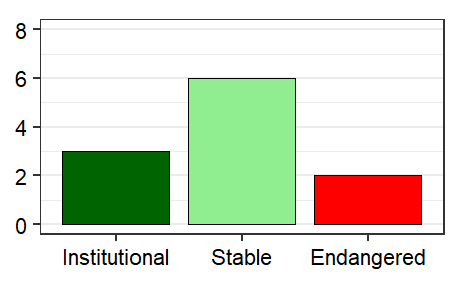
- The number of established languages listed for Gambia is 12. All are living languages. Of these, 7 are indigenous and 5 are non-indigenous. Furthermore, 3 are institutional, 3 are developing, 4 are vigorous, 1 is in trouble, and 1 is dying. Also listed are 6 unestablished languages.
Languages
- Bambara bam
- Users: 20,500 in Gambia (2016). Status: Unestablished. Classification: Niger-Congo, Mande, Western, Central-Southwestern, Central, Manding-Jogo, Manding-Vai, Manding-Mokole, Manding, Manding-East, Northeastern Manding, Bamana
- English eng
- Widespread. Users: 67,700 in Gambia, all users. L1 users: 2,000 in Gambia (Biel 2014). L2 users: 65,700 (2019). Status: 1 (National). De facto national language. Classification: Indo-European, Germanic, West, English
- French fra
- Banjul and Brikama LGAs; urban areas. Users: 512,000 in Gambia (Marcoux et al 2022), L2 users. Status: 5* (Dispersed). Classification: Indo-European, Italic, Romance, Italo-Western, Western, Gallo-Iberian, Gallo-Romance, Gallo-Rhaetian, Oïl, French
- Guinea-Bissau Creole pov
- Users: 21,300 in Gambia (2016). Status: Unestablished. Classification: Creole, Portuguese based
- Jola-Fonyi dyo
- West Coast division: southwest. Users: 117,000 in Gambia (2018). Status: 6a (Vigorous). Alternate Names: Diola-Fogny, Jola, Jola-Fogny, Jóola fóoñi, Kujamataak, Kújoolaak Kati Fooñi, Yola Classification: Niger-Congo, Atlantic-Congo, Atlantic, Northern, Bak, Jola, Jola Proper, Jola Central, Jola-Fonyi
- Karon krx
- West Coast division: south coast, from Senegal border north to Brikama. Users: 10,800 in Gambia (2016), increasing. No monolinguals. Ethnic population: 60,000. Status: 6a (Vigorous). Alternate Names: Kaloon, Karone, Karoninka, Kulonay Classification: Niger-Congo, Atlantic-Congo, Atlantic, Northern, Bak, Jola, Jola Proper, Karon-Mlomp
- Krio kri
- Banjul region. Users: 16,200 in Gambia (2016). Status: Unestablished. Classification: Creole, English based, Atlantic, Krio
- Mandinka mnk
- Widespread. Users: 879,000 in Gambia (2014). Status: 3 (Wider communication). The secondary LWC of commerce and the media, after Wolof [wof] (Biel 2014). Alternate Names: Manding, Mandingo, Mandinque, Mandé, Socé Classification: Niger-Congo, Mande, Western, Central-Southwestern, Central, Manding-Jogo, Manding-Vai, Manding-Mokole, Manding, Manding-West
- Mandjak mfv
- West Coast division: south of Gambia river. Users: 37,700 in Gambia (2018). Status: 6a (Vigorous). Alternate Names: Kanyop, Mandjaque, Mandyak, Manjaca, Manjack, Manjaco, Manjacu, Manjago, Manjiak, Manjáku, Ndyak Classification: Niger-Congo, Atlantic-Congo, Atlantic, Northern, Bak, Manjaku-Papel
- Maninkakan, Western mlq
- Upper River division. Users: 4,260 in Gambia (2016). Status: 6b* (Threatened). Alternate Names: Malinka, Malinke, Northwestern Maninka Classification: Niger-Congo, Mande, Western, Central-Southwestern, Central, Manding-Jogo, Manding-Vai, Manding-Mokole, Manding, Manding-West
- Mankanya knf
- Users: 1,960 in Gambia (2016). Status: Unestablished. Classification: Niger-Congo, Atlantic-Congo, Atlantic, Northern, Bak, Manjaku-Papel
- Mansoanka msw
- Users: 2,130 in Gambia (2016). Status: Unestablished. Classification: Niger-Congo, Atlantic-Congo, Atlantic, Southern, Sua
- N’ko nqo
- Scattered. Users: No known L1 speakers in Gambia. Ethnic population: No ethnic community. Status: 9 (Second language only). Classification: Mixed language
- Pulaar fuc
- Central River, Lower River, North Bank, and Upper River divisions. Users: 377,000 in Gambia (2018). Status: 5 (Developing). Alternate Names: Fulani, Fulbe Jeeri, Fulfulde-Pulaar, Peul, Peulh, Pulaar Fulfulde Classification: Niger-Congo, Atlantic-Congo, Atlantic, Northern, Senegambian, Fula-Wolof, Fula, Western
- Serahule snk
- Southeast corner, mainly MacCarthy Island and Upper River divisions. 17 villages. Users: 130,000 in Gambia (2018), increasing. Status: 5 (Developing). Alternate Names: Sarakole, Sarakule, Sarakulle, Saraxuli, Soninke, Sooninkanxanne Classification: Niger-Congo, Mande, Western, Northwestern, Soninke-Bobo, Soninke-Boso, Soninke
- Serer-Sine srr
- North Bank division: northwest. Users: 52,300 in Gambia (2018). Status: 6a (Vigorous). Alternate Names: Seereer, Serer, Serer-Sin, Serrer, Sine-Saloum Classification: Niger-Congo, Atlantic-Congo, Atlantic, Northern, Senegambian, Serer
- Wolof, Gambian wof
- North Bank division: Kombo north of Saint Mary’s district, Serekunda and Bakau, Banjul; Central River and Upper River divisions. Users: 314,000 (2018). Status: 3 (Wider communication). The Wolof people migrated to Gambia from central and eastern Africa. Wolof became widespread around the 15th century when the first Europeans traders came. Used in large-scale slave trade, religion, agriculture, and commerce. Wolof [wol] is an official language in Senegal and widely spoken in several other west African countries. Autonym: Wolof Classification: Niger-Congo, Atlantic-Congo, Atlantic, Northern, Senegambian, Fula-Wolof, Wolof
- Xasonga kao
- Users: 2,130 in Gambia (2016). Status: Unestablished. Alternate Names: Khassonké Classification: Niger-Congo, Mande, Western, Central-Southwestern, Central, Manding-Jogo, Manding-Vai, Manding-Mokole, Manding, Manding-West
Languages by Status
English
[eng] 1 (National). De facto national language. 67,700 in Gambia, all users. L1 users: 2,000 in Gambia (Biel 2014). L2 users: 65,700 (2019).
Mandinka
[mnk] 3 (Wider communication). The secondary LWC of commerce and the media, after Wolof [wof] (Biel 2014). 879,000 in Gambia (2014).
Wolof, Gambian
[wof] 3 (Wider communication). The Wolof people migrated to Gambia from central and eastern Africa. Wolof became widespread around the 15th century when the first Europeans traders came. Used in large-scale slave trade, religion, agriculture, and commerce. Wolof [wol] is an official language in Senegal and widely spoken in several other west African countries. 314,000 (2018).
French
[fra] 5* (Dispersed). 512,000 in Gambia (Marcoux et al 2022), L2 users.
Pulaar
[fuc] 5 (Developing). 377,000 in Gambia (2018).
Serahule
[snk] 5 (Developing). 130,000 in Gambia (2018), increasing.
Jola-Fonyi
[dyo] 6a (Vigorous). 117,000 in Gambia (2018).
Karon
[krx] 6a (Vigorous). 10,800 in Gambia (2016), increasing. No monolinguals. Ethnic population: 60,000.
Mandjak
[mfv] 6a (Vigorous). 37,700 in Gambia (2018).
Serer-Sine
[srr] 6a (Vigorous). 52,300 in Gambia (2018).
Maninkakan, Western
[mlq] 6b* (Threatened). 4,260 in Gambia (2016).
Bambara
[bam] Unestablished. 20,500 in Gambia (2016).
Guinea-Bissau Creole
[pov] Unestablished. 21,300 in Gambia (2016).
Krio
[kri] Unestablished. 16,200 in Gambia (2016).
Mankanya
[knf] Unestablished. 1,960 in Gambia (2016).
Mansoanka
[msw] Unestablished. 2,130 in Gambia (2016).
Xasonga
[kao] Unestablished. 2,130 in Gambia (2016).
Maps
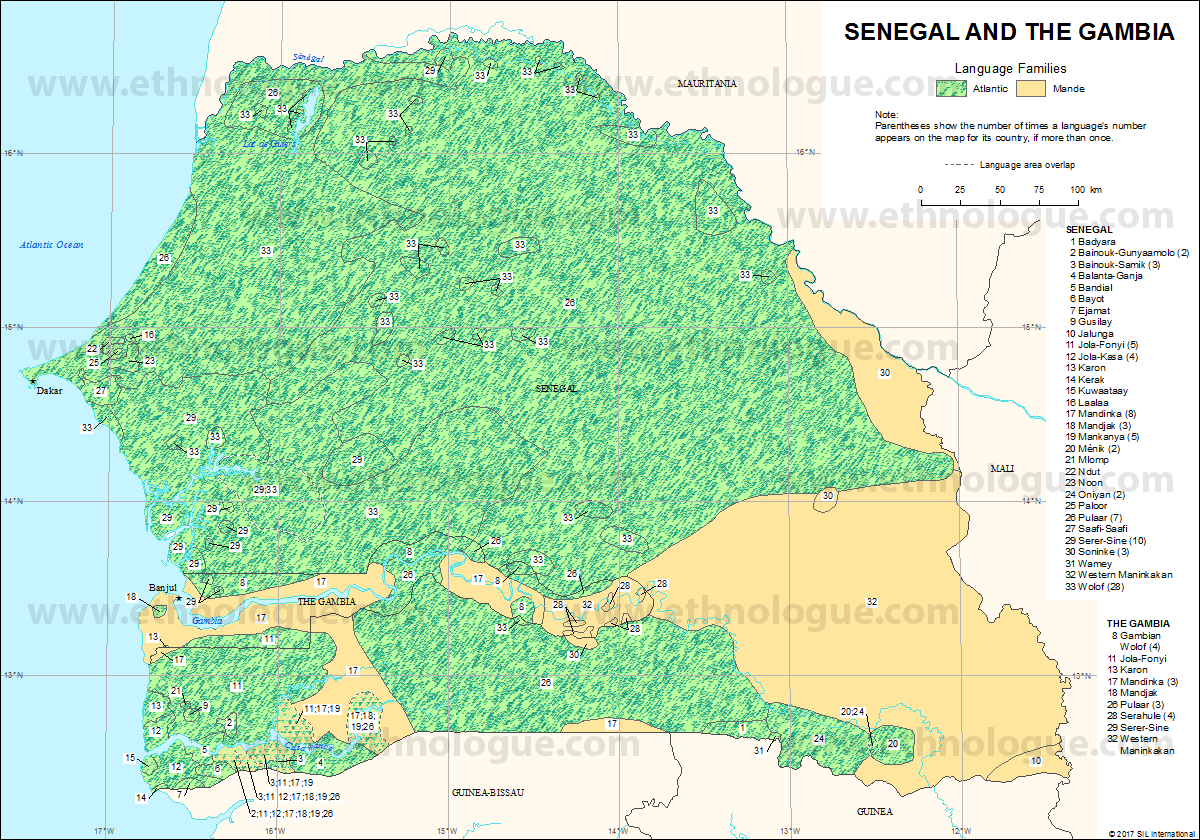
Senegal and The Gambia
Graphs
Language Vitality Profile
Full explanation
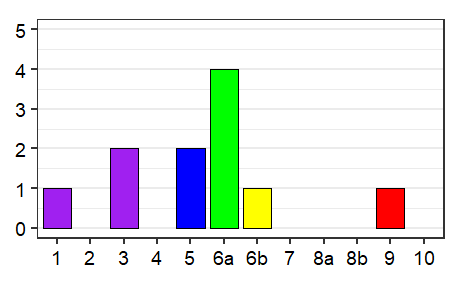
Language Status Profile
Full explanation
Resources
View Terms
Each Ethnologue country digest is a licensed product with restricted terms of use. Before downloading the product, you must agree to the following terms:
- This is a license for individual use. Just as with a conventionally published book, it is a violation of copyright to make a copy and give it to others.
- You may not redistribute this work in any form, including ingesting the contents into a database that is shared with others or posting it on a web site (whether public or private).
To inquire about permission for reuse or redistribution, please use the Contact Us form in the footer.
Digest of the languages of Gambia ($149.95, 23 page PDF)