
GQ
Republic of Equatorial Guinea
Equatorial Guinea
Summary
- Official Name
- Republic of Equatorial Guinea
- Population
- 1,497,000
- Principal Languages
- Spanish
- Literacy Rate
- 95% (2015 World Factbook)
- International Conventions
- ACHPR (1987), CPPDCE (2006), CSICH (2012), ICCPR (1966)
- General References
- Bendor-Samuel and Hartell 1989
- Language Counts
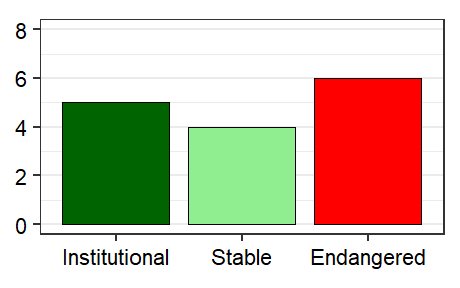
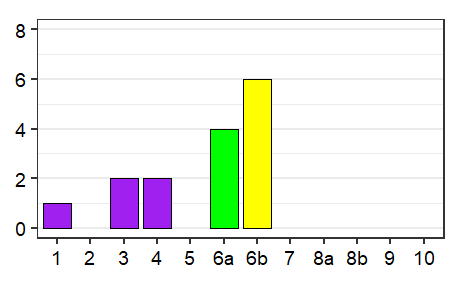
- The number of established languages listed for Equatorial Guinea is 15. All are living languages. Of these, 12 are indigenous and 3 are non-indigenous. Furthermore, 4 are institutional, 1 is developing, 4 are vigorous, and 6 are in trouble. Also listed is 1 unestablished language.
Languages
- Bapuku bnm
- Litoral province: Bapuku along central coast, south of Mbini to Cabo San Juan. Users: 8,000 in Equatorial Guinea (2017 SIL), decreasing. Very few monolinguals. Ethnic population: 9,000 (2017). Status: 6b* (Threatened). Alternate Names: Bapoko, Bapuu, Batanga, Naka, Puku Classification: Niger-Congo, Atlantic-Congo, Volta-Congo, Benue-Congo, Bantoid, Southern, Narrow Bantu, Northwest, A, Bubi-Benga (A.32)
- Benga bng
- Litoral province: Corisco Island, Rio Muni. Users: 4,000 in Equatorial Guinea (2017 S. Smith), decreasing. 500 on Corisco Island. No monolinguals. Ethnic population: 4,500 (2017 S. Smith). Total users in all countries: 5,500. Status: 6b (Threatened). Alternate Names: Boumba, Ndowe Autonym: Benga Classification: Niger-Congo, Atlantic-Congo, Volta-Congo, Benue-Congo, Bantoid, Southern, Narrow Bantu, Northwest, A, Bubi-Benga (A.34)
- Bube bvb
- Bioko Norte and Bioko Sur provinces: Bioko Island, Fernando Po. Users: 51,000 (2017 S. Smith), decreasing. Few monolinguals. Ethnic population: 61,000 (2017 S. Smith). Status: 6b (Threatened). Alternate Names: Adeeyah, Adija, Bobe, Boobe, Boombe, Bubi, Ediya, Fernandian Autonym: Böbë Classification: Niger-Congo, Atlantic-Congo, Volta-Congo, Benue-Congo, Bantoid, Southern, Narrow Bantu, Northwest, A, Bubi-Benga (A.31)
- Equatorial Guinean Pidgin fpe
- Bioko Norte and Bioko Sur provinces: north central Bioko Island, Fernando Po, Malabo area; Balueri de Cristo Rey, Basupu, Fiston, Las Palmas, Musola, and Sampaca. Users: 200,000, all users. L1 users: 15,000 (2020 S. Smith), increasing. L2 users: 185,000 (2020 S. Smith). Very few monolinguals. Status: 3 (Wider communication). Offshoot of Krio language of Sierra Leone; brought to Bioko with African settlers from Freetown, Sierra Leone in 1827. Used as LWC across Bioko island in all domains except education and government. Alternate Names: Criollo, Fernandino, Fernando Po Creole English, Fernando Po Krio, Pichinglis, Pidgin de Guinea Ecuatorial, Pidginglis Autonym: Pichi Classification: Creole, English based, Atlantic, Krio
- Fa d’Ambu fab
- Annobón province, isolated from mainland by 360 km of ocean; Bioko Norte province: Malabo; a few on continental Equatorial Guinea. Users: 6,000 in Equatorial Guinea (2017 S. Smith). No monolinguals. Total users in all countries: 6,600. Status: 6a (Vigorous). Alternate Names: Annobonense, Annobonese, Annobonés, Fa d’Ambô Autonym: Fa d’Ambu Classification: Creole, Portuguese based
- Fang fan
- Widespread. Centro Sur, Kié-Ntem, Litoral, Wele-Nzas provinces. Users: 624,000 in Equatorial Guinea, all users. L1 users: 589,000 in Equatorial Guinea (2013 S. Smith), increasing. L2 users: 35,000 (2013 S. Smith). Total users in all countries: 1,096,800 (as L1: 1,061,800; as L2: 35,000). Status: 3 (Wider communication). De facto language of national identity. Became dominant in the 19th century assimilating other related or less-related languages. Used in church, trade (noted for ivory and ironwork), musical oral tradition, and farming. Alternate Names: Pahouin, Pamue, Pangwe Autonym: Fang Classification: Niger-Congo, Atlantic-Congo, Volta-Congo, Benue-Congo, Bantoid, Southern, Narrow Bantu, Northwest, A, Ewondo-Fang (A.75)
- French fra
- Major cities. Users: 433,000 in Equatorial Guinea (Marcoux et al 2022), L2 users. Status: 4 (Educational). Recognized language (1998, Constitution, Article 4(1) as amended). Alternate Names: Francés, Français Classification: Indo-European, Italic, Romance, Italo-Western, Western, Gallo-Iberian, Gallo-Romance, Gallo-Rhaetian, Oïl, French
- Gyele gyi
- Centro Sur and Litoral provinces. Users: 50 in Equatorial Guinea (2017 SIL). Possibly hundreds more in isolated camps. Status: 6b (Threatened). Alternate Names: Babinga, Bagiele, Bagyele, Bajele, Bajeli, Bako, Bakola, Bakuele, Bekoe, Bogyel, Bogyeli, Bondjiel, Giele, Gieli, Gyeli, Likoya Classification: Niger-Congo, Atlantic-Congo, Volta-Congo, Benue-Congo, Bantoid, Southern, Narrow Bantu, Northwest, A, Makaa-Njem (A.801)
- Hindi hin
- Users: 1,400 in Equatorial Guinea (2020 Joshua Project). Status: Unestablished. Classification: Indo-European, Indo-Iranian, Indo-Aryan, Western Hindi, Hindustani
- Iyasa yko
- Litoral province: Edjabe village. Users: 1,000 in Equatorial Guinea (2017 S. Smith), decreasing. Ethnic population: 1,100 (2017). Status: 6b (Threatened). Alternate Names: Bongwe, Lyassa, Maasa, Yasa, Yassa Classification: Niger-Congo, Atlantic-Congo, Volta-Congo, Benue-Congo, Bantoid, Southern, Narrow Bantu, Northwest, A, Bubi-Benga (A.33)
- Kombe nui
- Litoral province: Rio Muni coast. Users: 9,200 (2011 SIL). Few monolinguals. Ethnic population: 9,200. Status: 6a (Vigorous). Alternate Names: Combe, Ndowe, Ngumbi Autonym: Kombe Classification: Niger-Congo, Atlantic-Congo, Volta-Congo, Benue-Congo, Bantoid, Southern, Narrow Bantu, Northwest, A, Bubi-Benga (A.33)
- Kwasio nmg
- Litoral province: coastal Rio Muni, Bisio. Users: 13,000 in Equatorial Guinea (2011 SIL). Status: 6a (Vigorous). Alternate Names: Bujeba, Mabea, Mabi, Magbea, Mgoumba, Mvumbo, Ngoumba, Ngumba Classification: Niger-Congo, Atlantic-Congo, Volta-Congo, Benue-Congo, Bantoid, Southern, Narrow Bantu, Northwest, A, Makaa-Njem (A.81)
- Molengue bxc
- Litoral province: South tip and Rio Benito, inland. Users: 900 (2017 S. Smith), decreasing. L2 users: 0 (2017). Few monolinguals. Ethnic population: 1,000 (2017 S. Smith). Status: 6b (Threatened). Alternate Names: Balengue, Molendji Classification: Niger-Congo, Atlantic-Congo, Volta-Congo, Benue-Congo, Bantoid, Southern, Narrow Bantu, Northwest, B, Kele (B.211)
- Portuguese por
- Major cities. Status: 4 (Educational). Recognized language (2010, Constitution, Article 4(1) as amended). Alternate Names: Portugués, Português Classification: Indo-European, Italic, Romance, Italo-Western, Western, Gallo-Iberian, Ibero-Romance, West Iberian, Portuguese-Galician
- Seki syi
- Litoral province. Users: 11,000 in Equatorial Guinea (Johnstone and Mandryk 2001). Status: 6a (Vigorous). Classification: Niger-Congo, Atlantic-Congo, Volta-Congo, Benue-Congo, Bantoid, Southern, Narrow Bantu, Northwest, B, Kele (B.21)
- Spanish spa
- Widespread. Users: 1,223,000 in Equatorial Guinea, all users. L1 users: 905,000 in Equatorial Guinea (Instituto Cervantes 2019). L2 users: 318,000 (Instituto Cervantes 2019). Status: 1 (National). Statutory national language (2011, Constitution, Article 4). Alternate Names: Español Classification: Indo-European, Italic, Romance, Italo-Western, Western, Gallo-Iberian, Ibero-Romance, West Iberian, Castilian
Languages by Status
Spanish
[spa] 1 (National). Statutory national language (2011, Constitution, Article 4). 1,223,000 in Equatorial Guinea, all users. L1 users: 905,000 in Equatorial Guinea (Instituto Cervantes 2019). L2 users: 318,000 (Instituto Cervantes 2019).
Equatorial Guinean Pidgin
[fpe] 3 (Wider communication). Offshoot of Krio language of Sierra Leone; brought to Bioko with African settlers from Freetown, Sierra Leone in 1827. Used as LWC across Bioko island in all domains except education and government. 200,000, all users. L1 users: 15,000 (2020 S. Smith), increasing. L2 users: 185,000 (2020 S. Smith). Very few monolinguals.
Fang
[fan] 3 (Wider communication). De facto language of national identity. Became dominant in the 19th century assimilating other related or less-related languages. Used in church, trade (noted for ivory and ironwork), musical oral tradition, and farming. 624,000 in Equatorial Guinea, all users. L1 users: 589,000 in Equatorial Guinea (2013 S. Smith), increasing. L2 users: 35,000 (2013 S. Smith). Total users in all countries: 1,096,800 (as L1: 1,061,800; as L2: 35,000).
French
[fra] 4 (Educational). Recognized language (1998, Constitution, Article 4(1) as amended). 433,000 in Equatorial Guinea (Marcoux et al 2022), L2 users.
Portuguese
[por] 4 (Educational). Recognized language (2010, Constitution, Article 4(1) as amended).
Fa d’Ambu
[fab] 6a (Vigorous). 6,000 in Equatorial Guinea (2017 S. Smith). No monolinguals. Total users in all countries: 6,600.
Kombe
[nui] 6a (Vigorous). 9,200 (2011 SIL). Few monolinguals. Ethnic population: 9,200.
Kwasio
[nmg] 6a (Vigorous). 13,000 in Equatorial Guinea (2011 SIL).
Seki
[syi] 6a (Vigorous). 11,000 in Equatorial Guinea (Johnstone and Mandryk 2001).
Bapuku
[bnm] 6b* (Threatened). 8,000 in Equatorial Guinea (2017 SIL), decreasing. Very few monolinguals. Ethnic population: 9,000 (2017).
Benga
[bng] 6b (Threatened). 4,000 in Equatorial Guinea (2017 S. Smith), decreasing. 500 on Corisco Island. No monolinguals. Ethnic population: 4,500 (2017 S. Smith). Total users in all countries: 5,500.
Bube
[bvb] 6b (Threatened). 51,000 (2017 S. Smith), decreasing. Few monolinguals. Ethnic population: 61,000 (2017 S. Smith).
Gyele
[gyi] 6b (Threatened). 50 in Equatorial Guinea (2017 SIL). Possibly hundreds more in isolated camps.
Iyasa
[yko] 6b (Threatened). 1,000 in Equatorial Guinea (2017 S. Smith), decreasing. Ethnic population: 1,100 (2017).
Molengue
[bxc] 6b (Threatened). 900 (2017 S. Smith), decreasing. L2 users: 0 (2017). Few monolinguals. Ethnic population: 1,000 (2017 S. Smith).
Hindi
[hin] Unestablished. 1,400 in Equatorial Guinea (2020 Joshua Project).
Maps
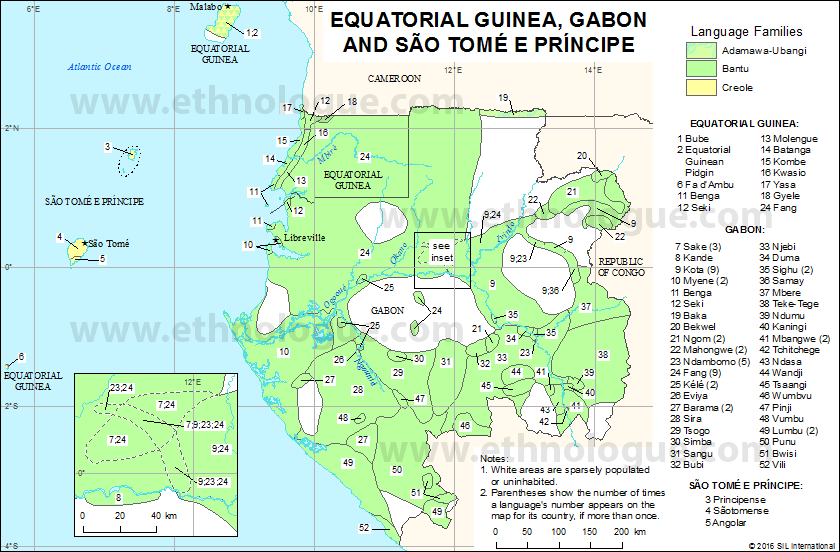
Equatorial Guinea and Gabon

Equatorial Guinea, Gabon and São Tomé e Príncipe
Graphs
Language Vitality Profile
Full explanation
Language Status Profile
Full explanation
Resources
View Terms
Each Ethnologue country digest is a licensed product with restricted terms of use. Before downloading the product, you must agree to the following terms:
- This is a license for individual use. Just as with a conventionally published book, it is a violation of copyright to make a copy and give it to others.
- You may not redistribute this work in any form, including ingesting the contents into a database that is shared with others or posting it on a web site (whether public or private).
To inquire about permission for reuse or redistribution, please use the Contact Us form in the footer.
Digest of the languages of Equatorial Guinea ($149.95, 28 page PDF)