
ID
Republic of Indonesia
Indonesia
Summary
- Official Name
- Republic of Indonesia
- Population
- 272,249,000
- Principal Languages
- Indonesian
- Literacy Rate
- 96% (2018 UNESCO)
- International Conventions
- CDE (1960), CPPDCE (2006), CSICH (2012), ICCPR (1966), UNCRPD (2006), UNDRIP (2007)
- General References
- Adelaar 1995, Barr et al 1979, Blust 2013, Campbell and King 2011, Fox 1991, Gray et al 2009, Grimes 1994, Grimes 1995, Grimes et al 1997, Himmelmann 2001, Hudson 1978, Martens 1989, Noorduyn 1991, Ross 2005, Wumbu et al 1986, Wurm and Hattori 1981
- Deaf Population
- 2,000,000 or more (1993)
- Language Counts
- The number of established languages listed for Indonesia is 724. Of these, 711 are living and 13 are extinct. Of the living languages, 705 are indigenous and 6 are non-indigenous. Furthermore, 17 are institutional, 82 are developing, 170 are vigorous, 361 are in trouble, and 81 are dying. Also listed are 10 unestablished languages.
Languages
- Abinomn bsa
- Papua province: Sarmi regency, Mamberamo Hulu sub-district. Lakes plain area, Baso river mouth at Idenburg river to headwaters in Foya mountains. Users: 300 (Clouse et al 2002). Status: 6b* (Threatened). Alternate Names: Avinomen, Foja, Foya, “Baso” (pej.) Classification: Language isolate
- Abui abz
- East Nusa Tenggara province: west Alor island. Users: 16,000 (Wurm and Hattori 1981). Status: 6a* (Vigorous). Alternate Names: Barue, Namatalaki, “Barawahing” (pej.) Classification: Trans-New Guinea, West, Timor-Alor-Pantar, Alor-Pantar, Alor
- Abun kgr
- West Papua province: Sorong regency, Ayamaru, Moraid, and Sausapor sub-districts, about 20 villages; north coast, interior of central Bird’s Head. Users: 3,000 (1995 SIL). Status: 6b* (Threatened). Alternate Names: A Nden, Karon, Manif, Yimbun Autonym: Abun Classification: Language isolate
- Aceh ace
- Aceh province: Aceh Barat, Aceh Barat Daya, Aceh Besar, Aceh Jaya, Aceh Selatan, Aceh Singkil, Aceh Tamiang, Aceh Timur, Aceh Utara, Bireuen, Kota Langsa, Kota Lhokseumawe, Nagan Raya, Pidie, and Pidie Jaya regencies, on Weh and neighboring islands; North Sumatra province: Tapanuli Tengah regency, south coast enclave. Users: 2,840,000 (2010 census). Ethnic population: 3,370,000 (2010 census). Status: 6b (Threatened). De facto language of provincial identity in Aceh province. Alternate Names: Acehnese, Achehnese, Achinese, Atjehnese, Basa Acèh Autonym: Aceh, Bahsa Acèh Classification: Austronesian, Malayo-Polynesian, Malayo-Chamic, Chamic, Acehnese
- Adang adn
- East Nusa Tenggara province: Alor island, northwest of Kalabahi town toward Banda Sea coast. Users: 3,000 (2000), decreasing. Status: 6b (Threatened). Alternate Names: Alor Classification: Trans-New Guinea, West, Timor-Alor-Pantar, Alor-Pantar, Alor
- Adonara adr
- East Nusa Tenggara province: Adonara and east Solor islands. Users: 98,000 (2008 census). Status: 6a* (Vigorous). Alternate Names: Nusa Tadon, Sagu, Vaiverang, Waiwerang Classification: Austronesian, Malayo-Polynesian, Central-Eastern Malayo-Polynesian, Bima-Lembata
- Aghu ahh
- Papua province: Boven Digoel regency, Jair sub-district in south interior between Mapi and Digul rivers. Users: 3,000 (1987 SIL). Status: 6b (Threatened). Alternate Names: Djair, Dyair Classification: Trans-New Guinea, Ok-Awyu, Awyu-Dumut, Awyu
- Airoran air
- Papua province: Jayapura regency, Mamberamo Hilir and Pantai Barat sub-districts, Isirania, Motobiak, Subu, and other villages on lower Apauwer river. Users: 1,000 (1998 SIL). Status: 6b* (Threatened). Alternate Names: Adora, Aeroran, Iriemkena Classification: Tor-Kwerba, Greater Kwerba, Kwerba, West Coast
- Alor aol
- East Nusa Tenggara province: coastal Bird’s Head of Alor, north Pantar and adjacent islands. Users: 25,000 (Grimes et al 1997). Status: 6a* (Vigorous). Alternate Names: Alorese Classification: Austronesian, Malayo-Polynesian, Central-Eastern Malayo-Polynesian, Bima-Lembata
- Alune alp
- Maluku province: Seram Bagian Barat regency, Kairatu and Taniwel districts, 27 villages in Latuhelu area and Piru bay. Users: 17,200 (2000). Status: 6b* (Threatened). Alternate Names: Patasiwa Alfoeren, Sapalewa Autonym: Alune Classification: Austronesian, Malayo-Polynesian, Central-Eastern Malayo-Polynesian, Central Maluku, East, Seram, Nunusaku, Three Rivers, Amalumute, Northwest Seram, Ulat Inai
- Amahai amq
- Maluku province: Maluku Tengah regency, 4 villages; Seram island in Elpaputih bay near Masohi town. Users: 50 (Wurm 2007). Status: 8b (Nearly extinct). Alternate Names: Amahei Classification: Austronesian, Malayo-Polynesian, Central-Eastern Malayo-Polynesian, Central Maluku, East, Seram, Nunusaku, Piru Bay, East, Seram Straits, Uliase, Hatuhaha, Elpaputi
- Amarasi aaz
- East Nusa Tenggara province: Kupang regency, Timor island southwest tip; Timur sea near Benini point east to Ela point, interior as far north as Oesa town; 80 villages. Dialects: central and east (Kotos dialect), west (Ro’is dialect), south (Ro’is Tais Nonof dialect), Kota Kupang area (Ro’is Hero dialect). Users: 70,000 (2011 Unit Bahasa dan Budaya - Gereja Masehi Injili di Timor (UBB-GMIT)). Status: 5* (Developing). Alternate Names: Timor Amarasi, Uab Meto Autonym: Amarasi Classification: Austronesian, Malayo-Polynesian, Central-Eastern Malayo-Polynesian, Timor-Babar, Nuclear Timor, Uab Meto
- Ambai amk
- Papua province: Yapen Waropen regency, Yapen Selatan and Yapen Timur sub-districts, 10 villages on Ambai island, Cenderawasih bay, and Yapen island south coast. Users: 10,100 (2000). Status: 6b* (Threatened). Alternate Names: Ambai-Menawi Classification: Austronesian, Malayo-Polynesian, Central-Eastern Malayo-Polynesian, Eastern Malayo-Polynesian, South Halmahera-West New Guinea, West New Guinea, Cenderawasih Bay, Yapen, Central-Western
- Ambel wgo
- West Papua province: Raja Ampat regency, Waigeo Selatan sub-district, Go, Kabare, Kabilol, Nyandesawai, Selegop, Waifoi, and Warsanbin villages in north central Waigeo island off western Bird’s Head. Users: 1,600 (Arnold 2018). Status: 7 (Shifting). Alternate Names: Amber, Amberi, Siam, Waigeo, Waigiu Classification: Austronesian, Malayo-Polynesian, Central-Eastern Malayo-Polynesian, Eastern Malayo-Polynesian, South Halmahera-West New Guinea, West New Guinea, Cenderawasih Bay, Raja Ampat
- Ambelau amv
- Maluku province: central Ambelau island; Buru island coast, Wae Tawa village; 8 villages. Users: 5,700 (1989 SIL). Ethnic population: 5,700. Status: 6a* (Vigorous). Alternate Names: Amblau Classification: Austronesian, Malayo-Polynesian, Central-Eastern Malayo-Polynesian, Central Maluku, Ambelau
- Ampanang apg
- East Kalimantan province: east of Jambu and Lamper towns west of Mahakam river delta. Users: 30,000 (Wurm and Hattori 1981). Status: 6a* (Vigorous). Classification: Austronesian, Malayo-Polynesian, Greater Barito, Barito-Mahakam
- Anakalangu akg
- East Nusa Tenggara province: Sumba island, southwest coast. Users: 16,000 (2011 SIL). Status: 6a* (Vigorous). Alternate Names: Anakalang Classification: Austronesian, Malayo-Polynesian, Central-Eastern Malayo-Polynesian, Sumba-Hawu, Sumba
- Anasi bpo
- Papua province: Jayapura regency, Mamberamo Hilir sub-district on north coast, lower west bank Mamberamo river. Users: 2,000 (1993 R. Doriot). Status: 6b* (Threatened). Alternate Names: Bapu Classification: East Geelvink Bay
- Andio bzb
- Central Sulawesi province: Lamala sub-district, Tangeban and Tauge villages, peninsula east tip area. Users: 335 (2010 census), decreasing. No monolinguals. Status: 7 (Shifting). Alternate Names: Andio’o, Imbao’o, Masama, “Bobongko” (pej.) Autonym: Andio Classification: Austronesian, Malayo-Polynesian, Celebic, Eastern, Saluan-Banggai, Western
- Ansus and
- Papua province: Yapen Waropen regency, Yapen Barat sub-district, Aibondeni, Ansus, Kairawi, and Yenusi villages on Yapen island south coast. Users: 4,600 (1987 SIL). Status: 6b* (Threatened). Classification: Austronesian, Malayo-Polynesian, Central-Eastern Malayo-Polynesian, Eastern Malayo-Polynesian, South Halmahera-West New Guinea, West New Guinea, Cenderawasih Bay, Yapen, Central-Western
- Anus auq
- Papua province: Sarmi regency, Pulau Anus and Podena islands off north coast; coastal area east of Biri river. Users: 320 (2005 SIL). Status: 7 (Shifting). Alternate Names: Koroernoes, Korur Classification: Austronesian, Malayo-Polynesian, Central-Eastern Malayo-Polynesian, Eastern Malayo-Polynesian, Oceanic, Western Oceanic, North New Guinea, Sarmi-Jayapura Bay, Sarmi
- Aoheng pni
- Central Kalimantan province: border areas; East Kalimantan province: Sarawak border area, upper reaches of Barito, Kapuas, and Mahakam rivers. Users: 2,630 (Wurm and Hattori 1981). Status: 6b* (Threatened). Alternate Names: Penihing Classification: Austronesian, Malayo-Polynesian, North Borneo, North Sarawakan, Kayan-Kenyah, Kayanic, Muller-Schwaner ‘Punan’
- Aputai apx
- Maluku province: Maluku Barat Daya regency; Wetar island, Banda Sea coast, Ilputih village; Wetar strait coast, Lurang village. Users: 150 (Hinton 2000). Status: 8b (Nearly extinct). Alternate Names: Ilputih, Opotai, Tutunohan Classification: Austronesian, Malayo-Polynesian, Central-Eastern Malayo-Polynesian, Timor-Babar, Southwest Maluku, Wetar
- Arabic, North Levantine Spoken apc
- Users: 283,000 in Indonesia (2021 Joshua Project), based on ethnicity. Status: Unestablished. Classification: Afro-Asiatic, Semitic, Central, South, Arabic
- Aralle-Tabulahan atq
- West Sulawesi province: Mamasa regency, Mambi sub-district, Aralle and Tabulalang towns, 2 separate areas. Users: 29,300 (2010 census). Status: 5 (Developing). Classification: Austronesian, Malayo-Polynesian, South Sulawesi, Northern, Pitu Ulunna Salu
- Arandai jbj
- West Papua province: Manokwari regency, Bintuni sub-district; South Bird’s Head, Ceram Sea coast. Users: 1,000 (1987 SIL). Status: 6b (Threatened). Alternate Names: Dombano, Jaban, Sebyar, Sumuri, Yaban Classification: Trans-New Guinea, South Bird’s Head, South Bird’s Head Proper, Eastern
- Arguni agf
- West Papua province: Fak-Fak district; Arguni island in Maccluer gulf off northwest coast, Bomberai peninsula. Users: 150 (Wurm 2000). Status: 6b (Threatened). Alternate Names: Argoeni Classification: Austronesian, Malayo-Polynesian, Central-Eastern Malayo-Polynesian, North Bomberai
- As asz
- West Papua province: Sorong regency, Asbaken and Sorong. Users: 6 (Arnold 2020). Also 2 semi-speakers (Arnold 2020). Ethnic population: 45 (Arnold 2020). Status: 8b (Nearly extinct). Classification: Austronesian, Malayo-Polynesian, Central-Eastern Malayo-Polynesian, Eastern Malayo-Polynesian, South Halmahera-West New Guinea, West New Guinea, Cenderawasih Bay, Raja Ampat
- Asilulu asl
- Maluku province: Asilulu, Negeri Lima, and Ureng, villages. Northwest Ambon island and west Seram island, Hoamoal peninsula, south coast. Users: 8,760 (1987 SIL). Status: 6b* (Threatened). Classification: Austronesian, Malayo-Polynesian, Central-Eastern Malayo-Polynesian, Central Maluku, East, Seram, Nunusaku, Piru Bay, West, Asilulu
- Asmat, Casuarina Coast asc
- Papua province: Mappi regency, Edera and Pantai Kasuari sub-districts on Casuarina Coast from Ewta river north to Kuti river south, and inland. Users: 9,000 (1991 SIL). 5,200 in Matia and 3,400 in Sapan. Status: 5* (Developing). Alternate Names: As-amat, Asmat, Kaweinag Classification: Trans-New Guinea, Asmat-Kamoro, Asmat
- Asmat, Central cns
- Papua province: Asmat regency; Sawa-Erma, Agats, Atsy, and Pantai Kasuari sub-districts, south coast from Owap river northwest to Farec river southwest, inland; Mappi regency, Edera and Nambai sub-districts in Digul river delta area. Users: 7,000 (Roesler 1972). Most are monolingual. Status: 6b* (Threatened). Alternate Names: Jas, Manowee, Yas Classification: Trans-New Guinea, Asmat-Kamoro, Asmat
- Asmat, North nks
- Papua province: Merauke regency, Sawa-Erma sub-district. Near Pater Le Cocq river headwaters west to Unir river east to the foothills. Users: 1,000 (1991 SIL). Status: 6a (Vigorous). Alternate Names: Keenok Classification: Trans-New Guinea, Asmat-Kamoro, Asmat
- Asmat, Yaosakor asy
- Papua province: Asmat regency, Agats and Atsy sub-districts; lower Surets and Eilanden rivers confluence area. Users: 2,000 (1991 SIL). Status: 7 (Shifting). Alternate Names: As-amat, Yaosakor Autonym: Asmat Classification: Trans-New Guinea, Asmat-Kamoro, Asmat
- Atohwaim aqm
- Papua province: Mappi regency, Pantai Kasuari sub-district. South coast inland, between Cook and Kronkel rivers. Users: 1,000 (1987 SIL). Status: 6b* (Threatened). Alternate Names: Kaugat Classification: Trans-New Guinea, Kayagar
- Auye auu
- Papua province: Paniai regency, Napan sub-district; central highlands in Siriwo river area. Users: 350 (1995 SIL). Ethnic population: 500 (2012 SIL). Status: 5 (Developing). Alternate Names: Auwje Autonym: Auye Classification: Trans-New Guinea, West, Wissel Lakes
- Awbono awh
- Papua province: Jayawijaya regency; Modera river area. Users: 100 (1999 SIL). 100 monolinguals. Status: 6b (Threatened). Alternate Names: Kvolyab Classification: Bayono-Awbono
- Awera awr
- Papua province: Waropen regency, Waropen Bawah sub-district,1 village; east Cenderawasih bay at Wapoga river mouth. Users: No known L1 speakers (S. Kim). Only 1 speaker remained in 2007.. Status: 9 (Dormant). Classification: Lakes Plain, Awera
- Awyi auw
- Papua province: Keerom regency, Arso sub-district; northeast highland enclave near Papua New Guinea border. Users: 350 (Wurm 2000). Status: 8a (Moribund). Alternate Names: Awje, Awji, Awye, Njao, Nyao Classification: Border, Taikat
- Awyu, Asue psa
- Papua province: Asmat and Mappi regencies; inland from Pirimapun. Users: 6,500 (2002 SIL). Status: 6b* (Threatened). Alternate Names: Miaro, Miaro Awyu, Pisa Classification: Trans-New Guinea, Ok-Awyu, Awyu-Dumut, Awyu
- Awyu, Central awu
- Papua province: Mappi and Boven Digul regencies, Bimika, Citak Mitak, Mandobo, and Obaa sub-districts; south coast inland. Users: 7,500 (2002 Sohn Myo-sook). Status: 6a* (Vigorous). Alternate Names: Ajau, Auyu, Avio, Awju, Awya, Central Auyu, Nohon Classification: Trans-New Guinea, Ok-Awyu, Awyu-Dumut, Awyu
- Awyu, Edera awy
- Papua province: Merauke regency, both banks, lower Digul river. Users: 3,870 (2002 SIL). Status: 6b* (Threatened). Alternate Names: Jenimu, Oser, Siagha, Sjiagha, Syiagha, Yenimu Classification: Trans-New Guinea, Ok-Awyu, Awyu-Dumut, Awyu
- Awyu, Jair awv
- Papua province: Merauke district. Users: 2,300 (2002 SIL). Status: 6b* (Threatened). Alternate Names: Kia River Awyu Classification: Trans-New Guinea, Ok-Awyu, Awyu-Dumut, Awyu
- Awyu, North yir
- Papua province: Merauke district; Digul river west side. Users: 1,500 (1987 SIL). Status: 6b* (Threatened). Alternate Names: Awyu, Djair, Dyair, Yair, “Jair” (pej.) Classification: Trans-New Guinea, Ok-Awyu, Awyu-Dumut, Awyu
- Awyu, South aws
- Papua province: Merauke and Mappi regencies, Bade town area; lower Digul river. Users: 9,340 (2002 SIL). Status: 6b* (Threatened). Alternate Names: Jenimu, Oser, Siagha, Sjiagha, Syiagha, Yenimu Classification: Trans-New Guinea, Ok-Awyu, Awyu-Dumut, Awyu
- Babar, North bcd
- Maluku province: Maluku Barat Daya regency, Ilwiara, Nakarhamto, and Yatoke villages, northeast Babar island. Users: 1,000 (2007 SIL). Status: 6b (Threatened). Classification: Austronesian, Malayo-Polynesian, Central-Eastern Malayo-Polynesian, Babar, North
- Babar, Southeast vbb
- Maluku province: Ahanari, Analutur, Kokwari, Kroing, Letwurung, Manuweri, Tutuwawan, and Wakpapai villages; southeast Babar island coast. Users: 4,460 (2007 SIL). Status: 6a* (Vigorous). Classification: Austronesian, Malayo-Polynesian, Central-Eastern Malayo-Polynesian, Babar, South, Masela-South Babar
- Bada bhz
- Central Sulawesi and border area South Sulawesi provinces: Luwu Utara and Poso regencies, Lore Selatan, Pamona Selatan, Parigi, and Poso Pesisir sub-districts; at least 24 villages. Northern Mamuju regency, Pasangkayu sub-district; some in Ampibabo sub-district, Lemusa village (Ako dialect). Users: 9,780 (2010 census), increasing. Status: 5 (Developing). Alternate Names: Tobada’ Autonym: Bádá’ Classification: Austronesian, Malayo-Polynesian, Celebic, Kaili-Pamona, Southern, Badaic
- Badui bac
- Banten province: Rangkasbitung regency, Pandeglang town, on Ujung river; West Java province: Sukabumi city area, 1 village, and Cikajang city area. Users: 20,000 (2000 census). 12,000 in Kenekes village area. Status: 6a (Vigorous). Alternate Names: Baduy, Bahasa Sunda, Gajebo Classification: Austronesian, Malayo-Polynesian, Sundanese
- Bagusa bqb
- Papua province: Jayapura regency, Mamberamo Tengah sub-district. Users: 300 (1987 SIL). Status: 6a (Vigorous). Alternate Names: Kapeso, Suaseso Classification: Tor-Kwerba, Greater Kwerba, Kwerba, Nuclear
- Baham bdw
- West Papua province: northwest Bomberai peninsula, Fakfak regency, Fakfak, Kaimana, and Kokas sub-districts; Kaimana regency, Cape Papisoi area. Users: 1,100 (1987 SIL). Status: 6b (Threatened). Alternate Names: Bahaam, Mbahaam maaq, Patimuni Classification: Trans-New Guinea, West, West Bomberai, West Bomberai Proper
- Bahau bhv
- East Kalimantan province: Kutai Barat regency, Long Apari, Long Bagun, and Long Hubung, and Long Pahangai sub-districts; Ratah and Mahakam rivers’ confluence area. Users: 19,000 (2007 SIL). Status: 6a* (Vigorous). Classification: Austronesian, Malayo-Polynesian, North Borneo, North Sarawakan, Kayan-Kenyah, Kayanic, Kayan Proper
- Bahonsuai bsu
- Central Sulawesi province: Morowali regency, Bungku Tengah sub-district, Bahonsuai village on the east coast, Tolo bay. Users: 780 (2010 census). Status: 7 (Shifting). Alternate Names: Bahoe-soeaai, Bahonsoewaai Classification: Austronesian, Malayo-Polynesian, Celebic, Eastern, Southeastern, Bungku-Tolaki, Eastern, East Coast
- Bajau, Indonesian bdl
- Gorontalo province; North Maluku province: Bacan, Kayoa, Obi, and Sula islands; Central Sulawesi, North Sulawesi, South Sulawesi, and Southeast Sulawesi provinces. Users: 226,000 (2010 census). 5,000 or more in North Maluku (Grimes 1982), 8,000 to 10,000 in South Sulawesi (Grimes and Grimes 1987), 7,000 in North Sulawesi and Gorontalo, 36,000 in Central Sulawesi, 40,000 in Southeast Sulawesi (Mead et al 2007), and several thousand in Nusa Tenggara (Wurm and Hattori 1981, Verheijen 1986). Status: 6b (Threatened). Alternate Names: Badjaw, Badjo, Bajao, Bajau, Bajo, Bayo, Baʔong Sama, Gaj, Indonesian Bajaw, Orang Laut, Sama, Taurije’ne’ Classification: Austronesian, Malayo-Polynesian, Greater Barito, Sama-Bajaw, Sulu-Borneo, Borneo Coast Bajaw
- Bakati’ bei
- West Kalimantan province: Sambas regency; Sambas river headwaters. Users: 4,000 (1986 UBS). Status: 6b* (Threatened). Alternate Names: Bakati Nyam, Bakati Riok, Bakatik Dayak, Bakatiq, Bekati, Riuk Bakati’ Classification: Austronesian, Malayo-Polynesian, Land Dayak, Bakati’
- Bakati’, Rara lra
- West Kalimantan province: Bengkayang regency, Pejampi and 2 other villages; Sanggau regency border area; upper Lundu and Sambas rivers. Users: 12,000 in Indonesia (2004 M. Connor). Status: 5* (Developing). Alternate Names: Bekati’ Kendayan, Bekati’ Nyam-Pelayo, Bekatiq, Lara’, Luru, Rara Bakati’ Classification: Austronesian, Malayo-Polynesian, Land Dayak, Bakati’
- Bakati’, Sara sre
- West Kalimantan province: near Sanggau-Ledo. Users: 4,000 (2004 M. Connor). Status: 6a* (Vigorous). Alternate Names: Riok Classification: Austronesian, Malayo-Polynesian, Land Dayak, Bakati’
- Bakumpai bkr
- Central Kalimantan province: Barito Selatan, and Barito Utara, and Kapuas regencies, Kapuas and Barito rivers; possibly southernmost Murung Raya regency. Users: 100,000 (2003). Status: 3 (Wider communication). Spoken by Dayak Ngaju people, dominant group in Central Kalimantan. LWC in the 17th century under Dutch colonial rule. Used in daily communication. Alternate Names: Bara-Jida Classification: Austronesian, Malayo-Polynesian, Greater Barito, West, South
- Balaesang bls
- Central Sulawesi province: Donggala regency, Balaesang sub-district, Kamonji, Ketong, and Rano villages on Manimbayu peninsula. Users: 3,300 (2010 census). Status: 7 (Shifting). Alternate Names: Balaesan, Balaisang, Pajo Classification: Austronesian, Malayo-Polynesian, Celebic, Tomini-Tolitoli, Tomini, Southern
- Balantak blz
- Central Sulawesi province: Banggai regency, Balantak, Lamala, Luwuk, and Tinangkung Lamala sub-districts, at least 49 villages; Cape Talabu. Users: 20,500, all users. L1 users: 19,500 (2010 census), increasing. L2 users: 1,000 (2015 R. Busenitz). 1,500 monolinguals (2015 R. Busenitz). Status: 5 (Developing). Alternate Names: Balanta, Kosian Autonym: Wurung Balantak Classification: Austronesian, Malayo-Polynesian, Celebic, Eastern, Saluan-Banggai, Eastern
- Bali ban
- Bali province: widespread; West Nusa Tenggara province: Kota Mataram and Lombok Barat regency; west central Lombok island. Users: 3,300,000 (2010 census). 7,000 in South Sulawesi. Includes immigrant speakers in west Nusa Tenggara, west Lombok Islands. Ethnic population: 3,950,000 (2011 census). Status: 5 (Developing). Alternate Names: Balinese Autonym: Basa Bali Classification: Austronesian, Malayo-Polynesian, Bali-Sasak-Sumbawa
- Bambam ptu
- West Sulawesi province: Mamasa regency, Mambi sub-district, Maloso and Mapilli rivers watershed; into Majene and Mamuju regencies. Users: 42,100 (2010 census). Status: 5 (Developing). Alternate Names: Pitu Uluna Salu, Pitu-Ulunna-Salu Autonym: Basa Bambam Classification: Austronesian, Malayo-Polynesian, South Sulawesi, Northern, Pitu Ulunna Salu
- Banda bnd
- Maluku province: Maluku Tenggara regency, Banda-Eli and Banda-Elat villages, possibly a third; Kei Besar island west and northeast. Users: 3,000 (1987 SIL). Status: 7 (Shifting). Classification: Austronesian, Malayo-Polynesian, Central-Eastern Malayo-Polynesian, Central Maluku, East, Banda-Geser
- Banggai bgz
- Central Sulawesi province: Banggai Kepulauan regency, at least 157 villages; Banggai and Bowokan islands. Users: 88,300 (2010 census), decreasing. Status: 7 (Shifting). Alternate Names: Aki, Banggaai, Banggaiy, Banggay, Banggaya Classification: Austronesian, Malayo-Polynesian, Celebic, Eastern, Saluan-Banggai, Eastern
- Bangka mfb
- Bangka Belitung Islands province: widespread, Bangka island. Users: 340,000 (2000 census). 50 or less speakers of the Lom dialect (Wurm 2007). Status: 6a* (Vigorous). Classification: Austronesian, Malayo-Polynesian, Malayo-Chamic, Malayic, Malay
- Banjar bjn
- Central Kalimantan province: Palangkaraya, Pangkalanbun, and Sampit; East Kalimantan province: Kutai, Pasir, and Pulau Laut coastal regions, north toward Samarinda city and Mahakan delta; South Kalimantan province: Banjarmasin area; West Kalimantan province: some in coastal Matua; Kalimantan south and southeastern coasts, Java Sea and Makassar Strait. Users: 3,650,000 in Indonesia (2015 UNSD), increasing. Total users in all countries: 3,655,000. Status: 3 (Wider communication). Spoken on the east coast of Kalimantan. Increased in the 17th century under Dutch colonial rule. Used in trade, fishing, farming, plantations, transportation, and mining. Alternate Names: Bandjarese, Banjar Malay, Banjarese, Labuhan Autonym: بنجر (Banjar) Classification: Austronesian, Malayo-Polynesian, Malayo-Chamic, Malayic, Malay
- Bantik bnq
- North Sulawesi province: Manado city area, 11 villages; north peninsula, northeast section. Users: 1,200 (2010 census), decreasing. Ethnic population: 10,000 (2019). Status: 8a (Moribund). Alternate Names: Banti’ Classification: Austronesian, Malayo-Polynesian, Sangiric, Southern
- Barakai baj
- Maluku province: Apara, Bemun, Longgar, and Mesiang villages in the south; Barakai island; some on Gomo-Gomo island northeast of Barakai. Users: 4,450 (2011 SIL). Status: 6a* (Vigorous). Alternate Names: Workai Classification: Austronesian, Malayo-Polynesian, Central-Eastern Malayo-Polynesian, Aru
- Barapasi brp
- Papua province: Yapen Waropen regency, Waropen Atas sub-district; east Cenderawasih bay, Barapasi river area and tributaries. Users: 2,500 (1995 SIL). Status: 6b (Threatened). Alternate Names: Baropasi Classification: East Geelvink Bay
- Baras brs
- West Sulawesi province: Mamuju Utara regency, Baras sub-district, in and north of Bambaloka village, Karossa sub-district, Salubiro village. Users: 64 (2010 census). Status: 8a (Moribund). Alternate Names: Ende Classification: Austronesian, Malayo-Polynesian, Celebic, Kaili-Pamona, Northern, Kaili
- Basap bdb
- East Kalimantan and North Kalimantan provinces: Berau, Bulungan, Kutai Kartanegara, Penajam Paser Utara, and Kutai Timur regencies, scattered. Users: 15,000 (2007 SIL). Status: 6b* (Threatened). Alternate Names: Bosap Classification: Austronesian, Malayo-Polynesian, North Borneo, Rejang-Sajau
- Batak Alas-Kluet btz
- Aceh province: inland from Tapaktuan, and northwest towards Kutacane; into North Sumatra province. Users: 101,000 (2010 census). Ethnic population: 114,000 (2010 census). Status: 6a* (Vigorous). Alternate Names: Alas-Kluet Batak Classification: Austronesian, Malayo-Polynesian, Northwest Sumatra-Barrier Islands, Batak, Northern
- Batak Angkola akb
- North Sumatra province: Labuhan Batu, Labuhan Batu Selatan, Padang Lawas, Padang Lawas Utara, Tapanuli Selatan, Tapanuli Tengah, and Tapanuli Utara regencies; inland from Sibolga city area south, east to Binanga, northeast toward the Strait of Malacca. Users: 535,000 (2010 census). Ethnic population: 614,000 (2010 census). Status: 6b (Threatened). Alternate Names: Anakola, Angkola Classification: Austronesian, Malayo-Polynesian, Northwest Sumatra-Barrier Islands, Batak, Southern
- Batak Dairi btd
- Aceh province: Aceh Singkil regency; North Sumatra province: Dairi, Humbang Hasundutan, Pakpak Barat, Samosir, and Tapanuli Tengah regencies, Sidikalang town area south to coast. Users: 172,000 (2010 census). Ethnic population: 245,000 (2010 census). Status: 6b (Threatened). Alternate Names: Pakpak Dairi Classification: Austronesian, Malayo-Polynesian, Northwest Sumatra-Barrier Islands, Batak, Northern
- Batak Karo btx
- Aceh province: Aceh Selatan, Aceh Singli, Aceh Tenggara, and Kota Subulussalam regencies; North Sumatra province: Dairi, Deli Serdang, Karo, and Langkat regencies; Tapanuli Tengah regency, south small border area. Users: 491,000 (2010 census). Ethnic population: 1,220,000 (2010 census). Status: 6b (Threatened). Alternate Names: Karo Batak, kalak Karo Autonym: cakap Karo Classification: Austronesian, Malayo-Polynesian, Northwest Sumatra-Barrier Islands, Batak, Northern
- Batak Mandailing btm
- North Sumatra province: south interior from Padang Sidempuan into Riau and West Sumatra provinces. Users: 691,000 (2010 census). Ethnic population: 1,720,000 (2010 census). Status: 6b (Threatened). Alternate Names: Batta, Mandailing Batak Classification: Austronesian, Malayo-Polynesian, Northwest Sumatra-Barrier Islands, Batak, Southern
- Batak Simalungun bts
- North Sumatra province: Deli Serdang, Kota Pematang Siantar, Serdang Bedagai, and Simalungun regencies. Users: 151,000 (2010 census). Ethnic population: 435,000 (2010 census). Status: 5* (Developing). Alternate Names: Simelungan, Timur Autonym: Sahap Simalungun Classification: Austronesian, Malayo-Polynesian, Northwest Sumatra-Barrier Islands, Batak, Simalungan
- Batak Toba bbc
- North Sumatra province: Asahan, Humbang Hasundutan, Labuhan Batu Utara, Samosir, Simalungan, south Tapanuli Tengah, Tapanuli Utara, and Toba Samosir regencies; Samosir island; east, south, and west of Lake Toba. Users: 1,610,000 (2010 census). Ethnic population: 4,160,000 (2010 census). Status: 6b (Threatened). Alternate Names: Toba Batak Autonym: Batta Classification: Austronesian, Malayo-Polynesian, Northwest Sumatra-Barrier Islands, Batak, Southern
- Bati bvt
- Maluku province: Seram island east coast between Kian Darat and Keleser towns, inland. Users: 3,500 (Loski and Loski 1989). Status: 6b* (Threatened). Alternate Names: Gah Classification: Austronesian, Malayo-Polynesian, Central-Eastern Malayo-Polynesian, Central Maluku, East, Banda-Geser, Geser-Gorom
- Batui zbt
- Central Sulawesi province: Banggai regency, Batui sub-district, Balantang, Batui, Sisipan, and Tolando villages; eastern peninsula. Users: 850 (2010 census), decreasing. Status: 7 (Shifting). Alternate Names: Baha Classification: Austronesian, Malayo-Polynesian, Celebic, Eastern, Saluan-Banggai, Western, Saluanic
- Batuley bay
- Maluku province: Aru islands regency, Arafura Sea east coast offshore communities, 7 island villages. Users: 3,640 (2011 SIL). Status: 6b* (Threatened). Alternate Names: Gwataley, Watulai Classification: Austronesian, Malayo-Polynesian, Central-Eastern Malayo-Polynesian, Aru
- Bauzi bvz
- Papua province: Jayapura and Yapen Waropen regencies, Mamberamo Tengah and Waropen Atas sub-districts, Danau Bira, Itaba, Kustera, Neao, Noiadi, Solom, and Vakiadi villages; extensive inland area between Mamberamo and Rouffaer rivers. Users: 1,500 (1991 SIL). 1,350 monolinguals. Status: 5 (Developing). Alternate Names: Baudi, Baudji, Baudzi, Bauri Autonym: Bauzi Classification: East Geelvink Bay, Bauzi
- Bayono byl
- Papua province: Asmat regency, Eilanden-Steenboom river area. Users: 300 (2020 M. Edelen). Status: 6a (Vigorous). Alternate Names: Benanu, Bese, Kofoyap Classification: Bayono-Awbono
- Bedoanas bed
- West Papua province: Fakfak regency, Kokas sub-district; Bomberai peninsula. Users: 180 (Wurm 2000). Status: 7 (Shifting). Classification: Austronesian, Malayo-Polynesian, Central-Eastern Malayo-Polynesian, Eastern Malayo-Polynesian, South Halmahera-West New Guinea, West New Guinea, Bomberai
- Beginci ebc
- West Kalimantan: Ketapang regency, Nanga Tayap and Hulu Sungai. Users: 7,500 (2019 D. Berglund). Status: 6a (Vigorous). Alternate Names: Bihak Classification: Austronesian, Malayo-Polynesian, Land Dayak, Southern
- Behoa bep
- Central Sulawesi province: Poso regency, Lore Utara sub-district, 8 villages; Behoa and Napu valleys. Users: 4,280 (2010 census), increasing. Status: 6b (Threatened). Alternate Names: Ako, Besoa Autonym: básá Behóá Classification: Austronesian, Malayo-Polynesian, Celebic, Kaili-Pamona, Southern, Badaic
- Beneraf bnv
- Papua province: Sarmi regency, Pantai Timur sub-district, Beneraf and part of Nenke village; north coast area east of Tor river mouth. Users: 200 (2005 SIL). Very few monolinguals. Status: 7 (Shifting). Alternate Names: Boneraf, Bonerif, Edwas Classification: Tor-Kwerba, Orya-Tor, Tor
- Benggoi bgy
- Maluku province: Werinama and Bula districts, Balakeo, Benggoi, and Lesa villages; Seram island, north Seram Sea coast. Users: 350 (1989 SIL). Status: 8a (Moribund). Alternate Names: Bengoi, Isal, Kobi-Benggoi, Uhei Kachlakan, Uhei-Kaclakin, Uhei-Kahlakim Classification: Austronesian, Malayo-Polynesian, Central-Eastern Malayo-Polynesian, Central Maluku, East, Seram, Manusela-Seti
- Bentong bnu
- South Sulawesi province: Barru, Bone, Pangkep, and Maros regencies; highland areas northeast of Makassar city. Users: 10,100 (2010 census). Status: 6b* (Threatened). Alternate Names: Bentong-Dentong, Dentong Classification: Austronesian, Malayo-Polynesian, South Sulawesi, Makassar
- Benyadu’ byd
- West Kalimantan province: Bengkayang and Landak regencies; near Sarawak border. Users: 54,000 (2007 SIL). Status: 6a* (Vigorous). Alternate Names: Balantian, Balantiang, Njadu, Nyadu Classification: Austronesian, Malayo-Polynesian, Land Dayak
- Berik bkl
- Papua province: Sarmi regency, Tor Atas sub-district, Beu, Bora Bora, Dangken, Doronta, Kondirjan, Safrontani, Sewan, Somanente, Taminambor, Tenwer, Togonfo, and Waf villages; north coast, mid and upper Tor river, inland from Sarmi peninsula. Users: 1,200 (1994 SIL). Status: 6b (Threatened). Alternate Names: Berick, Berrik, Sewan Teteris, Upper Tor Classification: Tor-Kwerba, Orya-Tor, Tor
- Betaf bfe
- Papua province: Sarmi regency, Pantai Timur sub-district; north coast area east of Sarmi. Users: 600 (2005 SIL). Status: 6b (Threatened). Alternate Names: Ten’a, Tena Classification: Tor-Kwerba, Orya-Tor, Tor
- Betawi bew
- Banten province: Tangerang recency and city; dominant in Jakarta Special Capital Region; West Java province: Bekasi, Bogar, and Karawang regencies, also Bekasi and Depok cities. Users: 5,000,000 (2000 census). Population count imprecise due to vague ethnic and linguistic definition of ‘Betawi’. Ethnic population: 6,800,000 (2011 census). Status: 6b* (Threatened). Alternate Names: Anak Betawi, Batavi, Batavian, Batawi, Betawi Malay, Jakarta Malay, Melayu Betawi, Melayu Jakarte, Orang Betawi Autonym: Betawi Classification: Creole, Malay based
- Biak bhw
- Papua province: Biak Numfor regency, Biak and Numfor islands; Yapen Island regency, north coast area; West Papua province: Mapia islands; Raja Ampat regency, Bantanta and south Waigeo islands; numerous island communities, east, north, and west of Bird’s Head. Users: 70,000 (van den Heuvel 2007). Status: 6b* (Threatened). Alternate Names: Bahasa Biak, Biak-Numfor, Mafoor, Mafoorsch, Mefoor, Myfoorsch, Noefoor, Noefoorsch, Nufoor Autonym: Wós Kovedi, Wós Vyak Classification: Austronesian, Malayo-Polynesian, Central-Eastern Malayo-Polynesian, Eastern Malayo-Polynesian, South Halmahera-West New Guinea, West New Guinea, Cenderawasih Bay, Biakic
- Bidayuh, Bau sne
- West Kalimantan: Bengkayang regency, Jagoi Babang sub-district. Status: 6b (Threatened). Alternate Names: Bau-Jagoi, Jaggoi, Jagoi Classification: Austronesian, Malayo-Polynesian, Land Dayak, Bidayuh, Core, Western
- Bidayuh, Biatah bth
- West Kalimantan province: Sanggau regency, area near Sarawak border; possibly northeast Landak regency. Users: 8,480 in Indonesia (2000). Status: 5* (Developing). Alternate Names: Biatah, Bideyu, Landu, Lundu, Pueh, Siburan Classification: Austronesian, Malayo-Polynesian, Land Dayak, Bidayuh, Core, Central
- Bidayuh, Bukar-Sadong sdo
- West Kalimantan province: Sanggau and Sintang regencies; Mount Cemaru, near Sarawak border. Status: 6a* (Vigorous). Alternate Names: Buka, Bukar, Bukar Sadong, Bukar Sadung Bidayah, Sabutan, Sadong, Serian, Tebakang Classification: Austronesian, Malayo-Polynesian, Land Dayak, Bidayuh, Eastern
- Biga bhc
- West Papua province: Sorong district, Biga village, on south Misool island. Users: 330 (Arnold 2020). Status: 6b (Threatened). Classification: Austronesian, Malayo-Polynesian, Central-Eastern Malayo-Polynesian, Eastern Malayo-Polynesian, South Halmahera-West New Guinea, West New Guinea, Cenderawasih Bay, Raja Ampat
- Bilba bpz
- East Nusa Tenggara province: northeast Rote island; Semau island; Timor mainland near Kupang. Users: 7,000 (2002 UKAW). Ethnic population: 7,000. Status: 6a (Vigorous). Alternate Names: Belubaa, Bilbaa, Eastern Rote, Rote, Rote Timur, Roti, Rotinese Classification: Austronesian, Malayo-Polynesian, Central-Eastern Malayo-Polynesian, Timor-Babar, Nuclear Timor, Rote
- Bima bhp
- East Nusa Tenggara province: Komodo island area; West Nusa Tenggara province: Sumbawa island, east of the isthmus, Banta and Sangeang islands. Users: 500,000 (1989). Status: 6a* (Vigorous). Alternate Names: Bimanese Autonym: Nggahi Mbojo Classification: Austronesian, Malayo-Polynesian, Central-Eastern Malayo-Polynesian, Bima-Lembata
- Bintauna bne
- North Sulawesi province: Bolaang Mongondou Utara regency, Bintauna town and inland; Celebes Sea. Users: 2,800 (2010 census), decreasing. No monolinguals (2019). Status: 7 (Shifting). Alternate Names: Bintaoena, Bintawoena, Bitaoena Classification: Austronesian, Malayo-Polynesian, Greater Central Philippine, Gorontalo-Mongondow, Gorontalic
- Biritai bqq
- Papua province: Puncakjaya district, Biri village. Users: 250 (1988 SIL). Status: 6b* (Threatened). Alternate Names: Aliki, Ati, Biri Classification: Lakes Plain, Tariku, East
- Blagar beu
- East Nusa Tenggara province: east Pantar, north Pura, and south Ternate islands. Users: 10,000 (Steinhauer 2014). Status: 6a (Vigorous). Alternate Names: Belagar, Pura, Tarang Classification: Trans-New Guinea, West, Timor-Alor-Pantar, Alor-Pantar, Pantar
- Boano bzl
- Central Sulawesi province: Parigi Moutong sub-district, Bolano village; north peninsula, south coast, facing gulf of Tomini. Users: 2,400 (2010 census). Status: 6b (Threatened). Alternate Names: Boan-diks, Bolano Classification: Austronesian, Malayo-Polynesian, Celebic, Tomini-Tolitoli, Tolitoli
- Boano bzn
- Maluku province: North Buano main village; Boano and Seram islands. Users: 3,240 (1982). Status: 6a* (Vigorous). Alternate Names: Buano Classification: Austronesian, Malayo-Polynesian, Central-Eastern Malayo-Polynesian, Central Maluku, East, Seram, Nunusaku, Piru Bay, West, Hoamoal
- Bobongko bgb
- Central Sulawesi province: Batu Daka island, Tumbulawa village on northwest coast; Togian islands, Lembanato village on Kilat bay, north side of Togian island. Users: 2,050 (2010 census). Status: 6a (Vigorous). Classification: Austronesian, Malayo-Polynesian, Celebic, Eastern, Saluan-Banggai, Western, Saluanic
- Bobot bty
- Maluku province: Seram Bagian Timur regency, Werinama sub-district, southeast from Atiahu village to Kota Baru; Tunsai village in Liana area. Users: 4,500 (1989 SIL). Status: 6b* (Threatened). Alternate Names: Ahtiago, Atiahu, Hatumeten, Ntau, Werinama Classification: Austronesian, Malayo-Polynesian, Central-Eastern Malayo-Polynesian, Central Maluku, East, Seram, Bobot
- Bolango bld
- Gorontalo province: Gorontalo Utara regency, Atinggola town area; North Sulawesi province: Bolaang Mongondow Selantan regency, Molibagu area; Bolaang Mongondow Utara regency. Users: 5,770 (2010 census), decreasing. Status: 6b (Threatened). Alternate Names: Atinggola-Bolango, Bolaang Uki, Bolang-Banka, Bulanga, Bulanga-Uki Classification: Austronesian, Malayo-Polynesian, Greater Central Philippine, Gorontalo-Mongondow, Gorontalic
- Bonerate bna
- South Sulawesi province: Bonerate, Madu, Kalaotoa, Karompa, and Selayer islands. Users: 11,900 (2010 census). Status: 6a (Vigorous). Classification: Austronesian, Malayo-Polynesian, Celebic, Eastern, Southeastern, Muna-Buton, Tukangbesi-Bonerate
- Bonggo bpg
- Papua province: Sarmi regency, Bonggo sub-district. Users: 790 (2006 SIL). Status: 8a (Moribund). Alternate Names: Armopa, Bgu, Bogu, Bongo Classification: Austronesian, Malayo-Polynesian, Central-Eastern Malayo-Polynesian, Eastern Malayo-Polynesian, Oceanic, Western Oceanic, North New Guinea, Sarmi-Jayapura Bay, Sarmi
- Budong-Budong bdx
- West Sulawesi province: Mamuju Tengah regency, Topoyo sub-district, Tabolang village; Makassar strait, Budong-Budong river area. Users: 180 (2010 census), decreasing. Status: 6b (Threatened). Alternate Names: Bubudong, Tangkou, To Budo-Budo, Tongkou Classification: Austronesian, Malayo-Polynesian, South Sulawesi, Seko, Panasuan
- Bugis bug
- Central Sulawesi province: Donggola, Oti, and Toaya, west; 3 Tolo bay enclaves east; South Sulawesi province: widespread in peninsular interior (except south and east of Makassar city) east to Bone bay; Southeast Sulawesi province: Kasiputih area, 3 interior enclaves near Sulawesi Tenggara, Lake Towuti, Bone bay east coast; West Sulawesi province: More, Pasangkayu on Mandar bay; possibly in Kalimantan, Maluku, Papua, and Sumatra provinces. Users: 4,370,000 in Indonesia, all users. L1 users: 3,870,000 in Indonesia (2010 census), increasing. L2 users: 500,000. Total users in all countries: 4,398,800 (as L1: 3,898,800; as L2: 500,000). Status: 3 (Wider communication). In the 17th century Bugis was widespread under Dutch rule. Used in literature (especially oral), folklore, and natural resources and agriculture development. Alternate Names: Boegineesche, Boeginezen, Bugi, Buginese, De’, Rappang Buginese, To Ugi Autonym: Basa Ugi Classification: Austronesian, Malayo-Polynesian, South Sulawesi, Bugis
- Bukat bvk
- West Kalimantan province: northeast near Sarawak border, Kapuas river, 3 areas. Users: 400 (Wurm and Hattori 1981). Status: 6b* (Threatened). Classification: Austronesian, Malayo-Polynesian, North Borneo, North Sarawakan, Kayan-Kenyah, Kayanic, Muller-Schwaner ‘Punan’
- Bukitan bkn
- North Kalimantan province: Malinau regency on Sarawak border, 2 enclaves on Iwan river. Users: 570 in Indonesia (2000). Total users in all countries: 860. Status: 6b (Threatened). Alternate Names: Bakatan, Bakitan, Beketan, Mangkettan, Manketa, Pakatan Classification: Austronesian, Malayo-Polynesian, North Borneo, Melanau-Kajang, Kajang
- Buli bzq
- North Maluku province: central Halmahera, 3 villages on Buli bay north shore. Users: 2,520 (2000). Status: 6b* (Threatened). Classification: Austronesian, Malayo-Polynesian, Central-Eastern Malayo-Polynesian, Eastern Malayo-Polynesian, South Halmahera-West New Guinea, South Halmahera, Southeast
- Bulungan blj
- East Kalimantan province: Tanjungselor town area, lower Kayan river. Users: 30,000 (Kawi et al 2002). Status: 6a* (Vigorous). Alternate Names: Bolongan Classification: Austronesian, Malayo-Polynesian, Unclassified
- Bunak bfn
- East Nusa Tenggara province: Belu regency, central interior, near East Timor border, on Timor island. Users: 21,000 in Indonesia (2010). Status: 6a* (Vigorous). Alternate Names: Buna’, Bunake, Bunaq, Gae’, Marae Classification: Trans-New Guinea, West, Timor-Alor-Pantar, Timor
- Bungku bkz
- Central Sulawesi province: Bungku Selatan, Bungku Tengah, and Bungku Utara sub-districts, about 45 coastal villages from Mondeodo south to Kendari area; Southeast Sulawesi province: Konawe regency, Asera, Soropia, and Lasolo sub-districts, Tulambatu and Kenduri areas inland, interior enclave southeast of Lake Poso. Users: 22,000 (2010 census), decreasing. Status: 6b (Threatened). Alternate Names: Ikinyikiusa, Tamboeko, Tambuku, Tobuco, “Nahina” (pej.) Classification: Austronesian, Malayo-Polynesian, Celebic, Eastern, Southeastern, Bungku-Tolaki, Eastern, East Coast
- Buol blf
- Central Sulawesi province: Baolan, Biau, Bokat, Bunobogu, Momunu, and Paleleh sub-districts, 68 villages on north coast, near Gorontalo province border. Users: 90,200 (2010 census). Status: 6a (Vigorous). Alternate Names: Bual, Bwo’ol, Bwool, Dia Autonym: Apadu Vuolo Classification: Austronesian, Malayo-Polynesian, Greater Central Philippine, Gorontalo-Mongondow, Gorontalic
- Burate bti
- Papua province: Yapen Waropen regency, Waropen Bawah sub-district, 1 village near Wapoga river mouth. Users: 100 (Wurm 2000). Status: 7 (Shifting). Classification: East Geelvink Bay
- Burmeso bzu
- Papua province: Mamberamo Raya regency, Mamberamo Tengah sub-district, 1 village on Middle Mamberamo river. Users: 250 (Donohue 1998). Status: 6a (Vigorous). Alternate Names: Boromeso, Borumesso, Burumeso, Manau, Monao, Monau, Taurap Classification: East Bird’s Head-Sentani, Burmeso
- Buru mhs
- Maluku province: Buru island except northeast corner, 70 villages; some on Ambon island in Jakarta. Users: 45,000 (Grimes 2009). Status: 6b (Threatened). Alternate Names: Boeroe, Buruese Autonym: Buru Classification: Austronesian, Malayo-Polynesian, Central-Eastern Malayo-Polynesian, Central Maluku, Buru
- Burumakok aip
- Papua province: Pegunungan Bintang regency, Kurima sub-district, Burumakok village. Users: 40 (1994 R. Kroneman). Status: 8b (Nearly extinct). Classification: Trans-New Guinea, Ok-Awyu, Ok, Western
- Burusu bqr
- East Kalimantan province: Bulungan regency, Sesayap sub-district, Sekatakbunyi town area. Users: 4,350 (2007 SIL). Status: 6a* (Vigorous). Alternate Names: Berusuh, Bulusu Classification: Austronesian, Malayo-Polynesian, North Borneo, Rejang-Sajau
- Buruwai asi
- West Papua province: Fakfak and Kaimana regencies, Esania, Gaka, Guriasa, Hia, Kuna, Marobia, Tairi, and Yarona villages in Kamrau bay southwest. Users: 1,000 (2000). Status: 7 (Shifting). Alternate Names: Asianara, Asienara, Karufa, Madidwana, Sabakor, Sebakoor Classification: Trans-New Guinea, Asmat-Kamoro, Sabakor
- Busami bsm
- Papua province: Yapen Waropen regency, Yapen Barat and Yapen Selatan sub-districts, Kamanap, Kaonda and Masiaroti villages on south and north coast of Yapen island. Users: 700 (1993 R. Doriot). Status: 6b (Threatened). Classification: Austronesian, Malayo-Polynesian, Central-Eastern Malayo-Polynesian, Eastern Malayo-Polynesian, South Halmahera-West New Guinea, West New Guinea, Cenderawasih Bay, Yapen, Central-Western
- Busoa bup
- Southeast Sulawesi province: South Buton regency, Batauga district, Busoa and Lakambau villages, around 22 km south of the town of Baubau. Users: 670 (2010 census), decreasing. Status: 7 (Shifting). Alternate Names: Bosoa Classification: Austronesian, Malayo-Polynesian, Celebic, Eastern, Southeastern, Muna-Buton, Nuclear Muna-Buton, Munan
- Chinese, Hakka hak
- Aceh, Bangka Belitung Islands, Banten, Central Java, East Java, West Java, South Kalimantan: Banjarmasin city; West Kalimantan: Singkawang city; Lampung, Maluku (Ambon island), Papua (Jayapura city), Riau Islands (Batam island), North Sulawesi, South Sulawesi, North Sumatra, South Sumatra; Yogyakarta province. Users: 640,000 in Indonesia (1982). Status: 8a (Moribund). Classification: Sino-Tibetan, Chinese
- Chinese, Mandarin cmn
- Scattered. Users: 466,000 in Indonesia (2005 J. Leclerc), increasing. Status: 3 (Wider communication). Classification: Sino-Tibetan, Chinese
- Chinese, Min Dong cdo
- Bali and Java provinces: scattered throughout. Users: Few speakers. Status: 8b (Nearly extinct). Alternate Names: Foochow, Hokchiu, Min Dong Classification: Sino-Tibetan, Chinese
- Chinese, Min Nan nan
- Bali, Java, Kalimantan, and Sumatra provinces: scattered. Users: 766,000 in Indonesia (2015). Status: 8a (Moribund). Alternate Names: Banlamgi, Min Nan, Minnan Classification: Sino-Tibetan, Chinese
- Chinese, Yue yue
- Jakarta Special Capital Region, Kalimantan, and North Sumatra: scattered. Users: 182,000 in Indonesia (2005 J. Leclerc). Status: 8a (Moribund). Alternate Names: Cantonese, Konghu, Yue, Yueh Classification: Sino-Tibetan, Chinese
- Cia-Cia cia
- Southeast Sulawesi province: southeast tip, Flores sea; Buton island, inland between Sampolawa and Pasawajo towns; Batu Atas and Binongko islands. Users: 104,000 (2010 census), decreasing. Status: 6b (Threatened). Alternate Names: Boetoneezen, Buton, Butonese, Butung, South Buton, Southern Butung Autonym: Cia-Cia Classification: Austronesian, Malayo-Polynesian, Celebic, Eastern, Southeastern, Muna-Buton, Nuclear Muna-Buton, Buton, West Buton
- Citak txt
- Papua province: Mappi regency, Citak-Mitak sub-district, 19 villages on south coast. Users: 8,000 (1985 M. Stringer). Status: 5* (Developing). Alternate Names: Asmat Darat, Cicak, Kaunak, Tjitak, Tjitjak Classification: Trans-New Guinea, Asmat-Kamoro, Asmat
- Citak, Tamnim tml
- Papua province: Asmat and Mappi regencies, Epem, Tamnim, Wowi, and Zinak villages; Senggo town area. Users: 290 (1993 R. Doriot). Status: 5 (Developing). Alternate Names: Asmat Darat, Tamnim Classification: Trans-New Guinea, Asmat-Kamoro, Asmat
- Col liw
- Bengkulu and South Sumatra provinces: Lubuklinggau and Muaraklingi areas south, east, and north; small group east of Bengkulu city. Users: 145,000 (2000 census). Status: 6a (Vigorous). Alternate Names: Cul, Sindang Classification: Austronesian, Malayo-Polynesian, Malayo-Chamic, Malayic, Malay
- Dabe dbe
- Papua province: Sarmi regency, Pantai Timur sub-district, Dabe village, Tor river valley north to coast. Users: 440 (2005 SIL). Status: 7 (Shifting). Alternate Names: Mangambilis Classification: Tor-Kwerba, Orya-Tor, Tor
- Dai dij
- Maluku province: Maluku Barat Daya regency, Sinairusi, 3 other villages on Lewa island. Users: 820 (2007 SIL). Status: 6b (Threatened). Classification: Austronesian, Malayo-Polynesian, Central-Eastern Malayo-Polynesian, Babar, North
- Dakka dkk
- West Sulawesi province: Polewali-Mandar regency, Wonomulyo sub-district. Users: 1,140 (2010 census), decreasing. Status: 7 (Shifting). Alternate Names: Nordost-Celebes Classification: Austronesian, Malayo-Polynesian, South Sulawesi, Northern, Pitu Ulunna Salu
- Damal uhn
- Papua province: central highlands, Paniai regency, Beoga and Ilaga sub-districts; Asmat, Deiya, Mimika, and Puncak regencies, north and south Carstens mountains; possibly Lanny Jaya and Nduga regencies. Users: 14,000 (Wurm 2000). Status: 6b* (Threatened). Alternate Names: Amung, Amung Kal, Amungme, Amuy, Enggipiloe, Hamung, Oehoendoeni, Uhunduni Classification: Trans-New Guinea, Damal
- Damar, East dmr
- Maluku province: southeast, 6 villages; east Damar island. Users: 2,800 (1990 SIL). Status: 6b* (Threatened). Alternate Names: South Damar Classification: Austronesian, Malayo-Polynesian, Central-Eastern Malayo-Polynesian, Timor-Babar, Southwest Maluku, East Damar
- Damar, West drn
- Maluku province: southeast, 2 villages; north Damar island. Users: 800 (1987 SIL). Status: 6b* (Threatened). Alternate Names: North Damar Classification: Austronesian, Malayo-Polynesian, Central-Eastern Malayo-Polynesian, West Damar
- Dampelas dms
- Central Sulawesi province: Donggala, Parigi-Moutong, and Toli-Toli regencies, Balaesang, Dampelas, and Sojol sub-districts, 8 villages on northwest Makassar Strait. Users: 9,560 (2010 census), decreasing. Status: 7 (Shifting). Alternate Names: Dampelasa, Dian Classification: Austronesian, Malayo-Polynesian, Celebic, Tomini-Tolitoli, Tomini, Southern
- Dani, Lower Grand Valley dni
- Papua province: Ndugu regency, Baliem Grand Valley central highlands; lower gorge. Users: 20,000 (1996 SIL). Status: 5* (Developing). Alternate Names: Dani, Grand Valley Dani Classification: Trans-New Guinea, West, Dani, Dani Proper
- Dani, Mid Grand Valley dnt
- Papua province: Lanny Jaya and Ndugu regencies, Baliem Grand Valley central highlands. Users: 50,000 (1990 UBS). Status: 5* (Developing). Alternate Names: Baliem Valley Dani, Central Grand Valley Dani, Dani, Tulem Classification: Trans-New Guinea, West, Dani, Dani Proper
- Dani, Upper Grand Valley dna
- Papua province: Lanny Jaya regency, Baliem Grand Valley central highlands; upper gorge. Users: 20,000 (1996). Status: 5* (Developing). Alternate Names: Dani Classification: Trans-New Guinea, West, Dani, Dani Proper
- Dani, Western dnw
- Papua province: Central highlands. Users: 180,000 (1993 census). Status: 6a* (Vigorous). Alternate Names: Dani Barat, Ilaga Western Dani, Laany, Lani, Oeringoep, Timorini Classification: Trans-New Guinea, West, Dani, Dani Proper
- Dao daz
- Papua province: Paniai regency, Napan sub-district; west central highlands along Dao river. Users: 250 (1991 SIL). Status: 6b* (Threatened). Alternate Names: Maniwo, “X-Ray” (pej.) Classification: Trans-New Guinea, West, Wissel Lakes
- Dawera-Daweloor ddw
- Maluku province: Maluku Barat Daya regency, Wiratan, Watuwei, and Nurnyaman villages in Banda Sea on twin coral islands northeast of Babar island; Daweloor island; Dawera island, Ilmarang, Letmasa, and Welora villages. Users: 1,270 (2007 SIL). Status: 7 (Shifting). Alternate Names: Davelor Classification: Austronesian, Malayo-Polynesian, Central-Eastern Malayo-Polynesian, Babar, North
- Dela-Oenale row
- East Nusa Tenggara province: Rote island west coast, Dela and Oe Nale areas. Users: 7,000 (2002 UKAW). Status: 6a (Vigorous). Alternate Names: Dela, Delha, Oe Nale, Rote, Rote Barat, Roti, Rotinese, Western Rote Autonym: Rote Dela Classification: Austronesian, Malayo-Polynesian, Central-Eastern Malayo-Polynesian, Timor-Babar, Nuclear Timor, Rote
- Dem dem
- Papua province: Western highlands along Rouffaer river headwaters. Users: 1,000 (1987 SIL). Status: 6b* (Threatened). Alternate Names: Lem, Ndem Classification: Trans-New Guinea, Dem
- Demisa dei
- Papua province: Waropen Bawah sub-district, Botawa, Desawa, and Muyere villages; inland in northeast Canderawasih bay. Users: 400 (Wurm 2000). Status: 7 (Shifting). Alternate Names: Desawa Classification: East Geelvink Bay, Bauzi
- Dengka dnk
- East Nusa Tenggara province: Rote island northwest coast, Ba’a town west to Tasilo bay. Users: 20,000 (2002 UKAW). Status: 6a (Vigorous). Alternate Names: Rote, Rote Barat, Roti, Rotinese, Western Rote Classification: Austronesian, Malayo-Polynesian, Central-Eastern Malayo-Polynesian, Timor-Babar, Nuclear Timor, Rote
- Dhao nfa
- East Nusa Tenggara province: Rote Ndao regency, Ndao island off western tip of Rote island; scattered settlements on Rote and Timor islands. Users: 5,000 (1997 A. Ranoh). Status: 5* (Developing). Alternate Names: Dao, Kahore, Ndao, Ndaonese, Ndaundau Autonym: Lii Dhao Classification: Austronesian, Malayo-Polynesian, Central-Eastern Malayo-Polynesian, Sumba-Hawu, Hawu-Dhao
- Diebroud tbp
- Papua province: Sarmi regency, Mamberamo Hulu sub-district. Users: 300 (2006 SIL). Status: 6b* (Threatened). Alternate Names: Bok, Dabra, Taburta, Taria, Taworta, Taworta-Aero Classification: Lakes Plain, East
- Dineor mrx
- Papua province: Sarmi regency on north coast, Walckenaer bay area. Users: 55 (2006 SIL), decreasing. Status: 8a (Moribund). Alternate Names: Maremgi, Marengge Classification: Tor-Kwerba, Orya-Tor, Tor
- Diuwe diy
- Papua province: Asmat regency, southeast of Wamena city. Users: 100 (1999 SIL). Status: 6b (Threatened). Classification: Trans-New Guinea, Asmat-Kamoro, Diuwe
- Dla kbv
- Papua province: Keerom regency, 13 villages on Papua New Guinea border. Users: 300 in Indonesia (de Sousa 2006). 240 Dla, 60 Menggwa Dla in Indonesia. All Dla speakers: 1,200 (de Sousa 2006). Total users in all countries: 1,200. Status: 7 (Shifting). Alternate Names: Awe, Dera, Dra, Kamberataro, Mangguar Autonym: Dla Classification: Senagi
- Dobel kvo
- Maluku province: Kepulauan Aru regency, Aru islands; Kobror island central and east coast, 18 villages; southeast Wokam island, 1 village; 4 villages in east Barakai strait on Kobror and Koba islands; 2 villages south of Beding Warlai town; many in Dobo; some in Ambon. Users: 5,680 (2011 SIL), increasing. Status: 5 (Developing). Alternate Names: Aru, Doibel, Kobro’or, Kobroor, Sersifar Tannin Autonym: Dobel Classification: Austronesian, Malayo-Polynesian, Central-Eastern Malayo-Polynesian, Aru
- Dondo dok
- Central Sulawesi province: Buol and Tolitoli regencies, Baolan, Dampal Utara, Dondo, Galang, and Tolitoli Utara sub-districts; at least 25 villages; Gorontalo province: Pohuwato regency. Users: 10,000 (2010 census). Status: 6b (Threatened). Classification: Austronesian, Malayo-Polynesian, Celebic, Tomini-Tolitoli, Tomini, Northern
- Doutai tds
- Papua province: Toli-Dou village southwest of Taiyeve town. Users: 70 (Wurm 2000). Ethnic population: 340 (1993 R. Doriot). Status: 7 (Shifting). Alternate Names: Taori, Taori-So, Tolitai Classification: Lakes Plain, Tariku, East
- Duano dup
- Sumatra, Riau province: west archipelago and Daratan east coast; into Jambi province: northeast coast; Riau Province, Bengkalis, Kepulauan Meranti, and Pelawan regencies, offshore islands Rangsang, Mendol, and Bengkalis, 4 areas. Users: 15,000 in Indonesia (2006 SIL). Ethnic population: Total ethnic population all countries: 19,000 (2006 E. Seidlitz). Total users in all countries: 15,600. Status: 6a* (Vigorous). Alternate Names: Desin Dolak, Desin Duano, Duano’, Orang Kuala Classification: Austronesian, Malayo-Polynesian, Malayo-Chamic, Malayic, Malay
- Duri mvp
- South Sulawesi province: north Enrekang regency; Makassar city and other communities. Users: 123,000 (2010 census). Status: 6b (Threatened). Alternate Names: Masenrempulu, Massenrempulu Autonym: Duri Classification: Austronesian, Malayo-Polynesian, South Sulawesi, Northern, Masenrempulu
- Duriankere dbn
- West Papua province: one island between Salawati island and Bird’s Head west end. Users: 30 (Wurm 2000). Ethnic population: 60. Status: 8a (Moribund). Alternate Names: Duriankari, Esaro, Sailen Classification: Trans-New Guinea, South Bird’s Head, Inanwatan
- Dusner dsn
- West Papua province: Teluk Wondama regency. Users: No known L1 speakers. Last known speakers survived into the 1980s (Wurm 2007). Status: 9 (Dormant). Alternate Names: Dusnir Classification: Austronesian, Malayo-Polynesian, Central-Eastern Malayo-Polynesian, Eastern Malayo-Polynesian, South Halmahera-West New Guinea, West New Guinea, Cenderawasih Bay, Biakic
- Dusun Deyah dun
- South Kalimantan province: Tabalong river northeast of Bongkang town; into Central Kalimantan province. Users: 20,000 (Wurm and Hattori 1981). Status: 6a* (Vigorous). Alternate Names: Deah, Dejah Classification: Austronesian, Malayo-Polynesian, Greater Barito, East, Central-South, Central
- Dusun Malang duq
- Central Kalimantan province: North Barito regency, northeast and west of Muarainu town; East Kalimantan province: Kutai Barat regency, small border area. Users: 4,500 (2003). 2,000 Bayan. Status: 6b* (Threatened). Classification: Austronesian, Malayo-Polynesian, Greater Barito, East, Central-South, South
- Dusun Witu duw
- Central Kalimantan province: South Barito regency, near Pendang and Buntokecil towns. Users: 5,000 (2003). Status: 6b* (Threatened). Classification: Austronesian, Malayo-Polynesian, Greater Barito, East, Central-South, South
- Duvle duv
- Papua province: south of Van Daalen river; Dagai river (Eastern Duvle), Fedide and Wedi rivers (Western Duvle). Users: 930 (2000). Status: 6b* (Threatened). Alternate Names: Duvde, Duve, Duvele, Duvre, Wiri Classification: Lakes Plain, Tariku, Duvle
- Edopi dbf
- Papua province: southwest Mamberamo Raya and north Puncak regencies; Rouffaer river between Splitsingbivak and Motorbivak. Users: 1,500 (2012 SIL). Status: 6b* (Threatened). Alternate Names: Dosobou, Dou, Doufou, Elopi, Foi, Iau, Turu, Urundi, Ururi, Yau Autonym: Edopi Classification: Lakes Plain, Tariku, Central
- Ekari ekg
- Papua province: Deiya, Dogiyai, Intan Jaya, north Mimika, south Nabire, and Paniai regencies in west central highlands and Lake Paniai area; West Papua province: Kaimana regency south-southwest. Users: 100,000 (1985 M. Doble). Status: 5* (Developing). Alternate Names: Ekagi, Kapauku, Me Mana, Mee Mana, Tapiro Autonym: Me Classification: Trans-New Guinea, West, Wissel Lakes
- Elseng mrf
- Papua province: Jayapura and Keerom regencies, Abepura, Arso, Kemtuk Gresi, and Senggi sub-districts, Lake Sentani area, south, southwest. Users: 300 (Foley 2018b). Status: 6b (Threatened). Alternate Names: Djanggu, Janggu, Sawa, Tabu, “Morwap” (pej.) Classification: Language isolate
- Embaloh emb
- West Kalimantan province: northeast Kapuas Hulu regency, upper Kapuas river, Embaloh, Kalis, Lauh, Leboyan, Nyabau, and Palin tributaries; small area south of the Kapuas, Mandai river, and Batutenobong. Users: 10,000 (1991 NTM). Status: 5* (Developing). Alternate Names: Malo, Maloh, Matoh, Mbaloh, Memaloh, Palin, Pari, Sangau, Sanggau Classification: Austronesian, Malayo-Polynesian, South Sulawesi, Bugis, Tamanic
- Emem enr
- Papua province: Keerom and Pegunungan Bintang regencies, border area south of Jayapura city. Users: 2,000 (2005 SIL). Some elderly monolinguals. Status: 6b (Threatened). Alternate Names: Emumu, Imimkal, Kiamerop Classification: Pauwasi, Eastern
- Emplawas emw
- Maluku province: Maluku Barat Daya regency, Emplawas village, south Babar island. Users: 250 (2007 SIL). Status: 8b (Nearly extinct). Classification: Austronesian, Malayo-Polynesian, Central-Eastern Malayo-Polynesian, Babar, South, Southwest Babar
- Ende end
- East Nusa Tenggara province: south central Flores island. Users: 110,000 (2009 census). Status: 6a* (Vigorous). Alternate Names: Endeh Classification: Austronesian, Malayo-Polynesian, Central-Eastern Malayo-Polynesian, Bima-Lembata
- Enggano eno
- Bengkulu province: Enggano island, southwest of mainland; 4 small nearby islands. Users: 870 (2010 census), decreasing. Ethnic population: 1,700 (2010 census). Status: 6b (Threatened). Alternate Names: Engganese Classification: Unclassified
- English eng
- Large cities in Java; other industrial areas. Users: 34,000 in Indonesia (2020 Joshua Project), based on ethnicity. Status: Unestablished. Alternate Names: Inggris Classification: Indo-European, Germanic, West, English
- Enrekang ptt
- South Sulawesi province: Enrekang and Pinrang regencies, Enrekang town area, west toward Mandar bay head; West Sulawesi province: Polewali Mandar regency coastal area. Users: 94,500 (2010 census). Status: 6b (Threatened). Alternate Names: Endekan, Endekan Timur Classification: Austronesian, Malayo-Polynesian, South Sulawesi, Northern, Masenrempulu
- Eritai ert
- Papua province: Sarmi regency, Mamberamo Hulu and Mamberamo Tengah sub-districts, Erai, Haya, and Kustera villages; low mountains, Kustera airstrip area. Users: 530 (2000). Status: 6b* (Threatened). Alternate Names: Aliki, Babiruwa, Babrua, Babruwa, Baburiwa, Barua, Editode Edai, Erai, Eri, Haya Classification: Lakes Plain, Tariku, East
- Erokwanas erw
- West Papua province: Fakfak regency on Berau bay. Users: 200 (Wurm 2000). Status: 6b (Threatened). Classification: Austronesian, Malayo-Polynesian, Central-Eastern Malayo-Polynesian, Eastern Malayo-Polynesian, South Halmahera-West New Guinea, West New Guinea, Bomberai
- Fayu fau
- Papua province: Kliki river area; northwest towards Cenderawasik bay. Users: 1,400 (2012 SIL). Status: 6b (Threatened). Alternate Names: Sehudate Classification: Lakes Plain, Tariku, West
- Fedan pdn
- Papua province: Sarmi regency, Bonggo sub-district, coastline and island off north coast of Biri river area. Users: 280 (2005 SIL). Status: 7 (Shifting). Alternate Names: Fandanus, Podena Classification: Austronesian, Malayo-Polynesian, Central-Eastern Malayo-Polynesian, Eastern Malayo-Polynesian, Oceanic, Western Oceanic, North New Guinea, Sarmi-Jayapura Bay, Sarmi
- Foau flh
- Papua province: Jayapura and Mamberamo Raya regencies, Kecamatan sub-district, 1 village; Mamberamo basin region on Dijai river. Users: 550 (2022 SIL), increasing. Status: 6a (Vigorous). Alternate Names: Abawiri, Doa, Fuau Classification: Lakes Plain, East
- Fordata frd
- Maluku province: southeast, 30 villages; north archipelago on Fordata, Larat, and Molu-Maru islands; northwest, Yamdena island west coast, Seira island; also Jakarta, other cities. Users: 50,000 (Marshall 2000). 25,000 in the language area and 25,000 elsewhere (Marshall 2000). Decreasing use in mixed language towns. 500 monolinguals. Status: 6b* (Threatened). Alternate Names: Larat, Vai Fordata, Vai Sera-Larat-Fordata, Vai Tnebar, Vaidida Classification: Austronesian, Malayo-Polynesian, Central-Eastern Malayo-Polynesian, Southeast Maluku, Kei-Tanimbar, Kei-Fordata
- Galela gbi
- North Maluku province: Halmahera Selatan regency, Bisa island, Koto Wonto area; Obi island: Laiwai and Sesepe area, and Woi Lower and Wui islands on south coast; Kasiratua, Mandioli, and Obit islands in Bacan islands group; Halmahera Utara regency, Galela bay, east of Galela town; Pulau Morotai regency, Rau and Morotai islands. Users: 79,000 (1990 SIL). 41,000 Kadai, 10,000 Kadina, 24,000 Morotai, and 4,000 Sopi. Status: 5* (Developing). Autonym: Galelaka Classification: West Papuan, North Halmahera, Galela-Loloda
- Galolen gal
- Maluku province: Maluku Barat Daya regency, Iliwaki village on Wetar island. Users: 680 in Indonesia (1990 SIL). Status: 6b (Threatened). Alternate Names: Galoleng, Iliwaki, Ilmedu, Ilwaki, Lir Talo Classification: Austronesian, Malayo-Polynesian, Central-Eastern Malayo-Polynesian, Timor-Babar, Nuclear Timor
- Gamkonora gak
- North Maluku province: Halmahera island, Baru town and inland on northwest coast. Users: 1,500 (Voorhoeve and Visser 1987). Status: 6b* (Threatened). Classification: West Papuan, North Halmahera, Sahu
- Gane gzn
- North Maluku province: Halmahera island, south peninsula. Users: 2,900 (1982 D. Teljeur). Status: 6b* (Threatened). Alternate Names: Gani, Giman Classification: Austronesian, Malayo-Polynesian, Central-Eastern Malayo-Polynesian, Eastern Malayo-Polynesian, South Halmahera-West New Guinea, South Halmahera, East Makian-Gane
- Gayo gay
- Aceh province: Central Aceh, East Aceh, Gayo Lues, and Southeast Aceh regencies; Sumatra highland region near Mount Sembuang. Users: 275,000 (2010 census). Ethnic population: 335,000 (2010 census). Status: 6b (Threatened). Alternate Names: Gajo, Gayonese Classification: Austronesian, Malayo-Polynesian, Northwest Sumatra-Barrier Islands
- Gebe gei
- North Maluku province: Gag, Gebe, and Yoi’umiya islands, 4 villages; Special Region of West Papua province: Halmahera island. Users: 2,650 (2000). Status: 6b (Threatened). Alternate Names: Gebi, Minyafuin Classification: Austronesian, Malayo-Polynesian, Central-Eastern Malayo-Polynesian, Eastern Malayo-Polynesian, South Halmahera-West New Guinea, West New Guinea, Cenderawasih Bay, Raja Ampat
- Gerai gef
- West Kalimantan: Ketapang regency. Users: 2,000 (2019 D. Berglund). Status: 5 (Developing). Alternate Names: Gema, Temiang Autonym: Gorai Classification: Austronesian, Malayo-Polynesian, Land Dayak, Southern
- Geser-Gorom ges
- Maluku province: Seram island southeast. Users: 36,500 (1989 SIL). Status: 6a* (Vigorous). Alternate Names: Gesa, Geser, Goram, Goran, Gorom, Gorong, Seram, Seran, Seran Laut Classification: Austronesian, Malayo-Polynesian, Central-Eastern Malayo-Polynesian, Central Maluku, East, Banda-Geser, Geser-Gorom
- Gorap goq
- North Maluku province: Halmahera Utara regency, Bobane and Igo villages; Pulau Morotai regency, Pilowo and Waringin villages on Morotai island. Users: 1,000 (1992 SIL). Status: 7 (Shifting). Classification: Austronesian, Malayo-Polynesian, Unclassified
- Gorontalo gor
- Gorontalo province: widespread along both coasts; North Sulawesi province: Bolaang Mongondow Utara regency, northeast of Gorontalo city. Users: 505,000 (2010 census), decreasing. Status: 6b (Threatened). Alternate Names: Gorongtalo, Guarantala, Gunongtello, Holontalo, Hulondalo, Hulonthalo Autonym: Hulontalo Classification: Austronesian, Malayo-Polynesian, Greater Central Philippine, Gorontalo-Mongondow, Gorontalic
- Gresi grs
- Papua province: Jayapura regency, Bring, Hawa, Ibub, Klaysu, Sunna, Tabangkwari, and Yansu villages. Users: 2,500 (1987 SIL). Status: 8a (Moribund). Alternate Names: Geresi, Glesi, Gresik, Klesi Classification: Nimboran
- Haji hji
- South Sumatra province: Ogan Komering Ulu Selatan regency, 2 areas on Sumatra. Users: 17,500 (2000 census). Very few monolinguals. Ethnic population: 17,500 (Anderbeck 2007). Status: 6a (Vigorous). Alternate Names: Aji, Malayisch Classification: Austronesian, Malayo-Polynesian, Malayo-Chamic, Malayic, Malay
- Hamap hmu
- East Nusa Tenggara province: Alor island, Moru town area, 2 villages in east Kalabahi bay. Users: 900. Status: 6b (Threatened). Classification: Trans-New Guinea, West, Timor-Alor-Pantar, Alor-Pantar, Alor
- Haruku hrk
- Maluku province: Haruku island, Lease islands. Users: 18,200 (1989 SIL). Status: 8a (Moribund). Classification: Austronesian, Malayo-Polynesian, Central-Eastern Malayo-Polynesian, Central Maluku, East, Seram, Nunusaku, Piru Bay
- Hatam had
- West Papua province: Manokwari regency. Users: 16,000 (1993 TEAM). Status: 5* (Developing). Alternate Names: Atam, Borai, Hattam, Mansim Classification: Language isolate
- Hawu hvn
- East Nusa Tenggara province: Flores island, Ende area; Raijua and Sawu islands, 3 enclaves; Sumba island, Waingapu and Melolo areas; Timor island, Kupang city. Users: 110,000 (1997). About 30,000 outside Sabu Island. Status: 5* (Developing). Alternate Names: Havu, Havunese, Sabu, Savu, Savunese, Sawu, Sawunese Autonym: Lii Hawu Classification: Austronesian, Malayo-Polynesian, Central-Eastern Malayo-Polynesian, Sumba-Hawu, Hawu-Dhao
- Helong heg
- East Nusa Tenggara province: Semau island; Timor island west tip, and Kupang city. Users: 14,000 (Grimes et al 1997). Ethnic population: 18,000 (2015 S. Cameron). Status: 6b (Threatened). Alternate Names: Helon, Kupang, Semau Autonym: Helong Classification: Austronesian, Malayo-Polynesian, Central-Eastern Malayo-Polynesian, Timor-Babar, Nuclear Timor
- Hitu htu
- Maluku province: Maluku Tengah regency, Hila, Hitu, Mamala, Morela, and Wakal villages on Ambon island, Piru Sea coast, Hitu peninsula. Users: 16,000 (1987 SIL). Status: 6b* (Threatened). Classification: Austronesian, Malayo-Polynesian, Central-Eastern Malayo-Polynesian, Central Maluku, East, Seram, Nunusaku, Piru Bay, East, Seram Straits, Ambon
- Hoti hti
- Maluku province: east Seram island. Users: No known L1 speakers. Last known speaker survived into the 1990s (1987 SIL). Status: 10 (Extinct). Classification: Austronesian, Malayo-Polynesian, Central-Eastern Malayo-Polynesian, Central Maluku, East, Seram, East Seram
- Hovongan hov
- East Kalimantan province: border area northeast near Sarawak; West Kalimantan province: Kapuas Hulu regency. Users: 1,000 (1991 NTM). Status: 6b* (Threatened). Alternate Names: Hobongan, Punan Bungan Classification: Austronesian, Malayo-Polynesian, North Borneo, North Sarawakan, Kayan-Kenyah, Kayanic, Muller-Schwaner ‘Punan’
- Huaulu hud
- Maluku province: Maluku Tengah regency, 10 villages on north Seram island, Salemen bay, south end near Opin town. Users: 300 (1987 SIL). Status: 6b (Threatened). Alternate Names: Alakamat, Bahasa Asli Classification: Austronesian, Malayo-Polynesian, Central-Eastern Malayo-Polynesian, Central Maluku, East, Seram, Manusela-Seti
- Hukumina huw
- Maluku province: Hukumina, Palumata, and Tomahu districts on northwest Buru island. Users: No known L1 speakers. Last known speaker survived into the early 1990s (1989 SIL). Status: 10 (Extinct). Alternate Names: Balamata, Bambaa, Palamata, Palumata Classification: Austronesian, Malayo-Polynesian, Central-Eastern Malayo-Polynesian, Hukumina
- Hulung huk
- Maluku province: Seram Bagian Barat regency, Hulung village on west Seram island. Users: No known L1 speakers. Last know speakers survived into the early years of the 2000s (Wurm 2007). Status: 10 (Extinct). Classification: Austronesian, Malayo-Polynesian, Central-Eastern Malayo-Polynesian, Central Maluku, East, Seram, Nunusaku, Three Rivers, Amalumute, Northwest Seram, Hulung
- Hupla hap
- Papua province: central highlands area, Baliem gorge. Users: 3,000 (1982 WT). Status: 6b* (Threatened). Alternate Names: Soba Autonym: Hupla Classification: Trans-New Guinea, West, Dani, Dani Proper
- Iau tmu
- Papua province: Puncak Jaya regency, Bakusi, Duita, Fawi, and Fi villages between Rouffaer and Van Daalen rivers. Users: 1,500 (2018 J. Bateman), increasing. 500 monolinguals. Ethnic population: 1,500. Status: 5 (Developing). Alternate Names: Iaw, Urundi, Ururi, Yau Autonym: yav ba Classification: Lakes Plain, Tariku, Central
- Iban iba
- West Kalimantan province: Kapuas Hulu regency, Nanga Katungau north to Sarawak border on middle Kapuas river, east of Mount Betung to Udjungumbut, west to Sebangkung town; Sintang regency, lower Kapuas south bank. Users: 15,000 in Indonesia (Benjamin and Chou 2003). Status: 5* (Dispersed). Alternate Names: Sea Dayak Classification: Austronesian, Malayo-Polynesian, Malayo-Chamic, Malayic, Ibanic
- Ibu ibu
- North Maluku province: Halmahera Barat regency, Gamlamo and Gamici villages on north Halmahera island, Iboe river mouth. Users: 35 (Voorhoeve and Visser 1987). In 1987, there were a few elderly speakers but it is now probably extinct (Wurm 2007). Ethnic population: 50 (1984). Status: 8b (Nearly extinct). Classification: West Papuan, North Halmahera, Sahu
- Iha ihp
- West Papua province: Fakfak regency, Fakfak, Kaimana, and Kokas sub-districts on west Bomberai peninsula. Users: 5,500 (1987 SIL). Status: 6a* (Vigorous). Alternate Names: Kapaur Classification: Trans-New Guinea, West, West Bomberai, West Bomberai Proper
- Iha Based Pidgin ihb
- West Papua province: Fak Fak regency, Fak Fak Selantan area on Bomberai peninsula south coast. Users: No known L1 speakers. Ethnic population: No ethnic community. Status: 9 (Second language only). Classification: Pidgin, Iha based
- Ile Ape ila
- East Nusa Tenggara province: Lembata regency, north Lomblem island, Ile Ape peninsula and inland. Users: 15,000 (2008 census). Status: 6b* (Threatened). Alternate Names: Nusa Tadon Classification: Austronesian, Malayo-Polynesian, Central-Eastern Malayo-Polynesian, Bima-Lembata
- Ili’uun ilu
- Maluku province: Erai, Esulit, Ilmaumau, Istutun, Karbubu, Klishatu, Nabar, and Telemar villages southwest; Lirang island; Wetar island southwest tip. Users: 1,400 (1990 SIL). Status: 6b* (Threatened). Alternate Names: Erai, Hahutan, Hahutau, Iliun, Ilmaumau, Limera Classification: Austronesian, Malayo-Polynesian, Central-Eastern Malayo-Polynesian, Timor-Babar, Southwest Maluku, Wetar
- Imroing imr
- Maluku province: Maluku Barat Daya regency, Emroing village; Babar island southwest. Users: 560 (2007 SIL). Status: 7 (Shifting). Alternate Names: Imroin Classification: Austronesian, Malayo-Polynesian, Central-Eastern Malayo-Polynesian, Babar, South, Southwest Babar
- Indonesian ind
- Widespread. Users: 198,000,000 in Indonesia (2010 census), all users. L1 users: 42,800,000 (2015 UNSD), increasing. Total users in all countries: 198,997,950 (as L1: 43,628,950; as L2: 155,369,000). Status: 1 (National). Statutory national language (1945, Constitution, Article 36). Autonym: Bahasa Indonesia Classification: Austronesian, Malayo-Polynesian, Malayo-Chamic, Malayic, Malay
- Indonesian Sign Language inl
- Scattered: Java and Bali, especially Jakarta. Users: 810,000 (2021 DBS/DOOR/SIL). Estimated 550,000–1,100,000 deaf signers (assuming 0.2%–0.4% of the total population). Status: 6a (Vigorous). Alternate Names: BISINDO, Bahasa Isyarat Indonesia, ISL Classification: Sign language, Deaf community sign language
- Indonesian, Makassar mfp
- South Sulawesi province: Makassar port area. Users: 1,880,950, all users. L1 users: 950 (2010 census). L2 users: 1,880,000 (2000). Ethnic population: No ethnic community. Status: 3 (Wider communication). Alternate Names: Macassarese Malay, Makassar Malay, Makassarese Malay, Sulsel Indonesian, Ujung Pandang Indonesian Classification: Austronesian, Malayo-Polynesian, Malayo-Chamic, Malayic, Malay
- Indonesian, Peranakan pea
- Central Java, East Java, West Java, and Yogyakarta provinces scattered on north coast. Users: 20,000 (Wurm and Hattori 1981). Status: 7 (Shifting). Alternate Names: Baba Indonesian, Chinese Indonesian, Peranakan Classification: Creole, Malay based
- Irarutu irh
- West Papua province: Fakfak, north Kaimana, and Teluk Bintani regencies on east Bomberai peninsula, Arguni bay north to Bintuni bay southwest, 44 villages. Users: 4,000 (1987 SIL). Status: 6b* (Threatened). Alternate Names: Arguni Bay, Irahutu, Irutu, Kaitero, Kasira Classification: Austronesian, Malayo-Polynesian, Central-Eastern Malayo-Polynesian, Eastern Malayo-Polynesian, South Halmahera-West New Guinea, South Halmahera
- Isirawa srl
- Papua province: Jayapura, north coast, Sarmi regency: Amsira, Arabais, Arsania, Kamenawari, Mararena, Martewar, Nisero, Nuerawar, Perkami, Siaratesa, Waim, Wari, and Webro villages. Users: 1,800 (Wurm 2000). Status: 6b (Threatened). Alternate Names: Okwasar, Saberi, Saweri Classification: Tor-Kwerba, Greater Kwerba, Isirawa
- Itik itx
- Papua province: Sarmi regency, north coast on upper Biri river. Users: 80 (Wurm 2000). Ethnic population: 200. Status: 6b (Threatened). Alternate Names: Betef, Borto, Ittik, Ittik-Tor Classification: Tor-Kwerba, Orya-Tor, Tor
- Jangkang djo
- West Kalimantan province: central Sanggau regency, between Sanggau and Balai Sebut towns on Kapuas river tributary. Users: 37,000 (2007 SIL). Status: 6a* (Vigorous). Alternate Names: Djongkang Classification: Austronesian, Malayo-Polynesian, Land Dayak, Southern
- Javanese jav
- Banten, Central Java, and East Java provinces; Special Region of Yogyakarta; Sumatra island: Lampung province; resettlements in Kalimantan, Maluku, Papua, and Sulawesi. Users: 68,200,000 in Indonesia (2015 UNSD). Ethnic population: 95,200,000 (2011 census). Total users in all countries: 68,278,400. Status: 4 (Educational). De facto language of provincial identity in central and eastern Java. Alternate Names: Djawa Autonym: Jawa Classification: Austronesian, Malayo-Polynesian, Javanese
- Javindo jvd
- Java island, Central Java province: south. Users: No known L1 speakers. May have been a few L2 speakers and even a very few L1 speakers at beginning of 20th century (Wurm 2007). Status: 9 (Dormant). Classification: Creole, Dutch based
- Jofotek-Bromnya jbr
- Papua province: Sarmi regency, Bonggo sub-district, Srum village (Bromnya dialect); Pantai Timur sub-district, Biridua village (Jofotek dialect). Users: 200 (2007), increasing. Few monolinguals. Status: 6b (Threatened). Classification: Tor-Kwerba, Orya-Tor, Tor
- Kabola klz
- East Nusa Tenggara province: northwest Alor island, Bird’s Head area. Users: 3,900 (1995 N. Johnston). Status: 6a* (Vigorous). Classification: Trans-New Guinea, West, Timor-Alor-Pantar, Alor-Pantar, Alor
- Kaburi uka
- West Papua province: Sorong Selatan and Teluk Bintuni regencies, Inanwatan and Merdei sub-districts; south Bird’s Head and west bank lower Kamundan river. Users: 600 (1986 SIL). Status: 6b (Threatened). Classification: Trans-New Guinea, South Bird’s Head, South Bird’s Head Proper, Western
- Kadai kzd
- North Maluku province: Kepulauan Sula regency in Sula Islands, Molucca sea coast, Tjapaplulu strait area; Taliabu island, 2 east coast groups; west Mangole island coast east from Dofa; 2 small offshore islands. Users: 350 (2000). Status: 7 (Shifting). Classification: Austronesian, Malayo-Polynesian, Central-Eastern Malayo-Polynesian, Central Maluku, Sula, Taliabo
- Kaera jka
- East Nusa Tenggara Timur province: Abangiwang, Bibit Gomi, Matgomi/Weniwa, Padangsul, Pantar, and Tamalabang villages on northeast coast. Users: 5,500 (2014 M. Kramer). Status: 6a* (Vigorous). Classification: Trans-New Guinea, West, Timor-Alor-Pantar, Alor-Pantar, Pantar
- Kafoa kpu
- East Nusa Tenggara province: Alor island, southwest enclave. Users: 1,000 (Wurm and Hattori 1981). Ethnic population: 1,000 (1981). Status: 6b (Threatened). Alternate Names: Aikoli, Fanating, Jafoo, Pailelang, Ruilak Classification: Trans-New Guinea, West, Timor-Alor-Pantar, Alor-Pantar, Alor
- Kaibobo kzb
- Maluku province: Seram Bagian Barat regency, Kairatu sub-district, Hatusua, Kaibobo, Kamarian, Seruawan, Tihulale, and Waisamu villages; west Seram island, north Piru bay area. Users: 500 (Collins 1983). Status: 8b (Nearly extinct). Alternate Names: Kaibubu Classification: Austronesian, Malayo-Polynesian, Central-Eastern Malayo-Polynesian, Central Maluku, East, Seram, Nunusaku, Piru Bay, East
- Kaidipang kzp
- North Sulawesi province: Bolaang Mongondo Utara regency, Kaidipang and Bolangitang towns; north coast. Users: 6,660 (2010 census), decreasing. No monolinguals (2019). Status: 7 (Shifting). Alternate Names: Bolangitang, Dio, Kaidipang-Bolangitang Classification: Austronesian, Malayo-Polynesian, Greater Central Philippine, Gorontalo-Mongondow, Gorontalic
- Kaili, Da’a kzf
- Central Sulawesi and West Sulawesi provinces: Banawa, Dolo, Marawola, Palolo, and Sigi-Biromaru sub-districts. Users: 62,600 (2010 census), increasing. Many monolinguals. Status: 5 (Developing). Alternate Names: Binggi, Bunggu, Da’a, Pakawa, Pekava, Pekawa Autonym: Basa Da’a Classification: Austronesian, Malayo-Polynesian, Celebic, Kaili-Pamona, Northern, Kaili
- Kaili, Ledo lew
- Central Sulawesi province: south Donggala, Morowali, south Parigi Moutong, Poso, Sigi, and Tojo Una-Una regencies, Kota Palu city; Una-Una island in Togian chain, coastal groups near Malai, Puna, and Tomori bay head. Users: 215,000 (2010 census), increasing. Status: 3 (Wider communication). Widely used in the northern part of Central Sulawesi in the 18th century under Dutch colonial era. Used in trade and government work. Alternate Names: Kaili, Ledo, Paloesch, Palu Autonym: Kaili-Ledo Classification: Austronesian, Malayo-Polynesian, Celebic, Kaili-Pamona, Northern, Kaili
- Kaili, Unde unz
- Central Sulawesi province: Banawa, Palu, and Tawaeli sub-districts; Palu bay west to Makassar strait; West Sulawesi province: Pasangkayu sub-district. Users: 35,700 (2010 census), increasing. Status: 6a* (Vigorous). Alternate Names: Banava, Banawa Classification: Austronesian, Malayo-Polynesian, Celebic, Kaili-Pamona, Northern, Kaili
- Kaimbulawa zka
- Southeast Sulawesi province: Kaimbulawa and Lantoi villages on Siompu island, southwest Buton island, Kambe-kambero village. Users: 2,290 (2010 census). Status: 6a (Vigorous). Classification: Austronesian, Malayo-Polynesian, Celebic, Eastern, Southeastern, Muna-Buton, Nuclear Muna-Buton, Munan, Munic
- Kais kzm
- West Papua province: Sorong Selatan regency, south Bird’s Head area; inland along Kais river: 8 villages. Users: 700 (1993 R. Doriot). Status: 7 (Shifting). Alternate Names: Aiso, Atori, Kampong Baru, Kampung Baru, Mintamani Classification: Trans-New Guinea, South Bird’s Head, South Bird’s Head Proper, Western
- Kaiy tcq
- Papua province: Kaiy and Kokou villages in Lakes plain area, lower Rouffaer river. Users: 220 (Wurm 2000). Status: 6b* (Threatened). Alternate Names: Kai, Taori-Kaiy, Taori-Kei, Todi Classification: Lakes Plain, Tariku, East
- Kalabra kzz
- West Papua province: west Bird’s Head, Kalabra river inland. Users: 3,290 (2000). Status: 6a* (Vigorous). Alternate Names: Beraur, Klabra, Salo Tkoin Classification: West Papuan, West Bird’s Head
- Kalao kly
- South Sulawesi province: Kepulauan Selayar regency, Selayar islands; east Kalao island. Users: 22 (2010 census). Status: 7 (Shifting). Alternate Names: Kalaotoa, Lambego Classification: Austronesian, Malayo-Polynesian, Celebic, Wotu-Wolio, Kalao
- Kalumpang kli
- South Sulawesi province; West Sulawesi province: southeast Mamuju regency, Kalumpang sub-district, Karama river headwaters. Users: 18,000 (2010 census). Status: 6a (Vigorous). Alternate Names: Galumpang, Ma’ki, Maki, Makki, Mangki, Mangkir Autonym: Kalumpang Classification: Austronesian, Malayo-Polynesian, South Sulawesi, Northern, Toraja-Sa’dan
- Kamang woi
- East Nusa Tenggara province: central Alor island. Users: 6,000 (Schapper 2014). Status: 6b (Threatened). Alternate Names: Kamana-Kamang, Waisika, Woisika Classification: Trans-New Guinea, West, Timor-Alor-Pantar, Alor-Pantar, Alor
- Kamarian kzx
- Maluku province: Seram Bagian Barat regency, southwest Seram island inland from Ceram strait, Haruku, and Sapura islands. Users: No known L1 speakers. Last known speakers survived into the 1990s (1987 SIL). Ethnic population: 6,000 (1987 SIL). Status: 9 (Dormant). Alternate Names: Kamariang, Seruawan Classification: Austronesian, Malayo-Polynesian, Central-Eastern Malayo-Polynesian, Central Maluku, East, Seram, Nunusaku, Piru Bay, East, Seram Straits, Uliase, Kamarian
- Kamaru kgx
- Southeast Sulawesi province: Buton regency, east Buton island on Lawelu bay. Users: 2,330 (2010 census), decreasing. Ethnic population: 8,700 (2019 SIL). Status: 6b (Threatened). Classification: Austronesian, Malayo-Polynesian, Celebic, Wotu-Wolio, Wolio-Kamaru
- Kambera xbr
- East Nusa Tenggara province: east Sumba island. Users: 240,000 (2009). Status: 5* (Developing). Alternate Names: East Sumba, East Sumbanese, Humba, Kamberaas, Oost-Sumbaas, Sumba, Sumbaasch, Sumbaneesch, Sumbanese, Sumbasch Autonym: Hilu Humba Classification: Austronesian, Malayo-Polynesian, Central-Eastern Malayo-Polynesian, Sumba-Hawu, Sumba
- Kamberau irx
- West Papua province: Kaimana regency, Bahomia, Coa, Inari, Koi, Tanggaromi, Ubia-Seramuku, Waho, Wamesa, and Wamoma villages; southeast Bomberai peninsula, Kamerau bay area. Users: 1,570 (1993 R. Doriot). Status: 7 (Shifting). Alternate Names: Iria, Kambrau, Kamrau Classification: Trans-New Guinea, Asmat-Kamoro, Sabakor
- Kamoro kgq
- Papua province: south coast; Mukamuga river into West Papua province: Etna bay area. Users: 8,000 (1987 SIL). Status: 6a* (Vigorous). Alternate Names: Kamora, Kaokonau, Lakahia, Mimika, Mukamuga, Nafarpi, Nagramadu, Nefarpi, Neferipi, Umar, Umari Classification: Trans-New Guinea, Asmat-Kamoro, Kamoro
- Kangean kkv
- Java island, East Java province: sea coast; Kangean islands. Users: 110,000 (2000 census). Status: 5* (Developing). Classification: Austronesian, Malayo-Polynesian, Madurese
- Kanum, Bädi khd
- Papua province: Merauke regency, Onggaya village; south coast border area. Users: 5 (Evans et al 2018). Status: 8b (Nearly extinct). Alternate Names: Bedi Ngkolmpu, Enkelembu, Kanum, Kenume, Knwne Classification: South-Central Papuan, Morehead-Upper Maro, Tonda
- Kanum, Ngkâlmpw kcd
- Papua province: Merauke regency, Onggaya, Tomer, and Yanggandur villages south along Papua New Guinea border. Users: 100 (Evans et al 2018). Status: 6b (Threatened). Alternate Names: Enkelembu, Kanum, Kenume, Knwne, Ngkolmpu, Ngkontar Ngkolmpu Classification: South-Central Papuan, Morehead-Upper Maro, Tonda
- Kanum, Smärky kxq
- Papua province: Kondo, Rawa Biru, Tomer, Tomerau, and Yanggandur villages, south point bordering Papua New Guinea. Users: 170 (Evans et al 2018). Status: 6b (Threatened). Alternate Names: Barkari, Enkelembu, Kenume, Knwne, Smärki Classification: South-Central Papuan, Morehead-Upper Maro, Tonda
- Kanum, Sota krz
- Papua province: Merauke regency, Sota village; south, bordering Papua New Guinea. Users: 100 (1996 M. Donohue). Status: 6a (Vigorous). Alternate Names: Ngar, Nggarna, Sota Classification: South-Central Papuan, Morehead-Upper Maro, Tonda
- Kao kax
- North Maluku province: Halmahera Utara regency; north Halmahera island on Kao bay area near Kao river mouth. Users: 400 (2000). Status: 8a (Moribund). Alternate Names: Ka’u, Kau Classification: West Papuan, North Halmahera, Sahu
- Kapauri khp
- Papua province: Pagai village, Kamikaru and Magri hamlets on upper Idenburg river north bank. Users: 200 (2006 SIL). Status: 6b (Threatened). Alternate Names: Kapori Classification: Kaure, Kapore
- Kaptiau kbi
- Papua province: Sarmi regency, Bonggo sub-district, Kaptiau village. Users: 230 (2006 SIL). Status: 8a (Moribund). Alternate Names: Kapitiauw, Kaptiauw, Sobei Classification: Austronesian, Malayo-Polynesian, Central-Eastern Malayo-Polynesian, Eastern Malayo-Polynesian, Oceanic, Western Oceanic, North New Guinea, Sarmi-Jayapura Bay, Sarmi
- Karas kgv
- West Papua province: Antalisa and Mas villages on Karas island. Users: 240 (1983 SIL). Status: 8a (Moribund). Alternate Names: Kalamang Classification: Trans-New Guinea, West, West Bomberai, Karas
- Karey kyd
- Maluku province: Tarangan island southeast coast, Karey valley in Aru Islands. Users: 610 (2011 SIL). Status: 6b* (Threatened). Alternate Names: Kerei, Krei Classification: Austronesian, Malayo-Polynesian, Central-Eastern Malayo-Polynesian, Aru
- Karon Dori kgw
- West Papua province: Asses, Pef, Siakwa, and Sunopi villages; central Bird’s Head Kamundan river headwaters area. Users: 5,000 (1987 SIL). Status: 6a* (Vigorous). Alternate Names: Maiyach, Mari, Meon Classification: Maybrat
- Kata Kolok bqy
- Northern Bali province: Buleleng regency, Kubutambahan Disctrict, Desa Kolok, about 20 km east of Singaraja. Users: 1,125, all users. L1 users: 125 (Marsaja 2008). 47 deaf and 78 hearing. L2 users: 1,000 (Marsaja 2008). Status: 5 (Developing). Alternate Names: Bengkala Sign Language, Benkala Sign Language Classification: Sign language, Shared sign language
- Kaur vkk
- Bengkulu province: south; South Sumatra province: northwest from Danay Panay; all on Sumatra island. Users: 40,000 (2000 census). Status: 6a (Vigorous). Alternate Names: Bintuhan, Ka’ur, Mulak Classification: Austronesian, Malayo-Polynesian, Malayo-Chamic, Malayic, Malay
- Kaure bpp
- Papua province: Aurina, Harna, Lereh, Masta, and Wes villages on Nawa river. Users: 450 (1995 SIL). Status: 8a (Moribund). Alternate Names: Kaureh, Kaurne Autonym: Kaureki Classification: Kaure, Kaure Proper
- Kauwera xau
- Papua province: middle Mamberamo river, north bank. Users: 400 (1987 SIL). Status: 6a (Vigorous). Alternate Names: Kabera, Kaowerawedj, Kauwerawec, Kauwerawetj, Kawera, Koassa, Tekutameso Classification: Tor-Kwerba, Greater Kwerba, Kwerba, Nuclear
- Kawe kgb
- West Papua province: Raja Ampat regency, Bird’s Head west coast, Bianci, Menyefun, Salio, and Selepele villages; Batangpele, Kawe, Minjaifuin, Waigeo, and nearby islands. Users: 600 (Remijsen 2001). Status: 6b (Threatened). Classification: Austronesian, Malayo-Polynesian, Central-Eastern Malayo-Polynesian, Eastern Malayo-Polynesian, South Halmahera-West New Guinea, West New Guinea, Cenderawasih Bay, Raja Ampat
- Kayagar kyt
- Papua province: Asmat and Mappi regencies, southwest coast from Arafura sea inland. Users: 10,000 (1993 WT), decreasing. Status: 6b* (Threatened). Alternate Names: Kajagar, Kajakaja, Kaygi, Kaygir, Wiyagar Classification: Trans-New Guinea, Kayagar
- Kayan Mahakam xay
- East Kalimantan province: Malinau and West Kutai regencies; Muller Mountains from south border north almost to Malaysia. Users: 1,300 (Wurm and Hattori 1981). Status: 6b* (Threatened). Classification: Austronesian, Malayo-Polynesian, North Borneo, North Sarawakan, Kayan-Kenyah, Kayanic, Kayan Proper
- Kayan, Busang bfg
- Central Kalimantan province; East Kalimantan province: Muller Mountains, Belayan, upper Mahakam, and Oga river areas. Users: 3,000 (Wurm and Hattori 1981). Status: 6b* (Threatened). Alternate Names: Busaang, Busang, Kajan, Kajang Classification: Austronesian, Malayo-Polynesian, North Borneo, North Sarawakan, Kayan-Kenyah, Kayanic, Kayan Proper
- Kayan, Kayan River xkn
- East Kalimantan province: Kayan river headwaters south, and downstream. Users: 2,000 (Wurm and Hattori 1981). Status: 6b* (Threatened). Alternate Names: Kajang, Kayan River Kajan Classification: Austronesian, Malayo-Polynesian, North Borneo, North Sarawakan, Kayan-Kenyah, Kayanic, Kayan Proper
- Kayan, Mendalam xkd
- West Kalimantan province: along Mendalam river. Users: 1,500 (Wurm and Hattori 1981). Status: 6b* (Threatened). Alternate Names: Mendalam Kajan Classification: Austronesian, Malayo-Polynesian, North Borneo, North Sarawakan, Kayan-Kenyah, Kayanic, Kayan Proper
- Kayan, Wahau whu
- East Kalimantan province: Kutai Timur regency, Telen river north tributary. Users: 500 (Wurm and Hattori 1981). Status: 6b (Threatened). Alternate Names: Wahau Kajan Classification: Austronesian, Malayo-Polynesian, North Borneo, North Sarawakan, Kayan-Kenyah, Kayanic, Kayan Proper
- Kayeli kzl
- Maluku province: Buru regency, northeast Buru island, Kayeli bay area. Users: No known L1 speakers. Last speaker of Leliali dialect died in 1989, and last speaker of Lumaete dialect died in the 1990s. Status: 9 (Dormant). Alternate Names: Caeli, Cajeli, Gaeli, Kajeli Classification: Austronesian, Malayo-Polynesian, Central-Eastern Malayo-Polynesian, Central Maluku, East, Seram, Nunusaku, Kayeli
- Kayupulau kzu
- Papua province: Kota Jayapura city and island in Jayapura harbor. Users: 50 (Wurm 2000). Used by under 10% of the ethnic group (Wurm 2007). Status: 8a (Moribund). Alternate Names: Kajupulau, Kayapulau, Kayu Pulo Classification: Austronesian, Malayo-Polynesian, Central-Eastern Malayo-Polynesian, Eastern Malayo-Polynesian, Oceanic, Western Oceanic, North New Guinea, Sarmi-Jayapura Bay, Jayapura Bay
- Ke’o xxk
- East Nusa Tenggara province: 4 villages on south central Flores island. Users: 40,000 (2001 L. Baird). Ethnic population: 40,000. Status: 6a (Vigorous). Alternate Names: Nage-Keo Classification: Austronesian, Malayo-Polynesian, Central-Eastern Malayo-Polynesian, Bima-Lembata
- Kedang ksx
- East Nusa Tenggara province: northeast Lembata island. Users: 30,000 (2008 census). Status: 6a* (Vigorous). Alternate Names: Dang, Kdang, Kedangese, Kédang Classification: Austronesian, Malayo-Polynesian, Central-Eastern Malayo-Polynesian, Bima-Lembata
- Kehu khh
- Papua province: Nabire regency, Sareba bay, Wapoga river in the foothills. Users: 200 (2007 SIL). Status: 6b (Threatened). Alternate Names: Keuw Classification: East Geelvink Bay
- Kei kei
- Maluku province: about 207 villages on 10 islands southeast; Besar, Kecil, and surrounding islands, Kei island group, and Kur islands northwest of Kei group. Users: 85,000 (2000 E. Travis). 4,500 monolinguals. Status: 6a (Vigorous). Alternate Names: Kai, Keiese, Saumlaki, Veveu Evav Classification: Austronesian, Malayo-Polynesian, Central-Eastern Malayo-Polynesian, Southeast Maluku, Kei-Tanimbar, Kei-Fordata
- Keijar kdy
- Papua province: Pacific coast east, north of Tor river mouth. Users: 370 (2005 SIL). Status: 8a (Moribund). Alternate Names: Keder Classification: Tor-Kwerba, Orya-Tor, Tor
- Kelabit kzi
- East Kalimantan province: Nunukan regency, 2 remote mountain enclaves, on Sarawak border. Users: 640 in Indonesia (2000). Status: 6b (Threatened). Alternate Names: Apo Duat, Kalabit, Kerabit Classification: Austronesian, Malayo-Polynesian, North Borneo, North Sarawakan, Dayic, Kelabitic
- Kemak kem
- East Nusa Tenggara province: Belu regency; north central Timor island, East Timor border area. Users: 10,000 in Indonesia (2010 census). Status: 6a* (Vigorous). Alternate Names: Ema Classification: Austronesian, Malayo-Polynesian, Central-Eastern Malayo-Polynesian, Timor-Babar, Nuclear Timor
- Kembayan xem
- West Kalimantan province: Balaikarangan and Kembayan to Sarawak border area. Users: 11,000 (2007 SIL). Status: 6a* (Vigorous). Alternate Names: Karambai Classification: Austronesian, Malayo-Polynesian, Land Dayak, Southern
- Kemberano bzp
- West Papua province: several villages on Bird’s Head south coast, northwest Bomberai peninsula, Kalitami across Bintuni bay. Users: 1,500 (1987 SIL). Status: 6b* (Threatened). Alternate Names: Arandai, Barau, Kalitami, Wariagar Classification: Trans-New Guinea, South Bird’s Head, South Bird’s Head Proper, Eastern
- Kembra xkw
- Papua province: Jayawijaya regency, Okbibab sub-district. Users: 20 (Wurm 2000). Ethnic population: 50. Status: 8a (Moribund). Classification: Unclassified
- Kemtuik kmt
- Papua province: Jayapura regency, Aib, Aimbe, Braso, Mamda, Mamdayawang, Meikari, Merem, Sabeyap, Sabeyap Kecil, Sabron Yaru, Sabransamon, Sekorup, and Yanim villages; Lake Sentani southwest area. Users: 2,500 (1987 SIL). Status: 7 (Shifting). Alternate Names: Kamtuk, Kemtuk Classification: Nimboran
- Kendayan knx
- West Kalimantan province: Bengkayang, Kota Singkawang, Kuba Raya, Landak, Sambas, and Sanggau regencies; northwest Kalimantan island, South China sea coast, and Madi and Papan jungle area. Users: 321,000 in Indonesia (2007 SIL). Total users in all countries: 331,700. Status: 3 (Wider communication). Became dominant in the 19th century under Dutch colonial era. Used in trade, agriculture, fishing, hunting, and church. Alternate Names: Badameà, Baicit, Damea, Kanayatn, Kendayan Dayak, Salako Autonym: Kendayan Classification: Austronesian, Malayo-Polynesian, Malayo-Chamic, Malayic
- Keninjal knl
- Central Kalimantan province; West Kalimantan province: Gelalak, Nangaella, Nangapinoh, and Nangasayan town areas, and along Melawi and Sayan rivers. Users: 32,000 (2007 SIL). Status: 6a* (Vigorous). Alternate Names: Dayak Kaninjal, Kaninjal, Kaninjal Dayak Classification: Austronesian, Malayo-Polynesian, Malayo-Chamic, Malayic
- Kenyah, Mainstream xkl
- East Kalimantan and North Kalimantan provinces: Batu Kajang, Long Belua, Long Setulang, Long Uli, and Pimping villages; Djempang area enclave, Melintang, and Semajang; on Bahau, upper Balui, upper Baram, Belayan, Kayan, Kelai, Mahakam, Malinau, Segah, and Telen rivers. Users: 12,000 in Indonesia (2007 A. Soriente), decreasing. No monolinguals. Total users in all countries: 52,000. Status: 6b* (Threatened). Alternate Names: Highland Kenyah, Usun Apau Kenyah Classification: Austronesian, Malayo-Polynesian, North Borneo, North Sarawakan, Kayan-Kenyah, Kenyah
- Kenyah, Wahau whk
- East Kalimantan province: Berau regency, Batu Majang, Buluk Sen, Kampung Baru, Muara Pedohon, Tabang Lama, Uma’ Bekuai, and Uma’ Dian villages on upper Mahakam river. Users: 8,000 in Indonesia (2007 A. Soriente), decreasing. No monolinguals. Total users in all countries: 9,000. Status: 6b* (Threatened). Alternate Names: Lebu’ Kulit, Wahau Kenya Classification: Austronesian, Malayo-Polynesian, North Borneo, North Sarawakan, Kayan-Kenyah, Kenyah, Kayanic Kenyah
- Kepo’ kuk
- East Nusa Tenggara province: Manggarai Timur regency, 2 areas in central Flores island highlands. Users: 6,000 (2010). Status: 6b* (Threatened). Alternate Names: Ba’i, Kepo, Kepoq Classification: Austronesian, Malayo-Polynesian, Central-Eastern Malayo-Polynesian, Bima-Lembata
- Kereho xke
- Central Kalimantan province: Murung Raya regency; East Kalimantan province: Kutai Barat regency; West Kalimantan province: east Kapuas Hulu regency. Users: 500 (2003). Status: 6b (Threatened). Alternate Names: Keriau Punan Classification: Austronesian, Malayo-Polynesian, North Borneo, North Sarawakan, Kayan-Kenyah, Kayanic, Muller-Schwaner ‘Punan’
- Kerinci kvr
- Sumatra, Jambi province: Kerinci regency, Sungaipenuh area in western mountains; West Sumatra province: Solok Selatan regency. Users: 260,000 in Indonesia (2000 census). Total users in all countries: 285,000. Status: 6b* (Threatened). Alternate Names: Kerinchi, Kinchai Classification: Austronesian, Malayo-Polynesian, Malayo-Chamic, Malayic, Malay
- Ketengban xte
- Papua province: Papua New Guinea border area, east highland slopes, scattered. Users: 9,970 (2000). Status: 5* (Developing). Alternate Names: Kufel-wenga, Kupel, Oktengban Autonym: Ketengban Classification: Trans-New Guinea, Mek, Western
- Ketum ktt
- Papua province: foothills on east Digul river. Users: 900 (2003 SIL). Status: 6b* (Threatened). Alternate Names: Kitum, Wambon-Ketum Classification: Trans-New Guinea, Ok-Awyu, Awyu-Dumut, Dumut
- Kimaghima kig
- Papua province: Merauke regency, Kolopom island interior. Users: 3,000 (1987 SIL). Status: 6b (Threatened). Alternate Names: Kaladdarsch, Kimaama, Kimaghama, Kimaghana, Teri-Kalwasch Classification: Trans-New Guinea, Kolopom
- Kimki sbt
- Papua province: Pegunungan Bintang regency, Batom sub-district, near Sepik river entrance to Papua New Guinea. Users: 500 (2004 SIL). Status: 6b (Threatened). Alternate Names: Aipki, Kimgi, Sukubatom, Sukubatong Classification: Unclassified
- Kioko ues
- Southeast Sulawesi province: north Buton regency, Bonegunu and Kambowa sub-districts, east central Buton island. Users: 5,970 (2010 census). 4,200 Kambowa dialect, 1,770 Kioko dialect. No monolinguals (2019). Status: 6b (Threatened). Classification: Austronesian, Malayo-Polynesian, Celebic, Eastern, Southeastern, Muna-Buton, Nuclear Muna-Buton, Munan, Munic, Western
- Kirikiri kiy
- Papua province: Dofu Wahuka and Paniai villages, west of Tariku and Kliki rivers’ confluence. Users: 250 (1982 SIL). Status: 6a (Vigorous). Alternate Names: Kirira Classification: Lakes Plain, Tariku, West
- Kisar kje
- Maluku province: south, over 20 villages; Kisar island, northeast of Timor island, 19 villages; Roma and Wetar islands, Amau, Hila, Hi’ai, Likagraha, and Naumatan villages; some in Ambon, Dili, and Kupang cities. Users: 20,000 (1995 SIL). Status: 5* (Developing). Alternate Names: Yotowawa Autonym: Bahasa Meher Classification: Austronesian, Malayo-Polynesian, Central-Eastern Malayo-Polynesian, Timor-Babar, Southwest Maluku, Kisar-Roma
- Klon kyo
- East Nusa Tenggara province: Alor regency, Halerman, Manatang, Margera, Probur, Probur Utara, and Tribur villages. Users: 5,000 (2008 L. Baird). Status: 6b* (Threatened). Alternate Names: Kalong, Kelon, Kelong, Kolon Classification: Trans-New Guinea, West, Timor-Alor-Pantar, Alor-Pantar, Alor
- Koba kpd
- Maluku province: southeast, at least 3 villages; Aru island group, Baun and Fukarel islands in mouth of Barakai strait. Users: 870 (2011 SIL). Status: 6b* (Threatened). Alternate Names: Aru Classification: Austronesian, Malayo-Polynesian, Central-Eastern Malayo-Polynesian, Aru
- Kodeoha vko
- Southeast Sulawesi province: North Kolaka regency, Lasusua sub-district, 4 villages in upper Bone bay, east coast. Users: 1,500 (Mead 1999). Status: 6b (Threatened). Alternate Names: Kondea, Kondeha Classification: Austronesian, Malayo-Polynesian, Celebic, Eastern, Southeastern, Bungku-Tolaki, Western, West Coast
- Kodi kod
- East Nusa Tenggara province: west Sumba. Users: 20,000. Status: 5* (Developing). Alternate Names: Kudi Classification: Austronesian, Malayo-Polynesian, Central-Eastern Malayo-Polynesian, Sumba-Hawu, Sumba
- Kofei kpi
- Papua province: Mamberamo Raya and Waropen regencies; east side of Cendrawasih bay. Users: 100 (Wurm 2000). Status: 7 (Shifting). Alternate Names: Kifei Classification: East Geelvink Bay
- Kohin kkx
- Central Kalimantan province: Kotawaringin Timur regency, 10 villages in central and north Seruyan river area. Users: 8,000 (2003). Status: 6b* (Threatened). Alternate Names: Bahasa Seruyan, Seruyan Classification: Austronesian, Malayo-Polynesian, Greater Barito, West, North
- Kokoda xod
- West Papua province: Sorong Selatan regency in Bird’s Head, northwest coast of Maccluer gulf. Users: 3,700 (1991 SIL). Status: 6b* (Threatened). Alternate Names: Kasuweri, Komudago, Nebes, Oderago, Samalek, Tarof Classification: Trans-New Guinea, South Bird’s Head, South Bird’s Head Proper, Central
- Kola kvv
- Maluku province: 22 villages in north Aru islands on Kola and adjacent islands. Users: 7,400 (2011 SIL). Status: 6a (Vigorous). Alternate Names: Kulaha, Marlasi, Warilau Classification: Austronesian, Malayo-Polynesian, Central-Eastern Malayo-Polynesian, Aru
- Kombai tyn
- Papua province: Asmat regency, between upper Wideman and Digul rivers. Users: 4,000 (1991 SIL). Status: 6b* (Threatened). Alternate Names: Komboy Classification: Trans-New Guinea, Ok-Awyu, Awyu-Dumut, Dumut
- Komering kge
- South Sumatra province: Ogan Komering Ulu Selatan, Ogan Komering Ulu Timur, Ogan Komering Ulu, and Ogan Ilir regencies; along Komering river from Ranaumeer to near Palembang city. Users: 470,000 (2000 census). 20,000 in Jakarta (1992). Status: 6a (Vigorous). Alternate Names: Kumoring Classification: Austronesian, Malayo-Polynesian, Lampung
- Komodo kvh
- East Nusa Tenggara province: Manggarai Barat regency, Komodo island. Users: 1,730 (2015 F. Hurd). Status: 6b (Threatened). Classification: Austronesian, Malayo-Polynesian, Central-Eastern Malayo-Polynesian, Bima-Lembata
- Kompane kvp
- Maluku province: Kepulauan Aru regency, Kompane village on Kongan island. Users: 330 (1995 SIL). Status: 6b (Threatened). Alternate Names: Aru, Komfana, Kongampani Classification: Austronesian, Malayo-Polynesian, Central-Eastern Malayo-Polynesian, Aru
- Komyandaret kzv
- Papua province: Sungai river west bank headwaters. Users: 300 (2000 SIL). Status: 6b* (Threatened). Classification: Trans-New Guinea, Ok-Awyu, Ok, Ngalum
- Konda knd
- West Papua province: Sorong Selatan regency, Teminabuan sub-district, Konda village; lower Waromge river in southwest Bird’s Head facing Seram Sea. Users: 500 (1988 SIL). Status: 6b (Threatened). Alternate Names: Ogit, Yabin, Yabin-Konda Classification: Trans-New Guinea, South Bird’s Head, Konda-Yahadian
- Koneq-koneq cml
- West Sulawesi province: Polewali Mandar regency on Mandar bay south coast. Users: 2,830 (2010 census), decreasing. Status: 6b (Threatened). Alternate Names: Kone’-Kone’e, Kone-Konee, Tallumpanuae, Tasing, Tjampalagian Classification: Austronesian, Malayo-Polynesian, South Sulawesi, Bugis
- Koneraw kdw
- Papua province: Merauke regency, Kolopom island south coast. Users: 1,200 (2001 SIL). Status: 7 (Shifting). Alternate Names: Konorau Classification: Trans-New Guinea, Mombum
- Konjo, Coastal kjc
- South Sulawesi province: Bantaeng, Bulukumba, and Sinjai regencies; southeast peninsula on Salayer strait. Users: 167,000 (2010 census). Status: 6b (Threatened). Alternate Names: Kondjo, Tiro Classification: Austronesian, Malayo-Polynesian, South Sulawesi, Makassar
- Konjo, Highland kjk
- South Sulawesi province: Bone, Bulukumba, Gowa, and Sinjai regencies, south peninsula interior; Mount Lompobatang area northwest, past Makassar city. Users: 68,500 (2010 census). Status: 6b (Threatened). Alternate Names: Konjo Pegunungan, Konyo Classification: Austronesian, Malayo-Polynesian, South Sulawesi, Makassar
- Kopkaka opk
- Papua province: Jayawijaya regency, Kurima sub-district, Burungmakok and Siradala villages in lowlands; headwaters area, and Sirac river tributaries. Users: 400 (2002 SIL). 400 monolinguals. Status: 6b* (Threatened). Alternate Names: Kopka Classification: Trans-New Guinea, Ok-Awyu, Ok, Western
- Korean kor
- Users: 22,800 in Indonesia (2019 Korean Ministry of Foreign Affairs), based on nationality. Status: Unestablished. Classification: Koreanic
- Koroni xkq
- Central Sulawesi province: Morowali regency, Bungku Tengah sub-district, Unsongi village on Tolo bay east coast. Users: 980 (2010 census). Status: 7 (Shifting). Alternate Names: Oengsongi Classification: Austronesian, Malayo-Polynesian, Celebic, Eastern, Southeastern, Bungku-Tolaki, Eastern, East Coast, Kulisusu
- Korowai khe
- Papua province: southeast inland area between upper Sirac and Digul rivers. Users: 3,500 (2007 P. de Vries). 3,000 monolinguals. Status: 6a (Vigorous). Alternate Names: Kolufaup Autonym: Kolufo Aup Classification: Trans-New Guinea, Ok-Awyu, Awyu-Dumut, Korowai
- Korupun-Sela kpq
- Papua province: Jayawijaya regency, Kurima sub-district in eastern highlands, on Erok river upper reaches. Users: 8,000 (1996 E. Young). Status: 5* (Developing). Alternate Names: Kimyal of Korupun, Korapun Classification: Trans-New Guinea, Mek, Eastern
- Kosare kiq
- Papua province: west of Nawa and Idenburg rivers confluence, south of Jayapura city. Users: 250 (1993 R. Doriot). Status: 6a (Vigorous). Alternate Names: Kosadle Classification: Kaure, Kaure Proper
- Kowiai kwh
- West Papua province: Kaimana regency, Adijaya, Kayumerah, Keroi, and Namatota villages; Bomberai peninsula, Kamrau bay area, Kaimana, Namatote, and Adi islands, smaller islands in bay. Users: 600 (2000 SIL). Status: 6b (Threatened). Alternate Names: Adi, Aiduma, Kaiwai, Kajumerah, Kayumerah, Koiwai, Kuiwai, Namatota, Namatote Classification: Austronesian, Malayo-Polynesian, Central-Eastern Malayo-Polynesian, South Bomberai
- Kubu kvb
- Sumatra, Jambi province: Sarolangun and Batang Hari regencies, 2 enclaves, eastern swamp region; Riau province: Indrigiri Hulu regency, Batang Cenaku, Alim, Batu Papan, and Sungai Pampan; South Sumatra province: Musi Banyuasin regency. Users: 10,000 (1989). Ethnic population: 15,000 (Persoon 1989). Status: 6b (Threatened). Alternate Names: Anak Dalam, Orang Hutan, Orang Rimba Classification: Austronesian, Malayo-Polynesian, Malayo-Chamic, Malayic, Malay
- Kui kvd
- East Nusa Tenggara province: Alor regency. Lerabaing and Buraga villages on Alor island (Kui dialect); Kapebang and Sibera villages in Kalabahi bay (Batulolong dialect). Users: 100 (Windschuttel and Shiohara 2018). Ethnic population: 830 (Windschuttel and Shiohara 2018). Status: 6b (Threatened). Alternate Names: Lerabaing, Masin-Lak Classification: Trans-New Guinea, West, Timor-Alor-Pantar, Alor-Pantar, Alor
- Kula tpg
- East Nusa Tenggara province: Alor island, northeast coast, Kiralela, Koilela, Maukuru, Peisaka, and Takala villages; also east central mountains. Users: 5,000 (Grimes et al 1997). Status: 6a* (Vigorous). Alternate Names: Kola, Lamtoka, Lantoka, Tanglapui Classification: Trans-New Guinea, West, Timor-Alor-Pantar, Tanglapui
- Kulisusu vkl
- Southeast Sulawesi province: North Buton regency, Bonegunu, Kulisusu Barat, Kulisusu Induk, and Kulisusu Utara sub-districts on north Buton island. Users: 32,100 (2010 census), increasing. Status: 6a (Vigorous). Alternate Names: Kalisusu, Kolensusu, Kolinsusu Autonym: Kulisusu Classification: Austronesian, Malayo-Polynesian, Celebic, Eastern, Southeastern, Bungku-Tolaki, Eastern, East Coast, Kulisusu
- Kumbewaha xks
- Southeast Sulawesi province: Buton regency, Lasalimu sub-district, Kumbewaha and Wajah Jaya villages on southeast Buton island. Users: 1,010 (2010 census), decreasing. Status: 6b (Threatened). Alternate Names: Kumberaha, Umbewaha Classification: Austronesian, Malayo-Polynesian, Celebic, Eastern, Southeastern, Muna-Buton, Nuclear Muna-Buton, Buton, East Buton
- Kur kuv
- Maluku province: west Kei Kecil district in Kur and surrounding islands southeast. Users: 3,180 (2000). Status: 6b* (Threatened). Classification: Austronesian, Malayo-Polynesian, Central-Eastern Malayo-Polynesian, Teor-Kur
- Kuri nbn
- West Papua province: Teluk Bintuni regency, 16 villages in southwest Bomberai peninsula. Users: 500 (1982 SIL). Status: 7 (Shifting). Alternate Names: Modan, Nabi Classification: Austronesian, Malayo-Polynesian, Central-Eastern Malayo-Polynesian, Unclassified
- Kurudu kjr
- Papua province: Mamberamo Raya regency, Kaipuri and Poiwai villages; Kurudu islands. Users: 2,180 (1993 R. Doriot). Status: 6b (Threatened). Classification: Austronesian, Malayo-Polynesian, Central-Eastern Malayo-Polynesian, Eastern Malayo-Polynesian, South Halmahera-West New Guinea, West New Guinea, Cenderawasih Bay, Yapen, East
- Kwer kwr
- Papua province: Jayawijaya regency, Kurima sub-district, Kwer village; lowlands area at Sirac river headwaters. Users: 100 (1998 M. Donohue). Status: 6b (Threatened). Alternate Names: Kware Classification: Trans-New Guinea, Ok-Awyu, Ok, Western
- Kwerba kwe
- Papua province: Apiaweti, Aurime, Munukania, Tatsewalem, and Wamariri villages in Apauwer river headwaters. Users: 2,500 (1996 SIL). Status: 6b* (Threatened). Alternate Names: Air Mati, Airmati, Armati, Koassa, Mataweja, Naibedj, Segar Tor, Tekutameso Autonym: Kwerba Classification: Tor-Kwerba, Greater Kwerba, Kwerba, Nuclear
- Kwerba Mamberamo xwr
- Papua province: Edifalen, Kwerba, and Marinafalen villages on Mamberamo river east bank and into highlands. Users: 300 (1993 R. Doriot). Status: 6a (Vigorous). Alternate Names: Napok, Nobuk, Nogukwabai, Nopuk, Nopukw, Tatsewalem Classification: Tor-Kwerba, Greater Kwerba, Kwerba, Nuclear
- Kwerisa kkb
- Papua province: Mamberamo Raya regency, lower Rouffaer river. Users: 15 (Wurm 2000). Ethnic population: 130. Status: 8b (Nearly extinct). Alternate Names: Taogwe Classification: Lakes Plain, Tariku, East
- Kwesten kwt
- Papua province: Sarmi regency, Arare, Holmhaven, Mafenter, and Omte villages in Pacific coast area. Users: 2,000 (1987 SIL). Status: 7 (Shifting). Alternate Names: Kwalhioqua, Kwalhioqua-Clatskanie Classification: Tor-Kwerba, Orya-Tor, Tor
- Kwinsu kuc
- Papua province: Sarmi regency, Pantai Timur sub-district, Ansudu village. Users: 500 (2007). Status: 6b (Threatened). Alternate Names: Ansudu Classification: Tor-Kwerba, Orya-Tor, Tor
- Laba lau
- North Maluku province: south Loloda district, 4 villages; Halmahera island northwest interior. Users: 2,000 (1991 SIL). Status: 6b* (Threatened). Alternate Names: Kedi, South Loloda Classification: West Papuan, North Halmahera, Galela-Loloda
- Laha lhh
- Maluku province: Laha and other villages on Ambon island south central coast. Users: 3,890 (1987 SIL). Status: 6a (Vigorous). Alternate Names: Central Ambon Classification: Austronesian, Malayo-Polynesian, Central-Eastern Malayo-Polynesian, Central Maluku, East, Seram, Nunusaku, Piru Bay, East, Seram Straits, Ambon
- Laiyolo lji
- South Sulawesi province: Kepulauan Selayar regency, Barang-Barang, Laiyolo, Lowa, and other villages on Selayar island south tip. Users: 290 (2010 census). 60 Laiyolo, 230 Barang-Barang. Status: 6b (Threatened). Alternate Names: Barang-Barang, Da’ang Classification: Austronesian, Malayo-Polynesian, Celebic, Wotu-Wolio, Kalao
- Lamaholot slp
- East Nusa Tenggara province: Flores Timur regency; also Solor island; possibly north Pantar coast, northwest Alor, and surrounding islands. Users: 268,000 in Indonesia, all users. L1 users: 180,000 in Indonesia (2010). L2 users: 88,000. Total users in all countries: 313,000 (as L1: 225,000; as L2: 88,000). Status: 3 (Wider communication). Lingua franca in the 19th century during European colonial expansion. Used in textiles, literature, trade, and fishing. Alternate Names: Solor, Solorese Classification: Austronesian, Malayo-Polynesian, Central-Eastern Malayo-Polynesian, Bima-Lembata
- Lamalera lmr
- East Nusa Tenggara province: 3 or more villages on Lembata island south coast. Users: 4,000 (2008 census). Status: 6a* (Vigorous). Alternate Names: Kawela, Lebatukan, Mulan Classification: Austronesian, Malayo-Polynesian, Central-Eastern Malayo-Polynesian, Bima-Lembata
- Lamatuka lmq
- East Nusa Tenggara province: central Lembata island, several villages between Ile Ape [ila] and Lewo Eleng [lwe] language areas. Users: 4,000 (2008 census). Status: 6a* (Vigorous). Alternate Names: Lamatoka Classification: Austronesian, Malayo-Polynesian, Central-Eastern Malayo-Polynesian, Bima-Lembata
- Lamboya lmy
- East Nusa Tenggara province: Sumba island southwest coast. Users: 25,000 (Grimes et al 1997). Status: 6a (Vigorous). Alternate Names: Laboya Classification: Austronesian, Malayo-Polynesian, Central-Eastern Malayo-Polynesian, Sumba-Hawu, Sumba
- Lampung Api ljp
- Bengkulu province: Kaur regency; Lampung province: Lampung Barat and Tanggamus regencies in Semangko bay area; Way Kanan, north Lampung, and Pringsewu regencies on Lampung bay east coast; also Sebuku, Sebesi, Tabuan, and Legundi islands; South Sumatra province: Ogan Komering Ulu, Ogan Komering Ulu Selatan, and Ogan Komering Ulu Timur regencies, near Kanan river headwaters. Users: 827,000 (2000 census). Status: 6a (Vigorous). Alternate Names: Api, Lampong, Lampung, Lampung Pesisir Classification: Austronesian, Malayo-Polynesian, Lampung
- Lampung Nyo abl
- Lampung province: 3 enclaves east between Kanan and Seputih rivers. Users: 180,000 (2000 census). Status: 6a (Vigorous). Alternate Names: Abung, Lampong Classification: Austronesian, Malayo-Polynesian, Lampung
- Larike-Wakasihu alo
- Maluku province: Maluku Tengah regency, Allang, Lai, Larike, Tapi, and Wakasihu villages on southwest Ambon island coast, Hitu peninsula. Users: 12,600 (1987 SIL). Status: 6b (Threatened). Classification: Austronesian, Malayo-Polynesian, Central-Eastern Malayo-Polynesian, Central Maluku, East, Seram, Nunusaku, Piru Bay, West, Hoamoal
- Lasalimu llm
- Southeast Sulawesi province: Buton regency, Lasalimu sub-district, Lasalima town, Lasalimu and Malaoge villages facing Lawelu bay on Buton island. Users: 1,150 (2010 census). Status: 6b (Threatened). Classification: Austronesian, Malayo-Polynesian, Celebic, Eastern, Southeastern, Muna-Buton, Nuclear Muna-Buton, Buton, East Buton
- Latu ltu
- Maluku province: Seram Bagian Barat regency, Latu village; west Seram island, southwest Elpaputih bay, Point Latu. Users: 2,130 (1982 SIL). Status: 7 (Shifting). Classification: Austronesian, Malayo-Polynesian, Central-Eastern Malayo-Polynesian, Central Maluku, East, Seram, Nunusaku, Piru Bay, East, Seram Straits, Uliase, Hatuhaha, Saparua
- Lauje law
- Central Sulawesi province: Donggala and Parigi Moutong regencies, Ampibabo, Dampelas Sojol, Dondo, Tinombo, and Tomini sub-districts in Sidoan river area. Users: 49,800 (2010 census). 6,000 use Ampibabo dialect (Himmelmann 2001). Status: 6b (Threatened). Alternate Names: Laudje, Tinombo Classification: Austronesian, Malayo-Polynesian, Celebic, Tomini-Tolitoli, Tomini, Northern
- Laura lur
- East Nusa Tenggara province: Mamboru town west to Cape Karosso on northwest Sumba island. Users: 10,000 (Grimes et al 1997). Status: 6a* (Vigorous). Alternate Names: Laora Classification: Austronesian, Malayo-Polynesian, Central-Eastern Malayo-Polynesian, Sumba-Hawu, Sumba
- Lawangan lbx
- Central Kalimantan province: North, East, and South Barito regencies; East Kalimantan province: Karau river area; South Kalimantan province: Balangan, Kotabaru, and Tabalong regencies. Users: 100,000 (Wurm and Hattori 1981). Status: 6a* (Vigorous). Alternate Names: Luwangan, Northeast Barito Classification: Austronesian, Malayo-Polynesian, Greater Barito, East, North
- Legenyem lcc
- West Papua province: Raja Ampat Islands, Waigeo island, Beo, Lempintol, and Wawiai villages in northwest main bay and south coast. Users: 250 (Wurm 2000). Status: 6a (Vigorous). Alternate Names: Laganyan Classification: Austronesian, Malayo-Polynesian, Central-Eastern Malayo-Polynesian, Eastern Malayo-Polynesian, South Halmahera-West New Guinea, West New Guinea, Cenderawasih Bay, Raja Ampat
- Lembata, South lmf
- East Nusa Tenggara province: Lembata regency, south Lembata island, Atadei district. Users: 8,000 (Krausse 2016). Status: 6a* (Vigorous). Alternate Names: Bahasa Atadei, Eastern Atadai, Painara Classification: Austronesian, Malayo-Polynesian, Central-Eastern Malayo-Polynesian, Bima-Lembata
- Lembata, West lmj
- East Nusa Tenggara province: west Lembata island. Users: 8,000 (2008 census). Status: 6a* (Vigorous). Alternate Names: Labalekan, Mingar Classification: Austronesian, Malayo-Polynesian, Central-Eastern Malayo-Polynesian, Bima-Lembata
- Lengilu lgi
- North Kalimantan province: Long Layu’, Long Padi. Users: 900 (2022 R. Saupia). Lengilu speakers are ethnically Lundayeh [lnd] (2022 R. Saupia). Status: 7 (Shifting). Alternate Names: Lengilo Classification: Austronesian, Malayo-Polynesian, North Borneo, North Sarawakan, Dayic, Kelabitic
- Lepki lpe
- Papua province: Pegunungan Bintang regency, Teiraplu, Yefta, and Aboy districts, west of Sungai Sobger. Users: 530 (1991 SIL). Status: 6b* (Threatened). Classification: Unclassified
- Leti lti
- Maluku province: Southwest Maluku regency, Leti island sub-district. Users: 7,710 (2017 R. Saupia). Status: 7 (Shifting). Alternate Names: Lir Leti Classification: Austronesian, Malayo-Polynesian, Central-Eastern Malayo-Polynesian, Timor-Babar, Southwest Maluku, Luang
- Levuka lvu
- East Nusa Tenggara province: west central Lembata island. Users: 4,000 (2008 census). Status: 6a* (Vigorous). Alternate Names: Lembata, Lewokukun, Lewuka Classification: Austronesian, Malayo-Polynesian, Central-Eastern Malayo-Polynesian, Bima-Lembata
- Lewo Eleng lwe
- East Nusa Tenggara province: central eastern Lembata island; north coastal plains villages are from recent government-induced migration. Users: 4,000 (2008 census). Status: 6a* (Vigorous). Classification: Austronesian, Malayo-Polynesian, Central-Eastern Malayo-Polynesian, Bima-Lembata
- Lewotobi lwt
- East Nusa Tenggara province: southeastern Flores island in Lewotobi volcano area. Users: 6,000. Status: 6a* (Vigorous). Alternate Names: Southwest Lamaholot Classification: Austronesian, Malayo-Polynesian, Central-Eastern Malayo-Polynesian, Bima-Lembata
- Li’o ljl
- East Nusa Tenggara province: east central Flores island. Users: 105,000 (2009 census). Status: 6a* (Vigorous). Alternate Names: Aku, Lio, Lionese, Tanah Kunu Classification: Austronesian, Malayo-Polynesian, Central-Eastern Malayo-Polynesian, Bima-Lembata
- Liabuku lix
- Southeast Sulawesi province: Bungi district, Bau-Bau sub-district; south Buton island Waliabuku village area north of Bau-Bau. Users: 160 (2019 SIL), decreasing. Status: 8a (Moribund). Classification: Austronesian, Malayo-Polynesian, Celebic, Eastern, Southeastern, Muna-Buton, Nuclear Muna-Buton, Munan, Munic, Western
- Liana-Seti ste
- Maluku province: Maluku Tengah and Seram Bagian regencies, Tehoru, Timur Bula, and Werinama districts, 8 villages from east Teluti bay north to Seram Sea coast. Users: 3,000 (1989 SIL). Status: 6b (Threatened). Alternate Names: Liambata-Kobi, Liana, Lianan, Teula, Uhei Kachlakan, Uhei Kaclakin, Uhei Kahlakim Classification: Austronesian, Malayo-Polynesian, Central-Eastern Malayo-Polynesian, Central Maluku, East, Seram, Manusela-Seti
- Lik eip
- Papua province: Eastern highlands, Eipo river area. Users: 3,000 (1987 SIL). Status: 6b* (Threatened). Alternate Names: Eipo, Eipomek, T-Valley Autonym: Lik Classification: Trans-New Guinea, Mek, Eastern
- Liki lio
- Papua province: Sarmi regency, Sarmi sub-district, Liki and Nirumoar islands. Users: 11 (2005 SIL), decreasing. Ethnic population: 320. Status: 8a (Moribund). Alternate Names: Moar Classification: Austronesian, Malayo-Polynesian, Central-Eastern Malayo-Polynesian, Eastern Malayo-Polynesian, Oceanic, Western Oceanic, North New Guinea, Sarmi-Jayapura Bay, Sarmi
- Limola ley
- South Sulawesi province: Luwu Utara regency, Sassa and Salassa villages, in middle Rongko river area; scattered in Sabbang sub-district. Users: 900 (2010 census), decreasing. No monolinguals (2019 W. McConvell). Ethnic population: 2,000 (2019 W. McConvell). Status: 6b (Threatened). Alternate Names: Baebunta, Lemolang, Limolang Classification: Austronesian, Malayo-Polynesian, South Sulawesi, Lemolang
- Lisabata-Nuniali lcs
- Maluku province: 5 villages on west and north Seram island. Users: 1,830 (1982). Status: 6b* (Threatened). Alternate Names: Lisabata, Noniali, Nuniali Classification: Austronesian, Malayo-Polynesian, Central-Eastern Malayo-Polynesian, Central Maluku, East, Seram, Nunusaku, Three Rivers, Amalumute, Northwest Seram
- Lisela lcl
- Maluku province: Buru island; Wae and Apo river valleys, and west on north Seram Sea coast; some in Ambon. Users: 11,900 (1989 SIL). Status: 7 (Shifting). Alternate Names: Buru, Li Enyorot, Liet Enjorot, North Buru, Wayapo Classification: Austronesian, Malayo-Polynesian, Central-Eastern Malayo-Polynesian, Central Maluku, Buru
- Lola lcd
- Maluku province: Kepulauan Aru regency, Jambuair, Lola, and Warabal villages in Aru island group on Barakan, Lola, and Penambulai islands. Users: 900 (2011 SIL). Status: 6b (Threatened). Classification: Austronesian, Malayo-Polynesian, Central-Eastern Malayo-Polynesian, Aru
- Lolak llq
- North Sulawesi province: Bolaang Mongondow regency, Lolak sub-district, Lolak, Mongkoinit, Mongkoinit Barat, Tombolango, and Motabang villages. Users: 50 (Lobel and Paputungan 2017), decreasing. No monolinguals (2017). Ethnic population: 3,000 (Lobel and Paputungan 2017). Status: 8b (Nearly extinct). Classification: Austronesian, Malayo-Polynesian, Greater Central Philippine, Gorontalo-Mongondow, Gorontalic
- Lole llg
- East Nusa Tenggara province; west central Rote island, Ba’a town and north to south coast; north and central region (North Lole dialect). Users: 20,000 (2002 UKAW). Ethnic population: 20,000. Status: 6a (Vigorous). Alternate Names: Central Rote, Loleh, Rote, Rote Tengah, Roti, Rotinese Autonym: Rote Lole Classification: Austronesian, Malayo-Polynesian, Central-Eastern Malayo-Polynesian, Timor-Babar, Nuclear Timor, Rote
- Loloda loa
- North Maluku province: North Halmahera regency on northwest coast, nearby islands. Users: 15,000 (1991 SIL). 2,000 Bakun. Status: 5* (Developing). Alternate Names: Loda, Loda’sch, North Loloda Autonym: Lolodaka Classification: West Papuan, North Halmahera, Galela-Loloda
- Lorang lrn
- Maluku Province: Aru islands group, Koba island on northwest coast. Users: 220 (2011 SIL). Status: 6a (Vigorous). Classification: Austronesian, Malayo-Polynesian, Central-Eastern Malayo-Polynesian, Aru
- Loun lox
- Maluku province: Maluku Tengah regency, north central Seram island. Users: No known L1 speakers. The last speakers survived into the late 1980s (Collins 1983). Status: 10 (Extinct). Classification: Austronesian, Malayo-Polynesian, Central-Eastern Malayo-Polynesian, Central Maluku, East, Seram, Nunusaku, Three Rivers, Amalumute, Northwest Seram, Loun
- Luang lex
- Maluku province: Wetan island, and across Wetan strait to northwest Babar island. Users: 18,000 (1995 SIL). 200 monolinguals. Status: 5* (Developing). Alternate Names: Leti, Letri Lgona, Lgona, Literi Lagona Autonym: Lteri Lgona Classification: Austronesian, Malayo-Polynesian, Central-Eastern Malayo-Polynesian, Timor-Babar, Southwest Maluku, Luang
- Lubu lcf
- North Sumatra province: Mandailing Natal regency, Kotanopan district. Users: 2,000 (2021). Status: 6a* (Vigorous). Classification: Austronesian, Malayo-Polynesian, Malayo-Chamic, Malayic, Malay
- Luhu lcq
- Maluku province: Seram Bagian Barat regency, Luhu village on northwest and south coast of Seram island, Boano and Manipa islands. Users: 6,500 (Collins 1983). Status: 6b* (Threatened). Alternate Names: Piru Classification: Austronesian, Malayo-Polynesian, Central-Eastern Malayo-Polynesian, Central Maluku, East, Seram, Nunusaku, Three Rivers, Amalumute, Northwest Seram
- Lundayeh lnd
- North Kalimantan province: mountainous Sesayap river area. Users: 23,000 in Indonesia (2007 SIL). Total users in all countries: 47,500. Status: 5* (Developing). Alternate Names: Buri tau, Lun Bawang, Lun Daya, Lun Dayah, Lun Daye, Lun Dayeh, Lun Dayoh, Lundaya Putuk, Southern Murut Autonym: Buri’ Lun Bawang, Buri’ Lun Dayeh Classification: Austronesian, Malayo-Polynesian, North Borneo, North Sarawakan, Dayic, Kelabitic
- Ma’anyan mhy
- Central Kalimantan province: Barito Selatan and Barito Timur regencies, Awang, Dusun Hilir, Dusun Selatan, Dusun Tengah, Dusun Utara, Gunung Bintang Awai, Karau Kuala, and Patangkep Tutui sub-districts, south Tamianglayang town area; South Kalimantan province: border area, and 2 areas near Damar and Tawahan. Users: 150,000 (2003). Status: 6b* (Threatened). Alternate Names: Ma’anjan, Maanyak Dayak Classification: Austronesian, Malayo-Polynesian, Greater Barito, East, Central-South, South
- Ma’ya slz
- West Papua province: Raja Ampat archipelago on east Bantanta, central Salawati islands, and Misool island. Users: 4,000 (Remijsen 2001). Status: 6b* (Threatened). Alternate Names: Sailolof, Salawati, Samate Classification: Austronesian, Malayo-Polynesian, Central-Eastern Malayo-Polynesian, Eastern Malayo-Polynesian, South Halmahera-West New Guinea, West New Guinea, Cenderawasih Bay, Raja Ampat
- Maba mqa
- North Maluku province: Halmahera island, Wasilei area on southeast peninsula, north coast facing Buli bay. Users: 6,620 (2000). Status: 6a* (Vigorous). Alternate Names: Bicoli, Bitjoli, Ingli Classification: Austronesian, Malayo-Polynesian, Central-Eastern Malayo-Polynesian, Eastern Malayo-Polynesian, South Halmahera-West New Guinea, South Halmahera, Southeast
- Madura mad
- East Java province: Java island coast south and west of Surabaja city, Bawean, Kangean, and Sapudi islands; South Kalimantan province: Java Sea area. Users: 7,790,000 in Indonesia (2015 UNSD), decreasing. Ethnic population: 7,180,000 (2011 census). Total users in all countries: 7,790,900. Status: 5 (Developing). Alternate Names: Madhura, Madurese Autonym: Basa Mathura Classification: Austronesian, Malayo-Polynesian, Madurese
- Mai Brat ayz
- West Papua province: about 40 villages in central Bird’s Head, Ayamaru lakes area. Users: 20,000 (1987 SIL). Status: 5 (Developing). Alternate Names: Ajamaru, Atinjo, Ayamaru, Brat, Maibrat, Maite, Majbrat, Maybrat, Mey Brat Autonym: Mai Brat Classification: Maybrat
- Mairasi zrs
- Papua province; West Papua province: Bomberai peninsula, southwest coast facing Arafura Sea, southeast from Arguni bay. Users: 3,300 (1996 SIL). Status: 5* (Developing). Alternate Names: Faranjao, Faranjo, Faranyao, Faranyau, Kaniran Autonym: Mairasi Classification: Mairasi
- Maiwa wmm
- South Sulawesi province: Enrekang, Polewali Mandar and Sidenrang-Rappang regencies; Boya river area. Users: 31,500 (2010 census), decreasing. L2 users: 0 (2019). Ethnic population: 52,800 (2018). Status: 6b (Threatened). Alternate Names: Masenrempulu Classification: Austronesian, Malayo-Polynesian, South Sulawesi, Northern, Masenrempulu
- Makasar mak
- South Sulawesi province: Bantaeng, Gowa, Jeneponto, Maros, Pangkajene Dan Kepulauan, and Takalar regencies; southwest peninsula. Users: 2,110,000, all users. L1 users: 1,710,000 (2010 census), decreasing. L2 users: 400,000. Status: 6b (Threatened). Alternate Names: Goa, Macassar, Macassarese, Makassa, Makassaarsche, Makassar, Makassarese, Mangasara, Mengkasara, Taena, Tena Autonym: Basa Mangkasara’ Classification: Austronesian, Malayo-Polynesian, South Sulawesi, Makassar
- Makian, East mky
- North Maluku province: Kota Tidore Kepaluan regency; Bacan, Halmahera west coast, Kayoa, south Mori, and Obi islands. Users: 20,000. 18,000 or more in East Makian, 2,000 or more in Kayoa (1983 SIL). Status: 6b* (Threatened). Alternate Names: Makian Dalam, Makian Timur Classification: Austronesian, Malayo-Polynesian, Central-Eastern Malayo-Polynesian, Eastern Malayo-Polynesian, South Halmahera-West New Guinea, South Halmahera, East Makian-Gane
- Makian, West mqs
- North Maluku province: Halmahera southwest coast, Kayoa, west Makian islands. Users: 12,000 (Voegelin and Voegelin 1977). 7,000 on Makian Island, 5,000 on Kayoa Islands. Status: 6a* (Vigorous). Alternate Names: Makian Barat, Makian Luar Classification: West Papuan, North Halmahera, West Makian
- Maklew mgf
- Papua province: Merauke regency, Welbuti village; south coast area. Users: 120. Status: 6b (Threatened). Alternate Names: Makleu Classification: South-Central Papuan, Yelmek-Maklew
- Malay zlm
- Aceh, Bangka Belitung Islands, Central Kalimantan, Jambi, North Sumatra, Riau, Riau Islands, South Kalimantan, West Kalimantan, and West Sumatra; widespread in central and north Sumatra, areas of Kalimantan, and island provinces between. Users: 4,910,000 in Indonesia (2000 census). 3,970,000 in Sumatra (100,000 in Belitung, 1,830,000 in Riau, 2,000,000 Deli, Asahan, etc. in North Sumatra and 40,000 Tamiang in Aceh), and 940,000 in Kalimantan (primarily Pontianak, Sambas and Ketapang). Status: 6a (Vigorous). De facto language of provincial identity in Sumatra. Alternate Names: Bahasa Daerah, Bahasa Melayu, Malayu Classification: Austronesian, Malayo-Polynesian, Malayo-Chamic, Malayic, Malay
- Malay, Ambonese abs
- Maluku province: Kepulauan Aru regency, Aru island group, Wamar island; Seram Bagian Barat regency, Ambon city, Kamarian to Seriholu on Hoamoa peninsula; Maluku Tengah regency, Nusa Laut island, upper Elpaputih bay east to Sepa; Ceram sea coast from Karlutu east to Sawai. Users: 1,600,000 in Indonesia, all users. L1 users: 200,000 in Indonesia (1987 J. Collins). L2 users: 1,400,000 (2013 M. Connor). Total users in all countries: 1,650,900 (as L1: 250,900; as L2: 1,400,000). Status: 3 (Wider communication). Developed on the island of Ambon in 16th century. First used as trade language. Used in market domain and media. Alternate Names: Ambon Malay, Ambonese, Ambong, Bahasa Ambon, Bahasa Melaju Ambon, Bahasa Melayu Ambon, Malayu Ambon, Moluccan (Maluku) Malay Autonym: Malayu Ambong Classification: Creole, Malay based
- Malay, Bacanese btj
- North Maluku province: at least 2 villages on Bacan and Mandioli islands. Users: 6 (2012 SIL). Status: 8b (Nearly extinct). Alternate Names: Bacan, Batjan Classification: Austronesian, Malayo-Polynesian, Malayo-Chamic, Malayic, Malay
- Malay, Balinese mhp
- Bali province: widespread on Bali and Nusa islands. Users: 25,000 (2000 census). Status: 6b* (Threatened). Classification: Creole, Malay based
- Malay, Banda bpq
- Maluku province: south Banda islands. Users: 3,690 (2000). Status: 6a* (Vigorous). Classification: Creole, Malay based
- Malay, Berau bve
- East Kalimantan province: Cape Pandan, Tanjungreder, and Muaramalinau towns on lower Segah river; Celebes Sea coast and south past Sepinang town to Cape Batube area. Users: 11,200 (2007 SIL). Status: 6a* (Vigorous). Alternate Names: Berau, Merau Malay Classification: Austronesian, Malayo-Polynesian, Malayo-Chamic, Malayic, Malay
- Malay, Bukit bvu
- South Kalimantan province: Sampanahan river area northwest of Limbungan town. Users: 59,000 (2007 SIL). Status: 6a* (Vigorous). Alternate Names: Bukat, Bukit, Meratus Classification: Austronesian, Malayo-Polynesian, Malayo-Chamic, Malayic, Malay
- Malay, Central pse
- Bengkulu province: central Bukit Barisan highlands west to Indian Ocean along Bengkulu coast; Lampung province; South Sumatra province: Lematang and Ogan river valleys. Users: 1,590,000 (2000 census). Status: 6a (Vigorous). Alternate Names: Bengkulu, Besemah, Enim, Lintang, Melayu Tengah, Midden Maleisch, Ogan, Pasemah, Semendo, Serawai Classification: Austronesian, Malayo-Polynesian, Malayo-Chamic, Malayic, Malay
- Malay, Jambi jax
- Bengkulu province: small area south of Lake Dipatipan; Jambi province: widespread; Riau province: Indragiri Hulu and Indragiri Hilir regencies; South Sumatra province: northern border area; all on southeast West Sumatra province: Pessisir Selantan regency border enclave. Users: 1,000,000 (2000 census). Status: 6a (Vigorous). Alternate Names: Bahasa Melayu Jambi, Bahaso Daerah, Bahaso Dusun, Baso Jambi, Batin, Djambi, Jambi Classification: Austronesian, Malayo-Polynesian, Malayo-Chamic, Malayic, Malay
- Malay, Kota Bangun Kutai mqg
- East Kalimantan province: Lakes Semajang and Melintang areas, north along Belayen river and central Mahakam river basin. Users: 80,000 (Wurm and Hattori 1981). Status: 6a* (Vigorous). Classification: Austronesian, Malayo-Polynesian, Malayo-Chamic, Malayic, Malay
- Malay, Kupang mkn
- East Nusa Tenggara province: Kupang regency, Kupang city and Semau island; all on west Timor island. Users: 350,000, all users. L1 users: 200,000 (2015 C. Grimes). L2 users: 150,000 (2015 C. Grimes). Status: 3 (Wider communication). LWC used in spice trade in the 1640s. Lingua franca for interethnic communication in the region and in mixed marriages. Alternate Names: Basa Kupang Autonym: Kupang Classification: Creole, Malay based
- Malay, Larantuka lrt
- East Nusa Tenggara province: Flores Timur regency, Larantuka city area, and southwest Flores Strait towards Lewotobi town. Users: 20,000 (2007). Status: 6b* (Threatened). Alternate Names: Bahasa Nagi, Ende Malay, Melayu Larantuka, Nagi Classification: Creole, Malay based
- Malay, Manado xmm
- Gorontalo and North Sulawesi provinces. Users: 3,320,000, all users. L1 users: 1,820,000 (2010 census), increasing. L2 users: 1,500,000 (2013 D. Mead). Status: 3 (Wider communication). Developed in 1658 under Dutch colonial period. Important, growing lingua franca in much of Sulawesi. Alternate Names: Manadonese, Manadonese Malay, Minahasan Malay Autonym: Bahasa Manado Classification: Creole, Malay based
- Malay, North Moluccan max
- North Maluku province: Halmahera Selatan regency, Damar, northwest Jaronga, and south Halmahera islands. Users: 1,000,000, all users. L1 users: 700,000 (2001 SIL). L2 users: 300,000 (2001 R. Whisler). 100,000 monolinguals. Status: 3 (Wider communication). Lingua franca in Tidore in 1512; widespread medium of communication, trade language. Alternate Names: Melayu Maluku Utara, Ternate Malay Autonym: Bahasa Pasar Classification: Creole, Malay based
- Malay, Papuan pmy
- Widespread in coastal areas of the Papuan provinces. Users: 1,100,000 (Kluge 2014), all users. L1 users: 500,000 (Clouse 2000), increasing. Status: 3 (Wider communication). Used as a trade language in the 19th century and established further as an LWC by Dutch colonial language policies in early 20th century. Now LWC throughout Papua and West Papua, used for trade and daily communication. Alternate Names: Bahasa Tanah, Logat Papua Autonym: Melayu Papua Classification: Creole, Malay based
- Malay, Tenggarong Kutai vkt
- East Kalimantan province: Mahakam river basin east to Celebes Sea coast, north from Cape Pandan along coast south to Samarinda city area. Users: 210,000 (Wurm and Hattori 1981). 100,000 in Tenggarong, 60,000 in Ancalong, 50,000 in Northern Kutai. Status: 6a* (Vigorous). Alternate Names: Kutai, Tenggarong Classification: Austronesian, Malayo-Polynesian, Malayo-Chamic, Malayic, Malay
- Malayic Dayak xdy
- Widely dispersed; Central Kalimantan province: Katingan, Kotawaringgin Barat, Koti Timur, Lamandau, and Sukamara regencies; West Kalimantan province: small area near Sintang, area near Putussibau, and Sandai area, all along Kapuas river; Ketapang city northeast towards Kotabaru. Sandai, Muarakayang, Pembuanghulu, Sukamara, and Sukaraja town areas (Kayung and Delang dialects); Sintang to Putus Sibau town areas (Semitau, Suhaid, and Mentebah-Suruk dialects); Singakawang, Bengkayang, Darit, and Sungairaya town areas (Banana’ and Tapitn dialects); Muarakayang, Pembuanghulu, Sandai, Sukamara, and Sukaraja town areas (Kayung and Delang dialects). Users: 520,000 (Wurm and Hattori 1981). 300 Tapitn, 100,000 Banana’, 100,000 Kayung, 200,000 Delang, 10,000 Semitau, 10,000 Suhaid, 20,000 Mentebah-Suruk. Status: 6a* (Vigorous). Alternate Names: Bamayo, Bumayoh, Malayik Dayak, Maleyik Dayak Classification: Austronesian, Malayo-Polynesian, Malayo-Chamic, Malayic
- Malimpung mli
- South Sulawesi province: Pinrang regency, Patampanua sub-district, Malimpung, Sulili (part), and Urung villages; north Sadang river. Users: 3,090 (2010 census). Ethnic population: 9,400 (2018). Status: 6b (Threatened). Classification: Austronesian, Malayo-Polynesian, South Sulawesi, Northern, Masenrempulu
- Mamasa mqj
- South Sulawesi province: north Pare-Pare area; West Sulawesi province: Mamasa regency, along Mamasa river. Users: 89,100 (2010 census). Status: 6a (Vigorous). Alternate Names: Mamasa Toraja Autonym: Mamasa Classification: Austronesian, Malayo-Polynesian, South Sulawesi, Northern, Toraja-Sa’dan
- Mamboru mvd
- East Nusa Tenggara province: northwest Sumba island, coastal Memboro town. Users: 10,000 (2007). Status: 6a* (Vigorous). Alternate Names: Memboro Classification: Austronesian, Malayo-Polynesian, Central-Eastern Malayo-Polynesian, Sumba-Hawu, Sumba
- Mamuju mqx
- West Sulawesi province: Mamuju regency, Budong-Budong, Kalukku, and Mamuju sub-districts; Point Rangas north along Makassar strait coast to Limba town area. Users: 62,900 (2010 census). Status: 6b (Threatened). Alternate Names: Mamoedjoe, Mamoedjoesch, Mamudju, Udai Autonym: Mamuju Classification: Austronesian, Malayo-Polynesian, South Sulawesi, Northern, Mamuju
- Mandar mdr
- South Sulawesi province: Pangkajene Islands regency, Pabbring islands near Makassar city, other areas; West Sulawesi province: Majene, Mamuju, and Polewali Mandar regencies, Cape Mandar and Majene city, and 3 coastal enclaves north; coastal area between Parangkayu and Simajo towns. Users: 499,000 (2010 census). Status: 3 (Wider communication). Used for trading purposes and other inter-group communication by 5 other language groups in the area (2020 S. Anonby). Alternate Names: Andian, Mandharsche, Manjar Classification: Austronesian, Malayo-Polynesian, South Sulawesi, Northern, Mandar
- Mander mqr
- Papua province: Sarmi regency, 2 areas on upper Tor river tributary of upper Bu river. Users: 20 (1991 SIL). Status: 8b (Nearly extinct). Classification: Tor-Kwerba, Orya-Tor, Tor
- Mandobo Atas aax
- Papua province: between Tanahmerah and Mindiptanah towns, toward Fly river border in Papua New Guinea. Users: 10,000 (2002 SIL). Status: 6a* (Vigorous). Alternate Names: Dumut, Kambon, Kwem, Mandobbo, Nub, Wambon, “Kaeti” (pej.) Classification: Trans-New Guinea, Ok-Awyu, Awyu-Dumut, Dumut
- Mandobo Bawah bwp
- Papua province: Boven Digul regency, Aiwat, Anggai, Butiptiri, Getentiri, Kaisah, and Subur villages; south of Tanahmerah and Mindiptanah towns, to Fly river on Papua New Guinea border. Users: 20,000 (2002 SIL). Status: 6b* (Threatened). Alternate Names: Dumut, Kambon, Mandobbo, Nub, “Kaeti” (pej.) Classification: Trans-New Guinea, Ok-Awyu, Awyu-Dumut, Dumut
- Manem jet
- Papua province: Keerom regency, northeast border area, Kiba, Wembi, and Yeti villages. Users: 400 in Indonesia (1978 SIL). Status: 6b* (Threatened). Alternate Names: Jeti, Skofro, Wembi, Yeti Classification: Border, Waris
- Manggarai mqy
- East Nusa Tenggara province: Flores island, western third. Users: 900,000. Status: 6a* (Vigorous). Classification: Austronesian, Malayo-Polynesian, Central-Eastern Malayo-Polynesian, Bima-Lembata
- Mangole mqc
- North Maluku province: Sula islands on Mangole island south coast, south to Sula Besi island south tip. Users: 7,280 (2000). Status: 6a* (Vigorous). Alternate Names: Mangoli, Sula Mangoli Classification: Austronesian, Malayo-Polynesian, Central-Eastern Malayo-Polynesian, Central Maluku, Sula
- Manipa mqp
- Maluku province: Central Maluku regency, 4 villages on Manipa island, west of Seram island. Users: 1,500 (Voorhoeve and Collins 1981). Status: 6b* (Threatened). Alternate Names: Soow Huhelia Classification: Austronesian, Malayo-Polynesian, Central-Eastern Malayo-Polynesian, Central Maluku, East
- Manombai woo
- Maluku province: Aru islands, Manombai strait to Wakua island, from Wokam village south, 21 villages; Kobror island, Benjina; Maikor island, Gardakau; Wokam island east coast, Kobamar village. Users: 9,110 (2011 SIL). Status: 6a* (Vigorous). Alternate Names: Manobai, Wamar, Wokam Classification: Austronesian, Malayo-Polynesian, Central-Eastern Malayo-Polynesian, Aru
- Mapia mpy
- Papua Barat province: Manokwari regency, Mapia islands. Users: No known L1 speakers. Last speaker survived into the 1990s. Ethnic population: The ethnic group emigrated from Micronesia in the early 20th century. Status: 10 (Extinct). Alternate Names: Mapian, Old Mapian Classification: Austronesian, Malayo-Polynesian, Central-Eastern Malayo-Polynesian, Eastern Malayo-Polynesian, Oceanic, Central-Eastern Oceanic, Remote Oceanic, Micronesian, Micronesian Proper, Pohnpeic-Chuukic, Chuukic
- Marau mvr
- Papua province: 5 villages on east Yapen island, Cenderawasih bay. Users: 1,700 (1987 SIL). Status: 6b* (Threatened). Classification: Austronesian, Malayo-Polynesian, Central-Eastern Malayo-Polynesian, Eastern Malayo-Polynesian, South Halmahera-West New Guinea, West New Guinea, Cenderawasih Bay, Yapen, Central-Western
- Marind mrz
- Papua province: Merauke regency south coast area; also, enclave in extreme south Papua. Users: 7,000 (1987 SIL). Status: 6b (Threatened). Alternate Names: Gawir, Holifoersch, Southeast Marind, Tugeri Classification: Trans-New Guinea, Marind, Nuclear Marind
- Marind, Bian bpv
- Papua province: Merauke regency, Muting sub-district, Sanayu village in upper Bian river area. Users: 2,900 (2002 Sohn Myo-sook). Status: 7 (Shifting). Alternate Names: Bian, Boven-Mbian, Malind Deg, Northwest Marind Classification: Trans-New Guinea, Marind, Nuclear Marind
- Mariri mqi
- Maluku province: 1 village southeast on Mairi island in Aru island group. Users: 280 (2011 SIL). Status: 6a (Vigorous). Alternate Names: Mairiri Classification: Austronesian, Malayo-Polynesian, Central-Eastern Malayo-Polynesian, Aru
- Masela, Central mxz
- Maluku province: Maluku Barat Daya regency, 3 villages in Ilbutung area on Marsela island. Users: 510 (1980 N. de Jonge). Status: 8a (Moribund). Alternate Names: Central Marsela, Marsela-South Babar Classification: Austronesian, Malayo-Polynesian, Central-Eastern Malayo-Polynesian, Babar, South, Masela-South Babar
- Masela, East vme
- Maluku province: Maluku Barat Daya regency, 3 villages from Welulora to Latalola Besar on east central Marsela island west coast. Users: 520 (1980 N. de Jonge). Status: 8a (Moribund). Alternate Names: East Marsela Classification: Austronesian, Malayo-Polynesian, Central-Eastern Malayo-Polynesian, Babar, South, Masela-South Babar
- Masela, West mss
- Maluku province: 5 villages on Masela island west tip. Users: 850 (2007 SIL). Status: 7 (Shifting). Alternate Names: West Marsela Classification: Austronesian, Malayo-Polynesian, Central-Eastern Malayo-Polynesian, Babar, South, Masela-South Babar
- Masimasi ism
- Papua province: Sarmi regency, Pantai Timur sub-district, Masi-Masi island off north coast. Users: 10 (2005 SIL). Status: 8b (Nearly extinct). Classification: Austronesian, Malayo-Polynesian, Central-Eastern Malayo-Polynesian, Eastern Malayo-Polynesian, Oceanic, Western Oceanic, North New Guinea, Sarmi-Jayapura Bay, Sarmi
- Masiwang bnf
- Maluku province: Bula district along Seram island northeast coast. Users: 1,000 (1989 SIL). Status: 6b* (Threatened). Alternate Names: Bonfia Classification: Austronesian, Malayo-Polynesian, Central-Eastern Malayo-Polynesian, Central Maluku, East, Seram, Masiwang
- Massep mvs
- Papua province: Sarmi regency, north coast; also west of Sarmi near Apauwer river. Users: 25 (Wurm 2000). Ethnic population: 85. Status: 8b (Nearly extinct). Alternate Names: Masep, Potafa, Wotaf Classification: Language isolate
- Matbat xmt
- West Papua province: Raja Ampat archipelago in Misool and Segaf islands. Users: 1,250 (Remijsen 2001). Status: 6b (Threatened). Alternate Names: Me Classification: Austronesian, Malayo-Polynesian, Central-Eastern Malayo-Polynesian, Eastern Malayo-Polynesian, South Halmahera-West New Guinea, West New Guinea, Cenderawasih Bay, Raja Ampat
- Mawes mgk
- Papua province: Sarmi regency, Bonggo sub-district, Mawes Dai, Mawes Mukti, and Mawes Wres villages on Buri river west bank inland. Users: 850 (2006 SIL). Status: 6b (Threatened). Classification: Language isolate
- Mekwei msf
- Papua province: Jayapura regency, Kendate, Maribu, Sabron Dosay, and Waibrong villages. Users: 1,200 (1987 SIL). Status: 8a (Moribund). Alternate Names: Demenggong-Waibron-Bano, Menggei, Menggwei, Moi, Mooi, Munggai, Mungge, Munkei Classification: Nimboran
- Mentawai mwv
- West Sumatra province: Sumatra island; Mentawai islands, across from Padang city. Users: 62,300 (2010 census). Ethnic population: 68,400 (2010 census). Status: 5* (Developing). Alternate Names: Mentawei, Mentawi Autonym: Mentawai Classification: Austronesian, Malayo-Polynesian, Northwest Sumatra-Barrier Islands
- Meoswar mvx
- West Papua province: Meoswar island, west Cenderawasih bay. Users: 250 (1993 R. Doriot). Status: 6b* (Threatened). Alternate Names: War Classification: Austronesian, Malayo-Polynesian, Central-Eastern Malayo-Polynesian, Eastern Malayo-Polynesian, South Halmahera-West New Guinea, West New Guinea, Cenderawasih Bay, Biakic
- Mer mnu
- Papua province: Nabire regency; West Papua province: Kaimana and Teluk Wondama regencies on central Bird’s Head, headwaters of Uremo and Wosimi rivers. Users: 85 (2000). Status: 6b (Threatened). Alternate Names: Miere, Muri Classification: Mairasi
- Meyah mej
- West Papua province: Bird’s Head northeast coast. Users: 14,800 (2000). Status: 5* (Developing). Alternate Names: Arfak, Meah, Meax, Mejach, Mejah, Meyach, “Mansibaber” (pej.) Autonym: Meyah Classification: East Bird’s Head-Sentani, East Bird’s Head, Meax
- Minangkabau min
- Bengkulu province: west coast Mukomuko area. Sumatra island, Indian Ocean coast, Padang is central area; South Sumatra province; West Sumatra province. Users: 4,880,000 (2010 census). Ethnic population: 6,480,000 (2010 census). Status: 5 (Developing). Alternate Names: Minang, Padang Classification: Austronesian, Malayo-Polynesian, Malayo-Chamic, Malayic, Malay
- Mlap kja
- Papua province: Jayapura regency, west of Lake Sentani. Users: 300 (Wurm 2000). Status: 8b (Nearly extinct). Alternate Names: Kuangsu-Bonggrang, Kwangsu-Bonggrang, Kwansu, Kwansu-Bonggrang, Malf Classification: Nimboran
- Mo wkd
- Papua province: Sarmi regency, Pantai Timur sub-district; Wakde island, and north coastal area. Users: 550 (2005 SIL). Status: 7 (Shifting). Alternate Names: Wakde Classification: Austronesian, Malayo-Polynesian, Central-Eastern Malayo-Polynesian, Eastern Malayo-Polynesian, Oceanic, Western Oceanic, North New Guinea, Sarmi-Jayapura Bay, Sarmi
- Modang mxd
- East Kalimantan province: 5 enclaves on upper reaches of Belayan, Kelinjau, Mahakam, and Segah rivers. Users: 15,300 (Wurm and Hattori 1981). Status: 6a* (Vigorous). Classification: Austronesian, Malayo-Polynesian, North Borneo, North Sarawakan, Kayan-Kenyah, Kayanic, Modang
- Modole mqo
- North Maluku province: Kao river headwaters on north Halmahera island. Users: 2,000 (1983 SIL). Status: 6b* (Threatened). Alternate Names: Madole Classification: West Papuan, North Halmahera, Galela-Loloda
- Moi mxn
- West Papua province: 9 villages on west Bird’s Head; Salawati island, Sorong city east and southeast. Users: 4,600 (1993 R. Doriot). Status: 6b* (Threatened). Alternate Names: Mekwei, Mooi, Mosana, Waipu Classification: West Papuan, West Bird’s Head
- Moksela vms
- Maluku province: east Buru island near Kayeli. Users: No known L1 speakers. Last speaker died in 1974. Status: 10 (Extinct). Alternate Names: Maksela, Opselan Classification: Austronesian, Malayo-Polynesian, Central-Eastern Malayo-Polynesian, Central Maluku, Buru
- Molof msl
- Papua province: 9 villages 100 km south of Jayapura city. Users: 230 (2005 SIL). Status: 6b* (Threatened). Alternate Names: Poule Classification: Unclassified
- Moma myl
- Central Sulawesi province: Kulawi sub-district, Kulawi and Toro town areas. Users: 9,940 (2010 census). Status: 5 (Developing). Alternate Names: Kulawi, Moma-Kulawi Classification: Austronesian, Malayo-Polynesian, Celebic, Kaili-Pamona, Northern, Kaili
- Mombum mso
- Papua province: Kolopom island. Users: 250 (1993 R. Doriot). Status: 8a (Moribund). Alternate Names: Kemelom, Kemelomsch, Komolom Classification: Trans-New Guinea, Mombum
- Momina mmb
- Papua province: Jayawijaya regency, Samboka village on lowland hills at headwaters of Brazza and Einladen rivers. Users: 200 (1998 M. Donohue). Status: 6b (Threatened). Classification: Somahai
- Momuna mqf
- Papua province: west Asmat regency into Yahukimo regency; lowlands south of main ranges. Users: 2,000 (Wurm 2000). Status: 6b (Threatened). Alternate Names: Somage, Somahai, Sumohai Classification: Somahai
- Mongondow mog
- North Sulawesi province: Bolaang Mongondow, Bolaang Mongondow Selatan, and Bolaang Mongondow Timur regencies; north peninsula, Nanasi town west to Bijaj river; south side, southwest of Ratatotok almost to Kombot town. Users: 117,000 (2010 census), decreasing. No monolinguals (2019). Ethnic population: 230,000 (2019 J. Lobel). Status: 6b (Threatened). Alternate Names: Bolaang Mongondow, Bolang-Mogondo, Minahassa, Mongondou Autonym: Mongondow Classification: Austronesian, Malayo-Polynesian, Greater Central Philippine, Gorontalo-Mongondow, Mongondowic
- Moni mnz
- Papua province: central highlands, northeast Lake Paniai area. Users: 20,000 (1991 SIL). Status: 5* (Developing). Alternate Names: Djonggunu, Jonggunu, Megani, Migani Classification: Trans-New Guinea, West, Wissel Lakes
- Mor mhz
- Papua Barat province: Nabire regency, Mor islands, east Cenderawasih bay; coastal area northeast of Ruwianui point. Users: 700 (1987 SIL). Status: 7 (Shifting). Alternate Names: Austronesian Mor Classification: Austronesian, Malayo-Polynesian, Central-Eastern Malayo-Polynesian, Eastern Malayo-Polynesian, South Halmahera-West New Guinea, West New Guinea, Cenderawasih Bay, Mor
- Mor moq
- West Papua province: Fakfak regency on northwest Bomberai peninsula, Berau bay inland. Users: 30 (2012 H. Hammarström). 70 semi-speakers (2012 H. Hammarström). Status: 8a (Moribund). Classification: Trans-New Guinea, Mor
- Moraid msg
- West Papua province: west Bird’s Head inland, Mata to Worbo area. Users: 1,000 (1988 SIL). Status: 6b* (Threatened). Classification: West Papuan, West Bird’s Head
- Mori Atas mzq
- Central Sulawesi province: Lembo, Mori Atas, and Petasia sub-districts, 25 villages on southeast peninsula neck; South Sulawesi province: Nuha sub-district. Users: 14,000 (1988 D. Mead). Status: 6b* (Threatened). Alternate Names: Aikoa, Berg-Tomori, Boven-Mori, Upper Mori, West Mori Classification: Austronesian, Malayo-Polynesian, Celebic, Eastern, Southeastern, Bungku-Tolaki, Western, Interior
- Mori Bawah xmz
- Central Sulawesi province: Bungku Tengah, Lembo, and Petasia sub-districts, 24 villages; South Sulawesi province: Mahalone and Matano lakes. All locations are on southeast Sulawesi island peninsula, Lake Towuti area. Users: 14,000 (1988 D. Mead). Status: 6b (Threatened). Alternate Names: Beneden-Tomori, East Mori, Lower Mori, Nahina, Oost-Mori, Petasia Classification: Austronesian, Malayo-Polynesian, Celebic, Eastern, Southeastern, Bungku-Tolaki, Eastern, East Coast
- Moronene mqn
- Southeast Sulawesi province: Bombana regency, Bombana district, Wita Ea village; Rumbia mountains on southeast mainland; Kabaena island, Tokotu’a village; mainland opposite Kabaena. Rumbia, Poleang, and Poleang Timur sub-districts (Wita Ea dialect). Users: 26,300 (2010 census), decreasing. 1,850 monolinguals. Status: 6b (Threatened). Alternate Names: Maronene Autonym: Moronene Classification: Austronesian, Malayo-Polynesian, Celebic, Eastern, Southeastern, Bungku-Tolaki, Eastern, Southwest
- Morop iwo
- Papua province: Iwur river valley border area, Ok Iwur east to Ok Denom. Dewok (Dinamne dialect); Aurarin hamlet (Upper Dintere dialect). Users: 6,900 (2011 J. Elliot). Status: 6a* (Vigorous). Alternate Names: Iwoer, Iwur Classification: Trans-New Guinea, Ok-Awyu, Ok, Lowland
- Morori mok
- Papua province: south coast border area. Users: 50 (1998 M. Donohue). Only a handful of Marori speakers left in 2012 (Evans et al 2018). Ethnic population: 250 (1998 M. Donohue). Status: 8b (Nearly extinct). Alternate Names: Marori, Moaraeri, Moraori, Morari Classification: Trans-New Guinea, Moraori
- Moskona mtj
- West Papua province: southeast Bird’s Head, west Bituni Bay; Sebjor river basin. Users: 8,000 (1996 SIL). Status: 5* (Developing). Alternate Names: Meninggo, Meningo, Meyah, Sabena Autonym: Moskona Classification: East Bird’s Head-Sentani, East Bird’s Head, Meax
- Mpur akc
- West Papua province: Manokwari regency on north coast of Bird’s Head; also Kebar valley. Users: 7,000 (1993 R. Doriot). Status: 6b* (Threatened). Alternate Names: Amberbaken, Dekwambre, Ekware, Kebar Classification: Language isolate
- Mualang mtd
- West Kalimantan province: Belitang, Belitang Hilir, and Belitang Hulu Sekadau sub-districts along Ayak and Belitang rivers. Users: 40,000 (Tjia 2007). Status: 5* (Developing). Autonym: Mualang Classification: Austronesian, Malayo-Polynesian, Malayo-Chamic, Malayic, Ibanic
- Muna mnb
- Southeast Sulawesi province: Buton regency, Kendari city; Central Buton, Muna, West-Muna, and South Buton regencies. Users: 266,000 (2010 census), decreasing. Status: 6b (Threatened). Autonym: Wuna Classification: Austronesian, Malayo-Polynesian, Celebic, Eastern, Southeastern, Muna-Buton, Nuclear Muna-Buton, Munan, Munic, Western
- Munggui mth
- Papua province: Yapen island north coast, 1 village. Users: 800 (1982 SIL). Status: 6b* (Threatened). Alternate Names: Natabui Classification: Austronesian, Malayo-Polynesian, Central-Eastern Malayo-Polynesian, Eastern Malayo-Polynesian, South Halmahera-West New Guinea, West New Guinea, Cenderawasih Bay, Yapen, Central-Western
- Murkim rmh
- Papua province: Pegunungan Bintang regency, Batom sub-district, Milki and Mot villages. Users: 290 (2004 SIL). Status: 6a (Vigorous). Classification: Unclassified
- Murut, Selungai slg
- East Kalimantan province: Nunukan regency on upper Sembakung river. Users: 640 in Indonesia (2000). Total users in all countries: 1,240. Status: 6b (Threatened). Alternate Names: Murut Classification: Austronesian, Malayo-Polynesian, North Borneo, Sabahan, Murutic, Murut
- Murut, Sembakung sbr
- East Kalimantan province: Nunukan regency, Sembakung river mouth. Users: 3,180 in Indonesia (2000). Status: 6b* (Threatened). Alternate Names: Sembakoeng, Sembakong, Simbakong, Tingalun, Tinggalan, Tinggalum Classification: Austronesian, Malayo-Polynesian, North Borneo, Sabahan, Murutic, Southern
- Murut, Tagal mvv
- North Kalimantan province: Nunukan regency, northwest valley east to Simalumung. Users: 2,000 in Indonesia. Status: 6b (Threatened). Alternate Names: Semambu, Semembu, Sumambu, Sumambu-Tagal, Sumambuq Classification: Austronesian, Malayo-Polynesian, North Borneo, Sabahan, Murutic, Murut
- Musi mui
- South Sumatra province: widespread in northern 2 thirds of province from Musi river upstream to Bukit Barisan mountains, downstream to coastal swamplands; Lampung province: northeast; border areas in Jambi and Bengkulu provinces. Users: 3,105,000 in Indonesia (2000 census). Total users in all countries: 3,116,000. Status: 3 (Wider communication). Became a lingua franca in South Sumatra in the 20th century. Seven people groups use Musi as L1. Used in farming, petroleum refineries, tourism, trade, and music. Alternate Names: Baso Palembang, Palembang, Palembang Malay, Palembangese, Sekayu Classification: Austronesian, Malayo-Polynesian, Malayo-Chamic, Malayic, Malay
- Muyu, North kti
- Papua province: south coast border area. Users: 8,000 (2002 SIL). Status: 6a* (Vigorous). Alternate Names: Kataut, Kati-Ninanti, Niinati, Ninatie, North Kati, North Moejoe, Yonggom, Yongkom, Yongom Classification: Trans-New Guinea, Ok-Awyu, Ok, Lowland
- Muyu, South kts
- Papua province: south coast, north of Fly river border with Papua New Guinea. Users: 4,000 (2002 SIL). Status: 6a* (Vigorous). Alternate Names: Digoel, Digul, Kati Metomka, Metomka, Moejoe, Ok Bari, South Kati, Yonggom, Yongkom, Yongom Classification: Trans-New Guinea, Ok-Awyu, Ok, Lowland
- Nafri nxx
- Papua province: Jayapura area, Nafri village on southeast Yotafa bay. Users: 1,630 (1975 SIL). Status: 8a (Moribund). Classification: East Bird’s Head-Sentani, Sentani, Sentani Proper
- Nage nxe
- East Nusa Tenggara province: central Flores island, west slopes of Ebu Lobo volcano. Users: 50,000 (Forth 1993). Status: 5* (Developing). Alternate Names: Nage-Keo, Nagé Classification: Austronesian, Malayo-Polynesian, Central-Eastern Malayo-Polynesian, Bima-Lembata
- Naka’ela nae
- Maluku province: Seram Bagian Barat regency, Taniwel village on Seram island. Users: No known L1 speakers. Last known speakers survived into the 1990s (1985 SIL). Status: 10 (Extinct). Classification: Austronesian, Malayo-Polynesian, Central-Eastern Malayo-Polynesian, Central Maluku, East, Seram, Nunusaku, Three Rivers, Amalumute, Northwest Seram, Ulat Inai
- Nakai nkj
- Papua province: east of upper Digul river, Awimbom village in the center of 5 other villages extending toward Ok Sibil northeast, and southwest toward Morop [iwo] language area. Users: 700 (1999 M. Donohue). Status: 6b* (Threatened). Alternate Names: Na’ai, Na’i, Nagai Classification: Trans-New Guinea, Ok-Awyu, Ok, Mountain
- Nalca nlc
- Papua province: east highlands north slopes. Users: 16,000 (2013 R. Doriot). Status: 5* (Developing). Alternate Names: Hmanggona, Hmonono, Kimjal, Kimyal, Nalja, Naltje, Naltya Autonym: Mek, Nalca Classification: Trans-New Guinea, Mek, Eastern
- Namla naa
- Papua province: Keerom regency, Senggi sub-district, Namla village. Users: 30 (2005 SIL). Status: 8b (Nearly extinct). Classification: Unclassified
- Napu npy
- Central Sulawesi province: Poso regency, Lore Utara sub-district, 10 villages in Tomini bay. Users: 6,240 (2010 census), increasing. Status: 5 (Developing). Alternate Names: Basa Napu Autonym: Pekurehua Classification: Austronesian, Malayo-Polynesian, Celebic, Kaili-Pamona, Southern, Badaic
- Nasal nsy
- Bengkulu province: Kaur regency, Gedung Menung, Tanjung Baru, and Tanjung Betuah villages in Nasal river area on Sumatra. Users: 3,000 (2008 K. Anderbeck). Very few monolinguals. Status: 6a (Vigorous). Classification: Austronesian, Malayo-Polynesian, Nasal
- Ndom nqm
- Papua province: Kolopom island. Users: 1,200 (2002 SIL). Status: 6b* (Threatened). Classification: Trans-New Guinea, Kolopom
- Nduga ndx
- Papua province: Jayawijaya regency, Tiom in central highlands, and scattered. Users: 10,000 (1985 M. Owen). Status: 5* (Developing). Alternate Names: Dauwa, Dawa, Ndauwa, Ndugwa, Pesecham, Pesechem, Pesegem Classification: Trans-New Guinea, West, Dani, Ngalik
- Nedebang nec
- East Nusa Tenggara province: north central Pantar island in Banda sea. Users: 1,500. Status: 6b* (Threatened). Alternate Names: Balungada, Klamu, Nédebang Classification: Trans-New Guinea, West, Timor-Alor-Pantar, Alor-Pantar, Pantar
- Ngad’a nxg
- East Nusa Tenggara province: south central Flores island. Users: 60,000 (1995). Status: 6a* (Vigorous). Alternate Names: Badjava, Bajava, Bajawa, Nad’a, Nga’da, Ngada, Ngadha, Rokka Classification: Austronesian, Malayo-Polynesian, Central-Eastern Malayo-Polynesian, Bima-Lembata
- Ngad’a, Eastern nea
- East Nusa Tenggara province: south central Flores, Desa Rowa, Kabupaten Ngada, Kecamatan Boawae, Kecamatan Golewa, Sanga Deto, Sara Sedu, and Taka Tunga. Users: 5,000 (1994). Status: 6a* (Vigorous). Alternate Names: Southeast Ngada Classification: Austronesian, Malayo-Polynesian, Central-Eastern Malayo-Polynesian, Bima-Lembata
- Ngaju nij
- Central Kalimantan province: Gunung Mas, Kapuas, Katingan, Kota Palangkaraya, Kotawaringin Timur, and Pulang Pisau regencies; headwaters of Kahayan, Kapuas, Katingan, and Mentaya rivers. Users: 890,000 (2003). Status: 3 (Wider communication). Widely used in the 19th century in Central Kalimantan. Used in trade, church, and education. Alternate Names: Biadju, Dayak Ngaju, Ngadju, Ngaja, Ngaju Dayak, Southwest Barito Autonym: Ngaju Classification: Austronesian, Malayo-Polynesian, Greater Barito, West, South
- Ngalum szb
- Papua province: Ok Bon, Ok Sibil, and Ok Tsop valleys. Users: 10,000 in Indonesia (1987 SIL). Total users in all countries: 18,000. Status: 6a* (Vigorous). Alternate Names: Sibil Classification: Trans-New Guinea, Ok-Awyu, Ok, Ngalum
- Nggem nbq
- Papua province: middle Hablifoeri river north of Wamena. Users: 4,400 (2005). Status: 5* (Developing). Autonym: Nggem Classification: Trans-New Guinea, West, Dani, Dani Proper
- Nias nia
- North Sumatra province: Batu, Nias and Mursala islands. Alasa, Sirombu and Mandrehe (Northwest dialect); Gomo, and south in Teluk Dalam and Batu islands (Central dialect). Users: 867,000 (2010 census). Ethnic population: 1,040,000 (2010 census). Status: 5 (Developing). Alternate Names: Batu, Niha Autonym: Li Nias Classification: Austronesian, Malayo-Polynesian, Northwest Sumatra-Barrier Islands, Nias
- Nila nil
- Maluku province: south central Seram island, 6 villages. Users: No known L1 speakers. The last speakers completely shifted to Ambon Malay [abs] by 1999 (Van Engelenhoven 2003). Status: 10 (Extinct). Classification: Austronesian, Malayo-Polynesian, Central-Eastern Malayo-Polynesian, Timor-Babar, Southwest Maluku, Teun-Nila-Serua, Nila-Serua
- Nimboran nir
- Papua province: Jayapura regency, about 26 villages west of Lake Sentani. Users: 2,000 (1987 SIL). Ethnic population: 3,500 (1987 SIL). Status: 8a (Moribund). Alternate Names: Nambrong Autonym: Nmblong nmbuo Classification: Nimboran
- Ninggerum nxr
- Papua province: Boven Digoel regency on Papua New Guinea border. Users: 1,000 in Indonesia. Status: 6b* (Threatened). Alternate Names: Kasiwa, Kativa, Muyu, Ninggeroem, Ninggirum, Ninggrum, Orgwo Classification: Trans-New Guinea, Ok-Awyu, Ok, Lowland
- Nipsan nps
- Papua province: Jayawijaya regency, Kurima sub-district west of Hmanggona. Users: 2,500 (1993 R. Doriot). Status: 6b* (Threatened). Alternate Names: Southern Jale, Yale-Nipsan Classification: Trans-New Guinea, Mek, Eastern
- Nisa njs
- Papua province: east Geelvink bay inland, Danau Nisa area. Users: 500 (1987 SIL). Status: 6b (Threatened). Alternate Names: Bonefa, Kerema Classification: East Geelvink Bay
- Nuaulu, North nni
- Maluku province: 2 villages on Seram island, central north coast and inland, and Saleman bay. Users: 500 (1990 SIL). Status: 6b* (Threatened). Alternate Names: Fatakai, Nuaulu, Patakai Classification: Austronesian, Malayo-Polynesian, Central-Eastern Malayo-Polynesian, Central Maluku, East, Seram, Sawai-Nuaulu
- Nuaulu, South nxl
- Maluku province: Amahai district, 6 villages on Seram island inland from south coast. Users: 1,500 (1995 SIL). Status: 6b* (Threatened). Alternate Names: Fatakai, Nuaulu, Patakai Classification: Austronesian, Malayo-Polynesian, Central-Eastern Malayo-Polynesian, Central Maluku, East, Seram, Sawai-Nuaulu
- Nusa Laut nul
- Maluku province: Maluku Tengah regency, Lease islands and Nusa Laut island in Titawai village. Users: No known L1 speakers. Last known speaker survived into the late 1990s (1989 SIL). Ethnic population: 2,230 (1989 SIL). Status: 9 (Dormant). Alternate Names: Nusalaut Classification: Austronesian, Malayo-Polynesian, Central-Eastern Malayo-Polynesian, Central Maluku, East, Seram, Nunusaku, Piru Bay, East, Seram Straits, Uliase, Hatuhaha, Elpaputi
- Obokuitai afz
- Papua province: Mamberamo Raya regency, Obogwi village on Lakes plain north of Rouffaer river. Users: 120 (Wurm 2000). Status: 6b (Threatened). Alternate Names: Aliki, Ati, Obogwitai Classification: Lakes Plain, Tariku, East
- Oirata oia
- Maluku province: southeast Maluku Barat Daya regency; Kisar island, Oirata village; some in Ambon city. Users: 1,220 (1987 SIL). Status: 7 (Shifting). Alternate Names: Maaro Classification: Trans-New Guinea, West, Timor-Alor-Pantar
- Okolod kqv
- East Kalimantan province: Sabah border area in northwest. Users: 3,390 in Indonesia (2000). Total users in all countries: 5,390. Status: 6a* (Vigorous). Alternate Names: Kolod, Kolour, Kolur, Okolod Murut Classification: Austronesian, Malayo-Polynesian, North Borneo, Sabahan, Murutic, Murut
- Onin oni
- West Papua province: Fakfak regency on north Bomberai peninsula in Berau bay south coast west to Wetin point, then southwest to Wirtopin bay; south coast facing Panjang island. Users: 500 (Wurm 2000). Status: 6b (Threatened). Alternate Names: Onim, Sepa Classification: Austronesian, Malayo-Polynesian, Central-Eastern Malayo-Polynesian, North Bomberai
- Onin Based Pidgin onx
- Papua Barat province: Fak Fak regency, Maruntiri area on Onin peninsula and inland highlands. Users: No known L1 speakers. Ethnic population: No ethnic community. Status: 9 (Second language only). Classification: Pidgin, Onin based
- Ormu orz
- Papua province: Jayapura regency north coast, Ormu Besar and Ormu Kecil villages. Users: 500 (Wurm 2000). Status: 7 (Shifting). Classification: Austronesian, Malayo-Polynesian, Central-Eastern Malayo-Polynesian, Eastern Malayo-Polynesian, Oceanic, Western Oceanic, North New Guinea, Sarmi-Jayapura Bay, Jayapura Bay
- Orya ury
- Papua province: Jayapura and Sarmi regencies, Bonggo, Lereh, and Unurum-Guay sub-districts, Taja, Wamho, and Witi villages. Users: 1,600 (1985 P. Fields). 900 in Unurum-Guay, 100 in Bonggo subdistrict, 600 in Lereh subdistrict. No monolinguals. Status: 6b (Threatened). Alternate Names: Oria, Uria, Warpok, Warpu Classification: Tor-Kwerba, Orya-Tor, Orya
- Osing osi
- East Java province: Banyuwangi regency area on far east Java island facing Bali strait. Users: 300,000 (2000 census). Status: 6a (Vigorous). Alternate Names: Banyuwangi Classification: Austronesian, Malayo-Polynesian, Javanese
- Ot Danum otd
- Central Kalimantan province: upper south Kapuas river, 7 villages; East Kalimantan province: Kutai Barat regency; West Kalimantan province: Melawi river watershed. Users: 78,800 (2007 SIL). Status: 6a* (Vigorous). Alternate Names: Dohoi, Malahoi, Uud Danum, Uut Danum Classification: Austronesian, Malayo-Polynesian, Greater Barito, West, North
- Padoe pdo
- South Sulawesi province: Luwu Utara regency, Malili, Mangkutana, and Nuha sub-districts, 9 villages inland between Lake Matano and Usu arm of Bone bay. Users: 3,100 (2010 census). Status: 6b (Threatened). Alternate Names: Alalao, Mori, Pado-e, Padoé, South Mori Classification: Austronesian, Malayo-Polynesian, Celebic, Eastern, Southeastern, Bungku-Tolaki, Western, Interior
- Pagu pgu
- North Maluku province: Halmahera Utara regency on lower Kao river and west to interior foothills. Users: 3,310 (2000). Status: 7 (Shifting). Alternate Names: Pago, Pagoe Classification: West Papuan, North Halmahera, Galela-Loloda
- Paku pku
- Central Kalimantan province: East Barito regency, Paku district, Bantei Napu, Kalamus, Tampa, and Tarinsing villages. Users: 50 (Diedrich 2018), decreasing. Status: 8a (Moribund). Alternate Names: Bakau Classification: Austronesian, Malayo-Polynesian, Greater Barito, East, Central-South, South
- Palu’e ple
- East Nusa Tenggara province: Palu’e island; Flores mainland, Nangahure village northwest of Maumere. Users: 10,000 (Grimes et al 1997). Status: 6b (Threatened). Alternate Names: Lu’a, Palue, Paluqe Classification: Austronesian, Malayo-Polynesian, Central-Eastern Malayo-Polynesian, Bima-Lembata
- Pamona pmf
- Central Sulawesi province: Poso regency, Ampana Kota, Ampanatete, Bungku Tengah, Bungku Utara, Lage, Mori Atas, Pamona Selatan, Pamona Utara, Parigi, Petasia, Poso Kota, Poso Pesisir, Tojo, Ulubongko, and Una-Una sub-districts; South Sulawesi province: Luwu Utara district, Bone-Bone, Mangkutana, and north Wotu sub-districts. 193 villages. Users: 77,900 (2010 census). Status: 6b (Threatened). Alternate Names: Bare’e, Baree, Poso Classification: Austronesian, Malayo-Polynesian, Celebic, Kaili-Pamona, Northern, Pamona
- Panasuan psn
- South Sulawesi province: Luwu Utara regency northwest; West Sulawesi province: Mamuju regency, Kalumpang and Seko sub-districts, 2 villages. Users: 770 (2010 census). Ethnic population: 800. Status: 6a (Vigorous). Alternate Names: To Pamosean, To Panasean Classification: Austronesian, Malayo-Polynesian, South Sulawesi, Seko, Panasuan
- Pancana pnp
- Southeast Sulawesi province: central Buton island, east and west coasts. Users: 9,460 (2010 census). Status: 6a (Vigorous). Alternate Names: Pantjana Classification: Austronesian, Malayo-Polynesian, Celebic, Eastern, Southeastern, Muna-Buton, Nuclear Muna-Buton, Munan, Munic, Western
- Pannei pnc
- West Sulawesi province: Polewali Mandar regency, Wonomulyo sub-district. Users: 24,400 (2010 census). Status: 6b (Threatened). Alternate Names: Panei, Tapango Classification: Austronesian, Malayo-Polynesian, South Sulawesi, Northern, Pitu Ulunna Salu
- Pantar, Western lev
- East Nusa Tenggara province: west Pantar island. Users: 10,800 (Holton 2014). Ethnic population: 10,800. Status: 6a* (Vigorous). Alternate Names: Lamma, Lamma’, Lemma, Mauta, Pantar Barat Classification: Trans-New Guinea, West, Timor-Alor-Pantar, Alor-Pantar, Pantar
- Papasena pas
- Papua province: Lakes plain area, lower Idenburg river. Users: 400 (1982 SIL). Status: 6b* (Threatened). Classification: Lakes Plain, Tariku, East
- Papuma ppm
- Papua province: Kepulauan Yapen regency, Papuma village on Yapen island south coast. Users: 600 (1982 SIL). Status: 6b (Threatened). Classification: Austronesian, Malayo-Polynesian, Central-Eastern Malayo-Polynesian, Eastern Malayo-Polynesian, South Halmahera-West New Guinea, West New Guinea, Cenderawasih Bay, Yapen, Central-Western
- Patani ptn
- North Maluku province: 9 villages on Halmahera island along the west coast. Users: 10,600 (2000). Status: 6a* (Vigorous). Classification: Austronesian, Malayo-Polynesian, Central-Eastern Malayo-Polynesian, Eastern Malayo-Polynesian, South Halmahera-West New Guinea, South Halmahera, Southeast
- Paulohi plh
- Maluku province: Maluku Tengah regency, Kecamatan and Amahai villages on Seram island, Elpaputih bay west shore. Users: 50 (1982). Very few left (Wurm 2007). Status: 8b (Nearly extinct). Classification: Austronesian, Malayo-Polynesian, Central-Eastern Malayo-Polynesian, Central Maluku, East, Seram, Nunusaku, Piru Bay, East, Seram Straits, Solehua
- Pekal pel
- Sumatera Selatan and Bengkulu provinces: northeast of Ipuh town to Tembesi river, to Argamakmur area south. Users: 30,000 (2000 census). Status: 6a (Vigorous). Classification: Austronesian, Malayo-Polynesian, Malayo-Chamic, Malayic, Malay
- Pendau ums
- Central Sulawesi province: Balaesang sub-district, Sibayu, Walandano, and other villages; scattered north to Dampal Utara district. Users: 1,820 (2010 census). Status: 6b (Threatened). Alternate Names: Ndaoe, Ndau, “Umalasa” (pej.) Classification: Austronesian, Malayo-Polynesian, Celebic, Tomini-Tolitoli, Tomini, Southern
- Perai wet
- Maluku province: Maluku Barat Daya regency, Moning and Uhak villages on Wetar island northeast coast. Users: 280 (Hinton 2000). Status: 6b (Threatened). Alternate Names: Tutunohan Classification: Austronesian, Malayo-Polynesian, Central-Eastern Malayo-Polynesian, Timor-Babar, Southwest Maluku, Wetar
- Petjo pey
- Jakarta Special Capital Region. Users: There are some L1 speakers (Wurm 2007). Status: 8b (Nearly extinct). Alternate Names: Peco’, Pecok, Petjoh Classification: Creole, Dutch based
- Pom pmo
- Papua province: Kepulauan Yapen regency, Mias Endi, Pom, and Serewen villages on Yapen island, from Pon bay west to Woko point; some on east Num island. Users: 2,000 (1987 SIL). Status: 6b (Threatened). Classification: Austronesian, Malayo-Polynesian, Central-Eastern Malayo-Polynesian, Eastern Malayo-Polynesian, South Halmahera-West New Guinea, West New Guinea, Cenderawasih Bay, Yapen, Central-Western
- Ponosakan pns
- North Sulawesi province: Belang town area. Users: No known L1 speakers. 3 or 4 semi-speakers (2019 J. Lobel). Status: 9 (Dormant). Alternate Names: Ponasakan, Ponosakansch Classification: Austronesian, Malayo-Polynesian, Greater Central Philippine, Gorontalo-Mongondow, Mongondowic
- Punan Aput pud
- North Kalimantan province: Malinau regency south of Kayan river. Users: 370 (Wurm and Hattori 1981). Status: 6b (Threatened). Alternate Names: Aput Classification: Austronesian, Malayo-Polynesian, North Borneo, North Sarawakan, Kayan-Kenyah, Kayanic, Muller-Schwaner ‘Punan’
- Punan Merah puf
- East Kalimantan province: Kutai Barat regency on Mahakam river. Users: 140 (Wurm and Hattori 1981). Status: 6b (Threatened). Classification: Austronesian, Malayo-Polynesian, North Borneo, North Sarawakan, Kayan-Kenyah, Kayanic, Muller-Schwaner ‘Punan’
- Punan Merap puc
- North Kalimantan province: Malinau regency on upper Malinau river. Users: 200 (Wurm and Hattori 1981). Status: 6b (Threatened). Classification: Austronesian, Malayo-Polynesian, North Borneo, Rejang-Sajau
- Punan Tubu puj
- East Kalimantan province: Malinau, Mentarang, and Sembakung river areas. Users: 2,000 (Wurm and Hattori 1981). Status: 6b* (Threatened). Classification: Austronesian, Malayo-Polynesian, North Borneo, North Sarawakan, Punan Tubu
- Puragi pru
- West Papua province: Sorong Selatan regency on southwest Bird’s Head along Maccluer Gulf, Matamani river area, and inland. Users: 700 (1991 SIL). Status: 6b (Threatened). Alternate Names: Mogao Classification: Trans-New Guinea, South Bird’s Head, South Bird’s Head Proper, Western
- Putoh put
- North Kalimantan province: Malinau and Nunukan regencies, Bangalan, Longberang, and Mensalong towns in Mentarang river area. Users: 6,000 (Wurm and Hattori 1981). Status: 6b* (Threatened). Alternate Names: Putuk Classification: Austronesian, Malayo-Polynesian, North Borneo, North Sarawakan, Dayic, Kelabitic
- Rahambuu raz
- Southeast Sulawesi province: Kolaka Utara regency, Pakue sub-district on upper Bone bay west coast, Batunong and north; some in South Sulawesi Selatan province. Users: 350 (2010 census). Status: 7 (Shifting). Alternate Names: Lellewao, Lellewau, Noihe, Wiaoe, Wiau Classification: Austronesian, Malayo-Polynesian, Celebic, Eastern, Southeastern, Bungku-Tolaki, Western, West Coast
- Rajong rjg
- East Nusa Tenggara province: Central Flores island near Mount Watuweri, 2 areas. Users: 6,000 (2010). Status: 6a* (Vigorous). Alternate Names: Razong Classification: Austronesian, Malayo-Polynesian, Central-Eastern Malayo-Polynesian, Bima-Lembata
- Rampi lje
- Central Sulawesi province: border area southwest of Lake Poso; South Sulawesi province: Luwu Utara regency, Rampi district, 6 mountain villages; Limbong, Mangkutana, Sabbang, and Wotu districts scattered. Users: 7,500 (2010 census). Status: 6b (Threatened). Alternate Names: Ha’uwa, Leboni, Rampi-Leboni Classification: Austronesian, Malayo-Polynesian, Celebic, Kaili-Pamona, Southern
- Rasawa rac
- Papua province: Waropen regency, Waropen Bawah sub-district, 2 villages on Cenderawasih bay east coast at Rombak river mouth. Users: 200 (1987 SIL). Status: 6b (Threatened). Classification: Lakes Plain, Rasawa-Saponi
- Ratahan rth
- North Sulawesi province: Minahasa regency on northeast peninsula and Tomini bay. Users: 1,340 (2010 census), decreasing. Ethnic population: 30,000 (1989). Status: 8b (Nearly extinct). Alternate Names: Bentenan, Pasan, Toratan, Toratán Classification: Austronesian, Malayo-Polynesian, Sangiric, Southern
- Rejang rej
- Bengkulu province: Arga Makmur, Curup, Kapahiang, and Muara Aman town areas in southwest highlands; South Sumatra province: Musi Rawas Ulu, west. Users: 350,000 (2000 census). Status: 6a (Vigorous). Alternate Names: Djang, Jang, Redjang Classification: Austronesian, Malayo-Polynesian, Rejang
- Rembong reb
- East Nusa Tenggara province: north central Flores island. Users: 5,000 (2010 C. Grimes). Status: 6a* (Vigorous). Classification: Austronesian, Malayo-Polynesian, Central-Eastern Malayo-Polynesian, Bima-Lembata
- Reta ret
- East Nusa Tenggara province: Alor regency, south Pura and south Ternate (Alor) islands. Users: 800. Status: 6b (Threatened). Alternate Names: Retta Classification: Trans-New Guinea, West, Timor-Alor-Pantar, Alor-Pantar, Pantar
- Riantana ran
- Papua province: Kolopom island. Users: 1,100 (Voegelin and Voegelin 1977). Status: 6b* (Threatened). Alternate Names: Kimaam Classification: Trans-New Guinea, Kolopom
- Ribun rir
- West Kalimantan province: Kapuas Hulu regency, Tayan Hulu sub-district, Landak river area. Users: 45,000 (Wurm and Hattori 1981). Status: 6a* (Vigorous). Classification: Austronesian, Malayo-Polynesian, Land Dayak, Southern
- Rikou rgu
- East Nusa Tenggara province: East Rote island, Landu, Oe Pao, and Rikou areas. Users: 12,000 (2011). Status: 6a (Vigorous). Alternate Names: Eastern Rote, Ringgou, Rote, Rote Timur, Roti, Rotinese Autonym: Rikou Classification: Austronesian, Malayo-Polynesian, Central-Eastern Malayo-Polynesian, Timor-Babar, Nuclear Timor, Rote
- Riung riu
- East Nusa Tenggara province: north central Flores island, Kabupaten Ngada and Kecamatan Riung. Users: 14,000 (Wurm and Hattori 1981). Status: 6a* (Vigorous). Alternate Names: Far Eastern Manggarai Classification: Austronesian, Malayo-Polynesian, Central-Eastern Malayo-Polynesian, Bima-Lembata
- Rohingya rhg
- Users: 1,000 in Indonesia (2017 The Arakan Project), based on nationality. Status: Unestablished. Classification: Indo-European, Indo-Iranian, Indo-Aryan, Outer Languages, Eastern, Bengali-Assamese
- Roma rmm
- Maluku province: Jerusu village on Roma island. Users: 1,700 (1991 SIL). Status: 6b* (Threatened). Alternate Names: Romang Classification: Austronesian, Malayo-Polynesian, Central-Eastern Malayo-Polynesian, Timor-Babar, Southwest Maluku, Kisar-Roma
- Rongga ror
- East Nusa Tenggara province: south central Flores island. Users: 4,000 (2005 W. Arka). Status: 6a* (Vigorous). Classification: Austronesian, Malayo-Polynesian, Central-Eastern Malayo-Polynesian, Bima-Lembata
- Roon rnn
- West Papua province: Roon island west of Cenderawasih bay. Users: 1,100 (1993 R. Doriot). Status: 6b* (Threatened). Alternate Names: Ron Classification: Austronesian, Malayo-Polynesian, Central-Eastern Malayo-Polynesian, Eastern Malayo-Polynesian, South Halmahera-West New Guinea, West New Guinea, Cenderawasih Bay, Yapen, Central-Western
- Sa’ban snv
- North Kalimantan province: Nunukan regency. Users: 850 in Indonesia (2000). Status: 6b (Threatened). Alternate Names: Merau Classification: Austronesian, Malayo-Polynesian, North Borneo, North Sarawakan, Dayic, Kelabitic
- Sahu saj
- North Maluku province: Jailolo town area on north Halmahera island. Users: 7,500 (Voorhoeve and Visser 1987). 3,500 in Tala’i, 4,000 in Pa’disua. Status: 5* (Developing). Alternate Names: Sa’u, Sahu’u, Sau Autonym: Sahu Classification: West Papuan, North Halmahera, Sahu
- Sajau Basap sjb
- East Kalimantan province: Berau and Bulungan regencies. Users: 6,000 (Wurm and Hattori 1981). Status: 6a* (Vigorous). Alternate Names: Sajau, Sujau Classification: Austronesian, Malayo-Polynesian, North Borneo, Rejang-Sajau
- Salas sgu
- Maluku province: Seram Bagian Timur regency, Gunung village on Seram island northeast coast. Users: 50 (1989 SIL). Status: 8b (Nearly extinct). Alternate Names: Lenkaitahe, Liambata, Salas Gunung Classification: Austronesian, Malayo-Polynesian, Central-Eastern Malayo-Polynesian, Central Maluku, East, Seram, Manusela-Seti
- Salawati xmx
- West Papua province: Raja Ampat regency, northwest Salawati island. Users: Unknown number. Total population of the villages where Salawati is spoken: 3,391. However, younger generations in at least some of the villages are no longer acquiring the language, and there are large numbers of speakers of other languages living in some of these villages (Arnold 2020). Status: 7 (Shifting). Alternate Names: Maden, Palamul, Saparan, Sapran Classification: Austronesian, Malayo-Polynesian, Central-Eastern Malayo-Polynesian, Eastern Malayo-Polynesian, South Halmahera-West New Guinea, West New Guinea, Cenderawasih Bay, Raja Ampat
- Saleman sau
- Maluku province: Maluku Tengah regency on Saleman bay, north central Seram island, 3 areas. Users: 4,800 (1989 SIL). Status: 6b* (Threatened). Alternate Names: Hatue, Sawai, Seleman, Wahai Classification: Austronesian, Malayo-Polynesian, Central-Eastern Malayo-Polynesian, Central Maluku, East, Seram, Sawai-Nuaulu
- Saluan loe
- Central Sulawesi province: Banggai regency, Balingara town east to Mount Balantak area; Lamala bay southwest along Peleng strait to Mantawa town, inland to central highlands; Tojo Una-Una regency, Togian islands, Walbabhi island: Batui, Boalemo, Bunta, Kintom, Luwuk, East Luwuk, Nuhon, and Pagimana sub-districts, 136 villages. Users: 51,900 (2010 census). Status: 6b (Threatened). Alternate Names: Coastal Saluan, Loinang, Loindang, Madi, Mondono Classification: Austronesian, Malayo-Polynesian, Celebic, Eastern, Saluan-Banggai, Western, Saluanic
- Samarokena tmj
- Papua province: Mamberamo Raya and Sarmi regencies, Karfasia, Maseb, Samarkena, and Tamaya villages on north coast, and inland east of Apauwar river and west of Sarmi. Users: 400 (1982 SIL). Status: 6b (Threatened). Alternate Names: Karfasia, Samarkena, Tamaja, Tamaya Classification: Tor-Kwerba, Greater Kwerba, Kwerba, West Coast
- Sanggau scg
- West Kalimantan province: Sanggau regency along Kapuas river. Users: 45,000 (Wurm and Hattori 1981). Status: 6a* (Vigorous). Classification: Austronesian, Malayo-Polynesian, Land Dayak
- Sangir sxn
- North Sulawesi province: Great Sangir island east peninsula. Users: 110,000 in Indonesia (2010 census), increasing. Total users in all countries: 165,000. Status: 5 (Developing). Alternate Names: Sangi, Sangih, Sangirese Autonym: Sangihẹ̆ Classification: Austronesian, Malayo-Polynesian, Sangiric, Northern
- Saparua spr
- Maluku province: Hualoy, Iha, Kairatu, Kulur, Latu, Siri-Sori, Tomalehu villages; Saparua and Seram islands. Users: 10,200 (1989 SIL). 4,520 in Iha. Status: 8a (Moribund). Classification: Austronesian, Malayo-Polynesian, Central-Eastern Malayo-Polynesian, Central Maluku, East, Seram, Nunusaku, Piru Bay, East, Seram Straits, Uliase, Hatuhaha, Saparua
- Saponi spi
- Papua province: Waropen regency, Waropen Bawah sub-district, Botawa village. Users: No known L1 speakers. Last known speakers survived into the first decade of the 2000s (Wurm 2000). Status: 10 (Extinct). Classification: Lakes Plain, Rasawa-Saponi
- Sarudu sdu
- West Sulawesi province: Mamuju Utara regency, south Pasangkayu sub-district, 1 area near Lariang river mouth, another south, both on Makassar strait north coast. Users: 2,550 (2010 census). Status: 6b (Threatened). Alternate Names: Doda’ Classification: Austronesian, Malayo-Polynesian, Celebic, Kaili-Pamona, Southern
- Sasak sas
- West Nusa Tenggara province: Lombok island. Users: 2,100,000 (1989). Ethnic population: 3,170,000 (2011 census). Status: 5* (Developing). Alternate Names: Lombok Classification: Austronesian, Malayo-Polynesian, Bali-Sasak-Sumbawa, Sasak-Sumbawa
- Sauri srt
- Papua province: Waropen regency, Sauri-Sirami village on east Cenderawasih bay. Users: 100 (1987 SIL). Status: 6b (Threatened). Classification: East Geelvink Bay
- Sause sao
- Papua Province, southwest of Sentani, northwest of Lereh, Ures, Mubararon, Sause-Bokoko, Witti-Yadow, Lidya, and Puaral villages. Users: 250 (Wurm 2000). Status: 6b* (Threatened). Alternate Names: Seuce Classification: Tor-Kwerba, Orya-Tor, Sause
- Sawai szw
- North Maluku province, Halmahera Tengah and Halmahera Selatan regencies, Gane Timur and Weda districts;13 villages. Halmahera island, southeast peninsula, Weda bay, both coasts: 13 villages. Users: 12,000 (2000 SIL), increasing. Few monolinguals. Status: 6b (Threatened). Alternate Names: Weda, Weda-Sawai, Were Classification: Austronesian, Malayo-Polynesian, Central-Eastern Malayo-Polynesian, Eastern Malayo-Polynesian, South Halmahera-West New Guinea, South Halmahera, Southeast
- Saweru swr
- Papua Province, Serui Waropen regency, Yapen Selatan subdistrict, central Yapen island, an island south of Yapen island near Serui. Users: 300 (1991 SIL). Status: 6b (Threatened). Alternate Names: Sarwar Use Classification: West Papuan, Yapen
- Sawi saw
- Papua Province, Asmat Regency, Pantai Kasuari and Fayit subdistricts, near south coastal lowland, between Kronkel and Ayip rivers and upper Fayit river area, Kamur, Esebor, Wiagas, Minahai, and Comoro villages. Users: 3,500 (1993 R. Doriot). Status: 8a (Moribund). Alternate Names: Aejauroh, Sawuy Classification: Trans-New Guinea, Ok-Awyu, Awyu-Dumut, Sawi
- Sawila swt
- East Nusa Tenggara Province; southeast Alor island, between Kula [tpg] and Wersing [kvw] language areas. Users: 3,000 (Grimes et al 1997). Status: 6b* (Threatened). Alternate Names: Manata, Sawali, Tanglapui, Tanlapui, Wullili Classification: Trans-New Guinea, West, Timor-Alor-Pantar, Tanglapui
- Seberuang sbx
- West Kalimantan province. Kapuas river area from Nanga Silat town to Selimbau town, on Belimbing, Lebang, Belitang, Seauk, Tempunak, Selimbau, and Silat rivers. Users: 37,000 (2007 SIL). Status: 6a* (Vigorous). Classification: Austronesian, Malayo-Polynesian, Malayo-Chamic, Malayic, Ibanic
- Sedoa tvw
- Central Sulawesi province, Lore Utara subdistrict, Sedoa village; Poso Pesisir subdistrict, parts of Tambarona and Pinedapa villages. Users: 660 (2010 census). Ethnic population: 4,000. Status: 5 (Developing). Alternate Names: Baria, Tawaelia, Tawailia, Tawelia, Topobaria Autonym: Sedoa Classification: Austronesian, Malayo-Polynesian, Celebic, Kaili-Pamona, Northern, Kaili
- Segai sge
- East Kalimantan province, Berau regency. Kelai river area around Longlaai town. Users: 2,000 (Wurm and Hattori 1981). Status: 6b* (Threatened). Alternate Names: Ga’ay, Menggae, Segayi Classification: Austronesian, Malayo-Polynesian, North Borneo, North Sarawakan, Kayan-Kenyah, Kayanic, Modang
- Seget sbg
- West Papua province, west Bird’s Head southwest of Sorong, Walian, Sailolof, Segum, and Seget villages. Users: 1,200 (1988 SIL). Status: 6b* (Threatened). Classification: West Papuan, West Bird’s Head
- Seit-Kaitetu hik
- Maluku Province, Maluku Tengah regency, Piru bay, Ambon island, north coast: Seit and Kaitetu villages. Users: 10,200 (1987 SIL). Status: 6b* (Threatened). Alternate Names: Hila-Kaitetu Classification: Austronesian, Malayo-Polynesian, Central-Eastern Malayo-Polynesian, Central Maluku, East, Seram, Nunusaku, Piru Bay, West, Asilulu
- Sekak lce
- Riau province; Riau Islands province; Bangka Belitung Islands province: Bangka Barat, Banka Tenga, and Bangka Selatan regencies, 2 coastal enclaves northern and southeast Bangka island; Belitung regency, western Belitung, Lepar, Liat, Mendanau, and other islands. Users: 420 (2000), decreasing. Status: 6b (Threatened). Alternate Names: Lonchong, Loncong, Lontjong, Orang Laut, Orang Sawang, Sawang, Seka, Sekah Classification: Austronesian, Malayo-Polynesian, Malayo-Chamic, Malayic, Malay
- Sekar skz
- West Papua province: Fakfak regency, Kokas area on northwest Bomberai peninsula coast; Ogar island. Users: 450 (Voegelin and Voegelin 1977). Status: 6b (Threatened). Alternate Names: Seka Classification: Austronesian, Malayo-Polynesian, Central-Eastern Malayo-Polynesian, North Bomberai
- Seko Padang skx
- Central Sulawesi Tengah province: Palolo valley; South Sulawesi province: North Luwu regency, northeast Limbong sub-district. Users: 5,000 (1985 SIL). 2,300 in the Seko area. Status: 6a (Vigorous). Alternate Names: Seko, Wono Autonym: Sua: tu Padang Classification: Austronesian, Malayo-Polynesian, South Sulawesi, Seko
- Seko Tengah sko
- South Sulawesi province: west Limbong sub-district along Betue river. Users: 2,500 (Laskowske and Laskowske 1987). Status: 6b* (Threatened). Alternate Names: Pewanean, Pewaneang, Pohoneang, Seko Classification: Austronesian, Malayo-Polynesian, South Sulawesi, Seko
- Selaru slu
- Maluku province: Maluku Tenggara Barat regency, Tanimbar island group; at least 6 villages on Nuswotar, Selaru, and Yamdena islands; some in Ambon and Saumlaki. Users: 8,000 (2001 SIL). Status: 6b* (Threatened). Alternate Names: Salaru Classification: Austronesian, Malayo-Polynesian, Central-Eastern Malayo-Polynesian, Southeast Maluku, Southern
- Selayar sly
- South Sulawesi province: Selayar island. Users: 103,000 (2010 census). Status: 6a (Vigorous). Alternate Names: Salajar, Salayar, Salayer, Saleier, Siladja, Silajara Classification: Austronesian, Malayo-Polynesian, South Sulawesi, Makassar
- Seluwasan sws
- Maluku province: Maluku Tenggara Barat regency, Batu Putih, Makatian, Marantutu, and Wermatang villages in Tanimbar island group on Yamdena island southwest coast. Users: 2,840 (2005). 740 Makatian, 2,100 Seluwasan. Status: 6b (Threatened). Alternate Names: Selvasa, Selwasa Classification: Austronesian, Malayo-Polynesian, Central-Eastern Malayo-Polynesian, Southeast Maluku, Southern
- Semandang sdq
- West Kalimantan province: Ketapang regency in Kualan and Semandang river areas. Users: 100,000 (2019 D. Berglund). 40,000 Semandang, 60,000 Kualan. Status: 5 (Developing). Alternate Names: Semanang, Semandang-Kualan, Simpang Autonym: Semandang Classification: Austronesian, Malayo-Polynesian, Land Dayak, Southern
- Semimi etz
- Papua province: Nabire regency, border area west of Lake Jamur; West Papua province: Kaimana regency, Bomberai peninsula from Tarera bay west and north to Lacmora and Aiwasa lakes area. Users: 1,000 (1991 SIL). Status: 7 (Shifting). Alternate Names: Etna Bay, Muri, Wesrau Classification: Mairasi
- Sempan xse
- Papua province: middle south coast, between Agats and Kokonao. Users: 1,000 (1987 SIL). Status: 6b* (Threatened). Alternate Names: Nararapi Classification: Trans-New Guinea, Asmat-Kamoro, Sempan
- Sentani set
- Papua province: Lake Sentani area, about 30 scattered villages; scattered in other parts of Indonesia. Users: 30,000 (1996 SIL), increasing. Few monolinguals. Status: 5* (Developing). Alternate Names: Buyaka Autonym: Sentani Classification: East Bird’s Head-Sentani, Sentani, Sentani Proper
- Sepa spb
- Maluku province: Sepa village on Seram island, and several areas on southwest coast. Users: 2,600 (1989 SIL). Status: 6b* (Threatened). Alternate Names: Tamilouw Classification: Austronesian, Malayo-Polynesian, Central-Eastern Malayo-Polynesian, Central Maluku, East, Seram, Nunusaku, Piru Bay, East
- Serili sve
- Maluku province: Babar island group, Papilewan town on northeast Marsela island. Users: 330 (1980 N. de Jonge). Status: 8a (Moribund). Classification: Austronesian, Malayo-Polynesian, Central-Eastern Malayo-Polynesian, Babar, South, Masela-South Babar
- Serua srw
- Maluku province: south central Seram island, 4 villages. Users: No known L1 speakers. The last speakers completely shifted to Ambon Malay [abs] by 1999 (Van Engelenhoven 2003). Status: 10 (Extinct). Classification: Austronesian, Malayo-Polynesian, Central-Eastern Malayo-Polynesian, Timor-Babar, Southwest Maluku, Teun-Nila-Serua, Nila-Serua
- Serui-Laut seu
- Papua province: Kepulauan Yapen regency, Serui town area on Yapen island south coast; west past Panduan point; Sareba bay on Nau island; 5 villages. Users: 1,200 (1987 SIL). Status: 7 (Shifting). Alternate Names: Arui Classification: Austronesian, Malayo-Polynesian, Central-Eastern Malayo-Polynesian, Eastern Malayo-Polynesian, South Halmahera-West New Guinea, West New Guinea, Cenderawasih Bay, Yapen, Central-Western
- Siang sya
- Central Kalimantan province: Murung Raya regency, Barito river north along tributary. Users: 60,000 (Wurm and Hattori 1981). Status: 6a* (Vigorous). Alternate Names: Ot Siang Classification: Austronesian, Malayo-Polynesian, Greater Barito, West, North
- Sika ski
- East Nusa Tenggara province: east Flores island. Users: 175,000 (Lewis and Grimes 1995). Status: 6a* (Vigorous). Alternate Names: Krowe, Maumere, Sara Sikka, Sikka, Sikkanese Classification: Austronesian, Malayo-Polynesian, Central-Eastern Malayo-Polynesian, Bima-Lembata
- Sikaritai tty
- Papua province: Haya, Iri, and Sikari villages in Lakes plain area. Users: 2,000 (2015 C. Wanarahardja). Status: 5 (Developing). Alternate Names: Aikwakai, Araikurioko, Ati, Sikari, Tori, Tori Aikwakai Classification: Lakes Plain, Tariku, East
- Sikule skh
- Aceh province: central Simeulue island. Users: 19,800 (2010 census). Ethnic population: 21,700 (2010 census). Status: 6b (Threatened). Alternate Names: Salang, Sichule, Sigulai, Sikhule, Simeulue Barat, Wali Banuah Classification: Austronesian, Malayo-Polynesian, Northwest Sumatra-Barrier Islands, Nias
- Silimo wul
- Papua province: central highlands, Amo and Kiniage valleys. Users: 5,000 (1987 SIL). 2,500 monolinguals. Status: 5* (Developing). Alternate Names: Ngalik, Paiyage, South Ngalik, Usak, Wulik Classification: Trans-New Guinea, West, Dani, Ngalik
- Simeulue smr
- Aceh province: east and west Simeulue island; Babi and Banyak islands. Users: 40,300 (2010 census). Ethnic population: 44,700 (2010 census). Status: 6a (Vigorous). Alternate Names: Defayan, Long Bano, Simalur, Simeuloë, Simulul Classification: Austronesian, Malayo-Polynesian, Northwest Sumatra-Barrier Islands
- Skou skv
- Papua province: Sko-Mabu, Sko-Sai, and Sko-Yambe villages, north coast border area at Tami river mouth. Users: 700 (1999 M. Donohue). Status: 6a (Vigorous). Alternate Names: Sekol, Sekou, Sko, Skouw, Skow, Sukou, Te Mawo, Tumawo Classification: Skou, Skou-Serra-Lagoon, Nuclear Skou, Skou
- So’a ssq
- East Nusa Tenggara province: Flores island, central Kabupaten Ngada. Users: 10,000 (1994). Status: 6a* (Vigorous). Alternate Names: Soa Classification: Austronesian, Malayo-Polynesian, Central-Eastern Malayo-Polynesian, Bima-Lembata
- Sobei sob
- Papua province: Sarmi regency, Sarmi sub-district, north coast area, Bagaiserwar, Sarmi, and Sawar villages. Users: 1,000 (Wurm 2000). Ethnic population: 1,850 (2000 D. Tryon). Status: 7 (Shifting). Alternate Names: Biga, Imasi, Liki Classification: Austronesian, Malayo-Polynesian, Central-Eastern Malayo-Polynesian, Eastern Malayo-Polynesian, Oceanic, Western Oceanic, North New Guinea, Sarmi-Jayapura Bay, Sarmi
- Sou Nama tlt
- Maluku province: south Seram island, Teluti bay area. Users: 17,000 (1989 SIL). Status: 6a* (Vigorous). Alternate Names: Silen, Taluti, Tehoru, Teluti, Tihoru, Wolu Classification: Austronesian, Malayo-Polynesian, Central-Eastern Malayo-Polynesian, Central Maluku, East, Seram, Nunusaku, Piru Bay, East
- Sou Upaa wha
- Maluku province: 30 villages on north Seram island mountain area; south along Teluti bay. Users: 7,000 (1989 SIL). Status: 6a* (Vigorous). Alternate Names: Manusela, Wahai, Wahinama Classification: Austronesian, Malayo-Polynesian, Central-Eastern Malayo-Polynesian, Central Maluku, East, Seram, Manusela-Seti
- Sougb mnx
- West Papua province: about 50 villages in Bird’s Head area, southeast from Anggi lakes to Momi town on northwest Cenderawasih bay. Users: 12,000 (1987 SIL). Status: 5* (Developing). Alternate Names: Mantion, Sogh, “Manikion” (pej.) Autonym: Sougb Classification: East Bird’s Head-Sentani, East Bird’s Head, Mantion
- Sowanda sow
- Papua province: Keerom regency, northeast border area. Users: 210 in Indonesia (2002 SIL). Status: 6b* (Threatened). Alternate Names: Waina, Waina-Sowanda, Wanja, Wanya, Wina Classification: Border, Waris
- Sowari dmy
- Papua province: Ambora, Muris Besar, Muris Kecil, and Yougafsa villages on north coast. Users: 1,300 (2000), decreasing. Status: 8a (Moribund). Alternate Names: Demta, Muris Classification: East Bird’s Head-Sentani, Sentani, Demta
- Suabo szp
- West Papua province: south Bird’s Head, 15 villages along Maccluer bay. Users: 1,100 (1987 SIL). Status: 6b* (Threatened). Alternate Names: Iagu, Inanwatan, Mirabo, Suabau Classification: Trans-New Guinea, South Bird’s Head, Inanwatan
- Sula szn
- North Maluku province: Sula islands; Sula Besi (Sanana) island, widespread; Mangole island scattered on east, west and north coasts; Buru island northeast coast. Users: 20,000 (1983 SIL). Status: 6a* (Vigorous). Alternate Names: Sanana Classification: Austronesian, Malayo-Polynesian, Central-Eastern Malayo-Polynesian, Central Maluku, Sula
- Sumbawa smw
- West Nusa Tenggara province: Sumbawa and Moyo islands. Users: 300,000 (1989). Status: 6a* (Vigorous). Alternate Names: Semawa, Sumbawarese Classification: Austronesian, Malayo-Polynesian, Bali-Sasak-Sumbawa, Sasak-Sumbawa
- Sunda sun
- Banten and West Java provinces: western third of Java; Central Java province: Cilacap regency. Users: 32,400,000 (2015 UNSD). Ethnic population: 36,700,000 (2011 census). Status: 5 (Developing). De facto language of provincial identity in western Java. Alternate Names: Basa Gumung, Priangan, Sundanese Autonym: Basa Sunda Classification: Austronesian, Malayo-Polynesian, Sundanese
- Sunum ymn
- Papua province: Sarmi regency, Pantai Timur sub-district, coastal area and Nirumoar island. Users: 560 (2005 SIL). Status: 8a (Moribund). Alternate Names: Yamna Autonym: Sunum Classification: Austronesian, Malayo-Polynesian, Central-Eastern Malayo-Polynesian, Eastern Malayo-Polynesian, Oceanic, Western Oceanic, North New Guinea, Sarmi-Jayapura Bay, Sarmi
- Suwawa swu
- Gorontalo province: Bone Bolango regency, Bone river valley. Users: 7,590 (2010 census), decreasing. No monolinguals (2019). Status: 7 (Shifting). Alternate Names: Bonda, Bone, Bunda, Bune, Suvava, Toewawa, Tuwawa Classification: Austronesian, Malayo-Polynesian, Greater Central Philippine, Gorontalo-Mongondow, Gorontalic
- Tabaru tby
- North Maluku province: West Halmahera regency, Ibu, Jailolo, and Oba sub-districts. Users: 15,000 (1991 SIL). Status: 5* (Developing). Alternate Names: Tobaru Autonym: Tabaru Classification: West Papuan, North Halmahera, Galela-Loloda
- Tabla tnm
- Papua province: Jayapura regency, Bukia, Depapre, and Wari towns, and 13 villages on north coast. Users: 3,750 (1990 UBS). Status: 8a (Moribund). Alternate Names: Jakari, Tabi, Tanah Merah, Tanahmerah Autonym: Tepera Classification: East Bird’s Head-Sentani, Sentani, Sentani Proper
- Tado klw
- Central Sulawesi province: Lindu sub-district, Anca, Langko, and Tomado villages near Lake Lindu. Users: 3,640 (2010 census), increasing. Status: 5 (Developing). Alternate Names: Lindoe, Lindu, Linduan, Tado-Lindu Autonym: Tado Classification: Austronesian, Malayo-Polynesian, Celebic, Kaili-Pamona, Northern, Kaili
- Tae’ rob
- South Sulawesi province: Luwu and North Luwu regencies; northwest coast; Bone bay; Bastem sub-district, Rongkong river valley. East Luwu regency, Nuha sub-district (Rongkong dialect). Users: 272,000 (2010 census), increasing. Status: 5* (Developing). Alternate Names: East Toraja, Luwu’, Luwu-Rongkong, Rongkong, Rongkong-Luwu, Tae’ Tae’, Taeq, Toala’, Toraja, Toraja Timur, Toware Autonym: Tae’ Classification: Austronesian, Malayo-Polynesian, South Sulawesi, Northern, Toraja-Sa’dan
- Taikat aos
- Papua province: northeast border area south of Jayapura. Users: 500 (Wurm 2000). Status: 6b* (Threatened). Alternate Names: Abrab, Abrap, Arso, Tajkat Classification: Border, Taikat
- Taje pee
- Central Sulawesi province: Parigi Moutong regency, Ampibabo and Parigi Tengah sub-districts in Tomini bay. Users: 370 (2010 census), decreasing. Status: 8b (Nearly extinct). Alternate Names: Andje, Lole, Petapa Classification: Austronesian, Malayo-Polynesian, Celebic, Tomini-Tolitoli, Tomini, Southern
- Tajio tdj
- Central Sulawesi province: Ampibabo, Sindue, and Tinombo sub-districts, 21 villages on Tomini bay west coast. Users: 6,100 (2010 census). Status: 7 (Shifting). Alternate Names: Adjio, Kasimbar, Ta’adjio, Tadjio Classification: Austronesian, Malayo-Polynesian, Celebic, Tomini-Tolitoli, Tomini, Southern
- Talaud tld
- North Sulawesi province: Talaud islands. Users: 53,100 (2010 census). Status: 6a* (Vigorous). Alternate Names: Talaur, Talaut, Talodda Classification: Austronesian, Malayo-Polynesian, Sangiric, Northern
- Taliabu tlv
- North Maluku province: Sula island group; Taliabu island northwest coast; some on Mangole island. Users: 4,520 (2000). 500–1,500 in Mangei. Status: 6a* (Vigorous). Alternate Names: Taliabo Classification: Austronesian, Malayo-Polynesian, Central-Eastern Malayo-Polynesian, Central Maluku, Sula, Taliabo
- Taloki tlk
- Southeast Sulawesi province: Buton Utara regency; Kapontori and Wakorumba sub-districts, Maligano and Wakalambe villages on Buton island northwest coast. Users: 310 (2010 census), decreasing. Status: 8a (Moribund). Alternate Names: Taaloki, Talloki, Taluki Classification: Austronesian, Malayo-Polynesian, Celebic, Eastern, Southeastern, Bungku-Tolaki, Eastern, East Coast, Kulisusu
- Talondo’ tln
- West Sulawesi province: Mamuju regency, Bonehau sub-district, Bonehau village area. Users: 320 (2010 census), decreasing. Status: 6b (Threatened). Alternate Names: Talondo Kondo Classification: Austronesian, Malayo-Polynesian, South Sulawesi, Northern, Toraja-Sa’dan
- Tamagario tcg
- Papua province: south coast area. Users: 3,500 (1987 SIL). Status: 6a* (Vigorous). Alternate Names: Buru, Tamaraw, Wagow, Wiyagar Classification: Trans-New Guinea, Kayagar
- Taman tmn
- West Kalimantan province: Kapuas Hulu regency; upper Kapuas river. Users: 30,000 (2007 SIL). Status: 6a* (Vigorous). Alternate Names: Dayak Taman, Taman Dayak Classification: Austronesian, Malayo-Polynesian, South Sulawesi, Bugis, Tamanic
- Tambora xxt
- West Nusa Tenggara: central Sumbawa. Users: No known L1 speakers. Last speakers died in the 1815 eruption of Mount Tambora. Status: 10 (Extinct). Classification: Unclassified
- Tanahmerah tcm
- West Papua province: Teluk Bintuni regency on north Bomberai peninsula, Bintuni bay, Bapai and Gondu river areas. Users: 500 (1978 SIL). Status: 6b (Threatened). Alternate Names: Sumeri, Sumerine Classification: Trans-New Guinea, Tanah Merah
- Tandia tni
- Papua province: Nabire regency, Bird’s Head neck area south of Wandamen peninsula and Wohsimi river; possibly Papua Barat province. Users: No known L1 speakers. Last known speaker survived into the 1990s (1991 SIL). Status: 9 (Dormant). Classification: Austronesian, Malayo-Polynesian, Central-Eastern Malayo-Polynesian, Eastern Malayo-Polynesian, South Halmahera-West New Guinea, West New Guinea, Cenderawasih Bay, Tandia
- Tangko tkx
- Papua province: Kawemaot village. Users: 100 (2000 SIL). Status: 6b (Threatened). Classification: Trans-New Guinea, Ok-Awyu, Ok, Tangko
- Tarangan, East tre
- Maluku province: 12 villages in south Aru islands, Tarangan island east coast, and Maikor strait (Sungai Maikor). Users: 6,110 (2011 SIL). Population counted in the 12 villages only. Status: 6a* (Vigorous). Alternate Names: East Trangan, Tarangan Timur Classification: Austronesian, Malayo-Polynesian, Central-Eastern Malayo-Polynesian, Aru
- Tarangan, West txn
- Maluku province: south Aru islands, Tarangan island west coast. Users: 7,910 (2011 SIL), increasing. No monolinguals. Status: 5 (Developing). Alternate Names: Tarangan Barat, West Trangan Autonym: Rau Jarjar Classification: Austronesian, Malayo-Polynesian, Central-Eastern Malayo-Polynesian, Aru
- Tarpia tpf
- Papua province: Jayapura regency, Demta sub-district, Tarfia village on north coast. Users: 630 (2006 SIL). Status: 8a (Moribund). Alternate Names: Sufrai, Tarfia Classification: Austronesian, Malayo-Polynesian, Central-Eastern Malayo-Polynesian, Eastern Malayo-Polynesian, Oceanic, Western Oceanic, North New Guinea, Sarmi-Jayapura Bay, Sarmi
- Tause tad
- Papua province: Mamberamo Raya and Waropen regencies, 3 areas on Rouffaer river. Users: 650 (2022 S. Kim). Status: 6a (Vigorous). Alternate Names: Darha, Doa Classification: Lakes Plain, Tariku, West
- Tausug tsg
- North Kalimantan province: scattered coastal settlements; immigrants from Sulu Archipelago in the Philippines. Users: 12,000 in Indonesia (Wurm and Hattori 1981). Status: 5* (Dispersed). Came as a trade language from northeast Mindanao around the 10th century. Lingua franca of the Sulu sultanate at the beginning of the 15th century. Tausug people now the dominant group in the Sulu archipelago. Used in all domains by all generations. Alternate Names: Bahasa Sūg, Joloano Sulu, Jolohano, Moro Joloano, Sinug Tausug, Sooloo, Sulu, Suluk, Taosug, Tausog, Taw Sug Classification: Austronesian, Malayo-Polynesian, Greater Central Philippine, Central Philippine, Bisayan, South, Butuan-Tausug
- Tawoyan twy
- Central Kalimantan province: Palori town area; East Kalimantan province: southeast border area. Users: 20,000 (Wurm and Hattori 1981). Status: 5* (Developing). Alternate Names: Tabojan, Tabojan Tongka, Taboyan, Tabuyan, Tawoyan Dayak, Tewoyan Classification: Austronesian, Malayo-Polynesian, Greater Barito, East, North
- Te’un tve
- Maluku province: 4 villages on central and south central Seram island. Users: No known L1 speakers. The last speakers completely shifted to Ambon Malay [abs] by 1999 (Van Engelenhoven 2003). Status: 10 (Extinct). Classification: Austronesian, Malayo-Polynesian, Central-Eastern Malayo-Polynesian, Timor-Babar, Southwest Maluku, Teun-Nila-Serua, Teun
- Tebi dmu
- Papua province: Keerom regency, Affi, Dubu, and Jembatan Web villages’ border area. Users: 220 (2005 SIL). Status: 8a (Moribund). Alternate Names: Dubu Classification: Pauwasi, Western
- Tefaro tfo
- Papua province: Demba and Tefaro villages in east Cenderawasih bay. Users: 100 (1987 SIL). Status: 6b (Threatened). Alternate Names: Demba Classification: East Geelvink Bay
- Tehit kps
- West Papua province: Sorong regency, most of Teminabuan sub-district, half of Sawiat sub-district, about 31 villages in southwest Bird’s Head. Users: 10,000 (2000 R. Hesse). 500 monolinguals. Status: 6b* (Threatened). Alternate Names: Kaibus, Tahit, Tehid, Teminabuan Autonym: Salo Tkoin, Tehit Classification: West Papuan, West Bird’s Head
- Teiwa twe
- East Nusa Tenggara province: 6 villages on central Pantar island. Users: 4,000 (Klamer and Klamer 2010). Status: 6a* (Vigorous). Alternate Names: Tewa Classification: Trans-New Guinea, West, Timor-Alor-Pantar, Alor-Pantar, Pantar
- Tela-Masbuar tvm
- Maluku province: Maluku Barat Daya regency, Masbuar and Tela villages on southwest Babar island. Users: 1,050 (2007 SIL). Status: 6a (Vigorous). Alternate Names: Masbuar-Tela, Tela’a Classification: Austronesian, Malayo-Polynesian, Central-Eastern Malayo-Polynesian, Babar, South, Southwest Babar
- Tengger tes
- East Java province: south of Pasuran regency, near Mount Bromo. Users: 80,000 (2000 census). Status: 6a* (Vigorous). Alternate Names: Tenggerese Classification: Austronesian, Malayo-Polynesian, Javanese
- Teor tev
- Maluku province: Watubela archipelago, Teor and Ut islands. Users: 1,100 (1986 SIL). Status: 6b* (Threatened). Alternate Names: Tio’or Classification: Austronesian, Malayo-Polynesian, Central-Eastern Malayo-Polynesian, Teor-Kur
- Tereweng twg
- East Nusa Tenggara province: 2 villages on Tereweng island; 1 village on Pantar island. Users: 800 (Grimes et al 1997). Status: 6b* (Threatened). Classification: Trans-New Guinea, West, Timor-Alor-Pantar, Alor-Pantar, Pantar
- Termanu twu
- East Nusa Tenggara province: Bokai, Keka, Korbafo, Talae, and Termanu areas on central Rote island. Users: 30,000 (2002 UKAW). Status: 6a (Vigorous). Alternate Names: Central Rote, Pa’da, Rote, Rote Tengah, Roti, Rotinese Classification: Austronesian, Malayo-Polynesian, Central-Eastern Malayo-Polynesian, Timor-Babar, Nuclear Timor, Rote
- Ternate tft
- North Maluku province: Kota Ternate regency, Hiri and Ternate islands; Halmahera Selatan regency, islands between Bacan and Kasiruta islands; Halmahera island southeast of Gane bay; Damar and Yoronga islands. Users: 62,000, all users. L1 users: 42,000 (Wurm and Hattori 1981). L2 users: 20,000. Status: 6b* (Threatened). Classification: West Papuan, North Halmahera, Ternate-Tidore
- Ternateño tmg
- North Maluku province: Kota Ternate city on Ternate island. Users: No known L1 speakers. Last speaker died sometime in the mid-20th century. Status: 10 (Extinct). Alternate Names: Portugis, Ternatenyo Classification: Creole, Portuguese based
- Tetun tet
- East Nusa Tenggara province: central Timor island. Users: 400,000 in Indonesia (2011). Status: 5* (Developing). De facto language of provincial identity in portions of Timor Island, East Nusa Tenggara province. Alternate Names: Belo, Belu, Fehan, Teto, Tettum, Tetu, Tetum, Tetun Belu, Tetung Classification: Austronesian, Malayo-Polynesian, Central-Eastern Malayo-Polynesian, Timor-Babar, Nuclear Timor
- Tidore tvo
- North Maluku province: Tidore, Mare, and Moti islands; Halmahera island west coast areas. Users: 46,000, all users. L1 users: 26,000 (Wurm and Hattori 1981). L2 users: 20,000. Status: 6a* (Vigorous). Classification: West Papuan, North Halmahera, Ternate-Tidore
- Tidung, Southern itd
- North Kalimantan province: Atap, Malinau, Mensalong, Nunukan, Pembeliangan, Tarakan, and Tideng Pale towns. Users: 27,000 in Indonesia (2007 SIL). Status: 6a* (Vigorous). Alternate Names: Camucones, Tedong, Tidoeng, Tidong, Tidung, Tiran, Tirones, Tiroon, Zedong Classification: Austronesian, Malayo-Polynesian, North Borneo, Sabahan, Murutic, Tidung
- Tii txq
- East Nusa Tenggara province: southwest Rote island. Users: 20,000 (2002 UKAW). Status: 6a (Vigorous). Alternate Names: Rote, Rote Barat, Roti, Rotinese, Thie, Ti, Western Rote Classification: Austronesian, Malayo-Polynesian, Central-Eastern Malayo-Polynesian, Timor-Babar, Nuclear Timor, Rote
- Tobati tti
- Papua province: Enggros, Entrop, Kota Raja, Tanah Hitam, and Tobati villages on Jayapura bay. Users: 100 (Wurm 2007). Status: 8b (Nearly extinct). Alternate Names: Enggros, Humboldt Jotafa, Jayapura, Jotafa, Tobwadic, Yautefa, Yotafa Classification: Austronesian, Malayo-Polynesian, Central-Eastern Malayo-Polynesian, Eastern Malayo-Polynesian, Oceanic, Western Oceanic, North New Guinea, Sarmi-Jayapura Bay, Jayapura Bay
- Tobelo tlb
- North Maluku province: Kao, Jailolo, and Tubelo districts on north Halmahera island; Maba and Wasile districts on central Halmahera; Morotai island central east coast; Ambon, Bacan, Gane, Obi, Patani, Raja Ampat, and Weda islands; Papua province: Sorong area. Users: 27,700 (2000). Status: 5* (Developing). Autonym: Tobelo Classification: West Papuan, North Halmahera, Galela-Loloda
- Tofanma tlg
- Papua province: Keerom regency, Senggi sub-district, most of Namla, Tofanma Dua, and Tofanma Satu villages in south Jayapura border area. Users: 250 (2005 SIL). Status: 6a (Vigorous). Alternate Names: Tofamna Classification: Unclassified
- Tolaki lbw
- Southeast Sulawesi province: Kolaka, North Kolaka, Konawe, North Konawe, and South Konawe regencies, Mekongga district; Point Kolono on southeast peninsula, northwest across plains to highlands; west coast, past Klaka town toward Bone bay narrows. Users: 238,000 (2010 census), decreasing. Status: 6b (Threatened). Alternate Names: Laki, Lolaki, To’olaki, Tokia, Tololaki Autonym: Tolaki Classification: Austronesian, Malayo-Polynesian, Celebic, Eastern, Southeastern, Bungku-Tolaki, Western, West Coast
- Tomadino tdi
- Central Sulawesi province: Bungku Tengah sub-district, Sakita village on Tolo bay east coast. Users: 100 (2010 census). Status: 8a (Moribund). Classification: Austronesian, Malayo-Polynesian, Celebic, Eastern, Southeastern, Bungku-Tolaki, Western, Interior
- Tombelala ttp
- Central Sulawesi province: Morowali regency, Bungku Tengah sub-district, 4 villages on Tolo bay west coast. Users: 2,240 (2010 census). Status: 6b (Threatened). Alternate Names: Baria, Belala, Mbelala Classification: Austronesian, Malayo-Polynesian, Celebic, Kaili-Pamona, Northern, Pamona
- Tombulu tom
- North Sulawesi province: Minahasa regency, Kota Tomohon city. Users: 19,000 (2010 census), decreasing. Status: 7 (Shifting). Alternate Names: Minahasa, Minhasa, Tombalu, Tombula, Tombulu’, Toumbulu Classification: Austronesian, Malayo-Polynesian, Minahasan, North, Northeast
- Tomini txm
- Central Sulawesi province: Parigi Moutong and Toli-Toli regencies; Gorontalo province: Pohuwato regency, east to Mautang area. 42 villages. Users: 19,700 (2010 census). Status: 6b* (Threatened). Alternate Names: Mouton, Moutong, Tiadje, Tialo Classification: Austronesian, Malayo-Polynesian, Celebic, Tomini-Tolitoli, Tomini, Northern
- Tondano tdn
- North Sulawesi province: Minahasa regency on north peninsula, Lake Tondano area. Users: 9,560 (2010 census), decreasing. No monolinguals (2019 T. Brickell). Status: 8a (Moribund). Alternate Names: Tolou, Tolour, Tondanou, Toulour Autonym: Toundano Classification: Austronesian, Malayo-Polynesian, Minahasan, North, Northeast
- Tonsawang tnw
- North Sulawesi province: Minahasa Tenggara regency; north area near Ronoketang town. Users: 21,000 (2010 census), decreasing. No monolinguals. Status: 7 (Shifting). Alternate Names: Tombatu, Toundanow Classification: Austronesian, Malayo-Polynesian, Minahasan
- Tonsea txs
- North Sulawesi province: Minahasa Utara regency, Kota Bitung and Kota Manado cities. Users: 670 (2010 census), decreasing. Status: 6b (Threatened). Alternate Names: Tonsea’ Classification: Austronesian, Malayo-Polynesian, Minahasan, North, Northeast
- Tontemboan tnt
- North Sulawesi province: Minahasa Selatan regency on Amurang bay inland; Minahasa and Minahasa Tenggara regencies, Lake Tondano southeast strip to coast. Users: 14,900 (2010 census). Status: 6b (Threatened). Alternate Names: Pakewa, Tompakewa, Tountemboan Classification: Austronesian, Malayo-Polynesian, Minahasan, North
- Topoiyo toy
- West Sulawesi province: Mamuju regency, Budong-Budong sub-district, inland along Budong-Budong river. Users: 440 (2010 census), decreasing. Status: 8a (Moribund). Classification: Austronesian, Malayo-Polynesian, Celebic, Kaili-Pamona, Northern, Kaili
- Toraja-Sa’dan sda
- South Sulawesi province: Luwu and Tana Toraja regencies; West Sulawesi province: Mamasa regency; possibly Makassar city, west coast. Users: 588,000 in Indonesia (2010 census), increasing. Status: 5 (Developing). Alternate Names: Basa Toraya, Sa’dan, Sa’dansche, Sada, Sadan, Sadang, South Toraja, Tae’, Taeq, Toradja, Toraja Autonym: Basa Tora’a Classification: Austronesian, Malayo-Polynesian, South Sulawesi, Northern, Toraja-Sa’dan
- Totoli txe
- Central Sulawesi province: Toli-Toli regency, Baolan, Dampal Selatan, Dampal Utara, Dondo, Galang, and Tolitoli Utara sub-districts, 29 villages; also Kabetan island. Users: 10,800 (2010 census). Status: 7 (Shifting). Alternate Names: Gage, Tolitoli, Tontoli Classification: Austronesian, Malayo-Polynesian, Celebic, Tomini-Tolitoli, Tolitoli
- Towei ttn
- Papua province: Pegunungan Bintang regency, Towe Hitam village. Users: 120 (1975 SIL). Status: 8a (Moribund). Alternate Names: Towe Classification: Pauwasi, Western
- Trimuris tip
- Papua province: Jayapura regency, Mamberamo Tengah sub-district on Mamberamo river east bank. Users: 300 (1999 SIL). Status: 6a (Vigorous). Classification: Tor-Kwerba, Greater Kwerba, Kwerba, Nuclear
- Tsaukambo kvz
- Papua province: upper Digul river west side. Users: 780 (2000 SIL). Status: 6b* (Threatened). Alternate Names: Kotogut, Kotogüt, Tsakwambo, Tsokwambo Classification: Trans-New Guinea, Ok-Awyu, Ok, Ngalum
- Tugun tzn
- Maluku province: southwest in Arwala, Ilpokil, Ilway, Kahailin, Mahuan, Masapun, and Tomliapat villages; southeast Wetar island. Users: 1,200 (1990 SIL). 10 monolinguals. Status: 6a (Vigorous). Alternate Names: Mahuan, Tutunohan Autonym: Tugun Classification: Austronesian, Malayo-Polynesian, Central-Eastern Malayo-Polynesian, Timor-Babar, Southwest Maluku, Wetar
- Tugutil tuj
- North Maluku province: East Halmahera regency, Maba district, Miaf, Bebsili, and Marasipno villages; Wasile district, pass between Lolobata and Buli; North Halmahera regency, Kao district, Taboulamo area; Tobelo district, Kusuri. Dodaga, Tutuling, Akelamo, and Mabulan rivers in Maba district. Users: 2,590 (2000). Status: 6b* (Threatened). Alternate Names: Tobelo Boeng, Togutil Autonym: O Totobeloho Classification: West Papuan, North Halmahera, Galela-Loloda
- Tukang Besi North khc
- Southeast Sulawesi province: Ambon, Bacan, Buru, Kaledupa, Maluku, Mongole, Runduma, Seram, Sulabesi, Taliabu, and Wangiwangi islands; Baubau and Sumbawa cities. Users: 120,000 in Indonesia (1995 SIL). 60,000 in Maluku. Status: 6a (Vigorous). Alternate Names: Buton, Wakatobi Classification: Austronesian, Malayo-Polynesian, Celebic, Eastern, Southeastern, Muna-Buton, Tukangbesi-Bonerate
- Tukang Besi South bhq
- South Sulawesi province: Selayar regency, Bonerate, Kalaotoa, Karompa, and Madu islands; Alor, Ambon, Buru, Maluku, Mongole, Seram, Sulawesi, and Taliabu islands; Southeast Sulawesi province: Tukang Besi archipelago, south islands, and northern Binongko and Tomea islands; Papua province: western areas. Users: 130,000 (1995 SIL), increasing. 100,000 in Maluku. Status: 6a (Vigorous). Alternate Names: Buton, Tukang-Besi, Wakatobi Classification: Austronesian, Malayo-Polynesian, Celebic, Eastern, Southeastern, Muna-Buton, Tukangbesi-Bonerate
- Tulehu tlu
- Maluku province: Maluku Tengah regency, Ambon island, Liang, Tulehu, Tengah-tengah, and Tial villages. Users: 10,000 (Musgrave 2010). Status: 7 (Shifting). Alternate Names: Northeast Ambon, Sou Amana Teru Classification: Austronesian, Malayo-Polynesian, Central-Eastern Malayo-Polynesian, Central Maluku, East, Seram, Nunusaku, Piru Bay, East, Seram Straits, Ambon
- Tunggare trt
- Papua province: Nabire regency, south Cendrawasih bay, Nabire town northeast past Ruwiami point. Users: 500 (1993 R. Doriot). Status: 6b (Threatened). Alternate Names: Tarunggare, Turunggare Classification: East Geelvink Bay
- Tunjung tjg
- Central Kalimantan province: North Barito regency border area; East Kalimantan province: Kutai Barat and Kutai Kartanegara regencies between Adas, Dempar, and Melak towns, then down Mahakam river, east around Djempang lake. Users: 50,000 (Nikolic´ 2008). Status: 6b* (Threatened). Alternate Names: Tunjung Dayak Classification: Austronesian, Malayo-Polynesian, Greater Barito, Barito-Mahakam
- Uab Meto aoz
- East Nusa Tenggara province: most of west Timor island. Users: 700,000 (2009 census). Status: 5* (Developing). Alternate Names: Atoni, Meto, Orang Gunung, Timol, Timor, Timoreesch, Timoreezen, Timorese, Uab Atoni Pah Meto, Uab Pah Meto, “Dawan” (pej.), “Rawan” (pej.), “Timor Dawan” (pej.) Autonym: Uab Meto Classification: Austronesian, Malayo-Polynesian, Central-Eastern Malayo-Polynesian, Timor-Babar, Nuclear Timor, Uab Meto
- Ujir udj
- Maluku province: Kepulauan-Aru regency; northwest Aru islands on Udjir and Wokam islands. Users: 1,030 (2011 SIL). Status: 7 (Shifting). Alternate Names: Udjir Classification: Austronesian, Malayo-Polynesian, Central-Eastern Malayo-Polynesian, Aru
- Ulumanda’ ulm
- West Sulawesi province: Majene, Mamuju, and Polewali-Mandar regencies, mostly interior. Users: 31,600 (2010 census). Status: 6b (Threatened). Alternate Names: Awo-Sumakuyu, Botteng-Tappalang, Kado, Oeloemanda, Paʔnnei, Tubbi, Ulumandak, Ulunda Classification: Austronesian, Malayo-Polynesian, South Sulawesi, Northern, Pitu Ulunna Salu
- Uma ppk
- Central Sulawesi province: Sigi regency, South Kulawi and Pipikoro sub-districts, 32 villages on Lariang river and tributaries; South Sulawesi province: north Luwu regency, enclave within Seko Padang [skx] language area; south Pasangkayu regency, Mamuju sub-district; West Sulawesi province: Lariang river west bank area. Users: 18,800 (2010 census), increasing. Status: 5 (Developing). Alternate Names: Koro, Oema, Pipikoro Autonym: Uma Classification: Austronesian, Malayo-Polynesian, Celebic, Kaili-Pamona, Southern
- Uma’ Lasan xky
- East Kalimantan province: Malinau regency, Long Jelet Mesahan, Long Pejalin (Uma Alim dialect), and Long Pujungan villages. Users: 1,500 in Indonesia (Soriente 2005). Status: 6b* (Threatened). Alternate Names: Western Kenyah Classification: Austronesian, Malayo-Polynesian, North Borneo, North Sarawakan, Kayan-Kenyah, Kenyah, Upper Pujungan
- Uma’ Lung ulu
- North Kalimantan province: Bulungan regency, small area; Malinau regency, Batu Kajang, Pimping, Long Belua, Long Setulang, Long Uli villages on middle Malinau river. Users: 3,000 (Soriente 2006), decreasing. Status: 6b (Threatened). Alternate Names: Oma Longh Classification: Austronesian, Malayo-Polynesian, North Borneo, North Sarawakan, Kayan-Kenyah, Kenyah, Upper Pujungan
- Una mtg
- Papua province: Langda, Bomela, and Sumtamon areas in east Weip and Yay valleys. Users: 5,600 (2006 SIL), increasing. Status: 5 (Developing). Alternate Names: Goliath, Langda, Mount Goliath, Oranje-Gebergte Autonym: Una Classification: Trans-New Guinea, Mek, Eastern
- Uruangnirin urn
- West Papua province: Fak-Fak regency, Faur and Tuburuasa islands; southwest Bomberai peninsula mainland; possibly Karas island. Users: 400 (1983 SIL). Status: 6b (Threatened). Alternate Names: Faur, Tubiruasa Classification: Austronesian, Malayo-Polynesian, Central-Eastern Malayo-Polynesian, North Bomberai
- Usku ulf
- Papua province: Keerom regency, Usku village west of Sobger river. Users: 110 (2004 SIL). Population estimates range from 20 to 160 (Wurm 2007). Few monolinguals. Status: 8a (Moribund). Alternate Names: Afra Classification: Unclassified
- Viid snu
- Papua province: Senggi village in border area south of Jayapura. Users: 250 (2005 SIL). No monolinguals. Status: 8a (Moribund). Alternate Names: Senggi Classification: Border, Waris
- Vitou vto
- Papua province: Sarmi regency, Pantai Timur sub-district, Takar village inland. Users: 630 (2007). Status: 7 (Shifting). Alternate Names: Takar Classification: Tor-Kwerba, Orya-Tor, Tor
- Wabo wbb
- Papua province: Kepulauan Yapen regency, 6 villages on Yapen island, north and south coast. Users: 1,500 (1987 SIL). Status: 7 (Shifting). Alternate Names: Berbai, Nusari, Woriasi Classification: Austronesian, Malayo-Polynesian, Central-Eastern Malayo-Polynesian, Eastern Malayo-Polynesian, South Halmahera-West New Guinea, West New Guinea, Cenderawasih Bay, Yapen, East
- Wae Rana wrx
- East Nusa Tenggara province: south central Flores island, 2 separate areas between Manggarai [mqy] and Ngad’a [nxg] language areas. Users: 3,000 (2010). Status: 6b* (Threatened). Alternate Names: Waerana Classification: Austronesian, Malayo-Polynesian, Central-Eastern Malayo-Polynesian, Bima-Lembata
- Waioli wli
- North Maluku province: northwest Halmahera island coast from Sasu town inland to highland interior. Users: 3,000 (Voorhoeve and Visser 1987). Status: 6b* (Threatened). Alternate Names: Wajoli, Wayoli Classification: West Papuan, North Halmahera, Sahu
- Walak wlw
- Papua province: Jayawijaya regency, Asologoima, Biri, Bolakme, Bugi, Koragi, Ngguma (Tagima), Pyramid, Silo Karno, Wolo, and Yalengga districts; Mamberamo Tengah Regency, Eragiam, Ilugwa, Mogonik, Winam, and Wurigelebur districts. Users: 20,000 (2007 P. Seow). Status: 6a* (Vigorous). Alternate Names: Lower Pyramid, Wodo Classification: Trans-New Guinea, West, Dani, Dani Proper
- Wambon wms
- Papua province: Boven Digoel regency, Ambatkwi sub-district. Users: 3,000 (1987 SIL). Status: 6b* (Threatened). Classification: Trans-New Guinea, Ok-Awyu, Awyu-Dumut, Dumut
- Wamesa wad
- West Papua province: Manokwari, Wasior, Wandamen bay to Bintuni bay east end. Users: 5,000 (1993 R. Doriot). Status: 6b* (Threatened). Alternate Names: Wandamen, Wandamen-Windesi Autonym: Wamesa, Wondama Classification: Austronesian, Malayo-Polynesian, Central-Eastern Malayo-Polynesian, Eastern Malayo-Polynesian, South Halmahera-West New Guinea, West New Guinea, Cenderawasih Bay, Yapen, Central-Western
- Wanggom wng
- Papua province: Boven Digoel regency, upper Digul river area. Users: 1,180 (2002 SIL). Status: 6b* (Threatened). Alternate Names: Wanggo, Wangom Classification: Trans-New Guinea, Ok-Awyu, Awyu-Dumut, Dumut
- Wano wno
- Papua province: Puncak and Puncak Jaya regencies in central highlands area; Van Daalen river to upper Rouffaer river. Users: 1,000 (2011), decreasing. L2 users: 0. 200 monolinguals. Ethnic population: 1,000. Status: 6b (Threatened). Alternate Names: Waano Autonym: Wano Classification: Trans-New Guinea, West, Dani, Wano
- Wanukaka wnk
- East Nusa Tenggara province: west Sumba island, southwest coast. Users: 10,000 (Wurm and Hattori 1981). Status: 6a* (Vigorous). Alternate Names: Wanokaka Classification: Austronesian, Malayo-Polynesian, Central-Eastern Malayo-Polynesian, Sumba-Hawu, Sumba
- Warembori wsa
- Papua province: Maberamo Raya regency, Bonoi, Poiwai, Tamakuri, and Warembori villages, Mamberamo river mouth west to Manini point. Users: 620, all users. L1 users: 600 (1998 SIL). L2 users: 20. Status: 7 (Shifting). Alternate Names: Waremboivoro, Warenbori Classification: Lower Mamberamo
- Wares wai
- Papua province: Sarmi regency, Maweswares village on Biri river headwaters south side. Users: 200 (1993 R. Doriot). Status: 7 (Shifting). Classification: Tor-Kwerba, Orya-Tor, Tor
- Waris wrs
- Papua province: Keerom regency, Waris sub-district. Users: 500 in Indonesia (2008 SIL). Status: 6b (Threatened). Alternate Names: Walsa Classification: Border, Waris
- Waritai wbe
- Papua province: Tolikara regency; Taiyeve area south of Idenburg, Mamberama, and Rouffaer rivers’ confluence. Users: 150 (Wurm 2000). Status: 6b (Threatened). Alternate Names: Wari, Weretai Classification: Lakes Plain, Tariku, East
- Warkay-Bipim bgv
- Papua province: Asmat regency south coast, 3 villages near Otsianep and northeast near Bapiem. Users: 300 (1993 R. Doriot). Status: 6b (Threatened). Alternate Names: Bipim, Bipim As-So Classification: Trans-New Guinea, Marind, Yaqay
- Waropen wrp
- Papua province: Mamberamo Raya and Waropen regencies; south Waropen bay area (Ambumi dialect), and southwest to Rombak river mouth. Users: 6,000 (1987 SIL). Status: 7 (Shifting). Alternate Names: Aropen, Wonti, Worpen Classification: Austronesian, Malayo-Polynesian, Central-Eastern Malayo-Polynesian, Eastern Malayo-Polynesian, South Halmahera-West New Guinea, West New Guinea, Cenderawasih Bay, Waropen
- Waru wru
- Southeast Sulawesi province: Konawe Utara regency, Asera sub-district interior, Mopute village. Users: 350 (Mead 1999). Status: 6b (Threatened). Alternate Names: Mapute, Mopute Classification: Austronesian, Malayo-Polynesian, Celebic, Eastern, Southeastern, Bungku-Tolaki, Western, West Coast
- Watubela wah
- Maluku province: Watubela islands east central area. Users: 4,000 (1990 SIL). Status: 6a* (Vigorous). Alternate Names: Esiriun, Kasiui, Kasui, Kesui, Matabello, Snabi Watubela, Wesi Classification: Austronesian, Malayo-Polynesian, Central-Eastern Malayo-Polynesian, Central Maluku, East, Banda-Geser, Geser-Gorom
- Wauyai wuy
- West Papua province: Raja Ampat regency, Wauyai village on southeast coast. Users: 300 (Remijsen 2001). Status: 7 (Shifting). Classification: Austronesian, Malayo-Polynesian, Central-Eastern Malayo-Polynesian, Eastern Malayo-Polynesian, South Halmahera-West New Guinea, West New Guinea, Cenderawasih Bay, Raja Ampat
- Wawonii wow
- Southeast Sulawesi province: Wawonii and Menui islands near Kendari port. Users: 27,600 (2010 census), decreasing. 19,500 Wawonii, 8,100 Menui. Status: 6b (Threatened). Alternate Names: Wowonii Autonym: Wawonii Classification: Austronesian, Malayo-Polynesian, Celebic, Eastern, Southeastern, Bungku-Tolaki, Eastern, East Coast
- Wejewa wew
- East Nusa Tenggara province: west Sumba island interior. Users: 55,000 (2011). Status: 6a* (Vigorous). Alternate Names: Veveva, Waidjewa, Wajewa, West Sumbanese, Wewewa, Wewjewa, Weyewa Classification: Austronesian, Malayo-Polynesian, Central-Eastern Malayo-Polynesian, Sumba-Hawu, Sumba
- Welaun wlh
- East Nusa Tenggara: Belu regency, Asumanu, Baudaok, Bauho, Raiulun, Sarabau, Silawan, Tohe, and Tulakadi. Users: 1,500 in Indonesia (2018 O. Edwards). Ethnic population: 1,500 (2018 O. Edwards). Status: 6a (Vigorous). Classification: Austronesian, Malayo-Polynesian, Central-Eastern Malayo-Polynesian, Timor-Babar, Nuclear Timor
- Wemale weo
- Maluku province: at least 14 villages on Seram island north coast, from Taniwel to Walakone towns; also southwest Seram. Users: 6,000 (2000 census). No monolinguals. Ethnic population: 7,500. Status: 6a (Vigorous). Alternate Names: Honitetu, Oemale, Tala Classification: Austronesian, Malayo-Polynesian, Central-Eastern Malayo-Polynesian, Central Maluku, East, Seram, Nunusaku, Three Rivers, Wemale
- Wersing kvw
- East Nusa Tenggara province: Alor island, Pietoko, Pureman, and 2 enclaves on central north, east, and southeast coasts. Users: 3,700 (Grimes et al 1997). Status: 6a* (Vigorous). Alternate Names: Kolana, Kolana-Wersin, Warsina, Wersin Classification: Trans-New Guinea, West, Timor-Alor-Pantar
- Woi wbw
- Papua province: west Yapen island, Wooi and Wainap villages. Users: 1,800 (2012 Y. Sawaki). Status: 6b (Threatened). Alternate Names: Wo’oi Classification: Austronesian, Malayo-Polynesian, Central-Eastern Malayo-Polynesian, Eastern Malayo-Polynesian, South Halmahera-West New Guinea, West New Guinea, Cenderawasih Bay, Yapen, Central-Western
- Wolani wod
- Papua province: west central highlands, Kemandoga and Mbiyandogo rivers area northeast of Lake Paniai, north of Wissel Lakes. Users: 5,000 (1992 UBS). Status: 5* (Developing). Alternate Names: Woda, Woda-Mo, Wodani Classification: Trans-New Guinea, West, Wissel Lakes
- Wolio wlo
- Southeast Sulawesi province: Buton regency, Bau-Bau city on Buton island southwest coast. Users: 65,000 in Indonesia (2004 D. Andersen). Population does not include those in other provinces. Status: 6b (Threatened). Alternate Names: Baubau, Buton, Butonese, Butung Classification: Austronesian, Malayo-Polynesian, Celebic, Wotu-Wolio, Wolio-Kamaru
- Woria wor
- Papua province: Waropen regency, Botawa village; Sanoringga river mouth to interior, and northeast. Users: 5 (2000 R. Doriot). Status: 8b (Nearly extinct). Classification: East Geelvink Bay
- Wotu wtw
- South Sulawesi province: Luwu Timur regency, Wotu sub-district, Bawalipu and Lampenai villages in north Bone bay; coast near Kalaena river mouth. Users: 250 (2010 census), decreasing. Ethnic population: 4,000 (2009). Status: 7 (Shifting). Alternate Names: Wadu Autonym: Wotu Classification: Austronesian, Malayo-Polynesian, Celebic, Wotu-Wolio
- Yahadian ner
- West Papua province: Sorong Selatan regency, south Bird’s Head along Maccluer bay. Users: 500 (1991 SIL). Status: 6b (Threatened). Alternate Names: Jahadian, Nerigo, Yabin Yahadian Classification: Trans-New Guinea, South Bird’s Head, Konda-Yahadian
- Yalahatan jal
- Maluku province: Makulu Tengah regency, south central Seram island coastal area. Users: 1,700 (2004 SIL), decreasing. Status: 7 (Shifting). Alternate Names: Atamanu, Awaiya, Jahalatan, Jahalatane, Yalahatan-Haruru-Awaiya Classification: Austronesian, Malayo-Polynesian, Central-Eastern Malayo-Polynesian, Central Maluku, East, Seram, Nunusaku, Three Rivers
- Yale, Kosarek kkl
- Papua province: eastern highlands. Users: 2,300 (1993 R. Doriot). 2,300 monolinguals. Nearly 100% are monolingual. Ethnic population: 2,300. Status: 5* (Developing). Alternate Names: In-lom, Kosarek, Mek Kosarek, Wanam, Yale, Yale yubu, Yale-Kosarek, Yali, Yali Kosarek Autonym: Yale yupu Classification: Trans-New Guinea, Mek, Eastern
- Yali, Angguruk yli
- Papua province: central highlands area. Users: 15,000 (1991 J. Wilson). Status: 5* (Developing). Alternate Names: Angguruk, Ngalik, Northern Yali, Yali, Yalimo Classification: Trans-New Guinea, West, Dani, Ngalik
- Yali, Ninia nlk
- Papua province: central highlands, Holuwon, Lolat, and Ninia villages. Users: 10,500 (1999 J. Wilson). Status: 5* (Developing). Alternate Names: Jaly, Jalè, Ninia, North Ngalik, Southern Yali, Yali, Yali Selatan Classification: Trans-New Guinea, West, Dani, Ngalik
- Yali, Pass Valley yac
- Papua province: central highlands, Jayawijaya, Kurima, and Kurulu regencies. Users: 5,000 (1988 SIL). Status: 6a* (Vigorous). Alternate Names: Abendago, North Ngalik, Western Yali, Yali, Yaly Classification: Trans-New Guinea, West, Dani, Ngalik
- Yamdena jmd
- Maluku province: Tannembar islands, east coast Yamdena island, south to north tip of Selaru island, 35 villages; southwest Yamdena island, Latdalam village. Users: 25,000 (1991 SIL), decreasing. Ethnic population: 35,000 (1991 SIL). Status: 5* (Developing). Alternate Names: Jamden, Jamdena, Tanemprar lirin Autonym: Tanempar, Tanempar Liriny Classification: Austronesian, Malayo-Polynesian, Central-Eastern Malayo-Polynesian, Southeast Maluku, Kei-Tanimbar, Yamdena
- Yaqay jaq
- Papua province: Mappi regency, south coast along Obaa river north to Gandaimu area. Users: 10,000 (1987 SIL). Status: 6b* (Threatened). Alternate Names: Jakai, Jaqai, Mapi, Sohur, Yaqai Classification: Trans-New Guinea, Marind, Yaqay
- Yarsun yrs
- Papua province: Sarmi regency, Bonggo sub-district. Users: 200 (1991 SIL). Status: 8a (Moribund). Classification: Austronesian, Malayo-Polynesian, Central-Eastern Malayo-Polynesian, Eastern Malayo-Polynesian, Oceanic, Western Oceanic, North New Guinea, Sarmi-Jayapura Bay, Sarmi
- Yaur jau
- Papua province: Nabire regency, west Cenderawasih bay, Manggua point south to Wororomi. Users: 350 (1978 SIL). Status: 7 (Shifting). Alternate Names: Jaur Classification: Austronesian, Malayo-Polynesian, Central-Eastern Malayo-Polynesian, Eastern Malayo-Polynesian, South Halmahera-West New Guinea, West New Guinea, Cenderawasih Bay, Yaur
- Yawa yva
- Papua province: central Yapen island, 8 north coast villages, 2 interior villages, and 18 south coast villages. Users: 10,000 (2011 SIL). Status: 5* (Developing). Alternate Names: Mantembu, Mora, Turu, Unat, Yapanani, Yava Autonym: Yawa Unat Classification: West Papuan, Yapen
- Yei jei
- Papua province: Merauke regency, 6 villages in south coast area, along Maro river. Users: 1,280 (Evans et al 2018). Status: 7 (Shifting). Alternate Names: Je, Jei, Yei-Nan, Yey Classification: South-Central Papuan, Morehead-Upper Maro, Yey
- Yelmek jel
- Papua province: Merauke regency, Bibikem, Dodalim, Wanam, and Woboyo villages; South coast, east Muli strait. Users: 400 (1978 SIL). Status: 8a (Moribund). Alternate Names: Jab, Jabsch, Jelmek, Jelmik Classification: South-Central Papuan, Yelmek-Maklew
- Yeresiam ire
- Papua province: Nabire regency, south Cenderawasih bay, Yamur lake area; West Papua province: Kaimana regency. Users: 70 (Wurm 2000). Status: 7 (Shifting). Alternate Names: Beduba, Iresim Classification: Austronesian, Malayo-Polynesian, Central-Eastern Malayo-Polynesian, Eastern Malayo-Polynesian, South Halmahera-West New Guinea, West New Guinea, Cenderawasih Bay, Iresim
- Yeretuar gop
- Papua province: Nabire regency, lower Kwatisore bay; West Papua province: south Teluk Wondama regency, Wandamen peninsula. Users: 350 (2000). Status: 7 (Shifting). Alternate Names: Goni, Umar, Umari Classification: Austronesian, Malayo-Polynesian, Central-Eastern Malayo-Polynesian, Eastern Malayo-Polynesian, South Halmahera-West New Guinea, West New Guinea, Cenderawasih Bay, Yeretuar
- Yetfa yet
- Papua province: Pegunungan Bintang regency, Okbibab sub-district. Users: 1,400, all users. L1 users: 1,000 (1996). L2 users: 400 (2013 M. Donohue). Status: 6a* (Vigorous). Alternate Names: Biaksi, Biksi, Inisine, Yetfa ma Classification: Unclassified
- Yoke yki
- Papua province: Sarmi regency, Mantarbori village northeast of Rombebai lake, east of Mamberamo river. Users: 200 (1998 M. Donohue). Status: 6b (Threatened). Alternate Names: Bitovondo, Jauke, Pauwi, Yauke, Yoki Classification: Lower Mamberamo
- Zorop wfg
- Papua province: Keerom regency, Warlef village. Users: 230 (2005 SIL). No monolinguals. Status: 7 (Shifting). Alternate Names: Jafi, Jafi Wagarindem, Wagarindem, Wargarindem, Warlef, Yaffi, Yafi Classification: Pauwasi, Eastern
Languages by Status
Indonesian
[ind] 1 (National). Statutory national language (1945, Constitution, Article 36). 198,000,000 in Indonesia (2010 census), all users. L1 users: 42,800,000 (2015 UNSD), increasing. Total users in all countries: 198,997,950 (as L1: 43,628,950; as L2: 155,369,000).
Bakumpai
[bkr] 3 (Wider communication). Spoken by Dayak Ngaju people, dominant group in Central Kalimantan. LWC in the 17th century under Dutch colonial rule. Used in daily communication. 100,000 (2003).
Banjar
[bjn] 3 (Wider communication). Spoken on the east coast of Kalimantan. Increased in the 17th century under Dutch colonial rule. Used in trade, fishing, farming, plantations, transportation, and mining. 3,650,000 in Indonesia (2015 UNSD), increasing. Total users in all countries: 3,655,000.
Bugis
[bug] 3 (Wider communication). In the 17th century Bugis was widespread under Dutch rule. Used in literature (especially oral), folklore, and natural resources and agriculture development. 4,370,000 in Indonesia, all users. L1 users: 3,870,000 in Indonesia (2010 census), increasing. L2 users: 500,000. Total users in all countries: 4,398,800 (as L1: 3,898,800; as L2: 500,000).
Chinese, Mandarin
[cmn] 3 (Wider communication). 466,000 in Indonesia (2005 J. Leclerc), increasing.
Indonesian, Makassar
[mfp] 3 (Wider communication). 1,880,950, all users. L1 users: 950 (2010 census). L2 users: 1,880,000 (2000). Ethnic population: No ethnic community.
Kaili, Ledo
[lew] 3 (Wider communication). Widely used in the northern part of Central Sulawesi in the 18th century under Dutch colonial era. Used in trade and government work. 215,000 (2010 census), increasing.
Kendayan
[knx] 3 (Wider communication). Became dominant in the 19th century under Dutch colonial era. Used in trade, agriculture, fishing, hunting, and church. 321,000 in Indonesia (2007 SIL). Total users in all countries: 331,700.
Lamaholot
[slp] 3 (Wider communication). Lingua franca in the 19th century during European colonial expansion. Used in textiles, literature, trade, and fishing. 268,000 in Indonesia, all users. L1 users: 180,000 in Indonesia (2010). L2 users: 88,000. Total users in all countries: 313,000 (as L1: 225,000; as L2: 88,000).
Malay, Ambonese
[abs] 3 (Wider communication). Developed on the island of Ambon in 16th century. First used as trade language. Used in market domain and media. 1,600,000 in Indonesia, all users. L1 users: 200,000 in Indonesia (1987 J. Collins). L2 users: 1,400,000 (2013 M. Connor). Total users in all countries: 1,650,900 (as L1: 250,900; as L2: 1,400,000).
Malay, Kupang
[mkn] 3 (Wider communication). LWC used in spice trade in the 1640s. Lingua franca for interethnic communication in the region and in mixed marriages. 350,000, all users. L1 users: 200,000 (2015 C. Grimes). L2 users: 150,000 (2015 C. Grimes).
Malay, Manado
[xmm] 3 (Wider communication). Developed in 1658 under Dutch colonial period. Important, growing lingua franca in much of Sulawesi. 3,320,000, all users. L1 users: 1,820,000 (2010 census), increasing. L2 users: 1,500,000 (2013 D. Mead).
Malay, North Moluccan
[max] 3 (Wider communication). Lingua franca in Tidore in 1512; widespread medium of communication, trade language. 1,000,000, all users. L1 users: 700,000 (2001 SIL). L2 users: 300,000 (2001 R. Whisler). 100,000 monolinguals.
Malay, Papuan
[pmy] 3 (Wider communication). Used as a trade language in the 19th century and established further as an LWC by Dutch colonial language policies in early 20th century. Now LWC throughout Papua and West Papua, used for trade and daily communication. 1,100,000 (Kluge 2014), all users. L1 users: 500,000 (Clouse 2000), increasing.
Mandar
[mdr] 3 (Wider communication). Used for trading purposes and other inter-group communication by 5 other language groups in the area (2020 S. Anonby). 499,000 (2010 census).
Musi
[mui] 3 (Wider communication). Became a lingua franca in South Sumatra in the 20th century. Seven people groups use Musi as L1. Used in farming, petroleum refineries, tourism, trade, and music. 3,105,000 in Indonesia (2000 census). Total users in all countries: 3,116,000.
Ngaju
[nij] 3 (Wider communication). Widely used in the 19th century in Central Kalimantan. Used in trade, church, and education. 890,000 (2003).
Javanese
[jav] 4 (Educational). De facto language of provincial identity in central and eastern Java. 68,200,000 in Indonesia (2015 UNSD). Ethnic population: 95,200,000 (2011 census). Total users in all countries: 68,278,400.
Iban
[iba] 5* (Dispersed). 15,000 in Indonesia (Benjamin and Chou 2003).
Tausug
[tsg] 5* (Dispersed). Came as a trade language from northeast Mindanao around the 10th century. Lingua franca of the Sulu sultanate at the beginning of the 15th century. Tausug people now the dominant group in the Sulu archipelago. Used in all domains by all generations. 12,000 in Indonesia (Wurm and Hattori 1981).
Amarasi
[aaz] 5* (Developing). 70,000 (2011 Unit Bahasa dan Budaya - Gereja Masehi Injili di Timor (UBB-GMIT)).
Aralle-Tabulahan
[atq] 5 (Developing). 29,300 (2010 census).
Asmat, Casuarina Coast
[asc] 5* (Developing). 9,000 (1991 SIL). 5,200 in Matia and 3,400 in Sapan.
Auye
[auu] 5 (Developing). 350 (1995 SIL). Ethnic population: 500 (2012 SIL).
Bada
[bhz] 5 (Developing). 9,780 (2010 census), increasing.
Bakati’, Rara
[lra] 5* (Developing). 12,000 in Indonesia (2004 M. Connor).
Balantak
[blz] 5 (Developing). 20,500, all users. L1 users: 19,500 (2010 census), increasing. L2 users: 1,000 (2015 R. Busenitz). 1,500 monolinguals (2015 R. Busenitz).
Bali
[ban] 5 (Developing). 3,300,000 (2010 census). 7,000 in South Sulawesi. Includes immigrant speakers in west Nusa Tenggara, west Lombok Islands. Ethnic population: 3,950,000 (2011 census).
Bambam
[ptu] 5 (Developing). 42,100 (2010 census).
Batak Simalungun
[bts] 5* (Developing). 151,000 (2010 census). Ethnic population: 435,000 (2010 census).
Bauzi
[bvz] 5 (Developing). 1,500 (1991 SIL). 1,350 monolinguals.
Bidayuh, Biatah
[bth] 5* (Developing). 8,480 in Indonesia (2000).
Citak
[txt] 5* (Developing). 8,000 (1985 M. Stringer).
Citak, Tamnim
[tml] 5 (Developing). 290 (1993 R. Doriot).
Dani, Lower Grand Valley
[dni] 5* (Developing). 20,000 (1996 SIL).
Dani, Mid Grand Valley
[dnt] 5* (Developing). 50,000 (1990 UBS).
Dani, Upper Grand Valley
[dna] 5* (Developing). 20,000 (1996).
Dhao
[nfa] 5* (Developing). 5,000 (1997 A. Ranoh).
Dobel
[kvo] 5 (Developing). 5,680 (2011 SIL), increasing.
Ekari
[ekg] 5* (Developing). 100,000 (1985 M. Doble).
Embaloh
[emb] 5* (Developing). 10,000 (1991 NTM).
Galela
[gbi] 5* (Developing). 79,000 (1990 SIL). 41,000 Kadai, 10,000 Kadina, 24,000 Morotai, and 4,000 Sopi.
Gerai
[gef] 5 (Developing). 2,000 (2019 D. Berglund).
Hatam
[had] 5* (Developing). 16,000 (1993 TEAM).
Hawu
[hvn] 5* (Developing). 110,000 (1997). About 30,000 outside Sabu Island.
Iau
[tmu] 5 (Developing). 1,500 (2018 J. Bateman), increasing. 500 monolinguals. Ethnic population: 1,500.
Kaili, Da’a
[kzf] 5 (Developing). 62,600 (2010 census), increasing. Many monolinguals.
Kambera
[xbr] 5* (Developing). 240,000 (2009).
Kangean
[kkv] 5* (Developing). 110,000 (2000 census).
Kata Kolok
[bqy] 5 (Developing). 1,125, all users. L1 users: 125 (Marsaja 2008). 47 deaf and 78 hearing. L2 users: 1,000 (Marsaja 2008).
Ketengban
[xte] 5* (Developing). 9,970 (2000).
Kisar
[kje] 5* (Developing). 20,000 (1995 SIL).
Kodi
[kod] 5* (Developing). 20,000.
Korupun-Sela
[kpq] 5* (Developing). 8,000 (1996 E. Young).
Loloda
[loa] 5* (Developing). 15,000 (1991 SIL). 2,000 Bakun.
Luang
[lex] 5* (Developing). 18,000 (1995 SIL). 200 monolinguals.
Lundayeh
[lnd] 5* (Developing). 23,000 in Indonesia (2007 SIL). Total users in all countries: 47,500.
Madura
[mad] 5 (Developing). 7,790,000 in Indonesia (2015 UNSD), decreasing. Ethnic population: 7,180,000 (2011 census). Total users in all countries: 7,790,900.
Mai Brat
[ayz] 5 (Developing). 20,000 (1987 SIL).
Mairasi
[zrs] 5* (Developing). 3,300 (1996 SIL).
Mentawai
[mwv] 5* (Developing). 62,300 (2010 census). Ethnic population: 68,400 (2010 census).
Meyah
[mej] 5* (Developing). 14,800 (2000).
Minangkabau
[min] 5 (Developing). 4,880,000 (2010 census). Ethnic population: 6,480,000 (2010 census).
Moma
[myl] 5 (Developing). 9,940 (2010 census).
Moni
[mnz] 5* (Developing). 20,000 (1991 SIL).
Moskona
[mtj] 5* (Developing). 8,000 (1996 SIL).
Mualang
[mtd] 5* (Developing). 40,000 (Tjia 2007).
Nage
[nxe] 5* (Developing). 50,000 (Forth 1993).
Nalca
[nlc] 5* (Developing). 16,000 (2013 R. Doriot).
Napu
[npy] 5 (Developing). 6,240 (2010 census), increasing.
Nduga
[ndx] 5* (Developing). 10,000 (1985 M. Owen).
Nggem
[nbq] 5* (Developing). 4,400 (2005).
Nias
[nia] 5 (Developing). 867,000 (2010 census). Ethnic population: 1,040,000 (2010 census).
Sahu
[saj] 5* (Developing). 7,500 (Voorhoeve and Visser 1987). 3,500 in Tala’i, 4,000 in Pa’disua.
Sangir
[sxn] 5 (Developing). 110,000 in Indonesia (2010 census), increasing. Total users in all countries: 165,000.
Sasak
[sas] 5* (Developing). 2,100,000 (1989). Ethnic population: 3,170,000 (2011 census).
Sedoa
[tvw] 5 (Developing). 660 (2010 census). Ethnic population: 4,000.
Semandang
[sdq] 5 (Developing). 100,000 (2019 D. Berglund). 40,000 Semandang, 60,000 Kualan.
Sentani
[set] 5* (Developing). 30,000 (1996 SIL), increasing. Few monolinguals.
Sikaritai
[tty] 5 (Developing). 2,000 (2015 C. Wanarahardja).
Silimo
[wul] 5* (Developing). 5,000 (1987 SIL). 2,500 monolinguals.
Sougb
[mnx] 5* (Developing). 12,000 (1987 SIL).
Sunda
[sun] 5 (Developing). De facto language of provincial identity in western Java. 32,400,000 (2015 UNSD). Ethnic population: 36,700,000 (2011 census).
Tabaru
[tby] 5* (Developing). 15,000 (1991 SIL).
Tado
[klw] 5 (Developing). 3,640 (2010 census), increasing.
Tae’
[rob] 5* (Developing). 272,000 (2010 census), increasing.
Tarangan, West
[txn] 5 (Developing). 7,910 (2011 SIL), increasing. No monolinguals.
Tawoyan
[twy] 5* (Developing). 20,000 (Wurm and Hattori 1981).
Tetun
[tet] 5* (Developing). De facto language of provincial identity in portions of Timor Island, East Nusa Tenggara province. 400,000 in Indonesia (2011).
Tobelo
[tlb] 5* (Developing). 27,700 (2000).
Toraja-Sa’dan
[sda] 5 (Developing). 588,000 in Indonesia (2010 census), increasing.
Uab Meto
[aoz] 5* (Developing). 700,000 (2009 census).
Uma
[ppk] 5 (Developing). 18,800 (2010 census), increasing.
Una
[mtg] 5 (Developing). 5,600 (2006 SIL), increasing.
Wolani
[wod] 5* (Developing). 5,000 (1992 UBS).
Yale, Kosarek
[kkl] 5* (Developing). 2,300 (1993 R. Doriot). 2,300 monolinguals. Nearly 100% are monolingual. Ethnic population: 2,300.
Yali, Angguruk
[yli] 5* (Developing). 15,000 (1991 J. Wilson).
Yali, Ninia
[nlk] 5* (Developing). 10,500 (1999 J. Wilson).
Yamdena
[jmd] 5* (Developing). 25,000 (1991 SIL), decreasing. Ethnic population: 35,000 (1991 SIL).
Yawa
[yva] 5* (Developing). 10,000 (2011 SIL).
Abui
[abz] 6a* (Vigorous). 16,000 (Wurm and Hattori 1981).
Adonara
[adr] 6a* (Vigorous). 98,000 (2008 census).
Alor
[aol] 6a* (Vigorous). 25,000 (Grimes et al 1997).
Ambelau
[amv] 6a* (Vigorous). 5,700 (1989 SIL). Ethnic population: 5,700.
Ampanang
[apg] 6a* (Vigorous). 30,000 (Wurm and Hattori 1981).
Anakalangu
[akg] 6a* (Vigorous). 16,000 (2011 SIL).
Asmat, North
[nks] 6a (Vigorous). 1,000 (1991 SIL).
Awyu, Central
[awu] 6a* (Vigorous). 7,500 (2002 Sohn Myo-sook).
Babar, Southeast
[vbb] 6a* (Vigorous). 4,460 (2007 SIL).
Badui
[bac] 6a (Vigorous). 20,000 (2000 census). 12,000 in Kenekes village area.
Bagusa
[bqb] 6a (Vigorous). 300 (1987 SIL).
Bahau
[bhv] 6a* (Vigorous). 19,000 (2007 SIL).
Bakati’, Sara
[sre] 6a* (Vigorous). 4,000 (2004 M. Connor).
Bangka
[mfb] 6a* (Vigorous). 340,000 (2000 census). 50 or less speakers of the Lom dialect (Wurm 2007).
Barakai
[baj] 6a* (Vigorous). 4,450 (2011 SIL).
Batak Alas-Kluet
[btz] 6a* (Vigorous). 101,000 (2010 census). Ethnic population: 114,000 (2010 census).
Bayono
[byl] 6a (Vigorous). 300 (2020 M. Edelen).
Beginci
[ebc] 6a (Vigorous). 7,500 (2019 D. Berglund).
Benyadu’
[byd] 6a* (Vigorous). 54,000 (2007 SIL).
Bidayuh, Bukar-Sadong
[sdo] 6a* (Vigorous).
Bilba
[bpz] 6a (Vigorous). 7,000 (2002 UKAW). Ethnic population: 7,000.
Bima
[bhp] 6a* (Vigorous). 500,000 (1989).
Blagar
[beu] 6a (Vigorous). 10,000 (Steinhauer 2014).
Boano
[bzn] 6a* (Vigorous). 3,240 (1982).
Bobongko
[bgb] 6a (Vigorous). 2,050 (2010 census).
Bonerate
[bna] 6a (Vigorous). 11,900 (2010 census).
Bulungan
[blj] 6a* (Vigorous). 30,000 (Kawi et al 2002).
Bunak
[bfn] 6a* (Vigorous). 21,000 in Indonesia (2010).
Buol
[blf] 6a (Vigorous). 90,200 (2010 census).
Burmeso
[bzu] 6a (Vigorous). 250 (Donohue 1998).
Burusu
[bqr] 6a* (Vigorous). 4,350 (2007 SIL).
Col
[liw] 6a (Vigorous). 145,000 (2000 census).
Dani, Western
[dnw] 6a* (Vigorous). 180,000 (1993 census).
Dela-Oenale
[row] 6a (Vigorous). 7,000 (2002 UKAW).
Dengka
[dnk] 6a (Vigorous). 20,000 (2002 UKAW).
Duano
[dup] 6a* (Vigorous). 15,000 in Indonesia (2006 SIL). Ethnic population: Total ethnic population all countries: 19,000 (2006 E. Seidlitz). Total users in all countries: 15,600.
Dusun Deyah
[dun] 6a* (Vigorous). 20,000 (Wurm and Hattori 1981).
Ende
[end] 6a* (Vigorous). 110,000 (2009 census).
Foau
[flh] 6a (Vigorous). 550 (2022 SIL), increasing.
Geser-Gorom
[ges] 6a* (Vigorous). 36,500 (1989 SIL).
Haji
[hji] 6a (Vigorous). 17,500 (2000 census). Very few monolinguals. Ethnic population: 17,500 (Anderbeck 2007).
Iha
[ihp] 6a* (Vigorous). 5,500 (1987 SIL).
Indonesian Sign Language
[inl] 6a (Vigorous). 810,000 (2021 DBS/DOOR/SIL). Estimated 550,000–1,100,000 deaf signers (assuming 0.2%–0.4% of the total population).
Jangkang
[djo] 6a* (Vigorous). 37,000 (2007 SIL).
Kabola
[klz] 6a* (Vigorous). 3,900 (1995 N. Johnston).
Kaera
[jka] 6a* (Vigorous). 5,500 (2014 M. Kramer).
Kaili, Unde
[unz] 6a* (Vigorous). 35,700 (2010 census), increasing.
Kaimbulawa
[zka] 6a (Vigorous). 2,290 (2010 census).
Kalabra
[kzz] 6a* (Vigorous). 3,290 (2000).
Kalumpang
[kli] 6a (Vigorous). 18,000 (2010 census).
Kamoro
[kgq] 6a* (Vigorous). 8,000 (1987 SIL).
Kanum, Sota
[krz] 6a (Vigorous). 100 (1996 M. Donohue).
Karon Dori
[kgw] 6a* (Vigorous). 5,000 (1987 SIL).
Kaur
[vkk] 6a (Vigorous). 40,000 (2000 census).
Kauwera
[xau] 6a (Vigorous). 400 (1987 SIL).
Ke’o
[xxk] 6a (Vigorous). 40,000 (2001 L. Baird). Ethnic population: 40,000.
Kedang
[ksx] 6a* (Vigorous). 30,000 (2008 census).
Kei
[kei] 6a (Vigorous). 85,000 (2000 E. Travis). 4,500 monolinguals.
Kemak
[kem] 6a* (Vigorous). 10,000 in Indonesia (2010 census).
Kembayan
[xem] 6a* (Vigorous). 11,000 (2007 SIL).
Keninjal
[knl] 6a* (Vigorous). 32,000 (2007 SIL).
Kirikiri
[kiy] 6a (Vigorous). 250 (1982 SIL).
Kola
[kvv] 6a (Vigorous). 7,400 (2011 SIL).
Komering
[kge] 6a (Vigorous). 470,000 (2000 census). 20,000 in Jakarta (1992).
Korowai
[khe] 6a (Vigorous). 3,500 (2007 P. de Vries). 3,000 monolinguals.
Kosare
[kiq] 6a (Vigorous). 250 (1993 R. Doriot).
Kula
[tpg] 6a* (Vigorous). 5,000 (Grimes et al 1997).
Kulisusu
[vkl] 6a (Vigorous). 32,100 (2010 census), increasing.
Kwerba Mamberamo
[xwr] 6a (Vigorous). 300 (1993 R. Doriot).
Laha
[lhh] 6a (Vigorous). 3,890 (1987 SIL).
Lamalera
[lmr] 6a* (Vigorous). 4,000 (2008 census).
Lamatuka
[lmq] 6a* (Vigorous). 4,000 (2008 census).
Lamboya
[lmy] 6a (Vigorous). 25,000 (Grimes et al 1997).
Lampung Api
[ljp] 6a (Vigorous). 827,000 (2000 census).
Lampung Nyo
[abl] 6a (Vigorous). 180,000 (2000 census).
Laura
[lur] 6a* (Vigorous). 10,000 (Grimes et al 1997).
Lawangan
[lbx] 6a* (Vigorous). 100,000 (Wurm and Hattori 1981).
Legenyem
[lcc] 6a (Vigorous). 250 (Wurm 2000).
Lembata, South
[lmf] 6a* (Vigorous). 8,000 (Krausse 2016).
Lembata, West
[lmj] 6a* (Vigorous). 8,000 (2008 census).
Levuka
[lvu] 6a* (Vigorous). 4,000 (2008 census).
Lewo Eleng
[lwe] 6a* (Vigorous). 4,000 (2008 census).
Lewotobi
[lwt] 6a* (Vigorous). 6,000.
Li’o
[ljl] 6a* (Vigorous). 105,000 (2009 census).
Lole
[llg] 6a (Vigorous). 20,000 (2002 UKAW). Ethnic population: 20,000.
Lorang
[lrn] 6a (Vigorous). 220 (2011 SIL).
Lubu
[lcf] 6a* (Vigorous). 2,000 (2021).
Maba
[mqa] 6a* (Vigorous). 6,620 (2000).
Makian, West
[mqs] 6a* (Vigorous). 12,000 (Voegelin and Voegelin 1977). 7,000 on Makian Island, 5,000 on Kayoa Islands.
Malay
[zlm] 6a (Vigorous). De facto language of provincial identity in Sumatra. 4,910,000 in Indonesia (2000 census). 3,970,000 in Sumatra (100,000 in Belitung, 1,830,000 in Riau, 2,000,000 Deli, Asahan, etc. in North Sumatra and 40,000 Tamiang in Aceh), and 940,000 in Kalimantan (primarily Pontianak, Sambas and Ketapang).
Malay, Banda
[bpq] 6a* (Vigorous). 3,690 (2000).
Malay, Berau
[bve] 6a* (Vigorous). 11,200 (2007 SIL).
Malay, Bukit
[bvu] 6a* (Vigorous). 59,000 (2007 SIL).
Malay, Central
[pse] 6a (Vigorous). 1,590,000 (2000 census).
Malay, Jambi
[jax] 6a (Vigorous). 1,000,000 (2000 census).
Malay, Kota Bangun Kutai
[mqg] 6a* (Vigorous). 80,000 (Wurm and Hattori 1981).
Malay, Tenggarong Kutai
[vkt] 6a* (Vigorous). 210,000 (Wurm and Hattori 1981). 100,000 in Tenggarong, 60,000 in Ancalong, 50,000 in Northern Kutai.
Malayic Dayak
[xdy] 6a* (Vigorous). 520,000 (Wurm and Hattori 1981). 300 Tapitn, 100,000 Banana’, 100,000 Kayung, 200,000 Delang, 10,000 Semitau, 10,000 Suhaid, 20,000 Mentebah-Suruk.
Mamasa
[mqj] 6a (Vigorous). 89,100 (2010 census).
Mamboru
[mvd] 6a* (Vigorous). 10,000 (2007).
Mandobo Atas
[aax] 6a* (Vigorous). 10,000 (2002 SIL).
Manggarai
[mqy] 6a* (Vigorous). 900,000.
Mangole
[mqc] 6a* (Vigorous). 7,280 (2000).
Manombai
[woo] 6a* (Vigorous). 9,110 (2011 SIL).
Mariri
[mqi] 6a (Vigorous). 280 (2011 SIL).
Modang
[mxd] 6a* (Vigorous). 15,300 (Wurm and Hattori 1981).
Morop
[iwo] 6a* (Vigorous). 6,900 (2011 J. Elliot).
Murkim
[rmh] 6a (Vigorous). 290 (2004 SIL).
Muyu, North
[kti] 6a* (Vigorous). 8,000 (2002 SIL).
Muyu, South
[kts] 6a* (Vigorous). 4,000 (2002 SIL).
Nasal
[nsy] 6a (Vigorous). 3,000 (2008 K. Anderbeck). Very few monolinguals.
Ngad’a
[nxg] 6a* (Vigorous). 60,000 (1995).
Ngad’a, Eastern
[nea] 6a* (Vigorous). 5,000 (1994).
Ngalum
[szb] 6a* (Vigorous). 10,000 in Indonesia (1987 SIL). Total users in all countries: 18,000.
Okolod
[kqv] 6a* (Vigorous). 3,390 in Indonesia (2000). Total users in all countries: 5,390.
Osing
[osi] 6a (Vigorous). 300,000 (2000 census).
Ot Danum
[otd] 6a* (Vigorous). 78,800 (2007 SIL).
Panasuan
[psn] 6a (Vigorous). 770 (2010 census). Ethnic population: 800.
Pancana
[pnp] 6a (Vigorous). 9,460 (2010 census).
Pantar, Western
[lev] 6a* (Vigorous). 10,800 (Holton 2014). Ethnic population: 10,800.
Patani
[ptn] 6a* (Vigorous). 10,600 (2000).
Pekal
[pel] 6a (Vigorous). 30,000 (2000 census).
Rajong
[rjg] 6a* (Vigorous). 6,000 (2010).
Rejang
[rej] 6a (Vigorous). 350,000 (2000 census).
Rembong
[reb] 6a* (Vigorous). 5,000 (2010 C. Grimes).
Ribun
[rir] 6a* (Vigorous). 45,000 (Wurm and Hattori 1981).
Rikou
[rgu] 6a (Vigorous). 12,000 (2011).
Riung
[riu] 6a* (Vigorous). 14,000 (Wurm and Hattori 1981).
Rongga
[ror] 6a* (Vigorous). 4,000 (2005 W. Arka).
Sajau Basap
[sjb] 6a* (Vigorous). 6,000 (Wurm and Hattori 1981).
Sanggau
[scg] 6a* (Vigorous). 45,000 (Wurm and Hattori 1981).
Seberuang
[sbx] 6a* (Vigorous). 37,000 (2007 SIL).
Seko Padang
[skx] 6a (Vigorous). 5,000 (1985 SIL). 2,300 in the Seko area.
Selayar
[sly] 6a (Vigorous). 103,000 (2010 census).
Siang
[sya] 6a* (Vigorous). 60,000 (Wurm and Hattori 1981).
Sika
[ski] 6a* (Vigorous). 175,000 (Lewis and Grimes 1995).
Simeulue
[smr] 6a (Vigorous). 40,300 (2010 census). Ethnic population: 44,700 (2010 census).
Skou
[skv] 6a (Vigorous). 700 (1999 M. Donohue).
So’a
[ssq] 6a* (Vigorous). 10,000 (1994).
Sou Nama
[tlt] 6a* (Vigorous). 17,000 (1989 SIL).
Sou Upaa
[wha] 6a* (Vigorous). 7,000 (1989 SIL).
Sula
[szn] 6a* (Vigorous). 20,000 (1983 SIL).
Sumbawa
[smw] 6a* (Vigorous). 300,000 (1989).
Talaud
[tld] 6a* (Vigorous). 53,100 (2010 census).
Taliabu
[tlv] 6a* (Vigorous). 4,520 (2000). 500–1,500 in Mangei.
Tamagario
[tcg] 6a* (Vigorous). 3,500 (1987 SIL).
Taman
[tmn] 6a* (Vigorous). 30,000 (2007 SIL).
Tarangan, East
[tre] 6a* (Vigorous). 6,110 (2011 SIL). Population counted in the 12 villages only.
Tause
[tad] 6a (Vigorous). 650 (2022 S. Kim).
Teiwa
[twe] 6a* (Vigorous). 4,000 (Klamer and Klamer 2010).
Tela-Masbuar
[tvm] 6a (Vigorous). 1,050 (2007 SIL).
Tengger
[tes] 6a* (Vigorous). 80,000 (2000 census).
Termanu
[twu] 6a (Vigorous). 30,000 (2002 UKAW).
Tidore
[tvo] 6a* (Vigorous). 46,000, all users. L1 users: 26,000 (Wurm and Hattori 1981). L2 users: 20,000.
Tidung, Southern
[itd] 6a* (Vigorous). 27,000 in Indonesia (2007 SIL).
Tii
[txq] 6a (Vigorous). 20,000 (2002 UKAW).
Tofanma
[tlg] 6a (Vigorous). 250 (2005 SIL).
Trimuris
[tip] 6a (Vigorous). 300 (1999 SIL).
Tugun
[tzn] 6a (Vigorous). 1,200 (1990 SIL). 10 monolinguals.
Tukang Besi North
[khc] 6a (Vigorous). 120,000 in Indonesia (1995 SIL). 60,000 in Maluku.
Tukang Besi South
[bhq] 6a (Vigorous). 130,000 (1995 SIL), increasing. 100,000 in Maluku.
Walak
[wlw] 6a* (Vigorous). 20,000 (2007 P. Seow).
Wanukaka
[wnk] 6a* (Vigorous). 10,000 (Wurm and Hattori 1981).
Watubela
[wah] 6a* (Vigorous). 4,000 (1990 SIL).
Wejewa
[wew] 6a* (Vigorous). 55,000 (2011).
Welaun
[wlh] 6a (Vigorous). 1,500 in Indonesia (2018 O. Edwards). Ethnic population: 1,500 (2018 O. Edwards).
Wemale
[weo] 6a (Vigorous). 6,000 (2000 census). No monolinguals. Ethnic population: 7,500.
Wersing
[kvw] 6a* (Vigorous). 3,700 (Grimes et al 1997).
Yali, Pass Valley
[yac] 6a* (Vigorous). 5,000 (1988 SIL).
Yetfa
[yet] 6a* (Vigorous). 1,400, all users. L1 users: 1,000 (1996). L2 users: 400 (2013 M. Donohue).
Abinomn
[bsa] 6b* (Threatened). 300 (Clouse et al 2002).
Abun
[kgr] 6b* (Threatened). 3,000 (1995 SIL).
Aceh
[ace] 6b (Threatened). De facto language of provincial identity in Aceh province. 2,840,000 (2010 census). Ethnic population: 3,370,000 (2010 census).
Adang
[adn] 6b (Threatened). 3,000 (2000), decreasing.
Aghu
[ahh] 6b (Threatened). 3,000 (1987 SIL).
Airoran
[air] 6b* (Threatened). 1,000 (1998 SIL).
Alune
[alp] 6b* (Threatened). 17,200 (2000).
Ambai
[amk] 6b* (Threatened). 10,100 (2000).
Anasi
[bpo] 6b* (Threatened). 2,000 (1993 R. Doriot).
Ansus
[and] 6b* (Threatened). 4,600 (1987 SIL).
Aoheng
[pni] 6b* (Threatened). 2,630 (Wurm and Hattori 1981).
Arandai
[jbj] 6b (Threatened). 1,000 (1987 SIL).
Arguni
[agf] 6b (Threatened). 150 (Wurm 2000).
Asilulu
[asl] 6b* (Threatened). 8,760 (1987 SIL).
Asmat, Central
[cns] 6b* (Threatened). 7,000 (Roesler 1972). Most are monolingual.
Atohwaim
[aqm] 6b* (Threatened). 1,000 (1987 SIL).
Awbono
[awh] 6b (Threatened). 100 (1999 SIL). 100 monolinguals.
Awyu, Asue
[psa] 6b* (Threatened). 6,500 (2002 SIL).
Awyu, Edera
[awy] 6b* (Threatened). 3,870 (2002 SIL).
Awyu, Jair
[awv] 6b* (Threatened). 2,300 (2002 SIL).
Awyu, North
[yir] 6b* (Threatened). 1,500 (1987 SIL).
Awyu, South
[aws] 6b* (Threatened). 9,340 (2002 SIL).
Babar, North
[bcd] 6b (Threatened). 1,000 (2007 SIL).
Baham
[bdw] 6b (Threatened). 1,100 (1987 SIL).
Bajau, Indonesian
[bdl] 6b (Threatened). 226,000 (2010 census). 5,000 or more in North Maluku (Grimes 1982), 8,000 to 10,000 in South Sulawesi (Grimes and Grimes 1987), 7,000 in North Sulawesi and Gorontalo, 36,000 in Central Sulawesi, 40,000 in Southeast Sulawesi (Mead et al 2007), and several thousand in Nusa Tenggara (Wurm and Hattori 1981, Verheijen 1986).
Bakati’
[bei] 6b* (Threatened). 4,000 (1986 UBS).
Barapasi
[brp] 6b (Threatened). 2,500 (1995 SIL).
Basap
[bdb] 6b* (Threatened). 15,000 (2007 SIL).
Batak Angkola
[akb] 6b (Threatened). 535,000 (2010 census). Ethnic population: 614,000 (2010 census).
Batak Dairi
[btd] 6b (Threatened). 172,000 (2010 census). Ethnic population: 245,000 (2010 census).
Batak Karo
[btx] 6b (Threatened). 491,000 (2010 census). Ethnic population: 1,220,000 (2010 census).
Batak Mandailing
[btm] 6b (Threatened). 691,000 (2010 census). Ethnic population: 1,720,000 (2010 census).
Batak Toba
[bbc] 6b (Threatened). 1,610,000 (2010 census). Ethnic population: 4,160,000 (2010 census).
Bati
[bvt] 6b* (Threatened). 3,500 (Loski and Loski 1989).
Batuley
[bay] 6b* (Threatened). 3,640 (2011 SIL).
Behoa
[bep] 6b (Threatened). 4,280 (2010 census), increasing.
Bentong
[bnu] 6b* (Threatened). 10,100 (2010 census).
Berik
[bkl] 6b (Threatened). 1,200 (1994 SIL).
Betaf
[bfe] 6b (Threatened). 600 (2005 SIL).
Betawi
[bew] 6b* (Threatened). 5,000,000 (2000 census). Population count imprecise due to vague ethnic and linguistic definition of ‘Betawi’. Ethnic population: 6,800,000 (2011 census).
Biak
[bhw] 6b* (Threatened). 70,000 (van den Heuvel 2007).
Bidayuh, Bau
[sne] 6b (Threatened).
Biga
[bhc] 6b (Threatened). 330 (Arnold 2020).
Biritai
[bqq] 6b* (Threatened). 250 (1988 SIL).
Boano
[bzl] 6b (Threatened). 2,400 (2010 census).
Bobot
[bty] 6b* (Threatened). 4,500 (1989 SIL).
Bolango
[bld] 6b (Threatened). 5,770 (2010 census), decreasing.
Budong-Budong
[bdx] 6b (Threatened). 180 (2010 census), decreasing.
Bukat
[bvk] 6b* (Threatened). 400 (Wurm and Hattori 1981).
Bukitan
[bkn] 6b (Threatened). 570 in Indonesia (2000). Total users in all countries: 860.
Buli
[bzq] 6b* (Threatened). 2,520 (2000).
Bungku
[bkz] 6b (Threatened). 22,000 (2010 census), decreasing.
Buru
[mhs] 6b (Threatened). 45,000 (Grimes 2009).
Busami
[bsm] 6b (Threatened). 700 (1993 R. Doriot).
Cia-Cia
[cia] 6b (Threatened). 104,000 (2010 census), decreasing.
Dai
[dij] 6b (Threatened). 820 (2007 SIL).
Damal
[uhn] 6b* (Threatened). 14,000 (Wurm 2000).
Damar, East
[dmr] 6b* (Threatened). 2,800 (1990 SIL).
Damar, West
[drn] 6b* (Threatened). 800 (1987 SIL).
Dao
[daz] 6b* (Threatened). 250 (1991 SIL).
Dem
[dem] 6b* (Threatened). 1,000 (1987 SIL).
Diebroud
[tbp] 6b* (Threatened). 300 (2006 SIL).
Diuwe
[diy] 6b (Threatened). 100 (1999 SIL).
Dondo
[dok] 6b (Threatened). 10,000 (2010 census).
Duri
[mvp] 6b (Threatened). 123,000 (2010 census).
Dusun Malang
[duq] 6b* (Threatened). 4,500 (2003). 2,000 Bayan.
Dusun Witu
[duw] 6b* (Threatened). 5,000 (2003).
Duvle
[duv] 6b* (Threatened). 930 (2000).
Edopi
[dbf] 6b* (Threatened). 1,500 (2012 SIL).
Elseng
[mrf] 6b (Threatened). 300 (Foley 2018b).
Emem
[enr] 6b (Threatened). 2,000 (2005 SIL). Some elderly monolinguals.
Enggano
[eno] 6b (Threatened). 870 (2010 census), decreasing. Ethnic population: 1,700 (2010 census).
Enrekang
[ptt] 6b (Threatened). 94,500 (2010 census).
Eritai
[ert] 6b* (Threatened). 530 (2000).
Erokwanas
[erw] 6b (Threatened). 200 (Wurm 2000).
Fayu
[fau] 6b (Threatened). 1,400 (2012 SIL).
Fordata
[frd] 6b* (Threatened). 50,000 (Marshall 2000). 25,000 in the language area and 25,000 elsewhere (Marshall 2000). Decreasing use in mixed language towns. 500 monolinguals.
Galolen
[gal] 6b (Threatened). 680 in Indonesia (1990 SIL).
Gamkonora
[gak] 6b* (Threatened). 1,500 (Voorhoeve and Visser 1987).
Gane
[gzn] 6b* (Threatened). 2,900 (1982 D. Teljeur).
Gayo
[gay] 6b (Threatened). 275,000 (2010 census). Ethnic population: 335,000 (2010 census).
Gebe
[gei] 6b (Threatened). 2,650 (2000).
Gorontalo
[gor] 6b (Threatened). 505,000 (2010 census), decreasing.
Hamap
[hmu] 6b (Threatened). 900.
Helong
[heg] 6b (Threatened). 14,000 (Grimes et al 1997). Ethnic population: 18,000 (2015 S. Cameron).
Hitu
[htu] 6b* (Threatened). 16,000 (1987 SIL).
Hovongan
[hov] 6b* (Threatened). 1,000 (1991 NTM).
Huaulu
[hud] 6b (Threatened). 300 (1987 SIL).
Hupla
[hap] 6b* (Threatened). 3,000 (1982 WT).
Ile Ape
[ila] 6b* (Threatened). 15,000 (2008 census).
Ili’uun
[ilu] 6b* (Threatened). 1,400 (1990 SIL).
Irarutu
[irh] 6b* (Threatened). 4,000 (1987 SIL).
Isirawa
[srl] 6b (Threatened). 1,800 (Wurm 2000).
Itik
[itx] 6b (Threatened). 80 (Wurm 2000). Ethnic population: 200.
Jofotek-Bromnya
[jbr] 6b (Threatened). 200 (2007), increasing. Few monolinguals.
Kaburi
[uka] 6b (Threatened). 600 (1986 SIL).
Kafoa
[kpu] 6b (Threatened). 1,000 (Wurm and Hattori 1981). Ethnic population: 1,000 (1981).
Kaiy
[tcq] 6b* (Threatened). 220 (Wurm 2000).
Kamang
[woi] 6b (Threatened). 6,000 (Schapper 2014).
Kamaru
[kgx] 6b (Threatened). 2,330 (2010 census), decreasing. Ethnic population: 8,700 (2019 SIL).
Kanum, Ngkâlmpw
[kcd] 6b (Threatened). 100 (Evans et al 2018).
Kanum, Smärky
[kxq] 6b (Threatened). 170 (Evans et al 2018).
Kapauri
[khp] 6b (Threatened). 200 (2006 SIL).
Karey
[kyd] 6b* (Threatened). 610 (2011 SIL).
Kawe
[kgb] 6b (Threatened). 600 (Remijsen 2001).
Kayagar
[kyt] 6b* (Threatened). 10,000 (1993 WT), decreasing.
Kayan Mahakam
[xay] 6b* (Threatened). 1,300 (Wurm and Hattori 1981).
Kayan, Busang
[bfg] 6b* (Threatened). 3,000 (Wurm and Hattori 1981).
Kayan, Kayan River
[xkn] 6b* (Threatened). 2,000 (Wurm and Hattori 1981).
Kayan, Mendalam
[xkd] 6b* (Threatened). 1,500 (Wurm and Hattori 1981).
Kayan, Wahau
[whu] 6b (Threatened). 500 (Wurm and Hattori 1981).
Kehu
[khh] 6b (Threatened). 200 (2007 SIL).
Kelabit
[kzi] 6b (Threatened). 640 in Indonesia (2000).
Kemberano
[bzp] 6b* (Threatened). 1,500 (1987 SIL).
Kenyah, Mainstream
[xkl] 6b* (Threatened). 12,000 in Indonesia (2007 A. Soriente), decreasing. No monolinguals. Total users in all countries: 52,000.
Kenyah, Wahau
[whk] 6b* (Threatened). 8,000 in Indonesia (2007 A. Soriente), decreasing. No monolinguals. Total users in all countries: 9,000.
Kepo’
[kuk] 6b* (Threatened). 6,000 (2010).
Kereho
[xke] 6b (Threatened). 500 (2003).
Kerinci
[kvr] 6b* (Threatened). 260,000 in Indonesia (2000 census). Total users in all countries: 285,000.
Ketum
[ktt] 6b* (Threatened). 900 (2003 SIL).
Kimaghima
[kig] 6b (Threatened). 3,000 (1987 SIL).
Kimki
[sbt] 6b (Threatened). 500 (2004 SIL).
Kioko
[ues] 6b (Threatened). 5,970 (2010 census). 4,200 Kambowa dialect, 1,770 Kioko dialect. No monolinguals (2019).
Klon
[kyo] 6b* (Threatened). 5,000 (2008 L. Baird).
Koba
[kpd] 6b* (Threatened). 870 (2011 SIL).
Kodeoha
[vko] 6b (Threatened). 1,500 (Mead 1999).
Kohin
[kkx] 6b* (Threatened). 8,000 (2003).
Kokoda
[xod] 6b* (Threatened). 3,700 (1991 SIL).
Kombai
[tyn] 6b* (Threatened). 4,000 (1991 SIL).
Komodo
[kvh] 6b (Threatened). 1,730 (2015 F. Hurd).
Kompane
[kvp] 6b (Threatened). 330 (1995 SIL).
Komyandaret
[kzv] 6b* (Threatened). 300 (2000 SIL).
Konda
[knd] 6b (Threatened). 500 (1988 SIL).
Koneq-koneq
[cml] 6b (Threatened). 2,830 (2010 census), decreasing.
Konjo, Coastal
[kjc] 6b (Threatened). 167,000 (2010 census).
Konjo, Highland
[kjk] 6b (Threatened). 68,500 (2010 census).
Kopkaka
[opk] 6b* (Threatened). 400 (2002 SIL). 400 monolinguals.
Kowiai
[kwh] 6b (Threatened). 600 (2000 SIL).
Kubu
[kvb] 6b (Threatened). 10,000 (1989). Ethnic population: 15,000 (Persoon 1989).
Kui
[kvd] 6b (Threatened). 100 (Windschuttel and Shiohara 2018). Ethnic population: 830 (Windschuttel and Shiohara 2018).
Kumbewaha
[xks] 6b (Threatened). 1,010 (2010 census), decreasing.
Kur
[kuv] 6b* (Threatened). 3,180 (2000).
Kurudu
[kjr] 6b (Threatened). 2,180 (1993 R. Doriot).
Kwer
[kwr] 6b (Threatened). 100 (1998 M. Donohue).
Kwerba
[kwe] 6b* (Threatened). 2,500 (1996 SIL).
Kwinsu
[kuc] 6b (Threatened). 500 (2007).
Laba
[lau] 6b* (Threatened). 2,000 (1991 SIL).
Laiyolo
[lji] 6b (Threatened). 290 (2010 census). 60 Laiyolo, 230 Barang-Barang.
Larike-Wakasihu
[alo] 6b (Threatened). 12,600 (1987 SIL).
Lasalimu
[llm] 6b (Threatened). 1,150 (2010 census).
Lauje
[law] 6b (Threatened). 49,800 (2010 census). 6,000 use Ampibabo dialect (Himmelmann 2001).
Lepki
[lpe] 6b* (Threatened). 530 (1991 SIL).
Liana-Seti
[ste] 6b (Threatened). 3,000 (1989 SIL).
Lik
[eip] 6b* (Threatened). 3,000 (1987 SIL).
Limola
[ley] 6b (Threatened). 900 (2010 census), decreasing. No monolinguals (2019 W. McConvell). Ethnic population: 2,000 (2019 W. McConvell).
Lisabata-Nuniali
[lcs] 6b* (Threatened). 1,830 (1982).
Lola
[lcd] 6b (Threatened). 900 (2011 SIL).
Luhu
[lcq] 6b* (Threatened). 6,500 (Collins 1983).
Ma’anyan
[mhy] 6b* (Threatened). 150,000 (2003).
Ma’ya
[slz] 6b* (Threatened). 4,000 (Remijsen 2001).
Maiwa
[wmm] 6b (Threatened). 31,500 (2010 census), decreasing. L2 users: 0 (2019). Ethnic population: 52,800 (2018).
Makasar
[mak] 6b (Threatened). 2,110,000, all users. L1 users: 1,710,000 (2010 census), decreasing. L2 users: 400,000.
Makian, East
[mky] 6b* (Threatened). 20,000. 18,000 or more in East Makian, 2,000 or more in Kayoa (1983 SIL).
Maklew
[mgf] 6b (Threatened). 120.
Malay, Balinese
[mhp] 6b* (Threatened). 25,000 (2000 census).
Malay, Larantuka
[lrt] 6b* (Threatened). 20,000 (2007).
Malimpung
[mli] 6b (Threatened). 3,090 (2010 census). Ethnic population: 9,400 (2018).
Mamuju
[mqx] 6b (Threatened). 62,900 (2010 census).
Mandobo Bawah
[bwp] 6b* (Threatened). 20,000 (2002 SIL).
Manem
[jet] 6b* (Threatened). 400 in Indonesia (1978 SIL).
Manipa
[mqp] 6b* (Threatened). 1,500 (Voorhoeve and Collins 1981).
Marau
[mvr] 6b* (Threatened). 1,700 (1987 SIL).
Marind
[mrz] 6b (Threatened). 7,000 (1987 SIL).
Masiwang
[bnf] 6b* (Threatened). 1,000 (1989 SIL).
Matbat
[xmt] 6b (Threatened). 1,250 (Remijsen 2001).
Mawes
[mgk] 6b (Threatened). 850 (2006 SIL).
Meoswar
[mvx] 6b* (Threatened). 250 (1993 R. Doriot).
Mer
[mnu] 6b (Threatened). 85 (2000).
Modole
[mqo] 6b* (Threatened). 2,000 (1983 SIL).
Moi
[mxn] 6b* (Threatened). 4,600 (1993 R. Doriot).
Molof
[msl] 6b* (Threatened). 230 (2005 SIL).
Momina
[mmb] 6b (Threatened). 200 (1998 M. Donohue).
Momuna
[mqf] 6b (Threatened). 2,000 (Wurm 2000).
Mongondow
[mog] 6b (Threatened). 117,000 (2010 census), decreasing. No monolinguals (2019). Ethnic population: 230,000 (2019 J. Lobel).
Moraid
[msg] 6b* (Threatened). 1,000 (1988 SIL).
Mori Atas
[mzq] 6b* (Threatened). 14,000 (1988 D. Mead).
Mori Bawah
[xmz] 6b (Threatened). 14,000 (1988 D. Mead).
Moronene
[mqn] 6b (Threatened). 26,300 (2010 census), decreasing. 1,850 monolinguals.
Mpur
[akc] 6b* (Threatened). 7,000 (1993 R. Doriot).
Muna
[mnb] 6b (Threatened). 266,000 (2010 census), decreasing.
Munggui
[mth] 6b* (Threatened). 800 (1982 SIL).
Murut, Selungai
[slg] 6b (Threatened). 640 in Indonesia (2000). Total users in all countries: 1,240.
Murut, Sembakung
[sbr] 6b* (Threatened). 3,180 in Indonesia (2000).
Murut, Tagal
[mvv] 6b (Threatened). 2,000 in Indonesia.
Nakai
[nkj] 6b* (Threatened). 700 (1999 M. Donohue).
Ndom
[nqm] 6b* (Threatened). 1,200 (2002 SIL).
Nedebang
[nec] 6b* (Threatened). 1,500.
Ninggerum
[nxr] 6b* (Threatened). 1,000 in Indonesia.
Nipsan
[nps] 6b* (Threatened). 2,500 (1993 R. Doriot).
Nisa
[njs] 6b (Threatened). 500 (1987 SIL).
Nuaulu, North
[nni] 6b* (Threatened). 500 (1990 SIL).
Nuaulu, South
[nxl] 6b* (Threatened). 1,500 (1995 SIL).
Obokuitai
[afz] 6b (Threatened). 120 (Wurm 2000).
Onin
[oni] 6b (Threatened). 500 (Wurm 2000).
Orya
[ury] 6b (Threatened). 1,600 (1985 P. Fields). 900 in Unurum-Guay, 100 in Bonggo subdistrict, 600 in Lereh subdistrict. No monolinguals.
Padoe
[pdo] 6b (Threatened). 3,100 (2010 census).
Palu’e
[ple] 6b (Threatened). 10,000 (Grimes et al 1997).
Pamona
[pmf] 6b (Threatened). 77,900 (2010 census).
Pannei
[pnc] 6b (Threatened). 24,400 (2010 census).
Papasena
[pas] 6b* (Threatened). 400 (1982 SIL).
Papuma
[ppm] 6b (Threatened). 600 (1982 SIL).
Pendau
[ums] 6b (Threatened). 1,820 (2010 census).
Perai
[wet] 6b (Threatened). 280 (Hinton 2000).
Pom
[pmo] 6b (Threatened). 2,000 (1987 SIL).
Punan Aput
[pud] 6b (Threatened). 370 (Wurm and Hattori 1981).
Punan Merah
[puf] 6b (Threatened). 140 (Wurm and Hattori 1981).
Punan Merap
[puc] 6b (Threatened). 200 (Wurm and Hattori 1981).
Punan Tubu
[puj] 6b* (Threatened). 2,000 (Wurm and Hattori 1981).
Puragi
[pru] 6b (Threatened). 700 (1991 SIL).
Putoh
[put] 6b* (Threatened). 6,000 (Wurm and Hattori 1981).
Rampi
[lje] 6b (Threatened). 7,500 (2010 census).
Rasawa
[rac] 6b (Threatened). 200 (1987 SIL).
Reta
[ret] 6b (Threatened). 800.
Riantana
[ran] 6b* (Threatened). 1,100 (Voegelin and Voegelin 1977).
Roma
[rmm] 6b* (Threatened). 1,700 (1991 SIL).
Roon
[rnn] 6b* (Threatened). 1,100 (1993 R. Doriot).
Sa’ban
[snv] 6b (Threatened). 850 in Indonesia (2000).
Saleman
[sau] 6b* (Threatened). 4,800 (1989 SIL).
Saluan
[loe] 6b (Threatened). 51,900 (2010 census).
Samarokena
[tmj] 6b (Threatened). 400 (1982 SIL).
Sarudu
[sdu] 6b (Threatened). 2,550 (2010 census).
Sauri
[srt] 6b (Threatened). 100 (1987 SIL).
Sause
[sao] 6b* (Threatened). 250 (Wurm 2000).
Sawai
[szw] 6b (Threatened). 12,000 (2000 SIL), increasing. Few monolinguals.
Saweru
[swr] 6b (Threatened). 300 (1991 SIL).
Sawila
[swt] 6b* (Threatened). 3,000 (Grimes et al 1997).
Segai
[sge] 6b* (Threatened). 2,000 (Wurm and Hattori 1981).
Seget
[sbg] 6b* (Threatened). 1,200 (1988 SIL).
Seit-Kaitetu
[hik] 6b* (Threatened). 10,200 (1987 SIL).
Sekak
[lce] 6b (Threatened). 420 (2000), decreasing.
Sekar
[skz] 6b (Threatened). 450 (Voegelin and Voegelin 1977).
Seko Tengah
[sko] 6b* (Threatened). 2,500 (Laskowske and Laskowske 1987).
Selaru
[slu] 6b* (Threatened). 8,000 (2001 SIL).
Seluwasan
[sws] 6b (Threatened). 2,840 (2005). 740 Makatian, 2,100 Seluwasan.
Sempan
[xse] 6b* (Threatened). 1,000 (1987 SIL).
Sepa
[spb] 6b* (Threatened). 2,600 (1989 SIL).
Sikule
[skh] 6b (Threatened). 19,800 (2010 census). Ethnic population: 21,700 (2010 census).
Sowanda
[sow] 6b* (Threatened). 210 in Indonesia (2002 SIL).
Suabo
[szp] 6b* (Threatened). 1,100 (1987 SIL).
Taikat
[aos] 6b* (Threatened). 500 (Wurm 2000).
Talondo’
[tln] 6b (Threatened). 320 (2010 census), decreasing.
Tanahmerah
[tcm] 6b (Threatened). 500 (1978 SIL).
Tangko
[tkx] 6b (Threatened). 100 (2000 SIL).
Tefaro
[tfo] 6b (Threatened). 100 (1987 SIL).
Tehit
[kps] 6b* (Threatened). 10,000 (2000 R. Hesse). 500 monolinguals.
Teor
[tev] 6b* (Threatened). 1,100 (1986 SIL).
Tereweng
[twg] 6b* (Threatened). 800 (Grimes et al 1997).
Ternate
[tft] 6b* (Threatened). 62,000, all users. L1 users: 42,000 (Wurm and Hattori 1981). L2 users: 20,000.
Tolaki
[lbw] 6b (Threatened). 238,000 (2010 census), decreasing.
Tombelala
[ttp] 6b (Threatened). 2,240 (2010 census).
Tomini
[txm] 6b* (Threatened). 19,700 (2010 census).
Tonsea
[txs] 6b (Threatened). 670 (2010 census), decreasing.
Tontemboan
[tnt] 6b (Threatened). 14,900 (2010 census).
Tsaukambo
[kvz] 6b* (Threatened). 780 (2000 SIL).
Tugutil
[tuj] 6b* (Threatened). 2,590 (2000).
Tunggare
[trt] 6b (Threatened). 500 (1993 R. Doriot).
Tunjung
[tjg] 6b* (Threatened). 50,000 (Nikolic´ 2008).
Ulumanda’
[ulm] 6b (Threatened). 31,600 (2010 census).
Uma’ Lasan
[xky] 6b* (Threatened). 1,500 in Indonesia (Soriente 2005).
Uma’ Lung
[ulu] 6b (Threatened). 3,000 (Soriente 2006), decreasing.
Uruangnirin
[urn] 6b (Threatened). 400 (1983 SIL).
Wae Rana
[wrx] 6b* (Threatened). 3,000 (2010).
Waioli
[wli] 6b* (Threatened). 3,000 (Voorhoeve and Visser 1987).
Wambon
[wms] 6b* (Threatened). 3,000 (1987 SIL).
Wamesa
[wad] 6b* (Threatened). 5,000 (1993 R. Doriot).
Wanggom
[wng] 6b* (Threatened). 1,180 (2002 SIL).
Wano
[wno] 6b (Threatened). 1,000 (2011), decreasing. L2 users: 0. 200 monolinguals. Ethnic population: 1,000.
Waris
[wrs] 6b (Threatened). 500 in Indonesia (2008 SIL).
Waritai
[wbe] 6b (Threatened). 150 (Wurm 2000).
Warkay-Bipim
[bgv] 6b (Threatened). 300 (1993 R. Doriot).
Waru
[wru] 6b (Threatened). 350 (Mead 1999).
Wawonii
[wow] 6b (Threatened). 27,600 (2010 census), decreasing. 19,500 Wawonii, 8,100 Menui.
Woi
[wbw] 6b (Threatened). 1,800 (2012 Y. Sawaki).
Wolio
[wlo] 6b (Threatened). 65,000 in Indonesia (2004 D. Andersen). Population does not include those in other provinces.
Yahadian
[ner] 6b (Threatened). 500 (1991 SIL).
Yaqay
[jaq] 6b* (Threatened). 10,000 (1987 SIL).
Yoke
[yki] 6b (Threatened). 200 (1998 M. Donohue).
Ambel
[wgo] 7 (Shifting). 1,600 (Arnold 2018).
Andio
[bzb] 7 (Shifting). 335 (2010 census), decreasing. No monolinguals.
Anus
[auq] 7 (Shifting). 320 (2005 SIL).
Asmat, Yaosakor
[asy] 7 (Shifting). 2,000 (1991 SIL).
Bahonsuai
[bsu] 7 (Shifting). 780 (2010 census).
Balaesang
[bls] 7 (Shifting). 3,300 (2010 census).
Banda
[bnd] 7 (Shifting). 3,000 (1987 SIL).
Banggai
[bgz] 7 (Shifting). 88,300 (2010 census), decreasing.
Batui
[zbt] 7 (Shifting). 850 (2010 census), decreasing.
Bedoanas
[bed] 7 (Shifting). 180 (Wurm 2000).
Beneraf
[bnv] 7 (Shifting). 200 (2005 SIL). Very few monolinguals.
Bintauna
[bne] 7 (Shifting). 2,800 (2010 census), decreasing. No monolinguals (2019).
Burate
[bti] 7 (Shifting). 100 (Wurm 2000).
Buruwai
[asi] 7 (Shifting). 1,000 (2000).
Busoa
[bup] 7 (Shifting). 670 (2010 census), decreasing.
Dabe
[dbe] 7 (Shifting). 440 (2005 SIL).
Dakka
[dkk] 7 (Shifting). 1,140 (2010 census), decreasing.
Dampelas
[dms] 7 (Shifting). 9,560 (2010 census), decreasing.
Dawera-Daweloor
[ddw] 7 (Shifting). 1,270 (2007 SIL).
Demisa
[dei] 7 (Shifting). 400 (Wurm 2000).
Dla
[kbv] 7 (Shifting). 300 in Indonesia (de Sousa 2006). 240 Dla, 60 Menggwa Dla in Indonesia. All Dla speakers: 1,200 (de Sousa 2006). Total users in all countries: 1,200.
Doutai
[tds] 7 (Shifting). 70 (Wurm 2000). Ethnic population: 340 (1993 R. Doriot).
Fedan
[pdn] 7 (Shifting). 280 (2005 SIL).
Gorap
[goq] 7 (Shifting). 1,000 (1992 SIL).
Imroing
[imr] 7 (Shifting). 560 (2007 SIL).
Indonesian, Peranakan
[pea] 7 (Shifting). 20,000 (Wurm and Hattori 1981).
Kadai
[kzd] 7 (Shifting). 350 (2000).
Kaidipang
[kzp] 7 (Shifting). 6,660 (2010 census), decreasing. No monolinguals (2019).
Kais
[kzm] 7 (Shifting). 700 (1993 R. Doriot).
Kalao
[kly] 7 (Shifting). 22 (2010 census).
Kamberau
[irx] 7 (Shifting). 1,570 (1993 R. Doriot).
Kemtuik
[kmt] 7 (Shifting). 2,500 (1987 SIL).
Kofei
[kpi] 7 (Shifting). 100 (Wurm 2000).
Koneraw
[kdw] 7 (Shifting). 1,200 (2001 SIL).
Koroni
[xkq] 7 (Shifting). 980 (2010 census).
Kuri
[nbn] 7 (Shifting). 500 (1982 SIL).
Kwesten
[kwt] 7 (Shifting). 2,000 (1987 SIL).
Latu
[ltu] 7 (Shifting). 2,130 (1982 SIL).
Lengilu
[lgi] 7 (Shifting). 900 (2022 R. Saupia). Lengilu speakers are ethnically Lundayeh [lnd] (2022 R. Saupia).
Leti
[lti] 7 (Shifting). 7,710 (2017 R. Saupia).
Lisela
[lcl] 7 (Shifting). 11,900 (1989 SIL).
Marind, Bian
[bpv] 7 (Shifting). 2,900 (2002 Sohn Myo-sook).
Masela, West
[mss] 7 (Shifting). 850 (2007 SIL).
Mo
[wkd] 7 (Shifting). 550 (2005 SIL).
Mor
[mhz] 7 (Shifting). 700 (1987 SIL).
Oirata
[oia] 7 (Shifting). 1,220 (1987 SIL).
Ormu
[orz] 7 (Shifting). 500 (Wurm 2000).
Pagu
[pgu] 7 (Shifting). 3,310 (2000).
Rahambuu
[raz] 7 (Shifting). 350 (2010 census).
Salawati
[xmx] 7 (Shifting). Unknown number. Total population of the villages where Salawati is spoken: 3,391. However, younger generations in at least some of the villages are no longer acquiring the language, and there are large numbers of speakers of other languages living in some of these villages (Arnold 2020).
Semimi
[etz] 7 (Shifting). 1,000 (1991 SIL).
Serui-Laut
[seu] 7 (Shifting). 1,200 (1987 SIL).
Sobei
[sob] 7 (Shifting). 1,000 (Wurm 2000). Ethnic population: 1,850 (2000 D. Tryon).
Suwawa
[swu] 7 (Shifting). 7,590 (2010 census), decreasing. No monolinguals (2019).
Tajio
[tdj] 7 (Shifting). 6,100 (2010 census).
Tombulu
[tom] 7 (Shifting). 19,000 (2010 census), decreasing.
Tonsawang
[tnw] 7 (Shifting). 21,000 (2010 census), decreasing. No monolinguals.
Totoli
[txe] 7 (Shifting). 10,800 (2010 census).
Tulehu
[tlu] 7 (Shifting). 10,000 (Musgrave 2010).
Ujir
[udj] 7 (Shifting). 1,030 (2011 SIL).
Vitou
[vto] 7 (Shifting). 630 (2007).
Wabo
[wbb] 7 (Shifting). 1,500 (1987 SIL).
Warembori
[wsa] 7 (Shifting). 620, all users. L1 users: 600 (1998 SIL). L2 users: 20.
Wares
[wai] 7 (Shifting). 200 (1993 R. Doriot).
Waropen
[wrp] 7 (Shifting). 6,000 (1987 SIL).
Wauyai
[wuy] 7 (Shifting). 300 (Remijsen 2001).
Wotu
[wtw] 7 (Shifting). 250 (2010 census), decreasing. Ethnic population: 4,000 (2009).
Yalahatan
[jal] 7 (Shifting). 1,700 (2004 SIL), decreasing.
Yaur
[jau] 7 (Shifting). 350 (1978 SIL).
Yei
[jei] 7 (Shifting). 1,280 (Evans et al 2018).
Yeresiam
[ire] 7 (Shifting). 70 (Wurm 2000).
Yeretuar
[gop] 7 (Shifting). 350 (2000).
Zorop
[wfg] 7 (Shifting). 230 (2005 SIL). No monolinguals.
Awyi
[auw] 8a (Moribund). 350 (Wurm 2000).
Bantik
[bnq] 8a (Moribund). 1,200 (2010 census), decreasing. Ethnic population: 10,000 (2019).
Baras
[brs] 8a (Moribund). 64 (2010 census).
Benggoi
[bgy] 8a (Moribund). 350 (1989 SIL).
Bonggo
[bpg] 8a (Moribund). 790 (2006 SIL).
Chinese, Hakka
[hak] 8a (Moribund). 640,000 in Indonesia (1982).
Chinese, Min Nan
[nan] 8a (Moribund). 766,000 in Indonesia (2015).
Chinese, Yue
[yue] 8a (Moribund). 182,000 in Indonesia (2005 J. Leclerc).
Dineor
[mrx] 8a (Moribund). 55 (2006 SIL), decreasing.
Duriankere
[dbn] 8a (Moribund). 30 (Wurm 2000). Ethnic population: 60.
Gresi
[grs] 8a (Moribund). 2,500 (1987 SIL).
Haruku
[hrk] 8a (Moribund). 18,200 (1989 SIL).
Kao
[kax] 8a (Moribund). 400 (2000).
Kaptiau
[kbi] 8a (Moribund). 230 (2006 SIL).
Karas
[kgv] 8a (Moribund). 240 (1983 SIL).
Kaure
[bpp] 8a (Moribund). 450 (1995 SIL).
Kayupulau
[kzu] 8a (Moribund). 50 (Wurm 2000). Used by under 10% of the ethnic group (Wurm 2007).
Keijar
[kdy] 8a (Moribund). 370 (2005 SIL).
Kembra
[xkw] 8a (Moribund). 20 (Wurm 2000). Ethnic population: 50.
Liabuku
[lix] 8a (Moribund). 160 (2019 SIL), decreasing.
Liki
[lio] 8a (Moribund). 11 (2005 SIL), decreasing. Ethnic population: 320.
Masela, Central
[mxz] 8a (Moribund). 510 (1980 N. de Jonge).
Masela, East
[vme] 8a (Moribund). 520 (1980 N. de Jonge).
Mekwei
[msf] 8a (Moribund). 1,200 (1987 SIL).
Mombum
[mso] 8a (Moribund). 250 (1993 R. Doriot).
Mor
[moq] 8a (Moribund). 30 (2012 H. Hammarström). 70 semi-speakers (2012 H. Hammarström).
Nafri
[nxx] 8a (Moribund). 1,630 (1975 SIL).
Nimboran
[nir] 8a (Moribund). 2,000 (1987 SIL). Ethnic population: 3,500 (1987 SIL).
Paku
[pku] 8a (Moribund). 50 (Diedrich 2018), decreasing.
Saparua
[spr] 8a (Moribund). 10,200 (1989 SIL). 4,520 in Iha.
Sawi
[saw] 8a (Moribund). 3,500 (1993 R. Doriot).
Serili
[sve] 8a (Moribund). 330 (1980 N. de Jonge).
Sowari
[dmy] 8a (Moribund). 1,300 (2000), decreasing.
Sunum
[ymn] 8a (Moribund). 560 (2005 SIL).
Tabla
[tnm] 8a (Moribund). 3,750 (1990 UBS).
Taloki
[tlk] 8a (Moribund). 310 (2010 census), decreasing.
Tarpia
[tpf] 8a (Moribund). 630 (2006 SIL).
Tebi
[dmu] 8a (Moribund). 220 (2005 SIL).
Tomadino
[tdi] 8a (Moribund). 100 (2010 census).
Tondano
[tdn] 8a (Moribund). 9,560 (2010 census), decreasing. No monolinguals (2019 T. Brickell).
Topoiyo
[toy] 8a (Moribund). 440 (2010 census), decreasing.
Towei
[ttn] 8a (Moribund). 120 (1975 SIL).
Usku
[ulf] 8a (Moribund). 110 (2004 SIL). Population estimates range from 20 to 160 (Wurm 2007). Few monolinguals.
Viid
[snu] 8a (Moribund). 250 (2005 SIL). No monolinguals.
Yarsun
[yrs] 8a (Moribund). 200 (1991 SIL).
Yelmek
[jel] 8a (Moribund). 400 (1978 SIL).
Amahai
[amq] 8b (Nearly extinct). 50 (Wurm 2007).
Aputai
[apx] 8b (Nearly extinct). 150 (Hinton 2000).
As
[asz] 8b (Nearly extinct). 6 (Arnold 2020). Also 2 semi-speakers (Arnold 2020). Ethnic population: 45 (Arnold 2020).
Burumakok
[aip] 8b (Nearly extinct). 40 (1994 R. Kroneman).
Chinese, Min Dong
[cdo] 8b (Nearly extinct). Few speakers.
Emplawas
[emw] 8b (Nearly extinct). 250 (2007 SIL).
Ibu
[ibu] 8b (Nearly extinct). 35 (Voorhoeve and Visser 1987). In 1987, there were a few elderly speakers but it is now probably extinct (Wurm 2007). Ethnic population: 50 (1984).
Kaibobo
[kzb] 8b (Nearly extinct). 500 (Collins 1983).
Kanum, Bädi
[khd] 8b (Nearly extinct). 5 (Evans et al 2018).
Kwerisa
[kkb] 8b (Nearly extinct). 15 (Wurm 2000). Ethnic population: 130.
Lolak
[llq] 8b (Nearly extinct). 50 (Lobel and Paputungan 2017), decreasing. No monolinguals (2017). Ethnic population: 3,000 (Lobel and Paputungan 2017).
Malay, Bacanese
[btj] 8b (Nearly extinct). 6 (2012 SIL).
Mander
[mqr] 8b (Nearly extinct). 20 (1991 SIL).
Masimasi
[ism] 8b (Nearly extinct). 10 (2005 SIL).
Massep
[mvs] 8b (Nearly extinct). 25 (Wurm 2000). Ethnic population: 85.
Mlap
[kja] 8b (Nearly extinct). 300 (Wurm 2000).
Morori
[mok] 8b (Nearly extinct). 50 (1998 M. Donohue). Only a handful of Marori speakers left in 2012 (Evans et al 2018). Ethnic population: 250 (1998 M. Donohue).
Namla
[naa] 8b (Nearly extinct). 30 (2005 SIL).
Paulohi
[plh] 8b (Nearly extinct). 50 (1982). Very few left (Wurm 2007).
Petjo
[pey] 8b (Nearly extinct). There are some L1 speakers (Wurm 2007).
Ratahan
[rth] 8b (Nearly extinct). 1,340 (2010 census), decreasing. Ethnic population: 30,000 (1989).
Salas
[sgu] 8b (Nearly extinct). 50 (1989 SIL).
Taje
[pee] 8b (Nearly extinct). 370 (2010 census), decreasing.
Tobati
[tti] 8b (Nearly extinct). 100 (Wurm 2007).
Woria
[wor] 8b (Nearly extinct). 5 (2000 R. Doriot).
Awera
[awr] 9 (Dormant). No known L1 speakers (S. Kim). Only 1 speaker remained in 2007..
Dusner
[dsn] 9 (Dormant). No known L1 speakers. Last known speakers survived into the 1980s (Wurm 2007).
Javindo
[jvd] 9 (Dormant). No known L1 speakers. May have been a few L2 speakers and even a very few L1 speakers at beginning of 20th century (Wurm 2007).
Kamarian
[kzx] 9 (Dormant). No known L1 speakers. Last known speakers survived into the 1990s (1987 SIL). Ethnic population: 6,000 (1987 SIL).
Kayeli
[kzl] 9 (Dormant). No known L1 speakers. Last speaker of Leliali dialect died in 1989, and last speaker of Lumaete dialect died in the 1990s.
Nusa Laut
[nul] 9 (Dormant). No known L1 speakers. Last known speaker survived into the late 1990s (1989 SIL). Ethnic population: 2,230 (1989 SIL).
Ponosakan
[pns] 9 (Dormant). No known L1 speakers. 3 or 4 semi-speakers (2019 J. Lobel).
Tandia
[tni] 9 (Dormant). No known L1 speakers. Last known speaker survived into the 1990s (1991 SIL).
Hoti
[hti] 10 (Extinct). No known L1 speakers. Last known speaker survived into the 1990s (1987 SIL).
Hukumina
[huw] 10 (Extinct). No known L1 speakers. Last known speaker survived into the early 1990s (1989 SIL).
Hulung
[huk] 10 (Extinct). No known L1 speakers. Last know speakers survived into the early years of the 2000s (Wurm 2007).
Loun
[lox] 10 (Extinct). No known L1 speakers. The last speakers survived into the late 1980s (Collins 1983).
Mapia
[mpy] 10 (Extinct). No known L1 speakers. Last speaker survived into the 1990s. Ethnic population: The ethnic group emigrated from Micronesia in the early 20th century.
Moksela
[vms] 10 (Extinct). No known L1 speakers. Last speaker died in 1974.
Naka’ela
[nae] 10 (Extinct). No known L1 speakers. Last known speakers survived into the 1990s (1985 SIL).
Nila
[nil] 10 (Extinct). No known L1 speakers. The last speakers completely shifted to Ambon Malay [abs] by 1999 (Van Engelenhoven 2003).
Saponi
[spi] 10 (Extinct). No known L1 speakers. Last known speakers survived into the first decade of the 2000s (Wurm 2000).
Serua
[srw] 10 (Extinct). No known L1 speakers. The last speakers completely shifted to Ambon Malay [abs] by 1999 (Van Engelenhoven 2003).
Tambora
[xxt] 10 (Extinct). No known L1 speakers. Last speakers died in the 1815 eruption of Mount Tambora.
Te’un
[tve] 10 (Extinct). No known L1 speakers. The last speakers completely shifted to Ambon Malay [abs] by 1999 (Van Engelenhoven 2003).
Ternateño
[tmg] 10 (Extinct). No known L1 speakers. Last speaker died sometime in the mid-20th century.
Arabic, North Levantine Spoken
[apc] Unestablished. 283,000 in Indonesia (2021 Joshua Project), based on ethnicity.
English
[eng] Unestablished. 34,000 in Indonesia (2020 Joshua Project), based on ethnicity.
Korean
[kor] Unestablished. 22,800 in Indonesia (2019 Korean Ministry of Foreign Affairs), based on nationality.
Rohingya
[rhg] Unestablished. 1,000 in Indonesia (2017 The Arakan Project), based on nationality.
Maps
Indonesia, Central Maluku
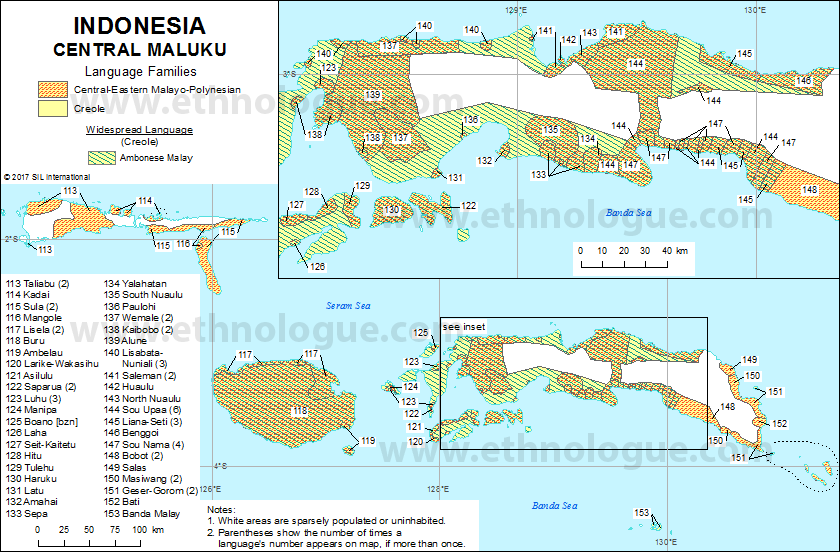
Indonesia, Eastern Papua
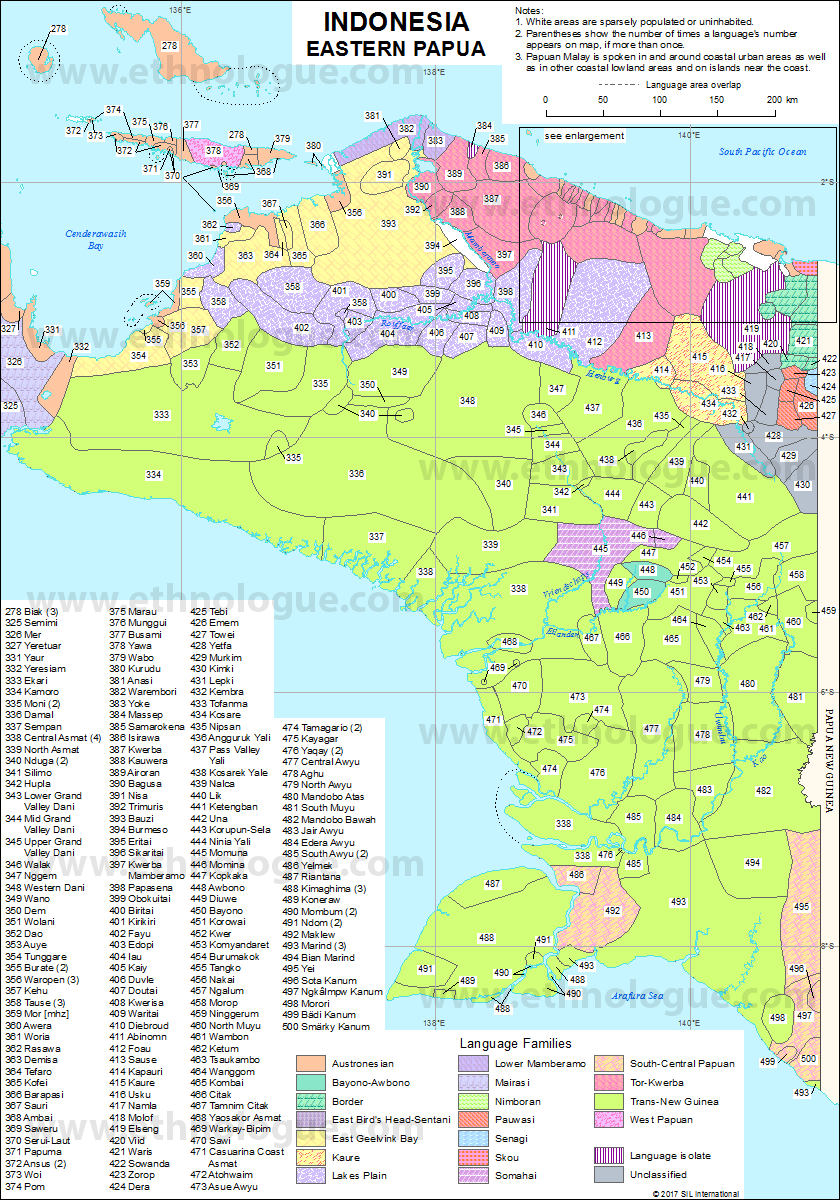
Indonesia, Java and Bali
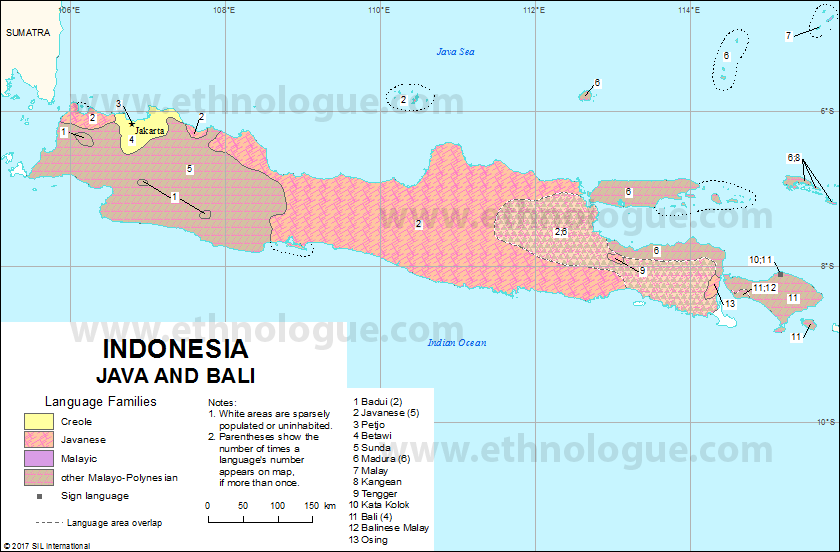
Indonesia, Kalimantan
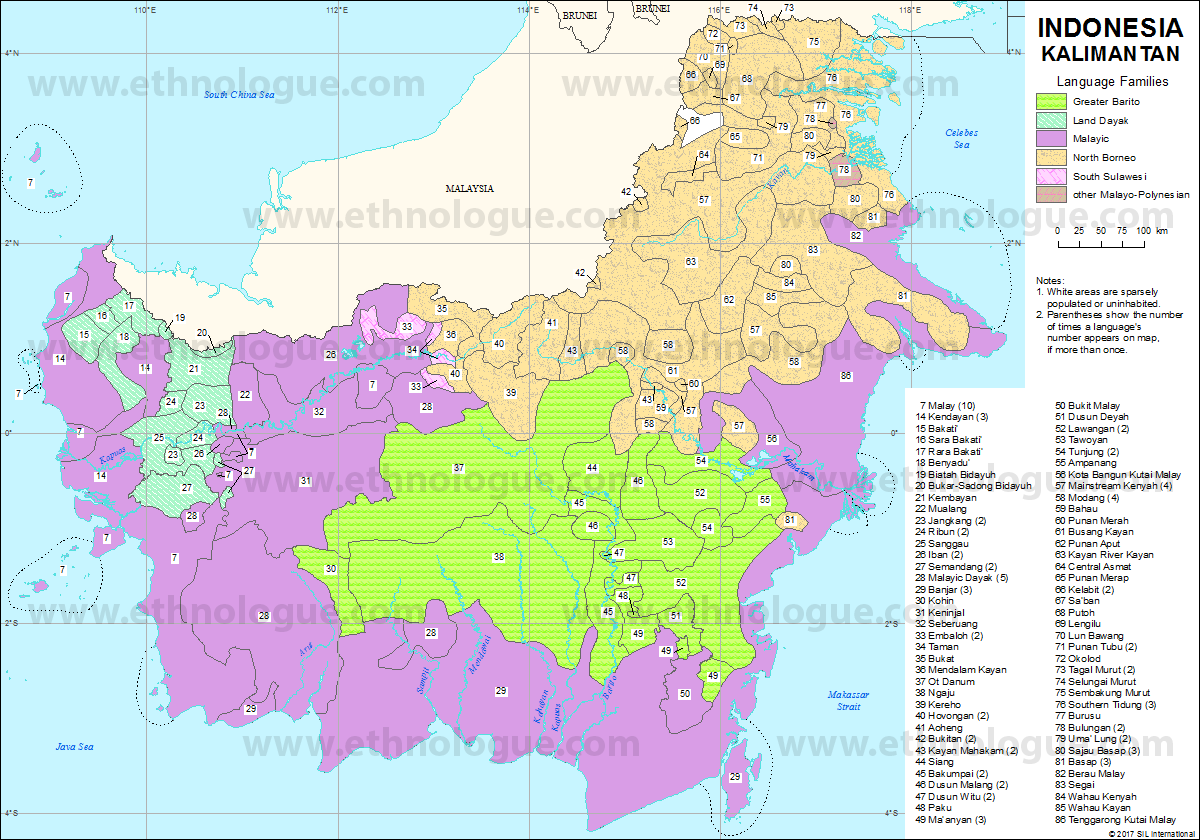
Indonesia, Northern Maluku
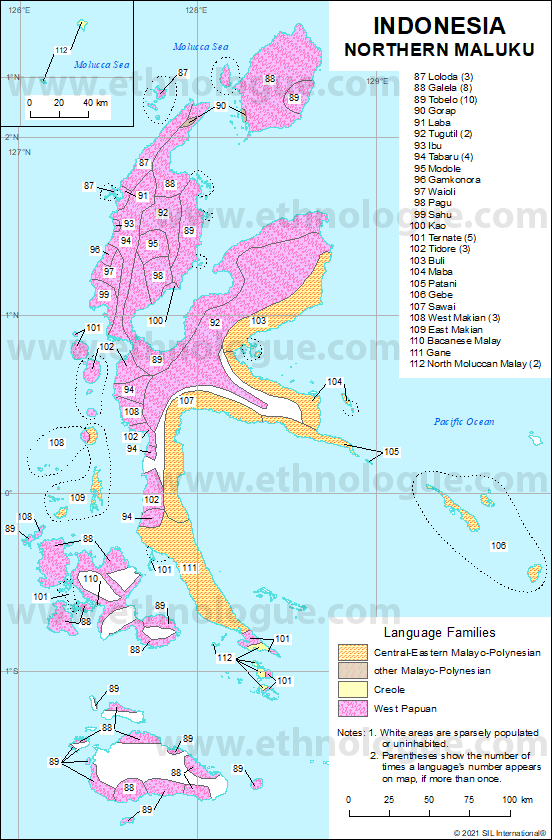
Indonesia, Northwestern Papua
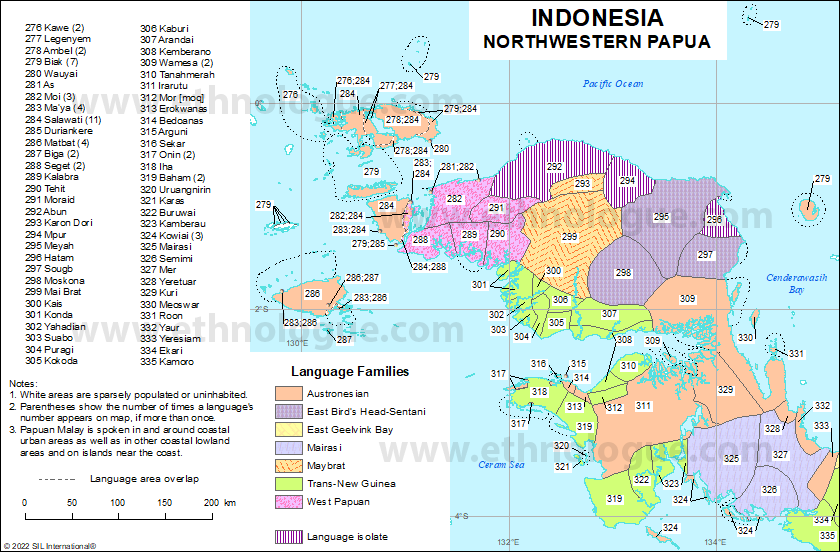
Indonesia, Nusa Tenggara
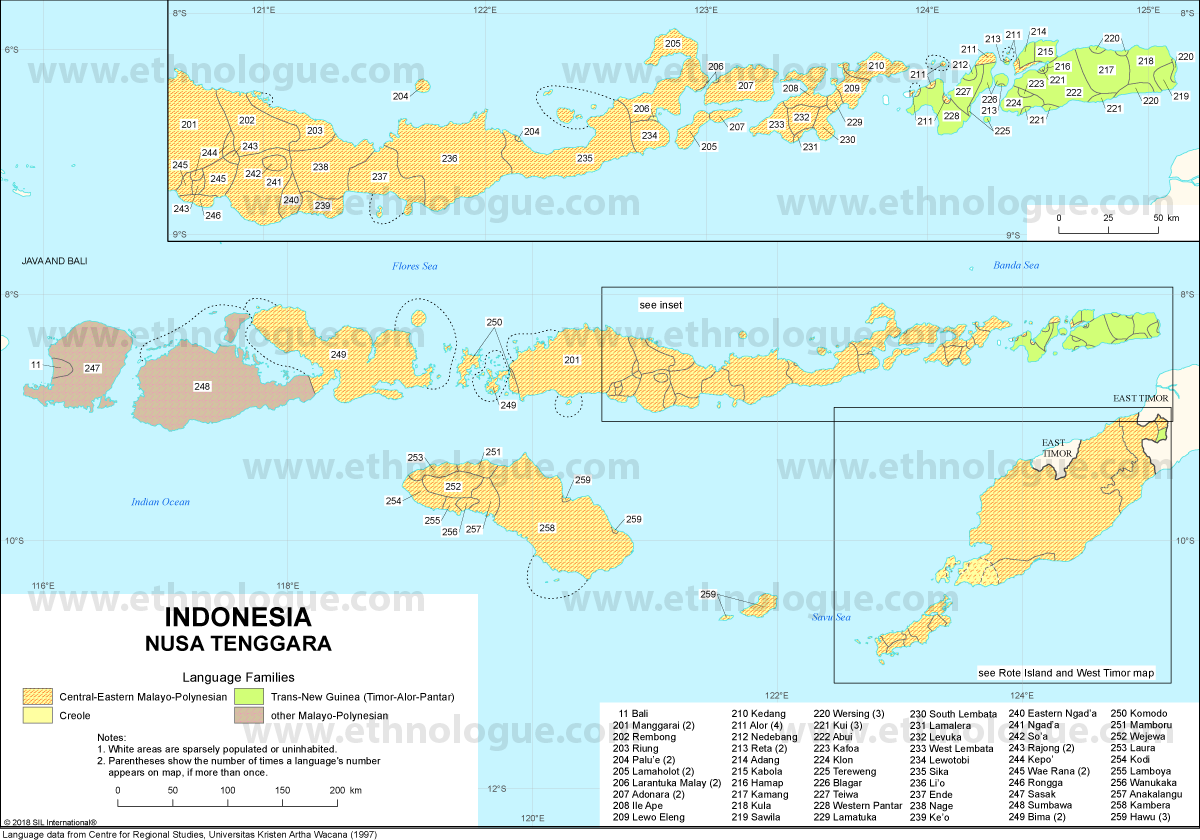
Indonesia, Papua enlargement
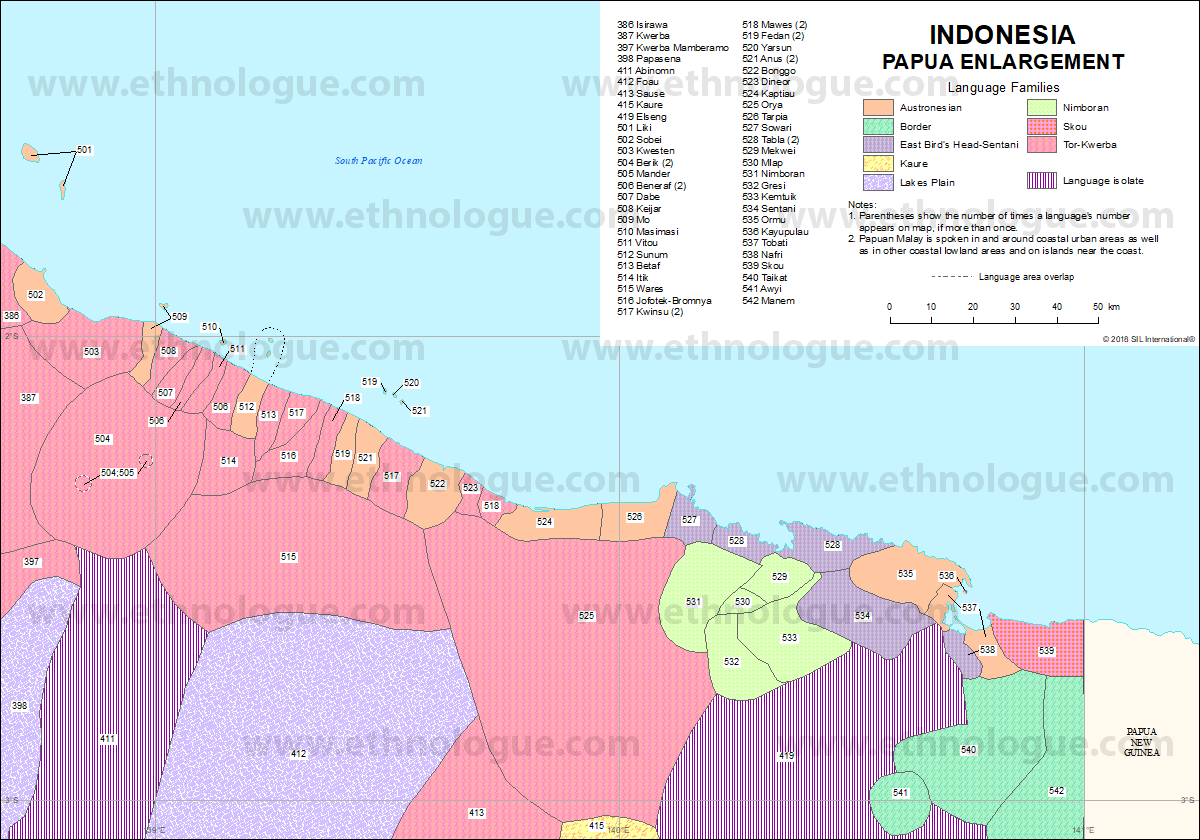
Indonesia, Rote and West Timor
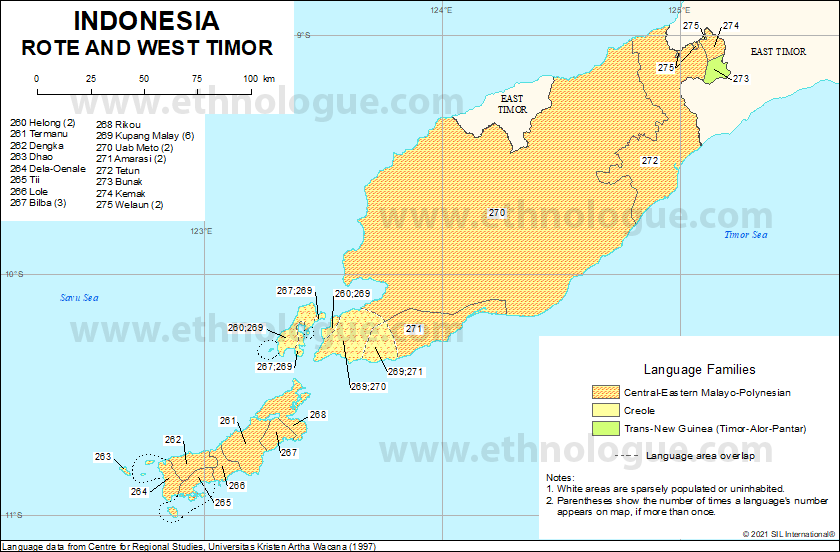
Indonesia, Southern Maluku
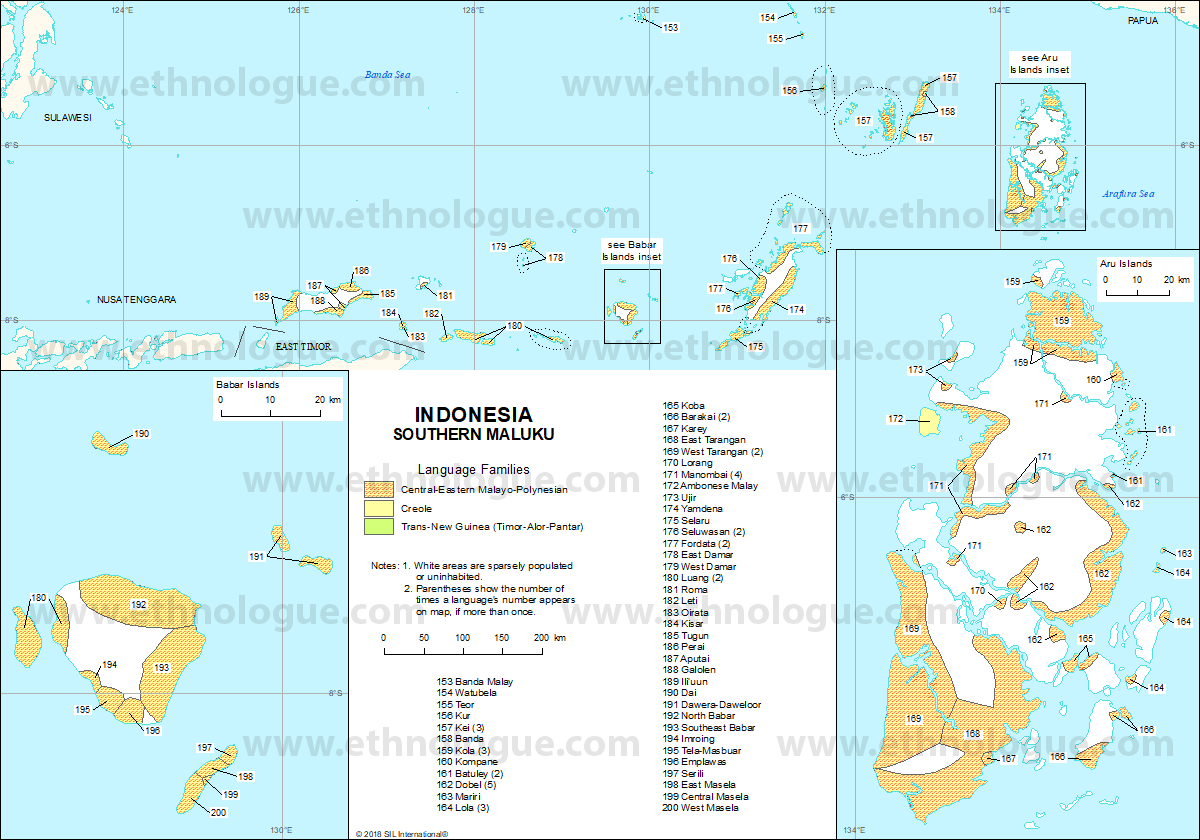
Indonesia, Sulawesi
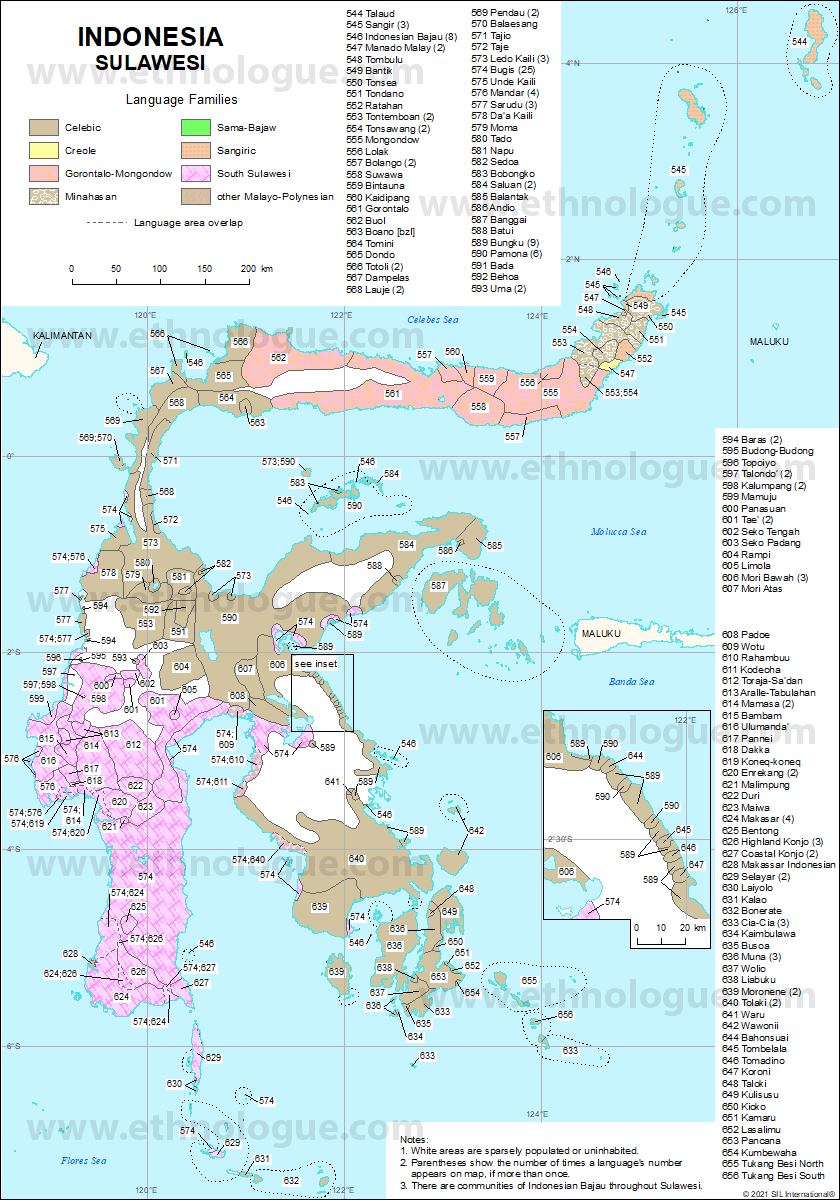
Indonesia, Sumatra
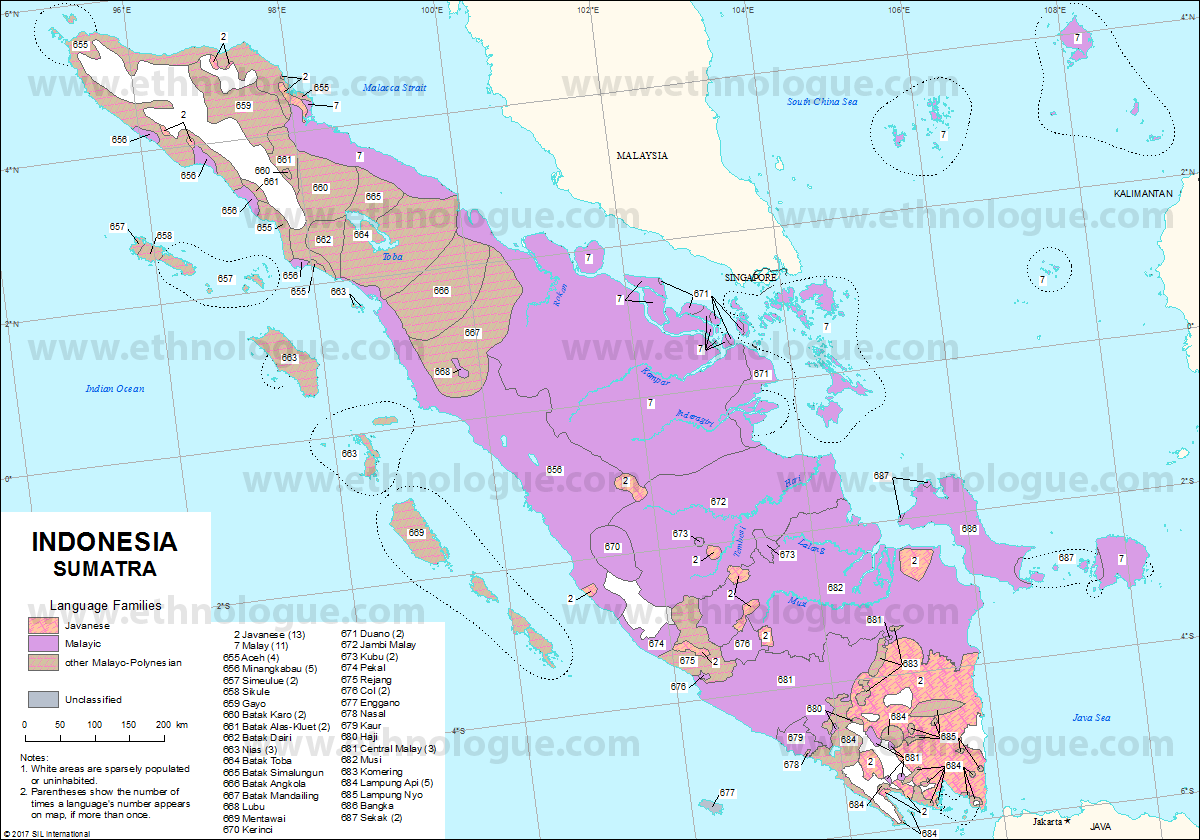
Indonesia: Index map
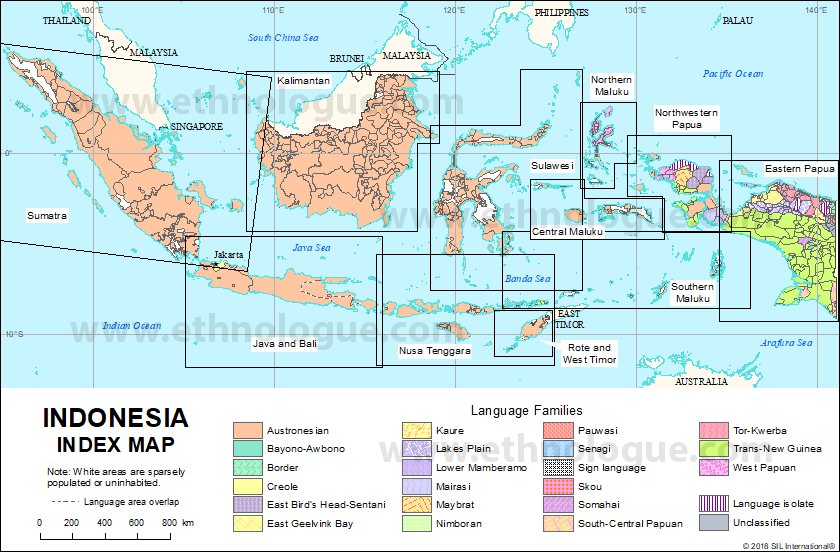
Graphs
Language Vitality Profile
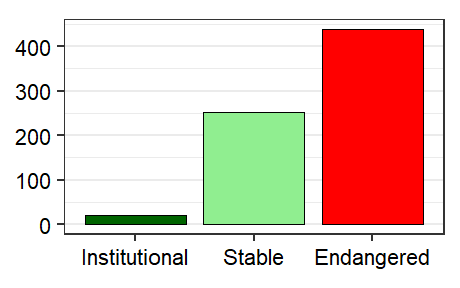
Full explanation
Language Status Profile
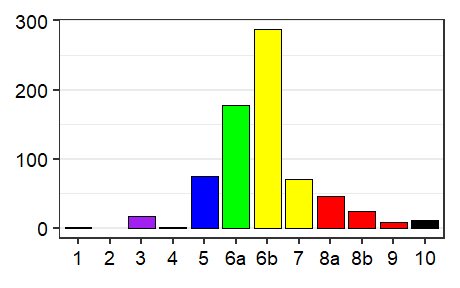
Full explanation
Resources
View Terms
Each Ethnologue country digest is a licensed product with restricted terms of use. Before downloading the product, you must agree to the following terms:
- This is a license for individual use. Just as with a conventionally published book, it is a violation of copyright to make a copy and give it to others.
- You may not redistribute this work in any form, including ingesting the contents into a database that is shared with others or posting it on a web site (whether public or private).
To inquire about permission for reuse or redistribution, please use the Contact Us form in the footer.