
IN
Republic of India
India
Summary
- Official Name
- Republic of India
- Population
- 1,380,004,000
- Principal Languages
- English, Hindi
- Literacy Rate
- 74% (2018 UNESCO)
- International Conventions
- CPPDCE (2006), CSICH (2012), ICCPR (1966), UNCRPD (2006), UNDRIP (2007)
- General References
- Bradley 1997, Bradley 2005, Breton 1997, Campbell and King 2011, Hugoniot 1970, Marrison 1967, Masica 1991, Matisoff et al 1996, Singh 1994a, Singh 1994b, Singh 1995a, Singh 1995b, VanBik 2006, Van Driem 2001, Van Driem 2007
- Deaf Population
- Over 10,000,000
- Language Counts
- The number of established languages listed for India is 464. Of these, 452 are living and 12 are extinct. Of the living languages, 423 are indigenous and 29 are non-indigenous. Furthermore, 47 are institutional, 155 are developing, 107 are vigorous, 123 are in trouble, and 20 are dying. Also listed are 5 unestablished languages and 6 macrolanguages.
Languages
- A-Pucikwar apq
- Andaman and Nicobar Islands. Users: No known L1 speakers. Last known speaker, Loka Raja, survived into the 1950s (Avtans and Abbi 2006). Status: 10 (Extinct). Alternate Names: Aka-pujjukar, Puchikwar, Pucikwar Classification: Andamanese, Great Andamanese, Central
- Adi adi
- Arunachal Pradesh state: East, West, and Upper Siang districts, Upper Subansiri and Dibang Valley districts; Assam state: Assam valley north hills, between Bhutan and Buruli rivers. Users: 150,000 in India (2011 census). Total users in all countries: 151,090. Status: 5* (Developing). Alternate Names: Abhor, Abor, Boga’er Luoba, Bori-Karko, Lhoba, Luoba Autonym: Adi Classification: Sino-Tibetan, Tibeto-Burman, Central Tibeto-Burman, Tani
- Adi, Galo adl
- Arunachal Pradesh state: East Siang, Lepa-Rada, West Siang, and Upper Subansiri districts. Users: 29,200 (2011 census). A few older adult monolinguals. Status: 5 (Developing). Alternate Names: Adi, Adi-Gallong, Adi-Galo, Gallong, Galong Autonym: Galo Classification: Sino-Tibetan, Tibeto-Burman, Central Tibeto-Burman, Tani
- Agariya agi
- Chhattisgarh state: Bilaspur district; Madhya Pradesh state: Mandla and Rewa districts, Maikal hills; Uttar Pradesh state: Agra, Mathura, and Mirzapur districts. Users: 72,000 (2007). Status: 6a* (Vigorous). Alternate Names: Agaria, Agharia, Agoria Classification: Austro-Asiatic, Munda, North Munda, Kherwari
- Ahirani ahr
- Gujarat state; Maharashtra state: Aurangabad, Dhulia, Jalgaon, Nandurbar, and Nasik districts. Users: 1,640,000 (2011 census). Status: 5* (Developing). Alternate Names: Ahiri Autonym: अहिराणी (Ahirani) Classification: Indo-European, Indo-Iranian, Indo-Aryan, Intermediate Divisions, Western, Khandesi
- Ahom aho
- Assam state. Users: No known L1 speakers. Ethnic population: No ethnic community. Status: 9 (Second language only). Alternate Names: Tai Ahom Classification: Kra-Dai, Kam-Tai, Tai, Southwestern
- Aimol aim
- Assam state; Manipur state: Bishnupur district, Kha-Aimol; Chandel district, Aimol Tampak, Chandonpokpi, Chingunghut, Khodamphai, Khomayai (Khunjai), Kumbirei, Ngairong Aimol, Satu, Soibong (Khudengthabi), and Unapal; Churachandpur district, Luichungbum (Louchulbung); Senapati district, Tuikhong. Users: 2,640 (2001 census). Status: 6b* (Threatened). Autonym: Aimol Classification: Sino-Tibetan, Tibeto-Burman, Kuki-Chin, Northwestern
- Aiton aio
- Assam state: Jorhat and Karbi Anglong districts, Ahomoni, Balipathar, Banlung, Barhula, Chakihula, Doboroni, Kaliyani, and Tengani villages. Users: 1,500 (Morey 2006). Status: 6b (Threatened). Alternate Names: Aitonia, Sham Doaniya, Tai Aiton Autonym: ဢႝတွꩫ် (Aiton) Classification: Kra-Dai, Kam-Tai, Tai, Southwestern
- Aka-Bea abj
- Andaman and Nicobar Islands union territory: South Andaman Island except northeast coast, and north and east interiors; Rutland Island except south coast; small islands southeast of Rutland; Labyrinth Islands. Users: No known L1 speakers. The last speaker died in 1931 (Van Driem 2001). Status: 10 (Extinct). Alternate Names: Aka-Beada, Aka-Biada, Bea, Beada, Biada, Bogijiab, Bojigiyab, Bojigniji, Bojigyab Classification: Andamanese, Great Andamanese, Central
- Aka-Bo akm
- Andaman and Nicobar Islands union territory: east central coast of North Andaman Island, North Reef Island. Users: No known L1 speakers. Last speaker, Boa Sr., died in 2010. Status: 10 (Extinct). Alternate Names: Ba, Bo Classification: Andamanese, Great Andamanese, Northern
- Aka-Cari aci
- Andaman and Nicobar Islands union territory: North Andaman Island north coast, Landfall Island, other nearby small islands. Users: No known L1 speakers. The last known speaker, Licho, died in April 2020. Status: 10 (Extinct). Alternate Names: Akacari, Cari, Chari, Chariar, Sare Classification: Andamanese, Great Andamanese, Northern
- Aka-Jeru akj
- Andaman and Nicobar Islands union territory: interior and south North Andaman island, Sound island. Users: 3 (2020 D. Dasgupta). Status: 8b (Nearly extinct). Alternate Names: Jero, Jeru, Yerawa Classification: Andamanese, Great Andamanese, Northern
- Aka-Kede akx
- Andaman and Nicobar Islands union territory: central and north central Middle Andaman Island. Users: No known L1 speakers. The last speaker probably died by 1940 (Van Driem 2001). Status: 10 (Extinct). Alternate Names: Kede Classification: Andamanese, Great Andamanese, Central
- Aka-Kol aky
- Andaman and Nicobar Islands union territory: southeast Middle Andaman Island. Users: No known L1 speakers. The last speaker died in 1921 (Van Driem 2001). Status: 10 (Extinct). Alternate Names: Kol Classification: Andamanese, Great Andamanese, Central
- Aka-Kora ack
- Andaman and Nicobar Islands union territory: northeast and north central coasts of North Andaman Island, Smith Island. Users: No known L1 speakers. Last speaker, Boro, died in 2009. Status: 10 (Extinct). Alternate Names: Kora Classification: Andamanese, Great Andamanese, Northern
- Akar-Bale acl
- Andaman and Nicobar Islands union territory: Ritchie’s Archipelago, Havelock Island, Neill Island. Users: No known L1 speakers. The last speaker died by 1940 (Van Driem 2001). Status: 10 (Extinct). Alternate Names: Balawa, Bale, Balwa Classification: Andamanese, Great Andamanese, Central
- Allar all
- Kerala state: Malappuram district, Manjeri and Perinthalmanna sub-districts, Aminikadu, Mannarmala, and Tazhecode; Palakkad district, Mannarkkad and Ottappalam sub-districts. Users: 350 (Shashi and Shri 1994). Status: 7 (Shifting). Alternate Names: Aalan, Alan, Alanmar, Alar, Allan, Chatans Classification: Dravidian, Unclassified
- Amri Karbi ajz
- Assam state: Kamrup district, Basbistha, Chandubi, Jalukbari, Jorabat, Kahi Kusi, Khetri, Loharghat, Pandu, Panikhaith, Rani block, Sonapur, and south of Brahmaputra river; Meghalaya state: Ri-Bhoi district, Nongpoh area, Barni Hat and Umling. Users: 125,000 (2003). Status: 6b (Threatened). Alternate Names: Amri Autonym: Amri Karbi Classification: Sino-Tibetan, Tibeto-Burman, Karbi
- Anal anm
- Manipur state: Chandel district, Chakpikarong, Chandel, and Engnoupal sub-districts, on Chakpi river banks. Users: 27,200 in India (2011 census). Total users in all countries: 27,250. Status: 5* (Developing). Alternate Names: Namfau Classification: Sino-Tibetan, Tibeto-Burman, Kuki-Chin, Northwestern
- Andaman Hindi Creole hca
- Andaman and Nicobar Islands union territory: Port Blair, 40 villages south of Port Blair. Users: 10,000 (Singh 1994a). Status: 6a (Vigorous). Alternate Names: Andaman Hindi Classification: Creole, Hindi based
- Andh anr
- Madhya Pradesh state; Maharashtra state: Akola, Aurangabad, Buldana, Nanded, Parbhani, and Yevatmal districts; Telangana state: Adilabad, Hyderabad. Users: 100,000 (2007). Ethnic population: 420,000 (2007). Status: 6b* (Threatened). Alternate Names: Andha, Andhi Classification: Indo-European, Indo-Iranian, Indo-Aryan, Unclassified
- Angika anp
- Bihar state: Banka, Bhagalpur, Katihar, and Purnia districts; Jharkhand state: Godda and Sahibganji districts. Users: 725,000 in India (IMA 1997). Total users in all countries: 745,330 (as L1: 743,600; as L2: 1,730). Status: 5 (Developing). Alternate Names: Anga, Angikar, Chhika-Chhiki Autonym: अंगिका (Angika) Classification: Indo-European, Indo-Iranian, Indo-Aryan, Outer Languages, Eastern, Unclassified
- Apatani apt
- Arunachal Pradesh state: lower Subansiri district, Billa, Dutta, Hari, Hija, Hong, Michi Bamin, and Mudang-Tage villages in Ziro valley; Assam and Nagaland states. Users: 44,800 (2011 census). Status: 6b* (Threatened). Alternate Names: Apa Classification: Sino-Tibetan, Tibeto-Burman, Central Tibeto-Burman, Tani
- Arabic, Mesopotamian Spoken acm
- Users: 59,400 in India (2011 census). Status: Unestablished. Classification: Afro-Asiatic, Semitic, Central, South, Arabic
- Aranadan aaf
- Kerala state: Kozhihkode district, Ernad sub-district; Malappuram district, Nilambur sub-district; Palakkad district; Karnataka and Tamil Nada states. Users: 200 (2001 census). Census did not include all people in interior settlements. Status: 6b (Threatened). Alternate Names: Aranatan, Arnatas, Eranadans Classification: Dravidian, Southern, Tamil-Kannada, Tamil-Kodagu, Tamil-Malayalam, Malayalam
- Assamese asm
- Arunachal Pradesh state: Changlang and Lohit; Assam state; Meghalaya state: west Garo Hills; Nagaland state: Dimapur, Kohima, Mokokchung, Wokha, and Zunheboto; West Bengal state: Jalpaiguri and Koch Bihar. Users: 15,300,000 in India (2011 census). Total users in all countries: 15,328,240 (as L1: 15,327,990; as L2: 250). Status: 2 (Provincial). Statutory provincial language in Assam State (1950, Constitution, Schedule VIII). Alternate Names: Asambe, Asami, Asamiya Autonym: অসমীয়া (Ôxômiya) Classification: Indo-European, Indo-Iranian, Indo-Aryan, Outer Languages, Eastern, Bengali-Assamese
- Asuri asr
- Chhattisgarh state: Raigarh district, Jashpur area; Jharkhand state: Gumla, Lohardaga, southern Palamau, and northern Ranchi districts of Chotanagpur Plateau; Maharashtra state; Odisha state: Sambalpur district; West Bengal state. Users: 7,000 (Van Driem 2007). Status: 6a* (Vigorous). Alternate Names: Ashree, Assur, Asura, Maleta Classification: Austro-Asiatic, Munda, North Munda, Kherwari, Mundari
- Atong aot
- Meghalaya state: south Garo Hills district; possibly Assam state: south Kamrup district. Users: 4,600 in India. Total users in all countries: 10,000. Status: 6b (Threatened). Alternate Names: A’tong Classification: Sino-Tibetan, Tibeto-Burman, Sal, Boro-Garo, Koch
- Awadhi awa
- Bihar state; Delhi; Madhya Pradesh state; Uttar Pradesh: Allahabad, Bahraich, Bara-Banki, Faizabad, Gonda, Kheri, Lucknow, Pratapgarh, Rae-Bareli, Sitapur, Sultanpur, and Unnao districts. Users: 3,850,000 in India (2011 census). Total users in all countries: 4,397,400 (as L1: 4,352,000; as L2: 45,400). Status: 5* (Developing). Alternate Names: Abadi, Abohi, Ambodhi, Avadhi, Baiswari, Kojali, Kosali Autonym: अवधी (Awadhi) Classification: Indo-European, Indo-Iranian, Indo-Aryan, Intermediate Divisions, Eastern, East Central
- Badaga bfq
- Kerala state: Malappuram district; Tamil Nadu state: Nilgiris district, Kunda hills, 200 villages. Users: 134,000 (2011 census). Status: 5* (Developing). Alternate Names: Badag, Badagu, Baduga, Badugu, Vadagu Autonym: Badaga, ಬಡಗ (Badaga) Classification: Dravidian, Southern, Tamil-Kannada, Kannada
- Bagheli bfy
- Chhattisgarh state: Bilaspur and Koriya districts; Madhya Pradesh state: Anuppur, Chhindwara, Dindori, Jabalpur, Mandla, Panna, Rewa, Satna, Shahdol, Sidhi, and Umaria districts; Uttar Pradesh state: Allahabad, Banda, Mirzapur, and Hamirpur districts. Users: 2,680,000 (2011 census). Status: 6a (Vigorous). Alternate Names: Bagelkhandi, Bhugelkhud, Gangai, Godwani Kawathi, Kenat, Kevat Boli, Kevati, Kewani, Kewat, Kewati, Kewot, Kumhari, Mandal, Mannadi, Riwai Autonym: बघेली (Bagheli) Classification: Indo-European, Indo-Iranian, Indo-Aryan, Intermediate Divisions, Eastern, East Central
- Bagri bgq
- Punjab state: Fatehabad, Firozepur, Hanumangarh, Haryana, Rajasthan, Sriganganagar, and Sirsa districts. Users: 1,890,000 in India (2011 census). 162,000 monolinguals. Total users in all countries: 2,196,000. Status: 6a* (Vigorous). Alternate Names: Bagari, Bagria, Bagris, Bahgri, Baorias Autonym: बागड़ी (Bagri) Classification: Indo-European, Indo-Iranian, Indo-Aryan, Intermediate Divisions, Western, Rajasthani, Unclassified
- Balochi, Eastern bgp
- Punjab state: Firozpur district. Users: 800 in India (2007). Possibly L2 speakers only. Ethnic population: 95,000. Status: 7 (Shifting). Alternate Names: Balochi, Baloci, Baluci Classification: Indo-European, Indo-Iranian, Iranian, Western, Northwestern, Balochi
- Balti bft
- Jammu and Kashmir state. Users: 13,800 in India (2011 census). Ethnic population: 38,800. Status: 6b (Threatened). Alternate Names: Baltistani, Bhoti of Baltistan, Byltae, Sbalt Classification: Sino-Tibetan, Tibeto-Burman, Western Tibeto-Burman, Bodish, Central Bodish, Western
- Bantawa bap
- Sikkim state: Lingdum, Rolep, and many other parts of the state; West Bengal state: Darjeeling. Users: 14,400 in India (2001 census). Few monolinguals. Status: 6b (Threatened). Alternate Names: An Yüng, Bantaba, Bantawa Dum, Bantawa Rai, Bantawa Yong, Bantawa Yüng, Bontawa, Kirat Khambu, Kirat Khambu Rai, Kirawa Yüng, Rai Classification: Sino-Tibetan, Tibeto-Burman, Western Tibeto-Burman, Himalayan, Kiranti, Eastern
- Bareli, Palya bpx
- Madhya Pradesh state: Barwani district, Rajpur and Barwani sub-districts; Khargone district, Jhirniya sub-district; Maharashtra state: Jalgaon district, Yawal and Raver sub-districts; Dhule district, Shirpur sub-district. Users: 10,000 (2000 V. Varkey). Status: 6a (Vigorous). Alternate Names: Bareli, Pali, Palodi Classification: Indo-European, Indo-Iranian, Indo-Aryan, Intermediate Divisions, Western, Bhil
- Bareli, Pauri bfb
- Maharashtra state: Nandurbar district, Dhadgaon, Shahada, and Taloda sub-districts; Dhule district, Shirpur sub-district; Madhya Pradesh state: Barwani district, Pansemal sub-district, Nivali and Pati blocks. Users: 991,000 (2011 census). Status: 5* (Developing). Alternate Names: Bareli, Barewali, Barli Classification: Indo-European, Indo-Iranian, Indo-Aryan, Intermediate Divisions, Western, Bhil
- Bareli, Rathwi bgd
- Madhya Pradesh state: Barwani district, Barwani, Sendhwa, and Rajpur sub-districts; Khargone district, Bhagawanpura, Jhirniya, and Bhikangaon sub-districts; Dewas district, Bagli sub-district; Khandwa district, Burhanpur sub-district; Dhar district, Dahi block; south Jhabua district, Rathia Bhilala; Maharashtra state: north Dhule district, Shirpur sub-district; Jalgaon district, Chopda, Raver, and Yawal sub-districts. Users: 359,000 (2011 census). Status: 5* (Developing). Alternate Names: Barel, Barela, Paura, Pauri, Pawari, Pawri, Rathi, Rathia, Rathwi Pauri Autonym: बरेली (Bareli) Classification: Indo-European, Indo-Iranian, Indo-Aryan, Intermediate Divisions, Western, Bhil
- Bateri btv
- Jammu and Kashmir state: Srinagar area. Users: 800 in India. 200 families. Status: 6a* (Vigorous). Classification: Indo-European, Indo-Iranian, Indo-Aryan, Outer Languages, Northwestern, Dardic, Kohistani
- Bauria bge
- Chandigarh, Haryana, Himachal Pradesh, Punjab, Rajasthan, and Uttar Pradesh states; Delhi. Users: 63,000 (2011 census). Status: 6a* (Vigorous). Alternate Names: Babri, Badak, Baori, Basria, Bawari, Bawaria, Bhoria, Vaghri Classification: Indo-European, Indo-Iranian, Indo-Aryan, Intermediate Divisions, Western, Bhil
- Bazigar bfr
- Haryana state: Ambala, Kaithal, Karnal, and Kurukshetra; Punjab state: Fatehgarh Sahib district and Patiala; Uttar Pradesh state: Muzaffarnagar and Saharanpur. Users: 58,200 (1981 census). Ethnic population: 800,000. Status: 7 (Shifting). Classification: Indo-European, Indo-Iranian, Indo-Aryan, Unclassified
- Bellari brw
- Karnataka state: Mysore district; Kerala state: Wayanad district; scattered in Tamil Nadu state. Users: 1,000 (Van Driem 2007). Status: 7 (Shifting). Classification: Dravidian, Southern, Tulu
- Bengali ben
- Assam state: Goalpara district; Bihar state; Jharkhand state: Dhanbad, Manbhum, Santal Parganas, and Singhbhum; Odisha state: Bales and Mayar; Tripura and West Bengal states. Users: 106,500,000 in India, all users. L1 users: 96,500,000 in India (2011 census). L2 users: 10,000,000 (2011 census). Status: 2 (Provincial). Statutory provincial language in West Bengal, Tripura, Assam states (1950, Constitution, Schedule VIII). Alternate Names: Bangala, Bangla-Bhasa Classification: Indo-European, Indo-Iranian, Indo-Aryan, Outer Languages, Eastern, Bengali-Assamese
- Bhadrawahi bhd
- Himachal Pradesh state: small border area; Jammu and Kashmir state: Doda district, Bhadarwah town and surrounding villages. Users: 116,000 (2011). 98,800 Bhadrawahi and 17,300 Padari (2011 census). Status: 6a* (Vigorous). Alternate Names: Baderwali, Badrohi, Bahi, Bhadarwahi, Bhaderbhai Jamu, Bhaderwali Pahari, Bhadrava, Bhadri Autonym: भद्रवाही (Bhadrawahi) Classification: Indo-European, Indo-Iranian, Indo-Aryan, Intermediate Divisions, Western, Pahari, Western Pahari
- Bhalay bhx
- Madhya Pradesh state; Maharashtra state: Amravati district. Users: 8,670 (1981 census). Status: 6a (Vigorous). Alternate Names: Balahi, Balai Classification: Indo-European, Indo-Iranian, Indo-Aryan, Outer Languages, Southern, Unclassified
- Bharia bha
- Chhattisgarh state: Bilaspur, Durg, and Surguja districts; Madhya Pradesh state: Chhatarpur, Chhindwara, Datia, Jabalpur, Mandla, Panna, Rewa, Sidhi, and Tikamgarh districts; Uttar Pradesh and West Bengal states. Users: 197,000 (1981 census). Status: 6a* (Vigorous). Alternate Names: Bhar, Bharat, Bhumia, Bhumiya, Paliha Classification: Dravidian, Unclassified
- Bhatri bgw
- Chhattisgarh state: Bastar district, Jagdalpur sub-district; Maharashtra state; Odisha state: Koraput district, Kotpad sub-district. Users: 334,000 (2011 census). Status: 3 (Wider communication). Came to the Bastar district from Warangal; became widespread under British rule in 1858. Used in trade (opium), daily communication between ethnic groups, and agriculture. Alternate Names: Basturia, Bhatra, Bhattra, Bhattri, Bhottada, Bhottara, Deshia, aisi jaisi got Autonym: भतरी (Bhatri) Classification: Indo-European, Indo-Iranian, Indo-Aryan, Outer Languages, Eastern, Oriya
- Bhattiyali bht
- Himachal Pradesh state: Chamba district, Bhattiyat and Sihunta sub-districts; Jammu and Kashmir state; Punjab state. Users: 24,000 (2011 census). Status: 5 (Developing). Alternate Names: Bhateali, Bhatiali Pahari, Bhatiyali, Pahari Classification: Indo-European, Indo-Iranian, Indo-Aryan, Intermediate Divisions, Western, Pahari, Western Pahari
- Bhilali bhi
- Karnataka state; Madhya Pradesh state: Barwani (Rajpur), southern Dhar, southern Jhabua, and Khargone (Segaon) districts; Maharashtra state: Dhule district; Rajasthan state; a few in Gujarat state. Users: 753,000 (2011 census). Status: 6a* (Vigorous). Alternate Names: Bhilala, Bhili Classification: Indo-European, Indo-Iranian, Indo-Aryan, Intermediate Divisions, Western, Bhil
- Bhili bhb
- Gujarat state: Dohad, Panch Mahals, and Sabarkantha districts; Madhya Pradesh state: Dhar, Indore, Jhabua, Khargone, and Ratlam districts; Rajasthan state: Banswara, Dungapur, and Udaipur districts. Users: 3,290,000 (2011 census). 10,400,000 for all Bhil languages (2011 census). Status: 5* (Developing). Alternate Names: Bhagoria, Bhil, Bhilbari, Bhilboli, Bhilla, Bhilodi, Lengotia, Vil Autonym: भीली (Bhīlī) Classification: Indo-European, Indo-Iranian, Indo-Aryan, Intermediate Divisions, Western, Bhil
- Bhojpuri bho
- Assam state; Bihar state: Champaran, Saran, and Shahabad districts; Delhi; Jharkhand state: Palamau and Ranchi districts; Madhya Pradesh state; Uttar Pradesh state: Azamgarh, Ballia, Basti, Deoria, Ghazipur, Gorakhpur, Mirzapur, and Varanasi districts; West Bengal state. Users: 50,600,000 in India (2011 census). Total users in all countries: 52,463,000 (as L1: 52,303,000; as L2: 160,000). Status: 5* (Developing). Alternate Names: Bajpuri, Bhojapuri, Bhozpuri, Khotla, Piscimas, “Bihari” (pej.) Autonym: भोजपुरी (Bhōjpurī) Classification: Indo-European, Indo-Iranian, Indo-Aryan, Outer Languages, Eastern, Bihari
- Bhunjia bhu
- Chhattisgarh state: Raipur district; Madhya Pradesh state: Hoshangabad district; Maharashtra state; Odisha state: Balasore (Baleshwar), Dhenkanal, Kalahandi, Keonjhar, Koraput, and Sambalpur districts, Sunabera Plateau area. Users: 6,790 (2000 USCWM). Status: 6b* (Threatened). Alternate Names: Bhumjiya, Bhunjiya, Bunjia Classification: Indo-European, Indo-Iranian, Indo-Aryan, Outer Languages, Eastern, Oriya
- Biate biu
- Assam state: North Cachar Hills district; Manipur state; Meghalaya state: Jaintia hills district; Mizoram state: Aizawl district, Darlawn, New Vervek, and Ratu villages. Users: 19,000 (IMA 1997). Status: 5* (Developing). Alternate Names: Baite, Bedesa, Beite, Bete, Beteh, Biete, Hadem Autonym: Biate Classification: Sino-Tibetan, Tibeto-Burman, Kuki-Chin, Central, Mizo
- Bijori bix
- Jharkhand state: Cowerdaga and Ranchi districts; Madhya Pradesh and Odisha states; West Bengal state: Darjeeling and Jalpaiguri districts. Users: 12,800 (2001 census). Status: 6b (Threatened). Alternate Names: Binjhia, Birijia, Birjia, Brijia, Burja Classification: Austro-Asiatic, Munda, North Munda, Kherwari
- Bilaspuri kfs
- Himachal Pradesh state: Bilaspur district; Punjab state: Rupnagar district. Users: 296,000 (2011 census). Status: 5 (Developing). Alternate Names: Bilaspuri Pahari, Kahluri, Kehloori Pahari, Kehluri, Pacchmi Classification: Indo-European, Indo-Iranian, Indo-Aryan, Intermediate Divisions, Western, Pahari, Western Pahari
- Birhor biy
- Chhattisgarh state: Raigarh district; Jharkhand state: southern Hazaribag, southern Palamau, Ranchi, and Singhbhum districts; Maharashtra state; Odisha state: Kalahandi, Keonjhar, Mayurbhanj, Sambalpur, and Sundargarh districts; West Bengal state: Puruliya district. Users: 2,000 (Van Driem 2007). Nomadic habits make assessment difficult. Some estimates as low as 1,000 (Parkin 1991). Status: 6a (Vigorous). Alternate Names: Bihor, Birhar, Birhore, Birhul, Mankidi, Mankidia, Mankiria Classification: Austro-Asiatic, Munda, North Munda, Kherwari, Mundari
- Bishnupuriya bpy
- Assam state: Cachar, Hailakandi, and Karimganj districts; north Tripura state. Users: 79,600 in India (2011 census). Total users in all countries: 119,600. Status: 5* (Developing). Alternate Names: Bishnupria Manipuri, Bishnupriya, Bishnupriya Manipuri, Bisna Puriya Classification: Indo-European, Indo-Iranian, Indo-Aryan, Outer Languages, Eastern, Bengali-Assamese
- Bodo Parja bdv
- Andhra Pradesh state; Odisha state: Koraput district. Users: 50,000 (2001 IBT). Status: 5* (Developing). Alternate Names: Bodo Paraja, Harja, Jhaliya, Jharia, Jhodia Parja, Parajhi, Parja, Parjhi, Parji, Paroja, Poroja, Sodia Parja Autonym: ବଡ଼ ପରଜା (Bodo Parja) Classification: Indo-European, Indo-Iranian, Indo-Aryan, Outer Languages, Eastern, Oriya
- Bondo bfw
- Odisha state: Malkangiri district, Khoirput sub-district, Bondo Hills. Users: 9,000 (2002 SIL). 5,570 Upper Bondo and 3,500 Lower Bondo. Few Lower Bondo are monolingual. Status: 6b* (Threatened). Alternate Names: Bhonda Bhasha, Bonda, Bondo-Poraja, Nanqa Poroja, Poraja Katha, Remo, Remosum Classification: Austro-Asiatic, Munda, South Munda, Koraput Munda, Gutob-Remo-Geta’, Gutob-Remo
- Boro brx
- Assam state: mainly Darrang, Goalpara, Kamrup, Lakhimpur, Nagaon, and Sibsagar districts; Manipur state: Chandel (Tengnoupal) district; Meghalaya state: West Garo Hills district, Tikrikilla sub-district, 7 villages; East Khasi Hills district; West Bengal state: Cooch-Behar, Darjeeling, and Jalpaiguri districts. Users: 1,470,000 in India (2011 census). 1,460,000 Boro, 11,500 Mech (2011 census). Total users in all countries: 1,474,380. Status: 4 (Educational). Statutory language of provincial identity in Assam (1950, Constitution, Articles 345–347). Alternate Names: Bara, Bodi, Bodo, Boroni, Kachari, Mech, Meche, Mechi, Meci Autonym: बोडो (boḍo), बोडो भाषा (boḍo bʰāṣā) Classification: Sino-Tibetan, Tibeto-Burman, Sal, Boro-Garo, Boro-Tiwa, Boro
- Braj Bhasha bra
- Bihar state; Delhi; Haryana state: Gurgaon district; Madhya Pradesh state: Bhind, Gwalior, and Morena districts; Rajasthan state: Bharatpur and Sawai Madhopur districts; Uttar Pradesh state: Agra region. Users: 1,560,000 (2011 census). Status: 5* (Developing). Alternate Names: Bijbhasha, Braj, Braj Bhakha, Bri, Brij Bhasha, Briju, Bruj, Daihaati Zabaan, Dehaati Zabaan Autonym: ब्रज भाषा (Braj Bhāshā) Classification: Indo-European, Indo-Iranian, Indo-Aryan, Western Hindi, Unclassified
- Brokskat bkk
- Jammu and Kashmir state: Kargil and Ladakh districts along Indus river; Garkhon area, including Batalik, Chulichan, Dah, Darchiks, and Gurgurdo villages. Users: 10,000 in India (Johnstone and Mandryk 2001). Total users in all countries: 10,400. Status: 6b* (Threatened). Alternate Names: Brok-skad, Brokpa, Brokpa of Dah-Hanu, Dokskat, Kyango, Minaro Classification: Indo-European, Indo-Iranian, Indo-Aryan, Outer Languages, Northwestern, Dardic, Shina
- Bugun bgg
- Arunachal Pradesh state: West Kameng district, Nafra and Singchung sub-districts, Bichom, Diching, Dikiang, Lichini, Mangopom, Namphri, New Kaspi, Ramu, Sachita, Singchung, Situ, and Wangho villages; in mountains on both sides of Rupa river, interspersed among the Aka. Users: 900 (2001 Asia Harvest). Status: 6b* (Threatened). Alternate Names: Kho, Khoa, Khowa Autonym: Bugun Classification: Sino-Tibetan, Tibeto-Burman, Central Tibeto-Burman, Kho-Bwa
- Buksa tkb
- Uttar Pradesh state; Uttarakhand state: southwest Nainital district, Kichha and Kashipur sub-districts, 130 villages, from Keneshpur to Ramnagar; some in Bijnor and Garhwal districts. Users: 59,000 (2011 census). Status: 6a (Vigorous). Alternate Names: Bhoksha, Bhuksa, Bukas, Buxa Classification: Indo-European, Indo-Iranian, Indo-Aryan, Outer Languages, Eastern, Unclassified
- Bundeli bns
- Madhya Pradesh state: Chhatarpur, Chhindwara, Datia, Narsinghpur, Panna, Sagar, Satna, Seoni, Shivpuri and Tikamgarh districts; Maharashtra state: Bhandara and Nagpur districts; Rajasthan state; Uttar Pradesh state: Banda, Hamirpur, Jalaun, Jhansi, and Lalitpur districts. Users: 5,630,000 (2011 census). Population estimates range up to 20,000,000. Status: 5* (Developing). Alternate Names: Bondili, Bundelkhandi Autonym: बुन्देली (Bundeli) Classification: Indo-European, Indo-Iranian, Indo-Aryan, Western Hindi, Bundeli
- Burushaski bsk
- Jammu and Kashmir state: Kargil and Leh districts, especially Ladakh area; group in Srinagar. Users: 300 in India (Munshi 2018). Status: 6a* (Vigorous). Classification: Language isolate
- Byangsi bee
- Uttarakhand state: Pithoragarh district, Darchula and Munsyari sub-districts, Garbyang, Gunji, Nabi, Napalchyu, and Rongkang villages; in Kuthi Yangti river valley in the Himalayas on Nepal and Tibet borders; Byangs Patti from Budi south to Kuti village north. Users: 2,830 in India (2000). No monolinguals. Total users in all countries: 3,380 (as L1: 3,310; as L2: 70). Status: 6b* (Threatened). Alternate Names: Bhotia, Byangkho Lwo, Byangkhopa, Byanshi, Byansi, Jaba, Rang, Rang Lo, Saukas, Shaukas Classification: Sino-Tibetan, Tibeto-Burman, Western Tibeto-Burman, Bodish, West Himalayish, Almora
- Chakma ccp
- Arunachal Pradesh state: Changlang district, Miao sub-district, Lohit district, Chowkham sub-district, Tirap district; Assam state: Anglong, Cachar, Karbi, and North Cachar districts; Mizoram state: southwest along Karnafuli river; Tripura state: North Tripura district, Kailashahar sub-district; South Tripura district; Manipur and West Bengal states. Users: 228,000 in India (2011 census). Status: 4 (Educational). Alternate Names: Chakama, Changma Vaj, Takam, Tsakma Classification: Indo-European, Indo-Iranian, Indo-Aryan, Outer Languages, Eastern, Bengali-Assamese
- Chambeali cdh
- Himachal Pradesh state: Chamba district, Chamba sub-district; Jammu and Kashmir state. Users: 126,000 (2011 census). Status: 6a (Vigorous). Alternate Names: Cameali, Chamĕāḷī, Chamaya, Chambiali, Chambiyali, Chamiyali Pahari, Chamrali, Chamya Classification: Indo-European, Indo-Iranian, Indo-Aryan, Intermediate Divisions, Western, Pahari, Western Pahari
- Chamling rab
- Sikkim state: South district; West Bengal state: Darjeeling, Regu and other parts of the state. Users: Ethnic population: 10,500 (2011 census). Status: 6b* (Threatened). Alternate Names: Camling Classification: Sino-Tibetan, Tibeto-Burman, Western Tibeto-Burman, Himalayan, Kiranti, Eastern
- Changthang cna
- Jammu and Kashmir state: Tibet border area, Changthang region east and southeast of Leh. Users: 10,100 (2000). Status: 6b* (Threatened). Alternate Names: Byangskat, Byanskat, Champas, Changs-Skat, Changtang, Changtang Ladakhi, Rong, Rupshu, Stotpa, Upper Ladakhi Classification: Sino-Tibetan, Tibeto-Burman, Western Tibeto-Burman, Bodish, Central Bodish, Western
- Chaudangsi cdn
- Uttarakhand state: Pithoragarh district, Darchula and Munsyari sub-districts, Chilla, Gala, Monggong, Panggu, Rimzhim, Rongto, Rung, Sirdang, Sirkha, Song, Sosa, Syang Khola, Tangkul, Waiku, and Zipti villages; Patti Chaudangs, Kali river west bank facing Nepal border along Mahakali valley. Users: 1,830 (2000 USCWM). No monolinguals. Status: 6b (Threatened). Alternate Names: Bangba Lo, Bangba-Lwo, Bangbani, Chanpa Lo, Chaudans Lo, Saukas, Shaukas, Tsaudangsi Classification: Sino-Tibetan, Tibeto-Burman, Western Tibeto-Burman, Bodish, West Himalayish, Almora
- Chaura crv
- Andaman and Nicobar Islands union territory: Nicobar Islands, Chaura island. Users: 5,910 (2001 census). Status: 6b* (Threatened). Alternate Names: Chowra, Tutet Classification: Austro-Asiatic, Mon-Khmer, Nicobar, Chowra-Teressa
- Chenchu cde
- Karnataka and Odisha states; Telangana state: mostly Kurnool district, Nallamalla hills. Users: 26,000 (2007). Status: 6a* (Vigorous). Alternate Names: Chenchucoolam, Chenchwar, Chensulu, Chenswar, Choncharu Classification: Dravidian, South-Central, Telugu
- Chetti, Moundadan cty
- Tamil Nadu state: Nilgiris district, Gudalur sub-district, Cherumulli, Devala, Gudalur, Mudumalai, Padanthurai, Nallakottai, and Srimadurai villages; Kerala state: Wayanad district, Sulthan Bathery, Pulpalli. Users: 5,400 (2020). Ethnic population: 5,400 (2020). Status: 6a (Vigorous). Alternate Names: Mamundadan Chetty, Mandadan Chetty, Moundan Chetty Classification: Mixed language, Kannada-Malayalam-Tamil
- Chetti, Wayanad ctt
- Karnataka state: Bavali; Kerala state: Wayanad district, Appapara, Chekadi, Kattikkulam, Panavalli, Pulpalli, Thirunelli, and Tholpetti villages; Tamil Nadu state: Coimbatore, Nilgiri and Periyar districts. Users: 5,000 (2004). Ethnic population: 23,000 (2019). Status: 8a (Moribund). Alternate Names: Chetti, Chetty Classification: Dravidian, Southern, Tamil-Kannada, Unclassified
- Chhattisgarhi hne
- Chhattisgarh state: north central; Jharkhand state: Simdega; Madhya Pradesh state: Anuppur and Shahdol (Baigani dialect) districts; Maharashtra state: border areas; Odisha state: Sundargarh. Users: 16,300,000 (2011 census). 16,250,000 Chhattisgarh, 89,900 Laria, and 15,600 Pando (2011 census). Status: 5* (Developing). Alternate Names: Khaltahi, Laria Autonym: छत्तीसगढ़ी (Chhattisgarhi) Classification: Indo-European, Indo-Iranian, Indo-Aryan, Intermediate Divisions, Eastern, East Central
- Chin, Bawm bgr
- Assam state; Mizoram state: Aizawl, Chhimtuipui, and Lunglei districts; Tripura state. Users: 4,440 in India (2004). Total users in all countries: 15,140. Status: 6b (Threatened). Alternate Names: Bawm, Bawn, Bawng, Bom Autonym: Bawm hawlh Classification: Sino-Tibetan, Tibeto-Burman, Kuki-Chin, Central, Lai
- Chin, Falam cfm
- Assam state: Karimganj district, a few villages in Cachar and North Hills districts; Mizoram, Tripura, and West Bengal states. Users: 38,900 in India (2011 census). Status: 5* (Developing). Alternate Names: Falam Chin, Fallam, Halam Chin, Hallam, Tipura Classification: Sino-Tibetan, Tibeto-Burman, Kuki-Chin, Central, Lai
- Chin, Hakha cnh
- Assam and Meghalaya states; Mizoram state: Aizawi district, Champhai subdistrict, southernmost tip; Chhimtuipui district, 41 villages. Users: 28,600 in India (2011 census). Status: 5* (Dispersed). Alternate Names: Baungshe, Haka Chin, Hakha Lai, Lai, Lai Hawlh, Lai Pawi, “Haka” (pej.) Classification: Sino-Tibetan, Tibeto-Burman, Kuki-Chin, Central, Lai
- Chin, Khumi cnk
- Mizoram state. Status: 5* (Developing). Alternate Names: Kami, Khami, Khumi, Khumi Chin, Khuni, Kumi, “Khweymi” (pej.) Classification: Sino-Tibetan, Tibeto-Burman, Kuki-Chin, Peripheral, Southern
- Chin, Mara mrh
- Mizoram state: Chhimtuipui district. 60 villages. Users: 42,400 in India (2011 census). Total users in all countries: 62,400. Status: 4 (Educational). Alternate Names: Lakher, Maram, Mira, Zao Autonym: Mara, Mara reih Classification: Sino-Tibetan, Tibeto-Burman, Kuki-Chin, Maraic, Mara
- Chin, Matu hlt
- Mizoram state. Users: 10,000 in India (2012). Status: 5* (Developing). Alternate Names: Matu, Matu Chin, Matupi, Nga La Classification: Sino-Tibetan, Tibeto-Burman, Kuki-Chin, Peripheral, Southern, Cho-Asho, Cho
- Chin, Paite pck
- Assam state; Manipur state: Churachandpur district, Khuga valley, Copur Bazar; Mizoram state: Aizawl district, Champhai sub-district, 20 villages; Tripura state. Users: 79,500 (2011 census). Status: 4 (Educational). Alternate Names: Haithe, Paite, Paithe, Parte, Vuite, Zome, Zomi, Zoukam Autonym: Paite Chin Classification: Sino-Tibetan, Tibeto-Burman, Kuki-Chin, Peripheral, Northern, Thado
- Chin, Tedim ctd
- Assam, Manipur (south), and Mizoram (north) states. Users: 155,000 in India (1990). Status: 5* (Developing). Alternate Names: Tedim, Tiddim Classification: Sino-Tibetan, Tibeto-Burman, Kuki-Chin, Peripheral, Northern, Thado
- Chin, Thado tcz
- Assam state; Manipur state: Chandel, Churachandpur, Senapati, and Tamenglong districts; Mizoram state: northeast; Nagaland state: Kohima district; Tripura state. Users: 313,000 in India (2011 census). Total users in all countries: 346,100. Status: 5* (Developing). Alternate Names: Kuki, Kuki-Thado, Thaadou, Thaadou Kuki, Thaadow, Thado, Thado-Pao, Thado-Ubiphei, Thadou, Thadow Autonym: Thadou Kuki, Thadou pao Classification: Sino-Tibetan, Tibeto-Burman, Kuki-Chin, Peripheral, Northern, Thado
- Chin, Zyphe zyp
- Mizoram state: Saiha district, Iana and Siata villages. Users: 3,000 in India (2000). Status: 5* (Developing). Alternate Names: Vawngtu, Zophei, Zoptei, Zyphe Classification: Sino-Tibetan, Tibeto-Burman, Kuki-Chin, Maraic
- Chinali cih
- Himachal Pradesh state: Lahul and Pattan valleys, and Gushal village. Users: 220 (2016 SPPEL). Status: 6b* (Threatened). Alternate Names: Chana, Channali, Chinal, Dagi, Harijan, Shipi Classification: Indo-European, Indo-Iranian, Indo-Aryan, Unclassified
- Chiru cdf
- Assam state: Cachar district, a village near Jirbom; Manipur state: Bishnupur district; Churachandpur district, Charoi Khullen village; Tamenglong district, Bungte, Dolang, Dolang Khunou, Kangchup, Lamdangmei, Nungshai, Sadu, Senapati, Thangzing, and Uram villages; Thoubal district, Vaithou; Nagaland state. Scattered. Users: 8,600 (2011 census). Status: 5 (Developing). Alternate Names: Rem, Riem Autonym: चीरू (Cīrū) Classification: Sino-Tibetan, Tibeto-Burman, Kuki-Chin, Northwestern
- Chodri cdi
- Gujarat state: Surat and Tapi districts. Users: 111,000 (2011 census). More speakers in Tapi district. Status: 5* (Developing). Alternate Names: Bhil, Chaudhari, Chaudri, Chodhari, Choudhara, Choudhary, Chowdhary Classification: Indo-European, Indo-Iranian, Indo-Aryan, Intermediate Divisions, Western, Bhil
- Chug cvg
- Arunachal Pradesh state: West Kameng district; Chug valley, Jagarbasti, Tsangpa, and Duhum villages and associated hamlets. Users: 600 (Bodt 2020). Status: 6b* (Threatened). Alternate Names: Chug Monpa, Chugpa Autonym: Duhumbi Classification: Sino-Tibetan, Tibeto-Burman, Central Tibeto-Burman, Kho-Bwa
- Churahi cdj
- Himachal Pradesh state: Chamba district, Chaurah and Saluni sub-district, Bhalai; Jammu and Kashmir state: Doda and Kathua districts. Users: 75,600 (2011 census). Status: 5 (Developing). Alternate Names: Chaurahi, Churahi Pahari, Churai Pahari Classification: Indo-European, Indo-Iranian, Indo-Aryan, Intermediate Divisions, Western, Pahari, Western Pahari
- Dangi dhn
- Gujarat state: Dangs district; Maharashtra state: Jalgaon district; Karnataka and Rajasthan states. Users: 203,000 (2011 census). 151,000 Dhanki and 52,000 Tadavi (2011 census). Status: 5* (Developing). Alternate Names: Dangri, Dangs Bhil, Dhanka, Dhanki, Kakachhu-Ki Boli, Tadavi, Tadvi Bhil Autonym: ડાંગી (Dangi) Classification: Indo-European, Indo-Iranian, Indo-Aryan, Intermediate Divisions, Western, Khandesi
- Darlong dln
- Assam state: Cachar district; Tripura state: North Tripura district, Kailashahar and Kamalpur sub-districts. Users: 6,000 (1998 T. Darlong). Status: 5* (Developing). Alternate Names: Dalong, Darlong hnam Autonym: Darlong Classification: Sino-Tibetan, Tibeto-Burman, Unclassified
- Darmiya drd
- Uttarakhand state: Pithoragarh district, Darchula and Munsyari sub-district, Baling, Baun, Bongling, Dar, Datu, Dhakar, Dugtu, Gwo, Marchha, Nanglin, Philam, Saung, Selachal, Sipoo, and Sobla villages; in Dhauli valley, from Tawaghat near Dharchula south to Sipoo north along Dhauli river. Users: 1,750 (2006 C. Willis). Ethnic population: 4,000. Status: 6b (Threatened). Alternate Names: Darimiya, Darma, Darma Lwo, Darma-Lwo, Darmani, Saukas, Shaukas Classification: Sino-Tibetan, Tibeto-Burman, Western Tibeto-Burman, Bodish, West Himalayish, Almora
- Deccan dcc
- Gujarat state; Madhya Pradesh state: Raisen and Sehore districts; Karnataka state: Belgaum and Vijayapura districts. Users: 12,800,000 (2000). Status: 6a* (Vigorous). Alternate Names: Dakhini, Dakhni, Dakini, Dakkani, Dakkhani, Deccani, Desi Classification: Indo-European, Indo-Iranian, Indo-Aryan, Outer Languages, Southern, Unclassified
- Deori der
- Assam state: Demaji, Lakhimpur, Jorhat, and Tinsukia districts; Arunachal Pradesh state: Lohit district. Users: 32,400 (2011 census). Ethnic population: 50,000. Status: 5* (Developing). Alternate Names: Chutiya, Dari, Deori-Chutiya, Deuri, Dewri, Drori, Jimochaya, Jimosaya Autonym: Deori, দেউৰী (Deurai) Classification: Sino-Tibetan, Tibeto-Burman, Sal, Boro-Garo
- Desiya dso
- Chhattisgarh state: Bastar district; Odisha state: Koraput district, Lamtaput sub-district; Nabarangapur district. Users: 227,000 (2011 census). Status: 3 (Wider communication). Native to India; became dominant around the second half of the 19th century under British rule. Used in literature, poetry, music, song, trade, and interethnic communication. Alternate Names: Deshia, Desia, Desiya Oriya, Koraput Oriya Autonym: ଦେଶିଆ (Desia) Classification: Indo-European, Indo-Iranian, Indo-Aryan, Outer Languages, Eastern, Oriya
- Dhatki mki
- Rajasthan state: west. Users: 16,400 in India (2000). Status: 6a* (Vigorous). Alternate Names: Thar Classification: Indo-European, Indo-Iranian, Indo-Aryan, Intermediate Divisions, Western, Rajasthani, Marwari
- Dhimal dhi
- Jharkhand state: Bokaro district; West Bengal state: Puruliya district, 16 villages. Users: 450 in India (2000 K. Cooper). Status: 5* (Developing). Classification: Sino-Tibetan, Tibeto-Burman, Sal, Dhimalish
- Dhodia dho
- Gujarat state: Surat and Valsad districts, Dadra, Daman and Diu union territory, and Nagar Haveli; Karnataka, Madhya Pradesh, Maharashtra, and Rajasthan states. Users: 49,100 (2011 census). Status: 6a* (Vigorous). Alternate Names: Dhobi, Dhore, Dhori, Dhowari, Doria Classification: Indo-European, Indo-Iranian, Indo-Aryan, Intermediate Divisions, Western, Bhil
- Dhundari dhd
- Rajasthan state: Dausa, Jaipur, and Tonk districts; possibly in Ajmer, Bundi, Jhalawar, northern Karauli, Kishangarh, Kota, and Sawai Madhopur districts. Users: 1,480,000 (2011 census). Status: 5* (Developing). Alternate Names: Dhundari-Marwari, Dhundhari, Jaipuri, Jhar-sahi boli, Kai kui ki boli, Marwari Autonym: धुन्धारी (Dhundhari) Classification: Indo-European, Indo-Iranian, Indo-Aryan, Intermediate Divisions, Western, Rajasthani, Marwari
- Digaro-Mishmi mhu
- Arunachal Pradesh state: Lohit district, Changlagam, Goiliang, and Hayuliang circles, Dibang Valley district; Assam state. Users: 44,100 in India (2011 census). Total users in all countries: 44,950. Status: 6a* (Vigorous). Alternate Names: Darang Deng, Digaro, Digaru, Mishmi, Taaon, Taraon, Taying Classification: Sino-Tibetan, Tibeto-Burman, Central Tibeto-Burman, Digarish
- Dimasa dis
- Assam state: north Cachar district and Cachar hills; Karbi Anglong and Nagaon districts; Nagaland state: Haflong district; Meghalaya and Mizoram states. Users: 137,000 (2011 census). Status: 5* (Developing). Alternate Names: Dimasa Kachari, Grau Dima, Hills Kachari, Magrau Autonym: Grao Dima Classification: Sino-Tibetan, Tibeto-Burman, Sal, Boro-Garo, Dimasa-Kokborok
- Dogri dgo
- Jammu and Kashmir state: Kathua, Poonch, Reasi, and Udhampur districts; Himachal Pradesh state: Chamba and Kangra districts; Punjab state: Gurdaspur district. Users: 2,600,000 (2011 census). Status: 4 (Educational). Statutory language of provincial identity in Jammu and Kashmir (1950, Constitution, Articles 345–347). Alternate Names: Dhogaryali, Dogari, Dogri Jammu, Dogri Pahari, Dogri-Kangri, Dongari, Hindi Dogri, Tokkaru Autonym: डोगरी (Dogri) Classification: Indo-European, Indo-Iranian, Indo-Aryan, Intermediate Divisions, Western, Pahari, Western Pahari
- Dogri doi
- Users: Population total all languages (L1 only): 3,720,000. Status:
- Dotyali dty
- Maharastra, Uttar Pradesh, and Uttarakhand states. Status: 6a* (Vigorous). Classification: Indo-European, Indo-Iranian, Indo-Aryan, Intermediate Divisions, Eastern, Eastern Pahari
- Dubli dub
- Gujarat state: Bharuch (Broach), Surat, Vadodara, and Valsad districts; Maharashtra state: Thane district, Dahanu and Talasari cities’ areas, Dadra and Nagar Haveli, Daman and Diu enclaves; Karnataka and Rajasthan states. Users: 252,000 (2007). Ethnic population: 791,000 (2007). Over half the ethnic group uses Gujarati [guj] (2007). Status: 6b* (Threatened). Alternate Names: Dubala, Dubla, Rathod, Talavia Classification: Indo-European, Indo-Iranian, Indo-Aryan, Intermediate Divisions, Western, Bhil
- Dungra Bhil duh
- Gujarat state: Vadodara district, Chotaudeyapur and Naswadi sub-districts; Madhya Pradesh state: Jhabua district, Alirajpur sub-district; Maharashtra state: Dedgam sub-district; slopes of Vindhya Satpura mountains. 200 villages. Users: 100,000 (2000 IICCC). Status: 5* (Developing). Alternate Names: Dongre Bhil, Dungri Bhil Classification: Indo-European, Indo-Iranian, Indo-Aryan, Intermediate Divisions, Western, Bhil
- Duruwa pci
- Chhattisgarh state: Bastar district, southeast Jagdalpur sub-district; Odisha state: Koraput district. Users: 12,000 (2020 M. Ramnath). Ethnic population: 52,300 (2011 census). Status: 6b (Threatened). Alternate Names: Dhruva, Dhurwa, Durva, Paraja, Parajhi, Parjhi, Parji, Tagara, Thakara, Tugara Autonym: दुरवा (Durvaa) Classification: Dravidian, Central, Parji-Gadaba
- Dzongkha dzo
- West Bengal state: Darjeeling and Kalimpong, just inside the Indo-Bhutan border; Arunachal Pradesh, Assam, Manipur, Meghalaya, Nagaland, and Sikkim states. Users: 11,000 in India (2007). Status: 5* (Dispersed). Alternate Names: Drokpa, Drukpa, Dukpa, Hloka, Lhoskad Classification: Sino-Tibetan, Tibeto-Burman, Western Tibeto-Burman, Bodish, Central Bodish, Central, Southern
- English eng
- Users: 265,260,000 in India, all users. L1 users: 260,000 in India (2011 census). L2 users: 265,000,000 (2019). Status: 1 (National). Statutory national working language (1950, Constitution, Articles 343 and 348(1)). Classification: Indo-European, Germanic, West, English
- Eravallan era
- Kerala state: Palakkad district, Chittoor sub-district; Tamil Nadu state: Coimbatore district. Users: 5,000 (2001). Ethnic population: 5,440 (2001 census). 3,890 in Kerala and 1,560 in Tamil Nadu. Status: 6b (Threatened). Alternate Names: Ambuvilluvedar, Villu Vedan, Vilvedan Classification: Dravidian, Southern, Tamil-Kannada, Tamil-Kodagu, Tamil-Malayalam, Tamil
- French fra
- Puducherry Union Territory. Status: 2 (Provincial). Statutory language of provincial identity in Puducherry Union Territory (1950, Constitution, Articles 345–347 inclusive), unscheduled language. Alternate Names: Français Classification: Indo-European, Italic, Romance, Italo-Western, Western, Gallo-Iberian, Gallo-Romance, Gallo-Rhaetian, Oïl, French
- Gadaba, Bodo gbj
- Andhra Pradesh state: Visakhapatnam district; Odisha state: Koraput district, Lamtaput sub-district, 40 villages; Malkangiri district, Khoirput sub-district. Users: 8,000 (2000 IICCC). All Gadaba: 41,000 (2011 census). Status: 6b (Threatened). Alternate Names: Boi Gadaba, Gadba, Gadwa, Godwa, Gudwa, Gutob, Gutop Classification: Austro-Asiatic, Munda, South Munda, Koraput Munda, Gutob-Remo-Geta’, Gutob-Remo
- Gadaba, Mudhili gau
- Andhra Pradesh state: Vizianagaram district, Salur and Pachipenta sub-districts; Srikakulam and Vishakhapatnam districts. Users: 8,000 (2000 IICCC). All Gadaba: 41,000 (2011 census). Status: 5* (Developing). Alternate Names: Gadaba, Gol Gadaba, Kondekar, Kondko, Konekor Gadaba Classification: Dravidian, Central, Parji-Gadaba
- Gadaba, Pottangi Ollar gdb
- Odisha state: Koraput district, Nandapur and Pottangi sub-districts. Users: 15,000 (2002 M. Kurian). All Gadaba: 41,000 (2011 census). Status: 6a* (Vigorous). Alternate Names: Allar, Gadaba, Gadba, Hallari, Hollar Gadbas, Konekor, Konekor Gadaba, Mundli, Ollar Gadaba, Ollari, Ollaro, San Gadaba, Sano Classification: Dravidian, Central, Parji-Gadaba
- Gaddi gbk
- Himachal Pradesh state: Chamba district, Brahmaur sub-district; Jammu and Kashmir, Madhya Pradesh, Punjab, and Uttar Pradesh states; Delhi. Users: 181,000 (2011 census). Status: 5* (Developing). Alternate Names: Bharmauri Bhadi, Gaddyali, Gadi, Gadiali, Pahari Bharmauri, Panchi Brahmauri Rajput Autonym: गदी (Gadi) Classification: Indo-European, Indo-Iranian, Indo-Aryan, Intermediate Divisions, Western, Pahari, Western Pahari
- Gahri bfu
- Himachal Pradesh state: Barbog, Biling, Gumrang, Guskyar, Kardang, Kyelang, Paspara, Pyukar, and Styering, and Yurnad villages; Gahr Valley along Bhaga river from confluence with the Chandra and upstream. Users: 3,750 (Widmer 2014). Status: 6b (Threatened). Alternate Names: Boonan, Bunan, Erankad, Ghara, Keylong Boli, Lahuli, Lahuli of Bunan, Poonan, Punan Classification: Sino-Tibetan, Tibeto-Burman, Western Tibeto-Burman, Bodish, West Himalayish, Kinauri
- Gamit gbl
- Gujarat state: Surat district; some in Bharuch, Dangs, and Valsad districts; Maharashtra state: Nandurbar district; some in Dhule district. Users: 139,000 (2011 census). Status: 5* (Developing). Alternate Names: Gamati, Gameti, Gamith, Gamta, Gamti, Gavit Autonym: ગામીત (Gamit) Classification: Indo-European, Indo-Iranian, Indo-Aryan, Intermediate Divisions, Western, Bhil
- Gangte gnb
- Manipur state: south Churachandpur district, 37 villages; Assam and Meghalaya states. Users: 16,500 (2011 census). Status: 5* (Developing). Alternate Names: Gante Classification: Sino-Tibetan, Tibeto-Burman, Kuki-Chin, Peripheral, Northern, Sizang
- Garasia, Adiwasi gas
- Gujarat state: Banaskantha district, Danta sub-district; Sabarkantha district, Poshina sub-district; Rajasthan state: Jalor district. Users: 100,000 (1988 V. Patel). Status: 5* (Developing). Alternate Names: Adiwasi Girasia, Adiwasi Gujarati, Girasia Classification: Indo-European, Indo-Iranian, Indo-Aryan, Intermediate Divisions, Western, Bhil
- Garasia, Rajput gra
- Gujarat state: Banaskantha district; Rajasthan state: Pali, Sirchi, and Udaipur districts. Users: 76,700 (2011 census). Status: 5* (Developing). Alternate Names: Dhungri Garasia, Dungari Garasia, Dungri Grasia, Girasia, Grasia, Nyar Autonym: गरसिया (Garasiya) Classification: Indo-European, Indo-Iranian, Indo-Aryan, Intermediate Divisions, Western, Bhil
- Garhwali gbm
- Himachal Pradesh state; Uttarakhand state: Chamoli, Dehra Dun, Pauri Garhwal, Rudraprayag, Tehri Garhwal, and Uttarkashi districts. Users: 2,480,000 (2011 census). Status: 5 (Developing). Alternate Names: Gadhavali, Gadhawala, Gadwahi, Gashwali, Girwali, Godauli, Gorwali, Gurvali, Pahari Garhwali Autonym: गढ़वळि भाख (Garhwali bhākha) Classification: Indo-European, Indo-Iranian, Indo-Aryan, Intermediate Divisions, Western, Pahari, Garhwali
- Garo grt
- Assam state: Goalpara, Kamrup, and Karbi Anglong districts; Meghalaya state: Garo Hills district; Nagaland state: Kohima district; Tripura state: south Tripura district, Udaipur sub-district; north Tripura district, Kailasahar and Kamalpur sub-districts; west Tripura district, Sadar sub-district; West Bengal state: Jalpaiguri and Koch Bihar districts. Users: 1,150,000 in India (2011 census). Total users in all countries: 1,270,000. Status: 2 (Provincial). Statutory provincial language in Meghalaya State (1950, Constitution, Articles 347), unscheduled language. Alternate Names: Garrow, Mandi Autonym: Mande Classification: Sino-Tibetan, Tibeto-Burman, Sal, Boro-Garo
- Gata’ gaq
- Andhra Pradesh state: east Godavari district; Odisha state: Koraput and Malkangiri districts, Kudumulgumma and Chitrakonda sub-districts south of Bondo Hills; some in Khairput sub-district. 47 villages. Users: 3,060 (1991 census). Ethnic population: 7,370 (2001 census). In Odisha. Status: 6b (Threatened). Alternate Names: Didayi, Didei, Dire, Gataq, Geta’, Getaq, Gta Asa, Gta’ Classification: Austro-Asiatic, Munda, South Munda, Koraput Munda, Gutob-Remo-Geta’, Geta’
- Godwari gdx
- Gujarat state: Banas Kantha and north Sabar Kantha; Rajasthan state: Jhalor, Pali, and Sirohi districts. Users: 3,000,000 (2001 census). Status: 6b (Threatened). Classification: Indo-European, Indo-Iranian, Indo-Aryan, Intermediate Divisions, Western, Rajasthani, Marwari
- Gondi gon
- Users: Population total all languages (L1 only): 2,400,000. Status:
- Gondi, Adilabad wsg
- Maharashtra state: south Chandrapur, Nanded, and Yavatmal districts; Telangana state: Adilabad, north Karimnagar, and Warrangal districts. Users: 300,000 (2015 M. Penny). All Gondi speakers: 2,910,000 (2011 census). Status: 4 (Educational). Alternate Names: Gunjala Gondi, Koyang, Nirmal, Raj Gond, Telugu Gondi Autonym: కోయంగ్ (Koyang), గోండి (Gondi) Classification: Dravidian, South-Central, Gondi-Kui, Gondi
- Gondi, Aheri esg
- Maharashtra state: Gadchiroli district; Telangana state: Adilabad district. Users: 150,000 (2015 B. Kurian). All Gondi speakers: 2,910,000 (2011 census). Status: 5 (Developing). Alternate Names: Koyam, Raj Gond Autonym: कोयम (Koyam), गोंडी (Gondi) Classification: Dravidian, South-Central, Gondi-Kui, Gondi
- Gondi, Northern gno
- Madhya Pradesh state: Balaghat, Betul, Chhindwara, Mandla, and Seoni districts; Maharashtra state: Amravati, Bhandara, Nagpur, Wardha, and Yavatmal districts. Users: 1,950,000 (1997 BSI). All Gondi speakers: 2,910,000 (2011 census). Status: 5 (Developing). Alternate Names: Gaudi, Ghond, Godi, Gondi, Gondiva, Gondu, Gondwadi, Goondile, Goudi, Goudwal Autonym: गोंडी (Gondi) Classification: Dravidian, South-Central, Gondi-Kui, Gondi
- Gowlan goj
- Madhya Pradesh state: Hoshangabad district; Maharashtra state: Amravati district, and among Korku [kfq] people; some in north Karnataka state. Users: 20,200 (2000). Status: 6a* (Vigorous). Classification: Indo-European, Indo-Iranian, Indo-Aryan, Outer Languages, Southern, Unclassified
- Gowli gok
- Madhya Pradesh state; Maharashtra state: Amravati district. Users: 35,000 (IMA 1997). Status: 5* (Developing). Alternate Names: Nand Classification: Indo-European, Indo-Iranian, Indo-Aryan, Western Hindi, Unclassified
- Great Andamanese, Mixed gac
- Andaman and Nicobar Islands union territory: Strait island, about 100 km northeast of Port Blair. Users: No known L1 speakers. The last fluent speaker, Nao, died in 2009 (2009 A. Abbi). Ethnic population: 60 (2020 D. Dasgupta). Status: 9 (Dormant). Alternate Names: Andamese, Jeru Classification: Andamanese, Great Andamanese
- Groma gro
- Sikkim state: North Sikkim district, Chumbi valley. Users: 14,000 in India (2007 Asia Harvest). Status: 6b* (Threatened). Alternate Names: Tromowa Classification: Sino-Tibetan, Tibeto-Burman, Western Tibeto-Burman, Bodish, Central Bodish, Central, Southern
- Gujarati guj
- Gujarat state: both shores of Gulf of Khambhat; Maharashtra state: Nandubar and Nashil districts; Rajasthan state: Jalor and Sirohi districts; Daman and Diu Union Territory. Users: 60,200,000 in India, all users. L1 users: 55,200,000 in India (2011 census). L2 users: 5,000,000 (2011 census). Total users in all countries: 61,933,220 (as L1: 56,933,220; as L2: 5,000,000). Status: 2 (Provincial). Statutory provincial language in Gujarat State; Dadra and Nagar Haveli, Daman and Diu union territories (1950, Constitution, Schedule VIII). Alternate Names: Gujerathi, Gujerati, Gujrathi Autonym: ગુજરાત (Gujarātī) Classification: Indo-European, Indo-Iranian, Indo-Aryan, Intermediate Divisions, Western, Gujarati
- Gujari gju
- Jammu and Kashmir state: Anantnag district, Doru, Kukernag, and Pahalgam sub-districts; Baramulla district, Uri sub-district; Ganderbal district, Kangan sub-district; Kulgam district; Kupwara district, Handwara, Karnah, and Kupwara sub-districts; Pulwama district, Tral sub-district; Shopian district. Users: 1,290,000 in India (2011 census). Ethnic population: 1,600,000 (2002). In Uttar Pradesh, Haryana, Madhya Pradesh, Rajasthan, Maharashtra, Gujarat, Punjab, Delhi. Total users in all countries: 1,696,000. Status: 5* (Developing). Alternate Names: Gogri, Gojari, Gojri, Gujar, Gujer, Gujjari, Gujuri, Gurjar, Hindki, Kashmir Gujuri, Parimu, Rajasthani Gujuri Autonym: گوجری (Gojri) Classification: Indo-European, Indo-Iranian, Indo-Aryan, Intermediate Divisions, Western, Rajasthani, Unclassified
- Gurung gvr
- Sikkim state: South district; West Bengal state: Darjeeling district. Users: 33,000 in India (2007). Ethnic population: 112,000. Status: 6b* (Threatened). Alternate Names: Gurung Kura, Tamu Kyi, Western Gurung Classification: Sino-Tibetan, Tibeto-Burman, Western Tibeto-Burman, Bodish, West Bodish, Gurung-Tamang, Gurungic
- Hajong haj
- Assam state: Goalpara, and Nagaon districts; Meghalaya state: West Garo Hills district, west side; West and East Khasi hills districts; Arunachal Pradesh and West Bengal states. Users: 71,800 in India (2011 census). Total users in all countries: 79,800. Status: 5* (Developing). Alternate Names: Haijong, Hajang, Hazong Autonym: Hajong Bhasa, হৃজং ভাশা (Hajong Bhasa) Classification: Indo-European, Indo-Iranian, Indo-Aryan, Outer Languages, Eastern, Bengali-Assamese
- Halbi hlb
- Andhra Pradesh state; Chhattisgarh state: Bastar district plains; Madhya Pradesh state: Balaghat district; Maharashtra state: Gondia district; Odisha state: Koraput district. Users: 966,000, all users. L1 users: 766,000 (2011 census). L2 users: 200,000 (2001 C. Thomas). Status: 3 (Wider communication). Became dominant in the 19th century under British rule. Main means of communication for various groups across the central part of India. Used in trade, music, and communication among the less educated. Alternate Names: Halabi, Halba, Halvas, Halvi, Holva, aia jaia got Autonym: हलबी (Halabi) Classification: Indo-European, Indo-Iranian, Indo-Aryan, Outer Languages, Eastern, Bengali-Assamese
- Haroti hoj
- Madhya Pradesh state: Neemuch district, 3 other border areas; Rajasthan state: Baran, Bundi, Jhalawar, and Kota districts. Users: 2,940,000 (2011 census). Status: 5* (Developing). Alternate Names: Hadauti, Hadothi, Hadoti, Hara, Harauti Autonym: हाड़ौती (Haroti) Classification: Indo-European, Indo-Iranian, Indo-Aryan, Intermediate Divisions, Western, Rajasthani, Unclassified
- Haryanvi bgc
- Haryana, Himachal Pradesh, Karnataka, Punjab, Rajasthan, and Uttar Pradesh states; Delhi. Users: 9,810,000 in India (2011 census). Ethnic population: 16,000,000 (1992 SIL). Total users in all countries: 9,810,900 (as L1: 9,810,890; as L2: 10). Status: 6a (Vigorous). Alternate Names: Bangaru, Banger, Bangri, Bangru, Chamarwa, Desari, Hariani, Hariyani, Haryani, Jatu Autonym: हरियाणवी (Hariyāṇvī) Classification: Indo-European, Indo-Iranian, Indo-Aryan, Western Hindi, Unclassified
- Hindi hin
- Widespread in north India: northern Bihar, Himachal Pradesh, Madhya Pradesh, Punjab, Rajasthan, Uttar Pradesh, and Uttarakhand states; Delhi. Users: 596,000,000 in India, all users. L1 users: 339,000,000 in India (2011 census). L2 users: 257,000,000 (2019). Total users in all countries: 602,202,550 (as L1: 343,935,650; as L2: 258,266,900). Status: 1 (National). Statutory national language (1950, Constitution, Article 343), also statutory provincial language in Bihar State and 12 other jurisdictions. Alternate Names: Modern Standard Hindi Autonym: मानक हिन्दी (Mānak Hindī), हिन्दी (Hindī) Classification: Indo-European, Indo-Iranian, Indo-Aryan, Western Hindi, Hindustani
- Hinduri hii
- Himachal Pradesh state: Solan district, Nalagarh, Ramshahr, and surrounding villages. Users: 47,800 (2011 census). Status: 6a* (Vigorous). Alternate Names: Handuri Classification: Indo-European, Indo-Iranian, Indo-Aryan, Intermediate Divisions, Western, Pahari, Western Pahari
- Hmar hmr
- Assam state: Cachar district; Manipur state: south, Churachandpur, Tipaimukh, 35 villages; Mizoram state: Aizawl district; Tripura state. Users: 99,000 (2011 census). Status: 4 (Educational). Alternate Names: Hamar, Hmari, Mhar Autonym: Hmar Classification: Sino-Tibetan, Tibeto-Burman, Kuki-Chin, Central, Mizo
- Ho hoc
- Bihar state; Jharkhand state: Purbi Singhbhum district, Kolhan, Seraikella; East Singhbhum district, Dhalbhum sub-district; Odisha state: Koenjhar and Mayurbhanj districts; West Bengal state. Users: 1,420,000 (2011 census). Status: 5* (Developing). Alternate Names: Bihar Ho, Ho haram, Ho jagar, Lanka Kol Autonym: Ho kaji Classification: Austro-Asiatic, Munda, North Munda, Kherwari, Mundari
- Holiya hoy
- Madhya Pradesh state: Balaghat and Seoni districts; Karnataka and Maharashtra states. Users: 500 (2002 survey). Status: 6b* (Threatened). Alternate Names: Gohllaru, Golari-Kannada, Holar, Holari, Hole, Holian, Holu Classification: Dravidian, Southern, Tamil-Kannada, Kannada
- Hrangkhol hra
- Assam, Manipur, Mizoram, and Tripura states. Users: 18,700 (2000), decreasing. Status: 6b (Threatened). Alternate Names: Hrangkol, Rangkhol Classification: Sino-Tibetan, Tibeto-Burman, Kuki-Chin, Central, Mizo
- Hruso hru
- Arunachal Pradesh state: West Kameng district, Thrizino sub-district, Balipho, Bhalukpong, Buragaon, Dijungonia, Gijiri, Gohainthan, Husigaon, Jamiri, Karangonia, Khuppi, Palizi, Polatari, Raghupam, Raindogonia, Tania, Tulu, and Yayom villages; East Kameng district, Seppa sub-district, Pisang village. Users: 3,000 (Van Driem 2007). Status: 6b (Threatened). Alternate Names: Aka, Angka, Angkae, Gusso, Hrusso, Tenae Classification: Sino-Tibetan, Tibeto-Burman, Central Tibeto-Burman, Hrusish
- Idu-Mishmi clk
- Arunachal Pradesh state: Dibang Valley district, Dibong Valley and Lower Dibong Valley districts; Assam state. Users: 4,000 in India (2016 R. Blench). 800 monolinguals. Total users in all countries: 4,080. Status: 6b (Threatened). Alternate Names: Ida, Idu, Midhi, Nedu, “Chulikata” (pej.), “Chulikotta” (pej.), “Sulikota” (pej.) Autonym: Idu-Mishmi Classification: Sino-Tibetan, Tibeto-Burman, Central Tibeto-Burman, Digarish
- Indian Sign Language ins
- Scattered. Users: 6,000,000 in India (2021 SIL). Estimated 4–8 million deaf signers, based on 0.3%–0.6% of the general population. Other estimates vary: 1.5 million (2008 S. Panda); 5.9 million profoundly deaf in India (2014 IMB); 8 million deaf signers (2017 Indian Sign Language Research and Training Centre). Total users in all countries: 6,815,000. Status: 5 (Developing). Alternate Names: IPSL, ISL, Indo-Pakistani Sign Language, Urban Indian Sign Language Classification: Sign language, Deaf community sign language
- Indo-Portuguese idb
- Kerala state: Kannur; Maharashtra state: Korlai near Mumbai; Daman and Diu Union Territory. Users: 4,940 in India (Cardoso 2006). Relatively few monolinguals, even in Korlai (Cardoso 2006). Total users in all countries: 7,160. Status: 6b (Threatened). Alternate Names: Daman-Diu Portuguese Classification: Creole, Portuguese based
- Irula iru
- Kerala state: Palakkad district, Attapady and Walayar sub-districts; Tamil Nadu state: Coimbatore, Nilgiri, Periyar districts; Andhra Pradesh and Karnataka states. Users: 11,900 (2011 census). Ethnic population: 200,000 (2003 E. Udayakumar). Status: 7 (Shifting). Alternate Names: Erukala, Irava, Irulan, Irular, Irular Mozhi, Irulavan, Iruliga, Iruligar, Kad Chensu, Korava Autonym: இருளா (Irula) Classification: Dravidian, Southern, Tamil-Kannada, Tamil-Kodagu, Tamil-Malayalam, Tamil
- Jad jda
- Himachal Pradesh state: Kinnaur district; Uttarakhand state: Uttarkashi district, Harsil subdistrict, Jadang and Nilang villages in Jad Ganga gorges. Users: 300 (Breton 1997). Status: 6a (Vigorous). Alternate Names: Bhotia, Dzad, Rongba Classification: Sino-Tibetan, Tibeto-Burman, Western Tibeto-Burman, Bodish, Central Bodish, Central, Western
- Jangshung jna
- Himachal Pradesh state: Kinnaur district, Morang sub-district, Asrang, Jangi, and Lippa villages. Users: 1,990 (1998 survey). Status: 6b* (Threatened). Alternate Names: Central Kinnauri, Jangiam, Jangrami, Thebarskad, Thebor, Thebör Skadd, Zangram, Zhang-Zhung Classification: Sino-Tibetan, Tibeto-Burman, Western Tibeto-Burman, Bodish, West Himalayish, Kinauri
- Jarawa anq
- Andaman and Nicobar Islands Union Territory: interior and south central Rutland Island; central and south interiors of South Andaman Island; Middle Andaman Island, west coast, 70 square km reserve. Users: 340 (Kumar 2012). 340 monolinguals (Kumar 2012). Monolingual group, with some language contact with Hindi [hin] (Kumar 2012). Status: 6a (Vigorous). Classification: Andamanese, South Andamanese
- Jaunsari jns
- Himachal Pradesh state: Shimla district; Uttar Pradesh state: Saharanpur district; Uttarakhand state: Dehra Dun district, Kalsi, Tiuni, and Chakrata sub-district, Jaunsar-Bawar area. Users: 137,000 (2011 census). Status: 6a (Vigorous). Alternate Names: Jansauri, Jaunpuri, Jaunsauri, Pahari Classification: Indo-European, Indo-Iranian, Indo-Aryan, Intermediate Divisions, Western, Pahari, Western Pahari
- Juang jun
- Odisha state: north Angul, east Dhenkanal, south Keonjhar districts. Users: 30,400 (2011 census). No monolinguals. Status: 5* (Developing). Alternate Names: Juango, Patra-Saara, Patua, Puttooas Autonym: ଜୁଆଙ୍ (Juang) Classification: Austro-Asiatic, Munda, South Munda, Kharia-Juang
- Juray juy
- Odisha state. Users: 25,000 (Anderson and Gomango 2016). Status: 8a (Moribund). Classification: Austro-Asiatic, Munda, South Munda, Koraput Munda, Sora-Juray-Gorum, Sora-Juray
- Kacchi kfr
- Gujarat state: Rann of Kutch area; Andhra Pradesh, Assam, Karnataka, Kerala, Madhya Pradesh, Maharashtra, Odisha, Tamil Nadu, Uttar Pradesh states. Users: 1,030,000 in India (2011 census). Total users in all countries: 1,175,000. Status: 6a* (Vigorous). Alternate Names: Cuchi, Cutch, Kachchhi, Kachchi, Kachi, Katch, Katchi, Kautchy, Kutchchi, Kutchie Autonym: કચ્છી (Kacchi) Classification: Indo-European, Indo-Iranian, Indo-Aryan, Outer Languages, Northwestern, Sindhi
- Kachari xac
- Assam state: north Cachar district, Cachar hills; Nagaland state: Kohima district; Dimapur district, Dhansiri sub-district. 16 villages. Users: 16,000 (2011 census). Status: 6b (Threatened). Alternate Names: Cachari, Plains Kachari Classification: Sino-Tibetan, Tibeto-Burman, Sal, Boro-Garo, Boro-Tiwa, Boro
- Kadar kej
- Kerala state: Thrissur district; Palakkad district, Chittoor sub-district; Tamil Nadu state: Coimbatore district. Users: 1,960 (2004 SIL), decreasing. Status: 6b (Threatened). Alternate Names: Kada, Kadir Classification: Dravidian, Southern, Tamil-Kannada, Tamil-Kodagu, Tamil-Malayalam, Malayalam
- Kaikadi kep
- Madhya Pradesh state: Betul district; Maharashtra state: Amravati district. Users: 25,900 (2011 census). Status: 6a* (Vigorous). Alternate Names: Kaikadia, Kaikai, Kokadi Classification: Dravidian, Southern, Tamil-Kannada, Tamil-Kodagu, Tamil-Malayalam, Tamil
- Kalanadi wkl
- Kerala state: Wayanad district, southwest. Users: 750 (2004 survey). Status: 6b* (Threatened). Classification: Dravidian, Southern
- Kamar keq
- Chhattisgarh state: Raipur district; Madhya Pradesh state: Rewa district; Maharashtra state. Users: 40,000 (2003 BI). Status: 6a* (Vigorous). Classification: Indo-European, Indo-Iranian, Indo-Aryan, Intermediate Divisions, Eastern, East Central
- Kamtapuri rkt
- West Bengal state: Darjeeling, Koch Bihar, Jalpaiguri, and Uttar Dinajpur districts; Assam state: Dhubri and Kokrajhar districts. Users: 476,000 in India (2011 census). Status: 5 (Developing). Alternate Names: Deshi Bhasa, Goalparia, Kamata, Kamta, Koch Rajbanshi, Rajbangsi, Rajbanshi, Rajbansi, Rajbongshi Classification: Indo-European, Indo-Iranian, Indo-Aryan, Outer Languages, Eastern, Bengali-Assamese
- Kanashi xns
- Himachal Pradesh state: Kullu district, Kullu sub-district, Bios valley glen, Malana (Malani) village area. Users: 1,400 (Chauhan 2002). Status: 6b* (Threatened). Alternate Names: Kanasi, Malani Classification: Sino-Tibetan, Tibeto-Burman, Western Tibeto-Burman, Bodish, West Himalayish, Kinauri
- Kanauji bjj
- Uttar Pradesh state: Auraiya, Etawah, Farrukhabad, Hardoi, Kanpur, Pilibhit, Mainpuri, and Shahjahanpur districts. Users: 6,000,000 (Dwivedi and Kar 2016). Status: 6b (Threatened). Alternate Names: Bhakha, Braj, Braj Kanauji, Dehati, Hindi, Kannauji Autonym: देहाती (Dehati) Classification: Indo-European, Indo-Iranian, Indo-Aryan, Western Hindi, Unclassified
- Kangri xnr
- Himachal Pradesh state: Hamirpur, Kangra, and Una districts; Punjab state: Gurdaspur and Hoshiarpur districts. Users: 1,120,000 (2011 census). Status: 6a (Vigorous). Alternate Names: Kangra-Dogri, Pahari, Pahari Kangri Classification: Indo-European, Indo-Iranian, Indo-Aryan, Intermediate Divisions, Western, Pahari, Western Pahari
- Kanikkaran kev
- Kerala state: Ernakulam, Koliam, Kozhikode, and Trivandrum districts, Nedumangadu and Neyyattinkara sub-districts; Tamil Nadu state: Kanniyakumari and Tirunelveli districts. Users: 19,000 (2007). Ethnic population: 19,000. Status: 6b (Threatened). Alternate Names: Kanikkar, Kannikan, Kannikaran, Kannikharan, Malampashi Classification: Dravidian, Southern, Tamil-Kannada, Tamil-Kodagu, Tamil-Malayalam, Tamil
- Kanjari kft
- Uttar Pradesh state: Aligarh, Etawah, Farrukhabad, Kheri, and Sitapur districts; Rajasthan state: Bhilwara, Chittorgarh, Bundi and Tonk districts; Bihar state: Madubani, Purnea and Saharsa districts; Maharashtra state: Pune, Satara, Kolhapur, Sangli, Thane, Bombay, Nasik districts; Madhya Pradesh state: Pune, Satara, Kolhapur, Sangli, Thane, Bombay, Nasik districts; New Delhi. Users: 206,000 (2011 census), all users. L1 users: 91,200 (1995). Status: 6a* (Vigorous). Alternate Names: Kagari, Kangar Bhat, Kangri, Kanjri Classification: Indo-European, Indo-Iranian, Indo-Aryan, Unclassified
- Kannada kan
- Mainly Goa and Karnataka states; Andhra Pradesh state: Anantapur; Maharashtra state: Latur district; Tamil Nadu and Kerala states; small border areas of last 4 states. Users: 58,500,000 in India, all users. L1 users: 43,500,000 in India (2011 census). L2 users: 15,000,000 (2011 census). Total users in all countries: 58,644,960 (as L1: 43,644,960; as L2: 15,000,000). Status: 2 (Provincial). Statutory provincial language in Karnataka (1950, Constitution, Schedule VIII). Alternate Names: Banglori, Canarese, Havyaka, Kanarese, “Madrassi” (pej.) Autonym: ಕನ್ನಡ (Kannaḍa) Classification: Dravidian, Southern, Tamil-Kannada, Kannada
- Karbi mjw
- Arunachal Pradesh state: Papumpare district, Balijan sub-district; Assam state: Cachar, Darrang, Karbi Anglong, Lakhimpur, Marigaon, Nagaon, and Sonitpur districts in Mikir and Rengma hills; Meghalaya state: Jaintia district; Nagaland state: Dimapur area foothills. Users: 529,000 (2011 census). Status: 5* (Developing). Alternate Names: Karbi Karbak, Karbiarlong, Manchati, Nihang, Puta, “Mikir” (pej.), “Mikiri” (pej.) Autonym: Arleng Alam Classification: Sino-Tibetan, Tibeto-Burman, Karbi
- Kashmiri kas
- Himachal Pradesh state: Chamba and Lahul Spiti districts in Kashmir valley; Jammu and Kashmir state: Anantag, Badgam, Bandipore, eastern Baramula and Kupwara, Doda, Ganderbal, Kargil, Kishtwar, Kulgam, west Leh, Ramban, and Shupian districts. Users: 6,770,000 in India (2011 census). 6,610,000 Kashmiri, 39,700 Kishtwari, and 125,000 Siraji (2011 census). Total users in all countries: 7,132,780. Status: 2 (Provincial). Statutory language of provincial identity in Jammu and Kashmir (1950, Constitution, Articles 345–347). Alternate Names: Cashmeeree, Cashmiri, Kacmiri, Kaschemiri, Keshur, Koshur Autonym: کٲشُر (Koshur), कॉशुर (Koshur) Classification: Indo-European, Indo-Iranian, Indo-Aryan, Outer Languages, Northwestern, Dardic, Kashmiri
- Katkari kfu
- Gujarat state: Bharuch, Dang, Surat, and Sabarkantha districts; Dadra and Nagar Haveli, Amboli and Dapada Panchayat areas; Maharashtra state: Raigad and Thane districts, Sahayadri Range foothills; Rajasthan state: Jhadol, Mubusha, Onga, and Samicha Parebati police station areas. Users: 12,000 (2007). Ethnic population: 294,000. Kathodi. Status: 6a* (Vigorous). Alternate Names: Katakari, Katari, Kathodi, Katvadi Classification: Indo-European, Indo-Iranian, Indo-Aryan, Outer Languages, Southern, Konkani
- Khah hkh
- Jammu and Kashmir: Ramban district, Banihal, Gool, Khari, and Ramsu sub-districts; Doda, Jammu, Rajouri, Reasi, and Udampur districts. Users: 20,000 (2020 S. Sohil). Status: 5 (Developing). Alternate Names: Banhali, Khahistani, Khash, Khasha, Khashali, Kohistani, Panchali, Parbati, Paristani Autonym: Khah Classification: Indo-European, Indo-Iranian, Indo-Aryan, Intermediate Divisions, Western, Pahari, Western Pahari
- Khaling klr
- Sikkim state: West and South districts, scattered; West Bengal state: Darjeeling district. Status: 5* (Developing). Alternate Names: Khael Baat, Khael Bra, Khael Braa, Khalinge Rai Classification: Sino-Tibetan, Tibeto-Burman, Western Tibeto-Burman, Himalayan, Kiranti, Western
- Khamba kbg
- Arunachal Pradesh state: West Siang district, Singa sub-district, Mankota, Nuykkang, Nyering, Tashigong, and Yortung villages in Yang Sang Chu valley. Users: 780 (2011 census). Status: 6b (Threatened). Alternate Names: Khamba Khaadi Classification: Sino-Tibetan, Tibeto-Burman, Unclassified
- Khamti kht
- Arunachal Pradesh state: Siang district, Namsai subdistrict, Barpathar, Chakham, Kheram, M. Pong, Man Khao, Memong, and Mime villages; Lohit district, Inten, Mahang, Mamareng, Nanam, Nathaw, and Ningro villages; Assam state: Lakimpur district, Barigaon, Barkhamti, Barpathar, Deotola, Sribhuyan, Tipling, and Tunijan villages; Dibrugarh district. Users: 5,000 in India (Bradley 2007a). Status: 6b* (Threatened). Alternate Names: Hkamti, Kham-Tai, Khampti, Khamti Shan, Khantis, Tai Kham Ti Classification: Kra-Dai, Kam-Tai, Tai, Southwestern
- Khamyang ksu
- Assam state: Tinsukia district, Pawaimukh village. Users: 50 (2003 S. Morey). Ethnic population: 800. Status: 8a (Moribund). Alternate Names: Khamiyang, Khamjang, Shyam, Tai Khamyang, Tai Nora Classification: Kra-Dai, Kam-Tai, Tai, Southwestern
- Khandesi khn
- Gujarat state; Maharashtra state: Dhule district, Sakri sub-district; Nasik district, Satna sub-district; Nandurbar district, Nandurbar, and Shahada sub-districts. Users: 15,900 (2011 census). Status: 5* (Developing). Alternate Names: Dhed Gujari, Khandeshi, Khandeshi Bhili, Khandish, Maharashtra Bhil Autonym: खान्देशी (Khandeshi) Classification: Indo-European, Indo-Iranian, Indo-Aryan, Intermediate Divisions, Western, Khandesi
- Kharia khr
- Jharkhand state: Ranchi district, Khunti sub-district, Kolebira and Thethaitangar Anchal; Simdega sub-district; Bilaspur, Chhattisgarh, Durg, Jashpur, Raigarh, Raipur, East Singhbhum, and West Singhbhum districts; Odisha state: Mayurbhanj, Sambalpur, and Sundargarh districts; Andaman and Nicobar Islands, Assam, Tripura, West Bengal states. Dhelki dialect mainly in northwest Gangpur (Raigarh), Jashpur, and Sundargarh; Dudh dialect is in south Gangpur (Raigarh) Ranchi, and western Sambalpur. Users: 298,000 in India (2011 census). Total users in all countries: 298,256 (as L1: 298,240; as L2: 16). Status: 5* (Developing). Alternate Names: Haria, Khadia, Khariya, Kharvi, Khatria, Kheria Autonym: Khaɽiyā Classification: Austro-Asiatic, Munda, South Munda, Kharia-Juang
- Kharia Thar ksy
- Jharkhand state, East Singhbhum district, Chakulia, Dhalbhumgarh, Dumaria, Ghatsila, Musabani and Potka blocks; a few in West Singhbhum district; West Bengal state: Bankura district, Indpur, Raipur, and Ranibandh blocks; Purulia district, Balrampur, Barabazar, Bundwan, Hura, Manbazar, Puncha, and Purulia Muffasil blocks; West Medinipur district, Binpur block. Users: 25,000 (2007 SIL). Ethnic population: 25,500 (2007 SIL). Status: 6a* (Vigorous). Alternate Names: Erenga, Kheria, Pahari, Sabar Classification: Indo-European, Indo-Iranian, Indo-Aryan, Outer Languages, Eastern, Bengali-Assamese
- Khasi kha
- Assam state: Cachar, Kamrup, Lakhimpur, Nagaon, and North Cachar Hills districts; Meghalaya state: Jaintia Hills, and East and West Khasi Hills districts; Manipur, Tripura, and West Bengal states. Users: 1,050,000 in India (2011 census). Status: 2 (Provincial). Statutory provincial language in Meghalaya State (1950, Constitution, Articles 345–347 inclusive), unscheduled language. Alternate Names: Kahasi, Kassi, Khasa, Khashi, Khasiyas, Khuchia Autonym: Khasi Classification: Austro-Asiatic, Mon-Khmer, Northern Mon-Khmer, Khasian
- Khirwar kwx
- Chhattisgarh state: Surguja district, at Madhya Pradesh and Uttar Pradesh borders. Users: 25,800 (2011 census). Census uses Kalari as the name. Status: 6a* (Vigorous). Alternate Names: Kalari, Kharwâr, Kherwari, Khirwara Classification: Dravidian, South-Central, Gondi-Kui, Gondi
- Khowar khw
- Jammu and Kashmir state. Users: 19,200 in India (2000). Status: 5* (Dispersed). Classification: Indo-European, Indo-Iranian, Indo-Aryan, Outer Languages, Northwestern, Dardic, Chitral
- Kinnauri kfk
- Himachal Pradesh state: Kinnaur and Lahaul Spiti districts, Chauhra to Sangla and north along Satluj river to Morang, upper Ropa river valley villages; Rampur and Shimla area; Kashmir, Punjab, and Uttar Pradesh states. Users: 98,600, all users. L1 users: 83,600 (2011 census). L2 users: 15,000. Status: 6b (Threatened). Alternate Names: Kanauri, Kanaury Anuskad, Kanawari, Kanawi, Kanoreunu Skad, Kanorin Skad, Kanorug Skadd, Kinnaura Yanuskad, Kinner, Kinori, Koonawure, Kunawari, Kunawur, Lower Kinnauri, Malhesti, Milchan, Milchanang, Milchang, Tibas Skad Autonym: किन्नौरी (Kinnauri) Classification: Sino-Tibetan, Tibeto-Burman, Western Tibeto-Burman, Bodish, West Himalayish, Kinauri
- Kinnauri, Bhoti nes
- Himachal Pradesh state: Kinnaur district, Morang sub-district, Nesang village in upper Kinnauri Sutlej river basin; Puh sub-district, Puh village; possibly Charang and Kuno villages. Users: 6,790 (2000 USCWM). Status: 6b* (Threatened). Alternate Names: Bhotea of Upper Kinnauri, Bod-Skad, Bud-Kat, Myamkat, Myamskad, Nyamkat, Nyamskad, Puh, Sangs-Rgyas, Sangyas Classification: Sino-Tibetan, Tibeto-Burman, Western Tibeto-Burman, Bodish, West Himalayish, Kinauri
- Kinnauri, Chhoyul tpq
- Himachal Pradesh state: Kinnaur district, Charang, Kunnu, and Nesang villages. Users: 610 (2000). Status: 6b* (Threatened). Alternate Names: Nesang, Nyam-Kad, Nyam-kat, Nyamkad, Tukpa Classification: Sino-Tibetan, Tibeto-Burman, Western Tibeto-Burman, Bodish, West Himalayish, Kinauri
- Kinnauri, Chitkuli cik
- Himachal Pradesh state: Kinnaur district, Nichar subdistrict, Chhitkul and Rakchham villages in Sangla valley, Baspa river area. Users: 1,400 (Martinez 2019). Ethnic population: 1,600 (2011 census). Status: 6a (Vigorous). Alternate Names: Chhitkul-Rakchham, Chitkhuli, Chitkuli, Kanauri, Kinnauri, Thebarskad, Tsitkhuli, Tsíhuli Classification: Sino-Tibetan, Tibeto-Burman, Western Tibeto-Burman, Bodish, West Himalayish, Kinauri
- Kinnauri, Pahari kjo
- Himachal Pradesh state: throughout Kinnaur district. Users: 6,330 (1998 survey). Status: 5* (Developing). Alternate Names: Boli, Chamang Boli, Himachali, Kinnauri Pahari, Lower Kinnauri, Oras Boli, Orasi, Ores, Pahari, Sonar Boli, “Harija” (pej.), “Harijan Boli” (pej.), “Harijan Kinnauri” (pej.) Classification: Indo-European, Indo-Iranian, Indo-Aryan, Intermediate Divisions, Western, Pahari, Western Pahari
- Kisan xis
- Jharkhand state: Palamu district; Odisha state: Sambalpur and Sundargarh districts; West Bengal state: Darjeeling and Jalpaiguri districts. Users: 206,000 (2011 census). Status: 5 (Developing). Alternate Names: Birhor, Koda, Kola, Kora, Kuda, Kunha, Kunhar, Kunhu, Kunna, Kunrukh, Kunuk, Mirdha, Morva, Nagesia, Nageswar Classification: Dravidian, Northern
- Koch kdq
- Assam state: Goalpara and Nagaon districts; Meghalaya state: West Garo Hills district; Bihar, Tripura, and West Bengal states. Users: 36,400 in India (2011 census), increasing. No monolinguals. Total users in all countries: 42,400. Status: 6a (Vigorous). Alternate Names: Koc, Kocch, Koce, Kocha, Kochboli, Konch Classification: Sino-Tibetan, Tibeto-Burman, Sal, Boro-Garo, Koch
- Koda cdz
- Bihar state; West Bengal state: Bankura and Bardhaman districts. Users: 47,300 in India (2011 census). Total users in all countries: 48,600. Status: 6a* (Vigorous). Alternate Names: Kaora, Kora, Korali, Korati, Kore, Mudi, Mudikora Classification: Austro-Asiatic, Munda, North Munda, Kherwari, Mundari
- Kodaku ksz
- Chhattisgarh state: Surguja district; Jharkhand state: Garhwa and Palamau districts; Uttar Pradesh state: Sonbhadra district. Users: 15,700 (1991 census). Status: 6b* (Threatened). Alternate Names: Koraku, Korwa Classification: Austro-Asiatic, Munda, North Munda, Kherwari
- Kodava kfa
- Karnataka state: Bengaluru (Bangalore), Dakshina Kannada (Mangalore), Kodagu (Coorg), and Mysuru (Mysore) districts. 50% live outside of Kodagu district in Karnataka state. Users: 114,000 (2011 census). Ethnic population: 200,000. 100,000 in Kodagu District; 100,000 in Karnataka District and major cities. Status: 5* (Developing). Alternate Names: Coorg, Coorgi Kodava, Kadagi, Khurgi, Kodagu, Kotagu, Kurja, Kurug Autonym: ಕೊಡವ (Kodava) Classification: Dravidian, Southern, Tamil-Kannada, Tamil-Kodagu, Kodagu
- Koireng nkd
- Manipur state: Bishnupur district, 3 villages south of Moirang; Chandel district, 2 villages near Palel; Senapati district, Saikul and Kangpokpi subdistricts, 5 villages; Nagaland state. Users: 3,000 (2002 BCA). Status: 6a (Vigorous). Alternate Names: Koirng, Kolren, Koren Classification: Sino-Tibetan, Tibeto-Burman, Western Naga
- Kok Borok trp
- Assam and Tripura states. Users: 953,000 in India (2011 census). Total users in all countries: 958,000. Status: 4 (Educational). Statutory language of provincial identity in Tripura State (1964, Official Languages Act No. 19 (as amended)), not a Schedule VIII language. Alternate Names: Halam, Hill Tippera, Kakbarak, Kohkborohk, Kokbarak, Kokborok, Tipura, Tripura, Tripuri, Usipi Mrung Autonym: Kok Borok, ককবরক (Kok borok) Classification: Sino-Tibetan, Tibeto-Burman, Sal, Boro-Garo, Dimasa-Kokborok, Kok Borok
- Kolami, Northwestern kfb
- Maharashtra state: Nanded, Wardha, and Yavatmal districts; Andhra Pradesh and Madhya Pradesh states. Users: 128,000 (2011 census). Status: 5* (Developing). Alternate Names: Kolam, Kolamboli, Kolami, Kolamy, Kolmi, Kulme Autonym: कोलामी (Kolami) Classification: Dravidian, Central, Kolami-Naiki
- Kolami, Southeastern nit
- Maharashtra state: Chandrapur and Nanded districts; Telangana state: Adilabad district. Users: 10,000 (1989 F. Blair). 1,500 speakers of Naiki (Van Driem 2007). Status: 6b* (Threatened). Classification: Dravidian, Central, Kolami-Naiki
- Koli, Kachi gjk
- Gujarat state: Kachchh district, Rann, centered in Bhuj area. Users: 400,000 in India (1998). 100,000 Kachi Koli, 250,000 Rabari, 50,000 or more Vagri Meghwar, Katai Meghwar, and Zalavaria Koli. Status: 5* (Developing). Alternate Names: Bajania, Kachi, Kachi Gujarati, Katchi, Kohli, Kolhi, Koli, Kori, Kuchi, Kuchikoli, Vagari, Vagaria, Vaghri Classification: Indo-European, Indo-Iranian, Indo-Aryan, Intermediate Divisions, Western, Gujarati
- Koli, Wadiyari kxp
- Gujarat state: Wadhyar town area. Users: 404,000 in India (2000). Total users in all countries: 583,000. Status: 5* (Developing). Alternate Names: Wadaria, Wadhiara, Wadiyara, Wadiyara Koli, Wadiyari Classification: Indo-European, Indo-Iranian, Indo-Aryan, Intermediate Divisions, Western, Gujarati
- Kom kmm
- Manipur state: Churachandpur, Seanapati, and Tamenglong districts, 22 villages. Users: 15,100 (2011 census). Status: 5* (Developing). Alternate Names: Kom Rem Autonym: Kom-tong Classification: Sino-Tibetan, Tibeto-Burman, Kuki-Chin, Northwestern
- Konda-Dora kfc
- Andhra Pradesh state: East Godavari, Srikakulam, and Vizianagaram districts (Konda-Dora); Odisha state: Koraput district (Kubi); Assam state. Users: 60,700 (2011 census). Status: 5* (Developing). Alternate Names: Konda, Kubi, Porja Autonym: కొండ (Konda) Classification: Dravidian, South-Central, Gondi-Kui, Konda-Kui, Konda
- Konkani knn
- Gujarat state: Valsad district; Dadra and Nagar Haveli; Maharashtra state: Raigad, Ratnagiri, Sindhudung, and Thane districts; probably in Mumbai. Users: 2,190,000 in India (2011 census). 2,150,000 Konkani, 17,200 Kudumbi, and 23,600 Malwani (2011 census). Total users in all countries: 2,195,750. Status: 2 (Provincial). Statutory provincial language in Goa State (1992, Constitution, Amendment 71). Alternate Names: Amchigela, Central Konkan, Concorinum, Cugani, Kathodi, Katvadi, Konkan Standard, Konkanese, Konkani Mangalorean, Kunabi, North Konkan Autonym: कोंकणी (Konknni) Classification: Indo-European, Indo-Iranian, Indo-Aryan, Outer Languages, Southern, Konkani
- Konkani kok
- Users: Population total all languages (L1 only): 5,902,750. Status:
- Konkani, Goan gom
- Maharashtra state: Ratnagari district, south coast strip; Goa, Karnataka, and Kerala states. Users: 3,630,000 in India (2000). Total users in all countries: 3,707,000. Status: 5* (Developing). Alternate Names: Goan, Goanese Konkani, Gomataki, Konkani, Southern Kanara, “Goanese” (pej.) Autonym: Konknni, कोंकणी (Konknni) Classification: Indo-European, Indo-Iranian, Indo-Aryan, Outer Languages, Southern, Konkani
- Koraga, Korra kfd
- Karnataka state: Dakshina Kannada, and Udupi districts; Kerala state: Kannur, and Kasargod districts; possibly Tamil Nadu state. Users: 14,000 (2007 census). Status: 6b (Threatened). Alternate Names: Koragar, Koragara, Korangi, Korra Classification: Dravidian, Southern, Tulu, Koraga
- Koraga, Mudu vmd
- Kerala state: Kasaragod district. Users: 1,580 (2011 census). Status: 6b* (Threatened). Alternate Names: Muudu Classification: Dravidian, Southern, Tulu, Koraga
- Korean kor
- Users: 11,300 in India (2019 Korean Ministry of Foreign Affairs), based on nationality. Status: Unestablished. Classification: Koreanic
- Korku kfq
- Madhya Pradesh state: Betul district, Betul city area and north; Hoshangabad and East Nimar (Khandwa) districts; Maharashtra state: Akola, Amravati, and Buldana districts. Users: 727,000 (2011 census). Status: 5* (Developing). Alternate Names: Bondeya, Bopchi, Korki, Kuri, Kurku, Ramekhera Autonym: कोर्कू (Korku) Classification: Austro-Asiatic, Munda, North Munda, Korku
- Korlai Portuguese Creole vkp
- Maharashtra state: Korlai, 200 km south of Mumbai on west coast. Users: 800 (Clements 2015). Status: 6a* (Vigorous). Alternate Names: Creole Portuguese, Kristi, Nɔ Ling, No Ling Autonym: Nou Ling Classification: Creole, Portuguese based
- Koro jkr
- Arunachal Pradesh state: East Kameng district. Users: 1,500 (2011). Status: 6b (Threatened). Alternate Names: Aka Koro Classification: Sino-Tibetan, Tibeto-Burman, Unclassified
- Korwa kfp
- Bihar state; Chhattisgarh state: Bilaspur, Jashpur, Korba, Raigarh, and Surguja districts; Jharkhand state: Gumla, Garhwa, and Palamau districts; Odisha state: Mayurbhanj and Sundargarh districts; Uttar Pradesh state: Mirzapur district; Andhra Pradesh, Maharashtra, and West Bengal states. Users: 28,500 (2011 census). Few monolinguals. Status: 6b (Threatened). Alternate Names: Ernga, Erngga, Singli Classification: Austro-Asiatic, Munda, North Munda, Kherwari, Mundari
- Kota kfe
- Tamil Nadu state: Gudalur, Kilkotagiri, Kollimalai, Kotagiri, Kundah, Sholur Kokkal, Trichicady settlements; a few in Aravankavu, Coonoor, Indunagar, Ooty, and Wellington; Chennai. Users: 930 (2001 census). Ethnic population: 1,400. Status: 6a* (Vigorous). Alternate Names: Knof, Kohatur, Kotar, Kotha, Kother-Tamil, Kotta, Kov, Kowe-Adiwasi, Kuof Classification: Dravidian, Southern, Tamil-Kannada, Tamil-Kodagu, Toda-Kota
- Koya kff
- Chhattisgarh state: Bastar district; Maharashtra state; Odisha state: Koraput district, Malkangiri subdistrict; Telangana state: south of Godavari river, adjoining districts north of the river. Users: 455,000 (2011 census). Status: 5* (Developing). Alternate Names: Kavor, Kaya, Koa, Koi, Koi Gondi, Koitar, Koyato, Koyi, Raj Koya Autonym: Koya, कोया (Koya), కోయ (Koya) Classification: Dravidian, South-Central, Gondi-Kui, Konda-Kui, Manda-Kui, Kui-Kuvi
- Kudiya kfg
- Karnataka state: Dakshina, Kannada, and Kodagu districts; Kerala state: Kannur, and Kasargod districts; Tamil Nadu state. Users: 2,800 (2007). Status: 6b* (Threatened). Alternate Names: Kurku, Male Kudiya Classification: Dravidian, Southern, Tulu
- Kudmali kyw
- Assam state: Darrang, Golaghat, Jorhat, and Sonitpur districts; Jharkhand state: east side; Odisha state: Keonjhar, Mayourbhanj, and Sundargargh districts; West Bengal state: Bankura Malda, west Midnapur, Nadia, and west Purulia districts. Users: 311,000 in India (2011 census). Total users in all countries: 311,230. Status: 6a (Vigorous). Alternate Names: Bedia, Dharua, Khotta, Kurmali, Kurmali Thar, Kurumali Classification: Indo-European, Indo-Iranian, Indo-Aryan, Outer Languages, Eastern, Bihari
- Kui uki
- Odisha state: Ganjam, Kandhamal, and possibly Koraput districts; Ganjam, Udayagiri area; Andhra Pradesh, Madhya Pradesh, and Tamil Nadu states. Users: 741,000 (2011 census). Status: 5 (Developing). Alternate Names: Kanda, Kandh, Khond, Khondi, Khondo, Kodu, Kodulu, Kuinga, Kutia, Kuy Autonym: କୁଇ (Kui), କୁଟିଆ (Kutia) Classification: Dravidian, South-Central, Gondi-Kui, Konda-Kui, Manda-Kui, Kui-Kuvi
- Kui, Dawik dwk
- Odisha state: Gajapati district. Users: 200,000 (2018 PR Shinu). Status: 5 (Developing). Alternate Names: Davik Kui Classification: Dravidian, South-Central, Gondi-Kui, Konda-Kui, Manda-Kui, Kui-Kuvi
- Kukna kex
- Gujarat state: Dangs and Valsad districts; Karnataka state: Dakshina Kannada (Kanara) district; Maharashtra state: Dhule, Nasik, and Thane districts, Dadra and Nagar Haveli; Rajasthan state. Users: 517,000, all users. L1 users: 417,000 (2011 census). L2 users: 100,000 (1998). Status: 3 (Wider communication). Became a language of wider communication in the 18th century under Portuguese control. Used in trade, plays, songs, and communication among ethnic tribes. Alternate Names: Kanara, Kanara Konkani, Kokna, Kokni Autonym: कुक्णा (Kukana) Classification: Indo-European, Indo-Iranian, Indo-Aryan, Outer Languages, Southern, Konkani
- Kulung kle
- Sikkim state: Assam Lingzey, Zoom and many other places; Uttarakhand state: Dehradun; West Bengal state: Jalpaiguri district; Assam state. Status: 6b* (Threatened). Alternate Names: Kholung, Khulung, Khulunge Rai, Kulu Ring Classification: Sino-Tibetan, Tibeto-Burman, Western Tibeto-Burman, Himalayan, Kiranti, Eastern
- Kumaoni kfy
- Uttarakhand state: Almora, Bageshwar, Champawat, Nainital, Pithoragarh, and Udhamsingh Nagar districts; Almora and north Nainital (Central Kumaoni); Pithoragarh (Northeastern Kumaoni); southeast Nainital (Southeastern Kumaoni); west of Almora and Nainital (Western Kumaoni). Users: 2,080,000 (2011 census). 472,000 monolinguals (1998 SIL). Status: 5 (Developing). Alternate Names: Kamaoni, Kumau, Kumauni, Kumawani, Kumgoni, Kumman, Kunayaoni Autonym: कुमाँऊनी (Kumaaũũnii) Classification: Indo-European, Indo-Iranian, Indo-Aryan, Intermediate Divisions, Western, Pahari, Central Pahari
- Kumarbhag Paharia kmj
- Jharkhand state: Godda district, Sundar Pahardi sub-district; Pakaur district except southernmost block; Odisha state: Mayurbhanj; West Bengal state: Bankura, Barddhaman, and Murshidabad districts. Users: 12,500 (Bhaskararao 2006). Status: 6a* (Vigorous). Alternate Names: Kumar, Mad, Mal, Maler, Malti, Malto, Maltu, Paharia, Pahariya Classification: Dravidian, Northern
- Kumbaran wkb
- Kerala state: Kozhikode, Malappuram, and Wayanad districts, Ernakkulam, Kannur, Palakkad, and Trissur; all states in peninsular India. Users: 10,000 (2004 NLCI). Status: 6b (Threatened). Alternate Names: Adi Andhra, Kusavan Classification: Dravidian, Southern
- Kunduvadi wku
- Kerala state: Kozhikode district, Vythiri sub-district, Cheeyambam, Irulambam, Manaluvayal, Pakkam, and Porakady villages; Wayanad district, Pulpalli, Purakkadi, and Puthadi villages. Users: 1,000 (2004 SIL). Status: 6b* (Threatened). Classification: Dravidian, Southern
- Kupia key
- Andhra Pradesh state: East Godavari and Vishakhapatnam districts. Users: 6,600 (2007). Ethnic population: 79,000 (2007). Status: 6b (Threatened). Alternate Names: Valmiki Classification: Indo-European, Indo-Iranian, Indo-Aryan, Outer Languages, Eastern, Oriya
- Kurichiya kfh
- Kerala state: Kannur, Kozhikode, and Wayanad districts, Mananthavady and Vythiri sub-districts in Wayanad. Users: 29,400 (2004 survey). Ethnic population: 32,800 (2001 census). Status: 6b* (Threatened). Alternate Names: Kowohans, Kurichchan, Kurichchia, Kurichia, Kurichiyars, Kuruchans Classification: Dravidian, Southern
- Kurmukar kfv
- Assam state: Barpeta, Goalpara, and Dhubri districts; Bihar, Madhya Pradesh, Tripura, and West Bengal states. Users: 3,000 (2000 SIL). Status: 6b* (Threatened). Alternate Names: Kamar, Karmakar, Karmokar, Kumbhakar, Kumhar, Umar Classification: Indo-European, Indo-Iranian, Indo-Aryan, Outer Languages, Eastern, Bengali-Assamese
- Kurumba, Alu xua
- Tamil Nadu state: east Nilgiri Hills. Users: 2,400 (2019). Status: 6b (Threatened). Alternate Names: Alu Kurumba Nonstandard Kannada, Hal Kurumba, Pal Kurumba Classification: Dravidian, Southern, Tamil-Kannada, Tamil-Kodagu, Kodagu
- Kurumba, Attapady pkr
- Kerala state: Palakkad district, Attapady sub-district. Users: 1,370 (1991 census). Status: 5 (Developing). Alternate Names: Kurumba, Pal Kurumba Classification: Dravidian, Southern
- Kurumba, Betta xub
- Karnataka state: Chamrajnagar district, Gundlupet sub-district; Kodagu district, Somvarpet and Virarajendrapet sub-districts; Mysore district, Heggadadevanakote and Piriyapatna sub-districts; Kerala state: Wayanad district, Bathery, Mananthavady and Vythiri sub-districts; Tamil Nadu state: Nilgiri district, Gudalur and Panthalur sub-districts. Users: 32,000 (2003 NLCI), increasing. Status: 5* (Developing). Alternate Names: Kadu Bhasha, Kadu Kurumba, Kurubara Bhashe, Nanga Man Pagi, Urali Kurumba Autonym: பெட்டக் குறும்பர் (Peṭṭak kuṟumpar) Classification: Dravidian, Southern, Tamil-Kannada, Tamil-Kodagu, Tamil-Malayalam, Tamil
- Kurumba, Jennu xuj
- Karnataka state: Mysore and Kodagu districts; Kerala state: Wayanad district. Tamil Nadu and Karnataka states’ border; east of Kerala state border; North Nilgiri Hills. Users: 101,000 (2011 census). 36,200 in Karnataka, 18,200 in Kerala, and 46,700 in Tamil Nadu (2011 census). Status: 6a* (Vigorous). Alternate Names: Jen Kurumba, Jennu Kurumba, Jennu Nudi, Kattu Nayaka, Naik Kurumba, Naikan, Nonstandard Kannada, Shola Nayakan, Ten Kurumba Classification: Dravidian, Southern, Tamil-Kannada, Tamil-Kodagu, Kodagu
- Kurumba, Kannada kfi
- Tamil Nadu state: Coimbatore district, Pollachi; Dindigul district, Sirumalai and Palani; Teni district, Cumbum Valley; Chingalpattu, Dharmapuri, Salem, and Vellore districts; Karnataka and Andhra Pradesh states. Users: 180,000 (2000). Status: 5 (Developing). Alternate Names: Canarese, Kannada, Korambar, Kuramwari, Kuremban, Kuruba, Kuruban, Kurubar, Kurubas Kuruma, Kuruman, Kurumans, Kurumar, Kurumba, Kurumban, Kurumbar, Kurumbas, Kurumvari, Palu Kurumba, Southern Nonstandard Kannada Autonym: கன்னட (Kannada) Classification: Dravidian, Southern, Tamil-Kannada, Tamil-Kodagu, Kodagu
- Kurumba, Mullu kpb
- Kerala state: Wayanad district, Sulthan Bathery and Vythiri sub-districts; Tamil Nadu state: Nilgiri district, Gudalur sub-districts, Cherangodu and Erumad villages, 10 hamlets. Users: 26,000 (2004 survey). 25,000 in Wayanad; 1,000 in Gudalur of Nilgiri. Status: 6a* (Vigorous). Classification: Dravidian, Southern, Tamil-Kannada, Tamil-Kodagu, Kodagu
- Kurux kru
- Chhattisgarh state: Raigarh and Surguja districts; Jharkhand state: Lohardaga and Ranchi districts; Odisha state: Jharsuguda and Sundargarh districts; West Bengal state: Jalpaigiri district; Assam, Bihar, and Tripura states. Users: 1,990,000 in India (2011 census). Total users in all countries: 2,084,390 (as L1: 2,083,700; as L2: 690). Status: 6b (Threatened). Alternate Names: Kadukali, Kurka, Kurukh, Urang, Uraon Autonym: कुड़ुख़ (Kudukh) Classification: Dravidian, Northern
- Kuvi kxv
- Odisha state: Ganjam, Kalahandi, Koraput, and Phulbani districts; Andhra Pradesh state: Srikakulam, Vishakhapatnam, and Vizianagaram districts. Users: 176,000 (2011 census). Status: 5* (Developing). Alternate Names: Khod, Khondh, Khondi, Kodu, Kond, Kuvi Kond, Kuvinga, Kuwi Autonym: కువి (Kuvi) Classification: Dravidian, South-Central, Gondi-Kui, Konda-Kui, Manda-Kui, Kui-Kuvi
- Ladakhi lbj
- Himachal Pradesh state: Kinnaur and Lahaul Spiti districts; Ladakh state: Leh district, 250 villages and hamlets. Users: 15,000 (2011 census). Status: 5 (Developing). Alternate Names: Ladak, Ladakh, Ladakh Skat, Ladaphi, Ladhakhi, Ladwags Autonym: ལ་དྭགས་ཀྱི་སྐད། (Ladaks skat) Classification: Sino-Tibetan, Tibeto-Burman, Western Tibeto-Burman, Bodish, Central Bodish, Western
- Lambadi lmn
- Gujarat, Himachal Pradesh, Karnataka, Madhya Pradesh, Maharashtra, Odisha, Tamil Nadu, Telangana, and West Bengal states. Users: 5,080,000 (2011 census). 1,580,000 Banjari, 50,300 Gorboli, 3,280,000 Lambadi, and 171,000 Sugali (2011 census). Ethnic population: Estimates range up to 40,000,000 for the total group. Status: 5* (Developing). Alternate Names: Bangala, Banjari, Banjori, Banjuri, Brinjari, Gohar-Herkeri, Goola, Gormati, Gurmarti, Kora, Labhani, Labhani Muka, Lamadi, Lamani, Lambani, Lambara, Lavani, Lemadi, Lumadale, Singali, Sugali, Sukali, Tanda, Vanjari, Wanji Autonym: బంజార (Banjara) Classification: Indo-European, Indo-Iranian, Indo-Aryan, Intermediate Divisions, Western, Rajasthani, Unclassified
- Lamkang lmk
- Manipur state: Chandel district, 6 villages near Shuganu; 6 villages in Chalong area; 18 villages in Palel, Chandel town, and Sibong area; Nagaland state: Dimapur. Users: 10,000 (1999 census). Status: 5 (Developing). Alternate Names: Lamkang Naga, “Hiroi-Lamgang” (pej.), “Lamgang” (pej.) Autonym: Lamkaang Classification: Sino-Tibetan, Tibeto-Burman, Kuki-Chin, Northwestern
- Lepcha lep
- Sikkim state: Dzongu district; West Bengal state: Darjeeling district, Kalimpong. Users: 47,300 in India (2011 census). Total users in all countries: 57,930 (as L1: 57,700; as L2: 230). Status: 6b* (Threatened). Alternate Names: Lapche, Nünpa, Rongke, Rongpa, Róng, Róng-ríng, Róngkup Classification: Sino-Tibetan, Tibeto-Burman, Central Tibeto-Burman, Lepcha
- Lhomi lhm
- West Bengal state: Darjeeling. Users: 1,320 in India (2000 USCWM). Status: 6b (Threatened). Alternate Names: Lhoket, Lhomi dzyükki keccyok, Lhomiki keccyok, Shing Saapa, Syingsaaba Classification: Sino-Tibetan, Tibeto-Burman, Western Tibeto-Burman, Bodish, Central Bodish, Central, gTsang
- Limbu lif
- Assam state; Sikkim state: West district; West Bengal state: Darjeeling district. Users: 40,800 in India (2011 census). Ethnic population: 177,000 (2007). Status: 4 (Educational). Alternate Names: Limbo, Limboo, Lumbu, Yakthung Pan Classification: Sino-Tibetan, Tibeto-Burman, Western Tibeto-Burman, Himalayan, Kiranti, Eastern
- Lish lsh
- Arunachal Pradesh state: West Kameng district, Lish, Lish Gompache, Lish Gompalok villages. Users: 2,340. Status: 6b* (Threatened). Alternate Names: Kishpignag, Lish Monpa, Lishpa, Monpa Classification: Sino-Tibetan, Tibeto-Burman, Central Tibeto-Burman, Kho-Bwa
- Lisu lis
- Arunachal Pradesh state: Changlang district, Miao and Vijoynagar sub-district, 6 villages, Gandhigram being largest. Users: 2,700 in India (Bradley 2007b). Status: 5* (Dispersed). Classification: Sino-Tibetan, Tibeto-Burman, Ngwi-Burmese, Ngwi, Central
- Lodhi lbm
- Jharkhand state: West Bengal state border area; Odisha state: Mayurbhanj district, Sadar subdistrict, Morada and Suliapada; Balasore district, Sora sub-district; West Bengal state: West Medinipur district, Binpur and Kharagpur-I sub-districts. Users: 139,000 (2011 census). Status: 6a (Vigorous). Alternate Names: Lodha, Lodi, Lohi, Lozi Classification: Indo-European, Indo-Iranian, Indo-Aryan, Outer Languages, Eastern, Bengali-Assamese
- Lohar, Gade gda
- Delhi, Gujarat, Haryana, Madhya Pradesh, Maharashtra, Punjab, Rajasthan, and Uttar Pradesh states. Users: 500,000 (2016). Status: 6a* (Vigorous). Alternate Names: Bagri Lohar, Belani, Bhubaliya Lohar, Chitodi Lohar, Chittoriya Lohar, Dhunkuria, Domba, Dombiali, Gadia Lohar, Gaduliya Lohar, Gara, Kanwar Khati, Lohari, Lohpitta, Panchal Lohar, Rajput Lohar Classification: Indo-European, Indo-Iranian, Indo-Aryan, Intermediate Divisions, Western, Rajasthani, Unclassified
- Lohar, Lahul lhl
- Himachal Pradesh: Lahaul Spiti district in Lahul valley; Jammu and Kashmir state: Leh district, small border area. Users: 750 (1996). Status: 6b* (Threatened). Alternate Names: Garas, Lohar Classification: Indo-European, Indo-Iranian, Indo-Aryan, Unclassified
- Lyngngam lyg
- Assam state: Kamrup district; Meghalaya state. Users: 11,600 in India (2011 census). Total users in all countries: 12,600. Status: 6b* (Threatened). Alternate Names: Khasi, Lyngam, Lyngym Classification: Austro-Asiatic, Mon-Khmer, Northern Mon-Khmer, Khasian
- Magahi mag
- Bihar state: Arwal, Aurangabad, western Bhagalpur, Gaya, Jehanabad, western Munger, Nalanda, Nawada, eastern Patna, and Sheikhpura districts; Jharkhand state: Giridih, Hazaribagh, Palamu, southern Ranchi districts, and north Chota Nagpur area. Users: 20,700,000 in India (2011 census). 8,000,000 Khortha and 12,700,000 Magahi (2011 census). Total users in all countries: 20,746,400 (as L1: 20,735,600; as L2: 10,800). Status: 6b (Threatened). Alternate Names: Bihari, Magadhi, Magaya, Maghai, Maghaya, Maghori, Magi, Magodhi, Megahi Autonym: मगही (magahī) Classification: Indo-European, Indo-Iranian, Indo-Aryan, Outer Languages, Eastern, Bihari
- Magar, Eastern mgp
- Sikkim state: South district, scattered in East district. Users: 71,700 in India (2006 J. Leclerc). Ethnic population: 278,000 (2006 FTT). Status: 6b* (Threatened). Alternate Names: Magari, Magarkura, Mangari, Manggar Classification: Sino-Tibetan, Tibeto-Burman, Western Tibeto-Burman, Himalayan, Central Himalayan, Kham-Magar, Magar
- Mahali mjx
- Assam state: tea estates; Bihar state; Jharkhand state: Dhanbad, Gumla, Hazaribagh, Pargana, Ranchi, Santal Lohardaga, Saraikela Kharsawan, East Singhbhum, and West Singhbhum districts in Chota Nagpur area; Odisha state: Balasore, Keonjhar, and Mayurbhanj districts; West Bengal state: Jalpaiguri and West Medinipur districts. Users: 26,400 in India (2011 census), decreasing. Ethnic population: 278,000 (2007). Total users in all countries: 29,400. Status: 6b* (Threatened). Alternate Names: Mahili, Mahle, Mahli Classification: Austro-Asiatic, Munda, North Munda, Kherwari, Santali
- Maithili mai
- Bihar state: Muzaffarpur west, past Kosi east to west Purnia district, to Munger and Bhagalpur districts south, and Himalayan foothills north; Delhi, Kolkata, Mumbai. Cultural, religious, and linguistic centers are Janakpur, Madhubani and Darbhanga. Many settled abroad. Users: 30,000,000 in India (2000 SIL). 12,000,000 monolinguals (1998). Total users in all countries: 34,085,000 (as L1: 33,890,000; as L2: 195,000). Status: 2 (Provincial). Statutory language of provincial identity in Bihar State (1992, Constitution, Amendment 71). Alternate Names: Apabhramsa, Bihari, Maitili, Maitli, Methli, Tirahutia, Tirhuti, Tirhutia Autonym: मैथिली (Maithilī) Classification: Indo-European, Indo-Iranian, Indo-Aryan, Outer Languages, Eastern, Bihari
- Majhi mjz
- Jharkhand state: Gumla district; Sikkim state: South district, Majhigaon near Jorethang, and East district, Majhitar near Rangpo; possibly Assam and West Bengal states. Users: No known L1 speakers in India (2016). Last native speaker in India, Thak Bahadur, died in 2016. Ethnic population: 121,000 (2007). Status: 9 (Dormant). Alternate Names: Manjhi Classification: Indo-European, Indo-Iranian, Indo-Aryan, Outer Languages, Eastern, Bihari
- Majhwar mmj
- Chhattisgarh state: Bilaspur district, Katghora sub-district; Raigarh and Surguja districts; Sikkim state; Uttar Pradesh state: scattered in Allahabad, Mirzapur, and Varanasi districts. Users: 34,300 (1995). Ethnic population: 174,000 (2007). Status: 7 (Shifting). Alternate Names: Majhvar, Manjhi, Manjhia Classification: Unclassified
- Mal Paharia mkb
- Bihar state: Banka district; Jharkhand state: Deoghar district; Dumka district, Pakaur; south Godda district; Sahibganj district, Borio, Depart village; south Santal Pargana district, Ramgarh hills; West Bengal state: Bankura, Barddhaman, and Murshidabad districts. Users: 51,000 (Bhaskararao 2006). Possibly 40,000 in West Bengal. Ethnic population: 111,000 (2000). Status: 6b* (Threatened). Alternate Names: Dehri, Mad, Mader, Mal, Mal Pahariya, Maler, Malpaharia, Malti, Malto, Maltu, Manlati, Mar, Marpaharia, Maw, Mawdo, Mawer, Mawer Nondi, Paharia, Parsi Classification: Indo-European, Indo-Iranian, Indo-Aryan, Outer Languages, Eastern, Bengali-Assamese
- Mala Malasar ima
- Kerala state: Palakkad district, Parambikulam wildlife sanctuary; Tamil Nadu state: Coimbatore district, Annamalai hills. Users: 1,000 (2004). Status: 6a (Vigorous). Alternate Names: Maha Malasar, Malai Malasar, Malasir Classification: Dravidian, Southern, Unclassified
- Malankuravan mjo
- Kerala state: Kollam, Kottayam, and Trivandrum districts, Chittar, Kattachira, and Rajanpara in Ranni Range, Pathanamthitta sub-district, Nottakal in Pathanapuram sub-district, Pampa river, Neduvanged sub-district forest tracks; Tamil Nadu state: Kanniyakumari district. Users: 18,600 (2001 census). 260 in Kerala, 18,300 in Tamil Nadu. Status: 6a* (Vigorous). Alternate Names: Mala Koravan, Malaikuravan, Malakkuravan, Male Kuravan Classification: Dravidian, Unclassified
- Malapandaram mjp
- Kerala state: Kollam and Pathanamthitta districts, some in Kottayam and Palakkad districts; Tamil Nadu state: Coimbatore, Maduari, and Villupuram districts. Users: 5,850 (2001 census). Status: 6b* (Threatened). Alternate Names: Hill Pantaram, Malapantaram, Malepantaram, Pandaram Basha Classification: Dravidian, Southern, Tamil-Kannada, Tamil-Kodagu, Tamil-Malayalam, Malayalam
- Malaryan mjq
- Kerala state: scattered in Ernakulam, Idukki, Kottayam, and Thrissur districts. Users: No known L1 speakers. Dormant by 2000s. Ethnic population: 35,000 (2001 census). Status: 9 (Dormant). Alternate Names: Arayans, Karingal, Malai Arayan, Malayarayan, Malayarayar, Male Arayans, Maley Arayan, Vazhiyammar Classification: Dravidian, Southern, Tamil-Kannada, Tamil-Kodagu, Tamil-Malayalam, Malayalam
- Malasar ymr
- Karnataka state; Kerala state: Palakkad district, Chittoor and Palakkad sub-districts; Tamil Nadu state: Coimbatore district, Pollachi sub-district. Users: 7,760 (2001 census). Status: 6a (Vigorous). Alternate Names: Malayar Classification: Dravidian, Southern, Unclassified
- Malavedan mjr
- Kerala state: Ernakulam, Idukki, Kollam, Kottayam, Pathanamthitta, and Trivandrum districts; Tamil Nadu state: scattered in Dindigul, Kanniyakumari, Madurai, Nilgiris, Salem, and Tirunelveli districts. Users: 27,000 (2011), decreasing. Ethnic population: 33,000 (2011 census). 26,000 in Kerala and 7,000 In Tamil Nadu. Status: 6b (Threatened). Alternate Names: Malai Vedan, Malavetan, Towetan, Veda Bhasha, Vedans, Vettava Bhasha Classification: Dravidian, Southern, Tamil-Kannada, Tamil-Kodagu, Tamil-Malayalam, Malayalam
- Malayalam mal
- Karnataka state: Dakshina Kannada, Kodagu, and Mysore districts; Kerala and Lakshadweep states; Puducherry state: Mahe; Tamil Nadu state: Colimbatore, The Nilgiris, and Tirunelveli districts. Users: 35,500,000 in India, all users. L1 users: 34,800,000 in India (2011 census). L2 users: 700,000 (2011 census). Total users in all countries: 37,207,900 (as L1: 36,507,900; as L2: 700,000). Status: 2 (Provincial). Statutory provincial language in Kerala State; union territories Lakshadweep and Puducherry (1950, Constitution, Schedule VIII). Alternate Names: Alealum, Malayalani, Malayali, Malean, Maliyad, Mallealle, Mopla Autonym: മലയാളം (Malayāḷam) Classification: Dravidian, Southern, Tamil-Kannada, Tamil-Kodagu, Tamil-Malayalam, Malayalam
- Maldivian div
- Lakshadweep state: Laccadives, Minicoy island; Kerala state: possibly in Trivandrum. Users: 9,500 in India (2012). Status: 5* (Dispersed). Alternate Names: Dhivehi, Dhivehi Bas, Mahl, Malikh, Malki Classification: Indo-European, Indo-Iranian, Indo-Aryan, Outer Languages, Southern, Sinhalese-Maldivian
- Malvi mup
- Madhya Pradesh state: Bhopal, Dewas, Dhar, Guna, Indore, Mandsaur, Nimuch, Rajgarh, Rathlam, Sehore, Shajapur, and Ujjain districts; Rajasthan state: Jhalawar district. Sondwari dialect geographically isolated from the others. Users: 5,440,000 (2011 census). 1,110,000 monolinguals. Status: 5* (Developing). Alternate Names: Malavi, Mallow, Malwada, Malwi Autonym: मालवी (Malvi) Classification: Indo-European, Indo-Iranian, Indo-Aryan, Intermediate Divisions, Western, Rajasthani, Unclassified
- Manda mha
- Odisha state: Kalahandi district, Thuamul Rampur subdivision. Users: 4,040 (2000). Status: 6b* (Threatened). Classification: Dravidian, South-Central, Gondi-Kui, Konda-Kui, Manda-Kui, Manda-Pengo
- Mandeali mjl
- Himachal Pradesh state: Mandi district. Users: 623,000 (2011 census). Status: 5 (Developing). Alternate Names: Mandi, Mandiali, Mandyali, Pahari Mandiyali Autonym: मंडियाली (Mandiali) Classification: Indo-European, Indo-Iranian, Indo-Aryan, Intermediate Divisions, Western, Pahari, Western Pahari
- Manna-Dora mju
- Andhra Pradesh state: Srikakulam, Vishakhapatnam, and Vizianagaram districts, scattered in East Godavari and West Godavari districts; perhaps in Tamil Nadu state. Users: 18,000 (2011 census). Ethnic population: 30,000. Status: 8b (Nearly extinct). Classification: Dravidian, South-Central, Telugu
- Mannan mjv
- Kerala state: Idukki district, Devikulam, Pirmed, and Udumpanchola sub-districts; Tamil Nadu state: scattered in Madurai district. Users: 7,850 (2001 census). 7,760 in Kerala, 82 in Tamil Nadu. Ethnic population: 12,000 (Shaw 2008). Status: 6b (Threatened). Alternate Names: Inavan petch, Mannan Pasha, Manne, Mannyod Classification: Dravidian, Southern, Tamil-Kannada, Tamil-Kodagu, Tamil-Malayalam
- Marathi mar
- Andhra Pradesh, Chhattisgarh, Goa, Karnataka, and Madhya Pradesh states; Maharashtra state: Belgaum, Bidar, and Karnataka districts. Users: 99,000,000 in India, all users. L1 users: 83,000,000 in India (2011 census). L2 users: 16,000,000 (2011 census). Total users in all countries: 99,148,180 (as L1: 83,148,180; as L2: 16,000,000). Status: 2 (Provincial). Statutory provincial language in Maharashtra State (1950, Constitution, Schedule VIII). Alternate Names: Maharashtra, Maharathi, Malhatee, Marthi, Muruthu Autonym: मराठी (Marāṭhī) Classification: Indo-European, Indo-Iranian, Indo-Aryan, Outer Languages, Southern
- Maria mrr
- Chhattisgarh state: Bastar district, Narayanpur and Bijapur sub-districts, administrative block of 200 villages known as ‘Abujhmar block’; Maharashtra state: Garhchiroli (Chanda) district, Bhamragad, Etapalli, and Sironcha sub-districts. Users: 165,000 (2000). 141,000 Maria and 23,700 Hill Maria; All Gondi speakers: 2,910,000 (2011 census). Status: 6a* (Vigorous). Alternate Names: Hill Maria, Madi, Madia, Madiya, Modh, Modi Classification: Dravidian, South-Central, Gondi-Kui, Gondi
- Maria, Dandami daq
- Andhra Pradesh state: Bijapur, Chhattisgarh, and Daksin Bastar Dantewada districts; Maharashtra state: Garhichiroli district; Telangana state: Khamman district. Users: 200,000 (2000). All Gondi speakers: 2,910,000 (2011 census). Status: 5 (Developing). Alternate Names: Bastar Koya, Bison Horn Maria, Dandami Madiya, Dhuru, Madiya, Maria Gond Classification: Dravidian, South-Central, Gondi-Kui, Gondi
- Marma rmz
- Mizoram and Tripura states. Users: 36,700 in India (2011 census). Status: 6a* (Vigorous). Alternate Names: Arkanese-Marma, Mraima, “Mogh” (pej.) Classification: Sino-Tibetan, Tibeto-Burman, Ngwi-Burmese, Burmish, Southern
- Marwari mwr
- Users: Population total all languages (L1 only): 20,609,400. Status:
- Marwari rwr
- Rajasthan state: Barmer, Bikaner, Churu, Jaisalmer, Jalore, Jodhpur, and Pali districts; Delhi, Gujarat, Haryana, Madhya Pradesh, Punjab, and Uttar Pradesh states; thoughout India. Users: 7,830,000 in India (2011 census). Total users in all countries: 7,856,410 (as L1: 7,855,400; as L2: 1,010). Status: 5 (Developing). Alternate Names: Marrubhasha, Marvadi, Marvari, Marwadi, Rajasthani Autonym: मारवाड़ी (Mārwāṛī) Classification: Indo-European, Indo-Iranian, Indo-Aryan, Intermediate Divisions, Western, Rajasthani, Marwari
- Mawchi mke
- Gujarat state: southeast; Maharashtra state: Dhule district. Users: 98,500 (2011 census). Status: 5* (Developing). Alternate Names: Māwəchī, Mauchi, Mavchi, Mawachi, Mawchi Bhil, Mowchi Classification: Indo-European, Indo-Iranian, Indo-Aryan, Intermediate Divisions, Western, Bhil
- Meitei mni
- Assam state: Cachar and Dima Hasao; Mainly Manipur state; Nagaland state: Dimapur, Kohima, Peren, Phek; Mizoram state: Aizwal and Kolasibi; possibly some in nearby states. Users: 1,760,000 in India (2011 census). Total users in all countries: 1,775,000. Status: 2 (Provincial). Statutory provincial language in Manipur State (1992, Constitution, Amendment 71). Alternate Names: Kathe, Kathi, Manipuri, Meetei, Meeteilon, Meitei Manipuri, Meiteilon, Meiteiron, Meithe, Meithei, Menipuri, Mitei, Mithe, Ponna Autonym: মৈতৈলোন্ (Meiteilon) Classification: Sino-Tibetan, Tibeto-Burman, Sal, Kuki-Chin-Naga
- Merwari wry
- Rajasthan state: Ajmer and Nagaur districts. Users: 3,900,000 (2001 census). Status: 6a (Vigorous). Alternate Names: Ajmeri Classification: Indo-European, Indo-Iranian, Indo-Aryan, Intermediate Divisions, Western, Rajasthani, Marwari
- Mewari mtr
- Rajasthan state: Bhilwara, Chittoaurgarh, and Udaipur districts; Gujarat, Haryana, Delhi, Madhya Pradesh, Uttar Pradesh states. Users: 4,210,000 (2011 census). Status: 5* (Developing). Alternate Names: Mewadi Autonym: मेवाड़ी (Mewadi) Classification: Indo-European, Indo-Iranian, Indo-Aryan, Intermediate Divisions, Western, Rajasthani, Marwari
- Mewati wtm
- Haryana state: Faridabad and Gurgaon districts; Rajasthan state: Alwar, Bharatpur, and Dholpur districts; Uttar Pradesh: Madhura district. Users: 857,000 (2011 census). 51,600 monolinguals (2006 SIL). Status: 5 (Developing). Alternate Names: Mewathi Autonym: मेवाती (Mewati) Classification: Indo-European, Indo-Iranian, Indo-Aryan, Intermediate Divisions, Western, Unclassified
- Miji sjl
- Arunachal Pradesh state: East Kameng district, Bameng and Lada sub-districts, Besai, Dongko, Drackchi, Gerangzing, Kampaa, Kojo, Nabolong, Naschgzang, Panker, Pego, Rojo, Sachung, Salang, Sekong, Wakke, and Zarkam villages; West Kemang district, Nafra sub-district, 25 villages including Chalang, Debbing, Dibrick, Dichik, Khellong, Lower Dzang, Nachinghom, Nafra, Najang, Naku, Nizong, Rurang, Upper Dzang, and Zangnaching in Bichom and Pakesa river valley. Users: 6,500 (2001). Status: 6a (Vigorous). Alternate Names: Dammai, Dhammai, Namrei, Sajalong, Sajolang Classification: Sino-Tibetan, Tibeto-Burman, Central Tibeto-Burman, Hrusish
- Miju-Mishmi mxj
- Arunachal Pradesh state: Lohit district, 25 villages, high altitudes of east, upper Lohit and Dau valleys; Assam state. Users: 3,000 in India (Blench 2015). Total users in all countries: 3,200. Status: 6a* (Vigorous). Alternate Names: Eastern Mishmi, Geman Dend, Geman Deng, Kaman, Kman, Miji, Miju, Mishmi Classification: Sino-Tibetan, Tibeto-Burman, Central Tibeto-Burman, Mijish
- Mirgan zrg
- Chhattisgarh state: Bastar district; Odisha state: Koraput and Nabarangapur districts. Users: 60,000 (1998 N. Lima). Status: 6a* (Vigorous). Alternate Names: Mirgami, Mirkan, Panika, Panka Classification: Indo-European, Indo-Iranian, Indo-Aryan, Outer Languages, Eastern, Bengali-Assamese
- Mising mrg
- Arunachal Pradesh state: Lower Subansiri district, Ziro subdistrict, villages near Pasighat, both sides of Kamla river; Upper Subansiri district, Daporizo sub-district; Assam state: Dhemaji, Dibrugarh, Golaghat, Jorhat, North Lakhimpur, Sibsagar, Sonitput, and Tinsukia districts. Users: 630,000 (2011 census). Status: 5* (Developing). Alternate Names: Miching, Miri, Mishing, Missing, Takam Autonym: Mising Classification: Sino-Tibetan, Tibeto-Burman, Central Tibeto-Burman, Tani
- Mizo lus
- Assam state; Manipur state: Churachandpur district; Mizoram and Nagaland states; Tripura state: Jampui Hill range. Users: 831,000 in India (2011 census). Total users in all countries: 843,750. Status: 4 (Educational). Statutory language of provincial identity in Mizoram State (1950, Constitution, Articles 345–347 inclusive), unscheduled language. Alternate Names: Duhlian Twang, Dulien, Hualngo, Lukhai, Lusago, Lusai, Lusei, Lushai, Lushai-Mizo, Lushei, Mizo ṭawng, Sailau, Whelngo Autonym: Mizo Classification: Sino-Tibetan, Tibeto-Burman, Kuki-Chin, Central, Mizo
- Monpa, Kalaktang kkf
- Arunachal Pradesh state: West Kameng district, Kalaktang sub-district, Balimu, Kalaktang, and Tomko villages. Users: 8,000 (2005). Status: 6a* (Vigorous). Alternate Names: Sharpa-lo, Southern Monpa, Tsangla Monpa Classification: Sino-Tibetan, Tibeto-Burman, Western Tibeto-Burman, Bodish
- Monpa, Tawang twm
- Arunachal Pradesh state: Tawang district. Users: 8,600 in India. Total users in all countries: 9,900. Status: 6a (Vigorous). Alternate Names: Brahmi, Cuona Menba, Dwags, Monkit, Northern Monpa, Takpa, Tawan Monba Classification: Sino-Tibetan, Tibeto-Burman, Western Tibeto-Burman, Bodish, East Bodish
- Mru mro
- West Bengal state: Hoogly, Jalpaiguri, and Nadia districts. Users: 200 in India (2011 census). Ethnic population: 2,100. Status: 5* (Developing). Alternate Names: Mro, Mrung, Murung, Niopheng Classification: Sino-Tibetan, Tibeto-Burman, Ngwi-Burmese, Mru
- Muduga udg
- Kerala state: Palakkad district, Mannarkad sub-district, Attapady block, Abbannuru, Chandakulam, Chitturu, Chundakki, Kakkuppady, Kallamale, Karuvare, Koravanpady, Kottamale, Kottiyuru, Molakambi, Mukkali, Ommale, Pettikkallu, Thazhachundakki, Thekkumpanna, Ummathupadiga, and Veeranuru; Tamil Nadu state: Coimbatore and Nilgiris. Users: 3,370 (1991 census). National census population figures combine Muduga of Attapady with Muthuvan, who, despite the similarity of the spelling of their ethnonym, are entirely different and separated by geographic and cultural distance (Menon 1996). Status: 5 (Developing). Alternate Names: Mudugar Classification: Dravidian, Southern
- Mugom muk
- Himachal Pradesh state: Kinnaur, Dharmshala and Ladakh; Kullu, Manali. Users: 500 in India (2006 SIL). 75 families in India, 60 Mugom and 15 Karmarong. In addition, there are many seasonal workers. Status: 6a (Vigorous). Classification: Sino-Tibetan, Tibeto-Burman, Western Tibeto-Burman, Bodish, Central Bodish, Central, gTsang
- Mukha-Dora mmk
- Andhra Pradesh state: Srikakulam, Vishakhapatnam, and Vizianagaram districts; Adivasi Oriya, scattered. Users: 29,700 (1991 census). Status: 6a* (Vigorous). Alternate Names: Conta-Reddi, Mukha Dhora, Nooka Dora, Nuka-Dora, Reddi, Reddi-Dora, Riddi Classification: Dravidian, South-Central, Gondi-Kui, Konda-Kui, Konda
- Munda unx
- Odisha and Jharkhand states; possibly Bihar and West Bengal. Users: 486,000 (2011 census). Status: 5* (Developing). Alternate Names: Heriki, Killi, hoɽo jagar, muɳɖa jagar Autonym: মুন্ডা (Muɳɖa) Classification: Austro-Asiatic, Munda, North Munda, Kherwari, Mundari
- Mundari unr
- Jharkhand state: Ranchi district, south and west; Andaman and Nicobar Islands union territory, Assam, Himachal Pradesh, Madhya Pradesh, Odisha, Tripura, and West Bengal states. Users: 1,160,000 in India (2011 census). 1,130,000 Mundari and 27,500 Bhumij (2011 census). Total users in all countries: 1,170,280. Status: 5* (Developing). Alternate Names: Colh, Horo, Kolh, Mandari, Mondari, Munari Autonym: Muṇḍari, मुण्डरि (Muṇḍari), মুণ্ডরি (Muṇḍari), ମୁଣ୍ଡରି (Muṇḍari) Classification: Austro-Asiatic, Munda, North Munda, Kherwari, Mundari
- Muria, Eastern emu
- Chhattisgarh state: Bastar district, Keshkal and Kondagaon sub-districts; Odisha state: Nabarangapur district, Raigarh sub-district. Users: 200,000 (2007). All Gondi speakers: 2,910,000 (2011 census). Status: 6a (Vigorous). Alternate Names: Muria Gonḍi Classification: Dravidian, South-Central, Gondi-Kui, Gondi
- Muria, Far Western fmu
- Chhattisgarh state: Rajnandgaon district, Mahola and Manpur sub-districts; Maharashtra state: Garhchiroli district, Armori, Dhanora, Korchi, and Kurkheda sub-districts; Gondia district, Jamdi sub-district. Users: 400,000 (2007). All Gondi speakers: 2,910,000 (2011 census). Status: 6a (Vigorous). Alternate Names: Gondi, Koitor Boli, Koitori Classification: Dravidian, South-Central, Gondi-Kui, Gondi
- Muria, Western mut
- Chhattisgarh state: Bastar district, Narayanpur and Uttar Bastar Kanker districts; Maharashtra state: Gadchiroli. Users: 400,000 (2000 IICCC). All Gondi speakers: 2,910,000 (2011 census). Status: 6a (Vigorous). Alternate Names: Jhoria, Mudia, Muria Gondi Classification: Dravidian, South-Central, Gondi-Kui, Gondi
- Muthuvan muv
- Andhra Pradesh state; Kerala state: Idukki district, Devikulam sub-district, Adimali and Devikulam blocks; Ernakulam, Kannur, Kottayam, Kozhikode, and Thrissur districts; Tamil Nadu state: Coimbatore district, Udumalpet and Valparai sub-districts, Anaimalai hills; Madurai district, Cardamom hills. Users: 16,800 (2006 IMB). Status: 5 (Developing). Alternate Names: Mudavan, Muduva, Muduvan, Muduvar, Mutuvar, Paanti naattu peeccu Classification: Dravidian, Southern, Tamil-Kannada, Tamil-Kodagu, Tamil-Malayalam, Tamil
- Na nbt
- Arunachal Pradesh state: Upper Subansiri district; Taksing sub-district, Dadu, Esnaya, Gumsing, Lingbing, Redi, Reding, Taying, Tongla, and Yeja villages. Users: 1,500. Status: 6b* (Threatened). Classification: Sino-Tibetan, Tibeto-Burman, Central Tibeto-Burman, Tani
- Naga, Angami njm
- Nagaland state: Kohima district; Maharashtra and Manipur states. Users: 153,000 (2011 census). Status: 3 (Wider communication). Originated in southern China; Naga Angami people migrated to the state of Nagaland during Naga pre-colonial period. Became widespread in first half of 19th century. Used in trade, church, and media. Alternate Names: Angami, Angamis, Gnamei, Monr, Ngami, Tendydie, Tsanglo, Tsoghami, Tsugumi Autonym: Tenyidie Classification: Sino-Tibetan, Tibeto-Burman, Angami-Pochuri
- Naga, Ao njo
- Assam state; Nagaland state: central Mokokchung district. Users: 260,000 (2011 census). Status: 5* (Developing). Alternate Names: Ao, Aorr, Cholimi, Hatigoria, Nowgong, Paimi, Uri Autonym: Ao Naga Classification: Sino-Tibetan, Tibeto-Burman, Central Naga
- Naga, Chang nbc
- Assam state; Nagaland state: Tuensang district, 36 villages. Users: 66,900 (2011 census). Status: 5* (Developing). Alternate Names: Chang, Changyanguh, Machongrr, Mochumi, Mojung Autonym: Mochungrr Classification: Sino-Tibetan, Tibeto-Burman, Sal, Boro-Garo, Northern Naga
- Naga, Chokri nri
- Nagaland state: Phek district, Cheswezumi is main village; Manipur state: some in Senapati district. Users: 111,000 (2011 census). Status: 5* (Developing). Alternate Names: Chakhesang, Chakhesang Chokri, Chakrima Naga, Chakru, Chokri, Eastern Angami Classification: Sino-Tibetan, Tibeto-Burman, Angami-Pochuri
- Naga, Chothe nct
- Manipur state: Bishnupur district, Lamlang Hupi village; Chandel district, 15 villages; Nagaland state: near Myanmar border. Users: 3,590 (2011 census). Ethnic population: 3,600 (2011 census). Status: 6a* (Vigorous). Alternate Names: Chawte, Chote, Chothe, Chowte Classification: Sino-Tibetan, Tibeto-Burman, Kuki-Chin, Northwestern
- Naga, Inpui nkf
- Assam state; Manipur state: Imphal, Senapati, and Tamenglong Imphal districts, 16 villages; Nagaland state: Dimapur, Mahei Namchi, New Zaluke, and Peren. Users: 54,200 (2011 census). Status: 6a (Vigorous). Alternate Names: Kabui, Kabui Naga, Kapwi, Koboi, Kubai Autonym: Inpui Classification: Sino-Tibetan, Tibeto-Burman, Unclassified
- Naga, Kharam kfw
- Manipur state: Senapati district, Kharam Pallen, Laikot, Phaijol, and Thuisenpai villages. Users: 1,400 (2000 SIL). Status: 6a (Vigorous). Alternate Names: Duisalongmei, Thinglong Classification: Sino-Tibetan, Tibeto-Burman, Kuki-Chin, Northwestern
- Naga, Khezha nkh
- Nagaland state: Khezhakhonoma, Kohima, and Phek districts. Users: 41,600 (2011 census). Status: 5* (Developing). Alternate Names: Kezami, Khezha, Khezhama, Kozale, Kuzale, Közhale Autonym: Kuzhale Classification: Sino-Tibetan, Tibeto-Burman, Angami-Pochuri
- Naga, Khiamniungan kix
- Nagaland state: east central Tuensang district. Users: 62,000 in India (2011 census). Total users in all countries: 72,000. Status: 5* (Developing). Alternate Names: Aoshedd, Kalyokengnyu, Khiamngan, Khiemnungan, Nokaw, Tukhemmi, Welam Autonym: Khiamniungan Classification: Sino-Tibetan, Tibeto-Burman, Sal, Boro-Garo, Northern Naga
- Naga, Khoibu nkb
- Manipur state: Chandel district mountainous regions, Khoibu, Narum, Saibol, and Yangkhul villages; Laiching. Users: 25,600 (2001). Ethnic population: 25,600. Status: 6a* (Vigorous). Alternate Names: Khoibu, Khoibu Maring, Khoibu Maring Naga Classification: Sino-Tibetan, Tibeto-Burman, Tangkhulic
- Naga, Konyak nbe
- Assam state: Sibsagar district, Bortol and Nagagaon villages near Simulguri township; Nagaland state: Mon and Tuensang districts. Users: 244,000 in India (2011 census). Total users in all countries: 246,000. Status: 5* (Developing). Alternate Names: Kanyak Autonym: Konyak Classification: Sino-Tibetan, Tibeto-Burman, Sal, Boro-Garo, Northern Naga
- Naga, Liangmai njn
- Manipur state: Kangpokpi, Senapati, and Tamenglong districts, centered in Tamei sub-district, 45 villages; Nagaland state: Peren district, Tening sub-district, 6 villages. Users: 49,800 (2011 census). Status: 4 (Educational). Alternate Names: Kacha Naga, Liangmai, Liangmei, Liyang, Lyangmay, Lyangmei, Lyengmai, Quoireng, Zeliang Autonym: Liangkhon, Lianglad Classification: Sino-Tibetan, Tibeto-Burman, Western Naga
- Naga, Lotha njh
- Nagaland state: west central, Wokha district. Users: 179,000 (2011 census). Status: 4 (Educational). Alternate Names: Chizima, Choimi, Hlota, Lhota, Lotha, Lutha, Miklai, Tsindir, Tsontsii Autonym: Kyong Classification: Sino-Tibetan, Tibeto-Burman, Central Naga
- Naga, Makuri jmn
- Nagaland state: Kiphire and Phek districts. Users: 4,000 in India (2007). Status: 6a (Vigorous). Alternate Names: Makuri, Makury Naga Classification: Sino-Tibetan, Tibeto-Burman, Unclassified
- Naga, Mao nbi
- Manipur state: Senapati district; Nagaland state. Users: 97,200 (2011 census). Status: 5* (Developing). Alternate Names: Emela, Imemai, Imemüi, Maikel, Mao, Memi, Muw, Sopfomie, Sopfomo, Sopvoma, Sopwama, Southern Angami Autonym: Imela Classification: Sino-Tibetan, Tibeto-Burman, Angami-Pochuri
- Naga, Maram nma
- Assam state; Manipur state: Imphal district; Senapati district, 26 villages near Maram, 5 villages near Senapati. Users: 32,500 (2011 census). Status: 4 (Educational). Autonym: Maram Classification: Sino-Tibetan, Tibeto-Burman, Western Naga
- Naga, Maring nng
- Manipur state: Chandel district north border mountainous region, Tengnoupal sub-district; southeast, Laiching. Users: 25,800 (2011 census). Status: 5* (Developing). Alternate Names: Maring Autonym: Maringa Tlou Classification: Sino-Tibetan, Tibeto-Burman, Tangkhulic
- Naga, Monsang nmh
- Manipur state: Chandel district, Chandel sub-district, Heibunglok, Japhou, Liwa Sarei, Liwchangning, and Monsang Pantha villages; Nagaland state: near Myanmar border. Users: 3,200 (2001). Ethnic population: 3,200. Status: 5* (Developing). Alternate Names: Mawshang, Mongsang, Monshang, Moshang, Mushang Autonym: Si:rti Classification: Sino-Tibetan, Tibeto-Burman, Kuki-Chin, Northwestern
- Naga, Moyon nmo
- Manipur state: Chandel district, 14 villages including Heigru Tampak, Khongjom, Komlathabi, Mitong, Moyon Khullen, Penaching; Nagaland state: near Myanmar border. Users: 3,700 (2001). Ethnic population: 3,700. Status: 5* (Developing). Alternate Names: Mayol, Mayon Naga, Moyon Autonym: Bujuurchong Classification: Sino-Tibetan, Tibeto-Burman, Kuki-Chin, Peripheral, Northern
- Naga, Mzieme nme
- Manipur state: Senapati; Nagaland state: Paren district, northeast of Zeme. Users: 29,000 (1997). Status: 5* (Developing). Alternate Names: Mzieme, Northern Zeme Classification: Sino-Tibetan, Tibeto-Burman, Western Naga
- Naga, Nocte njb
- Arunachal Pradesh state: Changlang district; Tirap district, Laju, Khonsa, and Namsang sub-districts; Assam state: Lakhimpur district, Jaipur; Nagaland state: Mon district, Namsang. Users: 30,800 (2011 census). 19,800 monolinguals (2001 census). Status: 6a (Vigorous). Alternate Names: Borduria, Jaipuria, Mohongia, Namsangia, Nocte, Nokte, Paniduria Classification: Sino-Tibetan, Tibeto-Burman, Sal, Boro-Garo, Northern Naga
- Naga, Northern Rengma nnl
- Nagaland state: Kohima district, north Rengma. Users: 13,000 (1997). 65,300 total Rengma (2011 census). Status: 5* (Developing). Alternate Names: Northern Rengma, Ntenyi Naga, Nthenyi Autonym: Ntenyi Classification: Sino-Tibetan, Tibeto-Burman, Angami-Pochuri
- Naga, Phom nph
- Nagaland state: Tuensang district, Longleng sub-district, 36 villages. Users: 54,400 (2011 census). Status: 5* (Developing). Alternate Names: Assiringia, Chingmengu, Phon, Tamlu, Tamlu Naga Autonym: Phom, Phom Naga Classification: Sino-Tibetan, Tibeto-Burman, Sal, Boro-Garo, Northern Naga
- Naga, Pochuri npo
- Manipur state: Ukrul district; Nagaland state: Phek district, Meluri sub-district, 27 villages. Users: 21,700 (2011 census). Status: 5* (Developing). Alternate Names: Eastern Rengma, Meluri, Pochuri Autonym: Pochury Classification: Sino-Tibetan, Tibeto-Burman, Angami-Pochuri
- Naga, Poumai pmx
- Manipur state. Users: 143,000 (2011 census). Status: 5* (Developing). Alternate Names: Paola, Paumei, Pomai, Pome, Poumai, Poumei, Poumei Naga Autonym: Poula Classification: Sino-Tibetan, Tibeto-Burman, Angami-Pochuri
- Naga, Puimei npu
- Assam and Manipur states. Users: 3,000 (2001). Mostly monolingual. Ethnic population: 3,000. Status: 6a* (Vigorous). Alternate Names: Puimei Classification: Sino-Tibetan, Tibeto-Burman, Unclassified
- Naga, Rongmei nbu
- Assam state: Cachar district. 35 villages; Manipur and Nagaland states. Users: 66,700 (2011 census). Status: 4 (Educational). Alternate Names: Kabui, Maruongmai, Nruanghmei, Rongmai, Zeliang Autonym: Rongmei Classification: Sino-Tibetan, Tibeto-Burman, Western Naga
- Naga, Sangtam nsa
- Nagaland state: Tuensang district, Kiphire sub-district, Chare circle. Users: 76,000 (2011 census). Status: 5* (Developing). Alternate Names: Isachanure, Lophomi Autonym: Sangtam Classification: Sino-Tibetan, Tibeto-Burman, Central Naga
- Naga, Southern Rengma nre
- Assam state: Karbi-Anglong district, 15 villages; Manipur state; Nagaland state: Kohima district, Tseminyu sub-district. Users: 21,000 (1997). 65,300 total Rengma (2011 census). Status: 5* (Developing). Alternate Names: Injang, Moiyui, Mon, Mozhumi, Nzong, Nzonyu, Rengma, Rengma Naga, Southern Rengma, Unza, Western Rengma Autonym: Terüpvunyu, Tseminyu Classification: Sino-Tibetan, Tibeto-Burman, Angami-Pochuri
- Naga, Sumi nsm
- Assam state: Tinsukia district, 7 villages. Nagaland state: Kohima, Mokokchung, Tuensang, and Zunheboto districts. Dayang is near Dayang river. Users: 10,800 (2011 census). Status: 5* (Developing). Alternate Names: Sema, Simi, Sumi Autonym: Sümi Classification: Sino-Tibetan, Tibeto-Burman, Angami-Pochuri
- Naga, Tangkhul nmf
- Manipur state: Ukhrul district, 168 villages; Nagaland and Tripura states. Users: 187,000 (2011 census). Status: 5* (Developing). Alternate Names: Champhung, Luppa, Tagkhul, Thangkhulm Autonym: Tangkhul Classification: Sino-Tibetan, Tibeto-Burman, Tangkhulic
- Naga, Tangsa nst
- Arunachal Pradesh state: Changlang district, Manmau, Jayrampur, Nampong, and Kharsang circles; Assam state: border area with Changlang district, 25 villages. Users: 38,600 in India (2011 census). Includes 10,200 Tutsa (2011 census). 400 monolinguals. Status: 6b (Threatened). Alternate Names: Cham Chang, Rangpan, Tangsa, Tangsa Naga, Tangshang, Tase, Tase Naga, Tasey Classification: Sino-Tibetan, Tibeto-Burman, Sal, Boro-Garo, Northern Naga
- Naga, Tarao tro
- Manipur state: Chandel district, Palel sub-district, Heikakpokpi, Khuringmul Laiminei, and Leishokching villages; Ukhrul district, Sinakeithei village. Users: 870 (2000). Status: 5 (Developing). Alternate Names: Tarao, Taraotrong, Tarau Classification: Sino-Tibetan, Tibeto-Burman, Kuki-Chin, Northwestern
- Naga, Thangal nki
- Manipur state: Senapati district, East and West Sadar hills sub-districts, Gailongde, Makeng Thangal, Mapao Thangal, Mayangkhang, Ningthoubam, Thangal Surung, Tikhulen, Tumnoupokpi, and Yaikangpou. Most are east of Barak valley. Users: 23,600 (2001). Ethnic population: 23,600. Status: 5 (Developing). Alternate Names: Khoirao, Khoirao Naga, Koirao, Kolya, Mayangkhang, Miyang-Khang, Ngari, Thangal, Thanggal, Tukaimi Autonym: Thangkhal Haam Classification: Sino-Tibetan, Tibeto-Burman, Western Naga
- Naga, Tutsa tvt
- Arunachal Pradesh state: south Changlang and east Tirap districts; Assam state: Tinsukia district. Users: 25,000 (2001). 12,500 monolinguals. Status: 5 (Developing). Alternate Names: Totcha, Tutsa Classification: Sino-Tibetan, Tibeto-Burman, Sal, Boro-Garo, Northern Naga
- Naga, Wancho nnp
- Arunachal Pradesh state: southwest Tirap district, 36 villages; Assam and Nagaland states. Users: 59,200 (2011 census). Status: 5* (Developing). Alternate Names: Banpara Naga, Joboka, Jokoba, Naga Wancho, Wancho, Wanchu Autonym: वांचो (Vaanko) Classification: Sino-Tibetan, Tibeto-Burman, Sal, Boro-Garo, Northern Naga
- Naga, Yimchungru yim
- Nagaland state: Tuensang district, between Namchik and Patkoi. Users: 83,300 (2011 census). Includes 12,300 Chirr and 11,100 Tikhir (2011 census). Status: 5* (Developing). Alternate Names: Tozhuma, Yachumi, Yanchunger, Yimchunger, Yimchungre Autonym: Yimchungrü Classification: Sino-Tibetan, Tibeto-Burman, Central Naga
- Naga, Zeme nzm
- Assam state: North Cachar district, upper Barak valley; Manipur state: Tamenglong district; Nagaland state: Kohima district, Jhaluke, Medzephima, and Paren sub-districts. Users: 114,000 (2011 census). Status: 5* (Developing). Alternate Names: Arung, Empeo, Empui, Jeme, Kacha, Kachcha, Kachcha Naga, Kutcha, Mezama, Sangrima, Sengima, Zeliang, Zeliangrong, Zemi Autonym: Zeme Classification: Sino-Tibetan, Tibeto-Burman, Western Naga
- Nagamese nag
- Nagaland state: Kohima district, Dimapur sub-district; Arunachal Pradesh state border area. Users: 410,000, all users. L1 users: 30,000 (Holm 1989). L2 users: 380,000 (2011). Status: 3 (Wider communication). Naga tribes came from China through Burma by late 14th century. Developed by mid 16th century. In 1826, lingua franca of Naga Hills, widely used in almost all domains by majority of population. Alternate Names: Bodo, Kachari Bengali, Naga Creole Assamese, Naga Pidgin, Naga-Assamese, Nagamese Creole Autonym: Nagamiz Classification: Creole, Assamese based
- Nagarchal nbg
- Madhya Pradesh state: Balaghat, Chhindwara, Mandla, and Seoni districts. Users: No known L1 speakers. The last speaker either died or shifted to Hindi [hin] or Northern Gondi [gno] by 1981 (Ishtiaq 1999). Status: 10 (Extinct). Alternate Names: Nagar, Nagarchi Classification: Dravidian, South-Central, Gondi-Kui, Gondi
- Nahali nlx
- Madhya Pradesh state: Barwani district; Maharashtra state: Dhule district; Jalgaon district, Chopda sub-district, north of Amalwadi; Nandurbar district, Dhadgaon sub-district, 12 villages near Toranmal. Users: 15,000 (2003). Status: 6b* (Threatened). Alternate Names: Kalto, Nahal, Nahale, Nahalia Classification: Indo-European, Indo-Iranian, Indo-Aryan, Intermediate Divisions, Western, Bhil
- Nahari nhh
- Chhattisgarh state: Raipur, Bilaspur districts; Odisha state: Sambalpur district. Users: 20,400 (2000). Status: 6a* (Vigorous). Alternate Names: Nahali Classification: Indo-European, Indo-Iranian, Indo-Aryan, Outer Languages, Eastern, Bengali-Assamese
- Nefamese nef
- Arunachal Pradesh state. Users: Population unknown. May be replaced by Hindi [hin] (2006 Y. Modi). Status: 8b (Nearly extinct). Alternate Names: Arunamese Classification: Pidgin, Assamese based
- Nepali npi
- Arunachal Pradesh, Assam, Bihar, Haryana, Himachal Pradesh, Manipur, Meghalaya, Mizoram, Nagaland, Sikkim, Tripura, Uttar Pradesh, and Uttarakhand states; West Bengal state: Darjeeling area. Users: 2,930,000 in India (2011 census). Status: 2 (Provincial). Statutory provincial language in Sikkim, West Bengal state (1992, Constitution, Amendment 71). Alternate Names: Eastern Pahari, Gorkhali, Gurkhali, Khaskura, Nepalese, Parbatiya Classification: Indo-European, Indo-Iranian, Indo-Aryan, Intermediate Divisions, Eastern, Eastern Pahari
- Newar new
- Bihar state: some in Bettiah; Sikkim and West Bengal states. Users: 14,000 in India (2007). Ethnic population: 166,000 (2007). Status: 6b (Threatened). Alternate Names: Newa Bhaye, Newaah Bhaae, “Newari” (pej.) Classification: Sino-Tibetan, Tibeto-Burman, Western Tibeto-Burman, Himalayan, Central Himalayan, Newar
- Nicobarese, Car caq
- Andaman and Nicobar Islands state: North Nicobar Islands, Car island. Users: 37,000 (2005). Status: 3 (Wider communication). Originated in Myanmar (Burma); became dominant under Great Britain rule in the second half of the 19th century. Spoken by majority of population in Nicobar Islands. Used in agriculture, church, school, oral literature, music, dance, and local economy. Alternate Names: Car, Nicobar, Nicobara Autonym: Pû Classification: Austro-Asiatic, Mon-Khmer, Nicobar, Car
- Nicobarese, Central ncb
- Andaman and Nicobar Islands state: Camorta, Katchal, Nancowry, Nicobar Islands, Trinket islands. Users: 10,100 (2001 census). 5,310 on Katchal, 3,410 on Kamorta, 930 on Nancowry, 430 on Trinket. Status: 5* (Developing). Alternate Names: Nicobar Autonym: Mūöt Classification: Austro-Asiatic, Mon-Khmer, Nicobar, Nancowry
- Nicobarese, Southern nik
- Andaman and Nicobar Islands state: Little Nicobar and outer Great Nicobar islands. Users: 7,500 (2001 census). 350 on Little Nicobar Island, 7,570 total on Great Nicobar, about 400 of these are Shom Peng [sii]. Status: 6b* (Threatened). Alternate Names: Nicobara Classification: Austro-Asiatic, Mon-Khmer, Nicobar, Great Nicobar
- Nihali nll
- Madhya Pradesh state: Burhanpur; Maharashtra state: Buldana district, Jamod Jalgaon sub-district. Users: 2,000 (Parkin 1991). Ethnic population: 5,000 (1987). Status: 6b (Threatened). Alternate Names: Nihal Classification: Language isolate
- Nimadi noe
- Madhya Pradesh state: Barwani, south Dhar, Khandwa, and Khargone districts; Maharashtra and Uttar Pradesh states. Users: 2,310,000 (2011 census). Status: 6a* (Vigorous). Alternate Names: Nemadi, Nimari, Nimiadi Classification: Indo-European, Indo-Iranian, Indo-Aryan, Intermediate Divisions, Western, Rajasthani, Unclassified
- Noiri noi
- Madhya Pradesh state: Badwani district, Pansemal sub-district; Maharashtra state: Dhule district, Shirpur sub-district; Jalgaon district, Chopda sub-district; Nandurbar district, Akkalkua, Dhadgaon, and Shahada sub-districts. Users: 100,000 (2003 IICCC). Status: 5* (Developing). Alternate Names: Mathwadi Bhilori Classification: Indo-European, Indo-Iranian, Indo-Aryan, Intermediate Divisions, Western, Bhil
- Nora nrr
- Arunachal Pradesh state: northeast, near Tibet. Users: No known L1 speakers. Had 300 speakers at beginning of 20th century, but extinct by end of century. Status: 10 (Extinct). Alternate Names: Norra, Noza, Nurra, Tai Nora Classification: Kra-Dai
- Nyishi njz
- Arunachal Pradesh state: lower Subansiri district. Users: 299,000 (2011 census). 23,000 speakers of Bangni dialect (Van Driem 2007). Status: 5* (Developing). Alternate Names: Bangni, Dafla, Daphla, Lel, Nishi, Nisi, Nissi, Nyising Autonym: Nil Classification: Sino-Tibetan, Tibeto-Burman, Central Tibeto-Burman, Tani
- Oadki odk
- Scattered, in Gujarat, Haryana, New Delhi, Punjab, Rajasthan and other states. Users: 2,000,000 in India (2017 A. Ranjha). Total users in all countries: 2,076,100. Status: 6a* (Vigorous). Alternate Names: Oad, Od, Odh, Odki Classification: Indo-European, Indo-Iranian, Indo-Aryan, Unclassified
- Odia ory
- Andhra Pradesh state: Vishakhapatnam district; Chhattisgarh state: Bastar, Raigarh, and Raipur districts; Jharkhand state: Ranchi and Singhbhum districts; West Bengal state: Medinipur (Midnapore) district; Assam and Odisha states. Users: 39,600,000 in India, all users. L1 users: 34,300,000 in India (2011 census). L2 users: 5,300,000 (2011 census). Total users in all countries: 39,761,547 (as L1: 34,461,520; as L2: 5,300,027). Status: 2 (Provincial). Statutory provincial language in Odisha State (1950, Constitution, Schedule VIII). Alternate Names: Odisha, Odri, Odrum, Oliya, Oriya, Uriya, Utkali, Vadiya, Yudhia Autonym: ଓଡ଼ିଆ (Oḍiā) Classification: Indo-European, Indo-Iranian, Indo-Aryan, Outer Languages, Eastern, Oriya
- Oko-Juwoi okj
- Andaman and Nicobar Islands, west central and southwest interior Middle Andaman island. Users: No known L1 speakers. The last speaker died in 1931 (Van Driem 2001). Status: 10 (Extinct). Alternate Names: Junoi, Juwai, Juwoi, Oku-Juwoi Classification: Andamanese, Great Andamanese, Central
- Öñge oon
- Andaman and Nicobar Islands: Little Andaman island, Dugong Creek and South Bay. Users: 94 (Abbi 2006). Mainly monolingual. Ethnic population: 110 (1999). Status: 6b (Threatened). Alternate Names: Ong Classification: Andamanese, South Andamanese
- Oriya ori
- Users: Population total all languages (L1 only): 37,089,890. Status:
- Oriya, Adivasi ort
- Andhra Pradesh state: Vishakhapatnam district, Araku valley; Odisha state. Users: 400,000, all users. L1 users: 200,000 (2011 SIL). L2 users: 200,000 (1998 U. Gustafsson). Status: 5* (Developing). Alternate Names: Adivasi, Adiwasi Oriya, Desiya, Kotia, Kotia Oriya, Kotiya, Tribal Oriya Autonym: ఆదివాసి ఒరియ (Adivasi Oriya) Classification: Indo-European, Indo-Iranian, Indo-Aryan, Outer Languages, Eastern, Oriya
- Pahari-Potwari phr
- Jammu and Kashmir state: Kupware district, near Pakistan border. Users: 1,020,000 in India (2000). Status: 6a* (Vigorous). Alternate Names: Mirpur, Mirpur Panjabi, Mirpur Punjabi, Mirpuri Classification: Indo-European, Indo-Iranian, Indo-Aryan, Intermediate Divisions, Western, Panjabi, Western Panjabi
- Pahari, Kullu kfx
- Himachal Pradesh state: Kullu district, Balichowk, Banjar, and Sainj sub-districts. Users: 195,000 (2011 census). All Pahari 2,170,000 (1997). Status: 6a* (Vigorous). Alternate Names: Kauli, Kullui, Kulu Boli, Kulu Pahari, Kului, Kulvi, Kulwali, Pahari, Pahari Kullu, Phari Kulu Classification: Indo-European, Indo-Iranian, Indo-Aryan, Intermediate Divisions, Western, Pahari, Western Pahari
- Pahari, Mahasu bfz
- Himachal Pradesh state: Shimla and Solan districts. Users: 1,000,000 (2002). Status: 6a (Vigorous). Alternate Names: Mahasui, Mahasuvi Classification: Indo-European, Indo-Iranian, Indo-Aryan, Intermediate Divisions, Western, Pahari, Western Pahari
- Pali pli
- Scattered. Users: No known L1 speakers in India. Ethnic population: No ethnic community. Total users in all countries: none known. Status: 9 (Second language only). Alternate Names: Magadhan Autonym: पालि (Pāḷi) Classification: Indo-European, Indo-Iranian, Indo-Aryan, Unclassified
- Paliyan pcf
- Karnataka state; Kerala state: Idukki district, Pirmed sub-district, Chakkupallam, Kumily, and Vandanmedu areas; Ernakulam and Kottayam districts; Tamil Nadu state: Coimbatore, Dindigul, Madurai, Pudukkottai, Ramanathapuram, Thanjavur, and Tirunelveli districts. Users: 9,520 (2001 census). Status: 6b* (Threatened). Alternate Names: Makkal, Malai Paliyar, Palani, Palaya, Palayan, Paliyar, Palleyan, Palliyar, Poliyar, Seramar, Tamil Classification: Dravidian, Southern, Tamil-Kannada, Tamil-Kodagu, Tamil-Malayalam, Malayalam
- Panchpargania tdb
- Assam state: upper tea gardens; Jharkhand state: Ranchi and Singhbhum districts; Odisha and West Bengal states. Users: 257,000 (2011 census). Status: 5 (Developing). Alternate Names: Bedia, Bediya, Chik Baraik, Chik Barik, Pan, Pan Sawasi, Tair, Tamara, Tamaria, Tanti, Temoral, Tumariya Autonym: पंचपरगानिया (Panchpargania) Classification: Indo-European, Indo-Iranian, Indo-Aryan, Outer Languages, Eastern, Bihari
- Pangwali pgg
- Himachal Pradesh state: Chamba district, Pangi sub-district; Lahaul Spiti district, Udaipur on Chenab river to Chamba border at Purthi, possibly from Tandi to Sach Pass; Jammu and Kashmir state: Doda district. Users: 18,700 (2011 census). Status: 6a* (Vigorous). Alternate Names: Pahari, Pangi, Pangwali Pahari Classification: Indo-European, Indo-Iranian, Indo-Aryan, Intermediate Divisions, Western, Pahari, Western Pahari
- Paniya pcg
- Karnataka state: Kodagu district; Kerala state: Kannur, Kozhikode, Malappuram, and Wayanad districts; Tamil Nadu state: west of Nilgiris hills. Users: 22,800 (2011 census). Status: 5* (Developing). Alternate Names: Nil, Pania, Paniyan, Panyah Autonym: பணிய (Paniya), പാണിയ (Paniya) Classification: Dravidian, Southern, Tamil-Kannada, Tamil-Kodagu, Tamil-Malayalam, Malayalam
- Pankhu pkh
- Mizoram state: Chhimtuipui and Lunglei districts, 12 villages. Users: Current population unknown. Ethnic population: 230 (1971). Status: 6a* (Vigorous). Alternate Names: Paang, Pang, Pang Khua, Pangkhu, Pankho, Pankhua, Panko, Pankua Classification: Sino-Tibetan, Tibeto-Burman, Kuki-Chin, Central
- Pardhan pch
- Andhra Pradesh state; Chhattisgarh state: Bilaspur, Raipur, and Surguja districts; Madhya Pradesh state: Balaghat, Betul, Chhindwara, Hoshangabad, Jabalpur, Mandla, and Seoni districts; Maharashtra state: Bhandara, Garhchiroli, Nagpur, Wardha, and Yavatmal districts; Telangana state: possibly in Adilbad district. Users: 135,000 (2007). All Gondi speakers: 2,910,000 (2011 census). Ethnic population: 347,000. Status: 6b* (Threatened). Alternate Names: Pradhan, Pradhani Classification: Dravidian, South-Central, Gondi-Kui, Gondi
- Pardhi pcl
- Karnataka state: Belgaum and Bijapur districts, small border areas; Maharashtra state: Kolhapur, Sangli, Satara, and Solapur districts; Gujarat and Madhya Pradesh states: widely scattered. Users: 69,100 (2011 census). Status: 6a* (Vigorous). Alternate Names: Bahelia, Chita Pardhi, Lango Pardhi, Paidia, Paradhi, Paradi, Paria, Phans Pardhi, Takankar, Takia Classification: Indo-European, Indo-Iranian, Indo-Aryan, Intermediate Divisions, Western, Bhil
- Parenga pcj
- Odisha state: Mayurbhanj district. Users: 20 (2011 UNESCO). Ethnic population: 12,600 (2001 census). In Odisha. Status: 8b (Nearly extinct). Alternate Names: Gadaba, Gorum, Gorum Sama, Gorum-Parenga, Pareng, Parenga Parja, Parengi, Parenji, Poroja Classification: Austro-Asiatic, Munda, South Munda, Koraput Munda, Sora-Juray-Gorum, Gorum
- Parsi prp
- Gujarat and Maharashtra states. Users: 11,700 in India (2001 census). Listed as Persian in the 2001 census. Total users in all countries: 111,700. Status: 6b* (Threatened). Alternate Names: Parsee Classification: Indo-European, Indo-Iranian, Iranian, Western, Northwestern, Central Iran
- Pashto, Northern pbu
- Punjab state: Pathankot; Himachal Pradesh and Jammu and Kashmir states: where the 3 states meet in southwest Kashmir valley; Kupwara district, Changnar and Dhakki villages; Gujarat, Madhya Pradesh, and Maharashtra states; New Delhi; Uttar Pradesh: Rampur district. Users: 21,700 in India (2011 census). Status: 6b* (Threatened). Classification: Indo-European, Indo-Iranian, Iranian, Eastern, Southeastern, Pashto
- Pathiya pty
- Kerala state: Wayanad district, Cheramkolli, Kazhambu, Mathamangalam, Thekkumpatta, and Thelampatta villages. Users: 1,000 (2004 SIL). Status: 6b* (Threatened). Classification: Dravidian, Southern
- Pattani lae
- Himachal Pradesh state: Chamba-Lahul, Lahul, Pattan, and lower Mayar valleys, some in Kullu and Manali cities; Jammu and Kashmir state: Kishtwar district. Users: 21,500, all users. L1 users: 16,500 (2011 census). L2 users: 5,000 (1997). Ethnic population: 20,000 (2002). Status: 6b* (Threatened). Alternate Names: Chamba, Chamba Lahuli, Changsapa Boli, Lahuli, Manchad, Manchati, Patni, Swangla Classification: Sino-Tibetan, Tibeto-Burman, Western Tibeto-Burman, Bodish, West Himalayish, Kinauri
- Pattapu ptq
- Andhra Pradesh state: Guntur, Prakasam, and Sri Potti Sriramulu Nellore districts. Users: 200,000 (2013 R. Rebbavarapu). Status: 6a (Vigorous). Alternate Names: Pattapu Bhasha Classification: Dravidian, Unclassified
- Pengo peg
- Odisha state: Kalahandi district; Koraput district, Dasamantapur and Nandapur sub-districts; Nabarangapur district, Pappadahandi sub-district; Rayagada district, Kashipur sub-district. Users: 65,000 (2011 census). Ethnic population: 350,000 (2000). Status: 6a* (Vigorous). Alternate Names: Hengo, Pengu Classification: Dravidian, South-Central, Gondi-Kui, Konda-Kui, Manda-Kui, Manda-Pengo
- Persian, Iranian pes
- Himachal Pradesh, Karnataka, Madhya Pradesh, Maharashtra, and Uttar Pradesh states; communities in Aligarh, Bhopal, Chota, Hyderabad, Mumbai, and Nagpur; scattered throughout. Users: 18,000 in India (IMA 1997). Status: Unestablished. Classification: Indo-European, Indo-Iranian, Iranian, Western, Southwestern, Persian
- Phake phk
- Arunachal Pradesh state; Assam state: Dibrugarh district, Bor-phake, Man-long, Man-po-mung, Mung-lang, Nam-phake, Ning-gam, Nong-lai, Pha-neng, and Tipam-phake villages along Dihing river. Users: 2,000 (Bradley 2007a). Status: 5 (Developing). Alternate Names: Faake, Fakial, Phakey, Phakial, Tai Phake Autonym: ၸႃကေ (Phaek) Classification: Kra-Dai, Kam-Tai, Tai, Southwestern
- Phudagi phd
- Maharashtra state: Thane district. Users: 1,010 (2000). Status: 6b* (Threatened). Alternate Names: Vadval Classification: Indo-European, Indo-Iranian, Indo-Aryan, Outer Languages, Southern, Konkani
- Pnar pbv
- Assam state: North Cachar hills, Borolokha, Dibruchera and Jatinga; Karbi Anglong district, Ulukunchi; Meghalaya state: Khasi and Jaintia hills north of War Jaintia; Mizoram state: north Aizawl district. Users: 319,000 in India (2011 census). Total users in all countries: 323,000. Status: 6a* (Vigorous). Classification: Austro-Asiatic, Mon-Khmer, Northern Mon-Khmer, Khasian
- Portuguese por
- Goa state, Daman and Diu, Dadra and Nagar Haveli. Users: 250,000 in India. Status: 5* (Dispersed). Alternate Names: Português, Purtagaalee Classification: Indo-European, Italic, Romance, Italo-Western, Western, Gallo-Iberian, Ibero-Romance, West Iberian, Portuguese-Galician
- Powari pwr
- Madhya Pradesh state: Balaghat, Betul, Chindwara, and Seoni districts; Maharashtra state: Bhandara, Gondia, and Wardha districts. Users: 326,000 (2011 census). Ethnic population: 2,000,000 (1986 All India Powar Council). Status: 6b* (Threatened). Alternate Names: Pwari Classification: Indo-European, Indo-Iranian, Indo-Aryan, Intermediate Divisions, Western
- Punjabi, Eastern pan
- Chandigarh state; Haryana state: Ambala and Pauchkula districts; Himachal Pradesh state: Kangra and Una districts; Jammu and Kashmir state: Jambu, Kathua, and Samba Jambu districts; Punjab state: Amritsar and Gurdaspur districts; Rajasthan state: north Ganganagar district. Users: 34,700,000 in India, all users. L1 users: 31,100,000 in India (2011 census). L2 users: 3,600,000 (2011 census). Total users in all countries: 51,729,670 (as L1: 48,129,670; as L2: 3,600,000). Status: 2 (Provincial). Statutory provincial language in Punjab, West Bengal states; union territories Delhi, Chandigarh (1950, Constitution, Schedule VIII). Alternate Names: Eastern Panjabi, Gurmukhi, Gurumukhi, Punjabi Autonym: ਪੰਜਾਬੀ (Panjabi), ਪੰਜਾਬੀ ਭਾਸ਼ਾ (Panjabi bhasa) Classification: Indo-European, Indo-Iranian, Indo-Aryan, Intermediate Divisions, Western, Panjabi
- Punjabi, Western pnb
- Jammu and Kashmir state: Kathua, Jammu, and Samba districts; Punjab state: Gurdaspur district; possibly Delhi, Haryana. Users: 154,000 in India (2019 Joshua Project). Status: 5* (Developing). Alternate Names: Lahanda, Lahnda, Lahndi, Western Panjabi, “Hindki” (pej.) Classification: Indo-European, Indo-Iranian, Indo-Aryan, Intermediate Divisions, Western, Panjabi, Western Panjabi
- Purig prx
- Ladakh state: Kargil district, mainly Suru valley; Dras valley, some in western Himalayas. Users: 93,500 (2011 census). Status: 6b (Threatened). Alternate Names: Burig, Burigskat, Purig-pa, Purigi, Purigskad, Purik, Purik Bhotia, Purik-Sham-Nubra, Purkhi, Purki Classification: Sino-Tibetan, Tibeto-Burman, Western Tibeto-Burman, Bodish, Central Bodish, Western
- Puroik suv
- Arunachal Pradesh state: East Kameng, Kurung Kumey, Papumpare, and Lower Subansiri districts, along Par river, 53 villages. Users: 15,000 (2019 T. Chhangte). Status: 6a* (Vigorous). Autonym: Puroik Classification: Sino-Tibetan, Tibeto-Burman, Central Tibeto-Burman, Kho-Bwa
- Purum pub
- Manipur state: Chandel district, Chandanpokpi, Khongkhang Chothe, Lamlang Huipi, Loirang Talsi, New Wangparan, Salemthar, and Zat’lang; Senapati district, Moibunglikli, Purumkhulen, Purumkhunou, Purumlikli, and Waicheiphai villages. Users: 500 (2001 census). Status: 6a (Vigorous). Alternate Names: Puram, Purum Naga Classification: Sino-Tibetan, Tibeto-Burman, Kuki-Chin, Peripheral, Northern
- Rabha rah
- Assam state: Darrang, Goalpara, and Kamrup districts; Nagaland state; West Bengal state: Alipurduar and Jalpaiguri districts; Koch Bihar district, Tafangunj sub-district; Meghalaya state: East and West Garo hills districts. Users: 140,000 (2011 census). No monolinguals. Ethnic population: 374,000 (1993). Status: 5 (Developing). Alternate Names: Rava, Rába Katha Autonym: রাভা (Rābhā) Classification: Sino-Tibetan, Tibeto-Burman, Sal, Boro-Garo, Koch
- Rajasthani raj
- Users: Population total all languages (L1 only): 16,162,000. Status:
- Ralte ral
- Mizoram state: mainly Aizawl district, scattered in Chhimtuipui and Lunglei districts; Manipur and Tripura states; a few in Jampui hills. Users: 900 (2007). Ethnic population: 34,000. Status: 8a (Moribund). Classification: Sino-Tibetan, Tibeto-Burman, Kuki-Chin, Peripheral, Northern
- Rangkas rgk
- Uttarakhand state: Pithoragarh district, Darchula and Munsyari sub-districts in Johar valley, Nepal border along Mahakali valley. Users: No known L1 speakers. The last speaker either died or shifted entirely to Kumaoni [kfy] by the 1950s. Ethnic population: 1,010 (2000). Status: 9 (Dormant). Alternate Names: Canpa, Chyanam, Johari, Kyonam, Saukas, Saukiya Khun, Shaukas Classification: Sino-Tibetan, Tibeto-Burman, Western Tibeto-Burman, Bodish, West Himalayish, Almora
- Ranglong rnl
- Assam and Mizoram states; Tripura state: Joitang village. Users: 8,000 (2003 BI). Status: 6b (Threatened). Alternate Names: Langlo, Langlong, Langlu, Langrong, Lengreng, Riam chong, Ronglong Autonym: Ranglong Classification: Sino-Tibetan, Tibeto-Burman, Unclassified
- Rathawi rtw
- Gujarat state: Panchmahals district; Vadodara district, Chhota Udaipur and Kavant sub-districts; Madhya Pradesh state: Jhabua district, Alirajpur sub-district. Users: 451,000 (2006 IMB). Status: 6a* (Vigorous). Alternate Names: Bal-La, Kohelia, Rathwi Classification: Indo-European, Indo-Iranian, Indo-Aryan, Intermediate Divisions, Western, Bhil
- Ravula yea
- Karnataka state: Kodagu district; Kerala state: Kannur district; Wayanad district, Mananthavadi sub-district. Users: 26,900 (2007). 25,000 Yerava and 1,900 Adiya. Ethnic population: 47,000 (2007). Status: 5* (Developing). Alternate Names: Iryavula, Yerava, Yoruba Classification: Dravidian, Southern, Tamil-Kannada, Tamil-Kodagu, Tamil-Malayalam, Malayalam
- Rawang raw
- Arunachal Pradesh state: near Myanmar and Tibet border (Kunlang). Users: 1,000 in India (2011 SIL). Status: 6b* (Threatened). Alternate Names: Ch’opa, Chiutse, Ganung-Rawang, Kiutze, Krangku, Rvwang, Taron, “Hkanung” (pej.) Classification: Sino-Tibetan, Tibeto-Burman, Central Tibeto-Burman, Nungish
- Rawat jnl
- Uttarakhand state: Pithoragarh district, north of Askot Maila, 9 villages. Users: 900 (Rastogi 2012). Status: 7 (Shifting). Alternate Names: Ban Manus, Ban Rauts, Bhulla, Bãt-kha, Dzanggali, Jangali, Janggali, Jhangar, Raji, Raut Classification: Sino-Tibetan, Tibeto-Burman, Western Tibeto-Burman, Himalayan, Central Himalayan, Raute-Raji
- Reli rei
- Andhra Pradesh state: near Adivasi Oriya [ort] language area; Odisha state: Koraput district. Users: 13,000 (2011 census). Status: 6b* (Threatened). Alternate Names: Relli Classification: Indo-European, Indo-Iranian, Indo-Aryan, Outer Languages, Eastern, Oriya
- Riang ria
- Assam state: Karimganj district; Mizoram state: Aizawl, Chhimtuipui, and Lunglei districts, Karnafuli river bank area, 30 villages; Tripura state: north and central. Users: 58,500 in India (2011 census). Ethnic population: 144,000. Total users in all countries: 59,000. Status: 5* (Developing). Alternate Names: Bru, Reang, Tipra Autonym: Kau Bru Classification: Sino-Tibetan, Tibeto-Burman, Sal, Boro-Garo, Dimasa-Kokborok, Kok Borok
- Rohingya rhg
- Users: 40,000 in India (2017 The Arakan Project), based on nationality. Status: Unestablished. Classification: Indo-European, Indo-Iranian, Indo-Aryan, Outer Languages, Eastern, Bengali-Assamese
- Rongpo rnp
- Uttarakhand state: Chamoli district, Joshimath sub-district, Bampa, Gamshali, Malari, and Niti villages; Mana valley, Aut, Benakuli, Gajkoti, Hanuman Chatti, Indradhara, Pathiya-Dhantoli, and Mana. Mana and Niti valleys (Marchha), Niti valley (a few Tolchha). Users: 7,500 (2001 D. Bradley). Status: 6a (Vigorous). Alternate Names: Rang Po Bhasa, Rangkas, Rangpa, “Manchhi Bhassa” (pej.), “Marchha” (pej.), “Marchha Pahari” (pej.), “Tolchha” (pej.) Classification: Sino-Tibetan, Tibeto-Burman, Western Tibeto-Burman, Bodish, West Himalayish, Kinauri
- Ruga ruh
- Meghalaya state: East Garo Hills district. Users: 10 (2019). Ethnic population: 2,500 (2019). Status: 8b (Nearly extinct). Classification: Sino-Tibetan, Tibeto-Burman, Sal, Boro-Garo, Koch
- Sadri sck
- Bihar state: Aurangabad; Chhattisgarh state: Surguja; Jharkhand state: Chatra, Latehar, Palamu, and Ranchi districts. Users: 12,130,000 in India, all users. L1 users: 5,130,000 in India (2011 census). 19,100 Gawari, 763,000 Nagpuria, and 4,350,000 Sadri (2011 census). L2 users: 7,000,000 (2007 B. Waugh). Total users in all countries: 12,131,225 (as L1: 5,131,180; as L2: 7,000,045). Status: 3 (Wider communication). Lingua franca among many tribal groups and among tea-garden community of Assam, Bengal, and Bangladesh during the Assam colonial period of 1860–1890. Taught at universities at Jharkhand. Historically used in court, literature, and poetry (17th century). Alternate Names: Chota Nagpuri, Dikku Kaji, Ganwari, Gauuari, Gawari, Goari, Jharkhandhi, Nagpuri, Nagpuria, Sadan, Sadana, Sadani, Sadati, Sadhan, Sadhari, Sadna, Sadrias Khatoya, Sadrik, Santri, Siddri, Sradri Autonym: सादरी (Sadari), ସାଦରୀ (Sadari) Classification: Indo-European, Indo-Iranian, Indo-Aryan, Outer Languages, Eastern, Bihari
- Sakachep sch
- Assam state: Hailakandi and Karimganj districts, Burua, Halam punji (Pakala), Ronpur, Ronpur Khothar, Tangpui (Kalidas punjee), and Zailien villages; Meghalaya state: Jaintia Hills district, Mongor, Rumphung, and Saithsma villages; Nagaland state: Kohima district, Khelma village; Manipur, Mizoram, and Tripura states. Users: 25,000 (2003). Status: 6a (Vigorous). Alternate Names: Khelma, Sakechep Classification: Sino-Tibetan, Tibeto-Burman, Kuki-Chin, Central, Mizo
- Sambalpuri spv
- Chhattisgarh state: Jagdalpur, Raigarh, and Raipur districts; Odisha state: Balangir, Bargarh, Boudh, Deogarh, Jharsuguda, Kalhandi, Nuvapada, Sambalpur, Sonpur, and Sundargarh districts. Users: 2,630,000 (2011 census). Status: 4 (Educational). Alternate Names: Dom, Kosali, Koshal, Koshali, Kosli, Oriya, Western Oriya Autonym: କୋଶଳୀ (Koshali) Classification: Indo-European, Indo-Iranian, Indo-Aryan, Outer Languages, Eastern, Oriya
- Samvedi smv
- Maharashtra state: Palghar district, Vasai-Virar. Users: 60,000 (2016). Status: 6a* (Vigorous). Alternate Names: Kadodi Classification: Indo-European, Indo-Iranian, Indo-Aryan, Outer Languages, Southern, Konkani
- Sansi ssi
- Haryana state: Sirsa district; Punjab state: Bathinda and Muktsar districts; Rajasthan state: Hanumangarh district; scattered elsewhere in Delhi, Himachal Pradesh, Jammu and Kashmir, Karnataka, Madhya Pradesh, and Uttar Pradesh states. Users: 60,000 in India (Gusain 2002). Total users in all countries: 80,000. Status: 7 (Shifting). Alternate Names: Bhilki, Sansiboli Classification: Indo-European, Indo-Iranian, Indo-Aryan, Western Hindi, Hindustani, Sansi
- Sanskrit san
- Uttar Pradesh state: Allahabad, Jaunpur, Kaushambi, and Pratagarh districts; Delhi and other urban areas; revival efforts in villages. Users: 5,024,800 in India, all users. L1 users: 24,800 in India (2011 census). L2 users: 5,000,000 (2011 census). Total users in all countries: 5,027,800 (as L1: 24,800; as L2: 5,003,000). Status: 4 (Educational). Statutory language of national identity (1950, Constitution, Schedule VIII). Autonym: संस्कृतम् (Saṃskṛtam) Classification: Indo-European, Indo-Iranian, Indo-Aryan
- Santhali sat
- Bihar state: Bhagalpur and Munger districts; Jharkhand state: Hazaribagh and Manbhum districts; Odisha state: Balasore district; West Bengal state: Bankura and Birbhum districts; Assam, Mizoram, and Tripura states. Users: 7,340,000 in India (2011 census). Total users in all countries: 7,621,180 (as L1: 7,620,200; as L2: 980). Status: 4 (Educational). Statutory language of provincial identity in Jharkhand State (1950, Constitution, Schedule VIII), amended 2003. Alternate Names: Har, Hor, Samtali, Sandal, Sangtal, Santal, Santali, Santhiali, Satar, Sentali, Sonthal Autonym: Har Rar Classification: Austro-Asiatic, Munda, North Munda, Kherwari, Santali
- Saraiki skr
- Haryana state: Bhiwani, Fatehabad, Hisar, Karnal, Kurukshetra, Palwal, Panipat, Sirsa, Sonipat, and Yamunanagar districts; Punjab state: Fatehgarh Sahib, Fazilka, Firozpur, and Patiala districts; Rajasthan state: Bikaner and Ganganagar districts. Users: 109,000 in India (2011 census). Status: 5* (Developing). Alternate Names: Multani, Mutani, Seraiki, Siraiki Classification: Indo-European, Indo-Iranian, Indo-Aryan, Intermediate Divisions, Western, Panjabi, Western Panjabi
- Sartang onp
- Arunachal Pradesh state: West Kameng district, Nafra and Dirang sub-districts, Darbu, Jerigaon, Khoina, Khoitam, Rahung, and Sellary villages. Users: 1,000 (2005). Status: 6a (Vigorous). Alternate Names: Bootpa, But Monpa, But Pa, Matchopa Autonym: Sartang Classification: Sino-Tibetan, Tibeto-Burman, Central Tibeto-Burman, Kho-Bwa
- Sauria Paharia mjt
- Bihar state: Bhagalpur; Jharkhand state: Godda and Sahibganj districts, Rajmahal hills; Pakaur district, Litipara sub-district; West Bengal state: Murshidabad district. Users: 235,000 in India (2011 census). Total users in all countries: 242,000. Status: 5* (Developing). Alternate Names: Malatri, Maler, Malti, Malto, Maltu, Rajmahali, Sawriya Malto Autonym: सौरिया पहाड़िया (sauriya pahaadiya) Classification: Dravidian, Northern
- Sentinel std
- Andaman and Nicobar Islands union territory: Sentinel island, west of South Andaman island. Users: 250 (2018 J. Chau). Status: 6a* (Vigorous). Alternate Names: Sentinelese Classification: Andamanese, South Andamanese
- Shekhawati swv
- Haryana state: Mahendragarh district; Rajasthan state: Jhunjhunun, Churu, and Sikar districts. Users: 3,000,000 (2002 L. Gusain). Status: 5* (Developing). Alternate Names: Shekhawati-Marwari Autonym: शेखावाटी (Shekhaavaatee) Classification: Indo-European, Indo-Iranian, Indo-Aryan, Intermediate Divisions, Western, Rajasthani, Marwari
- Shendu shl
- Mizoram state. Status: 6a* (Vigorous). Alternate Names: Khieng, Khyen, Sandu, Shandu Classification: Sino-Tibetan, Tibeto-Burman, Kuki-Chin, Peripheral, Southern
- Sherdukpen sdp
- Arunachal Pradesh state: West Kameng district, Rupa (Kupa), Shergaon, and Thungrao villages; Maharashtra state: Jigaon; Assam state. Users: 5,000 (2019). Status: 6a (Vigorous). Alternate Names: Ngnok Classification: Sino-Tibetan, Tibeto-Burman, Central Tibeto-Burman, Kho-Bwa
- Sherpa xsr
- West Bengal state: Darjeeling district; Arunachal Pradesh and Sikkim states. Users: 16,000 in India (2011 census). Status: 6b* (Threatened). Alternate Names: Serwa, Sharpa, Sharpa Bhotia, Sherwi tamnye, Xarba, Xiaerba Classification: Sino-Tibetan, Tibeto-Burman, Western Tibeto-Burman, Bodish, Central Bodish, Central, gTsang
- Shina scl
- Jammu and Kashmir state: Bandipore and Kargil districts, Dras and Kishenganga valleys, Gurais area. Users: 32,200 in India (2011 census). Status: 6a* (Vigorous). Alternate Names: Shinaki, Sina Classification: Indo-European, Indo-Iranian, Indo-Aryan, Outer Languages, Northwestern, Dardic, Shina
- Sholaga sle
- Karnataka state: Mysore district, Biligiri Rangana hills; Tamil Nadu state. Users: 24,000 (2006 IMB). Status: 6a* (Vigorous). Alternate Names: Kadu Sholigar, Sholanayika, Sholiga, Sholigar, Solaga, Solagaru mattu, Solanayakkans, Solega, Soliga, Soligar Classification: Dravidian, Southern, Tamil-Kannada, Tamil-Kodagu, Tamil-Malayalam, Tamil
- Shom Peng sii
- Andaman and Nicobar Islands state: interior Great Nicobar island. Users: 400 (2004). Mainly monolingual. Status: 6a* (Vigorous). Alternate Names: Shobang, Shom Pen, Shompen, Shompeng Classification: Austro-Asiatic, Mon-Khmer, Nicobar, Shom Peng
- Shumcho scu
- Himachal Pradesh state: Kinnaur district, Puh sub-district, Kanam, Labrang, Shyaso, Spilo, Rushkaling, and Taling villages. Users: 2,170 (1998). Status: 6b* (Threatened). Alternate Names: Central Kinnauri, Shumcu, Sumcho, Sumchu, Sumtsu, Thebarskad, Thebor, Thebör Skadd Classification: Sino-Tibetan, Tibeto-Burman, Western Tibeto-Burman, Bodish, West Himalayish, Kinauri
- Sikkimese sip
- Sikkim state: all districts; West Bengal state: Darjeeling. Users: 25,000 (2019). Some elderly people in some rural communities may be monolingual (Yliniemi 2019). Ethnic population: 48,800 (Yliniemi 2019). Status: 6b (Threatened). Alternate Names: Bhutia, Dandzongka, Danjongka, Danyouka, Denjong, Denjong-skad, Denjongke, Denjongkha, Denjongkä, Denjongpa, Denjonka, Denjonke, Denzong Ke, Denzongke, Denzongpe Ke, Denzongpeke, Dranjoke, Dranjongke, Drendzongké, Lachengpa, Lachungpa, Lhoke, Sikami, Sikkim Bhotia, Sikkim Bhutia, Sikkimese Bhutia Autonym: འབྲས་ལྗོངས་སྐད (’bras ljongs skad) Classification: Sino-Tibetan, Tibeto-Burman, Western Tibeto-Burman, Bodish, Central Bodish, Central, Southern
- Simte smt
- Manipur state: Churachandpur district, Dumsao, Khungung, Leikangpai, Lungthul, Maokot, Mingjang, Moijin, Monjon, New Bazar, Pamjal, Sasinoujang, Shumtuk, Simveng, Singhat, Suangdai, Suangpuhmun, Tallian, Thanlon, Tubuong, and Zouthang. Users: 10,200 (2001 census). Status: 5* (Developing). Autonym: Simte Classification: Sino-Tibetan, Tibeto-Burman, Kuki-Chin, Peripheral, Northern
- Sindhi snd
- Andhra Pradesh, Bihar, Delhi, Gujarat, Madhya Pradesh, Maharashtra, Odisha, Rajasthan, Tamil Nadu, and Uttar Pradesh states. Users: 1,740,000 in India (2011 census). Ethnic population: 3,000,000. Status: 7 (Shifting). Statutory language of provincial identity in Rajasthan State (1950, Constitution, Articles 345–347), Schedule VIII addition, 1961. Classification: Indo-European, Indo-Iranian, Indo-Aryan, Outer Languages, Northwestern, Sindhi
- Singpho sgp
- Arunachal Pradesh state: Changlang and Lohit districts; Assam state: Dibrugarh and Sibsagar districts; Tinsukia district, Margherita sub-district. Users: 3,500 (Morey 2006). 2,500 Singpho and 1,000 Turung speakers (Morey 2006). Status: 6b* (Threatened). Alternate Names: Jingphaw, Kachin, Sing-Fo Autonym: Singpho Classification: Sino-Tibetan, Tibeto-Burman, Sal, Jingppaw-Asakia, Jingphaw
- Sirmauri srx
- Himachal Pradesh state: Shimla district, southeast section; Sirmaur district. Users: 400,000 (2005 SIL). Status: 5* (Developing). Alternate Names: Himachali, Pahari, Sirmouri, Sirmuri Classification: Indo-European, Indo-Iranian, Indo-Aryan, Intermediate Divisions, Western, Pahari, Western Pahari
- Sora srb
- Andhra Pradesh state: Srikakulam district; Assam state: Plains division; Odisha state: Ganjam, Koraput, and Phulbani districts; Bihar, Madhya Pradesh, Tamil Nadu, and West Bengal states. Users: 410,000 (2011 census). Status: 5* (Developing). Alternate Names: Sabar, Sabara, Saonras, Saora, Saura, Savara, Sawaria, Shabari, Soura, Swara Autonym: ସଉରା (Savara), 𑃐𑃚𑃝 (Savara) Classification: Austro-Asiatic, Munda, South Munda, Koraput Munda, Sora-Juray-Gorum, Sora-Juray
- Sourashtra saz
- Tamil Nadu state: North Arcot, Chengai-Annai, Dindugul, Madurai, Ramanathapuram, Salem, Thanjavur, Tiruchchirappalli, and Tirunelveli districts; Chennai, Deccan, Madurai, Salem, and Thanjavur cities; Andhra Pradesh and Karnataka states. Users: 248,000 (2011 census). Each listed district has communities of at least 5,000. Status: 5* (Developing). Alternate Names: Palkar, Patnuli, Saurashtra, Saurashtri, Sowrashtra Autonym: சௌராட்டிர மொழி (Caurāṭṭira moḻi) Classification: Indo-European, Indo-Iranian, Indo-Aryan, Intermediate Divisions, Western, Gujarati
- Spiti Bhoti spt
- Himachal Pradesh state: Lahaul Spiti district, Spiti sub-district; Jammu and Kashmir state: southeast Leh district. Users: 10,000 (2000). Status: 6a (Vigorous). Alternate Names: Nyam, Piti Bhoti Classification: Sino-Tibetan, Tibeto-Burman, Western Tibeto-Burman, Bodish, Central Bodish, Central, Western
- Stod Bhoti sbu
- Himachal Pradesh state: Lahul region, Khoksar, upper Mayar, and Stod valleys. Users: 2,500 (1996). Status: 6b* (Threatened). Alternate Names: Lahul Bhoti, Stod, Stod-Kad, Tod, Tod-Kad Classification: Sino-Tibetan, Tibeto-Burman, Western Tibeto-Burman, Bodish, Central Bodish, Central, Western
- Sunam ssk
- Himachal Pradesh state: Kinnaur district, Puh sub-district, Sunam village. Users: 560 (1998). Status: 6b* (Threatened). Alternate Names: Central Kinnauri, Sangnaur, Sungam, Sungnam, Sunnam, Thebarshad, Thebor, Thebör Skadd Classification: Sino-Tibetan, Tibeto-Burman, Western Tibeto-Burman, Bodish, West Himalayish, Kinauri
- Surgujia sgj
- Chhattisgarh state: Jashpur, Koriya, and Surguja districts; Korba and Raigarh districts’ border areas. Users: 1,740,000 (2011 census). Status: 5* (Developing). Alternate Names: Suraji, Surguja, Surgujia-Chhattisgarhi, Surjugia Classification: Indo-European, Indo-Iranian, Indo-Aryan, Intermediate Divisions, Eastern, East Central
- Surjapuri sjp
- Bihar state: Katihar, Kishanganj, and Purnea districts; West Bengal state: Dakshin Dinajpur and Uttar Dinajpur districts. Users: 2,260,000 (2011 census). Status: 5 (Developing). Alternate Names: Deshi Bhasa, Sura, Surajpuri Autonym: सुरजापुरी (Surjapuri) Classification: Indo-European, Indo-Iranian, Indo-Aryan, Outer Languages, Eastern, Bihari
- Sylheti syl
- Assam state: Barak valley region, Cachar, Hailakandi, and Karimganj districts; Tripura state: North Tripura district; possibly Nagaland, Kolkata. Users: 3,000,000 in India (2003). Status: 5* (Dispersed). Alternate Names: Bengali of Cachar, Sileti, Siloti, Srihattia, Sylheti Bangla, Sylheti Bengali, Sylhetti, Syloti, Syloty Classification: Indo-European, Indo-Iranian, Indo-Aryan, Outer Languages, Eastern, Bengali-Assamese
- Tagin tgj
- Arunachal Pradesh state: upper Subansiri district. Users: 62,900 (2011 census). Status: 5* (Developing). Alternate Names: Nil Classification: Sino-Tibetan, Tibeto-Burman, Central Tibeto-Burman, Tani
- Tamang, Eastern taj
- Arunachal Pradesh state; Sikkim state: Rangit and lower Teesta valleys; West Bengal state: Darjeeling. Users: 20,200 in India (2011 census). Ethnic population: 272,000 (2006 FTT). Status: 5* (Dispersed). Alternate Names: Tamang Classification: Sino-Tibetan, Tibeto-Burman, Western Tibeto-Burman, Bodish, West Bodish, Gurung-Tamang, Tamang
- Tamil tam
- Andhra Pradesh state: Chittoor and Sri Potti Sriramulu Nellore districts, east Puducherry enclaves; Karnataka state: Chamarajana district; Kerala state: south; assorted border areas; Tamil Nadu state. Users: 76,900,000 in India, all users. L1 users: 68,900,000 in India (2011 census). L2 users: 8,000,000 (2011 census). Total users in all countries: 86,357,250 (as L1: 78,357,250; as L2: 8,000,000). Status: 2 (Provincial). Statutory provincial language in Tamil Nadu State; union territories Puducherry, Andaman and Nicobar Islands (1950, Constitution, Schedule VIII). Alternate Names: Damulian, Tamal, Tamalsan, Tambul, Tamili Autonym: தமிழ் (Tamiḻ) Classification: Dravidian, Southern, Tamil-Kannada, Tamil-Kodagu, Tamil-Malayalam, Tamil
- Telugu tel
- Mainly Andhra Pradesh and Telangana states; Chhattisgarh state: Bijapur; Karnataka state: Bangalore Rural, Bellary, east Bidar, Chikkaballapura, Chitradurga, Gulbarga, all of Kolar, Raichur, Tumkur, and Yadgir; Maharashtra state: Gadchiroli district, eastern enclaves; Puducherry union territory; Odisha state: Gajapati, Koraput, Malkangiri, and Rayagada; Tamil Nadu state: Chennai city, Thirvallur and Vellore. Users: 93,900,000 in India, all users. L1 users: 80,900,000 in India (2011 census). L2 users: 13,000,000 (2011 census). Total users in all countries: 95,701,490 (as L1: 82,701,490; as L2: 13,000,000). Status: 2 (Provincial). Statutory provincial language in Andhra Pradesh State; Telangana State: Puducherry Union Territory, Andaman and Nicobar islands (1950, Constitution, Schedule VIII). Alternate Names: Andhra, Tailangi, Telangire, Telegu, Telgi, Telinga, Teloogoo, Telungu, Tengu, Tenungu, Terangi, Tolangan, Trilinga, “Gentoo” (pej.) Autonym: తెలుగు (Telugu) Classification: Dravidian, South-Central, Telugu
- Teressa tef
- Andaman and Nicobar Islands union territory: Bompoka, Central Nicobar islands, and Teressa. Users: 2,080 (2001 census). Status: 6b* (Threatened). Alternate Names: Taih-Long Classification: Austro-Asiatic, Mon-Khmer, Nicobar, Chowra-Teressa
- Thachanadan thn
- Kerala state: Malappuram district, Nilambur area; Wayanad district, Ambalavayal, Kalpetta, Meppadi, and Muttil sub-districts. Users: 3,000 (2004 survey). Status: 6b (Threatened). Alternate Names: Moopan, Thacchanadens, Thachanad Muppans Classification: Dravidian, Southern, Unclassified
- Thangmi thf
- Sikkim state: East district, Aritar Sunua; West Bengal state: Darjeeling and scattered. Users: 500 in India. Status: 6b* (Threatened). Alternate Names: Thami Classification: Sino-Tibetan, Tibeto-Burman, Western Tibeto-Burman, Himalayan, Central Himalayan, Thangmi-Baraamu
- Tharu, Chitwania the
- Uttar Pradesh state: Kushinagar district, on Nepal border. Status: 6a* (Vigorous). Classification: Indo-European, Indo-Iranian, Indo-Aryan, Tharu, Eastern Tharu
- Tharu, Dangaura thl
- Uttar Pradesh state: Bahraich district; Gonda district, Tulsipur sub-district; Gorakhpur district; Kheri district, Nighasan sub-district border. Users: 174,000 in India (2007). Status: 6a* (Vigorous). Alternate Names: Chaudary, Chaudhari, Chaudhuri, Dang, Dangali, Dangora, Dangura, Tharu Classification: Indo-European, Indo-Iranian, Indo-Aryan, Tharu, Eastern Tharu
- Tharu, Kathariya tkt
- Uttar Pradesh state: Bahraich and Kheri districts near Nepal border. Status: 6a* (Vigorous). Alternate Names: Kathoriya Tharu, Khatima Tharu, Tharu Classification: Indo-European, Indo-Iranian, Indo-Aryan, Tharu
- Tharu, Kochila thq
- Bihar state: Pashchim Champaran district, on Nepal border. Status: 6a* (Vigorous). Alternate Names: Saptari Classification: Indo-European, Indo-Iranian, Indo-Aryan, Tharu, Eastern Tharu
- Tharu, Rana thr
- Uttar Pradesh state: Lakhimpur Kheri district, Paliakalan sub-district, Chandan Chauki block, on Nepal border; Uttarakhand state: Udham Singh Nagar district, Khatima sub-district. Users: 150,000 in India (2003). Status: 5* (Developing). Alternate Names: Rana Thakur, Tharu, Tharuwa Classification: Indo-European, Indo-Iranian, Indo-Aryan, Tharu
- Thulung tdh
- Sikkim and Uttar Pradesh states; West Bengal state: Darjeeling district. Status: 5* (Developing). Alternate Names: Thulunge Rai Classification: Sino-Tibetan, Tibeto-Burman, Western Tibeto-Burman, Himalayan, Kiranti, Western
- Tibetan bod
- Himachal Pradesh state: Tibet border; Arunachal Pradesh, Assam, Delhi, Sikkim, and Uttarakhand states. Users: 83,800 in India (2011 census). Status: 5* (Dispersed). Alternate Names: Bhotia, Bod, Central Tibetan, Phoke, Pohbetian, Poke, Skad, Tebilian, Tibate Classification: Sino-Tibetan, Tibeto-Burman, Western Tibeto-Burman, Bodish, Central Bodish, Central
- Tinani lbf
- Himachal Pradesh state: Lahaul Spiti district, lower Chandra, Rangloi, and Tinan valleys; Gondhla is main village. Users: 11,600 in India (2011 census). Total users in all countries: 12,050. Status: 6b* (Threatened). Alternate Names: Gondhla, Gondla, Lahauli, Lahouli, Lahuli, Rangloi, Teenan, Tinan Lahuli Classification: Sino-Tibetan, Tibeto-Burman, Western Tibeto-Burman, Bodish, West Himalayish, Kinauri
- Tiwa lax
- Assam state: Kamrup, Karbi Anglong, Lakhimpur, Nagaon, and Sibsagar districts; Meghalaya state: Khasi Hills district. Users: 33,900 (2011 census). Ethnic population: 171,000 (2001 census). Status: 6b (Threatened). Alternate Names: Dowyan, Lalung Classification: Sino-Tibetan, Tibeto-Burman, Sal, Boro-Garo, Boro-Tiwa
- Toda tcx
- Tamil Nadu state: Kunda and Nilgiri hills. Users: 1,560 (2001 census). Status: 6a (Vigorous). Alternate Names: Todi, Tuda Classification: Dravidian, Southern, Tamil-Kannada, Tamil-Kodagu, Toda-Kota
- Toto txo
- West Bengal state: Jalpaiguri district, Dhunchipara, Panchayatpara, and Subhapara areas, Totopara village on Indo-Bhutan border. Users: 1,400 (2012 SIL). Status: 6b* (Threatened). Classification: Sino-Tibetan, Tibeto-Burman, Sal, Dhimalish
- Tshangla tsj
- Arunachal Pradesh state: West Kameng district, Dirang area; Assam state: Udalguri district, Mechuka and Tuting sub-districts, Bishing Mechuka, Bona, Dorgling Halung, Galling, Korfu, Namsu, Opu, Sangti, Tempang, and Tuting villages; possibly West Siang district. Users: 11,200 in India (2007). 8,200 in Kameng District; 3,000 in West Siang. Status: 5 (Dispersed). Alternate Names: Cangluo Menba, Central Monpa, Dirang, Memba, Menba, Monba, Monpa, Motuo, Sangla, Sharchopkha, Tsangla Classification: Sino-Tibetan, Tibeto-Burman, Western Tibeto-Burman, Bodish
- Tulu tcy
- Karnataka state: Dakshina Kannada and Udupi districts; Kerala state: Kasargod district; scattered in other states. Users: 1,850,000 (2011 census). Status: 5* (Developing). Alternate Names: Tal, Tallu, Thalu, Thulu, Tilu, Tullu, Tuluva Bhasa Autonym: ತುಳು (Tulu), ತುಳು ಭಾಷೆ (Tuḷu bhāṣe) Classification: Dravidian, Southern, Tulu
- Turi trd
- Chhattisgarh state: Raigarh district, and scattered throughout; Jharkhand state: Gumla, Lohardaga, and Ranchi districts, Chotanagpur area; Odisha state: Sambalpur and Sundargarh districts; West Bengal state: Bankura, Birbhum, Murshidabad, and Nadia districts. Users: 2,000 (2007). Ethnic population: 354,000 (2007). Status: 8a (Moribund). Classification: Austro-Asiatic, Munda, North Munda, Kherwari, Santali
- Turung try
- Assam state: Golaghat district, Karbi Anglong and Titabar. Users: No known L1 speakers (Endangered Languages Archive). Adopted Singpho language [sgp] in the late 18th or early 19th centuries. Status: 10 (Extinct). Alternate Names: Tai Turung, Tailung, Tairong Classification: Sino-Tibetan, Tibeto-Burman, Sal, Jingppaw-Asakia, Jingphaw
- Ullatan ull
- Kerala state: Alleppey, Ernakulam, Idukki, Koliam, Kottayam, Palakkad, Pathanamthitta, Thrissur, and Trivandrum districts. Users: No known L1 speakers. Survived into the 1990s. Ethnic population: 16,700 (2001 census). Status: 9 (Dormant). Alternate Names: Katan, Kattalan, Kochuvelan, Ulladan Classification: Dravidian, Southern, Unclassified
- Urali url
- Kerala state: Idukki district, Memari and Vanchivayal villages. Users: No known L1 speakers. Survived into the 2000s. Ethnic population: 6,440 (2001 census). Status: 9 (Dormant). Alternate Names: Oorazhi, Uraly, Urli Classification: Dravidian, Southern, Tamil-Kannada, Kannada
- Urdu urd
- Jammu and Kashmir state: widespread use by Muslims; Maharashtra state: Hyderabad (Dakhini). Users: 62,800,000 in India, all users. L1 users: 50,800,000 in India (2011 census). L2 users: 12,000,000 (2011 census). Status: 2 (Provincial). Statutory provincial language in Andra Pradesh State; Delhi Union Territory (1950, Constitution, Schedule VIII). Statutory provincial language in Telangana state (2017, Telangana Official Languages Act, Act 9, Section 2b, 1966 (Amended by Telangana Official Languages Bill, Act 30)), co-official with Telugu [tel]. Statutory provincial working language in Bihar, Uttar Pradesh states (1950, Constitution, Schedule VIII), limited to official correspondence, notices and other communication. Statutory language of provincial identity in Jammu and Kashmir State (1957, State constitution, Article 145). Alternate Names: Islami, Undri, Urudu Classification: Indo-European, Indo-Iranian, Indo-Aryan, Western Hindi, Hindustani
- Uyghur uig
- Jammu and Kashmir state: Srinagar; Ladakh, Leh. Users: 2 in India (2016 S. Kumar). Ethnic population: 150 (2016 S. Kumar). Status: 8b (Nearly extinct). Classification: Turkic, Eastern
- Vaagri Booli vaa
- Andhra Pradesh, Karnataka, and Maharashtra states, and Pondicherry union territory; Tamil Nadu state: Cuddalore, Tiruvannamalai, Vellore, and Villupuram districts. Users: 9,300 (2007). Ethnic population: 12,000 (2007). Status: 6b* (Threatened). Alternate Names: Guvvalollu, Haki Piki, Hakkipikkaru, Karikkorava, Kuruvikkaran, Marattiyan, Narakureavar, Narikkorava, Narikoravar, Rattiyan, Shikarijanam, Vaghri, Vaghriwala, Vagri, Wagri Vel, Wogri Boli Classification: Indo-European, Indo-Iranian, Indo-Aryan, Unclassified
- Vaiphei vap
- Manipur state: Churachandpur district, 30+ villages; Assam, Meghalaya, and Tripura states. Users: 42,700 (2011 census). Status: 5* (Developing). Alternate Names: Bhaipei, Vaipei, Veiphei, Zome, Zomi Autonym: Vaiphei Classification: Sino-Tibetan, Tibeto-Burman, Kuki-Chin, Peripheral, Northern, Sizang
- Varhadi-Nagpuri vah
- Andhra Pradesh state: Adilabad and Nizamabad districts; Madhya Pradesh state: Balaghat and Chhindwara districts; Maharashtra state: Akola, Amravati, and Buldana districts. Users: 6,970,000 (1995). Status: 5* (Developing). Alternate Names: Berar Marathi, Berari, Dhanagari, Kumbhari, Madhya Pradesh Marathi Autonym: वरहदी-नागपुरी (Varahadī-nāgapurī), वऱ्हाडी (Vaṟhāḍī) Classification: Indo-European, Indo-Iranian, Indo-Aryan, Outer Languages, Southern, Unclassified
- Varli vav
- Maharashtra state: Nasik and Dhule districts; Thane district, Dahanu and Talasari sub-districts; Gujarat state: Valsad district, Dharampur sub-district, Dadra and Nagar Haveli; far north Thane district and south Gujarat state (Davari). Users: 387,000 (2011 census). Status: 5* (Developing). Alternate Names: Warli Autonym: वारली (Warli) Classification: Indo-European, Indo-Iranian, Indo-Aryan, Outer Languages, Southern, Konkani
- Vasavi vas
- Gujarat state: Bharuch and Surat districts, south Akkalkuwa and Dhadgaon sub-districts, north of Tapti river; Satpudas; central and north Nandurbar and Nawapur sub-districts south of Tapti; Maharashtra state: Nandurbar district, Tapti river area. Users: 187,000 (2011 census). Status: 5* (Developing). Alternate Names: Adiwasi Bhil, Bhilori, Keski Bhil, Padwi Bhilori, Vasava, Vasava Bhil, Vasave Autonym: वासावी (Vāsāvī) Classification: Indo-European, Indo-Iranian, Indo-Aryan, Intermediate Divisions, Western, Gujarati
- Vishavan vis
- Kerala state: Ernakulam, Kottayam, and Thrissur districts, Parana and Perumuzhi, Moovatupuzha sub-district on Idamala river, Idyara range; Chalakudi river area near Ittyani. Users: 150 (Shashi and Shri 1994). Status: 6b (Threatened). Alternate Names: Malankudi, Malarkuti Classification: Dravidian, Unclassified
- Waddar wbq
- Andhra Pradesh and Karnataka states; Maharashtra state: Jalgaon district. Users: 198,000 (2011 census). Ethnic population: In India, Pakistan, Nepal, and Sri Lanka about 3 million (2003 IMA). Status: 6a* (Vigorous). Alternate Names: Od, Orh, Vadari, Vadda Beldar, Werders, Wodde Classification: Dravidian, South-Central, Telugu
- Wagdi wbr
- Andhra Pradesh state: Jhabua; Gujarat state: Panchmahals and Sabarkantha; Rajasthan state: Banswara, Dungarpur, and south Udaipur districts. Users: 3,390,000 (2011 census). Status: 3 (Wider communication). Became widespread in the 19th century, mainly concentrated in Madhya Pradesh, Rajasthan, Gujarat, and Maharashtra. Promoted by the government of Rajasthan for educational purposes. Used in trade, at home (among older people), in education, mass media, short stories, literature, farming, and hunting. Alternate Names: Bhili, Bhilodi, Mina Bhil, Vagadi, Vagari, Vagdi, Vaged, Vageri, Vagi, Wagadi, Wagari, Waghari, Wagholi, Wagri Autonym: वाग्दी (Vāgdī) Classification: Indo-European, Indo-Iranian, Indo-Aryan, Intermediate Divisions, Western, Bhil
- Walungge ola
- West Bengal state: Darjeeling district, Pankhabari area. Users: 1,000 in India (Hattaway 2005). Status: 6b* (Threatened). Classification: Sino-Tibetan, Tibeto-Burman, Western Tibeto-Burman, Bodish, Central Bodish, Unclassified
- War-Jaintia aml
- Assam state; Meghalaya state: Jaintia and Khasi Hills area. Users: 51,600 in India (2011 census). Status: 6a (Vigorous). Alternate Names: Amwi, Jaintia, Khasi, War, War-Khasi Classification: Austro-Asiatic, Mon-Khmer, Northern Mon-Khmer, Khasian
- West Bengal Sign Language wbs
- West Bengal state: scattered. Users: 450,000 (2021 DBS/DOOR/SIL). Estimated 275,000–550,000 deaf signers, assuming 0.3%–0.6% of the total population. Another estimate: 37,000–197,000 current deaf signers, out of 400,000–600,000 who could learn and use WBSL (2016 R. Johnson). Status: 6a (Vigorous). Alternate Names: Kolkata Sign Language, W.B. Sign Language, WBSL Classification: Sign language, Deaf community sign language
- Yakkha ybh
- Sikkim state: North district; West Bengal state: Darjeeling district. Users: 810 in India (2000). Ethnic population: 6,300 (2007). Status: 7 (Shifting). Alternate Names: Yakha, Yakkha Ceya, Yakkhaba Classification: Sino-Tibetan, Tibeto-Burman, Western Tibeto-Burman, Himalayan, Kiranti, Eastern
- Yerukula yeu
- Karnataka, Kerala, and Maharashtra states; Telangana state: Karimagar and north Nizamabad districts; Tamil Nadu state: Chengai Anna, Coimbatore, Nilgiri, Periyar, and Salem. Users: 68,500 (2011 census). 10,400 Korava and 58,100 Yerukula (2011 census). Status: 5* (Developing). Alternate Names: Erukala, Eruku Bhasha, Korava, Korchi, Kurru Bhasha, Kurutha, Yarukula, Yerkula, Yerukala, Yerukala-Korava, Yerukla, Yerukula-Bhasha Autonym: ఎఱుకల (Erukala) Classification: Dravidian, Southern, Tamil-Kannada, Tamil-Kodagu, Tamil-Malayalam, Tamil
- Zakhring zkr
- Arunachal Pradesh state: Anjaw district, Dong, Kaho, Khroti, Kundun, Mulam Kembring, Musai, Tinai, Tinam, and Walong villages. Users: 400 in India (Jacquesson 2015). Status: 7 (Shifting). Alternate Names: Charumba, Eastern Mishmi, M’ye, Meye, Meyor, Zaiwa Classification: Sino-Tibetan, Tibeto-Burman, Central Tibeto-Burman, Keman
- Zangskari zau
- Jammu and Kashmir state: Kargil district south end, in Himalayas and Indus river valley; Zaskar mountains. Users: 11,400 (2001 census). Status: 6b* (Threatened). Alternate Names: Zanskari, Zaskari Classification: Sino-Tibetan, Tibeto-Burman, Western Tibeto-Burman, Bodish, Central Bodish, Western
- Zou zom
- Assam state; Manipur state: Chandel district, Singngat sub-district, Sugnu area; Churachandpur district. Users: 26,500 in India (2011 census). Status: 5* (Developing). Alternate Names: Jou, Yo, Zo, Zohâm, Zokam, Zome, Zoukam Classification: Sino-Tibetan, Tibeto-Burman, Kuki-Chin, Peripheral, Northern, Sizang
Languages by Status
English
[eng] 1 (National). Statutory national working language (1950, Constitution, Articles 343 and 348(1)). 265,260,000 in India, all users. L1 users: 260,000 in India (2011 census). L2 users: 265,000,000 (2019).
Hindi
[hin] 1 (National). Statutory national language (1950, Constitution, Article 343), also statutory provincial language in Bihar State and 12 other jurisdictions. 596,000,000 in India, all users. L1 users: 339,000,000 in India (2011 census). L2 users: 257,000,000 (2019). Total users in all countries: 602,202,550 (as L1: 343,935,650; as L2: 258,266,900).
Assamese
[asm] 2 (Provincial). Statutory provincial language in Assam State (1950, Constitution, Schedule VIII). 15,300,000 in India (2011 census). Total users in all countries: 15,328,240 (as L1: 15,327,990; as L2: 250).
Bengali
[ben] 2 (Provincial). Statutory provincial language in West Bengal, Tripura, Assam states (1950, Constitution, Schedule VIII). 106,500,000 in India, all users. L1 users: 96,500,000 in India (2011 census). L2 users: 10,000,000 (2011 census).
French
[fra] 2 (Provincial). Statutory language of provincial identity in Puducherry Union Territory (1950, Constitution, Articles 345–347 inclusive), unscheduled language.
Garo
[grt] 2 (Provincial). Statutory provincial language in Meghalaya State (1950, Constitution, Articles 347), unscheduled language. 1,150,000 in India (2011 census). Total users in all countries: 1,270,000.
Gujarati
[guj] 2 (Provincial). Statutory provincial language in Gujarat State; Dadra and Nagar Haveli, Daman and Diu union territories (1950, Constitution, Schedule VIII). 60,200,000 in India, all users. L1 users: 55,200,000 in India (2011 census). L2 users: 5,000,000 (2011 census). Total users in all countries: 61,933,220 (as L1: 56,933,220; as L2: 5,000,000).
Kannada
[kan] 2 (Provincial). Statutory provincial language in Karnataka (1950, Constitution, Schedule VIII). 58,500,000 in India, all users. L1 users: 43,500,000 in India (2011 census). L2 users: 15,000,000 (2011 census). Total users in all countries: 58,644,960 (as L1: 43,644,960; as L2: 15,000,000).
Kashmiri
[kas] 2 (Provincial). Statutory language of provincial identity in Jammu and Kashmir (1950, Constitution, Articles 345–347). 6,770,000 in India (2011 census). 6,610,000 Kashmiri, 39,700 Kishtwari, and 125,000 Siraji (2011 census). Total users in all countries: 7,132,780.
Khasi
[kha] 2 (Provincial). Statutory provincial language in Meghalaya State (1950, Constitution, Articles 345–347 inclusive), unscheduled language. 1,050,000 in India (2011 census).
Konkani
[knn] 2 (Provincial). Statutory provincial language in Goa State (1992, Constitution, Amendment 71). 2,190,000 in India (2011 census). 2,150,000 Konkani, 17,200 Kudumbi, and 23,600 Malwani (2011 census). Total users in all countries: 2,195,750.
Maithili
[mai] 2 (Provincial). Statutory language of provincial identity in Bihar State (1992, Constitution, Amendment 71). 30,000,000 in India (2000 SIL). 12,000,000 monolinguals (1998). Total users in all countries: 34,085,000 (as L1: 33,890,000; as L2: 195,000).
Malayalam
[mal] 2 (Provincial). Statutory provincial language in Kerala State; union territories Lakshadweep and Puducherry (1950, Constitution, Schedule VIII). 35,500,000 in India, all users. L1 users: 34,800,000 in India (2011 census). L2 users: 700,000 (2011 census). Total users in all countries: 37,207,900 (as L1: 36,507,900; as L2: 700,000).
Marathi
[mar] 2 (Provincial). Statutory provincial language in Maharashtra State (1950, Constitution, Schedule VIII). 99,000,000 in India, all users. L1 users: 83,000,000 in India (2011 census). L2 users: 16,000,000 (2011 census). Total users in all countries: 99,148,180 (as L1: 83,148,180; as L2: 16,000,000).
Meitei
[mni] 2 (Provincial). Statutory provincial language in Manipur State (1992, Constitution, Amendment 71). 1,760,000 in India (2011 census). Total users in all countries: 1,775,000.
Nepali
[npi] 2 (Provincial). Statutory provincial language in Sikkim, West Bengal state (1992, Constitution, Amendment 71). 2,930,000 in India (2011 census).
Odia
[ory] 2 (Provincial). Statutory provincial language in Odisha State (1950, Constitution, Schedule VIII). 39,600,000 in India, all users. L1 users: 34,300,000 in India (2011 census). L2 users: 5,300,000 (2011 census). Total users in all countries: 39,761,547 (as L1: 34,461,520; as L2: 5,300,027).
Punjabi, Eastern
[pan] 2 (Provincial). Statutory provincial language in Punjab, West Bengal states; union territories Delhi, Chandigarh (1950, Constitution, Schedule VIII). 34,700,000 in India, all users. L1 users: 31,100,000 in India (2011 census). L2 users: 3,600,000 (2011 census). Total users in all countries: 51,729,670 (as L1: 48,129,670; as L2: 3,600,000).
Tamil
[tam] 2 (Provincial). Statutory provincial language in Tamil Nadu State; union territories Puducherry, Andaman and Nicobar Islands (1950, Constitution, Schedule VIII). 76,900,000 in India, all users. L1 users: 68,900,000 in India (2011 census). L2 users: 8,000,000 (2011 census). Total users in all countries: 86,357,250 (as L1: 78,357,250; as L2: 8,000,000).
Telugu
[tel] 2 (Provincial). Statutory provincial language in Andhra Pradesh State; Telangana State: Puducherry Union Territory, Andaman and Nicobar islands (1950, Constitution, Schedule VIII). 93,900,000 in India, all users. L1 users: 80,900,000 in India (2011 census). L2 users: 13,000,000 (2011 census). Total users in all countries: 95,701,490 (as L1: 82,701,490; as L2: 13,000,000).
Urdu
[urd] 2 (Provincial). Statutory provincial language in Andra Pradesh State; Delhi Union Territory (1950, Constitution, Schedule VIII). Statutory provincial language in Telangana state (2017, Telangana Official Languages Act, Act 9, Section 2b, 1966 (Amended by Telangana Official Languages Bill, Act 30)), co-official with Telugu [tel]. Statutory provincial working language in Bihar, Uttar Pradesh states (1950, Constitution, Schedule VIII), limited to official correspondence, notices and other communication. Statutory language of provincial identity in Jammu and Kashmir State (1957, State constitution, Article 145). 62,800,000 in India, all users. L1 users: 50,800,000 in India (2011 census). L2 users: 12,000,000 (2011 census).
Bhatri
[bgw] 3 (Wider communication). Came to the Bastar district from Warangal; became widespread under British rule in 1858. Used in trade (opium), daily communication between ethnic groups, and agriculture. 334,000 (2011 census).
Desiya
[dso] 3 (Wider communication). Native to India; became dominant around the second half of the 19th century under British rule. Used in literature, poetry, music, song, trade, and interethnic communication. 227,000 (2011 census).
Halbi
[hlb] 3 (Wider communication). Became dominant in the 19th century under British rule. Main means of communication for various groups across the central part of India. Used in trade, music, and communication among the less educated. 966,000, all users. L1 users: 766,000 (2011 census). L2 users: 200,000 (2001 C. Thomas).
Kukna
[kex] 3 (Wider communication). Became a language of wider communication in the 18th century under Portuguese control. Used in trade, plays, songs, and communication among ethnic tribes. 517,000, all users. L1 users: 417,000 (2011 census). L2 users: 100,000 (1998).
Naga, Angami
[njm] 3 (Wider communication). Originated in southern China; Naga Angami people migrated to the state of Nagaland during Naga pre-colonial period. Became widespread in first half of 19th century. Used in trade, church, and media. 153,000 (2011 census).
Nagamese
[nag] 3 (Wider communication). Naga tribes came from China through Burma by late 14th century. Developed by mid 16th century. In 1826, lingua franca of Naga Hills, widely used in almost all domains by majority of population. 410,000, all users. L1 users: 30,000 (Holm 1989). L2 users: 380,000 (2011).
Nicobarese, Car
[caq] 3 (Wider communication). Originated in Myanmar (Burma); became dominant under Great Britain rule in the second half of the 19th century. Spoken by majority of population in Nicobar Islands. Used in agriculture, church, school, oral literature, music, dance, and local economy. 37,000 (2005).
Sadri
[sck] 3 (Wider communication). Lingua franca among many tribal groups and among tea-garden community of Assam, Bengal, and Bangladesh during the Assam colonial period of 1860–1890. Taught at universities at Jharkhand. Historically used in court, literature, and poetry (17th century). 12,130,000 in India, all users. L1 users: 5,130,000 in India (2011 census). 19,100 Gawari, 763,000 Nagpuria, and 4,350,000 Sadri (2011 census). L2 users: 7,000,000 (2007 B. Waugh). Total users in all countries: 12,131,225 (as L1: 5,131,180; as L2: 7,000,045).
Wagdi
[wbr] 3 (Wider communication). Became widespread in the 19th century, mainly concentrated in Madhya Pradesh, Rajasthan, Gujarat, and Maharashtra. Promoted by the government of Rajasthan for educational purposes. Used in trade, at home (among older people), in education, mass media, short stories, literature, farming, and hunting. 3,390,000 (2011 census).
Boro
[brx] 4 (Educational). Statutory language of provincial identity in Assam (1950, Constitution, Articles 345–347). 1,470,000 in India (2011 census). 1,460,000 Boro, 11,500 Mech (2011 census). Total users in all countries: 1,474,380.
Chakma
[ccp] 4 (Educational). 228,000 in India (2011 census).
Chin, Mara
[mrh] 4 (Educational). 42,400 in India (2011 census). Total users in all countries: 62,400.
Chin, Paite
[pck] 4 (Educational). 79,500 (2011 census).
Dogri
[dgo] 4 (Educational). Statutory language of provincial identity in Jammu and Kashmir (1950, Constitution, Articles 345–347). 2,600,000 (2011 census).
Gondi, Adilabad
[wsg] 4 (Educational). 300,000 (2015 M. Penny). All Gondi speakers: 2,910,000 (2011 census).
Hmar
[hmr] 4 (Educational). 99,000 (2011 census).
Kok Borok
[trp] 4 (Educational). Statutory language of provincial identity in Tripura State (1964, Official Languages Act No. 19 (as amended)), not a Schedule VIII language. 953,000 in India (2011 census). Total users in all countries: 958,000.
Limbu
[lif] 4 (Educational). 40,800 in India (2011 census). Ethnic population: 177,000 (2007).
Mizo
[lus] 4 (Educational). Statutory language of provincial identity in Mizoram State (1950, Constitution, Articles 345–347 inclusive), unscheduled language. 831,000 in India (2011 census). Total users in all countries: 843,750.
Naga, Liangmai
[njn] 4 (Educational). 49,800 (2011 census).
Naga, Lotha
[njh] 4 (Educational). 179,000 (2011 census).
Naga, Maram
[nma] 4 (Educational). 32,500 (2011 census).
Naga, Rongmei
[nbu] 4 (Educational). 66,700 (2011 census).
Sambalpuri
[spv] 4 (Educational). 2,630,000 (2011 census).
Sanskrit
[san] 4 (Educational). Statutory language of national identity (1950, Constitution, Schedule VIII). 5,024,800 in India, all users. L1 users: 24,800 in India (2011 census). L2 users: 5,000,000 (2011 census). Total users in all countries: 5,027,800 (as L1: 24,800; as L2: 5,003,000).
Santhali
[sat] 4 (Educational). Statutory language of provincial identity in Jharkhand State (1950, Constitution, Schedule VIII), amended 2003. 7,340,000 in India (2011 census). Total users in all countries: 7,621,180 (as L1: 7,620,200; as L2: 980).
Chin, Hakha
[cnh] 5* (Dispersed). 28,600 in India (2011 census).
Dzongkha
[dzo] 5* (Dispersed). 11,000 in India (2007).
Khowar
[khw] 5* (Dispersed). 19,200 in India (2000).
Lisu
[lis] 5* (Dispersed). 2,700 in India (Bradley 2007b).
Maldivian
[div] 5* (Dispersed). 9,500 in India (2012).
Portuguese
[por] 5* (Dispersed). 250,000 in India.
Sylheti
[syl] 5* (Dispersed). 3,000,000 in India (2003).
Tamang, Eastern
[taj] 5* (Dispersed). 20,200 in India (2011 census). Ethnic population: 272,000 (2006 FTT).
Tibetan
[bod] 5* (Dispersed). 83,800 in India (2011 census).
Tshangla
[tsj] 5 (Dispersed). 11,200 in India (2007). 8,200 in Kameng District; 3,000 in West Siang.
Adi
[adi] 5* (Developing). 150,000 in India (2011 census). Total users in all countries: 151,090.
Adi, Galo
[adl] 5 (Developing). 29,200 (2011 census). A few older adult monolinguals.
Ahirani
[ahr] 5* (Developing). 1,640,000 (2011 census).
Anal
[anm] 5* (Developing). 27,200 in India (2011 census). Total users in all countries: 27,250.
Angika
[anp] 5 (Developing). 725,000 in India (IMA 1997). Total users in all countries: 745,330 (as L1: 743,600; as L2: 1,730).
Awadhi
[awa] 5* (Developing). 3,850,000 in India (2011 census). Total users in all countries: 4,397,400 (as L1: 4,352,000; as L2: 45,400).
Badaga
[bfq] 5* (Developing). 134,000 (2011 census).
Bareli, Pauri
[bfb] 5* (Developing). 991,000 (2011 census).
Bareli, Rathwi
[bgd] 5* (Developing). 359,000 (2011 census).
Bhattiyali
[bht] 5 (Developing). 24,000 (2011 census).
Bhili
[bhb] 5* (Developing). 3,290,000 (2011 census). 10,400,000 for all Bhil languages (2011 census).
Bhojpuri
[bho] 5* (Developing). 50,600,000 in India (2011 census). Total users in all countries: 52,463,000 (as L1: 52,303,000; as L2: 160,000).
Biate
[biu] 5* (Developing). 19,000 (IMA 1997).
Bilaspuri
[kfs] 5 (Developing). 296,000 (2011 census).
Bishnupuriya
[bpy] 5* (Developing). 79,600 in India (2011 census). Total users in all countries: 119,600.
Bodo Parja
[bdv] 5* (Developing). 50,000 (2001 IBT).
Braj Bhasha
[bra] 5* (Developing). 1,560,000 (2011 census).
Bundeli
[bns] 5* (Developing). 5,630,000 (2011 census). Population estimates range up to 20,000,000.
Chhattisgarhi
[hne] 5* (Developing). 16,300,000 (2011 census). 16,250,000 Chhattisgarh, 89,900 Laria, and 15,600 Pando (2011 census).
Chin, Falam
[cfm] 5* (Developing). 38,900 in India (2011 census).
Chin, Khumi
[cnk] 5* (Developing).
Chin, Matu
[hlt] 5* (Developing). 10,000 in India (2012).
Chin, Tedim
[ctd] 5* (Developing). 155,000 in India (1990).
Chin, Thado
[tcz] 5* (Developing). 313,000 in India (2011 census). Total users in all countries: 346,100.
Chin, Zyphe
[zyp] 5* (Developing). 3,000 in India (2000).
Chiru
[cdf] 5 (Developing). 8,600 (2011 census).
Chodri
[cdi] 5* (Developing). 111,000 (2011 census). More speakers in Tapi district.
Churahi
[cdj] 5 (Developing). 75,600 (2011 census).
Dangi
[dhn] 5* (Developing). 203,000 (2011 census). 151,000 Dhanki and 52,000 Tadavi (2011 census).
Darlong
[dln] 5* (Developing). 6,000 (1998 T. Darlong).
Deori
[der] 5* (Developing). 32,400 (2011 census). Ethnic population: 50,000.
Dhimal
[dhi] 5* (Developing). 450 in India (2000 K. Cooper).
Dhundari
[dhd] 5* (Developing). 1,480,000 (2011 census).
Dimasa
[dis] 5* (Developing). 137,000 (2011 census).
Dungra Bhil
[duh] 5* (Developing). 100,000 (2000 IICCC).
Gadaba, Mudhili
[gau] 5* (Developing). 8,000 (2000 IICCC). All Gadaba: 41,000 (2011 census).
Gaddi
[gbk] 5* (Developing). 181,000 (2011 census).
Gamit
[gbl] 5* (Developing). 139,000 (2011 census).
Gangte
[gnb] 5* (Developing). 16,500 (2011 census).
Garasia, Adiwasi
[gas] 5* (Developing). 100,000 (1988 V. Patel).
Garasia, Rajput
[gra] 5* (Developing). 76,700 (2011 census).
Garhwali
[gbm] 5 (Developing). 2,480,000 (2011 census).
Gondi, Aheri
[esg] 5 (Developing). 150,000 (2015 B. Kurian). All Gondi speakers: 2,910,000 (2011 census).
Gondi, Northern
[gno] 5 (Developing). 1,950,000 (1997 BSI). All Gondi speakers: 2,910,000 (2011 census).
Gowli
[gok] 5* (Developing). 35,000 (IMA 1997).
Gujari
[gju] 5* (Developing). 1,290,000 in India (2011 census). Ethnic population: 1,600,000 (2002). In Uttar Pradesh, Haryana, Madhya Pradesh, Rajasthan, Maharashtra, Gujarat, Punjab, Delhi. Total users in all countries: 1,696,000.
Hajong
[haj] 5* (Developing). 71,800 in India (2011 census). Total users in all countries: 79,800.
Haroti
[hoj] 5* (Developing). 2,940,000 (2011 census).
Ho
[hoc] 5* (Developing). 1,420,000 (2011 census).
Indian Sign Language
[ins] 5 (Developing). 6,000,000 in India (2021 SIL). Estimated 4–8 million deaf signers, based on 0.3%–0.6% of the general population. Other estimates vary: 1.5 million (2008 S. Panda); 5.9 million profoundly deaf in India (2014 IMB); 8 million deaf signers (2017 Indian Sign Language Research and Training Centre). Total users in all countries: 6,815,000.
Juang
[jun] 5* (Developing). 30,400 (2011 census). No monolinguals.
Kamtapuri
[rkt] 5 (Developing). 476,000 in India (2011 census).
Karbi
[mjw] 5* (Developing). 529,000 (2011 census).
Khah
[hkh] 5 (Developing). 20,000 (2020 S. Sohil).
Khaling
[klr] 5* (Developing).
Khandesi
[khn] 5* (Developing). 15,900 (2011 census).
Kharia
[khr] 5* (Developing). 298,000 in India (2011 census). Total users in all countries: 298,256 (as L1: 298,240; as L2: 16).
Kinnauri, Pahari
[kjo] 5* (Developing). 6,330 (1998 survey).
Kisan
[xis] 5 (Developing). 206,000 (2011 census).
Kodava
[kfa] 5* (Developing). 114,000 (2011 census). Ethnic population: 200,000. 100,000 in Kodagu District; 100,000 in Karnataka District and major cities.
Kolami, Northwestern
[kfb] 5* (Developing). 128,000 (2011 census).
Koli, Kachi
[gjk] 5* (Developing). 400,000 in India (1998). 100,000 Kachi Koli, 250,000 Rabari, 50,000 or more Vagri Meghwar, Katai Meghwar, and Zalavaria Koli.
Koli, Wadiyari
[kxp] 5* (Developing). 404,000 in India (2000). Total users in all countries: 583,000.
Kom
[kmm] 5* (Developing). 15,100 (2011 census).
Konda-Dora
[kfc] 5* (Developing). 60,700 (2011 census).
Konkani, Goan
[gom] 5* (Developing). 3,630,000 in India (2000). Total users in all countries: 3,707,000.
Korku
[kfq] 5* (Developing). 727,000 (2011 census).
Koya
[kff] 5* (Developing). 455,000 (2011 census).
Kui
[uki] 5 (Developing). 741,000 (2011 census).
Kui, Dawik
[dwk] 5 (Developing). 200,000 (2018 PR Shinu).
Kumaoni
[kfy] 5 (Developing). 2,080,000 (2011 census). 472,000 monolinguals (1998 SIL).
Kurumba, Attapady
[pkr] 5 (Developing). 1,370 (1991 census).
Kurumba, Betta
[xub] 5* (Developing). 32,000 (2003 NLCI), increasing.
Kurumba, Kannada
[kfi] 5 (Developing). 180,000 (2000).
Kuvi
[kxv] 5* (Developing). 176,000 (2011 census).
Ladakhi
[lbj] 5 (Developing). 15,000 (2011 census).
Lambadi
[lmn] 5* (Developing). 5,080,000 (2011 census). 1,580,000 Banjari, 50,300 Gorboli, 3,280,000 Lambadi, and 171,000 Sugali (2011 census). Ethnic population: Estimates range up to 40,000,000 for the total group.
Lamkang
[lmk] 5 (Developing). 10,000 (1999 census).
Malvi
[mup] 5* (Developing). 5,440,000 (2011 census). 1,110,000 monolinguals.
Mandeali
[mjl] 5 (Developing). 623,000 (2011 census).
Maria, Dandami
[daq] 5 (Developing). 200,000 (2000). All Gondi speakers: 2,910,000 (2011 census).
Marwari
[rwr] 5 (Developing). 7,830,000 in India (2011 census). Total users in all countries: 7,856,410 (as L1: 7,855,400; as L2: 1,010).
Mawchi
[mke] 5* (Developing). 98,500 (2011 census).
Mewari
[mtr] 5* (Developing). 4,210,000 (2011 census).
Mewati
[wtm] 5 (Developing). 857,000 (2011 census). 51,600 monolinguals (2006 SIL).
Mising
[mrg] 5* (Developing). 630,000 (2011 census).
Mru
[mro] 5* (Developing). 200 in India (2011 census). Ethnic population: 2,100.
Muduga
[udg] 5 (Developing). 3,370 (1991 census). National census population figures combine Muduga of Attapady with Muthuvan, who, despite the similarity of the spelling of their ethnonym, are entirely different and separated by geographic and cultural distance (Menon 1996).
Munda
[unx] 5* (Developing). 486,000 (2011 census).
Mundari
[unr] 5* (Developing). 1,160,000 in India (2011 census). 1,130,000 Mundari and 27,500 Bhumij (2011 census). Total users in all countries: 1,170,280.
Muthuvan
[muv] 5 (Developing). 16,800 (2006 IMB).
Naga, Ao
[njo] 5* (Developing). 260,000 (2011 census).
Naga, Chang
[nbc] 5* (Developing). 66,900 (2011 census).
Naga, Chokri
[nri] 5* (Developing). 111,000 (2011 census).
Naga, Khezha
[nkh] 5* (Developing). 41,600 (2011 census).
Naga, Khiamniungan
[kix] 5* (Developing). 62,000 in India (2011 census). Total users in all countries: 72,000.
Naga, Konyak
[nbe] 5* (Developing). 244,000 in India (2011 census). Total users in all countries: 246,000.
Naga, Mao
[nbi] 5* (Developing). 97,200 (2011 census).
Naga, Maring
[nng] 5* (Developing). 25,800 (2011 census).
Naga, Monsang
[nmh] 5* (Developing). 3,200 (2001). Ethnic population: 3,200.
Naga, Moyon
[nmo] 5* (Developing). 3,700 (2001). Ethnic population: 3,700.
Naga, Mzieme
[nme] 5* (Developing). 29,000 (1997).
Naga, Northern Rengma
[nnl] 5* (Developing). 13,000 (1997). 65,300 total Rengma (2011 census).
Naga, Phom
[nph] 5* (Developing). 54,400 (2011 census).
Naga, Pochuri
[npo] 5* (Developing). 21,700 (2011 census).
Naga, Poumai
[pmx] 5* (Developing). 143,000 (2011 census).
Naga, Sangtam
[nsa] 5* (Developing). 76,000 (2011 census).
Naga, Southern Rengma
[nre] 5* (Developing). 21,000 (1997). 65,300 total Rengma (2011 census).
Naga, Sumi
[nsm] 5* (Developing). 10,800 (2011 census).
Naga, Tangkhul
[nmf] 5* (Developing). 187,000 (2011 census).
Naga, Tarao
[tro] 5 (Developing). 870 (2000).
Naga, Thangal
[nki] 5 (Developing). 23,600 (2001). Ethnic population: 23,600.
Naga, Tutsa
[tvt] 5 (Developing). 25,000 (2001). 12,500 monolinguals.
Naga, Wancho
[nnp] 5* (Developing). 59,200 (2011 census).
Naga, Yimchungru
[yim] 5* (Developing). 83,300 (2011 census). Includes 12,300 Chirr and 11,100 Tikhir (2011 census).
Naga, Zeme
[nzm] 5* (Developing). 114,000 (2011 census).
Nicobarese, Central
[ncb] 5* (Developing). 10,100 (2001 census). 5,310 on Katchal, 3,410 on Kamorta, 930 on Nancowry, 430 on Trinket.
Noiri
[noi] 5* (Developing). 100,000 (2003 IICCC).
Nyishi
[njz] 5* (Developing). 299,000 (2011 census). 23,000 speakers of Bangni dialect (Van Driem 2007).
Oriya, Adivasi
[ort] 5* (Developing). 400,000, all users. L1 users: 200,000 (2011 SIL). L2 users: 200,000 (1998 U. Gustafsson).
Panchpargania
[tdb] 5 (Developing). 257,000 (2011 census).
Paniya
[pcg] 5* (Developing). 22,800 (2011 census).
Phake
[phk] 5 (Developing). 2,000 (Bradley 2007a).
Punjabi, Western
[pnb] 5* (Developing). 154,000 in India (2019 Joshua Project).
Rabha
[rah] 5 (Developing). 140,000 (2011 census). No monolinguals. Ethnic population: 374,000 (1993).
Ravula
[yea] 5* (Developing). 26,900 (2007). 25,000 Yerava and 1,900 Adiya. Ethnic population: 47,000 (2007).
Riang
[ria] 5* (Developing). 58,500 in India (2011 census). Ethnic population: 144,000. Total users in all countries: 59,000.
Saraiki
[skr] 5* (Developing). 109,000 in India (2011 census).
Sauria Paharia
[mjt] 5* (Developing). 235,000 in India (2011 census). Total users in all countries: 242,000.
Shekhawati
[swv] 5* (Developing). 3,000,000 (2002 L. Gusain).
Simte
[smt] 5* (Developing). 10,200 (2001 census).
Sirmauri
[srx] 5* (Developing). 400,000 (2005 SIL).
Sora
[srb] 5* (Developing). 410,000 (2011 census).
Sourashtra
[saz] 5* (Developing). 248,000 (2011 census). Each listed district has communities of at least 5,000.
Surgujia
[sgj] 5* (Developing). 1,740,000 (2011 census).
Surjapuri
[sjp] 5 (Developing). 2,260,000 (2011 census).
Tagin
[tgj] 5* (Developing). 62,900 (2011 census).
Tharu, Rana
[thr] 5* (Developing). 150,000 in India (2003).
Thulung
[tdh] 5* (Developing).
Tulu
[tcy] 5* (Developing). 1,850,000 (2011 census).
Vaiphei
[vap] 5* (Developing). 42,700 (2011 census).
Varhadi-Nagpuri
[vah] 5* (Developing). 6,970,000 (1995).
Varli
[vav] 5* (Developing). 387,000 (2011 census).
Vasavi
[vas] 5* (Developing). 187,000 (2011 census).
Yerukula
[yeu] 5* (Developing). 68,500 (2011 census). 10,400 Korava and 58,100 Yerukula (2011 census).
Zou
[zom] 5* (Developing). 26,500 in India (2011 census).
Agariya
[agi] 6a* (Vigorous). 72,000 (2007).
Andaman Hindi Creole
[hca] 6a (Vigorous). 10,000 (Singh 1994a).
Asuri
[asr] 6a* (Vigorous). 7,000 (Van Driem 2007).
Bagheli
[bfy] 6a (Vigorous). 2,680,000 (2011 census).
Bagri
[bgq] 6a* (Vigorous). 1,890,000 in India (2011 census). 162,000 monolinguals. Total users in all countries: 2,196,000.
Bareli, Palya
[bpx] 6a (Vigorous). 10,000 (2000 V. Varkey).
Bateri
[btv] 6a* (Vigorous). 800 in India. 200 families.
Bauria
[bge] 6a* (Vigorous). 63,000 (2011 census).
Bhadrawahi
[bhd] 6a* (Vigorous). 116,000 (2011). 98,800 Bhadrawahi and 17,300 Padari (2011 census).
Bhalay
[bhx] 6a (Vigorous). 8,670 (1981 census).
Bharia
[bha] 6a* (Vigorous). 197,000 (1981 census).
Bhilali
[bhi] 6a* (Vigorous). 753,000 (2011 census).
Birhor
[biy] 6a (Vigorous). 2,000 (Van Driem 2007). Nomadic habits make assessment difficult. Some estimates as low as 1,000 (Parkin 1991).
Buksa
[tkb] 6a (Vigorous). 59,000 (2011 census).
Burushaski
[bsk] 6a* (Vigorous). 300 in India (Munshi 2018).
Chambeali
[cdh] 6a (Vigorous). 126,000 (2011 census).
Chenchu
[cde] 6a* (Vigorous). 26,000 (2007).
Chetti, Moundadan
[cty] 6a (Vigorous). 5,400 (2020). Ethnic population: 5,400 (2020).
Deccan
[dcc] 6a* (Vigorous). 12,800,000 (2000).
Dhatki
[mki] 6a* (Vigorous). 16,400 in India (2000).
Dhodia
[dho] 6a* (Vigorous). 49,100 (2011 census).
Digaro-Mishmi
[mhu] 6a* (Vigorous). 44,100 in India (2011 census). Total users in all countries: 44,950.
Dotyali
[dty] 6a* (Vigorous).
Gadaba, Pottangi Ollar
[gdb] 6a* (Vigorous). 15,000 (2002 M. Kurian). All Gadaba: 41,000 (2011 census).
Gowlan
[goj] 6a* (Vigorous). 20,200 (2000).
Haryanvi
[bgc] 6a (Vigorous). 9,810,000 in India (2011 census). Ethnic population: 16,000,000 (1992 SIL). Total users in all countries: 9,810,900 (as L1: 9,810,890; as L2: 10).
Hinduri
[hii] 6a* (Vigorous). 47,800 (2011 census).
Jad
[jda] 6a (Vigorous). 300 (Breton 1997).
Jarawa
[anq] 6a (Vigorous). 340 (Kumar 2012). 340 monolinguals (Kumar 2012). Monolingual group, with some language contact with Hindi [hin] (Kumar 2012).
Jaunsari
[jns] 6a (Vigorous). 137,000 (2011 census).
Kacchi
[kfr] 6a* (Vigorous). 1,030,000 in India (2011 census). Total users in all countries: 1,175,000.
Kaikadi
[kep] 6a* (Vigorous). 25,900 (2011 census).
Kamar
[keq] 6a* (Vigorous). 40,000 (2003 BI).
Kangri
[xnr] 6a (Vigorous). 1,120,000 (2011 census).
Kanjari
[kft] 6a* (Vigorous). 206,000 (2011 census), all users. L1 users: 91,200 (1995).
Katkari
[kfu] 6a* (Vigorous). 12,000 (2007). Ethnic population: 294,000. Kathodi.
Kharia Thar
[ksy] 6a* (Vigorous). 25,000 (2007 SIL). Ethnic population: 25,500 (2007 SIL).
Khirwar
[kwx] 6a* (Vigorous). 25,800 (2011 census). Census uses Kalari as the name.
Kinnauri, Chitkuli
[cik] 6a (Vigorous). 1,400 (Martinez 2019). Ethnic population: 1,600 (2011 census).
Koch
[kdq] 6a (Vigorous). 36,400 in India (2011 census), increasing. No monolinguals. Total users in all countries: 42,400.
Koda
[cdz] 6a* (Vigorous). 47,300 in India (2011 census). Total users in all countries: 48,600.
Koireng
[nkd] 6a (Vigorous). 3,000 (2002 BCA).
Korlai Portuguese Creole
[vkp] 6a* (Vigorous). 800 (Clements 2015).
Kota
[kfe] 6a* (Vigorous). 930 (2001 census). Ethnic population: 1,400.
Kudmali
[kyw] 6a (Vigorous). 311,000 in India (2011 census). Total users in all countries: 311,230.
Kumarbhag Paharia
[kmj] 6a* (Vigorous). 12,500 (Bhaskararao 2006).
Kurumba, Jennu
[xuj] 6a* (Vigorous). 101,000 (2011 census). 36,200 in Karnataka, 18,200 in Kerala, and 46,700 in Tamil Nadu (2011 census).
Kurumba, Mullu
[kpb] 6a* (Vigorous). 26,000 (2004 survey). 25,000 in Wayanad; 1,000 in Gudalur of Nilgiri.
Lodhi
[lbm] 6a (Vigorous). 139,000 (2011 census).
Lohar, Gade
[gda] 6a* (Vigorous). 500,000 (2016).
Mala Malasar
[ima] 6a (Vigorous). 1,000 (2004).
Malankuravan
[mjo] 6a* (Vigorous). 18,600 (2001 census). 260 in Kerala, 18,300 in Tamil Nadu.
Malasar
[ymr] 6a (Vigorous). 7,760 (2001 census).
Maria
[mrr] 6a* (Vigorous). 165,000 (2000). 141,000 Maria and 23,700 Hill Maria; All Gondi speakers: 2,910,000 (2011 census).
Marma
[rmz] 6a* (Vigorous). 36,700 in India (2011 census).
Merwari
[wry] 6a (Vigorous). 3,900,000 (2001 census).
Miji
[sjl] 6a (Vigorous). 6,500 (2001).
Miju-Mishmi
[mxj] 6a* (Vigorous). 3,000 in India (Blench 2015). Total users in all countries: 3,200.
Mirgan
[zrg] 6a* (Vigorous). 60,000 (1998 N. Lima).
Monpa, Kalaktang
[kkf] 6a* (Vigorous). 8,000 (2005).
Monpa, Tawang
[twm] 6a (Vigorous). 8,600 in India. Total users in all countries: 9,900.
Mugom
[muk] 6a (Vigorous). 500 in India (2006 SIL). 75 families in India, 60 Mugom and 15 Karmarong. In addition, there are many seasonal workers.
Mukha-Dora
[mmk] 6a* (Vigorous). 29,700 (1991 census).
Muria, Eastern
[emu] 6a (Vigorous). 200,000 (2007). All Gondi speakers: 2,910,000 (2011 census).
Muria, Far Western
[fmu] 6a (Vigorous). 400,000 (2007). All Gondi speakers: 2,910,000 (2011 census).
Muria, Western
[mut] 6a (Vigorous). 400,000 (2000 IICCC). All Gondi speakers: 2,910,000 (2011 census).
Naga, Chothe
[nct] 6a* (Vigorous). 3,590 (2011 census). Ethnic population: 3,600 (2011 census).
Naga, Inpui
[nkf] 6a (Vigorous). 54,200 (2011 census).
Naga, Kharam
[kfw] 6a (Vigorous). 1,400 (2000 SIL).
Naga, Khoibu
[nkb] 6a* (Vigorous). 25,600 (2001). Ethnic population: 25,600.
Naga, Makuri
[jmn] 6a (Vigorous). 4,000 in India (2007).
Naga, Nocte
[njb] 6a (Vigorous). 30,800 (2011 census). 19,800 monolinguals (2001 census).
Naga, Puimei
[npu] 6a* (Vigorous). 3,000 (2001). Mostly monolingual. Ethnic population: 3,000.
Nahari
[nhh] 6a* (Vigorous). 20,400 (2000).
Nimadi
[noe] 6a* (Vigorous). 2,310,000 (2011 census).
Oadki
[odk] 6a* (Vigorous). 2,000,000 in India (2017 A. Ranjha). Total users in all countries: 2,076,100.
Pahari-Potwari
[phr] 6a* (Vigorous). 1,020,000 in India (2000).
Pahari, Kullu
[kfx] 6a* (Vigorous). 195,000 (2011 census). All Pahari 2,170,000 (1997).
Pahari, Mahasu
[bfz] 6a (Vigorous). 1,000,000 (2002).
Pangwali
[pgg] 6a* (Vigorous). 18,700 (2011 census).
Pankhu
[pkh] 6a* (Vigorous). Current population unknown. Ethnic population: 230 (1971).
Pardhi
[pcl] 6a* (Vigorous). 69,100 (2011 census).
Pattapu
[ptq] 6a (Vigorous). 200,000 (2013 R. Rebbavarapu).
Pengo
[peg] 6a* (Vigorous). 65,000 (2011 census). Ethnic population: 350,000 (2000).
Pnar
[pbv] 6a* (Vigorous). 319,000 in India (2011 census). Total users in all countries: 323,000.
Puroik
[suv] 6a* (Vigorous). 15,000 (2019 T. Chhangte).
Purum
[pub] 6a (Vigorous). 500 (2001 census).
Rathawi
[rtw] 6a* (Vigorous). 451,000 (2006 IMB).
Rongpo
[rnp] 6a (Vigorous). 7,500 (2001 D. Bradley).
Sakachep
[sch] 6a (Vigorous). 25,000 (2003).
Samvedi
[smv] 6a* (Vigorous). 60,000 (2016).
Sartang
[onp] 6a (Vigorous). 1,000 (2005).
Sentinel
[std] 6a* (Vigorous). 250 (2018 J. Chau).
Shendu
[shl] 6a* (Vigorous).
Sherdukpen
[sdp] 6a (Vigorous). 5,000 (2019).
Shina
[scl] 6a* (Vigorous). 32,200 in India (2011 census).
Sholaga
[sle] 6a* (Vigorous). 24,000 (2006 IMB).
Shom Peng
[sii] 6a* (Vigorous). 400 (2004). Mainly monolingual.
Spiti Bhoti
[spt] 6a (Vigorous). 10,000 (2000).
Tharu, Chitwania
[the] 6a* (Vigorous).
Tharu, Dangaura
[thl] 6a* (Vigorous). 174,000 in India (2007).
Tharu, Kathariya
[tkt] 6a* (Vigorous).
Tharu, Kochila
[thq] 6a* (Vigorous).
Toda
[tcx] 6a (Vigorous). 1,560 (2001 census).
Waddar
[wbq] 6a* (Vigorous). 198,000 (2011 census). Ethnic population: In India, Pakistan, Nepal, and Sri Lanka about 3 million (2003 IMA).
War-Jaintia
[aml] 6a (Vigorous). 51,600 in India (2011 census).
West Bengal Sign Language
[wbs] 6a (Vigorous). 450,000 (2021 DBS/DOOR/SIL). Estimated 275,000–550,000 deaf signers, assuming 0.3%–0.6% of the total population. Another estimate: 37,000–197,000 current deaf signers, out of 400,000–600,000 who could learn and use WBSL (2016 R. Johnson).
Aimol
[aim] 6b* (Threatened). 2,640 (2001 census).
Aiton
[aio] 6b (Threatened). 1,500 (Morey 2006).
Amri Karbi
[ajz] 6b (Threatened). 125,000 (2003).
Andh
[anr] 6b* (Threatened). 100,000 (2007). Ethnic population: 420,000 (2007).
Apatani
[apt] 6b* (Threatened). 44,800 (2011 census).
Aranadan
[aaf] 6b (Threatened). 200 (2001 census). Census did not include all people in interior settlements.
Atong
[aot] 6b (Threatened). 4,600 in India. Total users in all countries: 10,000.
Balti
[bft] 6b (Threatened). 13,800 in India (2011 census). Ethnic population: 38,800.
Bantawa
[bap] 6b (Threatened). 14,400 in India (2001 census). Few monolinguals.
Bhunjia
[bhu] 6b* (Threatened). 6,790 (2000 USCWM).
Bijori
[bix] 6b (Threatened). 12,800 (2001 census).
Bondo
[bfw] 6b* (Threatened). 9,000 (2002 SIL). 5,570 Upper Bondo and 3,500 Lower Bondo. Few Lower Bondo are monolingual.
Brokskat
[bkk] 6b* (Threatened). 10,000 in India (Johnstone and Mandryk 2001). Total users in all countries: 10,400.
Bugun
[bgg] 6b* (Threatened). 900 (2001 Asia Harvest).
Byangsi
[bee] 6b* (Threatened). 2,830 in India (2000). No monolinguals. Total users in all countries: 3,380 (as L1: 3,310; as L2: 70).
Chamling
[rab] 6b* (Threatened). Ethnic population: 10,500 (2011 census).
Changthang
[cna] 6b* (Threatened). 10,100 (2000).
Chaudangsi
[cdn] 6b (Threatened). 1,830 (2000 USCWM). No monolinguals.
Chaura
[crv] 6b* (Threatened). 5,910 (2001 census).
Chin, Bawm
[bgr] 6b (Threatened). 4,440 in India (2004). Total users in all countries: 15,140.
Chinali
[cih] 6b* (Threatened). 220 (2016 SPPEL).
Chug
[cvg] 6b* (Threatened). 600 (Bodt 2020).
Darmiya
[drd] 6b (Threatened). 1,750 (2006 C. Willis). Ethnic population: 4,000.
Dubli
[dub] 6b* (Threatened). 252,000 (2007). Ethnic population: 791,000 (2007). Over half the ethnic group uses Gujarati [guj] (2007).
Duruwa
[pci] 6b (Threatened). 12,000 (2020 M. Ramnath). Ethnic population: 52,300 (2011 census).
Eravallan
[era] 6b (Threatened). 5,000 (2001). Ethnic population: 5,440 (2001 census). 3,890 in Kerala and 1,560 in Tamil Nadu.
Gadaba, Bodo
[gbj] 6b (Threatened). 8,000 (2000 IICCC). All Gadaba: 41,000 (2011 census).
Gahri
[bfu] 6b (Threatened). 3,750 (Widmer 2014).
Gata’
[gaq] 6b (Threatened). 3,060 (1991 census). Ethnic population: 7,370 (2001 census). In Odisha.
Godwari
[gdx] 6b (Threatened). 3,000,000 (2001 census).
Groma
[gro] 6b* (Threatened). 14,000 in India (2007 Asia Harvest).
Gurung
[gvr] 6b* (Threatened). 33,000 in India (2007). Ethnic population: 112,000.
Holiya
[hoy] 6b* (Threatened). 500 (2002 survey).
Hrangkhol
[hra] 6b (Threatened). 18,700 (2000), decreasing.
Hruso
[hru] 6b (Threatened). 3,000 (Van Driem 2007).
Idu-Mishmi
[clk] 6b (Threatened). 4,000 in India (2016 R. Blench). 800 monolinguals. Total users in all countries: 4,080.
Indo-Portuguese
[idb] 6b (Threatened). 4,940 in India (Cardoso 2006). Relatively few monolinguals, even in Korlai (Cardoso 2006). Total users in all countries: 7,160.
Jangshung
[jna] 6b* (Threatened). 1,990 (1998 survey).
Kachari
[xac] 6b (Threatened). 16,000 (2011 census).
Kadar
[kej] 6b (Threatened). 1,960 (2004 SIL), decreasing.
Kalanadi
[wkl] 6b* (Threatened). 750 (2004 survey).
Kanashi
[xns] 6b* (Threatened). 1,400 (Chauhan 2002).
Kanauji
[bjj] 6b (Threatened). 6,000,000 (Dwivedi and Kar 2016).
Kanikkaran
[kev] 6b (Threatened). 19,000 (2007). Ethnic population: 19,000.
Khamba
[kbg] 6b (Threatened). 780 (2011 census).
Khamti
[kht] 6b* (Threatened). 5,000 in India (Bradley 2007a).
Kinnauri
[kfk] 6b (Threatened). 98,600, all users. L1 users: 83,600 (2011 census). L2 users: 15,000.
Kinnauri, Bhoti
[nes] 6b* (Threatened). 6,790 (2000 USCWM).
Kinnauri, Chhoyul
[tpq] 6b* (Threatened). 610 (2000).
Kodaku
[ksz] 6b* (Threatened). 15,700 (1991 census).
Kolami, Southeastern
[nit] 6b* (Threatened). 10,000 (1989 F. Blair). 1,500 speakers of Naiki (Van Driem 2007).
Koraga, Korra
[kfd] 6b (Threatened). 14,000 (2007 census).
Koraga, Mudu
[vmd] 6b* (Threatened). 1,580 (2011 census).
Koro
[jkr] 6b (Threatened). 1,500 (2011).
Korwa
[kfp] 6b (Threatened). 28,500 (2011 census). Few monolinguals.
Kudiya
[kfg] 6b* (Threatened). 2,800 (2007).
Kulung
[kle] 6b* (Threatened).
Kumbaran
[wkb] 6b (Threatened). 10,000 (2004 NLCI).
Kunduvadi
[wku] 6b* (Threatened). 1,000 (2004 SIL).
Kupia
[key] 6b (Threatened). 6,600 (2007). Ethnic population: 79,000 (2007).
Kurichiya
[kfh] 6b* (Threatened). 29,400 (2004 survey). Ethnic population: 32,800 (2001 census).
Kurmukar
[kfv] 6b* (Threatened). 3,000 (2000 SIL).
Kurumba, Alu
[xua] 6b (Threatened). 2,400 (2019).
Kurux
[kru] 6b (Threatened). 1,990,000 in India (2011 census). Total users in all countries: 2,084,390 (as L1: 2,083,700; as L2: 690).
Lepcha
[lep] 6b* (Threatened). 47,300 in India (2011 census). Total users in all countries: 57,930 (as L1: 57,700; as L2: 230).
Lhomi
[lhm] 6b (Threatened). 1,320 in India (2000 USCWM).
Lish
[lsh] 6b* (Threatened). 2,340.
Lohar, Lahul
[lhl] 6b* (Threatened). 750 (1996).
Lyngngam
[lyg] 6b* (Threatened). 11,600 in India (2011 census). Total users in all countries: 12,600.
Magahi
[mag] 6b (Threatened). 20,700,000 in India (2011 census). 8,000,000 Khortha and 12,700,000 Magahi (2011 census). Total users in all countries: 20,746,400 (as L1: 20,735,600; as L2: 10,800).
Magar, Eastern
[mgp] 6b* (Threatened). 71,700 in India (2006 J. Leclerc). Ethnic population: 278,000 (2006 FTT).
Mahali
[mjx] 6b* (Threatened). 26,400 in India (2011 census), decreasing. Ethnic population: 278,000 (2007). Total users in all countries: 29,400.
Mal Paharia
[mkb] 6b* (Threatened). 51,000 (Bhaskararao 2006). Possibly 40,000 in West Bengal. Ethnic population: 111,000 (2000).
Malapandaram
[mjp] 6b* (Threatened). 5,850 (2001 census).
Malavedan
[mjr] 6b (Threatened). 27,000 (2011), decreasing. Ethnic population: 33,000 (2011 census). 26,000 in Kerala and 7,000 In Tamil Nadu.
Manda
[mha] 6b* (Threatened). 4,040 (2000).
Mannan
[mjv] 6b (Threatened). 7,850 (2001 census). 7,760 in Kerala, 82 in Tamil Nadu. Ethnic population: 12,000 (Shaw 2008).
Na
[nbt] 6b* (Threatened). 1,500.
Naga, Tangsa
[nst] 6b (Threatened). 38,600 in India (2011 census). Includes 10,200 Tutsa (2011 census). 400 monolinguals.
Nahali
[nlx] 6b* (Threatened). 15,000 (2003).
Newar
[new] 6b (Threatened). 14,000 in India (2007). Ethnic population: 166,000 (2007).
Nicobarese, Southern
[nik] 6b* (Threatened). 7,500 (2001 census). 350 on Little Nicobar Island, 7,570 total on Great Nicobar, about 400 of these are Shom Peng [sii].
Nihali
[nll] 6b (Threatened). 2,000 (Parkin 1991). Ethnic population: 5,000 (1987).
Öñge
[oon] 6b (Threatened). 94 (Abbi 2006). Mainly monolingual. Ethnic population: 110 (1999).
Paliyan
[pcf] 6b* (Threatened). 9,520 (2001 census).
Pardhan
[pch] 6b* (Threatened). 135,000 (2007). All Gondi speakers: 2,910,000 (2011 census). Ethnic population: 347,000.
Parsi
[prp] 6b* (Threatened). 11,700 in India (2001 census). Listed as Persian in the 2001 census. Total users in all countries: 111,700.
Pashto, Northern
[pbu] 6b* (Threatened). 21,700 in India (2011 census).
Pathiya
[pty] 6b* (Threatened). 1,000 (2004 SIL).
Pattani
[lae] 6b* (Threatened). 21,500, all users. L1 users: 16,500 (2011 census). L2 users: 5,000 (1997). Ethnic population: 20,000 (2002).
Phudagi
[phd] 6b* (Threatened). 1,010 (2000).
Powari
[pwr] 6b* (Threatened). 326,000 (2011 census). Ethnic population: 2,000,000 (1986 All India Powar Council).
Purig
[prx] 6b (Threatened). 93,500 (2011 census).
Ranglong
[rnl] 6b (Threatened). 8,000 (2003 BI).
Rawang
[raw] 6b* (Threatened). 1,000 in India (2011 SIL).
Reli
[rei] 6b* (Threatened). 13,000 (2011 census).
Sherpa
[xsr] 6b* (Threatened). 16,000 in India (2011 census).
Shumcho
[scu] 6b* (Threatened). 2,170 (1998).
Sikkimese
[sip] 6b (Threatened). 25,000 (2019). Some elderly people in some rural communities may be monolingual (Yliniemi 2019). Ethnic population: 48,800 (Yliniemi 2019).
Singpho
[sgp] 6b* (Threatened). 3,500 (Morey 2006). 2,500 Singpho and 1,000 Turung speakers (Morey 2006).
Stod Bhoti
[sbu] 6b* (Threatened). 2,500 (1996).
Sunam
[ssk] 6b* (Threatened). 560 (1998).
Teressa
[tef] 6b* (Threatened). 2,080 (2001 census).
Thachanadan
[thn] 6b (Threatened). 3,000 (2004 survey).
Thangmi
[thf] 6b* (Threatened). 500 in India.
Tinani
[lbf] 6b* (Threatened). 11,600 in India (2011 census). Total users in all countries: 12,050.
Tiwa
[lax] 6b (Threatened). 33,900 (2011 census). Ethnic population: 171,000 (2001 census).
Toto
[txo] 6b* (Threatened). 1,400 (2012 SIL).
Vaagri Booli
[vaa] 6b* (Threatened). 9,300 (2007). Ethnic population: 12,000 (2007).
Vishavan
[vis] 6b (Threatened). 150 (Shashi and Shri 1994).
Walungge
[ola] 6b* (Threatened). 1,000 in India (Hattaway 2005).
Zangskari
[zau] 6b* (Threatened). 11,400 (2001 census).
Allar
[all] 7 (Shifting). 350 (Shashi and Shri 1994).
Balochi, Eastern
[bgp] 7 (Shifting). 800 in India (2007). Possibly L2 speakers only. Ethnic population: 95,000.
Bazigar
[bfr] 7 (Shifting). 58,200 (1981 census). Ethnic population: 800,000.
Bellari
[brw] 7 (Shifting). 1,000 (Van Driem 2007).
Irula
[iru] 7 (Shifting). 11,900 (2011 census). Ethnic population: 200,000 (2003 E. Udayakumar).
Majhwar
[mmj] 7 (Shifting). 34,300 (1995). Ethnic population: 174,000 (2007).
Rawat
[jnl] 7 (Shifting). 900 (Rastogi 2012).
Sansi
[ssi] 7 (Shifting). 60,000 in India (Gusain 2002). Total users in all countries: 80,000.
Sindhi
[snd] 7 (Shifting). Statutory language of provincial identity in Rajasthan State (1950, Constitution, Articles 345–347), Schedule VIII addition, 1961. 1,740,000 in India (2011 census). Ethnic population: 3,000,000.
Yakkha
[ybh] 7 (Shifting). 810 in India (2000). Ethnic population: 6,300 (2007).
Zakhring
[zkr] 7 (Shifting). 400 in India (Jacquesson 2015).
Chetti, Wayanad
[ctt] 8a (Moribund). 5,000 (2004). Ethnic population: 23,000 (2019).
Juray
[juy] 8a (Moribund). 25,000 (Anderson and Gomango 2016).
Khamyang
[ksu] 8a (Moribund). 50 (2003 S. Morey). Ethnic population: 800.
Ralte
[ral] 8a (Moribund). 900 (2007). Ethnic population: 34,000.
Turi
[trd] 8a (Moribund). 2,000 (2007). Ethnic population: 354,000 (2007).
Aka-Jeru
[akj] 8b (Nearly extinct). 3 (2020 D. Dasgupta).
Manna-Dora
[mju] 8b (Nearly extinct). 18,000 (2011 census). Ethnic population: 30,000.
Nefamese
[nef] 8b (Nearly extinct). Population unknown. May be replaced by Hindi [hin] (2006 Y. Modi).
Parenga
[pcj] 8b (Nearly extinct). 20 (2011 UNESCO). Ethnic population: 12,600 (2001 census). In Odisha.
Ruga
[ruh] 8b (Nearly extinct). 10 (2019). Ethnic population: 2,500 (2019).
Uyghur
[uig] 8b (Nearly extinct). 2 in India (2016 S. Kumar). Ethnic population: 150 (2016 S. Kumar).
Great Andamanese, Mixed
[gac] 9 (Dormant). No known L1 speakers. The last fluent speaker, Nao, died in 2009 (2009 A. Abbi). Ethnic population: 60 (2020 D. Dasgupta).
Majhi
[mjz] 9 (Dormant). No known L1 speakers in India (2016). Last native speaker in India, Thak Bahadur, died in 2016. Ethnic population: 121,000 (2007).
Malaryan
[mjq] 9 (Dormant). No known L1 speakers. Dormant by 2000s. Ethnic population: 35,000 (2001 census).
Rangkas
[rgk] 9 (Dormant). No known L1 speakers. The last speaker either died or shifted entirely to Kumaoni [kfy] by the 1950s. Ethnic population: 1,010 (2000).
Ullatan
[ull] 9 (Dormant). No known L1 speakers. Survived into the 1990s. Ethnic population: 16,700 (2001 census).
Urali
[url] 9 (Dormant). No known L1 speakers. Survived into the 2000s. Ethnic population: 6,440 (2001 census).
A-Pucikwar
[apq] 10 (Extinct). No known L1 speakers. Last known speaker, Loka Raja, survived into the 1950s (Avtans and Abbi 2006).
Aka-Bea
[abj] 10 (Extinct). No known L1 speakers. The last speaker died in 1931 (Van Driem 2001).
Aka-Bo
[akm] 10 (Extinct). No known L1 speakers. Last speaker, Boa Sr., died in 2010.
Aka-Cari
[aci] 10 (Extinct). No known L1 speakers. The last known speaker, Licho, died in April 2020.
Aka-Kede
[akx] 10 (Extinct). No known L1 speakers. The last speaker probably died by 1940 (Van Driem 2001).
Aka-Kol
[aky] 10 (Extinct). No known L1 speakers. The last speaker died in 1921 (Van Driem 2001).
Aka-Kora
[ack] 10 (Extinct). No known L1 speakers. Last speaker, Boro, died in 2009.
Akar-Bale
[acl] 10 (Extinct). No known L1 speakers. The last speaker died by 1940 (Van Driem 2001).
Nagarchal
[nbg] 10 (Extinct). No known L1 speakers. The last speaker either died or shifted to Hindi [hin] or Northern Gondi [gno] by 1981 (Ishtiaq 1999).
Nora
[nrr] 10 (Extinct). No known L1 speakers. Had 300 speakers at beginning of 20th century, but extinct by end of century.
Oko-Juwoi
[okj] 10 (Extinct). No known L1 speakers. The last speaker died in 1931 (Van Driem 2001).
Turung
[try] 10 (Extinct). No known L1 speakers (Endangered Languages Archive). Adopted Singpho language [sgp] in the late 18th or early 19th centuries.
Arabic, Mesopotamian Spoken
[acm] Unestablished. 59,400 in India (2011 census).
Korean
[kor] Unestablished. 11,300 in India (2019 Korean Ministry of Foreign Affairs), based on nationality.
Persian, Iranian
[pes] Unestablished. 18,000 in India (IMA 1997).
Rohingya
[rhg] Unestablished. 40,000 in India (2017 The Arakan Project), based on nationality.
Maps
India, Map 1
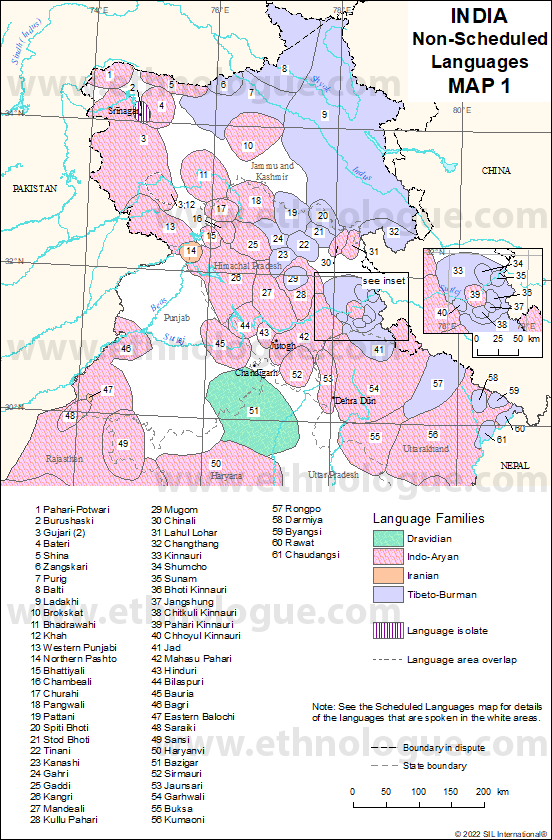
India, Map 2
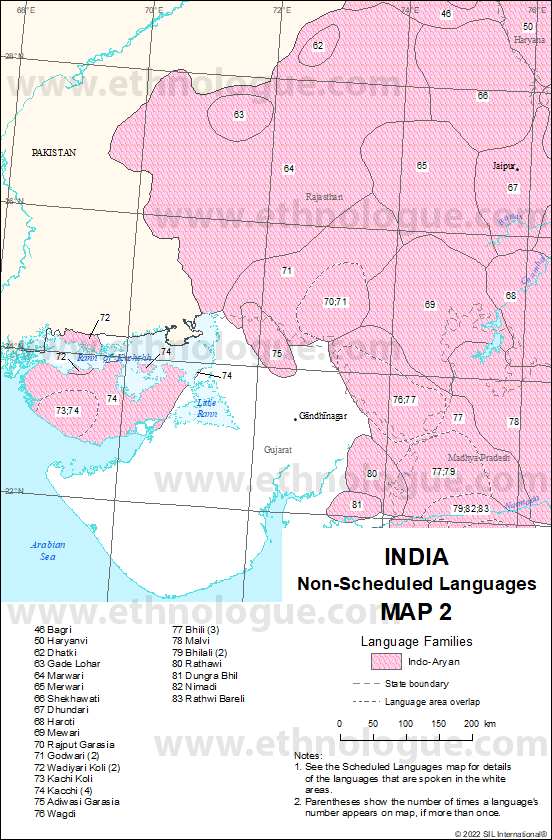
India, Map 3
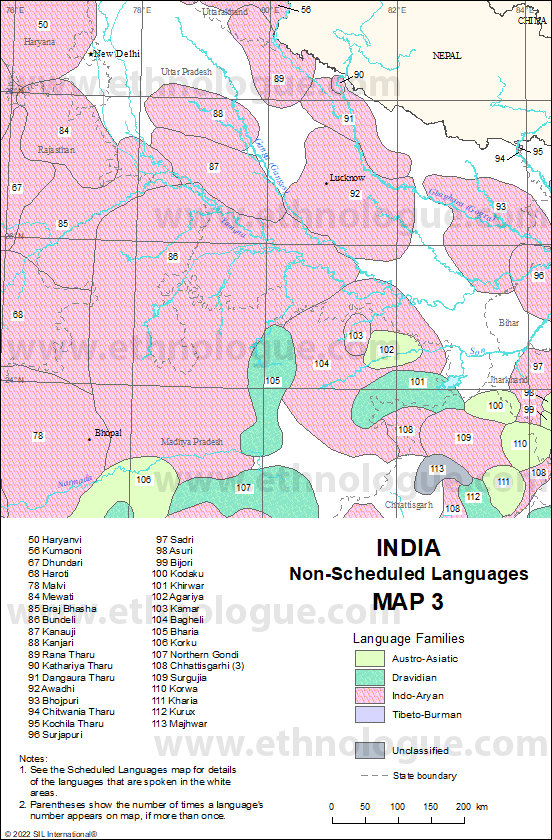
India, Map 4
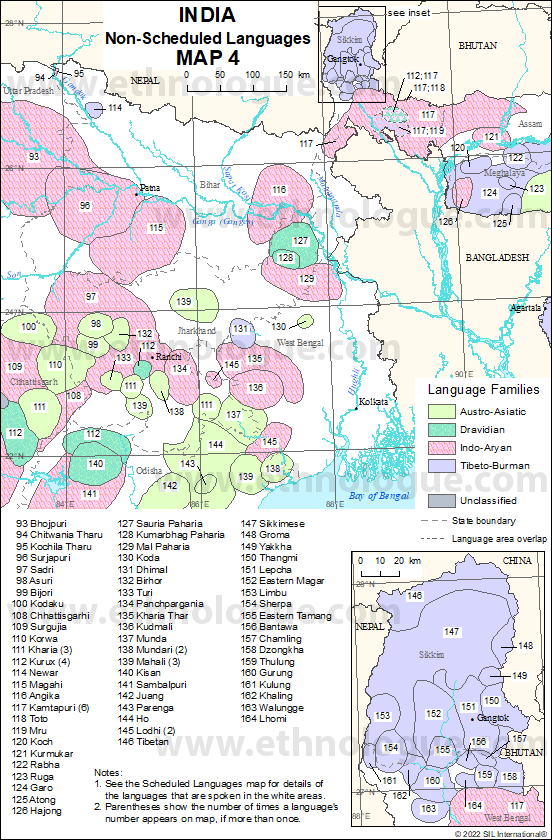
India, Map 5
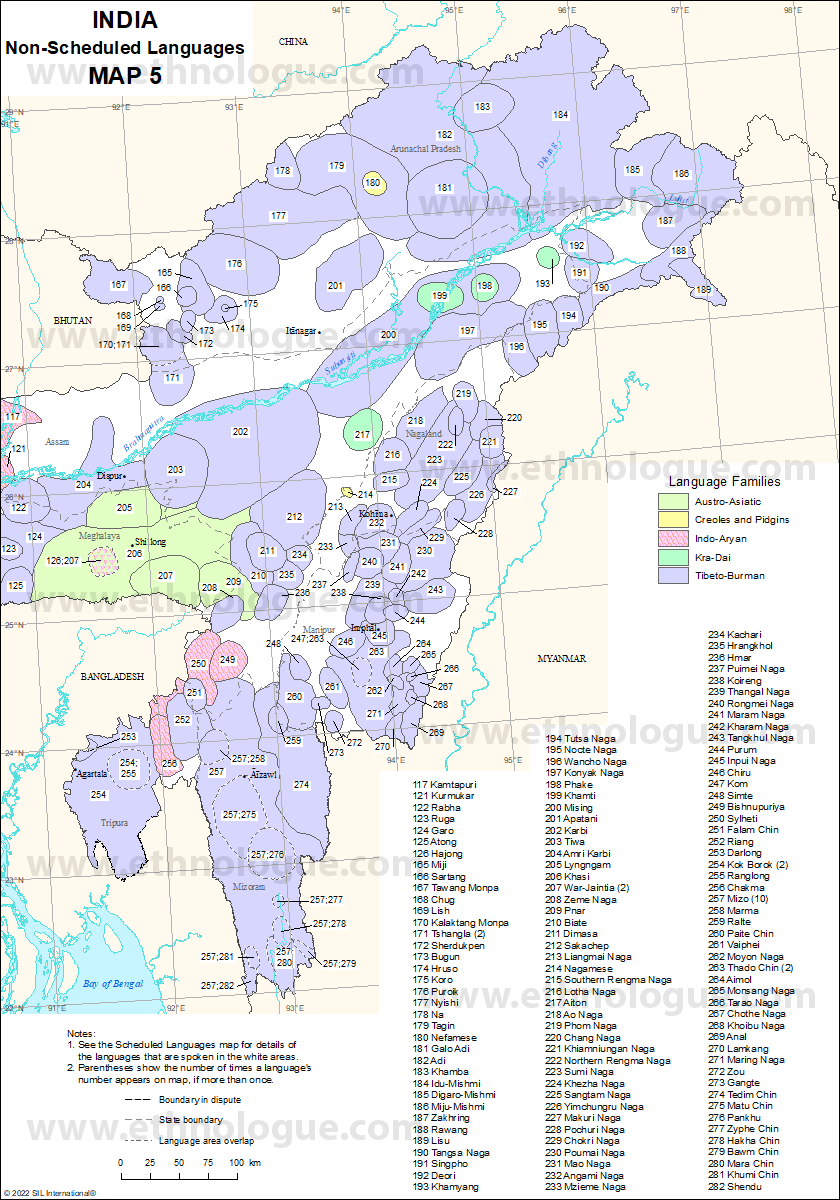
India, Map 6
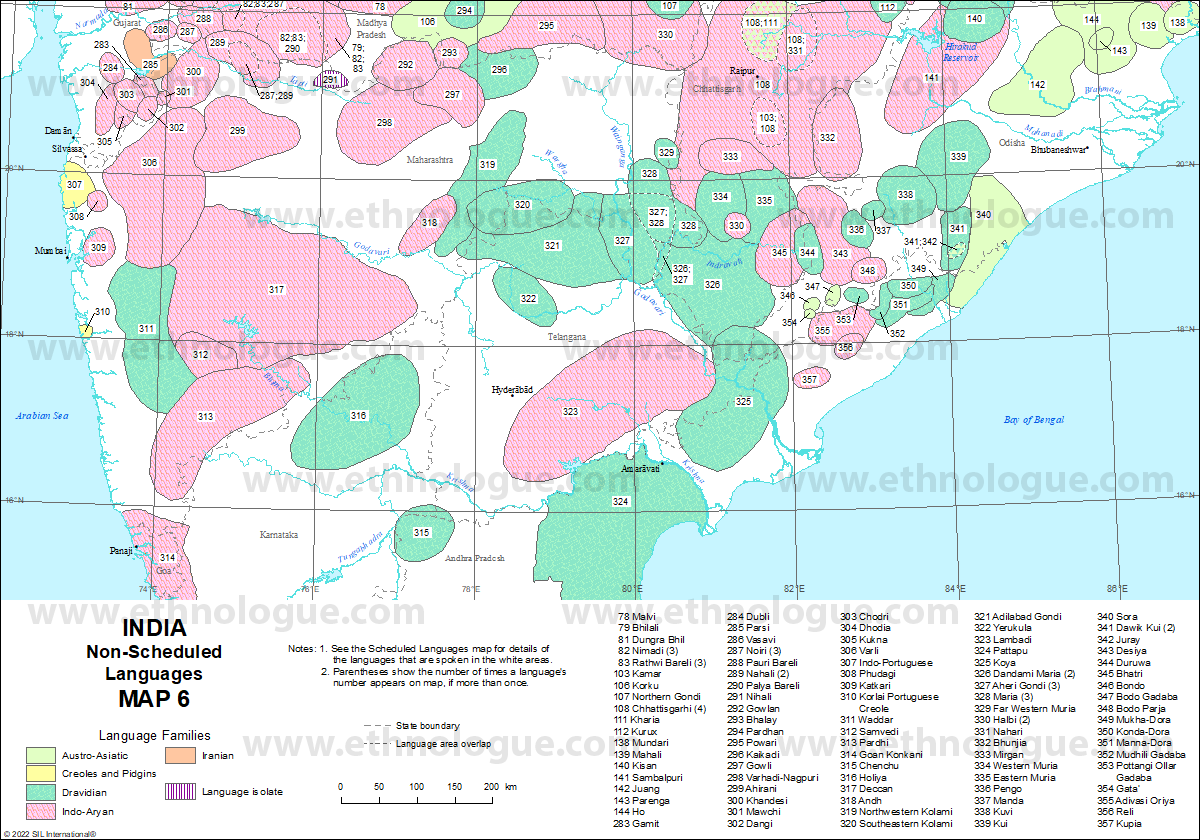
India, Map 7
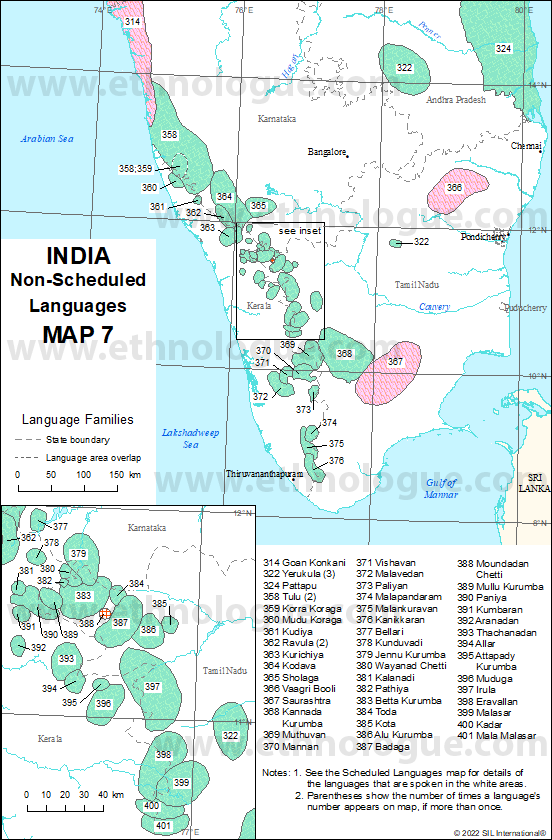
India, Map 8
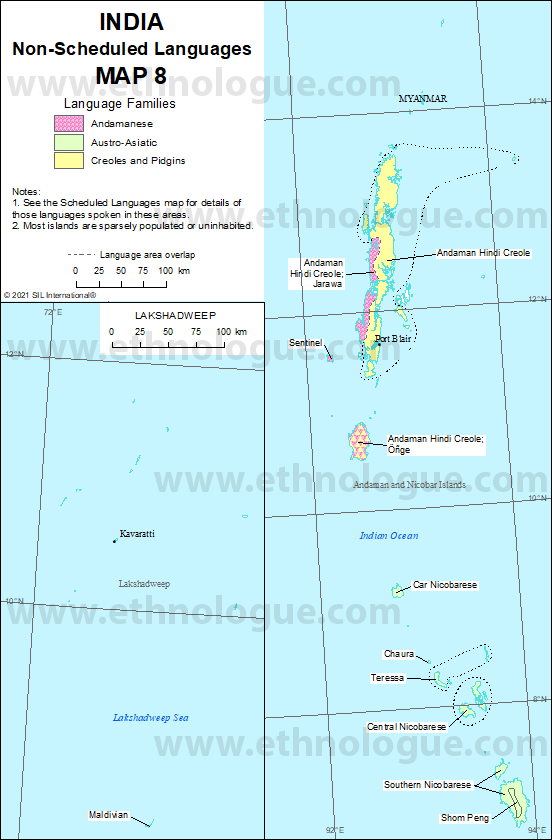
India: Index map
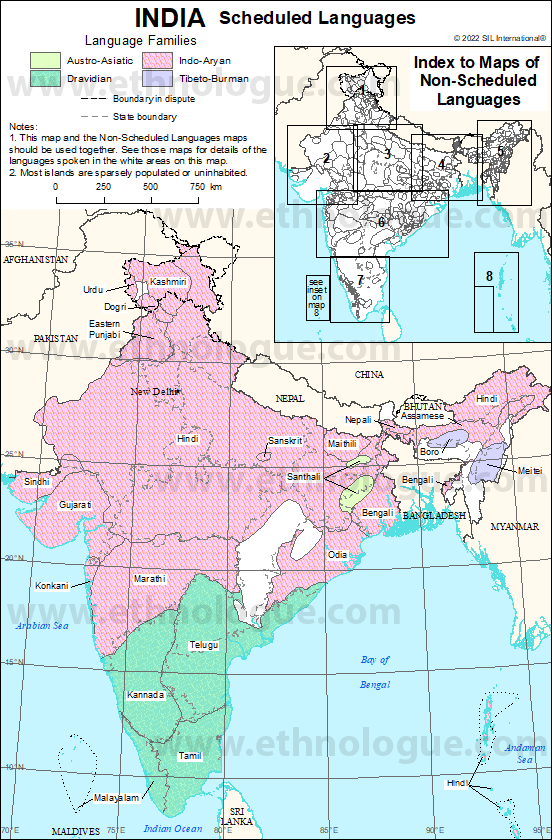
Graphs
Language Vitality Profile
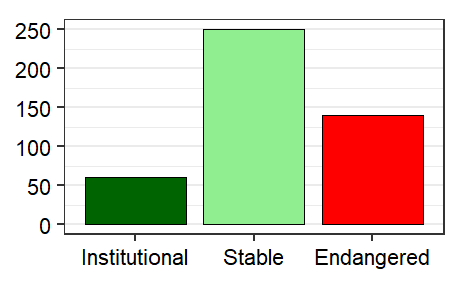
Full explanation
Language Status Profile
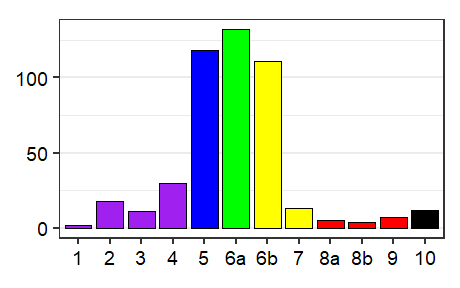
Full explanation
Resources
View Terms
Each Ethnologue country digest is a licensed product with restricted terms of use. Before downloading the product, you must agree to the following terms:
- This is a license for individual use. Just as with a conventionally published book, it is a violation of copyright to make a copy and give it to others.
- You may not redistribute this work in any form, including ingesting the contents into a database that is shared with others or posting it on a web site (whether public or private).
To inquire about permission for reuse or redistribution, please use the Contact Us form in the footer.
Digest of the languages of India ($499.95, 291 page PDF)