
LA
Lao People’s Democratic Republic
Laos
Summary
- Official Name
- Lao People’s Democratic Republic
- Population
- 7,379,000
- Principal Languages
- Lao
- Literacy Rate
- 85% (2015 UNESCO)
- International Conventions
- CPPDCE (2006), CSICH (2012), ICCPR (1966), UNCRPD (2006), UNDRIP (2007)
- General References
- Bradley 2007a, Edmondson and Solnit 1997, Lebar et al 1964, Matisoff et al 1996, Thomas and Headley 1970, Wurm and Hattori 1981
- Deaf Population
- 19,200
- Language Counts
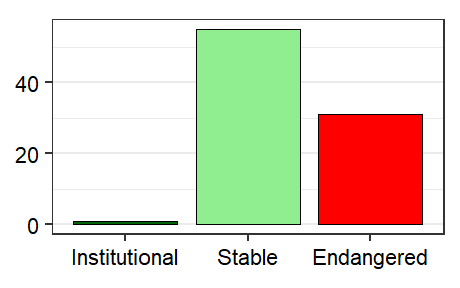
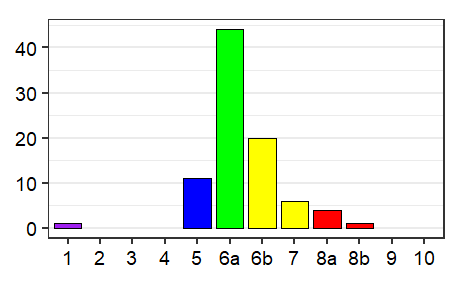
- The number of established languages listed for Laos is 87. All are living languages. Of these, 73 are indigenous and 14 are non-indigenous. Furthermore, 1 is institutional, 11 are developing, 44 are vigorous, 26 are in trouble, and 5 are dying. Also listed are 5 unestablished languages.
Languages
- Aheu thm
- Bolikhamxai province: Khamkeut district, near Lak Sao. Users: 250 in Laos (Bradley 2007b). Ethnic population: 500 (Bradley 2007b). Status: 6b* (Threatened). Alternate Names: Bru, Kha Tong Luang, Phon Soung, Phonsung, So, Thavung Classification: Austro-Asiatic, Mon-Khmer, Viet-Muong, Thavung
- Akeu aeu
- Phongsali province: Gnot Ou district. Users: 1,000 in Laos (1996 E. Johnson). Status: 6a (Vigorous). Alternate Names: Aki, Akui, Gaolkheel Classification: Sino-Tibetan, Tibeto-Burman, Ngwi-Burmese, Ngwi, Southern
- Akha ahk
- Phongsali and Luang Namtha provinces. Users: 113,000 in Laos (2015 census), based on ethnicity. Status: 5* (Dispersed). Alternate Names: Ahka, Aini, Ak’a, Aka, Ikor, Yani, “Ekaw” (pej.), “Hka Ko” (pej.), “Ikaw” (pej.), “Kaw” (pej.), “Khako” (pej.), “Khao Kha Ko” (pej.), “Ko” (pej.) Classification: Sino-Tibetan, Tibeto-Burman, Ngwi-Burmese, Ngwi, Southern
- Alak alk
- Xekong province: Lamam and Thataeng districts; Attapu and Salavan provinces. Users: 25,000 (2015 census), based on ethnicity. Status: 6a* (Vigorous). Alternate Names: Halak, Harak, Harlak, Hrlak Classification: Austro-Asiatic, Mon-Khmer, Eastern Mon-Khmer, Bahnaric, Central Bahnaric
- Arem aem
- Khammouan province: Nam Noy river upper reaches, both sides of Vietnam-Laos border, west of Phuc Trach. Users: 250 in Laos (Enfield and Diffloth 2009). Ethnic population: 500 (1995). Status: 8a (Moribund). Alternate Names: Chombrau, Chomrau, Harème, Kri, Umo Classification: Austro-Asiatic, Mon-Khmer, Viet-Muong, Chut
- Bit bgk
- Luang Namtha province: northeast Namtha district, and south of Boun Neua; Oudomxai province: Namo district; Phongsali province: Boun-Tai, Khua, and Mai districts, 8 villages; near China border. Users: 2,370 in Laos (2015 census), based on ethnicity. Total users in all countries: 2,570. Status: 6a (Vigorous). Alternate Names: Buxinhua, Kha Bet, Khabit, Khbit, Pasing, Phsin, Phsing, Pu Sing Classification: Austro-Asiatic, Mon-Khmer, Northern Mon-Khmer, Palaungic, Eastern Palaungic, Bit-Khang
- Bo bgl
- Bolikhamxai province: Lak Sao area; Khammouan province: Hinboun district, Nape area. Users: 8,000 (Schliesinger 2003b), based on ethnicity. Status: 6b (Threatened). Alternate Names: Boe, Bor, Kha Bo, Tai Bo, Thay Bo Classification: Austro-Asiatic, Mon-Khmer, Viet-Muong, Muong
- Brao brb
- Attapu and Champasak provinces: Laos-Cambodia border. Users: 26,000 in Laos (2015 census), based on ethnicity. Total users in all countries: 35,560. Status: 5* (Developing). Alternate Names: Braou, Brau, Brou, Lave, Laveh, Love, Proue, Rawe Classification: Austro-Asiatic, Mon-Khmer, Eastern Mon-Khmer, Bahnaric, West Bahnaric, Brao-Kravet
- Bru, Eastern bru
- Savannahkhet province: Sepone district; Khammouan province: Boulapha district. Users: 37,400 in Laos (2015 census), based on ethnicity. Total users in all countries: 132,000. Status: 5* (Developing). Alternate Names: Bru Tri Classification: Austro-Asiatic, Mon-Khmer, Eastern Mon-Khmer, Katuic, West Katuic, Bru
- Bru, Western brv
- Khammouan and Savannahkhet provinces: central and southern areas. Users: 163,000 in Laos (2015 census), includes So [sss]. Total users in all countries: 183,000. Status: 6a* (Vigorous). Alternate Names: Bru Classification: Austro-Asiatic, Mon-Khmer, Eastern Mon-Khmer, Katuic, West Katuic, Bru
- Cham cja
- Viengchan Capital City: Chanthaburi district, Ban Pounsavath Tai; Savannahkhet province. Users: Ethnic population: 340 (Schliesinger 2003a). Status: 8a (Moribund). Alternate Names: Cam, Chăm, Chiem, Khmer Islam, Tjam, Tscham, Tsiam Classification: Austronesian, Malayo-Polynesian, Malayo-Chamic, Chamic, Coastal, Cham
- Chepya ycp
- Phongsali province. Users: 1,000 (Bradley 2007b). Ethnic population: 2,000 (Bradley 2007b). Status: 7 (Shifting). Classification: Sino-Tibetan, Tibeto-Burman, Ngwi-Burmese, Ngwi, Southern
- Chinese, Mandarin cmn
- Users: 66,000 in Laos (2018 J. Leclerc), based on ethnicity. Status: Unestablished. Classification: Sino-Tibetan, Chinese
- Chinese, Yue yue
- Users: 18,000 in Laos (2018 J. Leclerc), based on ethnicity. Status: Unestablished. Classification: Sino-Tibetan, Chinese
- Chut scb
- Khammouan province: Boualapha district, near Vietnam border. Users: 200 in Laos (Bradley 2007a). 50 May, 150 Ruc (Bradley 2007a). Ethnic population: 400 (Bradley 2007b). Status: 7 (Shifting). Alternate Names: May, Ruc, Sach, Salang Classification: Austro-Asiatic, Mon-Khmer, Viet-Muong, Chut
- Con cno
- Bokeo province: Meung district; Luang Namtha province: southwest of Vieng Pou Kha. Users: 1,000 (Wurm and Hattori 1981). Status: 6b* (Threatened). Classification: Austro-Asiatic, Mon-Khmer, Northern Mon-Khmer, Palaungic, Eastern Palaungic, Lametic
- French fra
- Users: 204,000 in Laos (Marcoux et al 2022), L2 users. Status: 5* (Dispersed). Classification: Indo-European, Italic, Romance, Italo-Western, Western, Gallo-Iberian, Gallo-Romance, Gallo-Rhaetian, Oïl, French
- Halang Doan hld
- Attapu province: Sanxai district, Kasseng plateau, Kamane and Dak Robay rivers’ left banks near Vietnam border; Xekong province: Dakcheung district. Users: 2,350 in Laos (2000). Status: 6b* (Threatened). Alternate Names: Doan, Duan, Halang Duan Classification: Austro-Asiatic, Mon-Khmer, Eastern Mon-Khmer, Bahnaric, North Bahnaric, West, Duan
- Hani hni
- Phongsali province: Ou Nua district; Ban Sika Hon, Ban Si Ben Chay, and Ban Kuchu Lin. Users: 740 in Laos (2015 census), decreasing, based on ethnicity. Status: 6b (Threatened). Alternate Names: Ha Nhi, Hanhi, Haw, Hayi Classification: Sino-Tibetan, Tibeto-Burman, Ngwi-Burmese, Ngwi, Southern
- Hmong Daw mww
- Bokeo, Bolikhamxai, Houaphan, Khammouan, Louangphabang, Luang Namtha, Oudomxai, Phongsali, Viengchan, Xiangnabouli, Xiengkhoang provinces and Viengchan Capital City. Users: 170,000 in Laos (1995 census). Status: 5* (Developing). Alternate Names: Bai Miao, Hmong Der, Hmoob Dawb, White Hmong, White Lum, White Miao, “Meo Kao” (pej.), “White Meo” (pej.) Classification: Hmong-Mien, Hmongic, Chuanqiandian
- Hmong Njua hnj
- Bokeo, Bolikhamxai, Houaphan, Khammouan, Louangphabang, Luang Namtha, Oudomxai, Phongsali, Viengchan, Xiangnabouli, Xiengkhoang provinces, and Viengchan Capital City. Users: 100,000 in Laos (Hattaway 2003). Total users in all countries: 254,750. Status: 6a* (Vigorous). Alternate Names: Blue Hmong, Ching Miao, Green Hmong, Hmong Leng, Hmong Nzhua, Hmoob Leeg, Lu Miao, Mong Leng, Mong Njua, Mong Ntsua, Qing Miao, Tak Miao, “Blue Meo” (pej.), “Green Meo” (pej.), “Meo Dam” (pej.), “Meo Lai” (pej.) Autonym: Hmongb Nzhuab, Moob Leeg Classification: Hmong-Mien, Hmongic, Chuanqiandian
- Hung hnu
- Bolikhamxai province: Khamkeut district; northeast of Nape and south of Phong river (Toum dialect). Users: 3,630 in Laos (2015 census), based on ethnicity. Total users in all countries: 4,130. Status: 7 (Shifting). Classification: Austro-Asiatic, Mon-Khmer, Viet-Muong, Cuoi
- Ir irr
- Salavan province: east of Salavan town. Users: 4,420 (Asian Minorities Outreach 1999b), based on ethnicity. Status: 6a* (Vigorous). Alternate Names: In, Yiir, Yir Classification: Austro-Asiatic, Mon-Khmer, Eastern Mon-Khmer, Katuic, Central Katuic, Ta’oih
- Iu Mien ium
- Bokeo province: Houay Xay and Pak Tha districts; Luang Namtha province: Long, Namtha, and Sing districts; Phongsali province: Yot Ou district; Xiangnabouli province: Khop and Xienghone districts. Users: 32,400 in Laos (2015 census), based on ethnicity. Status: 5* (Developing). Alternate Names: Ewmien, Highland Yao, Iu Mienh, Man, Mien, Mienh, Myen, Yao, Yao Mienh Classification: Hmong-Mien, Mienic, Mian-Jin
- Jeh jeh
- Attapu province: Sanxai district; Xekong province: Dakchung district; basin of Dak Main, Kamane, and Poko rivers. Users: 11,500 in Laos (2015 census), based on ethnicity. Status: 5* (Developing). Alternate Names: Die, Gie, Yae, Yaeh, Yeh Classification: Austro-Asiatic, Mon-Khmer, Eastern Mon-Khmer, Bahnaric, North Bahnaric, West, Jeh-Halang
- Kaduo ktp
- Phongsali province: Ou Nua district. Users: 200 in Laos (Schliesinger 2003c). Status: 6a* (Vigorous). Alternate Names: Gazhuo, Kado, Kadu, Khatu Classification: Sino-Tibetan, Tibeto-Burman, Ngwi-Burmese, Ngwi, Southern
- Kang kyp
- Houaphan and Xiengkhoang provinces. Users: 47,600 in Laos (1995 census). Total users in all countries: 81,700. Status: 6a* (Vigorous). Alternate Names: Tai Khang Classification: Kra-Dai, Kam-Tai, Kam-Sui
- Katang, Northern ncq
- Salavan province: centered in Toumlan district; Savannahkhet province: Nong and Phin districts. Users: 65,000 (2016). Status: 6a (Vigorous). Alternate Names: Kataang, Katang Classification: Austro-Asiatic, Mon-Khmer, Eastern Mon-Khmer, Katuic, West Katuic, Bru
- Katang, Southern sct
- Salavan province: Salavan and Tumlan districts. Users: 40,000 (2016). Status: 6a (Vigorous). Alternate Names: Kataang Rueal, Katang, Katang Rueal Classification: Austro-Asiatic, Mon-Khmer, Eastern Mon-Khmer, Katuic, West Katuic, Bru
- Katu, Western kuf
- Xekong province: upper Xe Kong river border area. Users: 28,400 (2015 census), based on ethnicity. Status: 6a (Vigorous). Classification: Austro-Asiatic, Mon-Khmer, Eastern Mon-Khmer, Katuic, East Katuic, Katu-Pacoh
- Khmer khm
- Champasak province. Users: 7,000 in Laos (2015 census), based on ethnicity. Status: Unestablished. Classification: Austro-Asiatic, Mon-Khmer, Eastern Mon-Khmer, Khmer
- Khmu kjg
- Scattered in the north. Users: 708,000 in Laos (2015 census), based on ethnicity. Total users in all countries: 825,700. Status: 5 (Developing). Alternate Names: Kamhmu, Kammu, Kamu, Khamu, Khamuk, Khmu’, Khomu, Kmhmu, Lao Kang, Lao Terng, Mou, Pouteng, Pu Thenh, Tenh, Theng Autonym: ກຶມຫມຸ (Kmhmu’) Classification: Austro-Asiatic, Mon-Khmer, Northern Mon-Khmer, Khmuic, Mal-Khmu’, Khmu’
- Khua xhv
- Khammouan province: Bouarapha district, northwest of Boualapha. Users: 2,000 in Laos (1981). Status: 6b* (Threatened). Classification: Austro-Asiatic, Mon-Khmer, Eastern Mon-Khmer, Katuic, West Katuic, Bru
- Khuen khf
- Luang Namtha province: Nale, Sing, and Viangphoukha districts. Users: 8,000 in Laos (1995 L. Chazee). Total users in all countries: 9,000. Status: 6a* (Vigorous). Alternate Names: Khouen, Khween, Kween Classification: Austro-Asiatic, Mon-Khmer, Northern Mon-Khmer, Khmuic, Mal-Khmu’, Khmu’
- Khün kkh
- Louangphabang province: sacred temple area. Users: 600 in Laos (Schliesinger 2003a). Status: 6a* (Vigorous). Classification: Kra-Dai, Kam-Tai, Tai, Southwestern
- Kim Mun mji
- Luang Namtha province: Long district, 21 villages. Users: 4,500 in Laos (1995 L. Chazee). Status: 6a* (Vigorous). Alternate Names: Jim Mun, Kem di mun, Lan Tin, Lanten, Lowland Yao, Man Lan-Tien, Mun Classification: Hmong-Mien, Mienic, Mian-Jin
- Kiorr xko
- Luang Namtha and Oudomxai provinces: 6 villages. Users: 2,360 (1985 F. Proschan). Status: 6b* (Threatened). Alternate Names: Col, Con, Saamtaav, Samtao, Samtao II Classification: Austro-Asiatic, Mon-Khmer, Northern Mon-Khmer, Palaungic, Eastern Palaungic, Angkuic
- Kriang ngt
- Champasak province: Ba Chiang Chaleun Souk and Pak Song districts; Salavan province: Salavan district; Xekong province: Kaleum and Tha Taeng districts. Users: 16,800 (2015 census), based on ethnicity. 9,030 monolinguals (2005). Status: 6a* (Vigorous). Alternate Names: Griang, Khiang, Kuriang, Ngae, Nge, Nge’, Ngeh, Ngeq, Ngkriang, Nhae, Nkriang Classification: Austro-Asiatic, Mon-Khmer, Eastern Mon-Khmer, Katuic, East Katuic, Ngeq-Nkriang
- Ksing Mul puo
- Houaphan province: Xiangkho district; Xieng Khouang province: Het river, along Vietnam border. Users: 9,870 in Laos (2015 census), based on ethnicity. Status: 6a* (Vigorous). Alternate Names: Ksingmul, Lao Muh, Pou Hok, Puhoc, Xin Mul, Xing Mun, Xingmoun, Xinh Mul, Xinh Mun, “Kha Puhoc” (pej.), “Puoc” (pej.), “Puok” (pej.) Classification: Austro-Asiatic, Mon-Khmer, Northern Mon-Khmer, Khmuic, Xinh Mul
- Kuan uan
- Bolikhamxai province: Viangthong district, near Muang river; Khamkeut district, Ban Guan at Ban pakha, Ban Pung, and Ban Bo. Users: 890 (2015 census), based on ethnicity. Status: 6b* (Threatened). Alternate Names: Guan, Tai Guan, Tai Khouan, Tai Kouane, Tai Kuan, Tai Kwan Classification: Kra-Dai, Kam-Tai, Tai
- Kuay kdt
- Champasak, Salavan, and Savannahkhet provinces: both sides of the Mekong river. Users: 46,600 in Laos (2015 census), based on ethnicity. 34,200 monolinguals (2005). Status: 6b (Threatened). Alternate Names: Aouei, Cuoi, Douon, Dui, Khamen-Boran, Kouy, Kui, Kuoy, Kuy, Old Khmer, Soai, Soay, Soei, Souai, Souei, Suai, Suay, Suei, Sui, Suoi, Xuay, Xuoi Classification: Austro-Asiatic, Mon-Khmer, Eastern Mon-Khmer, Katuic, West Katuic, Kuay
- Lahu lhu
- Bokeo province: Houayxay, Peung, and Tonpheung districts; Luang Namtha province: Long district. Users: 19,200 in Laos (2015 census), increasing, based on ethnicity. Status: 6a* (Vigorous). Alternate Names: Muhso, Museu, Musso, Mussur Classification: Sino-Tibetan, Tibeto-Burman, Ngwi-Burmese, Ngwi, Central
- Lahu Si lhi
- Bokeo province: Kentung. Users: 3,000 in Laos (2007). Status: 6a* (Vigorous). Alternate Names: Kui, Kui Lung, Kui Sang, Lad hur Si, Lahu Shi, Yellow Lahu Classification: Sino-Tibetan, Tibeto-Burman, Ngwi-Burmese, Ngwi, Central
- Lao lao
- Widespread throughout Mekong river valley, south to the Cambodia border. Users: 4,230,000 in Laos, all users. L1 users: 3,430,000 in Laos (2015 census), based on ethnicity. L2 users: 800,000. Total users in all countries: 4,505,260 (as L1: 3,705,260; as L2: 800,000). Status: 1 (National). Statutory national language (2003, Constitution, Article 89). Alternate Names: Eastern Thai, Lao Wiang, Lao-Lum, Lao-Noi, Lao-Tai, Laotian, Laotian Tai, Lum Lao, Phou Lao, Rong Kong, Tai Lao Autonym: ພາສາລາວ (Phasa Lao) Classification: Kra-Dai, Kam-Tai, Tai, Southwestern
- Laopang lbg
- Bokeo province. Users: 9,550 (2000). Status: 6a* (Vigorous). Alternate Names: Gu-ba, Laopa, Laopan Classification: Sino-Tibetan, Tibeto-Burman, Ngwi-Burmese, Ngwi, Unclassified
- Laos Sign Language lso
- Scattered. Users: 36,000 (2021 DBS/DOOR/SIL). Estimated 21,000–42,000 deaf signers, based on 0.3%–0.6% of total population. Status: 6a* (Vigorous). Classification: Sign language, Deaf community sign language
- Laven lbo
- Attapu province; Champasak province: Paksong district; Salavan province; Xekong province: Thataeng district. Users: 56,400 (2015 census), based on ethnicity. Status: 6a* (Vigorous). Alternate Names: Boloven, Boriwen, Jaru, Jru, Jru’, Jruq, Laweenjru, Loven, Yrou Classification: Austro-Asiatic, Mon-Khmer, Eastern Mon-Khmer, Bahnaric, West Bahnaric, Laven
- Lavi lvi
- Xekong province: Lavi Fang Daeng village, south of Xekong town. Two other villages. Users: Ethnic population: 1,220 (2015 census). Status: 8a (Moribund). Alternate Names: Lavy, Lawi, Salwoeng, Saveung, Swoeng, “Lak-wi” (pej.) Classification: Austro-Asiatic, Mon-Khmer, Eastern Mon-Khmer, Bahnaric, West Bahnaric
- Lü khb
- Bokeo, Louangphabang, Luang Namtha, Oudomxai, Phongsali, and Xiangnabouli provinces. Users: 126,000 in Laos (2015 census), based on ethnicity. Status: 6b* (Threatened). Alternate Names: Lu, Lue, Pai-I, Shui-Pai-I Classification: Kra-Dai, Kam-Tai, Tai, Southwestern
- Mal mlf
- Xiangnabouli province: Phiang district, west of the Mekong. Users: 23,200 in Laos (1995 census). Total users in all countries: 26,700. Status: 5* (Developing). Alternate Names: Htin, Khatin, Madl, T’in, Thin, Tin Autonym: Mal, Ma’di Classification: Austro-Asiatic, Mon-Khmer, Northern Mon-Khmer, Khmuic, Mal-Khmu’, Mal-Prai
- Maleng pkt
- Khammouan province: Nakay district, Nam Theun valley, near Theun river; Bolikhamxai province: Khamkeut district, Lac Sao sub-district, Ban Baga Tan. Users: 500 in Laos (Bradley 2007a). Ethnic population: Less than 1,000. Total users in all countries: 1,700. Status: 6b (Threatened). Alternate Names: Malang, Malieng Classification: Austro-Asiatic, Mon-Khmer, Viet-Muong, Chut
- Mlabri mra
- Xiangnabouli province: Phiang district, near Thailand border. Users: 40 in Laos (Schliesinger 2003b). Ethnic population: 67 (Schliesinger 2003d). Status: 8a (Moribund). Alternate Names: Ma Ku, Mabri, Mla, Mla-Bri, Mrabri, Yellow Leaf, Yumbri Classification: Austro-Asiatic, Mon-Khmer, Northern Mon-Khmer, Khmuic, Mlabri
- Myen mya
- Bokeo province: Houayxay district; Luang Namtha province: Sing and Long districts; Xiangnabouli province: Xiangnabouli district; Viengchan Capital City. Users: 2,840 in Laos (2015 census). Status: Unestablished. Alternate Names: Man Classification: Sino-Tibetan, Tibeto-Burman, Ngwi-Burmese, Burmish, Southern
- Ngoaun nuo
- Khammouan province: Nakai district. Users: 760 in Laos (2010 N. Cheeseman). Status: 6a* (Vigorous). Alternate Names: Nguan, Nguane, Nguôn Classification: Austro-Asiatic, Mon-Khmer, Viet-Muong, Muong
- Nung nut
- Louangphabang province: Xiengngeun district. Users: A few in Laos. Status: 5* (Developing). Alternate Names: Nong Classification: Kra-Dai, Kam-Tai, Tai, Central
- Nyaheun nev
- Champasak province: Paksong district; Xekong and Attapu provinces. Users: 9,000 (2015 census), based on ethnicity. Status: 6a (Vigorous). Alternate Names: Hin, Hoen, Hun, Nha Heun, Nia Hoen, Niahon, Nyah Heuny, Nyahön, Yaheun Classification: Austro-Asiatic, Mon-Khmer, Eastern Mon-Khmer, Bahnaric, West Bahnaric, Nyaheun
- O’du tyh
- Xiengkhoang province: Khouone district, 2 villages. Users: 600 in Laos (2015 census), decreasing, based on ethnicity. Status: 7 (Shifting). Alternate Names: ’Iduh, O Du, Oedou, “Haat” (pej.), “Hat” (pej.), “Tay Hat” (pej.) Classification: Austro-Asiatic, Mon-Khmer, Northern Mon-Khmer, Khmuic, Mal-Khmu’, Khmu’
- Ong oog
- Champasak province; Salavan province: north of Salavan town. Users: 10,300 (2000). Status: 7 (Shifting). Alternate Names: Hantong, Tong Classification: Austro-Asiatic, Mon-Khmer, Eastern Mon-Khmer, Katuic, Central Katuic, Ta’oih
- Oy oyb
- Attapu province: foot of Bolaven plateau, and near Pakse; Xekong province: Thateng district. Attapu province: Samakkhixai and Sanamxai districts, 7 villages north of Attopeu town; Xekong province: Dakcheung and Lamam districts (Jeng dialect); Attapu, Champasak, and Xekong provinces (Sok dialect). Users: 32,200 (2015 census), based on ethnicity. 23,500 Oy and 8,690 Jeng (2015 census). 8,960 monolinguals (2007). Status: 6a (Vigorous). Alternate Names: Huei, Oey, Oi, Oi-Sok, Thae, The Classification: Austro-Asiatic, Mon-Khmer, Eastern Mon-Khmer, Bahnaric, West Bahnaric, Oi-The
- Pacoh pac
- Salavan province: Samouay district; Savannahkhet province; Xekong province: Kaleum district. Users: 22,600 in Laos (2015 census), based on ethnicity. 11,600 monolinguals (2005). Status: 6a (Vigorous). Alternate Names: Bo River Van Kieu, Ganai, Pa Co, Paco, Pako, Poko, Pokoh Classification: Austro-Asiatic, Mon-Khmer, Eastern Mon-Khmer, Katuic, East Katuic, Katu-Pacoh
- Phana’ phq
- Bokeo province: Houayxay district, 1 village; Luang Namtha province: Luang Namtha district, Bopiet and Namtoung villages; Phongsali province: east of Moung Ou Tail. Users: 380 (Schliesinger 2003c). Ethnic population: Included within the Ahka [ahk] ethnic group. Status: 6b* (Threatened). Alternate Names: Bana’, Pana’ Classification: Sino-Tibetan, Tibeto-Burman, Ngwi-Burmese, Ngwi, Southern
- Phong-Kniang pnx
- Houaphan province: Houameuang and Xam Neua districts, near the Neun and Peun rivers. Users: 30,700 (2015 census), based on ethnicity. Status: 6a* (Vigorous). Alternate Names: Keneng, Kenieng, Lao Phong, Pong, “Kha Niang” (pej.), “Khaniang” (pej.) Classification: Austro-Asiatic, Mon-Khmer, Northern Mon-Khmer, Khmuic, Xinh Mul
- Phu Thai pht
- Bolikhamxai, Khammouan, and Savannahkhet provinces; Salavan province: centered in Toumlan district; Champasak and Xiengkhoang provinces. Users: 218,000 in Laos (2015 census), based on ethnicity. Status: 6a* (Vigorous). Alternate Names: Phutai, Putai, Puthay Classification: Kra-Dai, Kam-Tai, Tai, Southwestern
- Phuan phu
- Bolikhamxai, Houaphan, Louangphabang, Luang Namtha, and Viengchan provinces; Viengchan Capital City; Xiengkhoang province: Kham, Pek, and Phou Kout districts. Users: 115,000 in Laos (Schliesinger 2003a), based on ethnicity. Status: 6a* (Vigorous). Alternate Names: Lao Phuan, Phu Un Classification: Kra-Dai, Kam-Tai, Tai, Southwestern
- Phunoi pho
- Phongsali province. Users: 39,200 (2015 census), based on ethnicity. Status: 6a* (Vigorous). Alternate Names: Phounoy, Phu Noi, Punoi, Singsily, Sinsali Classification: Sino-Tibetan, Tibeto-Burman, Ngwi-Burmese, Ngwi, Southern, Bisoid
- Prai prt
- Xiangnabouli province: Hongsa, Nguen, Phiang, Xiang Hon, and Xaignabouli districts. Users: 28,700 in Laos (2015 census), based on ethnicity. Status: 6a* (Vigorous). Alternate Names: Lao Mai, Lao Prai, Lua Prai, Phai, “Htin” (pej.) Classification: Austro-Asiatic, Mon-Khmer, Northern Mon-Khmer, Khmuic, Mal-Khmu’, Mal-Prai
- Rmeet lbn
- Bokeo, Luang Namtha, and Oudomxai provinces. Users: 22,400 (2015 census), based on ethnicity. Status: 6a* (Vigorous). Alternate Names: Kha Lamet, Khamed, Khamet, Lamed, Lamet, Lemet Autonym: Rmeet Classification: Austro-Asiatic, Mon-Khmer, Northern Mon-Khmer, Palaungic, Eastern Palaungic, Lametic
- Saek skb
- Bolikhamxai province: Khamkeut district, Nam Ve subdistrict, Na Kadok village; Khammouan province: Grommarol, Thakhek, Hinboun, Mahaxai, and Nakai districts. Users: 3,840 in Laos (2015 census), based on ethnicity. Status: 6b* (Threatened). Alternate Names: Seak, Sek, Set, Tai Sek, Xaek, Xec, Xek Classification: Kra-Dai, Kam-Tai, Tai, Northern
- Salang hal
- Attapu province. Users: 4,000 in Laos (Asian Minorities Outreach 1999b). Status: 6b* (Threatened). Alternate Names: Halang Classification: Austro-Asiatic, Mon-Khmer, Eastern Mon-Khmer, Bahnaric, North Bahnaric, West, Jeh-Halang
- Samtao stu
- Bokeo province: Houay Xai district; Luang Namtha province: Ban Tha Oo. Users: 3,420 in Laos (2015 census), based on ethnicity. Status: 6b* (Threatened). Alternate Names: Samtau, Samtuan Classification: Austro-Asiatic, Mon-Khmer, Northern Mon-Khmer, Palaungic, Eastern Palaungic, Angkuic
- Sapuan spu
- Champasak and Xekong provinces: Se Kamane and Se Kong rivers’ banks. Users: 1,000 (Sidwell 2003). Status: 6a (Vigorous). Alternate Names: Sapouan Classification: Austro-Asiatic, Mon-Khmer, Eastern Mon-Khmer, Bahnaric, West Bahnaric, Oi-The
- Sedang sed
- Attapu province: Phouvong district. Users: 900 in Laos (2015 census), based on ethnicity. Status: 6a* (Vigorous). Alternate Names: Dadang Classification: Austro-Asiatic, Mon-Khmer, Eastern Mon-Khmer, Bahnaric, North Bahnaric, West, Sedang-Todrah, Sedang
- Sila slt
- Luang Namtha province; Oudomxai province: Namo district; Phongsali province: Boun Neua, Ngot Ou, and Samphan districts. Users: 3,150 in Laos (2015 census), based on ethnicity. Total users in all countries: 4,060. Status: 6a (Vigorous). Alternate Names: Asong, Sida, “Kha Pai” (pej.) Classification: Sino-Tibetan, Tibeto-Burman, Ngwi-Burmese, Ngwi, Southern
- So sss
- Bolikhamxai, Khammouan, Savannahkhet provinces. Users: 163,000 in Laos (2015 census), based on ethnicity, includes Western Bru [brv]. Total users in all countries: 233,000. Status: 6a (Vigorous). Alternate Names: Bru, Makong, Mang Cong, Mang-Koong, Mangkong, Mankoong, So Makon, Sô, Thro, “Kha So” (pej.) Classification: Austro-Asiatic, Mon-Khmer, Eastern Mon-Khmer, Katuic, West Katuic, Bru
- Sou sqq
- Attapu province: Phouvong and Sanamxai districts. Users: 2,500 (Schliesinger 2003b). Status: 6b* (Threatened). Alternate Names: Sawk, Souk, Su, Su’, Suq Classification: Austro-Asiatic, Mon-Khmer, Eastern Mon-Khmer, Bahnaric, West Bahnaric, Brao-Kravet
- Ta’oih, Lower tto
- Salavan province: northwest of Saravan town; Xekong province: Kaleum district. Users: 15,800 (2000), increasing. Status: 6a (Vigorous). Alternate Names: Tong Classification: Austro-Asiatic, Mon-Khmer, Eastern Mon-Khmer, Katuic, Central Katuic, Ta’oih
- Ta’oih, Upper tth
- Salavan province: Ta-Oy district; Savannahkhet and Xekong provinces. Users: 30,900 in Laos (1995 census), increasing. 21,600 monolinguals (1995). Total users in all countries: 49,900. Status: 6a (Vigorous). Alternate Names: Katang, Ta Hoi, Ta’oiq, Ta-Oi, Ta-Oy, Ta-oiq, Tau Oi Autonym: ຕາໂອ້ຍອ໌ (Ta’oiq) Classification: Austro-Asiatic, Mon-Khmer, Eastern Mon-Khmer, Katuic, Central Katuic, Ta’oih
- Tai Daeng tyr
- Bolikhamxai province: Khamkeut district, Lac Sao sub-district; Luang Namtha province: Luong district; Viengchan province: Kasi district; Houaphan, Louangphabang, Oudomxai, Phongsali, and Xiengkhoang provinces. Users: 25,000 in Laos (Asian Minorities Outreach 1999b). Status: 6b* (Threatened). Alternate Names: Daeng, Man Thanh, Red Thai, Tai Deng, Tai Nhai, Thai Dang, Thai Do Classification: Kra-Dai, Kam-Tai, Tai, Southwestern
- Tai Dam blt
- Bokeo, Bolikhamxai, Houaphan, Louangphabang, Luang Namtha, Oudomxai, Phongsali, Viengchan, Xiangnabouli, and Xiengkhoang provinces. Users: 65,000 in Laos (Schliesinger 2003a). Status: 5* (Developing). Alternate Names: Black Tai, Tai Noir, Thai Den, ʼTáy Ðăm Classification: Kra-Dai, Kam-Tai, Tai, Southwestern
- Tai Dón twh
- Houaphan, Louangphabang, Luang Namtha, Oudomxai, and Phongsali provinces. Users: 33,000 in Laos (Schliesinger 2003a). Status: 6a* (Vigorous). Alternate Names: Tai Blanc, Tai Kao, Tai Khao, Tai Lai, Thái Tráng, Tãy Ðón, White Tai Classification: Kra-Dai, Kam-Tai, Tai, Southwestern
- Tai Khang tnu
- Bolikhamxai province: Khamkeut district, Ban Phon Than and Ban Ban Sopkat sub-districts; Nam Hai and Viengthong districts. Users: 200. Ethnic population: 1,500 (Schliesinger 2003a). Status: 6b (Threatened). Alternate Names: Tai Kang, Tay Chieng, Tay Khang Classification: Kra-Dai, Kam-Tai, Tai
- Tai Loi tlq
- Luang Namtha province: Sing district. Users: Ethnic population: 600 (Schliesinger 2003b). Status: 8b (Nearly extinct). Alternate Names: Doi, Lao Doi, Loi, Monglwe, Tai Doi, Tailoi, Wakut, “Kha Doy” (pej.) Classification: Austro-Asiatic, Mon-Khmer, Northern Mon-Khmer, Palaungic, Eastern Palaungic, Angkuic
- Tai Long thi
- Louangphabang province. Users: 4,800 (2004). Status: 6a* (Vigorous). Classification: Kra-Dai, Kam-Tai, Tai, Southwestern
- Tai Nüa tdd
- Bolikhamxai, Houaphan, Viengchan, Xiengkhoang, and Xaisomboun provinces. Users: 14,100 in Laos (2015 census), based on ethnicity. Status: 6b* (Threatened). Alternate Names: Chinese Shan, Tai Neua, Tai Nuea, Thaineau Classification: Kra-Dai, Kam-Tai, Tai, Southwestern
- Tai Pao tpo
- Bolikhamxai province: Khamkeut, Pakkading, and Viangthong districts. Users: 2,500 in Laos (Schliesinger 2003a). Total users in all countries: 12,500. Status: 6b* (Threatened). Classification: Kra-Dai, Kam-Tai, Tai
- Tai Yo tyj
- Bolikhamxai province: Khamkeut district, Lak Xao, Ka’ane, Khamkeut, Na Heuang, Nam Sak, Phon Thoen, Sop Chat, Sop Pone, and Tha Veng; Vieng Thong district. Users: 7,200 in Laos (1995 census). Status: 6a* (Vigorous). Alternate Names: Tai Do, Tai Maen, Tai Man, Tai Men, Tai Mene, Tai Mène, Tai Mènè, Tai-Maen Classification: Kra-Dai, Kam-Tai, Tai
- Talieng tdf
- Savannahkhet province: Phine district; Xekong province: Dak Cheung district near Vietnam border, Boloven plateau area; into Attapu province. Users: 38,400 (2015 census), based on ethnicity. Status: 6a (Vigorous). Alternate Names: Caliang, Calieng, Kaseng, Kasseng, Khon Dak Chueng, Koseng, Kraseng, Taliang, Tariang, Tarieng, Triang, Trieng Classification: Austro-Asiatic, Mon-Khmer, Eastern Mon-Khmer, Bahnaric, North Bahnaric, West
- Tareng tgr
- Xekong province: west of Vietnam border, east of Kayong, north of Chavane and Thia. Users: 5,000 (Wurm and Hattori 1981). Status: 6a* (Vigorous). Alternate Names: Tariang Classification: Austro-Asiatic, Mon-Khmer, Eastern Mon-Khmer, Katuic, East Katuic, Katu-Pacoh
- Thai, Northern nod
- Oudomxai and Xiangnabouli provinces. Users: 29,500 in Laos (2005 census). Status: 6a* (Vigorous). Alternate Names: Kam Mueang, Lan Na, Lanatai, Lanna, Lannatai, Muang, Mueang, Myang, “Youanne” (pej.), “Youon” (pej.), “Yuan” (pej.) Classification: Kra-Dai, Kam-Tai, Tai, Southwestern
- Vietnamese vie
- Users: 18,900 in Laos (2015 census), based on ethnicity. Status: Unestablished. Classification: Austro-Asiatic, Mon-Khmer, Viet-Muong, Vietnamese
- Yang pcc
- Luang Namtha province: Vieng Poukha district, Nam Fa; Nale district, Nam Huay; Oudomxai province: Beng district, Khone; Namo district, Ay, Sonsavath, Ponxay Savan Namo Neua; Xay district, Long Ya; Phongsali province: Khua district, Mone Savanh, Hat Xeui; Gnot Ou district, Xum Kham, Tha; Boun Tai district, Na Mak, Na Tene, Vieng Xai, Long Nam, Long Nay Khao; Boun Neua district, Muong Xou. Users: 5,840 in Laos (2015 census), based on ethnicity. Status: 6a* (Vigorous). Alternate Names: Nhang, Nyang Classification: Kra-Dai, Kam-Tai, Tai, Northern
- Yoy yoy
- Khammouan province. Users: 2,000 in Laos (1999 census). Status: 6b* (Threatened). Alternate Names: Dioi, Jui, Yoi, Yooi, Yooy Classification: Kra-Dai, Kam-Tai, Tai, Northern
Languages by Status
Lao
[lao] 1 (National). Statutory national language (2003, Constitution, Article 89). 4,230,000 in Laos, all users. L1 users: 3,430,000 in Laos (2015 census), based on ethnicity. L2 users: 800,000. Total users in all countries: 4,505,260 (as L1: 3,705,260; as L2: 800,000).
Akha
[ahk] 5* (Dispersed). 113,000 in Laos (2015 census), based on ethnicity.
French
[fra] 5* (Dispersed). 204,000 in Laos (Marcoux et al 2022), L2 users.
Brao
[brb] 5* (Developing). 26,000 in Laos (2015 census), based on ethnicity. Total users in all countries: 35,560.
Bru, Eastern
[bru] 5* (Developing). 37,400 in Laos (2015 census), based on ethnicity. Total users in all countries: 132,000.
Hmong Daw
[mww] 5* (Developing). 170,000 in Laos (1995 census).
Iu Mien
[ium] 5* (Developing). 32,400 in Laos (2015 census), based on ethnicity.
Jeh
[jeh] 5* (Developing). 11,500 in Laos (2015 census), based on ethnicity.
Khmu
[kjg] 5 (Developing). 708,000 in Laos (2015 census), based on ethnicity. Total users in all countries: 825,700.
Mal
[mlf] 5* (Developing). 23,200 in Laos (1995 census). Total users in all countries: 26,700.
Nung
[nut] 5* (Developing). A few in Laos.
Tai Dam
[blt] 5* (Developing). 65,000 in Laos (Schliesinger 2003a).
Akeu
[aeu] 6a (Vigorous). 1,000 in Laos (1996 E. Johnson).
Alak
[alk] 6a* (Vigorous). 25,000 (2015 census), based on ethnicity.
Bit
[bgk] 6a (Vigorous). 2,370 in Laos (2015 census), based on ethnicity. Total users in all countries: 2,570.
Bru, Western
[brv] 6a* (Vigorous). 163,000 in Laos (2015 census), includes So [sss]. Total users in all countries: 183,000.
Hmong Njua
[hnj] 6a* (Vigorous). 100,000 in Laos (Hattaway 2003). Total users in all countries: 254,750.
Ir
[irr] 6a* (Vigorous). 4,420 (Asian Minorities Outreach 1999b), based on ethnicity.
Kaduo
[ktp] 6a* (Vigorous). 200 in Laos (Schliesinger 2003c).
Kang
[kyp] 6a* (Vigorous). 47,600 in Laos (1995 census). Total users in all countries: 81,700.
Katang, Northern
[ncq] 6a (Vigorous). 65,000 (2016).
Katang, Southern
[sct] 6a (Vigorous). 40,000 (2016).
Katu, Western
[kuf] 6a (Vigorous). 28,400 (2015 census), based on ethnicity.
Khuen
[khf] 6a* (Vigorous). 8,000 in Laos (1995 L. Chazee). Total users in all countries: 9,000.
Khün
[kkh] 6a* (Vigorous). 600 in Laos (Schliesinger 2003a).
Kim Mun
[mji] 6a* (Vigorous). 4,500 in Laos (1995 L. Chazee).
Kriang
[ngt] 6a* (Vigorous). 16,800 (2015 census), based on ethnicity. 9,030 monolinguals (2005).
Ksing Mul
[puo] 6a* (Vigorous). 9,870 in Laos (2015 census), based on ethnicity.
Lahu
[lhu] 6a* (Vigorous). 19,200 in Laos (2015 census), increasing, based on ethnicity.
Lahu Si
[lhi] 6a* (Vigorous). 3,000 in Laos (2007).
Laopang
[lbg] 6a* (Vigorous). 9,550 (2000).
Laos Sign Language
[lso] 6a* (Vigorous). 36,000 (2021 DBS/DOOR/SIL). Estimated 21,000–42,000 deaf signers, based on 0.3%–0.6% of total population.
Laven
[lbo] 6a* (Vigorous). 56,400 (2015 census), based on ethnicity.
Ngoaun
[nuo] 6a* (Vigorous). 760 in Laos (2010 N. Cheeseman).
Nyaheun
[nev] 6a (Vigorous). 9,000 (2015 census), based on ethnicity.
Oy
[oyb] 6a (Vigorous). 32,200 (2015 census), based on ethnicity. 23,500 Oy and 8,690 Jeng (2015 census). 8,960 monolinguals (2007).
Pacoh
[pac] 6a (Vigorous). 22,600 in Laos (2015 census), based on ethnicity. 11,600 monolinguals (2005).
Phong-Kniang
[pnx] 6a* (Vigorous). 30,700 (2015 census), based on ethnicity.
Phu Thai
[pht] 6a* (Vigorous). 218,000 in Laos (2015 census), based on ethnicity.
Phuan
[phu] 6a* (Vigorous). 115,000 in Laos (Schliesinger 2003a), based on ethnicity.
Phunoi
[pho] 6a* (Vigorous). 39,200 (2015 census), based on ethnicity.
Prai
[prt] 6a* (Vigorous). 28,700 in Laos (2015 census), based on ethnicity.
Rmeet
[lbn] 6a* (Vigorous). 22,400 (2015 census), based on ethnicity.
Sapuan
[spu] 6a (Vigorous). 1,000 (Sidwell 2003).
Sedang
[sed] 6a* (Vigorous). 900 in Laos (2015 census), based on ethnicity.
Sila
[slt] 6a (Vigorous). 3,150 in Laos (2015 census), based on ethnicity. Total users in all countries: 4,060.
So
[sss] 6a (Vigorous). 163,000 in Laos (2015 census), based on ethnicity, includes Western Bru [brv]. Total users in all countries: 233,000.
Ta’oih, Lower
[tto] 6a (Vigorous). 15,800 (2000), increasing.
Ta’oih, Upper
[tth] 6a (Vigorous). 30,900 in Laos (1995 census), increasing. 21,600 monolinguals (1995). Total users in all countries: 49,900.
Tai Dón
[twh] 6a* (Vigorous). 33,000 in Laos (Schliesinger 2003a).
Tai Long
[thi] 6a* (Vigorous). 4,800 (2004).
Tai Yo
[tyj] 6a* (Vigorous). 7,200 in Laos (1995 census).
Talieng
[tdf] 6a (Vigorous). 38,400 (2015 census), based on ethnicity.
Tareng
[tgr] 6a* (Vigorous). 5,000 (Wurm and Hattori 1981).
Thai, Northern
[nod] 6a* (Vigorous). 29,500 in Laos (2005 census).
Yang
[pcc] 6a* (Vigorous). 5,840 in Laos (2015 census), based on ethnicity.
Aheu
[thm] 6b* (Threatened). 250 in Laos (Bradley 2007b). Ethnic population: 500 (Bradley 2007b).
Bo
[bgl] 6b (Threatened). 8,000 (Schliesinger 2003b), based on ethnicity.
Con
[cno] 6b* (Threatened). 1,000 (Wurm and Hattori 1981).
Halang Doan
[hld] 6b* (Threatened). 2,350 in Laos (2000).
Hani
[hni] 6b (Threatened). 740 in Laos (2015 census), decreasing, based on ethnicity.
Khua
[xhv] 6b* (Threatened). 2,000 in Laos (1981).
Kiorr
[xko] 6b* (Threatened). 2,360 (1985 F. Proschan).
Kuan
[uan] 6b* (Threatened). 890 (2015 census), based on ethnicity.
Kuay
[kdt] 6b (Threatened). 46,600 in Laos (2015 census), based on ethnicity. 34,200 monolinguals (2005).
Lü
[khb] 6b* (Threatened). 126,000 in Laos (2015 census), based on ethnicity.
Maleng
[pkt] 6b (Threatened). 500 in Laos (Bradley 2007a). Ethnic population: Less than 1,000. Total users in all countries: 1,700.
Phana’
[phq] 6b* (Threatened). 380 (Schliesinger 2003c). Ethnic population: Included within the Ahka [ahk] ethnic group.
Saek
[skb] 6b* (Threatened). 3,840 in Laos (2015 census), based on ethnicity.
Salang
[hal] 6b* (Threatened). 4,000 in Laos (Asian Minorities Outreach 1999b).
Samtao
[stu] 6b* (Threatened). 3,420 in Laos (2015 census), based on ethnicity.
Sou
[sqq] 6b* (Threatened). 2,500 (Schliesinger 2003b).
Tai Daeng
[tyr] 6b* (Threatened). 25,000 in Laos (Asian Minorities Outreach 1999b).
Tai Khang
[tnu] 6b (Threatened). 200. Ethnic population: 1,500 (Schliesinger 2003a).
Tai Nüa
[tdd] 6b* (Threatened). 14,100 in Laos (2015 census), based on ethnicity.
Tai Pao
[tpo] 6b* (Threatened). 2,500 in Laos (Schliesinger 2003a). Total users in all countries: 12,500.
Yoy
[yoy] 6b* (Threatened). 2,000 in Laos (1999 census).
Chepya
[ycp] 7 (Shifting). 1,000 (Bradley 2007b). Ethnic population: 2,000 (Bradley 2007b).
Chut
[scb] 7 (Shifting). 200 in Laos (Bradley 2007a). 50 May, 150 Ruc (Bradley 2007a). Ethnic population: 400 (Bradley 2007b).
Hung
[hnu] 7 (Shifting). 3,630 in Laos (2015 census), based on ethnicity. Total users in all countries: 4,130.
O’du
[tyh] 7 (Shifting). 600 in Laos (2015 census), decreasing, based on ethnicity.
Ong
[oog] 7 (Shifting). 10,300 (2000).
Arem
[aem] 8a (Moribund). 250 in Laos (Enfield and Diffloth 2009). Ethnic population: 500 (1995).
Cham
[cja] 8a (Moribund). Ethnic population: 340 (Schliesinger 2003a).
Lavi
[lvi] 8a (Moribund). Ethnic population: 1,220 (2015 census).
Mlabri
[mra] 8a (Moribund). 40 in Laos (Schliesinger 2003b). Ethnic population: 67 (Schliesinger 2003d).
Tai Loi
[tlq] 8b (Nearly extinct). Ethnic population: 600 (Schliesinger 2003b).
Chinese, Mandarin
[cmn] Unestablished. 66,000 in Laos (2018 J. Leclerc), based on ethnicity.
Chinese, Yue
[yue] Unestablished. 18,000 in Laos (2018 J. Leclerc), based on ethnicity.
Khmer
[khm] Unestablished. 7,000 in Laos (2015 census), based on ethnicity.
Myen
[mya] Unestablished. 2,840 in Laos (2015 census).
Vietnamese
[vie] Unestablished. 18,900 in Laos (2015 census), based on ethnicity.
Maps
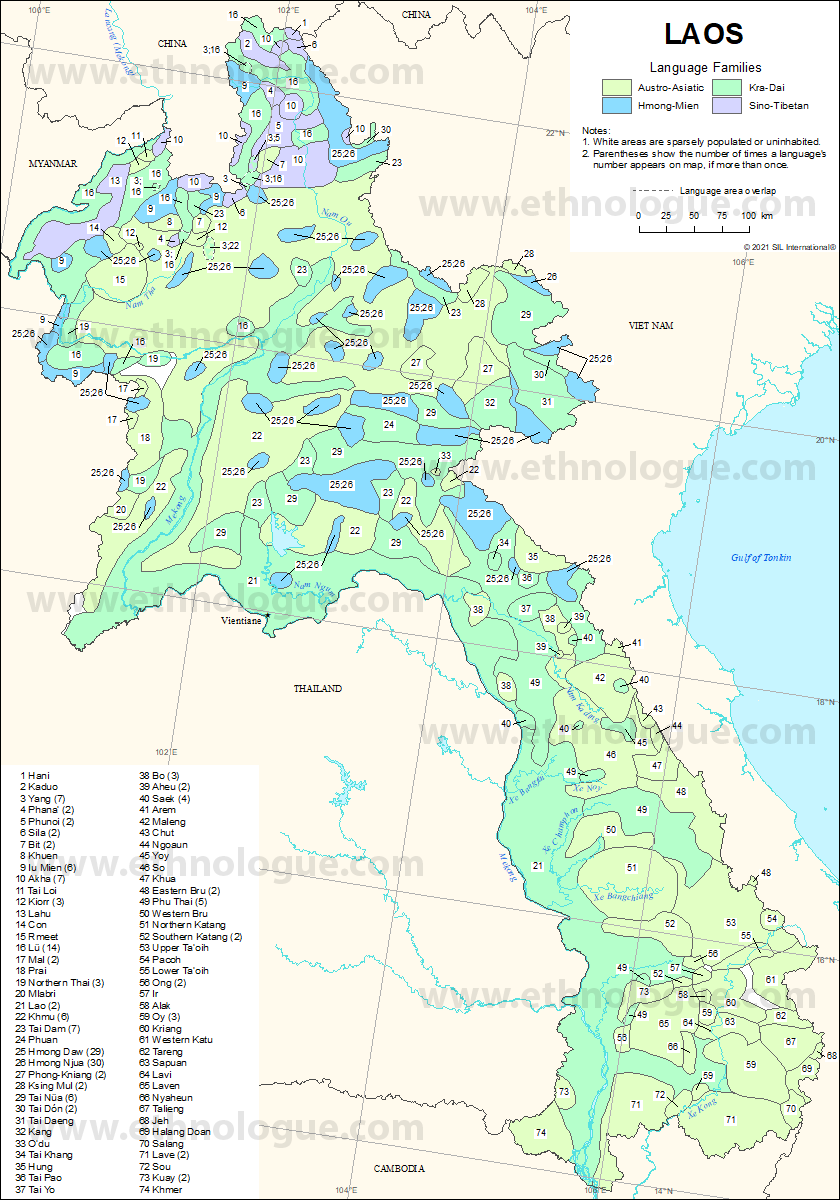
Laos
Graphs
Language Vitality Profile
Full explanation
Language Status Profile
Full explanation
Resources
View Terms
Each Ethnologue country digest is a licensed product with restricted terms of use. Before downloading the product, you must agree to the following terms:
- This is a license for individual use. Just as with a conventionally published book, it is a violation of copyright to make a copy and give it to others.
- You may not redistribute this work in any form, including ingesting the contents into a database that is shared with others or posting it on a web site (whether public or private).
To inquire about permission for reuse or redistribution, please use the Contact Us form in the footer.
Digest of the languages of Laos ($299.95, 53 page PDF)