
LB
Lebanese Republic
Lebanon
Summary
- Official Name
- Lebanese Republic
- Population
- 6,685,000
- Principal Languages
- French, North Levantine Spoken Arabic, Standard Arabic
- Literacy Rate
- 95% (2018 UNESCO)
- International Conventions
- CDE (1960), CSICH (2012), ICCPR (1966), UNDRIP (2007)
- General References
- Fischer and Jastrow 1980, Fleisch 1974, Sebeok 1963
- Deaf Population
- 12,000
- Language Counts
- The number of established languages listed for Lebanon is 8. All are living languages. Of these, 1 is indigenous and 7 are non-indigenous. Furthermore, 4 are institutional, 2 are developing, and 2 are in trouble. Also listed are 9 unestablished languages.
Languages
- Arabic, Egyptian Spoken arz
- Users: 118,000 in Lebanon (2020). Status: Unestablished. Classification: Afro-Asiatic, Semitic, Central, South, Arabic
- Arabic, Mesopotamian Spoken acm
- Users: 23,700 in Lebanon (2020). Status: Unestablished. Classification: Afro-Asiatic, Semitic, Central, South, Arabic
- Arabic, North Levantine Spoken apc
- Widespread. Users: 6,759,000 in Lebanon, all users. L1 users: 6,400,000 in Lebanon (2020). L2 users: 359,000 (2020). Status: 3 (Wider communication). De facto national working language. Alternate Names: Lebanese-Syrian Arabic, Levantine Arabic, Syro-Lebanese Arabic Classification: Afro-Asiatic, Semitic, Central, South, Arabic
- Arabic, Standard arb
- Widespread. Users: 5,220,000 in Lebanon (2015 SIL), all users. Status: 1 (National). Statutory national language (1943, Constitution, Article 11). Classification: Afro-Asiatic, Semitic, Central, South, Arabic
- Armenian, Western hyw
- Beqaa province: Zahle district, Anjar town; Beyrouth province: Beirut suburbs Bourj Hammoud and Mezher; Mont-Liban province: El Metn district; other scattered communities; centuries-old established presence, Beirut and Tripoli cities. Users: 336,000 in Lebanon (2020). Status: 5* (Developing). De facto language of national identity. Classification: Indo-European, Armenian
- Assyrian Neo-Aramaic aii
- Beyrouth. Users: 2,330 in Lebanon (2020). Ethnic population: 40,000. Status: Unestablished. Classification: Afro-Asiatic, Semitic, Central, Aramaic, Eastern, Central, Northeastern
- Chaldean Neo-Aramaic cld
- Beyrouth. Users: 35,500 in Lebanon (2020). Status: Unestablished. Classification: Afro-Asiatic, Semitic, Central, Aramaic, Eastern, Central, Northeastern
- Domari rmt
- Beqaa valley. Users: A few scattered and isolated speaker populations (Herin 2016). Status: 6b* (Threatened). Alternate Names: Dom, Qurbāti Classification: Indo-European, Indo-Iranian, Indo-Aryan, Intermediate Divisions, Western, Dom
- English eng
- Scattered. Users: 2,740,100 in Lebanon, all users. L1 users: 10,100 in Lebanon (2020). L2 users: 2,730,000 (Ramaswami et al 2012). Status: 3 (Wider communication). Classification: Indo-European, Germanic, West, English
- French fra
- Scattered. Users: 2,541,100 in Lebanon, all users. L1 users: 31,100 in Lebanon (2022). L2 users: 2,510,000 (Marcoux et al 2022). Status: 3 (Wider communication). De facto national working language. Alternate Names: Français Classification: Indo-European, Italic, Romance, Italo-Western, Western, Gallo-Iberian, Gallo-Romance, Gallo-Rhaetian, Oïl, French
- Greek ell
- Users: 6,520 in Lebanon (2020). Status: Unestablished. Classification: Indo-European, Greek, Attic
- Italian ita
- Users: 6,520 in Lebanon (2020). Status: Unestablished. Classification: Indo-European, Italic, Romance, Italo-Western, Italo-Dalmatian
- Kurdish, Northern kmr
- Beqaa province: Bekah Valley; Beyrouth, Liban-Nord (Tripoli), and Liban-Sud (Sidon) provinces: scattered urban areas. Users: 23,000 in Lebanon (2020). Ethnic population: 70,000 (2020 H. Salimi). Status: 5* (Dispersed). Classification: Indo-European, Indo-Iranian, Iranian, Western, Northwestern, Kurdish
- Portuguese por
- Users: 2,960 in Lebanon (2020). Status: Unestablished. Classification: Indo-European, Italic, Romance, Italo-Western, Western, Gallo-Iberian, Ibero-Romance, West Iberian, Portuguese-Galician
- Spanish spa
- Users: 22,300 in Lebanon (2020). Status: Unestablished. Classification: Indo-European, Italic, Romance, Italo-Western, Western, Gallo-Iberian, Ibero-Romance, West Iberian, Castilian
- Turkish tur
- Baalbek-Hermel province: Baalbek district, Addus, Al Qaa, Duris, Hadidiye, Nananiye, and Sheymiye villages; Beirut; Liban-Nord province: Akkar district, Aydamun and Kavashra villages; Tripoli district, Tripoli city. Users: 188,900 in Lebanon, all users. L1 users: 38,900 in Lebanon (Orhan 2010). L2 users: 150,000 (2022 A. Dusséaux). Status: 6b (Threatened). Alternate Names: Türkçe Classification: Turkic, Southern, Turkish
- Turoyo tru
- Scattered. Users: 29,300 in Lebanon (2015). Status: Unestablished. Classification: Afro-Asiatic, Semitic, Central, Aramaic, Eastern, Central, Northwestern
Languages by Status
Arabic, Standard
[arb] 1 (National). Statutory national language (1943, Constitution, Article 11). 5,220,000 in Lebanon (2015 SIL), all users.
Arabic, North Levantine Spoken
[apc] 3 (Wider communication). De facto national working language. 6,759,000 in Lebanon, all users. L1 users: 6,400,000 in Lebanon (2020). L2 users: 359,000 (2020).
English
[eng] 3 (Wider communication). 2,740,100 in Lebanon, all users. L1 users: 10,100 in Lebanon (2020). L2 users: 2,730,000 (Ramaswami et al 2012).
French
[fra] 3 (Wider communication). De facto national working language. 2,541,100 in Lebanon, all users. L1 users: 31,100 in Lebanon (2022). L2 users: 2,510,000 (Marcoux et al 2022).
Kurdish, Northern
[kmr] 5* (Dispersed). 23,000 in Lebanon (2020). Ethnic population: 70,000 (2020 H. Salimi).
Armenian, Western
[hyw] 5* (Developing). De facto language of national identity. 336,000 in Lebanon (2020).
Domari
[rmt] 6b* (Threatened). A few scattered and isolated speaker populations (Herin 2016).
Turkish
[tur] 6b (Threatened). 188,900 in Lebanon, all users. L1 users: 38,900 in Lebanon (Orhan 2010). L2 users: 150,000 (2022 A. Dusséaux).
Arabic, Egyptian Spoken
[arz] Unestablished. 118,000 in Lebanon (2020).
Arabic, Mesopotamian Spoken
[acm] Unestablished. 23,700 in Lebanon (2020).
Assyrian Neo-Aramaic
[aii] Unestablished. 2,330 in Lebanon (2020). Ethnic population: 40,000.
Chaldean Neo-Aramaic
[cld] Unestablished. 35,500 in Lebanon (2020).
Greek
[ell] Unestablished. 6,520 in Lebanon (2020).
Italian
[ita] Unestablished. 6,520 in Lebanon (2020).
Portuguese
[por] Unestablished. 2,960 in Lebanon (2020).
Spanish
[spa] Unestablished. 22,300 in Lebanon (2020).
Turoyo
[tru] Unestablished. 29,300 in Lebanon (2015).
Maps
Graphs
Language Vitality Profile
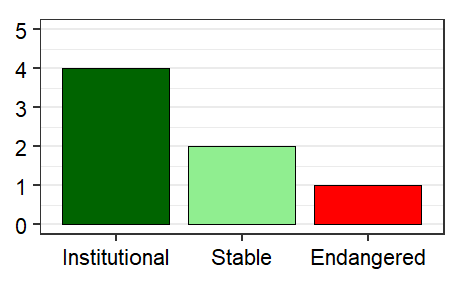
Full explanation
Language Status Profile
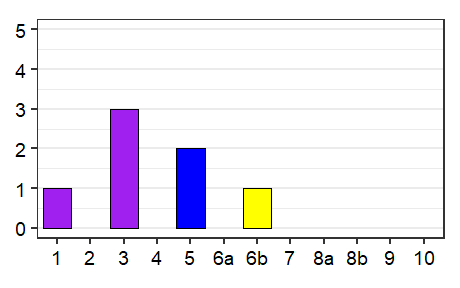
Full explanation
Resources
View Terms
Each Ethnologue country digest is a licensed product with restricted terms of use. Before downloading the product, you must agree to the following terms:
- This is a license for individual use. Just as with a conventionally published book, it is a violation of copyright to make a copy and give it to others.
- You may not redistribute this work in any form, including ingesting the contents into a database that is shared with others or posting it on a web site (whether public or private).
To inquire about permission for reuse or redistribution, please use the Contact Us form in the footer.
Digest of the languages of Lebanon ($149.95, 25 page PDF)