
LT
Republic of Lithuania
Lithuania
Summary
- Official Name
- Republic of Lithuania
- Population
- 2,684,000
- Principal Languages
- Lithuanian
- Literacy Rate
- 100% (2015 World Factbook)
- International Conventions
- CPPDCE (2006), CSICH (2012), FCPNM (1998), ICCPR (1966), UNCRPD (2006), UNDRIP (2007)
- General References
- Campbell and King 2011
- Language Counts
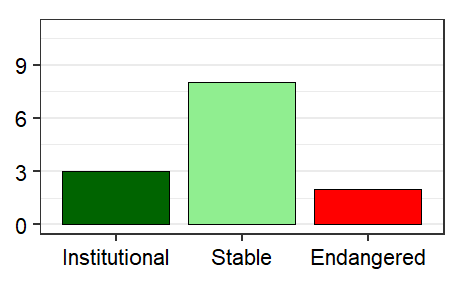
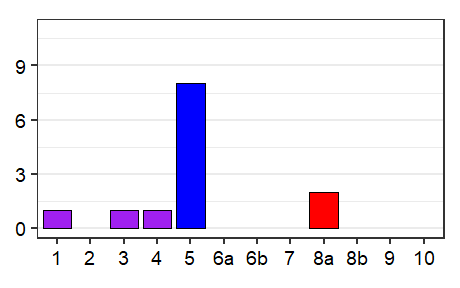
- The number of established languages listed for Lithuania is 15. Of these, 13 are living and 2 are extinct. Of the living languages, 4 are indigenous and 9 are non-indigenous. Furthermore, 3 are institutional, 8 are developing, and 2 are dying.
Languages
- Belarusian bel
- Vilniaus county: primarily Vilnius city; possibly scattered in Alytaus, Panevezio, and Utenos counties. Users: 7,110 in Lithuania (2014 UNSD). Ethnic population: 39,200 (2015 census). Status: 5* (Developing). Alternate Names: Belarusan Classification: Indo-European, Balto-Slavic, Slavic, East
- English eng
- Users: 1,100,290 in Lithuania, all users. L1 users: 290 in Lithuania (2014 UNSD). L2 users: 1,100,000 (European Commission 2012). Status: 4 (Educational). Alternate Names: Anglų Classification: Indo-European, Germanic, West, English
- French fra
- Users: 62,500 in Lithuania (Marcoux et al 2022), L2 users. Status: 5* (Dispersed). Classification: Indo-European, Italic, Romance, Italo-Western, Western, Gallo-Iberian, Gallo-Romance, Gallo-Rhaetian, Oïl, French
- German, Standard deu
- Users: 386,530 in Lithuania, all users. L1 users: 530 in Lithuania (2014 UNSD). L2 users: 386,000 (2019). Ethnic population: 2,830 (2015 census). Status: 5* (Dispersed). Alternate Names: Deutsch Classification: Indo-European, Germanic, West, High German, German, Middle German, East Middle German
- Karaim kdr
- Vilniaus county: Trakai district municipality; scattered in a few other places. Users: 75 in Lithuania (2014 UNSD). Ethnic population: 270. Total users in all countries: 84. Status: 8a (Moribund). Alternate Names: Lashon kedar, Turkic Karaite Autonym: Karaj Tili Classification: Turkic, Western, Ponto-Caspian
- Latvian, Standard lvs
- Users: 1,000 in Lithuania (2014 UNSD). Ethnic population: 3,140 (2015 census). Status: Unestablished. Classification: Indo-European, Balto-Slavic, Baltic, Eastern
- Lithuanian lit
- Widespread. Users: 2,540,000 in Lithuania (European Commission 2012). Total users in all countries: 2,909,520. Status: 1 (National). Statutory national language (1992, Constitution, Article 14). Alternate Names: Lietuviu, Litauische, Litewski, Litovskiy Autonym: Lietuviškai, Lietuvių kalba Classification: Indo-European, Balto-Slavic, Baltic, Eastern
- Lithuanian Sign Language lls
- Scattered. Users: 8,000 (2021 EUD). Approximately 0.3% of total population. Another estimate: 14,500 (2014 IMB). Status: 5 (Developing). Recognized language (2011, Law on Education, No. XI-1281, Article 30(6), as amended). Alternate Names: LGK, Lietuvių gestų kalba, Lietuviu gestu kalba, LtSL Classification: Sign language, Deaf community sign language
- Polish pol
- Alytaus, Kauno, Marijampoles, and Vilniaus counties. Users: 618,000 in Lithuania, all users. L1 users: 164,000 in Lithuania (2015 census), based on nationality. L2 users: 454,000 (European Commission 2006). Status: 5* (Dispersed). Alternate Names: Lenku Classification: Indo-European, Balto-Slavic, Slavic, West, Lechitic
- Romani, Baltic rml
- Siauliu, Utenos, and Vilniaus counties. Users: 1,350 in Lithuania (2014 UNSD). Ethnic population: 2,060 (2015 census). Status: 5* (Developing). Alternate Names: Balt Romani, Balt Slavic Romani, Baltic Slavic Romani, Romani Classification: Indo-European, Indo-Iranian, Indo-Aryan, Intermediate Divisions, Western, Romani, Northern
- Russian rus
- Kauno county: Jonava municipality; Klaipedos county: Klaipeda City municipality; Utenos county: Ingalina, Visaginas, and Zarasai municipalities; Vilniaus county: Elektrenai, Švenčionys, Trakai, Vilnius, and Vilnius City municipalities, Naujamiestis and Senamiestis neighborhoods. Users: 2,460,000 in Lithuania, all users. L1 users: 140,000 in Lithuania (2015 census), based on nationality. L2 users: 2,320,000 (European Commission 2012). Status: 3 (Wider communication). Alternate Names: Rusijos Classification: Indo-European, Balto-Slavic, Slavic, East
- Samogitian sgs
- Taurages, Telsiu and Klaipedos counties. Users: 500,000 (2009 A. Udovice). Status: 5* (Developing). Alternate Names: Lowland Lithuanian, Zhemaitish, Žemaičiai, Žemaičių, Žemaitiškai, Žemaitis Autonym: Žemaitiu Classification: Indo-European, Balto-Slavic, Baltic, Eastern
- Sudovian xsv
- Alytaus county. Users: No known L1 speakers in Lithuania. Last speaker died by the 1600s. Status: 10 (Extinct). Alternate Names: Jatvingian, Yatvingian, Yotvingian Classification: Indo-European, Balto-Slavic, Baltic, Western
- Ukrainian ukr
- Klaipedos county: Klaipeda City municipality; Utenos county: Visaginas municipality; Vilniaus county: Elektrenai, Šalčininkai, Švenčionys, and Vilnius City municipalities. Users: 5,340 in Lithuania (2014 UNSD). Ethnic population: 20,200 (2015 census). Status: 5* (Dispersed). Classification: Indo-European, Balto-Slavic, Slavic, East
- Yiddish, Eastern ydd
- Kauno, Klaipedos, Siauliu, and Vilniaus counties. Users: A few hundred speakers. Ethnic population: 2,270 (2015 census). Status: 8a (Moribund). Classification: Indo-European, Germanic, West, High German, Yiddish
- Zemgalian xzm
- Panevezio and Siauliu counties. Users: No known L1 speakers in Lithuania. Last speaker likely died by the 16th century. Status: 10 (Extinct). Alternate Names: Semigallian Classification: Indo-European, Balto-Slavic, Baltic, Eastern
Languages by Status
Lithuanian
[lit] 1 (National). Statutory national language (1992, Constitution, Article 14). 2,540,000 in Lithuania (European Commission 2012). Total users in all countries: 2,909,520.
Russian
[rus] 3 (Wider communication). 2,460,000 in Lithuania, all users. L1 users: 140,000 in Lithuania (2015 census), based on nationality. L2 users: 2,320,000 (European Commission 2012).
English
[eng] 4 (Educational). 1,100,290 in Lithuania, all users. L1 users: 290 in Lithuania (2014 UNSD). L2 users: 1,100,000 (European Commission 2012).
French
[fra] 5* (Dispersed). 62,500 in Lithuania (Marcoux et al 2022), L2 users.
German, Standard
[deu] 5* (Dispersed). 386,530 in Lithuania, all users. L1 users: 530 in Lithuania (2014 UNSD). L2 users: 386,000 (2019). Ethnic population: 2,830 (2015 census).
Polish
[pol] 5* (Dispersed). 618,000 in Lithuania, all users. L1 users: 164,000 in Lithuania (2015 census), based on nationality. L2 users: 454,000 (European Commission 2006).
Ukrainian
[ukr] 5* (Dispersed). 5,340 in Lithuania (2014 UNSD). Ethnic population: 20,200 (2015 census).
Belarusian
[bel] 5* (Developing). 7,110 in Lithuania (2014 UNSD). Ethnic population: 39,200 (2015 census).
Lithuanian Sign Language
[lls] 5 (Developing). Recognized language (2011, Law on Education, No. XI-1281, Article 30(6), as amended). 8,000 (2021 EUD). Approximately 0.3% of total population. Another estimate: 14,500 (2014 IMB).
Romani, Baltic
[rml] 5* (Developing). 1,350 in Lithuania (2014 UNSD). Ethnic population: 2,060 (2015 census).
Samogitian
[sgs] 5* (Developing). 500,000 (2009 A. Udovice).
Karaim
[kdr] 8a (Moribund). 75 in Lithuania (2014 UNSD). Ethnic population: 270. Total users in all countries: 84.
Yiddish, Eastern
[ydd] 8a (Moribund). A few hundred speakers. Ethnic population: 2,270 (2015 census).
Sudovian
[xsv] 10 (Extinct). No known L1 speakers in Lithuania. Last speaker died by the 1600s.
Zemgalian
[xzm] 10 (Extinct). No known L1 speakers in Lithuania. Last speaker likely died by the 16th century.
Latvian, Standard
[lvs] Unestablished. 1,000 in Lithuania (2014 UNSD). Ethnic population: 3,140 (2015 census).
Maps
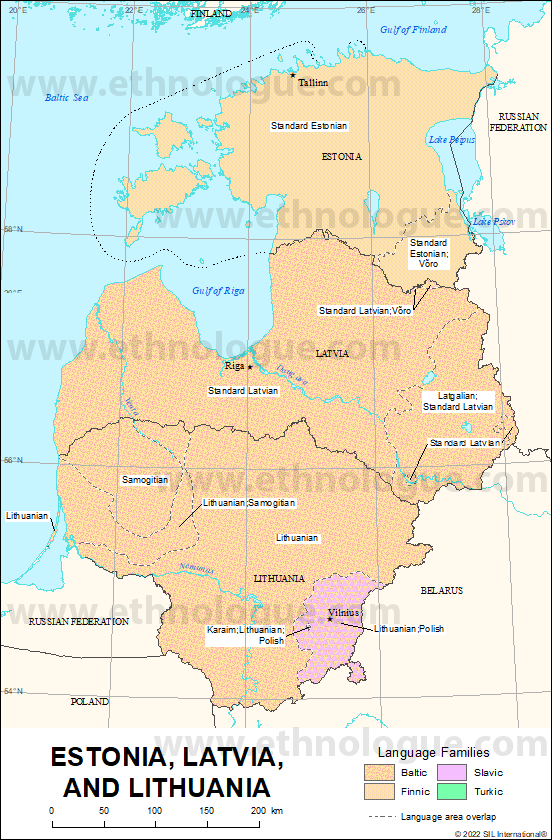
Estonia, Latvia and Lithuania
Graphs
Language Vitality Profile
Full explanation
Language Status Profile
Full explanation
Resources
View Terms
Each Ethnologue country digest is a licensed product with restricted terms of use. Before downloading the product, you must agree to the following terms:
- This is a license for individual use. Just as with a conventionally published book, it is a violation of copyright to make a copy and give it to others.
- You may not redistribute this work in any form, including ingesting the contents into a database that is shared with others or posting it on a web site (whether public or private).
To inquire about permission for reuse or redistribution, please use the Contact Us form in the footer.
Digest of the languages of Lithuania ($149.95, 21 page PDF)