
MM
Republic of the Union of Myanmar
Myanmar
Summary
- Official Name
- Republic of the Union of Myanmar
- Population
- 55,295,000
- Principal Languages
- Burmese
- Literacy Rate
- 76% (2016 UNESCO)
- International Conventions
- CSICH (2012), UNCRPD (2006), UNDRIP (2007)
- General References
- Burling 2003, Bradley 1997, Bradley 2005, Bradley 2007a, Campbell and King 2011, Comrie 1987, Hale 1982, Jones 1988, Lebar et al 1964, Manson 2010, Manson 2011, Matisoff et al 1996, Thurgood and LaPolla 2003, VanBik 2006
- Deaf Population
- 2,684,500
- Language Counts
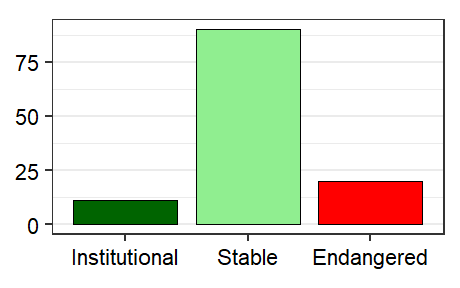
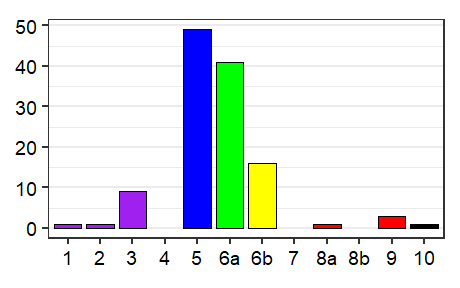
- The number of established languages listed for Myanmar is 122. Of these, 121 are living and 1 is extinct. Of the living languages, 115 are indigenous and 6 are non-indigenous. Furthermore, 10 are institutional, 53 are developing, 38 are vigorous, 16 are in trouble, and 4 are dying. Also listed are 7 unestablished languages.
Languages
- Akeu aeu
- Shan state: Kengtung and Mongla townships. Users: 1,000 in Myanmar (2004 E. Johnson). Status: 5 (Developing). Alternate Names: Akheu, Aki, Akui, Gaolkheel Classification: Sino-Tibetan, Tibeto-Burman, Ngwi-Burmese, Ngwi, Southern
- Akha ahk
- Shan state: east Kengtung district. Users: 200,000 in Myanmar (Bradley 2007a). Status: 3 (Wider communication). Alternate Names: Ahka, Aini, Ak’a, Aka, Ikor, Yani, “Ekaw” (pej.), “Ikaw” (pej.), “Kaw” (pej.), “Kha Ko” (pej.), “Khako” (pej.), “Khao Kha Ko” (pej.), “Ko” (pej.) Classification: Sino-Tibetan, Tibeto-Burman, Ngwi-Burmese, Ngwi, Southern
- Anal anm
- Sagaing region: Tamu town, 10 households. Users: 50 in Myanmar (2010). Status: 6b* (Threatened). Alternate Names: Namfau Classification: Sino-Tibetan, Tibeto-Burman, Kuki-Chin, Northwestern
- Anong nun
- Kachin state: Kawnglangphu, Myitkyina, Putao, Machanbaw, and Tanai townships. Users: 400 in Myanmar (2000 D. Bradley), decreasing. Ethnic population: 10,000 (Bradley 2007b). Total users in all countries: 450. Status: 8a (Moribund). Alternate Names: Anoong, Anu, Anung, Fuch’ye, Fuchve, Khingpang, Kwingsang, Kwinp’ang, Naw, Nawpha, Nu Autonym: Anong Classification: Sino-Tibetan, Tibeto-Burman, Central Tibeto-Burman, Nungish
- Bengali ben
- Users: 286,000 in Myanmar (Leclerc 2017d). Status: Unestablished. Classification: Indo-European, Indo-Iranian, Indo-Aryan, Outer Languages, Eastern, Bengali-Assamese
- Blang blr
- Shan state: Kengtung and Mong Yang townships. Users: 12,000 in Myanmar (1994). Status: 5 (Developing). Alternate Names: Bulang, K’ala, Kawa, Kontoi, Plang, Pula, Pulang Classification: Austro-Asiatic, Mon-Khmer, Northern Mon-Khmer, Palaungic, Eastern Palaungic, Waic, Bulang
- Burmese mya
- Ayeyarwady, Bago, Magway, Mandalay, and Yangon regions. Users: 42,000,000 in Myanmar, all users. L1 users: 32,000,000 in Myanmar (Bradley 2007a), increasing. 250,000 Beik, 20,000 Yaw. L2 users: 10,000,000. Total users in all countries: 42,953,860 (as L1: 32,953,860; as L2: 10,000,000). Status: 1 (National). Statutory national language (2008, Constitution, Chapter XV, Article 450). Alternate Names: Bama, Bama Saka, Bamachaka, Myamasa, Myamma Saka, Myanma, Myanmar, Myen Autonym: မြန်မာ (Mranmar), မြန်မာစကား (Mranmar sakar) Classification: Sino-Tibetan, Tibeto-Burman, Ngwi-Burmese, Burmish, Southern
- Chak ckh
- Rakhine state: 17 villages. Users: 1,000 in Myanmar (Bradley 2007b). Ethnic population: 1,600 (Bradley 2007b). Status: 6b (Threatened). Alternate Names: Ashah, Sak, Thet Classification: Sino-Tibetan, Tibeto-Burman, Sal, Jingppaw-Asakia, Asakian
- Chakma ccp
- Chin state: Paletwa township, a few villages; Rakhine state: Buthidaung, Kyauktaw (main concentration), Maungdaw, and Punnakyun townships. Status: 6a (Vigorous). Alternate Names: Daingnet, Sangma Classification: Indo-European, Indo-Iranian, Indo-Aryan, Outer Languages, Eastern, Bengali-Assamese
- Chin, Anu-Khongso anl
- Chin state: Paletwa and Sami townships, 14 villages, between Kaladan and Michaung rivers. Users: 4,000 (2008), decreasing. Status: 6b (Threatened). Alternate Names: Anu-Hkongso Chin, Kaungso, Kaungtso, Khaungtso, Khawngso, Khong, Khongso, No Classification: Sino-Tibetan, Tibeto-Burman, Ngwi-Burmese, Mru
- Chin, Asho csh
- Ayeyarwady, Bago region, and Magway regions; Rakhine state. Rakhine state; Magwe region: Mindon township (Hill Asho dialect); Magway region, Bago region, and Ayeyarwady region: most of the townships; Rakhine state: Tounggup township and townships further south (Plains Asho dialect). Users: 170,000 in Myanmar (2015 LSDO). Total users in all countries: 174,000. Status: 5 (Developing). Alternate Names: Asho, Ashu, Hyow, Khamaw, Khamoe, Khyang, Kyang, Qin, Saingbaung, Sho, Shoa Autonym: Asho Chin Classification: Sino-Tibetan, Tibeto-Burman, Kuki-Chin, Peripheral, Southern, Cho-Asho, Asho
- Chin, Bawm bgr
- Chin state: Paletwa township, Bahun Taung, Pi Taung, Mawtalar, and Rakan villages. Users: 700 in Myanmar (2016 LSDO), decreasing. Status: 5 (Developing). Alternate Names: Bawm, Bawm hawlh, Bawn, Bawng, Boam, Bom, Laisaw, Laizo, Langkay Classification: Sino-Tibetan, Tibeto-Burman, Kuki-Chin, Central, Lai
- Chin, Bualkhaw cbl
- Chin state: Falam township, north of Falam town, Bualkhua, Phaizawl, and Khuang villages. Users: 2,500 (2006). Status: 5 (Developing). Alternate Names: Bualkhua, Phadei Autonym: Bualkhaw Chin Classification: Sino-Tibetan, Tibeto-Burman, Kuki-Chin, Central, Lai
- Chin, Daai dao
- Chin state: Kanpetlet, Matupi, Mindat, and Paletwa townships, 142 villages. Users: 37,000 (2010). Status: 5 (Developing). Alternate Names: Dai, Khyo, Kkhyou Autonym: Daai, Daai Chin Classification: Sino-Tibetan, Tibeto-Burman, Kuki-Chin, Peripheral, Southern, Cho-Asho, Cho
- Chin, Eastern Khumi cek
- Chin state: Matupi township, 4 villages; Paletwa township, Sami area, 85 villages. Users: 12,000 (2009 SIL). Total for all the Eastern Khumi groups. Status: 5 (Developing). Alternate Names: Khami Classification: Sino-Tibetan, Tibeto-Burman, Kuki-Chin, Peripheral, Southern
- Chin, Ekai cey
- Rakhine state: northern Ann township. Users: 6,000 (2018 P. Nan). Status: 6a (Vigorous). Alternate Names: Ekai, Lawktu Classification: Sino-Tibetan, Tibeto-Burman, Kuki-Chin, Peripheral, Southern, Cho-Asho, Asho
- Chin, Falam cfm
- Chin state: Falam township. Users: 69,000 in Myanmar (1983). 9,000 Taisun, 16,000 Zanniat, 7,000 Khualsim, 4,000 Lente, 14,400 Zahau, 18,600 Laizo (1983). Total users in all countries: 107,900. Status: 5 (Developing). Alternate Names: Falam, Fallam, Halam, Hallam Chin Autonym: Falam Chin Classification: Sino-Tibetan, Tibeto-Burman, Kuki-Chin, Central, Lai
- Chin, Hakha cnh
- Chin state: Hakha township; Magway region: 2 small border areas extreme north. Users: 177,000 in Myanmar, all users. L1 users: 137,000 in Myanmar (Leclerc 2017d). L2 users: 40,000 (2013 SIL). Total users in all countries: 210,410 (as L1: 170,410; as L2: 40,000). Status: 3 (Wider communication). Widespread in the 19th century during the British colonial rule. Lingua franca for most of Chin State. Also used in northeastern India and southeastern Bangladesh. Primary language of five people groups. Used in church, literature, home, government work, business, farming, and agriculture. Alternate Names: Baungshe, Haka, Haka Chin, Hakha, Hakha Lai Autonym: Lai, Lai Chin Classification: Sino-Tibetan, Tibeto-Burman, Kuki-Chin, Central, Lai
- Chin, Kaang ckn
- Chin state: Mindat township, 3 villages. Users: 1,000 (2010 SIL). Status: 5 (Developing). Alternate Names: Kang, M’kaang, Makaang, Mgan, Mkan Autonym: Kaang Chin Classification: Sino-Tibetan, Tibeto-Burman, Kuki-Chin, Peripheral, Southern, Cho-Asho, Cho
- Chin, Khumi cnk
- Chin state: Paletwa township, Kaladan river area; Rakhine state: Kyauktaw township, a few villages. Users: 60,000 in Myanmar (2006). Total users in all countries: 64,000. Status: 5 (Developing). Alternate Names: Kaladan Khumi, Khami, Yangpan, “Khweymi” (pej.) Autonym: Khumi, Khumi Chin Classification: Sino-Tibetan, Tibeto-Burman, Kuki-Chin, Peripheral, Southern
- Chin, Laitu clj
- Rakhine state: Sittwe district, Minpya, Mrauk-U, and Myepung townships; Chin state: Paletwa township. Users: 15,000 (2007 SIL). Status: 5 (Developing). Alternate Names: Daitu, Hio Bei, Hle-tu, Laikhy, Laitu Kheu, Ledu, Leitu Autonym: Laitu Chin Classification: Sino-Tibetan, Tibeto-Burman, Kuki-Chin, Peripheral, Southern, Cho-Asho, Asho
- Chin, Lautu clt
- Chin state: Matupi and Thantlang townships, 17 villages. Users: 15,000 (2005 SIL). Status: 5 (Developing). Alternate Names: Lautu, Lawhtu Autonym: Lautu Chin Classification: Sino-Tibetan, Tibeto-Burman, Kuki-Chin, Maraic, Mara
- Chin, Mara mrh
- Chin state: Paletwa, Matupi, and Thantlang townships, border area with Mizoram in India, 70 villages. Users: 20,000 in Myanmar (1994). Status: 5 (Dispersed). Alternate Names: Lakher, Mara, Mara Chin, Mara reih, Maram, Mira, Miram, Zao Classification: Sino-Tibetan, Tibeto-Burman, Kuki-Chin, Maraic, Mara
- Chin, Matu hlt
- Chin state: Matupi township. Users: 30,000 in Myanmar (2012). Total users in all countries: 40,000. Status: 5 (Developing). Alternate Names: Matupi, Nga La Autonym: Matu, Matu Chin Classification: Sino-Tibetan, Tibeto-Burman, Kuki-Chin, Peripheral, Southern, Cho-Asho, Cho
- Chin, Mizo lus
- Chin state: northwest Falam, west Tedim and Tonzang townships, near India border. Users: 12,500 in Myanmar (1983 census). Status: 5 (Dispersed). Alternate Names: Hualngo, Ka-Lin-Kaw, Le, Lusai, Lushai, Lushay, Lushei, Mizo, Mizo Chin, Whelngo Classification: Sino-Tibetan, Tibeto-Burman, Kuki-Chin, Central, Mizo
- Chin, Müün mwq
- Chin state: Mindat township; Magway region: Saw and Htilin townships. Users: 15,000 (2011). Status: 5 (Developing). Alternate Names: Cho, K’cho Chin, Mindat, Mün, Müün Autonym: K’cho Classification: Sino-Tibetan, Tibeto-Burman, Kuki-Chin, Peripheral, Southern, Cho-Asho, Cho
- Chin, Ngawn cnw
- Chin state: north Falam township. Users: 18,600 (Leclerc 2017d). Status: 5 (Developing). Alternate Names: Ngon, Ngorn Autonym: Ngawn Classification: Sino-Tibetan, Tibeto-Burman, Kuki-Chin, Central
- Chin, Rawngtu weu
- Chin state: Mindat township; Magway region: Htilin township, 2 villages. Users: 5,000 (2008). Status: 6a (Vigorous). Alternate Names: Rongtu, Shimi, Welaung Classification: Sino-Tibetan, Tibeto-Burman, Kuki-Chin, Peripheral, Southern
- Chin, Rungtu rtc
- Magway region: Htilin, Kyaukhtu, and Saw townships, 35 villages. Users: 4,000 (2016 LSDO), decreasing. Ethnic population: 20,000 (2016 LSDO). Status: 6b* (Threatened). Alternate Names: Rungtu, Taungtha Classification: Sino-Tibetan, Tibeto-Burman, Kuki-Chin, Peripheral, Southern
- Chin, Senthang sez
- Chin state: Hakha township; Thantlang township, 2 villages; Magway region: Gangaw township, 15 villages; Sagaing region: Kaleymyo township, 2 villages. Users: 33,000 (2007 SIL). Status: 6a (Vigorous). Alternate Names: Hsemtang, Sentang Autonym: Senthang Chin Classification: Sino-Tibetan, Tibeto-Burman, Kuki-Chin, Maraic
- Chin, Siyin csy
- Chin state: south Tedim township. Users: 10,700 (Leclerc 2017d). Status: 5 (Developing). Alternate Names: Siyang, Siyin Autonym: Sizang Classification: Sino-Tibetan, Tibeto-Burman, Kuki-Chin, Peripheral, Northern, Sizang
- Chin, Songlai csj
- Chin state: Paletwa township (Doitu, Hettui, and Mang Um dialects); Rakhine state: Mrauk-U township (Lai dialect); along Phunglaung river. Users: 7,300 (2012 SIL). Status: 6a (Vigorous). Alternate Names: Hio Classification: Sino-Tibetan, Tibeto-Burman, Kuki-Chin, Peripheral, Southern
- Chin, Sumtu csv
- Rakhine state: Ann, Minbya, and Myebon townships. Users: 14,000 (2007 SIL). Status: 5 (Developing). Alternate Names: Ahmyo, Chang, Hmyo, Settu, Settu Hmyo, Sungtu Autonym: Cumtu, Sumtu Chin Classification: Sino-Tibetan, Tibeto-Burman, Kuki-Chin, Peripheral, Southern
- Chin, Tawr tcp
- Chin state: Hakha township, Laamtuk and Ruavan villages. Users: 580 (Khun 2019), decreasing. Status: 6a (Vigorous). Alternate Names: Tawr, Thawr, Thor, Thor Chin, Torr Classification: Sino-Tibetan, Tibeto-Burman, Kuki-Chin, Central
- Chin, Tedim ctd
- Chin state: Tedim and Tonzang townships; Sagaing region: Kale and Mawlaik townships. Users: 256,000 in Myanmar (Leclerc 2017d). Total users in all countries: 411,000. Status: 5 (Developing). Alternate Names: Hai-Dim, Tiddim, Tidim, Zo pau, Zome, Zomi Autonym: Tedim Classification: Sino-Tibetan, Tibeto-Burman, Kuki-Chin, Peripheral, Northern, Thado
- Chin, Thado tcz
- Sagaing region: Homalin, Khamti, Layshi, and Tamu townships, India border area. Users: 33,100 in Myanmar (Leclerc 2017d). Status: 5 (Developing). Alternate Names: Thado-Pao, Thado-Ubiphei, Thadou, Thadou pao, “Kuki” (pej.), “Kuki-Thado” (pej.) Classification: Sino-Tibetan, Tibeto-Burman, Kuki-Chin, Peripheral, Northern, Thado
- Chin, Thaiphum cth
- Chin state: Matupi township, 4 villages. Users: 1,000 (2005 SIL). Status: 5 (Developing). Alternate Names: Thui Phum Autonym: Thaiphum Classification: Sino-Tibetan, Tibeto-Burman, Kuki-Chin
- Chin, Uppu cnb
- Chin state: Kanpetlet and Paletwa townships; Magway region: Saw and Sidoktaya townships; Rakhine state: Minbya township. Users: 44,400 (Leclerc 2017d). Status: 6a (Vigorous). Alternate Names: Chin Pong, Chin Pung, Chinbon Chin, Chindwin Chin, Chinpon, Oo-pu, Sho, Tuishiip, Tuiship, Ütbü Autonym: Uppu, Uppu Chin Classification: Sino-Tibetan, Tibeto-Burman, Kuki-Chin, Peripheral, Southern, Cho-Asho, Cho
- Chin, Zotung czt
- Chin state: Reizwa sub-township. Users: 40,000 (1990 UBS). Status: 5 (Developing). Alternate Names: Yotun, Zo Mingphuin, Zobya Autonym: Zotung, Zotung Chin Classification: Sino-Tibetan, Tibeto-Burman, Kuki-Chin, Maraic
- Chin, Zyphe zyp
- Chin state: Thantlang township. Users: 17,000 in Myanmar (1994). Total users in all countries: 20,000. Status: 5 (Developing). Alternate Names: Zo-pe, Zophei, Zoptei Autonym: Zyphe Classification: Sino-Tibetan, Tibeto-Burman, Kuki-Chin, Maraic
- Chinese, Mandarin cmn
- Shan state: large China border area, Kokang Self-Administered Zone in Laukkai and Konkyan townships, and Muse township. Users: 994,000 in Myanmar (Leclerc 2017d). Status: 5 (Dispersed). Alternate Names: Tayok Classification: Sino-Tibetan, Chinese
- Danau dnu
- Shan state: Kalaw township, Ang Pan area, west of Inle lake, on the road to Heho. Users: 2,000 (Bradley 2007b). Ethnic population: 5,000 (Bradley 2007b). Status: 6b (Threatened). Alternate Names: Danaw Classification: Austro-Asiatic, Mon-Khmer, Northern Mon-Khmer, Palaungic, Western Palaungic, Danau
- Danu dnv
- Shan state: Danu Self-Administered Zone, Pindaya and Ywa Ngan townships; Aung Ban, and Kalaw, Taunggyi, Yak Sauk, and Ye Oo townships. Users: 100,000 (Bradley 2007a). Status: 6a (Vigorous). Alternate Names: Intha-Yaw, Taruw, Täruw Classification: Sino-Tibetan, Tibeto-Burman, Ngwi-Burmese, Burmish, Southern
- Drung duu
- Kachin state: Pannandin township, Talatu and Khraung villages far north. Users: 225 in Myanmar (2013 SIL). Status: 6a (Vigorous). Alternate Names: Derung, Dulong, Durung, Qiu, Rawang, T’rung, Tarong, Thrung, Trone, Trung, Tulung, Tvrung Classification: Sino-Tibetan, Tibeto-Burman, Central Tibeto-Burman, Nungish
- English eng
- Users: 45,600 in Myanmar (Leclerc 2017d). Status: Unestablished. Classification: Indo-European, Germanic, West, English
- Hindi hin
- Users: 133,000 in Myanmar (Leclerc 2017d). Status: Unestablished. Classification: Indo-European, Indo-Iranian, Indo-Aryan, Western Hindi, Hindustani
- Hmong Njua hnj
- Kachin state: Bhamo district, Momauk township; Shan state: Hseni, Kunlong, and Namtu townships, 6 villages. Users: 10,000 in Myanmar (2000). Status: 6a (Vigorous). Alternate Names: Blue Hmong, Blue Meo, Ching Miao, Green Hmong, Green Meo, Hmong Leng, Hmong Nzhua, Hmoob Leeg, Lu Man Zi, Meo Dam, Meo Lai, Miao Tsi, Mong Leng, Mong Ntsua, Qing Miao, Tak Miao Classification: Hmong-Mien, Hmongic, Chuanqiandian
- Hpon hpo
- Kachin state: Bhamo district, upper Ayeyarwady gorges. Users: No known L1 speakers. Last known speaker survived into the 1990s (Bradley 2007b). Ethnic population: 1,500 (Bradley 2007a). Status: 9 (Dormant). Alternate Names: Hpun, Hpön, Megyaw, Phon, Phun, Phön, Samong Classification: Sino-Tibetan, Tibeto-Burman, Ngwi-Burmese, Burmish, Northern
- Intha int
- Shan state: Taunggyi district, Shwe Nyaung township, Inle lake area. Important Intha-speaking villages: Heha Ywama (largest), In Chan, Nan Pan, Paw Kon, and Tha Lay. Users: 90,000 (2000 D. Bradley). Status: 6a (Vigorous). Alternate Names: Inntha, Insa, Naung Ma Classification: Sino-Tibetan, Tibeto-Burman, Ngwi-Burmese, Burmish, Southern
- Jingpho kac
- Kachin state: large area except north and southwest; Shan state: Lashio and Muse districts; Sagaing region: western border strip. Users: 900,000 in Myanmar (Johnstone and Mandryk 2001). Total users in all countries: 940,000. Status: 3 (Wider communication). Became widespread toward the end of the 19th century. L2 of smaller ethnic groups in Kachin State. Used in the justice system and education. Alternate Names: Aphu, Chingp’o, Chingpaw, Jinghpaw, Jingphaw, Kachin, Phu Autonym: Jinghpo Classification: Sino-Tibetan, Tibeto-Burman, Sal, Jingppaw-Asakia, Jingphaw
- Kadu zkd
- Sagaing region: Katha district, Banmauk and Indaw townships; Homalin, Paungbyin, Pinlebu, and Wuntho townships. Users: 30,000 (2007 SIL), decreasing. Over 30 villages in Mawteik dialect (nearly extinct); over 30 villages in Settaw dialect; 5 villages in Mawkhwin dialect. No monolinguals. Status: 6b (Threatened). Alternate Names: Gadu, Ka’do, Kadu-Ganaan, Kantu’, Kato, Kudo, Maw, Mawteik, Puteik, Thet Autonym: Asak Classification: Sino-Tibetan, Tibeto-Burman, Sal, Jingppaw-Asakia, Asakian
- Kanan zkn
- Sagaing region: Katha district, Banmauk township along Mu river, 24 villages; Homalin, Indaw, and Pinlebu townships, a few villages. Users: 9,000 (2007 SIL). No monolinguals. Status: 6a (Vigorous). Alternate Names: Ganaan, Ganan, Ganon, Genan, Kana Classification: Sino-Tibetan, Tibeto-Burman, Sal, Jingppaw-Asakia, Asakian
- Karen, Bwe bwe
- Bago region: Taungoo and Hpa-Ana townships; Kayah state: Hpruso township; Kayin state: Thandaung township, about 100 villages. Users: 17,200 (1997 F. Bennett), decreasing. No monolinguals. Status: 6b (Threatened). Alternate Names: Baghi, Bghai, Bghai Karen, Blimaw, Bwe, Dareh, Manaw Classification: Sino-Tibetan, Tibeto-Burman, Karenic, Central
- Karen, Geba kvq
- Bago region; Mandalay region: Pyinmana township; Kayah state; Kayin state: Thandaunggyi township, 140 villages; Shan state: Pekon and Pinlong townships. Users: 40,000 (2010 Geba Literature and Culture Committee). Status: 5 (Developing). Alternate Names: Daneh, Geba, Kaba, Karenbyu, Kayinbyu, Kayinpyu, Kebar, Kono, Koo-ong, Northern Bwe, White Karen Classification: Sino-Tibetan, Tibeto-Burman, Karenic, Central
- Karen, Geko ghk
- Bago region: Toungoo district; Mandalay region: Yamethin district; Kayin state: Thandaunggyi township; Shan state: Pekon township. Users: 17,000 (Manson 2010). Status: 6a (Vigorous). Alternate Names: Gaikho, Gek’o, Gekho, Ghekhol, Ghekhu, Gheko, Kakhau, Kayan, Kayan Kakhau, Kekaungdu, Kekhong, Keku, Yathu Gekho Classification: Sino-Tibetan, Tibeto-Burman, Karenic, Central
- Karen, Mobwa jkm
- Kayin state: Thandaung township, western foot of Thandaung mountains, 9 villages; some in Bago region: Taungoo township. Users: 4,000 (2010 SIL). Also live mixed with Bwe Karen [bwe] and Paku Karen [jkp] in some villages. Status: 6b (Threatened). Alternate Names: Bilichi, Blimaw, Dermuha, Maleh, Mobwa Karen, Monpwa, Mopwa, Pa-Le-Chi, Palachi, Palakhi, Palaychi Classification: Sino-Tibetan, Tibeto-Burman, Karenic, Southern
- Karen, Paku jkp
- Bago region: east near Kayin state border; Kayah state: south; Kayin state: hills southeast of Taungoo. Users: 6,710 (Leclerc 2017d). Status: 6a (Vigorous). Alternate Names: Mogpha, Mogwa, Monebwa, Monnepwa, Mopaga, Mopha, Pagu, Paku, Paku Karen, Thalwepwe Classification: Sino-Tibetan, Tibeto-Burman, Karenic, Southern
- Karen, Pwo Eastern kjp
- Bago region: Bago and Toungoo townships; Kayin state and Tanintharyi region: a large area near the Thailand border. Users: 1,000,000 in Myanmar (1998). Total users in all countries: 1,050,000. Status: 5 (Developing). Alternate Names: Moulmein Pwo Karen, Phlong, Pho Autonym: ဖၠုံ (Phlou) Classification: Sino-Tibetan, Tibeto-Burman, Karenic, Peripheral
- Karen, Pwo Western pwo
- Ayeyarwady region: Einmeh, Maubin, Pathein, Twante, others; Bago region: Kyonpyaw and Hinthada, others; Yangon region: Twante. Users: 210,000, decreasing. Status: 6b (Threatened). Alternate Names: Bassein Pwo Karen, Delta Pwo Karen, Mon Karen, Mon Kayin, Mutheit, Pathein Pwo Karen, Phlong, Phlong Sho, Pho, Shu, Talaing Karen Classification: Sino-Tibetan, Tibeto-Burman, Karenic, Peripheral
- Karen, S’gaw ksw
- Ayeyarwady region, Bago region, Yangon region, and Kayin state; scattered in Ayeyarwady delta area, generally among Western Pwo Karen [pwo] speakers. Users: 2,050,000 in Myanmar, all users. L1 users: 1,970,000 in Myanmar (Leclerc 2017d). L2 users: 80,000 (2013 SIL). Total users in all countries: 2,250,000 (as L1: 2,170,000; as L2: 80,000). Status: 3 (Wider communication). Karen people are thought to originate from Mongolia; language became widespread around mid-19th century with the creation of a written script by an American Baptist missionary, and under British colonial rule. Used in ethnic communication, church, farming, and trade. Alternate Names: Burmese Karen, Kanyaw, Kayinpyu, Kyetho, Paganyaw, Pchcknya, Pwakenyaw, S’gau, S’gaw, S’gaw Kayin, White Karen, Yang Khao Autonym: ပှၤကညီဖိ (Sgaw) Classification: Sino-Tibetan, Tibeto-Burman, Karenic, Southern
- Kawyaw kxf
- Kayah state: West Kyèbogyi area, border of Bawlake and Hpruso townships, 23 villages. Users: 10,000 (2000 D. Bradley). Ethnic population: 10,000 (Bradley 2007b). Status: 6a (Vigorous). Alternate Names: Kayah Monu, Kayah-Munu, Kayàw, Manaw, Manu, Manu Manaw, Manumanaw, Manumanaw Karen, Manö, Monu Autonym: Kawyaw Classification: Sino-Tibetan, Tibeto-Burman, Karenic, Central
- Kayah, Eastern eky
- Kayah state: Shadaw township east of Thanlwin river; Shan state: Langkho district. Users: 8,000 in Myanmar (2007). Total users in all countries: 26,000. Status: 6a (Vigorous). Alternate Names: Karenni, Karennyi, Kayah, Kayah Li, Kayay, Kayeh, Red Karen Classification: Sino-Tibetan, Tibeto-Burman, Karenic, Central
- Kayah, Western kyu
- Kayah state and Kayin state: east of Thanlwin river; Shan state: Pekon township south. Shan state: north of Loikaw (northern dialect); Dimawso and Hpruso townships south of Loikaw (southern dialect). Users: 150,000 (2007). 2,000 refugees in Thailand. Status: 5 (Developing). Alternate Names: Karenni, Karennyi, Karieng Daeng, Kayah, Kayah Li, Kayahli, Red Karen, Yang Daeng Autonym: ကယားလီ (Kayahli) Classification: Sino-Tibetan, Tibeto-Burman, Karenic, Central
- Kayan pdu
- Kayah state; Kayin state: Thandaung township; Shan state: Pekon township; Mandalay region: Pyinmana township. Kayah state: Lahwi and northwest Dimawso townships. Shan state: south Pekon (Kayan Lahwi dialect); northwest Kayah state: Dimawso area (Kayan Kangan dialect). Users: 133,000 in Myanmar (2005 E. Phan). Total users in all countries: 133,600. Status: 5 (Developing). Alternate Names: Ka-Yun, Kayang, Lahwi, “Long-Necked Karen” (pej.), “Padaung” (pej.), “Padaung Karen” (pej.) Autonym: Kayăn Classification: Sino-Tibetan, Tibeto-Burman, Karenic, Northern
- Kayaw kvl
- Kayah state: 30 villages east; Kayin state: Yado area; Shan state: Pekon township. Users: 20,100 (Leclerc 2017d). Status: 5 (Developing). Alternate Names: Deleh, Ka-yaw, Laku, Pramano, “Bre” (pej.), “Brec” (pej.), “Brek” (pej.), “Kayaw Brek” (pej.), “Paret” (pej.), “Pre” (pej.), “Pret” (pej.) Autonym: Kayaw Classification: Sino-Tibetan, Tibeto-Burman, Karenic, Central
- Khamti kht
- Kachin state: Putao district (4,500) and Myitkyina area (3,500); Sagaing region. Users: 8,000 in Myanmar (2000). Total users in all countries: 13,000. Status: 5 (Developing). Alternate Names: Hkampti Shan, Hkamti, Kam Ti, Khampti, Khampti Sam, Khampti Shan, Khamti Shan, Khandi Shan, Tai Kam Ti, Tai-Khamti Autonym: လိꩱ့်တဲးၵမ်းတီ (Tai Khamti) Classification: Kra-Dai, Kam-Tai, Tai, Southwestern
- Khün kkh
- Shan state: Kentung valley area east. Users: 100,000 in Myanmar (Diller and Juntanamalaga 1990). Total users in all countries: 106,880. Status: 5 (Developing). Alternate Names: Gon Shan, Hkun, Kengtung Dai, Khuen, Khun Shan, Khyn, Tai Khün, Tai-Khuen Classification: Kra-Dai, Kam-Tai, Tai, Southwestern
- Lacid lsi
- Kachin state: east border area. Users: 30,000 in Myanmar (2000 D. Bradley). Total users in all countries: 31,800. Status: 5 (Developing). Alternate Names: Ac’ye, Chashan, La Chit, Lachi, Lachik, Lachikwaw, Lacik, Lashi, Lashi-Maru, Lasi, Lechi, Leqi, Letsi Autonym: Lacid Classification: Sino-Tibetan, Tibeto-Burman, Ngwi-Burmese, Burmish, Northern
- Lahta kvt
- Nay Pyi Taw region: Pyinmana township; Shan state: Pekon and Pinlaung townships. Users: 9,550 (2000). Status: 6a (Vigorous). Alternate Names: Kayan Lahta, Khahta, Lahta Karen, Peu, Taru, Tarulakhi, Yan Wohta Classification: Sino-Tibetan, Tibeto-Burman, Karenic, Northern
- Lahu lhu
- Shan state: Kentung district. Users: 200,000 in Myanmar (2012 D. Bradley), increasing. Status: 3 (Wider communication). Alternate Names: Black Lahu, Lahu Na, Lahuna, Launa, Muhso, Museu, Musser Dam, Musso, Mussur, Na, “Lohei” (pej.) Classification: Sino-Tibetan, Tibeto-Burman, Ngwi-Burmese, Ngwi, Central
- Lahu Shi lhi
- Shan state: Kentung district. Users: 60,000 in Myanmar (2007). Status: 5 (Developing). Alternate Names: Kwi, Lad hur Si, Lahu Si, Yellow Lahu Classification: Sino-Tibetan, Tibeto-Burman, Ngwi-Burmese, Ngwi, Central
- Lhao Vo mhx
- Kachin state: Chiphwe, Sawlaw, and Waimaw townships widely dispersed in east border area; Shan state: Kutkai township north. Users: 121,000 in Myanmar (Leclerc 2017d). Total users in all countries: 124,500. Status: 5 (Developing). Alternate Names: Diso, Lang, Laungaw, Laungwaw, Lawgore, Lawng, Liangsu, Lovo, Malu, Mulu, Zi, “Maru” (pej.) Autonym: Lhaovo Classification: Sino-Tibetan, Tibeto-Burman, Ngwi-Burmese, Burmish, Northern
- Lisu lis
- Kachin state: Putao township toward Assam border, also Myitkyina; Mandalay region: Mogok township; Sagaing region: Katha and Tygyaing townships; Shan state: Lashio and Loilen townships. Users: 300,000 in Myanmar (Bradley 2007a). Status: 3 (Wider communication). Many use Lisu as L2. Alternate Names: Central Lisu, Li-Hsaw, Li-Shaw, Lisaw, Lu-Tzu, Southern Lisu, Yao Yen, Yaw Yin, Yaw-Yen, Yeh-Jeh Classification: Sino-Tibetan, Tibeto-Burman, Ngwi-Burmese, Ngwi, Central
- Lü khb
- Shan state: Muang Yong township east. Users: 60,000 in Myanmar (2013). Status: 5 (Dispersed). Alternate Names: Lue, Pai-I, Shu-Ai-I, Tai Lu Classification: Kra-Dai, Kam-Tai, Tai, Southwestern
- Mok mqt
- Shan state: Mong Khet, Kengtung and Mong Yang townships, 10 villages. Users: 4,000 in Myanmar (2018 S. Devereux). Total users in all countries: 4,700. Status: 6a (Vigorous). Alternate Names: A Mŏk, Doi, Loi, Loi Cim, “Hsem” (pej.), “Hsen Hsum” (pej.), “Shim Ceem” (pej.) Classification: Austro-Asiatic, Mon-Khmer, Northern Mon-Khmer, Palaungic, Eastern Palaungic, Angkuic
- Moken mwt
- Tanintharyi region: widespread in Mergui archipelago islands. Users: 4,000 in Myanmar (Bradley 2007a). Total users in all countries: 6,000. Status: 6b (Threatened). Alternate Names: Basing, Chau Ko’, Lawta, Mawken, Orang Laut, Salon, Salong, Selong, Selung Classification: Austronesian, Malayo-Polynesian, Moklen
- Mon mnw
- Kayin state and Mon states; Tanintharyi region: north. Users: 743,000 in Myanmar (2004), decreasing. Ethnic population: 1,000,000 (Bradley 2007b). Total users in all countries: 851,000. Status: 5 (Developing). Alternate Names: Aleng, Mou, Mun, Peguan, Raman, Rman, Rmen, Takanoon, Talaing, Taleng, Teguan Autonym: ဘာသာ မန် (bharsar maan) Classification: Austro-Asiatic, Mon-Khmer, Monic
- Mro-Khimi cmr
- Chin state: Paletwa township; Rakhine state: Buthidaung, Kyauktaw, Maungdaw, Mrauk U, Pauktaw, and Ponnagyun townships. Users: 75,000 (2012 SIL). Ethnic population: 200,000 (2018). Status: 6b (Threatened). Alternate Names: Awa Khami, Khami, Khumi Awa, Mro, Mro-Khimi Chin, “Kwe Myi” (pej.) Autonym: Khimi, Mro-Khimi Classification: Sino-Tibetan, Tibeto-Burman, Kuki-Chin, Peripheral, Southern
- Mru mro
- Rakhine state: Buthidaung, Maungdaw, and Ponnagyun townships. Users: 20,000 in Myanmar (1999 ABWE). Status: 6a (Vigorous). Alternate Names: Dak, Launghu, Mro, Mrucha, Mrung, Mrusa, Murung, Niopreng, Taung Mru Classification: Sino-Tibetan, Tibeto-Burman, Ngwi-Burmese, Mru
- Muak Sa-aak ukk
- Shan state: Mong Yawng township. Users: 4,500 in Myanmar (2016 E. Hall). Status: 5 (Developing). Alternate Names: Doi Autonym: Muak Sa-aak Classification: Austro-Asiatic, Mon-Khmer, Northern Mon-Khmer, Palaungic, Eastern Palaungic, Angkuic
- Myanmar Sign Language ysm
- Scattered. Users: 270,000 (2021 DBS/DOOR/SIL). Estimated 160,000–320,000 signers, assuming 0.1%–0.5% of the general population. Status: 5 (Developing). Alternate Names: Burmese Sign Language Classification: Sign language, Deaf community sign language
- Naga, Akyaung Ari nqy
- Sagaing region: Layshi township, Heinkut, Jagram, and Ngachan villages. Users: 1,000 (2004 SIL). Status: 6a (Vigorous). Alternate Names: Akyaung Ari Naga, Ngachan Classification: Sino-Tibetan, Tibeto-Burman, Unclassified
- Naga, Chen-Kayu nqq
- Sagaing region: Hkamti district, Lahe township, 13 villages, along India border. Users: 9,000 (2012 SIL). Status: 6a (Vigorous). Alternate Names: Kyan-Karyaw Naga Classification: Sino-Tibetan, Tibeto-Burman, Sal, Boro-Garo, Northern Naga
- Naga, Jejara pzn
- Sagaing region: Khamti district, Layshi township, 7 villages. Users: 1,500 (2004). Status: 6a (Vigorous). Alternate Names: Bara Naga, Para Naga, Parasar Naga Autonym: Naga Classification: Sino-Tibetan, Tibeto-Burman, Unclassified
- Naga, Khiamniungan kix
- Sagaing region: Khamti district, Khamti and Lahe townships, about 30 villages. Users: 10,000 in Myanmar (2010). Status: 5 (Developing). Alternate Names: Khiamniungan, Makware, Nokaw, Para, Tukhemmi, Welam Classification: Sino-Tibetan, Tibeto-Burman, Sal, Boro-Garo, Northern Naga
- Naga, Kokak nxk
- Sagaing region: south Layshi township; 10 villages. Users: 2,000 (2004 SIL). Status: 6a (Vigorous). Alternate Names: Goga, Kokak, Koki, Koki Naga, Konke Classification: Sino-Tibetan, Tibeto-Burman, Unclassified
- Naga, Konyak nbe
- Sagaing region: Khamti district, Lahe township. Users: 2,000 in Myanmar (2010). Status: 5 (Developing). Classification: Sino-Tibetan, Tibeto-Burman, Sal, Boro-Garo, Northern Naga
- Naga, Lainong lzn
- Sagaing region: Khamti district, Lahe township, about 25 villages. Users: 15,000 (Wayesha 2010). Status: 5 (Developing). Alternate Names: Htang Ngan, Htangan, Leinong Naga, Lenaung Naga Classification: Sino-Tibetan, Tibeto-Burman, Sal, Boro-Garo, Northern Naga
- Naga, Lao nlq
- Sagaing region: Khamti district, Lahe township, along India border. Users: 1,000 (2012 SIL). Status: 6a (Vigorous). Alternate Names: Law, Loh Classification: Sino-Tibetan, Tibeto-Burman, Sal, Boro-Garo, Northern Naga
- Naga, Long Phuri lpn
- Sagaing region: Khamti district, Layshi township, 6 villages. Users: 1,000 (2004). Status: 6a (Vigorous). Alternate Names: Amimi Naga, Longpfuri, Longpfuru, Mimi Classification: Sino-Tibetan, Tibeto-Burman, Unclassified
- Naga, Makuri jmn
- Sagaing region: Khamti district, Homalin, Lahe, and Layshi townships. Users: 2,500 in Myanmar (2004). Total users in all countries: 6,500. Status: 6a (Vigorous). Alternate Names: Makury Autonym: Makuri Classification: Sino-Tibetan, Tibeto-Burman, Unclassified
- Naga, Paungnyuan umn
- Sagaing region: Khamti district, Khamti and northeast Lahe townships, 13 villages. Users: 4,000 (2008 SIL). Status: 6a (Vigorous). Alternate Names: Lasam, Macham Naga, Makyam, Makyan Naga, Pongnyun Autonym: Paungnyuan Naga Classification: Sino-Tibetan, Tibeto-Burman, Sal, Boro-Garo, Northern Naga
- Naga, Ponyo-Gongwang npg
- Sagaing region: Khamti district, Lahe township, 19 villages. Users: 4,500 (2008 SIL). Status: 6a (Vigorous). Autonym: Gongwang Naga, Ponyo Naga Classification: Sino-Tibetan, Tibeto-Burman, Sal, Boro-Garo, Northern Naga
- Naga, Tangkhul ntx
- Sagaing region: Homalin township; Layshi township, Somra tract. Users: 4,000 (2004 SIL). Status: 6a (Vigorous). Alternate Names: Somara, Somra Autonym: Tangkhul Naga Classification: Sino-Tibetan, Tibeto-Burman, Tangkhulic
- Naga, Tangshang nst
- Sagaing region: Khamti district, Khamti, Lahe, Nanyun, and Pangsau townships; Kachin state: Myitkyina district, Shinbwiyan and Tanai townships. Users: 60,000 in Myanmar (2010). Total users in all countries: 98,600. Status: 5 (Developing). Alternate Names: Haimi, Hawa, Heimi, Kuwa, Pangmi, Pangwa, Rangpan, Rangpang, Tangwa, Tase, Tase Naga Autonym: Tangshang Naga Classification: Sino-Tibetan, Tibeto-Burman, Sal, Boro-Garo, Northern Naga
- Nepali npi
- Users: 299,000 in Myanmar (Leclerc 2017d). Status: Unestablished. Classification: Indo-European, Indo-Iranian, Indo-Aryan, Intermediate Divisions, Eastern, Eastern Pahari
- Ngochang acn
- Kachin state: Jahpui, Lawhkawng, Hpimaw, Uyan, and Waimaw townships, west of Ayeyarwaddy river near Bhamo (locally known as Manmaw); China border area. Users: 35,000 in Myanmar (2007). Status: 5 (Developing). Alternate Names: Acang, Achang, Anchan, Atsang, Chung, Longchuan Achang, Maingtha, Manmaw, Mönghsa, Ngac’ang, Ngachang, Ngoq Changh, Ngoqchangh, Tai Sa’ Classification: Sino-Tibetan, Tibeto-Burman, Ngwi-Burmese, Burmish, Northern
- Nusu nuf
- Kachin state: Myitkyina district, Chipwi, and Hsawlaw townships, about 22 villages. Users: 670 in Myanmar (2011), decreasing. No monolinguals. Ethnic population: 1,500 (2011). Status: 6b (Threatened). Alternate Names: Nang Tsu, No Tso, No Tsu, “Naw” (pej.), “No” (pej.), “No Pha” (pej.), “No Shi” (pej.), “Nu” (pej.) Classification: Sino-Tibetan, Tibeto-Burman, Ngwi-Burmese, Ngwi, Central
- Odia ory
- Users: 122,000 in Myanmar (Leclerc 2017d). Status: Unestablished. Classification: Indo-European, Indo-Iranian, Indo-Aryan, Outer Languages, Eastern, Oriya
- Pa’o blk
- Kayah state: Loikaw; Kayin state: Shan state border area; Mon state: near Thaton; Shan state. Users: 858,000 in Myanmar (Leclerc 2017d). Total users in all countries: 858,740. Status: 5 (Developing). Alternate Names: Black Karen, Northern Taungthu, Pa Oh, Pa’o Karen, Pa-O, Pa-U Autonym: ပအိုဝ် (Pa-O), ပအိုဝ်ႏခမ်းသား (Pa-O Kham Thar) Classification: Sino-Tibetan, Tibeto-Burman, Karenic, Peripheral
- Palaung, Ruching pce
- Mandalay region: Katha and Pyinoolwin townships; Shan state: Taunggyi district. Users: 258,000 in Myanmar (2000). Total users in all countries: 273,300. Status: 5 (Developing). Alternate Names: Da’ang, Di-Ang, Ngwe Palaung, Palay, Silver Palaung Autonym: ဒါအာင် (Daraarin) Classification: Austro-Asiatic, Mon-Khmer, Northern Mon-Khmer, Palaungic, Western Palaungic, Palaung
- Palaung, Rumai rbb
- Kachin state: Bhamo district, Mansi township; Shan state: Lashio area, north to the border in Mantong, Muse, Nam Kham, north Hsenwi, and Tawngpeng (the ancient Palaung state). Users: 158,000 in Myanmar (Leclerc 2017d). Total users in all countries: 162,100. Status: 5 (Developing). Alternate Names: Humai, Ngwe Palaung, Rumai, Rumai Humai, Shan Rumai, Silver Palaung, Ta’ang, Ta’ang Rumai, Tai Rumai Classification: Austro-Asiatic, Mon-Khmer, Northern Mon-Khmer, Palaungic, Western Palaungic, Palaung
- Palaung, Shwe pll
- Shan state: Nam Hsan is center. Users: 231,000 in Myanmar (Leclerc 2017d). Total users in all countries: 233,000. Status: 5 (Developing). Alternate Names: Golden Palaung, Liang, Red Da’ang, Saam-Loong, Shwe Palaung, Ta’ang Samlung, Ta-Ang Palaung Autonym: ဆာမ်လိုင် (Saam Loong) Classification: Austro-Asiatic, Mon-Khmer, Northern Mon-Khmer, Palaungic, Western Palaungic, Palaung
- Pali pli
- Widespread. Users: No known L1 speakers in Myanmar. Ethnic population: No ethnic community. Status: 9 (Second language only). Classification: Indo-European, Indo-Iranian, Indo-Aryan, Unclassified
- Pyen pyy
- Shan state: Mong Yang township, Namt Theun and Yaw Tan villages. Users: 600 (2013 Pyen Language Committee). Status: 5 (Developing). Alternate Names: Biˎ suˎ, Hpinba, Hpyin, Misu, Phen, Pyin Classification: Sino-Tibetan, Tibeto-Burman, Ngwi-Burmese, Ngwi, Southern, Bisoid
- Rakhine rki
- Chin state: Paletwa township; Rakhine state: widespread; Bago region, Shwegyin and Waw townships. Users: 1,820,000 in Myanmar, all users. L1 users: 800,000 in Myanmar (2013 SIL). L2 users: 1,020,000 (2013 SIL). Total users in all countries: 2,020,000 (as L1: 1,000,000; as L2: 1,020,000). Status: 3 (Wider communication). Descendants of Muslim immigrants, Rakhine people and language became dominant in Arakan in the 17th century. Used in poetry, among educated men, administrators, trade, farming, and religion. Alternate Names: Arakanese, Rakhain, Rakhaing, Rakkhaine, “Mogh” (pej.), “Moghi” (pej.) Autonym: ရခိုင် (Rakhine) Classification: Sino-Tibetan, Tibeto-Burman, Ngwi-Burmese, Burmish, Southern
- Rawang raw
- Kachin state: Putao district, Kawnglangphu, Machanbaw, Naungmaw, Pannandin, and Putao townships. Users: 62,000 in Myanmar (2000). Total users in all countries: 63,000. Status: 3 (Wider communication). Of Mongolian descent, the Rawang migrated to northern Burma in the second millennium. Became widespread in the early 1800s under British rule. Used at home, in education, farming, church, and gospel radio broadcasts. Alternate Names: Ch’opa, Chiutse, Ganung-Rawang, Kiutze, Nung, Nung Rawang, Qiuze, Rvwangka, “Hkanung” (pej.) Autonym: Rvwang Classification: Sino-Tibetan, Tibeto-Burman, Central Tibeto-Burman, Nungish
- Riang Lai yin
- Shan state: Langkho district. Users: 12,000 (2008), decreasing. Status: 6b (Threatened). Alternate Names: Ban Roi, Liang Sek, Ranei, Red Riang, Riang Saek, Riang Sak, Striped Karen, Yang, Yang Lai, Yin Kya, Yinchia, Yinja Classification: Austro-Asiatic, Mon-Khmer, Northern Mon-Khmer, Palaungic, Western Palaungic, Riang
- Riang Lang ril
- Shan state: Hopang district, Pang Long area. Users: 12,500 in Myanmar (2008). Total users in all countries: 15,500. Status: 6a (Vigorous). Alternate Names: Black Karen, Black Riang, Black Yang, Drum, Riang, Yang, Yang Lang, Yang Wan Kun, Yanglam, Yin, Yin Net, Yinnet Autonym: Riang Lang Classification: Austro-Asiatic, Mon-Khmer, Northern Mon-Khmer, Palaungic, Western Palaungic, Riang
- Rohingya rhg
- Rakhine state: Buthidaung, Maungdaw, Rathedaung and Sittwe townships. Users: 484,000 in Myanmar (2017 The Arakan Project). Due to unrest, numbers are very uncertain. Total users in all countries: 2,529,250. Status: 6a (Vigorous). Alternate Names: Rohinja Autonym: Ruwainggya Classification: Indo-European, Indo-Iranian, Indo-Aryan, Outer Languages, Eastern, Bengali-Assamese
- Samtao stu
- Shan state: east. Users: 9,550 in Myanmar (2000). Total users in all countries: 13,170. Status: 6a (Vigorous). Alternate Names: Samtau, Samtuan Classification: Austro-Asiatic, Mon-Khmer, Northern Mon-Khmer, Palaungic, Eastern Palaungic, Angkuic
- Shan shn
- Kachin state: Mansi and Mogaung townships, Bhamo, Mohnyin, west Momauk, and south Myitkyina; Kayah state: Loikaw; Mandalay region: assorted north border areas; Sagaing region: Homalin and Tamu townships; Shan state: north in Konkyan, Muse, and Nanhkan townships, to south in Hsihseng, Langko, Mawkwa, and Mongpan townships; southeast in Matman, Mongkhet, Monghpyak, Mongyang, and Mongyawng townships. Myanmar-Yunnan border, Mu’ang Mao Long and Namkham (Tai Mao dialect). Users: 4,590,000 in Myanmar (Leclerc 2017d). Total users in all countries: 4,685,000. Status: 3 (Wider communication). The Shan people migrated from Yunnan, China. Their presence in modern-day Burma dates back to the 10th century. In the second half of the 19th century Shan people migrated to northern Thailand. Under British colonial rule beginning around 1885, the Shan languages of Burma gained speakers and became widespread in different regions of Myanmar, Thailand, and China. Used in trade, agriculture, small business (artisans), interethnic communication, and religion. Alternate Names: Burmese Shan, Great Thai, Sam, Sha, Shan Bama, Shan Gyi, Tai, Tai Long, Tai Luang, Tai Shan, Tai Yai, Tai-Lon, Thai Yai, “Ngeo” (pej.), “Ngiao” (pej.), “Ngiaw” (pej.), “Ngio” (pej.), “Ngiow” (pej.) Autonym: လိၵ်ႈတႆး (Lik Tai) Classification: Kra-Dai, Kam-Tai, Tai, Southwestern
- Tai Laing tjl
- Sagaing region: Homalin township, along Chindwin, Irrawaddy, and Uru rivers; Kachin state: Bamaw to Myitkyina townships. Users: 100,000 (2010 SIL). Status: 6b* (Threatened). Alternate Names: Red Tai, Shan Bamar, Shan Kalee, Shan Ni, Tai Laeng, Tai Lai, Tai Lang, Tai Nai, Tai Naing Classification: Kra-Dai, Kam-Tai, Tai, Southwestern
- Tai Loi tlq
- Shan state. Users: Population information is not yet available for the other groups known as Tai Loi. Status: 6a (Vigorous). Alternate Names: Aw-aak, Bulang-Su, Doi, Khabe, Kon Doi, Kon Loi, Loi, Mong Lue, Monglwe, Tai-Loi, Tailoi, Wakut Classification: Austro-Asiatic, Mon-Khmer, Northern Mon-Khmer, Palaungic, Eastern Palaungic, Angkuic
- Tai Nüa tdd
- Kachin state: east; Shan state: north. Users: 102,000 in Myanmar (Leclerc 2017d). Status: 5 (Dispersed). Alternate Names: Chinese Shan, Tai Kong, Tai Neua Classification: Kra-Dai, Kam-Tai, Tai, Southwestern
- Taman tcl
- Sagaing region: Khamti district, Homalin township, Tamanthi area. Users: No known L1 speakers. Last Taman speaker died in 1990s. Descendants intermarried and now speak other languages. Status: 9 (Dormant). Classification: Sino-Tibetan, Tibeto-Burman, Sal, Jingppaw-Asakia, Jingphaw
- Tamil tam
- Users: 151,000 in Myanmar (Leclerc 2017b). Status: Unestablished. Classification: Dravidian, Southern, Tamil-Kannada, Tamil-Kodagu, Tamil-Malayalam, Tamil
- Taungyo tco
- Shan state: Taunggyi district, Kalaw, and Pinlong townships. Users: 40,000 (2000 D. Bradley). Status: 6a (Vigorous). Alternate Names: Taru, Taung Yoe, Taung-yo, Toru, Twing Reu, Twinreu Classification: Sino-Tibetan, Tibeto-Burman, Ngwi-Burmese, Burmish, Southern
- Tavoyan tvn
- Tanintharyi region: southeast. Users: 400,000 (2000 D. Bradley). Status: 6a (Vigorous). Alternate Names: Dawai, Dawe, Dawei, Tavoya, Tawe-Tavoy Classification: Sino-Tibetan, Tibeto-Burman, Ngwi-Burmese, Burmish, Southern
- Telugu tel
- Users: 140,000 in Myanmar (Leclerc 2017d). Status: Unestablished. Classification: Dravidian, South-Central, Telugu
- Tibetan, Khams khg
- Kachin state: Nomung township, Da On Dam, Dahom Dam, Mading, and San Dam villages. Users: 300 in Myanmar (2010 D. Bradley). Status: 6a (Vigorous). Classification: Sino-Tibetan, Tibeto-Burman, Western Tibeto-Burman, Bodish, Central Bodish, Khams
- Wa, Parauk prk
- Shan state: Kengtung and upper Salween river areas; resettling since 2000 in Shan state: Mong Hsat and Mong Ton townships, especially Mong Kyut, Mong Yawn, and Pong Pa Kyin town areas. Users: 400,000 in Myanmar (2000 census). Total users in all countries: 805,700. Status: 2 (Provincial). De facto provincial language in Shan state. Alternate Names: Baraog, Phalok, Praok, Standard Wa, Wa Classification: Austro-Asiatic, Mon-Khmer, Northern Mon-Khmer, Palaungic, Eastern Palaungic, Waic, Wa
- Wa, Vo wbm
- Shan state: Hopang township, 5 villages. Users: 700 in Myanmar (2012). Status: 6b* (Threatened). Alternate Names: Meung Hom, Peung Sux, Vax, Vhax Classification: Austro-Asiatic, Mon-Khmer, Northern Mon-Khmer, Palaungic, Eastern Palaungic, Waic, Wa
- Wewaw wea
- Bago region: Karen hills, near Taungoo, Bago Yoma range between Ayeyarwady and Sittang rivers. Users: No known L1 speakers. Probably extinct by late 20th century. Status: 10 (Extinct). Alternate Names: Wewau Classification: Sino-Tibetan, Tibeto-Burman, Karenic, Southern
- Yinbaw kvu
- Kayah state; Shan state: east. Users: 9,240 (Leclerc 2017d). Status: 6a (Vigorous). Alternate Names: Yeinbaw, Yinbaw Karen Classification: Sino-Tibetan, Tibeto-Burman, Karenic, Northern
- Yintale kvy
- Kayah state: Bawlakhè district, Hpasawng township, 3 villages. Users: 1,000 (2000 D. Bradley), decreasing. Wa Awng village is main village, with 100 households. Ethnic population: 10,000 (Bradley 2007b). Status: 6b (Threatened). Alternate Names: Tali, Taliak, Yangatalet, Yangtadai, Yintale Karen, Yintalet Classification: Sino-Tibetan, Tibeto-Burman, Karenic, Northern
- Zaiwa atb
- Kachin state: Waimaw township, Sedan area; Shan state: Kentung district. Users: 33,000 in Myanmar (2021). Status: 5 (Developing). Alternate Names: Aci, Atshi, Atsi, Atzi, Azi, Tsaiva, Tsaiwa, Zaiwâ, Zi Classification: Sino-Tibetan, Tibeto-Burman, Ngwi-Burmese, Burmish, Northern
- Zayein kxk
- Shan state: south between Mobyè and Phekon towns. Users: 11,800 (Leclerc 2017d). Status: 6a (Vigorous). Alternate Names: Gaungtou, Khaungtou, Lahta-Zayein Karen, Zayein Karen Classification: Sino-Tibetan, Tibeto-Burman, Karenic, Northern
- Zo zom
- Sagaing region: Kalay, Khampat, and Tamu townships; Chin state: Hakha, Tedim, and Tonzang townships. Users: 61,000 in Myanmar (2012 P. Tungdim). Total users in all countries: 87,500. Status: 5 (Developing). Alternate Names: Jou, Yo, Yos, Zohâm, Zou, Zou Chin Autonym: Zokam Classification: Sino-Tibetan, Tibeto-Burman, Kuki-Chin, Peripheral, Northern, Sizang
Languages by Status
Burmese
[mya] 1 (National). Statutory national language (2008, Constitution, Chapter XV, Article 450). 42,000,000 in Myanmar, all users. L1 users: 32,000,000 in Myanmar (Bradley 2007a), increasing. 250,000 Beik, 20,000 Yaw. L2 users: 10,000,000. Total users in all countries: 42,953,860 (as L1: 32,953,860; as L2: 10,000,000).
Wa, Parauk
[prk] 2 (Provincial). De facto provincial language in Shan state. 400,000 in Myanmar (2000 census). Total users in all countries: 805,700.
Akha
[ahk] 3 (Wider communication). 200,000 in Myanmar (Bradley 2007a).
Chin, Hakha
[cnh] 3 (Wider communication). Widespread in the 19th century during the British colonial rule. Lingua franca for most of Chin State. Also used in northeastern India and southeastern Bangladesh. Primary language of five people groups. Used in church, literature, home, government work, business, farming, and agriculture. 177,000 in Myanmar, all users. L1 users: 137,000 in Myanmar (Leclerc 2017d). L2 users: 40,000 (2013 SIL). Total users in all countries: 210,410 (as L1: 170,410; as L2: 40,000).
Jingpho
[kac] 3 (Wider communication). Became widespread toward the end of the 19th century. L2 of smaller ethnic groups in Kachin State. Used in the justice system and education. 900,000 in Myanmar (Johnstone and Mandryk 2001). Total users in all countries: 940,000.
Karen, S’gaw
[ksw] 3 (Wider communication). Karen people are thought to originate from Mongolia; language became widespread around mid-19th century with the creation of a written script by an American Baptist missionary, and under British colonial rule. Used in ethnic communication, church, farming, and trade. 2,050,000 in Myanmar, all users. L1 users: 1,970,000 in Myanmar (Leclerc 2017d). L2 users: 80,000 (2013 SIL). Total users in all countries: 2,250,000 (as L1: 2,170,000; as L2: 80,000).
Lahu
[lhu] 3 (Wider communication). 200,000 in Myanmar (2012 D. Bradley), increasing.
Lisu
[lis] 3 (Wider communication). Many use Lisu as L2. 300,000 in Myanmar (Bradley 2007a).
Rakhine
[rki] 3 (Wider communication). Descendants of Muslim immigrants, Rakhine people and language became dominant in Arakan in the 17th century. Used in poetry, among educated men, administrators, trade, farming, and religion. 1,820,000 in Myanmar, all users. L1 users: 800,000 in Myanmar (2013 SIL). L2 users: 1,020,000 (2013 SIL). Total users in all countries: 2,020,000 (as L1: 1,000,000; as L2: 1,020,000).
Rawang
[raw] 3 (Wider communication). Of Mongolian descent, the Rawang migrated to northern Burma in the second millennium. Became widespread in the early 1800s under British rule. Used at home, in education, farming, church, and gospel radio broadcasts. 62,000 in Myanmar (2000). Total users in all countries: 63,000.
Shan
[shn] 3 (Wider communication). The Shan people migrated from Yunnan, China. Their presence in modern-day Burma dates back to the 10th century. In the second half of the 19th century Shan people migrated to northern Thailand. Under British colonial rule beginning around 1885, the Shan languages of Burma gained speakers and became widespread in different regions of Myanmar, Thailand, and China. Used in trade, agriculture, small business (artisans), interethnic communication, and religion. 4,590,000 in Myanmar (Leclerc 2017d). Total users in all countries: 4,685,000.
Chin, Mara
[mrh] 5 (Dispersed). 20,000 in Myanmar (1994).
Chin, Mizo
[lus] 5 (Dispersed). 12,500 in Myanmar (1983 census).
Chinese, Mandarin
[cmn] 5 (Dispersed). 994,000 in Myanmar (Leclerc 2017d).
Lü
[khb] 5 (Dispersed). 60,000 in Myanmar (2013).
Tai Nüa
[tdd] 5 (Dispersed). 102,000 in Myanmar (Leclerc 2017d).
Akeu
[aeu] 5 (Developing). 1,000 in Myanmar (2004 E. Johnson).
Blang
[blr] 5 (Developing). 12,000 in Myanmar (1994).
Chin, Asho
[csh] 5 (Developing). 170,000 in Myanmar (2015 LSDO). Total users in all countries: 174,000.
Chin, Bawm
[bgr] 5 (Developing). 700 in Myanmar (2016 LSDO), decreasing.
Chin, Bualkhaw
[cbl] 5 (Developing). 2,500 (2006).
Chin, Daai
[dao] 5 (Developing). 37,000 (2010).
Chin, Eastern Khumi
[cek] 5 (Developing). 12,000 (2009 SIL). Total for all the Eastern Khumi groups.
Chin, Falam
[cfm] 5 (Developing). 69,000 in Myanmar (1983). 9,000 Taisun, 16,000 Zanniat, 7,000 Khualsim, 4,000 Lente, 14,400 Zahau, 18,600 Laizo (1983). Total users in all countries: 107,900.
Chin, Kaang
[ckn] 5 (Developing). 1,000 (2010 SIL).
Chin, Khumi
[cnk] 5 (Developing). 60,000 in Myanmar (2006). Total users in all countries: 64,000.
Chin, Laitu
[clj] 5 (Developing). 15,000 (2007 SIL).
Chin, Lautu
[clt] 5 (Developing). 15,000 (2005 SIL).
Chin, Matu
[hlt] 5 (Developing). 30,000 in Myanmar (2012). Total users in all countries: 40,000.
Chin, Müün
[mwq] 5 (Developing). 15,000 (2011).
Chin, Ngawn
[cnw] 5 (Developing). 18,600 (Leclerc 2017d).
Chin, Siyin
[csy] 5 (Developing). 10,700 (Leclerc 2017d).
Chin, Sumtu
[csv] 5 (Developing). 14,000 (2007 SIL).
Chin, Tedim
[ctd] 5 (Developing). 256,000 in Myanmar (Leclerc 2017d). Total users in all countries: 411,000.
Chin, Thado
[tcz] 5 (Developing). 33,100 in Myanmar (Leclerc 2017d).
Chin, Thaiphum
[cth] 5 (Developing). 1,000 (2005 SIL).
Chin, Zotung
[czt] 5 (Developing). 40,000 (1990 UBS).
Chin, Zyphe
[zyp] 5 (Developing). 17,000 in Myanmar (1994). Total users in all countries: 20,000.
Karen, Geba
[kvq] 5 (Developing). 40,000 (2010 Geba Literature and Culture Committee).
Karen, Pwo Eastern
[kjp] 5 (Developing). 1,000,000 in Myanmar (1998). Total users in all countries: 1,050,000.
Kayah, Western
[kyu] 5 (Developing). 150,000 (2007). 2,000 refugees in Thailand.
Kayan
[pdu] 5 (Developing). 133,000 in Myanmar (2005 E. Phan). Total users in all countries: 133,600.
Kayaw
[kvl] 5 (Developing). 20,100 (Leclerc 2017d).
Khamti
[kht] 5 (Developing). 8,000 in Myanmar (2000). Total users in all countries: 13,000.
Khün
[kkh] 5 (Developing). 100,000 in Myanmar (Diller and Juntanamalaga 1990). Total users in all countries: 106,880.
Lacid
[lsi] 5 (Developing). 30,000 in Myanmar (2000 D. Bradley). Total users in all countries: 31,800.
Lahu Shi
[lhi] 5 (Developing). 60,000 in Myanmar (2007).
Lhao Vo
[mhx] 5 (Developing). 121,000 in Myanmar (Leclerc 2017d). Total users in all countries: 124,500.
Mon
[mnw] 5 (Developing). 743,000 in Myanmar (2004), decreasing. Ethnic population: 1,000,000 (Bradley 2007b). Total users in all countries: 851,000.
Muak Sa-aak
[ukk] 5 (Developing). 4,500 in Myanmar (2016 E. Hall).
Myanmar Sign Language
[ysm] 5 (Developing). 270,000 (2021 DBS/DOOR/SIL). Estimated 160,000–320,000 signers, assuming 0.1%–0.5% of the general population.
Naga, Khiamniungan
[kix] 5 (Developing). 10,000 in Myanmar (2010).
Naga, Konyak
[nbe] 5 (Developing). 2,000 in Myanmar (2010).
Naga, Lainong
[lzn] 5 (Developing). 15,000 (Wayesha 2010).
Naga, Tangshang
[nst] 5 (Developing). 60,000 in Myanmar (2010). Total users in all countries: 98,600.
Ngochang
[acn] 5 (Developing). 35,000 in Myanmar (2007).
Pa’o
[blk] 5 (Developing). 858,000 in Myanmar (Leclerc 2017d). Total users in all countries: 858,740.
Palaung, Ruching
[pce] 5 (Developing). 258,000 in Myanmar (2000). Total users in all countries: 273,300.
Palaung, Rumai
[rbb] 5 (Developing). 158,000 in Myanmar (Leclerc 2017d). Total users in all countries: 162,100.
Palaung, Shwe
[pll] 5 (Developing). 231,000 in Myanmar (Leclerc 2017d). Total users in all countries: 233,000.
Pyen
[pyy] 5 (Developing). 600 (2013 Pyen Language Committee).
Zaiwa
[atb] 5 (Developing). 33,000 in Myanmar (2021).
Zo
[zom] 5 (Developing). 61,000 in Myanmar (2012 P. Tungdim). Total users in all countries: 87,500.
Chakma
[ccp] 6a (Vigorous).
Chin, Ekai
[cey] 6a (Vigorous). 6,000 (2018 P. Nan).
Chin, Rawngtu
[weu] 6a (Vigorous). 5,000 (2008).
Chin, Senthang
[sez] 6a (Vigorous). 33,000 (2007 SIL).
Chin, Songlai
[csj] 6a (Vigorous). 7,300 (2012 SIL).
Chin, Tawr
[tcp] 6a (Vigorous). 580 (Khun 2019), decreasing.
Chin, Uppu
[cnb] 6a (Vigorous). 44,400 (Leclerc 2017d).
Danu
[dnv] 6a (Vigorous). 100,000 (Bradley 2007a).
Drung
[duu] 6a (Vigorous). 225 in Myanmar (2013 SIL).
Hmong Njua
[hnj] 6a (Vigorous). 10,000 in Myanmar (2000).
Intha
[int] 6a (Vigorous). 90,000 (2000 D. Bradley).
Kanan
[zkn] 6a (Vigorous). 9,000 (2007 SIL). No monolinguals.
Karen, Geko
[ghk] 6a (Vigorous). 17,000 (Manson 2010).
Karen, Paku
[jkp] 6a (Vigorous). 6,710 (Leclerc 2017d).
Kawyaw
[kxf] 6a (Vigorous). 10,000 (2000 D. Bradley). Ethnic population: 10,000 (Bradley 2007b).
Kayah, Eastern
[eky] 6a (Vigorous). 8,000 in Myanmar (2007). Total users in all countries: 26,000.
Lahta
[kvt] 6a (Vigorous). 9,550 (2000).
Mok
[mqt] 6a (Vigorous). 4,000 in Myanmar (2018 S. Devereux). Total users in all countries: 4,700.
Mru
[mro] 6a (Vigorous). 20,000 in Myanmar (1999 ABWE).
Naga, Akyaung Ari
[nqy] 6a (Vigorous). 1,000 (2004 SIL).
Naga, Chen-Kayu
[nqq] 6a (Vigorous). 9,000 (2012 SIL).
Naga, Jejara
[pzn] 6a (Vigorous). 1,500 (2004).
Naga, Kokak
[nxk] 6a (Vigorous). 2,000 (2004 SIL).
Naga, Lao
[nlq] 6a (Vigorous). 1,000 (2012 SIL).
Naga, Long Phuri
[lpn] 6a (Vigorous). 1,000 (2004).
Naga, Makuri
[jmn] 6a (Vigorous). 2,500 in Myanmar (2004). Total users in all countries: 6,500.
Naga, Paungnyuan
[umn] 6a (Vigorous). 4,000 (2008 SIL).
Naga, Ponyo-Gongwang
[npg] 6a (Vigorous). 4,500 (2008 SIL).
Naga, Tangkhul
[ntx] 6a (Vigorous). 4,000 (2004 SIL).
Riang Lang
[ril] 6a (Vigorous). 12,500 in Myanmar (2008). Total users in all countries: 15,500.
Rohingya
[rhg] 6a (Vigorous). 484,000 in Myanmar (2017 The Arakan Project). Due to unrest, numbers are very uncertain. Total users in all countries: 2,529,250.
Samtao
[stu] 6a (Vigorous). 9,550 in Myanmar (2000). Total users in all countries: 13,170.
Tai Loi
[tlq] 6a (Vigorous). Population information is not yet available for the other groups known as Tai Loi.
Taungyo
[tco] 6a (Vigorous). 40,000 (2000 D. Bradley).
Tavoyan
[tvn] 6a (Vigorous). 400,000 (2000 D. Bradley).
Tibetan, Khams
[khg] 6a (Vigorous). 300 in Myanmar (2010 D. Bradley).
Yinbaw
[kvu] 6a (Vigorous). 9,240 (Leclerc 2017d).
Zayein
[kxk] 6a (Vigorous). 11,800 (Leclerc 2017d).
Anal
[anm] 6b* (Threatened). 50 in Myanmar (2010).
Chak
[ckh] 6b (Threatened). 1,000 in Myanmar (Bradley 2007b). Ethnic population: 1,600 (Bradley 2007b).
Chin, Anu-Khongso
[anl] 6b (Threatened). 4,000 (2008), decreasing.
Chin, Rungtu
[rtc] 6b* (Threatened). 4,000 (2016 LSDO), decreasing. Ethnic population: 20,000 (2016 LSDO).
Danau
[dnu] 6b (Threatened). 2,000 (Bradley 2007b). Ethnic population: 5,000 (Bradley 2007b).
Kadu
[zkd] 6b (Threatened). 30,000 (2007 SIL), decreasing. Over 30 villages in Mawteik dialect (nearly extinct); over 30 villages in Settaw dialect; 5 villages in Mawkhwin dialect. No monolinguals.
Karen, Bwe
[bwe] 6b (Threatened). 17,200 (1997 F. Bennett), decreasing. No monolinguals.
Karen, Mobwa
[jkm] 6b (Threatened). 4,000 (2010 SIL). Also live mixed with Bwe Karen [bwe] and Paku Karen [jkp] in some villages.
Karen, Pwo Western
[pwo] 6b (Threatened). 210,000, decreasing.
Moken
[mwt] 6b (Threatened). 4,000 in Myanmar (Bradley 2007a). Total users in all countries: 6,000.
Mro-Khimi
[cmr] 6b (Threatened). 75,000 (2012 SIL). Ethnic population: 200,000 (2018).
Nusu
[nuf] 6b (Threatened). 670 in Myanmar (2011), decreasing. No monolinguals. Ethnic population: 1,500 (2011).
Riang Lai
[yin] 6b (Threatened). 12,000 (2008), decreasing.
Tai Laing
[tjl] 6b* (Threatened). 100,000 (2010 SIL).
Wa, Vo
[wbm] 6b* (Threatened). 700 in Myanmar (2012).
Yintale
[kvy] 6b (Threatened). 1,000 (2000 D. Bradley), decreasing. Wa Awng village is main village, with 100 households. Ethnic population: 10,000 (Bradley 2007b).
Anong
[nun] 8a (Moribund). 400 in Myanmar (2000 D. Bradley), decreasing. Ethnic population: 10,000 (Bradley 2007b). Total users in all countries: 450.
Hpon
[hpo] 9 (Dormant). No known L1 speakers. Last known speaker survived into the 1990s (Bradley 2007b). Ethnic population: 1,500 (Bradley 2007a).
Taman
[tcl] 9 (Dormant). No known L1 speakers. Last Taman speaker died in 1990s. Descendants intermarried and now speak other languages.
Wewaw
[wea] 10 (Extinct). No known L1 speakers. Probably extinct by late 20th century.
Bengali
[ben] Unestablished. 286,000 in Myanmar (Leclerc 2017d).
English
[eng] Unestablished. 45,600 in Myanmar (Leclerc 2017d).
Hindi
[hin] Unestablished. 133,000 in Myanmar (Leclerc 2017d).
Nepali
[npi] Unestablished. 299,000 in Myanmar (Leclerc 2017d).
Odia
[ory] Unestablished. 122,000 in Myanmar (Leclerc 2017d).
Tamil
[tam] Unestablished. 151,000 in Myanmar (Leclerc 2017b).
Telugu
[tel] Unestablished. 140,000 in Myanmar (Leclerc 2017d).
Maps
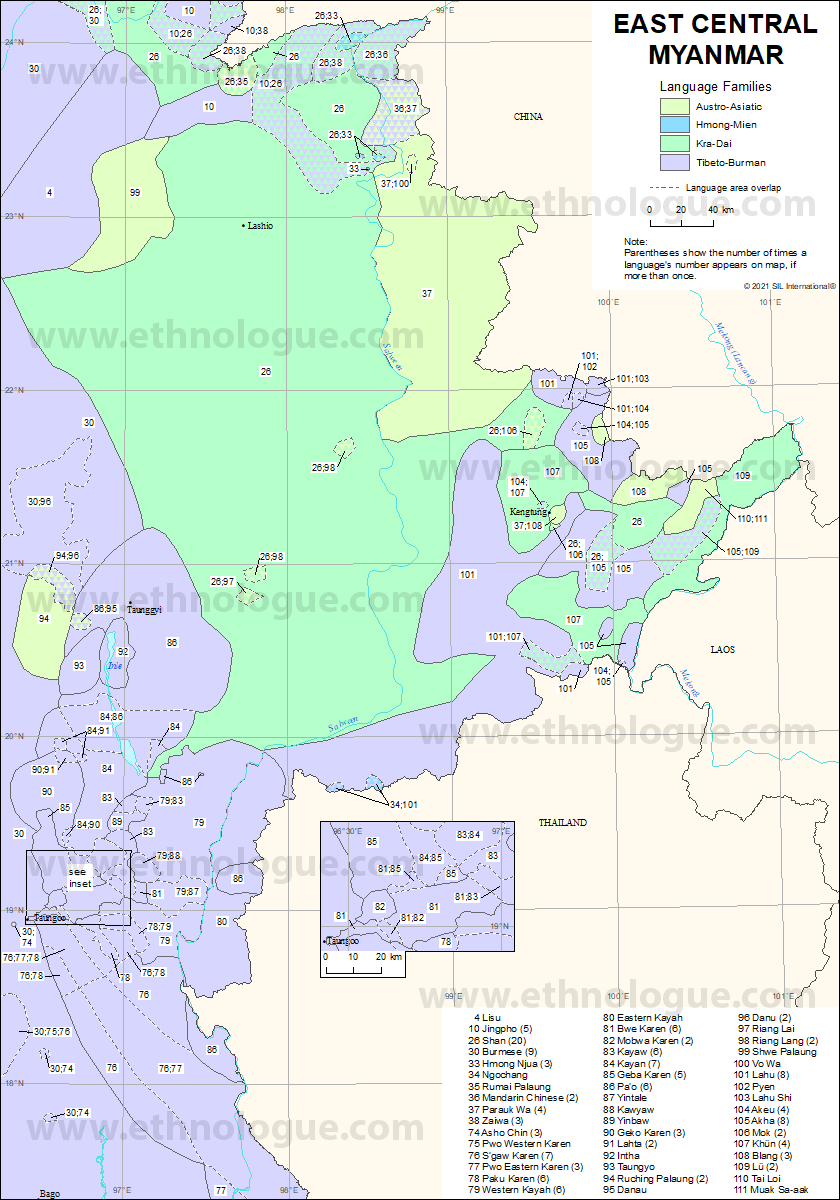
Eastern Central Myanmar
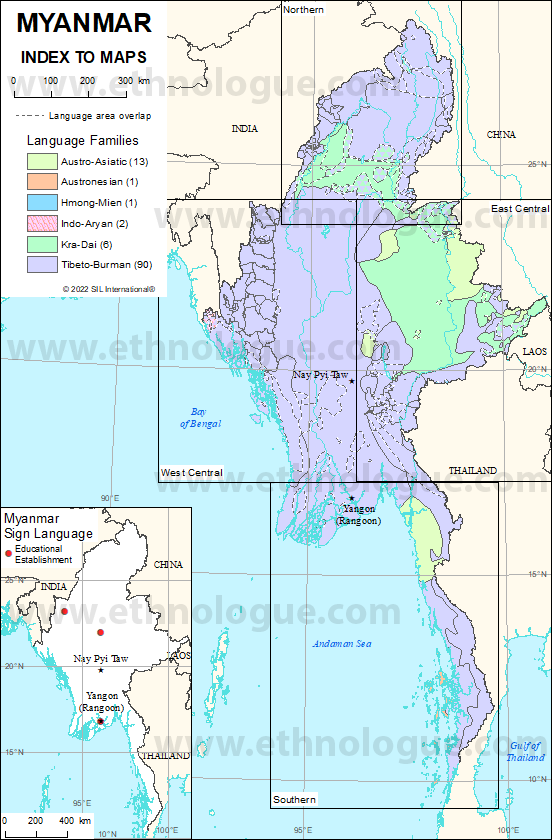
Myanmar: Index map
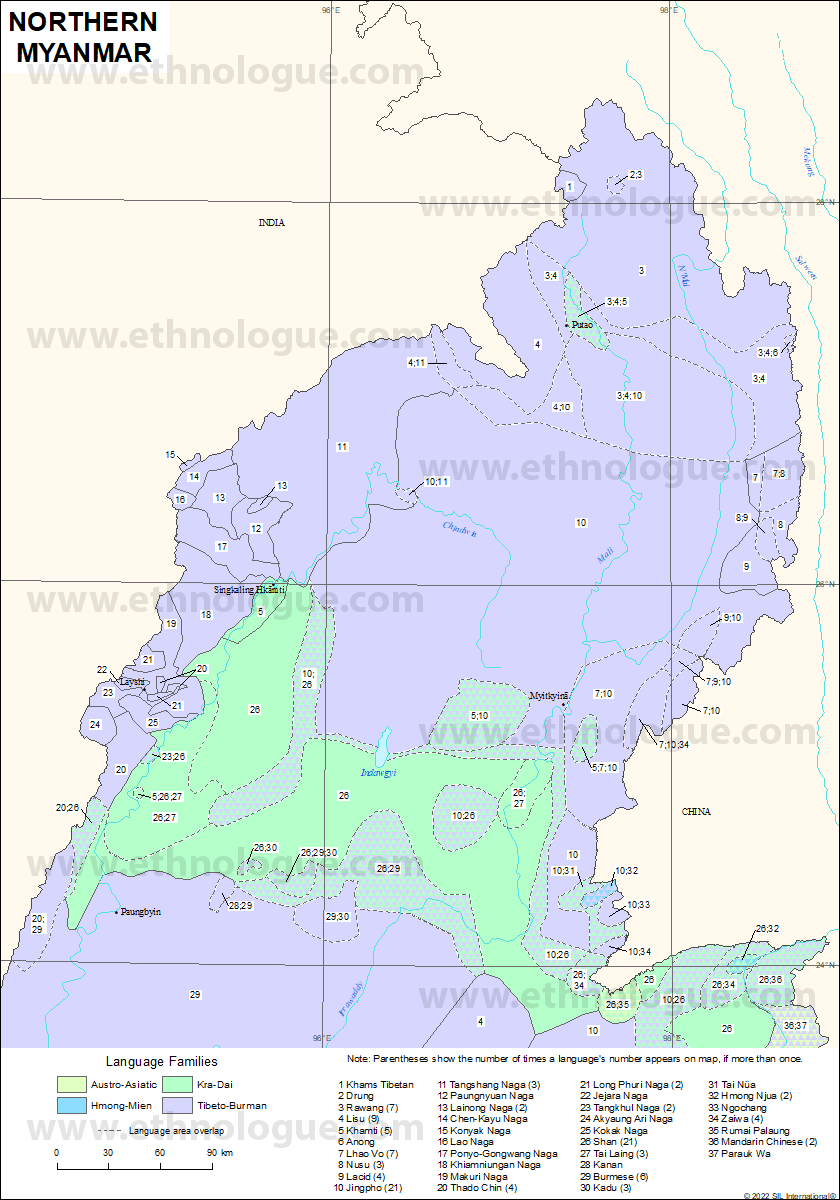
Northern Myanmar
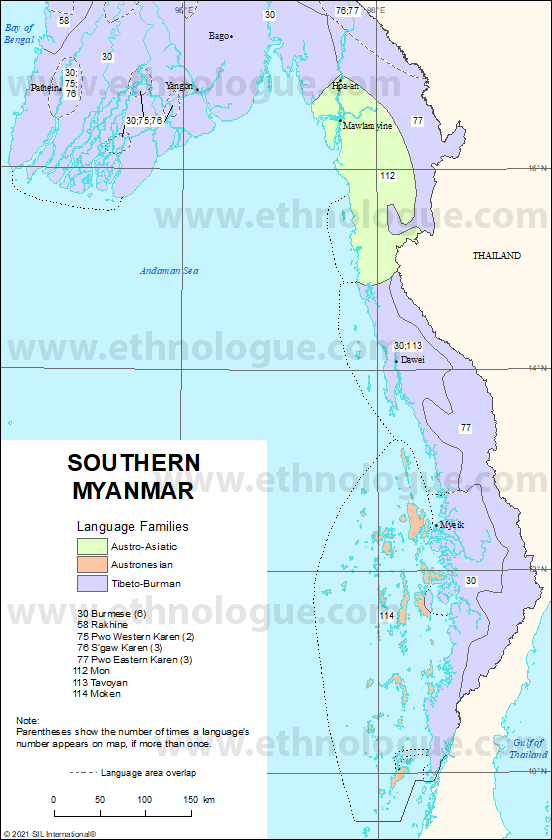
Southern Myanmar
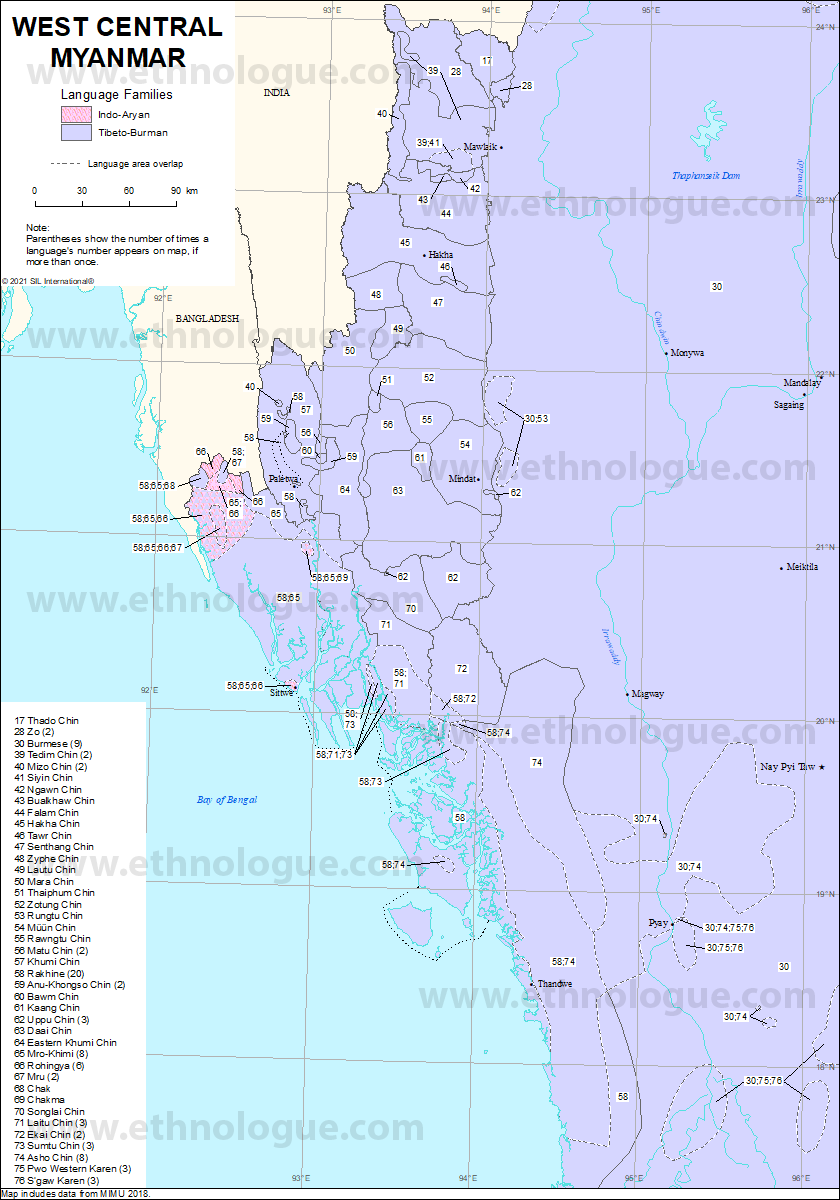
Western Central Myanmar
Graphs
Language Vitality Profile
Full explanation
Language Status Profile
Full explanation
Resources
View Terms
Each Ethnologue country digest is a licensed product with restricted terms of use. Before downloading the product, you must agree to the following terms:
- This is a license for individual use. Just as with a conventionally published book, it is a violation of copyright to make a copy and give it to others.
- You may not redistribute this work in any form, including ingesting the contents into a database that is shared with others or posting it on a web site (whether public or private).
To inquire about permission for reuse or redistribution, please use the Contact Us form in the footer.
Digest of the languages of Myanmar ($399.95, 100 page PDF)