
MR
Islamic Republic of Mauritania
Mauritania
Summary
- Official Name
- Islamic Republic of Mauritania
- Population
- 4,650,000
- Principal Languages
- French, Standard Arabic
- Literacy Rate
- 54% (2017 UNESCO)
- International Conventions
- ACHPR (1987), CPPDCE (2006), CSICH (2012), ICCPR (1966), UNCRPD (2006)
- General References
- Applegate 1970, Gerteiny 1967, Welmers 1971b
- Language Counts
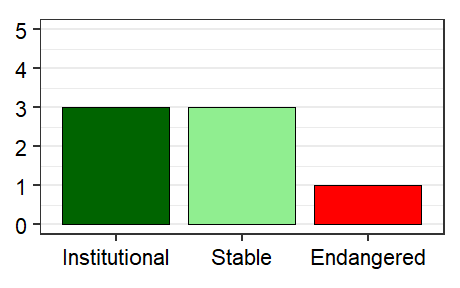
- The number of established languages listed for Mauritania is 7. All are living languages. Of these, 5 are indigenous and 2 are non-indigenous. Furthermore, 3 are institutional, 3 are developing, and 1 is dying. Also listed are 2 unestablished languages.
Languages
- Arabic, Standard arb
- Widespread. Users: 1,840,000 in Mauritania (2013 SIL), all users. Status: 1 (National). Statutory national language (1991, Constitution, Article 6). Classification: Afro-Asiatic, Semitic, Central, South, Arabic
- Bambara bam
- Users: 21,100 in Mauritania (2017). Status: Unestablished. Classification: Niger-Congo, Mande, Western, Central-Southwestern, Central, Manding-Jogo, Manding-Vai, Manding-Mokole, Manding, Manding-East, Northeastern Manding, Bamana
- French fra
- Widespread. Users: 662,560 in Mauritania, all users. L1 users: 6,560 in Mauritania (2020). L2 users: 656,000 (Marcoux et al 2022). Status: 3 (Wider communication). De facto national working language. Alternate Names: Français Classification: Indo-European, Italic, Romance, Italo-Western, Western, Gallo-Iberian, Gallo-Romance, Gallo-Rhaetian, Oïl, French
- Hassaniyya mey
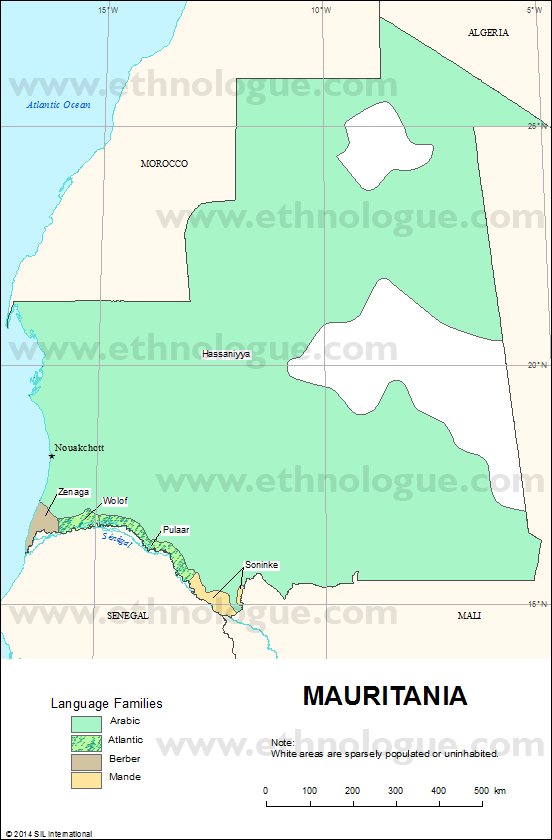
- Widespread. Users: 3,560,000 in Mauritania (2017), increasing. Total users in all countries: 4,885,400. Status: 3 (Wider communication). Statutory language of national identity (1991, Constitution, Article 6). Hassaniya comes from the name of the Beni Hassan tribes who invaded North Africa and settled in modern Mauritania in the 15th to 17th centuries. Used in trade and religion. Spoken throughout northwestern Africa. Alternate Names: Hasanya, Hasanya Arabic, Hassani, Hassania, Hassaniya, Hassaniyya Arabic, Klem El Bithan, Maure, Moor Autonym: Hassaniyya, حسانية (Ḥassānīya) Classification: Afro-Asiatic, Semitic, Central, South, Arabic
- Pulaar fuc
- Brakna, Gorgol, and Trarza regions, near Senegal. Users: 267,000 in Mauritania (2017). Status: 5 (Developing). Statutory language of national identity (1991, Constitution, Article 6). Alternate Names: Peul Classification: Niger-Congo, Atlantic-Congo, Atlantic, Northern, Senegambian, Fula-Wolof, Fula, Western
- Soninke snk
- Dakhlet Nouadhibou, Gorgol, and Guidimaka regions: Kaedi and Selibaby towns; 45 villages. Users: 219,000 in Mauritania (2017), increasing. Status: 5 (Developing). Statutory language of national identity (1991, Constitution, Article 6). Alternate Names: Aswanek, Aswanik, Azer, Gangara, Genger, Maraka, Marka, Sarakole, Sarakolle, Sarakule, Sarakulle, Serahule, Soninkanxanne Classification: Niger-Congo, Mande, Western, Northwestern, Soninke-Bobo, Soninke-Boso, Soninke
- Tamashek tmh
- Users: 117,000 in Mauritania (2017). Status: Unestablished.
- Wolof wol
- Brakna and Trarza regions. Users: 19,300 in Mauritania (2017), increasing. Status: 5 (Dispersed). Statutory language of national identity (1991, Constitution, Article 6). Alternate Names: Ouolof, Volof, Walaf, Yallof Classification: Niger-Congo, Atlantic-Congo, Atlantic, Northern, Senegambian, Fula-Wolof, Wolof
- Zenaga zen
- Trarza region: Atlantic coast to Mederdra. Users: 200 in Mauritania (2018), decreasing. Status: 8a (Moribund). Alternate Names: Mauritania Berber, Mauritanian Berber, Zenaga Berber Autonym: ⵜⵓⵥⵥⵓⵏⴳⵉⵢⵢⴰ (Tuẓẓungiyya) Classification: Afro-Asiatic, Berber, Zenaga
Languages by Status
Arabic, Standard
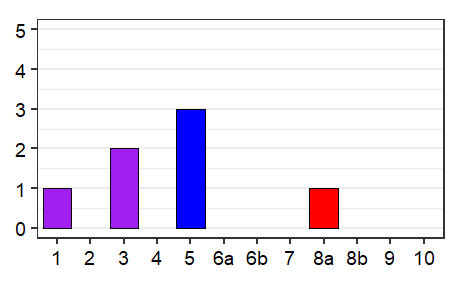
[arb] 1 (National). Statutory national language (1991, Constitution, Article 6). 1,840,000 in Mauritania (2013 SIL), all users.
French
[fra] 3 (Wider communication). De facto national working language. 662,560 in Mauritania, all users. L1 users: 6,560 in Mauritania (2020). L2 users: 656,000 (Marcoux et al 2022).
Hassaniyya
[mey] 3 (Wider communication). Statutory language of national identity (1991, Constitution, Article 6). Hassaniya comes from the name of the Beni Hassan tribes who invaded North Africa and settled in modern Mauritania in the 15th to 17th centuries. Used in trade and religion. Spoken throughout northwestern Africa. 3,560,000 in Mauritania (2017), increasing. Total users in all countries: 4,885,400.
Wolof
[wol] 5 (Dispersed). Statutory language of national identity (1991, Constitution, Article 6). 19,300 in Mauritania (2017), increasing.
Pulaar
[fuc] 5 (Developing). Statutory language of national identity (1991, Constitution, Article 6). 267,000 in Mauritania (2017).
Soninke
[snk] 5 (Developing). Statutory language of national identity (1991, Constitution, Article 6). 219,000 in Mauritania (2017), increasing.
Zenaga
[zen] 8a (Moribund). 200 in Mauritania (2018), decreasing.
Maps
Mauritania
Graphs
Language Vitality Profile
Full explanation
Language Status Profile
Full explanation
Resources
View Terms
Each Ethnologue country digest is a licensed product with restricted terms of use. Before downloading the product, you must agree to the following terms:
- This is a license for individual use. Just as with a conventionally published book, it is a violation of copyright to make a copy and give it to others.
- You may not redistribute this work in any form, including ingesting the contents into a database that is shared with others or posting it on a web site (whether public or private).
To inquire about permission for reuse or redistribution, please use the Contact Us form in the footer.
Digest of the languages of Mauritania ($149.95, PDF)