
MY
Malaysia
Summary
- Official Name
- Population
- 32,712,000
- Principal Languages
- English, Standard Malay
- Literacy Rate
- 95% (2018 UNESCO)
- International Conventions
- CSICH (2012), UNCRPD (2006), UNDRIP (2007)
- General References
- Boutin 1986, Boutin and Boutin 1985, Hudson 1978, King and King 1984, Kroeger 1985, Kroeger 1986, Moody and Walton 1984, Omar 1983, Prentice 1971, Prentice 1987, Rensch 2006, Rensch et al 2006, Salleh 2006, Soriente 2005, Wurm and Hattori 1981
- Deaf Population
- 29,500
- Language Counts
- The number of established languages listed for Malaysia is 133. Of these, 131 are living and 2 are extinct. Of the living languages, 110 are indigenous and 21 are non-indigenous. Furthermore, 10 are institutional, 4 are developing, 10 are vigorous, 94 are in trouble, and 13 are dying. Also listed are 23 unestablished languages and 1 macrolanguage.
Languages
- Abai Sungai abf
- Sabah: Kinabatangan river lower reaches. Users: Ethnic population: 500 (2000 SIL). Status: 7 (Shifting). Classification: Austronesian, Malayo-Polynesian, North Borneo, Sabahan, Paitanic
- Arabic, North Levantine Spoken apc
- Users: 15,000 in Malaysia (2021 Joshua Project), based on ethnicity. Status: Unestablished. Classification: Afro-Asiatic, Semitic, Central, South, Arabic
- Bajau, West Coast bdr
- Sabah: Kudat district, Banggi Island, Telutu’ village; Pitas district, south Marudu bay, mainly Dalima’, Jambangan, Kanibungan, Layag-Layag, Mapan-Mapan, Mausar, Mengkapon, Mengkubau Laut, Pantai Laut, and Sibayan Laut villages; west coast scattered from Kuala Penyu to Kudat districts, mainly Kota Belud and Tuaran towns. Users: Ethnic population: 210,000 (2010 census). Total users in all countries: 10,700. Status: 6b (Threatened). Alternate Names: Bajau, Bajau Sama, Land Bajaw, West Coast Bajao, West Coast Bajaw Autonym: Sama Classification: Austronesian, Malayo-Polynesian, Greater Barito, Sama-Bajaw, Sulu-Borneo, Borneo Coast Bajaw
- Bakati’, Rara lra
- Sarawak: Kuching division, Lundu, Pasir Hili, Pasir Tengah, and Kandai villages on Pasir river. Users: 11,300 in Malaysia (2000). Total users in all countries: 23,300. Status: 6a (Vigorous). Alternate Names: Luru Autonym: Rara Bakati’ Classification: Austronesian, Malayo-Polynesian, Land Dayak, Bakati’
- Banjar bjn
- Sabah: Keningau, Sandakan, Tawau, Tenom districts, scattered coastal settlements. Users: 5,000 in Malaysia (2013 SIL). Status: 7 (Shifting). Alternate Names: Bandjarese, Banjar Malay, Banjar Melau, Banjarese, Benjar Classification: Austronesian, Malayo-Polynesian, Malayo-Chamic, Malayic, Malay
- Batek btq
- Pahang, Kelantan, and Terengganu. Users: 1,000 (2006 JHEOA), decreasing. Ethnic population: 1,160 (2008 JHEOA). Status: 6b (Threatened). Alternate Names: Bateg, Bateq, Batok, Kleb, Nong, Tomo Classification: Austro-Asiatic, Mon-Khmer, Aslian, North Aslian, Eastern
- Bengali ben
- Users: 800,000 in Malaysia (2021 The Daily Star), based on nationality. Status: Unestablished. Classification: Indo-European, Indo-Iranian, Indo-Aryan, Outer Languages, Eastern, Bengali-Assamese
- Berawan, Central zbc
- Sarawak: Marudi district, Batu Belah (Tutoh river) and Long Teru (Tinjar river) villages. Users: 1,500 (2010 SIL). Status: 8a (Moribund). Alternate Names: Batu Belah, Long Teru, Melawan Classification: Austronesian, Malayo-Polynesian, North Borneo, North Sarawakan, Berawan-Lower Baram, Berawan, Central-East Berawan
- Berawan, East zbe
- Sarawak: Long Jegan, Long Takong, Long Taveng, and Long Teran Batu villages. Users: 1,100 (2010 SIL). Status: 6b (Threatened). Alternate Names: Long Jegan Berawan, Melawan Classification: Austronesian, Malayo-Polynesian, North Borneo, North Sarawakan, Berawan-Lower Baram, Berawan, Central-East Berawan
- Berawan, West zbw
- Sarawak: Mulu town, Long Terawan village. Users: 1,000 (2010 SIL). Status: 6b (Threatened). Alternate Names: Berawan, Long Terawan Classification: Austronesian, Malayo-Polynesian, North Borneo, North Sarawakan, Berawan-Lower Baram, Berawan
- Bidayuh Serian sdo
- Sarawak: Samarahan division, 30 or more villages. Users: 49,100 in Malaysia (2000 census). Status: 6b (Threatened). Alternate Names: Buka, Bukar, Bukar Sadung Bidayah, Bukar-Sadong Bidayuh, Sadung, Serian, Tebakang Autonym: Bidayŭh Bukar-Sadung Classification: Austronesian, Malayo-Polynesian, Land Dayak, Bidayuh, Eastern
- Bidayuh, Bau sne
- Sarawak: Kuching division, about 50 villages on Lundu, Sadong, and Samarahan Lundu rivers. Users: 29,200 in Malaysia (2000 census). Status: 6b (Threatened). Alternate Names: Bau-Jagoi, Jaggoi, Jagoi, Sarawak Dayak Classification: Austronesian, Malayo-Polynesian, Land Dayak, Bidayuh, Core, Western
- Bidayuh, Biatah bth
- Sarawak: Kuching division, Kuching district, 10 villages. Users: 63,900 in Malaysia (2000 census). Total users in all countries: 72,380. Status: 6b (Threatened). Alternate Names: Biatah, Bikuab, Kuap, Quop, Sentah, Siburan Classification: Austronesian, Malayo-Polynesian, Land Dayak, Bidayuh, Core, Central
- Bidayuh, Tringgus-Sembaan trx
- Sarawak: southwest of Kuching on Kalimantan border. Users: 850 in Malaysia (2007 Z. Akter). Status: 6b (Threatened). Alternate Names: Tringus Classification: Austronesian, Malayo-Polynesian, Land Dayak, Bidayuh, Core, Sembaan
- Bintulu bny
- Sarawak: Bintulu area, and 2 enclaves west; Sibuti area on northeast coast. Users: 4,200 (Wurm and Hattori 1981). Status: 6b* (Threatened). Classification: Austronesian, Malayo-Polynesian, North Borneo, North Sarawakan, Bintulu
- Bisaya, Brunei bsb
- Sarawak: Limbang and Marudi districts. Users: 20,000 in Malaysia (2007 SIL). Status: 6b* (Threatened). Alternate Names: Bekiau, Bisaya, Bisaya Bukit, Bisayah, Lorang Bukit, Visayak Classification: Austronesian, Malayo-Polynesian, North Borneo, Sabahan, Dusunic, Bisaya-Lotud, Southern
- Bisaya, Sabah bsy
- Sabah: Beaufort and Kuala Penyu districts, North Brunei Bay coast area, mainly along Padas and Klias rivers, south of Weston; Sarawak: Batu Danau, Limbang. Users: No monolinguals (2015 S.A. Luken). Ethnic population: 70,000 (2015 Sabah Bisaya Cultural Association). Status: 6b (Threatened). Alternate Names: Basaya, Besaya, Bisaia, Bisayah, Jilama Bawang, Jilama Sungai Classification: Austronesian, Malayo-Polynesian, North Borneo, Sabahan, Dusunic, Bisaya-Lotud
- Bonggi bdg
- Sabah: Kudat district, 15 villages on Balambangan and Banggi islands. Users: Ethnic population: 1,400 (1990 UBS). Status: 6b (Threatened). Alternate Names: Bangay, “Banggi” (pej.), “Banggi Dusun” (pej.) Classification: Austronesian, Malayo-Polynesian, Greater Central Philippine, Palawanic
- Brunei kxd
- Sabah: Kota Kinabalu southwest to Labuan Federal Territory and Brunei border; Sarawak: north Lawas district; Batang Baram river mouth to Bintulu town. Users: 51,000 in Malaysia (2013 SIL), decreasing. 35,000 monolinguals (2015 S. Damit). Ethnic population: 350,000 (2014 census). Status: 6b (Threatened). Alternate Names: Brunai, Brunei-Kadayan, “Orang Bukit” (pej.) Classification: Austronesian, Malayo-Polynesian, Malayo-Chamic, Malayic, Malay
- Bugis bug
- Sabah: Kota Kinabalu, Lahad Datu, Sandakan and Tawau districts, major cities but also scattered. Users: 17,800 in Malaysia (2000 SIL), decreasing. Ethnic population: 138,000 (2015 A. Supeno). Status: 6b (Threatened). Alternate Names: Basa Ugi, Buginese Classification: Austronesian, Malayo-Polynesian, South Sulawesi, Bugis
- Bukitan bkn
- Sarawak: small enclaves in Kapit and Tatau divisions. Users: 290 in Malaysia (2000). Status: 6b (Threatened). Alternate Names: Bakatan, Bakitan, Beketan, Mangkettan, Manketa, Pakatan Classification: Austronesian, Malayo-Polynesian, North Borneo, Melanau-Kajang, Kajang
- Burmese mya
- Peninsular: widespread. Users: 30,000 in Malaysia (2021 Joshua Project), based on ethnicity. Status: Unestablished. Classification: Sino-Tibetan, Tibeto-Burman, Ngwi-Burmese, Burmish, Southern
- Cham, Western cja
- Scattered in Peninsular Malaysia and Sabah. Users: 12,000 in Malaysia (2011). Status: Unestablished. Classification: Austronesian, Malayo-Polynesian, Malayo-Chamic, Chamic, Coastal, Cham
- Cheq Wong cwg
- Pahang: just south of Semai. Users: 460 (2008 JHEOA). Status: 6b (Threatened). Alternate Names: Beri, Ceq Wong, Che Wong, Che’wong, Chuba, Siwang Classification: Austro-Asiatic, Mon-Khmer, Aslian, North Aslian, Chewong
- Chinese, Hakka hak
- Negeri Sembilan, Perak, Sabah, Sarawak, Selangor: scattered, especially in major towns. Users: 1,810,000 in Malaysia (2021 Joshua Project), based on ethnicity. Status: 6b (Threatened). Classification: Sino-Tibetan, Chinese
- Chinese, Mandarin cmn
- Scattered, especially urban areas. Users: 1,230,000 in Malaysia, all users. L1 users: Recent census figures do not detail the number of Mandarin speakers. L2 users: 1,230,000 (2015). Status: 4 (Educational). Recognized language (1996, Education Act, No. 550, Article 2). Classification: Sino-Tibetan, Chinese
- Chinese, Min Bei mnp
- Users: 402,000 in Malaysia (2021 Joshua Project), based on ethnicity. Status: Unestablished. Classification: Sino-Tibetan, Chinese
- Chinese, Min Dong cdo
- Sarawak: mostly Bintangor, Sarikei, and Sibu towns. Users: 252,000 in Malaysia (2004). Status: 6b (Threatened). Classification: Sino-Tibetan, Chinese
- Chinese, Min Nan nan
- Johor, Kedah, Kelantan, and Terengganu. Users: 3,500,000 in Malaysia (2021 Joshua Project), based on ethnicity. Ethnic population: 6,410,000 (2014). Status: 6a* (Vigorous). Alternate Names: Banlamgi, Min Nan, Minnan Classification: Sino-Tibetan, Chinese
- Chinese, Pu-Xian cpx
- Selangor. Users: 24,700 in Malaysia (Salleh 2006). Ethnic population: 24,700 (2000 census). In Peninsular Malaysia. Status: 6a (Vigorous). Classification: Sino-Tibetan, Chinese
- Chinese, Yue yue
- Peninsular: Negeri Sembilan, Perak, Pahang, and Selangor states; Kuala Lumpur and other major cities and towns. Users: 1,460,000 in Malaysia (2021 Joshua Project), based on ethnicity. Ethnic population: 3,220,000 (2014). Status: 3 (Wider communication). The main lingua france among the Chinese in the cities and towns of central Peninsular Malaysia. Alternate Names: Cantonese, Yue, Yueh Classification: Sino-Tibetan, Chinese
- Duano dup
- Johor: Batu Pahat, Muar, and Pontian districts, Kuala Benut, Lenga, Minyak Beku, Pontian Besar, Rengit, Semerah, Senggarang, and Sungai Layau on west coast, Pontian Kecil area. Users: 600 in Malaysia (2007 SIL). No monolinguals. Ethnic population: 3,010 (2008 JHEOA). Status: 8a (Moribund). Alternate Names: Desin Dolak, Desin Duano, Orang Kuala, Orang Laut Classification: Austronesian, Malayo-Polynesian, Malayo-Chamic, Malayic, Malay
- Dumpas dmv
- Sabah: Beluran district, Bakung-Bakung, Gana Jati, Perancangan, Rancangan Nangoh, Tarasak, and Tombidong-Bidong villages. Users: 2,400 (2015 A. Ismael). No monolinguals (2015 A. Ismael). Ethnic population: 4,000 (2015 A. Ismael). Status: 7 (Shifting). Alternate Names: Doompas Classification: Austronesian, Malayo-Polynesian, North Borneo, Sabahan, Dusunic, Unclassified
- English eng
- Widespread: Johor, Kedah, Kelantan, Kuala Lumpur, Melaka, Negeri Sembilan, Pahang, Perak, Perlis, Pulau Pinang, Putrajaya, Selangor, and Terengganu states. Users: 10,383,900 in Malaysia, all users. L1 users: 83,900 in Malaysia (2021 Joshua Project), increasing, based on ethnicity. L2 users: 10,300,000 (2020). Status: 1 (National). Statutory national working language (1957, Constitution, Articles 152(2) through 152(5)). Classification: Indo-European, Germanic, West, English
- Gana gnq
- Sabah: Keningau district, Kuangoh and Minansut in Bingkor, along Baiaya river, a tributary of Pegalan river. Users: 250 (Pugh-Kitingan 2013), decreasing. Ethnic population: 2,000 (Pugh-Kitingan 2013). Status: 8a (Moribund). Alternate Names: Gana’, Ganaq, Ganna, Keningau Dusun, Minansut Classification: Austronesian, Malayo-Polynesian, North Borneo, Sabahan, Murutic, Unclassified
- Gujarati guj
- Users: 30,000 in Malaysia (2021 Joshua Project), based on ethnicity. Status: Unestablished. Classification: Indo-European, Indo-Iranian, Indo-Aryan, Intermediate Divisions, Western, Gujarati
- Hindi hin
- Users: 60,000 in Malaysia (2021 Joshua Project), based on ethnicity. Status: Unestablished. Classification: Indo-European, Indo-Iranian, Indo-Aryan, Western Hindi, Hindustani
- Iban iba
- Sabah: Tawau district; Sarawak: scattered in all 12 divisions of Sarawak. Users: 1,452,000 in Malaysia, all users. L1 users: 752,000 in Malaysia (2013 SIL), including 2,300 in 2 villages in Sabah (2013 A. Maraining). L2 users: 700,000 (2013 SIL). Total users in all countries: 1,482,800 (as L1: 782,800; as L2: 700,000). Status: 3 (Wider communication). Originated on Borneo Island; Iban people migrated to Malaysia and settled in the state of Sarawak. In 1840 during the British colonization period, Iban language became widely spoken. Used in education, media, literature, and music. Alternate Names: Iban Sabah, Sea Dayak Autonym: Jaku Iban Classification: Austronesian, Malayo-Polynesian, Malayo-Chamic, Malayic, Ibanic
- Ida’an dbj
- Sabah: Kinabatangan, Lahad Datu and Sandakan districts. Users: 10,000 (2013 SIL). Population includes 2,500 Begak. Ethnic population: 15,000 (2015 Pertubuhan Kebajikan Idahan Pewaris Madai, Lahad Datu (PEWARIS)). Status: 6b (Threatened). Alternate Names: Bulud Upi, Eraans, Idaan, Idahan, Idan, Idayan Classification: Austronesian, Malayo-Polynesian, North Borneo, Sabahan, Ida’an
- Iranun ilm
- Sabah: Kota Belud district, 24 villages; Kudat district, Indarasan Laut village; Lahad Datu district, Tungku. Users: 22,000 (2015 I. Sidik), decreasing. Ethnic population: 30,000 (Pugh-Kitingan and Mulia 1996). Status: 6b (Threatened). Alternate Names: Ilanun, Illanoan, Illanoon, Illanos, Illanun, Iranon Maranao, Iranum, Lanoon, Lanun, Ylanos Classification: Austronesian, Malayo-Polynesian, Greater Central Philippine, Danao, Maranao-Iranon
- Jah Hut jah
- Pahang: south of main Semai [sea] language area and Kuala Krau. Users: 2,500 (Bradley 2007b). Ethnic population: 3,760 (2008 JHEOA). Status: 6a (Vigorous). Alternate Names: Jah Het Classification: Austro-Asiatic, Mon-Khmer, Aslian, Jah Hut
- Jakun jak
- Johor and Pahang: Pekan district south along east coast to south of Johor river. Users: Ethnic population: 25,000 (2008 JHEOA). Status: 6b* (Threatened). Alternate Names: Djakun, Jakoon, Jaku’d, Jakud’n, Orang Hulu Classification: Austronesian, Malayo-Polynesian, Malayo-Chamic, Malayic, Malay
- Japanese jpn
- Users: 15,000 in Malaysia (2021 Joshua Project), based on ethnicity. Status: Unestablished. Classification: Japonic
- Javanese jav
- Kedah: Kota Setar and Kuala Munda districts; Perak: Kinta district; Sabah: scattered coastal areas; Selangor: Kuala Lumpur area. Users: Ethnic population: 300,000 (Wurm and Hattori 1981). Status: 8a (Moribund). Alternate Names: Jawa Classification: Austronesian, Malayo-Polynesian, Javanese
- Jehai jhi
- Perak: northeast; Kelantan: west. Users: 1,250 in Malaysia (Wurm and Hattori 1981). Ethnic population: 1,660 (2008 JHEOA). Status: 6b (Threatened). Alternate Names: Jahai, Pangan Classification: Austro-Asiatic, Mon-Khmer, Aslian, North Aslian, Eastern
- Kadazan Dusun dtp
- Sabah: West Coast division, Beaufort, Keningau, Kota Belud, Kota Kinabalu, Kota Marudu, Papar, Penampang, Ranau, Tambunan, and Tenom districts. Users: 264,000 (2010 census), increasing. Ethnic population: 556,000 (2010 census). Increasing. Status: 6b (Threatened). Alternate Names: Central Kadazan, Dusan, Dusum, Dusun, Dusur, Idaan, Kadasan, Kadayan, Kadazandusun, Kedayan Autonym: Kadazan Dusun Classification: Austronesian, Malayo-Polynesian, North Borneo, Sabahan, Dusunic, Dusun, Central
- Kadazan, Klias River kqt
- Sabah: Beaufort district, Klias river area. Users: 800 (2015 E. Ampai), decreasing. Ethnic population: 2,000 (2015 E. Ampai). Status: 6b (Threatened). Alternate Names: Kuijou, Kuizou Classification: Austronesian, Malayo-Polynesian, North Borneo, Sabahan, Dusunic, Dusun
- Kadazan, Labuk-Kinabatangan dtb
- Sabah: Beluran, Kinabatangan, and Sandakan districts. Users: Ethnic population: 20,600 (2000 SIL). Status: 7 (Shifting). Alternate Names: Eastern Kadazan, Labuk Kadazan, Sogilitan, Sungai, Sungai Kinabatangan, Tindakon, Tompulung Autonym: Tinangaran Kadajan Classification: Austronesian, Malayo-Polynesian, North Borneo, Sabahan, Dusunic, Dusun, Eastern
- Kajaman kag
- Sarawak: Kapit division near Belaga on Balui river. Users: 500 (Wurm and Hattori 1981). Status: 6b (Threatened). Alternate Names: Kajaman-Sekapan, Kayaman, Kejaman Classification: Austronesian, Malayo-Polynesian, North Borneo, Melanau-Kajang, Kajang
- Kannada kan
- Users: 59,000 in Malaysia (2021 Joshua Project), based on ethnicity. Status: Unestablished. Classification: Dravidian, Southern, Tamil-Kannada, Kannada
- Kayan, Baram kys
- Sarawak: north, Baram river area. Users: 4,150 (Wurm and Hattori 1981). Status: 6b (Threatened). Alternate Names: Baram Kajan Classification: Austronesian, Malayo-Polynesian, North Borneo, North Sarawakan, Kayan-Kenyah, Kayanic, Kayan Proper
- Kayan, Rejang ree
- Sarawak: Balui and Rejang river areas. Users: 3,030 (Wurm and Hattori 1981). Status: 6b (Threatened). Alternate Names: Rejang Kajan Classification: Austronesian, Malayo-Polynesian, North Borneo, North Sarawakan, Kayan-Kenyah, Kayanic, Kayan Proper
- Kelabit kzi
- Sarawak: highest most remote Borneo mountains, Bario highlands. Users: 4,000 in Malaysia (2011 SIL). Ethnic population: 5,000. Total users in all countries: 4,640. Status: 6b* (Threatened). Alternate Names: Kalabit, Kerabit Autonym: Kelabit Classification: Austronesian, Malayo-Polynesian, North Borneo, North Sarawakan, Dayic, Kelabitic
- Kenaboi xbn
- Negeri Sembilan. Users: No known L1 speakers. Last speaker likely died in about 1880 (Hajek 1998: 138). Status: 10 (Extinct). Alternate Names: Kĕnaboi Classification: Unclassified
- Kensiu kns
- Kedah: Baling district near Thai border; Perak: Hulu Perak district. Users: 250 in Malaysia (2015 N. Bishop). Total users in all countries: 259. Status: 6a (Vigorous). Alternate Names: Kenseu, Kensieu, Kensiw, Mendi, Monik, Moniq, Ngok Pa, Orang Bukit, Orang Liar Classification: Austro-Asiatic, Mon-Khmer, Aslian, North Aslian, Western
- Kenyah, Mainstream xkl
- Sarawak: near Kalimantan border, villages along Balui and Baram rivers and some tributaries; 1 village on Kakus river; Sungai Asap area. Users: 40,000 in Malaysia (2013 SIL). Status: 6b (Threatened). Alternate Names: Bakong, Bakung, Bakung Kenya, Bakung Kenyah Classification: Austronesian, Malayo-Polynesian, North Borneo, North Sarawakan, Kayan-Kenyah, Kenyah
- Kenyah, Wahau whk
- Sarawak: Belaga, Kapit, Marudi, and Tatau districts, Balang Baram, Baleh, Balul, and Belaga along interior rivers, including headwaters. Users: 1,000 in Malaysia (2007 A. Soriente). Status: 6b* (Threatened). Classification: Austronesian, Malayo-Polynesian, North Borneo, North Sarawakan, Kayan-Kenyah, Kenyah, Kayanic Kenyah
- Kimaragang kqr
- Sabah: Beluran, Kota Marudu, and Pitas districts. Users: 10,000 (Kroeger 2005), decreasing. Ethnic population: 25,000 (2007 SIL). Status: 6b (Threatened). Alternate Names: Kimaragan, Kimaragangan, Maragang, Marigang Autonym: Kimaragang Classification: Austronesian, Malayo-Polynesian, North Borneo, Sabahan, Dusunic, Dusun
- Kinabatangan, Upper dmg
- Sabah: Lahad Datu district; Tongod district, primarily upper reaches of Kinabatangan river. Users: Ethnic population: 15,000 (2015 L. Rose). Status: 6b (Threatened). Alternate Names: Orang Sungai, Sungai Milian Classification: Austronesian, Malayo-Polynesian, North Borneo, Sabahan, Paitanic, Upper Kinabatangan
- Kintaq knq
- Kedah and Perak border area, Thai border. Users: 110 in Malaysia (2008 JHEOA). Ethnic population: 240 (Bradley 2007b). Total users in all countries: 111. Status: 6b (Threatened). Alternate Names: Bong, Kenta, Kintak, Kintaq Bong Classification: Austro-Asiatic, Mon-Khmer, Aslian, North Aslian, Western
- Kiput kyi
- Sarawak: south of Marudi, Benawa and Kuala Tutoh villages. Users: 450 (Blust 2002). Status: 6b (Threatened). Classification: Austronesian, Malayo-Polynesian, North Borneo, North Sarawakan, Berawan-Lower Baram, Lower Baram, Central, A
- Korean kor
- Users: 20,900 in Malaysia (2019 Korean Ministry of Foreign Affairs), based on nationality. Status: Unestablished. Classification: Koreanic
- Kota Marudu Talantang grm
- Sabah: Kota Marudu district, Talantang 1 and Talantang 2. Users: Ethnic population: 1,800 (2000). Status: 6b* (Threatened). Classification: Austronesian, Malayo-Polynesian, North Borneo, Sabahan, Dusunic, Dusun
- Kuijau dkr
- Sabah: Keningau district, Keningau town area north and west. Users: Ethnic population: 7,910 (2000 S. Maduli). Status: 6b* (Threatened). Alternate Names: Hill Dusun, Kijau, Koijoe, Kuiyow, Kujau, Kuliow, Kuriyo, Kwijau, Menindal, Menindaq, Minansut, Tidung, Tindal Classification: Austronesian, Malayo-Polynesian, North Borneo, Sabahan, Dusunic, Dusun
- Lahanan lhn
- Sarawak: central, east of Belaga, southwest of Long Murum. Users: 350 (Wurm and Hattori 1981). Ethnic population: 700 (Alexander and Alexander 2002). Status: 6b (Threatened). Alternate Names: Lanan, Lanun Classification: Austronesian, Malayo-Polynesian, North Borneo, Melanau-Kajang, Kajang
- Lamaholot slp
- Sabah: scattered. Users: 45,000 in Malaysia (2015), decreasing. Ethnic population: 45,000 (2015 A. Supeno). Consulate of Indonesia. Status: Unestablished. Alternate Names: Florenese, Om, Orang Timur, Timorese Classification: Austronesian, Malayo-Polynesian, Central-Eastern Malayo-Polynesian, Bima-Lembata
- Lanoh lnh
- Perak: north central. Users: Ethnic population: 240 (2008 JHEOA). Status: 6b* (Threatened). Alternate Names: Jengjeng Classification: Austro-Asiatic, Mon-Khmer, Aslian, Senoic
- Lelak llk
- Sarawak: Marudi district, Loagan Bunut lake area on Tinjar river. Users: No known L1 speakers. The last speaker either died or fully assimilated to Central Berawan [zbc] by the late 1970s. Status: 10 (Extinct). Classification: Austronesian, Malayo-Polynesian, North Borneo, North Sarawakan, Berawan-Lower Baram, Lower Baram, Central, B
- Lobu, Lanas ruu
- Sabah: Keningau district, Sook sub-district, Lalapakon, Lanas, Kilu, Kuit, Mampisas, Manggarimot, Mansiat, Minusu, Pinipi, Sesalungon, and Tuawon; possibly Kinabatangan district. Rumanau dialect in Masaum, near Pinangah. Users: 4,000 (2015 P. Porodong), decreasing. No monolinguals (2015 P. Porodong). Ethnic population: 5,000 (2015 P. Porodong). 3,500 Lobu, 1,500 Rumanau. Status: 6b (Threatened). Alternate Names: Keningau Lobu, “Labou” (pej.) Autonym: Lobu Classification: Austronesian, Malayo-Polynesian, North Borneo, Sabahan, Paitanic, Upper Kinabatangan
- Lobu, Tampias low
- Sabah: Tampias area, Ranau, 3 villages. Users: Ethnic population: 1,800 (1985 SIL). Status: 6b* (Threatened). Classification: Austronesian, Malayo-Polynesian, North Borneo, Sabahan, Paitanic, Upper Kinabatangan
- Long Wat ttw
- Sarawak: northeast, Tutoh river. Users: 600 (Wurm and Hattori 1981). Status: 6b (Threatened). Alternate Names: Tutoh Kenya, Tutoh Kenyah Classification: Austronesian, Malayo-Polynesian, North Borneo, North Sarawakan, Kayan-Kenyah, Kenyah, Kayanic Kenyah
- Lotud dtr
- Sabah: Tuaran district, Kiulu, Telipok, Tuaran. Users: Ethnic population: 20,000 (2016 J. John-Baptist). Status: 6b (Threatened). Alternate Names: Dusun Lotud, Suang Lotud Classification: Austronesian, Malayo-Polynesian, North Borneo, Sabahan, Dusunic, Bisaya-Lotud
- Lundayeh lnd
- Sabah: Keningau district, Kuala Puntih, and Saup Baru; Sipitang district, Bamban, Bahagia, Batu Tujuh, Kaban, Kawang Baru, Kawang Lama, Long Kinangan, Long Mio, Long Pasia, Mendulong, Pekiak, Ranau-Ranau, Samin, Seri Menanti, Solob, and Tunas Baru; Sarawak: Lawas and Limbang districts; Tawau district, Batu 18 Balung, Batu 22 Balung, Batu 32, Cinta Damai, Kalabakan, Kunak, Merotai, and Serudung; Tenom district, Baru Jumpa, Baru Jumpa Seberang, Belumbung, Kalibatang Baru, Kelanan, Meluyan Ulu, Mengkelias, Sapong, and Sugiang Baru. Users: 24,000 in Malaysia (1982 SIL), decreasing. Sarawak 21,000, Sabah 3,000–4,000. Status: 6b (Threatened). Alternate Names: Buri tau, Buri’ Lun Bawang, Buri’ Lun Dayeh, Lun Bawang, Lun Daya, Lun Dayah, Lun Daye, Lun Dayeh, Lun Dayoh, Lun Lod, Lundaya, Lundayu, Southern Murut Classification: Austronesian, Malayo-Polynesian, North Borneo, North Sarawakan, Dayic, Kelabitic
- Mah Meri mhe
- Putrajaya, Negeri Sembilan, and Selangor: coastal areas; islands off the coasts. Users: 2,990 (2003 COAC). Ethnic population: 3,680 (2008 JHEOA). Status: 6b* (Threatened). Alternate Names: Besisi, Cellate, Hma’ Btsisi’, Ma’ Betisek, “Orang Sabat” (pej.) Classification: Austro-Asiatic, Mon-Khmer, Aslian, South Aslian
- Malaccan Malay Creole ccm
- Melaka: Gajah Berang and Kampung Tujung on Malacca straits. Users: Ethnic population: 300. Status: 8a (Moribund). Alternate Names: Chitties Malay Creole Classification: Creole, Malay based
- Malaccan Portuguese Creole mcm
- Melaka: Hilir and Trankera on Malacca Straits; Kuala Lumpur and Singapore. Users: 2,150 (Bradley 2007b). Ethnic population: 10,000 (Bradley 2007b). Status: 6b (Threatened). Alternate Names: Bahasa Geragau, Bahasa Serani, Luso-Malay, Malacca Creole, Malaccan, Malaqueiro, Malaquenho, Malaquense, Malaquês, Malayo-Portuguese, Malaysian Portuguese Creole, Papia Cristao, Papia Kristang, Portuguese Patois, Português de Malaca, Serani Autonym: Kristang Classification: Creole, Portuguese based
- Malay msa
- Users: Population total all languages (L1 only): 82,211,996. Status:
- Malay zlm
- Johor, Kedah, Kelantan, Kuala Lumpur, Melaka, Negeri Sembilan, Pahang, Perak, Perlis, Pulau Pinang, and Putrajaya states; Sarawak state: Betong, Kuching, Samarahan, and Sri Aman districts; Selangor and Terengganu states. Users: 13,500,000 in Malaysia, all users. L1 users: 10,500,000 in Malaysia (2004 census). 10 million in Peninsular Malaysia, 506,000 in Sarawak, and 30,000 in Labuan. L2 users: 3,000,000. Total users in all countries: 19,178,790 (as L1: 16,178,790; as L2: 3,000,000). Status: 5* (Developing). Originated in Sumatra; spoken throughout southeast Asia. With the advent of Islam, Malay became widespread in the 15th and 16th centuries. Lingua franca for Malaysia’s multiethnic population. Used in trade, literature, and story telling. Alternate Names: Colloquial Malay, Informal Malay, Local Malay, Malayu Autonym: Bahasa Melayu, ملايو (Melayu) Classification: Austronesian, Malayo-Polynesian, Malayo-Chamic, Malayic, Malay
- Malay, Baba mbf
- Melaka: Melaka city area and nearby coast; Pulau Pinang: Malacca Straits, Pinang island. Users: 2,000 in Malaysia (Salleh 2006). Status: 8a (Moribund). Alternate Names: Chinese Malay, Peranakan, Straits Malay Classification: Creole, Malay based
- Malay, Cocos Islands coa
- Sabah: Beluran, Lahad Datu and Tawau districts. Users: 500 monolinguals (2015 A. Serasa Tosel). Ethnic population: 4,000 (2000 SIL). Status: 7 (Shifting). Alternate Names: Cocos, Cocos Islands, Melayu Cocos, Ong Pulu Classification: Creole, Malay based
- Malay, Kedah meo
- Kedah, Perak, Perlis, and Pulau Pinang states. Users: 2,600,000 in Malaysia (2004). Status: 3 (Wider communication). Became the lingua franca of the state of Kedah in the late 1800s. Spoken by almost all Kedahans regardless of race. Used in trade and at home. Alternate Names: Kedahan Malay, Satun Malay Autonym: Pelat Utagha Classification: Austronesian, Malayo-Polynesian, Malayo-Chamic, Malayic, Malay
- Malay, Sabah msi
- Sabah. Users: 3,000,000 (2013 SIL), all users. L1 users: Mostly second-language speakers, but growing number of L1 speakers (2015 J. K. L. Wong). Ethnic population: No ethnic community (2015 J.K.L. Wong). Status: 3 (Wider communication). Used throughout the state of Sabah in virtually all non-formal domains. Became the lingua franca of over 50 different ethno-linguistic groups. Alternate Names: Bazaar Malay, Pasar Malay, Sabah Malay Dialect Autonym: Bahasa Sabah Classification: Austronesian, Malayo-Polynesian, Malayo-Chamic, Malayic, Malay
- Malay, Standard zsm
- Widespread. Users: Few L1 speakers. L2 includes most Malaysian population. Status: 1 (National). Statutory national language (1963, Constitution (amended), Article 153A(1)). Alternate Names: Bahasa Malayu, Bahasa Melayu Malaysia, Formal Malay, Malay, Malaysian Malay, Malayu, Melayu, Melayu Baku Autonym: Bahasa Malaysia, بهاس مليسيا (Bahasa Malaysia) Classification: Austronesian, Malayo-Polynesian, Malayo-Chamic, Malayic, Malay
- Malayalam mal
- Peninsular: western states. Users: 35,800 in Malaysia (Salleh 2006). Status: Unestablished. Classification: Dravidian, Southern, Tamil-Kannada, Tamil-Kodagu, Tamil-Malayalam, Malayalam
- Malaysian Sign Language xml
- Scattered. Users: 58,700 (2013 census). Approximately 0.2% of total population. Status: 6a (Vigorous). Alternate Names: BIM, Bahasa Isyarat Malaysia Classification: Sign language, Deaf community sign language
- Mapun sjm
- Sabah: Kota Kinabalu district, Kota Kinabalu; Kota Marudu district, Kota Marudu; Kudat district, Banggi and Mantanani islands, Kudat; Sandakan district, Sandakan. Users: 15,000 in Malaysia (2015 M. Tanjul). Ethnic population: 30,000 (2015 M. Tanjul). Status: 6b (Threatened). Alternate Names: Bajau Kagayan, Cagayan de Sulu, Cagayanon, Jama Mapun, Kagayan, Orang Cagayan, Pellun Mapun, Sama Mapun Classification: Austronesian, Malayo-Polynesian, Greater Barito, Sama-Bajaw, Sulu-Borneo, Borneo Coast Bajaw
- Melanau, Central mel
- Sarawak: Mukah division, Rejang delta coastal area to Balingian river. Users: 113,000 in Malaysia (2000 census). Total users in all countries: 113,280. Status: 6b* (Threatened). Alternate Names: Belana’u, Milanau, Milano Classification: Austronesian, Malayo-Polynesian, North Borneo, Melanau-Kajang, Melanau
- Melanau, Daro-Matu dro
- Sarawak: Daro and Matu areas on Matu river from Rejang river north channel to the sea. Users: 7,600 (Wurm and Hattori 1981). 4,800 Matu, 2,800 Daro. Status: 6b* (Threatened). Classification: Austronesian, Malayo-Polynesian, North Borneo, Melanau-Kajang, Melanau
- Melanau, Kanowit-Tanjong kxn
- Sarawak: Sibu division, middle Rejang River. Kanowit dialect downstream from Tanjong dialect. Users: 200 (Wurm 2000). Ethnic population: 500. Status: 6b (Threatened). Classification: Austronesian, Malayo-Polynesian, North Borneo, Melanau-Kajang, Melanau
- Melanau, Sibu sdx
- Sarawak: Sibu division, Rejang river. Users: 420 (Wurm and Hattori 1981). Status: 7 (Shifting). Alternate Names: Seduan-Banyok, Sibu, Siduan, Siduani Classification: Austronesian, Malayo-Polynesian, North Borneo, Melanau-Kajang, Melanau
- Minokok mqq
- Sabah: Kinabatangan river headwaters. Users: 1,200 (2007 SIL). Status: 6b (Threatened). Classification: Austronesian, Malayo-Polynesian, North Borneo, Sabahan, Dusunic, Dusun, Central
- Minriq mnq
- Kelantan: southeast, 2 villages. Users: 100 (Bradley 2007b). Ethnic population: 270 (2008 JHEOA). Status: 6b (Threatened). Alternate Names: Mendriq, Menraq, Menrik, Menriq Classification: Austro-Asiatic, Mon-Khmer, Aslian, North Aslian, Eastern
- Mintil mzt
- Pahang: Lipis district, Tamun river, 3 villages. Users: 180 (2005 Lye Tuck-Po). Status: 8a (Moribund). Alternate Names: Mitil Classification: Austro-Asiatic, Mon-Khmer, Aslian, North Aslian, Eastern
- Molbog pwm
- Sabah: Kudat district, Balambangan and Banggi islands. Users: 2,500 in Malaysia (2015 T. Imam Tuah). 250 monolinguals (2015 T. Imam Tuah). Ethnic population: 2,500 (2015 T. Imam Tuah). Status: 5 (Developing). Classification: Austronesian, Malayo-Polynesian, Greater Central Philippine, Palawanic
- Murik mxr
- Sarawak: below Long Miri (Banyok dialect) and below Lio Mato (Semiang dialect) on Baram river. Users: 1,120 (Wurm and Hattori 1981). Status: 7 (Shifting). Classification: Austronesian, Malayo-Polynesian, North Borneo, North Sarawakan, Kayan-Kenyah, Kayanic, Murik Kayan
- Murut, Bookan bnb
- Sabah: Keningau and Kinabatangan districts, Kinabatangan and Sook rivers’ headwaters area. Users: Ethnic population: 2,400 (2017 SIL). Status: 7 (Shifting). Alternate Names: Baukan, Baukan Murut, Bookan Classification: Austronesian, Malayo-Polynesian, North Borneo, Sabahan, Murutic, Northern
- Murut, Kalabakan kve
- Sabah: Tawau district, along Kalabakan river. Users: Ethnic population: 2,230 (2000 B. Lingki). Status: 6b (Threatened). Alternate Names: Kalabakan, Tawau Murut, Tidung Classification: Austronesian, Malayo-Polynesian, North Borneo, Sabahan, Murutic, Southern
- Murut, Keningau kxi
- Sabah: Keningau district, east of Pegalan river down to Ansip village. Users: 3,000 (2015 A. Jampadin), decreasing. Ethnic population: 7,000 (2000 A. Jampadin). Status: 7 (Shifting). Alternate Names: Central Murut Autonym: Keningau Murut Classification: Austronesian, Malayo-Polynesian, North Borneo, Sabahan, Murutic, Murut
- Murut, Kolod kqv
- Sabah: Sipitang district, Bamban, Iburu, Meligan, Sulob, and Ulu Bole villages; Tenom district, Bamban village; Sarawak: Lawas district, Long Tengoa. Users: 2,000 in Malaysia (2015 R. Ganang), decreasing. Less than 1,000 in Sarawak. More than 1,000 in Sabah. Status: 8a (Moribund). Alternate Names: Kolod, Kolor, Kolour, Kolur, Okolod, Okolod Murut Classification: Austronesian, Malayo-Polynesian, North Borneo, Sabahan, Murutic, Murut
- Murut, Paluan plz
- Sabah: Keningau, Pensiangan, and Tenom districts, Padas river tributaries; Dalit, Keramatoi, Mesopo, Nabawan, and Pamentarian rivers; lower Sook river valley; Sapulut and Talankai rivers’ headwaters. Users: 5,500 (2000 SIL). 3,000 Paluan, 1,000 to 2,000 Pandewan. Status: 6b* (Threatened). Alternate Names: Paluan Classification: Austronesian, Malayo-Polynesian, North Borneo, Sabahan, Murutic, Murut
- Murut, Selungai slg
- Sabah: Nabawan district, 1 village in Pensiangan river basin south to Indonesia border. Users: 600 in Malaysia (2000 SIL). Ethnic population: 600 (2000 SIL). Status: 6a (Vigorous). Classification: Austronesian, Malayo-Polynesian, North Borneo, Sabahan, Murutic, Murut
- Murut, Sembakung sbr
- Sabah: Sembakung river area. Users: Ethnic population: 2,000 (2000 SIL). Status: 6b* (Threatened). Alternate Names: Sembakoeng, Sembakong, Simbakong, Tenggalan, Tidoeng, Tidong, Tidung, Tingalan, Tingalun, Tinggalan, Tinggalum Classification: Austronesian, Malayo-Polynesian, North Borneo, Sabahan, Murutic, Southern
- Murut, Serudung srk
- Sabah: Tawau district, along Serudung river, 1 village near Tawau town. Users: 400 (2015 J. Rushing), decreasing. Ethnic population: 1,000 (2015 J. Rushing). Status: 6b (Threatened). Alternate Names: Serudong, Suudung, Tawau Murut, Tawou Murut Classification: Austronesian, Malayo-Polynesian, North Borneo, Sabahan, Murutic, Tidung
- Murut, Tahol mvv
- Sabah: Nabawan district, south Sipitang and Tenom districts, mainly along Maligan, Padas (Tomani), Salalir, Tahol, Tolokoson, and watersheds. Sarawak: Lawas district. Users: 20,000 in Malaysia (2015 L. Murang), decreasing. Ethnic population: 200,000 (2015 L. Murang). Largest Murutic group in Sabah (Harris 1991; Brewis 2004: 43). Total users in all countries: 22,000. Status: 6b (Threatened). Alternate Names: Pensiangan, Sumambu, Tagal, Tagal Murut, Tagol Autonym: Tahol Classification: Austronesian, Malayo-Polynesian, North Borneo, Sabahan, Murutic, Murut
- Murut, Timugon tih
- Sabah: Beaufort district, Bukau and lower Padas rivers; Tenom district, Padas river from Melalap to Batu-Batu. Users: Ethnic population: 9,000 (2004 S. Majius). Status: 6b (Threatened). Alternate Names: Temogun, Timigan, Timigun, Timogon, Timogun, Tumugun, “Tenom Murut” (pej.) Autonym: Timugon Classification: Austronesian, Malayo-Polynesian, North Borneo, Sabahan, Murutic, Murut
- Narom nrm
- Sarawak: Miri area and south; Kuala Nusah and Tanjung Beliput Niah area (Bakong dialect); Bekenu, Benkenu Asli, Jengalas, Menjelin, Rambai Asli, and Rancha-Rancha villages (Dali’ dialect); Bakam, Lopeng, Miri city, Pengkalan, and Pujut villages (Miri’ dialect). Users: Ethnic population: 4,000. Population includes about 1,000 Bakong, 1,000 Dali’, and 1,000 Miri’ (2012 SIL). Status: 6b* (Threatened). Alternate Names: Narum Classification: Austronesian, Malayo-Polynesian, North Borneo, North Sarawakan, Berawan-Lower Baram, Lower Baram, Central, B
- Negeri Sembilan Malay zmi
- Negeri Sembilan: Ulu Muar district. Users: Used as L1 by many inhabitants of Negeri Sembilan State (2011 K. Anderbeck). Ethnic population: 508,000 (2004). Status: 6b* (Threatened). Alternate Names: Malaysian Minangkabau, Orang Negeri, Ulu Muar Malay Classification: Austronesian, Malayo-Polynesian, Malayo-Chamic, Malayic, Malay
- Nepali npi
- Users: 235,000 in Malaysia (2021 Joshua Project), based on ethnicity. Status: Unestablished. Classification: Indo-European, Indo-Iranian, Indo-Aryan, Intermediate Divisions, Eastern, Eastern Pahari
- Orang Kanaq orn
- Johor: east, northeast of Mawai (Kota Tinggi). Users: Ethnic population: 160 (2008 JHEOA). Status: 8b (Nearly extinct). Alternate Names: Kanaq Classification: Austronesian, Malayo-Polynesian, Malayo-Chamic, Malayic, Malay
- Orang Seletar ors
- Johor: southeast coast, Kukuo area; Johore Bahru, east and north. Users: Ethnic population: 1,250 (2008 JHEOA). Total users in all countries: 1,200. Status: 6b* (Threatened). Alternate Names: Orang Laut Classification: Austronesian, Malayo-Polynesian, Malayo-Chamic, Malayic, Malay
- Papar dpp
- Sabah: Kuala Penyu district, Jangkit, Linsuk, Tenambak, and Tidung-Bedungon. Users: 500 (2015 J. Saban), decreasing. No monolinguals (2015 J. Saban). Ethnic population: 1,900 (2015 J. Saban). Status: 7 (Shifting). Alternate Names: Bajau Bukit, Bajau Pa’par, Pa’par, Pappar, “Papar Hanyut” (pej.) Classification: Austronesian, Malayo-Polynesian, North Borneo, Sabahan, Murutic, Unclassified
- Penan, Eastern pez
- Sarawak: Apoh river district east of Baram river. Users: 10,000 in Malaysia (2011 SIL). Total users in all countries: 10,055. Status: 6b* (Threatened). Classification: Austronesian, Malayo-Polynesian, North Borneo, North Sarawakan, Kayan-Kenyah, Penan
- Penan, Western pne
- Sarawak: Kapit division, Balui and upper Baram rivers, Mount Dulit area, 3 villages; Nibong branch of Lobong river. Users: 3,400 (2007 SIL). Status: 6b (Threatened). Alternate Names: Nibon, Nibong, “Punan” (pej.) Classification: Austronesian, Malayo-Polynesian, North Borneo, North Sarawakan, Kayan-Kenyah, Penan
- Penang Sign Language psg
- Pulau Pinang: scattered. Users: 1,000, decreasing. 150 monolinguals. Status: 8a (Moribund). Classification: Sign language, Deaf community sign language
- Punan Bah-Biau pna
- Sarawak: Kapit division, Merit and Rejang rivers areas. Users: 6,000 (2020 Punan National Association). Status: 6a (Vigorous). Alternate Names: Bah-Biau, Bah-Biau Penan, Punan Classification: Austronesian, Malayo-Polynesian, North Borneo, Rejang-Sajau
- Punan Batu pnm
- Sarawak: Marudi district, west of Long Geng, southeast of Belaga. Users: 30 (Wurm 2000). Status: 6b (Threatened). Alternate Names: Punan Batu 1 Classification: Austronesian, Malayo-Polynesian, North Borneo, Melanau-Kajang, Kajang
- Punjabi, Eastern pan
- Western Peninsular. Users: 56,400 in Malaysia (Salleh 2006). Status: Unestablished. Classification: Indo-European, Indo-Iranian, Indo-Aryan, Intermediate Divisions, Western, Panjabi
- Remun lkj
- Sarawak: Serian district, Kuching division, 13 villages, southeast of Serian to Balai Ringin. Users: 3,500 (2000 SIL). Status: 6b (Threatened). Alternate Names: Milikin, Millikin, Remun Iban Classification: Austronesian, Malayo-Polynesian, Malayo-Chamic, Malayic, Ibanic
- Rohingya rhg
- Users: 150,000 in Malaysia (2017 The Arakan Project), based on nationality. Status: Unestablished. Classification: Indo-European, Indo-Iranian, Indo-Aryan, Outer Languages, Eastern, Bengali-Assamese
- Rungus drg
- Sabah: Beluran, Kota Marudu, Kudat, and Pitas districts. Users: 55,000 (2009 PCS), decreasing. 10,000 monolinguals (2015 P. Porodong, F. Akiam). Ethnic population: 60,000 (2010 census). Status: 6b (Threatened). Alternate Names: Dayak Laut, Dusun Dayak, Kadazan, Melobong Rungus, Melubong Rungus, Memagun, Memogun, Roongas, Rungus Dusun Autonym: Momogun Classification: Austronesian, Malayo-Polynesian, North Borneo, Sabahan, Dusunic, Dusun
- Sa’ban snv
- Sarawak: Miri division, Long Banga’, Upper Baram, Long Peluan, Long Puak on Kalimantan border. Users: 1,110 in Malaysia (2000). Ethnic population: 1,400 (2011). Total users in all countries: 1,960. Status: 6b (Threatened). Alternate Names: Berau, Braow, “Merau” (pej.) Classification: Austronesian, Malayo-Polynesian, North Borneo, North Sarawakan, Dayic, Kelabitic
- Sabüm sbo
- Perak: north central. Users: No known L1 speakers. The last speaker survived into the late 1970s (Benjamin 1976). Status: 9 (Dormant). Classification: Austro-Asiatic, Mon-Khmer, Aslian, Senoic
- Salako knx
- Sarawak: Kuching division, Lundu district, Saak. 22 villages. Users: 10,700 in Malaysia (2000 census). Status: 6a (Vigorous). Alternate Names: Kenayatn, Kendayan, Salakau, Selakau, Selako, Silakau Classification: Austronesian, Malayo-Polynesian, Malayo-Chamic, Malayic
- Sama, Balangingih sse
- Sabah: Lahad Datu coast, Semporna, and Tawau districts; some in Kota Belud district. Users: 5,000 in Malaysia (2013 SIL). Status: 5* (Developing). Alternate Names: Baangingi’, Balagnini, Balangingi, Balangingi Bajau, Balanian, Balanini, Balignini, Bangingih, Bangingih Sama, Northern Sinama, Sama, Sama Bangingih Classification: Austronesian, Malayo-Polynesian, Greater Barito, Sama-Bajaw, Sulu-Borneo, Inner Sulu Sama
- Sama, Central sml
- Sabah: Kunak and Semporna districts, Bebeng, Bohe’an, Gaya, Karindingan, and Kallo’ islands; Halo, Hidayat, Mastra, Panji, Salamat, Siriyaman villages; Ampalling, Balimbing, Bangaw-Bangaw, Batu Ruwa, Danawan, Kabogang, Labuan Hadji, Mabul, Manam Pellit, Mataking Island, Tampe’-Tampe’, Timbun Mata, Tubu’-Tubu’, and Umaral settlements. Users: 15,000 in Malaysia (2000 C. Soderberg). Status: 5* (Developing). Alternate Names: Badjaw, Bajau Pela’u, Sama, Sama Dilaut, Sama Kabinga’an, Sama Mandelaut, Sama Pala’u, Sama Siasi, Sama Sitangkai, Sama Ubian, Sinama Classification: Austronesian, Malayo-Polynesian, Greater Barito, Sama-Bajaw, Sulu-Borneo, Inner Sulu Sama
- Sama, Southern ssb
- Sabah: some coastal regions of Kota Belud district; Kota Kinabalu district, including Gaya island; Kuala Penyu district; Kudat district, Banggi and Mantanani islands; Sandakan and Semporna districts. Users: 60,000 in Malaysia (2015 S. Hinayat, M. Miller), decreasing. No monolinguals. Ethnic population: 119,000 (2000 SIL). 61,000 Bajau Kubang (or Bajau Semporna), 15,000 Bajau Laut, 14,500 Bajau Simunul, 13,000 Bajau Ubian, 9,000 Sibutu, 6,000 Sikubung, 700 Bajau Banaran. Status: 6b (Threatened). Alternate Names: Sinama, Southern Bajau, Tawi-Tawi Sinama Classification: Austronesian, Malayo-Polynesian, Greater Barito, Sama-Bajaw, Sulu-Borneo, Inner Sulu Sama
- Sebop sib
- Sarawak: Bintulu, Kapit, and Miri divisions junctures on upper Tinjar river. Users: 1,730 (Wurm and Hattori 1981). Status: 6b (Threatened). Alternate Names: Cebop, Sabup, Sebob, Sibop Classification: Austronesian, Malayo-Polynesian, North Borneo, North Sarawakan, Kayan-Kenyah, Kenyah, Kayanic Kenyah
- Sekapan skp
- Sarawak: Kapit division, Belaga. Users: 750 (Wurm and Hattori 1981). Status: 6b (Threatened). Alternate Names: Sekepan Classification: Austronesian, Malayo-Polynesian, North Borneo, Melanau-Kajang, Kajang
- Selangor Sign Language kgi
- Selangor: scattered. Users: 500, decreasing. Status: 8a (Moribund). Alternate Names: KLSL, Kuala Lumpur Sign Language, SSL Classification: Sign language, Deaf community sign language
- Semai sea
- Pahang state: northwest; Perak state: south; Selangor state: north. Users: 45,000 (2020 G. Benjamin). Status: 3 (Wider communication). The Semai were the original inhabitants of the Malay Peninsula; their language spread widely in the 20th century. The language was the lingua franca of the Malaysian Aslian military armed forces unit (Bradley 2007a). Used in trade, hunting, fishing, farming, and literacy projects. Alternate Names: Semay, Seng’oi, Sengoi, Senoi, “Central Sakai” (pej.) Autonym: Semai Classification: Austro-Asiatic, Mon-Khmer, Aslian, Senoic
- Semaq Beri szc
- Kelantan, Pahang, and Terengganu states. Users: 2,000 (Bradley 2007b). Ethnic population: 3,970 (2008 JHEOA). Status: 6a (Vigorous). Alternate Names: Semaq Bri, Semoq Beri Classification: Austro-Asiatic, Mon-Khmer, Aslian, South Aslian
- Semelai sza
- Pahang state: southwest; Negeri Sembilan state: northwest; Tasek Bera shores area, along Bera, Teriang, and Serting rivers; Johor state, northwest, Muar river. Users: 4,100 (Kruspe 2009). Ethnic population: 6,270 (2008 JHEOA). Status: 6b* (Threatened). Classification: Austro-Asiatic, Mon-Khmer, Aslian, South Aslian
- Semnam ssm
- Perak state: north central. Users: 670 (2000). Status: 6b (Threatened). Classification: Austro-Asiatic, Mon-Khmer, Aslian, Senoic
- Seru szd
- Sarawak state. Status: Unattested. Classification: Austronesian, Malayo-Polynesian, North Borneo, Melanau-Kajang, Melanau
- Sihan spg
- Sarawak state: Kapita division, Belaga. Users: 50 (Wurm 2000). Ethnic population: 100 (2000). Status: 6b (Threatened). Alternate Names: Sian Classification: Austronesian, Malayo-Polynesian, North Borneo, Melanau-Kajang, Kajang
- Sindhi snd
- Users: 30,000 in Malaysia (2021 Joshua Project), based on ethnicity. Status: Unestablished. Classification: Indo-European, Indo-Iranian, Indo-Aryan, Outer Languages, Northwestern, Sindhi
- Sinhala sin
- Users: 4,400 in Malaysia (2021 Joshua Project), based on ethnicity. Status: Unestablished. Classification: Indo-European, Indo-Iranian, Indo-Aryan, Outer Languages, Southern, Sinhalese-Maldivian
- Sugut Dusun kzs
- Sabah state: Labuk-Sugut district on Sugut river headwaters. Users: Ethnic population: 12,200 (2000 SIL). Status: 6b* (Threatened). Alternate Names: Dusun, Kadayan, Sugut, Sugut Kadazan, Tanggal, Tilau-Ilau Classification: Austronesian, Malayo-Polynesian, North Borneo, Sabahan, Dusunic, Dusun, Central
- Suluk tsg
- Sabah state: Beluran, Kudat, Lahad Datu, Sandakan, Semporna, and Tawau districts’ coasts; Kota Kinabalu, Labuan, and Papar coasts. Users: 150,000 in Malaysia (2000 SIL), increasing. No monolinguals (2015 N. Dino). Status: 6b (Threatened). Alternate Names: Bahasa Sūg, Joloano, Joloano Sulu, Jolohano, Pamung Sug, Sinug, Sooloo, Sug, Sulu, Taosug, Tausog, Tausug, Taw Sug, “Moro” (pej.) Classification: Austronesian, Malayo-Polynesian, Greater Central Philippine, Central Philippine, Bisayan, South, Butuan-Tausug
- Tagalog tgl
- Users: 478,000 in Malaysia (2021 Joshua Project), based on ethnicity. Status: Unestablished. Classification: Austronesian, Malayo-Polynesian, Greater Central Philippine, Central Philippine, Tagalog
- Tamil tam
- Widespread: Johor, Kedah, Kelantan, Kuala Lumpur, Melaka, Negeri Sembilan, Pahang, Perak, Perlis, Pulau Pinang, Putrajaya, Selangor, and Terengganu states. Users: 1,890,000 in Malaysia (2021 Joshua Project), based on ethnicity. Status: 4 (Educational). Recognized language (1996, Education Act, No. 550, Articles 2 and 18). Classification: Dravidian, Southern, Tamil-Kannada, Tamil-Kodagu, Tamil-Malayalam, Tamil
- Tatana txx
- Sabah state: Kuala Penyu district, Beaufort (Kg. Manamam, Kg. Takuli), Kelang Valley, Keningau, Klias Kecil, Kota Kinabalu, Labuan, and Membakut. Users: 10,000 (2015 KadazanDusun Cultural Association), decreasing. Ethnic population: 22,000 (2015 KadazanDusun Cultural Association). Status: 6b (Threatened). Alternate Names: Dusun Tatana, Gia Tatana, Kadazan Tatana, Tatana’, Tatanaq Autonym: Tatana Classification: Austronesian, Malayo-Polynesian, North Borneo, Sabahan, Unclassified
- Telugu tel
- Peninsular. Users: 119,000 in Malaysia (2021 Joshua Project), based on ethnicity. Status: Unestablished. Classification: Dravidian, South-Central, Telugu
- Temiar tea
- Kelantan, Pahang, and Perak states. Users: 32,000 (2020 G. Benjamin). Status: 3 (Wider communication). Indigenous to the Malay Peninsula; became a lingua franca among the Orang Asli communities around 1830. Alternate Names: Northern Sakai, Nèhtuh Temèèr, Pie, Seroq, Temer Classification: Austro-Asiatic, Mon-Khmer, Aslian, Senoic
- Temoq tmo
- Pahang state: Pekan and Rompin districts on Jeram river. Status: 8b (Nearly extinct). Classification: Austro-Asiatic, Mon-Khmer, Aslian, South Aslian
- Temuan tmw
- Johor, Negeri Sembilan, Putrajaya, and Selangor states: Kuala Langat and scattered settlements. Users: Ethnic population: 22,700 (2008 JHEOA). Status: 6b* (Threatened). Alternate Names: Benua, Niap Classification: Austronesian, Malayo-Polynesian, Malayo-Chamic, Malayic, Malay
- Ten’edn tnz
- Perlis state: northwest tip, north of Kaki. Users: 15 in Malaysia (2007). Status: 6b* (Threatened). Alternate Names: Mos Tean-ean, Tonga Classification: Austro-Asiatic, Mon-Khmer, Aslian, North Aslian, Tonga
- Thai tha
- Users: 30,000 in Malaysia (2021 Joshua Project), based on ethnicity. Status: Unestablished. Classification: Kra-Dai, Kam-Tai, Tai, Southwestern
- Thai, Southern sou
- Users: 8,200 in Malaysia (2021 Joshua Project), based on ethnicity. Status: Unestablished. Classification: Kra-Dai, Kam-Tai, Tai, Southwestern
- Tidung, Northern ntd
- Sabah state: Beluran, Sandakan, and Tawau districts. Users: 5,000 (2015 J. Lobel). Ethnic population: 20,000 (2015 J. Lobel). Status: 7 (Shifting). Alternate Names: Camucones, Nonukan, Tedong, Tidoeng, Tidong, Tidung, Tiran, Tirones, Tiroon, Zedong Classification: Austronesian, Malayo-Polynesian, North Borneo, Sabahan, Murutic, Tidung
- Tidung, Southern itd
- Sabah state: Kalabakan and Tawau districts. Status: 7 (Shifting). Alternate Names: Tidong, Tidung Classification: Austronesian, Malayo-Polynesian, North Borneo, Sabahan, Murutic, Tidung
- Tobilung tgb
- Sabah state: Kota Belud, Kota Marudu, and Kudat districts; Kota Kinabalu, Inanam and other towns. Users: 4,000 (2015 G. Buck), decreasing. 1,500 monolinguals (2015 G. Buck). Ethnic population: 10,000 (2015 G. Buck). Status: 6b (Threatened). Alternate Names: Momogun, Tabilong, Tebilung, Tobilang Autonym: Tobilung Classification: Austronesian, Malayo-Polynesian, North Borneo, Sabahan, Dusunic, Dusun
- Tombonuo txa
- Sabah state: Beluran, Kota Marudu, and Pitas districts. Users: Ethnic population: 10,000 (2000 SIL). 3,000 Lingkabau. Status: 6b (Threatened). Alternate Names: Lobu, Paitan, Sungai, Sungei, Tambanua, Tambanuo, Tambanuva, Tambanwas, Tambenua, Tambunwas, Tembenua, Tombonuva, Tombonuwo, Tumbunwha, Tunbumohas, “Lobou nu Tindal” (pej.), “Pagan” (pej.) Autonym: Tangar nu Tombonuo Classification: Austronesian, Malayo-Polynesian, North Borneo, Sabahan, Paitanic
- Tring tgq
- Sarawak state: Long Terawan on lower Tutoh river. Users: 550 (2000). Status: 6b (Threatened). Classification: Austronesian, Malayo-Polynesian, North Borneo, North Sarawakan, Dayic, Kelabitic
- Ukit umi
- Sarawak state: Kapit division, Baleh on upper Rajom and Tatau rivers. Users: 150 (2019). Status: 6b (Threatened). Classification: Austronesian, Malayo-Polynesian, North Borneo, Melanau-Kajang, Kajang
- Uma’ Lasan xky
- Sarawak state: Balui, Belaga, Kalua, Kemena rivers; Sungai Asap resettlement camp. Users: 1,250 in Malaysia (Wurm and Hattori 1981). Total users in all countries: 2,750. Status: 6b (Threatened). Alternate Names: Kanyay, Kenja, Kindjin, Kinjin, Western Kenya, Western Kenyah Classification: Austronesian, Malayo-Polynesian, North Borneo, North Sarawakan, Kayan-Kenyah, Kenyah, Upper Pujungan
- Urdu urd
- Users: 15,000 in Malaysia (2021 Joshua Project), based on ethnicity. Status: Unestablished. Classification: Indo-European, Indo-Iranian, Indo-Aryan, Western Hindi, Hindustani
- Vietnamese vie
- Users: 101,000 in Malaysia (2021 Joshua Project), based on ethnicity. Status: Unestablished. Classification: Austro-Asiatic, Mon-Khmer, Viet-Muong, Vietnamese
Languages by Status
English
[eng] 1 (National). Statutory national working language (1957, Constitution, Articles 152(2) through 152(5)). 10,383,900 in Malaysia, all users. L1 users: 83,900 in Malaysia (2021 Joshua Project), increasing, based on ethnicity. L2 users: 10,300,000 (2020).
Malay, Standard
[zsm] 1 (National). Statutory national language (1963, Constitution (amended), Article 153A(1)). Few L1 speakers. L2 includes most Malaysian population.
Chinese, Yue
[yue] 3 (Wider communication). The main lingua france among the Chinese in the cities and towns of central Peninsular Malaysia. 1,460,000 in Malaysia (2021 Joshua Project), based on ethnicity. Ethnic population: 3,220,000 (2014).
Iban
[iba] 3 (Wider communication). Originated on Borneo Island; Iban people migrated to Malaysia and settled in the state of Sarawak. In 1840 during the British colonization period, Iban language became widely spoken. Used in education, media, literature, and music. 1,452,000 in Malaysia, all users. L1 users: 752,000 in Malaysia (2013 SIL), including 2,300 in 2 villages in Sabah (2013 A. Maraining). L2 users: 700,000 (2013 SIL). Total users in all countries: 1,482,800 (as L1: 782,800; as L2: 700,000).
Malay, Kedah
[meo] 3 (Wider communication). Became the lingua franca of the state of Kedah in the late 1800s. Spoken by almost all Kedahans regardless of race. Used in trade and at home. 2,600,000 in Malaysia (2004).
Malay, Sabah
[msi] 3 (Wider communication). Used throughout the state of Sabah in virtually all non-formal domains. Became the lingua franca of over 50 different ethno-linguistic groups. 3,000,000 (2013 SIL), all users. L1 users: Mostly second-language speakers, but growing number of L1 speakers (2015 J. K. L. Wong). Ethnic population: No ethnic community (2015 J.K.L. Wong).
Semai
[sea] 3 (Wider communication). The Semai were the original inhabitants of the Malay Peninsula; their language spread widely in the 20th century. The language was the lingua franca of the Malaysian Aslian military armed forces unit (Bradley 2007a). Used in trade, hunting, fishing, farming, and literacy projects. 45,000 (2020 G. Benjamin).
Temiar
[tea] 3 (Wider communication). Indigenous to the Malay Peninsula; became a lingua franca among the Orang Asli communities around 1830. 32,000 (2020 G. Benjamin).
Chinese, Mandarin
[cmn] 4 (Educational). Recognized language (1996, Education Act, No. 550, Article 2). 1,230,000 in Malaysia, all users. L1 users: Recent census figures do not detail the number of Mandarin speakers. L2 users: 1,230,000 (2015).
Tamil
[tam] 4 (Educational). Recognized language (1996, Education Act, No. 550, Articles 2 and 18). 1,890,000 in Malaysia (2021 Joshua Project), based on ethnicity.
Malay
[zlm] 5* (Developing). Originated in Sumatra; spoken throughout southeast Asia. With the advent of Islam, Malay became widespread in the 15th and 16th centuries. Lingua franca for Malaysia’s multiethnic population. Used in trade, literature, and story telling. 13,500,000 in Malaysia, all users. L1 users: 10,500,000 in Malaysia (2004 census). 10 million in Peninsular Malaysia, 506,000 in Sarawak, and 30,000 in Labuan. L2 users: 3,000,000. Total users in all countries: 19,178,790 (as L1: 16,178,790; as L2: 3,000,000).
Molbog
[pwm] 5 (Developing). 2,500 in Malaysia (2015 T. Imam Tuah). 250 monolinguals (2015 T. Imam Tuah). Ethnic population: 2,500 (2015 T. Imam Tuah).
Sama, Balangingih
[sse] 5* (Developing). 5,000 in Malaysia (2013 SIL).
Sama, Central
[sml] 5* (Developing). 15,000 in Malaysia (2000 C. Soderberg).
Bakati’, Rara
[lra] 6a (Vigorous). 11,300 in Malaysia (2000). Total users in all countries: 23,300.
Chinese, Min Nan
[nan] 6a* (Vigorous). 3,500,000 in Malaysia (2021 Joshua Project), based on ethnicity. Ethnic population: 6,410,000 (2014).
Chinese, Pu-Xian
[cpx] 6a (Vigorous). 24,700 in Malaysia (Salleh 2006). Ethnic population: 24,700 (2000 census). In Peninsular Malaysia.
Jah Hut
[jah] 6a (Vigorous). 2,500 (Bradley 2007b). Ethnic population: 3,760 (2008 JHEOA).
Kensiu
[kns] 6a (Vigorous). 250 in Malaysia (2015 N. Bishop). Total users in all countries: 259.
Malaysian Sign Language
[xml] 6a (Vigorous). 58,700 (2013 census). Approximately 0.2% of total population.
Murut, Selungai
[slg] 6a (Vigorous). 600 in Malaysia (2000 SIL). Ethnic population: 600 (2000 SIL).
Punan Bah-Biau
[pna] 6a (Vigorous). 6,000 (2020 Punan National Association).
Salako
[knx] 6a (Vigorous). 10,700 in Malaysia (2000 census).
Semaq Beri
[szc] 6a (Vigorous). 2,000 (Bradley 2007b). Ethnic population: 3,970 (2008 JHEOA).
Bajau, West Coast
[bdr] 6b (Threatened). Ethnic population: 210,000 (2010 census). Total users in all countries: 10,700.
Batek
[btq] 6b (Threatened). 1,000 (2006 JHEOA), decreasing. Ethnic population: 1,160 (2008 JHEOA).
Berawan, East
[zbe] 6b (Threatened). 1,100 (2010 SIL).
Berawan, West
[zbw] 6b (Threatened). 1,000 (2010 SIL).
Bidayuh Serian
[sdo] 6b (Threatened). 49,100 in Malaysia (2000 census).
Bidayuh, Bau
[sne] 6b (Threatened). 29,200 in Malaysia (2000 census).
Bidayuh, Biatah
[bth] 6b (Threatened). 63,900 in Malaysia (2000 census). Total users in all countries: 72,380.
Bidayuh, Tringgus-Sembaan
[trx] 6b (Threatened). 850 in Malaysia (2007 Z. Akter).
Bintulu
[bny] 6b* (Threatened). 4,200 (Wurm and Hattori 1981).
Bisaya, Brunei
[bsb] 6b* (Threatened). 20,000 in Malaysia (2007 SIL).
Bisaya, Sabah
[bsy] 6b (Threatened). No monolinguals (2015 S.A. Luken). Ethnic population: 70,000 (2015 Sabah Bisaya Cultural Association).
Bonggi
[bdg] 6b (Threatened). Ethnic population: 1,400 (1990 UBS).
Brunei
[kxd] 6b (Threatened). 51,000 in Malaysia (2013 SIL), decreasing. 35,000 monolinguals (2015 S. Damit). Ethnic population: 350,000 (2014 census).
Bugis
[bug] 6b (Threatened). 17,800 in Malaysia (2000 SIL), decreasing. Ethnic population: 138,000 (2015 A. Supeno).
Bukitan
[bkn] 6b (Threatened). 290 in Malaysia (2000).
Cheq Wong
[cwg] 6b (Threatened). 460 (2008 JHEOA).
Chinese, Hakka
[hak] 6b (Threatened). 1,810,000 in Malaysia (2021 Joshua Project), based on ethnicity.
Chinese, Min Dong
[cdo] 6b (Threatened). 252,000 in Malaysia (2004).
Ida’an
[dbj] 6b (Threatened). 10,000 (2013 SIL). Population includes 2,500 Begak. Ethnic population: 15,000 (2015 Pertubuhan Kebajikan Idahan Pewaris Madai, Lahad Datu (PEWARIS)).
Iranun
[ilm] 6b (Threatened). 22,000 (2015 I. Sidik), decreasing. Ethnic population: 30,000 (Pugh-Kitingan and Mulia 1996).
Jakun
[jak] 6b* (Threatened). Ethnic population: 25,000 (2008 JHEOA).
Jehai
[jhi] 6b (Threatened). 1,250 in Malaysia (Wurm and Hattori 1981). Ethnic population: 1,660 (2008 JHEOA).
Kadazan Dusun
[dtp] 6b (Threatened). 264,000 (2010 census), increasing. Ethnic population: 556,000 (2010 census). Increasing.
Kadazan, Klias River
[kqt] 6b (Threatened). 800 (2015 E. Ampai), decreasing. Ethnic population: 2,000 (2015 E. Ampai).
Kajaman
[kag] 6b (Threatened). 500 (Wurm and Hattori 1981).
Kayan, Baram
[kys] 6b (Threatened). 4,150 (Wurm and Hattori 1981).
Kayan, Rejang
[ree] 6b (Threatened). 3,030 (Wurm and Hattori 1981).
Kelabit
[kzi] 6b* (Threatened). 4,000 in Malaysia (2011 SIL). Ethnic population: 5,000. Total users in all countries: 4,640.
Kenyah, Mainstream
[xkl] 6b (Threatened). 40,000 in Malaysia (2013 SIL).
Kenyah, Wahau
[whk] 6b* (Threatened). 1,000 in Malaysia (2007 A. Soriente).
Kimaragang
[kqr] 6b (Threatened). 10,000 (Kroeger 2005), decreasing. Ethnic population: 25,000 (2007 SIL).
Kinabatangan, Upper
[dmg] 6b (Threatened). Ethnic population: 15,000 (2015 L. Rose).
Kintaq
[knq] 6b (Threatened). 110 in Malaysia (2008 JHEOA). Ethnic population: 240 (Bradley 2007b). Total users in all countries: 111.
Kiput
[kyi] 6b (Threatened). 450 (Blust 2002).
Kota Marudu Talantang
[grm] 6b* (Threatened). Ethnic population: 1,800 (2000).
Kuijau
[dkr] 6b* (Threatened). Ethnic population: 7,910 (2000 S. Maduli).
Lahanan
[lhn] 6b (Threatened). 350 (Wurm and Hattori 1981). Ethnic population: 700 (Alexander and Alexander 2002).
Lanoh
[lnh] 6b* (Threatened). Ethnic population: 240 (2008 JHEOA).
Lobu, Lanas
[ruu] 6b (Threatened). 4,000 (2015 P. Porodong), decreasing. No monolinguals (2015 P. Porodong). Ethnic population: 5,000 (2015 P. Porodong). 3,500 Lobu, 1,500 Rumanau.
Lobu, Tampias
[low] 6b* (Threatened). Ethnic population: 1,800 (1985 SIL).
Long Wat
[ttw] 6b (Threatened). 600 (Wurm and Hattori 1981).
Lotud
[dtr] 6b (Threatened). Ethnic population: 20,000 (2016 J. John-Baptist).
Lundayeh
[lnd] 6b (Threatened). 24,000 in Malaysia (1982 SIL), decreasing. Sarawak 21,000, Sabah 3,000–4,000.
Mah Meri
[mhe] 6b* (Threatened). 2,990 (2003 COAC). Ethnic population: 3,680 (2008 JHEOA).
Malaccan Portuguese Creole
[mcm] 6b (Threatened). 2,150 (Bradley 2007b). Ethnic population: 10,000 (Bradley 2007b).
Mapun
[sjm] 6b (Threatened). 15,000 in Malaysia (2015 M. Tanjul). Ethnic population: 30,000 (2015 M. Tanjul).
Melanau, Central
[mel] 6b* (Threatened). 113,000 in Malaysia (2000 census). Total users in all countries: 113,280.
Melanau, Daro-Matu
[dro] 6b* (Threatened). 7,600 (Wurm and Hattori 1981). 4,800 Matu, 2,800 Daro.
Melanau, Kanowit-Tanjong
[kxn] 6b (Threatened). 200 (Wurm 2000). Ethnic population: 500.
Minokok
[mqq] 6b (Threatened). 1,200 (2007 SIL).
Minriq
[mnq] 6b (Threatened). 100 (Bradley 2007b). Ethnic population: 270 (2008 JHEOA).
Murut, Kalabakan
[kve] 6b (Threatened). Ethnic population: 2,230 (2000 B. Lingki).
Murut, Paluan
[plz] 6b* (Threatened). 5,500 (2000 SIL). 3,000 Paluan, 1,000 to 2,000 Pandewan.
Murut, Sembakung
[sbr] 6b* (Threatened). Ethnic population: 2,000 (2000 SIL).
Murut, Serudung
[srk] 6b (Threatened). 400 (2015 J. Rushing), decreasing. Ethnic population: 1,000 (2015 J. Rushing).
Murut, Tahol
[mvv] 6b (Threatened). 20,000 in Malaysia (2015 L. Murang), decreasing. Ethnic population: 200,000 (2015 L. Murang). Largest Murutic group in Sabah (Harris 1991; Brewis 2004: 43). Total users in all countries: 22,000.
Murut, Timugon
[tih] 6b (Threatened). Ethnic population: 9,000 (2004 S. Majius).
Narom
[nrm] 6b* (Threatened). Ethnic population: 4,000. Population includes about 1,000 Bakong, 1,000 Dali’, and 1,000 Miri’ (2012 SIL).
Negeri Sembilan Malay
[zmi] 6b* (Threatened). Used as L1 by many inhabitants of Negeri Sembilan State (2011 K. Anderbeck). Ethnic population: 508,000 (2004).
Orang Seletar
[ors] 6b* (Threatened). Ethnic population: 1,250 (2008 JHEOA). Total users in all countries: 1,200.
Penan, Eastern
[pez] 6b* (Threatened). 10,000 in Malaysia (2011 SIL). Total users in all countries: 10,055.
Penan, Western
[pne] 6b (Threatened). 3,400 (2007 SIL).
Punan Batu
[pnm] 6b (Threatened). 30 (Wurm 2000).
Remun
[lkj] 6b (Threatened). 3,500 (2000 SIL).
Rungus
[drg] 6b (Threatened). 55,000 (2009 PCS), decreasing. 10,000 monolinguals (2015 P. Porodong, F. Akiam). Ethnic population: 60,000 (2010 census).
Sa’ban
[snv] 6b (Threatened). 1,110 in Malaysia (2000). Ethnic population: 1,400 (2011). Total users in all countries: 1,960.
Sama, Southern
[ssb] 6b (Threatened). 60,000 in Malaysia (2015 S. Hinayat, M. Miller), decreasing. No monolinguals. Ethnic population: 119,000 (2000 SIL). 61,000 Bajau Kubang (or Bajau Semporna), 15,000 Bajau Laut, 14,500 Bajau Simunul, 13,000 Bajau Ubian, 9,000 Sibutu, 6,000 Sikubung, 700 Bajau Banaran.
Sebop
[sib] 6b (Threatened). 1,730 (Wurm and Hattori 1981).
Sekapan
[skp] 6b (Threatened). 750 (Wurm and Hattori 1981).
Semelai
[sza] 6b* (Threatened). 4,100 (Kruspe 2009). Ethnic population: 6,270 (2008 JHEOA).
Semnam
[ssm] 6b (Threatened). 670 (2000).
Sihan
[spg] 6b (Threatened). 50 (Wurm 2000). Ethnic population: 100 (2000).
Sugut Dusun
[kzs] 6b* (Threatened). Ethnic population: 12,200 (2000 SIL).
Suluk
[tsg] 6b (Threatened). 150,000 in Malaysia (2000 SIL), increasing. No monolinguals (2015 N. Dino).
Tatana
[txx] 6b (Threatened). 10,000 (2015 KadazanDusun Cultural Association), decreasing. Ethnic population: 22,000 (2015 KadazanDusun Cultural Association).
Temuan
[tmw] 6b* (Threatened). Ethnic population: 22,700 (2008 JHEOA).
Ten’edn
[tnz] 6b* (Threatened). 15 in Malaysia (2007).
Tobilung
[tgb] 6b (Threatened). 4,000 (2015 G. Buck), decreasing. 1,500 monolinguals (2015 G. Buck). Ethnic population: 10,000 (2015 G. Buck).
Tombonuo
[txa] 6b (Threatened). Ethnic population: 10,000 (2000 SIL). 3,000 Lingkabau.
Tring
[tgq] 6b (Threatened). 550 (2000).
Ukit
[umi] 6b (Threatened). 150 (2019).
Uma’ Lasan
[xky] 6b (Threatened). 1,250 in Malaysia (Wurm and Hattori 1981). Total users in all countries: 2,750.
Abai Sungai
[abf] 7 (Shifting). Ethnic population: 500 (2000 SIL).
Banjar
[bjn] 7 (Shifting). 5,000 in Malaysia (2013 SIL).
Dumpas
[dmv] 7 (Shifting). 2,400 (2015 A. Ismael). No monolinguals (2015 A. Ismael). Ethnic population: 4,000 (2015 A. Ismael).
Kadazan, Labuk-Kinabatangan
[dtb] 7 (Shifting). Ethnic population: 20,600 (2000 SIL).
Malay, Cocos Islands
[coa] 7 (Shifting). 500 monolinguals (2015 A. Serasa Tosel). Ethnic population: 4,000 (2000 SIL).
Melanau, Sibu
[sdx] 7 (Shifting). 420 (Wurm and Hattori 1981).
Murik
[mxr] 7 (Shifting). 1,120 (Wurm and Hattori 1981).
Murut, Bookan
[bnb] 7 (Shifting). Ethnic population: 2,400 (2017 SIL).
Murut, Keningau
[kxi] 7 (Shifting). 3,000 (2015 A. Jampadin), decreasing. Ethnic population: 7,000 (2000 A. Jampadin).
Papar
[dpp] 7 (Shifting). 500 (2015 J. Saban), decreasing. No monolinguals (2015 J. Saban). Ethnic population: 1,900 (2015 J. Saban).
Tidung, Northern
[ntd] 7 (Shifting). 5,000 (2015 J. Lobel). Ethnic population: 20,000 (2015 J. Lobel).
Tidung, Southern
[itd] 7 (Shifting).
Berawan, Central
[zbc] 8a (Moribund). 1,500 (2010 SIL).
Duano
[dup] 8a (Moribund). 600 in Malaysia (2007 SIL). No monolinguals. Ethnic population: 3,010 (2008 JHEOA).
Gana
[gnq] 8a (Moribund). 250 (Pugh-Kitingan 2013), decreasing. Ethnic population: 2,000 (Pugh-Kitingan 2013).
Javanese
[jav] 8a (Moribund). Ethnic population: 300,000 (Wurm and Hattori 1981).
Malaccan Malay Creole
[ccm] 8a (Moribund). Ethnic population: 300.
Malay, Baba
[mbf] 8a (Moribund). 2,000 in Malaysia (Salleh 2006).
Mintil
[mzt] 8a (Moribund). 180 (2005 Lye Tuck-Po).
Murut, Kolod
[kqv] 8a (Moribund). 2,000 in Malaysia (2015 R. Ganang), decreasing. Less than 1,000 in Sarawak. More than 1,000 in Sabah.
Penang Sign Language
[psg] 8a (Moribund). 1,000, decreasing. 150 monolinguals.
Selangor Sign Language
[kgi] 8a (Moribund). 500, decreasing.
Orang Kanaq
[orn] 8b (Nearly extinct). Ethnic population: 160 (2008 JHEOA).
Temoq
[tmo] 8b (Nearly extinct).
Sabüm
[sbo] 9 (Dormant). No known L1 speakers. The last speaker survived into the late 1970s (Benjamin 1976).
Kenaboi
[xbn] 10 (Extinct). No known L1 speakers. Last speaker likely died in about 1880 (Hajek 1998: 138).
Lelak
[llk] 10 (Extinct). No known L1 speakers. The last speaker either died or fully assimilated to Central Berawan [zbc] by the late 1970s.
Arabic, North Levantine Spoken
[apc] Unestablished. 15,000 in Malaysia (2021 Joshua Project), based on ethnicity.
Bengali
[ben] Unestablished. 800,000 in Malaysia (2021 The Daily Star), based on nationality.
Burmese
[mya] Unestablished. 30,000 in Malaysia (2021 Joshua Project), based on ethnicity.
Cham, Western
[cja] Unestablished. 12,000 in Malaysia (2011).
Chinese, Min Bei
[mnp] Unestablished. 402,000 in Malaysia (2021 Joshua Project), based on ethnicity.
Gujarati
[guj] Unestablished. 30,000 in Malaysia (2021 Joshua Project), based on ethnicity.
Hindi
[hin] Unestablished. 60,000 in Malaysia (2021 Joshua Project), based on ethnicity.
Japanese
[jpn] Unestablished. 15,000 in Malaysia (2021 Joshua Project), based on ethnicity.
Kannada
[kan] Unestablished. 59,000 in Malaysia (2021 Joshua Project), based on ethnicity.
Korean
[kor] Unestablished. 20,900 in Malaysia (2019 Korean Ministry of Foreign Affairs), based on nationality.
Lamaholot
[slp] Unestablished. 45,000 in Malaysia (2015), decreasing. Ethnic population: 45,000 (2015 A. Supeno). Consulate of Indonesia.
Malayalam
[mal] Unestablished. 35,800 in Malaysia (Salleh 2006).
Nepali
[npi] Unestablished. 235,000 in Malaysia (2021 Joshua Project), based on ethnicity.
Punjabi, Eastern
[pan] Unestablished. 56,400 in Malaysia (Salleh 2006).
Rohingya
[rhg] Unestablished. 150,000 in Malaysia (2017 The Arakan Project), based on nationality.
Sindhi
[snd] Unestablished. 30,000 in Malaysia (2021 Joshua Project), based on ethnicity.
Sinhala
[sin] Unestablished. 4,400 in Malaysia (2021 Joshua Project), based on ethnicity.
Tagalog
[tgl] Unestablished. 478,000 in Malaysia (2021 Joshua Project), based on ethnicity.
Telugu
[tel] Unestablished. 119,000 in Malaysia (2021 Joshua Project), based on ethnicity.
Thai
[tha] Unestablished. 30,000 in Malaysia (2021 Joshua Project), based on ethnicity.
Thai, Southern
[sou] Unestablished. 8,200 in Malaysia (2021 Joshua Project), based on ethnicity.
Urdu
[urd] Unestablished. 15,000 in Malaysia (2021 Joshua Project), based on ethnicity.
Vietnamese
[vie] Unestablished. 101,000 in Malaysia (2021 Joshua Project), based on ethnicity.
Maps
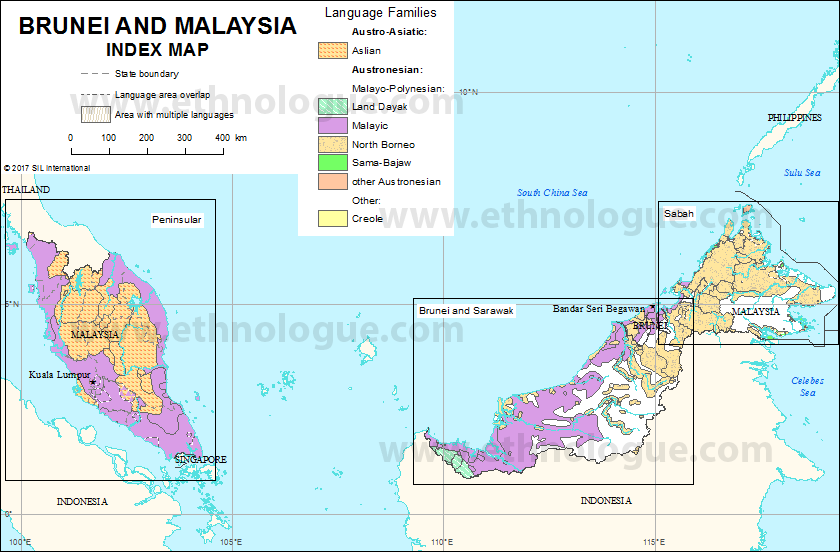
Brunei and Malaysia: Index map
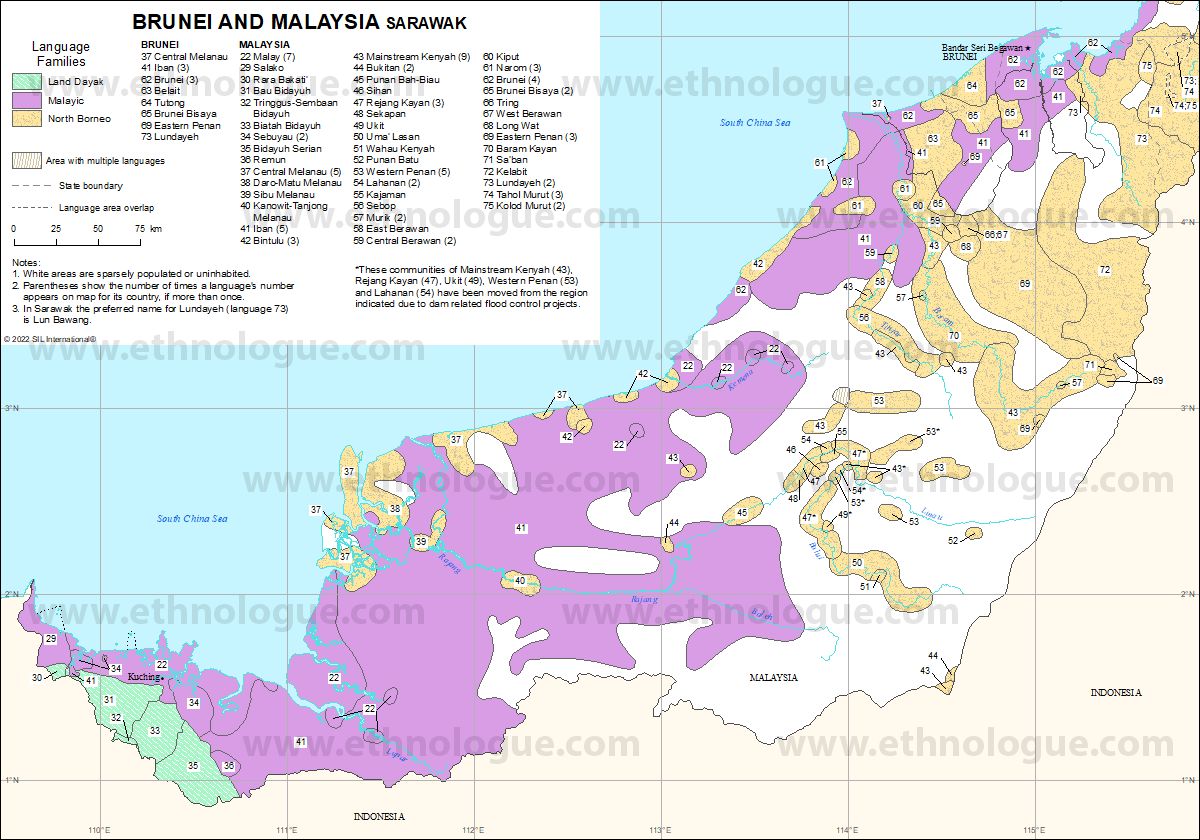
Brunei and Malaysia: Sarawak
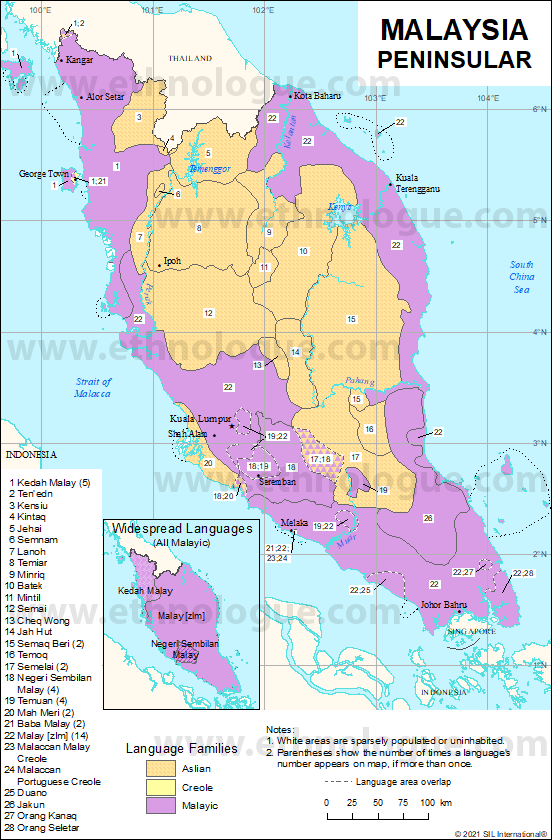
Malaysia: Peninsular
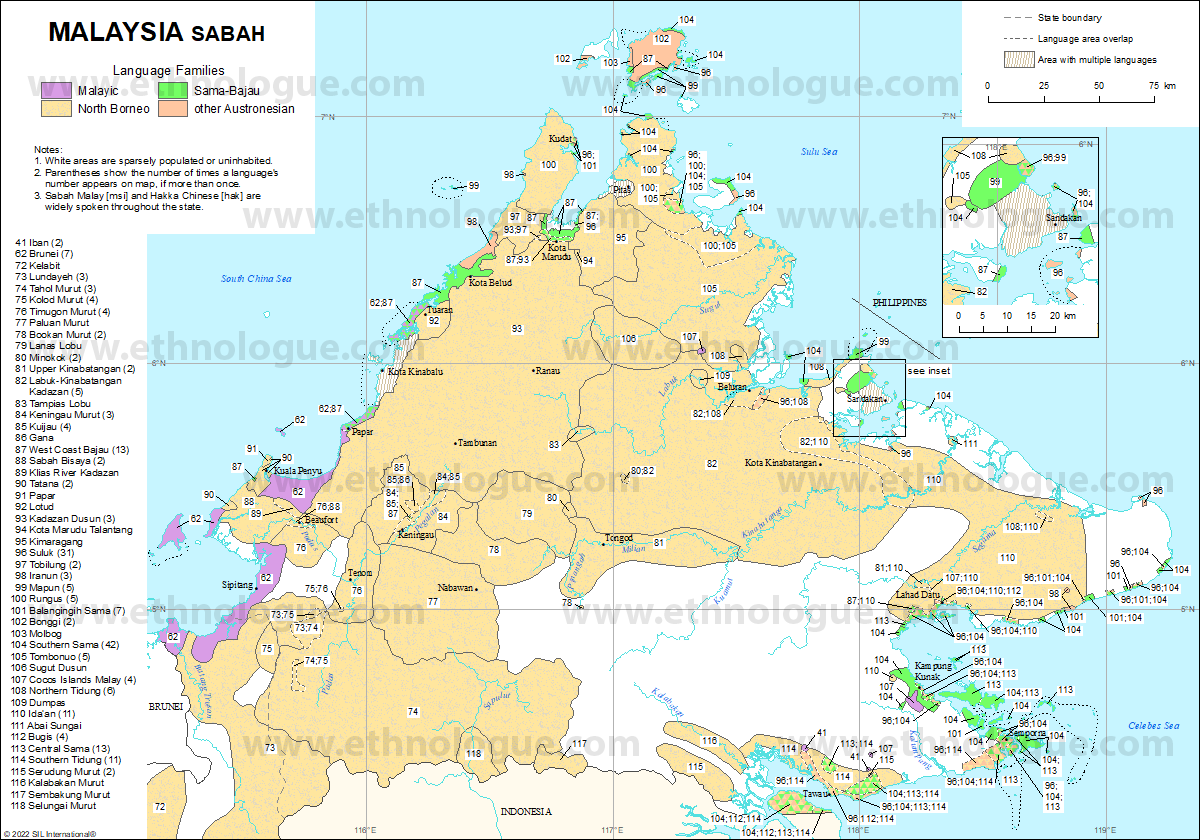
Malaysia: Sabah
Graphs
Language Vitality Profile
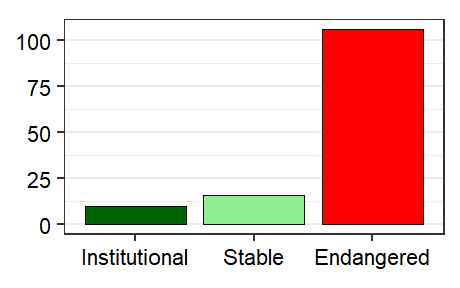
Full explanation
Language Status Profile
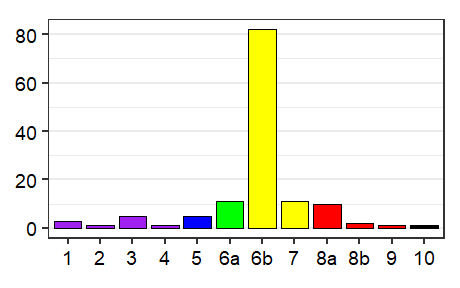
Full explanation
Resources
View Terms
Each Ethnologue country digest is a licensed product with restricted terms of use. Before downloading the product, you must agree to the following terms:
- This is a license for individual use. Just as with a conventionally published book, it is a violation of copyright to make a copy and give it to others.
- You may not redistribute this work in any form, including ingesting the contents into a database that is shared with others or posting it on a web site (whether public or private).
To inquire about permission for reuse or redistribution, please use the Contact Us form in the footer.
Digest of the languages of Malaysia ($399.95, 102 page PDF)