
MZ
Republic of Mozambique
Mozambique
Summary
- Official Name
- Republic of Mozambique
- Population
- 31,693,000
- Principal Languages
- Portuguese
- Literacy Rate
- 61% (2017 UNESCO)
- International Conventions
- ACHPR (1987), CPPDCE (2006), CSICH (2012), ICCPR (1966), UNCRPD (2006), UNDRIP (2007)
- General References
- Afido et al 1989
- Language Counts
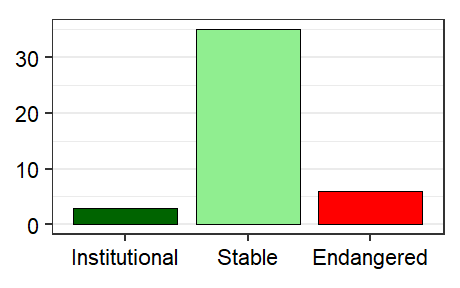
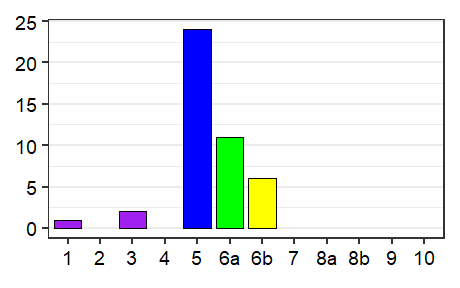
- The number of established languages listed for Mozambique is 44. All are living languages. Of these, 42 are indigenous and 2 are non-indigenous. Furthermore, 3 are institutional, 25 are developing, 10 are vigorous, and 6 are in trouble. Also listed are 5 unestablished languages.
Languages
- Barwe bwg
- Manica province. Users: 34,000 in Mozambique (2017). Status: 6b* (Threatened). Alternate Names: Balke, Chirue, Cibalke, Rue Classification: Niger-Congo, Atlantic-Congo, Volta-Congo, Benue-Congo, Bantoid, Southern, Narrow Bantu, Central, N, Senga-Sena (N.44)
- Chinese, Mandarin cmn
- Users: 25,000 in Mozambique (2017). Status: Unestablished. Classification: Sino-Tibetan, Chinese
- Chopi cce
- Gaza province: coastal strip between Chidunguela and Inharrime; Inhambane province: south Zavala district; Maputo province. Center is Quissico. Users: 1,100,000 (2017). Status: 5* (Developing). Alternate Names: Cicopi, Copi, Shichopi, Shicopi, Shilenge, Tschopi, Txitxopi, Txopi, Xilenge, shiChopi Autonym: Chichopi Classification: Niger-Congo, Atlantic-Congo, Volta-Congo, Benue-Congo, Bantoid, Southern, Narrow Bantu, Central, S, Copi (S.61)
- Chuwabu chw
- Zambezia province: central coast between Mlanje and Quelimane mountains. Users: 970,000 (2017). Status: 5 (Developing). Alternate Names: Chichwabo, Chuabo, Chuwabo, Chwabo, Cicuabo, Cuabo, Cuwabo, Echuabo, Echuwabu, Ecwabo, Etxuwabo, Txuwabo, Xuabo Autonym: Echuwabo Classification: Niger-Congo, Atlantic-Congo, Volta-Congo, Benue-Congo, Bantoid, Southern, Narrow Bantu, Central, P, Makhuwa (P.34)
- Dema dmx
- Tete province: near Cahora Bassa dam, north of Zimbabwe. Users: 11,000 (2017). Population displaced during Cabora Bassa Dam construction. Status: 6b* (Threatened). Classification: Niger-Congo, Atlantic-Congo, Volta-Congo, Benue-Congo, Bantoid, Southern, Narrow Bantu, Central, S, Shona (S.10)
- French fra
- Users: 93,900 in Mozambique, all users. L1 users: 2,300 in Mozambique (2020 Joshua Project). L2 users: 91,600 (Beck et al 2018). Status: 5* (Dispersed). Classification: Indo-European, Italic, Romance, Italo-Western, Western, Gallo-Iberian, Gallo-Romance, Gallo-Rhaetian, Oïl, French
- German, Standard deu
- Users: 4,000 in Mozambique (2017). Status: Unestablished. Classification: Indo-European, Germanic, West, High German, German, Middle German, East Middle German
- Greek ell
- Users: 12,700 in Mozambique (2017). Status: Unestablished. Classification: Indo-European, Greek, Attic
- Kabuverdianu kea
- Users: 2,000 in Mozambique (2017). Status: Unestablished. Classification: Creole, Portuguese based
- Kokola kzn
- Zambezia province: west. Users: 163,000 in Mozambique (2017). Status: 5* (Developing). Alternate Names: iKokola Classification: Niger-Congo, Atlantic-Congo, Volta-Congo, Benue-Congo, Bantoid, Southern, Narrow Bantu, Central, P, Makhuwa (P.31)
- Korean kor
- Users: 43,000 in Mozambique (2017). Status: Unestablished. Classification: Koreanic
- Koti eko
- Nampula province: Angoche district, Angoche island coast area; Nampula city enclave. Users: 140,000 (2017). Status: 6a (Vigorous). Alternate Names: Akoti, Angoche, Angoje, Angoxe, Coti Autonym: Ekoti Classification: Niger-Congo, Atlantic-Congo, Volta-Congo, Benue-Congo, Bantoid, Southern, Narrow Bantu, Central, P, Makhuwa (P.311)
- Kunda kdn
- Tete province: Luangwe and Zambezi rivers’ confluence area. Users: 11,000 in Mozambique (2017). Status: 6b* (Threatened). Alternate Names: Chicunda, Chikunda, Cikunda, Mu Chikunda Classification: Niger-Congo, Atlantic-Congo, Volta-Congo, Benue-Congo, Bantoid, Southern, Narrow Bantu, Central, N, Senga-Sena (N.42)
- Lolo llb
- Zambezia province. Users: 330,000 (2017). Status: 5* (Developing). Autonym: iLolo Classification: Niger-Congo, Atlantic-Congo, Volta-Congo, Benue-Congo, Bantoid, Southern, Narrow Bantu, Central, P, Makhuwa (P.31)
- Lomwe ngl
- Nampula and Niassa provinces: Alto Molocue; Zambezia province. Users: 2,520,000 (2017). Status: 5* (Developing). Alternate Names: Acilowe, Alomwe, Chilowe, Cilowe, Elomwe, Ilomwe, Ingulu, Lomue, Mihavane, Mihavani, Mihawani, Ngulu, Nguru, Walomwe, West Makhuwa, Western Makua Autonym: Elhomwe Classification: Niger-Congo, Atlantic-Congo, Volta-Congo, Benue-Congo, Bantoid, Southern, Narrow Bantu, Central, P, Makhuwa (P.32)
- Maindo cwb
- Zambezia province: Micaune, Zambezi river mouth. Users: 43,000 (2017). Status: 6b* (Threatened). Alternate Names: Chwambo Classification: Niger-Congo, Atlantic-Congo, Volta-Congo, Benue-Congo, Bantoid, Southern, Narrow Bantu, Central, P, Makhuwa (P.34)
- Makhuwa vmw
- Nampula province: south of Meetto area; Cabo Delgado, Niassa, and Zambezia provinces: border areas. Users: 3,960,000 in Mozambique (2017). Total users in all countries: 3,973,600. Status: 5* (Developing). Alternate Names: Central Makhuwa, Emakhuwa-Makhuwana, Emakua, Macua, Makhuwa-Makhuwana, Makhuwwa of Nampula, Makoane, Makua, Maquoua Autonym: Emakhuwa Classification: Niger-Congo, Atlantic-Congo, Volta-Congo, Benue-Congo, Bantoid, Southern, Narrow Bantu, Central, P, Makhuwa (P.31)
- Makhuwa-Marrevone xmc
- Nampula province: inland from Angoche and Moma; Zambezia province: Nova Nabori inland to Amela. Users: 438,000 (2017). Status: 6a* (Vigorous). Alternate Names: Coastal Makhuwa, Emaka, Maca, Maka, Makua-Marevone, Marevone, Marrevone, South Maca Classification: Niger-Congo, Atlantic-Congo, Volta-Congo, Benue-Congo, Bantoid, Southern, Narrow Bantu, Central, P, Makhuwa (P.31)
- Makhuwa-Meetto mgh
- Cabo Delgado and Niassa provinces: Pemba coast inland; Nampula province: coast north of Nacala. Users: 1,170,000 in Mozambique (2017). Total users in all countries: 1,748,630. Status: 5* (Developing). Alternate Names: Emeto, Medo, Meetto, Meto, Metto, Mêto Autonym: Imeetto Classification: Niger-Congo, Atlantic-Congo, Volta-Congo, Benue-Congo, Bantoid, Southern, Narrow Bantu, Central, P, Makhuwa (P.31)
- Makhuwa-Moniga mhm
- Zambezia province: Indian Ocean coast and inland past Mocubela. Users: 440,000 (2017). Status: 6a* (Vigorous). Alternate Names: Emakhuwa-Emoniga, Emoniga, Moniga Classification: Niger-Congo, Atlantic-Congo, Volta-Congo, Benue-Congo, Bantoid, Southern, Narrow Bantu, Central, P, Makhuwa (P.341)
- Makhuwa-Saka xsq
- Cabo Delgado and Nampula provinces: border area, Lurio river. Users: 432,000 (2017). Status: 6a* (Vigorous). Alternate Names: Esaaka, Esaka, Isaanga, Ishanga, Saaka, Saanga, Saka, Sanga Classification: Niger-Congo, Atlantic-Congo, Volta-Congo, Benue-Congo, Bantoid, Southern, Narrow Bantu, Central, P, Makhuwa (P.31)
- Makhuwa-Shirima vmk
- Nampula province: west; Niassa province; Zambezia province: northwest border. Users: 729,000 (2017). Status: 5* (Developing). Alternate Names: Chirima, Echirima, Emakhua Eshirima, Emakhuwa Echirima, Eshirima, Makhuwa-Exirima, Makhuwa-Niassa, Makhuwa-Xirima, Shirima, West Makua, Xirima Autonym: Emakhua Exirima Classification: Niger-Congo, Atlantic-Congo, Volta-Congo, Benue-Congo, Bantoid, Southern, Narrow Bantu, Central, P, Makhuwa (P.31)
- Makonde kde
- Cabo Delgado province: Mueda (Maviha dialect). Users: 525,000 in Mozambique (2017). Status: 5* (Developing). Alternate Names: Chimakonde, Chinimakonde, Cimakonde, Konde, Maconde, Makonda, Matambwe, Shimakonde Classification: Niger-Congo, Atlantic-Congo, Volta-Congo, Benue-Congo, Bantoid, Southern, Narrow Bantu, Central, P, Yao (P.23)
- Makwe ymk
- Cabo Delgado province: coast, Tanzania border area south to Quionga and Palma; Ruvuma river area to Pundanhar. Users: 50,000 in Mozambique (2017). Total users in all countries: 147,700. Status: 6b* (Threatened). Alternate Names: Kimakwe, Macue, Palma Classification: Niger-Congo, Atlantic-Congo, Volta-Congo, Benue-Congo, Bantoid, Southern, Narrow Bantu, Central, G, Swahili (G.402)
- Manyawa mny
- Zambezia province: Lugela district. Users: 219,000 (2017). 85% monolingual in Lugela District. Status: 6a (Vigorous). Classification: Niger-Congo, Atlantic-Congo, Volta-Congo, Benue-Congo, Bantoid, Southern, Narrow Bantu, Central, P, Makhuwa (P.31)
- Manyika mxc
- Manica province: north of Ndau, west of Tewe; Tete province: southwest. Users: 146,000 in Mozambique (2017). Status: 5* (Developing). Alternate Names: Chimanyika, Manika Classification: Niger-Congo, Atlantic-Congo, Volta-Congo, Benue-Congo, Bantoid, Southern, Narrow Bantu, Central, S, Shona (S.13)
- Marenje vmr
- Zambezia province. Users: 588,000 (2017). Status: 6a* (Vigorous). Alternate Names: Emarendje, Marendje Classification: Niger-Congo, Atlantic-Congo, Volta-Congo, Benue-Congo, Bantoid, Southern, Narrow Bantu, Central, P, Makhuwa (P.31)
- Mozambican Sign Language mzy
- Scattered. In at least 3 large cities: Beira, Maputo, and Nampula. Users: 150,000 (2021 DBS/DOOR/SIL). Estimated 90,000–180,000 deaf signers, based on 0.3%–0.6% of total population. Status: 5 (Developing). Classification: Sign language, Deaf community sign language
- Mwani wmw
- Cabo Delgado province: coast north of Pemba, Arimba to Palma, Ibo and Mocimboa da Praia; Querimba archipelago offshore. Users: 166,000, all users. L1 users: 146,000 (2017). L2 users: 20,000. Status: 5* (Developing). Alternate Names: Ibo, Muane, Mwane, Mwaní, Namwaní, Quimuane Autonym: Kimwani Classification: Niger-Congo, Atlantic-Congo, Volta-Congo, Benue-Congo, Bantoid, Southern, Narrow Bantu, Central, G, Swahili (G.403)
- Nathembo nte
- Nampula province: Amisse, Charamatane, Mutembua, Namaeca, Namaponda, Zubairi, to Khibulani and Mogincual, all on Sangange peninsula. Users: 51,000 (2017). Status: 6a* (Vigorous). Alternate Names: Esakaji, Sakaji, Sakati, Sanagage, Sangaji, Sankaji, Theithei Classification: Niger-Congo, Atlantic-Congo, Volta-Congo, Benue-Congo, Bantoid, Southern, Narrow Bantu, Central, P, Makhuwa (P.312)
- Ndau ndc
- Inhambane and Gaza provinces; Manica and Sofala provinces: south of Beira. Users: 730,000 in Mozambique (2017). Total users in all countries: 1,530,000. Status: 5* (Developing). Alternate Names: Cindau, Ndzawu, Njao, Sofala, Southeast Shona Autonym: Chindau Classification: Niger-Congo, Atlantic-Congo, Volta-Congo, Benue-Congo, Bantoid, Southern, Narrow Bantu, Central, S, Shona (S.15)
- Nsenga nse
- Tete province: north of Zambezi river. Users: 206,000 in Mozambique (2017). Status: 5* (Developing). Alternate Names: Chinsenga, Cinsenga, Senga Classification: Niger-Congo, Atlantic-Congo, Volta-Congo, Benue-Congo, Bantoid, Southern, Narrow Bantu, Central, N, Senga-Sena (N.41)
- Nyanja nya
- Niassa, Tete, and Zambezia provinces. Macanga district, Tete (Angoni and Chewa dialects); Niassa province: Lago and Sanga (Ngoni dialect); Niassa and Tete, along Lake Niassa (Nyanja dialect). Users: 1,290,000 in Mozambique (2017). Status: 5* (Dispersed). Alternate Names: Chinyanja, CiNyanja, Cinianja Classification: Niger-Congo, Atlantic-Congo, Volta-Congo, Benue-Congo, Bantoid, Southern, Narrow Bantu, Central, N, Chewa-Nyanja (N.31)
- Nyungwe nyu
- Manica province: Luenha river east bank, east from Changara; Tete province: Zambezi river banks. Users: 490,000 (2017 census). Status: 3 (Wider communication). Nyungwe is one of the recognized national languages during postcolonial period in 1975. Used as a trade language throughout Tete province. Alternate Names: Chinyungwe, Chinyungwi, Nyongwe, Teta, Tete, Yungwe Autonym: Cinyungwe Classification: Niger-Congo, Atlantic-Congo, Volta-Congo, Benue-Congo, Bantoid, Southern, Narrow Bantu, Central, N, Senga-Sena (N.43)
- Phimbi phm
- Tete province: Zambezi river banks northwest of Tete city. Users: 12,800 (2017). Status: 6b* (Threatened). Alternate Names: Pimbi Classification: Niger-Congo, Atlantic-Congo, Volta-Congo, Benue-Congo, Bantoid, Southern, Narrow Bantu, Central, N, Senga-Sena (N.41)
- Portuguese por
- Users: 13,130,000 in Mozambique, all users. L1 users: 5,000,000 in Mozambique (2020). L2 users: 8,130,000 (2020). Status: 1 (National). Statutory national language (2004, Constitution, Article 10). Alternate Names: Português Classification: Indo-European, Italic, Romance, Italo-Western, Western, Gallo-Iberian, Ibero-Romance, West Iberian, Portuguese-Galician
- Ronga rng
- Cidade de Maputo; Maputo province. Users: 617,000 in Mozambique (2017). Total users in all countries: 618,000. Status: 5* (Developing). Alternate Names: GiRonga, Gironga, Rhonga, ShiRonga, Shironga, XiRonga, Xirhonga Autonym: Xironga Classification: Niger-Congo, Atlantic-Congo, Volta-Congo, Benue-Congo, Bantoid, Southern, Narrow Bantu, Central, S, Tswa-Rhonga (S.54)
- Sena seh
- Manica, Sofala, Tete, and Zambezia provinces: lower Zambezi river region. Users: 2,030,000 (2017). Status: 5* (Developing). Alternate Names: Chisena Autonym: Cisena Classification: Niger-Congo, Atlantic-Congo, Volta-Congo, Benue-Congo, Bantoid, Southern, Narrow Bantu, Central, N, Senga-Sena (N.44)
- Swahili swh
- Cabo Delgado province. Users: 22,000 in Mozambique (2017). Status: 3 (Wider communication). Alternate Names: Kiswahili Classification: Niger-Congo, Atlantic-Congo, Volta-Congo, Benue-Congo, Bantoid, Southern, Narrow Bantu, Central, G, Swahili (G.42)
- Swati ssw
- Maputo province: border area west of the capital. Users: 2,500 in Mozambique (2017). Status: 5* (Dispersed). Alternate Names: Siswazi, Swazi, Tekela, Tekeza, siSwati Classification: Niger-Congo, Atlantic-Congo, Volta-Congo, Benue-Congo, Bantoid, Southern, Narrow Bantu, Central, S, Nguni (S.43)
- Takwane tke
- Zambezia province. Users: 368,000 (2017). Status: 6a* (Vigorous). Alternate Names: Etakwane, Thakwani Autonym: Etakwani Classification: Niger-Congo, Atlantic-Congo, Volta-Congo, Benue-Congo, Bantoid, Southern, Narrow Bantu, Central, P, Makhuwa (P.31)
- Tawara twl
- Tete province: south, north of Zimbabwe. Users: 110,000 (2017). Status: 6a* (Vigorous). Alternate Names: Tavara, Tawala Classification: Niger-Congo, Atlantic-Congo, Volta-Congo, Benue-Congo, Bantoid, Southern, Narrow Bantu, Central, S, Shona (S.11)
- Tewe twx
- Manica and Sofala provinces: Chimoio city northeast, Pungoe river north bank. Users: 365,000 (2017). Status: 6a* (Vigorous). Alternate Names: Chitewe, Chiute, Ciute, Teve, Utee, Vateve, Wateve Classification: Niger-Congo, Atlantic-Congo, Volta-Congo, Benue-Congo, Bantoid, Southern, Narrow Bantu, Central, S, Shona (S.13)
- Tonga toh
- Inhambane province: up to Morrumbane. Users: 327,000 (2017). Status: 5* (Developing). Alternate Names: Bitonga, Gitonga, Guitonga, Inhambane, Shengwe, Tonga-Inhambane Autonym: guiTonga Classification: Niger-Congo, Atlantic-Congo, Volta-Congo, Benue-Congo, Bantoid, Southern, Narrow Bantu, Central, S, Copi (S.62)
- Tsonga tso
- Cidade de Maputo, Gaza, and Maputo provinces; Inhambane province: west. Users: 4,200,000 in Mozambique (2017). Status: 5* (Dispersed). Alternate Names: Gwamba, Shitsonga, Thonga, Tonga, Vatsonga, Xitsonga Classification: Niger-Congo, Atlantic-Congo, Volta-Congo, Benue-Congo, Bantoid, Southern, Narrow Bantu, Central, S, Tswa-Rhonga (S.53)
- Tswa tsc
- Gaza province: border area; Inhambane province: south of Save river. Users: 1,000,000 in Mozambique (2017). Total users in all countries: 1,020,000. Status: 5* (Developing). Alternate Names: Kitshwa, Sheetshwa, Shitshwa, Tshwa, Xitshwa Autonym: Xitswa Classification: Niger-Congo, Atlantic-Congo, Volta-Congo, Benue-Congo, Bantoid, Southern, Narrow Bantu, Central, S, Tswa-Rhonga (S.51)
- Xingoni xnq
- Cabo Delgado province: Meluco, Montepuez, Mueda, and Nangade districts; Niassa province: Mecula district. Users: 53,000 (2020 SIL). Status: 5 (Developing). Alternate Names: Mozambican Ngoni, Ngoni Autonym: Xingoni Classification: Niger-Congo, Atlantic-Congo, Volta-Congo, Benue-Congo, Bantoid, Southern, Narrow Bantu, Central, N, Manda (N.12)
- Yao yao
- Cabo Delgado province: Ruvumu river near Negomano; Nampula province: west; Niassa province: south and east of Lake Malawi; Zambezia province: Gurue district, northwest border. Users: 298,000 in Mozambique (2017). Status: 5* (Developing). Alternate Names: Achawa, Adsawa, Adsoa, Ajawa, Ayawa, Ayo, Chiyao, Ciyao, Ciyawo, Djao, Haiao, Hiao, Hyao, Jao, Veiao, Wajao, Yawo Classification: Niger-Congo, Atlantic-Congo, Volta-Congo, Benue-Congo, Bantoid, Southern, Narrow Bantu, Central, P, Yao (P.21)
- Zulu zul
- Maputo province: borders with Swaziland and South Africa. Users: 6,000 in Mozambique (2017). Status: 5* (Dispersed). Alternate Names: Isizulu, Zunda Classification: Niger-Congo, Atlantic-Congo, Volta-Congo, Benue-Congo, Bantoid, Southern, Narrow Bantu, Central, S, Nguni (S.42)
Languages by Status
Portuguese
[por] 1 (National). Statutory national language (2004, Constitution, Article 10). 13,130,000 in Mozambique, all users. L1 users: 5,000,000 in Mozambique (2020). L2 users: 8,130,000 (2020).
Nyungwe
[nyu] 3 (Wider communication). Nyungwe is one of the recognized national languages during postcolonial period in 1975. Used as a trade language throughout Tete province. 490,000 (2017 census).
Swahili
[swh] 3 (Wider communication). 22,000 in Mozambique (2017).
French
[fra] 5* (Dispersed). 93,900 in Mozambique, all users. L1 users: 2,300 in Mozambique (2020 Joshua Project). L2 users: 91,600 (Beck et al 2018).
Nyanja
[nya] 5* (Dispersed). 1,290,000 in Mozambique (2017).
Swati
[ssw] 5* (Dispersed). 2,500 in Mozambique (2017).
Tsonga
[tso] 5* (Dispersed). 4,200,000 in Mozambique (2017).
Zulu
[zul] 5* (Dispersed). 6,000 in Mozambique (2017).
Chopi
[cce] 5* (Developing). 1,100,000 (2017).
Chuwabu
[chw] 5 (Developing). 970,000 (2017).
Kokola
[kzn] 5* (Developing). 163,000 in Mozambique (2017).
Lolo
[llb] 5* (Developing). 330,000 (2017).
Lomwe
[ngl] 5* (Developing). 2,520,000 (2017).
Makhuwa
[vmw] 5* (Developing). 3,960,000 in Mozambique (2017). Total users in all countries: 3,973,600.
Makhuwa-Meetto
[mgh] 5* (Developing). 1,170,000 in Mozambique (2017). Total users in all countries: 1,748,630.
Makhuwa-Shirima
[vmk] 5* (Developing). 729,000 (2017).
Makonde
[kde] 5* (Developing). 525,000 in Mozambique (2017).
Manyika
[mxc] 5* (Developing). 146,000 in Mozambique (2017).
Mozambican Sign Language
[mzy] 5 (Developing). 150,000 (2021 DBS/DOOR/SIL). Estimated 90,000–180,000 deaf signers, based on 0.3%–0.6% of total population.
Mwani
[wmw] 5* (Developing). 166,000, all users. L1 users: 146,000 (2017). L2 users: 20,000.
Ndau
[ndc] 5* (Developing). 730,000 in Mozambique (2017). Total users in all countries: 1,530,000.
Nsenga
[nse] 5* (Developing). 206,000 in Mozambique (2017).
Ronga
[rng] 5* (Developing). 617,000 in Mozambique (2017). Total users in all countries: 618,000.
Sena
[seh] 5* (Developing). 2,030,000 (2017).
Tonga
[toh] 5* (Developing). 327,000 (2017).
Tswa
[tsc] 5* (Developing). 1,000,000 in Mozambique (2017). Total users in all countries: 1,020,000.
Xingoni
[xnq] 5 (Developing). 53,000 (2020 SIL).
Yao
[yao] 5* (Developing). 298,000 in Mozambique (2017).
Koti
[eko] 6a (Vigorous). 140,000 (2017).
Makhuwa-Marrevone
[xmc] 6a* (Vigorous). 438,000 (2017).
Makhuwa-Moniga
[mhm] 6a* (Vigorous). 440,000 (2017).
Makhuwa-Saka
[xsq] 6a* (Vigorous). 432,000 (2017).
Manyawa
[mny] 6a (Vigorous). 219,000 (2017). 85% monolingual in Lugela District.
Marenje
[vmr] 6a* (Vigorous). 588,000 (2017).
Nathembo
[nte] 6a* (Vigorous). 51,000 (2017).
Takwane
[tke] 6a* (Vigorous). 368,000 (2017).
Tawara
[twl] 6a* (Vigorous). 110,000 (2017).
Tewe
[twx] 6a* (Vigorous). 365,000 (2017).
Barwe
[bwg] 6b* (Threatened). 34,000 in Mozambique (2017).
Dema
[dmx] 6b* (Threatened). 11,000 (2017). Population displaced during Cabora Bassa Dam construction.
Kunda
[kdn] 6b* (Threatened). 11,000 in Mozambique (2017).
Maindo
[cwb] 6b* (Threatened). 43,000 (2017).
Makwe
[ymk] 6b* (Threatened). 50,000 in Mozambique (2017). Total users in all countries: 147,700.
Phimbi
[phm] 6b* (Threatened). 12,800 (2017).
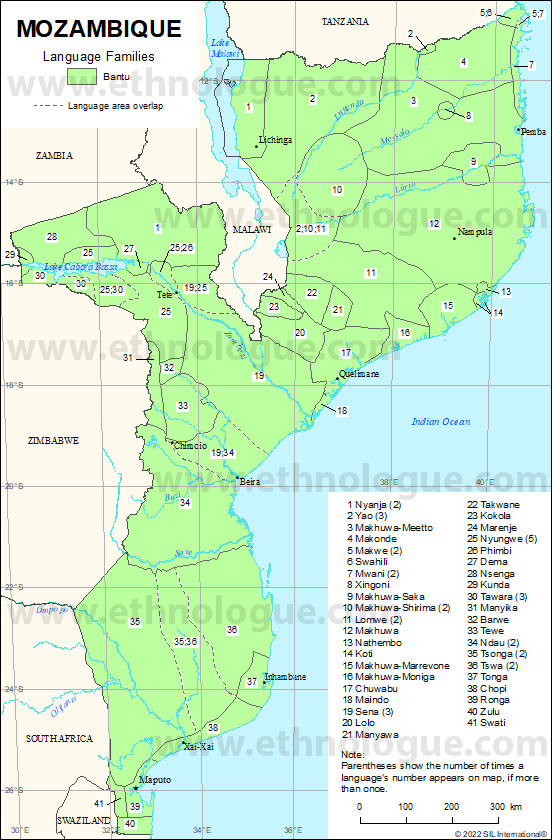
Maps
Mozambique
Graphs
Language Vitality Profile
Full explanation
Language Status Profile
Full explanation
Resources
View Terms
Each Ethnologue country digest is a licensed product with restricted terms of use. Before downloading the product, you must agree to the following terms:
- This is a license for individual use. Just as with a conventionally published book, it is a violation of copyright to make a copy and give it to others.
- You may not redistribute this work in any form, including ingesting the contents into a database that is shared with others or posting it on a web site (whether public or private).
To inquire about permission for reuse or redistribution, please use the Contact Us form in the footer.
Digest of the languages of Mozambique ($199.95, 38 page PDF)