
NI
Nicaragua
Summary
- Official Name
- Population
- 6,560,000
- Principal Languages
- Spanish
- Literacy Rate
- 83% (2015 UNESCO)
- International Conventions
- CDE (1960), CPPDCE (2006), CSICH (2012), ICCPR (1966), (), UNCRPD (2006), UNDRIP (2007)
- General References
- Campbell 1997
- Deaf Population
- 3,000–600,000
- Language Counts
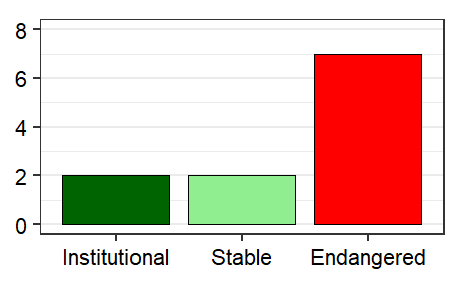
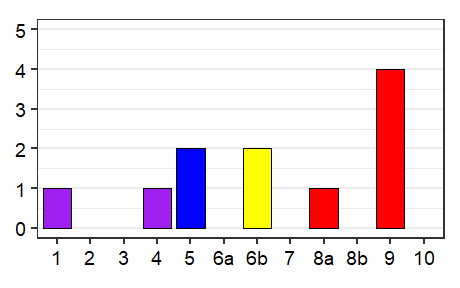
- The number of established languages listed for Nicaragua is 11. All are living languages. Of these, 9 are indigenous and 2 are non-indigenous. Furthermore, 2 are institutional, 2 are developing, 2 are in trouble, and 5 are dying. Also listed are 2 unestablished languages.
Languages
- Chinese, Mandarin cmn
- Users: 14,000 in Nicaragua (2021 Joshua Project), based on ethnicity. Status: Unestablished. Classification: Sino-Tibetan, Chinese
- English eng
- Users: 7,000 in Nicaragua (2021 Joshua Project), based on ethnicity. Status: Unestablished. Classification: Indo-European, Germanic, West, English
- Garifuna cab
- South Caribbean Coast Autonomous Region: Orinoco village. Users: No known L1 speakers in Nicaragua (2012 R. Reeck). Ethnic population: 3,270 (2005 census). Status: 9 (Dormant). Recognized language (1993, Official Language Use, Atlantic Autonomous Regions, Law No. 162, Article 4). Alternate Names: Black Carib, Caribe, Central American Carib, Garífuna, “Moreno” (pej.) Classification: Maipurean, Northern, Maritime, Ta-Maipurean, Iñeri
- Mangue mom
- Scattered. North Caribbean Coast Autonomous Region: highlands. Users: No known L1 speakers. The last fluent speaker either died or shifted to Spanish by the early 1870s; some rememberers survived into the late 1880s (Brinton 1886). Ethnic population: 46,000 (2005 census). Status: 9 (Dormant). Alternate Names: Chorotega, Monimbo Classification: Unclassified
- Matagalpa mtn
- Jinotega and Matagalpa departments; Central highlands. Users: No known L1 speakers. The last speaker died in 1997. Ethnic population: 15,000 (2005 census). Status: 9 (Dormant). Alternate Names: Pantasmas Classification: Misumalpan, Sumu-Cacaopera-Matagalpa, Cacaopera-Matagalpa
- Mayangna yan
- Jinotega department; North Caribbean Coast Autonomous Region: Bambana and Tungi along Waspuk river; Santo Tomás de Umbra on the upper Wawa; Panamahka dialect along Wanki river; Tuahka dialect: Wasakin area near Rosita. Users: 8,000 in Nicaragua (Adelaar 2007). 8,540 (2005 census). Ethnic population: 9,760 (2005 census). Total users in all countries: 8,700. Status: 5* (Developing). Classification: Misumalpan
- Mískito miq
- Jinotega department; North Caribbean Coast Autonomous Region and South Caribbean Coast Autonomous Region; Bihmuna, Bocana de Paiwas, Bonanza, Karawala, Leimus, Prinzapolka, Puerto Cabeza city, Rosita, San Carlos (Río Coco), Sangnilaya, Sisin, Siuna, Tronquera, Wasla, Waspam; Río Coco area and Pearl lagoon to Black river coast and lowlands. Users: 114,000 in Nicaragua (2009 UNSD). Ethnic population: 121,000 (2005 census). Total users in all countries: 143,000. Status: 6b (Threatened). Recognized language (1993, Official Language Use, Atlantic Autonomous Regions, Law No. 162, Article 4). Alternate Names: Marquito, Miskuto, Mosquito, Mísquito Autonym: Mískitu Classification: Misumalpan
- Nicaragua English Creole bzk
- Scattered. North Caribbean Coast Autonomous Region and South Caribbean Coast Autonomous Region: Bluefields region, Corn islands, Pearl lagoon, Prinzapolka, Puerto Cabezas, Rama Cay island. Users: 18,400 (2009 UNSD). 630 Rama Cay Creole speakers (Holm 1989). Status: 4 (Educational). Recognized language (1993, Official Language Use, Atlantic Autonomous Regions, Law No. 162, Article 4). Alternate Names: Mískito Coast English Creole Autonym: Creole Classification: Creole, English based, Atlantic, Western
- Nicaraguan Sign Language ncs
- Scattered, especially Managua. Users: 6,200 (2019 ANSNIC). Estimated assuming 0.1% of the general population. Status: 5 (Developing). Alternate Names: ISN, Idioma de Señas de Nicaragua, Lengua de Signos Nicaragüense, Lenguaje de Signos Nicaragüense, NSL Classification: Sign language, Deaf community sign language
- Rama rma
- South Caribbean Coast Autonomous Region: Rama Cay, 30-mile radius. Users: 740 (2009 UNSD). Ethnic population: 4,190 (2005 census). Status: 8a (Moribund). Recognized language (1993, Official Language Use, Atlantic Autonomous Regions, Law No. 162, Article 4). Classification: Chibchan, Chibchan B, Votic
- Spanish spa
- Users: 6,344,000 in Nicaragua, all users. L1 users: 6,160,000 in Nicaragua (Instituto Cervantes 2019). L2 users: 184,000 (Instituto Cervantes 2019). Status: 1 (National). Statutory national language (1987, Constitution, Article 11). Alternate Names: Castellano, Español Classification: Indo-European, Italic, Romance, Italo-Western, Western, Gallo-Iberian, Ibero-Romance, West Iberian, Castilian
- Subtiaba sut
- León department: Pacific slope. Users: No known L1 speakers. The last speaker probably died in the 1920s (Bright 1990). Ethnic population: 20,000 (2005 census). Status: 9 (Dormant). Alternate Names: Subtiava Classification: Otomanguean, Western Otomanguean, Tlapanec-Manguean, Tlapanec-Subtiaba
- Ulwa ulw
- South Caribbean Coast Autonomous Region: Karawala village. Users: 350 (2009 J. Mejia). 83 (2005 census). Ethnic population: 700 (2005 census). Status: 6b (Threatened). Recognized language (1993, Official Language Use, Atlantic Autonomous Regions, Law No. 162, Article 4). Alternate Names: Sumu, Ulúa, Woolwa Classification: Misumalpan
Languages by Status
Spanish
[spa] 1 (National). Statutory national language (1987, Constitution, Article 11). 6,344,000 in Nicaragua, all users. L1 users: 6,160,000 in Nicaragua (Instituto Cervantes 2019). L2 users: 184,000 (Instituto Cervantes 2019).
Nicaragua English Creole
[bzk] 4 (Educational). Recognized language (1993, Official Language Use, Atlantic Autonomous Regions, Law No. 162, Article 4). 18,400 (2009 UNSD). 630 Rama Cay Creole speakers (Holm 1989).
Mayangna
[yan] 5* (Developing). 8,000 in Nicaragua (Adelaar 2007). 8,540 (2005 census). Ethnic population: 9,760 (2005 census). Total users in all countries: 8,700.
Nicaraguan Sign Language
[ncs] 5 (Developing). 6,200 (2019 ANSNIC). Estimated assuming 0.1% of the general population.
Mískito
[miq] 6b (Threatened). Recognized language (1993, Official Language Use, Atlantic Autonomous Regions, Law No. 162, Article 4). 114,000 in Nicaragua (2009 UNSD). Ethnic population: 121,000 (2005 census). Total users in all countries: 143,000.
Ulwa
[ulw] 6b (Threatened). Recognized language (1993, Official Language Use, Atlantic Autonomous Regions, Law No. 162, Article 4). 350 (2009 J. Mejia). 83 (2005 census). Ethnic population: 700 (2005 census).
Rama
[rma] 8a (Moribund). Recognized language (1993, Official Language Use, Atlantic Autonomous Regions, Law No. 162, Article 4). 740 (2009 UNSD). Ethnic population: 4,190 (2005 census).
Garifuna
[cab] 9 (Dormant). Recognized language (1993, Official Language Use, Atlantic Autonomous Regions, Law No. 162, Article 4). No known L1 speakers in Nicaragua (2012 R. Reeck). Ethnic population: 3,270 (2005 census).
Mangue
[mom] 9 (Dormant). No known L1 speakers. The last fluent speaker either died or shifted to Spanish by the early 1870s; some rememberers survived into the late 1880s (Brinton 1886). Ethnic population: 46,000 (2005 census).
Matagalpa
[mtn] 9 (Dormant). No known L1 speakers. The last speaker died in 1997. Ethnic population: 15,000 (2005 census).
Subtiaba
[sut] 9 (Dormant). No known L1 speakers. The last speaker probably died in the 1920s (Bright 1990). Ethnic population: 20,000 (2005 census).
Maps
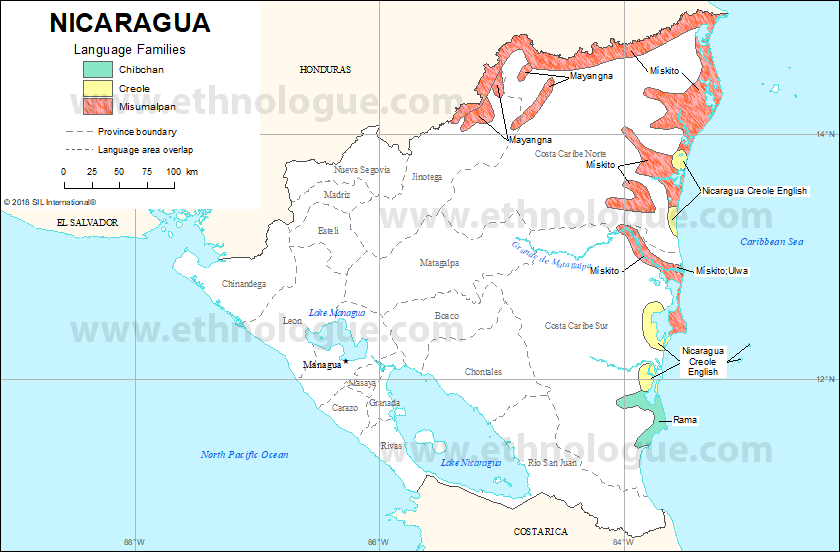
Nicaragua
Graphs
Language Vitality Profile
Full explanation
Language Status Profile
Full explanation
Resources
View Terms
Each Ethnologue country digest is a licensed product with restricted terms of use. Before downloading the product, you must agree to the following terms:
- This is a license for individual use. Just as with a conventionally published book, it is a violation of copyright to make a copy and give it to others.
- You may not redistribute this work in any form, including ingesting the contents into a database that is shared with others or posting it on a web site (whether public or private).
To inquire about permission for reuse or redistribution, please use the Contact Us form in the footer.
Digest of the languages of Nicaragua ($149.95, 24 page PDF)