
PG
Independent State of Papua New Guinea
Papua New Guinea
Summary
- Official Name
- Independent State of Papua New Guinea
- Population
- 9,119,000
- General Remarks
- 600 islands
- Principal Languages
- English, Tok Pisin
- Literacy Rate
- 64% (2015 World Factbook)
- International Conventions
- CSICH (2012), ICCPR (1966), UNCRPD (2006)
- General References
- Anceaux 1961, Carrington 1996, Foley 2005, Franklin 1968, Healey 1964, Hooley 1971, Hooley and McElhanon 1970, McElhanon 1970, McElhanon 1978, Pawley 2005, Ross 1988, Ross 2005, Sankoff 1968, Shaw 1973, Shaw 1986, Wurm 2000, Wurm 2007, Wurm and Hattori 1981, Z’Graggen 1971, Z’Graggen 1975
- Language Counts
- The number of established languages listed for Papua New Guinea is 852. Of these, 840 are living and 12 are extinct. Of the living languages, 839 are indigenous and 1 is non-indigenous. Furthermore, 27 are institutional, 227 are developing, 273 are vigorous, 267 are in trouble, and 46 are dying. Also listed is 1 unestablished language.
Languages
- ’Auhelawa kud
- Milne Bay province: Sehuleya district, Normanby island. Users: 950 (2015 BTA). Status: 5* (Developing). Alternate Names: ’Urada, Kurada, Nuakata, Ulada Autonym: ’Auhelawa Classification: Austronesian, Malayo-Polynesian, Central-Eastern Malayo-Polynesian, Eastern Malayo-Polynesian, Oceanic, Western Oceanic, Papuan Tip, Nuclear, Suauic
- Abadi kbt
- Central province: Kairuku district, 5 main villages. Users: 2,900 (Kassell and Potter 2011), increasing. Status: 5 (Developing). Alternate Names: Gabadi, Kabadi Autonym: Abadi Classification: Austronesian, Malayo-Polynesian, Central-Eastern Malayo-Polynesian, Eastern Malayo-Polynesian, Oceanic, Western Oceanic, Papuan Tip, Peripheral, Central Papuan, West Central Papuan, Gabadi
- Abau aau
- Sandaun province: Green River district, Sepik and Green rivers. Users: 7,500 (Lock 2008), increasing. No monolinguals (Lock 2008). Status: 5 (Developing). Alternate Names: Green River Autonym: Abau Classification: Sepik, Abau
- Abom aob
- Western province: Lewada, Mutam, and Tewara villages. Users: 3 (Rogers 2018). Status: 8b (Nearly extinct). Classification: Trans-New Guinea, Tirio
- Abu ado
- Madang and East Sepik provinces: between Angoram, Ramu, and Sepik rivers; northwest of Madang. 22 villages. Users: 4,200 (2000 census). 820 Sabu, 3,380 Abu. Status: 6a (Vigorous). Alternate Names: Adjora, Adjoria, Azao Classification: Ramu-Lower Sepik, Ramu, Grass
- Abu’ aah
- East Sepik province: Maprik district, Mablep Rural LLG, ward 8; Sandaun province: Aitape district, East Aitape Rural LLG, wards 23, 24, 25. Users: 2,560 (2000). Ethnic population: 2,560 (2000 census). Status: 6b (Threatened). Alternate Names: Abu’ Arapesh, Ua Classification: Torricelli, Kombio-Arapesh, Arapesh
- Adzera adz
- Eastern Highlands province: Kainantan Rural LLG border area; Morobe province: Markham district and valley, Leron river to Markham-Ramu divide. Users: 30,000 (2000 census). A few monolinguals, among the youngest and oldest. Ethnic population: 30,000 (2000 census). Status: 4 (Educational). Alternate Names: Acira, Atsera, Atzera, Azera Autonym: Adzera Classification: Austronesian, Malayo-Polynesian, Central-Eastern Malayo-Polynesian, Eastern Malayo-Polynesian, Oceanic, Western Oceanic, North New Guinea, Huon Gulf, Markham, Upper
- Aeka aez
- Oro province: Sohe district, Tamata rural LLG. Users: 3,400 (2007 SIL). Status: 6a (Vigorous). Alternate Names: Ajeka Autonym: Aeka Classification: Trans-New Guinea, Greater Binanderean, Binanderean, Nuclear Binanderean, South Binanderean, Orokaivan
- Aekyom awi
- Western province: Kiunga area. Users: 21,100 (2000 census). Ethnic population: 21,100 (2000 census). Status: 6a (Vigorous). Alternate Names: Aiwin, Akium, Awin, West Awin Classification: Trans-New Guinea, Awin-Pare
- Agarabi agd
- Eastern Highlands province: Kainantu district. Users: 27,000 (2000 census). Status: 6a (Vigorous). Alternate Names: Agarabe, Bare Autonym: Agarabi Classification: Trans-New Guinea, Kainantu-Goroka, Kainantu, Gadsup-Auyana-Awa
- Agi aif
- Sandaun province. Users: 960 (2003 SIL). Status: 6a* (Vigorous). Classification: Torricelli, Wapei-Palei, Palei
- Agob kit
- Western province: Pahoturi river area and south coast. Users: 2,440 (2000 census). 1,440 Agob, 540 Ende, 460 Kawam. Status: 6a (Vigorous). Alternate Names: Agob-Ende-Kawam, Dabu Classification: South-Central Papuan, Pahoturi
- Aighon aix
- West New Britain province: Gasmata and Mosa rural LLGs, Akolet and Avau inland, between Avio and Amgen rivers, to north side of Whiteman range. Users: 2,100 (2002 SIL), increasing. 100 monolinguals. Ethnic population: 2,100 (2002 SIL). Status: 6a (Vigorous). Alternate Names: Aigon, Eighon Classification: Austronesian, Malayo-Polynesian, Central-Eastern Malayo-Polynesian, Eastern Malayo-Polynesian, Oceanic, Western Oceanic, North New Guinea, Ngero-Vitiaz, Vitiaz, Southwest New Britain, Arawe-Pasismanua, Pasismanua
- Aiklep mwg
- West New Britain province: Ais, Analo, Asailo, and Yumielo villages on southwest coast; inland, Aviklo island near Kandrian. Users: 3,700 (1991 SIL). Status: 6a* (Vigorous). Alternate Names: Agerlep, Eklep, Kaul, Moewehafen Classification: Austronesian, Malayo-Polynesian, Central-Eastern Malayo-Polynesian, Eastern Malayo-Polynesian, Oceanic, Western Oceanic, North New Guinea, Ngero-Vitiaz, Vitiaz, Southwest New Britain, Arawe-Pasismanua, Arawe, West Arawe
- Ainbai aic
- Sandaun province: Vanimo district, south of Bewani station. 2 villages. Users: 100 (2003 SIL). Ethnic population: 370 (2011 census). Status: 8a (Moribund). Alternate Names: Ainba Classification: Border, Bewani
- Aiome aki
- Madang province: west of Madang town, scattered. Users: 1,790 (2000 census). Status: 6a* (Vigorous). Alternate Names: Aren, Ayom Classification: Ramu-Lower Sepik, Ramu, Middle Ramu
- Aisi mmq
- Madang province: Ramu river west of Astrolabe bay. Users: 400 (Daniels 2015). Status: 6b (Threatened). Alternate Names: Musak Classification: Trans-New Guinea, Madang, South Adelbert, Sogeram, East Sogeram
- Ak akq
- Sandaun province: Kwieftim village. Users: 10 (2017 SIL). Status: 8b (Nearly extinct). Classification: Sepik, Yellow River
- Akolet akt
- West New Britain province: south coast, and islands Awio bay area. Users: 1,970 (2000 census). Status: 6a* (Vigorous). Classification: Austronesian, Malayo-Polynesian, Central-Eastern Malayo-Polynesian, Eastern Malayo-Polynesian, Oceanic, Western Oceanic, North New Guinea, Ngero-Vitiaz, Vitiaz, Southwest New Britain, Arawe-Pasismanua, Arawe, East Arawe
- Akoye miw
- Gulf province: Kaberofe district, valleys between Nabo range and Albert mountains, Lohiki river. Most in a Kerema settlement. Users: 600 (2001 UNESCO), decreasing. Ethnic population: 600 (2001 UNESCO). Status: 6b (Threatened). Alternate Names: Akoinkake, Akoyi, Angoya, Lohiki, Mai-Hea-Ri, Maihiri, Obi Autonym: Akoye Classification: Trans-New Guinea, Angan, Nuclear Angan
- Akukem spm
- Madang province: Bogia district, mountains east of lower Ramu river. Users: 800 (Weatherhead 2020). Status: 6b (Threatened). Alternate Names: Sepen Autonym: Akɨghɨm Classification: Ramu-Lower Sepik, Ramu, Mikarew
- Alamblak amp
- East Sepik province: Angoram district. 9 villages on Middle Karawari and Wagupmeri rivers. Another dialect has 4 villages near Kuvanmas lake. Users: 1,000 (Coulter 2011). Ethnic population: 1,530 (2000 census). Status: 6b (Threatened). Alternate Names: Arambak Autonym: Alamblak Classification: Sepik, Sepik Hill, Alamblak
- Alekano gah
- Eastern Highlands province: Goroka district, Goroka town area. Users: 40,000 (2008 SIL), decreasing. Ethnic population: 103,400 (2011 census). Status: 7 (Shifting). Alternate Names: Gafuku, Gahuku, Gahuku-Asaro, Gahuku-Gama, Gahukuq Autonym: Alekano Classification: Trans-New Guinea, Kainantu-Goroka, Gorokan, Gahuku-Benabena
- Amaimon ali
- Madang province. Users: 1,780 (2003 SIL). Status: 6a* (Vigorous). Alternate Names: Okim Classification: Trans-New Guinea, Madang, Croisilles
- Amako koz
- Madang province. Users: 510 (2003 SIL). Status: 6b (Threatened). Alternate Names: Korak Autonym: Amako Classification: Trans-New Guinea, Madang, Croisilles, Kowan
- Amal aad
- East Sepik and Sandaun provinces: Wagana river, near confluence with Wanibe creek. Users: 830 (2003 SIL). Status: 6a* (Vigorous). Alternate Names: Alai Classification: Sepik, Iwam
- Amam wer
- Central province: Goilala district northeast; Morobe province: Wau district, Biaru, Ono, and Waria rivers’ headwaters. Users: 6,900 (2017 SIL). Status: 5* (Developing). Alternate Names: Wele, Weli, Weri Autonym: Amam Classification: Trans-New Guinea, Southeast Papuan, Goilalan, Kunimaipa
- Amanab amn
- Sandaun province: Amanab district. Users: 4,420 (2003 SIL). Ethnic population: 5,010 (2000 census). Status: 6b (Threatened). Autonym: Awai Classification: Border, Waris
- Amara aie
- West New Britain province: northwest coast, Anepmate, Kaugo, Niuniuai, Siamatai, and Waramasalai villages. Users: 230 (2011 SIL), decreasing. Status: 6b (Threatened). Alternate Names: Bibling, Longa Classification: Austronesian, Malayo-Polynesian, Central-Eastern Malayo-Polynesian, Eastern Malayo-Polynesian, Oceanic, Western Oceanic, North New Guinea, Ngero-Vitiaz, Vitiaz, Southwest New Britain, Amara
- Ambakich aew
- East Sepik Province: Angoram District; along the Porapora (Bien) and Keram Rivers. Users: 770 (Potter et al 2008). Ethnic population: 1,970 (Potter et al 2008). Status: 7 (Shifting). Alternate Names: Aion, Porapora Classification: Ramu-Lower Sepik, Ramu, Grass
- Ambrak aag
- Sandaun province: Nuku district. Users: 290 (2000 census). Status: 6b (Threatened). Classification: Torricelli, Wapei-Palei, Palei
- Ambul apo
- West New Britain province: Ambonge, Asepsep, Ayuvet, and Melenglo villages; south coast area islands between Andru and Johanna rivers. Users: 1,200 (2000 census). Status: 6a (Vigorous). Alternate Names: Apalik, Palik Classification: Austronesian, Malayo-Polynesian, Central-Eastern Malayo-Polynesian, Eastern Malayo-Polynesian, Oceanic, Western Oceanic, North New Guinea, Ngero-Vitiaz, Vitiaz, Southwest New Britain, Arawe-Pasismanua, Arawe, West Arawe
- Ambulas abt
- East Sepik province: Maprik district. Users: 33,000 (Aikhenvald 2004). Status: 5* (Developing). Alternate Names: Abelam Autonym: Abulas Classification: Sepik, Ndu
- Amele aey
- Madang province: Madang district, hills up from Astrolabe bay, between Gum and Gogol rivers. 40 hamlets. Users: 5,300 (1987 SIL). Status: 6b (Threatened). Alternate Names: Amale Autonym: Amele Classification: Trans-New Guinea, Madang, Croisilles, Gum
- Amio-Gelimi let
- West New Britain and East New Britain provinces: east and Solomon sea coast. Kaskas island, Amio village (Amio dialect), Atui island and Poronga village (Gelimi dialect). Users: 2,000 (2000 census). Status: 6a (Vigorous). Alternate Names: Amio, Atui, Gelimi, Lesing-Atui, Lesing-Gelimi, Poronga Classification: Austronesian, Malayo-Polynesian, Central-Eastern Malayo-Polynesian, Eastern Malayo-Polynesian, Oceanic, Western Oceanic, North New Guinea, Ngero-Vitiaz, Vitiaz, Southwest New Britain, Arawe-Pasismanua, Arawe, East Arawe
- Amol alx
- Sandaun province: Nuku district. Users: 500 (2004 SIL). Status: 7 (Shifting). Alternate Names: Alatil, Aru, Eru, Mol, Oru Classification: Torricelli, Wapei-Palei, Palei
- Amto amt
- Sandaun province: Amanab and Rocky Peak districts, Amto, Amu and Habiyon villages south of Upper Sepik river, toward Left May river headwaters on Samaia river. Users: 500 (2013 SIL). Ethnic population: 500 (2013 SIL). Status: 6a (Vigorous). Classification: Amto-Musan
- Anam pda
- Madang province: Josephstaal area villages. Users: 1,070 (2003 SIL). Status: 6b (Threatened). Alternate Names: Pondoma Classification: Trans-New Guinea, Madang, South Adelbert, Josephstaal, Pomoikan
- Anamuxra imi
- Madang province: northwest of Josephstaal. Users: 1,960 (2000 census). Status: 6a (Vigorous). Alternate Names: Anamgura, Ikundun, Mindivi Classification: Trans-New Guinea, Madang, South Adelbert, Josephstaal, Pomoikan
- Andai afd
- East Sepik province: Karawari rural district. Andambit, Awarem, Imboin, Kaiyam, Kupini, and Namata mountain villages; Arafundi and Wagupman rivers’ head. Users: 440 (Kassell et al 2017). Status: 6a (Vigorous). Alternate Names: Anday, Pundungum, Wangkai Classification: Arafundi
- Andarum aod
- Madang province. Users: 2,100 (2000 census). Status: 6a* (Vigorous). Classification: Ramu-Lower Sepik, Ramu, Tanggu
- Andra-Hus anx
- Manus province: Andra and Hus islands. Users: 1,500 (2018 SIL). 500 in Pohon Kol Andra, 1000 in Idioh (2018 SIL). Status: 6a (Vigorous). Alternate Names: Ahus, Ha’us Classification: Austronesian, Malayo-Polynesian, Central-Eastern Malayo-Polynesian, Eastern Malayo-Polynesian, Oceanic, Admiralty Islands, Eastern, Manus, East
- Anem anz
- West New Britain province: northwest coast and inland. Users: 830 (Paris et al 2012b). Ethnic population: 830 (Paris et al 2012b). Status: 6a (Vigorous). Classification: Yele-West New Britain, West New Britain
- Aneme Wake aby
- Oro province: Afore district, both sides of Owen Stanley range; Central province: north from Ianu along Domara and Foasi creeks. Users: 650 (1990 SIL). Status: 5* (Developing). Alternate Names: Abia, Abie Classification: Trans-New Guinea, Southeast Papuan, Yareban
- Angaataha agm
- Morobe province: Menyamya district. Users: 2,500 (2015 BTA). Status: 5 (Developing). Alternate Names: Angaatiha, Angaatiya, Angataha, Langimar Autonym: Angaataha Classification: Trans-New Guinea, Angan, Angaatiha
- Angal age
- Southern Highlands province: Mendi area, north into Mendi valley, west into Lai valley, east bank, west of Mount Giluwe. Users: 18,600 (2000). Status: 5* (Developing). Alternate Names: East Angal, Mendi Autonym: Angal Heneng Classification: Trans-New Guinea, Engan, Angal-Kewa
- Angal Enen aoe
- Southern Highlands province: south of Nipa, north of Erave river, east of Lake Kutubu, west of Lai valley. Users: 34,400 (2000 census). Status: 5 (Developing). Alternate Names: Nembi, South Angal Heneng, South Mendi Classification: Trans-New Guinea, Engan, Angal-Kewa
- Angal Heneng akh
- Southern Highlands province: south of Kandep and Margarima, north of Lake Kutubu, west of Lai valley. Users: 40,000 (1994 V. Schlatter). Status: 6a (Vigorous). Alternate Names: Agarar, Augu, Katinja, Wage, West Angal Heneng, West Mendi Autonym: Angal Heneng Classification: Trans-New Guinea, Engan, Angal-Kewa
- Angor agg
- Sandaun province: Amanab district. 11 villages. Users: 1,500 (Litteral 2004). Status: 6b (Threatened). Alternate Names: Anggor, Senagi, Wan, Watapor Classification: Senagi
- Angoram aog
- East Sepik province: Angoram district, lower Sepik river area. Users: 8,220 (2003 SIL). Status: 6a* (Vigorous). Alternate Names: Kanda, Olem, Pondo, Tjimundo Classification: Ramu-Lower Sepik, Lower Sepik, Angoram
- Anjam boj
- Madang province: Astrolabe Bay district. Users: 2,020 (2003 SIL). Status: 6b (Threatened). Alternate Names: Bogadjim, Bogajim, Bogati, Bom, Lalok Autonym: Anjam Classification: Trans-New Guinea, Madang, Rai Coast, Mindjim
- Ankave aak
- Gulf province: Kerema district, Mbwei and Swanson valleys’ rivers. Users: 1,500 (Bonnemère 2014). Ethnic population: 1,500 (Bonnemère 2014). Status: 6a (Vigorous). Alternate Names: Angave, Ankave-Anga Autonym: Aga pɨ’ne’ Classification: Trans-New Guinea, Angan, Nuclear Angan
- Anor anj
- Madang province. Users: 980 (2000). Status: 6a* (Vigorous). Classification: Ramu-Lower Sepik, Ramu, Middle Ramu
- Anuki aui
- Milne Bay province: north coast, Cape Vogel. Users: 630 (Landweer 2010). Ethnic population: 900 (Landweer 2010). Status: 6b (Threatened). Alternate Names: Gabobora Autonym: Anuki Classification: Austronesian, Malayo-Polynesian, Central-Eastern Malayo-Polynesian, Eastern Malayo-Polynesian, Oceanic, Western Oceanic, Papuan Tip, Nuclear, North Papuan Mainland-D’Entrecasteaux, Anuki
- Ap Ma kbx
- East Sepik province: Angoram district. Users: 10,000 (2010 PBT). Status: 6a (Vigorous). Alternate Names: Ap Ma Botin, Botin, Kambot, Karaube Classification: Ramu-Lower Sepik, Kambot
- Apal ena
- Madang province: Aiome district, upper Ramu river area. Users: 980 (2003 SIL). Status: 5* (Developing). Alternate Names: Apali, Emerum Autonym: Apalɨ Classification: Trans-New Guinea, Madang, South Adelbert, Sogeram, Central Sogeram
- Aramba stk
- Western province: Morehead subprovince, southwest of Suki. Users: 750 (Evans et al 2018). Status: 4 (Educational). Alternate Names: Arammba, Serki, Serkisetavi, Upper Morehead Autonym: Aramba Classification: South-Central Papuan, Morehead-Upper Maro, Tonda
- Are mwc
- Milne Bay province: Cape Vogel tip. Users: 1,700 (2015 BTA). Status: 5* (Developing). Alternate Names: Mukawa Autonym: Are Classification: Austronesian, Malayo-Polynesian, Central-Eastern Malayo-Polynesian, Eastern Malayo-Polynesian, Oceanic, Western Oceanic, Papuan Tip, Nuclear, North Papuan Mainland-D’Entrecasteaux, Are-Taupota, Are
- Ari aac
- Western province: Ari and Serea villages; Aramia river area. Users: 50 (Wurm 2000). Ethnic population: 1,650 (2011 census). Status: 6b* (Threatened). Classification: Trans-New Guinea, Gogodala-Suki, Gogodala
- Aribwatsa laz
- Morobe province: Butibum and Kamkumun villages, lower Wamped river. Users: No known L1 speakers. Last speaker died in 1997 (Wurm 2007). Status: 10 (Extinct). Alternate Names: Aribuacha, Lae, Lahe Classification: Austronesian, Malayo-Polynesian, Central-Eastern Malayo-Polynesian, Eastern Malayo-Polynesian, Oceanic, Western Oceanic, North New Guinea, Huon Gulf, Markham, Lower, Busu
- Aribwaung ylu
- Morobe province: Yalu village; lower Markham valley. Users: 500 (2008 SIL). Ethnic population: 1,200 (2000 census). Status: 6b (Threatened). Alternate Names: Aribwaungg, Jaloc, Yalu Classification: Austronesian, Malayo-Polynesian, Central-Eastern Malayo-Polynesian, Eastern Malayo-Polynesian, Oceanic, Western Oceanic, North New Guinea, Huon Gulf, Markham, Lower, Busu
- Aro tei
- East Sepik province: Maprik district; Sandaun province: west of Kombio. 5 villages. Users: 520 (2003 SIL). Status: 6b (Threatened). Alternate Names: Anamagi, Lou, Torricelli Classification: Torricelli, Kombio-Arapesh, Kombio
- Arop-Lokep apr
- Madang province: Saidor district, Long and Crown islands (Arop dialect); Morobe province: Siassi district, Tolokiwa island and northwest tip of Umboi island (Lokep dialect). Vitiaz Strait, Siassi chain, 4 islands. Users: 4,500 (D’Jernes 2013), increasing. Few monolinguals. Status: 5 (Developing). Alternate Names: Arop-Lukep, Lukep, Moromiranga, Siasi, Siassi, Tolokiwa Autonym: Arop-Lokep Classification: Austronesian, Malayo-Polynesian, Central-Eastern Malayo-Polynesian, Eastern Malayo-Polynesian, Oceanic, Western Oceanic, North New Guinea, Ngero-Vitiaz, Vitiaz, Korap
- Aruamu msy
- Madang province: Bogia district, between Ramu river and Bogia town. Users: 12,000 (2018 PBT). Status: 5 (Developing). Alternate Names: Ariawiai, Makarub, Makarup, Mikarew, Mikarew-Ariaw, Mikarup Autonym: Aruamɨn Akam Classification: Ramu-Lower Sepik, Ramu, Mikarew
- Aruek aur
- Sandaun province: north of Yessip Mission; East Sepik province. Users: 740 (2003 SIL). Status: 6a* (Vigorous). Alternate Names: Djang Classification: Torricelli, Kombio-Arapesh, Kombio
- Aruop lsr
- Sandaun province. 6 villages. Users: 800 (2004 SIL). Status: 6b (Threatened). Alternate Names: Lau’u, Lauisaranga, Lawu Srenge, Srenge Classification: Torricelli, Wapei-Palei, Palei
- Asa’a kyy
- Eastern Highlands province: Kainantu district. Users: 3 (2016 SIL). Ethnic population: 500 (2000 census). Status: 8b (Nearly extinct). Alternate Names: Kambaira Classification: Trans-New Guinea, Kainantu-Goroka, Kainantu, Kambaira
- Asaba seo
- Sandaun province: Telefomin district, Kenu river hamlets; Om river tributary. Near Duranmin airstrip. Users: 300 (Lancey and Little 2016). Ethnic population: 300 (Lancey and Little 2016). Status: 6a (Vigorous). Alternate Names: Akiapmin, Asabano, Duranmin, Suarmin Classification: Sepik, Sepik Hill, Papi
- Asaro’o mtv
- Madang province: Bagen, Baru, Somek, and Subura; some in Mur; possibly Kasu; southeast of Saidor. Users: 1,250 (2003 SIL). Status: 5* (Developing). Alternate Names: Morafa Autonym: Asarɨ’o Classification: Trans-New Guinea, Finisterre-Huon, Finisterre, Warup
- Askopan eiv
- Bougainville province: south central mountains. Users: 5,000 (2000 SIL). Status: 6a* (Vigorous). Alternate Names: Eivo, Eiwo Autonym: Askopan Classification: North Bougainville, Rotokas
- Au avt
- Sandaun province: Lumi district, Torricelli mountain foothills. 19 villages. Users: 8,000 (2000 census). 1,600 monolinguals. Status: 5* (Developing). Autonym: Au Classification: Torricelli, Wapei-Palei, Wapei
- Auwe smf
- Sandaun province: Amanab district, Simog and Watape villages. Users: 410 (2003 SIL). Status: 6a (Vigorous). Alternate Names: Simog Classification: Border, Waris
- Avau avb
- West New Britain province: south coast and islands around Gasmata. Users: 620 (2002 SIL). Status: 6a (Vigorous). Alternate Names: Awau Classification: Austronesian, Malayo-Polynesian, Central-Eastern Malayo-Polynesian, Eastern Malayo-Polynesian, Oceanic, Western Oceanic, North New Guinea, Ngero-Vitiaz, Vitiaz, Southwest New Britain, Arawe-Pasismanua, Arawe, East Arawe
- Awa awb
- Eastern Highlands province: Kainantu and Okapa districts. Users: 2,050 (2003 SIL). Status: 5* (Developing). Alternate Names: Mobuta Autonym: Ahwa Classification: Trans-New Guinea, Kainantu-Goroka, Kainantu, Gadsup-Auyana-Awa
- Awad Bing bcu
- Madang province: Astrolabe Bay area, west of Saidor. 7 villages. Users: 1,450 (2000 SIL). Status: 5 (Developing). Alternate Names: Awad Gey, Biliau, Bing, Samang, Sengam Autonym: Awad Bing Classification: Austronesian, Malayo-Polynesian, Central-Eastern Malayo-Polynesian, Eastern Malayo-Polynesian, Oceanic, Western Oceanic, North New Guinea, Ngero-Vitiaz, Vitiaz, Bel, Astrolabe
- Awar aya
- Madang province: Bogia district, Hansa bay coast. 3 villages. Users: 900 (2013 PBT). Ethnic population: 1,200 (2013 PBT). Status: 6b (Threatened). Classification: Ramu-Lower Sepik, Ramu, Ottilien, Bosmun-Awar
- Awara awx
- Morobe province: Lae district, near the Wantoat [wnc] language area. Users: 1,800 (Quigley and Quigley 2011), increasing. 630 monolinguals. Ethnic population: 1,800 (Quigley and Quigley 2011). Status: 5 (Developing). Classification: Trans-New Guinea, Finisterre-Huon, Finisterre, Wantoat
- Awiyaana auy
- Eastern Highlands province: Kainantu and Okapa districts. 15 villages. Users: 11,100 (2000). Status: 5* (Developing). Alternate Names: Auyana Autonym: Awiyaana Classification: Trans-New Guinea, Kainantu-Goroka, Kainantu, Gadsup-Auyana-Awa
- Awtuw kmn
- Sandaun province: Galkutua, Gutaiya, Kamnom, Tubum, and Wiup villages. Users: 700 (2014 SIL). Ethnic population: 1,000 (2014 SIL). Status: 6b (Threatened). Alternate Names: Autu, Kamnum Classification: Sepik, Ram
- Awun aww
- Sandaun province: Yakeltim village east of Namia. Users: 400 (2003 SIL). Status: 6b* (Threatened). Alternate Names: Auwon, Awon Classification: Sepik, Yellow River
- Ayi ayq
- Sandaun province: southeast corner, Wan Wan division. 3 villages. Users: 430 (2000 census). Status: 6a (Vigorous). Autonym: Ayi Classification: Sepik, Tama
- Aziana gat
- Eastern Highlands province: Wonenara district, Wonenara area. 3 villages. Users: 1,000 (2004 Ethnos360). Status: 5 (Developing). Alternate Names: Ganati, Kenathi, Kenati Autonym: Aziana Classification: Trans-New Guinea, Kainantu-Goroka, Kainantu
- Bagupi bpi
- Madang province: Gogol river headwaters, west of Mabanob, northwest of Madang town. Users: 50 (Wurm 2000). Ethnic population: 75 (2000 census). Status: 7 (Shifting). Classification: Trans-New Guinea, Madang, Croisilles, Hanseman
- Bahinemo bjh
- East Sepik province: Ambunti district, Hunstein range, south of Sepik river. 4 villages. Users: 700 (Dye and Dye 2012). Status: 5 (Developing). Alternate Names: Bahenemo, Gahom, Inaru, Wogu, Yigai Autonym: Bahinemo Classification: Sepik, Sepik Hill, Bahinemo
- Baibai bbf
- Sandaun province: Amanab district. Users: 340 (2000 census). Status: 6a (Vigorous). Classification: Fas
- Baimak bmx
- Madang province: west of Madang city. Users: 650 (2003 SIL). Status: 6a* (Vigorous). Classification: Trans-New Guinea, Madang, Croisilles, Hanseman
- Baiyamo ppe
- Sandaun and East Sepik provinces: Frieda river area; Paupe village. Users: 220 (2011 census). Ethnic population: 220 (2011 census). Status: 6a (Vigorous). Alternate Names: Papi, Paupe Classification: Sepik, Sepik Hill, Papi
- Bamu bcf
- Gulf province: Turama river mouth south bank; Western province: Bamu river from mouth to confluence of Wawoi and Guavi rivers, lower Wawoi, Guavi and Gama rivers, Sagero creek to its mouth at Fly river. Users: 6,310 (2000 census). 960 Gama. Status: 4 (Educational). Alternate Names: Bamu Kiwai, Kiwai Autonym: Bamu Owera Classification: Trans-New Guinea, Kiwaian
- Bannoni bcm
- Bougainville province: Empress Augusta Bay coast, between Aruma and Puriata rivers. Users: 4,500 (2000 SIL). Status: 6a* (Vigorous). Alternate Names: Banoni Autonym: Tsunari Classification: Austronesian, Malayo-Polynesian, Central-Eastern Malayo-Polynesian, Eastern Malayo-Polynesian, Oceanic, Western Oceanic, Meso Melanesian, New Ireland, South New Ireland-Northwest Solomonic, Piva-Banoni
- Barai bbb
- Central province: Rigo district, Rigo Inland RLLG, west of Moni river; Oro province: Afore district, Managalas plateau; Itokama, Madokoro, Naokanane, and Umuate villages (Birarie dialect). Users: 3,500 (2015 BTA). Status: 5 (Developing). Autonym: Barai Classification: Trans-New Guinea, Southeast Papuan, Koiarian, Baraic
- Baramu bmz
- Western province: Baramura, Tapila, Tirio, and Tirio 2 villages; lower Fly river south bank. Users: 850 (2000 census). Status: 6a (Vigorous). Classification: Trans-New Guinea, Tirio
- Bargam mlp
- Madang province: Madang district, North Coast road opposite Karkar island. Users: 4,000 (2006 SIL). Ethnic population: 6,640 (2000 census). Status: 6b (Threatened). Alternate Names: Mugil, Saker Classification: Trans-New Guinea, Madang, Croisilles, Mugil
- Bariai bch
- West New Britain province: east of Cape Gloucester, northwest coast. Users: 1,400 (Gallagher 2008). Status: 5 (Developing). Autonym: Bariai Classification: Austronesian, Malayo-Polynesian, Central-Eastern Malayo-Polynesian, Eastern Malayo-Polynesian, Oceanic, Western Oceanic, North New Guinea, Ngero-Vitiaz, Ngero, Bariai
- Bariji bjc
- Oro province: Bariji river south bank. Users: 460 (2000). Status: 6a* (Vigorous). Alternate Names: Aga Bereho Classification: Trans-New Guinea, Southeast Papuan, Yareban
- Barikewa jbk
- Gulf province: Omati river. Users: 320 (2011 SIL). Status: 6a (Vigorous). Alternate Names: Iba Classification: Trans-New Guinea, Turama-Kikorian, Kaser
- Barok bjk
- New Ireland province: south central, east and west coasts. 15 villages. Users: 2,740 (Du 2010). 1,000 Usen (Du 2010), 1,740 Nabo (2000 census). Ethnic population: 7,000 (Du 2010). Status: 6b (Threatened). Alternate Names: Kanalu, Kanapit, Kolube, Komalu, Kulubi Autonym: Barok Classification: Austronesian, Malayo-Polynesian, Central-Eastern Malayo-Polynesian, Eastern Malayo-Polynesian, Oceanic, Western Oceanic, Meso Melanesian, New Ireland, Madak
- Baruga bjz
- Oro province: Tufi district, west Musa and Bariji rivers flood plains; Gaina [gcn], Bariji [bjc], and Yareba [yrb] language areas on south and west borders, Dyke Ackland bay is north; Ewage-Notu (Okeina dialect) [nou], Ambe Tofo, Korafe-Mokorua, Miniafia-Arifama, Ubir [ubr], and Maisin [mbq] villages on the east. Users: 2,230 (2003 SIL), increasing. 800 Tafota, 990 Bareji, 440 Mado. 200 monolinguals. Status: 5 (Developing). Autonym: Baruga Classification: Trans-New Guinea, Greater Binanderean, Binanderean, Nuclear Binanderean, South Binanderean, Coastal Binanderean, Baruga
- Bauni bpe
- Sandaun province: West Aitape LLG, Barupu, Pou, and Warapu villages. Users: 2,220 (2000 census). Ethnic population: 2,220 (2000 census). Status: 5 (Developing). Alternate Names: Barapu, Barupu, Warapu Autonym: Bauni Classification: Skou, Skou-Serra-Lagoon, Serra Hills, Lagoon
- Bauwaki bwk
- Oro province: south of Moni river; into Central province: Amau river. Users: 520 (2000 census). Status: 6a* (Vigorous). Alternate Names: Bawaki Classification: Trans-New Guinea, Southeast Papuan, Mailuan
- Bebeli bek
- West New Britain province: Stettin Bay, Cape Hoskins area. Users: 3,130 (Bullock et al 2013). Status: 6b (Threatened). Alternate Names: Banaule, Beli, Benaule, Kapore, Yangura Classification: Austronesian, Malayo-Polynesian, Central-Eastern Malayo-Polynesian, Eastern Malayo-Polynesian, Oceanic, Western Oceanic, North New Guinea, Ngero-Vitiaz, Vitiaz, Southwest New Britain, Arawe-Pasismanua, Arawe, East Arawe
- Bedamuni beo
- Western province: east of Nomad; into Southern Highlands province. Users: 5,000 (Minnegal and Dwyer 2006). Ethnic population: 12,000 (Fleming 2019). Status: 5* (Developing). Alternate Names: Beami, Bedamini, Biami, Mougulu, Piame Autonym: Bedamuni Classification: Trans-New Guinea, Bosavi
- Beli bey
- Sandaun province: west of Mehek. Users: 2,200 (2000). Status: 6a (Vigorous). Alternate Names: Akuwagel, Makarim, Mukili Classification: Torricelli, Maimai, Beli
- Benabena bef
- Eastern Highlands province: Goroka district. Users: 45,000 (2000 census). Status: 6b (Threatened). Alternate Names: Bena, Bena Bena, Holupaga, Holupaka Classification: Trans-New Guinea, Kainantu-Goroka, Gorokan, Gahuku-Benabena
- Bepour bie
- Madang province: Bogia district, south of lower Kumil river and Sikor. Users: 50 (Wurm 2000). Ethnic population: 340 (2000 census). Status: 6b* (Threatened). Classification: Trans-New Guinea, Madang, Croisilles, Northern Adelbert, Kumil-Tibor, Kumil
- Berinomo bit
- East Sepik province: April river, Bitara and Kagiru villages. Users: 350 (2000 census). Status: 6b* (Threatened). Alternate Names: Berinmo, Bitara Classification: Sepik, Sepik Hill, Bahinemo
- Biage bdf
- Oro province: Sohe district, Kokoda RLLG, along Owen Stanley range foothills and mountains. Users: 1,100 (2009 S. Cott). Status: 6a (Vigorous). Classification: Trans-New Guinea, Southeast Papuan, Koiarian, Koiaric
- Biangai big
- Morobe province: Wau district, Bulolo river headwaters. 7 villages. Users: 6,230 (Halvaksz 2020). 700 monolinguals. Status: 5* (Developing). Autonym: Biangai Classification: Trans-New Guinea, Southeast Papuan, Goilalan, Kunimaipa
- Biem bmc
- East Sepik province: Bam, Blupblup, Kadovar, and Viai islands east of Wewak. Users: 3,000 (2012 NTM). Status: 5* (Developing). Alternate Names: Bam Classification: Austronesian, Malayo-Polynesian, Central-Eastern Malayo-Polynesian, Eastern Malayo-Polynesian, Oceanic, Western Oceanic, North New Guinea, Schouten, Kairiru-Manam, Manam
- Bilakura bql
- Madang province: Madang district, headwaters of Gilagil river, due east of Kosilanta. Users: 34 (Wurm 2007). Ethnic population: 42 (2000 census). Status: 8a (Moribund). Alternate Names: Karian Classification: Trans-New Guinea, Madang, Croisilles, Northern Adelbert, Numugen, Karian-Usan-Yaban
- Bilbil brz
- Madang province: coast just south of Madang town. Users: 1,250 (2003 SIL). Status: 6b* (Threatened). Alternate Names: Bilibil Autonym: Bel Classification: Austronesian, Malayo-Polynesian, Central-Eastern Malayo-Polynesian, Eastern Malayo-Polynesian, Oceanic, Western Oceanic, North New Guinea, Ngero-Vitiaz, Vitiaz, Bel, Nuclear Bel, Northern
- Bimin bhl
- Western province: large area west of Strickland river; Sandaun province: Telefomin district, Oksapmin RLLG; Southern Highlands province: small border area south of Umanapi. Users: 2,250 (2003 SIL). Status: 5 (Developing). Autonym: Bimin Classification: Trans-New Guinea, Ok-Awyu, Ok, Mountain
- Bina bmn
- Central province: north of Baibara. Users: No known L1 speakers. Extinct by late 20th century. Status: 10 (Extinct). Classification: Austronesian, Malayo-Polynesian, Central-Eastern Malayo-Polynesian, Eastern Malayo-Polynesian, Oceanic, Western Oceanic, Papuan Tip, Peripheral, Central Papuan, Oumic, Magoric
- Binahari bxz
- Central province: Cloudy Bay hills range inland. Users: 630 (2000 census). Status: 6a* (Vigorous). Alternate Names: Binahari-Neme Classification: Trans-New Guinea, Southeast Papuan, Mailuan
- Binandere bhg
- Oro province: along Eia, Gira, Kumusi, and Mamba rivers; between Iwaia and Sowara villages on coast; some in Morobe province. Users: 7,000 (2007 SIL). Status: 4 (Educational). Alternate Names: Ioma Binandere Autonym: Binandere Classification: Trans-New Guinea, Greater Binanderean, Binanderean, Nuclear Binanderean, Binandere
- Bine bon
- Western province: Daru district, south of Fly river. Users: 2,050 (2000 census). Status: 5 (Developing). Alternate Names: Oriomo, Pine Autonym: Bine Classification: Eastern Trans-Fly
- Binumarien bjr
- Eastern Highlands province: Kainantu district. Users: 1,200 (van Dasselaar 2019). Status: 5 (Developing). Alternate Names: Binamarir, Binumaria Autonym: Afaqinna ufa Classification: Trans-New Guinea, Kainantu-Goroka, Kainantu, Tairora
- Bipi biq
- Manus province: west coast, Maso, Matahei, and Salapai villages, Bipi and Sisi islands. Users: 1,380 (2000 census). Status: 6a* (Vigorous). Alternate Names: Sisi-Bipi Classification: Austronesian, Malayo-Polynesian, Central-Eastern Malayo-Polynesian, Eastern Malayo-Polynesian, Oceanic, Admiralty Islands, Eastern, Manus, West
- Bisis bnw
- East Sepik province: Ambunti district, between Lower Salumei river and Chambri lake, Hunstein range. 3 villages. Users: 3,500 (2013 Ethnos360). Ethnic population: 5,000 (2013 Ethnos360). Status: 5 (Developing). Alternate Names: Yambiyambi, Yembiyembi Autonym: Bises Classification: Sepik, Sepik Hill, Bahinemo
- Bisorio bir
- East Sepik province: Bisorio, Gadio, and Iniai villages; Karawari, Korosameri, and Wagupmeri rivers’ headwaters. Users: 260 (2003 SIL). 50–100 Bikaru. Ethnic population: 500 (2000 census). Status: 6b* (Threatened). Alternate Names: Iniai, Inyai-Gadio-Bisorio Classification: Trans-New Guinea, Engan, Enga
- Bitur mcc
- Western province: Bisuaka, Kasimap, Petom, Tewara and Upiara villages; south bank and inland of Fly river. Users: 860 (2000 census). Status: 6a (Vigorous). Alternate Names: Bituri, Dudi, Mutum, Paswam Autonym: Bitur Classification: Trans-New Guinea, Tirio
- Biwat bwm
- East Sepik province: lower and middle Yuat river. Users: 3,040 (2003 SIL). Status: 6a* (Vigorous). Alternate Names: Munduguma, Mundugumor, Mundukumo Classification: Yuat
- Biyom bpm
- Madang province: southeast of Gende. Users: 650 (2011 census). Status: 6b* (Threatened). Alternate Names: Sasime Classification: Trans-New Guinea, Madang, Rai Coast, Biyom-Tauya
- Blafe bfh
- Western province: Indorodoro village is center; west of Nambo [ncm] language area. Users: 550 (Evans et al 2018). 350 Blafe, 200 Ránmo (Evans et al 2018). Ethnic population: 960 (2011 census). Status: 6b (Threatened). Alternate Names: Blafe Wonana, Indorodoro, Tonda Autonym: Mblafe, Ránmo Classification: South-Central Papuan, Morehead-Upper Maro, Tonda
- Bo bpw
- Sandaun province: Bo, Kaumifi, Kobaru, and Nigyama Umarita villages; East Sepik province: Sandaun province border area, near Right May river. Heart of Western Range. Users: 300 (2021 NTM). Status: 6b* (Threatened). Alternate Names: Po, Sorimi Classification: Arai (Left May)
- Bo-Ung mux
- Western Highlands province: Hagen, Lower Kaugel, and Tambul districts. Users: 30,000 (Head 2010). 10,000 in Ku Waru (Rumsey et al 2020). Status: 5* (Developing). Alternate Names: Mbo-Ung, Mboung Autonym: Bo-Ung Classification: Trans-New Guinea, Chimbu-Wahgi, Hagen, Kaugel
- Bogaya boq
- Hela province: Koroba Lake Kopiago district; Western province: large area east of Strickland river; North Fly district, Olsobip and Nomad RLLGs. Users: 300 (2007 SIL). Status: 6b (Threatened). Alternate Names: Bogaia, Pogaya Classification: Trans-New Guinea, Duna-Bogaya
- Boikin bzf
- East Sepik province: Yangoru district. Users: 35,000 (Aikhenvald 2004). Status: 5* (Developing). Alternate Names: Boiken, Nucum, Yengoru Autonym: Yangoru Classification: Sepik, Ndu
- Bola bnp
- West New Britain province: Willaumez peninsula northeast coast, Harua east of Kimbe. Users: 13,700 (2000 census). 2,250 Harua. Status: 6b (Threatened). Alternate Names: Bakovi, Talasea, Valupai Autonym: Bola-Bakovi Classification: Austronesian, Malayo-Polynesian, Central-Eastern Malayo-Polynesian, Eastern Malayo-Polynesian, Oceanic, Western Oceanic, Meso Melanesian, Willaumez
- Bongu bpu
- Madang province: Astrolabe bay, Rai coast. Users: 1,000 (2021 D. Daniels). Status: 6b (Threatened). Classification: Trans-New Guinea, Madang, Rai Coast, Mindjim
- Bonkiman bop
- Madang and Morobe provinces. Users: 150 (Slotta 2014). Ethnic population: 230 (2000 census). Status: 6b (Threatened). Classification: Trans-New Guinea, Finisterre-Huon, Finisterre, Yupna
- Borong ksr
- Morobe province: Finschhafen district, central Huon peninsula between Kuat and Burum rivers. 5 villages and 5 hamlets, Lae and others. Users: 2,200 (2000 SIL). Ethnic population: 2,500 (2001 SIL). Status: 5 (Developing). Alternate Names: Naama Autonym: Boroŋ Classification: Trans-New Guinea, Finisterre-Huon, Huon, Eastern
- Boselewa bwf
- Milne Bay province: Fergusson island north shore. Users: 880 (2011 census). Ethnic population: 880 (2011 census). Status: 6a (Vigorous). Alternate Names: Bosalewa, Bosilewa, Lagota, Mwani’u Classification: Austronesian, Malayo-Polynesian, Central-Eastern Malayo-Polynesian, Eastern Malayo-Polynesian, Oceanic, Western Oceanic, Papuan Tip, Nuclear, North Papuan Mainland-D’Entrecasteaux, Dobu-Duau
- Bosmun bqs
- East Sepik province; Madang province: Bogia district, lower Ramu river. 5 villages. Users: 1,725, all users. L1 users: 1,700 (2013 PBT). L2 users: 25 (2013 PBT). 260 monolinguals. Ethnic population: 1,800 (2013 PBT). Status: 6b (Threatened). Alternate Names: Bosman, Bosngun Classification: Ramu-Lower Sepik, Ramu, Ottilien, Bosmun-Awar
- Bouni suo
- Sandaun province: West Aitape Rural LLG, Sumo village; south of Sera coast. Users: Ethnic population: 550 (2000 census). Status: 7 (Shifting). Alternate Names: Bouni-Bobe, Sumo Classification: Skou, Skou-Serra-Lagoon, Serra Hills, Lagoon
- Bragat aof
- Sandaun province: 4 villages. Users: 460 (2003 SIL). Status: 6a (Vigorous). Alternate Names: Alauagat, Yauan Classification: Torricelli, Wapei-Palei, Palei
- Brem buq
- Madang province: including Bunabun village. Users: 1,190 (2003 SIL). Status: 6b (Threatened). Alternate Names: Barem, Bububun, Bunabun, Bunubun Classification: Trans-New Guinea, Madang, Croisilles, Northern Adelbert, Manep-Barem
- Breri brq
- Madang province: Middle Ramu district, Arabaka LLG. Users: 4,500 (2020 Ethnos360). 3,500 Kwanga, 1,000 Misingi (2020 Ethnos360). Status: 5 (Developing). Alternate Names: Iski, Mbñioŋko Autonym: Bnyoqko Classification: Ramu-Lower Sepik, Ramu, Tamolan
- Buang, Mangga mmo
- Morobe province: Mumeng district, Lae and Moresby, mid-upper Snake river area. Users: 1,500 (2011 SIL), decreasing. Ethnic population: 3,130 (2000 census). Status: 6b (Threatened). Alternate Names: Kaidemui, Manga Buang Classification: Austronesian, Malayo-Polynesian, Central-Eastern Malayo-Polynesian, Eastern Malayo-Polynesian, Oceanic, Western Oceanic, North New Guinea, Huon Gulf, South, Hote-Buang, Buang
- Buang, Mapos bzh
- Morobe province: Mumeng district, middle Snake river area. 10 villages. Users: 7,000 (2001 UNESCO). 1,400 monolinguals (2001 UNESCO). Status: 6b (Threatened). Alternate Names: Buang, Central Buang Classification: Austronesian, Malayo-Polynesian, Central-Eastern Malayo-Polynesian, Eastern Malayo-Polynesian, Oceanic, Western Oceanic, North New Guinea, Huon Gulf, South, Hote-Buang, Buang
- Budibud btp
- Milne Bay province: Budibud islands. Users: 200 (Senft 2020). Status: 6b (Threatened). Alternate Names: Nada Classification: Austronesian, Malayo-Polynesian, Central-Eastern Malayo-Polynesian, Eastern Malayo-Polynesian, Oceanic, Western Oceanic, Papuan Tip, Peripheral, Kilivila-Louisiades, Kilivila
- Bugawac buk
- Morobe province: Huon gulf coast. Central-Western dialect: Buhalu, Cape Arkona, Hec, Tikeleng, Wideru villages; Eastern dialect: Bukawasip, Ulugidu; South Western dialect: Asini, Busamang; Western dialect: Lae city villages. Users: 12,000 (2011 W. Eckermann). 4,800 monolinguals. Ethnic population: 12,500. Status: 5 (Developing). Alternate Names: Bukaua, Bukawa, Bukawac, Kawa, Kawac, Yom Gawac Autonym: Bugawac Classification: Austronesian, Malayo-Polynesian, Central-Eastern Malayo-Polynesian, Eastern Malayo-Polynesian, Oceanic, Western Oceanic, North New Guinea, Huon Gulf, North
- Buhutu bxh
- Milne Bay province: Alotau district, Sagarai valley, East tip of Papua. Users: 1,500 (2001 UNESCO), increasing. 300 monolinguals (2001 UNESCO). Ethnic population: 1,500 (2001 UNESCO). Status: 5 (Developing). Alternate Names: Bohutu, Buhulu, Siasiada, Yaleba Autonym: Buhutu Classification: Austronesian, Malayo-Polynesian, Central-Eastern Malayo-Polynesian, Eastern Malayo-Polynesian, Oceanic, Western Oceanic, Papuan Tip, Nuclear, Suauic
- Bukiyip ape
- East Sepik province: west Yangoru district, Torricelli mountains; Sandaun province: Attape Lumi district. Users: 16,200 (2003 SIL). Status: 7 (Shifting). Alternate Names: Bukiyúp, Mountain Arapesh Classification: Torricelli, Kombio-Arapesh, Arapesh
- Bulu bjl
- West New Britain province: Willaumez peninsula, Buludaba and Bulumuri villages. Users: 910 (2000 census). Status: 6a* (Vigorous). Classification: Austronesian, Malayo-Polynesian, Central-Eastern Malayo-Polynesian, Eastern Malayo-Polynesian, Oceanic, Western Oceanic, Meso Melanesian, Willaumez
- Bun buv
- East Sepik province. Users: 480 (2003 SIL). Status: 6a* (Vigorous). Classification: Yuat
- Buna bvn
- East Sepik province: Angoram district. Users: 750 (2003 SIL). Status: 6a (Vigorous). Classification: Torricelli, Marienberg
- Bunama bdd
- Milne Bay province: Esa’ala district, south Normanby island. Users: 4,000 (1993 SIL). Status: 5* (Developing). Alternate Names: Kelelegeia Autonym: Bunama Classification: Austronesian, Malayo-Polynesian, Central-Eastern Malayo-Polynesian, Eastern Malayo-Polynesian, Oceanic, Western Oceanic, Papuan Tip, Nuclear, North Papuan Mainland-D’Entrecasteaux, Dobu-Duau
- Bungain but
- East Sepik province. Users: 3,600 (2003 SIL). Status: 7 (Shifting). Classification: Torricelli, Marienberg
- Burui bry
- East Sepik province: Ambunti district, Sepik plains south of Maprik, Burui village, north of Pagwi. Users: 260 (2000). Status: 6b* (Threatened). Classification: Sepik, Ndu
- Bwaidoka bwd
- Milne Bay province: Bolubolu district, west Fergusson island, south tip of Goodenough island. Users: 7,640 (2019 SIL). Status: 5 (Developing). Alternate Names: Bwaidoga Autonym: Bwaidoka Classification: Austronesian, Malayo-Polynesian, Central-Eastern Malayo-Polynesian, Eastern Malayo-Polynesian, Oceanic, Western Oceanic, Papuan Tip, Nuclear, North Papuan Mainland-D’Entrecasteaux, Bwaidoga
- Bwanabwana tte
- Milne Bay province: Bwanabwana district, southeast Basilaki island, Engineer islands, Kitai island, Laseinie islands, Ware island. Users: 2,400 (2007 SIL), increasing. 720 monolinguals. Status: 5* (Developing). Autonym: Bwanabwana, Tubetube Classification: Austronesian, Malayo-Polynesian, Central-Eastern Malayo-Polynesian, Eastern Malayo-Polynesian, Oceanic, Western Oceanic, Papuan Tip, Nuclear, Suauic
- Chambri can
- East Sepik province: marsh dwellers east and north of Sepik Hill area, southeast shore and Chambri lake island. 4 villages. Users: 800 (Foley 2016). Status: 6a* (Vigorous). Alternate Names: Tchambuli, Tshamberi Classification: Ramu-Lower Sepik, Lower Sepik, Chambri
- Changriwa cga
- East Sepik province. Users: 690 (2003 SIL). Status: 6a* (Vigorous). Classification: Yuat
- Chenapian cjn
- East Sepik province: Sepik river west of Wogamusin. 1 village. Users: 180 (2003 SIL). Status: 6b (Threatened). Alternate Names: Chenap, Tsenap, Zenap Classification: Sepik, Wogamusin-Chenapian
- Chini afi
- Madang province: Middle Ramu district. 2 villages. Users: 60 (Brooks 2018b). 20 Andamang, 40 Akrukay (Brooks 2018b). Ethnic population: 350 (Brooks 2018a). Status: 7 (Shifting). Alternate Names: Akrukay, Wɨrkŋɨ, gwɨrkŋɨ, ŋgɨgɨ ɨrkŋɨ Classification: Ramu-Lower Sepik, Ramu, Tamolan
- Chuave cjv
- Chimbu province: Chuave district, Elimbari LLG; Eastern Highlands province: Lufa district, Lufa Station. Users: 26,000 (2000 census). Status: 5* (Developing). Alternate Names: Tjuave Classification: Trans-New Guinea, Chimbu-Wahgi, Chimbu
- Daantanai’ lni
- Bougainville province: Kieta district, Piruneu’ and Warana villages; Crown Prince range east slope, Kreiowo and Tavatava rivers’ headwaters, east-south-east of Koromira Point. Users: 600 (2007 SIL). Status: 6a* (Vigorous). Alternate Names: Lantanai Classification: South Bougainville, Nasioi
- Dadibi mps
- Chimbu province: Karimui district, Tua river system; Southern Highlands province: Kagua-Erave district, southeast corner, 28 villages; Jiwaka province: southern extremity, South Waghi LLG. Users: 12,600 (2000 census). 1,000 monolinguals. Status: 5* (Developing). Alternate Names: Daribi, Karimui Autonym: Dadibi Classification: Trans-New Guinea, Teberan
- Daga dgz
- Central province: Abau district; Milne Bay province: Rabaraba district; Oro province: some southeast. Users: 9,000 (2007 SIL), increasing. 4,000 monolinguals. Ethnic population: 10,000. Status: 5 (Developing). Alternate Names: Dimuga, Nawp Autonym: Daga Classification: Trans-New Guinea, Southeast Papuan, Dagan
- Dambi dac
- Morobe province: Mumeng district. Users: 350 (2000 SIL). Ethnic population: 400. Status: 6b* (Threatened). Alternate Names: Mumeng Classification: Austronesian, Malayo-Polynesian, Central-Eastern Malayo-Polynesian, Eastern Malayo-Polynesian, Oceanic, Western Oceanic, North New Guinea, Huon Gulf, South, Hote-Buang, Buang, Mumeng
- Danaru dnr
- Madang province: Usino Rural LLG, Ward 16, Danaru village. Users: 260 (2003 SIL). Ethnic population: 500 (2000 SIL). Status: 6b (Threatened). Alternate Names: Maiya Classification: Trans-New Guinea, Madang, Rai Coast, Peka
- Dano aso
- Eastern Highlands province: Goroka district. Users: 30,000 (1987 SIL). Status: 5* (Developing). Alternate Names: Asaro Classification: Trans-New Guinea, Kainantu-Goroka, Gorokan, Gahuku-Benabena
- Daonda dnd
- Sandaun province: Amanab district near Imonda. Users: 170 (2003 SIL). Ethnic population: 170 (2000 census). Status: 6a (Vigorous). Alternate Names: Dawonda Classification: Border, Waris
- Dawawa dww
- Milne Bay province: Rabaraba district, west and inland from Wedau. Users: 2,280 (2000 census). 500 monolinguals. Status: 5 (Developing). Alternate Names: Dawana Autonym: Dawawa Classification: Austronesian, Malayo-Polynesian, Central-Eastern Malayo-Polynesian, Eastern Malayo-Polynesian, Oceanic, Western Oceanic, Papuan Tip, Nuclear, North Papuan Mainland-D’Entrecasteaux, Kakabai
- Dedua ded
- Morobe province: Sialum district, Masaweng and Tewae rivers’ headwaters, south of Mount Besenona. 19 villages. Users: 6,500 (2000 census), increasing. No monolinguals above age 20. Ethnic population: 6,500 (2000 census). Status: 5 (Developing). Autonym: Dedua Classification: Trans-New Guinea, Finisterre-Huon, Huon, Eastern
- Degenang dge
- Madang province: Rai coast, Seure and Sel villages. Users: 790 (2003 SIL). Ethnic population: 1,200 (2020 SIL). Status: 6b (Threatened). Alternate Names: Degenan, Dingana Classification: Trans-New Guinea, Finisterre-Huon, Finisterre, Warup
- Dia dia
- Sandaun province. Users: 1,840 (2003 SIL). Status: 6a* (Vigorous). Alternate Names: Alu, Galu, Metru Classification: Torricelli, Wapei-Palei, Wapei
- Dibiyaso dby
- Western province: Bamustu, Makapa, and Pikiwa villages. Users: 1,950 (2000 census). Status: 6a (Vigorous). Alternate Names: Bainapi, Dibiasu, Pikiwa Classification: Trans-New Guinea, Bosavi
- Dima jma
- Milne Bay province: east of Moi bay coast almost to Posaposa Harbor; Ruaba river area. Users: 750 (2001 SIL). 115 monolinguals. Status: 6a (Vigorous). Alternate Names: Bayu Dimadima, Dimadima, Jimajima, Jimjam Classification: Trans-New Guinea, Southeast Papuan, Dagan
- Dla kbv
- Sandaun province: Amanab district, Faringi river area. Users: 900 in Papua New Guinea (de Sousa 2006). 760 Dla, 140 Menggwa Dla in Papua New Guinea. All Dla speakers: 1,200 (de Sousa 2006). Ethnic population: 1,470 (2000 census). Status: 7 (Shifting). Alternate Names: Awe, Dera, Dra, Kamberataro, Kamberatoro, Komberatoro, Mangguar Classification: Senagi
- Dobu dob
- Milne Bay province: Esa’ala district, Dobu, parts of Fergusson, Normanby, and Sanaroa islands. 500 villages. Users: 61,000, all users. L1 users: 10,000 (1998 SIL). L2 users: 51,000 (2021). 6,000 monolinguals. Status: 3 (Wider communication). Native to Papua New Guinea. Adopted as a lingua franca around 19th century by the Wesleyan Mission. Spoken in central Massim, Southeast Fergusson, north Normanby, and the offshore islands of Dobu, Sanaroa, and Tewara. Used in trade, agriculture, fishing, hunting, gold mining, church, and music. Alternate Names: Dobuan Autonym: Dobu Classification: Austronesian, Malayo-Polynesian, Central-Eastern Malayo-Polynesian, Eastern Malayo-Polynesian, Oceanic, Western Oceanic, Papuan Tip, Nuclear, North Papuan Mainland-D’Entrecasteaux, Dobu-Duau
- Doga dgg
- Milne Bay province: Cape Vogel north coast. Users: 140 (Landweer 2010). Ethnic population: 260 (Landweer 2010). Status: 6b (Threatened). Alternate Names: Magabara Classification: Austronesian, Malayo-Polynesian, Central-Eastern Malayo-Polynesian, Eastern Malayo-Polynesian, Oceanic, Western Oceanic, Papuan Tip, Nuclear, North Papuan Mainland-D’Entrecasteaux, Are-Taupota, Are
- Doghoro dgx
- Oro province: Tufi district, Bendorode and Sebagha villages on Bariji and Musa river flood plains. Users: 270 (2000 census). Status: 6b* (Threatened). Alternate Names: Dogoro Classification: Trans-New Guinea, Greater Binanderean, Binanderean, Nuclear Binanderean, South Binanderean, Coastal Binanderean, Baruga
- Doloman mhf
- Morobe province: Mama village. North-northwest of Uri [uvh] and west of Finongan [fag] language areas. Users: 12 (2000 SIL). Ethnic population: 380 (2000 census). Status: 8b (Nearly extinct). Alternate Names: Mama, Mamaa Classification: Trans-New Guinea, Finisterre-Huon, Finisterre, Erap
- Dom doa
- Chimbu province: mainly south of Wahgi river from Kundiawa west. Users: 16,000 (Tida 2006). Ethnic population: 16,000 (Tida 2006). Status: 5 (Developing). Autonym: Dom Classification: Trans-New Guinea, Chimbu-Wahgi, Chimbu
- Domu dof
- Central province: coast east of Cape Rodney and inland. Users: 950 (2000). Status: 6a* (Vigorous). Alternate Names: Dom Classification: Trans-New Guinea, Southeast Papuan, Mailuan
- Domung dev
- Madang province: Rai Coast district, Aunon, Ayengket, Bobongat, Dirit, Gabutamon, Kian, Kosit, Maramung, Maum, Sibgou, Swantan, Tapen, and Wokopop villages. Users: 2,000 (Slotta 2014). Status: 6a (Vigorous). Classification: Trans-New Guinea, Finisterre-Huon, Finisterre, Yupna
- Doromu-Koki kqc
- Central province: Inland Rigo district, south of Mount Obree, west of Mount Brown. Users: 2,000 (2018 SIL). Status: 4 (Educational). Alternate Names: Dorom, Doromu, Koki Autonym: Doromu-Koki Classification: Trans-New Guinea, Southeast Papuan, Manubaran
- Doso dol
- Western province: Aramia river and Wawoi falls areas, near Kamula [xla] language area. Users: 2,390 (2000 census). Status: 6b (Threatened). Classification: Unclassified
- Duau dva
- Milne Bay province: Normanby and Sawabwala islands. Users: 5,000 (2004 SIL). 1,000 monolinguals (2004). Status: 6a (Vigorous). Classification: Austronesian, Malayo-Polynesian, Central-Eastern Malayo-Polynesian, Eastern Malayo-Polynesian, Oceanic, Western Oceanic, Papuan Tip, Nuclear, North Papuan Mainland-D’Entrecasteaux, Dobu-Duau
- Dubuporo ynl
- Madang province: east of Erima. Users: 910 (2016 J. Claussen). Ethnic population: 910 (2016 J. Claussen). Status: 6a (Vigorous). Alternate Names: Yangulam Classification: Trans-New Guinea, Madang, Rai Coast, Nuru
- Dumo vam
- Sandaun province: Vanimo district; 5 villages. Users: 2,700 (2011 SIL). Status: 6b (Threatened). Alternate Names: Duso, Manimo, Vanimo, Wanimo Autonym: Dumo Classification: Skou, Skou-Serra-Lagoon, Nuclear Skou, Eastern Skou
- Dumun dui
- Madang province: Astrolabe bay south coast, Gowar river mouth, west of Dein, and its lower course. Users: 120 (2000 census). Status: 6b (Threatened). Alternate Names: Bai Classification: Trans-New Guinea, Madang, Rai Coast, Yaganon
- Duna duc
- Hela province: Koroba and Lake Kopiago districts, east from Strickland river; Enga province: Paiela-Hewa RLLG. Users: 20,000 (San Roque 2015). Status: 6a (Vigorous). Alternate Names: Yuna Autonym: Yunaya haga Classification: Trans-New Guinea, Duna-Bogaya
- Duwet gve
- Morobe province: Busu river area. Users: 400 (2011 SIL), increasing. No monolinguals. Ethnic population: 450. Status: 6b (Threatened). Alternate Names: Guwet, Guwot, Waing Classification: Austronesian, Malayo-Polynesian, Central-Eastern Malayo-Polynesian, Eastern Malayo-Polynesian, Oceanic, Western Oceanic, North New Guinea, Huon Gulf, Markham, Lower, Busu
- Edolo etr
- Hela province: Tari district; Western province: Nomad district, southwest of Mount Sisa. 16 villages. Users: 1,670 (2000 census). 300 monolinguals (2015 A. Grosh). Status: 5 (Developing). Alternate Names: Edolo Ado, Etolo, Etoro Autonym: Edolo Classification: Trans-New Guinea, Bosavi
- Eibela ail
- Southern Highlands province: southwest corner, Mount Bosavi area; Western province: Lake Campbell area. Most moved to Western province: Wawoi falls area. Users: 300 (Aiton 2016). Status: 6a (Vigorous). Alternate Names: Aimele, Kware Classification: Trans-New Guinea, Bosavi
- Eitiep eit
- East Sepik province: southwest of Kombio; Sandaun province: across Bongos river. Users: 500 (2003 SIL), decreasing. No monolinguals. Ethnic population: 500 (2000 census). Status: 6b (Threatened). Classification: Torricelli, Kombio-Arapesh, Kombio
- Elepi ele
- East Sepik province: Samap coast area. Users: 330 (2003 SIL). Status: 6b* (Threatened). Alternate Names: Blabla, Samap Classification: Torricelli, Marienberg
- Elkei elk
- Sandaun province. Users: 1,640 (2000 census). Status: 6a* (Vigorous). Alternate Names: Olkoi Classification: Torricelli, Wapei-Palei, Wapei
- Elu elu
- Manus province: Manus island north coast. Users: 570 (2011 census). Status: 6b (Threatened). Alternate Names: Admiralitäts-inseln, Elle, Ere Classification: Austronesian, Malayo-Polynesian, Central-Eastern Malayo-Polynesian, Eastern Malayo-Polynesian, Oceanic, Admiralty Islands, Eastern, Manus, East
- Enga enq
- East Sepik province: Angoram district; Enga province: eastern 2 thirds; Southern Highlands province: border area near Winja; Western Highlands province: Mul-Baiyer Station district, Baiyer LLG. Users: 370,000, all users. L1 users: 300,000 (Gibbs 2011). L2 users: 70,000 (2021). Status: 5 (Developing). Alternate Names: Caga, Tchaga, Tsaga Autonym: Eŋa Classification: Trans-New Guinea, Engan, Enga
- English eng
- Widespread. Users: 832,000 in Papua New Guinea, all users. L1 users: 132,000 in Papua New Guinea (2019 World Factbook). L2 users: 700,000 (2021). Status: 1 (National). De facto national language. Used as LWC in the southern part of the country. Classification: Indo-European, Germanic, West, English
- Ere twp
- Manus province: Drabitou, Hatwara, Loi, Lohe, Londru, Metawari, Pau, Piterait, and Taui-Undrau villages on south coast. Users: 1,400 (2000 census). Status: 6a* (Vigorous). Alternate Names: Londru Autonym: Ede Classification: Austronesian, Malayo-Polynesian, Central-Eastern Malayo-Polynesian, Eastern Malayo-Polynesian, Oceanic, Admiralty Islands, Eastern, Manus, East
- Ese mcq
- Oro province: Popondetta district, Kawawoki Mission area. Users: 10,000 (2000 SIL). 4,000 monolinguals (2001 UNESCO). Ethnic population: 10,000 (2001 UNESCO). Status: 5 (Developing). Classification: Trans-New Guinea, Southeast Papuan, Koiarian, Baraic
- Essono sso
- Sandaun province: Aitape district, Sissano area. Users: 3,530 (2011 census). Status: 6b* (Threatened). Alternate Names: Sinama, Sinano, Sisano, Sissano Autonym: Essono Classification: Austronesian, Malayo-Polynesian, Central-Eastern Malayo-Polynesian, Eastern Malayo-Polynesian, Oceanic, Western Oceanic, North New Guinea, Schouten, Siau
- Ewage-Notu nou
- Oro province: Popondetta district, coast between Bakumbari and Pongani. Users: 12,000 (2015 BTA). Status: 5* (Developing). Alternate Names: Notu-Ewage, “Ewage” (pej.), “Notu” (pej.) Classification: Trans-New Guinea, Greater Binanderean, Binanderean, Nuclear Binanderean, South Binanderean, Coastal Binanderean, Notu
- Faiwol fai
- Western province: Tabubil district, Fly and Palmer rivers’ headwaters; Sandaun province: Telefomin district, Yapsie RLLG. Users: 3,270 (2000 census). Status: 5* (Developing). Autonym: Faiwol Classification: Trans-New Guinea, Ok-Awyu, Ok, Mountain
- Fanamaket bjp
- New Ireland province: Namatanai Rural LLG, Muliama, Sena, and Warangansau villages. Users: 1,080 (2000 census). Status: 5 (Developing). Alternate Names: Maket, Tangga Autonym: Fanamaket Classification: Austronesian, Malayo-Polynesian, Central-Eastern Malayo-Polynesian, Eastern Malayo-Polynesian, Oceanic, Western Oceanic, Meso Melanesian, New Ireland, South New Ireland-Northwest Solomonic, Patpatar-Tolai
- Fasu faa
- Southern Highlands province: Nipa district; Gulf province; Western province: Kikori river. Users: 1,100 (San Roque and Loughnane 2012). Status: 5* (Developing). Alternate Names: Namo Aporo, Namome Autonym: Nāmo Mé Classification: Trans-New Guinea, West Kutubu
- Fembe agl
- Western province: Upper Strickland river. Users: 500 (Minnegal and Dwyer 2017). Status: 6b* (Threatened). Alternate Names: Agala, Febi, Sinale Classification: Trans-New Guinea, East Strickland
- Finongan fag
- Morobe province: Huon and Nawae districts. Users: 1,140 (2006 SIL). 40 monolinguals. Ethnic population: 1,140 (2006 SIL). Status: 5 (Developing). Alternate Names: Finungwa, Finungwan Classification: Trans-New Guinea, Finisterre-Huon, Finisterre, Erap
- Fiwaga fiw
- Southern Highlands province: northeast of Tama. Users: 300 (Wurm and Hattori 1981). Status: 6b* (Threatened). Alternate Names: Fimaga, Fiwage Classification: Trans-New Guinea, East Kutubu
- Foi foi
- Southern Highlands province: east and south of Lake Kutubu and Mubi river. Users: 7,000 (Weiner and Niles 2015). Status: 6b (Threatened). Alternate Names: Mubi River Autonym: Foe Classification: Trans-New Guinea, East Kutubu
- Foia Foia ffi
- Western province: Middle Fly district, Bibisa village; Gulf province: Kikori district, Turama river, Moka village. Users: 180 (2000 census). Ethnic population: 260 (2000 census). Status: 6a (Vigorous). Alternate Names: Foiafoia, Foyafoya Autonym: Foia Foia Classification: Trans-New Guinea, Inland Gulf, Minanibai
- Folopa ppo
- Gulf province: Baimuru district, Kerabi valley; Southern Highlands province. 20 villages. Users: 3,200 (2000 census). Status: 6a (Vigorous). Alternate Names: Foraba, Podoba, Podopa, Polopa Autonym: Folopa Classification: Trans-New Guinea, Teberan
- Forak frq
- Madang province: Saidor district, Mamgak village, west and inland from Seure on the coast. Users: 280 (2003 SIL). Ethnic population: 400 (2020 SIL). Status: 6b (Threatened). Alternate Names: Mamgak, Porak Autonym: Forak Classification: Trans-New Guinea, Finisterre-Huon, Finisterre, Warup
- Fore for
- Eastern Highlands province: Okapa district. Users: 30,200 (2000 census). Status: 5* (Developing). Classification: Trans-New Guinea, Kainantu-Goroka, Gorokan, Fore
- Fulumu bbd
- Madang province: Ambenob Rural LLG, 10 villages. Users: 3,150 (2000 SIL). Status: 6b (Threatened). Alternate Names: Bau, Efu, Leh, Muag, Udun Autonym: Fulumu Classification: Trans-New Guinea, Madang, Croisilles, Gum
- Fuyug fuy
- Central province: Goilala district, Owen Stanley range; Oro province: Kokoda Rural LLG. Users: 14,000 (2003 SIL). Ethnic population: 14,000 (2000 census). Status: 6a (Vigorous). Alternate Names: Fujuge, Fuyuge, Fuyughe, Mafufu, Mafulu Classification: Trans-New Guinea, Southeast Papuan, Goilalan, Fuyug
- Gadsup gaj
- Eastern Highlands province: Kainantu district; Morobe province: Markham district, west of district headquarters Mutzing town. Users: 22,100 (2000 census). Status: 5 (Developing). Alternate Names: Gadzub Classification: Trans-New Guinea, Kainantu-Goroka, Kainantu, Gadsup-Auyana-Awa
- Gaikundi gbf
- East Sepik province: Ambunti district, Sepik Plains south of Maprik, east of Pagwi. Users: 1,200 (2000). Status: 5* (Developing). Alternate Names: Gaikunti Autonym: Gaikundi Classification: Sepik, Ndu
- Gaina gcn
- Oro province: Ijivitari district, Iwuji village area, inland from Solomon sea. Users: 1,410 (Dutton 1971). 1,000 in Bareji, 130 in Gaina. Status: 6a* (Vigorous). Classification: Trans-New Guinea, Greater Binanderean, Binanderean, Nuclear Binanderean, South Binanderean, Coastal Binanderean, Gaena-Korafe
- Gal gap
- Madang province: Gogol river. Users: 340 (2003 SIL). Status: 6b* (Threatened). Alternate Names: Baimak, Weim Classification: Trans-New Guinea, Madang, Croisilles, Hanseman
- Gala nud
- East Sepik province: Ambunti district. 1 village. Users: 150 (Aikhenvald 2018). Status: 6b* (Threatened). Alternate Names: Kara, Ngala, Sogap, Swagup Classification: Sepik, Ndu
- Galeya gar
- Milne Bay province: Fergusson island, Esa’ala district, Duduna, Gameta, Lau’oya, Momo’awa, Sebutuya, and Ulua wards. Users: 2,620 (2000 census). 790 monolinguals. Status: 6a (Vigorous). Alternate Names: Garea Classification: Austronesian, Malayo-Polynesian, Central-Eastern Malayo-Polynesian, Eastern Malayo-Polynesian, Oceanic, Western Oceanic, Papuan Tip, Nuclear, North Papuan Mainland-D’Entrecasteaux, Dobu-Duau
- Gamane bmp
- Madang province: Astrolabe bay inland on east end of south coast, on lower Nankina river. Users: 150 (2016 J. Claussen). Ethnic population: 150 (2016 J. Claussen). Status: 6a (Vigorous). Alternate Names: Bulgebi Classification: Trans-New Guinea, Finisterre-Huon, Finisterre, Warup
- Ganglau ggl
- Madang province. Users: 470 (2003 SIL). Ethnic population: 640 (2016 J. Claussen). Status: 6b (Threatened). Classification: Trans-New Guinea, Madang, Rai Coast, Yaganon
- Gants gao
- Madang province. Users: 2,500 (Daniels 2015). Status: 6a* (Vigorous). Alternate Names: Gaj, Ganj Classification: Trans-New Guinea, Madang, South Adelbert, Sogeram, East Sogeram
- Gapapaiwa pwg
- Milne Bay province: Makamaka district, Cape Vogel south coast, inland on Ruaba river. Users: 3,000 (2007 SIL), increasing. Status: 6a (Vigorous). Alternate Names: Manape Autonym: Gapapaiwa Classification: Austronesian, Malayo-Polynesian, Central-Eastern Malayo-Polynesian, Eastern Malayo-Polynesian, Oceanic, Western Oceanic, Papuan Tip, Nuclear, North Papuan Mainland-D’Entrecasteaux, Are-Taupota, Are
- Garus gyb
- Madang province: Astrolabe bay. Users: 2,650 (2003 SIL). Status: 6a* (Vigorous). Alternate Names: Ate, Em, Kurupi Classification: Trans-New Guinea, Madang, Croisilles, Hanseman
- Gavak dmc
- Madang province: Madang district, Basken, Dawo, Dindareng, Malan, Pagin, and Segar villages. Users: 3,820 (2003 SIL). Ethnic population: 3,890 (2000 census). Status: 6b (Threatened). Alternate Names: Bosiken, Boskien, Dimir Classification: Trans-New Guinea, Madang, Croisilles, Northern Adelbert
- Gebusi goi
- Western province. Users: 1,000 (Knauft 2016). Ethnic population: 1,000 (Knauft 2016). Status: 6a (Vigorous). Alternate Names: Gobasi, Nomad Classification: Trans-New Guinea, East Strickland
- Gedaged gdd
- Madang province: Bagabag, Karkar, Sek, and Yabob islands, Astrolabe bay, Madang coastal villages area. Users: 6,950 (2003 SIL). Status: 5* (Developing). Alternate Names: Bel, Graged, Mitebog, Ragetta, Rio, Sek, Siar, Siar-Ragetta, Szeak-Bagili, Tiara Autonym: Gedaged Classification: Austronesian, Malayo-Polynesian, Central-Eastern Malayo-Polynesian, Eastern Malayo-Polynesian, Oceanic, Western Oceanic, North New Guinea, Ngero-Vitiaz, Vitiaz, Bel, Nuclear Bel, Northern
- Gende gaf
- Madang province: Usino Bundi district, near Bundi. Users: 3,230 (2000 census). Status: 6a* (Vigorous). Alternate Names: Bundi, Gendeka, Gene Classification: Trans-New Guinea, Kainantu-Goroka, Gorokan, Gende
- Ghayavi bmk
- Milne Bay province: Alotau district, Weraura LLG, north coast Goodenough bay, Uga west to Wadobuna east, including Rabaraba. Users: 2,810 (2000 census). Status: 5* (Developing). Alternate Names: Boanai, Boanaki, Boianaki, Boinaki, Galavi Autonym: Ghayavi Classification: Austronesian, Malayo-Polynesian, Central-Eastern Malayo-Polynesian, Eastern Malayo-Polynesian, Oceanic, Western Oceanic, Papuan Tip, Nuclear, North Papuan Mainland-D’Entrecasteaux, Are-Taupota, Are
- Gimi gim
- Chimbu province: border area; Eastern Highlands province: Okapa district. Users: 23,200 (2000 census). Status: 5 (Developing). Alternate Names: Labogai Autonym: Gimi Classification: Trans-New Guinea, Kainantu-Goroka, Gorokan, Fore
- Gimi gip
- West New Britain province: southwest coast and inland, Anu to Johanna rivers. Users: 2,960 (2000 census). Status: 5 (Developing). Alternate Names: Loko Autonym: Gimi Classification: Austronesian, Malayo-Polynesian, Central-Eastern Malayo-Polynesian, Eastern Malayo-Polynesian, Oceanic, Western Oceanic, North New Guinea, Ngero-Vitiaz, Vitiaz, Southwest New Britain, Arawe-Pasismanua, Arawe, West Arawe
- Ginuman gnm
- Central province: Abau district, Amazon RLLG; Milne Bay province: Mount Simpson to Naraka coast, Goodenough bay. Users: 1,440 (2000 census). Status: 6a (Vigorous). Alternate Names: Dime Classification: Trans-New Guinea, Southeast Papuan, Dagan
- Girawa bbr
- Madang province: Upper Ramu district. Users: 3,630 (2000 census). Status: 5* (Developing). Alternate Names: Bagasin, Begasin, Begesin Classification: Trans-New Guinea, Madang, Croisilles, Kokon
- Gitua ggt
- Morobe province: Huon peninsula north coast. Users: 900 (2000 SIL). Ethnic population: 900 (2000 SIL). Status: 6a (Vigorous). Alternate Names: Gitoa, Kelana Classification: Austronesian, Malayo-Polynesian, Central-Eastern Malayo-Polynesian, Eastern Malayo-Polynesian, Oceanic, Western Oceanic, North New Guinea, Ngero-Vitiaz, Ngero, Tuam
- Gizrra tof
- Western province: South Fly area, Barnap, Kulalae, Kupere, Ngomtono, and Waidoro villages northeast of Torres Strait, Saibai island. Users: 1,050 (2002 SIL). Status: 4 (Educational). Alternate Names: Gizra, Toga Autonym: Gizrra Classification: Eastern Trans-Fly
- Gnau gnu
- Sandaun province: Namblo census division, northwest of Maimai. Users: 1,330 (2000 census). Status: 6a* (Vigorous). Classification: Torricelli, Wapei-Palei, Wapei
- Gogodala ggw
- Western province: Fly River north bank, Aramia river. 35 villages. Users: 26,000 (Evans et al 2018). Ethnic population: 26,000 (Evans et al 2018). Status: 5 (Developing). Alternate Names: Gogodara Classification: Trans-New Guinea, Gogodala-Suki, Gogodala
- Golin gvf
- Chimbu province: Gumine district. Users: 51,100 (Wurm and Hattori 1981). Status: 5* (Developing). Alternate Names: Gollum, Gumine Autonym: Golin ka Classification: Trans-New Guinea, Chimbu-Wahgi, Chimbu
- Goodenough, West ddi
- Milne Bay province: Goodenough island west coast. Users: 2,650 (2000 census). 440 monolinguals. Status: 4 (Educational). Classification: Austronesian, Malayo-Polynesian, Central-Eastern Malayo-Polynesian, Eastern Malayo-Polynesian, Oceanic, Western Oceanic, Papuan Tip, Nuclear, North Papuan Mainland-D’Entrecasteaux, Bwaidoga
- Gorakor goc
- Morobe province: Mumeng district, including Yanta. Users: 2,470 (2000 census). Status: 6a* (Vigorous). Classification: Austronesian, Malayo-Polynesian, Central-Eastern Malayo-Polynesian, Eastern Malayo-Polynesian, Oceanic, Western Oceanic, North New Guinea, Huon Gulf, South, Hote-Buang, Buang, Mumeng
- Gorovu grq
- East Sepik province: Angoram district, Ramu river, Bangapela village; Madang province: Bogia district, Iabu RLLG. Users: 20 (Wurm 2007), decreasing. Ethnic population: 630 (2000 census). Status: 8b (Nearly extinct). Alternate Names: Gorova, Yerani Classification: Ramu-Lower Sepik, Ramu, Grass
- Guhu-Samane ghs
- Oro province: Sohe district, Kanoma and Sidema villages north; Morobe province: Lae district; Waria river headwaters. Users: 12,000 (Bjorkman and Ttopoqogo 2002), increasing. Ethnic population: 13,500. Status: 5 (Developing). Alternate Names: Bia, Mid-Waria, Muri, Paiawa, Tahari Autonym: Guhu-Samane noo Classification: Trans-New Guinea, Greater Binanderean, Guhu-Samane
- Gumalu gmu
- Madang province. Users: 580 (2003 SIL). Status: 6a* (Vigorous). Classification: Trans-New Guinea, Madang, Croisilles, Gum
- Gumawana gvs
- Milne Bay province: Esa’ala district, Amphlett Islands, about 25 islands north of Fergusson. 7 villages. Users: 370 (2001 UNESCO), increasing. 90 monolinguals (2001 UNESCO). Ethnic population: 370 (2001 UNESCO). Status: 5 (Developing). Alternate Names: Domdom, Gumasi, Gumasila Autonym: Gumawana Classification: Austronesian, Malayo-Polynesian, Central-Eastern Malayo-Polynesian, Eastern Malayo-Polynesian, Oceanic, Western Oceanic, Papuan Tip, Nuclear, North Papuan Mainland-D’Entrecasteaux, Gumawana
- Guramalum grz
- New Ireland province. Users: No known L1 speakers. Last known speaker survived into the early 1990s (1987 SIL). Status: 10 (Extinct). Classification: Austronesian, Malayo-Polynesian, Central-Eastern Malayo-Polynesian, Eastern Malayo-Polynesian, Oceanic, Western Oceanic, Meso Melanesian, New Ireland, South New Ireland-Northwest Solomonic, Patpatar-Tolai
- Guya gka
- Madang province: 20 km west of Seure. Users: 130 (Wurm and Hattori 1981). Status: 6b (Threatened). Alternate Names: Guiarak, Guyarak Classification: Trans-New Guinea, Finisterre-Huon, Finisterre, Warup
- Gwahatike dah
- Madang province: Saidor district, several villages south of Saidor. Users: 1,570 (2003 SIL). Status: 6a (Vigorous). Alternate Names: Dahating, Gwatike Classification: Trans-New Guinea, Finisterre-Huon, Finisterre, Warup
- Gweda grw
- Milne Bay province: Alotau district, Maramatana local council area, Garuwahi village. Users: 26 (2001 SIL). Ethnic population: 310 (2001 SIL). Status: 8a (Moribund). Alternate Names: Garuwahi Autonym: Gweda Classification: Austronesian, Malayo-Polynesian, Central-Eastern Malayo-Polynesian, Eastern Malayo-Polynesian, Oceanic, Western Oceanic, Papuan Tip, Nuclear, North Papuan Mainland-D’Entrecasteaux, Are-Taupota, Taupota
- Hahon hah
- Bougainville province: northwest. Users: 3,000 (2014 B. Palmer). Ethnic population: 3,000 (2014 B. Palmer). Status: 6a (Vigorous). Alternate Names: Hanon Autonym: Rautsuiiri Classification: Austronesian, Malayo-Polynesian, Central-Eastern Malayo-Polynesian, Eastern Malayo-Polynesian, Oceanic, Western Oceanic, Meso Melanesian, New Ireland, South New Ireland-Northwest Solomonic, Nehan-North Bougainville, Saposa-Tinputz
- Haigwai hgw
- Milne Bay province: Alotau district, Huhu local government area, inland from Milne Bay head between Hagita and Waigani estates and mountains west. Users: 1,060 (2000 census). 160 monolinguals. Status: 6a (Vigorous). Alternate Names: Garaghwaghi, Kapulika, Naura Classification: Austronesian, Malayo-Polynesian, Central-Eastern Malayo-Polynesian, Eastern Malayo-Polynesian, Oceanic, Western Oceanic, Papuan Tip, Nuclear, North Papuan Mainland-D’Entrecasteaux, Are-Taupota, Taupota
- Hakö hao
- Bougainville province: North Bougainville district, northeast Buka island. Users: 12,000 (Kenneth 2015), increasing. Ethnic population: 12,000 (Kenneth 2015). Status: 4 (Educational). Alternate Names: Haku Autonym: Hakö Classification: Austronesian, Malayo-Polynesian, Central-Eastern Malayo-Polynesian, Eastern Malayo-Polynesian, Oceanic, Western Oceanic, Meso Melanesian, New Ireland, South New Ireland-Northwest Solomonic, Nehan-North Bougainville, Buka, Halia
- Halia hla
- Bougainville province: North Bougainville district, Buka island east coast; Selau peninsula, Cartaret Islands. Users: 25,000 (2005 SIL), increasing. Status: 5* (Developing). Alternate Names: Tasi Autonym: Halia Classification: Austronesian, Malayo-Polynesian, Central-Eastern Malayo-Polynesian, Eastern Malayo-Polynesian, Oceanic, Western Oceanic, Meso Melanesian, New Ireland, South New Ireland-Northwest Solomonic, Nehan-North Bougainville, Buka, Halia
- Hamtai hmt
- Gulf province: Kukipi district, Tauri river inland east to Ladedamu river; Morobe province: Lae district, Kodama range into Bulolo-Watut divide, to Mount Grosse and north to Mount Taylor. Users: 45,000 (1998 T. Palmer). Ethnic population: 66,000 (2000 census). Status: 6b (Threatened). Alternate Names: Hamday, Kamea, Kapau, Watut, “Kukukuku” (pej.) Autonym: Hamtai Classification: Trans-New Guinea, Angan, Nuclear Angan
- Hanga Hundi wos
- East Sepik province: Pagwi district. 16 villages. Users: 7,200 (2000 census). Status: 5* (Developing). Alternate Names: Kwasengen, West Wosera Autonym: Hanga Hundi Classification: Sepik, Ndu
- Haruai tmd
- Madang province: southwest Mid-Ramu district, west Schrader range, west of the Kobon [kpw] language area. Users: 2,000 (2000 SIL). Many monolinguals. Status: 5 (Developing). Alternate Names: Harway, Taman, Waibuk, Wiyau, Wiyaw, Wovan Autonym: Haruai Classification: Piawi
- Heiyoho auk
- East Sepik province: Aumbunti Dreikker district; Sandaun province: Nuku district. Users: 1,500 (Diaz 2018). Ethnic population: 2,700 (2000 census). Status: 7 (Shifting). Alternate Names: Arima, Arinua, Arinwa, Heyo, Lolopani, Ruruhip, Wan Wan, Wanib Autonym: Heiyoho Classification: Torricelli, Maimai, Maimai Proper
- Hermit llf
- Western Manus province: Hermit Islands, Luf and Maron islands. Users: No known L1 speakers. The last fluent speaker likely died in the early 1990s (1992 SIL). Status: 10 (Extinct). Alternate Names: Agomes, Luf, Maron Classification: Austronesian, Malayo-Polynesian, Central-Eastern Malayo-Polynesian, Eastern Malayo-Polynesian, Oceanic, Admiralty Islands, Eastern, Manus, West
- Hewa ham
- Enga province: Lagaip district; Sandaun province: Telefomin district; Hela province: Koroba district; Lagaip river area, mountains north of Duna [duc] and Ipili [ipi] language areas; south of Lagaip river northward to Central range high peaks (boundary between Sepik region and the highlands). Users: 4,800 (2014 SIL). 1,600 monolinguals (2001 UNESCO). Ethnic population: 4,800 (2014 SIL). Status: 6a (Vigorous). Alternate Names: Sisimin, Taduaguay, Yoliapi Classification: Sepik, Sepik Hill, Sanio
- Hoia Hoia hhi
- Western province: Middle Fly district, Ukusi-Koparamio village. Users: 80 (2000 census). Ethnic population: 120 (2000 census). Status: 6a (Vigorous). Alternate Names: Hoiahoia, Ukusi-Koparamio Hoyahoya Classification: Trans-New Guinea, Inland Gulf, Minanibai
- Hoyahoya hhy
- Western province: Middle Fly district, Matakaia village. Users: 95 (2000 census), decreasing. Ethnic population: 130 (2000 census). Status: 7 (Shifting). Alternate Names: Hoiahoia, Hoya Hoya, Matakaia Hoyahoya Classification: Trans-New Guinea, Inland Gulf, Minanibai
- Huli hui
- Enga province: south fringe; Hela province: Tari area. Users: 200,000 (Gould 2011), increasing. Status: 5 (Developing). Alternate Names: Huli-Hulidana, Huri Autonym: Huli Classification: Trans-New Guinea, Engan, Huli
- Humene huf
- Central province: lower Sogeri plateau; plain between Gaire and Kapakapa villages. Manugoro is principal village. Users: 940 (2000 census). Status: 6a* (Vigorous). Classification: Trans-New Guinea, Southeast Papuan, Kwalean
- Hunjara-Kaina Ke hkk
- Oro province: Kokoda RLLG. Users: 8,770 (2000 census). Status: 6a (Vigorous). Classification: Trans-New Guinea, Greater Binanderean, Binanderean, Nuclear Binanderean, South Binanderean, Orokaivan
- I’saka ksi
- Sandaun province: Krisa and Pasi villages; near Mt. Asowa. Users: 420 (2003 SIL). Ethnic population: 1,000 (Donohue and San Roque 2004). Status: 8a (Moribund). Alternate Names: Isaka, Krisa Classification: Skou, I’saka
- Iamalele yml
- Milne Bay province: Bwaidoka district, west Fergusson island. Users: 3,480 (2000 census). Status: 5* (Developing). Alternate Names: Yamalele Autonym: Vona Ubuvala Classification: Austronesian, Malayo-Polynesian, Central-Eastern Malayo-Polynesian, Eastern Malayo-Polynesian, Oceanic, Western Oceanic, Papuan Tip, Nuclear, North Papuan Mainland-D’Entrecasteaux, Bwaidoga
- Iatmul ian
- East Sepik province: Ambunti and Angoram districts, Sepik river, Tambunum to Japandai, Kundungay area villages. Users: 8,440 (2003 SIL). Status: 6b (Threatened). Alternate Names: Big Sepik, Gepma Kwudi, Gepma Kwundi, Ngepma Kwundi Autonym: gepmakudi Classification: Sepik, Ndu
- Idi idi
- Western province: northwest of Agob [kit], east of Nambo [ncm] language areas; Dimsisi, Sibidiri, Dimiri villages. Users: 1,610 (2000 census). 780 Idi, 800 Tame. Status: 6a (Vigorous). Alternate Names: Diblaeg, Dimisi, Dimsisi, Tame Classification: South-Central Papuan, Pahoturi
- Idio mft
- Manus province: north Los Negros island, Ndrilo island, Mokareng village. Users: 360 (2011 census). Status: 6b (Threatened). Alternate Names: Idien, Mokareng, Mokerang, Mokoreng Classification: Austronesian, Malayo-Polynesian, Central-Eastern Malayo-Polynesian, Eastern Malayo-Polynesian, Oceanic, Admiralty Islands, Eastern, Manus, Mokoreng-Loniu
- Iduna viv
- Milne Bay province: Esa’ala district, north coast, Goodenough island. Users: 6,000 (1984 SIL). Status: 5 (Developing). Alternate Names: Bonada, Vivigana, Vivigani Autonym: Bona Iduna Classification: Austronesian, Malayo-Polynesian, Central-Eastern Malayo-Polynesian, Eastern Malayo-Polynesian, Oceanic, Western Oceanic, Papuan Tip, Nuclear, North Papuan Mainland-D’Entrecasteaux, Bwaidoga
- Igana igg
- Madang province: west of Josephstaal. Users: 200 (2003 SIL). Ethnic population: 260 (2000 census). Status: 6b (Threatened). Alternate Names: Iski Classification: Ramu-Lower Sepik, Ramu, Tamolan
- Ikobi meb
- Gulf province: south of Kibirowi island, upper Omati and Middle Turama rivers’ areas. Users: 1,570 (2009 SIL). Status: 6a (Vigorous). Alternate Names: Ikobi Kairi, Ikobi-Mena, Kasere, Kopo-Monia, Meni, Wailemi Classification: Trans-New Guinea, Turama-Kikorian, Kaser
- Imbongu imo
- Southern Highlands province: Ialibu district. Users: 30,000 (Head 2010). Status: 5 (Developing). Alternate Names: Ibo Ugu, Imbo Ungo, Imbo Ungu, Imbonggo Classification: Trans-New Guinea, Chimbu-Wahgi, Hagen, Kaugel
- Imonda imn
- Sandaun province: Amanab district, near Imonda airstrip. Users: 250 (1994 SIL). Status: 6b* (Threatened). Classification: Border, Waris
- Inapang mzu
- East Sepik province; Madang province: Josephstaal subdistrict. Users: 4,000 (2016 Ethnos360). Status: 5 (Developing). Alternate Names: Midsivindi Autonym: Inapang Classification: Ramu-Lower Sepik, Ramu, Tamolan
- Inoke-Yate ino
- Eastern Highlands province: Okapa district. Users: 10,000 (1993 SIL). Status: 5* (Developing). Alternate Names: Inoke, Jate, Yate Autonym: Inoke-Yate Classification: Trans-New Guinea, Kainantu-Goroka, Gorokan, Kamano-Yagaria
- Ipiko ipo
- Gulf province: Ipiko and Pahemuba villages on Pie river beyond Baimuru. Users: 600 (2016 SIL). Status: 6a (Vigorous). Alternate Names: Epai, Higa, Ipikoi Classification: Trans-New Guinea, Inland Gulf, Ipiko
- Ipili ipi
- Enga province: Porgera patrol–post area. Users: 26,000 (2002 SIL), increasing. 13,000 monolinguals. Status: 6a (Vigorous). Alternate Names: Ipili-Paiela, Ipili-Payala Classification: Trans-New Guinea, Engan, Enga
- Isabi isa
- Eastern Highlands province: Goroka district, Goroka Urban LLG; Madang province: Usino Bundi district, Bundi LLG. Users: 280 (Wurm and Hattori 1981). Status: 6b* (Threatened). Alternate Names: Maruhia Classification: Trans-New Guinea, Kainantu-Goroka, Gorokan, Isabi
- Isebe igo
- Madang province: Madang district, Gum river north bank, west of Madang town. Users: 1,180 (2000 census). Status: 6a* (Vigorous). Alternate Names: Balahaim Classification: Trans-New Guinea, Madang, Croisilles, Gum
- Iwal kbm
- Morobe province: Lae district, between Salamaua and Wau. Users: 2,100 (2011 SIL). Ethnic population: 2,300. Status: 5* (Developing). Alternate Names: Kaiwa Autonym: Iwal Classification: Austronesian, Malayo-Polynesian, Central-Eastern Malayo-Polynesian, Eastern Malayo-Polynesian, Oceanic, Western Oceanic, North New Guinea, Huon Gulf, South, Kaiwa
- Iwam iwm
- East Sepik province: Ambunti district, Sepik river, Iyomempwi and Mowi villages; May river villages and surrounding lakes and tributaries to Premai village. Users: 3,000 (1998 NTM). Status: 5* (Developing). Alternate Names: May River, May River Iwam Classification: Sepik, Iwam
- Iwam, Sepik iws
- East Sepik province: Ambunti district, Sepik river villages, lagoons north and south, Iniok village downstream to Leonard Schultze river. Users: 2,500 (2000 census). Status: 5* (Developing). Alternate Names: Yawenian Classification: Sepik, Iwam
- Iyo nca
- Madang province: Finisterre mountains’ south slopes along Nahu and Bure rivers; north slopes along Kipuro and Kasang rivers; Morobe province: northwest Markham district. Users: 6,900 (Minter 2009). Status: 5 (Developing). Alternate Names: Bure, Nabu, Naho, Nahu, Ndo Autonym: Iyo Classification: Trans-New Guinea, Finisterre-Huon, Finisterre, Gusap-Mot
- Jilim jil
- Madang province. Users: 650 (2000 census). Status: 6a* (Vigorous). Classification: Trans-New Guinea, Madang, Rai Coast, Nuru
- Juwar mwb
- East Sepik province: south southeast of Wewak. Users: 700 (2000 SIL). Ethnic population: 1,400 (2000 census). Status: 7 (Shifting). Alternate Names: Juwal Classification: Torricelli, Marienberg
- Kaiep kbw
- East Sepik province: Kep and Taul coast area. Users: 200 (Wurm 2007). Ethnic population: 650 (2000 census). Status: 6b (Threatened). Alternate Names: Samap, Sumup Classification: Austronesian, Malayo-Polynesian, Central-Eastern Malayo-Polynesian, Eastern Malayo-Polynesian, Oceanic, Western Oceanic, North New Guinea, Schouten, Kairiru-Manam, Kairiru
- Kairak ckr
- East New Britain province: Ivere and Malabunga villages on Gazelle peninsula. Users: 900 (2012 SIL). Status: 6a (Vigorous). Alternate Names: Neu-Pommern Classification: East New Britain, Baining
- Kairiru kxa
- East Sepik province: Wewak district, Kairiru, Karesau, and Yuo islands; mainland coastal villages between Cape Karawop and Cape Samein; north and west Mushu island. Users: 2,500 (Ross 2002b). Status: 6a* (Vigorous). Autonym: Kairiru Classification: Austronesian, Malayo-Polynesian, Central-Eastern Malayo-Polynesian, Eastern Malayo-Polynesian, Oceanic, Western Oceanic, North New Guinea, Schouten, Kairiru-Manam, Kairiru
- Kakabai kqf
- Milne Bay province: Alotau district, Suau and Weraura LLGs, inland villages, Papua eastern tip. Users: 900 (2003 SIL). 135 monolinguals. Status: 5 (Developing). Alternate Names: Igola, Igora Autonym: Kakabai Classification: Austronesian, Malayo-Polynesian, Central-Eastern Malayo-Polynesian, Eastern Malayo-Polynesian, Oceanic, Western Oceanic, Papuan Tip, Nuclear, North Papuan Mainland-D’Entrecasteaux, Kakabai
- Kaki Ae tbd
- Gulf province: Auri, Kupiano, Kupla, Lou, Ovorio, and Uriri villages southeast of Kerema. Users: 630 (Potter et al 2015). Ethnic population: 660 (Potter et al 2015). Status: 6a (Vigorous). Alternate Names: Lorabada, Lou, Raepa Tati, Tate, Tati Classification: Trans-New Guinea, Eleman, Tate
- Kala kcl
- Morobe province: Alẽso, Apoze, Kamiali, Kui, Lambu, and Manidala villages. Users: 2,200 (2011 SIL). Ethnic population: 3,000. Status: 6b (Threatened). Alternate Names: Apoze, Gela, Kela, Kelana, Laukanu Classification: Austronesian, Malayo-Polynesian, Central-Eastern Malayo-Polynesian, Eastern Malayo-Polynesian, Oceanic, Western Oceanic, North New Guinea, Huon Gulf, North
- Kalam kmh
- Madang province: Ramu district; Western Highlands province: Hagen district, Jimi river north side into Kaironk valley. Users: 20,000 (Pawley et al 2011). Status: 5* (Developing). Alternate Names: Aforo, Karam, Kotp, Monmon, Mseŋ Autonym: Kalam Classification: Trans-New Guinea, Madang, Kalam-Kobon
- Kalou ywa
- Sandaun province: Sepik Iwam area, northwest of Hauna. Users: 1,370 (2003 SIL). Status: 6a (Vigorous). Alternate Names: Yawa Classification: Sepik, Tama
- Kaluli bco
- Southern Highlands province: Muluma sub-district; Western province: Mount Bosavi northern and western slopes. Users: 3,100 (2015 SIL). Status: 4 (Educational). Alternate Names: Bosavi Autonym: Kaluli Classification: Trans-New Guinea, Bosavi
- Kamano kbq
- Eastern Highlands province: Henganofi and Kainantu districts. Users: 80,000 (Drew et al 2005). Status: 6b (Threatened). Autonym: Kamano-Kafe Classification: Trans-New Guinea, Kainantu-Goroka, Gorokan, Kamano-Yagaria
- Kamasa klp
- Morobe province: Katsiong census unit area. Users: 7 (2003 SIL). Ethnic population: 160 (2000 census). Status: 8b (Nearly extinct). Classification: Trans-New Guinea, Angan, Nuclear Angan
- Kamasau kms
- East Sepik province: Wewak district. Ghini dialect: Wandomi, Wobu and Yibab; Hagi dialect: Kenyari; Segi dialect: Kamasau, Tring, and Wau villages. Users: 960 (2003 SIL). Status: 6b (Threatened). Autonym: Wand Tuan Classification: Torricelli, Marienberg
- Kamula xla
- Western province: Wawoi Falls area, Kamiyami village; Aramia river area, Keseki and Somokopa. Users: 1,100 (2000 census). Ethnic population: 1,100 (2000 census). Status: 6a (Vigorous). Alternate Names: Wawoi Classification: Trans-New Guinea, Kamula
- Kanasi soq
- Milne Bay province: Rabaraba district, from Mount Thomson, main range river valleys. Users: 2,460 (2000 census). Status: 5 (Developing). Alternate Names: Sona Autonym: Kanasi Classification: Trans-New Guinea, Southeast Papuan, Dagan
- Kandas kqw
- New Ireland province: Danop, Kait, King, Palangot, Semalu, and Watpi villages on southwest coast. Users: 1,400 (2010 SIL). Ethnic population: 1,460 (2010 SIL). Status: 6b (Threatened). Alternate Names: Kadas, King Autonym: Kandas Classification: Austronesian, Malayo-Polynesian, Central-Eastern Malayo-Polynesian, Eastern Malayo-Polynesian, Oceanic, Western Oceanic, Meso Melanesian, New Ireland, South New Ireland-Northwest Solomonic, Patpatar-Tolai
- Kandawo gam
- Chimbu province: isolated border areas; Madang province: Usino-Bundi district, Bundi LLG; Western Highlands province: Hagen district, upper Jimi headwaters, Mount Wilhelm slopes. Users: 4,000 (2003 SIL). Status: 6a (Vigorous). Alternate Names: Narake Classification: Trans-New Guinea, Chimbu-Wahgi, Jimi
- Kanggape igm
- Madang province: Bogia district, west of Tanggu. Users: 1,840 (2000 census). Status: 6a* (Vigorous). Alternate Names: Igom Classification: Ramu-Lower Sepik, Ramu, Tanggu
- Kaniet ktk
- Manus province: Anchorite and Kaniet islands. Users: No known L1 speakers. The last known speaker died by 1950. Status: 10 (Extinct). Classification: Austronesian, Malayo-Polynesian, Central-Eastern Malayo-Polynesian, Eastern Malayo-Polynesian, Oceanic, Admiralty Islands, Western
- Kaningra knr
- East Sepik province: Blackwater river south of Kuvanmas lake. 2 villages. Users: 330 (Sumbuk 2006). Ethnic population: 330 (Sumbuk 2006). Status: 6a (Vigorous). Alternate Names: Kaningara Classification: Sepik, Sepik Hill, Alamblak
- Kaninuwa wat
- Milne Bay province: Sivesive village and 1 other; 2 villages north of Goodenough island. Users: 600 (2020 SIL). 400 monolinguals (2020 SIL). Ethnic population: 800 (2020 SIL). 100 or so live outside language area. Status: 4 (Educational). Alternate Names: Kaokao, Wataluma Autonym: Kaninuwa Classification: Austronesian, Malayo-Polynesian, Central-Eastern Malayo-Polynesian, Eastern Malayo-Polynesian, Oceanic, Western Oceanic, Papuan Tip, Nuclear, North Papuan Mainland-D’Entrecasteaux, Are-Taupota, Are
- Kanite kmu
- Eastern Highlands province: Okapa district. Users: 9,300 (2019 Wycliffe Bible Translators). Status: 5* (Developing). Autonym: Kanite Classification: Trans-New Guinea, Kainantu-Goroka, Gorokan, Kamano-Yagaria
- Kanja pep
- Western province: extreme southwest. Users: 350 (Evans et al 2018). Ethnic population: 400 (2000 census). Status: 6a (Vigorous). Alternate Names: Kunja, Kánchá, Kénzä, Lower Morehead, Peremka, Thundai-Kanza Autonym: Kanja Classification: South-Central Papuan, Morehead-Upper Maro, Tonda
- Kap ykm
- Sandaun province: between Paup and Yakamul coast; Ali, Angel, and Seleo islands. Users: 3,460 (2003 SIL), decreasing. Status: 6b (Threatened). Alternate Names: Ali, Yakamul Classification: Austronesian, Malayo-Polynesian, Central-Eastern Malayo-Polynesian, Eastern Malayo-Polynesian, Oceanic, Western Oceanic, North New Guinea, Schouten, Siau
- Kapin tbx
- Morobe province: Bulolo and Mumeng districts; hills southwest of Mumeng, 5 villages; Lae and Wau settlements. Users: 3,500 (2002 SIL). Status: 6b (Threatened). Alternate Names: Katumene, Sambio, Taiak, Tayek Autonym: Nambei nyon Classification: Austronesian, Malayo-Polynesian, Central-Eastern Malayo-Polynesian, Eastern Malayo-Polynesian, Oceanic, Western Oceanic, North New Guinea, Huon Gulf, South, Hote-Buang, Buang
- Kapriman dju
- East Sepik province: Blackwater and Korosameri rivers. 6 villages. Users: 1,340 (Sumbuk 2006). Ethnic population: 1,340 (Sumbuk 2006). Status: 6a (Vigorous). Alternate Names: Mugumute, Sare, Wasare Classification: Sepik, Sepik Hill, Bahinemo
- Kara leu
- New Ireland province: north New Ireland district. Users: 5,870 (2000 census). Status: 6b (Threatened). Alternate Names: Lemakot, Lemusmus Classification: Austronesian, Malayo-Polynesian, Central-Eastern Malayo-Polynesian, Eastern Malayo-Polynesian, Oceanic, Western Oceanic, Meso Melanesian, New Ireland, Lavongai-Nalik
- Karami xar
- Gulf province; Western province: border area northeast of Tao-Suamoto. Users: No known L1 speakers. The last speaker survived into the 1950s (Wurm 2007). Status: 10 (Extinct). Classification: Trans-New Guinea, Inland Gulf, Minanibai
- Karawa xrw
- Sandaun province: Lumi district, Pulwa village. Users: 63 (2003 SIL), decreasing. No monolinguals (2007 SIL). Ethnic population: 130 (2000 census). Status: 8b (Nearly extinct). Alternate Names: Bulawa Classification: Sepik, Ram
- Karawari tzx
- East Sepik province: near Chambri, lower Karawari river. 9 villages. Users: 3,000 (Telban 2017). Ethnic population: 3,000 (Telban 2017). Status: 6a (Vigorous). Alternate Names: Ambonwari, Tabriak Classification: Ramu-Lower Sepik, Lower Sepik, Karawari
- Kare kmf
- Madang province. Users: 470 (2000 census). Status: 6b* (Threatened). Classification: Trans-New Guinea, Madang, Croisilles, Kare
- Karkar-Yuri yuj
- Sandaun province: Amanab district, Papua, Indonesia border area. Users: 1,310 (2000 census). Status: 5* (Developing). Alternate Names: Yuri Autonym: Karkar Classification: Pauwasi, Eastern
- Karnai bbv
- Morobe province: 4 mainland villages near Wasu, 3 on southwest Umboi island. Users: 520 (Raymond 2005). Status: 6a (Vigorous). Autonym: Karnai Classification: Austronesian, Malayo-Polynesian, Central-Eastern Malayo-Polynesian, Eastern Malayo-Polynesian, Oceanic, Western Oceanic, North New Guinea, Ngero-Vitiaz, Vitiaz, Korap
- Karore xkx
- West New Britain province: Kandrian district, between Andru and Johanna rivers. Users: 550 (2003 SIL). Ethnic population: 930 (2000 census). Status: 6b* (Threatened). Classification: Austronesian, Malayo-Polynesian, Central-Eastern Malayo-Polynesian, Eastern Malayo-Polynesian, Oceanic, Western Oceanic, North New Guinea, Ngero-Vitiaz, Vitiaz, Southwest New Britain, Arawe-Pasismanua, Pasismanua
- Kasua khs
- Gulf province: West Kikori RLLG, 6 villages; Southern Highlands province: east and south of Mount Bosavi; Western province: Olosobip RLLG. Users: 580 (2000 SIL). 240 monolinguals (2000 SIL). Ethnic population: 580 (2000 SIL). Status: 6a (Vigorous). Autonym: Kasua Classification: Trans-New Guinea, Bosavi
- Kâte kmg
- Morobe province: Finschhafen district. Users: 61,000, all users. L1 users: 20,000 (2011 M. Muhujupe). L2 users: 41,000 (2021). Status: 3 (Wider communication). Established as a church language by the Lutherans in the early 1900s. Currently an LWC in the Huon peninsula. Alternate Names: Kai, Kâte Dong Autonym: Kâte dâŋ Classification: Trans-New Guinea, Finisterre-Huon, Huon, Eastern
- Kaulong pss
- West New Britain province: Kandrian district, southwest. Users: 4,000 (2000 D. Tryon). Status: 5* (Developing). Alternate Names: Kowlong, Pasismanua Autonym: Kaulong Classification: Austronesian, Malayo-Polynesian, Central-Eastern Malayo-Polynesian, Eastern Malayo-Polynesian, Oceanic, Western Oceanic, North New Guinea, Ngero-Vitiaz, Vitiaz, Southwest New Britain, Arawe-Pasismanua, Pasismanua
- Kawacha kcb
- Morobe province: Katsiong census unit east of Ampale. Users: 12 (Wurm 2000). Ethnic population: 160 (2000 census). Status: 8a (Moribund). Alternate Names: Kawatsa Classification: Trans-New Guinea, Angan, Nuclear Angan
- Kayan kct
- Madang province: Bogia district, Kayan village; coast east of Ramu river. Users: 780, all users. L1 users: 740 (2013 PBT). L2 users: 40 (2013 PBT). Ethnic population: 790 (2013 PBT). Status: 6a (Vigorous). Alternate Names: Kaian, Kayan Na Yon Classification: Ramu-Lower Sepik, Ramu, Ottilien, Watam
- Keapara khz
- Central province: coast east of Hood peninsula to Lalaura west of Cape Rodney. 3 villages. Users: 19,400 (2000 D. Tryon). Status: 5* (Developing). Alternate Names: Keopara Classification: Austronesian, Malayo-Polynesian, Central-Eastern Malayo-Polynesian, Eastern Malayo-Polynesian, Oceanic, Western Oceanic, Papuan Tip, Peripheral, Central Papuan, Sinagoro-Keapara
- Kein bmh
- Madang province: Trans-Gogol district. Users: 1,750 (2000 census). Status: 6b* (Threatened). Alternate Names: Bemal Classification: Trans-New Guinea, Madang, Croisilles, Kokon
- Kele sbc
- Manus province: Buyang, Droia, Kawaliap, Koruniat, and Tingau on south coast inland. Users: 1,460 (2000 census). Status: 6a* (Vigorous). Alternate Names: Gele’ Classification: Austronesian, Malayo-Polynesian, Central-Eastern Malayo-Polynesian, Eastern Malayo-Polynesian, Oceanic, Admiralty Islands, Eastern, Manus, East
- Keoru-Ahia xeu
- Gulf province: Purari river mouth east to Bairu river west of Kerema. Users: 5,970 (2000 census). Keoru: 5070, Ahia: 710, Pairi: 190. Status: 6a (Vigorous). Alternate Names: Ahia, Ahiave, Haura, Haura Haela, Horo, Houro, Hovoiroro, Hovoyo, Ke’oru, Keuro, Keuru, Kouri, Lavau, Lower Ahia, O’o Moko, Pairi, Velepa Classification: Trans-New Guinea, Eleman, Nuclear Eleman, Western
- Kerewo kxz
- Gulf province: Omati river west bank, east and inland to Samoa village. Users: 1,090 (2011 SIL). Population represents speakers living in their language area. Status: 5* (Developing). Alternate Names: Kerewa, Kerewa-Goari Autonym: Kerewo Classification: Trans-New Guinea, Kiwaian
- Kewapi, East kjs
- Southern Highlands province: Ialibu and Kagua districts. Users: 50,000 (2004 SIL). Status: 6b (Threatened). Alternate Names: East Kewa, Kewa, Kewapi Autonym: adaa agale Classification: Trans-New Guinea, Engan, Angal-Kewa
- Kewapi, West kew
- Southern Highlands province: Kagua and Mendi districts. Users: 45,000 (2000 census). Status: 5* (Developing). Alternate Names: Pasuma, West Kewa, adaa agaa, adaa agale Classification: Trans-New Guinea, Engan, Angal-Kewa
- Keyagana kyg
- Eastern Highlands province: Henganofi and Okapa districts. Users: 11,500 (2000 census). Status: 5* (Developing). Alternate Names: Ke’yagana, Keiagana, Keigana Classification: Trans-New Guinea, Kainantu-Goroka, Gorokan, Kamano-Yagaria
- Khehek tlx
- Manus province: Soparibeu district, Bucho, Levei and Ndrehet villages. Users: 1,620 (2000 census). Status: 6a* (Vigorous). Alternate Names: Levei-Drehet, Levei-Ndrehet Classification: Austronesian, Malayo-Polynesian, Central-Eastern Malayo-Polynesian, Eastern Malayo-Polynesian, Oceanic, Admiralty Islands, Eastern, Manus, West
- Kibiri prm
- Gulf province: Kikori district, Babaguina, Doibo, Ero, Paile, Tipeowo, and Wowa villages near Aird Hills, Kikori river tributaries. Users: 1,180 (2011 SIL). 900 Porome, 280 Kibiri. Ethnic population: 1,360 (2000 census). Status: 6b (Threatened). Alternate Names: Gibiri, Polome, Porome Classification: Trans-New Guinea, Kiwaian
- Kilivila kij
- Milne Bay province: Trobriand Islands. Users: 40,000 (Senft 2020). Status: 5 (Developing). Alternate Names: Kiriwina Classification: Austronesian, Malayo-Polynesian, Central-Eastern Malayo-Polynesian, Eastern Malayo-Polynesian, Oceanic, Western Oceanic, Papuan Tip, Peripheral, Kilivila-Louisiades, Kilivila
- Kilmeri kih
- Sandaun province: Vanimo district near Ossima. 15 villages. Users: 1,970 (2004 SIL), decreasing. Ethnic population: 2,800 (2004 SIL). Status: 7 (Shifting). Alternate Names: Kilmera Classification: Border, Bewani
- Kinalakna kco
- Morobe province. Users: 305 (2000 census). Ethnic population: 330. Status: 6b* (Threatened). Classification: Trans-New Guinea, Finisterre-Huon, Huon, Western
- Kire geb
- Madang province: Bogia district, lower Ramu, Garati village area. Users: 2,500 (2003 PBT). Ethnic population: 2,500 (2003 PBT). Status: 5 (Developing). Alternate Names: Gire, Giri, Kire-Puire Classification: Ramu-Lower Sepik, Ramu, Mikarew
- Kis kis
- East Sepik province: south southeast of Samap, inland from the coast. Users: 220 (2000 D. Tryon). Status: 6b* (Threatened). Classification: Austronesian, Malayo-Polynesian, Central-Eastern Malayo-Polynesian, Eastern Malayo-Polynesian, Oceanic, Western Oceanic, North New Guinea, Schouten, Kairiru-Manam, Manam
- Kiunum wei
- Western province: Dewala village. Users: 700 (2002 SIL). Status: 6a (Vigorous). Alternate Names: Were, Weredai Classification: Trans-New Guinea, Tirio
- Kiwai, Northeast kiw
- Gulf province. Users: 6,000 (2011 SIL). Status: 5 (Developing). Alternate Names: Urama-Kope Classification: Trans-New Guinea, Kiwaian
- Kiwai, Southern kjd
- Western province: Fly river delta, Fly river north bank. Users: 20,000 (2011 SIL). Status: 5 (Developing). Alternate Names: Kiwai Classification: Trans-New Guinea, Kiwaian
- Kobon kpw
- Madang province: Middle Ramu district; Western Highlands province: Kaironk river, lower Jimi river area north of Mount Hagen. Users: 10,000 (2007 SIL), increasing. 4,000 monolinguals. Status: 5 (Developing). Autonym: Kobon Classification: Trans-New Guinea, Madang, Kalam-Kobon
- Kobuka urg
- Madang province: Ramu river, 50 km downstream from Dumpu. Users: 1,500 (2000 SIL). Status: 6b (Threatened). Alternate Names: Kopuka, Origanau, Urigina, Uriginau Autonym: Kobuka, Wakoro Classification: Trans-New Guinea, Madang, Rai Coast, Peka
- Kodut, Middle mpl
- Morobe province: Mumeng district, lower Watut valley, Babuaf (Madzim and Singono), Bencheng, Dungutung, and Marauna villages. Users: 1,700 (Carter et al 2014). Status: 6a (Vigorous). Alternate Names: Maraliinan, Maralinan, Middle Watut, Silisili, Watut Classification: Austronesian, Malayo-Polynesian, Central-Eastern Malayo-Polynesian, Eastern Malayo-Polynesian, Oceanic, Western Oceanic, North New Guinea, Huon Gulf, Markham, Watut
- Kodut, North una
- Morobe province: Mumeng district, Kaiapit area, Waffa valley, Mafanazo, Onom (Morom), and Uruf villages. Users: 630 (Carter et al 2014). Ethnic population: 900. Status: 6a (Vigorous). Alternate Names: North Watut, Onank, Unangg, Unank, Watut Classification: Austronesian, Malayo-Polynesian, Central-Eastern Malayo-Polynesian, Eastern Malayo-Polynesian, Oceanic, Western Oceanic, North New Guinea, Huon Gulf, Markham, Watut
- Kodut, South mcy
- Morobe province: lower or south Watut river, Bulaprik (Gumots), Dangal, Maralangko, Sanang, Wawas and Zinimb villages. Users: 730 (Carter et al 2014). Status: 6b (Threatened). Alternate Names: South Watut Classification: Austronesian, Malayo-Polynesian, Central-Eastern Malayo-Polynesian, Eastern Malayo-Polynesian, Oceanic, Western Oceanic, North New Guinea, Huon Gulf, Markham, Watut
- Koiali, Mountain kpx
- Central province: Kairuku-Hiri district, Hiri RLLG; National Capital District, Barai, and Efogi, and Koiari villages north of Koita. Users: 4,000 (2000 census). 2,000 monolinguals. Status: 5* (Developing). Alternate Names: Mountain Koiari Classification: Trans-New Guinea, Southeast Papuan, Koiarian, Koiaric
- Koiari kbk
- Central province: east of Port Moresby to coast, Sinnuma reservoir area; National Capital District, eastern portion. Users: 4,300 (2001 SIL). 3,000 Lahada, 500 Omani, 800 Hogeri. Status: 6b (Threatened). Alternate Names: Grass Koiari Autonym: Koiari Classification: Trans-New Guinea, Southeast Papuan, Koiarian, Koiaric
- Koita kqi
- Central province: Kairuku-Hiri district, Hiri and Kairuku RLLGs; National Capital District, Port Moresby and north, west and southeast. Users: 3,000 (2001 SIL). Status: 6b* (Threatened). Autonym: Koita Classification: Trans-New Guinea, Southeast Papuan, Koiarian, Koiaric
- Koiwat kxt
- East Sepik province: Ambunti district, Kamangaui, Koiwat, Paiambit, and Seraba villages between Munguma and Nagam rivers. Users: 800 (2000 census). Status: 6a* (Vigorous). Alternate Names: Sawos Classification: Sepik, Ndu
- Kol kol
- East New Britain province: Pomio district, Open bay inland to Waterfall bay coast. Most on island’s south side. Users: 4,930 (2000 census). Status: 5* (Developing). Alternate Names: Kola, Kole Classification: Language isolate
- Koluwawa klx
- Milne Bay province: Fergusson island northwest tip. Users: 950 (Guderian and Guderian 2005). Status: 5 (Developing). Alternate Names: Kalokalo Autonym: Koluwawa Classification: Austronesian, Malayo-Polynesian, Central-Eastern Malayo-Polynesian, Eastern Malayo-Polynesian, Oceanic, Western Oceanic, Papuan Tip, Nuclear, North Papuan Mainland-D’Entrecasteaux, Bwaidoga
- Komba kpf
- Morobe province: Kabwum district. Selepet [spl] language area is northwest, Timbe [tim] language area is west, Saruwaged mountains south, and Cromwell mountains east. Users: 15,000 (2000 SIL). Status: 5 (Developing). Alternate Names: Neng Den, Niiŋ Den Classification: Trans-New Guinea, Finisterre-Huon, Huon, Western
- Kombio xbi
- East Sepik province: Dreikikir district, Torricelli mountains. 31 villages. Users: 2,970 (2003 SIL), decreasing. Small groups in West New Britain, Vanimo and Lae areas; a few elsewhere. About 2,400 live in Kombio area. Very few monolinguals. Status: 7 (Shifting). Alternate Names: Endangen, Indiang Autonym: Akwun Classification: Torricelli, Kombio-Arapesh, Kombio
- Kominimung xoi
- Madang province. Users: 320 (2003 SIL). Ethnic population: 1,130 (2001 SIL). Status: 6b* (Threatened). Alternate Names: Iski, Konminimung, Kuminimu, Okmaŋɨheŋgi Classification: Ramu-Lower Sepik, Ramu, Tamolan
- Konai kxw
- Western province: Upper Strickland river west side. Users: 600 (2016 SIL). Status: 6a (Vigorous). Alternate Names: Mirapmin Autonym: Kala̱i̱ Classification: Trans-New Guinea, East Strickland
- Konomala koa
- New Ireland province: southeast coast. 8 villages. Users: 800 (1985 SIL). Ethnic population: 1,990 (2000 census). Status: 6b (Threatened). Classification: Austronesian, Malayo-Polynesian, Central-Eastern Malayo-Polynesian, Eastern Malayo-Polynesian, Oceanic, Western Oceanic, Meso Melanesian, New Ireland, South New Ireland-Northwest Solomonic, Patpatar-Tolai
- Kopar xop
- East Sepik province. Users: 20 (Foley 2016). Ethnic population: 300 (Foley 2004). Status: 8a (Moribund). Classification: Ramu-Lower Sepik, Lower Sepik, Nor
- Korafe-Yegha kpr
- Oro province: Tufi district, Cape Nelson headlands. Users: 3,630 (2003 SIL). A very few old women are monolingual. Status: 5 (Developing). Alternate Names: Kailikaili, Kaire, Korafe, Korafe-Mokorua, Korafi, Korape, Kwarafe Autonym: Korafe-Yegha Classification: Trans-New Guinea, Greater Binanderean, Binanderean, Nuclear Binanderean, South Binanderean, Coastal Binanderean, Gaena-Korafe
- Koro kxr
- Manus Province: Lele-Bupi LLG; Los Negros LLG. Users: 1,730 (2015), decreasing. 1,250 in Lelemadih-Bupichupeu LLG (2011 census), 480 in Los Negros LLG (Cleary-Kemp 2015). Status: 7 (Shifting). Alternate Names: Kara Classification: Austronesian, Malayo-Polynesian, Central-Eastern Malayo-Polynesian, Eastern Malayo-Polynesian, Oceanic, Admiralty Islands, Eastern, Manus, East
- Koromira kqj
- Bougainville province: Kieta district, central mountains and southeast coast, between Metong and Luluai rivers. Users: 2,500 (2007 SIL). 2,300 Koromira and 200 Koianu. Status: 6a* (Vigorous). Classification: South Bougainville, Nasioi
- Koromu xes
- Madang province. Users: 750 (Priestley 2020). Ethnic population: 890 (2000 census). Status: 6b (Threatened). Alternate Names: Kesawai, Kesawi, Koromu sakine, Namuya Classification: Trans-New Guinea, Madang, Rai Coast, Evapia
- Kosena kze
- Eastern Highlands province: Kainantu and Okapa districts. Users: 2,780 (2000 census). Status: 5* (Developing). Autonym: Kóséna Classification: Trans-New Guinea, Kainantu-Goroka, Kainantu, Gadsup-Auyana-Awa
- Kou snz
- Madang province: between the Mindjim and Napu Rivers, and along the Madang Highway. Users: 3,000 (2017 SIL). Status: 6b (Threatened). Alternate Names: Asas, Kow, Sensauru, Sinsauru Autonym: Kou Classification: Trans-New Guinea, Madang, Rai Coast, Evapia
- Kovai kqb
- Morobe province: Siassi district, Umboi and Rooke islands. 13 villages. Users: 6,000 (2011 SIL). Ethnic population: 6,300. Status: 5 (Developing). Alternate Names: Kobai, Kowai Autonym: Alngubin Classification: Trans-New Guinea, Finisterre-Huon, Huon, Kovai
- Kove kvc
- West New Britain province: northwest coast. 24 villages, most on small coastal islands. Users: 8,000 (2015 SIL), decreasing. Ethnic population: 9,810 (2011 census). Status: 6b (Threatened). Classification: Austronesian, Malayo-Polynesian, Central-Eastern Malayo-Polynesian, Eastern Malayo-Polynesian, Oceanic, Western Oceanic, North New Guinea, Ngero-Vitiaz, Ngero, Bariai
- Kovol kgu
- Madang province: 5 km south of Mount Phom. Users: 720 (2000 census). Status: 6a (Vigorous). Alternate Names: Kobol, Koguman, Kogumar Classification: Trans-New Guinea, Madang, Croisilles, Omosan
- Kowaki xow
- Madang province: south of Kumil river, about 10 km from the coast, south of Sikor and Malala harbor. Users: 30 (Wurm 2007). Status: 8b (Nearly extinct). Classification: Trans-New Guinea, Madang, Croisilles, Northern Adelbert, Kumil-Tibor, Tibor
- Kuanua ksd
- East New Britain province: Rabaul district, Gazelle peninsula. Users: 148,000, all users. L1 users: 120,000 (Martin 2013). L2 users: 28,000 (2021). Ethnic population: 120,000 (Martin 2013). Status: 3 (Wider communication). Became widely spoken in East New Britain on the Gazelle peninsula under British protectorate in 1884. Used in church. Main language of the Tolai people. Alternate Names: Blanche Bay, Gunantuna, Neu-Pommern, New Britain Language, Tolai, Tuna Autonym: Tinata Tuna Classification: Austronesian, Malayo-Polynesian, Central-Eastern Malayo-Polynesian, Eastern Malayo-Polynesian, Oceanic, Western Oceanic, Meso Melanesian, New Ireland, South New Ireland-Northwest Solomonic, Patpatar-Tolai
- Kube kgf
- Morobe province: Dindiu district, east Mongi river headwaters, lower Kua river valley east slopes, Foris river valley. Users: 7,500 (2000 census), increasing. Ethnic population: 8,000. Status: 5 (Developing). Alternate Names: Hube, Kulungtfu-Yuanggeng-Tobo, Mongi Classification: Trans-New Guinea, Finisterre-Huon, Huon, Eastern
- Kubo jko
- Western province: Lake Murray district, north half Upper Strickland census district, east of Strickland river, north of the Samo [smq] language area. Users: 1,000 (Minnegal and Dwyer 2017). Status: 5* (Developing). Classification: Trans-New Guinea, East Strickland
- Kumalu ksl
- Morobe province: Mumeng district. Users: 4,850 (2000 census). Status: 6a* (Vigorous). Alternate Names: Kumara Classification: Austronesian, Malayo-Polynesian, Central-Eastern Malayo-Polynesian, Eastern Malayo-Polynesian, Oceanic, Western Oceanic, North New Guinea, Huon Gulf, South, Hote-Buang, Buang, Mumeng
- Kuman kue
- Chimbu province: northern third; Eastern Highlands province: Daulo, Lufa and Unggai-Benna Lufa districts. Users: 185,000, all users. L1 users: 115,000 (2000 census). L2 users: 70,000 (2021). Few monolinguals. Status: 6b (Threatened). Native to Papua New Guinea; gained speakers in the 20th century. Widely spoken in Chimbu Province. Used in trade, mask culture, church, and education. Alternate Names: Chimbu, Simbu Autonym: Kuman Classification: Trans-New Guinea, Chimbu-Wahgi, Chimbu
- Kumukio kuo
- Morobe province. Users: 1,260 (2000 SIL). Ethnic population: 1,260 (2000 SIL). Status: 6a (Vigorous). Alternate Names: Kumokio Classification: Trans-New Guinea, Finisterre-Huon, Huon, Western
- Kuni kse
- Central province: Kairuku and southwest Goilala districts, toward Port Moresby, south of Mekeo. Users: 2,400 (2000 census). Status: 6a (Vigorous). Classification: Austronesian, Malayo-Polynesian, Central-Eastern Malayo-Polynesian, Eastern Malayo-Polynesian, Oceanic, Western Oceanic, Papuan Tip, Peripheral, Central Papuan, West Central Papuan, Nuclear
- Kuni-Boazi kvg
- Western province: Lake Murray district. Users: 4,500 (2007 SIL), increasing. Status: 5 (Developing). Alternate Names: Boadji, Boazi, Bwadji, Kuini, Kuni Autonym: Kuni-Boazi Classification: Trans-New Guinea, Marind, Boazi
- Kunimaipa kup
- Central province: north Goilala district; Morobe province: Wau district; Oro province: extreme northwest. Users: 8,200 (2000 census). Status: 5* (Developing). Classification: Trans-New Guinea, Southeast Papuan, Goilalan, Kunimaipa
- Kuot kto
- New Ireland province: northwest coast. 10 villages. Users: 1,500 (Lindström 2005). Ethnic population: 2,400 (2002 SIL). Status: 7 (Shifting). Alternate Names: Kuat, Panaras Autonym: Kuot Classification: Language isolate
- Kursav faj
- Madang province: upper Ramu river, near Usino. Users: 10 (Daniels 2015). Ethnic population: 110 (2000 census). Status: 8b (Nearly extinct). Alternate Names: Faita Classification: Trans-New Guinea, Madang, South Adelbert, Sogeram, East Sogeram
- Kurti ktm
- Manus province: north central coast. Users: 3,000 (2002 SIL). About 400 outside the language area. Status: 5 (Developing). Alternate Names: Kuruti, Kuruti-Pare, Ndrugul, Sohou Kurti Autonym: Kurti Classification: Austronesian, Malayo-Polynesian, Central-Eastern Malayo-Polynesian, Eastern Malayo-Polynesian, Oceanic, Admiralty Islands, Eastern, Manus, East
- Kutong skm
- Morobe province: Kamdaran, Makwa, Sakam, and Tamunat villages. Users: 1,000 (2011 Ethnos360). Ethnic population: 1,000 (2011 Ethnos360). Status: 5 (Developing). Alternate Names: Dinangat, Sakam Autonym: Kutong, Kutong gin Classification: Trans-New Guinea, Finisterre-Huon, Finisterre, Uruwa
- Kwanga kwj
- East Sepik province: Maprik district, beyond west boundary; Makru-Klaplei division, Nuku district; Sandaun province: east of Mehek. 40 villages. Users: 10,000 (2001 SIL). Status: 5* (Developing). Alternate Names: Gawanga, Kawanga Autonym: Kwanga Classification: Sepik, Nukuma
- Kwoma kmo
- East Sepik province: Ambunti district, Sepik and Sanchi river areas. 12 villages. Users: 4,000 (Lambert-Brétière 2018). 800 monolinguals (Lambert-Brétière 2018). Status: 6a (Vigorous). Alternate Names: Kuome Autonym: Washkuk Classification: Sepik, Nukuma
- Kwomtari kwo
- Sandaun province: Amanab district, north of Namia. 6 villages. Users: 800 (Honsberger and Tupper 2008). Status: 6a (Vigorous). Alternate Names: Kefe, Kisofe, Klefe Autonym: Glefe Classification: Kwomtari, Nuclear Kwomtari
- Kyaka kyc
- Enga province: Wapenamanda district; Western Highlands province: Baiyer-Mul district. Users: 12,000 (Draper and Draper 2002). Status: 5* (Developing). Alternate Names: Baiyer, Enga-Kyaka, Kyaka Eŋa, Kyaka Enga Autonym: Kyaka Classification: Trans-New Guinea, Engan, Enga
- Kyenele kql
- East Sepik province: Giling village on Yuat river. Users: 1,250 (2003 SIL). Status: 6a* (Vigorous). Alternate Names: Bulang, Kenen Birang, Kenying, Keyele, Keñele, Kyenying-Barang, Miyak Classification: Yuat
- Label lbb
- New Ireland province: southwest coast, Nasko village. Users: 150 (2010 SIL). Ethnic population: 160 (2010 SIL). Status: 5 (Developing). Autonym: Label Classification: Austronesian, Malayo-Polynesian, Central-Eastern Malayo-Polynesian, Eastern Malayo-Polynesian, Oceanic, Western Oceanic, Meso Melanesian, New Ireland, South New Ireland-Northwest Solomonic, Patpatar-Tolai
- Labu lbu
- Morobe province: Labu-Butu, Labu-Miti, and Labu-Tali, Markham river coast area. Users: Ethnic population: 2,480 (2011 census). Status: 6b* (Threatened). Alternate Names: Hapa, Labo, Labu’ Classification: Austronesian, Malayo-Polynesian, Central-Eastern Malayo-Polynesian, Eastern Malayo-Polynesian, Oceanic, Western Oceanic, North New Guinea, Huon Gulf, Markham, Lower, Labu
- Laeko-Libuat lkl
- Sandaun province: Torricelli mountains, west of Mehek. Users: 720 (2003 SIL). 520 in area; 200 outside. Status: 6a (Vigorous). Alternate Names: Laeko, Laeko-Limbuat Classification: Torricelli, Maimai, Laeko-Libuat
- Lakurumau lxm
- New Ireland province: Kavieng district, Tikana LLG, Lakurumau village. Users: 800 (2020 C. Volker). Status: 6b (Threatened). Alternate Names: Lakuramau, Laxudamau, Loxodumau Classification: Austronesian, Malayo-Polynesian, Central-Eastern Malayo-Polynesian, Eastern Malayo-Polynesian, Oceanic, Western Oceanic, Meso Melanesian, New Ireland, Lavongai-Nalik
- Lala nrz
- Central province: between Kuni and Waima, inland from the coast, south of Yule Island. Users: 1,540 (Kassell and Potter 2009). Ethnic population: 1,540 (Kassell and Potter 2009). Status: 6a (Vigorous). Alternate Names: Ala’ala, Nala, Nara, Pokau Classification: Austronesian, Malayo-Polynesian, Central-Eastern Malayo-Polynesian, Eastern Malayo-Polynesian, Oceanic, Western Oceanic, Papuan Tip, Peripheral, Central Papuan, West Central Papuan, Nuclear
- Lamogai lmg
- West New Britain province: northwest interior, 2 regions on south coast. Users: 6,130 (2000 census). Status: 5* (Developing). Alternate Names: Akiuru, Akivru, Mulakaino Classification: Austronesian, Malayo-Polynesian, Central-Eastern Malayo-Polynesian, Eastern Malayo-Polynesian, Oceanic, Western Oceanic, North New Guinea, Ngero-Vitiaz, Vitiaz, Southwest New Britain, Bibling
- Laua luf
- Central province: north and west of Laua. Users: No known L1 speakers. Last known speakers survived into the 1990s (1987 SIL). Status: 10 (Extinct). Alternate Names: Labu Classification: Trans-New Guinea, Southeast Papuan, Mailuan
- Lavatbura-Lamusong lbv
- New Ireland province: central. Users: 4,580 (2000 census). Status: 6a* (Vigorous). Alternate Names: Lamasong Classification: Austronesian, Malayo-Polynesian, Central-Eastern Malayo-Polynesian, Eastern Malayo-Polynesian, Oceanic, Western Oceanic, Meso Melanesian, New Ireland, Madak
- Lawunuia tgi
- Bougainville province: Piva river. Users: 2,000 (2000 SIL). Status: 6a* (Vigorous). Alternate Names: Nagarege, Nagarige, Naghareghe, Piva Classification: Austronesian, Malayo-Polynesian, Central-Eastern Malayo-Polynesian, Eastern Malayo-Polynesian, Oceanic, Western Oceanic, Meso Melanesian, New Ireland, South New Ireland-Northwest Solomonic, Piva-Banoni
- Leipon lek
- Manus province: Lolo village, Hauwai, Ndrilo, and Pityilu islands. Users: 1,320 (2000 census). Status: 6b (Threatened). Alternate Names: Pitilu, Pityilu Classification: Austronesian, Malayo-Polynesian, Central-Eastern Malayo-Polynesian, Eastern Malayo-Polynesian, Oceanic, Admiralty Islands, Eastern, Manus, East
- Lele lle
- Manus province: Lele-Bupi LLG. Users: 4,500 (Boettger 2015). Ethnic population: 4,610 (2011 census). Status: 6b (Threatened). Alternate Names: Elu-Kara, Hai, Lele Hai, Manus, Moanus, Nongena kor, Usiai Classification: Austronesian, Malayo-Polynesian, Central-Eastern Malayo-Polynesian, Eastern Malayo-Polynesian, Oceanic, Admiralty Islands, Eastern, Manus, East
- Lembena leq
- Enga province: northeast; East Sepik province: Eleme, Isataele, Itopeno, Madawesa, Mokosele, Pipitesa, Saut Mosope, and Yambaitoko villages. Users: 1,760 (2000 census), increasing. 750 monolinguals. Status: 6a (Vigorous). Alternate Names: Lembena Pii, Nanimba Pii, Uyalipa Pii, Wapi Pii Classification: Trans-New Guinea, Engan, Enga
- Lemio lei
- Madang province: Two villages, one in the Banaga river area, another north of the Ramu river. Users: 270 (2003 SIL). Status: 6b* (Threatened). Classification: Trans-New Guinea, Madang, Rai Coast, Kabenau
- Lenkau ler
- Manus province: southwest Rambutyo island. 1 village. Users: 380 (2000 census). Ethnic population: 250 (2000 D. Tryon). Status: 6a (Vigorous). Classification: Austronesian, Malayo-Polynesian, Central-Eastern Malayo-Polynesian, Eastern Malayo-Polynesian, Oceanic, Admiralty Islands, Eastern, Southeast Islands
- Lihir lih
- New Ireland province: Lihir and 3 smaller islands. Users: 15,000 (Hermer 2016), increasing. Ethnic population: 15,000 (Hermer 2016). Status: 5 (Developing). Alternate Names: Lir Autonym: Lihir Classification: Austronesian, Malayo-Polynesian, Central-Eastern Malayo-Polynesian, Eastern Malayo-Polynesian, Oceanic, Western Oceanic, Meso Melanesian, New Ireland, Tabar
- Likum lib
- Manus province: west Manus island. Users: 80 (Wurm 2000). Status: 6b (Threatened). Classification: Austronesian, Malayo-Polynesian, Central-Eastern Malayo-Polynesian, Eastern Malayo-Polynesian, Oceanic, Admiralty Islands, Eastern, Manus, West
- Lilau lll
- Madang province: Bogia district. Users: 850 (2000 census). Status: 6b* (Threatened). Alternate Names: Ngaimbom Classification: Torricelli, Monumbo
- Loniu los
- Manus province: Lolak and Loniu villages on Los Negros island south coast. Users: 780 (2000 census). Ethnic population: 660. Status: 6a (Vigorous). Alternate Names: Lonio, Ndroku Classification: Austronesian, Malayo-Polynesian, Central-Eastern Malayo-Polynesian, Eastern Malayo-Polynesian, Oceanic, Admiralty Islands, Eastern, Manus, Mokoreng-Loniu
- Lote uvl
- East New Britain province: Pomio district, southeast coast and inland near Cape Dampier. Users: 6,000 (Pearson and van den Berg 2008). 700 monolinguals. Ethnic population: 6,000 (Pearson and van den Berg 2008). Status: 5 (Developing). Alternate Names: Lohote, Uvol Autonym: Lote Classification: Austronesian, Malayo-Polynesian, Central-Eastern Malayo-Polynesian, Eastern Malayo-Polynesian, Oceanic, Western Oceanic, North New Guinea, Ngero-Vitiaz, Vitiaz, Mengen
- Lou loj
- Manus province: Lou island. Users: 1,230 (2000 census). Status: 6a* (Vigorous). Alternate Names: Baluan-Lou-Pam Classification: Austronesian, Malayo-Polynesian, Central-Eastern Malayo-Polynesian, Eastern Malayo-Polynesian, Oceanic, Admiralty Islands, Eastern, Southeast Islands
- Lusi khl
- West New Britain province: northwest coast. Users: 2,130 (2000 census). Status: 6a* (Vigorous). Alternate Names: Kaliai, Kaliai-Kove Classification: Austronesian, Malayo-Polynesian, Central-Eastern Malayo-Polynesian, Eastern Malayo-Polynesian, Oceanic, Western Oceanic, North New Guinea, Ngero-Vitiaz, Ngero, Bariai
- Ma mjn
- Madang province: Mibu and Tariknan villages, area hamlets southwest of Saidor. Users: 570 (2003 SIL). Ethnic population: 570. Status: 6a (Vigorous). Alternate Names: Mawam, Mebu Classification: Trans-New Guinea, Finisterre-Huon, Finisterre, Yupna
- Ma Manda skc
- Morobe province: Nawaeb district, Kesengen, Lemang, Maulak, Saut, and Yangaran. Users: 1,600 (Pennington 2018). Ethnic population: 1,600 (Pennington 2018). Status: 6a (Vigorous). Alternate Names: Sauk Autonym: Ma Manda Classification: Trans-New Guinea, Finisterre-Huon, Finisterre, Erap
- Madak mmx
- New Ireland province: Central New Ireland district. Users: 3,000 (1985 UBS). Ethnic population: 5,000 (2000 SIL). Status: 6b (Threatened). Alternate Names: Lelet, Mandak Classification: Austronesian, Malayo-Polynesian, Central-Eastern Malayo-Polynesian, Eastern Malayo-Polynesian, Oceanic, Western Oceanic, Meso Melanesian, New Ireland, Madak
- Madi grg
- Madang province. Users: 380 (2003 SIL). Ethnic population: 1,220 (2000 census). Status: 6b (Threatened). Alternate Names: Gira, Girara Classification: Trans-New Guinea, Finisterre-Huon, Finisterre, Gusap-Mot
- Magi mgu
- Central province: south coast, near Gadaisu to Baramata, Table bay and Toulon island; Milne Bay province: small area on south coast. Users: 8,500 (2000 census). Status: 5* (Developing). Alternate Names: Mailu Autonym: Magi Classification: Trans-New Guinea, Southeast Papuan, Mailuan
- Magiyi gmg
- Madang province: Middle Ramu district, Vguvindi village. Status: 6a* (Vigorous). Classification: Trans-New Guinea, Madang, South Adelbert, Sogeram, Central Sogeram
- Magɨ gkd
- Madang province. Users: 50 (2016 D. Daniels). Status: 8a (Moribund). Classification: Trans-New Guinea, Madang, South Adelbert, Sogeram, East Sogeram
- Magori zgr
- Central province: Table bay east end, Bailebo-Tavenei river lower reaches. Users: 100 (Wurm 2000). Status: 6b (Threatened). Classification: Austronesian, Malayo-Polynesian, Central-Eastern Malayo-Polynesian, Eastern Malayo-Polynesian, Oceanic, Western Oceanic, Papuan Tip, Peripheral, Central Papuan, Oumic, Magoric
- Maia sks
- Madang province: Bogia district, mainland south of Manam island. Users: 4,500 (2007 SIL). 3,510 in main dialect, 990 in southern dialect (2007 SIL). Status: 6a (Vigorous). Alternate Names: Banar, Maya, Pila, Saki, Suaro, Turutap, Yakiba Autonym: Maia Classification: Trans-New Guinea, Madang, Croisilles, Northern Adelbert, Kaukombar
- Maiadomu mzz
- Milne Bay province: Bwaidoka district, east Fergusson island. Users: 900 (2000 SIL), increasing. Status: 5 (Developing). Alternate Names: Maiadom Autonym: Maiadomu Classification: Austronesian, Malayo-Polynesian, Central-Eastern Malayo-Polynesian, Eastern Malayo-Polynesian, Oceanic, Western Oceanic, Papuan Tip, Nuclear, North Papuan Mainland-D’Entrecasteaux, Bwaidoga
- Maiani tnh
- Madang province: Bogia district. Users: 3,040 (2003 SIL). Status: 6b (Threatened). Alternate Names: Banara, Miani South, Tani, Wagimuda Autonym: Maiani Classification: Trans-New Guinea, Madang, Croisilles, Northern Adelbert, Kaukombar
- Maisin mbq
- Oro province: Ijivitari district, Collingwood bay and Kosirava swamp coast villages. Users: 2,610 (2000 census). 600 in Kosirava dialect. Status: 5 (Developing). Alternate Names: Maisan Autonym: Maisin Classification: Austronesian, Malayo-Polynesian, Central-Eastern Malayo-Polynesian, Eastern Malayo-Polynesian, Oceanic, Western Oceanic, Papuan Tip, Nuclear, Maisin
- Maiwa mti
- Milne Bay province: Rabaraba district, Meneao range area; Moi Biri bay coast; into Oro province. Users: 1,470 (2001 SIL), increasing. 330 Gairen, 180 Gwareta, 380 Maiwa, 180 Manigara, 400 Oren (2001 SIL). 74 monolinguals (2001 SIL). Ethnic population: 1,470 (2001 SIL). Status: 6a (Vigorous). Autonym: Maiwa Classification: Trans-New Guinea, Southeast Papuan, Dagan
- Maiwala mum
- Milne Bay province: Alotau district, Huhu LGA, Milne bay head. Users: 3,000 (2015 BTA). Status: 6a (Vigorous). Autonym: Maiwalei Classification: Austronesian, Malayo-Polynesian, Central-Eastern Malayo-Polynesian, Eastern Malayo-Polynesian, Oceanic, Western Oceanic, Papuan Tip, Nuclear, North Papuan Mainland-D’Entrecasteaux, Are-Taupota, Taupota
- Makayam aup
- Western province: Adulu, Fly estuary, Lewada, Suame, and Sumogi island villages. Janor village (Giribam dialect). Users: 1,300 (2003 SIL). Status: 6a (Vigorous). Alternate Names: Adulu, Atura, Aturu, Makaeyam, Tirio Classification: Trans-New Guinea, Tirio
- Makolkol zmh
- East New Britain province: Gazelle peninsula. Users: No known L1 speakers. 7 speakers reported in 1988 (Arlo 2016). Ethnic population: 5 (Arlo 2016). Status: 9 (Dormant). Classification: East New Britain, Baining
- Mala mmt
- Madang province: Bonga, Malalamai, and Yara villages; Rai coast east of Saidor. Users: 800 (Carter et al 2011). Ethnic population: 800 (Carter et al 2011). Status: 6a (Vigorous). Alternate Names: Bonga, Garingei, Garpunei, Malalamai Classification: Austronesian, Malayo-Polynesian, Central-Eastern Malayo-Polynesian, Eastern Malayo-Polynesian, Oceanic, Western Oceanic, North New Guinea, Ngero-Vitiaz, Ngero, Bariai
- Mala ped
- Madang province: Bogia district. Users: 1,390 (2003 SIL). Status: 6b (Threatened). Alternate Names: Alam, Banara, Dagoi, Dagui, Hatzfeldhafen, Malala, Pai, Pay Autonym: Mala Classification: Trans-New Guinea, Madang, Croisilles, Northern Adelbert, Kaukombar
- Malei hot
- Morobe province: Lae district, Francisco river area. Users: 4,500 (2020 SIL). Ethnic population: 4,500 (2020 SIL). Status: 5* (Developing). Alternate Names: Ho’tei, Hote, Hotec, Malei-Hote, Malê Autonym: Malei Classification: Austronesian, Malayo-Polynesian, Central-Eastern Malayo-Polynesian, Eastern Malayo-Polynesian, Oceanic, Western Oceanic, North New Guinea, Huon Gulf, South, Hote-Buang, Hote
- Maleu-Kilenge mgl
- West New Britain province: Talasea district west tip. Users: 7,730 (2000 census). Status: 5 (Developing). Alternate Names: Idne, Lolo, Maleu Classification: Austronesian, Malayo-Polynesian, Central-Eastern Malayo-Polynesian, Eastern Malayo-Polynesian, Oceanic, Western Oceanic, North New Guinea, Ngero-Vitiaz, Vitiaz, Kilenge-Maleu
- Mali gcc
- East New Britain province: east Gazelle peninsula. Users: 5,000 (2002 SIL). Ethnic population: 6,720 (2000 census). Status: 6b (Threatened). Alternate Names: Baining, Gaktai, Neu-Pommern Autonym: Mali, Mali-Baining Classification: East New Britain, Baining
- Malol mbk
- Sandaun province: Malol village area. Users: 4,560 (2000 census). Status: 6a* (Vigorous). Alternate Names: Malolo, Malon Classification: Austronesian, Malayo-Polynesian, Central-Eastern Malayo-Polynesian, Eastern Malayo-Polynesian, Oceanic, Western Oceanic, North New Guinea, Schouten, Siau
- Mamusi kdf
- East New Britain province: southeast coast and inland on Melkoi and Torlu rivers. Users: 6,000 (2020 SIL). Status: 6a (Vigorous). Alternate Names: Kakuna Autonym: Mamusi Classification: Austronesian, Malayo-Polynesian, Central-Eastern Malayo-Polynesian, Eastern Malayo-Polynesian, Oceanic, Western Oceanic, North New Guinea, Ngero-Vitiaz, Vitiaz, Mengen
- Manam mva
- Madang province: Bogia district, Boesa and Manam islands, Sepa and Wanami on adjacent mainland. Users: 7,950 (2003 SIL). Ethnic population: 9,000 (Connell and Lutkehaus 2016). Status: 6b* (Threatened). Alternate Names: Manum Autonym: Manam pile Classification: Austronesian, Malayo-Polynesian, Central-Eastern Malayo-Polynesian, Eastern Malayo-Polynesian, Oceanic, Western Oceanic, North New Guinea, Schouten, Kairiru-Manam, Manam
- Manambu mle
- East Sepik province: Ambunti subprovince, Sepik river area. 5 villages. Users: 3,000 (Aikhenvald 2018). No monolinguals (Aikhenvald 2018). Status: 6b (Threatened). Classification: Sepik, Ndu
- Manat pmr
- Madang province. Users: 50 (Daniels 2015). Ethnic population: 300 (Daniels 2015). Status: 8a (Moribund). Alternate Names: Paynamar Classification: Trans-New Guinea, Madang, South Adelbert, Sogeram, Central Sogeram
- Mand ate
- Madang province: Ramu river, northwest of Aiome, upstream from Annaberg. Users: 8 (Daniels 2015). Ethnic population: 330 (2000 census). Status: 8b (Nearly extinct). Alternate Names: Atemble, Atemple, Atemple-Apris Classification: Trans-New Guinea, Madang, South Adelbert, Sogeram, West Sogeram
- Mandara tbf
- New Ireland province: Simberi, Tabar, Tatau. Users: 4,000 (2000 census). Status: 5 (Developing). Autonym: Madara Classification: Austronesian, Malayo-Polynesian, Central-Eastern Malayo-Polynesian, Eastern Malayo-Polynesian, Oceanic, Western Oceanic, Meso Melanesian, New Ireland, Lavongai-Nalik
- Manem jet
- Sandaun province: Skotiau. Users: 500 in Papua New Guinea (1993 SIL). Total users in all countries: 900. Status: 6a* (Vigorous). Alternate Names: Jeti, Skofro, Wembi, Yeti Classification: Border, Waris
- Manep mkr
- Madang province: Tokain area. Users: 650 (2003 SIL). Status: 6b (Threatened). Alternate Names: Malas Classification: Trans-New Guinea, Madang, Croisilles, Northern Adelbert, Manep-Barem
- Mangseng mbh
- East New Britain province: Montagu harbor south coast to Fulleborn harbor west; West New Britain province: north coast, south of Commodore bay. Users: 2,560 (2000 census). Status: 5 (Developing). Alternate Names: Mangsing, Masegi, Maseki Autonym: Mangseng Classification: Austronesian, Malayo-Polynesian, Central-Eastern Malayo-Polynesian, Eastern Malayo-Polynesian, Oceanic, Western Oceanic, North New Guinea, Ngero-Vitiaz, Vitiaz, Southwest New Britain, Arawe-Pasismanua, Arawe
- Mape mlh
- Morobe province: Mape river area. Users: 1,700 (2000 census), decreasing. Ethnic population: 8,110 (2000 census). Status: 7 (Shifting). Classification: Trans-New Guinea, Finisterre-Huon, Huon, Eastern
- Mapena mnm
- Milne Bay province: Mount Gwoira area. Users: 450 (2000 census). Status: 6a (Vigorous). Classification: Trans-New Guinea, Southeast Papuan, Dagan
- Marangis wax
- East Sepik province: Angoram district, Watam village; Madang province: Bogia district, Marangis village. Users: 700 (Aikhenvald 2004). Ethnic population: 1,000 (2013 PBT). Status: 6a (Vigorous). Alternate Names: Watam Classification: Ramu-Lower Sepik, Ramu, Ottilien, Watam
- Mari hob
- Madang province: upper Ramu river, 4 villages; Morobe province: extreme northwest. Users: 810 (2000 D. Tryon). Status: 6a* (Vigorous). Alternate Names: Hop Classification: Austronesian, Malayo-Polynesian, Central-Eastern Malayo-Polynesian, Eastern Malayo-Polynesian, Oceanic, Western Oceanic, North New Guinea, Huon Gulf, Markham, Upper, Mountain
- Mari mbx
- East Sepik province: near Mari lake and on Salumei river. Users: 80 (Wurm 2000). Ethnic population: 240 (2011 census). Status: 6b (Threatened). Classification: Sepik, Sepik Hill, Bahinemo
- Maria mds
- Central province: Abau and Rigo districts, Marshall lagoon to northwest; Oro province: Mount Brown area. Users: 1,350 (2000 census). Status: 6a* (Vigorous). Alternate Names: Manubara Classification: Trans-New Guinea, Southeast Papuan, Manubaran
- Marik dad
- Madang province: Madang district, Gogol river area inland. 10 villages. Users: 3,620 (2000 census). Status: 5* (Developing). Alternate Names: Dami, Ham Autonym: Marik od Classification: Austronesian, Malayo-Polynesian, Central-Eastern Malayo-Polynesian, Eastern Malayo-Polynesian, Oceanic, Western Oceanic, North New Guinea, Ngero-Vitiaz, Vitiaz, Bel, Nuclear Bel, Southern
- Maring mbw
- Madang province: Bismarck range; Western Highlands province: Hagen district. 18 villages. Users: 13,000 (2015 BTA). Status: 5* (Developing). Alternate Names: Mareng, Yoadabe-Watoare Classification: Trans-New Guinea, Chimbu-Wahgi, Jimi
- Matepi mqe
- Madang province. Users: 280 (2003 SIL). Ethnic population: 290 (2000 census). Status: 6b* (Threatened). Classification: Trans-New Guinea, Madang, Croisilles, Hanseman
- Mato met
- Morobe province: Huon peninsula north coast, near Morobe-Madang provincial border, Uruwa river plain west of Wasu, north of Sapmanga, southeast of Saidor. Users: 700 (Stober 2013). Status: 4 (Educational). Alternate Names: Nenaya, Nengaya, Nineia Autonym: Mato Classification: Austronesian, Malayo-Polynesian, Central-Eastern Malayo-Polynesian, Eastern Malayo-Polynesian, Oceanic, Western Oceanic, North New Guinea, Ngero-Vitiaz, Vitiaz, Roinji-Nenaya
- Matukar Panau mjk
- Madang province: north of Madang town, Matukar village and nearby hamlet. Users: 160 (Anderson et al 2015). Ethnic population: 700 (Anderson et al 2015). Status: 7 (Shifting). Alternate Names: Matugar, Matukar Classification: Austronesian, Malayo-Polynesian, Central-Eastern Malayo-Polynesian, Eastern Malayo-Polynesian, Oceanic, Western Oceanic, North New Guinea, Ngero-Vitiaz, Vitiaz, Bel, Nuclear Bel, Northern
- Mauwake mhl
- Madang province: Bogia district. Users: 2,390 (2003 SIL). Ethnic population: 4,000 (2000 census). Status: 6b (Threatened). Alternate Names: Mawake, Ulingan Autonym: Mauwake Classification: Trans-New Guinea, Madang, Croisilles, Northern Adelbert, Kumil-Tibor, Kumil
- Mawak mjj
- Madang province: south of upper Kumil river, southwest of Malala and Sikor harbor. Users: 30 (Wurm 2007). Status: 8a (Moribund). Classification: Trans-New Guinea, Madang, Croisilles, Northern Adelbert, Kumil-Tibor, Tibor
- Mawan mcz
- Madang province: Gogol river area. Users: 400 (2001 SIL), decreasing. Ethnic population: 480 (2000 census). Status: 8a (Moribund). Autonym: Mawan Classification: Trans-New Guinea, Madang, Croisilles, Hanseman
- Mbore gai
- Madang province: Bogia district, Ramu river area and east. 8 villages. Users: 2,090 (2003 SIL). Status: 5* (Developing). Alternate Names: Bore, Borei, Gamai, Gamei, Mborei Autonym: Mborena Kam Classification: Ramu-Lower Sepik, Ramu, Ottilien, Borei
- Mbula mna
- Morobe province: Siassi district, east Umboi island, 6 villages; Sakar island, 1 village. Users: 4,500 (Bugenhagen and Bugenhagen 2007), increasing. 450 monolinguals. Ethnic population: 4,500 (Bugenhagen and Bugenhagen 2007). Status: 5 (Developing). Alternate Names: Mangaaba, Mangaava, Mangaawa, Mangap, Mangap-Mbula, “Kaimanga” (pej.) Autonym: Mbula Classification: Austronesian, Malayo-Polynesian, Central-Eastern Malayo-Polynesian, Eastern Malayo-Polynesian, Oceanic, Western Oceanic, North New Guinea, Ngero-Vitiaz, Vitiaz, Mangap-Mbula
- Medebur mjm
- Madang province: coast just north of Sikor at Medebur. Users: 510 (2003 SIL). Ethnic population: 510 (2003 SIL). Status: 6a (Vigorous). Classification: Austronesian, Malayo-Polynesian, Central-Eastern Malayo-Polynesian, Eastern Malayo-Polynesian, Oceanic, Western Oceanic, North New Guinea, Schouten, Kairiru-Manam, Manam
- Mehek nux
- Sandaun province: Nuku district, Makru-Klaplei area, Torricelli mountains lower foothills, southeast of Siliput. 9 large villages. Users: 6,300 (1994 SIL). Ethnic population: 7,750 (2011 census). Status: 6b (Threatened). Alternate Names: Driafleisuma, Indinogosima, Me’ek, Mehek Suma, Nuku Classification: Sepik, Tama
- Mekeo mek
- Central province: Kaiyuku district, inland, west boundary is Waima, east are Kuni [kse] and Kunimaipa [kup] language areas; into Gulf province. Users: 20,000 (2015 BTA). Status: 6a (Vigorous). Alternate Names: Mekeo-Kovio Classification: Austronesian, Malayo-Polynesian, Central-Eastern Malayo-Polynesian, Eastern Malayo-Polynesian, Oceanic, Western Oceanic, Papuan Tip, Peripheral, Central Papuan, West Central Papuan, Nuclear
- Mekmek mvk
- East Sepik province. Users: 1,400 (2000 census). Status: 6a* (Vigorous). Classification: Yuat
- Melpa med
- Western Highlands province: Hagen district. Users: 100,000 (Stewart et al 2011). Status: 6a (Vigorous). Alternate Names: Hagen, Medlpa, Metlpa Autonym: Melpa Classification: Trans-New Guinea, Chimbu-Wahgi, Hagen, Melpa
- Mende sim
- Sandaun province: Nuku district, Torricelli range hills sloping south toward Sepik river plains. 15 villages east of Mehek. Users: 6,000 (2006 SIL). Status: 5 (Developing). Alternate Names: Seim Autonym: Mende Classification: Sepik, Nukuma
- Mengen mee
- East New Britain province: Pomio district, Jacquinot bay and inland, 20 villages; West New Britain province: Talasea district, coast, Bismark Sea. Users: 4,000 (2001 SIL). Status: 5 (Developing). Alternate Names: Poeng Classification: Austronesian, Malayo-Polynesian, Central-Eastern Malayo-Polynesian, Eastern Malayo-Polynesian, Oceanic, Western Oceanic, North New Guinea, Ngero-Vitiaz, Vitiaz, Mengen
- Menya mcr
- Gulf province: Karema district, Naniwe area; Morobe province: Menyamya district, north Tauri river area and tributaries. Users: 25,000 (Whitehead 2004). Status: 6b (Threatened). Alternate Names: Menyama, Menye Classification: Trans-New Guinea, Angan, Nuclear Angan
- Meramera mxm
- East New Britain province: Lolobau island, coast east to Cape Torkoro; West New Britain province: Bialla district, northwest coast to Toriu river and inland. Users: 4,500 (2020 SIL). Status: 6a (Vigorous). Alternate Names: Melamela, Ubili Autonym: Meramera Classification: Austronesian, Malayo-Polynesian, Central-Eastern Malayo-Polynesian, Eastern Malayo-Polynesian, Oceanic, Western Oceanic, Meso Melanesian, Willaumez
- Mesem mci
- Morobe province: Lae district, Boana subdistrict, interior north of Lae. 14 villages. Users: 4,000 (1997 census). Status: 5* (Developing). Autonym: Mese Classification: Trans-New Guinea, Finisterre-Huon, Huon, Western
- Mevembet keh
- East Sepik province. Users: 7,000 (2020 L. Liew). Status: 6b (Threatened). Alternate Names: Keak, Kwaruwikwundi, Malinguat, Sepik Plains, Tshuosh, Tshwosh Autonym: Mevembet Classification: Sepik, Ndu
- Mian mpt
- East Sepik province: Ambunti-Dreikikir district, upper May river, Blimo, Nenebil, Suganga, and Wagarabai; Sandaun province: Telefomin district, north Aki and Fak river valleys, August river headwaters. Users: 3,500 (Fedden 2007). Ethnic population: 3,500 (Fedden 2007). Status: 5 (Developing). Alternate Names: Mianmin Autonym: Mian weng Classification: Trans-New Guinea, Ok-Awyu, Ok, Mountain
- Miani pla
- Madang province: Bogia district, inland. Users: 2,990 (2000 census). Status: 6b (Threatened). Alternate Names: Banar, Bonaputa-Mopu, Kenege, Miani North, Tani Autonym: Miani Classification: Trans-New Guinea, Madang, Croisilles, Northern Adelbert, Kaukombar
- Migabac mpp
- Morobe province: Masaweng river area. 5 villages divided among 3 dialects: Ago; Butengka and Kapawa; Hudewa and Waringai. Users: 2,600 (2010 SIL). Status: 6a (Vigorous). Alternate Names: Migaba’ Classification: Trans-New Guinea, Finisterre-Huon, Huon, Eastern
- Migum klm
- Madang province. Users: 470 (2003 SIL). Status: 6b (Threatened). Alternate Names: Kolom Classification: Trans-New Guinea, Madang, Rai Coast, Kabenau
- Minanibai mcv
- Gulf province: Goaribari and Ikobi Kairi census districts, near Omati river mouth, Moka and Pepeha villages. Users: 300 (Wurm and Hattori 1981), decreasing. Status: 6b (Threatened). Alternate Names: Eme-Eme, Hei, Pepeha Classification: Trans-New Guinea, Inland Gulf, Minanibai
- Minaveha mvn
- Milne Bay province: Bolubolu district, southwest Fergusson island near Mapamoiwa station. Users: 2,300 (2007 SIL), increasing. 500 monolinguals (2001 UNESCO). Status: 4 (Educational). Alternate Names: Kukuya, Minavega Autonym: Minaveha Classification: Austronesian, Malayo-Polynesian, Central-Eastern Malayo-Polynesian, Eastern Malayo-Polynesian, Oceanic, Western Oceanic, Papuan Tip, Nuclear, North Papuan Mainland-D’Entrecasteaux, Are-Taupota, Taupota
- Mindiri mpn
- Madang province: Rai Coast area west of Saidor. 1 village. Users: 80 (Wurm 2000). Ethnic population: 300 (2016 J. Claussen). Status: 7 (Shifting). Classification: Austronesian, Malayo-Polynesian, Central-Eastern Malayo-Polynesian, Eastern Malayo-Polynesian, Oceanic, Western Oceanic, North New Guinea, Ngero-Vitiaz, Vitiaz, Bel, Astrolabe
- Miniafia Oyan aai
- Oro province: Tufi district, Cape Nelson and Collingwood Bay, 4 coastal locations. 20 to 25 villages. Users: 3,470 (2000). Status: 5* (Developing). Alternate Names: Arifama-Miniafia, Miniafia-Arifama Autonym: Miniafia Classification: Austronesian, Malayo-Polynesian, Central-Eastern Malayo-Polynesian, Eastern Malayo-Polynesian, Oceanic, Western Oceanic, Papuan Tip, Nuclear, North Papuan Mainland-D’Entrecasteaux, Are-Taupota, Are
- Minidien wii
- Sandaun province: north of Beli, Laeko-Libuat. Users: 100 (2004 SIL). No monolinguals. Ethnic population: 1,190 (2000 census). Status: 8a (Moribund). Alternate Names: Miniden, Wiakei, Wiaki Autonym: Minidien Classification: Torricelli, Maimai, Wiaki
- Minigir bxf
- East New Britain province: Gazelle peninsula, southeast of Cape Gazelle. 12 villages. Users: 4,180 (2012 SIL). Status: 6a (Vigorous). Alternate Names: Bilur, Birar Autonym: Minigir Classification: Austronesian, Malayo-Polynesian, Central-Eastern Malayo-Polynesian, Eastern Malayo-Polynesian, Oceanic, Western Oceanic, Meso Melanesian, New Ireland, South New Ireland-Northwest Solomonic
- Misima-Panaeati mpx
- Milne Bay province: Misima district, Calvados chain, Misima island, and Panaieti islands. 32 villages. Users: 20,000 (Callister 2005). 4,000 monolinguals. Status: 4 (Educational). Alternate Names: Misima, Misima-Paneati, Misiman, Pana Panaeati, Panaeati, Panaieti, Panayeti, Paneate, Paneyate Autonym: Pana Misima Classification: Austronesian, Malayo-Polynesian, Central-Eastern Malayo-Polynesian, Eastern Malayo-Polynesian, Oceanic, Western Oceanic, Papuan Tip, Peripheral, Kilivila-Louisiades, Misima
- Miu mpo
- West New Britain province: Gimi Rauto district, southwest interior. Users: 395 (2000 D. Tryon). Ethnic population: 1,250. Status: 7 (Shifting). Alternate Names: Myu Classification: Austronesian, Malayo-Polynesian, Central-Eastern Malayo-Polynesian, Eastern Malayo-Polynesian, Oceanic, Western Oceanic, North New Guinea, Ngero-Vitiaz, Vitiaz, Southwest New Britain, Arawe-Pasismanua, Pasismanua
- Moere mvq
- Madang province: south of Kumil river, Malala harbour, and Sikor. Users: 50 (Wurm 2000). Status: 7 (Shifting). Classification: Trans-New Guinea, Madang, Croisilles, Northern Adelbert, Kumil-Tibor, Kumil
- Moikodi mkp
- Oro province: Owen Stanley Range north slopes, Mount Brown to Moni river. Users: 570 (Wurm and Hattori 1981). 290 monolinguals. Status: 6a* (Vigorous). Alternate Names: Doriri Classification: Trans-New Guinea, Southeast Papuan, Yareban
- Molima mox
- Milne Bay province: Esa’ala district, Ebadidi, Ni’ubuo, and Salakahadi area inland villages on west Fergusson island; central west coast, Fagululu; central south coast, Molima. Users: 3,500 (2009 SIL), increasing. Status: 5 (Developing). Alternate Names: Ebadidi, Fagululu, Morima, Salakahadi Autonym: Molima Classification: Austronesian, Malayo-Polynesian, Central-Eastern Malayo-Polynesian, Eastern Malayo-Polynesian, Oceanic, Western Oceanic, Papuan Tip, Nuclear, North Papuan Mainland-D’Entrecasteaux, Bwaidoga
- Momare msz
- Morobe province: north of Masaweng river. Users: 10. Ethnic population: 800 (2000 census). Status: 8b (Nearly extinct). Alternate Names: Momale, Momole, Mumare Classification: Trans-New Guinea, Finisterre-Huon, Huon, Eastern
- Momu fqs
- Sandaun province: Amanab and Aitape districts, Fas, Fugumui, Kilifas, Utai, and Wara Mayu villages. Users: 2,500 (2000 census). Ethnic population: 5,000 (Honeyman 2016). Status: 6b (Threatened). Alternate Names: Bembi, Fas Classification: Fas
- Mondropolon npn
- Manus province: north central coast, Manus island. Users: 720 (2011 census). Ethnic population: 720 (2011 census). Status: 6a (Vigorous). Alternate Names: Nawe Mondropolon Classification: Austronesian, Malayo-Polynesian, Central-Eastern Malayo-Polynesian, Eastern Malayo-Polynesian, Oceanic, Admiralty Islands, Eastern, Manus, West
- Monumbo mxk
- Madang province: Bogia District. Users: 410 (2003 SIL). Status: 8b (Nearly extinct). Alternate Names: Mambuwan Classification: Torricelli, Monumbo
- Morawa mze
- Central province: south coast around Cloudy bay. Users: 1,100 (2000 census). Status: 6a* (Vigorous). Classification: Trans-New Guinea, Southeast Papuan, Mailuan
- Moresada msx
- Madang province. Users: 380 (2011 census). Status: 6b (Threatened). Alternate Names: Murisapa, Murusapa-Sarewa Classification: Trans-New Guinea, Madang, South Adelbert, Josephstaal, Pomoikan
- Morigi mdb
- Gulf province: lower Turama census division. Users: 700 (Wurm 1975). Status: 6a (Vigorous). Alternate Names: Dabura, Morigi Island, Turama River Kiwai, Wariadai Classification: Trans-New Guinea, Kiwaian
- Mosimo mqv
- Madang province: about 30 km inland from the east coast, north of Alexishafen, due west of Garu and Yoidik settlements. Users: 50 (Wurm 2000). Status: 7 (Shifting). Classification: Trans-New Guinea, Madang, Croisilles, Hanseman
- Motu meu
- Central province: Port Moresby area, coastal villages from Galley Reach and Manumanu to GabaGaba. Users: 39,000 (2008 A. Taylor). Status: 5* (Developing). Alternate Names: Pure Motu, True Motu Autonym: Motu Classification: Austronesian, Malayo-Polynesian, Central-Eastern Malayo-Polynesian, Eastern Malayo-Polynesian, Oceanic, Western Oceanic, Papuan Tip, Peripheral, Central Papuan, Sinagoro-Keapara
- Motu, Hiri hmo
- Central and Gulf provinces: concentrated in Port Moresby area; widely scattered elsewhere: Oro, Milne Bay and Western provinces. Users: 95,000, all users. L1 users: Very few L1 speakers (1992 T. Dutton). L2 users: 95,000 (2021). Status: 3 (Wider communication). Recognized language (1975, Constitution, Articles 67 and 68). Originated with the arrival of European sailor-explorers and missionaries in the 1870s. Developed as a lingua franca in early 1900s in the form of Police Motu used by colonizers and non-indigenous police agents to communicate with Papua New Guinea’s indigenous people. Since about 1970 has been declining as a lingua franca in favor of English [eng] and Tok Pisin [tpi]. Alternate Names: Hiri, Pidgin Motu, Police Motu Autonym: Hiri Motu Classification: Pidgin, Motu based
- Motuna siw
- Bougainville province: southeast. Users: 16,000 (Stebbins et al 2018). Ethnic population: 16,000 (Stebbins et al 2018). Status: 6a (Vigorous). Alternate Names: Siuai, Siwai Autonym: Motuna Classification: South Bougainville, Buin
- Mouk-Aria mwh
- West New Britain province: Kandrian district southeast coast to northwest coast. Users: 3,840 (2000 census). Status: 5* (Developing). Alternate Names: Aria-Mouk Classification: Austronesian, Malayo-Polynesian, Central-Eastern Malayo-Polynesian, Eastern Malayo-Polynesian, Oceanic, Western Oceanic, North New Guinea, Ngero-Vitiaz, Vitiaz, Southwest New Britain, Bibling
- Mouwase jmw
- Gulf province: Omati river. Users: 450 (2011 SIL). Speakers of other languages live at some of the Mouwase villages, especially Omati, and this may have skewed population figures. Speakers are widely scattered in bush villages, hamlets and squatter settlements. Status: 6a (Vigorous). Classification: Trans-New Guinea, Turama-Kikorian, Kaser
- Mubami tsx
- Western province: middle and lower Wawoi river; Diwami, Kubeai, Parieme, Paueme, Sogae, Ugu, and Waliho villages on Guavi and Aramia rivers. Users: 1,730 (2002 SIL). Status: 6a (Vigorous). Alternate Names: Dausame, Dausuami Mubami, Ta, Tao-Suamato, Tao-Suame Classification: Trans-New Guinea, Inland Gulf, Minanibai
- Mufian aoj
- East Sepik province: Maprik district, Torricelli mountains, west of Maprik. 36 villages. Users: 11,000 (1998 SIL). 6,000 Filifita (1999 SIL). Status: 6b (Threatened). Alternate Names: Muhian, Muhiang, Southern Arapesh Classification: Torricelli, Kombio-Arapesh, Arapesh
- Mulaha mfw
- Central province: southeast of Gaile on the coast. Users: No known L1 speakers. The last known speaker survived into the 1950s (Wurm 2007). Status: 10 (Extinct). Classification: Trans-New Guinea, Southeast Papuan, Kwalean
- Mum kqa
- Madang province. Users: 2,500 (Daniels 2015). Status: 6b (Threatened). Alternate Names: Katiati Classification: Trans-New Guinea, Madang, South Adelbert, Sogeram, Central Sogeram, North Central Sogeram
- Mungkip mpv
- Morobe province: Kasuka and Mungkip villages. Users: 12 (Retsema et al 2009). Ethnic population: 670 (Retsema et al 2009). Status: 8b (Nearly extinct). Alternate Names: Munkip Classification: Trans-New Guinea, Finisterre-Huon, Finisterre, Erap
- Munit mtc
- Madang province: Trans-Gogol district. Users: 910 (2003 SIL). Status: 6a* (Vigorous). Classification: Trans-New Guinea, Madang, Croisilles, Kokon
- Muno grx
- Sandaun province: Amanab district. Users: 1,500 (2014 SIL). Ethnic population: 1,600 (2014 SIL). Status: 6b (Threatened). Alternate Names: Guriaso Classification: Kwomtari, Guriaso
- Mur Pano tkv
- Madang province: Mur village. Users: 1,000 (2012 SIL). Status: 6a (Vigorous). Alternate Names: Pano Classification: Austronesian, Malayo-Polynesian, Central-Eastern Malayo-Polynesian, Eastern Malayo-Polynesian, Oceanic, Western Oceanic, North New Guinea, Ngero-Vitiaz, Vitiaz, Korap
- Muratayak asx
- Madang province: Rai Coast district, east of Saidor. Users: 1,440 (2000 census). Ethnic population: 1,440 (2000 census). Status: 6a (Vigorous). Alternate Names: Asat, Maratayak, Mratayak, Murataik Classification: Trans-New Guinea, Finisterre-Huon, Finisterre, Warup
- Murik mtf
- East Sepik province: Angoram district, coast west of Sepik river mouth. Users: 1,200 (Aikhenvald 2004). Ethnic population: 3,130 (2000 census). Status: 7 (Shifting). Alternate Names: Nor, Nor-Murik Lakes Classification: Ramu-Lower Sepik, Lower Sepik, Nor
- Murupi mqw
- Madang province. Users: 300 (Wurm and Hattori 1981). Status: 6b* (Threatened). Classification: Trans-New Guinea, Madang, Croisilles, Hanseman
- Musar mmi
- Madang province: inland, west of Tokain. Users: 1,500 (2000 SIL). Status: 6b (Threatened). Alternate Names: Aregerek, Hember Avu Autonym: Amben Classification: Trans-New Guinea, Madang, Croisilles, Northern Adelbert, Kumil-Tibor, Tibor
- Musom msu
- Morobe province: Busu river tributary. Users: 200 (Wurm 2000). Ethnic population: 320 (2000 census). Status: 7 (Shifting). Alternate Names: Misatik Classification: Austronesian, Malayo-Polynesian, Central-Eastern Malayo-Polynesian, Eastern Malayo-Polynesian, Oceanic, Western Oceanic, North New Guinea, Huon Gulf, Markham, Lower, Busu
- Mussau-Emira emi
- New Ireland province: Emira, Mussau, and Saint Matthias Islands northwest of Kavieng; Goroka, Kavieng, Lae, Madang, and Port Moresby. Users: 6,000 (2015 SIL), increasing. Ethnic population: 6,000 (2015 SIL). Includes 3,500 in the traditional area (2015 J. Brownie). Status: 5 (Developing). Alternate Names: Emira-Mussau, Musao, Musau-Emira Autonym: Emira, Mussau Classification: Austronesian, Malayo-Polynesian, Central-Eastern Malayo-Polynesian, Eastern Malayo-Polynesian, Oceanic, St. Matthias
- Mutu tuc
- Morobe province: south of Umboi island, Aramot, Aronai, Malai, Mandok, Mutu Malau, Siassi islands, and Tuam; Yaga village on Umboi Island. Users: 4,000 (Bugenhagen 2010), increasing. Only older adults are monolingual. Ethnic population: 4,000 (Bugenhagen 2010). Status: 5 (Developing). Alternate Names: Sisi, Tuam, Tuam-Mutu, Tuom Autonym: Saveeng Classification: Austronesian, Malayo-Polynesian, Central-Eastern Malayo-Polynesian, Eastern Malayo-Polynesian, Oceanic, Western Oceanic, North New Guinea, Ngero-Vitiaz, Ngero, Tuam
- Muyuw myw
- Milne Bay province: Losuia district, Woodlark island. Users: 4,000 (Senft 2020). Status: 5* (Developing). Alternate Names: Egum, Murua, Murua Dukwayasi, Murua Kaulae, Muruwa, Muyu, Muyua, Muyuwa Autonym: Aga-Muyuw Classification: Austronesian, Malayo-Polynesian, Central-Eastern Malayo-Polynesian, Eastern Malayo-Polynesian, Oceanic, Western Oceanic, Papuan Tip, Peripheral, Kilivila-Louisiades, Kilivila
- Mwakai mgt
- East Sepik province: Angoram district, Kaimbal and Mongol villages, Angoram town outskirts. Users: 200 (Barlow 2020b). No monolinguals (Barlow 2020b). Ethnic population: 1,500 (Barlow 2020b). Status: 8a (Moribund). Alternate Names: Mongol, Mwa Classification: Mongol-Langam
- Mwatebu mwa
- Milne Bay province: Normanby island, north central coast. 1 village. Users: 120 (Wurm 2000). 10 monolinguals. Ethnic population: 270 (2000 census). Status: 6b (Threatened). Classification: Austronesian, Malayo-Polynesian, Central-Eastern Malayo-Polynesian, Eastern Malayo-Polynesian, Oceanic, Western Oceanic, Papuan Tip, Nuclear, North Papuan Mainland-D’Entrecasteaux, Dobu-Duau
- Naasioi nas
- Bougainville province: Kieta district, central mountains and southeast coast. Users: 22,000 (Stebbins et al 2018). Status: 5 (Developing). Alternate Names: Aunge, Kieta, Kieta Talk, Nasioi Autonym: Naasioina’ Classification: South Bougainville, Nasioi
- Nabak naf
- Morobe province: Lae district, Busu river east headwaters. 52 villages, 30 settlements. Users: 16,000 (1994 SIL). Status: 5* (Developing). Alternate Names: Naba, Napa, Wain Autonym: Nabak Classification: Trans-New Guinea, Finisterre-Huon, Huon, Western
- Nabi mty
- Sandaun province. 3 villages. Users: 620 (2003 SIL). Status: 6a* (Vigorous). Alternate Names: Metan, Mitang, Nambieb Classification: Torricelli, Wapei-Palei, Palei
- Nafi srf
- Morobe province: Busu river. Users: 160 (Holzknecht 1988). May be less than 100 speakers (Wurm 2007). Ethnic population: 540 (2000 census). Status: 6b (Threatened). Alternate Names: Sirak Classification: Austronesian, Malayo-Polynesian, Central-Eastern Malayo-Polynesian, Eastern Malayo-Polynesian, Oceanic, Western Oceanic, North New Guinea, Huon Gulf, Markham, Lower, Busu
- Nai bio
- Sandaun province: Amanab district, southeast of Angor [agg] language area. 3 large villages. Users: 750 (2010 SIL). Status: 5 (Developing). Alternate Names: Biaka, Nai-Biaka Classification: Kwomtari, Nuclear Kwomtari
- Nakame nib
- Morobe province: west and northwest of Boana Saruwaged Range south side. 6 villages. Users: 1,640 (2006 SIL). Ethnic population: 1,900 (2000 census). Status: 6b (Threatened). Alternate Names: Nakama Classification: Trans-New Guinea, Finisterre-Huon, Finisterre, Erap
- Nakanai nak
- East New Britain province: small area in Pomio district, Mamusi-West Pomio RLLG; West New Britain province: Talasea district, especially Hoskins RLLG, and northwest coast, Biala RLLG, 42 villages. Users: 30,000 (2000 census). Status: 5* (Developing). Alternate Names: Nakonai Classification: Austronesian, Malayo-Polynesian, Central-Eastern Malayo-Polynesian, Eastern Malayo-Polynesian, Oceanic, Western Oceanic, Meso Melanesian, Willaumez
- Nake nbk
- Madang province: northwest of Madang. Users: 170 (Wurm and Hattori 1981). Status: 6b (Threatened). Alternate Names: Ale Classification: Trans-New Guinea, Madang, Croisilles, Hanseman
- Nakwi nax
- East Sepik province: Augot, Nakwi-Amasu, Tiki, and Uwau villages south of Sawiyanu [amm] language area. Users: 280 (2003 SIL). Status: 6b* (Threatened). Classification: Arai (Left May)
- Nali nss
- Manus province: southeast Manus island; southwest coast, northwest of Titan. Users: 2,900 (2000 census). 200 Okro (2000 D. Tryon). Ethnic population: 4,500. In Okro. Status: 5 (Developing). Alternate Names: Yiru Autonym: Nali Classification: Austronesian, Malayo-Polynesian, Central-Eastern Malayo-Polynesian, Eastern Malayo-Polynesian, Oceanic, Admiralty Islands, Eastern, Manus, East
- Nalik nal
- New Ireland province: north central, Kavieng, on the east coast, 14 villages; west coast, 3 villages. Some in urban areas. Users: 6,500 (2020 C. Volker). Ethnic population: 8,780 (2014 census). Status: 6b (Threatened). Alternate Names: Fesoa, Fessoa, Lugagon Classification: Austronesian, Malayo-Polynesian, Central-Eastern Malayo-Polynesian, Eastern Malayo-Polynesian, Oceanic, Western Oceanic, Meso Melanesian, New Ireland, Lavongai-Nalik
- Nama nmx
- Western province: Morehead district, Daraia, Mata, and Ngaraita villages. Users: 1,200 (Evans et al 2018). Status: 6a (Vigorous). Classification: South-Central Papuan, Morehead-Upper Maro, Nambu
- Namat nkm
- Western province: Morehead district, Mibini village south of Morehead. Users: 170 (Evans et al 2018). Ethnic population: 215 (2003 SIL). Status: 6a (Vigorous). Alternate Names: Mibini Classification: South-Central Papuan, Morehead-Upper Maro, Nambu
- Nambo ncm
- Western province: Morehead district, Arufe, Bebdeben, Derideri, Gubam, and Pongariki villages bordering Idi [idi] and Nen [nqn] language areas. Users: 710 (Evans et al 2018). Status: 6a (Vigorous). Alternate Names: Arufe, Kerake, Keraki, Nambu, Namna, Nmbo Classification: South-Central Papuan, Morehead-Upper Maro, Nambu
- Namia nnm
- East Sepik province: Ameni, Edwaki, Iwane, Lawo, Pabei, Panewai village, and Wiyari areas; Sandaun province: Yellow River district, 19 villages. Users: 7,000 (2011 SIL), increasing. 300 monolinguals. Ethnic population: 7,000 (2011 SIL). Status: 6a (Vigorous). Alternate Names: Edawapi, Lujere, Namie, Nemia, Yellow River Classification: Sepik, Yellow River
- Namiae nvm
- Oro province: Afore district, inland, Kokoro, Kuae, Sorefuna, Tahama, and Ubuvara villages; Managalas plateau. Users: 1,200 (2003 SIL). Status: 5* (Developing). Alternate Names: Namiai Autonym: Namiaiko Classification: Trans-New Guinea, Southeast Papuan, Koiarian, Baraic
- Namo mxw
- Western province: Morehead district, Mari and Tais villages south coast and inland. Users: 370 (Evans et al 2018). Ethnic population: 400 (2003 SIL). Status: 6a (Vigorous). Alternate Names: Dorro, Mari, Nä Autonym: Namo Classification: South-Central Papuan, Morehead-Upper Maro, Nambu
- Nankina nnk
- Madang province: Saidor district, upper Nankina river valley. Users: 3,480 (2000 census). Status: 5* (Developing). Classification: Trans-New Guinea, Finisterre-Huon, Finisterre, Yupna
- Nanubae afk
- East Sepik province: Karawari rural district, Imanmeri, Wambrumas and Yamandim villages. Users: 1,270 (Kassell et al 2017). Status: 6b (Threatened). Alternate Names: Aunda, Kapagmai, Nanbay Classification: Arafundi
- Narak nac
- Madang province: Usino-Bundi district; Western Highlands province: Hagen district, middle Jimi river valley near Tabibuga. Users: 8,000 (Hainsworth et al 2019). 4,200 monolinguals (2001 UNESCO). Ethnic population: 8,000 (Hainsworth et al 2019). Status: 5 (Developing). Alternate Names: Ganja Autonym: Narak Classification: Trans-New Guinea, Chimbu-Wahgi, Jimi
- Nawaru nwr
- Oro province: Ijivitari district, upper Musa river valley area near Sibia. Users: 190 (1990 SIL). Ethnic population: 290 (2000 census). Status: 6b (Threatened). Alternate Names: Sirio Classification: Trans-New Guinea, Southeast Papuan, Yareban
- Nehan nsn
- Bougainville province: Nissan islands. Users: 7,000 (Glennon 2014), increasing. 5,000 Uanuleik, 1,000 Sirouatan, and 1,000 Pinipel (Glennon 2014). Status: 5 (Developing). Alternate Names: Nihan, Nissan Autonym: Nehan Classification: Austronesian, Malayo-Polynesian, Central-Eastern Malayo-Polynesian, Eastern Malayo-Polynesian, Oceanic, Western Oceanic, Meso Melanesian, New Ireland, South New Ireland-Northwest Solomonic, Nehan-North Bougainville, Nehan
- Neherneh ncn
- Manus province: Nauna island. 1 village. Users: 420 (2000 census). Ethnic population: 700 (2019 SIL). Status: 6b (Threatened). Alternate Names: Nauna, Naune Classification: Austronesian, Malayo-Polynesian, Central-Eastern Malayo-Polynesian, Eastern Malayo-Polynesian, Oceanic, Admiralty Islands, Eastern, Southeast Islands
- Nek nif
- Morobe province: Nawaeb district, Saruwaged range south side, rugged terrain north of Boana. 5 villages. Users: 2,000 (2011 SIL), increasing. Status: 5 (Developing). Autonym: Nek Classification: Trans-New Guinea, Finisterre-Huon, Finisterre, Erap
- Nekgini nkg
- Madang province: west of Mot river. Users: 690 (2000 census). Status: 6b (Threatened). Alternate Names: Nakgini, Nekeni Autonym: Nekgini Classification: Trans-New Guinea, Finisterre-Huon, Finisterre, Gusap-Mot
- Neko nej
- Madang province: coast near Biliau. Users: 640 (2000 census). Status: 6a (Vigorous). Alternate Names: Yarete Classification: Trans-New Guinea, Finisterre-Huon, Finisterre, Gusap-Mot
- Nema gsn
- Morobe province. Users: 800 (2000 census). Ethnic population: 1,030 (2000 SIL). Status: 6a (Vigorous). Alternate Names: Gusan Classification: Trans-New Guinea, Finisterre-Huon, Finisterre, Erap
- Neme nex
- Western province: Morehead district, Keru and Mitere villages northeast of Morehead. Users: 200 (Evans et al 2018). Status: 6a (Vigorous). Classification: South-Central Papuan, Morehead-Upper Maro, Nambu
- Nen nqn
- Western province: Morehead district, Bimadbn village, between Nambo [ncm] and Idi [idi] language areas. Users: 350 (Evans et al 2018). Ethnic population: 350 (Evans et al 2018). Status: 6a (Vigorous). Alternate Names: Nen Ym, Nen Zi Classification: South-Central Papuan, Morehead-Upper Maro, Nambu
- Nend anh
- Madang province: Pasinkap village area between Ramu and Sogeram rivers. Users: 2,000 (1991 UBS). Status: 6b (Threatened). Alternate Names: Angaua, Nent Autonym: Nend Classification: Trans-New Guinea, Madang, South Adelbert, Sogeram, West Sogeram
- Nete net
- East Sepik and Enga provinces: next to Hewa [ham] language area. 3 villages. Users: 750 (2000 census). Status: 6a* (Vigorous). Alternate Names: Iniai, Malamauda, Malaumanda, Malumanda Classification: Trans-New Guinea, Engan, Enga
- Ngaing nnf
- Madang province: southwest of Saidor, foothills from coast to Finisterre Range. 15 villages. Users: 2,100 (2000 census). Ethnic population: 2,500 (2005 SIL). Status: 5 (Developing). Alternate Names: Mailang, Sor Autonym: Ngaing Classification: Trans-New Guinea, Finisterre-Huon, Finisterre, Gusap-Mot
- Ngalum szb
- Sandaun province. Users: 8,000 in Papua New Guinea (1981). Status: 6a* (Vigorous). Classification: Trans-New Guinea, Ok-Awyu, Ok, Ngalum
- Nii nii
- Western Highlands province: Hagen district. Users: 12,000 (1991 SIL). Status: 5* (Developing). Autonym: Ek Nii Classification: Trans-New Guinea, Chimbu-Wahgi, Wahgi
- Niksek gbe
- East Sepik and Sandaun provinces: upper Niksek and east branch of Leonhard Schultze rivers’ headwaters; Sumwari. Users: 930 (2003 SIL). Status: 6a* (Vigorous). Alternate Names: Meiyari, Sumwari Classification: Sepik, Sepik Hill, Sanio
- Nimo niw
- East Sepik province: Arakau, Binuto, Didipas, Fowiom, Nimo, Uburu, Uwawi, Wamwiu, Wasuai, and Yuwaitri villages. Southeast of Sawiyanu [amm] language area. Users: 350 (1998 NTM). Status: 6b* (Threatened). Alternate Names: Nimo-Wasawai Classification: Arai (Left May)
- Ningera nby
- Sandaun province: Vanimo district, east of Vanimo, north of Bewani and Ossima. Users: 150 (2003 SIL). Status: 6b (Threatened). Alternate Names: Nagira, Negira, Ninggera Classification: Border, Bewani
- Ninggerum nxr
- Western province: between Ok Birim and Ok Tedi rivers, east of Ok Tedi to main road linking Kiunga and Tabubil, and north to the main mountain range. Users: 3,950 in Papua New Guinea (2001 UNESCO). 1,600 monolinguals (2001 UNESCO). Ethnic population: 4,000 (2001 UNESCO). Total users in all countries: 4,950. Status: 6a (Vigorous). Alternate Names: Kasiwa, Kativa, Ningerum, Ninggirum, Ninggrum, Niyium, Obgwo, Tedi, Tidi Classification: Trans-New Guinea, Ok-Awyu, Ok, Lowland
- Ningil niz
- Sandaun province. Users: 950 (2000 census). Status: 6a* (Vigorous). Classification: Torricelli, Wapei-Palei, Wapei
- Niwer Mil hrc
- New Ireland province: Tangga islands. Users: 6,300 (2000 census). Status: 6a (Vigorous). Alternate Names: Tanga, Tangga Classification: Austronesian, Malayo-Polynesian, Central-Eastern Malayo-Polynesian, Eastern Malayo-Polynesian, Oceanic, Western Oceanic, Meso Melanesian, New Ireland, South New Ireland-Northwest Solomonic, Patpatar-Tolai
- Nobonob gaw
- Madang province: Madang district. Users: 2,400 (2015 BTA), increasing. No monolinguals (2001 UNESCO). Ethnic population: 2,400 (2015 BTA). Status: 5 (Developing). Alternate Names: Butelkud-Guntabak, Garuh, Nobanob, Nobnob, Nupanob Autonym: Nobonob Classification: Trans-New Guinea, Madang, Croisilles, Hanseman
- Nomane nof
- Chimbu province: Karimui-Nomane district, Karimui LLG; Eastern Highlands province: Lufa district, Lufa RLLG. Users: 6,700 (2000 census). 3,140 Kewo-Meba, 2,290 Meine, 1,250 Siarha, and 20 Gomla (all men 35 and older). Status: 6a (Vigorous). Alternate Names: Kiari Classification: Trans-New Guinea, Chimbu-Wahgi, Chimbu
- Nomu noh
- Morobe province: Huon peninsula north coast. Users: 400 (2000 census). Ethnic population: 1,200 (2000 SIL). Status: 6b (Threatened). Alternate Names: Mida Classification: Trans-New Guinea, Finisterre-Huon, Huon, Western
- Notsi ncf
- New Ireland province: Central New Ireland district, east coast. Users: 1,840 (2000 census). Status: 5 (Developing). Alternate Names: Nochi Autonym: Notsi Classification: Austronesian, Malayo-Polynesian, Central-Eastern Malayo-Polynesian, Eastern Malayo-Polynesian, Oceanic, Western Oceanic, Meso Melanesian, New Ireland, Tabar
- Nuk noc
- Morobe province: Saruwaged range south side, rugged terrain northeast of Boana. 8 villages. Users: 900 (2006 SIL). Ethnic population: 1,630 (2000 census). Status: 6b (Threatened). Classification: Trans-New Guinea, Finisterre-Huon, Finisterre, Erap
- Nukeria nur
- Bougainville province: Atolls district, north of Bougainville island, Nukuria atoll and Puhuria island; Buka island. Users: 500 (Davletshin 2017). 170 monolinguals. Ethnic population: 500 (Davletshin 2017). Status: 6a (Vigorous). Alternate Names: Fead, Nahoa, Nuguria, Nukuria Classification: Austronesian, Malayo-Polynesian, Central-Eastern Malayo-Polynesian, Eastern Malayo-Polynesian, Oceanic, Central-Eastern Oceanic, Remote Oceanic, Central Pacific, East Fijian-Polynesian, Polynesian, Nuclear, Samoic-Outlier, Ellicean
- Nukna klt
- Morobe province: lower Timbe river valley. Users: 1,000 (Taylor 2015). Ethnic population: 1,000 (Taylor 2015). Status: 6a (Vigorous). Alternate Names: Komutu Autonym: Nukna Classification: Trans-New Guinea, Finisterre-Huon, Finisterre, Uruwa
- Nukumanu nuq
- Bougainville province: Atolls district, Nukumanu atoll. Users: 750 (2015 SIL). Status: 6a (Vigorous). Alternate Names: Tasman Autonym: Nukumanu Classification: Austronesian, Malayo-Polynesian, Central-Eastern Malayo-Polynesian, Eastern Malayo-Polynesian, Oceanic, Central-Eastern Oceanic, Remote Oceanic, Central Pacific, East Fijian-Polynesian, Polynesian, Nuclear, Samoic-Outlier, Ellicean
- Numanggang nop
- Morobe province: Lae district, north of Nadzab. 10 villages; Lae, Mount Hagen, and Rabaul. Users: 2,500 (Hynum 2010). Few monolinguals. Ethnic population: 2,500 (Hynum 2010). Status: 5 (Developing). Alternate Names: Boana, Kai, Manggang, Ngain, Numangan, Numangang, Sugu Autonym: Numaŋgaŋ Classification: Trans-New Guinea, Finisterre-Huon, Finisterre, Erap
- Numbami sij
- Morobe province: Lae district. 1 coastal village. Users: 200 (Wurm 2007). Ethnic population: 240 (2000 census). Status: 6b (Threatened). Alternate Names: Siboma, Sipoma Classification: Austronesian, Malayo-Polynesian, Central-Eastern Malayo-Polynesian, Eastern Malayo-Polynesian, Oceanic, Western Oceanic, North New Guinea, Huon Gulf, Numbami
- Nyindrou lid
- Manus province: Manus island west coast. 10 villages. Users: 4,800 (2000 census). Few monolinguals. Status: 5 (Developing). Alternate Names: Lindau, Lindrou, Nyada, Salien Autonym: Nyindrou Classification: Austronesian, Malayo-Polynesian, Central-Eastern Malayo-Polynesian, Eastern Malayo-Polynesian, Oceanic, Admiralty Islands, Eastern, Manus, West
- Odiai bhf
- Sandaun province: Amanab district, north of Upper Sepik river. 3 villages. Users: 370 (2011 census). Ethnic population: 370 (2011 census). Status: 6a (Vigorous). Alternate Names: Busa, Busan, Uriai Classification: Language isolate
- Odoodee kkc
- Southern Highlands province: southwest corner; Western province: middle Fly district, Hasalibi, Kalamo Lake Campbell, villages on middle Rentoul river south bank past middle Tomu river to Wawoi Falls. Users: 430 (2003 SIL). Ethnic population: 430 (2003 SIL). Status: 5 (Developing). Alternate Names: Kalamo, Nomad, Ododei, Tomu, Tomu River Autonym: Odoodee Classification: Trans-New Guinea, East Strickland
- Ogea eri
- Madang province: Astrolabe bay. Users: 2,210 (2003 SIL). Status: 5* (Developing). Alternate Names: Erima, Nuru, Ogia Autonym: Ogea Classification: Trans-New Guinea, Madang, Rai Coast, Nuru
- Oksapmin opm
- Sandaun province: Telefomin district; Southern Highlands province: Strickland river north bank to Sandaun province border; Western province: Olsobip RLLG. Users: 12,000 (2005 SIL). Status: 5 (Developing). Classification: Trans-New Guinea, Oksapmin
- Olo ong
- Sandaun province: Lumi district. 55 villages. Users: 13,700 (2003 SIL). Ethnic population: 15,750 (2000 census). Status: 6b (Threatened). Alternate Names: Orlei Classification: Torricelli, Wapei-Palei, Wapei
- Ömie aom
- Oro province: Afore, Kokoda, and Upper Kumusi districts, northwest of Managalasi; Mamama river, and upper Kumusi valley. Users: 1,190 (2000 census). 400 monolinguals. Status: 5* (Developing). Alternate Names: Aomie, Upper Managalasi Autonym: Ömie Classification: Trans-New Guinea, Southeast Papuan, Koiarian, Baraic
- One, Inebu oin
- Sandaun province: Lumi district, West Waipei division, Alkula, Inebu, Kalema, and Windiple villages between east Bewani and west Torricelli ranges. Users: 1,300 (2000 M. Crowther). Status: 6b (Threatened). Alternate Names: Aunalei, Inebu, Onele, Oni Classification: Torricelli, West Wapei, One
- One, Kabore onk
- Sandaun province: Lumi district, West Waipei division, Abore, Kabore Station, Kara, Sapin, and Wamtip villages between east Bewani and west Torricelli ranges. Users: 300 (2000 M. Crowther). Status: 6b (Threatened). Alternate Names: Aunalei, Kabore, Onele, Oni Classification: Torricelli, West Wapei, One
- One, Kwamtim okk
- Sandaun province: Lumi district, west Waipei division, Kuamtim village between east Bewani and west Torricelli ranges. Users: 130 (2014 SIL). Status: 6b (Threatened). Alternate Names: Aunalei, Kuamtim, Kwamtim, Oni Classification: Torricelli, West Wapei, One
- One, Molmo aun
- Sandaun province: west Waipei division, Anononti, Laurela, Molmo, Pusa and Wisoli villages between East Bewani and West Torricelli ranges. Users: 700, all users. L1 users: 500 (2000 M. Crowther). L2 users: 200. Status: 6b (Threatened). Alternate Names: Aunalei, Molmo, Onele, Oni Autonym: One Classification: Torricelli, West Wapei, One
- One, Northern onr
- Sandaun province: Lumi district, West Waipei division, Karantu, Koiniri, Parara, Romei, and Wolwale villages between east Bewani and west Torricelli ranges. Users: 2,000 (2000 M. Crowther). Status: 6b (Threatened). Alternate Names: Aunalei, Onele, Oni Classification: Torricelli, West Wapei, One
- One, Southern osu
- Sandaun province: Lumi district, West Waipei division, Karantu, Koiniri, Parara, Romei, and Wolwale villages between east Bewani and west Torricelli ranges. Users: 200 (2000 M. Crowther). Ethnic population: 300 (2000 census). Status: 6b (Threatened). Alternate Names: Aunalei, Onele, Oni Classification: Torricelli, West Wapei, One
- Onjob onj
- Oro province: Ijivitari district, Koreat and Naukwate villages inland south of Cape Nelson. Users: 150 (Wurm 2000). Ethnic population: 200 (Bonshek 2005). Status: 6b (Threatened). Alternate Names: Onjab, Onjou Classification: Trans-New Guinea, Southeast Papuan, Dagan
- Ono ons
- Morobe province: Finschhafen district, northeast Huon peninsula. Users: 11,000, all users. L1 users: 10,000 (2011 SIL), increasing. Population increase due to Bakesu Revival Church activity. L2 users: 1,000 (Voegelin and Voegelin 1977). Status: 5* (Developing). Autonym: Ono Classification: Trans-New Guinea, Finisterre-Huon, Huon, Western
- Onobasulu onn
- Hela and Southern Highlands provinces: midway between Mount Sisa and Mount Bosavi. Users: 1,200, all users. L1 users: 1,000 (2010 SIL). L2 users: 200. 350 monolinguals (2001 UNESCO). Status: 5 (Developing). Alternate Names: Onabasulu Autonym: Onobasulu Classification: Trans-New Guinea, Bosavi
- Ontenu ont
- Eastern Highlands province: Kainantu district. Users: 3,000 (1996 SIL). Status: 7 (Shifting). Alternate Names: Ontena Classification: Trans-New Guinea, Kainantu-Goroka, Kainantu, Gadsup-Auyana-Awa
- Opao opo
- Gulf province: Orokolo and Keuru area. Users: 2,070 (2005 SIL). Status: 6a (Vigorous). Classification: Trans-New Guinea, Eleman, Nuclear Eleman, Western
- Orokaiva okv
- Oro province: Popondetta town area. 200 villages. Users: 35,000 (2000 census). Status: 6a (Vigorous). Classification: Trans-New Guinea, Greater Binanderean, Binanderean, Nuclear Binanderean, South Binanderean, Orokaivan
- Orokolo oro
- Gulf province: Purari river mouth east to Bairu river; Kerema is the main town. Users: 7,500 (Brown 1986). Status: 5* (Developing). Alternate Names: Bailala, Haira, Kaipi, Kairu-Kaura, Muro, Muru, Vailala, West Elema Classification: Trans-New Guinea, Eleman, Nuclear Eleman, Western
- Orop aps
- Sandaun province: Aitape district, Arop village. Users: 1,500 (2001 SIL). Status: 5* (Developing). Alternate Names: Arop, Arop-Sissano Autonym: Orop Classification: Austronesian, Malayo-Polynesian, Central-Eastern Malayo-Polynesian, Eastern Malayo-Polynesian, Oceanic, Western Oceanic, North New Guinea, Schouten, Siau
- Ouma oum
- Central province: south coast around Labu. Users: No known L1 speakers. Last known speaker survived into the late 1980s (Wurm and Hattori 1981). Status: 10 (Extinct). Classification: Austronesian, Malayo-Polynesian, Central-Eastern Malayo-Polynesian, Eastern Malayo-Polynesian, Oceanic, Western Oceanic, Papuan Tip, Peripheral, Central Papuan, Oumic
- Oune oue
- Bougainville province: Crown Prince Range, Asiamana river headwaters southeast to Karewong river. Users: 1,000 (2007 SIL). Status: 6a* (Vigorous). Alternate Names: Dapera, Eivo, Ounge Classification: South Bougainville, Nasioi
- Owenia wsr
- Eastern Highlands province: Obura district. Users: 640 (2000 census). Status: 6b* (Threatened). Alternate Names: Owena, Owenda, Waijara, Waisara Classification: Trans-New Guinea, Kainantu-Goroka, Kainantu, Owenia
- Owiniga owi
- East Sepik province: Amu, Inagri, Samo, and Yei villages southeast of Nimo [niw] language area. Users: 330 (1998 NTM). Status: 6b* (Threatened). Alternate Names: Bero, Owininga, Samo, Taina Classification: Arai (Left May)
- Oya’oya oyy
- Milne Bay province: Samarai-Murua district, Bwanabwana local government area, southeast tip of Papuan mainland facing China strait. Users: 380 (2005 SIL). Status: 6a (Vigorous). Alternate Names: Daiomuni, Kuiaro, Loani, Simagahi Classification: Austronesian, Malayo-Polynesian, Central-Eastern Malayo-Polynesian, Eastern Malayo-Polynesian, Oceanic, Western Oceanic, Papuan Tip, Nuclear, Suauic
- Pa ppt
- Western province. Users: 6,500 (2000 census). Ethnic population: 6,500 (2000 census). Status: 6a (Vigorous). Alternate Names: Akium-Pare, Pare Classification: Trans-New Guinea, Awin-Pare
- Pagi pgi
- Sandaun province: Vanimo district, Bewani subdistrict, east and southeast of Kilmeri [kih] language area. 5 villages. Users: 2,140 (2003 SIL). Status: 6a (Vigorous). Alternate Names: Bembi, Pagei Classification: Border, Bewani
- Pahi lgt
- Sandaun province: north into Maimai Namblo division. Users: 840 (2000 census). Status: 6a (Vigorous). Alternate Names: Lugitama, Riahoma, Wansum Classification: Sepik, Tama
- Pak-Tong pkg
- Manus province: Pak and Tong islands. Users: 1,090 (2000 census). Status: 6a* (Vigorous). Alternate Names: Tong-Pak Classification: Austronesian, Malayo-Polynesian, Central-Eastern Malayo-Polynesian, Eastern Malayo-Polynesian, Oceanic, Admiralty Islands, Eastern, Pak-Tong
- Pal abw
- Madang province. Users: 1,160 (2000 census). Status: 6a (Vigorous). Alternate Names: Abasakur Classification: Trans-New Guinea, Madang, Croisilles, Omosan
- Paluai blq
- Manus province: Baluan and Pam islands. Users: 2,500 (Schokkin 2020). Status: 6a (Vigorous). Alternate Names: Baluan-Pam, Pam-Baluan Classification: Austronesian, Malayo-Polynesian, Central-Eastern Malayo-Polynesian, Eastern Malayo-Polynesian, Oceanic, Admiralty Islands, Eastern, Southeast Islands
- Pamosu hih
- Madang province: north central, Adelbert Range. Users: 1,800 (Tupper 2012). Ethnic population: 1,800 (Tupper 2012). Status: 6a (Vigorous). Alternate Names: Hinihon Autonym: Pamosu Classification: Trans-New Guinea, Madang, Croisilles, Northern Adelbert, Kumil-Tibor, Tibor
- Panim pnr
- Madang province: west of Madang town. Users: 12 (2019 Western Institute for Endangered Language Documentation). Ethnic population: 420 (2000 census). Status: 8b (Nearly extinct). Classification: Trans-New Guinea, Madang, Croisilles, Gum
- Pano mqz
- Morobe province: Huon peninsula north coast, Bugada, Malasanga, Sigawa, and Singorokai villages from Lepsius Point tip to Wasu. Users: 1,180 (2000 census), including 433 in Singorokai Ward, 461 in Malasanga Ward and 279 in Kiari Ward. Status: 6a (Vigorous). Alternate Names: Malasanga Classification: Austronesian, Malayo-Polynesian, Central-Eastern Malayo-Polynesian, Eastern Malayo-Polynesian, Oceanic, Western Oceanic, North New Guinea, Ngero-Vitiaz, Vitiaz, Korap
- Papapana ppn
- Bougainville province: northeast coast. Users: 99 (Smith-Dennis 2020). Ethnic population: 510 (Smith 2015). Status: 7 (Shifting). Alternate Names: Auta, Numanuma, Papapa, Teperoi Classification: Austronesian, Malayo-Polynesian, Central-Eastern Malayo-Polynesian, Eastern Malayo-Polynesian, Oceanic, Western Oceanic, Meso Melanesian, New Ireland, South New Ireland-Northwest Solomonic, Nehan-North Bougainville, Papapana
- Papua New Guinean Sign Language pgz
- Scattered. Users: 30,000 (2015 N. Simonsson Juhonewe). 30,000 is an estimate, approximately 0.34% of the overall population; unclear if this represents all deaf or only signing deaf. Status: 6a (Vigorous). Recognized language (2015, Decision No. 100/2015, Directive No. 8), National Executive Council (NEC) endorsement of the National Policy on disability 2015–2016 (7 May 2015). Alternate Names: Melanesian Sign Language, PNGSL Classification: Sign language, Deaf community sign language
- Parawen prw
- Madang province. Users: 430 (Wurm and Hattori 1981). Ethnic population: 760 (2000 census). Status: 6b (Threatened). Alternate Names: Para Classification: Trans-New Guinea, Madang, Croisilles, Northern Adelbert, Numugen, Yarawata-Parawen-Ukuriguma
- Pasi psq
- Sandaun province: southeast corner, Wan Wan division. 3 villages. Users: 360 (2000 census). Status: 6a (Vigorous). Alternate Names: Besi Autonym: Pasi Classification: Sepik, Tama
- Patep ptp
- Morobe province: Mumeng district. Users: 1,700 (2003 SIL). Status: 7 (Shifting). Alternate Names: Buang, Mumeng, Ptep Classification: Austronesian, Malayo-Polynesian, Central-Eastern Malayo-Polynesian, Eastern Malayo-Polynesian, Oceanic, Western Oceanic, North New Guinea, Huon Gulf, South, Hote-Buang, Buang, Mumeng
- Patpatar gfk
- New Ireland province: south central Namatanai district. Users: 10,000 (2000 census). Status: 5 (Developing). Alternate Names: Gelik, Pala, Patpari Autonym: Patpatar Classification: Austronesian, Malayo-Polynesian, Central-Eastern Malayo-Polynesian, Eastern Malayo-Polynesian, Oceanic, Western Oceanic, Meso Melanesian, New Ireland, South New Ireland-Northwest Solomonic, Patpatar-Tolai
- Pawaia pwa
- Chimbu province: Karimui district; Eastern Highlands province: Lufa and Okapa districts, Lamari river; Gulf province: Baimuru RLLG, Purari river near Oroi. Users: 6,490 (2000 census). Status: 5* (Developing). Alternate Names: Pauaia, Pavaia, Pawaian, Tudahwe, Yasa Classification: Trans-New Guinea, Pawaian
- Pefiyahe ppq
- East Sepik province: Tunap/Hustain LLG; Pei village. Users: 200 (2012 NTM). Status: 6b (Threatened). Alternate Names: Pai, Pei Classification: Sepik, Leonhard Schultze
- Pele-Ata ata
- East New Britain province: Mamusi-West Pomio RLLG; West New Britain province: Talasea district, inland from Bongula bay in Nakanai mountains. Users: 2,000 (2007 SIL). Status: 5 (Developing). Alternate Names: Peleata, Uase, Uasi, Uasilau, Wasi Autonym: Ata Classification: Yele-West New Britain, West New Britain
- Penchal pek
- Manus province: Rambutyo island. Users: 1,060 (2000 census). Status: 6a* (Vigorous). Classification: Austronesian, Malayo-Polynesian, Central-Eastern Malayo-Polynesian, Eastern Malayo-Polynesian, Oceanic, Admiralty Islands, Eastern, Southeast Islands
- Petats pex
- Bougainville province: Buka Passage district, Hitau, Petats, and Pororan islands off Buka island west coast. Users: 6,340 (2010 SIL). Status: 6b (Threatened). Alternate Names: Majugan Classification: Austronesian, Malayo-Polynesian, Central-Eastern Malayo-Polynesian, Eastern Malayo-Polynesian, Oceanic, Western Oceanic, Meso Melanesian, New Ireland, South New Ireland-Northwest Solomonic, Nehan-North Bougainville, Buka
- Piame pin
- East Sepik province: middle Sepik region, eastern headwaters of Niksek (April) river. Users: 100 (Wurm and Hattori 1981). 97 monolinguals (1981). Status: 6a (Vigorous). Alternate Names: Biami Classification: Sepik, Sepik Hill, Sanio
- Pin wmx
- Sandaun province: Onei and Sumararu villages. Users: 6 (Honeyman 2016). Ethnic population: 190 (2000 census). Status: 8b (Nearly extinct). Alternate Names: Womo Classification: Skou, Skou-Serra-Lagoon, Serra Hills, Rawo-Main Serra, Main Serra
- Pinai-Hagahai pnn
- East Sepik, Enga, Madang, and Western Highlands provinces border area. Users: 700 (Melliger 2005). Status: 6a (Vigorous). Alternate Names: Aramo, Hagahai, Miamia, Pinai, Pinaye, Wapi Classification: Piawi
- Piu pix
- Morobe province: upper Watut river. 1 village. Users: 100 (Wurm 2000). Ethnic population: 160 (2000 census). Status: 7 (Shifting). Alternate Names: Kuruko, Lanzog, Sanbiau Classification: Austronesian, Malayo-Polynesian, Central-Eastern Malayo-Polynesian, Eastern Malayo-Polynesian, Oceanic, Western Oceanic, North New Guinea, Huon Gulf, South, Hote-Buang, Buang
- Pole kjy
- Southern Highlands province. Users: 10,000 (2000 census). Status: 6a* (Vigorous). Alternate Names: Erave, Kewa South, South Kewa, South Kewapi Classification: Trans-New Guinea, Engan, Angal-Kewa
- Ponam ncc
- Manus province: Ponam island. Users: 560 (2018 SIL). Ethnic population: 560 (2018 SIL). Status: 6a (Vigorous). Alternate Names: Rahau Ponam Classification: Austronesian, Malayo-Polynesian, Central-Eastern Malayo-Polynesian, Eastern Malayo-Polynesian, Oceanic, Admiralty Islands, Eastern, Manus, East
- Pondi lnm
- East Sepik province: Angoram district, Langam village. Users: 300 (Barlow 2020a), decreasing. Ethnic population: 620 (Barlow 2020a). Status: 8a (Moribund). Alternate Names: Langam, Mwa Classification: Mongol-Langam
- Pouye bye
- Sandaun province: Lumi, East and West Wapei districts. 7 villages: Bulawa, Kiliauto, Komtin, Maurom, Wokien, Wulme, Yukilau. Users: 960 (2003 SIL), increasing. Status: 5 (Developing). Alternate Names: Bouye Autonym: Pouye Classification: Sepik, Ram
- Puare pux
- Sandaun province: Puari coast area. Users: 35 (2003 SIL). Ethnic population: 220 (2000 census). Status: 8a (Moribund). Alternate Names: Bkwala Classification: Skou, Skou-Serra-Lagoon, Serra Hills, Puari
- Pulabu pup
- Madang province. Users: 120 (Wurm and Hattori 1981). Status: 6b (Threatened). Classification: Trans-New Guinea, Madang, Rai Coast, Kabenau
- Purari iar
- Gulf province: Kapaina inlet to Orokolo, Purari river. Users: 7,000 (2011 SIL). Status: 5 (Developing). Alternate Names: Evorra, Iai, Maipua, “Namau” (pej.) Autonym: Koriki Classification: Trans-New Guinea, Eleman, Purari
- Pyu pby
- Sandaun province: October river, Biake No. 2 village. East of Papua, Indonesia border. Users: 250 (2012 SIL). Status: 6a (Vigorous). Alternate Names: Ineisine Classification: Language isolate
- Qaqet byx
- East New Britain province: Gazelle peninsula. Users: 15,000 (Hellwig 2019). Status: 6a (Vigorous). Alternate Names: Baining, Kakat, Makakat, Maqaqet Autonym: Qaqet Classification: East New Britain, Baining
- Ramoaaina rai
- East New Britain province: Kokopo district, Duke of York Islands. Users: 10,300 (2000 census), increasing. Status: 5 (Developing). Alternate Names: Duke of York, Ramuaina Autonym: Ramoaaina Classification: Austronesian, Malayo-Polynesian, Central-Eastern Malayo-Polynesian, Eastern Malayo-Polynesian, Oceanic, Western Oceanic, Meso Melanesian, New Ireland, South New Ireland-Northwest Solomonic, Patpatar-Tolai
- Ramopa kjx
- Bougainville province: northwest Bougainville island, south of Rapoisi. Users: 6,000 (2000 SIL). Status: 6a* (Vigorous). Alternate Names: Kereaka, Keriaka Classification: North Bougainville, Keriaka
- Rao rao
- Madang province: Keram river area, to East Sepik province border: lower Ramu valley. Users: 6,000 (1992 UBS). Status: 5* (Developing). Alternate Names: Annaberg, Rao Breri Classification: Ramu-Lower Sepik, Ramu, Middle Ramu
- Rapoisi kyx
- Bougainville province: Kuna district, northwest Bougainville island. Most villages are inland. Users: 3,500 (1998 SIL). Status: 4 (Educational). Alternate Names: Konua, Kunua Autonym: Rapoisi Classification: North Bougainville, Konua
- Rapting rpt
- Madang province: 30 km north of Madang. Users: 330 (Wurm and Hattori 1981). Status: 6b* (Threatened). Classification: Trans-New Guinea, Madang, Croisilles, Hanseman
- Rawa rwo
- Madang province. Rai Coast district (Karo dialect), Upper Ramu district (Rawa dialect); dialects on opposite sides of Finisterre Range. Users: 11,500 (1998 SIL), increasing. 7,000 Rawa and 4,500 Karo. Status: 5 (Developing). Alternate Names: Erawa, Erewa, Raua Autonym: Rawa, Rawa mande Classification: Trans-New Guinea, Finisterre-Huon, Finisterre, Gusap-Mot
- Rawo rwa
- Sandaun province: coast, 35 km east of Vanimo, Leitre and Rawo area. Users: 640 (2003 SIL). Status: 6a* (Vigorous). Classification: Skou, Skou-Serra-Lagoon, Serra Hills, Rawo-Main Serra, Rawo
- Rema bow
- Western province: Morehead district, Wereavere village. Users: 12 (2012 J. Thiessen). Status: 8b (Nearly extinct). Alternate Names: Bothar Classification: South-Central Papuan, Morehead-Upper Maro, Tonda
- Rempi rmp
- Madang province: north coast. Users: 1,590 (2003 SIL). Ethnic population: 2,440 (2011 census). Status: 6b (Threatened). Alternate Names: A’e, Ai’, Erempi, Rempin Autonym: Aic Classification: Trans-New Guinea, Madang, Croisilles, Hanseman
- Rerau rea
- Madang province. Users: 590 (2000 census). Status: 6b (Threatened). Classification: Trans-New Guinea, Madang, Rai Coast, Nuru
- Rifao nmw
- Milne Bay province: Misima district, island group northwest of Sud-Est. Users: 1,100 (2000 census). 440 monolinguals. Status: 6a* (Vigorous). Autonym: Rifao Classification: Austronesian, Malayo-Polynesian, Central-Eastern Malayo-Polynesian, Eastern Malayo-Polynesian, Oceanic, Western Oceanic, Papuan Tip, Peripheral, Kilivila-Louisiades, Nimoa-Sudest
- Romkun rmk
- Madang province. Users: 630 (2003 SIL). Status: 6a* (Vigorous). Alternate Names: Iski, Olvɨeŋgɨ In’ambreŋgɨ, Romaken, Romkuin Classification: Ramu-Lower Sepik, Ramu, Tamolan
- Rotokas roo
- Bougainville province: Central Bougainville district, central mountains. 28 villages. Users: 11,600 (2000 SIL). Status: 6b (Threatened). Alternate Names: Asiagao reo Autonym: Rotokas reo Classification: North Bougainville, Rotokas
- Rumu klq
- Gulf province: Kikori district, Kikori, Sirebi, and Tiviri rivers north of Kikori. Users: 3,870 (2000 census). Status: 6a (Vigorous). Alternate Names: Dumu, Kai-Iri, Kairi, Kibiri, Rumū Heì, Rumuwa, Tumu Autonym: Rumuhei Classification: Trans-New Guinea, Turama-Kikorian, Kairi
- Saep spd
- Madang province: Gowar river area, Rai coast, east of Madang. Users: 550 (2003 SIL). Ethnic population: 700 (2001 UNESCO). Status: 7 (Shifting). Autonym: Saep Classification: Trans-New Guinea, Madang, Rai Coast, Yaganon
- Safeyoka apz
- Morobe province: Kaiapit, Lae-Wamba, and Menyamya districts. Users: 4,650 (2000 census). Status: 5* (Developing). Alternate Names: Ambari, Ampale, Ampeeli-Wojokeso, Ampele Autonym: Ampeeli Classification: Trans-New Guinea, Angan, Nuclear Angan
- Saliba sbe
- Milne Bay province: China strait, Rogeia and Sariba islands, mainland across from Rogeia island, southwest Sideia island. Users: 3,000 (Oetzel 2019), increasing. 200 monolinguals (2001 UNESCO). Status: 4 (Educational). Alternate Names: Saliba-Logea, Sariba Autonym: Saliba Classification: Austronesian, Malayo-Polynesian, Central-Eastern Malayo-Polynesian, Eastern Malayo-Polynesian, Oceanic, Western Oceanic, Papuan Tip, Nuclear, Suauic
- Sam snx
- Madang province: Rai coast, near the head of Astrolabe Bay along the Kabenau River, Songum, Buan, and Wongbe villages. Users: 700 (Rueck and Jore 2003). Status: 6a (Vigorous). Alternate Names: Songum Autonym: Sam, Songumsam Classification: Trans-New Guinea, Madang, Rai Coast, Mindjim
- Sama nis
- Morobe province: upper Erap river, south of Saruwaged range. Users: 2,000 (2006 SIL). Ethnic population: 2,000 (2006 SIL). Status: 6a (Vigorous). Alternate Names: Nimi Classification: Trans-New Guinea, Finisterre-Huon, Finisterre, Erap
- Samberigi ssx
- Southern Highlands province: Lake Kutubu district, east of Erave. Users: 5,050 (2000 census). Status: 5* (Developing). Alternate Names: Sambeleke, Sanaberigi, Sau Classification: Trans-New Guinea, Engan, Angal-Kewa
- Samo smq
- Western province: Lake Murray district, south Upper Strickland census district, east of Strickland river, north of Nomad. Users: 900 (2001 SIL). Status: 5* (Developing). Alternate Names: Daba, Nomad, Supei Autonym: Samon Classification: Trans-New Guinea, East Strickland
- Samosa swm
- Madang province: inland from Aleishafen on Gogal river north tributary headwaters. Users: 90 (Wurm 2000). Status: 7 (Shifting). Classification: Trans-New Guinea, Madang, Croisilles, Hanseman
- Saniyo-Hiyewe sny
- East Sepik province: Ambunti district, Wogamus river basin foothills; Sandaun province: Telefomin district, southeast of Wano river; Hiyowe dialect: Maposi village; Saniyo dialect: Hanasi, Malapute’e, Pukapuki, Salunapi, and Sio villages. Users: 1,300 (2000 census). Status: 5* (Developing). Alternate Names: Sanio-Hiowe Autonym: Saniyo-Hiyewe Classification: Sepik, Sepik Hill, Sanio
- Saposa sps
- Bougainville province: Buka district, island chain south of Buka Island off northwest coast of Bougainville. Users: 2,000 (2015 BTA). Status: 7 (Shifting). Autonym: Faa Saposa Classification: Austronesian, Malayo-Polynesian, Central-Eastern Malayo-Polynesian, Eastern Malayo-Polynesian, Oceanic, Western Oceanic, Meso Melanesian, New Ireland, South New Ireland-Northwest Solomonic, Nehan-North Bougainville, Saposa-Tinputz
- Sarasira zsa
- Morobe province: upper Markham valley, southeast side of Leron river. Users: 600 (2000 SIL). Ethnic population: 950 (2000 SIL). Status: 6b (Threatened). Alternate Names: Sirasira, Som Classification: Austronesian, Malayo-Polynesian, Central-Eastern Malayo-Polynesian, Eastern Malayo-Polynesian, Oceanic, Western Oceanic, North New Guinea, Huon Gulf, Markham, Upper, Mountain
- Saruga sra
- Madang province: 35 km north of Madang. Users: 160 (2000 census). Status: 6b (Threatened). Classification: Trans-New Guinea, Madang, Croisilles, Hanseman
- Sawiyanu amm
- East Sepik province: Ambunti district, Ama (Wopolu I), Kauvia (Kawiya), Waniap creek, Wopolu II (Nokonufa), and Yonuwai villages; all on hills rising from the swamp south of Sepik river, south of Namia. Users: 490 (2000 census). Status: 5* (Developing). Alternate Names: Ama, Sawiyano Autonym: Sawiyanu Classification: Arai (Left May)
- Seimat ssg
- Western Manus province: Anchorite and Ninigo islands. Users: 1,400 (2010 SIL). Status: 4 (Educational). Alternate Names: Ninigo Autonym: Kakai Seimat Classification: Austronesian, Malayo-Polynesian, Central-Eastern Malayo-Polynesian, Eastern Malayo-Polynesian, Oceanic, Admiralty Islands, Western
- Selepet spl
- Morobe province: Kabwum district, Kiari and Pumune river valleys. Users: 7,240 (2000 census). Ethnic population: 7,500. Status: 5* (Developing). Alternate Names: Selepe Autonym: Selepet Classification: Trans-New Guinea, Finisterre-Huon, Huon, Western
- Sene sej
- Morobe province: east end of Huon peninsula. Users: No known L1 speakers. Last known speakers likely survived into the 1980s. Status: 10 (Extinct). Classification: Trans-New Guinea, Finisterre-Huon, Huon, Eastern
- Sengo spk
- East Sepik province: Ambunti district, Sengo village west-northwest of Pagwi. Users: 520 (2003 SIL). Status: 6a* (Vigorous). Classification: Sepik, Ndu
- Sengseng ssz
- West New Britain province: southwest interior. Users: 1,750 (2003 SIL). Status: 6b (Threatened). Alternate Names: Asengseng Classification: Austronesian, Malayo-Polynesian, Central-Eastern Malayo-Polynesian, Eastern Malayo-Polynesian, Oceanic, Western Oceanic, North New Guinea, Ngero-Vitiaz, Vitiaz, Southwest New Britain, Arawe-Pasismanua, Pasismanua
- Sepa spe
- Madang province: Manam island south coast, Bogia area. Users: 700 (2003 SIL). Status: 6b* (Threatened). Classification: Austronesian, Malayo-Polynesian, Central-Eastern Malayo-Polynesian, Eastern Malayo-Polynesian, Oceanic, Western Oceanic, North New Guinea, Schouten, Kairiru-Manam, Manam
- Sera sry
- Sandaun province: Aitape District; 3 villages. Users: 630 (2001 SIL). Ethnic population: 1,020 (2011 census). Status: 7 (Shifting). Alternate Names: Serra, Ssia Autonym: Ser Classification: Austronesian, Malayo-Polynesian, Central-Eastern Malayo-Polynesian, Eastern Malayo-Polynesian, Oceanic, Western Oceanic, North New Guinea, Schouten, Siau
- Seta stf
- Sandaun province. Users: 180 (2000 census). Ethnic population: 210 (2000 census). Status: 6b (Threatened). Classification: Torricelli, West Wapei
- Setaman stm
- Western province: North Fly district, Olsobip RLLG, Baktamin area. Users: 500 (Bullock and Van Cott 2010). Status: 6a (Vigorous). Classification: Trans-New Guinea, Ok-Awyu, Ok, Mountain
- Seti sbi
- Sandaun province. Users: 160 (2003 SIL). Ethnic population: 160 (2000 census). Status: 6b (Threatened). Classification: Torricelli, West Wapei
- Sewa Bay sew
- Milne Bay province: center of Normanby island, Sewa Bay area. Users: 4,510 (2000 census). 300 monolinguals. Status: 6a* (Vigorous). Alternate Names: Duau Pwata Classification: Austronesian, Malayo-Polynesian, Central-Eastern Malayo-Polynesian, Eastern Malayo-Polynesian, Oceanic, Western Oceanic, Papuan Tip, Nuclear, North Papuan Mainland-D’Entrecasteaux, Dobu-Duau
- Sialum slw
- Morobe province: Huon peninsula, northeast coast. Users: 400 (2000 SIL). Ethnic population: 960 (2000 SIL). Status: 6b (Threatened). Classification: Trans-New Guinea, Finisterre-Huon, Huon, Western
- Siane snp
- Chimbu province: Nambaiyufa census division; Eastern Highlands province: Unggai and Watabung census divisions, Goroka district. Users: 29,000 (2000 census). Status: 5* (Developing). Alternate Names: Siani, Siyane Classification: Trans-New Guinea, Kainantu-Goroka, Gorokan, Siane
- Siar-Lak sjr
- New Ireland province: Namatanai district. Users: 2,500 (Rowe 2005). Status: 6a (Vigorous). Alternate Names: Lak, Lamassa, Lambom, Siar Autonym: ep warwar anun dat Classification: Austronesian, Malayo-Polynesian, Central-Eastern Malayo-Polynesian, Eastern Malayo-Polynesian, Oceanic, Western Oceanic, Meso Melanesian, New Ireland, South New Ireland-Northwest Solomonic, Patpatar-Tolai
- Siawi mmp
- Sandaun province: south of Sepik river, between Amto and Ama. 1 village. Users: 220 (2007 NTM), increasing. Status: 6b (Threatened). Alternate Names: Musa, Musan, Musian, Siafli, Siwai Classification: Amto-Musan
- Sibe nco
- Bougainville province: Buin district. Users: 12,000 (Stebbins et al 2018), increasing. 100 monolinguals. Ethnic population: 12,000 (Stebbins et al 2018). Status: 6a (Vigorous). Alternate Names: Nagovis, Nagovisi, Nagovisinarai Karetaake, Sibbe, Sibe-Nagovisi Classification: South Bougainville, Nasioi
- Sihan snr
- Madang province: 35 km southwest of Madang. Users: 570 (2003 SIL). Status: 6a* (Vigorous). Classification: Trans-New Guinea, Madang, Croisilles, Gum
- Siliput mkc
- Sandaun province: Makru-Klaplei division, Nuku district, Seleput village north of Mehek. Users: 520 (2003 SIL). Status: 6b (Threatened). Alternate Names: Mai, Maimai, Seleput, Sokorok Classification: Torricelli, Maimai, Maimai Proper
- Silopi xsp
- Madang province: 25 km northwest of Madang. Users: 180 (2003 SIL). Ethnic population: 350 (2000 census). Status: 6b (Threatened). Classification: Trans-New Guinea, Madang, Croisilles, Hanseman
- Simbali smg
- East New Britain province: Gazelle peninsula, Avungi and Kavudemki villages. Users: 450 (2012 SIL). Ethnic population: 450 (2012 SIL). Status: 6a (Vigorous). Alternate Names: Asimbali Classification: East New Britain, Baining
- Simbari smb
- Eastern Highlands province: Obura-Wonenara district, Marawaka station, southeast of Lamari river; Gulf province: Kikori district, Baimuru and Ihu RLLGs. Users: 3,850 (2000 census). Status: 5* (Developing). Alternate Names: Chimbari Autonym: Simbari Classification: Trans-New Guinea, Angan, Nuclear Angan
- Simeku smz
- Bougainville province: Crown Prince Range west of Arawa, Koopei on east slope, Mainoki west. Users: 3,000 (2007 SIL). 2,000 Koopei and 1,000 Mainoki. Status: 6a* (Vigorous). Classification: South Bougainville, Nasioi
- Sinagen siu
- Sandaun province: 30 km south of Aitape. Users: 330 (2003 SIL). Status: 6b* (Threatened). Alternate Names: Galu, Metru Classification: Torricelli, Wapei-Palei, Wapei
- Sinasina sst
- Chimbu province: Sinasina-Yonggamugl district, Sinasina RLLG. Users: 21,000 (2000 census). Status: 6b (Threatened). Alternate Names: Chimbu Classification: Trans-New Guinea, Chimbu-Wahgi, Chimbu
- Sinaugoro snc
- Central province: Rigo district, south of Kwikila. Users: 18,000 (2000 census). Status: 5* (Developing). Alternate Names: Sinagoro Autonym: Sinaugoro Classification: Austronesian, Malayo-Polynesian, Central-Eastern Malayo-Polynesian, Eastern Malayo-Polynesian, Oceanic, Western Oceanic, Papuan Tip, Peripheral, Central Papuan, Sinagoro-Keapara
- Sio xsi
- Morobe province: Wasu district, mainland near Sio island. Users: 3,000 (Clark 2012). Status: 5 (Developing). Alternate Names: Sigawa, Siâ Autonym: Sio Classification: Austronesian, Malayo-Polynesian, Central-Eastern Malayo-Polynesian, Eastern Malayo-Polynesian, Oceanic, Western Oceanic, North New Guinea, Ngero-Vitiaz, Vitiaz, Sio
- Siroi ssd
- Madang province: Saidor district, Kumisanger village. 5 villages. Users: 1,310 (2003 SIL). Status: 5 (Developing). Alternate Names: Suroi Autonym: Siroi Classification: Trans-New Guinea, Madang, Rai Coast, Kabenau
- Sirva sbq
- Madang province: 60 km northwest of Madang. Users: 250 (Daniels 2015). Ethnic population: 670 (2011 census). Status: 7 (Shifting). Alternate Names: Sileibi Classification: Trans-New Guinea, Madang, South Adelbert, Sogeram, Central Sogeram, North Central Sogeram
- Sob urw
- Madang province: Usino Bundi district, Usino subdistrict, northeast of Ramu valley. Users: 2,250 (2003 SIL). Status: 6b (Threatened). Alternate Names: Kari, Sop, Usino Autonym: Sob Classification: Trans-New Guinea, Madang, Rai Coast, Peka
- Solong aaw
- West New Britain province: southwest coast. Users: 4,160 (2000 census). Status: 5* (Developing). Alternate Names: Arawe, Arove, Pililo Autonym: Solong Classification: Austronesian, Malayo-Polynesian, Central-Eastern Malayo-Polynesian, Eastern Malayo-Polynesian, Oceanic, Western Oceanic, North New Guinea, Ngero-Vitiaz, Vitiaz, Southwest New Britain, Arawe-Pasismanua, Arawe, West Arawe
- Solos sol
- Bougainville province: central and southwest Buka island. Users: 8,830 (2000 census). Status: 6b (Threatened). Alternate Names: Toros Autonym: Sumoun Classification: Austronesian, Malayo-Polynesian, Central-Eastern Malayo-Polynesian, Eastern Malayo-Polynesian, Oceanic, Western Oceanic, Meso Melanesian, New Ireland, South New Ireland-Northwest Solomonic, Nehan-North Bougainville, Solos
- Somba-Siawari bmu
- Morobe province: Finschhafen district, Central Huon peninsula, Lae south of Cromwell Range, Burum river valley and west slopes of Kuat river; scattered in Port Moresby. 30 villages. Users: 10,000 (2000 census). 5,500 Somba, 4,500 Siawari. 1,000 monolinguals (2001 UNESCO). Ethnic population: 10,000 (2001 UNESCO). Status: 5 (Developing). Alternate Names: Bulum, Burum, Burum-Mindik, Mindik Autonym: Somba-Siawari Classification: Trans-New Guinea, Finisterre-Huon, Huon, Western
- Sonia siq
- Western and Southern Highlands provinces: west and southwest of Bosavi. Users: 300 (Aiton 2019), decreasing. Status: 8a (Moribund). Classification: Trans-New Guinea, Bosavi
- Soq mdc
- Madang province: Astrolabe Bay coast and Finesterre foothills; three villages. Users: 700 (Daniels and Corbett 2019). Ethnic population: 990 (2000 census). Status: 6b (Threatened). Alternate Names: Koliku, Male Classification: Trans-New Guinea, Madang, Rai Coast, Mindjim
- Sori-Harengan sbh
- Manus province: Manus island northwest coast; Harengan and Sori islands. Users: 770 (2000 census). Status: 6a* (Vigorous). Classification: Austronesian, Malayo-Polynesian, Central-Eastern Malayo-Polynesian, Eastern Malayo-Polynesian, Oceanic, Admiralty Islands, Eastern, Manus, West
- Sos Kundi sdk
- East Sepik province: Angoram, Kwaliangua (center village), Saussia, Wosera Gawi district, and Yangoru villages. Users: 3,300 (Richardson and Tupper 2013). Status: 6b (Threatened). Alternate Names: Agbane, Agbanekundi, Akbana, Gaikundi, Soskundi Autonym: Sos Kundi Classification: Sepik, Ndu
- Sowanda sow
- Sandaun province: Amanab district. Users: 970 in Papua New Guinea (2000 census). Total users in all countries: 1,180. Status: 6a* (Vigorous). Alternate Names: Waina, Wanja, Wanya, Wina Classification: Border, Waris
- Suau swp
- Milne Bay province: southeasternmost Papua mainland. Users: 20,810, all users. L1 users: 7,810 (2000 census). L2 users: 13,000 (2021). Status: 3 (Wider communication). Spoken on the southeastern tip of Papua New Guinea in Milne Bay province. Lingua franca in the 19th century. Used in trade, taro cultivation, hunting, housebuilding, literature, and church. Alternate Names: Iou, Suwau Autonym: Suau Classification: Austronesian, Malayo-Polynesian, Central-Eastern Malayo-Polynesian, Eastern Malayo-Polynesian, Oceanic, Western Oceanic, Papuan Tip, Nuclear, Suauic
- Sudest tgo
- Milne Bay province: Yama-Yele district, Tagula island, west of Rossel island, end of Calvados chain. 17 villages or hamlets. Users: 2,450 (2000 census), increasing. Status: 5 (Developing). Alternate Names: Sud-Est, Tagula, Vanatinai, Vanga Classification: Austronesian, Malayo-Polynesian, Central-Eastern Malayo-Polynesian, Eastern Malayo-Polynesian, Oceanic, Western Oceanic, Papuan Tip, Peripheral, Kilivila-Louisiades, Nimoa-Sudest
- Suena sue
- Morobe province: Lae district, southeast coast, north of Yekora. Users: 3,600 (2000 SIL). Ethnic population: 3,700. Status: 5* (Developing). Alternate Names: Yarawe, Yarawi, Yema Autonym: Suena Classification: Trans-New Guinea, Greater Binanderean, Binanderean, North Binanderean
- Suganga sug
- East Sepik province: Ambunti-Dreikikir district; Sandaun province: Telefomin district, east of Sepik river. Users: 350 (2000 census). Status: 6b* (Threatened). Alternate Names: North Mianmin, Wagarabai Classification: Trans-New Guinea, Ok-Awyu, Ok, Mountain
- Suki sui
- Western province: Lake Suki. Users: 3,510 (2003 SIL). Status: 6a (Vigorous). Alternate Names: Nausaku, Wiram Classification: Trans-New Guinea, Gogodala-Suki, Suki
- Sukurum zsu
- Morobe province: upper Markham valley, Leron river northwest side. Users: 1,160 (2000 census). Ethnic population: 1,160 (2000 census). Status: 6a (Vigorous). Alternate Names: Wapu Classification: Austronesian, Malayo-Polynesian, Central-Eastern Malayo-Polynesian, Eastern Malayo-Polynesian, Oceanic, Western Oceanic, North New Guinea, Huon Gulf, Markham, Upper, Mountain
- Sulka sua
- East New Britain province: East Pomio district, Wide Bay coast. Users: 3,500 (Reesink 2005). Status: 6b (Threatened). Alternate Names: Moglon Autonym: Sulka Classification: Language isolate
- Sumariup siv
- East Sepik province: upper Wagupmeri river, Ratoma village. Users: 20 (Coulter 2007). Ethnic population: 130 (2000 census). Status: 8a (Moribund). Alternate Names: Latoma, Smajof, Sogoba, Sohoba, Togoba Classification: Sepik, Sepik Hill, Bahinemo
- Sumau six
- Madang province: low mountain ranges between Ramu and Naru rivers. Users: 2,580 (2003 SIL). Status: 6a* (Vigorous). Alternate Names: Garia, Kari, Sumau-Garia Classification: Trans-New Guinea, Madang, Rai Coast, Peka
- Sursurunga sgz
- New Ireland province: Namatanai district. Users: 5,000 (Benroi et al 2018). Status: 5 (Developing). Autonym: Sursurunga Classification: Austronesian, Malayo-Polynesian, Central-Eastern Malayo-Polynesian, Eastern Malayo-Polynesian, Oceanic, Western Oceanic, Meso Melanesian, New Ireland, South New Ireland-Northwest Solomonic, Patpatar-Tolai
- Susuami ssu
- Morobe province: upper Watut valley outside Bulolo. Users: 10 (Wurm 2000). Status: 8b (Nearly extinct). Classification: Trans-New Guinea, Angan, Nuclear Angan
- Tabo knv
- Western province: lower Aramia river, Alagi, Galu, Saiwase, and Waya villages; Bamu river, Alikinapi village; lower Fly river, Kenedibi, Urio, and Wagumi-Sarau villages; Segero Creek, Segero village. Users: 3,500 (2003 SIL). Status: 5 (Developing). Alternate Names: Hibaradai, Hiwi, Waia, Waya Autonym: Tabo Classification: South-Central Papuan, Waia
- Tainae ago
- Gulf province: Ivori-Swanson district, Famba, Paiguna, and Pio are main villages. Users: 1,000 (1991 SIL). Status: 6a (Vigorous). Alternate Names: Ivori Autonym: Tainae Classification: Trans-New Guinea, Angan, Nuclear Angan
- Tairora, North tbg
- Eastern Highlands province: Kainantu and Obura districts, north of Kainantu. Users: 5,000 (Vincent and Kaave 2010). Status: 5* (Developing). Alternate Names: Mopara Autonym: Tairora Classification: Trans-New Guinea, Kainantu-Goroka, Kainantu, Tairora
- Tairora, South omw
- Eastern Highlands province: Kainantu and Obura districts, south of Kainantu. Users: 8,000 (Vincent and Kaave 2010). Status: 5* (Developing). Autonym: Tairora Classification: Trans-New Guinea, Kainantu-Goroka, Kainantu, Tairora
- Tairuma uar
- Gulf province: Uaripi and villages near Kerema. Users: 4,500 (Rueck et al 2010), increasing. Ethnic population: 4,500 (Rueck et al 2010). Status: 6a (Vigorous). Alternate Names: Kerema, Tairuma’a, Uaripi Autonym: Tairuma Classification: Trans-New Guinea, Eleman, Nuclear Eleman, Eastern
- Takia tbc
- Madang province: Madang district, Bagabag island, Karkar island south half, Megiar and Serang coastal villages. Users: 25,000 (Ross 2002c). Status: 5 (Developing). Autonym: Takia Classification: Austronesian, Malayo-Polynesian, Central-Eastern Malayo-Polynesian, Eastern Malayo-Polynesian, Oceanic, Western Oceanic, North New Guinea, Ngero-Vitiaz, Vitiaz, Bel, Nuclear Bel, Northern
- Takuu nho
- Bougainville province: Atolls district, northeast of Bougainville, Mortlock village, Takuu atoll; scattered, especially on mainland Papua New Guinea. Users: 1,750 (Moesinger 2018). 320 on Takuu atoll. 100 monolinguals. Status: 6a (Vigorous). Alternate Names: Mortlock, Taku, Tau, Tauu Classification: Austronesian, Malayo-Polynesian, Central-Eastern Malayo-Polynesian, Eastern Malayo-Polynesian, Oceanic, Central-Eastern Oceanic, Remote Oceanic, Central Pacific, East Fijian-Polynesian, Polynesian, Nuclear, Samoic-Outlier, Ellicean
- Tami tmy
- Morobe province: Tami Islands and mainland villages south of Finschhafen. Users: 2,100 (2010 SIL), increasing. 1,000 in each dialect. Status: 5* (Developing). Classification: Austronesian, Malayo-Polynesian, Central-Eastern Malayo-Polynesian, Eastern Malayo-Polynesian, Oceanic, Western Oceanic, North New Guinea, Ngero-Vitiaz, Vitiaz, Tami
- Tandɨ ygm
- Madang province: Saidor district, coast southeast of Seure, Yagomi village. Users: 20 (2020 SIL). Ethnic population: 300 (2020 SIL). Status: 8a (Moribund). Alternate Names: Tanda, Yagomi Classification: Trans-New Guinea, Finisterre-Huon, Finisterre, Warup
- Tanggu tgu
- Madang province: Bogia district. Users: 3,000 (1991 SIL). Status: 6b (Threatened). Alternate Names: Tanggu-Nai, Tanggum, Tangu Classification: Ramu-Lower Sepik, Ramu, Tanggu
- Tanguat tbs
- Madang province: south of Tanggu [tgu] language area. Users: 740 (2003 SIL). Status: 6a* (Vigorous). Autonym: Tanguat Classification: Ramu-Lower Sepik, Ramu, Tanggu
- Tapei afp
- East Sepik province: Karawari rural district, Awim and Imboin villages, Arafundi river area. Users: 250 (Kassell et al 2017). Ethnic population: 250 (Kassell et al 2017). Status: 6a (Vigorous). Alternate Names: Tape Classification: Arafundi
- Tauade ttd
- Central province: Goilala district northeast; Oro province: Sohe district, Kira RLLG. Users: 12,000 (Stutzman and Stutzman 2016). Ethnic population: 12,000 (Stutzman and Stutzman 2016). Status: 6a (Vigorous). Alternate Names: Tauata Classification: Trans-New Guinea, Southeast Papuan, Goilalan, Kunimaipa
- Taupi awm
- Madang province. Users: 320 (2016 J. Claussen). Ethnic population: 320 (2016 J. Claussen). Status: 6a (Vigorous). Alternate Names: Arawum Classification: Trans-New Guinea, Madang, Rai Coast, Kabenau
- Taupota tpa
- Milne Bay province: Alotau district, Maramatana LGA, East Cape, Garuwahi to Wamawamana, includes Taupota village. Users: 1,280 (2001 SIL). Status: 6a (Vigorous). Autonym: Taupota Classification: Austronesian, Malayo-Polynesian, Central-Eastern Malayo-Polynesian, Eastern Malayo-Polynesian, Oceanic, Western Oceanic, Papuan Tip, Nuclear, North Papuan Mainland-D’Entrecasteaux, Are-Taupota, Taupota
- Tauya tya
- Madang province: Ramu river valley, 30 km west of Dumpu. Users: 400 (MacDonald 2013). Ethnic population: 690 (2011 census). Status: 6b (Threatened). Alternate Names: Foʔu, Inafosa Autonym: Foʔu Po Classification: Trans-New Guinea, Madang, Rai Coast, Biyom-Tauya
- Tawala tbo
- Milne Bay province: Alotau district, Awaiama to East Cape, Milne Bay north and south shores, Basilaki and Sideia islands. Users: 16,200, all users. L1 users: 10,000 (2001 SIL). L2 users: 6,200 (2021). Ethnic population: 10,000 (2001 SIL). Status: 3 (Wider communication). Alternate Names: Tavara, Tawara Autonym: Tawala Classification: Austronesian, Malayo-Polynesian, Central-Eastern Malayo-Polynesian, Eastern Malayo-Polynesian, Oceanic, Western Oceanic, Papuan Tip, Nuclear, North Papuan Mainland-D’Entrecasteaux, Are-Taupota, Taupota
- Tay taw
- Madang province: Upper Aunjang, middle Asai, and Mjbl valleys. Users: 1,000 (2013 PBT). Status: 5 (Developing). Alternate Names: Tai, Tai mnm, Tay mnm, Ti Autonym: Tay Classification: Trans-New Guinea, Madang, Kalam-Kobon
- Tayap gpn
- East Sepik province: Gapun village and surrounding areas, Wongan, Atam, and Boroi villages. Users: 20 (Kulick and Terrill 2019), decreasing. Ethnic population: 300 (Kulick and Terrill 2019). Status: 8a (Moribund). Alternate Names: Gapun, Taiap Classification: Language isolate
- Tayatuk smc
- Morobe province: northwest Huon peninsula, on middle Som river, a tributary of Uruwa river, east of Wantoat [wnc] language area. Users: 500 (Guérin 2017). Status: 6a (Vigorous). Alternate Names: Dinanget, Som, Somm Classification: Trans-New Guinea, Finisterre-Huon, Finisterre, Uruwa
- Telefol tlf
- Sandaun province: Telefomin district, large central area; Western province: North Fly district, Star Mountains and Olsobip RLLGs. Users: 5,630 (2000 census). Status: 5* (Developing). Alternate Names: Teleefool, Telefolmin, Telefomin Autonym: Telefol Classification: Trans-New Guinea, Ok-Awyu, Ok, Mountain
- Tenis tns
- New Ireland province: Tench (Enus) island, Kavieng. Users: 30 (Wurm 2000), decreasing. Ethnic population: 250 (2015 J. Brownie). Status: 8b (Nearly extinct). Alternate Names: Tench Classification: Austronesian, Malayo-Polynesian, Central-Eastern Malayo-Polynesian, Eastern Malayo-Polynesian, Oceanic, St. Matthias
- Teop tio
- Bougainville province: Tinputz district, northeast. Users: 14,000 (2022 SIL). Ethnic population: 14,000 (2022 SIL). Status: 6a (Vigorous). Alternate Names: Teapu, Tiop Classification: Austronesian, Malayo-Polynesian, Central-Eastern Malayo-Polynesian, Eastern Malayo-Polynesian, Oceanic, Western Oceanic, Meso Melanesian, New Ireland, South New Ireland-Northwest Solomonic, Nehan-North Bougainville, Saposa-Tinputz
- Terebu trb
- East Sepik province: Taul coast southeast of Wewak, Turubu village. Users: 130 (1990 SIL). Ethnic population: 470 (2000 census). Status: 6b (Threatened). Alternate Names: Terepu, Turubu, Turupu Classification: Austronesian, Malayo-Polynesian, Central-Eastern Malayo-Polynesian, Eastern Malayo-Polynesian, Oceanic, Western Oceanic, North New Guinea, Schouten, Kairiru-Manam, Kairiru
- Terei buo
- Bougainville province: Buin district. Users: 26,500 (2003 SIL). Status: 5 (Developing). Alternate Names: Buin, Kugara, Telei Autonym: Puuiŋ, Terei Classification: South Bougainville, Buin
- Tiang tbj
- New Ireland province: east Djaul island area. Users: 4,000 (2011 SIL). Status: 6a (Vigorous). Alternate Names: Djaul Autonym: Tiaang Classification: Austronesian, Malayo-Polynesian, Central-Eastern Malayo-Polynesian, Eastern Malayo-Polynesian, Oceanic, Western Oceanic, Meso Melanesian, New Ireland, Lavongai-Nalik
- Tifal tif
- Sandaun province: Telefomin district, south of Sepik river; Western province: North Fly district, Star Mountains RLLG. Users: 3,600 (2003 SIL). Status: 5 (Developing). Alternate Names: Tifalmin Autonym: Tifal Classification: Trans-New Guinea, Ok-Awyu, Ok, Mountain
- Tigak tgc
- New Ireland province: Kavieng district, west Djaul island. Users: 10,000 (Jenkins 2005). Status: 6b (Threatened). Alternate Names: Omo Autonym: Tigak Classification: Austronesian, Malayo-Polynesian, Central-Eastern Malayo-Polynesian, Eastern Malayo-Polynesian, Oceanic, Western Oceanic, Meso Melanesian, New Ireland, Lavongai-Nalik
- Timbe tim
- Morobe province: Kabwum district, Timbe river valley and tributaries. Users: 11,000 (1991 SIL), increasing. 6,000 monolinguals (2001 UNESCO). Status: 5 (Developing). Classification: Trans-New Guinea, Finisterre-Huon, Huon, Western
- Tinputz tpz
- Bougainville province: Teop-Tinputz district. Users: 5,350 (2004 SIL). Status: 6a (Vigorous). Alternate Names: Timputs, Vasui, Vasuii, Wasoi Classification: Austronesian, Malayo-Polynesian, Central-Eastern Malayo-Polynesian, Eastern Malayo-Polynesian, Oceanic, Western Oceanic, Meso Melanesian, New Ireland, South New Ireland-Northwest Solomonic, Nehan-North Bougainville, Saposa-Tinputz
- Titan ttv
- Manus province: Manus island, southeast coast, Baluan, Bundro, Johnson, M’buke, Rambutyo, Tawi, Tilianu, and Wal islands. Users: 5,100 (2000 census). Status: 6a (Vigorous). Alternate Names: M’bunai, Manus, Moanus, Tito Autonym: Titan Classification: Austronesian, Malayo-Polynesian, Central-Eastern Malayo-Polynesian, Eastern Malayo-Polynesian, Oceanic, Admiralty Islands, Eastern, Manus, East
- Toaripi tqo
- Gulf province: Cape Possession to Cape Cupola, Kerema is a main town. Users: 25,200 (2000 census). Status: 5* (Developing). Alternate Names: East Elema, Motumotu Classification: Trans-New Guinea, Eleman, Nuclear Eleman, Eastern
- Tobo tbv
- Morobe province: upper Kuat river valley, south of Cromwell range. Users: 3,230 (2000 census). Status: 5* (Developing). Classification: Trans-New Guinea, Finisterre-Huon, Huon, Western
- Tok Pisin tpi
- Widespread. Users: 4,122,000 in Papua New Guinea, all users. L1 users: 122,000 in Papua New Guinea (2004 SIL), increasing. L2 users: 4,000,000 (2001 UNESCO). 50,000 monolinguals (2001 UNESCO). Total users in all countries: 4,125,740 (as L1: 125,740; as L2: 4,000,000). Status: 1 (National). De facto national language. Alternate Names: Melanesian English, Neomelanesian, New Guinea Pidgin English, Pidgin, Pisin Autonym: Tok Pisin Classification: Creole, English based, Pacific
- Tokano zuh
- Eastern Highlands province: Goroka district. Users: 6,000 (1982 SIL). Status: 5* (Developing). Alternate Names: Gamuso, Tokama, Yufiyufa, Zaka Autonym: Gamoze Classification: Trans-New Guinea, Kainantu-Goroka, Gorokan, Gahuku-Benabena
- Tomoip tqp
- East New Britain province: Pomio district, Waterfall Bay to Wide Bay and interior; West New Britain province: Talasea district, inland from Open bay, small border area. Users: 2,000 (2002 SIL). Status: 6a* (Vigorous). Alternate Names: Tomoive, Tomoyp, Tumie, Tumuip Classification: Austronesian, Malayo-Polynesian, Central-Eastern Malayo-Polynesian, Eastern Malayo-Polynesian, Oceanic, Western Oceanic, Meso Melanesian, New Ireland, Tomoip
- Torau ttu
- Bougainville province: southeast coast, north of Kieta. Users: 2,000 (Jepson 2014). Status: 6b* (Threatened). Alternate Names: Rorovana Classification: Austronesian, Malayo-Polynesian, Central-Eastern Malayo-Polynesian, Eastern Malayo-Polynesian, Oceanic, Western Oceanic, Meso Melanesian, New Ireland, South New Ireland-Northwest Solomonic, Mono-Uruava
- Toura don
- Central province: Galley Reach area, 50 km northwest of Port Moresby. Users: 1,800 (2007 SIL). Status: 6b (Threatened). Alternate Names: Doura Classification: Austronesian, Malayo-Polynesian, Central-Eastern Malayo-Polynesian, Eastern Malayo-Polynesian, Oceanic, Western Oceanic, Papuan Tip, Peripheral, Central Papuan, West Central Papuan, Nuclear
- Tulil tuh
- East New Britain province: Gazelle peninsula; Taulil 1, Taulil 2, Kadaulung, and Toma villages. Users: 2,000 (2012 SIL). Ethnic population: 2,440 (2000 census). Status: 6b (Threatened). Alternate Names: Taulil Classification: East New Britain, Taulil
- Tulu-Bohuai rak
- Manus province: Bohuai, Peli island, Pelipowai. Users: 1,970 (2000 census). Status: 6b (Threatened). Alternate Names: Bohuai, Bohuai-Tulu, Bowai, Pahavai, Pelipowai, Pohuai Classification: Austronesian, Malayo-Polynesian, Central-Eastern Malayo-Polynesian, Eastern Malayo-Polynesian, Oceanic, Admiralty Islands, Eastern, Manus, West
- Tuma-Irumu iou
- Morobe province: Kaiapit district, Wantoat subdistrict. Users: 1,100 (2000 SIL). Ethnic population: 1,560 (2000 census). Status: 5* (Developing). Alternate Names: Irumu, Tatuma-Irumu, Tuma, Upper Irumu Autonym: Tuma Man Classification: Trans-New Guinea, Finisterre-Huon, Finisterre, Wantoat
- Tumleo tmq
- Sandaun province: Tumleo island, Aitape coast area. Users: 790 (2003 SIL). Status: 6a* (Vigorous). Classification: Austronesian, Malayo-Polynesian, Central-Eastern Malayo-Polynesian, Eastern Malayo-Polynesian, Oceanic, Western Oceanic, North New Guinea, Schouten, Siau
- Tungag lcm
- New Ireland province: Lamet district, New Hanover, Tingwon, and Umbukul islands. Users: 16,000 (Fast 2015). Status: 6a (Vigorous). Alternate Names: Dang, Lavangai, Lavongai, Toangai, Tungak Autonym: Tungag Classification: Austronesian, Malayo-Polynesian, Central-Eastern Malayo-Polynesian, Eastern Malayo-Polynesian, Oceanic, Western Oceanic, Meso Melanesian, New Ireland, Lavongai-Nalik
- Turaka trh
- Milne Bay province: southwest of Radarada and Ruaba, inland from Goodenough bay. Users: 25 (Wurm 2000). Status: 8a (Moribund). Classification: Trans-New Guinea, Southeast Papuan, Dagan
- Turumsa tqm
- Western province: Middle Fly district, Makapa village. Users: 5 (2002 SIL), decreasing. Possibly no remaining speakers (2011). Ethnic population: 870 (2000 census). Status: 8b (Nearly extinct). Classification: Trans-New Guinea, Bosavi
- Tuwari tww
- Sandaun province: middle Sepik region, upper Walio river; near Akiapmin south of Central Range. Users: 740 (2011 census). Status: 6b* (Threatened). Classification: Sepik, Leonhard Schultze
- Uare ksj
- Central province: Rigo Inland district, southeast of Port Moresby, Hunter and Kemp Welsh rivers. Users: 1,300 (2004 SIL). 550 Garihe, 750 Uare (2004 SIL). Status: 5 (Developing). Alternate Names: Kwale, Kware Autonym: Uare Classification: Trans-New Guinea, Southeast Papuan, Kwalean
- Ubir ubr
- Milne Bay province: Alotau district, Makamaka RLLG; Oro province: Afore district, Tufi RLLG, Collingwood Bay coast, Kwagila river; Milne Bay provincial border area. Users: 2,560 (2000 census). Status: 5* (Developing). Alternate Names: Kubiri, Ubiri Classification: Austronesian, Malayo-Polynesian, Central-Eastern Malayo-Polynesian, Eastern Malayo-Polynesian, Oceanic, Western Oceanic, Papuan Tip, Nuclear, North Papuan Mainland-D’Entrecasteaux, Are-Taupota, Are
- Ufim ufi
- Morobe province: Markham river upper reaches. Users: 1,320 (2000 census). Status: 6a* (Vigorous). Classification: Trans-New Guinea, Finisterre-Huon, Finisterre, Gusap-Mot
- Uisai uis
- Bougainville province: Buin district. Users: 350 (2001 UNESCO). Ethnic population: 1,500 (2001 UNESCO). Status: 4 (Educational). Autonym: Uisai Classification: South Bougainville, Buin
- Ukuriguma ukg
- Madang province: 40 km northwest of Madang. Users: 170 (2003 SIL). Status: 6b (Threatened). Classification: Trans-New Guinea, Madang, Croisilles, Northern Adelbert, Numugen, Yarawata-Parawen-Ukuriguma
- Ulau-Suain svb
- Sandaun province: Suain coastal area, Ulau 1, Ulau 2. Users: 2,800 (2003 SIL), decreasing. Status: 6b (Threatened). Alternate Names: Ainiayn, Suain Classification: Austronesian, Malayo-Polynesian, Central-Eastern Malayo-Polynesian, Eastern Malayo-Polynesian, Oceanic, Western Oceanic, North New Guinea, Schouten, Siau
- Ulwa yla
- East Sepik province: Angoram district, Dimiri, Manu, Maruat, and Yaul villages. Users: 700 (Barlow 2018). Ethnic population: 3,900 (Barlow 2018). Status: 8a (Moribund). Alternate Names: Yaul Classification: Mongol-Langam
- Uma roe
- Madang and Morobe provinces: 1 village in each province, north coast of Huon peninsula, northwest of Wasu, north-northwest of Sapmanga, southeast of Saidor. Users: 450 (2003 SIL). Ethnic population: 740 (2020 SIL). Status: 6b (Threatened). Alternate Names: Gali, Roinji, Ronji Classification: Austronesian, Malayo-Polynesian, Central-Eastern Malayo-Polynesian, Eastern Malayo-Polynesian, Oceanic, Western Oceanic, North New Guinea, Ngero-Vitiaz, Vitiaz, Roinji-Nenaya
- Umanakaina gdn
- Milne Bay province: Rabaraba district, Goodenough Bay coast, inland between Mount Gwoira and Mount Simpson. Users: 2,810 (2000 census). Status: 5* (Developing). Alternate Names: Gvede, Gweda, Gwede, Gwedena, Umanikaina Autonym: Umanakaina Classification: Trans-New Guinea, Southeast Papuan, Dagan
- Umbu-Ungu ubu
- Western Highlands province. Tambul district (No-Penge dialect), lower Kaugel district (Kala dialect), Southern Highlands province (Andelale dialect). Users: 32,000 (Head 2010). Status: 6a (Vigorous). Alternate Names: Gawigl, Gawil, Hagen, Imbo-Ungu, Kakoli, Kaugel, Kauil, Ubu Ugu, Umbongu Autonym: Umbu-Ungu Classification: Trans-New Guinea, Chimbu-Wahgi, Hagen, Kaugel
- Umeda upi
- Sandaun province: Amanda district, south of Imonda. Users: 290 (2003 SIL). Ethnic population: 290 (2003 SIL). Status: 6a (Vigorous). Classification: Border, Bewani
- Uneapa bbn
- West New Britain province: Talasea district, Unea island, off northwest coast. Users: 12,000 (2010 Ethnos360). Status: 6a (Vigorous). Alternate Names: Bali, Bali-Vitu, Unea Classification: Austronesian, Malayo-Polynesian, Central-Eastern Malayo-Polynesian, Eastern Malayo-Polynesian, Oceanic, Western Oceanic, Meso Melanesian, Bali-Vitu
- Uni uni
- Sandaun province: West Aitape LLG, Ramo village; south of Sera and Sissano coast. Users: 670 (2000 census). Ethnic population: 670 (2000 census). Status: 5 (Developing). Alternate Names: Ramo Classification: Skou, Skou-Serra-Lagoon, Serra Hills, Lagoon
- Unserdeutsch uln
- Scattered. Users: 10 in Papua New Guinea (2016 P. Maitz). Total users in all countries: 110. Status: 8a (Moribund). Alternate Names: Rabaul Creole German Classification: Creole, German based
- Unubahe unu
- Milne Bay province: Gumini village. Users: 7 (2012 SIL). Ethnic population: 59 (2001 SIL). Status: 8b (Nearly extinct). Alternate Names: Unoba’i Classification: Austronesian, Malayo-Polynesian, Central-Eastern Malayo-Polynesian, Eastern Malayo-Polynesian, Oceanic, Western Oceanic, Papuan Tip, Nuclear, Suauic
- Ura uro
- East New Britain province: Gazelle peninsula. Users: 5,000 (2018 SIL). Status: 5 (Developing). Alternate Names: Auramot, Uramet, Uramit, Uramot, Uramät Autonym: Ura Classification: East New Britain, Baining
- Urapmin urm
- Sandaun province: Telefomin district, southern headwaters Sepik river; Western province: North Fly district, Olsobip RLLG, Dumidubi area. Users: 370 (2003 SIL). Status: 6a (Vigorous). Alternate Names: Urabmin, Urap Classification: Trans-New Guinea, Ok-Awyu, Ok, Mountain
- Urat urt
- East Sepik province: Dreikikir district, southwest of Wom, south of Kombio. 20 villages, several hamlets. Users: 7,000 (Arminen et al 2017), decreasing. 2,500 in Wasep Yehre (Arminen et al 2017). Status: 6b (Threatened). Autonym: Urat Classification: Torricelli, Wapei-Palei, Urat
- Uri uvh
- Morobe province: Boana district. Users: 3,000 (2000 census). Ethnic population: 3,110 (2000 census). Status: 6b (Threatened). Alternate Names: Erap, Uri Vehees, Urii Classification: Trans-New Guinea, Finisterre-Huon, Finisterre, Erap
- Urim uri
- East Sepik province: Maprik subdistrict; Sandaun province: Nuku subdistrict, southwest of Kombio. 16 villages. Users: 4,000 (Wood 2012). 40 monolinguals. Status: 6b (Threatened). Alternate Names: Kurom, Kwrom, Tayon, Wan Autonym: Urim Classification: Torricelli, Urim
- Urimo urx
- East Sepik province: 35 km south of Wewak. Users: 800 (2003 SIL). Status: 7 (Shifting). Alternate Names: Ulimo, Yaugiba Classification: Torricelli, Marienberg
- Uruava urv
- Bougainville province: southeast coast. Users: No known L1 speakers. Last known speaker survived into the 1980s. Status: 10 (Extinct). Classification: Austronesian, Malayo-Polynesian, Central-Eastern Malayo-Polynesian, Eastern Malayo-Polynesian, Oceanic, Western Oceanic, Meso Melanesian, New Ireland, South New Ireland-Northwest Solomonic, Mono-Uruava
- Usan wnu
- Madang province: Madang district, 65 km northwest of Madang. Users: 1,400 (1991 SIL). Status: 6b (Threatened). Alternate Names: Wanuma Autonym: Usan Classification: Trans-New Guinea, Madang, Croisilles, Northern Adelbert, Numugen, Karian-Usan-Yaban
- Usarufa usa
- Eastern Highlands province: Okapa district. Users: 1,200 (2009 S. Bird). Ethnic population: 4,700 (2000 census). Status: 7 (Shifting). Alternate Names: Usurufa, Uturupa Classification: Trans-New Guinea, Kainantu-Goroka, Kainantu, Gadsup-Auyana-Awa
- Utarmbung omo
- Madang province. Users: 1,170 (2003 SIL). Status: 6a* (Vigorous). Alternate Names: Namnd, Osum, Utarmbu Classification: Trans-New Guinea, Madang, South Adelbert, Josephstaal, Osum
- Utu utu
- Madang province: 30 km west of Madang. Users: 1,010 (2000 census). Status: 6a* (Vigorous). Classification: Trans-New Guinea, Madang, Croisilles, Hanseman
- Uya usu
- Madang province: Trans-Gogol district. Users: 270 (2003 SIL). Status: 8a (Moribund). Alternate Names: Usu Classification: Trans-New Guinea, Madang, Rai Coast, Nuru
- Uyajitaya duk
- Madang province: 30 km south of Madang. Users: 1,050 (Kassell et al 2008). Status: 6b (Threatened). Alternate Names: Abowe, Amito, Amowe, Duduela, Koki, Uyaji, Xuyadzitaya, Yabatia Classification: Trans-New Guinea, Madang, Rai Coast, Nuru
- Vehes val
- Morobe province: near the coast between Lae and Salamaua. 1 village. Users: 70 (Wurm 2000). Status: 7 (Shifting). Alternate Names: Buasi, Vehees Classification: Austronesian, Malayo-Polynesian, Central-Eastern Malayo-Polynesian, Eastern Malayo-Polynesian, Oceanic, Western Oceanic, North New Guinea, Huon Gulf, South, Hote-Buang, Buang
- Vinitiri vmg
- East New Britain province: Ataliklikun bay, Lungalunga and Vunamarita villages on Gazelle peninsula. Users: 6,000 (2012 SIL). Ethnic population: 6,000 (2012 SIL). Status: 6a (Vigorous). Alternate Names: Lungalunga, Minigir, Minigiri, Tavue, Vinitiri Tuna Autonym: Vinitiri, Vinitiri Lungalungá Classification: Austronesian, Malayo-Polynesian, Central-Eastern Malayo-Polynesian, Eastern Malayo-Polynesian, Oceanic, Western Oceanic, Meso Melanesian, New Ireland, South New Ireland-Northwest Solomonic, Mono-Uruava
- Vitu wiv
- West New Britain Province: Talasea district, Vitu and Bali islands off northwest coast. Users: 7,000 (van den Berg and Bachet 2006). Status: 4 (Educational). Alternate Names: Bali-Vitu, Muduapa, Pole Matotoa, Tok Vitu, Vittu, Witu Autonym: Pole Vitu Classification: Austronesian, Malayo-Polynesian, Central-Eastern Malayo-Polynesian, Eastern Malayo-Polynesian, Oceanic, Western Oceanic, Meso Melanesian, Bali-Vitu
- Vula’a hul
- Central province: Hood peninsula; National Capital District. Users: 5,000 (Van Heekeren 2014). Ethnic population: 5,000 (Van Heekeren 2014). Status: 5 (Developing). Alternate Names: Bula’a, Hula, Vulaa Autonym: Vula’a Classification: Austronesian, Malayo-Polynesian, Central-Eastern Malayo-Polynesian, Eastern Malayo-Polynesian, Oceanic, Western Oceanic, Papuan Tip, Peripheral, Central Papuan, Sinagoro-Keapara
- Wa’ema wag
- Milne Bay province: Alotau district, Huhu local government area, Giligili estates to Turnbull war memorial, Milne Bay area north up to East Cape coastal range. Users: 1,020 (2000 census). Status: 6a (Vigorous). Alternate Names: Waema, Waiema Classification: Austronesian, Malayo-Polynesian, Central-Eastern Malayo-Polynesian, Eastern Malayo-Polynesian, Oceanic, Western Oceanic, Papuan Tip, Nuclear, North Papuan Mainland-D’Entrecasteaux, Are-Taupota, Taupota
- Waboda kmx
- Western province: Wabuda island, Dameratamu, Gesoa, Kabaturi, Maduduo, Meipani, Sagero, Tirere, and Wapi villages on Fly river mouth north bank. Users: 2,750 (2003 SIL). Status: 5 (Developing). Alternate Names: Wabuda Classification: Trans-New Guinea, Kiwaian
- Wadaginam wdg
- Madang province: 30 km southeast of Erima. Users: 950 (2003 SIL). Status: 6a* (Vigorous). Alternate Names: Wadaginamb Classification: Trans-New Guinea, Madang, South Adelbert, Josephstaal, Wadaginam
- Waffa waj
- Eastern Highlands province: Kainantau district, small border area near To’okena; Morobe province: Kaiapit district, Waffa river headwaters, 5 villages. Users: 1,990 (2000 census). Status: 5 (Developing). Alternate Names: Vuafaaqaa Classification: Trans-New Guinea, Kainantu-Goroka, Kainantu, Tairora
- Wagama abg
- Eastern Highlands province: Henganofi district, Dunantina valley, Kese village. Users: 600 (2017 SIL). No monolinguals (2017 SIL). Ethnic population: 1,000 (2017 SIL). Status: 6b (Threatened). Alternate Names: Abaga, Vaga, Wagaba Classification: Trans-New Guinea, Madang, Kalam-Kobon
- Wagawaga wgb
- Milne Bay province: Upper and Lower Dawadawa wards, along Tawala river and east of Wagawaga village, in the middle of Tawala [tbo] language area. Users: 600 (2000 census). 60 monolinguals. Status: 6a (Vigorous). Alternate Names: Baeaula, Beauli, Ealeba, Gamadoudou, Gibara, Kilikilana Classification: Austronesian, Malayo-Polynesian, Central-Eastern Malayo-Polynesian, Eastern Malayo-Polynesian, Oceanic, Western Oceanic, Papuan Tip, Nuclear, Suauic
- Wagi fad
- Madang province: northwest of Madang, Foran, Kamba, Kauris, Mis, and Silibob villages. Users: 3,380 (2003 SIL). Status: 6b (Threatened). Alternate Names: Foran, Furan, Kamba, Mis-Kemba Classification: Trans-New Guinea, Madang, Croisilles, Hanseman
- Wahgi wgi
- Jiwaka province: Minj district; Chimbu province: south of Wahgi river. Users: 39,000 (1999 SIL). Status: 5* (Developing). Alternate Names: Banz Classification: Trans-New Guinea, Chimbu-Wahgi, Wahgi
- Waima rro
- Central province: Bereina district, Hall Sound shores between Yule island and mainland, northwest of Port Moresby. Users: 12,000 (2002 SIL). Ethnic population: 15,000 (2000 census). Status: 5 (Developing). Alternate Names: Roro Autonym: Waima Classification: Austronesian, Malayo-Polynesian, Central-Eastern Malayo-Polynesian, Eastern Malayo-Polynesian, Oceanic, Western Oceanic, Papuan Tip, Peripheral, Central Papuan, West Central Papuan, Nuclear
- Walio wla
- East Sepik province: Walio (Leonhardt Schultze) river. Users: 230 (2003 SIL). Status: 6b* (Threatened). Classification: Sepik, Leonhard Schultze
- Walman van
- Sandaun province: east of Aitape. Users: 1,740 (2003 SIL). Status: 7 (Shifting). Alternate Names: Koroko, Koruon, Valman Classification: Torricelli, Wapei-Palei, Wapei
- Wamas wmc
- Madang province: 40 km north of Madang. 10 villages. Users: 220 (2000). Status: 6b* (Threatened). Classification: Trans-New Guinea, Madang, Croisilles, Hanseman
- Wampar lbq
- Morobe province: lower Markham and Wamped rivers. Users: 15,000 (Beer and Bender 2015). Status: 6b (Threatened). Alternate Names: Laewamba, Laewomba, Laiwomba, Ngaeng Wampar Autonym: Dzob Wampar, Wampar Classification: Austronesian, Malayo-Polynesian, Central-Eastern Malayo-Polynesian, Eastern Malayo-Polynesian, Oceanic, Western Oceanic, North New Guinea, Huon Gulf, Markham, Lower, Wampar
- Wampur waz
- Morobe province: Wanton river, Mirir and Wampur villages (Holzknecht 1989); some in Aringon village of Waffa [waj] language group. Users: 530 (2000 census). Ethnic population: 550. Status: 6a* (Vigorous). Alternate Names: Wampul Classification: Austronesian, Malayo-Polynesian, Central-Eastern Malayo-Polynesian, Eastern Malayo-Polynesian, Oceanic, Western Oceanic, North New Guinea, Huon Gulf, Markham, Upper, Mountain
- Wanambre wnb
- Madang province: 55 km west of Karkar island. Users: 590 (2003 SIL). Status: 6b (Threatened). Alternate Names: Mokati, Vanambere Classification: Trans-New Guinea, Madang, Croisilles, Northern Adelbert, Kumil-Tibor, Tibor
- Wanap wnp
- Sandaun province: north of Mehek, northeast of Siliput. Users: 1,070 (2003 SIL). Status: 6b (Threatened). Alternate Names: Kayik Classification: Torricelli, Wapei-Palei, Palei
- Wantoat wnc
- Morobe province: Kaiapit district, Bam, Leron, and Wantoat rivers. Users: 8,000 (Quigley 2012). Status: 6a (Vigorous). Classification: Trans-New Guinea, Finisterre-Huon, Finisterre, Wantoat
- Wára tci
- Western province: Morehead district, villages west of Morehead. Users: 930 (Evans et al 2018). 150 Anta, 200 Komnzo, 350 Wára, 100 Wèré, and 130 Kémä (Evans et al 2018). Status: 6a (Vigorous). Alternate Names: Ara, Kamindjo, Rouku, Tjokwai, Tokwasa, Upper Morehead, Vara, Wärä, Yumbar Classification: South-Central Papuan, Morehead-Upper Maro, Tonda
- Waran byz
- East Sepik and Madang provinces. Users: 4,000 (2019 PBT). Status: 5* (Developing). Alternate Names: Banar, Banara, Banaro Autonym: Waran Classification: Ramu-Lower Sepik, Ramu, Grass
- Waris wrs
- Sandaun province: Amanab district, Wasengla area. Users: 2,500 in Papua New Guinea (2008 SIL), increasing. Total users in all countries: 3,000. Status: 5 (Developing). Autonym: Walsa Classification: Border, Waris
- Wartha Thuntai gnt
- Western province: Morehead district; Torassi River area. Users: 430 (Evans et al 2018). Status: 6a (Vigorous). Alternate Names: Guntai, Kan, Thuntai, Warta Thuntai, Wartha Classification: South-Central Papuan, Morehead-Upper Maro, Tonda
- Waruna wrv
- Western province: Aramia river area, Waruna village. Users: 600 (1991 SIL). Status: 6a* (Vigorous). Classification: Trans-New Guinea, Gogodala-Suki, Gogodala
- Warwar Feni hrw
- New Ireland province: Feni islands. Users: 2,100 (2000 census). Status: 6a (Vigorous). Alternate Names: Anir, Feni, Tangga Classification: Austronesian, Malayo-Polynesian, Central-Eastern Malayo-Polynesian, Eastern Malayo-Polynesian, Oceanic, Western Oceanic, Meso Melanesian, New Ireland, South New Ireland-Northwest Solomonic, Patpatar-Tolai
- Wasembo gsp
- Morobe province: west of Ufim. Users: 830 (2000 census). Status: 6a* (Vigorous). Alternate Names: Biapim, Gusap, Horokoi, Yankowan Classification: Trans-New Guinea, Madang
- Waskia wsk
- Madang province: Madang district, northern half of Karkar island. Users: 20,000 (2007 SIL). Ethnic population: 22,850 (2011 census). Status: 6b (Threatened). Alternate Names: Vaskia, Woskia Autonym: Waskia Classification: Trans-New Guinea, Madang, Croisilles, Kowan
- Watakataui wtk
- East Sepik province: middle Korosameri river branch, Meska and Wenim villages. Users: 750 (2020 Ethnos360). Status: 6b* (Threatened). Alternate Names: Waxe Classification: Sepik, Sepik Hill, Bahinemo
- Watiwa wtf
- Madang province: upper Ramu river valley, close to Dumpu station. Users: 510 (2003 SIL). Status: 6b (Threatened). Alternate Names: Dumpu, Watifa Classification: Trans-New Guinea, Madang, Rai Coast, Evapia
- Waube kop
- Madang province: Astrolabe bay region, southeast of Madang town, near the Ioworo, Mindjim, and Naru rivers, 9 villages. Users: 1,650 (Kassell et al 2009). Status: 6b (Threatened). Alternate Names: Kwato, Waupe Classification: Trans-New Guinea, Madang, Rai Coast, Nuru
- Wedau wed
- Milne Bay province: Rabaraba district, Weraura local government area, mainland from Kuvira Bay to Dogura along north coast. Users: 13,700, all users. L1 users: 2,700 (2001 SIL). L2 users: 11,000 (2021). 900 monolinguals. Status: 3 (Wider communication). Prestige language and LWC for other language groups. Alternate Names: Wamira, Wedaun, Wedawan Autonym: Pona Wedau Classification: Austronesian, Malayo-Polynesian, Central-Eastern Malayo-Polynesian, Eastern Malayo-Polynesian, Oceanic, Western Oceanic, Papuan Tip, Nuclear, North Papuan Mainland-D’Entrecasteaux, Are-Taupota, Taupota
- Weliki klh
- Morobe province: lower Timbe river valley. Users: 670 (2000 census). Ethnic population: 760 (2016 SIL). Status: 6b (Threatened). Alternate Names: Karangi, Weleki Classification: Trans-New Guinea, Finisterre-Huon, Finisterre, Uruwa
- Weri aon
- East Sepik province: Maprik district, Torricelli mountains, south of Wom. 13 villages. Users: 4,340 (2003 SIL). Ethnic population: 8,680. Status: 6b (Threatened). Alternate Names: Bambita Arapesh, Bumbita Arapesh, But Arapesh Autonym: Weri Classification: Torricelli, Kombio-Arapesh, Arapesh
- Wia ssj
- Madang province: Upper Ramu river, near Koropa. Users: 500 (2000 SIL). Status: 6b (Threatened). Alternate Names: Sausi, Uya, Wiya Autonym: Wia, Witi Classification: Trans-New Guinea, Madang, Rai Coast, Evapia
- Wiarumus tua
- East Sepik province: Mandi village, southeast of Wewak on coast. Users: 460 (2000 census). Status: 8b (Nearly extinct). Alternate Names: Imandi, Mandi Autonym: Wiarumus Classification: Torricelli, Marienberg
- Wipi gdr
- Western province: east third of area between Fly delta, estuary, and south coast. Users: 3,290 (2000 census). Status: 5 (Developing). Alternate Names: Jibu, Oriomo, “Gidra” (pej.) Autonym: Wipi Classification: Eastern Trans-Fly
- Witu wiu
- Southern Highlands province: Ialibu district. Users: 20,000 (Stewart and Strathern 2002). Status: 5* (Developing). Alternate Names: Wiru Autonym: Witu Classification: Trans-New Guinea, Wiru
- Wogamusin wog
- East Sepik province: Ambunti district, juncture of Niksek (April) and Sepik rivers. 4 villages. Users: 700 (1998 SIL). Status: 6a* (Vigorous). Alternate Names: Wongamusin Classification: Sepik, Wogamusin-Chenapian
- Wogeo woc
- East Sepik province: Koil islands and Vokeo islands. Users: 1,600 (Exter 2012). Ethnic population: 1,750 (2011 census). Status: 6b (Threatened). Alternate Names: Oageva, Uageo Classification: Austronesian, Malayo-Polynesian, Central-Eastern Malayo-Polynesian, Eastern Malayo-Polynesian, Oceanic, Western Oceanic, North New Guinea, Schouten, Kairiru-Manam, Manam
- Wom wmo
- East Sepik province: Maprik district, east of Wara Sikau; Dreikikir district, west of Maprik; Torricelli mountain foothills. 12 villages. Users: 4,260 (2003 SIL). Status: 7 (Shifting). Alternate Names: Mie, Wam Classification: Torricelli, Kombio-Arapesh, Kombio
- Wutung wut
- Sandaun province: Vanimo district, coast bordering Papua, Indonesia, Wutung village. Users: 580 (Marmion 2010). Status: 6a (Vigorous). Alternate Names: Udung Classification: Skou, Skou-Serra-Lagoon, Nuclear Skou, Eastern Skou
- Wuvulu-Aua wuv
- Western Manus province: Aua, Durour, Maty, and Wuvulu islands. Users: 1,600 (Hafford 2014). Status: 5 (Developing). Alternate Names: Aua-Viwulu, Viwulu-Aua Autonym: Wuvulu Classification: Austronesian, Malayo-Polynesian, Central-Eastern Malayo-Polynesian, Eastern Malayo-Polynesian, Oceanic, Admiralty Islands, Western
- Yabem jae
- Morobe province: Huon peninsula, near Finschhafen coast. Users: 18,080, all users. L1 users: 2,080 (McElhanon 1978). L2 users: 16,000 (2021). Ethnic population: 5,890 (2000 census). Status: 6b* (Threatened). Alternate Names: Jabem, Jabim, Laulabu, Yabim Autonym: Jabêm Classification: Austronesian, Malayo-Polynesian, Central-Eastern Malayo-Polynesian, Eastern Malayo-Polynesian, Oceanic, Western Oceanic, North New Guinea, Huon Gulf, North
- Yaben ybm
- Madang province: 65 km northwest of Madang. Users: 1,090 (2000 census). Status: 6b (Threatened). Classification: Trans-New Guinea, Madang, Croisilles, Northern Adelbert, Numugen, Karian-Usan-Yaban
- Yabong ybo
- Madang province. Users: 1,500 (2000 census). Status: 6a (Vigorous). Autonym: Yabong Classification: Trans-New Guinea, Madang, Rai Coast, Yaganon
- Yagaria ygr
- Eastern Highlands province: Goroka district. Users: 37,800 (2000 census). Status: 5* (Developing). Autonym: Yagaria Classification: Trans-New Guinea, Kainantu-Goroka, Gorokan, Kamano-Yagaria
- Yagwoia ygw
- Eastern Highlands province: Iqwalaqamalje; Gulf province: Gwase; Morobe province: Hiqwase, Hiqwaye, and Yeqwangilje. Users: 10,000 (2005 R. Westerveld). 1,500 Iwalaqamalje, 1,500 Gwase, 7,000 Hiqwaye, Hiqwase, Yeqwangilje. Status: 5* (Developing). Alternate Names: Kokwaiyakwa, Yeghuye Classification: Trans-New Guinea, Angan, Nuclear Angan
- Yahang rhp
- Sandaun province: west of Mehek. Users: 1,430 (2003 SIL). 1,120 in area, 66 outside. Ethnic population: 2,020 (2011 census). Status: 6b (Threatened). Alternate Names: Ruruhi’ip, Ruruhip, Ya’unk Classification: Torricelli, Maimai, Maimai Proper
- Yakaikeke ykk
- Milne Bay province: Alotau district, Weraura local government area, Goodenough Bay between Wedau and Radava, Diruna near Manubada. Users: 100 (1998 SIL). Ethnic population: 240 (2000 census). Status: 6b (Threatened). Alternate Names: Iakaikeke Classification: Austronesian, Malayo-Polynesian, Central-Eastern Malayo-Polynesian, Eastern Malayo-Polynesian, Oceanic, Western Oceanic, Papuan Tip, Nuclear, North Papuan Mainland-D’Entrecasteaux, Are-Taupota, Taupota
- Yalaku ylg
- East Sepik province: Ambunti district, 3 villages. Users: 900 (Aikhenvald 2018). No monolinguals (Aikhenvald 2018). Ethnic population: 900 (Aikhenvald 2018). Status: 6a (Vigorous). Alternate Names: Buiamanambu, Kaunga, Yelogu Classification: Sepik, Ndu
- Yale nce
- Sandaun province: Amanab district, west of Namia. 6 villages. South of Kwomtari [kwo] language, north of Abau [aau] language area, northeast of Busa [bhf] language area, east of Biaka [bio] language area, southeast of Angor [agg] and Amanab [amn] language areas. Users: 600 (2015 SIL). Status: 5 (Developing). Alternate Names: Nagatiman, Nagatman, Yadë, Yarë Autonym: Yalë Classification: Language isolate
- Yaleba ylb
- Milne Bay province: Huhu LGA, Dalidali, Gamadoudou, Gibara, Gwaugulina, Iwame, Kilakilana, and Wanabelo villages. Users: 1,330 (2005 SIL). Only 25 Sileba dialect speakers. Status: 6a (Vigorous). Alternate Names: Aisana Classification: Austronesian, Malayo-Polynesian, Central-Eastern Malayo-Polynesian, Eastern Malayo-Polynesian, Oceanic, Western Oceanic, Papuan Tip, Nuclear, Suauic
- Yamap ymp
- Morobe province: Francisco river area. Users: 1,580 (2000 census). Status: 5 (Developing). Classification: Austronesian, Malayo-Polynesian, Central-Eastern Malayo-Polynesian, Eastern Malayo-Polynesian, Oceanic, Western Oceanic, North New Guinea, Huon Gulf, South, Hote-Buang, Hote
- Yambes ymb
- East Sepik province: Dreikikkir district, east and southeast of Kombio, northwest of Wom. 4 villages. Users: 1,080 (2003 SIL), decreasing. No monolinguals. Status: 6b (Threatened). Classification: Torricelli, Kombio-Arapesh, Kombio
- Yangum Dey yde
- Sandaun province: Nuku district. Users: 180 (2000 census). Status: 6b (Threatened). Classification: Torricelli, Wapei-Palei, Palei
- Yangum Gel ygl
- Sandaun province: Nuku district. Users: 45 (2000 census). Ethnic population: 45 (2000 census). Status: 6b (Threatened). Classification: Torricelli, Wapei-Palei, Palei
- Yangum Mon ymo
- Sandaun province: Nuku district. Users: 730 (2000 census). Status: 6b (Threatened). Alternate Names: Aiku, Malek, Menandon, Minendon Classification: Torricelli, Wapei-Palei, Palei
- Yarawata yrw
- Madang province. Users: 130 (2003 SIL). Status: 8a (Moribund). Classification: Trans-New Guinea, Madang, Croisilles, Northern Adelbert, Numugen, Yarawata-Parawen-Ukuriguma
- Yareba yrb
- Oro province: Ijitivari and Popondetta districts, Moni river basin. Users: 1,230 (2000 census). Status: 5* (Developing). Alternate Names: Middle Musa Autonym: Yareba Classification: Trans-New Guinea, Southeast Papuan, Yareban
- Yau yuw
- Morobe province: Kabwum district, Boit, Boksawin, Komdaron, Kotet, Mitmit, Mup, Sapmanga, Sapurong, Sindamon, Sugan, Towet, Worin, and Yawan villages. Users: 2,380 (2000 census). 1,000 Nungon (Sarvasy 2014). Status: 5 (Developing). Alternate Names: Uruwa Autonym: Yaö Classification: Trans-New Guinea, Finisterre-Huon, Finisterre, Uruwa
- Yau yyu
- Sandaun province: northwest of Lumi, Senim village. Users: 200 (2014 SIL). Ethnic population: 350 (2014 SIL). Status: 6b (Threatened). Classification: Torricelli, Wapei-Palei, Wapei
- Yaweyuha yby
- Eastern Highlands province: Goroka district, south of Goroka. Users: 2,340 (2000 census). Status: 5* (Developing). Alternate Names: Yabiyufa, Yawiyuha Autonym: Yaweyuha Classification: Trans-New Guinea, Kainantu-Goroka, Gorokan, Siane
- Yawiyo ybx
- East Sepik province: Ambunti-Dreikikir district; Sandaun province: Telefomin district, east of Duranmin, 3 villages; language area situated astride upstream portion of Wano river. Users: 66 (2000 census). Status: 6b (Threatened). Alternate Names: Yabio Classification: Sepik, Leonhard Schultze
- Yawuno Teneyo itr
- East Sepik province: northwest Ambunti Dreikikir district; Sandaun province: Rocky Peak mountains. Users: 500 (Brooks 2020). Ethnic population: 800 (2015 The Traveling Team). Status: 6b (Threatened). Alternate Names: Alowiemino, Iteri, Iyo, Laro, Rocky Peak, Yawuno, Yinibu Classification: Arai (Left May)
- Yekora ykr
- Morobe province: Morobe government station area. 2 villages. Users: 1,050 (2000 SIL). Ethnic population: 1,080 (2000 census). Status: 6a (Vigorous). Classification: Trans-New Guinea, Greater Binanderean, Binanderean, Yekora
- Yélî Dnye yle
- Milne Bay province: Misima district, Rossel island at Calvados chain east end; Alotau and Port Moresby. Users: 5,000 (Levinson 2015). 400 monolinguals (2001 UNESCO). Ethnic population: 5,000 (Levinson 2015). Status: 5 (Developing). Alternate Names: Rossel, Yela, Yelatnye, Yele, Yelejong, Yeletnye, Yelidnye Autonym: Yélî Dnye Classification: Yele-West New Britain, Yele
- Yerakai yra
- East Sepik province: Ambunti district, southeast near government station. 2 villages. Users: 380 (2000 census). Status: 6b* (Threatened). Alternate Names: Yerekai Classification: Sepik, Yerakai
- Yeri yev
- Sandaun province: south-southeast of Aitape, on upper Om river, Yapunda village. Users: 150 (Wilson 2017). Status: 8a (Moribund). Alternate Names: Reiwo, Yapunda, wigal Yeri Classification: Torricelli, Wapei-Palei, Wapei
- Yessan-Mayo yss
- East Sepik province: Ambunti district; Sandaun province: Wan Wan district, south of Mehek. 10 villages. Users: 1,990 (2000 census). 993 Yawu dialect (2000 census). Status: 6a (Vigorous). Alternate Names: Maio-Yesan, Mayo, Mayo-Yesan, Yasyin, Yesan Autonym: Yamano Classification: Sepik, Tama
- Yil yll
- Sandaun province: northwest of Au [avt] language area. 16 villages. Users: 2,470 (2000 census). Status: 6a* (Vigorous). Classification: Torricelli, Wapei-Palei, Wapei
- Yimas yee
- East Sepik province: near Chambri, Arafundi and middle Karawari rivers. Users: 50 (Foley 2016). Ethnic population: 350 (2000 census). Status: 6b (Threatened). Classification: Ramu-Lower Sepik, Lower Sepik, Karawari
- Yipma byr
- Eastern Highlands province: Marawaka district. Users: 9,610 (2000 census). Status: 5* (Developing). Alternate Names: Barua, Baruya Autonym: Yɨ’mayagaala Classification: Trans-New Guinea, Angan, Nuclear Angan
- Yis yis
- Sandaun province: west of Lumi. 5 villages. Users: 800 (2014 SIL). Ethnic population: 1,000 (2014 SIL). Status: 6b (Threatened). Classification: Torricelli, Wapei-Palei, Wapei
- Yoba yob
- Central province: north of Magori. Users: No known L1 speakers. The last speaker probably survived into the 1980s (Dutton 1976). Status: 10 (Extinct). Classification: Austronesian, Malayo-Polynesian, Central-Eastern Malayo-Polynesian, Eastern Malayo-Polynesian, Oceanic, Western Oceanic, Papuan Tip, Peripheral, Central Papuan, Oumic, Magoric
- Yoidik ydk
- Madang province: 35 km north of Madang on the coast. Users: 770 (2003 SIL). Status: 6a* (Vigorous). Classification: Trans-New Guinea, Madang, Croisilles, Hanseman
- Yongkom yon
- Western province: Fly and Tedi (Alice) rivers and toward Lake Murray. Users: 6,000 (Christensen 2010). All Yongkom speakers: 20,000 across Papua New Guinea and West Papua (Christensen 2010). Status: 5 (Developing). Alternate Names: Yonggom, Yongom Autonym: Yongkom Classification: Trans-New Guinea, Ok-Awyu, Ok, Lowland
- Yopno yut
- Madang and Morobe provincial borders: Finisterre range. Users: 8,000 (Slotta 2012), increasing. 6,000 monolinguals. Ethnic population: 8,000 (Slotta 2015). Status: 5 (Developing). Alternate Names: Yupna Autonym: Yopno Classification: Trans-New Guinea, Finisterre-Huon, Finisterre, Yupna
- Yote wab
- Madang province: Huon peninsula north coast, Saui and Wab villages next to Saidor. Users: 390 (2001 SIL). Ethnic population: 440 (2000 census). Status: 6b (Threatened). Alternate Names: Som, Wab Autonym: Yote Classification: Austronesian, Malayo-Polynesian, Central-Eastern Malayo-Polynesian, Eastern Malayo-Polynesian, Oceanic, Western Oceanic, North New Guinea, Ngero-Vitiaz, Vitiaz, Bel, Astrolabe
- Yout Wam ytw
- Madang province: Finisterre mountains north slope of Rai Coast, Yout village. Users: 270 (2006 SIL). Status: 6a (Vigorous). Classification: Trans-New Guinea, Finisterre-Huon, Finisterre, Yupna
- Yui sll
- Chimbu province: Gumine district. 10 villages. Users: 6,500 (Wurm and Hattori 1981), decreasing. Status: 6b (Threatened). Alternate Names: Iui, Salt, Salt-Iui, Salt-Yui Autonym: Yui Classification: Trans-New Guinea, Chimbu-Wahgi, Chimbu
- Yuwei whg
- Chimbu province: Kerowagi district; Madang province: Usino-Bundi district, Usino LLG; Jiwaka province: Minj district; both sides of Sepik-Wahgi divide. Users: 58,000 (2000 census). Status: 6a* (Vigorous). Alternate Names: Banz, Jiwaka, North Wahgi, Yu We, Yu Wei, Yuwe Classification: Trans-New Guinea, Chimbu-Wahgi, Wahgi
- Zenag zeg
- Morobe province: Mumeng district, northwest of Bulolo. Users: 1,980 (2000 census). Status: 6a* (Vigorous). Alternate Names: Zenang Classification: Austronesian, Malayo-Polynesian, Central-Eastern Malayo-Polynesian, Eastern Malayo-Polynesian, Oceanic, Western Oceanic, North New Guinea, Huon Gulf, South, Hote-Buang, Buang, Mumeng
- Zia zia
- Morobe province: Huon Gulf district, Morobe Patrol Post station near Waria river mouth; downstream from Oro province, Sohe district. Users: 6,550 (2000 census). Ethnic population: 6,550 (2000 census). Status: 5 (Developing). Alternate Names: Lower Waria, Tsia, Ziya Classification: Trans-New Guinea, Greater Binanderean, Binanderean, North Binanderean
- Zimakani zik
- Western province: Lake Murray south end. Users: 4,630 (2011 census). Status: 5* (Developing). Alternate Names: Baegwa, Bagwa Zimakani, Dea Classification: Trans-New Guinea, Marind, Boazi
Languages by Status
English
[eng] 1 (National). De facto national language. Used as LWC in the southern part of the country. 832,000 in Papua New Guinea, all users. L1 users: 132,000 in Papua New Guinea (2019 World Factbook). L2 users: 700,000 (2021).
Tok Pisin
[tpi] 1 (National). De facto national language. 4,122,000 in Papua New Guinea, all users. L1 users: 122,000 in Papua New Guinea (2004 SIL), increasing. L2 users: 4,000,000 (2001 UNESCO). 50,000 monolinguals (2001 UNESCO). Total users in all countries: 4,125,740 (as L1: 125,740; as L2: 4,000,000).
Dobu
[dob] 3 (Wider communication). Native to Papua New Guinea. Adopted as a lingua franca around 19th century by the Wesleyan Mission. Spoken in central Massim, Southeast Fergusson, north Normanby, and the offshore islands of Dobu, Sanaroa, and Tewara. Used in trade, agriculture, fishing, hunting, gold mining, church, and music. 61,000, all users. L1 users: 10,000 (1998 SIL). L2 users: 51,000 (2021). 6,000 monolinguals.
Kâte
[kmg] 3 (Wider communication). Established as a church language by the Lutherans in the early 1900s. Currently an LWC in the Huon peninsula. 61,000, all users. L1 users: 20,000 (2011 M. Muhujupe). L2 users: 41,000 (2021).
Kuanua
[ksd] 3 (Wider communication). Became widely spoken in East New Britain on the Gazelle peninsula under British protectorate in 1884. Used in church. Main language of the Tolai people. 148,000, all users. L1 users: 120,000 (Martin 2013). L2 users: 28,000 (2021). Ethnic population: 120,000 (Martin 2013).
Motu, Hiri
[hmo] 3 (Wider communication). Recognized language (1975, Constitution, Articles 67 and 68). Originated with the arrival of European sailor-explorers and missionaries in the 1870s. Developed as a lingua franca in early 1900s in the form of Police Motu used by colonizers and non-indigenous police agents to communicate with Papua New Guinea’s indigenous people. Since about 1970 has been declining as a lingua franca in favor of English [eng] and Tok Pisin [tpi]. 95,000, all users. L1 users: Very few L1 speakers (1992 T. Dutton). L2 users: 95,000 (2021).
Suau
[swp] 3 (Wider communication). Spoken on the southeastern tip of Papua New Guinea in Milne Bay province. Lingua franca in the 19th century. Used in trade, taro cultivation, hunting, housebuilding, literature, and church. 20,810, all users. L1 users: 7,810 (2000 census). L2 users: 13,000 (2021).
Tawala
[tbo] 3 (Wider communication). 16,200, all users. L1 users: 10,000 (2001 SIL). L2 users: 6,200 (2021). Ethnic population: 10,000 (2001 SIL).
Wedau
[wed] 3 (Wider communication). Prestige language and LWC for other language groups. 13,700, all users. L1 users: 2,700 (2001 SIL). L2 users: 11,000 (2021). 900 monolinguals.
Adzera
[adz] 4 (Educational). 30,000 (2000 census). A few monolinguals, among the youngest and oldest. Ethnic population: 30,000 (2000 census).
Aramba
[stk] 4 (Educational). 750 (Evans et al 2018).
Bamu
[bcf] 4 (Educational). 6,310 (2000 census). 960 Gama.
Binandere
[bhg] 4 (Educational). 7,000 (2007 SIL).
Doromu-Koki
[kqc] 4 (Educational). 2,000 (2018 SIL).
Gizrra
[tof] 4 (Educational). 1,050 (2002 SIL).
Goodenough, West
[ddi] 4 (Educational). 2,650 (2000 census). 440 monolinguals.
Hakö
[hao] 4 (Educational). 12,000 (Kenneth 2015), increasing. Ethnic population: 12,000 (Kenneth 2015).
Kaluli
[bco] 4 (Educational). 3,100 (2015 SIL).
Kaninuwa
[wat] 4 (Educational). 600 (2020 SIL). 400 monolinguals (2020 SIL). Ethnic population: 800 (2020 SIL). 100 or so live outside language area.
Mato
[met] 4 (Educational). 700 (Stober 2013).
Minaveha
[mvn] 4 (Educational). 2,300 (2007 SIL), increasing. 500 monolinguals (2001 UNESCO).
Misima-Panaeati
[mpx] 4 (Educational). 20,000 (Callister 2005). 4,000 monolinguals.
Rapoisi
[kyx] 4 (Educational). 3,500 (1998 SIL).
Saliba
[sbe] 4 (Educational). 3,000 (Oetzel 2019), increasing. 200 monolinguals (2001 UNESCO).
Seimat
[ssg] 4 (Educational). 1,400 (2010 SIL).
Uisai
[uis] 4 (Educational). 350 (2001 UNESCO). Ethnic population: 1,500 (2001 UNESCO).
Vitu
[wiv] 4 (Educational). 7,000 (van den Berg and Bachet 2006).
’Auhelawa
[kud] 5* (Developing). 950 (2015 BTA).
Abadi
[kbt] 5 (Developing). 2,900 (Kassell and Potter 2011), increasing.
Abau
[aau] 5 (Developing). 7,500 (Lock 2008), increasing. No monolinguals (Lock 2008).
Amam
[wer] 5* (Developing). 6,900 (2017 SIL).
Ambulas
[abt] 5* (Developing). 33,000 (Aikhenvald 2004).
Aneme Wake
[aby] 5* (Developing). 650 (1990 SIL).
Angaataha
[agm] 5 (Developing). 2,500 (2015 BTA).
Angal
[age] 5* (Developing). 18,600 (2000).
Angal Enen
[aoe] 5 (Developing). 34,400 (2000 census).
Apal
[ena] 5* (Developing). 980 (2003 SIL).
Are
[mwc] 5* (Developing). 1,700 (2015 BTA).
Arop-Lokep
[apr] 5 (Developing). 4,500 (D’Jernes 2013), increasing. Few monolinguals.
Aruamu
[msy] 5 (Developing). 12,000 (2018 PBT).
Asaro’o
[mtv] 5* (Developing). 1,250 (2003 SIL).
Au
[avt] 5* (Developing). 8,000 (2000 census). 1,600 monolinguals.
Awa
[awb] 5* (Developing). 2,050 (2003 SIL).
Awad Bing
[bcu] 5 (Developing). 1,450 (2000 SIL).
Awara
[awx] 5 (Developing). 1,800 (Quigley and Quigley 2011), increasing. 630 monolinguals. Ethnic population: 1,800 (Quigley and Quigley 2011).
Awiyaana
[auy] 5* (Developing). 11,100 (2000).
Aziana
[gat] 5 (Developing). 1,000 (2004 Ethnos360).
Bahinemo
[bjh] 5 (Developing). 700 (Dye and Dye 2012).
Barai
[bbb] 5 (Developing). 3,500 (2015 BTA).
Bariai
[bch] 5 (Developing). 1,400 (Gallagher 2008).
Baruga
[bjz] 5 (Developing). 2,230 (2003 SIL), increasing. 800 Tafota, 990 Bareji, 440 Mado. 200 monolinguals.
Bauni
[bpe] 5 (Developing). 2,220 (2000 census). Ethnic population: 2,220 (2000 census).
Bedamuni
[beo] 5* (Developing). 5,000 (Minnegal and Dwyer 2006). Ethnic population: 12,000 (Fleming 2019).
Biangai
[big] 5* (Developing). 6,230 (Halvaksz 2020). 700 monolinguals.
Biem
[bmc] 5* (Developing). 3,000 (2012 NTM).
Bimin
[bhl] 5 (Developing). 2,250 (2003 SIL).
Bine
[bon] 5 (Developing). 2,050 (2000 census).
Binumarien
[bjr] 5 (Developing). 1,200 (van Dasselaar 2019).
Bisis
[bnw] 5 (Developing). 3,500 (2013 Ethnos360). Ethnic population: 5,000 (2013 Ethnos360).
Bo-Ung
[mux] 5* (Developing). 30,000 (Head 2010). 10,000 in Ku Waru (Rumsey et al 2020).
Boikin
[bzf] 5* (Developing). 35,000 (Aikhenvald 2004).
Borong
[ksr] 5 (Developing). 2,200 (2000 SIL). Ethnic population: 2,500 (2001 SIL).
Breri
[brq] 5 (Developing). 4,500 (2020 Ethnos360). 3,500 Kwanga, 1,000 Misingi (2020 Ethnos360).
Bugawac
[buk] 5 (Developing). 12,000 (2011 W. Eckermann). 4,800 monolinguals. Ethnic population: 12,500.
Buhutu
[bxh] 5 (Developing). 1,500 (2001 UNESCO), increasing. 300 monolinguals (2001 UNESCO). Ethnic population: 1,500 (2001 UNESCO).
Bunama
[bdd] 5* (Developing). 4,000 (1993 SIL).
Bwaidoka
[bwd] 5 (Developing). 7,640 (2019 SIL).
Bwanabwana
[tte] 5* (Developing). 2,400 (2007 SIL), increasing. 720 monolinguals.
Chuave
[cjv] 5* (Developing). 26,000 (2000 census).
Dadibi
[mps] 5* (Developing). 12,600 (2000 census). 1,000 monolinguals.
Daga
[dgz] 5 (Developing). 9,000 (2007 SIL), increasing. 4,000 monolinguals. Ethnic population: 10,000.
Dano
[aso] 5* (Developing). 30,000 (1987 SIL).
Dawawa
[dww] 5 (Developing). 2,280 (2000 census). 500 monolinguals.
Dedua
[ded] 5 (Developing). 6,500 (2000 census), increasing. No monolinguals above age 20. Ethnic population: 6,500 (2000 census).
Dom
[doa] 5 (Developing). 16,000 (Tida 2006). Ethnic population: 16,000 (Tida 2006).
Edolo
[etr] 5 (Developing). 1,670 (2000 census). 300 monolinguals (2015 A. Grosh).
Enga
[enq] 5 (Developing). 370,000, all users. L1 users: 300,000 (Gibbs 2011). L2 users: 70,000 (2021).
Ese
[mcq] 5 (Developing). 10,000 (2000 SIL). 4,000 monolinguals (2001 UNESCO). Ethnic population: 10,000 (2001 UNESCO).
Ewage-Notu
[nou] 5* (Developing). 12,000 (2015 BTA).
Faiwol
[fai] 5* (Developing). 3,270 (2000 census).
Fanamaket
[bjp] 5 (Developing). 1,080 (2000 census).
Fasu
[faa] 5* (Developing). 1,100 (San Roque and Loughnane 2012).
Finongan
[fag] 5 (Developing). 1,140 (2006 SIL). 40 monolinguals. Ethnic population: 1,140 (2006 SIL).
Fore
[for] 5* (Developing). 30,200 (2000 census).
Gadsup
[gaj] 5 (Developing). 22,100 (2000 census).
Gaikundi
[gbf] 5* (Developing). 1,200 (2000).
Gedaged
[gdd] 5* (Developing). 6,950 (2003 SIL).
Ghayavi
[bmk] 5* (Developing). 2,810 (2000 census).
Gimi
[gim] 5 (Developing). 23,200 (2000 census).
Gimi
[gip] 5 (Developing). 2,960 (2000 census).
Girawa
[bbr] 5* (Developing). 3,630 (2000 census).
Gogodala
[ggw] 5 (Developing). 26,000 (Evans et al 2018). Ethnic population: 26,000 (Evans et al 2018).
Golin
[gvf] 5* (Developing). 51,100 (Wurm and Hattori 1981).
Guhu-Samane
[ghs] 5 (Developing). 12,000 (Bjorkman and Ttopoqogo 2002), increasing. Ethnic population: 13,500.
Gumawana
[gvs] 5 (Developing). 370 (2001 UNESCO), increasing. 90 monolinguals (2001 UNESCO). Ethnic population: 370 (2001 UNESCO).
Halia
[hla] 5* (Developing). 25,000 (2005 SIL), increasing.
Hanga Hundi
[wos] 5* (Developing). 7,200 (2000 census).
Haruai
[tmd] 5 (Developing). 2,000 (2000 SIL). Many monolinguals.
Huli
[hui] 5 (Developing). 200,000 (Gould 2011), increasing.
Iamalele
[yml] 5* (Developing). 3,480 (2000 census).
Iduna
[viv] 5 (Developing). 6,000 (1984 SIL).
Imbongu
[imo] 5 (Developing). 30,000 (Head 2010).
Inapang
[mzu] 5 (Developing). 4,000 (2016 Ethnos360).
Inoke-Yate
[ino] 5* (Developing). 10,000 (1993 SIL).
Iwal
[kbm] 5* (Developing). 2,100 (2011 SIL). Ethnic population: 2,300.
Iwam
[iwm] 5* (Developing). 3,000 (1998 NTM).
Iwam, Sepik
[iws] 5* (Developing). 2,500 (2000 census).
Iyo
[nca] 5 (Developing). 6,900 (Minter 2009).
Kakabai
[kqf] 5 (Developing). 900 (2003 SIL). 135 monolinguals.
Kalam
[kmh] 5* (Developing). 20,000 (Pawley et al 2011).
Kanasi
[soq] 5 (Developing). 2,460 (2000 census).
Kanite
[kmu] 5* (Developing). 9,300 (2019 Wycliffe Bible Translators).
Karkar-Yuri
[yuj] 5* (Developing). 1,310 (2000 census).
Kaulong
[pss] 5* (Developing). 4,000 (2000 D. Tryon).
Keapara
[khz] 5* (Developing). 19,400 (2000 D. Tryon).
Kerewo
[kxz] 5* (Developing). 1,090 (2011 SIL). Population represents speakers living in their language area.
Kewapi, West
[kew] 5* (Developing). 45,000 (2000 census).
Keyagana
[kyg] 5* (Developing). 11,500 (2000 census).
Kilivila
[kij] 5 (Developing). 40,000 (Senft 2020).
Kire
[geb] 5 (Developing). 2,500 (2003 PBT). Ethnic population: 2,500 (2003 PBT).
Kiwai, Northeast
[kiw] 5 (Developing). 6,000 (2011 SIL).
Kiwai, Southern
[kjd] 5 (Developing). 20,000 (2011 SIL).
Kobon
[kpw] 5 (Developing). 10,000 (2007 SIL), increasing. 4,000 monolinguals.
Koiali, Mountain
[kpx] 5* (Developing). 4,000 (2000 census). 2,000 monolinguals.
Kol
[kol] 5* (Developing). 4,930 (2000 census).
Koluwawa
[klx] 5 (Developing). 950 (Guderian and Guderian 2005).
Komba
[kpf] 5 (Developing). 15,000 (2000 SIL).
Korafe-Yegha
[kpr] 5 (Developing). 3,630 (2003 SIL). A very few old women are monolingual.
Kosena
[kze] 5* (Developing). 2,780 (2000 census).
Kovai
[kqb] 5 (Developing). 6,000 (2011 SIL). Ethnic population: 6,300.
Kube
[kgf] 5 (Developing). 7,500 (2000 census), increasing. Ethnic population: 8,000.
Kubo
[jko] 5* (Developing). 1,000 (Minnegal and Dwyer 2017).
Kuni-Boazi
[kvg] 5 (Developing). 4,500 (2007 SIL), increasing.
Kunimaipa
[kup] 5* (Developing). 8,200 (2000 census).
Kurti
[ktm] 5 (Developing). 3,000 (2002 SIL). About 400 outside the language area.
Kutong
[skm] 5 (Developing). 1,000 (2011 Ethnos360). Ethnic population: 1,000 (2011 Ethnos360).
Kwanga
[kwj] 5* (Developing). 10,000 (2001 SIL).
Kyaka
[kyc] 5* (Developing). 12,000 (Draper and Draper 2002).
Label
[lbb] 5 (Developing). 150 (2010 SIL). Ethnic population: 160 (2010 SIL).
Lamogai
[lmg] 5* (Developing). 6,130 (2000 census).
Lihir
[lih] 5 (Developing). 15,000 (Hermer 2016), increasing. Ethnic population: 15,000 (Hermer 2016).
Lote
[uvl] 5 (Developing). 6,000 (Pearson and van den Berg 2008). 700 monolinguals. Ethnic population: 6,000 (Pearson and van den Berg 2008).
Magi
[mgu] 5* (Developing). 8,500 (2000 census).
Maiadomu
[mzz] 5 (Developing). 900 (2000 SIL), increasing.
Maisin
[mbq] 5 (Developing). 2,610 (2000 census). 600 in Kosirava dialect.
Malei
[hot] 5* (Developing). 4,500 (2020 SIL). Ethnic population: 4,500 (2020 SIL).
Maleu-Kilenge
[mgl] 5 (Developing). 7,730 (2000 census).
Mandara
[tbf] 5 (Developing). 4,000 (2000 census).
Mangseng
[mbh] 5 (Developing). 2,560 (2000 census).
Marik
[dad] 5* (Developing). 3,620 (2000 census).
Maring
[mbw] 5* (Developing). 13,000 (2015 BTA).
Mbore
[gai] 5* (Developing). 2,090 (2003 SIL).
Mbula
[mna] 5 (Developing). 4,500 (Bugenhagen and Bugenhagen 2007), increasing. 450 monolinguals. Ethnic population: 4,500 (Bugenhagen and Bugenhagen 2007).
Mende
[sim] 5 (Developing). 6,000 (2006 SIL).
Mengen
[mee] 5 (Developing). 4,000 (2001 SIL).
Mesem
[mci] 5* (Developing). 4,000 (1997 census).
Mian
[mpt] 5 (Developing). 3,500 (Fedden 2007). Ethnic population: 3,500 (Fedden 2007).
Miniafia Oyan
[aai] 5* (Developing). 3,470 (2000).
Molima
[mox] 5 (Developing). 3,500 (2009 SIL), increasing.
Motu
[meu] 5* (Developing). 39,000 (2008 A. Taylor).
Mouk-Aria
[mwh] 5* (Developing). 3,840 (2000 census).
Mussau-Emira
[emi] 5 (Developing). 6,000 (2015 SIL), increasing. Ethnic population: 6,000 (2015 SIL). Includes 3,500 in the traditional area (2015 J. Brownie).
Mutu
[tuc] 5 (Developing). 4,000 (Bugenhagen 2010), increasing. Only older adults are monolingual. Ethnic population: 4,000 (Bugenhagen 2010).
Muyuw
[myw] 5* (Developing). 4,000 (Senft 2020).
Naasioi
[nas] 5 (Developing). 22,000 (Stebbins et al 2018).
Nabak
[naf] 5* (Developing). 16,000 (1994 SIL).
Nai
[bio] 5 (Developing). 750 (2010 SIL).
Nakanai
[nak] 5* (Developing). 30,000 (2000 census).
Nali
[nss] 5 (Developing). 2,900 (2000 census). 200 Okro (2000 D. Tryon). Ethnic population: 4,500. In Okro.
Namiae
[nvm] 5* (Developing). 1,200 (2003 SIL).
Nankina
[nnk] 5* (Developing). 3,480 (2000 census).
Narak
[nac] 5 (Developing). 8,000 (Hainsworth et al 2019). 4,200 monolinguals (2001 UNESCO). Ethnic population: 8,000 (Hainsworth et al 2019).
Nehan
[nsn] 5 (Developing). 7,000 (Glennon 2014), increasing. 5,000 Uanuleik, 1,000 Sirouatan, and 1,000 Pinipel (Glennon 2014).
Nek
[nif] 5 (Developing). 2,000 (2011 SIL), increasing.
Ngaing
[nnf] 5 (Developing). 2,100 (2000 census). Ethnic population: 2,500 (2005 SIL).
Nii
[nii] 5* (Developing). 12,000 (1991 SIL).
Nobonob
[gaw] 5 (Developing). 2,400 (2015 BTA), increasing. No monolinguals (2001 UNESCO). Ethnic population: 2,400 (2015 BTA).
Notsi
[ncf] 5 (Developing). 1,840 (2000 census).
Numanggang
[nop] 5 (Developing). 2,500 (Hynum 2010). Few monolinguals. Ethnic population: 2,500 (Hynum 2010).
Nyindrou
[lid] 5 (Developing). 4,800 (2000 census). Few monolinguals.
Odoodee
[kkc] 5 (Developing). 430 (2003 SIL). Ethnic population: 430 (2003 SIL).
Ogea
[eri] 5* (Developing). 2,210 (2003 SIL).
Oksapmin
[opm] 5 (Developing). 12,000 (2005 SIL).
Ömie
[aom] 5* (Developing). 1,190 (2000 census). 400 monolinguals.
Ono
[ons] 5* (Developing). 11,000, all users. L1 users: 10,000 (2011 SIL), increasing. Population increase due to Bakesu Revival Church activity. L2 users: 1,000 (Voegelin and Voegelin 1977).
Onobasulu
[onn] 5 (Developing). 1,200, all users. L1 users: 1,000 (2010 SIL). L2 users: 200. 350 monolinguals (2001 UNESCO).
Orokolo
[oro] 5* (Developing). 7,500 (Brown 1986).
Orop
[aps] 5* (Developing). 1,500 (2001 SIL).
Patpatar
[gfk] 5 (Developing). 10,000 (2000 census).
Pawaia
[pwa] 5* (Developing). 6,490 (2000 census).
Pele-Ata
[ata] 5 (Developing). 2,000 (2007 SIL).
Pouye
[bye] 5 (Developing). 960 (2003 SIL), increasing.
Purari
[iar] 5 (Developing). 7,000 (2011 SIL).
Ramoaaina
[rai] 5 (Developing). 10,300 (2000 census), increasing.
Rao
[rao] 5* (Developing). 6,000 (1992 UBS).
Rawa
[rwo] 5 (Developing). 11,500 (1998 SIL), increasing. 7,000 Rawa and 4,500 Karo.
Safeyoka
[apz] 5* (Developing). 4,650 (2000 census).
Samberigi
[ssx] 5* (Developing). 5,050 (2000 census).
Samo
[smq] 5* (Developing). 900 (2001 SIL).
Saniyo-Hiyewe
[sny] 5* (Developing). 1,300 (2000 census).
Sawiyanu
[amm] 5* (Developing). 490 (2000 census).
Selepet
[spl] 5* (Developing). 7,240 (2000 census). Ethnic population: 7,500.
Siane
[snp] 5* (Developing). 29,000 (2000 census).
Simbari
[smb] 5* (Developing). 3,850 (2000 census).
Sinaugoro
[snc] 5* (Developing). 18,000 (2000 census).
Sio
[xsi] 5 (Developing). 3,000 (Clark 2012).
Siroi
[ssd] 5 (Developing). 1,310 (2003 SIL).
Solong
[aaw] 5* (Developing). 4,160 (2000 census).
Somba-Siawari
[bmu] 5 (Developing). 10,000 (2000 census). 5,500 Somba, 4,500 Siawari. 1,000 monolinguals (2001 UNESCO). Ethnic population: 10,000 (2001 UNESCO).
Sudest
[tgo] 5 (Developing). 2,450 (2000 census), increasing.
Suena
[sue] 5* (Developing). 3,600 (2000 SIL). Ethnic population: 3,700.
Sursurunga
[sgz] 5 (Developing). 5,000 (Benroi et al 2018).
Tabo
[knv] 5 (Developing). 3,500 (2003 SIL).
Tairora, North
[tbg] 5* (Developing). 5,000 (Vincent and Kaave 2010).
Tairora, South
[omw] 5* (Developing). 8,000 (Vincent and Kaave 2010).
Takia
[tbc] 5 (Developing). 25,000 (Ross 2002c).
Tami
[tmy] 5* (Developing). 2,100 (2010 SIL), increasing. 1,000 in each dialect.
Tay
[taw] 5 (Developing). 1,000 (2013 PBT).
Telefol
[tlf] 5* (Developing). 5,630 (2000 census).
Terei
[buo] 5 (Developing). 26,500 (2003 SIL).
Tifal
[tif] 5 (Developing). 3,600 (2003 SIL).
Timbe
[tim] 5 (Developing). 11,000 (1991 SIL), increasing. 6,000 monolinguals (2001 UNESCO).
Toaripi
[tqo] 5* (Developing). 25,200 (2000 census).
Tobo
[tbv] 5* (Developing). 3,230 (2000 census).
Tokano
[zuh] 5* (Developing). 6,000 (1982 SIL).
Tuma-Irumu
[iou] 5* (Developing). 1,100 (2000 SIL). Ethnic population: 1,560 (2000 census).
Uare
[ksj] 5 (Developing). 1,300 (2004 SIL). 550 Garihe, 750 Uare (2004 SIL).
Ubir
[ubr] 5* (Developing). 2,560 (2000 census).
Umanakaina
[gdn] 5* (Developing). 2,810 (2000 census).
Uni
[uni] 5 (Developing). 670 (2000 census). Ethnic population: 670 (2000 census).
Ura
[uro] 5 (Developing). 5,000 (2018 SIL).
Vula’a
[hul] 5 (Developing). 5,000 (Van Heekeren 2014). Ethnic population: 5,000 (Van Heekeren 2014).
Waboda
[kmx] 5 (Developing). 2,750 (2003 SIL).
Waffa
[waj] 5 (Developing). 1,990 (2000 census).
Wahgi
[wgi] 5* (Developing). 39,000 (1999 SIL).
Waima
[rro] 5 (Developing). 12,000 (2002 SIL). Ethnic population: 15,000 (2000 census).
Waran
[byz] 5* (Developing). 4,000 (2019 PBT).
Waris
[wrs] 5 (Developing). 2,500 in Papua New Guinea (2008 SIL), increasing. Total users in all countries: 3,000.
Wipi
[gdr] 5 (Developing). 3,290 (2000 census).
Witu
[wiu] 5* (Developing). 20,000 (Stewart and Strathern 2002).
Wuvulu-Aua
[wuv] 5 (Developing). 1,600 (Hafford 2014).
Yagaria
[ygr] 5* (Developing). 37,800 (2000 census).
Yagwoia
[ygw] 5* (Developing). 10,000 (2005 R. Westerveld). 1,500 Iwalaqamalje, 1,500 Gwase, 7,000 Hiqwaye, Hiqwase, Yeqwangilje.
Yale
[nce] 5 (Developing). 600 (2015 SIL).
Yamap
[ymp] 5 (Developing). 1,580 (2000 census).
Yareba
[yrb] 5* (Developing). 1,230 (2000 census).
Yau
[yuw] 5 (Developing). 2,380 (2000 census). 1,000 Nungon (Sarvasy 2014).
Yaweyuha
[yby] 5* (Developing). 2,340 (2000 census).
Yélî Dnye
[yle] 5 (Developing). 5,000 (Levinson 2015). 400 monolinguals (2001 UNESCO). Ethnic population: 5,000 (Levinson 2015).
Yipma
[byr] 5* (Developing). 9,610 (2000 census).
Yongkom
[yon] 5 (Developing). 6,000 (Christensen 2010). All Yongkom speakers: 20,000 across Papua New Guinea and West Papua (Christensen 2010).
Yopno
[yut] 5 (Developing). 8,000 (Slotta 2012), increasing. 6,000 monolinguals. Ethnic population: 8,000 (Slotta 2015).
Zia
[zia] 5 (Developing). 6,550 (2000 census). Ethnic population: 6,550 (2000 census).
Zimakani
[zik] 5* (Developing). 4,630 (2011 census).
Abu
[ado] 6a (Vigorous). 4,200 (2000 census). 820 Sabu, 3,380 Abu.
Aeka
[aez] 6a (Vigorous). 3,400 (2007 SIL).
Aekyom
[awi] 6a (Vigorous). 21,100 (2000 census). Ethnic population: 21,100 (2000 census).
Agarabi
[agd] 6a (Vigorous). 27,000 (2000 census).
Agi
[aif] 6a* (Vigorous). 960 (2003 SIL).
Agob
[kit] 6a (Vigorous). 2,440 (2000 census). 1,440 Agob, 540 Ende, 460 Kawam.
Aighon
[aix] 6a (Vigorous). 2,100 (2002 SIL), increasing. 100 monolinguals. Ethnic population: 2,100 (2002 SIL).
Aiklep
[mwg] 6a* (Vigorous). 3,700 (1991 SIL).
Aiome
[aki] 6a* (Vigorous). 1,790 (2000 census).
Akolet
[akt] 6a* (Vigorous). 1,970 (2000 census).
Amaimon
[ali] 6a* (Vigorous). 1,780 (2003 SIL).
Amal
[aad] 6a* (Vigorous). 830 (2003 SIL).
Ambul
[apo] 6a (Vigorous). 1,200 (2000 census).
Amio-Gelimi
[let] 6a (Vigorous). 2,000 (2000 census).
Amto
[amt] 6a (Vigorous). 500 (2013 SIL). Ethnic population: 500 (2013 SIL).
Anamuxra
[imi] 6a (Vigorous). 1,960 (2000 census).
Andai
[afd] 6a (Vigorous). 440 (Kassell et al 2017).
Andarum
[aod] 6a* (Vigorous). 2,100 (2000 census).
Andra-Hus
[anx] 6a (Vigorous). 1,500 (2018 SIL). 500 in Pohon Kol Andra, 1000 in Idioh (2018 SIL).
Anem
[anz] 6a (Vigorous). 830 (Paris et al 2012b). Ethnic population: 830 (Paris et al 2012b).
Angal Heneng
[akh] 6a (Vigorous). 40,000 (1994 V. Schlatter).
Angoram
[aog] 6a* (Vigorous). 8,220 (2003 SIL).
Ankave
[aak] 6a (Vigorous). 1,500 (Bonnemère 2014). Ethnic population: 1,500 (Bonnemère 2014).
Anor
[anj] 6a* (Vigorous). 980 (2000).
Ap Ma
[kbx] 6a (Vigorous). 10,000 (2010 PBT).
Aruek
[aur] 6a* (Vigorous). 740 (2003 SIL).
Asaba
[seo] 6a (Vigorous). 300 (Lancey and Little 2016). Ethnic population: 300 (Lancey and Little 2016).
Askopan
[eiv] 6a* (Vigorous). 5,000 (2000 SIL).
Auwe
[smf] 6a (Vigorous). 410 (2003 SIL).
Avau
[avb] 6a (Vigorous). 620 (2002 SIL).
Ayi
[ayq] 6a (Vigorous). 430 (2000 census).
Baibai
[bbf] 6a (Vigorous). 340 (2000 census).
Baimak
[bmx] 6a* (Vigorous). 650 (2003 SIL).
Baiyamo
[ppe] 6a (Vigorous). 220 (2011 census). Ethnic population: 220 (2011 census).
Bannoni
[bcm] 6a* (Vigorous). 4,500 (2000 SIL).
Baramu
[bmz] 6a (Vigorous). 850 (2000 census).
Bariji
[bjc] 6a* (Vigorous). 460 (2000).
Barikewa
[jbk] 6a (Vigorous). 320 (2011 SIL).
Bauwaki
[bwk] 6a* (Vigorous). 520 (2000 census).
Beli
[bey] 6a (Vigorous). 2,200 (2000).
Biage
[bdf] 6a (Vigorous). 1,100 (2009 S. Cott).
Binahari
[bxz] 6a* (Vigorous). 630 (2000 census).
Bipi
[biq] 6a* (Vigorous). 1,380 (2000 census).
Bitur
[mcc] 6a (Vigorous). 860 (2000 census).
Biwat
[bwm] 6a* (Vigorous). 3,040 (2003 SIL).
Boselewa
[bwf] 6a (Vigorous). 880 (2011 census). Ethnic population: 880 (2011 census).
Bragat
[aof] 6a (Vigorous). 460 (2003 SIL).
Bulu
[bjl] 6a* (Vigorous). 910 (2000 census).
Bun
[buv] 6a* (Vigorous). 480 (2003 SIL).
Buna
[bvn] 6a (Vigorous). 750 (2003 SIL).
Chambri
[can] 6a* (Vigorous). 800 (Foley 2016).
Changriwa
[cga] 6a* (Vigorous). 690 (2003 SIL).
Daantanai’
[lni] 6a* (Vigorous). 600 (2007 SIL).
Daonda
[dnd] 6a (Vigorous). 170 (2003 SIL). Ethnic population: 170 (2000 census).
Dia
[dia] 6a* (Vigorous). 1,840 (2003 SIL).
Dibiyaso
[dby] 6a (Vigorous). 1,950 (2000 census).
Dima
[jma] 6a (Vigorous). 750 (2001 SIL). 115 monolinguals.
Domu
[dof] 6a* (Vigorous). 950 (2000).
Domung
[dev] 6a (Vigorous). 2,000 (Slotta 2014).
Duau
[dva] 6a (Vigorous). 5,000 (2004 SIL). 1,000 monolinguals (2004).
Dubuporo
[ynl] 6a (Vigorous). 910 (2016 J. Claussen). Ethnic population: 910 (2016 J. Claussen).
Duna
[duc] 6a (Vigorous). 20,000 (San Roque 2015).
Eibela
[ail] 6a (Vigorous). 300 (Aiton 2016).
Elkei
[elk] 6a* (Vigorous). 1,640 (2000 census).
Ere
[twp] 6a* (Vigorous). 1,400 (2000 census).
Foia Foia
[ffi] 6a (Vigorous). 180 (2000 census). Ethnic population: 260 (2000 census).
Folopa
[ppo] 6a (Vigorous). 3,200 (2000 census).
Fuyug
[fuy] 6a (Vigorous). 14,000 (2003 SIL). Ethnic population: 14,000 (2000 census).
Gaina
[gcn] 6a* (Vigorous). 1,410 (Dutton 1971). 1,000 in Bareji, 130 in Gaina.
Galeya
[gar] 6a (Vigorous). 2,620 (2000 census). 790 monolinguals.
Gamane
[bmp] 6a (Vigorous). 150 (2016 J. Claussen). Ethnic population: 150 (2016 J. Claussen).
Gants
[gao] 6a* (Vigorous). 2,500 (Daniels 2015).
Gapapaiwa
[pwg] 6a (Vigorous). 3,000 (2007 SIL), increasing.
Garus
[gyb] 6a* (Vigorous). 2,650 (2003 SIL).
Gebusi
[goi] 6a (Vigorous). 1,000 (Knauft 2016). Ethnic population: 1,000 (Knauft 2016).
Gende
[gaf] 6a* (Vigorous). 3,230 (2000 census).
Ginuman
[gnm] 6a (Vigorous). 1,440 (2000 census).
Gitua
[ggt] 6a (Vigorous). 900 (2000 SIL). Ethnic population: 900 (2000 SIL).
Gnau
[gnu] 6a* (Vigorous). 1,330 (2000 census).
Gorakor
[goc] 6a* (Vigorous). 2,470 (2000 census).
Gumalu
[gmu] 6a* (Vigorous). 580 (2003 SIL).
Gwahatike
[dah] 6a (Vigorous). 1,570 (2003 SIL).
Hahon
[hah] 6a (Vigorous). 3,000 (2014 B. Palmer). Ethnic population: 3,000 (2014 B. Palmer).
Haigwai
[hgw] 6a (Vigorous). 1,060 (2000 census). 160 monolinguals.
Hewa
[ham] 6a (Vigorous). 4,800 (2014 SIL). 1,600 monolinguals (2001 UNESCO). Ethnic population: 4,800 (2014 SIL).
Hoia Hoia
[hhi] 6a (Vigorous). 80 (2000 census). Ethnic population: 120 (2000 census).
Humene
[huf] 6a* (Vigorous). 940 (2000 census).
Hunjara-Kaina Ke
[hkk] 6a (Vigorous). 8,770 (2000 census).
Idi
[idi] 6a (Vigorous). 1,610 (2000 census). 780 Idi, 800 Tame.
Ikobi
[meb] 6a (Vigorous). 1,570 (2009 SIL).
Ipiko
[ipo] 6a (Vigorous). 600 (2016 SIL).
Ipili
[ipi] 6a (Vigorous). 26,000 (2002 SIL), increasing. 13,000 monolinguals.
Isebe
[igo] 6a* (Vigorous). 1,180 (2000 census).
Jilim
[jil] 6a* (Vigorous). 650 (2000 census).
Kairak
[ckr] 6a (Vigorous). 900 (2012 SIL).
Kairiru
[kxa] 6a* (Vigorous). 2,500 (Ross 2002b).
Kaki Ae
[tbd] 6a (Vigorous). 630 (Potter et al 2015). Ethnic population: 660 (Potter et al 2015).
Kalou
[ywa] 6a (Vigorous). 1,370 (2003 SIL).
Kamula
[xla] 6a (Vigorous). 1,100 (2000 census). Ethnic population: 1,100 (2000 census).
Kandawo
[gam] 6a (Vigorous). 4,000 (2003 SIL).
Kanggape
[igm] 6a* (Vigorous). 1,840 (2000 census).
Kaningra
[knr] 6a (Vigorous). 330 (Sumbuk 2006). Ethnic population: 330 (Sumbuk 2006).
Kanja
[pep] 6a (Vigorous). 350 (Evans et al 2018). Ethnic population: 400 (2000 census).
Kapriman
[dju] 6a (Vigorous). 1,340 (Sumbuk 2006). Ethnic population: 1,340 (Sumbuk 2006).
Karawari
[tzx] 6a (Vigorous). 3,000 (Telban 2017). Ethnic population: 3,000 (Telban 2017).
Karnai
[bbv] 6a (Vigorous). 520 (Raymond 2005).
Kasua
[khs] 6a (Vigorous). 580 (2000 SIL). 240 monolinguals (2000 SIL). Ethnic population: 580 (2000 SIL).
Kayan
[kct] 6a (Vigorous). 780, all users. L1 users: 740 (2013 PBT). L2 users: 40 (2013 PBT). Ethnic population: 790 (2013 PBT).
Kele
[sbc] 6a* (Vigorous). 1,460 (2000 census).
Keoru-Ahia
[xeu] 6a (Vigorous). 5,970 (2000 census). Keoru: 5070, Ahia: 710, Pairi: 190.
Khehek
[tlx] 6a* (Vigorous). 1,620 (2000 census).
Kiunum
[wei] 6a (Vigorous). 700 (2002 SIL).
Kodut, Middle
[mpl] 6a (Vigorous). 1,700 (Carter et al 2014).
Kodut, North
[una] 6a (Vigorous). 630 (Carter et al 2014). Ethnic population: 900.
Koiwat
[kxt] 6a* (Vigorous). 800 (2000 census).
Konai
[kxw] 6a (Vigorous). 600 (2016 SIL).
Koromira
[kqj] 6a* (Vigorous). 2,500 (2007 SIL). 2,300 Koromira and 200 Koianu.
Kovol
[kgu] 6a (Vigorous). 720 (2000 census).
Kumalu
[ksl] 6a* (Vigorous). 4,850 (2000 census).
Kumukio
[kuo] 6a (Vigorous). 1,260 (2000 SIL). Ethnic population: 1,260 (2000 SIL).
Kuni
[kse] 6a (Vigorous). 2,400 (2000 census).
Kwoma
[kmo] 6a (Vigorous). 4,000 (Lambert-Brétière 2018). 800 monolinguals (Lambert-Brétière 2018).
Kwomtari
[kwo] 6a (Vigorous). 800 (Honsberger and Tupper 2008).
Kyenele
[kql] 6a* (Vigorous). 1,250 (2003 SIL).
Laeko-Libuat
[lkl] 6a (Vigorous). 720 (2003 SIL). 520 in area; 200 outside.
Lala
[nrz] 6a (Vigorous). 1,540 (Kassell and Potter 2009). Ethnic population: 1,540 (Kassell and Potter 2009).
Lavatbura-Lamusong
[lbv] 6a* (Vigorous). 4,580 (2000 census).
Lawunuia
[tgi] 6a* (Vigorous). 2,000 (2000 SIL).
Lembena
[leq] 6a (Vigorous). 1,760 (2000 census), increasing. 750 monolinguals.
Lenkau
[ler] 6a (Vigorous). 380 (2000 census). Ethnic population: 250 (2000 D. Tryon).
Loniu
[los] 6a (Vigorous). 780 (2000 census). Ethnic population: 660.
Lou
[loj] 6a* (Vigorous). 1,230 (2000 census).
Lusi
[khl] 6a* (Vigorous). 2,130 (2000 census).
Ma
[mjn] 6a (Vigorous). 570 (2003 SIL). Ethnic population: 570.
Ma Manda
[skc] 6a (Vigorous). 1,600 (Pennington 2018). Ethnic population: 1,600 (Pennington 2018).
Magiyi
[gmg] 6a* (Vigorous).
Maia
[sks] 6a (Vigorous). 4,500 (2007 SIL). 3,510 in main dialect, 990 in southern dialect (2007 SIL).
Maiwa
[mti] 6a (Vigorous). 1,470 (2001 SIL), increasing. 330 Gairen, 180 Gwareta, 380 Maiwa, 180 Manigara, 400 Oren (2001 SIL). 74 monolinguals (2001 SIL). Ethnic population: 1,470 (2001 SIL).
Maiwala
[mum] 6a (Vigorous). 3,000 (2015 BTA).
Makayam
[aup] 6a (Vigorous). 1,300 (2003 SIL).
Mala
[mmt] 6a (Vigorous). 800 (Carter et al 2011). Ethnic population: 800 (Carter et al 2011).
Malol
[mbk] 6a* (Vigorous). 4,560 (2000 census).
Mamusi
[kdf] 6a (Vigorous). 6,000 (2020 SIL).
Manem
[jet] 6a* (Vigorous). 500 in Papua New Guinea (1993 SIL). Total users in all countries: 900.
Mapena
[mnm] 6a (Vigorous). 450 (2000 census).
Marangis
[wax] 6a (Vigorous). 700 (Aikhenvald 2004). Ethnic population: 1,000 (2013 PBT).
Mari
[hob] 6a* (Vigorous). 810 (2000 D. Tryon).
Maria
[mds] 6a* (Vigorous). 1,350 (2000 census).
Medebur
[mjm] 6a (Vigorous). 510 (2003 SIL). Ethnic population: 510 (2003 SIL).
Mekeo
[mek] 6a (Vigorous). 20,000 (2015 BTA).
Mekmek
[mvk] 6a* (Vigorous). 1,400 (2000 census).
Melpa
[med] 6a (Vigorous). 100,000 (Stewart et al 2011).
Meramera
[mxm] 6a (Vigorous). 4,500 (2020 SIL).
Migabac
[mpp] 6a (Vigorous). 2,600 (2010 SIL).
Minigir
[bxf] 6a (Vigorous). 4,180 (2012 SIL).
Moikodi
[mkp] 6a* (Vigorous). 570 (Wurm and Hattori 1981). 290 monolinguals.
Mondropolon
[npn] 6a (Vigorous). 720 (2011 census). Ethnic population: 720 (2011 census).
Morawa
[mze] 6a* (Vigorous). 1,100 (2000 census).
Morigi
[mdb] 6a (Vigorous). 700 (Wurm 1975).
Motuna
[siw] 6a (Vigorous). 16,000 (Stebbins et al 2018). Ethnic population: 16,000 (Stebbins et al 2018).
Mouwase
[jmw] 6a (Vigorous). 450 (2011 SIL). Speakers of other languages live at some of the Mouwase villages, especially Omati, and this may have skewed population figures. Speakers are widely scattered in bush villages, hamlets and squatter settlements.
Mubami
[tsx] 6a (Vigorous). 1,730 (2002 SIL).
Munit
[mtc] 6a* (Vigorous). 910 (2003 SIL).
Mur Pano
[tkv] 6a (Vigorous). 1,000 (2012 SIL).
Muratayak
[asx] 6a (Vigorous). 1,440 (2000 census). Ethnic population: 1,440 (2000 census).
Nabi
[mty] 6a* (Vigorous). 620 (2003 SIL).
Nama
[nmx] 6a (Vigorous). 1,200 (Evans et al 2018).
Namat
[nkm] 6a (Vigorous). 170 (Evans et al 2018). Ethnic population: 215 (2003 SIL).
Nambo
[ncm] 6a (Vigorous). 710 (Evans et al 2018).
Namia
[nnm] 6a (Vigorous). 7,000 (2011 SIL), increasing. 300 monolinguals. Ethnic population: 7,000 (2011 SIL).
Namo
[mxw] 6a (Vigorous). 370 (Evans et al 2018). Ethnic population: 400 (2003 SIL).
Neko
[nej] 6a (Vigorous). 640 (2000 census).
Nema
[gsn] 6a (Vigorous). 800 (2000 census). Ethnic population: 1,030 (2000 SIL).
Neme
[nex] 6a (Vigorous). 200 (Evans et al 2018).
Nen
[nqn] 6a (Vigorous). 350 (Evans et al 2018). Ethnic population: 350 (Evans et al 2018).
Nete
[net] 6a* (Vigorous). 750 (2000 census).
Ngalum
[szb] 6a* (Vigorous). 8,000 in Papua New Guinea (1981).
Niksek
[gbe] 6a* (Vigorous). 930 (2003 SIL).
Ninggerum
[nxr] 6a (Vigorous). 3,950 in Papua New Guinea (2001 UNESCO). 1,600 monolinguals (2001 UNESCO). Ethnic population: 4,000 (2001 UNESCO). Total users in all countries: 4,950.
Ningil
[niz] 6a* (Vigorous). 950 (2000 census).
Niwer Mil
[hrc] 6a (Vigorous). 6,300 (2000 census).
Nomane
[nof] 6a (Vigorous). 6,700 (2000 census). 3,140 Kewo-Meba, 2,290 Meine, 1,250 Siarha, and 20 Gomla (all men 35 and older).
Nukeria
[nur] 6a (Vigorous). 500 (Davletshin 2017). 170 monolinguals. Ethnic population: 500 (Davletshin 2017).
Nukna
[klt] 6a (Vigorous). 1,000 (Taylor 2015). Ethnic population: 1,000 (Taylor 2015).
Nukumanu
[nuq] 6a (Vigorous). 750 (2015 SIL).
Odiai
[bhf] 6a (Vigorous). 370 (2011 census). Ethnic population: 370 (2011 census).
Opao
[opo] 6a (Vigorous). 2,070 (2005 SIL).
Orokaiva
[okv] 6a (Vigorous). 35,000 (2000 census).
Oune
[oue] 6a* (Vigorous). 1,000 (2007 SIL).
Oya’oya
[oyy] 6a (Vigorous). 380 (2005 SIL).
Pa
[ppt] 6a (Vigorous). 6,500 (2000 census). Ethnic population: 6,500 (2000 census).
Pagi
[pgi] 6a (Vigorous). 2,140 (2003 SIL).
Pahi
[lgt] 6a (Vigorous). 840 (2000 census).
Pak-Tong
[pkg] 6a* (Vigorous). 1,090 (2000 census).
Pal
[abw] 6a (Vigorous). 1,160 (2000 census).
Paluai
[blq] 6a (Vigorous). 2,500 (Schokkin 2020).
Pamosu
[hih] 6a (Vigorous). 1,800 (Tupper 2012). Ethnic population: 1,800 (Tupper 2012).
Pano
[mqz] 6a (Vigorous). 1,180 (2000 census), including 433 in Singorokai Ward, 461 in Malasanga Ward and 279 in Kiari Ward.
Papua New Guinean Sign Language
[pgz] 6a (Vigorous). Recognized language (2015, Decision No. 100/2015, Directive No. 8), National Executive Council (NEC) endorsement of the National Policy on disability 2015–2016 (7 May 2015). 30,000 (2015 N. Simonsson Juhonewe). 30,000 is an estimate, approximately 0.34% of the overall population; unclear if this represents all deaf or only signing deaf.
Pasi
[psq] 6a (Vigorous). 360 (2000 census).
Penchal
[pek] 6a* (Vigorous). 1,060 (2000 census).
Piame
[pin] 6a (Vigorous). 100 (Wurm and Hattori 1981). 97 monolinguals (1981).
Pinai-Hagahai
[pnn] 6a (Vigorous). 700 (Melliger 2005).
Pole
[kjy] 6a* (Vigorous). 10,000 (2000 census).
Ponam
[ncc] 6a (Vigorous). 560 (2018 SIL). Ethnic population: 560 (2018 SIL).
Pyu
[pby] 6a (Vigorous). 250 (2012 SIL).
Qaqet
[byx] 6a (Vigorous). 15,000 (Hellwig 2019).
Ramopa
[kjx] 6a* (Vigorous). 6,000 (2000 SIL).
Rawo
[rwa] 6a* (Vigorous). 640 (2003 SIL).
Rifao
[nmw] 6a* (Vigorous). 1,100 (2000 census). 440 monolinguals.
Romkun
[rmk] 6a* (Vigorous). 630 (2003 SIL).
Rumu
[klq] 6a (Vigorous). 3,870 (2000 census).
Sam
[snx] 6a (Vigorous). 700 (Rueck and Jore 2003).
Sama
[nis] 6a (Vigorous). 2,000 (2006 SIL). Ethnic population: 2,000 (2006 SIL).
Sengo
[spk] 6a* (Vigorous). 520 (2003 SIL).
Setaman
[stm] 6a (Vigorous). 500 (Bullock and Van Cott 2010).
Sewa Bay
[sew] 6a* (Vigorous). 4,510 (2000 census). 300 monolinguals.
Siar-Lak
[sjr] 6a (Vigorous). 2,500 (Rowe 2005).
Sibe
[nco] 6a (Vigorous). 12,000 (Stebbins et al 2018), increasing. 100 monolinguals. Ethnic population: 12,000 (Stebbins et al 2018).
Sihan
[snr] 6a* (Vigorous). 570 (2003 SIL).
Simbali
[smg] 6a (Vigorous). 450 (2012 SIL). Ethnic population: 450 (2012 SIL).
Simeku
[smz] 6a* (Vigorous). 3,000 (2007 SIL). 2,000 Koopei and 1,000 Mainoki.
Sori-Harengan
[sbh] 6a* (Vigorous). 770 (2000 census).
Sowanda
[sow] 6a* (Vigorous). 970 in Papua New Guinea (2000 census). Total users in all countries: 1,180.
Suki
[sui] 6a (Vigorous). 3,510 (2003 SIL).
Sukurum
[zsu] 6a (Vigorous). 1,160 (2000 census). Ethnic population: 1,160 (2000 census).
Sumau
[six] 6a* (Vigorous). 2,580 (2003 SIL).
Tainae
[ago] 6a (Vigorous). 1,000 (1991 SIL).
Tairuma
[uar] 6a (Vigorous). 4,500 (Rueck et al 2010), increasing. Ethnic population: 4,500 (Rueck et al 2010).
Takuu
[nho] 6a (Vigorous). 1,750 (Moesinger 2018). 320 on Takuu atoll. 100 monolinguals.
Tanguat
[tbs] 6a* (Vigorous). 740 (2003 SIL).
Tapei
[afp] 6a (Vigorous). 250 (Kassell et al 2017). Ethnic population: 250 (Kassell et al 2017).
Tauade
[ttd] 6a (Vigorous). 12,000 (Stutzman and Stutzman 2016). Ethnic population: 12,000 (Stutzman and Stutzman 2016).
Taupi
[awm] 6a (Vigorous). 320 (2016 J. Claussen). Ethnic population: 320 (2016 J. Claussen).
Taupota
[tpa] 6a (Vigorous). 1,280 (2001 SIL).
Tayatuk
[smc] 6a (Vigorous). 500 (Guérin 2017).
Teop
[tio] 6a (Vigorous). 14,000 (2022 SIL). Ethnic population: 14,000 (2022 SIL).
Tiang
[tbj] 6a (Vigorous). 4,000 (2011 SIL).
Tinputz
[tpz] 6a (Vigorous). 5,350 (2004 SIL).
Titan
[ttv] 6a (Vigorous). 5,100 (2000 census).
Tomoip
[tqp] 6a* (Vigorous). 2,000 (2002 SIL).
Tumleo
[tmq] 6a* (Vigorous). 790 (2003 SIL).
Tungag
[lcm] 6a (Vigorous). 16,000 (Fast 2015).
Ufim
[ufi] 6a* (Vigorous). 1,320 (2000 census).
Umbu-Ungu
[ubu] 6a (Vigorous). 32,000 (Head 2010).
Umeda
[upi] 6a (Vigorous). 290 (2003 SIL). Ethnic population: 290 (2003 SIL).
Uneapa
[bbn] 6a (Vigorous). 12,000 (2010 Ethnos360).
Urapmin
[urm] 6a (Vigorous). 370 (2003 SIL).
Utarmbung
[omo] 6a* (Vigorous). 1,170 (2003 SIL).
Utu
[utu] 6a* (Vigorous). 1,010 (2000 census).
Vinitiri
[vmg] 6a (Vigorous). 6,000 (2012 SIL). Ethnic population: 6,000 (2012 SIL).
Wa’ema
[wag] 6a (Vigorous). 1,020 (2000 census).
Wadaginam
[wdg] 6a* (Vigorous). 950 (2003 SIL).
Wagawaga
[wgb] 6a (Vigorous). 600 (2000 census). 60 monolinguals.
Wampur
[waz] 6a* (Vigorous). 530 (2000 census). Ethnic population: 550.
Wantoat
[wnc] 6a (Vigorous). 8,000 (Quigley 2012).
Wára
[tci] 6a (Vigorous). 930 (Evans et al 2018). 150 Anta, 200 Komnzo, 350 Wára, 100 Wèré, and 130 Kémä (Evans et al 2018).
Wartha Thuntai
[gnt] 6a (Vigorous). 430 (Evans et al 2018).
Waruna
[wrv] 6a* (Vigorous). 600 (1991 SIL).
Warwar Feni
[hrw] 6a (Vigorous). 2,100 (2000 census).
Wasembo
[gsp] 6a* (Vigorous). 830 (2000 census).
Wogamusin
[wog] 6a* (Vigorous). 700 (1998 SIL).
Wutung
[wut] 6a (Vigorous). 580 (Marmion 2010).
Yabong
[ybo] 6a (Vigorous). 1,500 (2000 census).
Yalaku
[ylg] 6a (Vigorous). 900 (Aikhenvald 2018). No monolinguals (Aikhenvald 2018). Ethnic population: 900 (Aikhenvald 2018).
Yaleba
[ylb] 6a (Vigorous). 1,330 (2005 SIL). Only 25 Sileba dialect speakers.
Yekora
[ykr] 6a (Vigorous). 1,050 (2000 SIL). Ethnic population: 1,080 (2000 census).
Yessan-Mayo
[yss] 6a (Vigorous). 1,990 (2000 census). 993 Yawu dialect (2000 census).
Yil
[yll] 6a* (Vigorous). 2,470 (2000 census).
Yoidik
[ydk] 6a* (Vigorous). 770 (2003 SIL).
Yout Wam
[ytw] 6a (Vigorous). 270 (2006 SIL).
Yuwei
[whg] 6a* (Vigorous). 58,000 (2000 census).
Zenag
[zeg] 6a* (Vigorous). 1,980 (2000 census).
Abu’
[aah] 6b (Threatened). 2,560 (2000). Ethnic population: 2,560 (2000 census).
Aisi
[mmq] 6b (Threatened). 400 (Daniels 2015).
Akoye
[miw] 6b (Threatened). 600 (2001 UNESCO), decreasing. Ethnic population: 600 (2001 UNESCO).
Akukem
[spm] 6b (Threatened). 800 (Weatherhead 2020).
Alamblak
[amp] 6b (Threatened). 1,000 (Coulter 2011). Ethnic population: 1,530 (2000 census).
Amako
[koz] 6b (Threatened). 510 (2003 SIL).
Amanab
[amn] 6b (Threatened). 4,420 (2003 SIL). Ethnic population: 5,010 (2000 census).
Amara
[aie] 6b (Threatened). 230 (2011 SIL), decreasing.
Ambrak
[aag] 6b (Threatened). 290 (2000 census).
Amele
[aey] 6b (Threatened). 5,300 (1987 SIL).
Anam
[pda] 6b (Threatened). 1,070 (2003 SIL).
Angor
[agg] 6b (Threatened). 1,500 (Litteral 2004).
Anjam
[boj] 6b (Threatened). 2,020 (2003 SIL).
Anuki
[aui] 6b (Threatened). 630 (Landweer 2010). Ethnic population: 900 (Landweer 2010).
Ari
[aac] 6b* (Threatened). 50 (Wurm 2000). Ethnic population: 1,650 (2011 census).
Aribwaung
[ylu] 6b (Threatened). 500 (2008 SIL). Ethnic population: 1,200 (2000 census).
Aro
[tei] 6b (Threatened). 520 (2003 SIL).
Aruop
[lsr] 6b (Threatened). 800 (2004 SIL).
Awar
[aya] 6b (Threatened). 900 (2013 PBT). Ethnic population: 1,200 (2013 PBT).
Awtuw
[kmn] 6b (Threatened). 700 (2014 SIL). Ethnic population: 1,000 (2014 SIL).
Awun
[aww] 6b* (Threatened). 400 (2003 SIL).
Bargam
[mlp] 6b (Threatened). 4,000 (2006 SIL). Ethnic population: 6,640 (2000 census).
Barok
[bjk] 6b (Threatened). 2,740 (Du 2010). 1,000 Usen (Du 2010), 1,740 Nabo (2000 census). Ethnic population: 7,000 (Du 2010).
Bebeli
[bek] 6b (Threatened). 3,130 (Bullock et al 2013).
Benabena
[bef] 6b (Threatened). 45,000 (2000 census).
Bepour
[bie] 6b* (Threatened). 50 (Wurm 2000). Ethnic population: 340 (2000 census).
Berinomo
[bit] 6b* (Threatened). 350 (2000 census).
Bilbil
[brz] 6b* (Threatened). 1,250 (2003 SIL).
Bisorio
[bir] 6b* (Threatened). 260 (2003 SIL). 50–100 Bikaru. Ethnic population: 500 (2000 census).
Biyom
[bpm] 6b* (Threatened). 650 (2011 census).
Blafe
[bfh] 6b (Threatened). 550 (Evans et al 2018). 350 Blafe, 200 Ránmo (Evans et al 2018). Ethnic population: 960 (2011 census).
Bo
[bpw] 6b* (Threatened). 300 (2021 NTM).
Bogaya
[boq] 6b (Threatened). 300 (2007 SIL).
Bola
[bnp] 6b (Threatened). 13,700 (2000 census). 2,250 Harua.
Bongu
[bpu] 6b (Threatened). 1,000 (2021 D. Daniels).
Bonkiman
[bop] 6b (Threatened). 150 (Slotta 2014). Ethnic population: 230 (2000 census).
Bosmun
[bqs] 6b (Threatened). 1,725, all users. L1 users: 1,700 (2013 PBT). L2 users: 25 (2013 PBT). 260 monolinguals. Ethnic population: 1,800 (2013 PBT).
Brem
[buq] 6b (Threatened). 1,190 (2003 SIL).
Buang, Mangga
[mmo] 6b (Threatened). 1,500 (2011 SIL), decreasing. Ethnic population: 3,130 (2000 census).
Buang, Mapos
[bzh] 6b (Threatened). 7,000 (2001 UNESCO). 1,400 monolinguals (2001 UNESCO).
Budibud
[btp] 6b (Threatened). 200 (Senft 2020).
Burui
[bry] 6b* (Threatened). 260 (2000).
Chenapian
[cjn] 6b (Threatened). 180 (2003 SIL).
Dambi
[dac] 6b* (Threatened). 350 (2000 SIL). Ethnic population: 400.
Danaru
[dnr] 6b (Threatened). 260 (2003 SIL). Ethnic population: 500 (2000 SIL).
Degenang
[dge] 6b (Threatened). 790 (2003 SIL). Ethnic population: 1,200 (2020 SIL).
Doga
[dgg] 6b (Threatened). 140 (Landweer 2010). Ethnic population: 260 (Landweer 2010).
Doghoro
[dgx] 6b* (Threatened). 270 (2000 census).
Doso
[dol] 6b (Threatened). 2,390 (2000 census).
Dumo
[vam] 6b (Threatened). 2,700 (2011 SIL).
Dumun
[dui] 6b (Threatened). 120 (2000 census).
Duwet
[gve] 6b (Threatened). 400 (2011 SIL), increasing. No monolinguals. Ethnic population: 450.
Eitiep
[eit] 6b (Threatened). 500 (2003 SIL), decreasing. No monolinguals. Ethnic population: 500 (2000 census).
Elepi
[ele] 6b* (Threatened). 330 (2003 SIL).
Elu
[elu] 6b (Threatened). 570 (2011 census).
Essono
[sso] 6b* (Threatened). 3,530 (2011 census).
Fembe
[agl] 6b* (Threatened). 500 (Minnegal and Dwyer 2017).
Fiwaga
[fiw] 6b* (Threatened). 300 (Wurm and Hattori 1981).
Foi
[foi] 6b (Threatened). 7,000 (Weiner and Niles 2015).
Forak
[frq] 6b (Threatened). 280 (2003 SIL). Ethnic population: 400 (2020 SIL).
Fulumu
[bbd] 6b (Threatened). 3,150 (2000 SIL).
Gal
[gap] 6b* (Threatened). 340 (2003 SIL).
Gala
[nud] 6b* (Threatened). 150 (Aikhenvald 2018).
Ganglau
[ggl] 6b (Threatened). 470 (2003 SIL). Ethnic population: 640 (2016 J. Claussen).
Gavak
[dmc] 6b (Threatened). 3,820 (2003 SIL). Ethnic population: 3,890 (2000 census).
Guya
[gka] 6b (Threatened). 130 (Wurm and Hattori 1981).
Hamtai
[hmt] 6b (Threatened). 45,000 (1998 T. Palmer). Ethnic population: 66,000 (2000 census).
Iatmul
[ian] 6b (Threatened). 8,440 (2003 SIL).
Idio
[mft] 6b (Threatened). 360 (2011 census).
Igana
[igg] 6b (Threatened). 200 (2003 SIL). Ethnic population: 260 (2000 census).
Imonda
[imn] 6b* (Threatened). 250 (1994 SIL).
Isabi
[isa] 6b* (Threatened). 280 (Wurm and Hattori 1981).
Kaiep
[kbw] 6b (Threatened). 200 (Wurm 2007). Ethnic population: 650 (2000 census).
Kala
[kcl] 6b (Threatened). 2,200 (2011 SIL). Ethnic population: 3,000.
Kamano
[kbq] 6b (Threatened). 80,000 (Drew et al 2005).
Kamasau
[kms] 6b (Threatened). 960 (2003 SIL).
Kandas
[kqw] 6b (Threatened). 1,400 (2010 SIL). Ethnic population: 1,460 (2010 SIL).
Kap
[ykm] 6b (Threatened). 3,460 (2003 SIL), decreasing.
Kapin
[tbx] 6b (Threatened). 3,500 (2002 SIL).
Kara
[leu] 6b (Threatened). 5,870 (2000 census).
Kare
[kmf] 6b* (Threatened). 470 (2000 census).
Karore
[xkx] 6b* (Threatened). 550 (2003 SIL). Ethnic population: 930 (2000 census).
Kein
[bmh] 6b* (Threatened). 1,750 (2000 census).
Kewapi, East
[kjs] 6b (Threatened). 50,000 (2004 SIL).
Kibiri
[prm] 6b (Threatened). 1,180 (2011 SIL). 900 Porome, 280 Kibiri. Ethnic population: 1,360 (2000 census).
Kinalakna
[kco] 6b* (Threatened). 305 (2000 census). Ethnic population: 330.
Kis
[kis] 6b* (Threatened). 220 (2000 D. Tryon).
Kobuka
[urg] 6b (Threatened). 1,500 (2000 SIL).
Kodut, South
[mcy] 6b (Threatened). 730 (Carter et al 2014).
Koiari
[kbk] 6b (Threatened). 4,300 (2001 SIL). 3,000 Lahada, 500 Omani, 800 Hogeri.
Koita
[kqi] 6b* (Threatened). 3,000 (2001 SIL).
Kominimung
[xoi] 6b* (Threatened). 320 (2003 SIL). Ethnic population: 1,130 (2001 SIL).
Konomala
[koa] 6b (Threatened). 800 (1985 SIL). Ethnic population: 1,990 (2000 census).
Koromu
[xes] 6b (Threatened). 750 (Priestley 2020). Ethnic population: 890 (2000 census).
Kou
[snz] 6b (Threatened). 3,000 (2017 SIL).
Kove
[kvc] 6b (Threatened). 8,000 (2015 SIL), decreasing. Ethnic population: 9,810 (2011 census).
Kuman
[kue] 6b (Threatened). Native to Papua New Guinea; gained speakers in the 20th century. Widely spoken in Chimbu Province. Used in trade, mask culture, church, and education. 185,000, all users. L1 users: 115,000 (2000 census). L2 users: 70,000 (2021). Few monolinguals.
Labu
[lbu] 6b* (Threatened). Ethnic population: 2,480 (2011 census).
Lakurumau
[lxm] 6b (Threatened). 800 (2020 C. Volker).
Leipon
[lek] 6b (Threatened). 1,320 (2000 census).
Lele
[lle] 6b (Threatened). 4,500 (Boettger 2015). Ethnic population: 4,610 (2011 census).
Lemio
[lei] 6b* (Threatened). 270 (2003 SIL).
Likum
[lib] 6b (Threatened). 80 (Wurm 2000).
Lilau
[lll] 6b* (Threatened). 850 (2000 census).
Madak
[mmx] 6b (Threatened). 3,000 (1985 UBS). Ethnic population: 5,000 (2000 SIL).
Madi
[grg] 6b (Threatened). 380 (2003 SIL). Ethnic population: 1,220 (2000 census).
Magori
[zgr] 6b (Threatened). 100 (Wurm 2000).
Maiani
[tnh] 6b (Threatened). 3,040 (2003 SIL).
Mala
[ped] 6b (Threatened). 1,390 (2003 SIL).
Mali
[gcc] 6b (Threatened). 5,000 (2002 SIL). Ethnic population: 6,720 (2000 census).
Manam
[mva] 6b* (Threatened). 7,950 (2003 SIL). Ethnic population: 9,000 (Connell and Lutkehaus 2016).
Manambu
[mle] 6b (Threatened). 3,000 (Aikhenvald 2018). No monolinguals (Aikhenvald 2018).
Manep
[mkr] 6b (Threatened). 650 (2003 SIL).
Mari
[mbx] 6b (Threatened). 80 (Wurm 2000). Ethnic population: 240 (2011 census).
Matepi
[mqe] 6b* (Threatened). 280 (2003 SIL). Ethnic population: 290 (2000 census).
Mauwake
[mhl] 6b (Threatened). 2,390 (2003 SIL). Ethnic population: 4,000 (2000 census).
Mehek
[nux] 6b (Threatened). 6,300 (1994 SIL). Ethnic population: 7,750 (2011 census).
Menya
[mcr] 6b (Threatened). 25,000 (Whitehead 2004).
Mevembet
[keh] 6b (Threatened). 7,000 (2020 L. Liew).
Miani
[pla] 6b (Threatened). 2,990 (2000 census).
Migum
[klm] 6b (Threatened). 470 (2003 SIL).
Minanibai
[mcv] 6b (Threatened). 300 (Wurm and Hattori 1981), decreasing.
Momu
[fqs] 6b (Threatened). 2,500 (2000 census). Ethnic population: 5,000 (Honeyman 2016).
Moresada
[msx] 6b (Threatened). 380 (2011 census).
Mufian
[aoj] 6b (Threatened). 11,000 (1998 SIL). 6,000 Filifita (1999 SIL).
Mum
[kqa] 6b (Threatened). 2,500 (Daniels 2015).
Muno
[grx] 6b (Threatened). 1,500 (2014 SIL). Ethnic population: 1,600 (2014 SIL).
Murupi
[mqw] 6b* (Threatened). 300 (Wurm and Hattori 1981).
Musar
[mmi] 6b (Threatened). 1,500 (2000 SIL).
Mwatebu
[mwa] 6b (Threatened). 120 (Wurm 2000). 10 monolinguals. Ethnic population: 270 (2000 census).
Nafi
[srf] 6b (Threatened). 160 (Holzknecht 1988). May be less than 100 speakers (Wurm 2007). Ethnic population: 540 (2000 census).
Nakame
[nib] 6b (Threatened). 1,640 (2006 SIL). Ethnic population: 1,900 (2000 census).
Nake
[nbk] 6b (Threatened). 170 (Wurm and Hattori 1981).
Nakwi
[nax] 6b* (Threatened). 280 (2003 SIL).
Nalik
[nal] 6b (Threatened). 6,500 (2020 C. Volker). Ethnic population: 8,780 (2014 census).
Nanubae
[afk] 6b (Threatened). 1,270 (Kassell et al 2017).
Nawaru
[nwr] 6b (Threatened). 190 (1990 SIL). Ethnic population: 290 (2000 census).
Neherneh
[ncn] 6b (Threatened). 420 (2000 census). Ethnic population: 700 (2019 SIL).
Nekgini
[nkg] 6b (Threatened). 690 (2000 census).
Nend
[anh] 6b (Threatened). 2,000 (1991 UBS).
Nimo
[niw] 6b* (Threatened). 350 (1998 NTM).
Ningera
[nby] 6b (Threatened). 150 (2003 SIL).
Nomu
[noh] 6b (Threatened). 400 (2000 census). Ethnic population: 1,200 (2000 SIL).
Nuk
[noc] 6b (Threatened). 900 (2006 SIL). Ethnic population: 1,630 (2000 census).
Numbami
[sij] 6b (Threatened). 200 (Wurm 2007). Ethnic population: 240 (2000 census).
Olo
[ong] 6b (Threatened). 13,700 (2003 SIL). Ethnic population: 15,750 (2000 census).
One, Inebu
[oin] 6b (Threatened). 1,300 (2000 M. Crowther).
One, Kabore
[onk] 6b (Threatened). 300 (2000 M. Crowther).
One, Kwamtim
[okk] 6b (Threatened). 130 (2014 SIL).
One, Molmo
[aun] 6b (Threatened). 700, all users. L1 users: 500 (2000 M. Crowther). L2 users: 200.
One, Northern
[onr] 6b (Threatened). 2,000 (2000 M. Crowther).
One, Southern
[osu] 6b (Threatened). 200 (2000 M. Crowther). Ethnic population: 300 (2000 census).
Onjob
[onj] 6b (Threatened). 150 (Wurm 2000). Ethnic population: 200 (Bonshek 2005).
Owenia
[wsr] 6b* (Threatened). 640 (2000 census).
Owiniga
[owi] 6b* (Threatened). 330 (1998 NTM).
Parawen
[prw] 6b (Threatened). 430 (Wurm and Hattori 1981). Ethnic population: 760 (2000 census).
Pefiyahe
[ppq] 6b (Threatened). 200 (2012 NTM).
Petats
[pex] 6b (Threatened). 6,340 (2010 SIL).
Pulabu
[pup] 6b (Threatened). 120 (Wurm and Hattori 1981).
Rapting
[rpt] 6b* (Threatened). 330 (Wurm and Hattori 1981).
Rempi
[rmp] 6b (Threatened). 1,590 (2003 SIL). Ethnic population: 2,440 (2011 census).
Rerau
[rea] 6b (Threatened). 590 (2000 census).
Rotokas
[roo] 6b (Threatened). 11,600 (2000 SIL).
Sarasira
[zsa] 6b (Threatened). 600 (2000 SIL). Ethnic population: 950 (2000 SIL).
Saruga
[sra] 6b (Threatened). 160 (2000 census).
Sengseng
[ssz] 6b (Threatened). 1,750 (2003 SIL).
Sepa
[spe] 6b* (Threatened). 700 (2003 SIL).
Seta
[stf] 6b (Threatened). 180 (2000 census). Ethnic population: 210 (2000 census).
Seti
[sbi] 6b (Threatened). 160 (2003 SIL). Ethnic population: 160 (2000 census).
Sialum
[slw] 6b (Threatened). 400 (2000 SIL). Ethnic population: 960 (2000 SIL).
Siawi
[mmp] 6b (Threatened). 220 (2007 NTM), increasing.
Siliput
[mkc] 6b (Threatened). 520 (2003 SIL).
Silopi
[xsp] 6b (Threatened). 180 (2003 SIL). Ethnic population: 350 (2000 census).
Sinagen
[siu] 6b* (Threatened). 330 (2003 SIL).
Sinasina
[sst] 6b (Threatened). 21,000 (2000 census).
Sob
[urw] 6b (Threatened). 2,250 (2003 SIL).
Solos
[sol] 6b (Threatened). 8,830 (2000 census).
Soq
[mdc] 6b (Threatened). 700 (Daniels and Corbett 2019). Ethnic population: 990 (2000 census).
Sos Kundi
[sdk] 6b (Threatened). 3,300 (Richardson and Tupper 2013).
Suganga
[sug] 6b* (Threatened). 350 (2000 census).
Sulka
[sua] 6b (Threatened). 3,500 (Reesink 2005).
Tanggu
[tgu] 6b (Threatened). 3,000 (1991 SIL).
Tauya
[tya] 6b (Threatened). 400 (MacDonald 2013). Ethnic population: 690 (2011 census).
Terebu
[trb] 6b (Threatened). 130 (1990 SIL). Ethnic population: 470 (2000 census).
Tigak
[tgc] 6b (Threatened). 10,000 (Jenkins 2005).
Torau
[ttu] 6b* (Threatened). 2,000 (Jepson 2014).
Toura
[don] 6b (Threatened). 1,800 (2007 SIL).
Tulil
[tuh] 6b (Threatened). 2,000 (2012 SIL). Ethnic population: 2,440 (2000 census).
Tulu-Bohuai
[rak] 6b (Threatened). 1,970 (2000 census).
Tuwari
[tww] 6b* (Threatened). 740 (2011 census).
Ukuriguma
[ukg] 6b (Threatened). 170 (2003 SIL).
Ulau-Suain
[svb] 6b (Threatened). 2,800 (2003 SIL), decreasing.
Uma
[roe] 6b (Threatened). 450 (2003 SIL). Ethnic population: 740 (2020 SIL).
Urat
[urt] 6b (Threatened). 7,000 (Arminen et al 2017), decreasing. 2,500 in Wasep Yehre (Arminen et al 2017).
Uri
[uvh] 6b (Threatened). 3,000 (2000 census). Ethnic population: 3,110 (2000 census).
Urim
[uri] 6b (Threatened). 4,000 (Wood 2012). 40 monolinguals.
Usan
[wnu] 6b (Threatened). 1,400 (1991 SIL).
Uyajitaya
[duk] 6b (Threatened). 1,050 (Kassell et al 2008).
Wagama
[abg] 6b (Threatened). 600 (2017 SIL). No monolinguals (2017 SIL). Ethnic population: 1,000 (2017 SIL).
Wagi
[fad] 6b (Threatened). 3,380 (2003 SIL).
Walio
[wla] 6b* (Threatened). 230 (2003 SIL).
Wamas
[wmc] 6b* (Threatened). 220 (2000).
Wampar
[lbq] 6b (Threatened). 15,000 (Beer and Bender 2015).
Wanambre
[wnb] 6b (Threatened). 590 (2003 SIL).
Wanap
[wnp] 6b (Threatened). 1,070 (2003 SIL).
Waskia
[wsk] 6b (Threatened). 20,000 (2007 SIL). Ethnic population: 22,850 (2011 census).
Watakataui
[wtk] 6b* (Threatened). 750 (2020 Ethnos360).
Watiwa
[wtf] 6b (Threatened). 510 (2003 SIL).
Waube
[kop] 6b (Threatened). 1,650 (Kassell et al 2009).
Weliki
[klh] 6b (Threatened). 670 (2000 census). Ethnic population: 760 (2016 SIL).
Weri
[aon] 6b (Threatened). 4,340 (2003 SIL). Ethnic population: 8,680.
Wia
[ssj] 6b (Threatened). 500 (2000 SIL).
Wogeo
[woc] 6b (Threatened). 1,600 (Exter 2012). Ethnic population: 1,750 (2011 census).
Yabem
[jae] 6b* (Threatened). 18,080, all users. L1 users: 2,080 (McElhanon 1978). L2 users: 16,000 (2021). Ethnic population: 5,890 (2000 census).
Yaben
[ybm] 6b (Threatened). 1,090 (2000 census).
Yahang
[rhp] 6b (Threatened). 1,430 (2003 SIL). 1,120 in area, 66 outside. Ethnic population: 2,020 (2011 census).
Yakaikeke
[ykk] 6b (Threatened). 100 (1998 SIL). Ethnic population: 240 (2000 census).
Yambes
[ymb] 6b (Threatened). 1,080 (2003 SIL), decreasing. No monolinguals.
Yangum Dey
[yde] 6b (Threatened). 180 (2000 census).
Yangum Gel
[ygl] 6b (Threatened). 45 (2000 census). Ethnic population: 45 (2000 census).
Yangum Mon
[ymo] 6b (Threatened). 730 (2000 census).
Yau
[yyu] 6b (Threatened). 200 (2014 SIL). Ethnic population: 350 (2014 SIL).
Yawiyo
[ybx] 6b (Threatened). 66 (2000 census).
Yawuno Teneyo
[itr] 6b (Threatened). 500 (Brooks 2020). Ethnic population: 800 (2015 The Traveling Team).
Yerakai
[yra] 6b* (Threatened). 380 (2000 census).
Yimas
[yee] 6b (Threatened). 50 (Foley 2016). Ethnic population: 350 (2000 census).
Yis
[yis] 6b (Threatened). 800 (2014 SIL). Ethnic population: 1,000 (2014 SIL).
Yote
[wab] 6b (Threatened). 390 (2001 SIL). Ethnic population: 440 (2000 census).
Yui
[sll] 6b (Threatened). 6,500 (Wurm and Hattori 1981), decreasing.
Alekano
[gah] 7 (Shifting). 40,000 (2008 SIL), decreasing. Ethnic population: 103,400 (2011 census).
Ambakich
[aew] 7 (Shifting). 770 (Potter et al 2008). Ethnic population: 1,970 (Potter et al 2008).
Amol
[alx] 7 (Shifting). 500 (2004 SIL).
Bagupi
[bpi] 7 (Shifting). 50 (Wurm 2000). Ethnic population: 75 (2000 census).
Bouni
[suo] 7 (Shifting). Ethnic population: 550 (2000 census).
Bukiyip
[ape] 7 (Shifting). 16,200 (2003 SIL).
Bungain
[but] 7 (Shifting). 3,600 (2003 SIL).
Chini
[afi] 7 (Shifting). 60 (Brooks 2018b). 20 Andamang, 40 Akrukay (Brooks 2018b). Ethnic population: 350 (Brooks 2018a).
Dla
[kbv] 7 (Shifting). 900 in Papua New Guinea (de Sousa 2006). 760 Dla, 140 Menggwa Dla in Papua New Guinea. All Dla speakers: 1,200 (de Sousa 2006). Ethnic population: 1,470 (2000 census).
Heiyoho
[auk] 7 (Shifting). 1,500 (Diaz 2018). Ethnic population: 2,700 (2000 census).
Hoyahoya
[hhy] 7 (Shifting). 95 (2000 census), decreasing. Ethnic population: 130 (2000 census).
Juwar
[mwb] 7 (Shifting). 700 (2000 SIL). Ethnic population: 1,400 (2000 census).
Kilmeri
[kih] 7 (Shifting). 1,970 (2004 SIL), decreasing. Ethnic population: 2,800 (2004 SIL).
Kombio
[xbi] 7 (Shifting). 2,970 (2003 SIL), decreasing. Small groups in West New Britain, Vanimo and Lae areas; a few elsewhere. About 2,400 live in Kombio area. Very few monolinguals.
Koro
[kxr] 7 (Shifting). 1,730 (2015), decreasing. 1,250 in Lelemadih-Bupichupeu LLG (2011 census), 480 in Los Negros LLG (Cleary-Kemp 2015).
Kuot
[kto] 7 (Shifting). 1,500 (Lindström 2005). Ethnic population: 2,400 (2002 SIL).
Mape
[mlh] 7 (Shifting). 1,700 (2000 census), decreasing. Ethnic population: 8,110 (2000 census).
Matukar Panau
[mjk] 7 (Shifting). 160 (Anderson et al 2015). Ethnic population: 700 (Anderson et al 2015).
Mindiri
[mpn] 7 (Shifting). 80 (Wurm 2000). Ethnic population: 300 (2016 J. Claussen).
Miu
[mpo] 7 (Shifting). 395 (2000 D. Tryon). Ethnic population: 1,250.
Moere
[mvq] 7 (Shifting). 50 (Wurm 2000).
Mosimo
[mqv] 7 (Shifting). 50 (Wurm 2000).
Murik
[mtf] 7 (Shifting). 1,200 (Aikhenvald 2004). Ethnic population: 3,130 (2000 census).
Musom
[msu] 7 (Shifting). 200 (Wurm 2000). Ethnic population: 320 (2000 census).
Ontenu
[ont] 7 (Shifting). 3,000 (1996 SIL).
Papapana
[ppn] 7 (Shifting). 99 (Smith-Dennis 2020). Ethnic population: 510 (Smith 2015).
Patep
[ptp] 7 (Shifting). 1,700 (2003 SIL).
Piu
[pix] 7 (Shifting). 100 (Wurm 2000). Ethnic population: 160 (2000 census).
Saep
[spd] 7 (Shifting). 550 (2003 SIL). Ethnic population: 700 (2001 UNESCO).
Samosa
[swm] 7 (Shifting). 90 (Wurm 2000).
Saposa
[sps] 7 (Shifting). 2,000 (2015 BTA).
Sera
[sry] 7 (Shifting). 630 (2001 SIL). Ethnic population: 1,020 (2011 census).
Sirva
[sbq] 7 (Shifting). 250 (Daniels 2015). Ethnic population: 670 (2011 census).
Urimo
[urx] 7 (Shifting). 800 (2003 SIL).
Usarufa
[usa] 7 (Shifting). 1,200 (2009 S. Bird). Ethnic population: 4,700 (2000 census).
Vehes
[val] 7 (Shifting). 70 (Wurm 2000).
Walman
[van] 7 (Shifting). 1,740 (2003 SIL).
Wom
[wmo] 7 (Shifting). 4,260 (2003 SIL).
Ainbai
[aic] 8a (Moribund). 100 (2003 SIL). Ethnic population: 370 (2011 census).
Bilakura
[bql] 8a (Moribund). 34 (Wurm 2007). Ethnic population: 42 (2000 census).
Gweda
[grw] 8a (Moribund). 26 (2001 SIL). Ethnic population: 310 (2001 SIL).
I’saka
[ksi] 8a (Moribund). 420 (2003 SIL). Ethnic population: 1,000 (Donohue and San Roque 2004).
Kawacha
[kcb] 8a (Moribund). 12 (Wurm 2000). Ethnic population: 160 (2000 census).
Kopar
[xop] 8a (Moribund). 20 (Foley 2016). Ethnic population: 300 (Foley 2004).
Magɨ
[gkd] 8a (Moribund). 50 (2016 D. Daniels).
Manat
[pmr] 8a (Moribund). 50 (Daniels 2015). Ethnic population: 300 (Daniels 2015).
Mawak
[mjj] 8a (Moribund). 30 (Wurm 2007).
Mawan
[mcz] 8a (Moribund). 400 (2001 SIL), decreasing. Ethnic population: 480 (2000 census).
Minidien
[wii] 8a (Moribund). 100 (2004 SIL). No monolinguals. Ethnic population: 1,190 (2000 census).
Mwakai
[mgt] 8a (Moribund). 200 (Barlow 2020b). No monolinguals (Barlow 2020b). Ethnic population: 1,500 (Barlow 2020b).
Pondi
[lnm] 8a (Moribund). 300 (Barlow 2020a), decreasing. Ethnic population: 620 (Barlow 2020a).
Puare
[pux] 8a (Moribund). 35 (2003 SIL). Ethnic population: 220 (2000 census).
Sonia
[siq] 8a (Moribund). 300 (Aiton 2019), decreasing.
Sumariup
[siv] 8a (Moribund). 20 (Coulter 2007). Ethnic population: 130 (2000 census).
Tandɨ
[ygm] 8a (Moribund). 20 (2020 SIL). Ethnic population: 300 (2020 SIL).
Tayap
[gpn] 8a (Moribund). 20 (Kulick and Terrill 2019), decreasing. Ethnic population: 300 (Kulick and Terrill 2019).
Turaka
[trh] 8a (Moribund). 25 (Wurm 2000).
Ulwa
[yla] 8a (Moribund). 700 (Barlow 2018). Ethnic population: 3,900 (Barlow 2018).
Unserdeutsch
[uln] 8a (Moribund). 10 in Papua New Guinea (2016 P. Maitz). Total users in all countries: 110.
Uya
[usu] 8a (Moribund). 270 (2003 SIL).
Yarawata
[yrw] 8a (Moribund). 130 (2003 SIL).
Yeri
[yev] 8a (Moribund). 150 (Wilson 2017).
Abom
[aob] 8b (Nearly extinct). 3 (Rogers 2018).
Ak
[akq] 8b (Nearly extinct). 10 (2017 SIL).
Asa’a
[kyy] 8b (Nearly extinct). 3 (2016 SIL). Ethnic population: 500 (2000 census).
Doloman
[mhf] 8b (Nearly extinct). 12 (2000 SIL). Ethnic population: 380 (2000 census).
Gorovu
[grq] 8b (Nearly extinct). 20 (Wurm 2007), decreasing. Ethnic population: 630 (2000 census).
Kamasa
[klp] 8b (Nearly extinct). 7 (2003 SIL). Ethnic population: 160 (2000 census).
Karawa
[xrw] 8b (Nearly extinct). 63 (2003 SIL), decreasing. No monolinguals (2007 SIL). Ethnic population: 130 (2000 census).
Kowaki
[xow] 8b (Nearly extinct). 30 (Wurm 2007).
Kursav
[faj] 8b (Nearly extinct). 10 (Daniels 2015). Ethnic population: 110 (2000 census).
Mand
[ate] 8b (Nearly extinct). 8 (Daniels 2015). Ethnic population: 330 (2000 census).
Momare
[msz] 8b (Nearly extinct). 10. Ethnic population: 800 (2000 census).
Monumbo
[mxk] 8b (Nearly extinct). 410 (2003 SIL).
Mungkip
[mpv] 8b (Nearly extinct). 12 (Retsema et al 2009). Ethnic population: 670 (Retsema et al 2009).
Panim
[pnr] 8b (Nearly extinct). 12 (2019 Western Institute for Endangered Language Documentation). Ethnic population: 420 (2000 census).
Pin
[wmx] 8b (Nearly extinct). 6 (Honeyman 2016). Ethnic population: 190 (2000 census).
Rema
[bow] 8b (Nearly extinct). 12 (2012 J. Thiessen).
Susuami
[ssu] 8b (Nearly extinct). 10 (Wurm 2000).
Tenis
[tns] 8b (Nearly extinct). 30 (Wurm 2000), decreasing. Ethnic population: 250 (2015 J. Brownie).
Turumsa
[tqm] 8b (Nearly extinct). 5 (2002 SIL), decreasing. Possibly no remaining speakers (2011). Ethnic population: 870 (2000 census).
Unubahe
[unu] 8b (Nearly extinct). 7 (2012 SIL). Ethnic population: 59 (2001 SIL).
Wiarumus
[tua] 8b (Nearly extinct). 460 (2000 census).
Makolkol
[zmh] 9 (Dormant). No known L1 speakers. 7 speakers reported in 1988 (Arlo 2016). Ethnic population: 5 (Arlo 2016).
Aribwatsa
[laz] 10 (Extinct). No known L1 speakers. Last speaker died in 1997 (Wurm 2007).
Bina
[bmn] 10 (Extinct). No known L1 speakers. Extinct by late 20th century.
Guramalum
[grz] 10 (Extinct). No known L1 speakers. Last known speaker survived into the early 1990s (1987 SIL).
Hermit
[llf] 10 (Extinct). No known L1 speakers. The last fluent speaker likely died in the early 1990s (1992 SIL).
Kaniet
[ktk] 10 (Extinct). No known L1 speakers. The last known speaker died by 1950.
Karami
[xar] 10 (Extinct). No known L1 speakers. The last speaker survived into the 1950s (Wurm 2007).
Laua
[luf] 10 (Extinct). No known L1 speakers. Last known speakers survived into the 1990s (1987 SIL).
Mulaha
[mfw] 10 (Extinct). No known L1 speakers. The last known speaker survived into the 1950s (Wurm 2007).
Ouma
[oum] 10 (Extinct). No known L1 speakers. Last known speaker survived into the late 1980s (Wurm and Hattori 1981).
Sene
[sej] 10 (Extinct). No known L1 speakers. Last known speakers likely survived into the 1980s.
Uruava
[urv] 10 (Extinct). No known L1 speakers. Last known speaker survived into the 1980s.
Yoba
[yob] 10 (Extinct). No known L1 speakers. The last speaker probably survived into the 1980s (Dutton 1976).
Maps
Papua New Guinea, Map 1
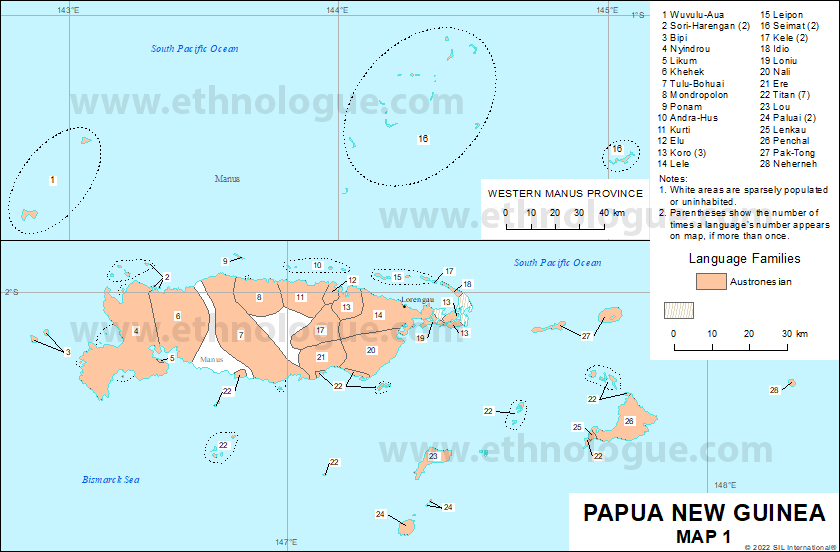
Papua New Guinea, Map 10
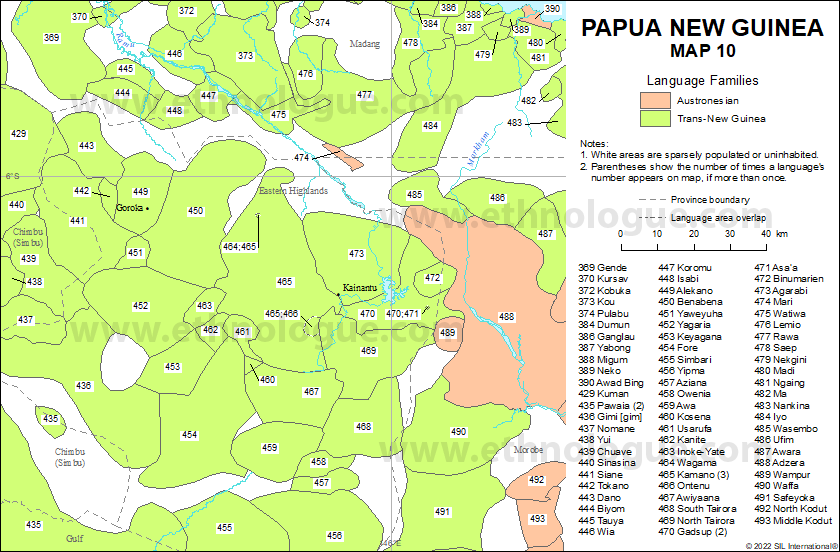
Papua New Guinea, Map 11
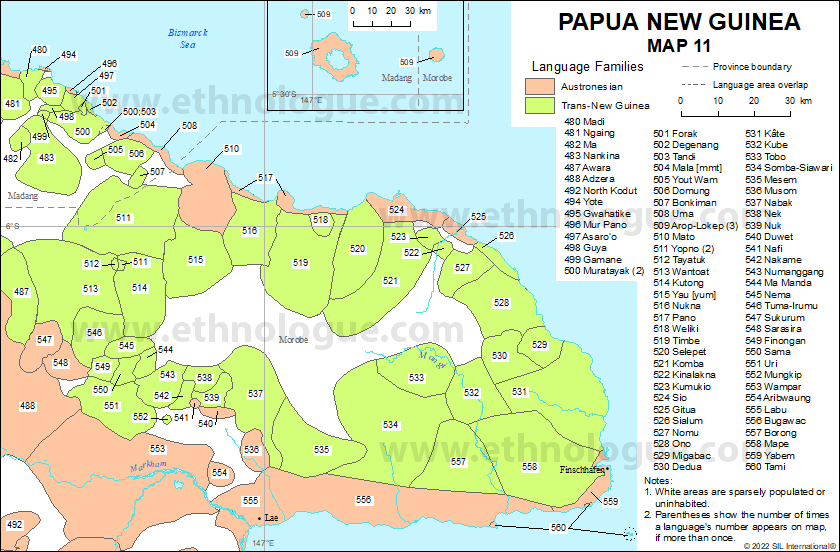
Papua New Guinea, Map 12
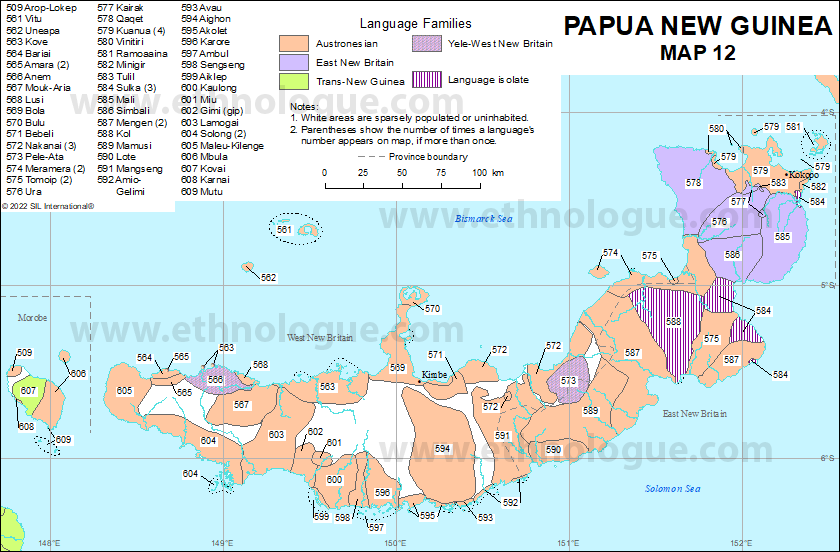
Papua New Guinea, Map 13
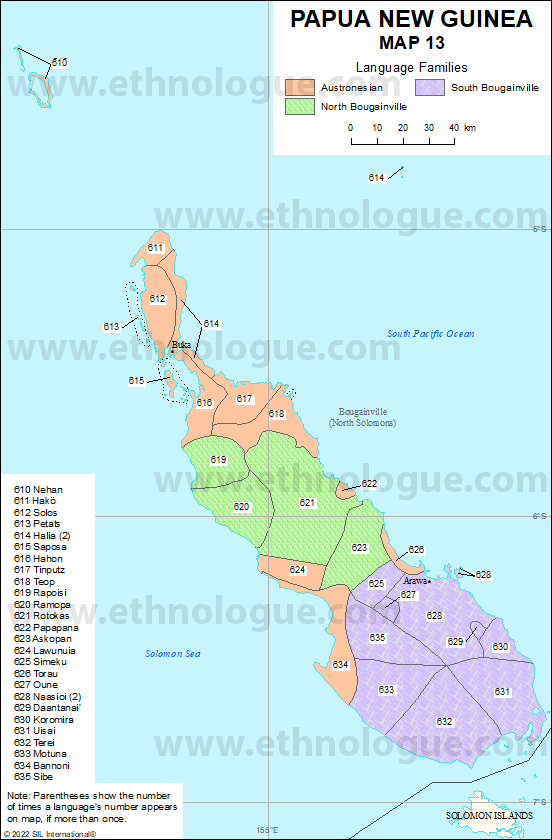
Papua New Guinea, Map 14
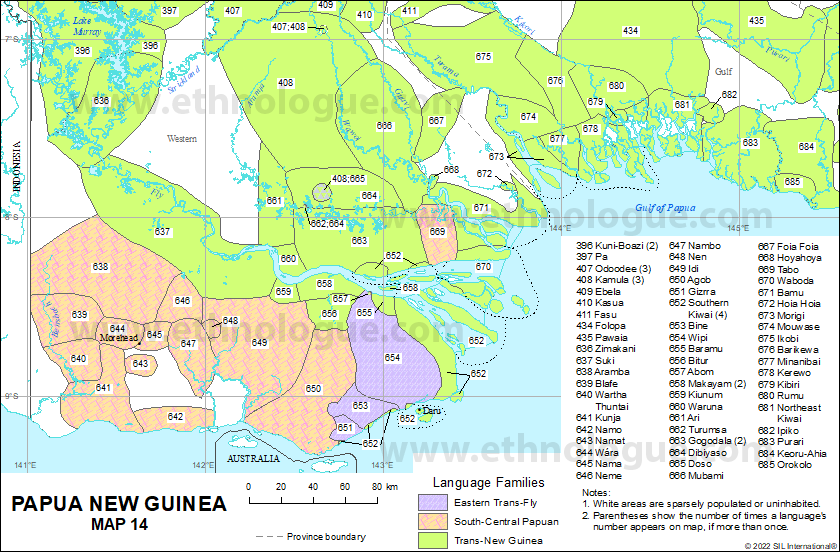
Papua New Guinea, Map 15
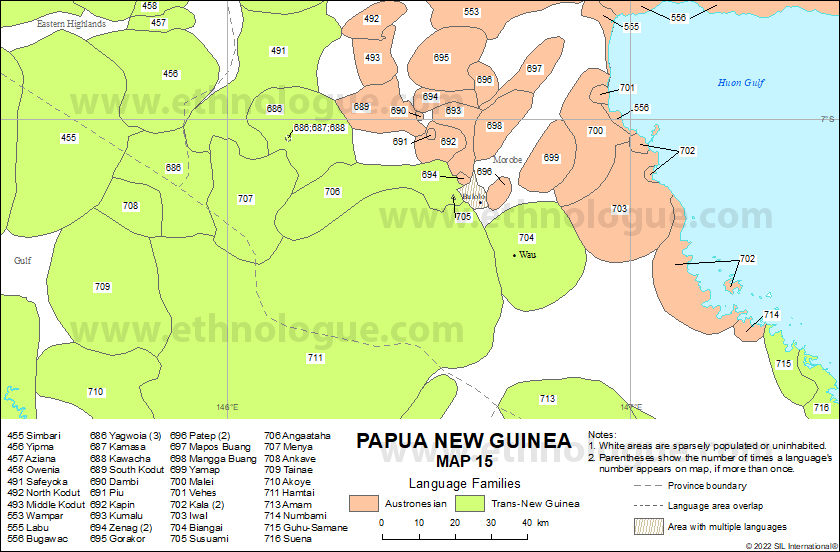
Papua New Guinea, Map 16
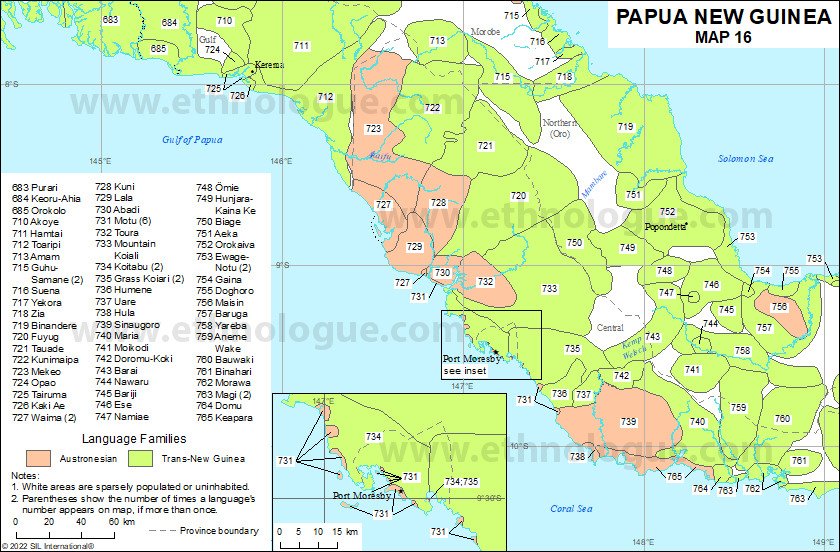
Papua New Guinea, Map 17
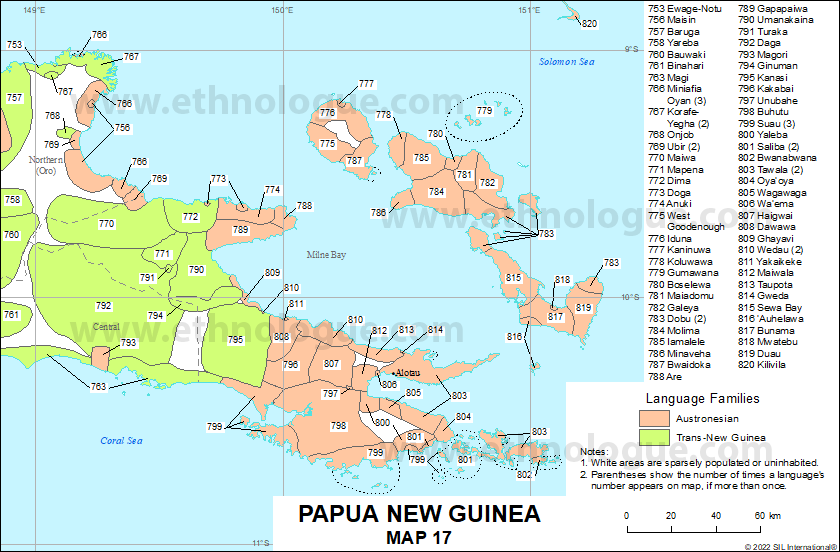
Papua New Guinea, Map 18
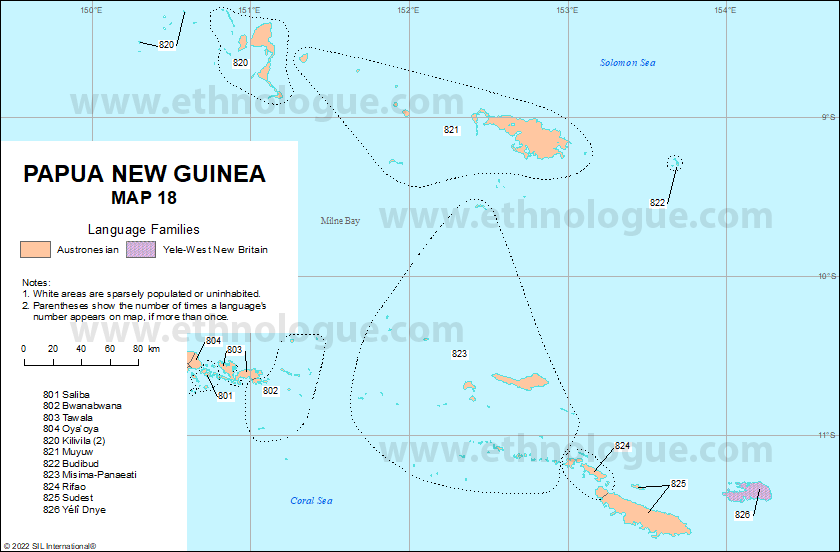
Papua New Guinea, Map 2
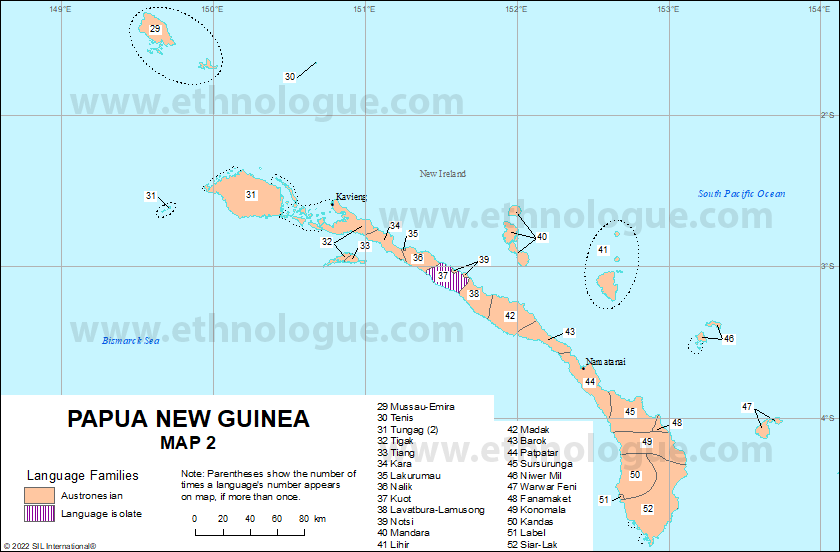
Papua New Guinea, Map 3
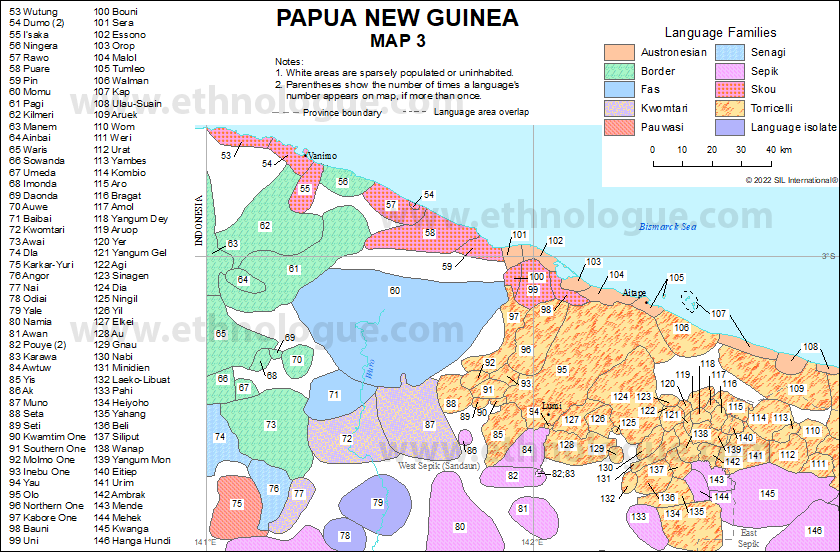
Papua New Guinea, Map 4
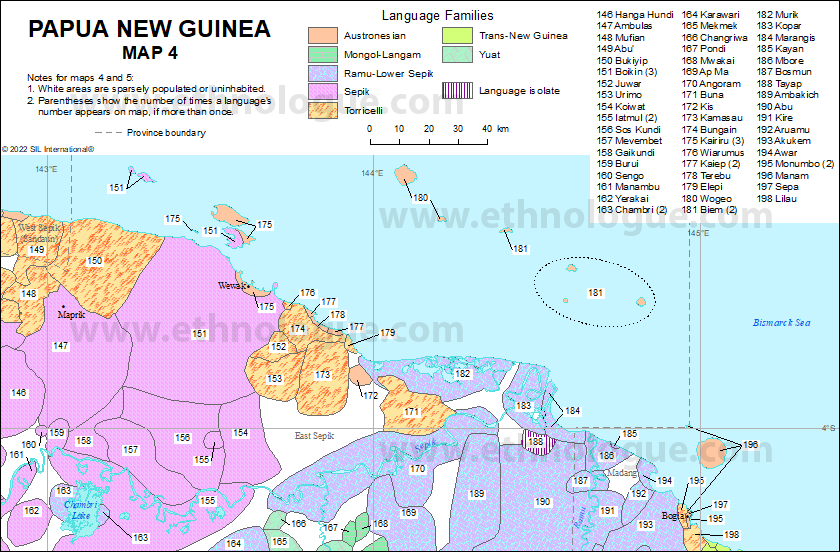
Papua New Guinea, Map 5
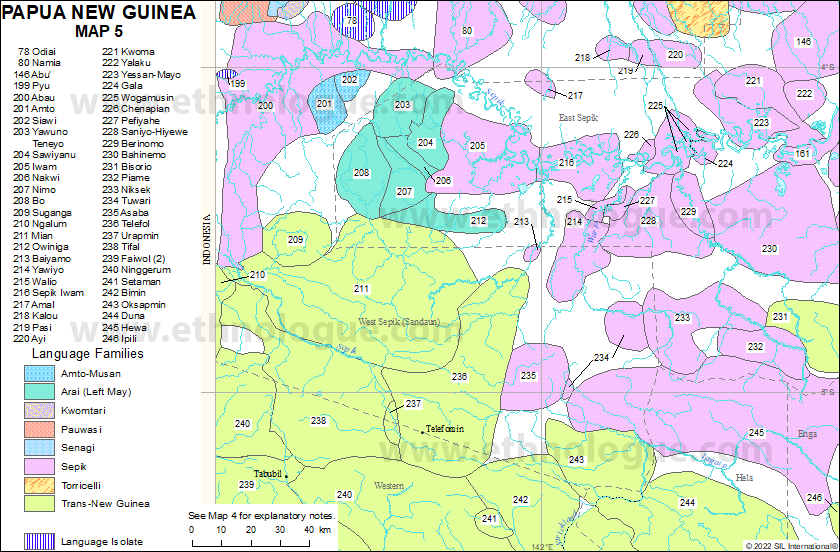
Papua New Guinea, Map 6
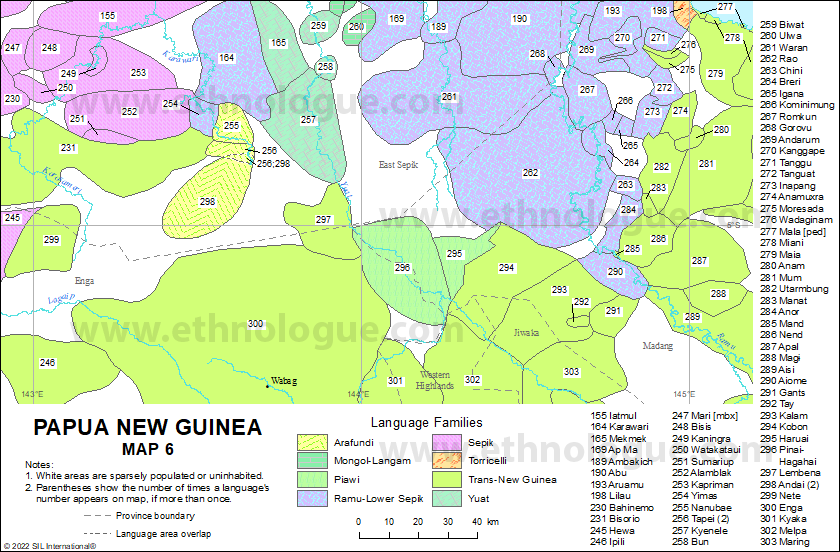
Papua New Guinea, Map 7
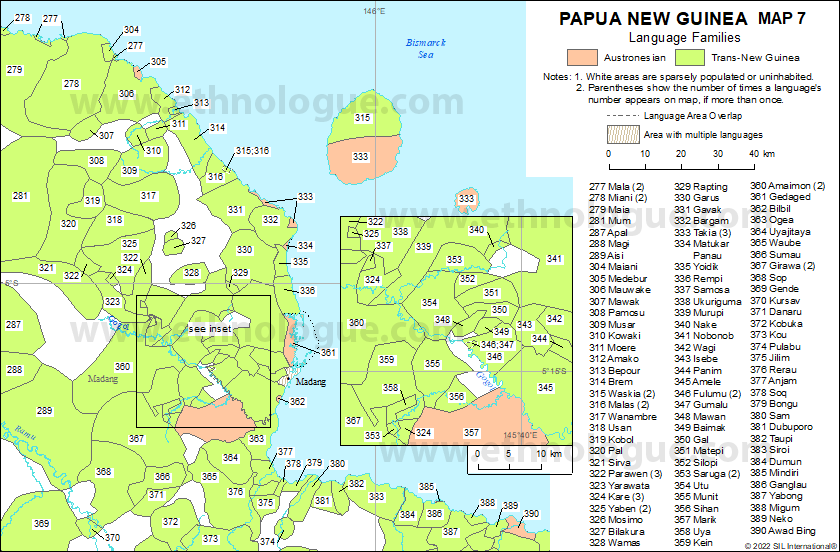
Papua New Guinea, Map 8
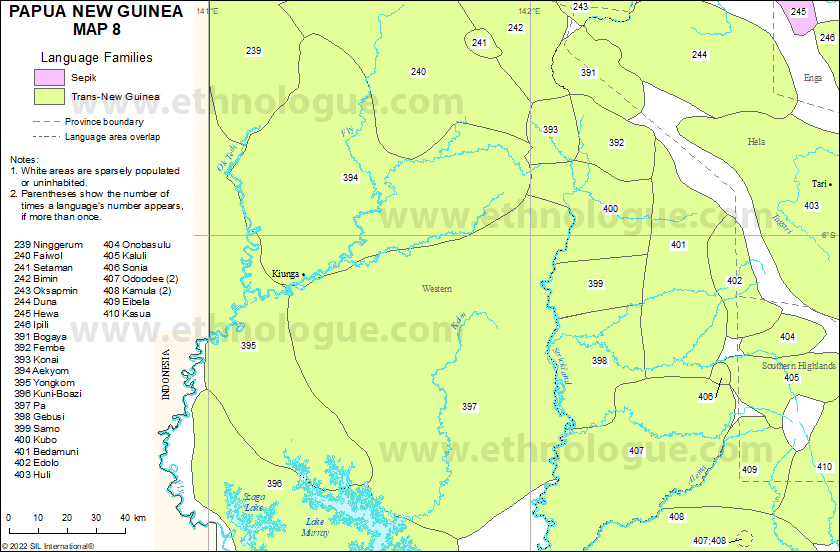
Papua New Guinea, Map 9
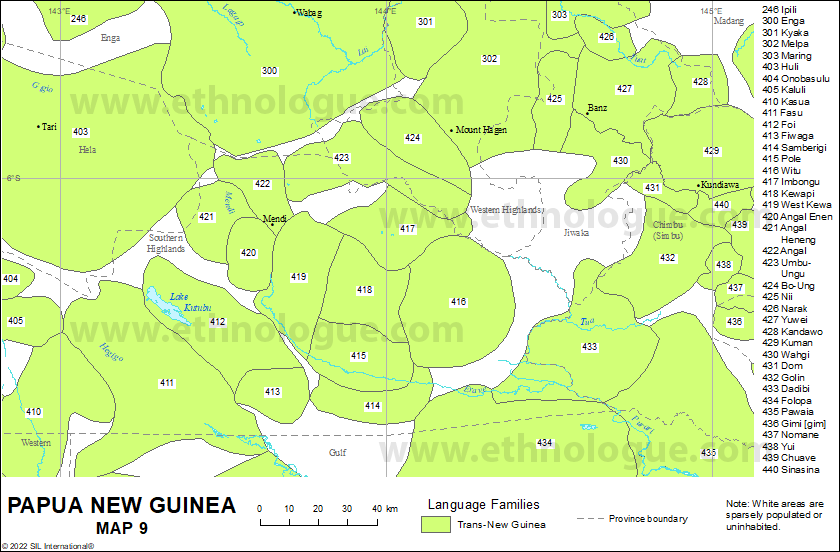
Papua New Guinea: Index map
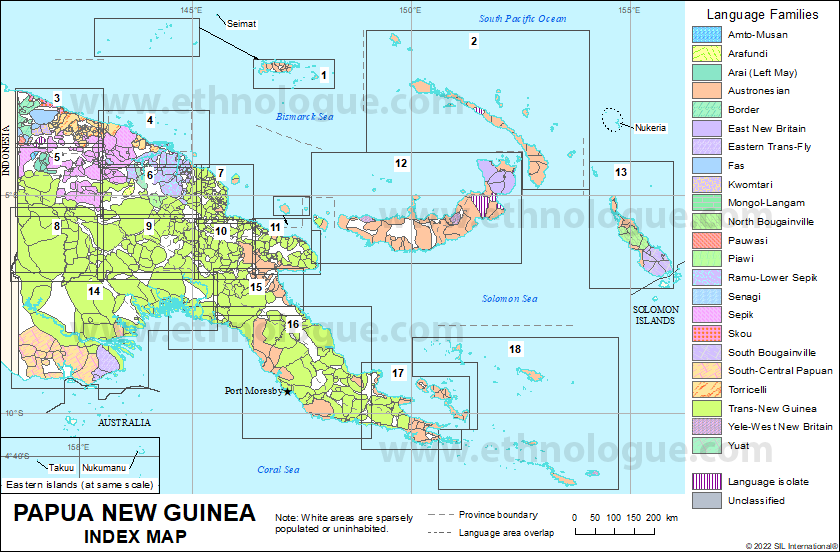
Graphs
Language Vitality Profile
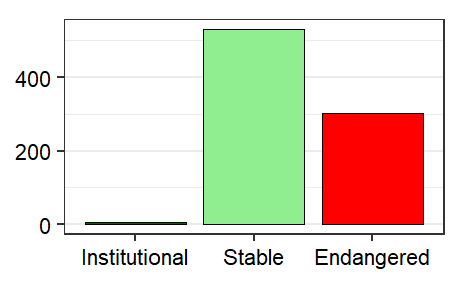
Full explanation
Language Status Profile
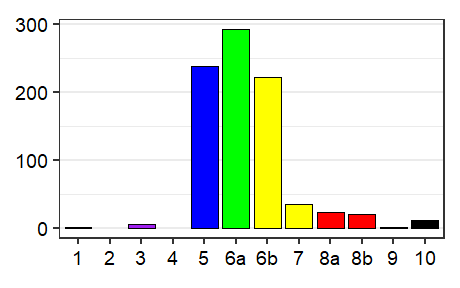
Full explanation
Resources
View Terms
Each Ethnologue country digest is a licensed product with restricted terms of use. Before downloading the product, you must agree to the following terms:
- This is a license for individual use. Just as with a conventionally published book, it is a violation of copyright to make a copy and give it to others.
- You may not redistribute this work in any form, including ingesting the contents into a database that is shared with others or posting it on a web site (whether public or private).
To inquire about permission for reuse or redistribution, please use the Contact Us form in the footer.
Digest of the languages of Papua New Guinea ($499.95, 347 page PDF)