
SD
Republic of the Sudan
Sudan
Summary
- Official Name
- Republic of the Sudan
- Population
- 44,385,000
- Principal Languages
- English, Standard Arabic
- Literacy Rate
- 61% (2018 UNESCO)
- International Conventions
- ACHPR (1987), CPPDCE (2006), CSICH (2012), ICCPR (1966), UNCRPD (2006), UNDRIP (2007)
- General References
- Bender 1975, Bender 1983a, Bender 1989b, Bendor-Samuel and Hartell 1989, Doornbos and Bender 1983, Schadeberg and Bender 1981, Stevenson 1984
- Deaf Population
- 48,900
- Language Counts
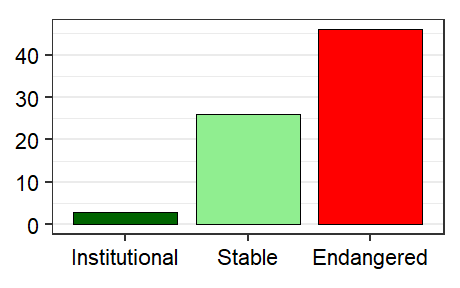
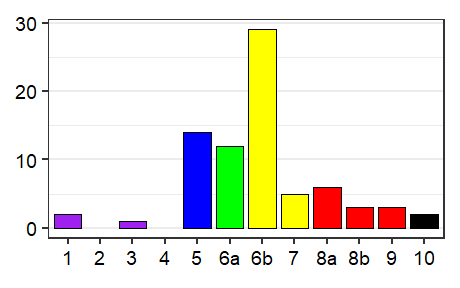
- The number of established languages listed for Sudan is 77. Of these, 75 are living and 2 are extinct. Of the living languages, 70 are indigenous and 5 are non-indigenous. Furthermore, 3 are institutional, 18 are developing, 8 are vigorous, 34 are in trouble, and 12 are dying. Also listed are 6 unestablished languages.
Languages
- Acheron acz
- South Kordofan state: Saraf Aj-Jaamous area, east of Moro hills. Users: 20,000 (2006 R. Norton). 9,830 speakers in home area (2006 R. Norton). Status: 5 (Developing). Alternate Names: Aceron, Achurun, Asheron Autonym: Garme Classification: Niger-Congo, Kordofanian, Talodi, Talodi Proper, Tocho
- Afitti aft
- North Kordofan state: east Jebel ed Dair, main center is Sidra. Users: 4,000 (de Voogt 2009). Status: 6b (Threatened). Alternate Names: Affitti, Dinik, Ditti, Unietti Classification: Nilo-Saharan, Satellite-Core, Core, Eastern Sudanic, Northern (k languages), Nyimang
- Aka soh
- Blue Nile state: Jebel Silak, southwest of Ingessana hills. Users: 300 (Bender 1983a). Status: 8a (Moribund). Alternate Names: Fa-c-aka, Jebel Silak, Jebels Sillok, Sillok Classification: Nilo-Saharan, Satellite-Core, Core, Eastern Sudanic, Southern (n languages), Eastern Jebel, Aka-Kelo-Molo
- Ama nyi
- South Kordofan state: Al Fous, Fuony, Hajar Sultan, Kakara, Kalara, Koromiti, Nitil, Salara, Tundia, and other villages in Jebel Mandal range, Nyimang hills. Users: 158,000 (2017). Elderly and young children are monolingual. Status: 5 (Developing). Alternate Names: Inyimang, Nyima, Nyiman, Nyimang, Nyuwing Autonym: Ámá Classification: Nilo-Saharan, Satellite-Core, Core, Eastern Sudanic, Northern (k languages), Nyimang
- Amharic amh
- Users: 99,000 in Sudan (2017). Status: Unestablished. Classification: Afro-Asiatic, Semitic, South, Ethiopian, South, Transversal, Amharic-Argobba
- Andaandi dgl
- Northern state: Dongola district; north boundary is Burgeg. Users: 70,000 (2014 M. Jaeger). Status: 6b* (Threatened). Alternate Names: Danaagla, Danaqla, Dongola, Dongola Nubian, Dongolawi, Dongolawi Nubian, Dongolese Autonym: Andaandi Classification: Nilo-Saharan, Satellite-Core, Core, Eastern Sudanic, Northern (k languages), Nubian, Central, Dongolawi
- Arabic, Algerian Spoken arq
- Users: 39,000 in Sudan (2017). Status: Unestablished. Classification: Afro-Asiatic, Semitic, Central, South, Arabic
- Arabic, North Levantine Spoken apc
- Users: 96,000 in Sudan (2017). Status: Unestablished. Classification: Afro-Asiatic, Semitic, Central, South, Arabic
- Arabic, Standard arb
- Users: 26,900,000 in Sudan (2015 SIL), all users. Status: 1 (National). Statutory national working language (2005, Interim Constitution, Article 8(3)). Classification: Afro-Asiatic, Semitic, Central, South, Arabic
- Arabic, Sudanese Spoken apd
- Widespread. Users: 39,100,000 in Sudan, all users. L1 users: 30,100,000 in Sudan (2017). L2 users: 9,000,000 (2019). Total users in all countries: 42,332,360 (as L1: 33,332,360; as L2: 9,000,000). Status: 3 (Wider communication). De facto language of national identity. Language of wider communication with the coming of the Arabs between the 14th and 15 centuries. More widespread in the 1890s under British rule. Spoken throughout Sudan and part of Eritrea. Language of religion and trade. Alternate Names: Khartoum Arabic, Sudanese Arabic Autonym: Dārijīya, سوداني (sūdānī) Classification: Afro-Asiatic, Semitic, Central, South, Arabic
- Baygo byg
- South Darfur state: southeast of Nyala, east Kube hills, Jebel Beygo. Users: No known L1 speakers. The last speakers probably survived into the 1960s (Sommer 1992). Ethnic population: 850 (1978 GRN). Status: 9 (Dormant). Alternate Names: Baigo, Bego, Beigo, Beko, Beygo, Béogé Classification: Nilo-Saharan, Satellite-Core, Core, Eastern Sudanic, Southern (n languages), Daju, Western Daju
- Bedawiyet bej
- Red Sea state; Gedaref, Kassala, and River Nile states, southeast river Nile. Users: 2,220,000 in Sudan (2017). Total users in all countries: 2,498,000. Status: 5 (Developing). Alternate Names: Beḍauye, Bedawi, Bedawiye, Bedja, Bedàwie, Beja, Biďaːwyéːt, Tibďaːwyě, To Bedawiat, To Bedawie, Tu Bdhaawi, Tu-Bedawie Autonym: Bidhaawyeet, Tubdhaawi, بجاوية (Bidhaawyeet), تُبڈاوِ (Tubdhaawi) Classification: Afro-Asiatic, Cushitic, North
- Berta wti
- Blue Nile state: Geissan, Kurmuk, and south Roseires districts, Ethiopia border area. Users: 180,000 in Sudan (Osman 2006). Status: 6b* (Threatened). Alternate Names: Barta, Beni Shangul, Benishangul, Bertha, Burta, Funj, Gwami, Ndú Berthú, Rotana, Rut’ana, Wetawit Classification: Nilo-Saharan, Satellite-Core, Satellites
- Berti byt
- North Darfur state: Tagabo hills. Users: No known L1 speakers. The last speakers probably died or shifted to Arabic by the 1980s (Sommer 1992). Status: 10 (Extinct). Classification: Nilo-Saharan, Saharan, Eastern
- Birked brk
- North Darfur state: between Jebel Harayt and Rizaykat (Arab) country, north of Nyala; North Kordofan: south of El Obeid. Users: No known L1 speakers. Last speakers survived into the 1970s; ethnic Birked shifted to Arabic (Sommer 1992). Status: 10 (Extinct). Alternate Names: Birgid, Birguid, Birkit, Birqed, Kajjara, Murgi Classification: Nilo-Saharan, Satellite-Core, Core, Eastern Sudanic, Northern (k languages), Nubian, Central, Birked
- Bornu knc
- Scattered, in South Darfur, South Kordofan, West Darfur, and West Kordofan states and other regions. Users: 348,000 in Sudan (2017). Status: 6a* (Vigorous). Alternate Names: Bornouans, Central Kanuri, Kanouri, Kanoury, Kanuri, Kole, Sirata, Yerwa Kanuri, “Beriberi” (pej.) Classification: Nilo-Saharan, Saharan, Western, Kanuri
- Burun bdi
- Blue Nile state: north Kurmuk district. Users: 46,000 (2017). Status: 5 (Developing). Alternate Names: Borun, Cai, Kurmuk, Lange Classification: Nilo-Saharan, Satellite-Core, Core, Eastern Sudanic, Southern (n languages), Nilotic, Western, Luo, Northern, Mabaan-Burun, Burun
- Dagik dec
- South Kordofan state: Mesakin hills, Buram, Kamlela, Reikha, Taballa, and Tosari villages. Users: 61,000 (2017). Status: 5 (Developing). Alternate Names: Dagig, Dharuwa, Duwa, Masakin Dagig, Ruwa, Thakik, “Masakin” (pej.), “Masakin Gusar” (pej.) Autonym: Dhaduwa Classification: Niger-Congo, Kordofanian, Talodi, Talodi Proper, Ngile-Dengebu
- Dair drb
- North Kordofan state: west and south of Jebel Dair. Users: 1,000 (1978 GRN). Status: 8a (Moribund). Alternate Names: Dabab, Daier, Thaminyi Classification: Nilo-Saharan, Satellite-Core, Core, Eastern Sudanic, Northern (k languages), Nubian, Central, Hill, Unclassified
- Daju, Dar Fur daj
- West Darfur state: Geneina district; South Darfur state: Daju hills 40 km northeast of Nyala; South Kordofan state: Dar el Kabira, Jebel Miheila, Lagawa, Nyukri, Silecce, Tamanyik, and Warina area villages (Lagowa dialect). Users: 98,000 (2017). Status: 5 (Developing). Alternate Names: Beke, Dagu, Daju Ferne, Fininga, Nyala-Lagowa Autonym: Bekke Classification: Nilo-Saharan, Satellite-Core, Core, Eastern Sudanic, Southern (n languages), Daju, Western Daju
- Daju, Dar Sila dau
- West Darfur state: Habilla district. Users: 7,000 in Sudan (2009 T. Alaki). Status: 6b (Threatened). Alternate Names: Bokor, Bokorike, Bokoruge, Mongo-Sila, Sila, Sula Classification: Nilo-Saharan, Satellite-Core, Core, Eastern Sudanic, Southern (n languages), Daju, Western Daju
- Dilling dil
- South Kordofan state: Dilling town and surrounding hills, including Kudur. Users: 12,000 (2017), decreasing. No monolinguals. Status: 8a (Moribund). Alternate Names: Delen, Warkimbe Autonym: Warki Classification: Nilo-Saharan, Satellite-Core, Core, Eastern Sudanic, Northern (k languages), Nubian, Central, Hill, Unclassified
- El Hugeirat elh
- North Kordofan and South Kordofan states: Baboy, Bija, Sija, and Shenshin villages in El Hugeirat hills, divided by border. Users: 50 (2007 SIL), decreasing. Status: 8a (Moribund). Alternate Names: El Hagarat, Hill Nubian, Kordofan Classification: Nilo-Saharan, Satellite-Core, Core, Eastern Sudanic, Northern (k languages), Nubian, Central, Hill, Unclassified
- English eng
- Status: 1 (National). Statutory national working language (2005, Interim Constitution, Article 8(3)). Classification: Indo-European, Germanic, West, English
- Fulfulde, Adamawa fub
- Blue Nile, Gedaref, Sennar, and South Darfur states; possibly North Kordofan and South Kordofan states, scattered. Users: 204,000 in Sudan (2017). Status: 6b* (Threatened). Alternate Names: Fellata, Fulfulde Classification: Niger-Congo, Atlantic-Congo, Atlantic, Northern, Senegambian, Fula-Wolof, Fula, Eastern
- Fur fvr
- North Darfur, South Darfur, and West Darfur states; some villages in east Sudan. Users: 744,000 in Sudan (2004 SIL). Ethnic population: 1,100,000 (2017). Total users in all countries: 745,800. Status: 5 (Developing). Alternate Names: Dala, For, Fora, Fordunga, Forok, Forta, Furakang, Furawi, Kadirgi, Konjara, Korra, Kungara, Kurka, Lali, Onage, Yerge, bèle fòòr, fòòraŋ bèle Autonym: Poor’íŋ Belé’ŋ Classification: Nilo-Saharan, Satellite-Core, Satellites, Fur
- Gaam tbi
- Blue Nile state: Baw district, Jebel Tabi and outlying hills. Users: 104,000 (2017). Status: 5 (Developing). Alternate Names: Gaahmg, Ingassana, Ingessana, Kamanidi, Kor é Gəəmg, Mamedja, Mamidza, Metabi, Muntabi, Tabi Autonym: Gəəməndən Classification: Nilo-Saharan, Satellite-Core, Core, Eastern Sudanic, Southern (n languages), Eastern Jebel, Gaam
- Ganza gza
- Blue Nile state: Kurmuk district, Dahmoh, Darsoma, Korbum, Tugubele, and Yeshkab villages between Daga and Yabus rivers. Users: 2,600 in Sudan (2007 A. Krell). Total users in all countries: 3,000. Status: 6a (Vigorous). Alternate Names: Ganzo, Gwami, Koma, Koma-Ganza Classification: Afro-Asiatic, Omotic, North, Mao
- Gbaya krs
- South Darfur state: Radom district, Kafia Kingi and south. Users: 28,000 in Sudan (2017). Total users in all countries: 48,000 (as L1: 44,000; as L2: 4,000). Status: 5 (Developing). Autonym: Gbäyä Classification: Nilo-Saharan, Satellite-Core, Satellites, Central Sudanic, West, Kresh
- Ghulfan ghl
- South Kordofan state: Dabri, Karkandi, Katang, Kurgul, Namang, Ninya, Moring, Ota, Shigda, and Tarda villages in Ghulfan Kurgul and Ghulfan Morung hills south of Dilling. Users: 37,000 (2017), decreasing. No monolinguals. Status: 7 (Shifting). Alternate Names: Gulfan, Uncu, Uncunwee, Wunci, Wuncimbe Classification: Nilo-Saharan, Satellite-Core, Core, Eastern Sudanic, Northern (k languages), Nubian, Central, Hill, Kadaru-Ghulfan
- Gula kcm
- South Darfur state: Kafia Kingi. Users: 200 in Sudan (1987 SIL). Status: 6b (Threatened). Alternate Names: Kara, Kara of Sudan, Yamegi Classification: Nilo-Saharan, Satellite-Core, Satellites, Central Sudanic, West, Bongo-Bagirmi, Kara
- Gule gly
- Blue Nile state: Damazin district, Jebel Gule, San and Roro hills. Users: No known L1 speakers. The last speakers survived into the 1980s (Sommer 1992). Ethnic population: 1,000 (Bender 1983a). Status: 9 (Dormant). Alternate Names: Anej, Fecakomodiyo, Hamej Classification: Nilo-Saharan, Satellite-Core, Core, Koman
- Gumuz guk
- Blue Nile state: east Er Roseires district, Famaka and Fazoglo areas on the Blue Nile; Sennar state: Dinder district, north along Ethiopia border. Users: 88,000 in Sudan (2017). Status: 6a* (Vigorous). Alternate Names: Debatsa, Deguba, Dehenda, Gombo, Gumis, Kadallu, Mendeya, Sa-Gumuz, “Shankillinya” (pej.), “Shanqilla” (pej.) Classification: Nilo-Saharan, Satellite-Core, Core, B’aga
- Hausa hau
- Blue Nile and Khartoum states; scattered in Khartoum, along Blue Nile river; Kordofan. Users: 740,000 in Sudan, all users. L1 users: 80,000 in Sudan (2007). L2 users: 660,000 (2017). Status: 5* (Dispersed). Classification: Afro-Asiatic, Chadic, West, A, A.1
- Heiban hbn
- South Kordofan state: Abul and Heiban towns. Users: 4,410 (Stevenson 1984). Status: 7 (Shifting). Alternate Names: Abul, Ebang Classification: Niger-Congo, Kordofanian, Heiban, West-Central, Central, Ebang-Logol, Ebang-Laru
- Jumjum jum
- Blue Nile state: west Kurmuk district, Jebels Tunga, Terta, and Wadega areas on South Sudan border. Users: 78,000 in Sudan (2017). Status: 5 (Developing). Alternate Names: Berin, Jiik Mäbaan, Olga, Wadega, Wadkai Autonym: Tüŋ Mäbaan Classification: Nilo-Saharan, Satellite-Core, Core, Eastern Sudanic, Southern (n languages), Nilotic, Western, Luo, Northern, Mabaan-Burun, Mabaan
- Kadaru kdu
- South Kordofan state: Jibaal as Sitta hills between Delami and Dilling. Users: 25,000 (2013 T. Alaki and R. Norton). Status: 7 (Shifting). Alternate Names: Kadaro, Kadero, Kaderu, Kodhin, Kodhinniai, Kodoro, Tamya Classification: Nilo-Saharan, Satellite-Core, Core, Eastern Sudanic, Northern (k languages), Nubian, Central, Hill, Kadaru-Ghulfan
- Kanga kcp
- South Kordofan state: Miri hills, west and southwest of Kadugli; Kufa village cluster southeast of Miri, northeast of Lima, and north of Kanga. Bilenya, Dologi, Lenyaguyox, Lima, Kilag, Kufa, Mashaish, and Toole (center) villages (Kufa-Lima dialect). Users: 15,000 (2017). Status: 6b (Threatened). Classification: Nilo-Saharan, Satellite-Core, Core, Kadugli-Krongo
- Karko kko
- South Kordofan state: Karko hills, 35 km west of Dilling, includes Dulman. Users: 7,000 (2004 A. Farah). Status: 7 (Shifting). Alternate Names: Garko, Kaak, Karme, Kithonirishe Autonym: Kakenbi Classification: Nilo-Saharan, Satellite-Core, Core, Eastern Sudanic, Northern (k languages), Nubian, Central, Hill, Unclassified
- Katcha-Kadugli-Miri xtc
- South Kordofan state. Belanya, Dabakaya, Farouq, Kafina, Katcha, and Tuna villages (Katcha dialect); ’Daalimo, Kadugli, Kulba, Murta, Takko, and Thappare villages (Kadugli dialect); Hayar al-Nimr, Kadoda, Kasari, Kuduru, Kya, Luba, Miri Bara, Miri Guwa, Nyimodu, Sogolle, Tulluk, and Umduiu villages (Miri dialect). Users: 75,000 (2004 SIL). 30,000 Katcha and Kadugli (2004), 4,000 Miri. Status: 6b (Threatened). Classification: Nilo-Saharan, Satellite-Core, Core, Kadugli-Krongo
- Katla kcr
- South Kordofan state: Katla hills southwest of Dilling. Kabog, Kabog North, Kabosh, Kambai, Karkando, Karkarya, Kary, Kimndang, Kitanngo, Kolbi, Koto Kork, Octiang, Rumber, Sabba, Tolot, (Julud dialect); Bombori, Karoka, Kateik, Kiddu, Kirkpong, and Koldrong (Katla dialect). Users: 25,000 (2009). Population for Julud. Status: 6b (Threatened). Alternate Names: Akalak, Kalak Classification: Niger-Congo, Kordofanian, Katla
- Keiga kec
- South Kordofan state: Jebel Demik, northwest of Kadugli; Ambong area, Ambong, Ambongadi, Arungekkaadi, Bila Ndulang, Kandang, Kuluwaring, Lakkadi, Roofik, Saadhing, Taffor, and Tingiragadi villages; Lubung area, Kuwaik, Miya Ndumuru, Miya Ntaarang, Miya Ntaluwa, Semalili, and Tungunungunu villages; Tumuro area, Jughuba, Kayide, Koolo, and Tumuro villages. Users: 6,070 (Stevenson 1984). Status: 6b (Threatened). Alternate Names: Deiga, Kayigang, Kayikang, Keiga-Al-Kheil, Keiga-Timero, Sani ma-yɛgaŋ, Yega Classification: Nilo-Saharan, Satellite-Core, Core, Kadugli-Krongo
- Kelo xel
- Blue Nile state: Geissan district, Beni Sheko and Keeli villages. Users: 200. Status: 8b (Nearly extinct). Alternate Names: Kelo-Beni Sheko, Ndu-Faa-Keelo, Tornasi Classification: Nilo-Saharan, Satellite-Core, Core, Eastern Sudanic, Southern (n languages), Eastern Jebel, Aka-Kelo-Molo
- Ko fuj
- South Kordofan state: isolated hills between Talodi and the White Nile. Users: 2,680 (Stevenson 1984). Status: 6b (Threatened). Alternate Names: Fungor, Fungur, Kau Classification: Niger-Congo, Kordofanian, Heiban, Eastern
- Koalib kib
- South Kordofan state: Delami area. Hadra, Nyukwur, and Umm Heitan (Nginyukwur dialect); Abri area villages scattered on the plain (Ngirere dialect); Koalib hills area (Ngunduna dialect); Turum and Umm Berumbita (Nguqwurang dialect). Users: 100,000 (Quint 2009). Status: 5* (Developing). Alternate Names: Abri, Kandiza Kethi Koalib, Kawaaliib, Kawalib, Kowalib, Lgalige, Nirere, Rere Autonym: Kwɐ̀ɐlîp Classification: Niger-Congo, Kordofanian, Heiban, West-Central, Central, Rere
- Komo xom
- Blue Nile state: Kurmuk district, Ahmar, Tombak, and Yabus rivers area. Users: 10,000 in Sudan (1979 W. James). Total users in all countries: 37,000. Status: 6a (Vigorous). Alternate Names: Central Koma, Como, Gokwom, Hayahaya, Koma of Daga, Madiin Autonym: Tta Komo Classification: Nilo-Saharan, Satellite-Core, Core, Koman
- Krongo kgo
- South Kordofan state: Angolo, Tabanya, and Toroji in Krongo hills; Buram, Damaguto, Dar, Dimadragu, and Dimodongo. Users: 49,000 (2017). Status: 5 (Developing). Alternate Names: Dimodongo, Kadumodi, Korongo, Kurungu, Tabanya Autonym: Niino mo-di Classification: Nilo-Saharan, Satellite-Core, Core, Kadugli-Krongo
- Lafofa laf
- South Kordofan state: central Eliri hills. Users: 5,140 (Stevenson 1984). Status: 6b (Threatened). Alternate Names: Kidie, Kidie Lafofa Classification: Niger-Congo, Kordofanian, Talodi, Tegem
- Laro lro
- South Kordofan state: Oya, Rodong (Hajar Medani), Hajar Baco, Gunisaia, Serif, Tondly, Reli, Lagau (Serfinila), Getaw (Hajar Tiya), Orme (Ando) villages in Alleira hills north of Heiban town. Users: 40,000 (Kuku 2012). Status: 5 (Developing). Alternate Names: Al-Leira, Leera, Liira, Ngwullaro, Yillaro Autonym: Laru Classification: Niger-Congo, Kordofanian, Heiban, West-Central, Central, Ebang-Logol, Ebang-Laru
- Logol lof
- South Kordofan state: isolated hills between Talodi and the White Nile. Users: 12,000 (2017). Status: 8a (Moribund). Alternate Names: Lukha Classification: Niger-Congo, Kordofanian, Heiban, West-Central, Central, Ebang-Logol, Logol
- Logorik liu
- South Kordofan state: Jebel Liguri and hills 15 km northeast of Kadugli. Users: 2,000 (Welmers 1971a). Status: 6b (Threatened). Alternate Names: Laggori, Liguri, Logori Classification: Nilo-Saharan, Satellite-Core, Core, Eastern Sudanic, Southern (n languages), Daju, Eastern Daju
- Lumun lmd
- South Kordofan state: Canya’ru, Toromathan, and To’ri villages in Limon hills. Users: 15,000 (2014 SIL). Home area population 9,500 (2011 census). Ethnic population: 20,000 (2014 SIL). Status: 5* (Developing). Alternate Names: Kuku-Lumun, Lomon Autonym: Lumun Classification: Niger-Congo, Kordofanian, Talodi, Talodi Proper, Tocho
- Masalit mls
- South Darfur state: scattered; West Darfur state: Geneina and Habila districts. North and east of Geneina (Northern Masalit dialect). Users: 350,000 in Sudan (2011 SIL). Total users in all countries: 462,000. Status: 6a (Vigorous). Alternate Names: Kana Masalaka, Kana Masaraka, Kanaa Masaraka, Masaraka, Massalit, Mesalit Autonym: Kanaa Masarak, Masarak Classification: Nilo-Saharan, Satellite-Core, Satellites, Maban, Masalit
- Midob mei
- Khartoum state: scattered throughout, and Omdurman district, Gezirat Aba island; White Nile state; North Darfur state: Mellit district, Malha area. Users: 85,000 (2017). Status: 6a (Vigorous). Alternate Names: Meidob, Meidob Nubian, Midobi, Tid, Tid-N-Aal, Tidda Classification: Nilo-Saharan, Satellite-Core, Core, Eastern Sudanic, Northern (k languages), Nubian, Western
- Molo zmo
- Blue Nile state: Jebel Malkan. Users: 100 (1988 M. Bender), decreasing. Status: 8b (Nearly extinct). Alternate Names: Malkan, Tura-Ka-Molo Classification: Nilo-Saharan, Satellite-Core, Core, Eastern Sudanic, Southern (n languages), Eastern Jebel, Aka-Kelo-Molo
- Moro mor
- South Kordofan state: Moro hills. Users: 72,000 (2017). Status: 5 (Developing). Autonym: Dhimorong Classification: Niger-Congo, Kordofanian, Heiban, West-Central, Western
- Nding eli
- South Kordofan state: East Nuba hills, south Eliri range. Users: 400 (Welmers 1971a). Status: 6b (Threatened). Alternate Names: Eliri Classification: Niger-Congo, Kordofanian, Talodi, Talodi Proper, Nding
- Ngile jle
- South Kordofan state: Mesakin hills. Masakin and Togosilu villages (Masakin Tuwal dialect); Daloka and El Aheimar villages (Daloka dialect). Users: 11,700 (Stevenson 1984), including Dagik [dec] speakers. Status: 6b* (Threatened). Alternate Names: Angire, Arra, Daloka, Darra, Masakin, Mesakin, Taloka Classification: Niger-Congo, Kordofanian, Talodi, Talodi Proper, Ngile-Dengebu
- Nobiin fia
- Northern state: Wadi Halfa district, Burgeg to Wadi Halfa; possibly east of Khartoum city, New Halfa area. Users: 144,000 in Sudan (2017). Total users in all countries: 546,000. Status: 6b (Threatened). Alternate Names: Fiadidja-Mahas, Mahas-Fiadidja, Mahas-Fiyadikkya Classification: Nilo-Saharan, Satellite-Core, Core, Eastern Sudanic, Northern (k languages), Nubian, Northern
- Oromo, West Central gaz
- Users: 96,000 in Sudan (2017). Status: Unestablished. Classification: Afro-Asiatic, Cushitic, East, Oromo
- Otoro otr
- South Kordofan state: Otoro hills south of Heiban town. Users: 10,000 (2001). Status: 6b (Threatened). Alternate Names: Dhitoro, Kawama, Kawarma, Litoro, Utoro Autonym: Ḏuṯuɽu Classification: Niger-Congo, Kordofanian, Heiban, West-Central, Central, Ebang-Logol, Utoro
- Shatt shj
- South Kordofan state: Shatt Daman, Shatt Safia, and Shatt Tebeldia; Abu Hashim and Abu Sinam areas. Users: 30,000 (2014 T. Stirtz). Status: 6b* (Threatened). Alternate Names: Caning Autonym: Ikä Caning Classification: Nilo-Saharan, Satellite-Core, Core, Eastern Sudanic, Southern (n languages), Daju, Eastern Daju
- Shwai shw
- South Kordofan state: 20 km west of Heiban town. Users: 3,500 (1989). Status: 6b (Threatened). Alternate Names: Ludumor, Shirumba, Shuway Autonym: Cwaya Classification: Niger-Congo, Kordofanian, Heiban, West-Central, Shirumba
- Sulaihab mde
- South Kordofan: Nuba mountains. Users: 25,000 in Sudan (2017). Status: Unestablished. Alternate Names: Maba Classification: Nilo-Saharan, Satellite-Core, Satellites, Maban, Maba
- Tagoi tag
- South Kordofan state: Moreb, Tagoi, Tukum, Tuling, Tumale, Turjok, and Turum. Users: 27,000 (2017). Status: 6b* (Threatened). Alternate Names: Tagoy Classification: Niger-Congo, Kordofanian, Rashad
- Talodi tlo
- South Kordofan state: Talodi town, Tasomi and Tata villages. Users: 1,500 (1989). Status: 8b (Nearly extinct). Alternate Names: Ajomang, Gajomang, Jomang Classification: Niger-Congo, Kordofanian, Talodi, Talodi Proper, Jomang
- Tama tma
- South Darfur state: west of Nyala; West Darfur state. Sirba area, Abu Shadra, Abu Suruj, Agar, Bir Dagig, Budiflo, Gezin, Giilint, Goboron, Immed Marloga, Kengrem, Kondobe, Kuma Mardok, Matinoor, Muburung, Rigilmur, Saraf Jidad, Shitkol, Tord, and Zere (Erenga dialect:); Jabal Muun area, Salia town (Mileere dialect). Users: 227,000 in Sudan (2017). 155,000 Kimr and 72,000 Tama. Status: 6b (Threatened). Classification: Nilo-Saharan, Satellite-Core, Core, Eastern Sudanic, Northern (k languages), Tama, Tama-Sungor
- Tegali ras
- South Kordofan state: Tegali and Rashad hills and Rashad town. Users: 99,000 (2017). 80,000 Tegali and 19,000 Tingal. Status: 6b (Threatened). Alternate Names: Orig, Tagale, Tegele, Tekele, Togole, Turjok Classification: Niger-Congo, Kordofanian, Rashad
- Temein teq
- South Kordofan state: Farik, Kuris, Kwiye, Nekring, Tokoing, Tukur, and Tulu villages between Jebels Ghulfan Morung and Julud. Users: 13,000 (2006). 6,000 in home area villages; 7,000 in other towns in Sudan. Status: 6b* (Threatened). Alternate Names: Rone, Ronge, Temainian Classification: Nilo-Saharan, Satellite-Core, Core, Eastern Sudanic, Southern (n languages), Temein
- Tese keg
- South Kordofan state: Keiga Jirru, and 6 villages northeast of Kadugli. Users: 1,400 (Welmers 1971a). Status: 6b (Threatened). Alternate Names: Keiga Girru, Keiga Jirru, Teis-Umm-Danab, These Classification: Nilo-Saharan, Satellite-Core, Core, Eastern Sudanic, Southern (n languages), Temein
- Tigré tig
- Red Sea state: Tokar and Garora regions; Gedaref and Kassala states. Users: 19,000 in Sudan (2017). Status: 6b* (Threatened). Classification: Afro-Asiatic, Semitic, South, Ethiopian, North
- Tigrigna tir
- Users: 48,000 in Sudan (2017). Status: Unestablished. Classification: Afro-Asiatic, Semitic, South, Ethiopian, North
- Tima tms
- South Kordofan state: Jebel Tima village, 15 km southwest of Katla, north of Lagawa. Users: Ethnic population: 5,000 (Dimmendaal and Voeltz 2007). Status: 8a (Moribund). Alternate Names: Domurik, Lomorik, Lomuriki, Tamanik, Yibwa Classification: Niger-Congo, Kordofanian, Katla
- Tira tic
- South Kordofan state: hills between Kauda and Talodi. Users: 31,000 (2017). Status: 5 (Developing). Alternate Names: Lithiro, Littiro, Thiro, Tiro Autonym: Zittiro Classification: Niger-Congo, Kordofanian, Heiban, West-Central, Western
- Tocho taz
- South Kordofan state: 15 villages near Saraf aj Jamus, and Delabaya. Users: 2,650 (2013 T. Alaki and R. Norton). Home area population: 2,000. Status: 6b (Threatened). Alternate Names: Tacho, Toicho Classification: Niger-Congo, Kordofanian, Talodi, Talodi Proper, Tocho
- Torona tqr
- South Kordofan state: Limon hills. Users: No known L1 speakers. The last known proficient speaker died in January 2014 (Norton and Alaki 2015). Status: 9 (Dormant). Classification: Niger-Congo, Kordofanian, Talodi, Talodi Proper, Tocho
- Tulishi tey
- South Kordofan state: Lagawa and northeast at Aabiisa, Aliyooro Manadaha, Jebels Tulishi, Kamdang, Kirakaati, Laati, Lawwa, Nattilongke, Ntukungnge, and Thudhi villages. 25km southwest of Lagawa (Dar el Kabira dialect). Users: 2,500 (Dimmendaal and Voeltz 2007). Status: 6b (Threatened). Alternate Names: Kuntulishi, Thulishi, Tulesh Classification: Nilo-Saharan, Satellite-Core, Core, Kadugli-Krongo
- Tumtum tbr
- South Kordofan state: Kurondi south of Eliri Hills. North Eliri hills (Talassa dialect); west Talodi hills (Tumtum dialect). Users: 15,000 (2017). Status: 6b (Threatened). Classification: Nilo-Saharan, Satellite-Core, Core, Kadugli-Krongo
- Uduk udu
- Blue Nile state: Kurmuk district, from Belila north, south to Yabus river. Users: 22,000 in Sudan and South Sudan (split between the two not known). Few monolinguals (Killian 2015). Status: 5 (Developing). Alternate Names: Cai, Kamus, Kebeirka, Korara, Kwanim Pa, Othan, Tam Autonym: Twampa Classification: Nilo-Saharan, Satellite-Core, Core, Koman
- Wali wll
- South Kordofan state: 12 km northeast of Katla. Users: 9,000 (2007 SIL). Many monolinguals. Status: 6a (Vigorous). Alternate Names: Walari, Walarishe, Wele Classification: Nilo-Saharan, Satellite-Core, Core, Eastern Sudanic, Northern (k languages), Nubian, Central, Hill, Unclassified
- Warnang wrn
- South Kordofan state: isolated hills between Talodi and the White Nile. Users: 1,100 (1956 census). Status: 6b (Threatened). Alternate Names: Werni Classification: Niger-Congo, Kordofanian, Heiban, Eastern
- Yulu yul
- South Darfur state: Habbaniya area. Users: 3,000 in Sudan (1987 SIL). Population is total for both Sudan and South Sudan. 2,000 Yulu, 1,000 Binga. Status: 7 (Shifting). Alternate Names: Youlou Classification: Nilo-Saharan, Satellite-Core, Satellites, Central Sudanic, West, Bongo-Bagirmi, Kara
- Zaghawa zag
- North Darfur and West Darfur states, scattered. Users: 180,000 in Sudan (Osman 2006). Total users in all countries: 348,400. Status: 6a (Vigorous). Alternate Names: Beri, Beri-Aa, Berri, Bideyat, Kebadi, Kuyuk, Merida, Soghaua, Zagaoua, Zagawa, Zauge, Zeggaoua, Zeghawa, Zorhaua Autonym: Beria Classification: Nilo-Saharan, Saharan, Eastern
Languages by Status
Arabic, Standard
[arb] 1 (National). Statutory national working language (2005, Interim Constitution, Article 8(3)). 26,900,000 in Sudan (2015 SIL), all users.
English
[eng] 1 (National). Statutory national working language (2005, Interim Constitution, Article 8(3)).
Arabic, Sudanese Spoken
[apd] 3 (Wider communication). De facto language of national identity. Language of wider communication with the coming of the Arabs between the 14th and 15 centuries. More widespread in the 1890s under British rule. Spoken throughout Sudan and part of Eritrea. Language of religion and trade. 39,100,000 in Sudan, all users. L1 users: 30,100,000 in Sudan (2017). L2 users: 9,000,000 (2019). Total users in all countries: 42,332,360 (as L1: 33,332,360; as L2: 9,000,000).
Hausa
[hau] 5* (Dispersed). 740,000 in Sudan, all users. L1 users: 80,000 in Sudan (2007). L2 users: 660,000 (2017).
Acheron
[acz] 5 (Developing). 20,000 (2006 R. Norton). 9,830 speakers in home area (2006 R. Norton).
Ama
[nyi] 5 (Developing). 158,000 (2017). Elderly and young children are monolingual.
Bedawiyet
[bej] 5 (Developing). 2,220,000 in Sudan (2017). Total users in all countries: 2,498,000.
Burun
[bdi] 5 (Developing). 46,000 (2017).
Dagik
[dec] 5 (Developing). 61,000 (2017).
Daju, Dar Fur
[daj] 5 (Developing). 98,000 (2017).
Fur
[fvr] 5 (Developing). 744,000 in Sudan (2004 SIL). Ethnic population: 1,100,000 (2017). Total users in all countries: 745,800.
Gaam
[tbi] 5 (Developing). 104,000 (2017).
Gbaya
[krs] 5 (Developing). 28,000 in Sudan (2017). Total users in all countries: 48,000 (as L1: 44,000; as L2: 4,000).
Jumjum
[jum] 5 (Developing). 78,000 in Sudan (2017).
Koalib
[kib] 5* (Developing). 100,000 (Quint 2009).
Krongo
[kgo] 5 (Developing). 49,000 (2017).
Laro
[lro] 5 (Developing). 40,000 (Kuku 2012).
Lumun
[lmd] 5* (Developing). 15,000 (2014 SIL). Home area population 9,500 (2011 census). Ethnic population: 20,000 (2014 SIL).
Moro
[mor] 5 (Developing). 72,000 (2017).
Tira
[tic] 5 (Developing). 31,000 (2017).
Uduk
[udu] 5 (Developing). 22,000 in Sudan and South Sudan (split between the two not known). Few monolinguals (Killian 2015).
Bornu
[knc] 6a* (Vigorous). 348,000 in Sudan (2017).
Ganza
[gza] 6a (Vigorous). 2,600 in Sudan (2007 A. Krell). Total users in all countries: 3,000.
Gumuz
[guk] 6a* (Vigorous). 88,000 in Sudan (2017).
Komo
[xom] 6a (Vigorous). 10,000 in Sudan (1979 W. James). Total users in all countries: 37,000.
Masalit
[mls] 6a (Vigorous). 350,000 in Sudan (2011 SIL). Total users in all countries: 462,000.
Midob
[mei] 6a (Vigorous). 85,000 (2017).
Wali
[wll] 6a (Vigorous). 9,000 (2007 SIL). Many monolinguals.
Zaghawa
[zag] 6a (Vigorous). 180,000 in Sudan (Osman 2006). Total users in all countries: 348,400.
Afitti
[aft] 6b (Threatened). 4,000 (de Voogt 2009).
Andaandi
[dgl] 6b* (Threatened). 70,000 (2014 M. Jaeger).
Berta
[wti] 6b* (Threatened). 180,000 in Sudan (Osman 2006).
Daju, Dar Sila
[dau] 6b (Threatened). 7,000 in Sudan (2009 T. Alaki).
Fulfulde, Adamawa
[fub] 6b* (Threatened). 204,000 in Sudan (2017).
Gula
[kcm] 6b (Threatened). 200 in Sudan (1987 SIL).
Kanga
[kcp] 6b (Threatened). 15,000 (2017).
Katcha-Kadugli-Miri
[xtc] 6b (Threatened). 75,000 (2004 SIL). 30,000 Katcha and Kadugli (2004), 4,000 Miri.
Katla
[kcr] 6b (Threatened). 25,000 (2009). Population for Julud.
Keiga
[kec] 6b (Threatened). 6,070 (Stevenson 1984).
Ko
[fuj] 6b (Threatened). 2,680 (Stevenson 1984).
Lafofa
[laf] 6b (Threatened). 5,140 (Stevenson 1984).
Logorik
[liu] 6b (Threatened). 2,000 (Welmers 1971a).
Nding
[eli] 6b (Threatened). 400 (Welmers 1971a).
Ngile
[jle] 6b* (Threatened). 11,700 (Stevenson 1984), including Dagik [dec] speakers.
Nobiin
[fia] 6b (Threatened). 144,000 in Sudan (2017). Total users in all countries: 546,000.
Otoro
[otr] 6b (Threatened). 10,000 (2001).
Shatt
[shj] 6b* (Threatened). 30,000 (2014 T. Stirtz).
Shwai
[shw] 6b (Threatened). 3,500 (1989).
Tagoi
[tag] 6b* (Threatened). 27,000 (2017).
Tama
[tma] 6b (Threatened). 227,000 in Sudan (2017). 155,000 Kimr and 72,000 Tama.
Tegali
[ras] 6b (Threatened). 99,000 (2017). 80,000 Tegali and 19,000 Tingal.
Temein
[teq] 6b* (Threatened). 13,000 (2006). 6,000 in home area villages; 7,000 in other towns in Sudan.
Tese
[keg] 6b (Threatened). 1,400 (Welmers 1971a).
Tigré
[tig] 6b* (Threatened). 19,000 in Sudan (2017).
Tocho
[taz] 6b (Threatened). 2,650 (2013 T. Alaki and R. Norton). Home area population: 2,000.
Tulishi
[tey] 6b (Threatened). 2,500 (Dimmendaal and Voeltz 2007).
Tumtum
[tbr] 6b (Threatened). 15,000 (2017).
Warnang
[wrn] 6b (Threatened). 1,100 (1956 census).
Ghulfan
[ghl] 7 (Shifting). 37,000 (2017), decreasing. No monolinguals.
Heiban
[hbn] 7 (Shifting). 4,410 (Stevenson 1984).
Kadaru
[kdu] 7 (Shifting). 25,000 (2013 T. Alaki and R. Norton).
Karko
[kko] 7 (Shifting). 7,000 (2004 A. Farah).
Yulu
[yul] 7 (Shifting). 3,000 in Sudan (1987 SIL). Population is total for both Sudan and South Sudan. 2,000 Yulu, 1,000 Binga.
Aka
[soh] 8a (Moribund). 300 (Bender 1983a).
Dair
[drb] 8a (Moribund). 1,000 (1978 GRN).
Dilling
[dil] 8a (Moribund). 12,000 (2017), decreasing. No monolinguals.
El Hugeirat
[elh] 8a (Moribund). 50 (2007 SIL), decreasing.
Logol
[lof] 8a (Moribund). 12,000 (2017).
Tima
[tms] 8a (Moribund). Ethnic population: 5,000 (Dimmendaal and Voeltz 2007).
Kelo
[xel] 8b (Nearly extinct). 200.
Molo
[zmo] 8b (Nearly extinct). 100 (1988 M. Bender), decreasing.
Talodi
[tlo] 8b (Nearly extinct). 1,500 (1989).
Baygo
[byg] 9 (Dormant). No known L1 speakers. The last speakers probably survived into the 1960s (Sommer 1992). Ethnic population: 850 (1978 GRN).
Gule
[gly] 9 (Dormant). No known L1 speakers. The last speakers survived into the 1980s (Sommer 1992). Ethnic population: 1,000 (Bender 1983a).
Torona
[tqr] 9 (Dormant). No known L1 speakers. The last known proficient speaker died in January 2014 (Norton and Alaki 2015).
Berti
[byt] 10 (Extinct). No known L1 speakers. The last speakers probably died or shifted to Arabic by the 1980s (Sommer 1992).
Birked
[brk] 10 (Extinct). No known L1 speakers. Last speakers survived into the 1970s; ethnic Birked shifted to Arabic (Sommer 1992).
Amharic
[amh] Unestablished. 99,000 in Sudan (2017).
Arabic, Algerian Spoken
[arq] Unestablished. 39,000 in Sudan (2017).
Arabic, North Levantine Spoken
[apc] Unestablished. 96,000 in Sudan (2017).
Oromo, West Central
[gaz] Unestablished. 96,000 in Sudan (2017).
Sulaihab
[mde] Unestablished. 25,000 in Sudan (2017).
Tigrigna
[tir] Unestablished. 48,000 in Sudan (2017).
Maps
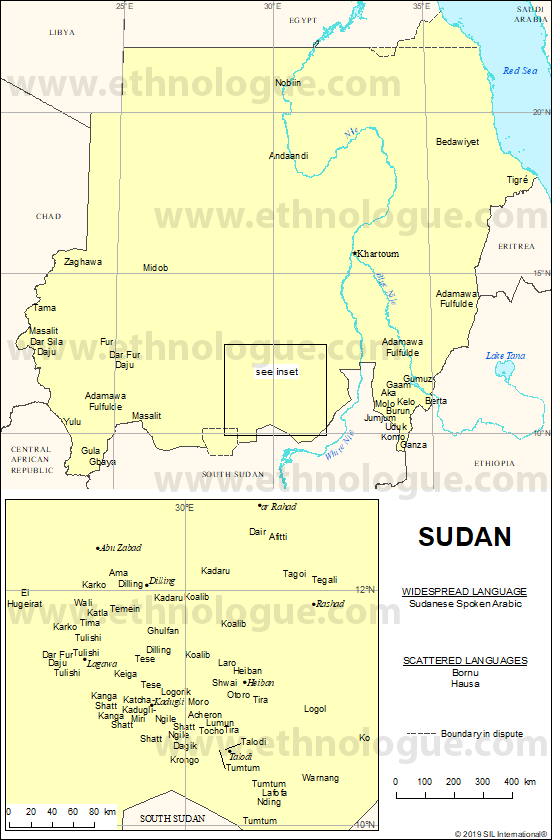
Sudan
Graphs
Language Vitality Profile
Full explanation
Language Status Profile
Full explanation
Resources
View Terms
Each Ethnologue country digest is a licensed product with restricted terms of use. Before downloading the product, you must agree to the following terms:
- This is a license for individual use. Just as with a conventionally published book, it is a violation of copyright to make a copy and give it to others.
- You may not redistribute this work in any form, including ingesting the contents into a database that is shared with others or posting it on a web site (whether public or private).
To inquire about permission for reuse or redistribution, please use the Contact Us form in the footer.
Digest of the languages of Sudan ($299.95, 56 page PDF)