
TH
Kingdom of Thailand
Thailand
Summary
- Official Name
- Kingdom of Thailand
- Population
- 69,640,000
- Principal Languages
- Thai
- Literacy Rate
- 94% (2018 UNESCO)
- International Conventions
- CSICH (2012), ICCPR (1966), UNCRPD (2006), UNDRIP (2007)
- General References
- Bradley 2007a, Campbell and King 2011, Lebar et al 1964, Matisoff 1991, Matisoff et al 1996, Prachakij-karacak 1995, Purnell 1970, Smalley 1976, Wurm and Hattori 1981
- Deaf Population
- 90,000–300,000
- Language Counts
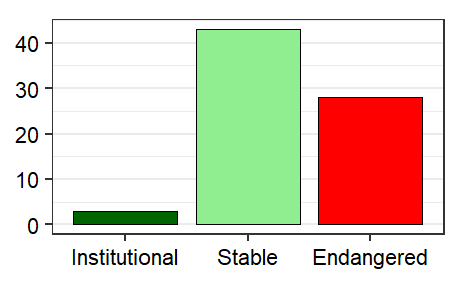
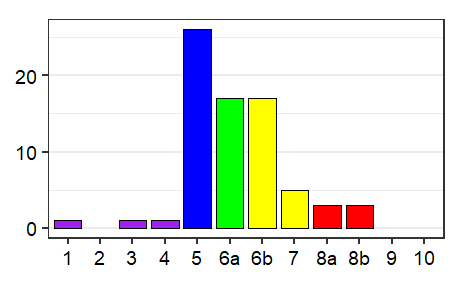
- The number of established languages listed for Thailand is 73. All are living languages. Of these, 51 are indigenous and 22 are non-indigenous. Furthermore, 3 are institutional, 26 are developing, 15 are vigorous, 22 are in trouble, and 7 are dying. Also listed are 13 unestablished languages.
Languages
- Aheu thm
- Sakon Nakhon province: Song Dao district, Thavung, 3 villages. Users: 450 in Thailand (Bradley 2007b). Ethnic population: 1,500 (Bradley 2007b). Total users in all countries: 700. Status: 6b (Threatened). Alternate Names: Phon Soung, So, So Thavung, Sotawueng, Thavung Classification: Austro-Asiatic, Mon-Khmer, Viet-Muong, Thavung
- Akeu aeu
- Chiang Rai province: Mae Suai and Wiang Pa Pao districts. Users: 400 in Thailand (2006 E. Johnson). Status: 6a (Vigorous). Alternate Names: Akheu, Aki, Akui, Gaolkheel, Gokhy Classification: Sino-Tibetan, Tibeto-Burman, Ngwi-Burmese, Ngwi, Southern
- Akha ahk
- Chiang Mai, Chiang Rai, and Mae Hong Son provinces. 250 villages. Users: 56,600 in Thailand (Bradley 2007a). Status: 5* (Dispersed). Alternate Names: Ahka, Aini, Ak’a, Aka, Ikor, Yani, “Ekaw” (pej.), “Ikaw” (pej.), “Kaw” (pej.), “Kha Ko” (pej.), “Khako” (pej.), “Khao Kha Ko” (pej.), “Ko” (pej.) Classification: Sino-Tibetan, Tibeto-Burman, Ngwi-Burmese, Ngwi, Southern
- Ban Khor Sign Language bfk
- Lampang province: Ban Khor village. Users: 400 (Nonaka 2009), all users. Conservative estimate: 15%–25% of the village signs to some extent. L1 users: 16 (Nonaka 2009). 16 deaf users, plus an unknown number of hearing L1 users. Status: 6a (Vigorous). Alternate Names: BKSL, Pasa Kidd Classification: Sign language, Shared sign language
- Bengali ben
- Users: 35,000 in Thailand (Leclerc 2019a), based on ethnicity. Status: Unestablished. Classification: Indo-European, Indo-Iranian, Indo-Aryan, Outer Languages, Eastern, Bengali-Assamese
- Bisu bzi
- Chiang Rai province: Doi Chomphu and Pui Kham villages. Users: 700 (2016 K. Person). No monolinguals (2015 K. Person). Ethnic population: 700 (2018 K. Person). Status: 5 (Developing). Alternate Names: Lawa, Lua, Mbisu, Mibisu Classification: Sino-Tibetan, Tibeto-Burman, Ngwi-Burmese, Ngwi, Southern, Bisoid
- Blang blr
- Chiang Rai province: Mae Sai and Mae Chan districts; some west of Bangkok. Users: 1,200 in Thailand (1998 SIL). Status: 6a (Vigorous). Alternate Names: Bulang, Hkawa, K’ala, K’wa, Kawa, Khon Doi, Kontoi, Plang, Pula, Pulang, Sen Chun, Wa Classification: Austro-Asiatic, Mon-Khmer, Northern Mon-Khmer, Palaungic, Eastern Palaungic, Waic, Bulang
- Bru, Western brv
- Ubon Ratchathani, Mukdahan, Nakhon Phanom, and Sakon Nakhon provinces. Users: 20,000 in Thailand (1991). Status: 6b (Threatened). Alternate Names: B’ru, Baru, Bruu Classification: Austro-Asiatic, Mon-Khmer, Eastern Mon-Khmer, Katuic, West Katuic, Bru
- Burmese mya
- Users: 828,000 in Thailand (2010 census). Status: Unestablished. Classification: Sino-Tibetan, Tibeto-Burman, Ngwi-Burmese, Burmish, Southern
- Cham, Western cja
- Krung Thep province: Ban Khrue section of city (Bangkok), otherwise scattered. Users: 4,000 in Thailand. Status: 6b* (Threatened). Alternate Names: Cambodian Cham, Chăm, Cham, New Cham, Tjam Classification: Austronesian, Malayo-Polynesian, Malayo-Chamic, Chamic, Coastal, Cham
- Chiangmai Sign Language csd
- Chiang Mai province: Scattered. Users: 10 (2019 J. Woodward), decreasing. 10 is an estimated maximum. Status: 8a (Moribund). Alternate Names: Chiengmai Sign Language, OCMSL, Old Chiang Mai Sign Language, Old Chiangmai Sign Language, Original Chiang Mai Sign Language, Original Chiangmai Sign Language Classification: Sign language, Deaf community sign language
- Chinese, Hakka hak
- Chiang Mai province; Krung Thep province: Samphanthawong district; Nakhon Ratchasima and Udon Thani provinces: urban areas; Nan province: Mueang district and municipal districts. Users: 79,000 in Thailand (Leclerc 2019a), based on ethnicity. Status: 5* (Dispersed). Classification: Sino-Tibetan, Chinese
- Chinese, Mandarin cmn
- Krung Thep province: dispersed through provincial towns and south in Kra peninsula. Users: 76,000 in Thailand (Leclerc 2019a), based on ethnicity. Status: 5* (Dispersed). Classification: Sino-Tibetan, Chinese
- Chinese, Min Dong cdo
- Chumphon and Nakhon Si Thammarat provinces: main towns Chandi, Nabon, and Lamae. Status: 5* (Developing). Alternate Names: Eastern Min Classification: Sino-Tibetan, Chinese
- Chinese, Min Nan nan
- Krung Thep province; used in capital cities of Chiang Mai, Nakhon Ratchasima, and Udon Thani provinces; used in other urban areas. Southern Min constitute the majority of Thai Chinese and speak the Teochew dialect. Users: 1,520,000 in Thailand (Leclerc 2019a). 1,060,000 Chaochow, 17,600 Fujian, 5,880 Hainanese (1984). Status: 5* (Dispersed). Alternate Names: Banlamgi, Min Nan, Minnan Classification: Sino-Tibetan, Chinese
- Chinese, Yue yue
- Scattered in Suphan Buri province. Users: 40,000 in Thailand (Leclerc 2019a), based on ethnicity. Status: 5* (Dispersed). Alternate Names: Cantonese, Yue, Yueh Classification: Sino-Tibetan, Chinese
- Chong cog
- Chanthaburi province: Khao Khitchakut district, 4 villages; Trat province. Users: 500 in Thailand (Bradley 2007b), decreasing. Ethnic population: 2,000 (Bradley 2007b). Status: 7 (Shifting). Alternate Names: Chawng, Chuang, Shong, Xong Autonym: พะซาช์อง (pha sāch̒ xng) Classification: Austro-Asiatic, Mon-Khmer, Eastern Mon-Khmer, Pearic, Western, Chong
- English eng
- Users: 18,924,000 in Thailand, all users. L1 users: 324,000 in Thailand (2010 census). L2 users: 18,600,000 (2019). Status: Unestablished. Classification: Indo-European, Germanic, West, English
- French fra
- Users: 580,900 in Thailand, all users. L1 users: 13,900 in Thailand (2010 census). L2 users: 567,000 (Beck et al 2018). Status: Unestablished. Classification: Indo-European, Italic, Romance, Italo-Western, Western, Gallo-Iberian, Gallo-Romance, Gallo-Rhaetian, Oïl, French
- German, Standard deu
- Users: 11,100 in Thailand (2010 census). Status: Unestablished. Classification: Indo-European, Germanic, West, High German, German, Middle German, East Middle German
- Hindi hin
- Bangkok, Mookherji area. Users: 22,900 in Thailand (2010 census). Status: Unestablished. Classification: Indo-European, Indo-Iranian, Indo-Aryan, Western Hindi, Hindustani
- Hmong Daw mww
- Phetchabun, Tak, Mae Hong Son, Chiang Mai, Nan, Chiang Rai, Phitsanulok, Loei, Sukhothai, Kamphaeng Phet, Phrae, Phayao, Uttaradit, and Lampang provinces. Users: 32,400 in Thailand (2000). Status: 5* (Developing). Alternate Names: Bai Miao, Chuan Miao, Hmong Der, Hmoob Dawb, Pe Miao, Peh Miao, White Hmong, White Lum, White Miao, “Meo Kao” (pej.), “White Meo” (pej.) Classification: Hmong-Mien, Hmongic, Chuanqiandian
- Hmong Njua hnj
- Chiang Mai, Chiang Rai, Kamphaeng Phet, Loei, Mae Hong Son, Nan, Phayao, Phetchabun, Phrae, Sukhothai, Tak, Uthai Thani, and Uttaradit provinces. Users: 60,000 in Thailand (Hattaway 2003). Status: 6a* (Vigorous). Alternate Names: Ching Miao, Green Hmong, Hmong Leng, Hmong Nzhua, Hmoob Leeg, Lu Miao, Mong Leng, Mong Ntsua, Qing Miao, Tak Miao, “Blue Meo” (pej.), “Green Meo” (pej.), “Meo Dam” (pej.), “Meo Lai” (pej.) Classification: Hmong-Mien, Hmongic, Chuanqiandian
- Iu Mien ium
- Chiang Rai, Phayao, Lampang, Kamphaeng Phet, and Nan provinces; possibly in Chiang Mai and Sukhothai provinces. 159 villages. Users: 45,000 in Thailand (Leclerc 2019a), based on ethnicity. Status: 5* (Developing). Alternate Names: Highland Yao, Iu Mienh, Mian, Mien, Mienh, Myen, Pan Yao, Yao, Yao Mienh, Yiu Mien, Youmian Classification: Hmong-Mien, Mienic, Mian-Jin
- Japanese jpn
- Users: 70,700 in Thailand (2010 census). Status: Unestablished. Classification: Japonic
- Jehai jhi
- Narathiwat province. Users: Ethnic population: 150 (Bradley 2007a). Status: 7 (Shifting). Classification: Austro-Asiatic, Mon-Khmer, Aslian, North Aslian, Eastern
- Karen, Phrae Pwo kjt
- Phrae, Lampang, and Chiang Rai provinces. Users: 6,000 (Dawkins and Phillips 2009a). Total Karen: 441,000 (2010 census). Status: 6a (Vigorous). Alternate Names: Northeastern Pwo Karen, Phrae, Prae, Pwo Phrae Classification: Sino-Tibetan, Tibeto-Burman, Karenic, Peripheral
- Karen, Pwo Northern pww
- Chiang Mai, Lamphun, and Tak provinces; Mae Hong Son province: Mae Sarieng town, Mae Ngaw along Salween river, 15–25 villages, Hot to Mae Sarieng. Users: 60,000 (1983 SIL). Total Karen: 441,000 (2010 census). Status: 5* (Developing). Alternate Names: Phlon, Phlong Classification: Sino-Tibetan, Tibeto-Burman, Karenic, Peripheral
- Karen, Pwo West-Central Thailand kjp
- Kanchanaburi, Phetchaburi, Prachuap Khiri Khan, Ratchaburi, Suphan Buri, and Uthai Thani provinces; Tak province: Umphang and Phop Phra districts. Kanchanaburi dialect is north, Ratchaburi-Phetchaburi dialect is south. Users: 50,000 in Thailand (1998). Total Karen: 441,000 (2010 census. Status: 7 (Shifting). Alternate Names: Phlou, Southern Pwo Karen Classification: Sino-Tibetan, Tibeto-Burman, Karenic, Peripheral
- Karen, S’gaw ksw
- Tak, Mae Hong Son, Chiang Mai, Kanchanaburi, and Kamphaeng Phet provinces, near Myanmar border. Users: 200,000 in Thailand (2006 Mahidol University). Total Karen: 441,000 (2010 census). Status: 5* (Dispersed). Alternate Names: Burmese Karen, Kanyaw, Karen, Paganyaw, Pwakanyaw, S’gau, S’gaw, S’gaw Kayin, White, Yang Khao Classification: Sino-Tibetan, Tibeto-Burman, Karenic, Southern
- Kayah, Eastern eky
- Mae Hong Son province. Users: 18,000 in Thailand (2000). 2 camps of 15,000 refugees from Myanmar. Status: 6b* (Threatened). Alternate Names: Karennyi, Kayah, Kayay, Kayeh, Red Karen, “Yang Daeng” (pej.) Classification: Sino-Tibetan, Tibeto-Burman, Karenic, Central
- Kensiu kns
- Yala province: Thanto district. Users: 9 in Thailand (2015 N. Bishop). Ethnic population: 250 (Bradley 2007a). Status: 8b (Nearly extinct). Alternate Names: Belubn, Kansiw, Kense, Kenseu, Kensieu, Kensiw, Maniq, Mawas, Mengo, Meni, Menik, Moni, Monik, Moniq, Mos, Ngok Pa, Orang Bukit, Orang Liar, Tiong, “Sakai” (pej.) Classification: Austro-Asiatic, Mon-Khmer, Aslian, North Aslian, Western
- Khamen Padong scq
- Kanchanaburi province: Si Sawat district, Ban Thung Na. Users: 20 in Thailand (Bradley 2007b). Status: 8b (Nearly extinct). Alternate Names: Chu’ung, Chung, Padong Khmer, Ut Classification: Austro-Asiatic, Mon-Khmer, Eastern Mon-Khmer, Pearic, Western, Chong
- Khmer, Northern kxm
- Surin, Buriram, Chanthaburi, Sisaket, and Ubon Ratchathani provinces. Users: 1,400,000 (2006 Mahidol University), decreasing. Very few monolinguals. Status: 5* (Developing). Alternate Names: Khmer Lue, Thailand Khmer, Upper Khmer Autonym: เขมรถิ่นไทย (khmĕ :n thìn thai) Classification: Austro-Asiatic, Mon-Khmer, Eastern Mon-Khmer, Khmer
- Khmu kjg
- Chiang Rai, Nan, and Phayao provinces. Scattered throughout Thailand. Users: 10,600 in Thailand (Michaud 2016), based on ethnicity. Status: 5* (Developing). Alternate Names: Kamhmu, Kammu, Kamu, Kha Khmu, Khamu, Khamuk, Khmu’, Kmhmu, Luu, Mou, Pouteng, Tmooy Classification: Austro-Asiatic, Mon-Khmer, Northern Mon-Khmer, Khmuic, Mal-Khmu’, Khmu’
- Khün kkh
- Chiang Mai and Chiang Rai provinces. Users: 6,280 in Thailand (2000). Status: 5* (Developing). Alternate Names: Gon Shan, Hkun, Khuen, Khun Shan, Tai Khün Classification: Kra-Dai, Kam-Tai, Tai, Southwestern
- Kintaq knq
- Southern Yala province. Users: 1 in Thailand (2017 N. Bishop). Status: 8b (Nearly extinct). Alternate Names: Kenta, Kintaq Bong, Kintk, Maniq Classification: Austro-Asiatic, Mon-Khmer, Aslian, North Aslian, Western
- Korean kor
- Users: 20,200 in Thailand (2019 Korean Ministry of Foreign Affairs), based on nationality. Status: Unestablished. Classification: Koreanic
- Kuay kdt
- Surin, Buriram, Sisaket, and Ubon Ratchathani provinces: near Cambodian and Laos borders. Users: 400,000 in Thailand (2006 Mahidol University). Few monolinguals. Total users in all countries: 456,600. Status: 6b (Threatened). Alternate Names: Cuoi, Khamen-Boran, Kui, Kui Souei, Kuoy, Kuy, Soai, Suai, Suay, Suei, Sui, Suoi Autonym: กวย (Kuay), กูย (Kuuy) Classification: Austro-Asiatic, Mon-Khmer, Eastern Mon-Khmer, Katuic, West Katuic, Kuay
- Lahu lhu
- Chiang Mai, Chiang Rai, Kamphaeng Phet, Mae Hong Son, Yala provinces: 119 known villages. Users: 32,000 in Thailand (Johnstone and Mandryk 2001). Status: 5* (Dispersed). Alternate Names: Muhso, Muhsur, Mussar, Musso, Mussuh, “Lohei” (pej.) Classification: Sino-Tibetan, Tibeto-Burman, Ngwi-Burmese, Ngwi, Central
- Lahu Si lhi
- Chiang Rai, Lampang, and Chiang Mai provinces; near Pua and Nan; separate enclaves in Tak and Phayao provinces. Users: 15,000 in Thailand (2007). Status: 6b (Threatened). Alternate Names: Lad hur Si, Lahu Shi Classification: Sino-Tibetan, Tibeto-Burman, Ngwi-Burmese, Ngwi, Central
- Lao lao
- Scattered. Users: 60,200 in Thailand (2010 census). Status: Unestablished. Alternate Names: Lao Lum, Lao Tai, Laotian, Laotian Lao, Phou Lao, Tai Lao Classification: Kra-Dai, Kam-Tai, Tai, Southwestern
- Lawa, Eastern lwl
- Chiang Mai province: Hot district, Bo Luang and Bo Sali sub-districts, 16 villages. Users: 7,000 (Nahhas 2011). Ethnic population: 8,000 (Nahhas 2011). Status: 6a (Vigorous). Alternate Names: Lavua, “Lua” (pej.) Autonym: ละเวือะ (Lawa) Classification: Austro-Asiatic, Mon-Khmer, Northern Mon-Khmer, Palaungic, Eastern Palaungic, Waic, Lawa
- Lawa, Western lcp
- Chiang Mai and Mae Hong Son provinces. Users: 8,000 (Nahhas 2011). Ethnic population: 8,500 (Nahhas 2011). Status: 5 (Developing). Alternate Names: L’wa, Lava, Lavua, Lavüa, Mae Hong Son Lawa, Mountain Lawa, “Lua” (pej.), “Luwa” (pej.) Autonym: ละเวือะ (Lawa) Classification: Austro-Asiatic, Mon-Khmer, Northern Mon-Khmer, Palaungic, Eastern Palaungic, Waic, Lawa
- Lisu lis
- Chiang Mai, Chiang Rai, Kamphaeng Phet, Mae Hong Son, Phayao, Sukhothai, and Tak provinces. Users: 40,000 in Thailand (Bradley 2007b). Status: 5* (Dispersed). Alternate Names: Li-Hsaw, Li-Shaw, Lisaw, Liso, Lu-Tzu, Southern Lisu, Yao Yen, Yaw Yin, Yaw-Yen, Yeh-Jen Classification: Sino-Tibetan, Tibeto-Burman, Ngwi-Burmese, Ngwi, Central
- Lü khb
- Nan and Phayao provinces; scattered in north. Users: 83,000 in Thailand (Johnstone and Mandryk 2001). Status: 5 (Dispersed). Alternate Names: Lu, Lue, Pai-I, Pai-Yi, Shui-Pai-I, Tai Lu, Tai Lue, Thai Lu Classification: Kra-Dai, Kam-Tai, Tai, Southwestern
- Mal mlf
- Nan province: east of Pua district and Chiang Kam, valley near northern Laos border. Users: 3,500 in Thailand (1982 SIL). Status: 5* (Developing). Alternate Names: Ht’in, Khatin, Lua, Ma’di, T’in, Thin, Tin Classification: Austro-Asiatic, Mon-Khmer, Northern Mon-Khmer, Khmuic, Mal-Khmu’, Mal-Prai
- Malay, Pattani mfa
- Narathiwat, Pattani, and Yala provinces; Songkhla province: Saba Yoi and Thepha districts. Users: 1,470,000 (2010 census). Status: 4 (Educational). Alternate Names: Jawi, Jawi-Malay, Yawi, oré Jawi Autonym: ภาษายาวี (Baso Jawi) Classification: Austronesian, Malayo-Polynesian, Malayo-Chamic, Malayic, Malay
- Malay, Satun meo
- A few villages near Satun. Isolated. Status: 6a* (Vigorous). Alternate Names: Kedah Malay Classification: Austronesian, Malayo-Polynesian, Malayo-Chamic, Malayic, Malay
- Mlabri mra
- Nan province: Na Noi and Wiang Sa districts; Phrae province: Rong Kwang and Song districts. Users: 400 in Thailand (2017 F. Lipsius), increasing. Ethnic population: 400 (2017 F. Lipsius). Total users in all countries: 440. Status: 6a (Vigorous). Alternate Names: Luang, Ma Ku, Mabri, Mla, Mrabri, Yumbri, “Phi Thong Lueang” (pej.), “Spirits of the Yellow Leaf” (pej.) Autonym: มละบริ (Mlabri) Classification: Austro-Asiatic, Mon-Khmer, Northern Mon-Khmer, Khmuic, Mlabri
- Mok mqt
- Chiang Rai province: 5 villages. Users: 700 in Thailand (2018 S. Devereux). Status: 6a (Vigorous). Alternate Names: A Mŏk, Loi, Loi Cim, Muak, ʔape, “Hsem” (pej.), “Hsen Hsum” (pej.), “Shim Ceem” (pej.) Classification: Austro-Asiatic, Mon-Khmer, Northern Mon-Khmer, Palaungic, Eastern Palaungic, Angkuic
- Moken mwt
- Ranong, Phangnga, Phuket (southernmost tip), and Krabi provinces: southwest coast, offshore islands, Andaman Sea and Straits of Malacca. Users: 2,000 in Thailand (Bradley 2007a). Status: 6b* (Threatened). Alternate Names: Basing, Chau Ko’, Mawken, Salon, Salong, Selong, Selung Classification: Austronesian, Malayo-Polynesian, Moklen
- Moklen mkm
- Phangnga and Phuket provinces: west coast. Users: 2,750 (Larish 2005), decreasing. Ethnic population: 4,000 (2000 D. Bradley). Status: 6b (Threatened). Alternate Names: Chau Pok Classification: Austronesian, Malayo-Polynesian, Moklen
- Mon mnw
- Kanchanaburi, Nakhon Pathom, Pathum Thani, Ratchaburi, and Samut Sakhon provinces. Users: 108,000 in Thailand (2000). 70,000–120,000, total population (Bauer 1984). 1983 census estimated 100,000; about 50,000 L1 speakers (Foster 1972; Smalley 1994). Ethnic population: 200,000 (Bradley 2007a). Status: 6b* (Threatened). Alternate Names: Aleng, Mun, Peguan, Takanoon, Talaing, Taleng Classification: Austro-Asiatic, Mon-Khmer, Monic
- Mpi mpz
- Phrae province: Mueang district, Suan Khuean sub-district; Nan province: Song Khwae district, Jod sub-district, Ban Sakoen. A few Mpi live in nearby villages to these two locations as well as in Bangkok (Krung Thep). Users: 900 (Nahhas 2007), decreasing. Ethnic population: 1,500 (Nahhas 2007). Status: 6b (Threatened). Alternate Names: Kaw Autonym: ก้อ (Kaw), มปี้ (Mpi) Classification: Sino-Tibetan, Tibeto-Burman, Ngwi-Burmese, Ngwi, Southern
- Nyahkur cbn
- Bueng Kan, Chaiyaphum, Kalasin, Nakhon Ratchasima, Phetchabun, Phitsanulok, and Sakon Nakhon provinces. Users: 1,500 (2006 C. Shimmin), decreasing. No monolinguals. It appears the last monolingual speakers likely died out no later than the 1950s (2017 C. Shimmin). Ethnic population: 3,000 (Thongkum 1984). Status: 7 (Shifting). Alternate Names: Chao Dong, Chaodon, Lawa, Niakuol, Niakuoll, Nyah Kur, Nyakur, “Chaobon” (pej.), “Chaobun” (pej.), “Chaubun” (pej.) Autonym: ญัฮกุ้ร (Nyah Kur), เนียะกวล (Niakuol) Classification: Austro-Asiatic, Mon-Khmer, Southern Monic
- Nyaw nyw
- Mukdahan province: Wan Yai and Don Tan districts; Nakhon Phanom province: Tha Uthen, Na Wa, and Phon Sawan districts; Nong Khai province: Tha Bo district; Sakon Nakhon province: Mueang, Kut Bak, Song Dao, and Warit Chaphum districts; Sa Kaeo province: isolated area on Cambodia border; Bueng Kan, Maha Sarakham, and Udon Thani provinces. Users: 80,000 (Hattaway 2005). Status: 6a* (Vigorous). Alternate Names: Jo, Nyo, Nyoh, Yo Classification: Kra-Dai, Kam-Tai, Tai, Southwestern
- Nyeu nyl
- Sisaket province: Mueang Sisaket district, Phon Kho sub-district; Phrai Bueng district, Prasat Yoe sub-district. Users: 3,000 (Phimjun 2004). Status: 6b* (Threatened). Alternate Names: Yeu, Yoe Classification: Austro-Asiatic, Mon-Khmer, Eastern Mon-Khmer, Katuic, West Katuic, Kuay
- Pa’o blk
- Mae Hong Son province. Users: 740 in Thailand (2000). Status: 6b* (Threatened). Alternate Names: Black Karen, Pa Oh, Pa’O, Pa’o Karen, Pa-Oh, Pa-U, Taungtu Classification: Sino-Tibetan, Tibeto-Burman, Karenic, Peripheral
- Palaung, Pale pce
- Chiang Mai province: Fang district, No Lae village. Users: 5,000 in Thailand (1989). Status: 8a (Moribund). Alternate Names: Di-Ang, Ngwe Palaung, Palay, Pale, Silver Palaung, Southern Palaung, Ta-Ang Classification: Austro-Asiatic, Mon-Khmer, Northern Mon-Khmer, Palaungic, Western Palaungic, Palaung
- Phu Thai pht
- Amnat Charoen, Kalasin, Mukdahan, Nakhon Phanom, Sakon Nakhon, Udon Thani, Yasothon, and Roi Et provinces. Possibly also in China. Users: 470,000 in Thailand (2006 Mahidol University). Total users in all countries: 897,000. Status: 6a* (Vigorous). Alternate Names: Phutai, Phuu Thai, Poutai, Putai, Puthai Autonym: ผู้ไท (Phu Thai or Phuu Thai), ภูไท (Phu Thai or Phuu Thai) Classification: Kra-Dai, Kam-Tai, Tai, Southwestern
- Phuan phu
- Chachoengsao, Chaiyaphum, Lop Buri, Nakhon Nayok, Phetchabun, Phichit, Prachin Buri, and Sara Buri provinces; Bueng Kan province, isolated area, 1 village south of Bangkok. Users: 200,000 in Thailand (2006 Mahidol University). Total users in all countries: 316,000. Status: 6a* (Vigorous). Alternate Names: Lao Phuan, Phoan, Phu Un, Phu-uen, Phuon, Poan, Puan Classification: Kra-Dai, Kam-Tai, Tai, Southwestern
- Prai prt
- Nan province: Bo Klua, Chalerm Prakiat, Chiang Klang, Pua and Thung Chang districts. Users: 20,000 in Thailand (2001 D. Jordon). Possibly 3,000 Ban Wen dialect speakers. Total users in all countries: 48,700. Status: 5 (Developing). Alternate Names: Lao Prai, Lua Prai, Lua’, Phai, Pray, Thin, “Htin” (pej.) Autonym: ไปร (Prai) Classification: Austro-Asiatic, Mon-Khmer, Northern Mon-Khmer, Khmuic, Mal-Khmu’, Mal-Prai
- Punjabi, Eastern pan
- Users: 62,000 in Thailand (Leclerc 2019a), based on ethnicity. Status: Unestablished. Classification: Indo-European, Indo-Iranian, Indo-Aryan, Intermediate Divisions, Western, Panjabi
- Rohingya rhg
- Political refugees from the Rakhine states in Myanmar without legal status, housed in camps largely in southernmost provinces, although there are also Rohingya held in western and eastern provinces of Kanchanaburi, Mukdahan, and Ubon Ratchathani. Users: 5,000 in Thailand (2017 The Arakan Project), based on nationality. Status: Unestablished. Classification: Indo-European, Indo-Iranian, Indo-Aryan, Outer Languages, Eastern, Bengali-Assamese
- Saek skb
- Nakhon Phanom province: Mueang Nakhon Phanom district, At Samat sub-district; Na Wa district, Tha Ruea sub-district. Users: Total L1 speakers in Laos and Thailand: 10,000 with a total ethnic population of 20,000. The majority of the speakers are in Laos (Bradley 2007a). Status: 6b (Threatened). Alternate Names: Sek, Tai Sek, Xec, Xek Classification: Kra-Dai, Kam-Tai, Tai, Northern
- Samre sxm
- Trat province: Bo Rai district, Nonsi sub-district. Users: 10 in Thailand (Ploykaew 2001). 10–20 semi-speakers (Ploykaew 2001). Status: 8b (Nearly extinct). Classification: Austro-Asiatic, Mon-Khmer, Eastern Mon-Khmer, Pearic, Western, Samre
- Shan shn
- Chiang Mai, Mae Hong Son, Mukdahan, and Tak provinces; Chiang Rai: Mae Sai district. Users: 95,000 in Thailand (2006 Mahidol University). Status: 5* (Dispersed). Alternate Names: Great Thai, Sam, Sha, Tai Luang, Tai Shan, Tai Yay, Thai Yay, “Ngeo” (pej.), “Ngiao” (pej.), “Ngiaw” (pej.), “Ngio” (pej.), “Ngiow” (pej.) Classification: Kra-Dai, Kam-Tai, Tai, Southwestern
- Sinhala sin
- Bangkok area. Users: 72,000 in Thailand (Leclerc 2019a). Status: Unestablished. Classification: Indo-European, Indo-Iranian, Indo-Aryan, Outer Languages, Southern, Sinhalese-Maldivian
- So sss
- Kalasin, Nakhon Phanom, Nong Khai, Sakon Nakhon provinces: 53 villages. Users: 70,000 in Thailand (2006 Mahidol University). Status: 6a (Vigorous). Alternate Names: “Kha So” (pej.) Classification: Austro-Asiatic, Mon-Khmer, Eastern Mon-Khmer, Katuic, West Katuic, Bru
- Tai Dam blt
- Loei province; Chiang Khan district, Khao Kaeo sub-district, Ban Na Pa Nat village. Users: 700 in Thailand (2004). Status: 5* (Developing). Alternate Names: Black Tai, Jinping Dai, Thai Den, ʼTáy Ðăm Classification: Kra-Dai, Kam-Tai, Tai, Southwestern
- Tai Ya cuu
- Chiang Rai province: Mae Chan district, Mae Rai sub-district, Ban Pa Sak Khwang; Mae Sai district, Huay Khrai sub-district, Ban Nam Bor Khaw and Ban Pa Sak Khwang; Mueang Chiang Rai district. Users: 400 in Thailand (Dawkins and Kirkland 2008), decreasing. Ethnic population: 1,000 (Dawkins and Kirkland 2008). Status: 6b (Threatened). Alternate Names: Dai Ya, Huayaodai, Tai Chung, Ya Classification: Kra-Dai, Kam-Tai, Tai, Southwestern
- Tamil tam
- Scattered in Chiang Mai, Krung Thep, and Phuket provinces. Users: 38,000 in Thailand (Leclerc 2019a), based on ethnicity. Status: Unestablished. Classification: Dravidian, Southern, Tamil-Kannada, Tamil-Kodagu, Tamil-Malayalam, Tamil
- Ten’edn tnz
- Phatthalung, Trang, Satun, and Songkhla provinces. Users: 350 in Thailand (2014 SIL). Total users in all countries: 365. Status: 6a (Vigorous). Alternate Names: Maniq, Mos, Tean-ean, Ten’en, Tonga, Tonga-Mos Classification: Austro-Asiatic, Mon-Khmer, Aslian, North Aslian, Tonga
- Thai tha
- Widespread. Ratchasima province (Khorat dialect). Users: 60,200,000 in Thailand, all users. L1 users: 20,200,000 in Thailand (2000). L2 users: 40,000,000 (2001 A. Diller). Total users in all countries: 60,688,200 (as L1: 20,688,200; as L2: 40,000,000). Status: 1 (National). De facto national language. Alternate Names: Bangkok Thai, Central Thai, Siamese, Standard Thai, Thai Klang, Thaiklang Autonym: ภาษาไทย Classification: Kra-Dai, Kam-Tai, Tai, Southwestern
- Thai Sign Language tsq
- Scattered. Major regional centers and Bangkok. Users: 200,000 (2008 WFD). Estimated 90,000–300,000 deaf (2008 WFD); another older estimate: 51,000 profoundly, prelingually deaf people in Thailand (1997 C. Reilly). Status: 5 (Developing). Alternate Names: MSTSL, Modern Standard Thai Sign Language, TSL, ThSL Classification: Sign language, Deaf community sign language
- Thai Song soa
- Kanchanaburi, Nakhon Pathom, Nakhon Sawan, Phetchaburi, and Phitsanulok provinces: possibly in Suphan Buri province. Users: 45,000 (Schliesinger 2001). Status: 6b (Threatened). Alternate Names: Chao Song, Lao Song, Lao Song Dam, Song, Tai Song Dam, Thai Soang Classification: Kra-Dai, Kam-Tai, Tai, Southwestern
- Thai, Northeastern tts
- Chiang Mai, Chiang Rai, Lampang, Lamphun, Nan, Phayao, and Phrae provinces. Users: 15,000,000 (1983 SIL). At least 1,000,000 in Bangkok. Kalerng has a few thousand speakers (1990 A. Diller). Status: 6a (Vigorous). De facto language of provincial identity in east, northeast provinces. Alternate Names: Esarn, Isaan, Issan, Thai Isaan Autonym: อีสาน (Isan) Classification: Kra-Dai, Kam-Tai, Tai, Southwestern
- Thai, Northern nod
- Chiang Mai, Chiang Rai, Kamphaeng Phet, Lampang, Lamphun, Mae Hong Son, Nan, Phayao, Phrae, Sukhothai, Tak, Uttaradit provinces. Users: 6,000,000 in Thailand (1983 SIL). Total users in all countries: 6,029,500. Status: 3 (Wider communication). De facto language of provincial identity in northern provinces. Became a dominant regional language in the 18th century in northern Thailand. Language of the royalty and well-educated northerners. Alternate Names: Kam Mu’ang, Kammyang, Kammüang, Khon, Khon Mueang, Khon Myang, Khonmuang, La Nya, Lan Na, Lanatai, Lanna, Mu’ang, Mueang, Mung, Myang, Payap, Phayap, Phyap, Tai Nya, Western Laotian, “Tai Yon” (pej.), “Tai Yuan” (pej.), “Yuan” (pej.) Autonym: คำเมือง (Kam Mueang) Classification: Kra-Dai, Kam-Tai, Tai, Southwestern
- Thai, Southern sou
- Surat Thani, Chumphon, Nakhon Si Thammarat, Songkhla, Phatthalung, Ranong, Phangnga, Phuket, Krabi, Trang, Prachuap Khiri Khan, Pattani, Yala, and Satun provinces; Muslim Thai dialect. Users: 4,500,000 in Thailand (2006 Mahidol University). Total users in all countries: 4,508,200. Status: 5 (Developing). De facto language of provincial identity in southeasternmost 15 provinces. Alternate Names: Dambro, Pak Tai, Pak Thai, Paktay Autonym: ภาษาไทยถิ่นใต้ (P̣hās̄ʹā thịy t̄hìn tı̂) Classification: Kra-Dai, Kam-Tai, Tai, Southwestern
- Ugong ugo
- Suphan Buri province: northwestern; Uthai Thani province: southwestern. Users: 150 (Bradley 2007b). Ethnic population: 500 (Bradley 2007b). Status: 8a (Moribund). Alternate Names: Gong, Lawa, Ugawng Classification: Sino-Tibetan, Tibeto-Burman, Ngwi-Burmese, Ngwi, Unclassified
- Urak Lawoi’ urk
- Krabi province: Jam and PhiPhi Don islands; Phuket province: Laem Tukae, Rawai, and Sepam villages, all on main Phuket island; Trang province: Lanta island; Satun province: Adung, Bulon, and Lipae islands. Users: 5,000 (2012 S. Pattemore). Ethnic population: 3,000 (Bradley 2007b). Status: 7 (Shifting). Alternate Names: Chaw Talay, Lawoi, Lawta, Lumoh Lawoi’, Olang Lawta, Orak Lawoi’, “Chawnam” (pej.) Classification: Austronesian, Malayo-Polynesian, Malayo-Chamic, Malayic
- Vietnamese vie
- Long-established small communities in Bangkok and scattered in southeastern provinces. Users: 8,280 in Thailand (2010 census). Status: 5* (Dispersed). Classification: Austro-Asiatic, Mon-Khmer, Viet-Muong, Vietnamese
- Wa, Parauk prk
- Scattered; probably north, northwest. Users: 6,700 in Thailand (2008 P. Hopple). Status: 5 (Dispersed). Classification: Austro-Asiatic, Mon-Khmer, Northern Mon-Khmer, Palaungic, Eastern Palaungic, Waic, Wa
- Yong yno
- Chiang Mai province: San Kamphaeng district; Lamphun province: Ban Hong, Mae The, Mueang Lamphun, and Pa Sang districts. Users: 12,600 (2000). Status: 6b (Threatened). Alternate Names: Nyong Classification: Kra-Dai, Kam-Tai, Tai, Southwestern
- Yoy yoy
- Sakon Nakhon province: Akat Amnuai district, Akat, Ba Wa, Wa Yai, sub-districts; Phang Khon district and Sawang Daen Din district. Users: 7,000 in Thailand (Schliesinger 2001). Total users in all countries: 9,000. Status: 6b (Threatened). Alternate Names: Dioi, Du’o’i, Duoi, Giy, I, Jui, Lao Yuai, Yay, Yi, Yoe, Yoi, Yooi, Yooy, Yuai, Yueai Classification: Kra-Dai, Kam-Tai, Tai, Northern
Languages by Status
Thai
[tha] 1 (National). De facto national language. 60,200,000 in Thailand, all users. L1 users: 20,200,000 in Thailand (2000). L2 users: 40,000,000 (2001 A. Diller). Total users in all countries: 60,688,200 (as L1: 20,688,200; as L2: 40,000,000).
Thai, Northern
[nod] 3 (Wider communication). De facto language of provincial identity in northern provinces. Became a dominant regional language in the 18th century in northern Thailand. Language of the royalty and well-educated northerners. 6,000,000 in Thailand (1983 SIL). Total users in all countries: 6,029,500.
Malay, Pattani
[mfa] 4 (Educational). 1,470,000 (2010 census).
Akha
[ahk] 5* (Dispersed). 56,600 in Thailand (Bradley 2007a).
Chinese, Hakka
[hak] 5* (Dispersed). 79,000 in Thailand (Leclerc 2019a), based on ethnicity.
Chinese, Mandarin
[cmn] 5* (Dispersed). 76,000 in Thailand (Leclerc 2019a), based on ethnicity.
Chinese, Min Nan
[nan] 5* (Dispersed). 1,520,000 in Thailand (Leclerc 2019a). 1,060,000 Chaochow, 17,600 Fujian, 5,880 Hainanese (1984).
Chinese, Yue
[yue] 5* (Dispersed). 40,000 in Thailand (Leclerc 2019a), based on ethnicity.
Karen, S’gaw
[ksw] 5* (Dispersed). 200,000 in Thailand (2006 Mahidol University). Total Karen: 441,000 (2010 census).
Lahu
[lhu] 5* (Dispersed). 32,000 in Thailand (Johnstone and Mandryk 2001).
Lisu
[lis] 5* (Dispersed). 40,000 in Thailand (Bradley 2007b).
Lü
[khb] 5 (Dispersed). 83,000 in Thailand (Johnstone and Mandryk 2001).
Shan
[shn] 5* (Dispersed). 95,000 in Thailand (2006 Mahidol University).
Vietnamese
[vie] 5* (Dispersed). 8,280 in Thailand (2010 census).
Wa, Parauk
[prk] 5 (Dispersed). 6,700 in Thailand (2008 P. Hopple).
Bisu
[bzi] 5 (Developing). 700 (2016 K. Person). No monolinguals (2015 K. Person). Ethnic population: 700 (2018 K. Person).
Chinese, Min Dong
[cdo] 5* (Developing).
Hmong Daw
[mww] 5* (Developing). 32,400 in Thailand (2000).
Iu Mien
[ium] 5* (Developing). 45,000 in Thailand (Leclerc 2019a), based on ethnicity.
Karen, Pwo Northern
[pww] 5* (Developing). 60,000 (1983 SIL). Total Karen: 441,000 (2010 census).
Khmer, Northern
[kxm] 5* (Developing). 1,400,000 (2006 Mahidol University), decreasing. Very few monolinguals.
Khmu
[kjg] 5* (Developing). 10,600 in Thailand (Michaud 2016), based on ethnicity.
Khün
[kkh] 5* (Developing). 6,280 in Thailand (2000).
Lawa, Western
[lcp] 5 (Developing). 8,000 (Nahhas 2011). Ethnic population: 8,500 (Nahhas 2011).
Mal
[mlf] 5* (Developing). 3,500 in Thailand (1982 SIL).
Prai
[prt] 5 (Developing). 20,000 in Thailand (2001 D. Jordon). Possibly 3,000 Ban Wen dialect speakers. Total users in all countries: 48,700.
Tai Dam
[blt] 5* (Developing). 700 in Thailand (2004).
Thai Sign Language
[tsq] 5 (Developing). 200,000 (2008 WFD). Estimated 90,000–300,000 deaf (2008 WFD); another older estimate: 51,000 profoundly, prelingually deaf people in Thailand (1997 C. Reilly).
Thai, Southern
[sou] 5 (Developing). De facto language of provincial identity in southeasternmost 15 provinces. 4,500,000 in Thailand (2006 Mahidol University). Total users in all countries: 4,508,200.
Akeu
[aeu] 6a (Vigorous). 400 in Thailand (2006 E. Johnson).
Ban Khor Sign Language
[bfk] 6a (Vigorous). 400 (Nonaka 2009), all users. Conservative estimate: 15%–25% of the village signs to some extent. L1 users: 16 (Nonaka 2009). 16 deaf users, plus an unknown number of hearing L1 users.
Blang
[blr] 6a (Vigorous). 1,200 in Thailand (1998 SIL).
Hmong Njua
[hnj] 6a* (Vigorous). 60,000 in Thailand (Hattaway 2003).
Karen, Phrae Pwo
[kjt] 6a (Vigorous). 6,000 (Dawkins and Phillips 2009a). Total Karen: 441,000 (2010 census).
Lawa, Eastern
[lwl] 6a (Vigorous). 7,000 (Nahhas 2011). Ethnic population: 8,000 (Nahhas 2011).
Malay, Satun
[meo] 6a* (Vigorous).
Mlabri
[mra] 6a (Vigorous). 400 in Thailand (2017 F. Lipsius), increasing. Ethnic population: 400 (2017 F. Lipsius). Total users in all countries: 440.
Mok
[mqt] 6a (Vigorous). 700 in Thailand (2018 S. Devereux).
Nyaw
[nyw] 6a* (Vigorous). 80,000 (Hattaway 2005).
Phu Thai
[pht] 6a* (Vigorous). 470,000 in Thailand (2006 Mahidol University). Total users in all countries: 897,000.
Phuan
[phu] 6a* (Vigorous). 200,000 in Thailand (2006 Mahidol University). Total users in all countries: 316,000.
So
[sss] 6a (Vigorous). 70,000 in Thailand (2006 Mahidol University).
Ten’edn
[tnz] 6a (Vigorous). 350 in Thailand (2014 SIL). Total users in all countries: 365.
Thai, Northeastern
[tts] 6a (Vigorous). De facto language of provincial identity in east, northeast provinces. 15,000,000 (1983 SIL). At least 1,000,000 in Bangkok. Kalerng has a few thousand speakers (1990 A. Diller).
Aheu
[thm] 6b (Threatened). 450 in Thailand (Bradley 2007b). Ethnic population: 1,500 (Bradley 2007b). Total users in all countries: 700.
Bru, Western
[brv] 6b (Threatened). 20,000 in Thailand (1991).
Cham, Western
[cja] 6b* (Threatened). 4,000 in Thailand.
Kayah, Eastern
[eky] 6b* (Threatened). 18,000 in Thailand (2000). 2 camps of 15,000 refugees from Myanmar.
Kuay
[kdt] 6b (Threatened). 400,000 in Thailand (2006 Mahidol University). Few monolinguals. Total users in all countries: 456,600.
Lahu Si
[lhi] 6b (Threatened). 15,000 in Thailand (2007).
Moken
[mwt] 6b* (Threatened). 2,000 in Thailand (Bradley 2007a).
Moklen
[mkm] 6b (Threatened). 2,750 (Larish 2005), decreasing. Ethnic population: 4,000 (2000 D. Bradley).
Mon
[mnw] 6b* (Threatened). 108,000 in Thailand (2000). 70,000–120,000, total population (Bauer 1984). 1983 census estimated 100,000; about 50,000 L1 speakers (Foster 1972; Smalley 1994). Ethnic population: 200,000 (Bradley 2007a).
Mpi
[mpz] 6b (Threatened). 900 (Nahhas 2007), decreasing. Ethnic population: 1,500 (Nahhas 2007).
Nyeu
[nyl] 6b* (Threatened). 3,000 (Phimjun 2004).
Pa’o
[blk] 6b* (Threatened). 740 in Thailand (2000).
Saek
[skb] 6b (Threatened). Total L1 speakers in Laos and Thailand: 10,000 with a total ethnic population of 20,000. The majority of the speakers are in Laos (Bradley 2007a).
Tai Ya
[cuu] 6b (Threatened). 400 in Thailand (Dawkins and Kirkland 2008), decreasing. Ethnic population: 1,000 (Dawkins and Kirkland 2008).
Thai Song
[soa] 6b (Threatened). 45,000 (Schliesinger 2001).
Yong
[yno] 6b (Threatened). 12,600 (2000).
Yoy
[yoy] 6b (Threatened). 7,000 in Thailand (Schliesinger 2001). Total users in all countries: 9,000.
Chong
[cog] 7 (Shifting). 500 in Thailand (Bradley 2007b), decreasing. Ethnic population: 2,000 (Bradley 2007b).
Jehai
[jhi] 7 (Shifting). Ethnic population: 150 (Bradley 2007a).
Karen, Pwo West-Central Thailand
[kjp] 7 (Shifting). 50,000 in Thailand (1998). Total Karen: 441,000 (2010 census.
Nyahkur
[cbn] 7 (Shifting). 1,500 (2006 C. Shimmin), decreasing. No monolinguals. It appears the last monolingual speakers likely died out no later than the 1950s (2017 C. Shimmin). Ethnic population: 3,000 (Thongkum 1984).
Urak Lawoi’
[urk] 7 (Shifting). 5,000 (2012 S. Pattemore). Ethnic population: 3,000 (Bradley 2007b).
Chiangmai Sign Language
[csd] 8a (Moribund). 10 (2019 J. Woodward), decreasing. 10 is an estimated maximum.
Palaung, Pale
[pce] 8a (Moribund). 5,000 in Thailand (1989).
Ugong
[ugo] 8a (Moribund). 150 (Bradley 2007b). Ethnic population: 500 (Bradley 2007b).
Kensiu
[kns] 8b (Nearly extinct). 9 in Thailand (2015 N. Bishop). Ethnic population: 250 (Bradley 2007a).
Khamen Padong
[scq] 8b (Nearly extinct). 20 in Thailand (Bradley 2007b).
Kintaq
[knq] 8b (Nearly extinct). 1 in Thailand (2017 N. Bishop).
Samre
[sxm] 8b (Nearly extinct). 10 in Thailand (Ploykaew 2001). 10–20 semi-speakers (Ploykaew 2001).
Bengali
[ben] Unestablished. 35,000 in Thailand (Leclerc 2019a), based on ethnicity.
Burmese
[mya] Unestablished. 828,000 in Thailand (2010 census).
English
[eng] Unestablished. 18,924,000 in Thailand, all users. L1 users: 324,000 in Thailand (2010 census). L2 users: 18,600,000 (2019).
French
[fra] Unestablished. 580,900 in Thailand, all users. L1 users: 13,900 in Thailand (2010 census). L2 users: 567,000 (Beck et al 2018).
German, Standard
[deu] Unestablished. 11,100 in Thailand (2010 census).
Hindi
[hin] Unestablished. 22,900 in Thailand (2010 census).
Japanese
[jpn] Unestablished. 70,700 in Thailand (2010 census).
Korean
[kor] Unestablished. 20,200 in Thailand (2019 Korean Ministry of Foreign Affairs), based on nationality.
Lao
[lao] Unestablished. 60,200 in Thailand (2010 census).
Punjabi, Eastern
[pan] Unestablished. 62,000 in Thailand (Leclerc 2019a), based on ethnicity.
Rohingya
[rhg] Unestablished. 5,000 in Thailand (2017 The Arakan Project), based on nationality.
Sinhala
[sin] Unestablished. 72,000 in Thailand (Leclerc 2019a).
Tamil
[tam] Unestablished. 38,000 in Thailand (Leclerc 2019a), based on ethnicity.
Maps
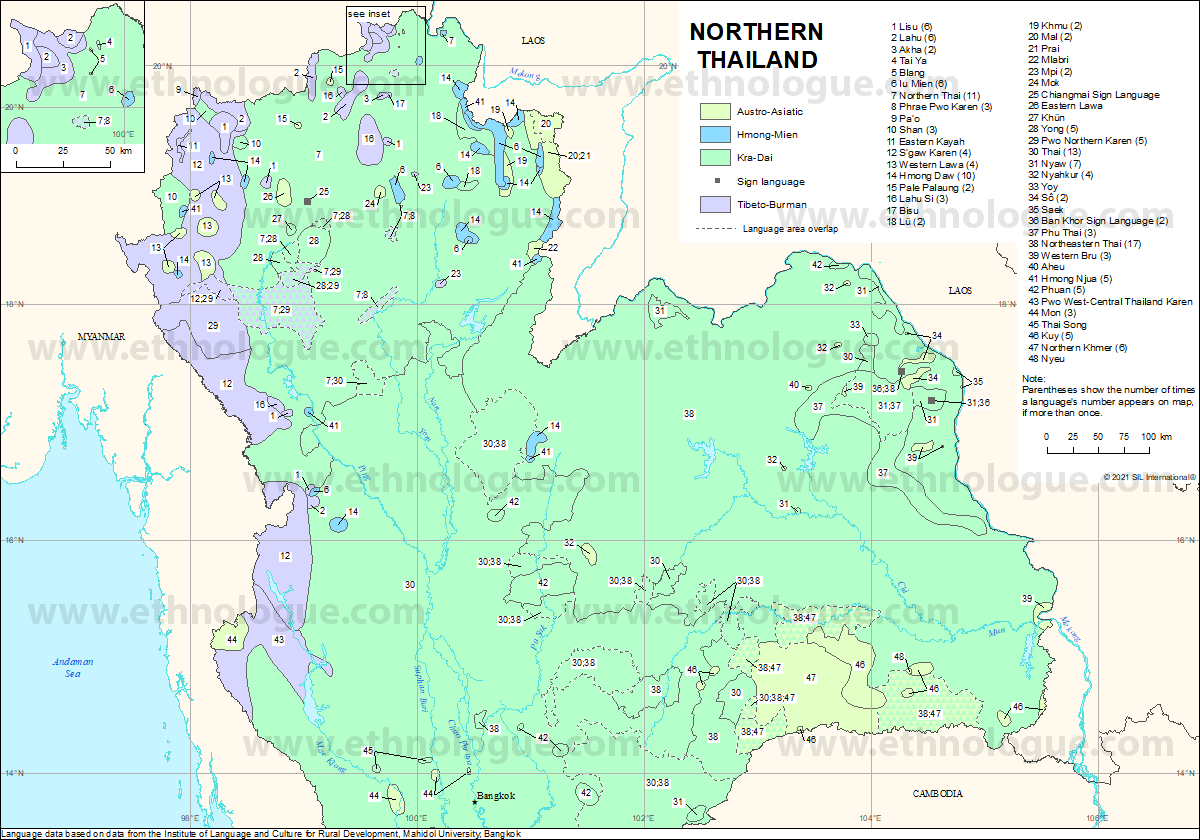
Northern Thailand
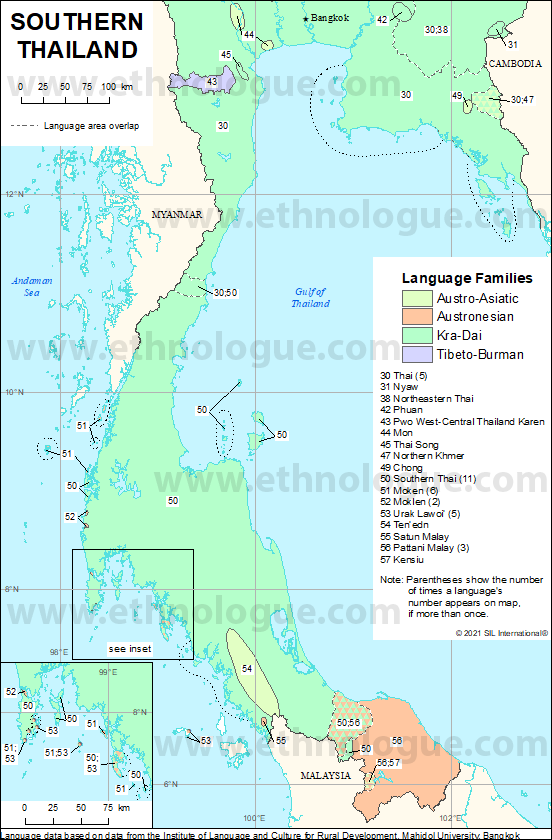
Southern Thailand
Graphs
Language Vitality Profile
Full explanation
Language Status Profile
Full explanation
Resources
View Terms
Each Ethnologue country digest is a licensed product with restricted terms of use. Before downloading the product, you must agree to the following terms:
- This is a license for individual use. Just as with a conventionally published book, it is a violation of copyright to make a copy and give it to others.
- You may not redistribute this work in any form, including ingesting the contents into a database that is shared with others or posting it on a web site (whether public or private).
To inquire about permission for reuse or redistribution, please use the Contact Us form in the footer.
Digest of the languages of Thailand ($299.95, 60 page PDF)