
TN
Republic of Tunisia
Tunisia
Summary
- Official Name
- Republic of Tunisia
- Population
- 11,936,000
- Principal Languages
- Standard Arabic, Tunisian Spoken Arabic
- Literacy Rate
- 82% (2015 World Factbook)
- International Conventions
- ACHPR (1987), CDE (1960), CPPDCE (2006), CSICH (2012), ICCPR (1966), UNCRPD (2006), UNDRIP (2007)
- General References
- Applegate 1970, Cohen 1985, S’hiri 1994
- Deaf Population
- 21,240
- Language Counts
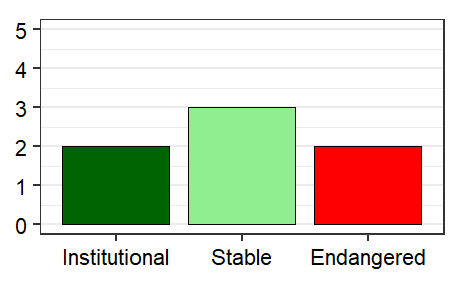
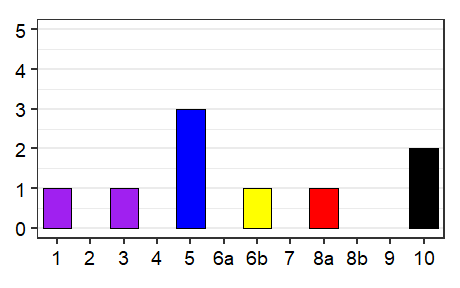
- The number of established languages listed for Tunisia is 8. Of these, 6 are living and 2 are extinct. Of the living languages, 2 are indigenous and 4 are non-indigenous. Furthermore, 4 are institutional, 1 is developing, and 1 is in trouble. Also listed are 7 unestablished languages.
Languages
- Arabic, Algerian Saharan Spoken aao
- Users: 68,000 in Tunisia (2015 J. Leclerc). Status: Unestablished. Classification: Afro-Asiatic, Semitic, Central, South, Arabic
- Arabic, Algerian Spoken arq
- Users: 268,000 in Tunisia (2016). Status: Unestablished. Classification: Afro-Asiatic, Semitic, Central, South, Arabic
- Arabic, Libyan Spoken ayl
- Users: 293,000 in Tunisia (2016). Status: Unestablished. Classification: Afro-Asiatic, Semitic, Central, South, Arabic
- Arabic, North Levantine Spoken apc
- Users: 23,000 in Tunisia (2015 J. Leclerc). Status: Unestablished. Classification: Afro-Asiatic, Semitic, Central, South, Arabic
- Arabic, Standard arb
- Users: 8,790,000 in Tunisia (2014 SIL), all users. Status: 1 (National). Statutory national language (1959, Constitution, Article 1). Classification: Afro-Asiatic, Semitic, Central, South, Arabic
- Arabic, Tunisian Spoken aeb
- Widespread. Users: 10,800,000 in Tunisia (2014 census). Total users in all countries: 11,709,020. Status: 3 (Wider communication). De facto national working language. Gained vitality in the 17th century with the use of Arabic script in literature. Used in everyday communications in Tunisia and Libya. Widely used in education after Tunisian independence in 1956. Alternate Names: Tunisian, Tunisian Arabic, Tunisian Darija Autonym: Derja, تونسي (Tounsi) Classification: Afro-Asiatic, Semitic, Central, South, Arabic
- English eng
- Users: 1,721,500 in Tunisia, all users. L1 users: 1,500 in Tunisia (2015 J. Leclerc). L2 users: 1,720,000 (Ramaswami et al 2012). Status: 5* (Dispersed). Classification: Indo-European, Germanic, West, English
- French fra
- Widespread. Users: 6,081,200 in Tunisia, all users. L1 users: 1,200 in Tunisia (2015 J. Leclerc). L2 users: 6,080,000 (Beck et al 2018). Status: 5* (Dispersed). Alternate Names: Français Classification: Indo-European, Italic, Romance, Italo-Western, Western, Gallo-Iberian, Gallo-Romance, Gallo-Rhaetian, Oïl, French
- Ghadamès gha
- Users: 3,100 in Tunisia (2015 J. Leclerc). Status: Unestablished. Classification: Afro-Asiatic, Berber, Northern, Zenati, East
- Italian ita
- Users: 1,100 in Tunisia (2015 J. Leclerc). Status: Unestablished. Classification: Indo-European, Italic, Romance, Italo-Western, Italo-Dalmatian
- Lingua Franca pml
- Tunis governorate; other major Mediterranean ports. Users: No known L1 speakers. The last speakers probably survived into the 1850s (Holm 1989). Status: 10 (Extinct). Alternate Names: ’Ajnabi, Aljamia, Ferenghi, Petit Mauresque, Sabir Classification: Pidgin, Romance based
- Maltese mlt
- Users: 3,400 in Tunisia (2015 J. Leclerc). Status: Unestablished. Classification: Afro-Asiatic, Semitic, Central, South, Arabic
- Sened sds
- Qafsah governorate: Sened and Tmagourt villages, northwest of Gabès. Users: No known L1 speakers. The last speakers probably survived into the 1970s. Status: 10 (Extinct). Classification: Afro-Asiatic, Berber, Northern, Zenati, East
- Shilha jbn
- Madanin governorate: Ajim, Djerba island, Guellala, and Sedouikech; Qabis governorate: Matmata, Tamezret, Taoujjout, and Zraoua; Qibili governorate: Douiret, Chenini, and Tataouine; Tunis city. Users: 50,000 in Tunisia (2004 S. Chaker). Status: 6b* (Threatened). Alternate Names: Djerbi, Jabal Nafusi, Nafusi, Tunisian Berber Classification: Afro-Asiatic, Berber, Northern, Zenati, East
- Tunisian Sign Language tse
- Scattered, especially Tunis and Sfax. Users: 21,200 (2008 WFD). Approximately 0.2% of total population. Another estimate: 53,000 deaf (2014 IMB). Status: 5 (Developing). Classification: Sign language, Deaf community sign language
Languages by Status
Arabic, Standard
[arb] 1 (National). Statutory national language (1959, Constitution, Article 1). 8,790,000 in Tunisia (2014 SIL), all users.
Arabic, Tunisian Spoken
[aeb] 3 (Wider communication). De facto national working language. Gained vitality in the 17th century with the use of Arabic script in literature. Used in everyday communications in Tunisia and Libya. Widely used in education after Tunisian independence in 1956. 10,800,000 in Tunisia (2014 census). Total users in all countries: 11,709,020.
English
[eng] 5* (Dispersed). 1,721,500 in Tunisia, all users. L1 users: 1,500 in Tunisia (2015 J. Leclerc). L2 users: 1,720,000 (Ramaswami et al 2012).
French
[fra] 5* (Dispersed). 6,081,200 in Tunisia, all users. L1 users: 1,200 in Tunisia (2015 J. Leclerc). L2 users: 6,080,000 (Beck et al 2018).
Tunisian Sign Language
[tse] 5 (Developing). 21,200 (2008 WFD). Approximately 0.2% of total population. Another estimate: 53,000 deaf (2014 IMB).
Shilha
[jbn] 6b* (Threatened). 50,000 in Tunisia (2004 S. Chaker).
Lingua Franca
[pml] 10 (Extinct). No known L1 speakers. The last speakers probably survived into the 1850s (Holm 1989).
Sened
[sds] 10 (Extinct). No known L1 speakers. The last speakers probably survived into the 1970s.
Arabic, Algerian Saharan Spoken
[aao] Unestablished. 68,000 in Tunisia (2015 J. Leclerc).
Arabic, Algerian Spoken
[arq] Unestablished. 268,000 in Tunisia (2016).
Arabic, Libyan Spoken
[ayl] Unestablished. 293,000 in Tunisia (2016).
Arabic, North Levantine Spoken
[apc] Unestablished. 23,000 in Tunisia (2015 J. Leclerc).
Ghadamès
[gha] Unestablished. 3,100 in Tunisia (2015 J. Leclerc).
Italian
[ita] Unestablished. 1,100 in Tunisia (2015 J. Leclerc).
Maltese
[mlt] Unestablished. 3,400 in Tunisia (2015 J. Leclerc).
Maps
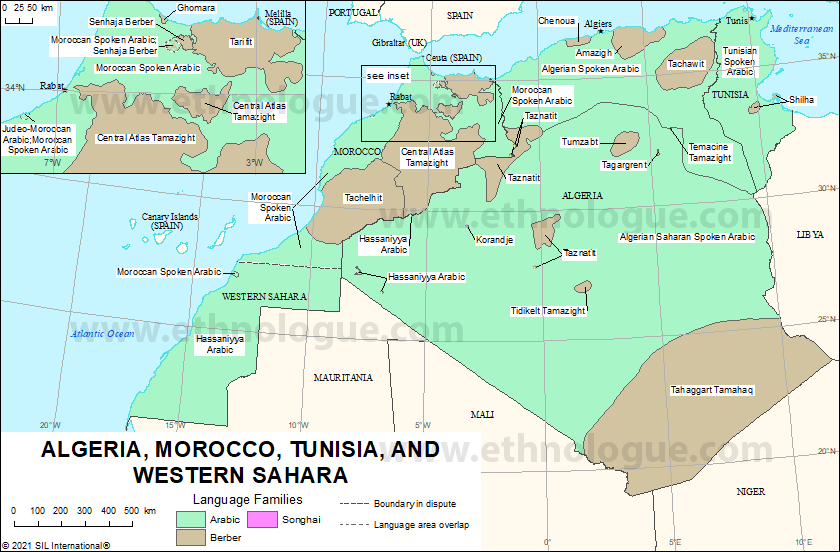
Algeria, Morocco, Tunisia and Western Sahara
Graphs
Language Vitality Profile
Full explanation
Language Status Profile
Full explanation
Resources
View Terms
Each Ethnologue country digest is a licensed product with restricted terms of use. Before downloading the product, you must agree to the following terms:
- This is a license for individual use. Just as with a conventionally published book, it is a violation of copyright to make a copy and give it to others.
- You may not redistribute this work in any form, including ingesting the contents into a database that is shared with others or posting it on a web site (whether public or private).
To inquire about permission for reuse or redistribution, please use the Contact Us form in the footer.
Digest of the languages of Tunisia ($149.95, 20 page PDF)