
ZA
Republic of South Africa
South Africa
Summary
- Official Name
- Republic of South Africa
- Population
- 60,143,000
- Principal Languages
- Afrikaans, English, Ndebele, Northern Sotho, Setswana, Southern Sotho, Swati, Tsonga, Venda, Xhosa, Zulu
- Literacy Rate
- 87% (2017 UNESCO)
- International Conventions
- ACHPR (1987), CDE (1960), CPPDCE (2006), ICCPR (1966), UNCRPD (2006), UNDRIP (2007)
- General References
- Brenzinger 1998, Campbell and King 2011, Ruhlen 1987, Van der Merwe and van Niekerk 1994, Voegelin and Voegelin 1977
- Deaf Population
- 383,000
- Language Counts
- The number of established languages listed for South Africa is 36. Of these, 31 are living and 5 are extinct. Of the living languages, 20 are indigenous and 11 are non-indigenous. Furthermore, 12 are institutional, 8 are developing, 2 are vigorous, 2 are in trouble, and 7 are dying. Also listed are 17 unestablished languages.
Languages
- ‡Ungkue gku
- Northern Cape province: Siya Themba municipality, near the confluence of the Orange and Vaal rivers. Users: No known L1 speakers. Probably extinct by late 20th century. Status: 10 (Extinct). Alternate Names: Vaal–Orange, ǁKxau Classification: Tuu, !Ui
- Afrikaans afr
- Free State, Gauteng, Northern Cape, and Western Cape states. Users: 17,160,000 in South Africa, all users. L1 users: 6,860,000 in South Africa (2013 UNSD), decreasing. L2 users: 10,300,000 (Webb 2002). Total users in all countries: 17,641,380 (as L1: 7,341,380; as L2: 10,300,000). Status: 1 (National). Statutory national language (1996, Constitution, Art 6(1)), has been designated, along with English, as an official language in all 9 provinces. Autonym: Afrikaans Classification: Indo-European, Germanic, West, Low Saxon-Low Franconian, Low Franconian
- Angloromani rme
- Users: 7,900 in South Africa (2012 J. Leclerc). Status: Unestablished. Classification: Mixed language, English-Romani
- Arabic, Egyptian Spoken arz
- Users: 60,000 in South Africa (2020 Joshua Project), based on ethnicity. Status: Unestablished. Classification: Afro-Asiatic, Semitic, Central, South, Arabic
- Bengali ben
- Users: 300,000 in South Africa (2019), based on nationality. Status: Unestablished. Classification: Indo-European, Indo-Iranian, Indo-Aryan, Outer Languages, Eastern, Bengali-Assamese
- Bhojpuri bho
- Users: 57,000 in South Africa (2020 Joshua Project), based on ethnicity. Status: Unestablished. Classification: Indo-European, Indo-Iranian, Indo-Aryan, Outer Languages, Eastern, Bihari
- Birwa brl
- Limpopo province: Capricorn district; near Zimbabwe border. Status: 6a* (Vigorous). Classification: Niger-Congo, Atlantic-Congo, Volta-Congo, Benue-Congo, Bantoid, Southern, Narrow Bantu, Central, S, Sotho-Tswana (S.32)
- Camtho cmt
- Gauteng province: Soweto, Johannesburg, other urban settings. Users: No known L1 speakers. Ethnic population: No ethnic community. Status: 9 (Second language only). Alternate Names: Iscamtho, Isicamtho, Tsotsitaal Classification: Mixed language, Zulu-Bantu
- Chinese, Mandarin cmn
- KwaZulu-Natal coast. Users: 10,000 in South Africa (2012 J. Leclerc). Status: Unestablished. Classification: Sino-Tibetan, Chinese
- Chinese, Yue yue
- KwaZulu-Natal coast. Users: 15,000 in South Africa (1993). Status: Unestablished. Classification: Sino-Tibetan, Chinese
- Dutch nld
- Users: 15,000 in South Africa (2020 Joshua Project), based on ethnicity. Status: Unestablished. Classification: Indo-European, Germanic, West, Low Saxon-Low Franconian, Low Franconian
- English eng
- Gauteng province: Cape Town area; KwaZulu-Natal and Western Cape provinces; Tugela river to Port Edward area, and inland to Eastern Cape province; urban concentrations, Johannesburg, suburbs. Users: 19,640,000 in South Africa, all users. L1 users: 5,640,000 in South Africa (2019). L2 users: 14,000,000 (2019). Status: 1 (National). Statutory national language (1996, Constitution, Article 6(1)), has been designated, along with Afrikaans, as an official language in all 9 provinces. Classification: Indo-European, Germanic, West, English
- Flaaitaal fly
- Major cities. Users: No known L1 speakers. Ethnic population: No ethnic community (Makhudu 2002). Status: 9 (Second language only). Alternate Names: Bika, Flaai Taal, Fly Taal, Himbul, Himli, Hova, Iscamtho, Isikhumsha, Lingam, Lingo, Sepantsula, Setsotsi, Shalambombo, Sjita, Taal, Tsotsitaal, Withi Classification: Creole, Afrikaans based
- French fra
- Users: 11,000 in South Africa (2020 Joshua Project), based on ethnicity. Status: Unestablished. Classification: Indo-European, Italic, Romance, Italo-Western, Western, Gallo-Iberian, Gallo-Romance, Gallo-Rhaetian, Oïl, French
- Gail gic
- Eastern Cape, Free State, Gauteng, KwaZulu-Natal, and Western Cape provinces; mainly urban settings: Bloemfontein, Cape Town, Durban, Johannesburg, Port Elizabeth, Pretoria. Users: 20,000, all users. L1 users: No known L1 speakers. L2 users: 20,000. Ethnic population: No ethnic community. Status: 9 (Second language only). Classification: Unclassified
- German, Standard deu
- Users: 15,000 in South Africa (2020 Joshua Project), based on ethnicity. Status: Unestablished. Classification: Indo-European, Germanic, West, High German, German, Middle German, East Middle German
- Greek ell
- Users: 21,000 in South Africa (2020 Joshua Project), based on ethnicity. Status: Unestablished. Classification: Indo-European, Greek, Attic
- Gujarati guj
- Users: 32,000 in South Africa (2020 Joshua Project), based on ethnicity. Status: Unestablished. Classification: Indo-European, Indo-Iranian, Indo-Aryan, Intermediate Divisions, Western, Gujarati
- Hindi hin
- KwaZulu-Natal province. Users: 463,000 in South Africa (2020 Joshua Project), based on ethnicity. Status: 5* (Dispersed). Classification: Indo-European, Indo-Iranian, Indo-Aryan, Western Hindi, Hindustani
- Italian ita
- Users: 20,000 in South Africa (2020 Joshua Project), based on ethnicity. Status: Unestablished. Classification: Indo-European, Italic, Romance, Italo-Western, Italo-Dalmatian
- Khoekhoe naq
- Northern Cape province. Users: 2,000 in South Africa (Brenzinger 2013b). Status: 5* (Dispersed). Alternate Names: Bergdamara, Dama, Damaqua, Damara, Khoekhoegowab, Khoekhoegowap, Khoi, Nama, Namakwa, Naman, Namaqua, Tama, Tamakwa, Tamma, “Hottentot” (pej.) Classification: Khoe-Kwadi, Khoe, Khoekhoe, Nama
- Khwedam xuu
- Northern Cape province: Platfontein. Users: 1,760 in South Africa (Louw and van Schalkwyk 2019). Status: Unestablished. Classification: Khoe-Kwadi, Khoe, Kalahari Khoe, Northwest
- Korana kqz
- Northern Cape province. Users: No known L1 speakers. Last known speakers survived into the 1980s. Ethnic population: 10,000 (1972 D. Barrett, M. Hronek, G. Mambo et al.). Status: 9 (Dormant). Alternate Names: !Gora, !Kora, !Ora, Gorachouqua, Kora, Koranna, Koraqua, “Korana Hottentot” (pej.) Classification: Khoe-Kwadi, Khoe, Khoekhoe, Nama
- Lower Nossob nsb
- Northern Cape province: ZF Mgcawu district municipality, Dawid Kruiper local municipality. Users: No known L1 speakers in South Africa. Last known speaker died in 2015 (2018 UNESCO). Total users in all countries: none known. Status: 10 (Extinct). Alternate Names: Lower-Nosop Classification: Tuu, Taa
- Morisyen mfe
- Users: 42,000 in South Africa (2020 Joshua Project), based on ethnicity. Status: Unestablished. Classification: Creole, French based
- Ndebele nbl
- Mpumalanga and Gauteng (Nkangala district) provinces: northeast of Pretoria. Users: 2,490,000, all users. L1 users: 1,090,000 (2011 census). L2 users: 1,400,000 (Webb 2002). Status: 1 (National). Statutory national language (1996, Constitution, Article 6(1)). Statutory provincial language in Mpumalunga province (2012, Use of Official Languages Act, No. 12, Section 4(1)). Alternate Names: Isikhethu, Ndzundza, Nrebele, Southern Ndebele, Transvaal Ndebele, isiNdebele Autonym: IsiNdebele Classification: Niger-Congo, Atlantic-Congo, Volta-Congo, Benue-Congo, Bantoid, Southern, Narrow Bantu, Central, S, Nguni (S.407)
- Northwestern !Kung vaj
- Northern Cape province: Diamondfields district, Kimberley, Schmidtsdrift military base. Users: 4,570 in South Africa (Louw and van Schalkwyk 2019). Status: 6b* (Threatened). Alternate Names: !’O!Xun, !Xun Classification: Kx’a, !Kung
- Nǁng ngh
- Northern Cape province: Olifantshoek and Upington towns. Users: 3 (2021), decreasing. 1 speaker of N|u dialect and 2 speakers of ||Au dialect. Ethnic population: 500 (1998 N. Crawhall). Status: 8b (Nearly extinct). Alternate Names: Ng’uki, Nghuki, Nǀhuuki, Nǀu, Nǀuu, Nǀuuki, ‡Khomani Classification: Tuu, !Ui
- Oorlams oor
- Mpumalanga province. Users: 32,000 (2006 J. Leclerc). Status: 6a* (Vigorous). Classification: Creole, Afrikaans based
- Pidgin Bantu fng
- Gauteng province: suburban Johannesburg and mining areas. Users: No known L1 speakers in South Africa. Ethnic population: No ethnic community. Total users in all countries: 5,100 (as L1: ; as L2: 5,100). Status: 9 (Second language only). Alternate Names: Basic Zulu, Fanagoloi, Isilololo, Isipiki, Lololo, Piki, Silunguboi, “Fanagalo” (pej.), “Fanakalo” (pej.), “Fanekolo” (pej.), “Isikula” (pej.) Classification: Pidgin, Zulu based
- Portuguese por
- Users: 300,000 in South Africa (2010 Observatório da Emigração). Ethnic population: 1,850,000 (2020 Joshua Project). Status: Unestablished. Classification: Indo-European, Italic, Romance, Italo-Western, Western, Gallo-Iberian, Ibero-Romance, West Iberian, Portuguese-Galician
- Ronga rng
- KwaZulu-Natal province. Users: 1,000 in South Africa (2012 J. Leclerc). Status: 6b* (Threatened). Alternate Names: Shironga Classification: Niger-Congo, Atlantic-Congo, Volta-Congo, Benue-Congo, Bantoid, Southern, Narrow Bantu, Central, S, Tswa-Rhonga (S.54)
- Seroa kqu
- Free State province: Xhariep district; near Swaziland border. Users: No known L1 speakers. The last speaker died in the 1870s (Traill 2002). Status: 10 (Extinct). Alternate Names: Vaal–Orange Classification: Tuu, !Ui
- Setswana tsn
- Free State province: between Bloemfontein and Kimberley; Gauteng province: southwest of Pretoria; Limpopo province: Waterberg municipality; North-West province; Northern Cape province: northeast. Users: 11,770,000 in South Africa, all users. L1 users: 4,070,000 in South Africa (2013 UNSD), increasing. L2 users: 7,700,000 (Webb 2002). Status: 1 (National). Statutory national language (1996, Constitution, Article 6(1)). Statutory provincial language in Northern Cape and North West provinces (2012, Use of Official Languages Act, No. 12, Section 4(1)). Alternate Names: Beetjuans, Chuana, Coana, Cuana, Sechuana, Tsiwaha, Tswana Classification: Niger-Congo, Atlantic-Congo, Volta-Congo, Benue-Congo, Bantoid, Southern, Narrow Bantu, Central, S, Sotho-Tswana (S.31)
- Shona sna
- Users: 18,000 in South Africa (2012 J. Leclerc). Status: Unestablished. Classification: Niger-Congo, Atlantic-Congo, Volta-Congo, Benue-Congo, Bantoid, Southern, Narrow Bantu, Central, S, Shona (S.10)
- Somali som
- Users: 24,000 in South Africa (2020 Joshua Project), based on ethnicity. Status: Unestablished. Classification: Afro-Asiatic, Cushitic, East, Somali
- Sotho, Northern nso
- Gauteng province: Pretoria area; Limpopo province; Mpumalanga province: Ehlanzeni and Nkangala districts; North-West province: Mortele municipality. Users: 13,720,000 in South Africa, all users. L1 users: 4,620,000 in South Africa (2013 UNSD), increasing. L2 users: 9,100,000 (Webb 2002). Total users in all countries: 13,731,000 (as L1: 4,631,000; as L2: 9,100,000). Status: 1 (National). Statutory national language (1996, Constitution, Article 6(1)). Statutory provincial language in Gauteng and Limpopo provinces (2012, Use of Official Languages Act, No. 12, Section 4(1)). Alternate Names: Pedi, Sepedi, Transvaal Sotho Autonym: Sesotho sa Leboa Classification: Niger-Congo, Atlantic-Congo, Volta-Congo, Benue-Congo, Bantoid, Southern, Narrow Bantu, Central, S, Sotho-Tswana (S.32)
- Sotho, Southern sot
- Eastern Cape province: Senqu municipality, south of Lesotho; Free State province; Gauteng province: Kempton and Tembisa Park; North-West and Mpumalanga provinces border areas. Users: 11,750,000 in South Africa, all users. L1 users: 3,850,000 in South Africa (2013 UNSD), increasing. L2 users: 7,900,000 (Webb 2002). Status: 1 (National). Statutory national language (1996, Constitution, Article 6(1)). Statutory provincial language in Gauteng, East Cape, Free State, and North West provinces (2012, Use of Official Languages Act, No. 12, Section 4(1)). Alternate Names: Sesotho, Sisutho, Souto, Suthu, Suto Classification: Niger-Congo, Atlantic-Congo, Volta-Congo, Benue-Congo, Bantoid, Southern, Narrow Bantu, Central, S, Sotho-Tswana (S.33)
- South African Sign Language sfs
- Scattered. Users: 500,000 (Aarons and Akach 2002), all users. Estimated, including some hearing people. L1 users: 235,000 (2011 census). Approximately 0.4% of the total population. Other estimates vary widely: 12,100 (Van Cleve 1986); 400,000–500,000 (2008 WFD). Status: 5 (Developing). Recognized language (1996, Constitution, Chapter 1, Section 6(5)(a)), although not an official language, it is recognized as a language to be promoted. Alternate Names: SASL Classification: Sign language, Deaf community sign language
- Swahili swh
- KwaZulu-Natal province: Chatsworth 1, southwest of Durban proper on the coast. Users: 2,000 in South Africa (2012 J. Leclerc). Status: 5* (Dispersed). Alternate Names: Kiswahili Classification: Niger-Congo, Atlantic-Congo, Volta-Congo, Benue-Congo, Bantoid, Southern, Narrow Bantu, Central, G, Swahili (G.42)
- Swati ssw
- KwaZulu-Natal and Mpumalanga provinces. Users: 3,700,000 in South Africa, all users. L1 users: 1,300,000 in South Africa (2013 UNSD). L2 users: 2,400,000 (Webb 2002). Status: 1 (National). Statutory national language (1996, Constitution, Article 6(1)). Statutory provincial language in Mpumalanga province (2012, Use of Official Languages Act, No. 12, Section 4(1)). Alternate Names: Siswati, Siswazi, Swazi, Tekela, Tekeza, Thithiza, Yeyeza, siSwati Classification: Niger-Congo, Atlantic-Congo, Volta-Congo, Benue-Congo, Bantoid, Southern, Narrow Bantu, Central, S, Nguni (S.43)
- Tamil tam
- KwaZulu-Natal province. Users: 32,000 in South Africa (2020 Joshua Project), based on ethnicity. Ethnic population: 1,030,000 (2012 J. Leclerc). Status: 4 (Educational). Classification: Dravidian, Southern, Tamil-Kannada, Tamil-Kodagu, Tamil-Malayalam, Tamil
- Telugu tel
- Users: 4,900 in South Africa (2020 Joshua Project), based on ethnicity. Status: 5* (Dispersed). Classification: Dravidian, South-Central, Telugu
- Tsonga tso
- Limpopo and Mpumalanga provinces. Users: 5,680,000 in South Africa, all users. L1 users: 2,280,000 in South Africa (2013 UNSD), increasing. L2 users: 3,400,000 (Webb 2002). Total users in all countries: 10,003,500 (as L1: 6,603,500; as L2: 3,400,000). Status: 1 (National). Statutory national language (1996, Constitution, Article 6(1)). Statutory provincial language in Limpopo province (2012, Use of Official Languages Act, No. 12, Section 4(1)). Alternate Names: Shangaan, Shangana, Shitsonga, Thonga, Tonga, Vatsonga Autonym: Xitsonga Classification: Niger-Congo, Atlantic-Congo, Volta-Congo, Benue-Congo, Bantoid, Southern, Narrow Bantu, Central, S, Tswa-Rhonga (S.53)
- Tswa tsc
- Limpopo province: near South Africa-Zimbabwe-Mozambique shared border. Users: 20,000 in South Africa (2012 J. Leclerc). Status: 5* (Developing). Alternate Names: Kitshwa, Sheetshwa, Shitshwa, Tshwa, Xitshwa Classification: Niger-Congo, Atlantic-Congo, Volta-Congo, Benue-Congo, Bantoid, Southern, Narrow Bantu, Central, S, Tswa-Rhonga (S.51)
- Urdu urd
- KwaZulu-Natal province: Durban coastal and urban areas; Gauteng province: Johannesburg area, and scattered smaller towns. Users: 15,000 in South Africa (2020 Joshua Project), based on ethnicity. Status: 5* (Dispersed). Classification: Indo-European, Indo-Iranian, Indo-Aryan, Western Hindi, Hindustani
- Venda ven
- Limpopo province. Users: 2,910,000 in South Africa, all users. L1 users: 1,210,000 in South Africa (2013 UNSD), increasing. L2 users: 1,700,000 (Webb 2002). Total users in all countries: 3,001,400 (as L1: 1,301,400; as L2: 1,700,000). Status: 1 (National). Statutory national language (1996, Constitution, Article 6(1)). Statutory provincial language in Limpopo province (2012, Use of Official Languages Act, No. 12, Section 4(1)). Alternate Names: Chivenda, Luvenda Autonym: Tshivenḓa (Tshivenda) Classification: Niger-Congo, Atlantic-Congo, Volta-Congo, Benue-Congo, Bantoid, Southern, Narrow Bantu, Central, S, Venda (S.21)
- Xhosa xho
- Eastern Cape province: east of Middelburg and Port Elizabeth; Northern Cape province: southeast Pixley ka Seme municipality; KwaZulu-Natal province: Ugu and Sisonke municipalities; Free State: border area, west of Lesotho. Users: 19,150,000 in South Africa, all users. L1 users: 8,150,000 in South Africa (2013 UNSD). L2 users: 11,000,000 (Webb 2002). Total users in all countries: 19,216,300 (as L1: 8,216,300; as L2: 11,000,000). Status: 1 (National). Statutory national language (1996, Constitution, Article 6(1)). Statutory provincial language in Eastern Cape, Free State, KwaZulu-Natal, Northern Cape, and Western Cape (2012, Use of Official Languages Act, No. 12, Section 4(1)), official language in 5 provinces. Alternate Names: Isixhosa, Koosa, Xosa, “Cauzuh” (pej.) Autonym: isiXhosa Classification: Niger-Congo, Atlantic-Congo, Volta-Congo, Benue-Congo, Bantoid, Southern, Narrow Bantu, Central, S, Nguni (S.41)
- Xiri xii
- Northern Cape province: near Namibia border. Users: 87 in South Africa (2000). Total users in all countries: 187. Status: 8b (Nearly extinct). Alternate Names: Cape Hottentot, Gri, Grikwa, Griqua, Gry, Xirikwa, Xrikwa Classification: Khoe-Kwadi, Khoe, Khoekhoe, Nama
- Yiddish, Eastern ydd
- Major cities. Status: 5* (Dispersed). Classification: Indo-European, Germanic, West, High German, Yiddish
- Zulu zul
- KwaZulu-Natal and Mpumalanga (Gert Sibande muni) provinces; northeast Free State and southeast Gauteng provinces; Eastern Cape province: Harding area. Users: 27,300,000 in South Africa, all users. L1 users: 11,600,000 in South Africa (2013 UNSD), increasing. L2 users: 15,700,000 (Webb 2002). Total users in all countries: 27,804,600 (as L1: 12,104,600; as L2: 15,700,000). Status: 1 (National). Statutory national language (1996, Constitution, Article 6(1)). Statutory provincial language in Gauteng and KwaZulu-Natal provinces (2012, Use of Official Languages Act, No. 12, Section 4(1)). Alternate Names: Isizulu, Zunda, isiZulu Classification: Niger-Congo, Atlantic-Congo, Volta-Congo, Benue-Congo, Bantoid, Southern, Narrow Bantu, Central, S, Nguni (S.42)
- ǀXam xam
- Northern Cape province. Users: No known L1 speakers. The last speakers survived into the 1910s (Traill 1995). Status: 10 (Extinct). Alternate Names: !Kham, /Kam, /Kama-ka !Ke, /Xam, Xam, ǀKamka!e, ǀKham-Ka-!k’e, ǀXam-Ka-!k’e Classification: Tuu, !Ui
- ǁXegwi xeg
- Limpopo province. Users: No known L1 speakers. Last known speaker, Jopi Mabinda, died in 1988 (Traill 2002). Status: 10 (Extinct). Alternate Names: Abathwa, Amabusmana, Amankgqwigqwi, Batwa, Boroa, Bush-C, Giǀkxigwi, Kiǁkxigwi, Kloukle, Lxloukxle, Nkqeshe, Tloue, Tloutle, ǁXegwe, ǁXekwi Classification: Tuu, !Ui
Languages by Status
Afrikaans
[afr] 1 (National). Statutory national language (1996, Constitution, Art 6(1)), has been designated, along with English, as an official language in all 9 provinces. 17,160,000 in South Africa, all users. L1 users: 6,860,000 in South Africa (2013 UNSD), decreasing. L2 users: 10,300,000 (Webb 2002). Total users in all countries: 17,641,380 (as L1: 7,341,380; as L2: 10,300,000).
English
[eng] 1 (National). Statutory national language (1996, Constitution, Article 6(1)), has been designated, along with Afrikaans, as an official language in all 9 provinces. 19,640,000 in South Africa, all users. L1 users: 5,640,000 in South Africa (2019). L2 users: 14,000,000 (2019).
Ndebele
[nbl] 1 (National). Statutory national language (1996, Constitution, Article 6(1)). Statutory provincial language in Mpumalunga province (2012, Use of Official Languages Act, No. 12, Section 4(1)). 2,490,000, all users. L1 users: 1,090,000 (2011 census). L2 users: 1,400,000 (Webb 2002).
Setswana
[tsn] 1 (National). Statutory national language (1996, Constitution, Article 6(1)). Statutory provincial language in Northern Cape and North West provinces (2012, Use of Official Languages Act, No. 12, Section 4(1)). 11,770,000 in South Africa, all users. L1 users: 4,070,000 in South Africa (2013 UNSD), increasing. L2 users: 7,700,000 (Webb 2002).
Sotho, Northern
[nso] 1 (National). Statutory national language (1996, Constitution, Article 6(1)). Statutory provincial language in Gauteng and Limpopo provinces (2012, Use of Official Languages Act, No. 12, Section 4(1)). 13,720,000 in South Africa, all users. L1 users: 4,620,000 in South Africa (2013 UNSD), increasing. L2 users: 9,100,000 (Webb 2002). Total users in all countries: 13,731,000 (as L1: 4,631,000; as L2: 9,100,000).
Sotho, Southern
[sot] 1 (National). Statutory national language (1996, Constitution, Article 6(1)). Statutory provincial language in Gauteng, East Cape, Free State, and North West provinces (2012, Use of Official Languages Act, No. 12, Section 4(1)). 11,750,000 in South Africa, all users. L1 users: 3,850,000 in South Africa (2013 UNSD), increasing. L2 users: 7,900,000 (Webb 2002).
Swati
[ssw] 1 (National). Statutory national language (1996, Constitution, Article 6(1)). Statutory provincial language in Mpumalanga province (2012, Use of Official Languages Act, No. 12, Section 4(1)). 3,700,000 in South Africa, all users. L1 users: 1,300,000 in South Africa (2013 UNSD). L2 users: 2,400,000 (Webb 2002).
Tsonga
[tso] 1 (National). Statutory national language (1996, Constitution, Article 6(1)). Statutory provincial language in Limpopo province (2012, Use of Official Languages Act, No. 12, Section 4(1)). 5,680,000 in South Africa, all users. L1 users: 2,280,000 in South Africa (2013 UNSD), increasing. L2 users: 3,400,000 (Webb 2002). Total users in all countries: 10,003,500 (as L1: 6,603,500; as L2: 3,400,000).
Venda
[ven] 1 (National). Statutory national language (1996, Constitution, Article 6(1)). Statutory provincial language in Limpopo province (2012, Use of Official Languages Act, No. 12, Section 4(1)). 2,910,000 in South Africa, all users. L1 users: 1,210,000 in South Africa (2013 UNSD), increasing. L2 users: 1,700,000 (Webb 2002). Total users in all countries: 3,001,400 (as L1: 1,301,400; as L2: 1,700,000).
Xhosa
[xho] 1 (National). Statutory national language (1996, Constitution, Article 6(1)). Statutory provincial language in Eastern Cape, Free State, KwaZulu-Natal, Northern Cape, and Western Cape (2012, Use of Official Languages Act, No. 12, Section 4(1)), official language in 5 provinces. 19,150,000 in South Africa, all users. L1 users: 8,150,000 in South Africa (2013 UNSD). L2 users: 11,000,000 (Webb 2002). Total users in all countries: 19,216,300 (as L1: 8,216,300; as L2: 11,000,000).
Zulu
[zul] 1 (National). Statutory national language (1996, Constitution, Article 6(1)). Statutory provincial language in Gauteng and KwaZulu-Natal provinces (2012, Use of Official Languages Act, No. 12, Section 4(1)). 27,300,000 in South Africa, all users. L1 users: 11,600,000 in South Africa (2013 UNSD), increasing. L2 users: 15,700,000 (Webb 2002). Total users in all countries: 27,804,600 (as L1: 12,104,600; as L2: 15,700,000).
Tamil
[tam] 4 (Educational). 32,000 in South Africa (2020 Joshua Project), based on ethnicity. Ethnic population: 1,030,000 (2012 J. Leclerc).
Hindi
[hin] 5* (Dispersed). 463,000 in South Africa (2020 Joshua Project), based on ethnicity.
Khoekhoe
[naq] 5* (Dispersed). 2,000 in South Africa (Brenzinger 2013b).
Swahili
[swh] 5* (Dispersed). 2,000 in South Africa (2012 J. Leclerc).
Telugu
[tel] 5* (Dispersed). 4,900 in South Africa (2020 Joshua Project), based on ethnicity.
Urdu
[urd] 5* (Dispersed). 15,000 in South Africa (2020 Joshua Project), based on ethnicity.
Yiddish, Eastern
[ydd] 5* (Dispersed).
South African Sign Language
[sfs] 5 (Developing). Recognized language (1996, Constitution, Chapter 1, Section 6(5)(a)), although not an official language, it is recognized as a language to be promoted. 500,000 (Aarons and Akach 2002), all users. Estimated, including some hearing people. L1 users: 235,000 (2011 census). Approximately 0.4% of the total population. Other estimates vary widely: 12,100 (Van Cleve 1986); 400,000–500,000 (2008 WFD).
Tswa
[tsc] 5* (Developing). 20,000 in South Africa (2012 J. Leclerc).
Northwestern !Kung
[vaj] 6b* (Threatened). 4,570 in South Africa (Louw and van Schalkwyk 2019).
Ronga
[rng] 6b* (Threatened). 1,000 in South Africa (2012 J. Leclerc).
Nǁng
[ngh] 8b (Nearly extinct). 3 (2021), decreasing. 1 speaker of N|u dialect and 2 speakers of ||Au dialect. Ethnic population: 500 (1998 N. Crawhall).
Xiri
[xii] 8b (Nearly extinct). 87 in South Africa (2000). Total users in all countries: 187.
Korana
[kqz] 9 (Dormant). No known L1 speakers. Last known speakers survived into the 1980s. Ethnic population: 10,000 (1972 D. Barrett, M. Hronek, G. Mambo et al.).
‡Ungkue
[gku] 10 (Extinct). No known L1 speakers. Probably extinct by late 20th century.
Lower Nossob
[nsb] 10 (Extinct). No known L1 speakers in South Africa. Last known speaker died in 2015 (2018 UNESCO). Total users in all countries: none known.
Seroa
[kqu] 10 (Extinct). No known L1 speakers. The last speaker died in the 1870s (Traill 2002).
ǀXam
[xam] 10 (Extinct). No known L1 speakers. The last speakers survived into the 1910s (Traill 1995).
ǁXegwi
[xeg] 10 (Extinct). No known L1 speakers. Last known speaker, Jopi Mabinda, died in 1988 (Traill 2002).
Angloromani
[rme] Unestablished. 7,900 in South Africa (2012 J. Leclerc).
Arabic, Egyptian Spoken
[arz] Unestablished. 60,000 in South Africa (2020 Joshua Project), based on ethnicity.
Bengali
[ben] Unestablished. 300,000 in South Africa (2019), based on nationality.
Bhojpuri
[bho] Unestablished. 57,000 in South Africa (2020 Joshua Project), based on ethnicity.
Chinese, Mandarin
[cmn] Unestablished. 10,000 in South Africa (2012 J. Leclerc).
Chinese, Yue
[yue] Unestablished. 15,000 in South Africa (1993).
Dutch
[nld] Unestablished. 15,000 in South Africa (2020 Joshua Project), based on ethnicity.
French
[fra] Unestablished. 11,000 in South Africa (2020 Joshua Project), based on ethnicity.
German, Standard
[deu] Unestablished. 15,000 in South Africa (2020 Joshua Project), based on ethnicity.
Greek
[ell] Unestablished. 21,000 in South Africa (2020 Joshua Project), based on ethnicity.
Gujarati
[guj] Unestablished. 32,000 in South Africa (2020 Joshua Project), based on ethnicity.
Italian
[ita] Unestablished. 20,000 in South Africa (2020 Joshua Project), based on ethnicity.
Khwedam
[xuu] Unestablished. 1,760 in South Africa (Louw and van Schalkwyk 2019).
Morisyen
[mfe] Unestablished. 42,000 in South Africa (2020 Joshua Project), based on ethnicity.
Portuguese
[por] Unestablished. 300,000 in South Africa (2010 Observatório da Emigração). Ethnic population: 1,850,000 (2020 Joshua Project).
Shona
[sna] Unestablished. 18,000 in South Africa (2012 J. Leclerc).
Somali
[som] Unestablished. 24,000 in South Africa (2020 Joshua Project), based on ethnicity.
Maps
Lesotho, South Africa and Swaziland
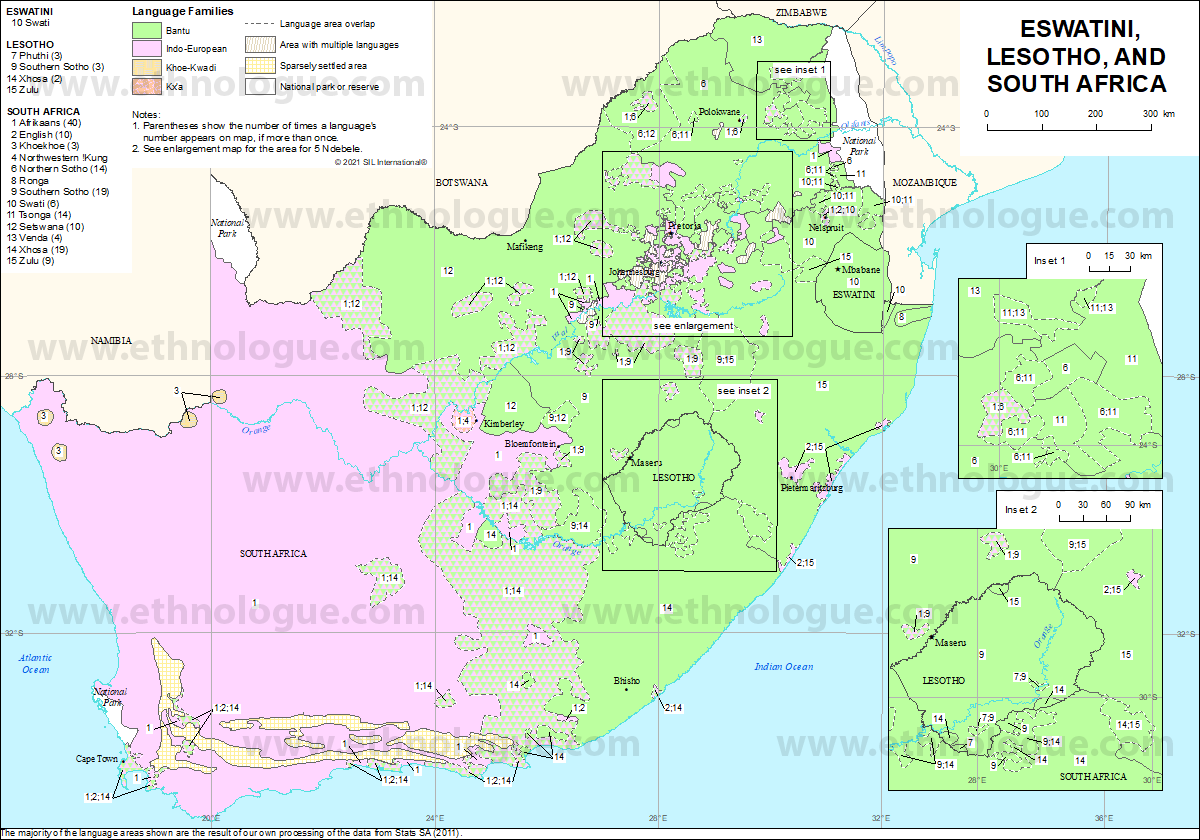
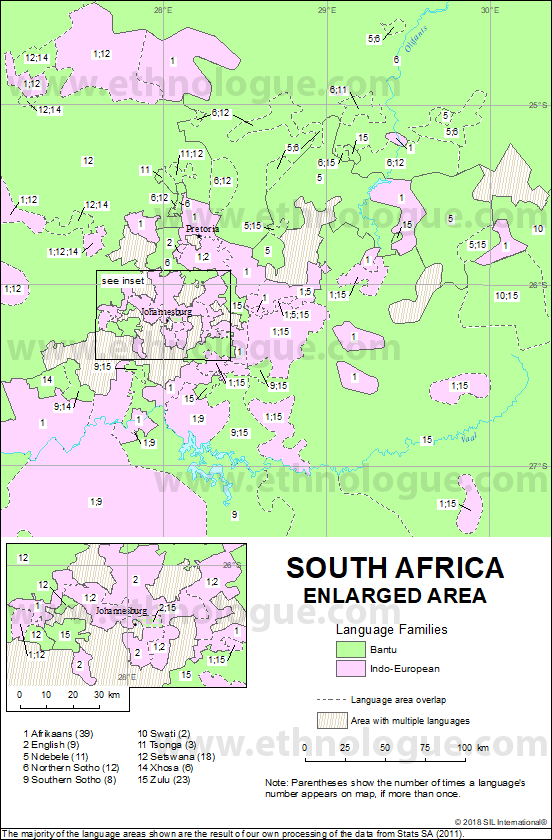
South Africa: Enlarged area
Graphs
Language Vitality Profile
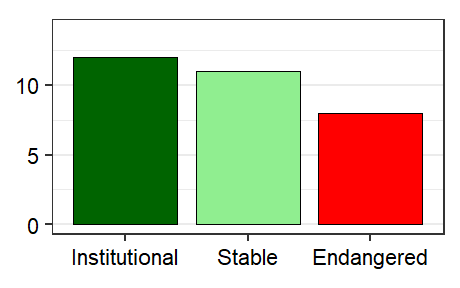
Full explanation
Language Status Profile
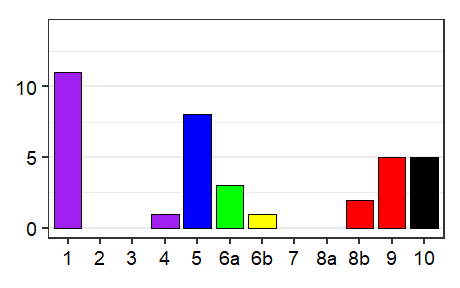
Full explanation
Resources
View Terms
Each Ethnologue country digest is a licensed product with restricted terms of use. Before downloading the product, you must agree to the following terms:
- This is a license for individual use. Just as with a conventionally published book, it is a violation of copyright to make a copy and give it to others.
- You may not redistribute this work in any form, including ingesting the contents into a database that is shared with others or posting it on a web site (whether public or private).
To inquire about permission for reuse or redistribution, please use the Contact Us form in the footer.
Digest of the languages of South Africa ($199.95, 40 page PDF)