
ZM
Republic of Zambia
Zambia
Summary
- Official Name
- Republic of Zambia
- Population
- 18,394,000
- Principal Languages
- English
- Literacy Rate
- 87% (2018 UNESCO)
- International Conventions
- ACHPR (1987), CDE (1960), CSICH (2012), ICCPR (1966), UNCRPD (2006), UNDRIP (2007)
- General References
- Brenzinger 1998, Ohannessian and Kashoki 1978
- Deaf Population
- 16,000 (2008 WFD)
- Language Counts
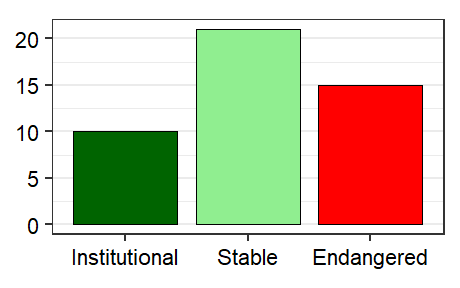
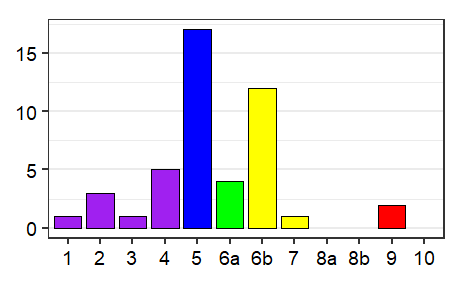
- The number of established languages listed for Zambia is 47. All are living languages. Of these, 38 are indigenous and 9 are non-indigenous. Furthermore, 9 are institutional, 17 are developing, 6 are vigorous, 13 are in trouble, and 2 are dying. Also listed are 7 unestablished languages.
Languages
- Afrikaans afr
- Scattered. Users: 96,000 in Zambia (2017 J. Leclerc). Status: 5* (Dispersed). Classification: Indo-European, Germanic, West, Low Saxon-Low Franconian, Low Franconian
- Aushi auh
- Luapula province. Users: 100,000 in Zambia (2010 census). Status: 6a* (Vigorous). Alternate Names: Abaushi, Avaushi, Ba-Usi, Bahushi, Bahusi, Batushi, Ikyaushi, Ushi, Usi, Uzhil, Wa-Usi, Waushi, Wauzhi Classification: Niger-Congo, Atlantic-Congo, Volta-Congo, Benue-Congo, Bantoid, Southern, Narrow Bantu, Central, M, Bemba (M.402)
- Bemba bem
- Eastern, Luapula, Muchinga, and Northern provinces; possibly Copperbelt province. Users: 3,810,000 in Zambia (2010 census), decreasing. 3,730,000 Bemba, 12,800 Chishinga, 37,900 Kabende, 15,000 Lunda, 1,680 Mukulu, 11,500 Unga (2010 census). Ethnic population: 2,890,000 (2010 census). 2,630,000 Bemba, 64,400 Chishinga, 45,000 Kabende, 119,000 Lunda, 5,130 Mukulu, 24,900 Unga (2010 census). Total users in all countries: 4,110,000. Status: 2 (Provincial). De facto provincial language in North, Copperbelt, and Luapula provinces. Town Bemba is a widely used lingua franca in urban areas, with higher social status than other languages except English [eng], and is used for educational and administrative purposes. Alternate Names: Chibemba, Chiwemba, Cibemba, Ichibemba, Wemba Autonym: IciBemba Classification: Niger-Congo, Atlantic-Congo, Volta-Congo, Benue-Congo, Bantoid, Southern, Narrow Bantu, Central, M, Bemba (M.42)
- Bwile bwc
- Luapula province. Users: 19,600 in Zambia (2010 census). Ethnic population: 55,600 (2010 census). Total users in all countries: 32,000. Status: 6b (Threatened). Classification: Niger-Congo, Atlantic-Congo, Volta-Congo, Benue-Congo, Bantoid, Southern, Narrow Bantu, Central, M, Bemba (M.401)
- Chichewa nya
- Central and Eastern provinces. Users: 2,180,000 in Zambia (2010 census). 500,000 Chewa, 40,000 Kunda 1,640,000 Nyanja (2010 census). Ethnic population: 1,060,000 (2010 census). 930,000 Chewa, 83,500 Kunda, 50,800 Nyanja (2010 census). Status: 4 (Educational). De facto language of provincial identity in Eastern, Central provinces. Alternate Names: Chewa, Chicheŵa, Chinyanja, Cinyanja, Nyanja Classification: Niger-Congo, Atlantic-Congo, Volta-Congo, Benue-Congo, Bantoid, Southern, Narrow Bantu, Central, N, Chewa-Nyanja (N.31)
- Chinese, Mandarin cmn
- Users: 48,000 in Zambia (2017 J. Leclerc). Status: Unestablished. Classification: Sino-Tibetan, Chinese
- Chokwe cjk
- North-Western province. Users: 17,700 in Zambia (2010 census). Ethnic population: 61,900 (2010 census). Status: 6a (Vigorous). Alternate Names: Ciokwe, Cokwe, Djok, Shioko, Tschiokwe, Tshokwe Classification: Niger-Congo, Atlantic-Congo, Volta-Congo, Benue-Congo, Bantoid, Southern, Narrow Bantu, Central, K, Ciokwe-Luchazi (K.11)
- English eng
- Widespread. Users: 3,215,300 in Zambia, all users. L1 users: 15,300 in Zambia (2017 J. Leclerc). L2 users: 3,200,000 (2018). Status: 1 (National). Statutory national language (1991, Constitution, Article 1(3)). Classification: Indo-European, Germanic, West, English
- French fra
- Users: 7,200 in Zambia (2017 J. Leclerc). Status: Unestablished. Classification: Indo-European, Italic, Romance, Italo-Western, Western, Gallo-Iberian, Gallo-Romance, Gallo-Rhaetian, Oïl, French
- Fwe fwe
- Western province: Imusho and Sinjembela areas, parts of the Mutomena, along the Zambia-Angola border. Users: 12,000 in Zambia (Gunnink 2018). Status: 6a (Vigorous). Alternate Names: Cìfwè, Mafwe, Sifwe Classification: Niger-Congo, Atlantic-Congo, Volta-Congo, Benue-Congo, Bantoid, Southern, Narrow Bantu, Central, K, Subiya-Totela (K.402)
- Greek ell
- Users: 9,700 in Zambia (2017 J. Leclerc). Status: Unestablished. Classification: Indo-European, Greek, Attic
- Gujarati guj
- Scattered. Users: 41,000 in Zambia (2017 J. Leclerc). Status: 5* (Dispersed). Classification: Indo-European, Indo-Iranian, Indo-Aryan, Intermediate Divisions, Western, Gujarati
- Ila ilb
- Central and Southern provinces: Kafue river west bend. Users: 82,900 (2010 census). Ethnic population: 97,400 (2010 census). Status: 5 (Developing). Alternate Names: Shukulumbwe, Sukulumbwe Autonym: Chiila Classification: Niger-Congo, Atlantic-Congo, Volta-Congo, Benue-Congo, Bantoid, Southern, Narrow Bantu, Central, M, Lenje-Tonga (M.63)
- Italian ita
- Users: 12,000 in Zambia (2017 J. Leclerc). Status: Unestablished. Classification: Indo-European, Italic, Romance, Italo-Western, Italo-Dalmatian
- Kaonde kqn
- Central, Copperbelt, North-Western, and Western provinces: northwest of Mumbwa. Users: 206,000 in Zambia (2010 census). Total users in all countries: 242,000. Status: 4 (Educational). Alternate Names: Chikahonde, Chikaonde, Kahonde, Kawonde, Luba Kaonde Autonym: kiiKaonde Classification: Niger-Congo, Atlantic-Congo, Volta-Congo, Benue-Congo, Bantoid, Southern, Narrow Bantu, Central, L, Kaonde (L.41)
- Khwedam xuu
- Western province: Shangombo district, Kashesha ki liwanika, Namafumbwana, and Sanze. Users: 200 in Zambia (Brenzinger 2013b). Status: 7 (Shifting). Alternate Names: !Hukwe, Black Bushman, Cazama, Glanda-Khwe, Hukwe, Khwe, Kxoe, Mbara Kwengo, Mbarakwena, Schekere, Vazama, Water Bushmen, Xu, Xuhwe, Xun, Zama Classification: Khoe-Kwadi, Khoe, Kalahari Khoe, Northwest
- Kuhane sbs
- Southern province: southwest corner; Western province: southeast corner; along Zambezi river. Users: 1,350 in Zambia (2010 census). Status: 6b* (Threatened). Alternate Names: Chikuahane, Chikwahane, Echisubia, Ikuhane, Subia, Subiya, Supia Classification: Niger-Congo, Atlantic-Congo, Volta-Congo, Benue-Congo, Bantoid, Southern, Narrow Bantu, Central, K, Subiya-Totela (K.42)
- Kunda kdn
- Eastern province; Lusaka province: Luangwa district; small areas in Central and Northern provinces. Users: 6,760 in Zambia (2010 census). Ethnic population: 31,300 (2010 census). Status: 6a (Vigorous). Alternate Names: Chikunda, Mu Chikunda Classification: Niger-Congo, Atlantic-Congo, Volta-Congo, Benue-Congo, Bantoid, Southern, Narrow Bantu, Central, N, Senga-Sena (N.42)
- Lala-Bisa leb
- Central, Eastern, Muchinga, and Northern provinces: east along Luangwa river (Bisa dialect), southwest (Lala dialect); Copperbelt province: Masaiti district. Users: 353,000 in Zambia (2010 census). 750 Ambo, 112,000 Bisa, 201,000 Lala, 1,620 Luano, 37,700 Swaka (2010 census). Ethnic population: 590,000 (2010 census). 2,450 Ambo, 198,000 Bisa, 392,000 Lala (2010 census). Status: 5* (Developing). Alternate Names: Biza-Lala Autonym: Chilala Classification: Niger-Congo, Atlantic-Congo, Volta-Congo, Benue-Congo, Bantoid, Southern, Narrow Bantu, Central, M, Lala-Bisa-Lamba (M.51)
- Lamba lam
- Central, Copperbelt, and North-Western provinces. Users: 201,000 in Zambia (2010 census). 198,000 Lamba, 2,250 Lima (2010 census). Status: 5* (Developing). Autonym: ChiLamba, IchiLamba Classification: Niger-Congo, Atlantic-Congo, Volta-Congo, Benue-Congo, Bantoid, Southern, Narrow Bantu, Central, M, Lala-Bisa-Lamba (M.54)
- Lambya lai
- Muchinga province: Isoka district. Users: 17,000 in Zambia (2017 J. Leclerc). Status: 6b* (Threatened). Alternate Names: ChiLambya Classification: Niger-Congo, Atlantic-Congo, Volta-Congo, Benue-Congo, Bantoid, Southern, Narrow Bantu, Central, M, Nyiha-Safwa (M.201)
- Lenje leh
- Central province: Lukanga swamp area; Copperbelt province: border areas south; Lusaka province. Users: 128,000 (2010 census). Status: 5 (Developing). Alternate Names: Chinamukuni, Ciina, Ciina Mukuni, Lengi, Lenji, Mukuni Autonym: Chilenje Classification: Niger-Congo, Atlantic-Congo, Volta-Congo, Benue-Congo, Bantoid, Southern, Narrow Bantu, Central, M, Lenje-Tonga (M.61)
- Lozi loz
- Southern province: Livingstone area; Western province: Barotseland. Users: 612,000 in Zambia (2010 census). Total users in all countries: 734,000. Status: 4 (Educational). De facto language of provincial identity in portions of Western and Southern provinces. Alternate Names: Kololo, Kolololo, Rotse, Rozi, Rutse, Silozi, Tozvi, seRotse Autonym: siLozi Classification: Niger-Congo, Atlantic-Congo, Volta-Congo, Benue-Congo, Bantoid, Southern, Narrow Bantu, Central, K, Lozi (K.21)
- Luchazi lch
- North-Western province. Users: 29,600 in Zambia (2010 census). Status: 5* (Developing). Alternate Names: Chiluchazi, Cujazi, Lucazi, Lujash, Lujasi, Lutshase, Luxage, Ponda Classification: Niger-Congo, Atlantic-Congo, Volta-Congo, Benue-Congo, Bantoid, Southern, Narrow Bantu, Central, K, Ciokwe-Luchazi (K.13)
- Lunda lun
- Luapula province: between Mweru and Bangweula lakes; North-Western province, northern Kabompo and Mwinilunga districts; Western province: Kabongo river area. Users: 225,000 in Zambia (2010 census). 214,000 Lunda, 10,900 Ndembu (2010 census). Total users in all countries: 403,000. Status: 4 (Educational). De facto language of provincial identity in Northwest Province, Copperbelt. Autonym: chiLunda Classification: Niger-Congo, Atlantic-Congo, Volta-Congo, Benue-Congo, Bantoid, Southern, Narrow Bantu, Central, L, Lunda (L.52)
- Luvale lue
- North-Western and Western provinces. Users: 171,000 in Zambia (2010 census). Total users in all countries: 482,000. Status: 2 (Provincial). De facto provincial language in Northwestern and Western provinces. Alternate Names: Balovale, Lovale, Lubale Autonym: Chiluvale, Luvale Classification: Niger-Congo, Atlantic-Congo, Volta-Congo, Benue-Congo, Bantoid, Southern, Narrow Bantu, Central, K, Ciokwe-Luchazi (K.14)
- Luyana lyn
- Western province: east Lozi-Luyana area. Users: 2,880 in Zambia (2010 census). 1,000 Kwandi, 1,400 Kwangwa, 480 Luyana (2010 census). Status: 6a* (Vigorous). Alternate Names: Aluyi, Ca-Luiana, Esiluyana, Louyi, Lui, Luyaana, Luyi, Rouyi, Si-Luyana Classification: Niger-Congo, Atlantic-Congo, Volta-Congo, Benue-Congo, Bantoid, Southern, Narrow Bantu, Central, K, Luyana (K.31)
- Mambwe-Lungu mgr
- Northern province: south of Lake Tanganyika. Users: 207,000 in Zambia (2010 census). 64,500 Lungu, 142,000 Mambwe (2010 census). Total users in all countries: 213,680. Status: 5* (Developing). Alternate Names: Mambe-Lungu, Mambwe-Rungu Autonym: ichiMambwe Classification: Niger-Congo, Atlantic-Congo, Volta-Congo, Benue-Congo, Bantoid, Southern, Narrow Bantu, Central, M, Fipa-Mambwe (M.14)
- Mashi mho
- Western province. Users: 18,800 in Zambia (2010 census). Total users in all countries: 21,730. Status: 6b* (Threatened). Alternate Names: Masi Classification: Niger-Congo, Atlantic-Congo, Volta-Congo, Benue-Congo, Bantoid, Southern, Narrow Bantu, Central, K, Luyana (K.34)
- Mbowe mxo
- North-Western province: Zambezi district; Western province: Lukulu district; Zambezi river area. Users: 460 (2010 census). Status: 6b (Threatened). Alternate Names: Esimbowe Classification: Niger-Congo, Atlantic-Congo, Volta-Congo, Benue-Congo, Bantoid, Southern, Narrow Bantu, Central, K, Luyana (K.32)
- Mbukushu mhw
- Western province: Kwando river area. Users: 10,000 in Zambia (2017 J. Leclerc). Status: 6b (Threatened). Alternate Names: Gova, Kusso, Mambukush, Mampukush, Mbukuhu, Mbukushi, Thimukushu Classification: Niger-Congo, Atlantic-Congo, Volta-Congo, Benue-Congo, Bantoid, Southern, Narrow Bantu, Central, K, Luyana (K.333)
- Mbunda mck
- North-Western province: north Barotseland. Users: 83,000 in Zambia (2010 census). Status: 5* (Developing). Alternate Names: Chimbunda, Chimbúùnda, Gimbunda, Kimbunda, Mbuunda Classification: Niger-Congo, Atlantic-Congo, Volta-Congo, Benue-Congo, Bantoid, Southern, Narrow Bantu, Central, K, Ciokwe-Luchazi (K.15)
- Ndebele nde
- Central province: Mumbwa district. Users: 13,000 in Zambia (2017 J. Leclerc). Status: Unestablished. Classification: Niger-Congo, Atlantic-Congo, Volta-Congo, Benue-Congo, Bantoid, Southern, Narrow Bantu, Central, S, Nguni (S.44)
- Nkoya nka
- North-Western province: Kabompo district; Southern and Western provinces: Mankoya area. Users: 36,200 (2010 census). 1,190 Mashasha, 35,000 Nkoya (2010 census). Status: 5* (Developing). Alternate Names: shiNkoya Autonym: Shinkoya Classification: Niger-Congo, Atlantic-Congo, Volta-Congo, Benue-Congo, Bantoid, Southern, Narrow Bantu, Central, L, Nkoya (L.60)
- Nsenga nse
- Eastern province: Petauke district; Lusaka province: Chongwe and Luangwa districts. Users: 405,000 in Zambia (2010 census). 76,000 Ngoni, 329,000 Nsenga (2010 census). Ethnic population: 1,570,000 (2010 census). 503,000 Ngoni, 661,000 Nsenga (2010 census). Total users in all countries: 627,100. Status: 5 (Developing). Alternate Names: Cinsenga, Senga Autonym: Chinsenga Classification: Niger-Congo, Atlantic-Congo, Volta-Congo, Benue-Congo, Bantoid, Southern, Narrow Bantu, Central, N, Senga-Sena (N.41)
- Nyamwanga mwn
- Northern province: east; Muchinga province: Chama district. Users: 140,000 in Zambia (2010 census). 135,000 Nyamwanga, 4,220 Tambo (2010 census). Total users in all countries: 281,000. Status: 5* (Developing). Alternate Names: Ichinamwanga, Inamwanga, Mwanga, Namwanga Autonym: Chinamwanga Classification: Niger-Congo, Atlantic-Congo, Volta-Congo, Benue-Congo, Bantoid, Southern, Narrow Bantu, Central, M, Nyiha-Safwa (M.22)
- Nyiha nih
- Muchinga province: Chama and Isoka districts; near Malawi border. Users: 356,000 in Zambia (Johnstone 1993). Status: 5* (Developing). Alternate Names: Ishinyiha, Nyika, Nyixa, Shinyiha Classification: Niger-Congo, Atlantic-Congo, Volta-Congo, Benue-Congo, Bantoid, Southern, Narrow Bantu, Central, M, Nyiha-Safwa (M.23)
- Nyika nkv
- Muchinga province: Isoka district, Mulekatembo village area. Users: 9,300 in Zambia (2017 J. Leclerc). Status: 6b* (Threatened). Alternate Names: Chinyika, Kinyika Classification: Niger-Congo, Atlantic-Congo, Volta-Congo, Benue-Congo, Bantoid, Southern, Narrow Bantu, Central, M, Nyiha-Safwa (M.23)
- Pidgin Bantu fng
- Widely dispersed, towns and mining areas. Users: 5,100 in Zambia, all users. L1 users: No known L1 speakers in Zambia. L2 users: 5,100 (2006). Ethnic population: No ethnic community. Status: 9 (Second language only). Alternate Names: Basic Zulu, Chikabanga, Isilololo, Isipiki, Lololo, Piki, “Fanagalo” (pej.), “Fanakalo” (pej.), “Fanekolo” (pej.), “Isikula” (pej.) Classification: Pidgin, Zulu based
- Portuguese por
- Users: 5,000 in Zambia (2017 J. Leclerc). Status: Unestablished. Classification: Indo-European, Italic, Romance, Italo-Western, Western, Gallo-Iberian, Ibero-Romance, West Iberian, Portuguese-Galician
- Sala shq
- Central province; west Lusaka and Southern (Mazabuka) provinces. Users: 23,500 (2010 census). Status: 6a (Vigorous). Classification: Niger-Congo, Atlantic-Congo, Volta-Congo, Benue-Congo, Bantoid, Southern, Narrow Bantu, Central, M, Lenje-Tonga (M.631)
- Serbian srp
- Users: 4,800 in Zambia (2017 J. Leclerc). Status: Unestablished. Classification: Indo-European, Balto-Slavic, Slavic, South, Western
- Settla sta
- Central province: north of Lusaka city. Users: No known L1 speakers. Ethnic population: No ethnic community. Status: 9 (Second language only). Alternate Names: Kisetla, Kisettla Classification: Pidgin, Swahili based
- Shona sna
- Lusaka province: southeast of the capital; Southern province: Slavonga district; possibly Central province: near Zimbabwe border. Users: 12,700 in Zambia (2010 census). Ethnic population: 21,900 (2010 census). Status: 6b* (Threatened). Alternate Names: Chishona, chiShona Classification: Niger-Congo, Atlantic-Congo, Volta-Congo, Benue-Congo, Bantoid, Southern, Narrow Bantu, Central, S, Shona (S.10)
- Simaa sie
- Western province: Lozi-Luyana area. Users: 16,700 in Zambia (2010 census). 1,980 Imilangu, 9,300 Koma, 2,870 Mwenyi, 2,530 Simaa. Ethnic population: 27,600 (2010 census). 3,630 Imilangu, 14,300 Koma, 4,600 Mwenyi, 5,000 Simaa (2010 census). Total users in all countries: 19,700. Status: 6b (Threatened). Classification: Niger-Congo, Atlantic-Congo, Volta-Congo, Benue-Congo, Bantoid, Southern, Narrow Bantu, Central, K, Luyana (K.35)
- Soli sby
- Lusaka province; Central province: Mkusi district, east of Lusaka; Southern province: border areas. Users: 34,100 (2010 census). Status: 5 (Developing). Alternate Names: Chisoli Classification: Niger-Congo, Atlantic-Congo, Volta-Congo, Benue-Congo, Bantoid, Southern, Narrow Bantu, Central, M, Lenje-Tonga (M.62)
- Swahili, Congo swc
- Northern province: Kaputa and Mporokoso districts; Copperbelt province: Masaiti district. Users: 43,000 in Zambia (2017 J. Leclerc). Status: 3 (Wider communication). Alternate Names: Kiswahili Classification: Niger-Congo, Atlantic-Congo, Volta-Congo, Benue-Congo, Bantoid, Southern, Narrow Bantu, Central, G, Swahili (G.40)
- Taabwa tap
- Congo-Kinshasa border, Northern and Luapula provinces surrounding Lake Chishi. Users: 31,600 in Zambia (2010 census). 4,120 Shila, 27,500 Taabwa (2010 census). Status: 5 (Developing). Alternate Names: Ichitaabwa, Rungu, Tabwa Classification: Niger-Congo, Atlantic-Congo, Volta-Congo, Benue-Congo, Bantoid, Southern, Narrow Bantu, Central, M, Bemba (M.41)
- Tonga toi
- Southern province: with Ila [ilb] language users; Western province: Sesheke district; small Lusaka border areas. Users: 1,330,000 in Zambia (2010 census), increasing. 55,600 Toka-Leya, 1,270,000 Tonga (2010 census). Total users in all countries: 1,530,000. Status: 2 (Provincial). De facto provincial language in Southern and Western provinces. Alternate Names: Batonga, Plateau Tonga, Zambezi, iciTonga Autonym: Chitonga Classification: Niger-Congo, Atlantic-Congo, Volta-Congo, Benue-Congo, Bantoid, Southern, Narrow Bantu, Central, M, Lenje-Tonga (M.64)
- Totela ttl
- Western province: north of Subia; Southern province: Kazungula district. Users: 1,120 (2010 census). Status: 6b* (Threatened). Alternate Names: Echitotela Classification: Niger-Congo, Atlantic-Congo, Volta-Congo, Benue-Congo, Bantoid, Southern, Narrow Bantu, Central, K, Subiya-Totela (K.41)
- Tumbuka tum
- Eastern province: northern third; Muchinga province: Isoka district. Users: 366,000 in Zambia (2010 census). 79,500 Senga, 285,000 Tumbuka, 2,000 Yombe (2010 census). Status: 5* (Dispersed). Alternate Names: Chitumbuka, Tambuka, Tew, Timbuka, Tombucas, Tumboka Classification: Niger-Congo, Atlantic-Congo, Volta-Congo, Benue-Congo, Bantoid, Southern, Narrow Bantu, Central, N, Tumbuka (N.21)
- Yao yao
- Eastern province: Chipata district, Kapata township; Katete district. Users: 200 families or more in the 1970s (F. Banda). Status: 6b* (Threatened). Alternate Names: Achawa, Adsawa, Adsoa, Ajawa, Ayawa, Ayo, Chichawa, Chiyao, Ciyao, Djao, Haiao, Hiao, Hyao, Jao, Veiao, Wajao Classification: Niger-Congo, Atlantic-Congo, Volta-Congo, Benue-Congo, Bantoid, Southern, Narrow Bantu, Central, P, Yao (P.21)
- Yauma yax
- Western province: southwest corner, Kwando river area. Users: 12,000 in Zambia (2017 J. Leclerc). Status: 6b (Threatened). Classification: Niger-Congo, Atlantic-Congo, Volta-Congo, Benue-Congo, Bantoid, Southern, Narrow Bantu, Central, K, Ciokwe-Luchazi (K.16)
- Zambian Sign Language zsl
- Scattered. Users: 14,400 (2008 WFD). 14,400 deaf signers out of 16,000 total deaf (2008 WFD), less than 0.1% of total population. Another estimate: 50,000–100,000 deaf signers, assuming 0.3%–0.6% (2021 DBS/DOOR/SIL). Status: 5 (Developing). Alternate Names: ZAMSL Classification: Sign language, Deaf community sign language
Languages by Status
English
[eng] 1 (National). Statutory national language (1991, Constitution, Article 1(3)). 3,215,300 in Zambia, all users. L1 users: 15,300 in Zambia (2017 J. Leclerc). L2 users: 3,200,000 (2018).
Bemba
[bem] 2 (Provincial). De facto provincial language in North, Copperbelt, and Luapula provinces. Town Bemba is a widely used lingua franca in urban areas, with higher social status than other languages except English [eng], and is used for educational and administrative purposes. 3,810,000 in Zambia (2010 census), decreasing. 3,730,000 Bemba, 12,800 Chishinga, 37,900 Kabende, 15,000 Lunda, 1,680 Mukulu, 11,500 Unga (2010 census). Ethnic population: 2,890,000 (2010 census). 2,630,000 Bemba, 64,400 Chishinga, 45,000 Kabende, 119,000 Lunda, 5,130 Mukulu, 24,900 Unga (2010 census). Total users in all countries: 4,110,000.
Luvale
[lue] 2 (Provincial). De facto provincial language in Northwestern and Western provinces. 171,000 in Zambia (2010 census). Total users in all countries: 482,000.
Tonga
[toi] 2 (Provincial). De facto provincial language in Southern and Western provinces. 1,330,000 in Zambia (2010 census), increasing. 55,600 Toka-Leya, 1,270,000 Tonga (2010 census). Total users in all countries: 1,530,000.
Swahili, Congo
[swc] 3 (Wider communication). 43,000 in Zambia (2017 J. Leclerc).
Chichewa
[nya] 4 (Educational). De facto language of provincial identity in Eastern, Central provinces. 2,180,000 in Zambia (2010 census). 500,000 Chewa, 40,000 Kunda 1,640,000 Nyanja (2010 census). Ethnic population: 1,060,000 (2010 census). 930,000 Chewa, 83,500 Kunda, 50,800 Nyanja (2010 census).
Kaonde
[kqn] 4 (Educational). 206,000 in Zambia (2010 census). Total users in all countries: 242,000.
Lozi
[loz] 4 (Educational). De facto language of provincial identity in portions of Western and Southern provinces. 612,000 in Zambia (2010 census). Total users in all countries: 734,000.
Lunda
[lun] 4 (Educational). De facto language of provincial identity in Northwest Province, Copperbelt. 225,000 in Zambia (2010 census). 214,000 Lunda, 10,900 Ndembu (2010 census). Total users in all countries: 403,000.
Afrikaans
[afr] 5* (Dispersed). 96,000 in Zambia (2017 J. Leclerc).
Gujarati
[guj] 5* (Dispersed). 41,000 in Zambia (2017 J. Leclerc).
Tumbuka
[tum] 5* (Dispersed). 366,000 in Zambia (2010 census). 79,500 Senga, 285,000 Tumbuka, 2,000 Yombe (2010 census).
Ila
[ilb] 5 (Developing). 82,900 (2010 census). Ethnic population: 97,400 (2010 census).
Lala-Bisa
[leb] 5* (Developing). 353,000 in Zambia (2010 census). 750 Ambo, 112,000 Bisa, 201,000 Lala, 1,620 Luano, 37,700 Swaka (2010 census). Ethnic population: 590,000 (2010 census). 2,450 Ambo, 198,000 Bisa, 392,000 Lala (2010 census).
Lamba
[lam] 5* (Developing). 201,000 in Zambia (2010 census). 198,000 Lamba, 2,250 Lima (2010 census).
Lenje
[leh] 5 (Developing). 128,000 (2010 census).
Luchazi
[lch] 5* (Developing). 29,600 in Zambia (2010 census).
Mambwe-Lungu
[mgr] 5* (Developing). 207,000 in Zambia (2010 census). 64,500 Lungu, 142,000 Mambwe (2010 census). Total users in all countries: 213,680.
Mbunda
[mck] 5* (Developing). 83,000 in Zambia (2010 census).
Nkoya
[nka] 5* (Developing). 36,200 (2010 census). 1,190 Mashasha, 35,000 Nkoya (2010 census).
Nsenga
[nse] 5 (Developing). 405,000 in Zambia (2010 census). 76,000 Ngoni, 329,000 Nsenga (2010 census). Ethnic population: 1,570,000 (2010 census). 503,000 Ngoni, 661,000 Nsenga (2010 census). Total users in all countries: 627,100.
Nyamwanga
[mwn] 5* (Developing). 140,000 in Zambia (2010 census). 135,000 Nyamwanga, 4,220 Tambo (2010 census). Total users in all countries: 281,000.
Nyiha
[nih] 5* (Developing). 356,000 in Zambia (Johnstone 1993).
Soli
[sby] 5 (Developing). 34,100 (2010 census).
Taabwa
[tap] 5 (Developing). 31,600 in Zambia (2010 census). 4,120 Shila, 27,500 Taabwa (2010 census).
Zambian Sign Language
[zsl] 5 (Developing). 14,400 (2008 WFD). 14,400 deaf signers out of 16,000 total deaf (2008 WFD), less than 0.1% of total population. Another estimate: 50,000–100,000 deaf signers, assuming 0.3%–0.6% (2021 DBS/DOOR/SIL).
Aushi
[auh] 6a* (Vigorous). 100,000 in Zambia (2010 census).
Chokwe
[cjk] 6a (Vigorous). 17,700 in Zambia (2010 census). Ethnic population: 61,900 (2010 census).
Fwe
[fwe] 6a (Vigorous). 12,000 in Zambia (Gunnink 2018).
Kunda
[kdn] 6a (Vigorous). 6,760 in Zambia (2010 census). Ethnic population: 31,300 (2010 census).
Luyana
[lyn] 6a* (Vigorous). 2,880 in Zambia (2010 census). 1,000 Kwandi, 1,400 Kwangwa, 480 Luyana (2010 census).
Sala
[shq] 6a (Vigorous). 23,500 (2010 census).
Bwile
[bwc] 6b (Threatened). 19,600 in Zambia (2010 census). Ethnic population: 55,600 (2010 census). Total users in all countries: 32,000.
Kuhane
[sbs] 6b* (Threatened). 1,350 in Zambia (2010 census).
Lambya
[lai] 6b* (Threatened). 17,000 in Zambia (2017 J. Leclerc).
Mashi
[mho] 6b* (Threatened). 18,800 in Zambia (2010 census). Total users in all countries: 21,730.
Mbowe
[mxo] 6b (Threatened). 460 (2010 census).
Mbukushu
[mhw] 6b (Threatened). 10,000 in Zambia (2017 J. Leclerc).
Nyika
[nkv] 6b* (Threatened). 9,300 in Zambia (2017 J. Leclerc).
Shona
[sna] 6b* (Threatened). 12,700 in Zambia (2010 census). Ethnic population: 21,900 (2010 census).
Simaa
[sie] 6b (Threatened). 16,700 in Zambia (2010 census). 1,980 Imilangu, 9,300 Koma, 2,870 Mwenyi, 2,530 Simaa. Ethnic population: 27,600 (2010 census). 3,630 Imilangu, 14,300 Koma, 4,600 Mwenyi, 5,000 Simaa (2010 census). Total users in all countries: 19,700.
Totela
[ttl] 6b* (Threatened). 1,120 (2010 census).
Yao
[yao] 6b* (Threatened). 200 families or more in the 1970s (F. Banda).
Yauma
[yax] 6b (Threatened). 12,000 in Zambia (2017 J. Leclerc).
Khwedam
[xuu] 7 (Shifting). 200 in Zambia (Brenzinger 2013b).
Chinese, Mandarin
[cmn] Unestablished. 48,000 in Zambia (2017 J. Leclerc).
French
[fra] Unestablished. 7,200 in Zambia (2017 J. Leclerc).
Greek
[ell] Unestablished. 9,700 in Zambia (2017 J. Leclerc).
Italian
[ita] Unestablished. 12,000 in Zambia (2017 J. Leclerc).
Ndebele
[nde] Unestablished. 13,000 in Zambia (2017 J. Leclerc).
Portuguese
[por] Unestablished. 5,000 in Zambia (2017 J. Leclerc).
Serbian
[srp] Unestablished. 4,800 in Zambia (2017 J. Leclerc).
Maps
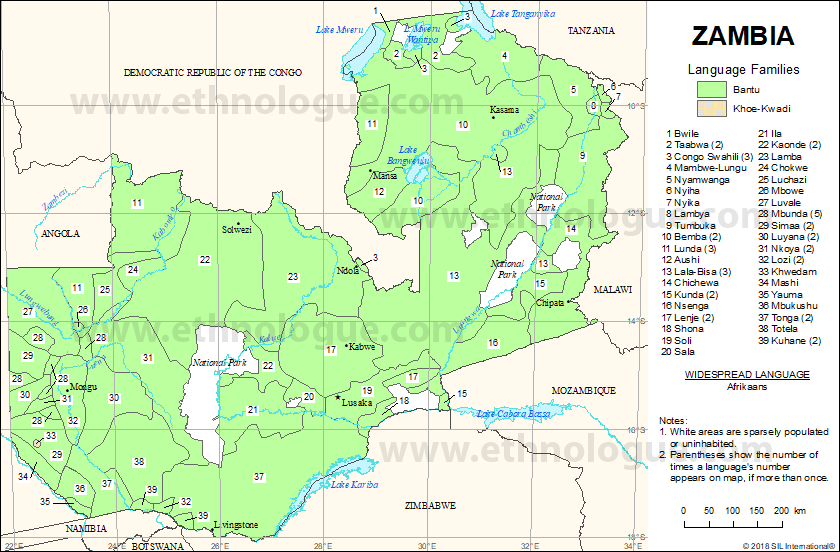
Zambia
Graphs
Language Vitality Profile
Full explanation
Language Status Profile
Full explanation
Resources
View Terms
Each Ethnologue country digest is a licensed product with restricted terms of use. Before downloading the product, you must agree to the following terms:
- This is a license for individual use. Just as with a conventionally published book, it is a violation of copyright to make a copy and give it to others.
- You may not redistribute this work in any form, including ingesting the contents into a database that is shared with others or posting it on a web site (whether public or private).
To inquire about permission for reuse or redistribution, please use the Contact Us form in the footer.
Digest of the languages of Zambia ($199.95, 43 page PDF)