
aoa ISO 639
Ngola Autonyms
Angolar
Visualizations
Language Cloud
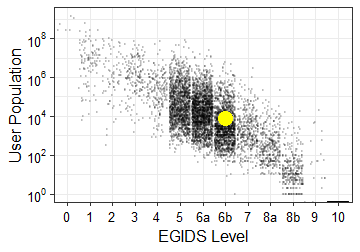
Full explanation
A language of São Tomé e Príncipe
- ISO 639
- aoa
- Autonym
- Ngola
- Population
- 7,900 (2019 D. Eberhard), based on survey of Angolar communities in Caué and Lembá districts. Ethnic population: 12,000 (2019 D. Eberhard), based on extrapolations of 2012 census for 2019, plus estimates from community leaders for each district.
- Location
- São Tomé province: most spoken in Caué district, in particular São João dos Angolares. Also spoken in Santa Catarina, Lembá district (2020 M. Bouchard).
- Language Maps
- Equatorial Guinea, Gabon and São Tomé e Príncipe, Sao Tome & Principe
- Language Status
- 6b (Threatened).
- Classification
- Creole, Portuguese based
- Dialects
- None known. Substratum largely Kwa [kwb] and Western Bantu; quite distinct from creoles of Guinea-Bissau, Senegal, Gambia, and Cape Verde. The 33% of the Angolar lexicon not shared with Sãotomense [cri] is largely of Bantu origin, apparently Kimbundu [kmb] of Angola, with some from Koongo [kng] and Bini [bin]. Angolar speakers tend to understand much of Sãotomense, but the opposite does not hold. The version of Angolar spoken in Santa Catarina has more influence from Sãotomense than the version spoken in Caué district (2019 D. Eberhard). Lexical similarity: 70% with São Tomense [cri], 67% with Principense [pre], 53% with Fa d’Ambu [fab].
- Language Use
- Some Angolar youth and young adults have learned Angolar as L2. Increasing language shift to Portuguese [por], particularly among those who migrate to the capital (2019 D. Eberhard). Home, traditional economy, music. Some of all ages. All also use Portuguese [por]. Many also use Sãotomense [cri]. Used as L2 by Sãotomense [cri].
- Language Development
- Literacy rate in L2: 40% in Portuguese [por]. Dictionary. Grammar.
- Writing
- Latin script [Latn], unified alphabet (ALUSTP) developed for use by all native languages of São Tomé e Principe officially recognized by government in 2010 (2020 M. Bouchard). Writing only used for unpublished church music. No published literature (2019 D. Eberhard).
- Other Comments
- Distinct ethnolinguistic group from the Forros, the emancipated. Mixed marriages with Forro or Kabuverdianos are common (2019 D. Eberhard). Christian.
- Language Resources
- OLAC resources in and about Angolar