
ase ISO 639
American Sign Language
Visualizations
Language Cloud
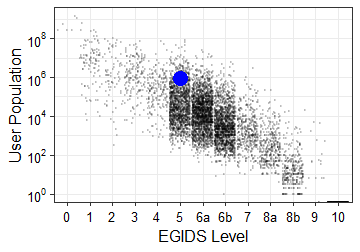
Full explanation
A language of United States
- ISO 639
- ase
- Alternate Names
- #A-S-L, ASL, Ameslan, SIGN AMERICA
- Population
- 408,000 in United States, all users. L1 users: 277,000 in United States (Mitchell et al 2006). Mitchell et al 2006 estimate no more than 277,000 in 1972 who were prevocationally deaf; more recent figures unavailable but an estimate based on 0.1% of total population for 2019 would be 325,000. L2 users: 131,000 (Mitchell et al 2006). Total users in all countries: 860,605 (as L1: 729,605; as L2: 131,000).
- Location
- Scattered, especially in urban centers and near (present or former) residential deaf schools.
- Language Maps
- Sign Languages of Africa, Sign Languages of Asia, Sign Languages of the Americas, Sign Languages of the Pacific
- Language Status
- 5 (Developing). Provincially recognized language in various states, state laws cover a variety of issues: approving ASL for college credit, regulating interpreter services, deaf children’s education, etc. Recognized language (1990, Americans with Disabilities Act, ADA), requires governments, nonprofit organizations and private businesses to make their services accessible to deaf people, and mandates equal access to telecommunications services.
- Classification
- Sign language, Deaf community sign language
- Dialects
- Black American Sign Language (BASL, Black ASL), Tactile American Sign Language (TASL, Tactile ASL). Some lexical variation across the United States and Canada (except Quebec), but intelligibility is high among all varieties called ASL. Black American Sign Language, which developed among African-American children in segregated schools in the southern United States, contains some distinctive vocabulary, grammatical structure, and phonological properties (McCaskill et al 2020). Tactile ASL (TASL) is used throughout the United States by and with deaf-blind people, especially those with Usher’s Syndrome, concentrations of whom are found in Louisiana and Seattle. TASL uses ASL vocabulary and grammar, except (1) signs are perceived by holding the signer’s hands and following them around, and (2) there are modifications to compensate for lack of access to the signer’s facial expressions and other parts of the body that are not being touched. Since 2007, in Seattle and elsewhere, more substantial structural changes have occurred as a result of innovations by deaf-blind people that employ the unique characteristics of touch (Edwards 2014, Edwards and Brentari 2020), such as articulating signs on the listener’s body. This has resulted in a new variety called Protactile that is not mutually intelligible with (visual) ASL and TASL (Granda and Nuccio 2018), although as yet it does not have a separate ISO 639-3 code. Indeed, Protactile exemplifies a new modality of language: a tactile language, one structured around touch rather than sound or sight. Some deaf-blind people learn Braille for reading English. Varieties of ASL or closely-related languages derived from ASL are used in many other countries, particularly in the Caribbean and Africa; they are typically referred to either as ‘ASL’ (despite their differences) or by a name based on their country name. Some of these still use the ISO code [ase] but are different enough that they probably should acquire their own separate code. Lexical similarity: 58% between modern ASL and French Sign Language (LSF) [fsl] on a comparison of 872 signs (Woodward 1978b). Although the 2 are historically related, ASL has undergone substantial creolization (Woodward 1975, Woodward 1976).
- Typology
- One-handed fingerspelling system derived from French Sign Language [fsl]. SVO, topic comment structures; adjectives, numerals, genitives, question word initial or final, relative clause after noun head.
- Language Use
- Interpreters required for many legal and civic situations. Lingua franca of the deaf world, used widely as L2 in many countries other than those listed here. Used by all. Many also use English [eng]. Fluency in English varies widely, from native (hearing children of Deaf parents), or near-native in reading/writing (many Deaf professionals), to ability only to read individual English words. Used as L2 by Hawaii Sign Language [hps], Plains Indian Sign Language [psd].
- Language Development
- Literacy is almost always based on English rather than ASL. Deaf people’s English varies from highly literate to illiterate, but the average deaf student graduates from high school with a third or fourth grade reading level. TV. Videos. Dictionary. Grammar. Bible: 2020.
- Other Comments
- American Sign Language is different from Signed English, a range of signing registers influenced by English. Signing Exact English (SEE) and Seeing Essential English (SEE2) are artificially-constructed systems that attempt to match English word order and morphemic structure exactly. Pidgin Signed English (PSE) does not follow English grammar exactly, and is sometimes referred to as ‘contact signing’. Deaf schools and interpreters in mainstreamed educational settings may use any of these sign varieties. The alternate name ‘SIGN AMERICA’ is a representation of the signs that sign language users in other countries often use for ASL. This name is not used in English, but is a word-for-sign translation of the signed name.
Also Spoken in
- Location
- Scattered.
- Language Status
- 6a (Vigorous)
- Other Comments
- Non-indigenous. View other languages of Barbados
Language Name
American Sign Language
User Population
290 in Barbados (2011 J. Parks and L. Parks). Approximately 0.1% of the total population.
- Location
- Scattered.
- Language Status
- 6a (Vigorous)
- Other Comments
- Non-indigenous. Survey needed to determine how similar or different the sign language in Burkina Faso is to standard ASL and to signing in other Francophone African countries. View other languages of Burkina Faso
Language Name
American Sign Language
User Population
102,000 in Burkina Faso (2021 DBS/DOOR/SIL). Estimated 60,000–120,000, based on 0.3%–0.6% of the total population.
- Location
- Scattered.
- Language Status
- 6a (Vigorous)
- Other Comments
- Non-indigenous. Although many people say they use ASL in Benin, they generally do not understand nor sign standard ASL from the United States. However, the sign language in Benin has not been separately recognized by ISO 639-3. View other languages of Benin
Language Name
American Sign Language
User Population
12,500 in Benin (2008 WFD). Approximately 0.1% of the total population.
- Location
- Scattered.
- Language Status
- 6a (Vigorous)
- Other Comments
- Non-indigenous. View other languages of Bermuda
Language Name
American Sign Language
User Population
65 in Bermuda (2021 SIL). Estimated, based on 0.1% of total population.
- Location
- Scattered.
- Language Status
- 6a (Vigorous)
- Other Comments
- Non-indigenous. View other languages of Bahamas
Language Name
American Sign Language
User Population
400 in Bahamas (2021 SIL). Estimated, based on 0.1% of the total population.
- Language Status
- Unestablished
- Other Comments
- Non-indigenous. View other languages of Belize
Language Name
American Sign Language
User Population
3,000 in Belize (2011 L. Parks). Estimated population 3,000 (2011 L. Parks), approximately 0.7% of the total population. Another estimate, assuming 0.2%–0.4%: 800–1,600 (2021 DBS/DOOR/SIL).
- Location
- Scattered. English-speaking areas of Canada.
- Language Status
- 5 (Developing)
- Language Use
- Sign language interpreters required for deaf in court. Used for deaf college students, important public functions, job training, social service programs. Sign language instruction for parents of deaf children, classes for hearing people, organization for sign language teachers, committee on national sign language. Used by all. Used as L2 by Inuit Sign Language [iks], Maritime Sign Language [nsr], Plains Indian Sign Language [psd], Quebec Sign Language [fcs].
- Other Comments
- Non-indigenous. View other languages of Canada
Language Name
American Sign Language
User Population
38,000 in Canada (2021 DBS/DOOR/SIL). Estimated based on 0.1% of the total population. Other estimates vary widely: 3,660 (2011 census), 357,000 (2015 Canadian Association of the Deaf).
- Location
- Scattered.
- Language Status
- 6a (Vigorous)
- Other Comments
- Non-indigenous. Survey needed to determine how similar or different the sign language in Central African Republic is to standard ASL and to signing in other Francophone African countries. View other languages of Central African Republic
Language Name
American Sign Language
User Population
24,000 in Central African Republic (2021 DBS/DOOR/SIL). Estimated 14,000–28,000, based on 0.3%–0.6% of the total population.
- Location
- Scattered.
- Language Status
- 5 (Developing)
- Language Use
- Used by all.
- Other Comments
- Non-indigenous. Some early influence in the 1970s from French Sign Language [fsl], but now predominately consists of signs from ASL together with local signs, plus influence from French [fra] on the grammar in some contexts (1997 S. Dalle). Degree of difference from standard ASL and from ASL (or languages derived from ASL) in other African countries has not been determined. View other languages of Congo
Language Name
American Sign Language
User Population
27,000 in Congo (2021 DBS/DOOR/SIL). Estimated 16,000–32,000, based on 0.3%–0.6% of total population.
- Location
- Scattered.
- Language Status
- 5 (Developing)
- Language Use
- Used by all.
- Other Comments
- Non-indigenous. As of 2015, LSAF is not officially recognized as a distinct language and would be considered a dialect of ASL, with influence from spoken and written French [fra] and local signs. The relationship of signing in Côte d’Ivoire to standard ASL in the United States and to LSAF in other francophone African countries has not been assessed. Further, there is significant variation within the country, again not systematically assessed, and a variety of names used. Some people regard these names as referring to distinct languages, others as dialects of the same language. Some deaf know more than one variety. There is also a local variety in the village of Bouakako, Hiré in southwestern Côte d’Ivoire. (2013 A. Tano). View other languages of Côte d’Ivoire
Language Name
American Sign Language
User Population
130,000 in Côte d’Ivoire (2021 DBS/DOOR/SIL). Estimated 77,000–155,000, based on 0.3%–0.6% of the total population.
- Location
- Scattered.
- Language Status
- 6a (Vigorous)
- Language Use
- One deaf school, with some use of sign language (2010 S. Houge).
- Other Comments
- Non-indigenous. Although developing out of Francophone ASL, Gabonese Sign Language has diverged enough that it is possibly a separate language. Deaf school founded in Libreville in early 1980s as outgrowth of work by American educator Andrew Foster (2010 S. Houge). Some influence from French Sign Language [fsl]. View other languages of Gabon
Language Name
American Sign Language
User Population
7,000 in Gabon (2021 DBS/DOOR/SIL). Approximately 0.3% of the total population. Another estimate: 2,000 (2008 WFD), approximately 0.1%.
- Location
- Scattered.
- Language Status
- 6a (Vigorous)
- Language Use
- Some also use English [eng], but most deaf people do not read English or communicate orally at a high level.
- Language Development
- Generally mainstreamed into hearing schools without interpreters, few do well enough to enter secondary school, and fewer to finish, for lack of support.
- Other Comments
- Non-indigenous. Christian. View other languages of Grenada
Language Name
American Sign Language
User Population
340 in Grenada (2021 DBS/DOOR/SIL). Estimated 225–450 deaf signers, approximately 0.2%–0.4% of the total population.
- Location
- Scattered.
- Dialects
- None known. Some differences from ASL in the United States, but there has been no careful assessment of how much difference. An indigenous variety, known as Chamoru or Guåhan Sign Language, is also reportedly used by older signers, but is being displaced by ASL.
- Language Status
- 5 (Developing)
- Language Use
- All domains, except schools often use signed English. Used by all. Many also use English [eng].
- Language Development
- Total communication and mainstream education.
- Other Comments
- Non-indigenous. Certificate in sign language interpreting offered at Guam Community College. View other languages of Guam
Language Name
American Sign Language
User Population
150 in Guam (2017 S. Kohn). Specifically, ‘45 kids and 100-plus adults who are deaf and hard of hearing’, or about 0.1% of the general population.
- Location
- Scattered.
- Language Status
- 6a (Vigorous)
- Language Use
- In three special education schools in Guyana, basic American Sign Language was introduced in the 1990s. Each school has continued its use creating their own adaptations (2010 L. Hallahan and M. Hallahan, International Disability Network 2004). Frequent code-mixing between ASL and a variety of signing that could be called Guyanese Sign Language, but which hasn’t been adequately described.
- Other Comments
- Non-indigenous. View other languages of Guyana
Language Name
American Sign Language
User Population
2,000 in Guyana (2021 DBS/DOOR/SIL). Estimated 1,500–3,000 deaf signers, assuming 0.2%–0.4% of the total population.
- Location
- Scattered.
- Language Status
- 6a (Vigorous)
- Language Use
- Used by all.
- Other Comments
- Non-indigenous. The sign language commonly used by the deaf community in Haiti is currently reported as a dialect of ASL, but many regard it as a separate language, as there are significant lexical and grammatical differences and challenges to mutual intelligibility. ASL tends to be used in schools and with foreigners, which has hidden the separate existence of LSH from outsiders (Hochgesang and McAuliff 2016). View other languages of Haiti
Language Name
American Sign Language
User Population
40,000 in Haiti (2008 WFD). Approximately 0.4% of the total population.
- Location
- Scattered.
- Language Status
- 5 (Developing)
- Language Use
- Vigorous. Used by all.
- Language Development
- Deaf school in St. Kitts (2010 Global Deaf Connection).
- Other Comments
- Non-indigenous. Relatively little information available. Use of ASL in the country is inferred, without direct evidence (Parks and Williams 2011). View other languages of Saint Kitts and Nevis
Language Name
American Sign Language
User Population
40 in Saint Kitts and Nevis (Parks and Williams 2011). Estimated 40–100 in 2011 (0.1%–0.2% of the total population), based in part on estimates dating back to 2004.
- Location
- Scattered.
- Language Status
- 5 (Developing)
- Language Use
- Some also use English [eng].
- Other Comments
- Non-indigenous. There were reports of an indigenous sign language, similar to Providence Island (Washabaugh 1986). However, by the 1980s, children were being educated in ASL. Classes in ASL for families with deaf children (Parks and Williams 2011). View other languages of Cayman Islands
Language Name
American Sign Language
User Population
65 in Cayman Islands (2021 DBS/DOOR/SIL). Estimated assuming 0.1% of total population. Another estimate: 50–200 (Parks and Williams 2011).
- Location
- Scattered.
- Language Status
- 5 (Developing)
- Other Comments
- Non-indigenous. A rubella epidemic in the 1980s greatly increased that generation’s deaf population (Parks and Williams 2011). View other languages of Saint Lucia
Language Name
American Sign Language
User Population
200 in Saint Lucia (Parks and Williams 2011). Estimated 160–300 deaf signers (Parks and Williams 2011), 0.1%–0.2% of the total population.
- Location
- Scattered.
- Language Status
- 5 (Developing)
- Language Use
- Used by all. Used as L2 by Filipino Sign Language [psp].
- Other Comments
- Non-indigenous. Filipino Sign Language [psp] and ASL are very similar but generally regarded by deaf people in the Philippines as distinct languages. Both are in use as a normal means of communication, with a lot of bilingualism. Different deaf schools prefer different languages. View other languages of Philippines
Language Name
American Sign Language
- Location
- Scattered, mostly in and around San Salvador.
- Dialects
- None known. ASL users in El Salvador have considerable difficulty understanding ASL from the United States (Ciupek-Reed 2012), so it probably should be regarded as a separate language from standard ASL. Salvadoran ASL includes signs from Salvadoran Sign Language (LESSA) [esn], and reflects Spanish influence in initialized signs and grammar. It is perhaps better described as Signed Spanish based on ASL vocabulary (Ciupek-Reed 2012).
- Language Status
- 6b (Threatened)
- Language Use
- Previously used in one private educational institution and by their graduates (Ciupek-Reed 2012); that school has now closed. Its graduates generally learned LESSA upon graduation for interaction with the wider deaf community. Used mostly only by adults who attended the school (2020 S. Shannon). Also use Salvadoran Sign Language [esn]. Used as L2 by Salvadoran Sign Language [esn].
- Other Comments
- Non-indigenous. View other languages of El Salvador
Language Name
American Sign Language
- Location
- Scattered.
- Language Status
- 6a (Vigorous)
- Other Comments
- Non-indigenous. Although many people say they use ASL in Togo, they generally do not understand nor sign standard ASL from the United States. However, the sign language in Togo has not been separately recognized by ISO 639-3. View other languages of Togo
Language Name
American Sign Language
User Population
40,000 in Togo (2021 DBS/DOOR/SIL). Estimated 24,000–48,000 deaf signers, based on 0.3%–0.6% of the total population.
- Location
- Scattered.
- Language Status
- 5 (Developing)
- Language Use
- Very few deaf people over 40 use sign language. Used by all.
- Language Development
- 3 special needs schools accept deaf students, using both oral and signing methods. Little education offered them beyond that.
- Other Comments
- Non-indigenous. Christian. View other languages of Saint Vincent and the Grenadines
Language Name
American Sign Language
User Population
100 in Saint Vincent and the Grenadines (2008 J. Parks). Estimated 100 deaf signers (half of those with significant deafness), about 0.1% of the total population (2008 J. Parks).
- Location
- Scattered.
- Dialects
- None known. Signed English in St. Thomas; ASL in St. Croix (Parks and Williams 2011).
- Language Status
- 5 (Developing)
- Language Use
- Vigorous. Used by all.
- Language Development
- There is a self-contained deaf classroom on both St. Croix and St. Thomas (Parks and Williams 2011).
- Other Comments
- Non-indigenous. ASL classes at university. Some elementary and secondary deaf students mainstreamed in private schools with special accommodations. The Americans with Disabilities Act applies to this United States territory, hence interpreters required for any governmental activity. Qualified interpreters exist but often are not readily available. Closed captioning and telecommunication relay available in some places. Annual ASL deaf camp in St. Thomas. Interaction with deaf community in the United States (Parks and Williams 2011). View other languages of U.S. Virgin Islands
Language Name
American Sign Language
User Population
110 in U.S. Virgin Islands (Parks and Williams 2011). Approximately 0.1% of total population.
- Location
- Scattered.
- Language Status
- 5 (Developing)
- Language Use
- Used in education. Used by all. Also use Malian Sign Language [bog]. Used as L2 by Malian Sign Language [bog].
- Language Development
- Agency: L’Association Malienne des Sourds.
- Other Comments
- Non-indigenous. Since LSAF is not recognized by ISO 639-3 as a distinct language, it must be treated here as a dialect of ASL, with influence from spoken and written French [fra] (initialization of signs and mouthing) and addition of local signs. The relationship of ASL and LSAF in Mali to standard ASL in the United States and to LSAF in other francophone African countries has not been systematically assessed (Nyst 2015). The name ‘Malian Sign Language’ is used both for this variety, influenced strongly by ASL and here called LSAF, and for a more traditional and indigenous variety centered in Bamako, sometimes called Bamako Sign Language [bog]. View other languages of Mali
Language Name
Langue des signes de l’Afrique francophone
User Population
25,000 in Mali (2021 DBS/DOOR/SIL). Estimated 40,000–65,000 people with profound hearing loss in Mali (Nyst 2015), of which approximately half are assumed here to use LSAF [ase].