
bam ISO 639
Bamanankan Autonyms
Bamanankan
Visualizations
Language Cloud
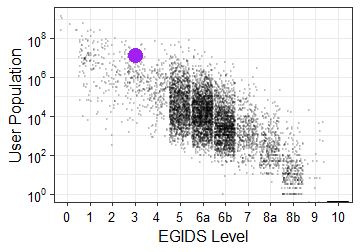
Full explanation
A language of Mali
- ISO 639
- bam
- Alternate Names
- Bamanakan, Bambara
- Autonym
- Bamanankan
- Population
- 14,000,000 in Mali, all users. L1 users: 4,000,000 in Mali (2012 V. Vydrin), increasing. 75,000 Ganadugu (Vanderaa 1991), 164,000 Wasulu (2009 census). L2 users: 10,000,000 (2012 V. Vydrine). Total users in all countries: 14,187,540 (as L1: 4,187,540; as L2: 10,000,000).
- Location
- Bamako, Kayes, Koulikoro, and Ségou regions; Sikasso region: north, middle Niger river watershed.
- Language Maps
- Central Mali, Central Mali: Enlarged area, Côte d’Ivoire, Southern Mali, Western Mali
- Language Status
- 3 (Wider communication). Recognized language (1982, Decree No. 159 of 19 July, Article 1). Bamanankan serves as lingua franca everywhere, except for the northeastern part of the country. Bamanankan is the form of Jula [dyu] recognized by the Malian government. Used for travel, market, and business communication.
- Classification
- Niger-Congo, Mande, Western, Central-Southwestern, Central, Manding-Jogo, Manding-Vai, Manding-Mokole, Manding, Manding-East, Northeastern Manding, Bamana
- Dialects
- Standard Bambara, Somono (Kombye), Segou, San, Beledugu, Ganadugu, Sikasso, Wasulunkakan (Maninkakan, Eastern, Wassulu, Wassulunka, Wassulunke, Wasulu, Wasuu). Many local dialects. The main division is standard Bambara, influenced heavily by Eastern Maninkakan [emk], and rural dialects. Bamanankan dialects are spoken in varying degrees by 80% of the Mali population. In Mali, Wasulunkakan is shared by both Bamanankan and Eastern Maninkakan, but in Guinea it is only a dialect of Eastern Maninkakan.
- Typology
- SOV; postpositions; passives; tense; causatives; 21 consonant and 14 vowel phonemes; tonal (2 tones: high, low).
- Language Use
- Growing. All domains. Used by all. Positive attitudes. Used as L2 by Bankagooma [bxw], Bunoge Dogon [dgb], Duungooma [dux], Jenaama Bozo [bze], Jowulu [jow], Kagoro [xkg], Kelengaxo Bozo [bzx], Konabéré [bbo], Koyra Chiini Songhay [khq], Koyraboro Senni Songhay [ses], Maasina Fulfulde [ffm], Malian Sign Language [bog], Mamara Sénoufo [myk], Pana [pnq], Soninke [snk], Supyire Sénoufo [spp], Syenara Sénoufo [shz], Tieyaxo Bozo [boz].
- Language Development
- Literacy rate in L1: 15%. Taught in many adult and youth literacy classes (2021 SIL). Taught in some primary schools in early grades only. Bambara is most widely used and best developed program (2021 SIL). Literature. Newspapers. Radio. TV. Videos. Dictionary. Grammar. Texts. Bible: 1961–1987.
- Writing
- Latin script [Latn]. N’Ko script [Nkoo], used in Mali.
- Other Comments
- Wasulu are former Fulbe. Muslim, traditional religion.
- Language Resources
- OLAC resources in and about Bamanankan
Also Spoken in
- Language Status
- Unestablished
- Other Comments
- Non-indigenous. View other languages of Niger
Language Name
Bamanankan
User Population
54,200 in Niger (2021).
- Location
- Denguélé district: center and northeast; Savanes district: Tingréla department, Ségélon subprefecture; Malian diaspora in all major cities.
- Language Status
- 3 (Wider communication)
- Other Comments
- Muslim. View other languages of Côte d’Ivoire
Language Name
Bambara
User Population
5,500 in Côte d’Ivoire (1993 SIL).
- Language Status
- Unestablished
- Language Use
- Also use English [eng], as the language of education and government (Biel 2014). Also use Gambian Wolof [wof], as the language of commerce and media (Biel 2014). Also use Mandinka [mnk], as the secondary LWC for commerce and media (Biel 2014).
- Other Comments
- Non-indigenous. View other languages of Gambia
Language Name
Bambara
User Population
20,500 in Gambia (2016).
- Language Status
- Unestablished
- Language Use
- All also use French [fra], as the language of education, media and government. Most also use Hassaniyya [mey], as the language of commerce and interethnic communication. Many also use Standard Arabic [arb], as the language of government, media, and religion (Ould Ahmed 2012).
- Other Comments
- Non-indigenous. View other languages of Mauritania
Language Name
Bambara
User Population
21,100 in Mauritania (2017).
- Location
- Tambacounda region: near Mali border.
- Language Status
- 5 (Dispersed)
- Language Use
- Many also use Wolof [wol], as the language of commerce and interethnic communication. Some also use French [fra], as the language of education and government. Used as L2 by Soninke [snk].
- Other Comments
- Non-indigenous. View other languages of Senegal
Language Name
Bambara
User Population
84,700 in Senegal (2017).