
bca ISO 639
白语 (Baip‧ngvp‧zix) Autonyms
Bai, Central
Visualizations
Language Cloud
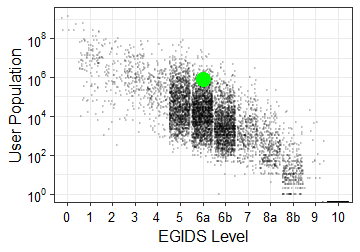
Full explanation
A language of China
- ISO 639
- bca
- Alternate Names
- Báiyǔ, Labbu, Minchia, Minjia, Minkia, Nama, Pai, Yunnan Bai
- Autonym
- 白语 (Baip‧ngvp‧zix)
- Population
- 800,000 (2003 census). Ethnic population: 1,930,000 (2010 census). Includes Lama Bai [lay], Panyi Bai [bfc], and Southern Bai [bfs] languages.
- Location
- Guizhou province: small enclave; Yunnan province: Eryuan, Heqing, Jianchuan, Lanping, and Yunlong.
- Language Maps
- Southwestern China
- Language Status
- 6a (Vigorous). Language of recognized nationality: Bai.
- Classification
- Sino-Tibetan, Tibeto-Burman, Northeastern Tibeto-Burman, Bai
- Dialects
- Jianchuan, Heqing, Lanping, Eryuan, Yunlong.
- Typology
- SVO; prepositions; attributives precede noun heads; number classifier constructions follow noun heads; aspect words; tense-lax vowel distinction; 21 consonants and 8 vowels; tonal (5 to 8 tones).
- Language Use
- Vigorous. All domains. Used by all. Positive attitudes. Some also use Mandarin Chinese [cmn]. A few also use Anong [nun]. A few also use Lisu [lis]. A few also use Naxi [nxq]. Used as L2 by Lisu [lis], Naxi [nxq], Northern Pumi [pmi], Southern Pumi [pmj], Zaiwa [atb], Zauzou [zal].
- Language Development
- Literacy rate in L2: 70%. 1 experimental program. Literature. Radio. Dictionary. Grammar. Texts.
- Writing
- Han (Hanzi, Kanji, Hanja) script [Hani], dating from 9th century, limited use in folk songs and ritual texts, favoured by older people. Latin script [Latn], pinyin-based, used since 1982, revised in 1993, experimental, small-scale use in education, administration, and literature.
- Other Comments
- Classification difficult due to heavy borrowing (60%–70%) from Chinese. Considered genetically related to Chinese, or a mixed language with Chinese, or an independent branch of Tibeto-Burman. Traditional religion, Buddhist, Daoist.
- Language Resources
- OLAC resources in and about Bai, Central