
bda ISO 639
Bayot
Visualizations
Language Cloud
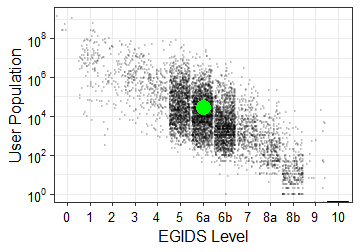
Full explanation
A language of Senegal
- ISO 639
- bda
- Alternate Names
- Baiot, Baiote, Bayoot, Bayotte, Jola Bayote
- Population
- 24,200 in Senegal (2020). Total users in all countries: 33,200.
- Location
- Ziguinchor region: villages in Nyassia commune; majority in urban areas and in the larger cities, including Dakar.
- Language Maps
- Guinea and Guinea-Bissau, Guinea-Bissau, Senegal and The Gambia
- Language Status
- 6b (Threatened). Recognized language (2011, Codification).
- Classification
- Niger-Congo, Atlantic-Congo, Atlantic, Northern, Bak, Jola, Bayot
- Dialects
- Essin (Kuhiŋe), Kugere. Minor differences between the main dialects in pronunciation and grammar. Phonology and vocabulary in Senegal are considerably different from the Bayot dialect(s) in Guinea-Bissau. Lexical similarity: 87% between the 2 dialects (Carlton and Rand 1993); 15%–18% with other Jola varieties (most similar), similarity mostly because of borrowings (Segerer 2010).
- Language Use
- L1 by all generations in the Nyassia municipality. Adults who have moved away speak it when possible but their children tend to speak Wolof [wol]. Close contact with the Nyassia area (2021 SIL). Some young people, all adults. Positive attitudes. Many also use Jola-Fonyi [dyo], mostly adults who live in the Nyassia area. Many also use Wolof [wol], mostly the younger generation and also those who have moved away from the language area. Also use French [fra], used by educated people in official and public situations. Also use Guinea-Bissau Creole [pov].
- Language Development
- Beginning literacy classes. Radio. Grammar. Bible portions: 2013.
- Writing
- Latin script [Latn].
- Other Comments
- Traditional religion, Christian.
- Language Resources
- OLAC resources in and about Bayot
Also Spoken in
- Location
- Cacheu region: São Domingos area, Arrame village, on Senegal border.
- Dialects
- Kúsikinay (Aramé, Kuhoole), Gudamlé, Guledjé, Gubalé, Guehagelé.
- Language Status
- 6b (Threatened)
- Language Use
- Home, friends, work, religion. Some young people, all adults. Language loss occurring among children of younger families whose parents migrated to the capital Bissau for further education. Positive attitudes. Most also use Guinea-Bissau Creole [pov], as the language of interethnic unity, communication, and commerce. Most also use Jola-Felupe [eja]. Some also use Portuguese [por], as the language of education and communication with foreigners.
- Language Development
- Beginning literacy classes with adults and children.
- Other Comments
- Bayot in Guinea-Bissau is different (about 70% the same) from the variety in Senegal. One dialect in Kasu and Arrame villages; the other in Elia, Kulaje, Ijobel, and Nambalan villages. Traditional religion, Christian. View other languages of Guinea-Bissau
Language Name
Jola Bayote
User Population
9,000 in Guinea-Bissau (2022 SIL). Ethnic population: 10,000 (2022 SIL).