
cri ISO 639
Sãotomense Autonyms
Sãotomense
Visualizations
Language Cloud
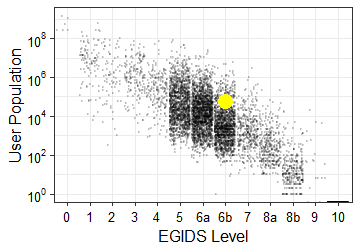
Full explanation
A language of São Tomé e Príncipe
- ISO 639
- cri
- Alternate Names
- Dialeto, Forro, Fôlô, Lungwa santome, Santomense, Santomé, São Tomense
- Autonym
- Sãotomense
- Population
- 45,000 in São Tomé e Príncipe (2019 D. Eberhard). Based on extrapolations of 2012 census for 2019, plus adjustments made by Ministry of Culture. Ethnic population: Current estimates of ethnic population unreliable due to high rate of mixed marriages and increased shift to a national identity. Traditonally, the language community (the Forro) considered the largest ethnicity in the country with a size at least 10 times that of the Angolar community (2020 M. Bouchard). Total users in all countries: 55,600.
- Location
- North side of São Tomé island, spoken mostly in the districts of Agua Grande, Cantagalo, Lobata, and Me-Zóxi.
- Language Maps
- Equatorial Guinea, Gabon and São Tomé e Príncipe, Sao Tome & Principe
- Language Status
- 7 (Shifting). De facto language of provincial identity in São Tomé Island except south tip.
- Classification
- Creole, Portuguese based
- Dialects
- None known. Substratum largely Kwa [kwb] and Western Bantu languages; quite distinct from the creoles of Guinea-Bissau, Senegal, Gambia, and Cape Verde. Lexical similarity: 77% with Principense [pre], 62% with Fa d’Ambu [fab] (Annobonese), 70% with Angolar [aoa].
- Language Use
- Language of national identity, although most commonly used by fishermen, fish-sellers, and agriculturalists. Also used for greetings and music by majority of population (2020 M. Bouchard). Adults only. Used as L1 by many over 50. Latent acquisition among many older youth and young adults for identity purposes, or by some young adults for use in traditional occupations (2019 D. Eberhard). All shifting to Portuguese [por]. Some also use Angolar [aoa]. Used as L2 by Angolar [aoa], Kabuverdianu [kea], Principense [pre].
- Language Development
- Literacy rate in L2: 50% in Portuguese [por]. Dictionary.
- Writing
- Latin script [Latn], unified alphabet (ALUSTP) for Sãotomense and all native languages of São Tomé recognized by government in 2010 (2020 M. Bouchard). Incipient use of Sãotomense writing in advertisements and unpublished church music. No published literature. Emerging use in private messaging (2019 D. Eberhard).
- Other Comments
- Speakers known as Forros. 90% of lexicon of Portuguese [por] origin. Mixed marriages with Angolares and with Kabuverdianos common. Christian.
- Language Resources
- OLAC resources in and about Sãotomense
Also Spoken in
- Language Status
- 6b (Threatened)
- Language Use
- All also use Portuguese [por], as the language of education, government, business, and upward mobility.
- Other Comments
- Non-indigenous. View other languages of Portugal
Language Name
Sãotomense
User Population
10,600 in Portugal (2007 J. Leclerc).