
esn ISO 639
Salvadoran Sign Language
Visualizations
Language Cloud
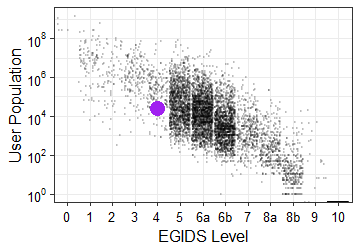
Full explanation
A language of El Salvador
- ISO 639
- esn
- Alternate Names
- El Salvadoran Sign Language, LESA, LESSA, Lengua de señas salvadoreñas
- Population
- 26,000 (2020 H. Harm). Estimated 26,000, or approximately 0.4% of the overall population (2020 H. Harm). Other estimates: 50%–75% of the total deaf signers use LESSA (Ciupek-Reed 2012).
- Location
- Scattered.
- Language Maps
- Sign Languages of the Americas
- Language Status
- 4 (Educational). Recognized language (2005, Acuerdo Nº 16-0132, August 12, 2005; Ley General de Educación, Art. 15-A (as amended 2014)).
- Classification
- Sign language, Deaf community sign language
- Typology
- One-handed fingerspelling system similar to ASL. An older, two-handed system fingerspelling system is used by elderly deaf.
- Language Use
- LESSA is in use in families with generational deafness, in public deaf education, within deaf associations, at churches with interpreted services, for distributing information on the internet, and for official interpretation for the government of El Salvador. The growth and spread of deaf education using LESSA suggests that the percentage of LESSA users will increase. Multigenerational deaf families all use LESSA (Ciupek-Reed 2012). Five active interpreters (2008 WFD). Some also use American Sign Language [ase], especially in the western region. A few also use Costa Rican Sign Language [csr], in the eastern region, mixed with LESSA. Also use Spanish [spa], with positive attitude toward developing Spanish reading and writing skills (Ciupek-Reed 2012). Used as L2 by American Sign Language [ase], Costa Rican Sign Language [csr].
- Language Development
- Literacy in written Spanish is increasing. Dictionary. Texts. Agencies: Asociación Salvadoreña de Sordos (ASS); Asociación pro Desarrollo Integral de la Comunidad Sorda Salvadoreña (ASDICSSA); Fundación Pro Educación de El Salvador (FUNPRES); Fundación para el Desarrollo Integral de la Persona Sorda (FUDIPES).
- Other Comments
- Some deaf people use a variety of signing which is based on ASL with strong Spanish influence. Although they call it ‘ASL’ (see separate entry for ASL [ase] in El Salvador), they cannot understand ASL from the United States (Ciupek-Reed 2012). Christian.