
eth ISO 639
Ethiopian Sign Language
Visualizations
Language Cloud
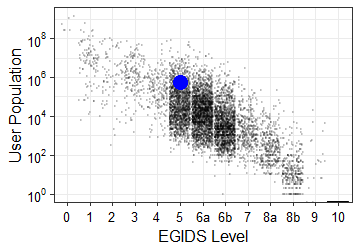
Full explanation
A language of Ethiopia
- ISO 639
- eth
- Alternate Names
- EthSL
- Population
- 560,000 (2021 DBS/DOOR/SIL). Estimated 340,000–680,000 deaf signers, assuming 0.3%–0.6% of the total population. Other estimates: 250,000 as reported by the government (2008 WFD); 1,000,000 (2005 Ethiopian National Association of the Deaf); over 1 million (Tamene 2016:307).
- Location
- Scattered.
- Language Maps
- Sign Languages of Africa
- Language Status
- 5 (Developing).
- Classification
- Sign language, Deaf community sign language
- Dialects
- Addis Ababa, Hosanna. Hosanna (Hosaena) School for the Deaf uses more indigenous signs than Addis Ababa, which has more influence from Amharic [amh]. Influence from Amharic [amh] in grammar and lexicon. Commonly believed to be influenced by ASL [ase] due to historical contact (Tamene 2016). About 25% lexical similarity with ASL (2005 J. Netzley). Possible lexical influence from European sign languages, due to presence of foreign advisors.
- Typology
- One-handed fingerspelling representing the Amharic syllabary, with handshapes representing consonants and movements representing vowels (Tamene 2016).
- Language Use
- Vigorous. Used in mass media. Used by all. Many also use Amharic [amh] (Tamene 2016). Some also use English [eng] (Tamene 2016). A few also use Dorze [doz] (Tamene 2016). A few also use Gamo [gmv] (Tamene 2016).
- Language Development
- Taught in primary and secondary schools. Most deaf students learn both the Ethiopian Manual Alphabet (based on the Amharic syllabry) and ASL fingerspelling (Tamene 2016). Addis Ababa University offers a BA in Ethiopian Sign Language and Deaf Culture, for training interpreters, linguists and deaf teachers in primary and secondary schools. TV. Dictionary. Bible portions: 2011–2014. Agency: Ethiopian National Association of the Deaf (ENAD).
- Other Comments
- Hosanna, south of Addis Ababa, is the site of the first boarding school for the deaf, and continues to be an important center. Other schools in Addis Ababa, Harar and Nekemt. Urban use centered in Addis Ababa.