
evn ISO 639
Evenki
Visualizations
Language Cloud
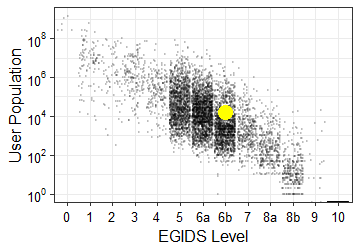
Full explanation
A language of China
- ISO 639
- evn
- Alternate Names
- Ewenk, Ewenke, Ewenki, Khamnigan, Owenke, Solon, Solong, Sulong, Suolun
- Population
- 11,000 in China (Salminen 2007). Ethnic population: 30,900 (2010 census). Total users in all countries: 15,800.
- Location
- Heilongjiang province: Nale prefecture; a few in Xinjiang Uyghur Autonomous Region; Nei Mongol Autonomous Region: Hulunbuir banners in Arong, Chen Bargu, Ergune East, Ewenki, Huisuomu, Moriadawa, Oronchon.
- Language Maps
- Central Russian Federation, China, Eastern Russian Federation
- Language Status
- 6b (Threatened). Language of recognized nationality: Ewenki.
- Classification
- Tungusic, Northern, Evenki
- Dialects
- Haila’er, Aoluguya (Olguya), Chenba’erhu (Old Bargu), Morigele (Mergel), Huihe (Hoy). Standard dialect is Huihe. Dialectal differences within Evenki are small and the case for regarding Evenki and Orochen as separate languages is weak (Salminen 2007).
- Language Use
- Other speakers in the area also use Evenki. All domains. Some young people, all adults. Very few children except among the Khamnigan. Positive attitudes. Also use Mandarin Chinese [cmn]. Written Chinese used as literary languages. Farmers use Chinese. Also use Daur [dta]. Also use Oroqen [orh]. Also use Peripheral Mongolian [mvf]. Written Mongolian used as literary language. Herdsmen use Mongolian as L2. Used as L2 by Daur [dta], Oroqen [orh].
- Language Development
- Literacy rate in L2: 96%, literacy in any language (2000 census, Ewenki nationality). Radio. TV. Dictionary. Grammar. Texts. Bible portions: 1995.
- Writing
- Cyrillic script [Cyrl], used since 1937, small-scale use in Russia. Latin script [Latn], used in Russia between 1931–1937, limited use in a few publications in China and on internet from 1983.
- Other Comments
- Traditional religion, Buddhist.
- Language Resources
- OLAC resources in and about Evenki
Also Spoken in
- Location
- Selenge province.
- Language Status
- 9 (Dormant)
- Language Use
- Shifted to Halh Mongolian [khk].
- Other Comments
- Non-indigenous. View other languages of Mongolia
Language Name
Evenki
User Population
No known L1 speakers in Mongolia.
- Location
- Most in Sakha (Yakutia) republic, and Krasnoyarsk krai; Amur province; Buryatia republic; Irkutsk province; Zabaykalsky krai; Pacific coast settlements, Magadan province, Chukotka autonomous district; Khabarovsk krai; Kamchatka krai; Sakhalin province.
- Dialects
- Manegir, Yerbogocen, Nakanna, Ilimpeya, Tutoncana, Podkamennaya Tunguska, Cemdalsk, Vanavara, Baykit, Poligus, Uchama, Cis-Baikalia, Sym, Tokmo-Upper Lena, Nepa, Lower Nepa Tungir, Kalar, Tokko, Aldan Timpton, Tommot, Jeltulak, Uchur, Ayan-Maya, Kur-Urmi, Tuguro-Chumikan, Sakhalin, Zeya-Bureya.
- Language Status
- 6b (Threatened)
- Language Use
- Used by half or less of ethnic group. Language maintenance higher in remote parts of Amur province and Zabaykalsky krai. Vitality decreasing, but on the taiga, strong motivation to use it. Home, community, other domains in some regions. Some young people, all adults. Positive attitudes. Also use Russia Buriat [bxr], especially in Buryatia republic. Also use Russian [rus]. Also use Yakut [sah], especially in Sakha republic.
- Language Development
- Literacy rate in L2: Nearly all.
- Other Comments
- Non-indigenous. Traditional religion, Buddhist, Christian. View other languages of Russian Federation
Language Name
Evenki
User Population
4,800 in Russian Federation (2010 census). Ethnic population: 38,400 (2010 census).