
fng ISO 639
Pidgin Bantu
Visualizations
Language Cloud
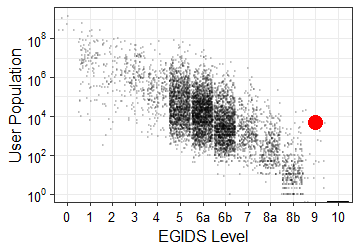
Full explanation
A language of South Africa
- ISO 639
- fng
- Alternate Names
- Basic Zulu, Fanagoloi, Isilololo, Isipiki, Lololo, Piki, Silunguboi, “Fanagalo” (pej.), “Fanakalo” (pej.), “Fanekolo” (pej.), “Isikula” (pej.)
- Population
- No known L1 speakers in South Africa. Ethnic population: No ethnic community. Total users in all countries: 5,100 (as L1: ; as L2: 5,100).
- Location
- Gauteng province: suburban Johannesburg and mining areas.
- Language Maps
- Language Status
- 9 (Second language only).
- Classification
- Pidgin, Zulu based
- Dialects
- Zambia dialect is called Cikabanga; in Zimbabwe, it is called, Chilapalapa. Influenced by Shona [sna] in Zimbabwe. About 70% of the vocabulary in Zimbabwe comes from Zulu [zul], 24% from English [eng], 6% from Afrikaans [afr]. Influenced by Bemba [bem] in Zambia. Lexical similarity: 70% with Zulu [zul], 24% with English [eng], 6% with Afrikaans [afr].
- Language Use
- Used widely in towns and gold, diamond, coal, and copper mining areas.
- Language Development
- Dictionary.
- Other Comments
- Originated in 19th century. “Fanagalo” and most or all other names are pejorative.
Also Spoken in
- Location
- Widely dispersed, towns and mining areas.
- Dialects
- Cikabanga.
- Language Status
- 9 (Second language only)
- Language Use
- Negative attitudes.
- Other Comments
- Non-indigenous. Rejected by most Africans because it was imported from Zimbabwe and South Africa by Europeans who did not want Africans to learn English (Adler 1977). View other languages of Zambia
Language Name
Pidgin Bantu
User Population
5,100 in Zambia, all users. L1 users: No known L1 speakers in Zambia. L2 users: 5,100 (2006). Ethnic population: No ethnic community.
- Location
- Mashonaland Central province; widespread in Shona speaking areas, mining camps, and urban centers.
- Dialects
- Chilapalapa.
- Language Status
- 9 (Second language only)
- Language Use
- Used widely in towns and mining areas.
- Other Comments
- Non-indigenous. View other languages of Zimbabwe
Language Name
Pidgin Bantu
User Population
No known L1 speakers in Zimbabwe. Ethnic population: No ethnic community.