
fub ISO 639
Fulfulde, ڢُلْڢُلْدٜ (Fulfulde) Autonyms
Fulfulde, Adamawa
Visualizations
Language Cloud
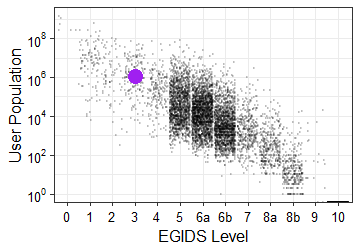
Full explanation
A language of Cameroon
- ISO 639
- fub
- Alternate Names
- Boulbe, Domona, Dzemay, Eastern Fulani, Foulfoulde, Ful, Fula, Fulata, Fulbe, Mbororo, Palata, Peul, Peulh
- Autonym
- Fulfulde, ڢُلْڢُلْدٜ (Fulfulde)
- Population
- 5,180,000 in Cameroon, all users. L1 users: 2,500,000 in Cameroon (2019). L2 users: 2,680,000 (2019). Total users in all countries: 5,685,500 (as L1: 3,005,500; as L2: 2,680,000).
- Location
- Widespead in Adamawa, Far North, and North regions.
- Language Maps
- Central Cameroon, Nigeria, Map 12, Nigeria, Map 6, Nigeria: Index map, Northern Cameroon, Southwestern Chad, Sudan
- Language Status
- 3 (Wider communication). Brought to Cameroon in 1805 via a religious war (jihad) launched by Usman Dan Fodio in northern Nigeria. Originally used as a trade language. Since the arrival of missionaries in 1885, used as a church language. Now used as LWC in 3 regions of northern Cameroon.
- Classification
- Niger-Congo, Atlantic-Congo, Atlantic, Northern, Senegambian, Fula-Wolof, Fula, Eastern
- Dialects
- Maroua, Garoua, Ngaondéré, Nomadic Fulfulde - Mbororoore, Bilkire (Bilkiri). Lexical similarity: high with Maroua, Garoua, and Ngaoundere dialects. A member of macrolanguage Fulah [ful].
- Typology
- SVO (Maroua dialect sometimes uses VSO); prepositions; noun head initial; gender (human/non-human); no articles; passives (middle, active, passive); comparatives; 26 consonant and 10 vowel phonemes; non-tonal; long vowels are stressed.
- Language Use
- Clans often only permit marriage within the same clan. Adult men will speak Adamawa Fulfulde, while women and children will speak their specific clan’s dialect. Home, neighborhood, work. Used by all. Positive attitudes. A few also use Cameroon Pidgin [wes]. A few also use English [eng]. A few also use French [fra]. A few also use Hausa [hau]. A few also use Standard Arabic [arb]. Used as L2 by Bana [bcw], Bata [bta], Buwal [bhs], Cuvok [cuv], Daba [dbq], Dama [dmm], Dii [dur], Doyayo [dow], Dugun [ndu], Dugwor [dme], Duli-Gey [duz], Duupa [dae], Gavar [gou], Gbaya-Mbodomo [gmm], Gidar [gid], Gimme [kmp], Gimnime [gmn], Giziga [giz], Gude [gde], Gvoko [ngs], Hdi [xed], Hya [hya], Jimjimen [jim], Karang [kzr], Kera [ker], Kolbila [klc], Koma [kmy], Kuo [xuo], Longto [wok], Mafa [maf], Mambai [mcs], Masana [mcn], Maslam [msv], Matal [mfh], Mazagway-Hidi [dkx], Mbudum [xmd], Mbuko [mqb], Mbum [mdd], Mefele [mfj], Merey [meq], Mina [hna], Mofu-Gudur [mif], Moloko [mlw], Mom Jango [ver], Mono [mru], Mundang [mua], Musey [mse], Musgu [mug], Muyang [muy], Ndai [gke], Ndoola [ndr], Ngambay [sba], Nizaa [sgi], North Fali [fll], North Giziga [gis], North Mofu [mfk], Northwest Gbaya [gya], Nzakambay [nzy], Nzanyi [nja], Oblo [obl], Pam [pmn], Pana [pnz], Parkwa [pbi], Pere [pfe], Pévé [lme], Pol [pmm], Psikye [kvj], Sharwa [swq], South Fali [fal], Tsuvan [tsh], Tupuri [tui], Vame [mlr], Vemgo-Mabas [vem], Wandala [mfi], Wawa [www], Wuzlam [udl], Yerwa Kanuri [knc], Zizilivakan [ziz], Zulgo-Gemzek [gnd].
- Language Development
- Literacy rate in L1: Low compared with national average. Arabic script literacy is 2–3 times greater than Roman script literacy and growing. Franco-Arabic and Anglo-Arabic schools are increasing rapidly. Taught as subject in primary schools. Literature. Newspapers. Radio. Videos. Dictionary. Grammar. Texts. Bible: 1983–2017.
- Writing
- Arabic script, Naskh variant [Arab]. Latin script [Latn].
- Other Comments
- Muslim, Christian, traditional religion.
- Language Resources
- OLAC resources in and about Fulfulde, Adamawa
Also Spoken in
- Location
- Adamawa and Taraba states: Yola area.
- Language Status
- 5 (Dispersed)
- Language Use
- Used by all. Used as L2 by Bacama [bcy], Bade [bde], Bata [bta], Dadiya [dbd], Hya [hya], Jilbe [jie].
- Language Development
- Government has a nomadic education program with materials (2013 R. Wenger).
- Other Comments
- Traditional religion, Muslim. View other languages of Nigeria
Language Name
Fulfulde, Adamawa
User Population
7,610,000 all Fulfulde in Nigeria (1991 SIL).
- Location
- Blue Nile, Gedaref, Sennar, and South Darfur states; possibly North Kordofan and South Kordofan states, scattered.
- Dialects
- Gombe.
- Language Status
- 6b (Threatened)
- Language Use
- Also use Hausa [hau]. Also use Humburi Senni Songhay [hmb]. Also use Sudanese Spoken Arabic [apd].
- Other Comments
- Non-indigenous. Migration originally from Sokoto, Adamawa, and Gombe in Nigeria, Maasina in Mali, Liptaako and Jelgooji in Burkina Faso, also the Wodaabe lineage, and from Cameroon. Influenced by Arabic. View other languages of Sudan
Language Name
Fulfulde, Adamawa
User Population
204,000 in Sudan (2017).
- Location
- Scattered, in Western Bahr al Ghazal state.
- Language Status
- 6a (Vigorous)
- Other Comments
- Non-indigenous. Migrating groups of Ambororo cattle herders. View other languages of South Sudan
Language Name
Fulfulde, Adamawa
- Location
- Mayo-Kebbi Ouest region: Lac Léré department.
- Dialects
- Maroua, Garoua, Ngaoundéré, Kambariire, Nomadic Fulfulde, Bilkire Fulani (Bilkiri).
- Language Status
- 5 (Dispersed)
- Other Comments
- Traditional religion, Muslim. View other languages of Chad
Language Name
Fulfulde, Adamawa
User Population
271,000 in Chad (2019).
- Location
- Scattered.
- Language Status
- Unestablished
- Language Use
- Many also use English [eng].
- Other Comments
- Non-indigenous. View other languages of United States
Language Name
Fulfulde, Adamawa
User Population
30,500 in United States (2015 census). Predominant Fulfulde language in the United States.