
fuv ISO 639
Fulfulde, فُلْفُلْدٜ (fulْfulْdٜ) Autonyms
Fulfulde, Nigerian
Visualizations
Language Cloud
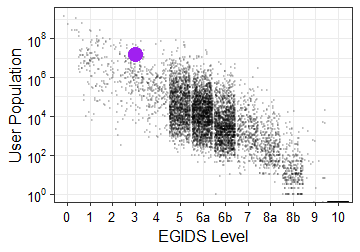
Full explanation
A language of Nigeria
- ISO 639
- fuv
- Alternate Names
- Fulɓe, Fulani, Fulatanci, Hausa States Fulfulde
- Autonym
- Fulfulde, فُلْفُلْدٜ (fulْfulْdٜ)
- Population
- 16,500,000 in Nigeria (2020), increasing. Total users in all countries: 16,585,000.
- Location
- Widespread.
- Language Maps
- Nigeria: Index map, Northern Cameroon
- Language Status
- 3 (Wider communication). The Fulani people were widely dispersed across the Sahel and West Africa, and arrived in Nigeria during the 15th century. Fulfulde became dominant across West Africa during British colonial rule in the 19th century. Used in religion, poetry, literature, education, trade, and agriculture.
- Classification
- Niger-Congo, Atlantic-Congo, Atlantic, Northern, Senegambian, Fula-Wolof, Fula, East Central
- Dialects
- Kano-Katsina, Bororo (Aku, Fulfulde Caka Nigeria, Mbororo, Nomadic Fulfulde, Woylaare), Sokoto. Intelligibility 40%–50% of Fulfulde [fub] Cameroon. Lexical similarity: highest with Central-Eastern Niger Fulfulde [fuq], then Adamawa Fulfulde [fub], then Benin-Togo Fulfulde [fue], then Western Niger Fulfulde [fuh], and Maasina Fulfulde [ffm]. A member of macrolanguage Fulah [ful].
- Language Use
- Home, some use in market. All ages, but youth increasingly want to learn English [eng]. Mixed attitudes. Though proud of their oral and written language, they now view speaking and writing English [eng] as more prestigious. Used as L2 by Bali [bcn], Bena [yun], Bille [bil], Bokobaru [bus], Bure [bvh], Deno [dbb], Dera [kna], Duguri [dbm], Fali Muchella [fli], Ga’anda [gqa], Gude [gde], Holma [hod], Hõne [juh], Hwana [hwo], Jara [jaf], Jibu [jib], Kaan [ldl], Kam [kdx], Kibaku [ckl], Kpasham [pbn], Kumba [ksm], Lala-Roba [lla], Longuda [lnu], Mboi [moi], Mbula-Bwazza [mbu], Ndoola [ndr], Ngwaba [ngw], Nigeria Mambila [mzk], Nya Huba [hbb], Nyong [muo], Pere [pfe], Ron [cla], Samba Daka [ccg], Shoo-Minda-Nye [bcv], Sukur [syk], Teme [tdo], Tsuvadi [tvd], Vemgo-Mabas [vem], Verre [ver], Waja [wja], Yendang [ynq].
- Language Development
- Literacy rate in L1: Below 1% in Roman script; below 20% in Arabic script. Keen interest in younger generation learning to read and write. Literature. Dictionary. Grammar. Texts. NT: 2007–2010.
- Writing
- Arabic script, Naskh variant [Arab], used since 2011. Latin script [Latn], used since 2003.
- Other Comments
- Sokoto is a major Fulbe geopolitical unit. Caka (Fulfulde Caka Nigeria dialect) means ‘central’. Muslim.
- Language Resources
- OLAC resources in and about Fulfulde, Nigerian
Also Spoken in
- Location
- Widespread by clans in Adamawa, Far North, and North West regions; North West region (Fulfulde-Jaafun and Fulfulde-Aku dialects).
- Dialects
- Kano-Katsina, Mbororo (Aku, Akuure, Bororo, Jaafun, Nomadic Fulfulde).
- Language Status
- 5 (Dispersed)
- Language Use
- Positive attitudes. Many also use Cameroon Pidgin [wes]. Also use English [eng]. Also use French [fra]. Also use Nchane [ncr]. Also use Sari [asj]. Used as L2 by Chung [cnq], Naami [bzv], Nchane [ncr], Ngiemboon [nnh], Noone [nhu], Pinyin [pny].
- Language Development
- Literacy rate in L1: Very low.
- Other Comments
- Non-indigenous. Muslim. View other languages of Cameroon
Language Name
Fulfulde, Mbororo
User Population
85,000 in Cameroon (2011 SIL), increasing.
- Location
- Chari-Baguirmi region: Baguirmi department, Massenya subprefecture; Hadjer-Lamis region: Dagana department, Massakory subprefecture; Kanem region: Kanem department, Rig-Rig subprefecture; possibly Lac region; Mayo-Kebbi Ouest region: Léré and Pala area.
- Dialects
- Kano-Katsina, Bororro (Ako, Bororo, Mbororo, Nomadic Fulfulde).
- Language Status
- 6a (Vigorous)
- Other Comments
- Non-indigenous. Muslim. View other languages of Chad
Language Name
Fulfulde, Nigerian