
hak ISO 639
客家話 (Hakkafa) Autonyms
Chinese, Hakka
Visualizations
Language Cloud
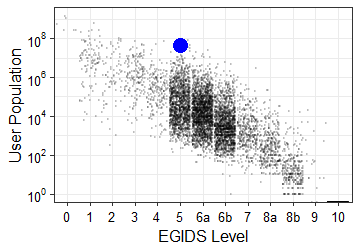
Full explanation
A language of China
- ISO 639
- hak
- Alternate Names
- Hokka, Ke, Kechia, Kejia, Kejiahua, Majiahua, Tu Guangdonghua, Xinminhua
- Autonym
- 客家話 (Hakkafa)
- Population
- 36,800,000 in China (2022), based on ethnicity. Total users in all countries: 44,266,410 (as L1: 44,018,410; as L2: 248,000).
- Location
- Guangdong province: greatest concentrations east and northeast; Fujian, Guangxi, Hainan, Hunan, south Jiangxi, and Sichuan provinces.
- Language Maps
- Cambodia, Southeastern China, Taiwan
- Language Status
- 4 (Educational). Language of recognized nationality: Han.
- Classification
- Sino-Tibetan, Chinese
- Dialects
- Yue-Tai (Meixian, Raoping, Taiwan Kejia), Yuezhong, Huizhou, Yuebei (Northern Guangdong), Tingzhou (Min-Ke), Ning-Long (Longnan), Yugui, Tong-Gui, Hai-Lu, Yuexi (Western Guangdong). Yue-Tai (Meixian) is standard dialect. Lexical similarity: with Gan Chinese [gan]. A member of macrolanguage Chinese [zho].
- Typology
- SVO; tonal.
- Language Use
- Used by all. Also use Mandarin Chinese [cmn]. Used as L2 by She [shx].
- Language Development
- Literacy rate in L2: 91% (2000 census, Han nationality). Highly literate in Chinese and they use that literature. Literature. Newspapers. Periodicals. Radio. TV. Videos. Dictionary. Grammar. Bible: 1916–2012.
- Writing
- Han script, Simplified variant [Hans]. Han script, Traditional variant [Hant]. Latin script [Latn], used since early 19th century.
- Language Resources
- OLAC resources in and about Chinese, Hakka
Also Spoken in
- Language Status
- Unestablished
- Other Comments
- Non-indigenous. View other languages of Australia
Language Name
Chinese, Hakka
User Population
8,990 in Australia (2016 census).
- Location
- Major cities.
- Language Status
- 5 (Dispersed)
- Other Comments
- Non-indigenous. View other languages of Brunei
Language Name
Chinese, Hakka
User Population
2,750 in Brunei (2019).
- Language Status
- Unestablished
- Other Comments
- Non-indigenous. View other languages of Canada
Language Name
Chinese, Hakka
User Population
10,900 in Canada (2016 census).
- Location
- Cayenne, Kourou, Macouria, Matoury, and Remire-Montjoly communes, especially in urban concentrations. Central coast.
- Language Status
- 5 (Dispersed)
- Language Use
- Use is being maintained.
- Other Comments
- Non-indigenous. View other languages of French Guiana
Language Name
Chinese, Hakka
User Population
14,700 in French Guiana (2019), based on ethnicity.
- Location
- New Territories.
- Language Status
- 6b (Threatened)
- Language Use
- Some young people, all adults. Most also use Yue Chinese [yue], especially young people. View other languages of China–Hong Kong
Language Name
Chinese, Hakka
User Population
289,300 in China–Hong Kong, all users. L1 users: 42,300 in China–Hong Kong (2016 census). L2 users: 247,000 (2016 census).
- Location
- Aceh, Bangka Belitung Islands, Banten, Central Java, East Java, West Java, South Kalimantan: Banjarmasin city; West Kalimantan: Singkawang city; Lampung, Maluku (Ambon island), Papua (Jayapura city), Riau Islands (Batam island), North Sulawesi, South Sulawesi, North Sumatra, South Sumatra; Yogyakarta province.
- Language Status
- 8a (Moribund)
- Language Use
- Older adults only. Most remaining speakers are of the grandparent generation. Shifted to Indonesian [ind].
- Other Comments
- Non-indigenous. View other languages of Indonesia
Language Name
Chinese, Hakka
User Population
640,000 in Indonesia (1982).
- Language Status
- Unestablished
- Other Comments
- Non-indigenous. View other languages of Jamaica
Language Name
Chinese, Hakka
User Population
76,000 in Jamaica (2021 Joshua Project), based on ethnicity.
- Location
- Ratanakiri and Stung Treng provinces: border areas, 2 enclaves along Sesan river.
- Language Status
- 6a (Vigorous)
- Other Comments
- Non-indigenous. View other languages of Cambodia
Language Name
Chinese, Hakka
User Population
500 in Cambodia (2011 SIL).
- Language Status
- Unestablished
- Other Comments
- Non-indigenous. View other languages of Mauritius
Language Name
Chinese, Hakka
User Population
4,100 in Mauritius (Leclerc 2018c).
- Location
- Negeri Sembilan, Perak, Sabah, Sarawak, Selangor: scattered, especially in major towns.
- Dialects
- Loong Chun, Her Po.
- Language Status
- 6b (Threatened)
- Language Use
- Stronger in Sabah, weakening in Peninsular Malaysia. Spoken as L2 by anyone attending Chinese school, or employed by Chinese (of any Chinese ethnicity), or with Hakka classmates. Home, Friends. Mixed use: Religion, Work. Some of all ages. Used by all ages in Sabah; not used by many young people in Peninsular Malaysia. Positive attitudes. Most also use English [eng]. Most also use Mandarin Chinese [cmn]. Most also use Sabah Malay [msi]. Most also use Yue Chinese [yue]. Many also use Rungus [drg]. Many also use Standard Malay [zsm]. A few also use Min Nan Chinese [nan]. Used as L2 by Brunei [kxd], Bugis [bug], Kadazan Dusun [dtp], Keningau Murut [kxi], Lotud [dtr], Mandarin Chinese [cmn], Min Dong Chinese [cdo], Min Nan Chinese [nan], Pu-Xian Chinese [cpx], Rungus [drg], Tahol Murut [mvv], Tatana [txx], Timugon Murut [tih], Yue Chinese [yue].
- Language Development
- Literacy rate in L1: 100% in Roman script (Pinyin); many are able to read the language in Chinese script. Literacy rate in L2: 100% in English [eng]; 100% in Sabah Malay [msi]; 75% in Standard Malay [zsm]; 50% in Chinese Mandarin [cmn].
- Other Comments
- Non-indigenous. Christian. View other languages of Malaysia
Language Name
Chinese, Hakka
User Population
1,810,000 in Malaysia (2021 Joshua Project), based on ethnicity.
- Language Status
- Unestablished
- Other Comments
- Non-indigenous. View other languages of New Zealand
Language Name
Chinese, Hakka
User Population
1,220 in New Zealand (2018 census).
- Location
- Panamá province: Salsipuedes, a suburb of Panama City.
- Language Status
- 6a (Vigorous)
- Language Use
- Also use Spanish [spa].
- Other Comments
- Non-indigenous. View other languages of Panama
Language Name
Chinese, Hakka
User Population
29,000 in Panama (2021 Joshua Project), based on ethnicity.
- Location
- Windward Islands.
- Language Status
- 7 (Shifting)
- Language Use
- Home, church. Adults only. Shifting to Tahitian [tah].
- Other Comments
- Non-indigenous. Buddhist, Christian, traditional religion. View other languages of French Polynesia
Language Name
Chinese, Hakka
User Population
1,100 in French Polynesia, all users. L1 users: 100 in French Polynesia (2015 census). L2 users: 1,000 (2015).
- Language Status
- Unestablished
- Other Comments
- Non-indigenous. View other languages of Réunion
Language Name
Chinese, Hakka
User Population
11,400 in Réunion (2017).
- Location
- Scattered.
- Language Status
- 6b (Threatened)
- Other Comments
- Non-indigenous. View other languages of Singapore
Language Name
Chinese, Hakka
User Population
233,000 in Singapore (2010 census).
- Location
- Saramacca district: scattered.
- Language Status
- 8a (Moribund)
- Language Use
- Home, friends. Older adults only. Neutral attitudes. Shifted to Sranan Tongo [srn].
- Other Comments
- Non-indigenous. View other languages of Suriname
Language Name
Chinese, Hakka
User Population
9,000 in Suriname (2018), decreasing. Ethnic population: 12,000 (1971). Includes Yue [yue].
- Location
- Chiang Mai province; Krung Thep province: Samphanthawong district; Nakhon Ratchasima and Udon Thani provinces: urban areas; Nan province: Mueang district and municipal districts.
- Language Status
- 5 (Dispersed)
- Language Use
- Also use Northern Thai [nod] (Luangthongkum 2010). Also use Thai [tha] (Luangthongkum 2010).
- Other Comments
- Non-indigenous. Chinese, Hakka [hak] children in Nan province are literate in Thai [tha] also use Northern Thai [nod]. View other languages of Thailand
Language Name
Chinese, Hakka
User Population
79,000 in Thailand (Leclerc 2019a), based on ethnicity.
- Location
- Hsinchu, Kaohsiung, Miaoli, Pingtung, and Taoyuan counties; New Taipei Municipality.
- Dialects
- Hailu (Hi-Lu, Hoilluk, Hoiluk), Sanhsien (Shi Xien, Shigen, Shixien).
- Language Status
- 4 (Educational)
- Language Use
- Used as L2 by Saisiyat [xsy].
- Language Development
- Taught in some primary schools in early grades only.
- Other Comments
- Non-indigenous. Settled in Taiwan for 200 years. Sanhsien closely resembles Yuetai of Mainland China. Hailu closely resembles Yong-Ting or Yuqui of Mainland China. View other languages of China–Taiwan
Language Name
Chinese, Hakka
User Population
4,240,000 in China–Taiwan (2017 J. Leclerc).
- Language Status
- Unestablished
- Language Use
- Many also use English [eng].
- Other Comments
- Non-indigenous. View other languages of United States
Language Name
Chinese, Hakka
User Population
3,800 in United States (2015 census). United States Census figure for all Chinese varieties: 2,900,000 (2015).
- Location
- Hai Phong, Quang Ninh, and Thai Nguyen provinces.
- Language Status
- 6a (Vigorous)
- Other Comments
- Non-indigenous. View other languages of Vietnam
Language Name
Chinese, Hakka
User Population
1,650 in Vietnam (2019 census), based on ethnicity.