
hds ISO 639
Honduran Sign Language
Visualizations
Language Cloud
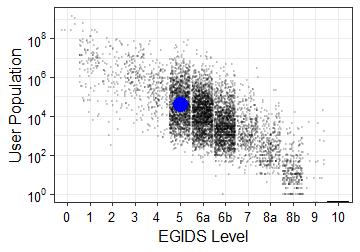
Full explanation
A language of Honduras
- ISO 639
- hds
- Alternate Names
- Honduras Sign Language, LESHO, Lengua de Señas Hondureñas, Lengua de señas Hondureña
- Population
- 40,000 (2021 DBS/DOOR/SIL). Estimated 30,000–60,000 deaf signers, assuming 0.3%–0.6% of the total population. Other estimates: 34,800 (2008 WFD), 18,000–70,000 (Williams 2010:5).
- Location
- Scattered.
- Language Maps
- Sign Languages of the Americas
- Language Status
- 5 (Developing). Recognized language (2013, Decreto no. 321-2013), Recognizes LESHO as a means of communication for deaf and the general population, provides for use in deaf education, training of interpreters and provision of interpreters for official government communications.
- Classification
- Sign language, Deaf community sign language
- Dialects
- Deaf people along the north coast have some distinct signs from deaf people in the southern part of the country. Intelligibility and standardization across dialects is increasing as more deaf have opportunity to socialize with other parts of the country (Williams 2010:14–15). In addition to LESHO, a distinct sign language (not yet recognized in ISO 639-3) has developed independently on two islands off the north coast and is used by deaf, deaf-blind, and hearing community members. Tentatively called Bay Islands Sign Language (BISL), it is well-adapted for tactile use (2019 B. Braithwaite). Lexical variation in different regions; people disagree over who uses ‘pure’ LESHO vs. who has more influence from ASL [ase] (Williams 2010:13–15).
- Typology
- One-handed fingerspelling similar to ASL. Reports of an older, two-handed fingerspelling system similar to Guatemalan Sign Language [gsm] (Williams 2010:16).
- Language Use
- Vigorous. Used by all except elderly deaf; in 2010 research it was rare to find any LESHO user who was born before 1970. Older deaf were reported to sign differently but it was not clear what system they used or if there was any consistency. Some children learn LESHO in primary schools, others don’t learn LESHO until their teens (Williams 2010:6, 14, 16). Some also use American Sign Language [ase] (Williams 2010). Some also use Spanish [spa] (Williams 2010).
- Language Development
- At least 17 deaf schools (Williams 2010:6), at least 12 of which offer primary education with Honduran Sign Language as their communication philosophy. Six are located in Tegucigalpa. In 2010, approximately 30 deaf people had graduated from secondary school. Most deaf schools offer only primary grades (Williams 2010:6–7). Dictionary. Agency: Asociación Nacional de Sordos de Honduras (ANSH).
- Other Comments
- 5–8 certified interpreters (Williams 2010:18).