
hks ISO 639
Hong Kong Sign Language
Visualizations
Language Cloud
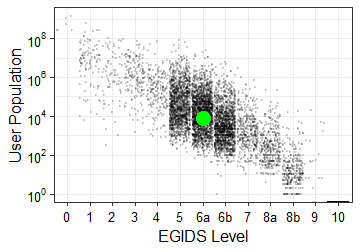
Full explanation
A language of China—Hong Kong
- ISO 639
- hks
- Alternate Names
- HKSL, Heung Kong Sau Yue
- Population
- 8,000 in China–Hong Kong (2021 DBS/DOOR/SIL). Estimated based on 0.1% of total population. Another estimate: 3,900 (2014 Hong Kong Special Administrative Region, HKSAR). Total users in all countries: 8,200.
- Location
- Scattered.
- Language Maps
- Sign Languages of Asia, Southeastern China
- Language Status
- 6a (Vigorous).
- Classification
- Sign language, Deaf community sign language
- Dialects
- None known. 40% similarity with Chinese Sign Language [csl], 42%–52% similarity with Taiwan Sign Language [tss].
- Language Use
- Vigorous. All domains. Used by all. Positive attitudes. Some also use English [eng]. Some also use Mandarin Chinese [cmn].
- Language Development
- Literacy rate in L2: 70%–80% in written Chinese. Dictionary.
- Other Comments
- Most education of deaf children is in mainstream programs. Deaf schools converted to oralist instruction starting in the 1960s, and most have since closed. One experimental sign-bilingual program operated by The Chinese University of Hong Kong, with both deaf and hearing students. 51 registered sign language interpreters (Gan 2019).
Also Spoken in
- Location
- Widespread.
- Dialects
- None known. Closely related to Hong Kong Sign Language according to preliminary lexical comparison (Sze et al 2016).
- Language Status
- 7 (Shifting)
- Language Use
- Adults only. Shifting to Chinese Sign Language [csl].
- Other Comments
- Non-indigenous. Being replaced by sign languages from China and influence from Western sign languages (Sze et al 2016). View other languages of China–Macao
Language Name
Macao Sign Language
User Population
200 in China–Macao (Sze et al 2016), decreasing. At least 200 users (Sze et al 2016). Possibly as many as 600, assuming 0.1% of the total population. Ethnic population: 1,200 (Sze et al 2016). Approximately 1,200 deaf and hard of hearing, using a variety of language systems.