
hun ISO 639
Magyar Autonyms
Hungarian
Visualizations
Language Cloud
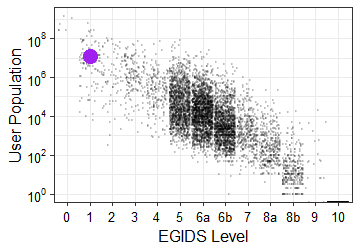
Full explanation
A language of Hungary
- ISO 639
- hun
- Autonym
- Magyar
- Population
- 9,780,000 in Hungary (European Commission 2012). Total users in all countries: 12,564,120.
- Location
- Widespread.
- Language Maps
- Austria, Bosnia and Herzegovina, Croatia and Slovenia, Hungary, Northern Moldova and Northeast Romania, Northwestern Romania, Serbia, Slovakia, Southwestern Romania, Ukraine
- Language Status
- 1 (National). De facto national language.
- Classification
- Uralic
- Dialects
- Western Transdanubian, Central Transdanubian, Southern Transdanubian, Southern Great Plains, Palóc, Tisza–Körös, Northeastern Hungarian. Reportedly most similar to the Uralic language Vogul (Mansi [mns]) in Siberia. Speakers of standard Hungarian have difficulty understanding the Oberwart dialect spoken in Austria, and considerable difficulty understanding the Moldavian Csángó dialect spoken in Rumania.
- Typology
- SVO; postpositions; noun head final; definite article; case-marking (18 cases); verb affixes mark person, number, object; no passives; tense; comparatives; 25 consonants, 14 vowels, no diphthongs; non-tonal; stress on first syllable; vowel harmony.
- Language Use
- Some also use English [eng] (European Commission 2006).
- Language Development
- Taught in all primary and secondary schools. Taught in tertiary schools. Fully developed. Bible: 1590–1991.
- Writing
- Braille script [Brai]. Latin script [Latn], primary usage.
- Language Resources
- OLAC resources in and about Hungarian
Also Spoken in
- Location
- Burgenland, Lower Austria, Styria, and Vienna states.
- Dialects
- Oberwart.
- Language Status
- 4 (Educational)
- Language Development
- Taught as subject in primary schools where there are larger numbers of speakers, mostly in Burgenland. View other languages of Austria
Language Name
Hungarian
User Population
40,600 in Austria (2003 UNSD). Ethnic population: 60,000 (Laakso et al 2013).
- Language Status
- Unestablished
- Other Comments
- Non-indigenous. View other languages of Australia
Language Name
Hungarian
User Population
19,900 in Australia (2016 census).
- Language Status
- Unestablished
- Other Comments
- Non-indigenous. View other languages of Brazil
Language Name
Hungarian
User Population
22,000 in Brazil (2021 Joshua Project), based on ethnicity.
- Language Status
- Unestablished
- Other Comments
- Non-indigenous. View other languages of Canada
Language Name
Hungarian
User Population
61,200 in Canada (2016 census).
- Language Status
- Unestablished
- Other Comments
- Non-indigenous. View other languages of Switzerland
Language Name
Hungarian
User Population
14,600 in Switzerland (2012 UNSD).
- Language Status
- Unestablished
- Other Comments
- Non-indigenous. View other languages of Czechia
Language Name
Hungarian
User Population
11,500 in Czechia (2011 census).
- Language Status
- Unestablished
- Other Comments
- Non-indigenous. View other languages of Germany
Language Name
Hungarian
User Population
213,000 in Germany (2021 census), based on nationality.
- Language Status
- Unestablished
- Other Comments
- Non-indigenous. View other languages of Denmark
Language Name
Hungarian
User Population
5,370 in Denmark (2020 census), based on nationality.
- Language Status
- Unestablished
- Other Comments
- Non-indigenous. View other languages of Spain
Language Name
Hungarian
User Population
10,600 in Spain (2020 census), based on nationality.
- Language Status
- Unestablished
- Other Comments
- Non-indigenous. View other languages of Finland
Language Name
Hungarian
User Population
3,240 in Finland (2021 census).
- Language Status
- Unestablished
- Other Comments
- Non-indigenous. View other languages of United Kingdom
Language Name
Hungarian
User Population
45,400 in United Kingdom (2011 census). England and Wales 44,400, Northern Ireland 1,040.
- Location
- Bjelovar-Bilogora, Osijek-Baranja, Vukovar-Syrmia, and Zagreb city.
- Language Status
- 4 (Educational)
- Language Development
- Taught in some primary schools, as part of the minority education program.
- Other Comments
- Non-indigenous. View other languages of Croatia
Language Name
Hungarian
User Population
10,200 in Croatia (2011 census). Ethnic population: 14,000 (2011 census).
- Location
- HaMerkaz, Hefa, and Tel Aviv districts.
- Language Status
- 5 (Dispersed)
- Language Use
- Older adults prefer Hungarian. Also use Hebrew [heb].
- Other Comments
- Non-indigenous. Jewish. View other languages of Israel
Language Name
Hungarian
User Population
23,000 in Israel (Leclerc 2018a).
- Language Status
- Unestablished
- Other Comments
- Non-indigenous. View other languages of Luxembourg
Language Name
Hungarian
User Population
1,120 in Luxembourg (2021).
- Language Status
- Unestablished
- Other Comments
- Non-indigenous. View other languages of Netherlands
Language Name
Hungarian
User Population
12,500 in Netherlands (2019).
- Language Status
- Unestablished
- Other Comments
- Non-indigenous. View other languages of Norway
Language Name
Hungarian
User Population
4,800 in Norway (2021 census), based on nationality.
- Language Status
- Unestablished
- Other Comments
- Non-indigenous. View other languages of New Zealand
Language Name
Hungarian
User Population
1,950 in New Zealand (2018 census).
- Location
- Alba, Arad, Bacau, Bihor, Bistrita-Nasaud, Brasov, Cluj, Covasna, Harghita, Maramures, Mures, Salaj, Satu Mare, Sibiu, and Timis counties.
- Dialects
- Mezoségi, Székely, Csángó.
- Language Status
- 2 (Provincial)
- Language Use
- Also use Romanian [ron].
- Language Development
- Taught in a few primary and secondary schools, in minority language schools in Hungarian-speaking areas. View other languages of Romania
Language Name
Hungarian
User Population
1,260,000 in Romania (2011 census). Ethnic population: 1,230,000 (2011 census).
- Location
- Central Banat, North Backa, North Banat, South Backa, and West Backa districts; Vojvodina area.
- Language Status
- 2 (Provincial)
- Language Development
- Taught in primary schools, in minority-language schools. View other languages of Serbia
Language Name
Hungarian
User Population
243,000 in Serbia (2013 UNSD).
- Language Status
- Unestablished
- Other Comments
- Non-indigenous. View other languages of Russian Federation
Language Name
Hungarian
User Population
6,890 in Russian Federation (2010 census).
- Language Status
- Unestablished
- Other Comments
- Non-indigenous. View other languages of Sweden
Language Name
Hungarian
User Population
7,150 in Sweden (2020 census), based on nationality.
- Location
- Hungary border area.
- Language Status
- 2 (Provincial)
- Language Development
- Taught in primary and secondary schools in Hungarian-speaking areas.
- Other Comments
- Non-indigenous. Acknowledged as autochthonous (indigenous) communities and protected by the constitution. View other languages of Slovenia
Language Name
Hungarian
User Population
8,700 in Slovenia (Laakso et al 2013).
- Location
- Banskobystricky, Bratislavsky, Kosicky, Nitriansky, and Trnavsky regions; mainly near southern border.
- Language Status
- 2 (Provincial)
- Language Use
- Used as L2 by Standard German [deu].
- Language Development
- Taught in primary schools in early grades and as subject thereafter in minority schools, usually 1 class each day. View other languages of Slovakia
Language Name
Hungarian
User Population
509,000 in Slovakia (2013 UNSD).
- Location
- Zakarpattia region.
- Language Status
- 5 (Dispersed)
- Language Use
- 95% speak it as L1.
- Other Comments
- Christian. View other languages of Ukraine
Language Name
Hungarian
User Population
162,000 in Ukraine (2003 UNSD). Ethnic population: 157,000 (2001 census).
- Location
- Scattered.
- Language Status
- Unestablished
- Language Use
- Most also use English [eng].
- Other Comments
- Non-indigenous. View other languages of United States
Language Name
Hungarian
User Population
86,400 in United States (2015 census).