
ins ISO 639
Indian Sign Language
Visualizations
Language Cloud
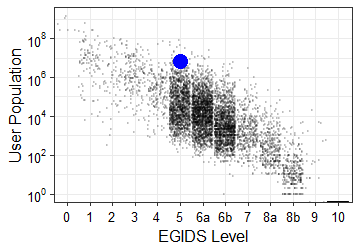
Full explanation
A language of India
- ISO 639
- ins
- Alternate Names
- IPSL, ISL, Indo-Pakistani Sign Language, Urban Indian Sign Language
- Population
- 6,000,000 in India (2021 SIL). Estimated 4–8 million deaf signers, based on 0.3%–0.6% of the general population. Other estimates vary: 1.5 million (2008 S. Panda); 5.9 million profoundly deaf in India (2014 IMB); 8 million deaf signers (2017 Indian Sign Language Research and Training Centre). Total users in all countries: 6,815,000.
- Location
- Scattered.
- Language Maps
- Sign Languages of Asia
- Language Status
- 5 (Developing).
- Classification
- Sign language, Deaf community sign language
- Dialects
- Mumbai-Delhi, Kerala, Hyderabad (Andhra Pradesh), Bangalore (Karnataka), Chennai (Tamil Nadu). Most sign language varieties in south Asia appear to be related, but there is considerable variation, which has only been partially assessed. Some scholars regard most varieties in India, Pakistan, Bangladesh and possibly Nepal as dialects of one language called Indo-Pakistani Sign Language (IPSL), while others feel at least some varieties should be recognized as separate languages. The ISO standard currently (as of 2020) distinguishes ISL from Pakistan Sign Language [pks], West Bengal Sign Language (Kolkata Sign Language) [wbs], and Nepalese Sign Language [nsp]. The variety that originated in Delhi is the most widely-recognized and promoted; Mumbai is very similar. Varieties in the southern Indian states of Andhra Pradesh, Karnataka, Kerala, and Tamil Nadu are quite divergent from the Delhi variety and may need to be recognized as a distinct language (2020 D. Eberle). Some villages, such as Alipur, Karnataka have an indigenous sign language unrelated to ISL (Panda 2012). Some influence from British Sign Language [bfi] in the fingerspelling system and a few other signs developed indigenously in India.
- Language Use
- Vigorous. Used by all. Many also use American Sign Language [ase], especially in Bangalore (Panda 2012).
- Language Development
- Literacy rate in L2: Below 2%. Male literacy rate in L2 is higher than female as boys are more likely to attend school. TV. Videos. Dictionary. Grammar. Agency: Indian Sign Language Research and Training Centre at Indira Gandhi National Open University.
- Other Comments
- Only about 550–700 schools use ISL (2008 S. Panda, 2017 BBC). 2% or less of deaf children attend deaf schools, with a high drop-out rate. Vocational programs use ISL more often. Nearly all educated deaf are bilingual in a written language of wider communication to some degree, and ISL serves as a signed language of wider communication among deaf in India, especially in cities. The government and educational institutions promote the Delhi variety for use in the entire country. Starting 2001, interpreter training in Mumbai by the Ali Yavar Jung National Institute for Hearing Handicapped.
Also Spoken in
- Location
- Scattered.
- Dialects
- None known. Related to other sign languages in south Asia, esp. West Bengal Sign Language [wbs], which it resembles more closely than the Delhi variety of Indian Sign Language (Johnson and Johnson 2016); see further comments on Indian Sign Language [ins] in India.
- Language Status
- 6a (Vigorous)
- Other Comments
- Non-indigenous. View other languages of Bangladesh
Language Name
Bangla Sign Language
User Population
815,000 in Bangladesh (2021 DBS/DOOR/SIL). Estimated 500,000–1,000,000, assuming 0.3%–0.6% of the total population. Another estimate: 2,600,000 (2014 Disabled Peoples’ International Pacific-Asia Region).