
isg ISO 639
Irish Sign Language
Visualizations
Language Cloud
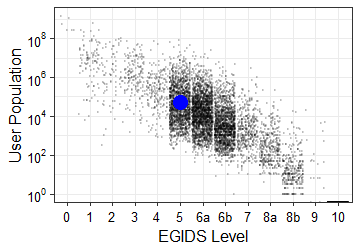
Full explanation
A language of Ireland
- ISO 639
- isg
- Alternate Names
- Teanga Chomharthaíochta na hÉireann
- Population
- 50,000 in Ireland, all users. L1 users: 5,000 in Ireland (2019 Deaf Village Ireland). Approximately 0.1% of the total population. Other estimates: 4,500 (2019 EUD), 21,000 (2014 IMB). L2 users: 45,000 (2014 Deaf Village Ireland). Total users in all countries: 51,550 (as L1: 6,550; as L2: 45,000).
- Location
- Scattered.
- Language Maps
- Sign Languages of Europe
- Language Status
- 5 (Developing). Recognized language (2017, Irish Sign Language Act 2017), authorized for use and interpretation in courts, schools, and other public bodies.
- Classification
- Sign language, Deaf community sign language
- Dialects
- Separate schools for boys and girls resulted in strong gender-based dialectal differences, but these have diminished with time. British Sign Language (BSL) [bfi] was formally introduced to Ireland in 1816, but references to signing go back much further in Irish history. In 1846, the Catholic nuns who established St. Mary’s School for Deaf Girls went to France, so contemporary Irish Sign Language includes aspects of nineteenth-century French Sign Language [fsl] as well as BSL, with influence from signed French, signed English, and gestural systems like cued speech. (Leeson and Sneed 2012).
- Typology
- One-handed fingerspelling.
- Language Use
- Several deaf schools. Government policy recommends bilingual education (National Council for Special Education 2011). Deaf associations. Committee on national sign language, and organization for sign language teachers. All domains. Used by all. Some also use English [eng].
- Language Development
- Literature. TV. Videos. Dictionary. Grammar. Agency: Irish Deaf Society (IDS).
- Other Comments
- Support for parents to learn Irish Sign Language (2014 National Council for Special Education). The name ‘Irish Sign Language’ (ISL) came into common use following the publication of a dictionary of ISL in 1979 and establishment of the Irish Deaf Society in the mid 1980s. (Leeson and Sneed 2012). 50 working sign language interpreters (2019 EUD). Fingerspelling system similar to French Sign Language [fsl]. Christian.
Also Spoken in
- Location
- Scattered.
- Language Status
- 8a (Moribund)
- Language Use
- Older adults only. Shifted to Auslan [asf].
- Other Comments
- Non-indigenous. Introduced in 1875, used in at least three deaf schools until the 1950s, with separate schools (and dialects) for boys and girls. After leaving schooling in AISL, deaf people learned Auslan [asf]. Those who still use AISL tend to mix it with Auslan [asf] and may have difficulty remembering AISL signs (2016 R. Adam). View other languages of Australia
Language Name
Australian Irish Sign Language
User Population
50 in Australia (2016 R. Adam), decreasing. Estimated 50–100 users left, no monolinguals.
- Location
- Scattered in Northern Ireland, particularly Londonderry and other areas with stronger Catholic ties.
- Dialects
- None known. Some differences with Irish Sign Language as used in Dublin (Parks and Parks 2012).
- Language Status
- 6a (Vigorous)
- Language Use
- Most also use British Sign Language [bfi] (Parks and Parks 2012).
- Other Comments
- Non-indigenous. Catholic Deaf in Northern Ireland historically tended to go to Dublin for schooling, acquiring Irish Sign Language there (Parks and Parks 2012). However, because most services in Northern Ireland are available in British Sign Language [bfi], most native ISL users are also proficient in BSL. 50 working sign language interpreters (2019 EUD). View other languages of United Kingdom
Language Name
Irish Sign Language
User Population
1,500 in United Kingdom (Parks and Parks 2012).