
jad ISO 639
Jahanka
Visualizations
Language Cloud
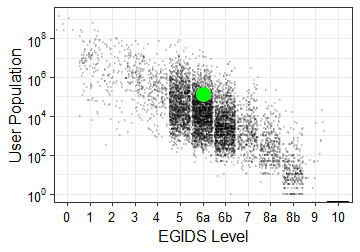
Full explanation
A language of Guinea
- ISO 639
- jad
- Alternate Names
- Diakanka, Diakhanke, Diakkanke, Dyakanke, Jahanque, Jahonque, Jaxanka
- Population
- 137,000 in Guinea (2017 census). Total users in all countries: 147,500.
- Location
- Boké region: central Gaoual prefecture, more than 60 villages on Tamine river upper reaches between Boké and Sangea towns.
- Language Maps
- Central Mali: Enlarged area, Guinea, Guinea and Guinea-Bissau, Western Mali
- Language Status
- 6a* (Vigorous).
- Classification
- Niger-Congo, Mande, Western, Central-Southwestern, Central, Manding-Jogo, Manding-Vai, Manding-Mokole, Manding
- Dialects
- Jahanka in Gambia may be same language, or a dialect of Western Maninkakan [mlq]. Jahanka in Senegal and Guinea-Bissau is a dialect of Western Maninkakan [mlq]. Lexical similarity: 75% with Mandinka [mnk].
- Language Development
- Radio.
- Writing
- Arabic script, Naskh variant [Arab].
- Other Comments
- Reportedly came from Mali in 18th century and trace their origins to Soninke [snk], but now speak a separate language. Muslim.
- Language Resources
- OLAC resources in and about Jahanka
Also Spoken in
- Location
- Gabu: centered in neighborhoods in and around the town of Gabu, and other nearby towns. Urban dwellers.
- Language Status
- 6a (Vigorous)
- Language Use
- Home, friends, work, religion. Used by all. Positive attitudes. All also use Mandinka [mnk]. All also use Pulaar [fuc]. Most also use Susu [sus]. Many also use Wolof [wol]. Used as L2 by Soninke [snk].
- Other Comments
- Non-indigenous. Muslim. View other languages of Guinea-Bissau
Language Name
Djakanka
User Population
10,000 in Guinea-Bissau (2022 SIL), all users. Ethnic population: 10,000 (2022 Joshua Project).
- Location
- Kayes region: Kéniéba circle, Kofoulabé, a few other villages.
- Language Status
- 6b (Threatened)
- Language Use
- Also use Western Maninkakan [mlq], with some shfting.
- Other Comments
- Non-indigenous. Reportedly originated in Mali. Origins traced to Soninke [snk], but now speak a separate language. Muslim. View other languages of Mali
Language Name
Jahanka
User Population
500 in Mali (2001), decreasing.