
mey ISO 639
Hassaniyya, حسانية (Ḥassānīya) Autonyms
Hassaniyya
Visualizations
Language Cloud
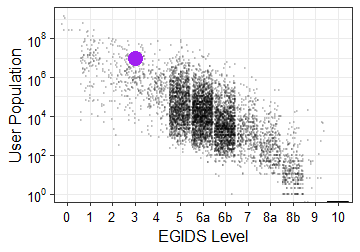
Full explanation
A language of Mauritania
- ISO 639
- mey
- Alternate Names
- Hasanya, Hasanya Arabic, Hassani, Hassania, Hassaniya, Hassaniyya Arabic, Klem El Bithan, Maure, Moor
- Autonym
- Hassaniyya, حسانية (Ḥassānīya)
- Population
- 3,560,000 in Mauritania (2017), increasing. Total users in all countries: 4,885,400.
- Location
- Widespread.
- Language Maps
- Algeria, Morocco, Tunisia and Western Sahara, Central Mali, Central Mali: Enlarged area, Mali: Index map, Mauritania, Niger, Western Mali
- Language Status
- 3 (Wider communication). Statutory language of national identity (1991, Constitution, Article 6). Hassaniya comes from the name of the Beni Hassan tribes who invaded North Africa and settled in modern Mauritania in the 15th to 17th centuries. Used in trade and religion. Spoken throughout northwestern Africa.
- Classification
- Afro-Asiatic, Semitic, Central, South, Arabic
- Dialects
- None known. Not intelligible with other Arabic varieties. The Nemadi (Ikoku) are an ethnic group of 200 (1967) that speak Hassaniyya, but they have special morphemes for dogs, hunting, and houses. Nomadic between Mali and Mauritania.
- Language Use
- Vigorous. All domains. Used by all. Positive attitudes. All also use French [fra], as the language of education, media and government. Many also use Standard Arabic [arb], as the language of government, media, and religion (Ould Ahmed 2012). Used as L2 by Bambara [bam], Pulaar [fuc], Soninke [snk], Tamashek [tmh], Wolof [wol], Zenaga [zen].
- Language Development
- Literacy rate in L2: 40% in Arabic [arb], 25% in French [fra]. Literacy in Hassaniyya not encouraged by the government. Literature. Radio. Dictionary.
- Writing
- Arabic script, Naskh variant [Arab]. Latin script [Latn], in development.
- Other Comments
- White Maure are called Bithan, also used for Maures in general. Black Maures are called Haratine. Muslim.
- Language Resources
- OLAC resources in and about Hassaniyya
Also Spoken in
- Location
- Widespread.
- Language Status
- 5 (Dispersed)
- Language Use
- Used by all. Used as L2 by Koyra Chiini Songhay [khq], Soninke [snk].
- Other Comments
- Muslim. View other languages of Mali
Language Name
Arabic, Hasanya
User Population
123,000 in Mali (2014 UNSD).
- Location
- Tindouf province.
- Language Status
- 5 (Dispersed)
- Other Comments
- Mainly refugees from Western Sahara. View other languages of Algeria
Language Name
Arabic, Hassaniyya
User Population
220,000 in Algeria (2021 Joshua Project).
- Location
- Widespread.
- Language Status
- 5 (Dispersed) View other languages of Western Sahara
Language Name
Arabic, Hassaniyya
User Population
424,000 in Western Sahara (Leclerc 2018d).
- Language Status
- Unestablished
- Other Comments
- Non-indigenous. View other languages of Libya
Language Name
Arabic, Hassaniyya
User Population
54,000 in Libya (2020).
- Location
- Souss-Massa-Drâa region: Mhamid, western Algeria border; Western Sahara, south from Laâyoune, Laâyoune-Boujdour-Sakia El Hamra.
- Language Status
- 5 (Dispersed)
- Other Comments
- Non-indigenous. View other languages of Morocco
Language Name
Arabic, Hassaniyya
User Population
282,000 in Morocco (2016).
- Location
- Tahoua region: Tchin-tabaraden department.
- Language Status
- 6a (Vigorous)
- Other Comments
- Non-indigenous. Muslim. View other languages of Niger
Language Name
Arabic, Hassaniyya
User Population
26,400 in Niger (2021).
- Location
- Matam and Saint-Louis regions.
- Language Status
- 5 (Dispersed)
- Language Use
- Used by all. Most also use Wolof [wol], as the language of commerce and interethnic communication. Many also use French [fra], as the language of education and government. Used as L2 by Zenaga [zen].
- Other Comments
- Non-indigenous. View other languages of Senegal
Language Name
Hassaniyya
User Population
196,000 in Senegal (2017).