
mnk ISO 639
Mandi’nka kango Autonyms
Mandinka
Visualizations
Language Cloud
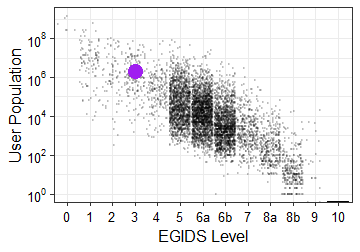
Full explanation
A language of Senegal
- ISO 639
- mnk
- Alternate Names
- Mande, Manding, Mandingo, Mandingue, Mandinque, Socé
- Autonym
- Mandi’nka kango
- Population
- 888,000 in Senegal (2017). Total users in all countries: 1,993,000.
- Location
- Kolda region: Oussadou area on southeast border with Guinea; Sédhiou region: Casamance river north to The Gambia; Ziguinchor region: south of Casamance river.
- Language Maps
- Guinea and Guinea-Bissau, Guinea-Bissau, Senegal and The Gambia
- Language Status
- 5 (Developing). Recognized language (2005, Decree No. 982 of 21 October).
- Classification
- Niger-Congo, Mande, Western, Central-Southwestern, Central, Manding-Jogo, Manding-Vai, Manding-Mokole, Manding, Manding-West
- Dialects
- None known. Mandinka, Eastern Maninkakan [emk], and Western Maninkakan [mlq] are separate languages. Lexical similarity: 79% with Kalanke, 75% with Jahanka [jad], 70% with Xaasongaxango [kao], 59% with Western Maninkakan [mlq], 53% with Eastern Maninkakan [emk], 48% with Bambara [bam]. A member of macrolanguage Mandingo [man].
- Language Use
- Used by all. Many also use Wolof [wol], as the language of commerce and interethnic communication (Sarr and Thiaw 2012). Some also use French [fra], as the language of education and government (Diouf et al 2017). Also use Guinea-Bissau Creole [pov]. Used as L2 by Badyara [pbp], Bainouk-Gunyaamolo [bcz], Balanta-Ganja [bjt], Gusilay [gsl], Jola-Fonyi [dyo], Karon [krx], Mlomp [mlo].
- Language Development
- Literature. Periodicals. Radio. Grammar. Bible: 2013.
- Writing
- Arabic script, Naskh variant [Arab]. Latin script [Latn].
- Other Comments
- Muslim.
- Language Resources
- OLAC resources in and about Mandinka
Also Spoken in
- Location
- Widespread.
- Language Status
- 3 (Wider communication)
- Language Use
- Main language of middle Gambia. Home, religion, and local business. Positive attitudes. Many also use English [eng], as the language of education and government (Biel 2014). Also use Gambian Wolof [wof], as the language of commerce and media (Biel 2014). Used as L2 by Bambara [bam], Bandial [bqj], Bassari [bsc], Guinea-Bissau Creole [pov], Jola-Fonyi [dyo], Karon [krx], Mandjak [mfv], Pulaar [fuc], Serahule [snk], Serer-Sine [srr], Western Maninkakan [mlq].
- Language Development
- Literacy rate in L1: 10%. About 50% in Mandinka in Arabic script. People read newspapers but not books.
- Other Comments
- Muslim. View other languages of Gambia
Language Name
Mandinka
User Population
879,000 in Gambia (2014).
- Location
- Bafata region: Contuboel, north Gamamundo, and Sonaca sectors; Cacheu region: Bigene, Cacheu, and São Domingos sectors; Gabu region: Pirada and Sonaco sectors; Oio region: Farim and north Mansaba sectors.
- Dialects
- Mandinga-moro, Bambaram.
- Language Status
- 6b (Threatened)
- Language Use
- Home, friends, religion, work. Some young people, all adults. Growing shift towards Guinea-Bissau Creole [pov], particularly among children of mixed marriages, and those from families who moved to the capital of Bissau for education and economic opportunity (2022 I. Gruitibna). Positive attitudes. Most also use Guinea-Bissau Creole [pov], as the language of interethnic unity, communication, and commerce. Some also use Portuguese [por], as the language of education and communication with foreigners. Some also use Pulaar [fuc]. Some also use Susu [sus]. Also use Mandinka [mnk]. Used as L2 by Bainouk-Gunyuño [bab], Biafada [bif], Djakanka [jad], Kanjad [pbp], Kasanga [ccj], Mandinka [mnk], Mandjak [mfv], Mansoanka [msw], Soninke [snk].
- Language Development
- Literacy rate in L2: 60%.
- Other Comments
- Muslim. View other languages of Guinea-Bissau
Language Name
Mandinka
User Population
226,000 in Guinea-Bissau (2022 SIL). Ethnic population: 279,000 (2022 SIL).