
moe ISO 639
Innu, Innu Aimun Autonyms
Innu
Visualizations
Language Cloud
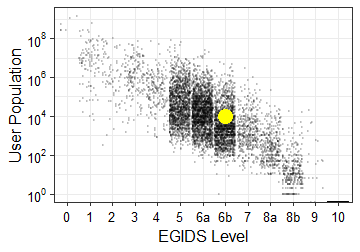
Full explanation
A language of Canada
- ISO 639
- moe
- Alternate Names
- Innu Aionun, Montagnais, Montagnais Innu
- Autonym
- Innu, Innu Aimun
- Population
- 10,200 (2016 census).
- Location
- Newfoundland and Labrador, and Quebec provinces; Lake Saint John east along Saguenay Valley to north shore Saint Lawrence River, Gulf of Saint Lawrence east to St. Augustin, north to height of land at Schefferville and inland Labrador, Goose Bay and Lake Melville, 11 communities.
- Language Maps
- Canada
- Language Status
- 6b (Threatened). Language of recognized indigenous peoples: Bande des Innus de Pessamit, Innu Takuaikan Uashat Mak Mani-Utenam, Innue Essipit, Innu Matimekush-Lac John, Les Innus de Ekuanitshit, Montagnais de Pakua Shipi, Montagnais de Unamen Shipu, Montagnais du Lac St-Jean, Mushuau Innu, Innus de Nutashkuan, Sheshatshiu Innu.
- Classification
- Algic, Algonquian, Cree-Montagnais
- Dialects
- Western Montagnais, Eastern Montagnais. Palatalized l-dialect and palatalized n-dialect within Cree-Montagnais-Naskapi language complex or dialect subgroup. There are possibly 3 dialects based on the replacement of Proto-Algonquian *l within Western Montagnais with ‘n’. 2 Western Montagnais communities (Mashteuiatsh, Betsiamites) use ‘l’, as the reflex of Proto-Algonquian *l, and the other Western Montagnais (Uashat-Maliotenam, Matimekosh) use ‘n’. Uashat-Maliotenam and Matimekosh could be classified as Central Montagnais. All Eastern Montagnais speakers use ‘n’.
- Typology
- Polysynthetic language; fairly free word order.
- Language Use
- Vigorous except in 2 communities near cities where there is rapid language loss. Strong use in lower north shore communities and Schefferville (Golla 2007). Some of all ages. Most also use French [fra], especially in the Mashteuiatsh communities in Quebec, nearly all fluently. Some also use English [eng]. Used as L2 by Naskapi [nsk].
- Language Development
- Literacy rate in L1: 5%. Literacy rate in L2: 50%–75% in French [fra] or English [eng]. Taught in all schools (Golla 2007). Recent language of instruction in Betsiamites, and taught as a subject in other classes. Taught as L2 in 2 communities. Taught as subject in primary schools. Dictionary. Grammar. NT: 1990–2004.
- Writing
- Latin script [Latn].
- Other Comments
- Culture mainly based on family hunting grounds visited seasonally.
- Language Resources
- OLAC resources in and about Innu